Navy SEALs Handed the “Homeless Old Man” a Sniper Rifle as a Joke—Then He Hit 2,000 Yards Cold
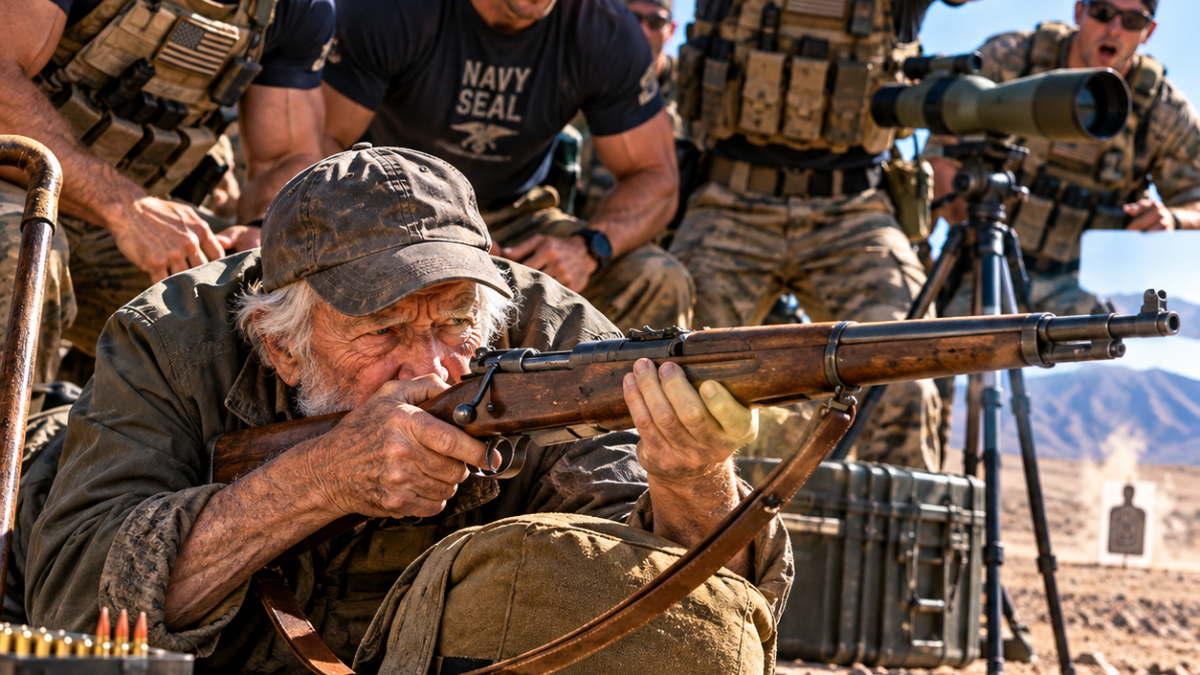
Navy SEALs Handed the “Homeless Old Man” a Sniper Rifle as a Joke—Then He Hit 2,000 Yards Cold.
The Navy SEALs thought the seventy-nine-year-old man with the frayed cap, oversized windbreaker, battered cane, and worn-out boots had wandered onto the wrong firing range, so one of them handed him a long-range rifle and jokingly told him to try the 2,000-yard steel.
Raymond Coyle lowered himself behind the weapon without saying a word, looked at the flag and the shimmering desert exactly once, and sent his first cold round into a target none of the young operators had managed to hit that morning.
Then their command master chief walked onto the range, called the “homeless old man” Gunny, introduced him as their instructor—and revealed that the SEAL who had mocked him was the grandson of the dying Marine Raymond had carried six miles through Vietnam and never managed to bring home alive.
Tyler Brennan started laughing before the old man even reached the benches.
He would spend the rest of his life wishing he hadn’t.
It was just after six in the morning at a long-range training complex buried deep in high desert country, the kind of place where dawn arrived cold enough to make men zip their jackets and afternoon heat turned the ground into a sheet of silver distortion.
Nine Navy SEALs were already on the firing line.
They were waiting for an instructor.
Not just any instructor.
According to the training schedule, the next five days were supposed to be devoted to advanced observation, field judgment, and long-range precision under difficult environmental conditions.
Nobody had given them the instructor’s name.
Only:
SPECIAL GUEST INSTRUCTOR.
Command Master Chief Luis Vargas had refused every question about it.
That alone had created rumors.
Former DEVGRU sniper.
British SAS exchange instructor.
A legendary competitive shooter.
Maybe a classified contractor who had spent the last twenty years teaching people whose names never appeared in newspapers.
Tyler Brennan hoped for the last one.
Tyler was twenty-eight years old, six-foot-two, two hundred pounds, and built like the military had ordered him from a catalog marked high performance.
Broad shoulders.
Fast hands.
Exceptional eyesight.
More confidence than most men could safely carry.
His teammates called him Brick.
Partly because of his build.
Partly because once Tyler decided something, changing his mind was like trying to negotiate with masonry.
He was not stupid.
That mattered.
Arrogance in stupid men is easy to recognize.
Tyler was smart.
Talented.
Disciplined.
He had passed selection when better athletes hadn’t.
He had learned quickly.
Shot well.
Moved well.
Kept his head when other men lost theirs.
He had already survived situations that made civilian confidence look decorative.
And because of all that, he had developed a dangerous habit.
He trusted his first judgment.
Most of the time, that instinct had been rewarded.
On that morning, his first judgment about Raymond Coyle was wrong before the old man had taken ten steps.
Raymond parked his faded tan Buick near the far end of the gravel lot.
Not in the marked instructor spaces.
Not near the team vans.
Far away.
He turned the engine off but stayed sitting for almost a minute.
Both hands rested on the steering wheel.
His right knee hurt.
That wasn’t unusual.
PART2:
Weather had moved in overnight, and the old injury always seemed to know pressure changes before meteorologists did.
Raymond looked toward the firing line through the windshield.
Young men moving around benches.
Rifles in cases.
Spotting scopes.
Range flags snapping hard in the morning wind.
He saw one flag twist, relax, then pull hard again.
Quartering.
Unsteady near the ground.
Stronger above it.
Raymond smiled faintly.
“Same liar,” he whispered.
Wind had been lying to riflemen since long before anybody invented an instrument to measure it.
His passenger seat held a green notebook.
Old.
Corners rounded.
Cover stained.
Rubber band around the middle because the spine had separated years ago.
Raymond picked it up.
Held it for a moment.
Then put it into the inside pocket of his windbreaker.
Beside it was another object.
Smaller.
Metal.
Worn smooth around the edges by fifty-six years of being touched.
He checked that too.
Still there.
It had been there every morning since 1969.
Raymond opened his door.
Placed the cane onto the gravel.
Then slowly stood.
Age had not taken his dignity.
It had only made every transition more expensive.
Standing.
Sitting.
Kneeling.
Cold mornings.
Long drives.
He waited for his right leg to settle.
Then began walking.
The cane made a small crunch every second step.
The operators noticed him almost immediately.
Tyler was sitting on an ammunition case drinking coffee.
He elbowed Petty Officer Lucas Grant beside him.
“Visitor parking moved?”
Grant followed his gaze.
Old man.
Dusty boots.
Windbreaker hanging too loose on narrow shoulders.
Ball cap with no command insignia.
Cane.
Grant shrugged.
“Maybe somebody’s grandfather.”
Tyler grinned.
“Somebody lose one?”
Grant gave him a look.
“Don’t start.”
“I’m not starting anything.”
“You have the exact face you make before starting something.”
Across the range, Raymond stopped.
Not because of them.
He looked up at the flag.
Then toward the distant target line.
Then continued walking.
Tyler watched.
Something about the way the old man looked at the flag seemed deliberate.
He ignored the thought.
Raymond reached the range perimeter.
Nobody greeted him.
That was expected.
Vargas had specifically asked him not to arrive with ceremony.
Raymond had agreed.
He hated ceremony.
Ceremony made young men stand differently.
He wanted to see them before they knew who he was.
Not as a test.
At least that was what he told himself.
The truth was more complicated.
Raymond had seen the roster three weeks earlier.
BRENNAN, TYLER J.
He had read that name four times.
Then closed the email.
Opened it again.
Read it once more.
Brennan.
Age twenty-eight.
Family listed from Ohio.
Raymond had made one phone call to Vargas.
“Luis.”
“Gunny.”
“Your Brennan boy.”
“What about him?”
“You know his family?”
Pause.
“Why?”
“Just answer.”
“Grandfather was Marine. Killed Vietnam.”
Raymond had closed his eyes.
“Samuel?”
Vargas went quiet.
“How did you know?”
Raymond sat at his kitchen table for a long time before answering.
“I knew Sam.”
He had not said more.
Vargas did not press.
Men like Vargas understood silence could be information.
Now Raymond stood fifty feet from Sam Brennan’s grandson.
And Tyler was laughing at him.
Strange.
Life could spend half a century arranging a joke nobody should enjoy.
Tyler walked over.
“Sir?”
Raymond looked at him.
There was Sam.
Not exact.
But enough.
Shape of the jaw.
Dark eyebrows.
One crooked front tooth visible when he smiled.
Sam had broken his in a bar fight before joining the Corps and refused to fix it because he said women trusted imperfection.
Raymond suddenly had trouble breathing.
Tyler interpreted the silence differently.
“Live range, sir.”
Raymond nodded.
“I know.”
“You looking for somebody?”
“No.”
“Tour group meets at the office.”
“Good to know.”
Tyler waited.
Raymond looked toward the benches.
Then walked past him.
Tyler turned.
“Sir?”
Raymond stopped.
“Yes?”
“You can’t just wander around the firing line.”
Raymond’s eyes settled on Tyler’s name tape.
BRENNAN.
He had prepared himself for it.
Preparation failed.
“You Tyler?”
That changed Tyler’s expression.
“How do you know?”
“Roster.”
“What roster?”
Raymond almost answered.
Instead:
“I’m where I’m supposed to be.”
Tyler smiled.
“Okay.”
Then, louder:
“Just making sure the senior center didn’t drop you off at the wrong gate.”
Two men laughed.
Grant didn’t.
Raymond looked at Tyler.
Not angry.
That somehow made Tyler feel more foolish than anger would have.
“Senior center serves better coffee,” Raymond said.
Grant laughed immediately.
Tyler grinned.
“All right. He’s got jokes.”
Raymond found a folding chair near the equipment table and sat.
He leaned the cane beside him.
Then watched.
That was all.
For nearly forty-five minutes, the operators worked through warm-up strings.
Raymond said nothing.
He watched rifles.
But mostly men.
He watched who checked his partner’s equipment without being asked.
Who blamed wind.
Who blamed ammunition.
Who listened.
Who talked.
Who looked downrange before every shot and who looked at his own gear instead.
He watched Tyler most.
Tyler was good.
Very good.
Raymond hated that he was pleased.
The boy’s position was efficient.
Recoil management clean.
He recovered quickly.
Listened to his spotter when the information agreed with him.
Argued when it didn’t.
That last part made Raymond smile.
Sam had done the same thing.
In 1968, near Da Nang, Samuel Brennan had once told Raymond:
“You don’t listen to your spotter. You listen to your own opinion coming out of his mouth.”
Raymond had replied:
“That sentence doesn’t even make sense.”
Sam:
“You know exactly what I mean.”
Raymond still remembered the laugh afterward.
Fifty-six years.
A man’s laugh survives that long.
You would think memory would lose the sound.
It doesn’t.
Not the important ones.
A rifle malfunction paused the line.
Range went cold.
Men stood.
Stretched.
Talked.
Tyler got bored.
Bored confidence is where many bad ideas begin.
He noticed Raymond still sitting near the equipment.
“Hey, old timer.”
Grant muttered:
“Brick.”
“What?”
“Leave him alone.”
“He’s fine.”
Raymond looked up.
Tyler gestured toward the distant steel.
“You shoot?”
“Used to.”
“Used to?”
“Some.”
A couple of operators turned.
Tyler grinned.
“How long ago?”
Raymond considered.
“Depends what you mean.”
“Rifle.”
“Long time.”
“Military?”
Raymond said nothing.
Tyler took silence as invitation.
“Come on.”
He picked up the heavy long-range rifle resting on one bench.
A specialized bolt-action platform set up for extreme-distance work.
Tyler carried it carefully despite the joke.
He was arrogant.
Not irresponsible.
He held it out.
“Big steel at two thousand.”
Raymond looked at the rifle.
Then Tyler.
“Cold?”
“No warm-up.”
“Your zero?”
“Confirmed.”
“Wind call?”
Tyler laughed.
“No freebies.”
One of the others said:
“Brick, stop.”
Tyler ignored him.
“Knock yourself out, old timer.”
The line quieted.
Raymond looked downrange.
Heat beginning to rise.
Wind had changed slightly since dawn.
Then he looked at Tyler again.
Sam’s grandson.
Still smiling.
Raymond thought:
Sam, your boy’s an ass.
Then:
So were you.
He stood.
Slowly.
Set down the cane.
Took the rifle.
Tyler’s smile changed first.
Not because Raymond did anything dramatic.
Because he didn’t.
No awkward search for controls.
No uncertainty.
Raymond simply handled the rifle with the familiarity of a man picking up a tool whose basic language had not changed even if its details had.
His hands were old.
Veins raised.
Knuckles enlarged.
One finger permanently bent from an injury Tyler couldn’t see.
Yet every movement had purpose.
Raymond checked the setup.
Adjusted his position.
Lowered himself carefully behind the rifle.
His bad knee made the descent slow.
Once he reached the ground, age seemed to disappear from everything except his skin.
Grant noticed it.
He whispered:
“Oh.”
Tyler heard.
“What?”
Grant shook his head.
“Nothing.”
Raymond looked through the optic.
The target at two thousand yards was tiny.
Heat shimmer distorted the desert.
Wind moved differently at several points along the path.
He studied it.
No one spoke now.
The joke had lost momentum.
Raymond made a small adjustment.
Then waited.
Tyler folded his arms.
Thirty seconds.
Forty.
Fifty.
Someone behind him whispered:
“Is he going to shoot?”
Raymond breathed.
Everything became simple.
Not easy.
Simple.
Rifle.
Target.
Air.
Time.
Old skills are strange.
The body deteriorates.
Hands ache.
Eyes need glass.
Legs refuse orders.
But some patterns live deeper.
Raymond had spent decades away from combat.
He had not spent decades away from patience.
The shot broke.
Hard report across the desert.
Rifle came back.
Raymond remained behind it.
Tyler automatically started counting flight time in his head.
Nobody moved.
Then the distant steel rang.
Thin.
Bright.
Impossible.
Clang.
Tyler stopped breathing.
Grant whispered:
“No way.”
Another operator stepped toward the spotting scope.
“Hit.”
Nobody laughed.
Raymond worked the action, cleared the rifle, and carefully laid it safe.
Then he pushed himself upward.
That part took effort.
Grant instinctively stepped forward to help.
Raymond waved him off.
He got one knee under himself.
Found the bench.
Pulled himself upright.
Reached for his cane.
Tyler stared.
“You’ve shot that platform before?”
“No.”
The answer irritated him because he could not understand it.
“Then how—”
A door opened behind them.
“ON YOUR FEET.”
Every operator recognized the voice.
Command Master Chief Vargas walked onto the range.
Conversation died.
The men snapped upright.
Vargas ignored them.
Walked straight to Raymond.
Stopped.
For a moment, his face changed.
Not rank.
Not command.
Respect.
He extended a hand.
“Gunny Coyle.”
Raymond took it.
“Master Chief.”
“Good drive?”
“Long.”
“Coffee?”
“Criminal.”
Vargas smiled.
Then noticed the rifle.
Looked downrange.
Looked at Tyler.
Then at Raymond.
“You already started teaching?”
Raymond said:
“Apparently.”
Vargas turned toward the line.
“Gentlemen.”
No one moved.
“Gunnery Sergeant Raymond Coyle, United States Marine Corps, retired.”
Tyler’s stomach dropped.
Vargas continued.
“He is your instructor for the week.”
Silence.
The kind that has weight.
Tyler looked at Grant.
Grant did not look back.
Vargas walked slowly along the line.
“Some of you expected somebody younger.”
Nobody answered.
“Some of you apparently expected somebody prettier.”
Still nothing.
Raymond said:
“That’s fair.”
One man choked back a laugh.
Vargas did not.
“Gunny Coyle served two combat tours in Vietnam.”
Raymond’s eyes shifted toward him.
“Luis.”
Vargas glanced back.
Raymond shook his head slightly.
Enough.
Vargas understood.
He did not list medals.
Did not list kills.
Did not turn Raymond into mythology.
Instead he said:
“He was a Marine scout sniper during a period when much of the long-range fieldcraft you now treat as institutional knowledge still depended heavily on men passing lessons directly to one another.”
He looked at the SEALs.
“You’re going to listen.”
Then his eyes stopped on Tyler.
“Especially you.”
Tyler swallowed.
“Yes, Master Chief.”
Vargas gestured toward the rifle.
“You give him that?”
Tyler’s ears burned.
“Yes.”
“Why?”
No safe answer.
Raymond rescued him.
“He wanted to see if the old man could shoot.”
Vargas looked at Raymond.
“And?”
Raymond shrugged.
“Old man got lucky.”
Nobody believed him.
Vargas almost smiled.
Training began.
Not with shooting.
Raymond made them put rifles aside.
That confused everyone.
He handed each man a notebook.
Cheap green field notebooks.
Tyler turned his over.
Blank.
Raymond said:
“First thing you’re going to learn is that a rifle remembers nothing.”
One operator asked:
“Meaning?”
“Meaning you do.”
He tapped his own battered notebook.
“And when you don’t, paper does.”
He sent them walking.
Not running.
Walking.
Across the range.
Stopping at several points.
Observing.
Not calculating firing solutions.
Observing the environment.
Which flags moved first.
Which brush stayed still.
Where terrain changed airflow.
How light altered perception.
How heat changed the image.
No one fired a round before lunch.
Tyler hated it.
He also couldn’t stop watching Raymond.
The old man moved slowly.
He needed the cane.
Occasionally his right leg dragged slightly.
But when he spoke about terrain, every man listened.
He didn’t sound mystical.
He sounded practical.
“Stop trying to impress the target.”
Someone laughed.
“It’s steel. It doesn’t care.”
At lunch, Tyler sat away from the group.
Grant joined him.
“You okay?”
“Fine.”
“You look like someone shot your dog.”
“I handed our instructor a rifle like he was a carnival act.”
“Yes.”
“Thank you.”
“Happy to help.”
Tyler looked toward Raymond.
The old man sat alone near the range hut.
Eating a sandwich.
Reading his green notebook.
Tyler said:
“Why didn’t Vargas tell us?”
“Maybe this was the point.”
“What?”
“To see who we are when we think nobody important is watching.”
Tyler looked at him.
“That’s annoyingly philosophical.”
“I’m deep.”
“You’re an idiot.”
“Still didn’t insult the instructor.”
Tyler threw a napkin at him.
That afternoon Raymond paired shooters with spotters and kept switching roles.
Tyler shot well.
Raymond criticized him anyway.
“You rush agreement.”
Tyler frowned.
“What?”
“Spotter gives you information. You decide too fast whether you like it.”
“I evaluate.”
“You defend.”
“Against bad calls.”
Raymond looked at him.
“How often is your spotter wrong?”
Tyler hesitated.
Raymond waited.
“Not often.”
“How often do you tell him he’s wrong?”
Tyler understood.
“Too often.”
“Good.”
“What?”
“You can count.”
Raymond walked away.
Tyler muttered:
“Old bastard.”
Raymond called over his shoulder:
“Better hearing than you think.”
The team laughed.
Something loosened.
By the end of the first day, nobody saw a homeless old man anymore.
They saw Gunny.
Except Tyler saw something else.
He couldn’t name it.
Raymond watched him differently.
Not like a student.
Like a memory.
Tuesday morning Tyler arrived early.
Raymond was already there.
Of course.
Sitting near the range flag.
Coffee.
Notebook.
Tyler approached carefully.
“Gunny?”
Raymond looked up.
“Brick.”
Tyler winced.
“You heard that?”
“Everybody heard that.”
“Right.”
Pause.
“I wanted to apologize.”
“For?”
Tyler almost laughed.
“For being an asshole.”
Raymond drank coffee.
“Young men recover from that.”
“I shouldn’t have treated you like that.”
“No.”
“I saw an old guy with a cane and—”
“Decided the rest.”
“Yes.”
Raymond looked toward desert.
“My turn.”
“What?”
“When I saw you, I decided some things too.”
“Like?”
“Arrogant.”
Tyler smiled.
“Fair.”
“Loud.”
“Fair.”
“Too comfortable being best in the room.”
Tyler stopped smiling.
Raymond looked at him.
“Was I wrong?”
“No.”
“Then we’re even.”
Tyler nodded.
Then asked:
“Why me?”
“What?”
“You keep watching me.”
Raymond’s hand tightened around the coffee cup.
He had known this would come.
Just not Tuesday.
“Your name.”
“What about it?”
“Brennan.”
Tyler waited.
“My grandfather was Marine.”
Raymond said nothing.
Tyler’s face changed.
“You knew him.”
Not question.
Raymond looked at him.
“What was his name?”
“Samuel Brennan.”
Raymond closed his eyes for half a second.
There it was.
Out loud.
Sam.
Tyler noticed.
“You knew him.”
“Yes.”
“How?”
Raymond stared toward the range.
“Later.”
“Gunny—”
“Later.”
Tyler almost pushed.
Then stopped.
First lesson finally taking hold.
Listen.
Training continued.
Raymond taught less about rifles than Tyler expected.
More about decisions.
Patience.
Observation.
Knowing what you did not know.
He had a phrase:
“The shot is the smallest part.”
Someone asked what he meant.
Raymond said:
“Most mistakes happen before anybody touches the trigger.”
He spoke about restraint.
About uncertainty.
About the danger of falling in love with your first interpretation.
About people.
Terrain.
Time.
He told them:
“If you need to feel certain before you act, you’ll be late.”
Then:
“If you act certain when you’re not, you’ll be dangerous.”
Tyler wrote that down.
Wednesday afternoon, Raymond’s knee gave out.
Not dramatically.
He was stepping from a low platform.
His leg buckled.
Tyler caught his elbow.
Raymond jerked away instinctively.
Then steadied.
“Thanks.”
Tyler saw pain.
Real pain.
“Old injury?”
“Yes.”
“Vietnam?”
Raymond looked at him.
“Your grandfather.”
Tyler went still.
The rest of the team was twenty yards away.
Wind moved through range flags.
“Tell me.”
Raymond stared at his cane.
Then:
“After training.”
That evening the team stayed.
Nobody complained.
Raymond sat on the edge of a bench.
Tyler stood opposite him.
Vargas arrived quietly.
He had known the moment was coming.
Raymond looked at Tyler.
“Your grandfather spotted for me.”
Tyler swallowed.
“My family always said he was reconnaissance.”
“He was good.”
“How good?”
Raymond smiled faintly.
“Annoyingly good.”
Tyler laughed once.
Then stopped.
Raymond continued:
“He saw wind before I did.”
He tapped his temple.
“Remembered terrain like he’d built it.”
“Talked too much.”
“Sounds familiar.”
A few operators smiled.
Raymond’s expression softened.
“Sam was twenty-two.”
Tyler whispered:
“Twenty-three when he died.”
“Birthday was two weeks before.”
Tyler nodded.
He knew.
Raymond did too.
“In May of 1969, our team got compromised on a ridge southwest of Da Nang.”
The men became very still.
Raymond did not give them tactical details.
Not because he had forgotten.
Because some memories did not belong in instruction.
“We were trying to move out.”
He paused.
“Sam was hit.”
Tyler’s jaw tightened.
“How bad?”
“Bad.”
“Immediately?”
“No.”
That answer hurt more.
Raymond continued.
“I carried him.”
“How far?”
Raymond looked down.
“Long enough.”
Vargas said quietly:
“Nearly six miles.”
Raymond glanced at him but did not object.
Tyler stared.
“My grandmother always said somebody carried him.”
Raymond nodded.
“She knew me.”
“You met her?”
“Once.”
“When?”
“Funeral.”
Tyler looked stunned.
“I don’t remember anybody ever saying your name.”
“I asked them not to.”
“Why?”
Raymond’s face hardened.
“Because it wasn’t about me.”
Tyler’s voice dropped.
“Did he die while you were carrying him?”
“No.”
A tiny relief.
Then guilt for feeling relieved.
“We reached aid.”
Raymond’s right hand moved toward his thigh unconsciously.
“I had been hit too.”
Tyler looked at the cane.
Raymond nodded.
“Sam was conscious part of the way.”
“What did he say?”
Raymond laughed softly.
“Mostly complained.”
Tyler smiled through tightening eyes.
“That sounds like family.”
“He told me I was walking too slow.”
More laughter.
Then silence.
“He died later.”
Tyler looked away.
The other SEALs lowered their eyes.
Raymond said:
“I spent a long time thinking if I had moved faster…”
Tyler looked back.
“No.”
Raymond continued anyway.
“If I had picked a different route.”
“No.”
“If I had recognized his condition sooner.”
“Gunny.”
“If—”
Tyler stepped closer.
“My grandfather died fifty-six years ago.”
Raymond stopped.
“My grandmother said nobody could have done more.”
Raymond’s face changed.
“You know that?”
“Yes.”
“She said a Marine carried him until his own boots filled with blood.”
The range went completely silent.
Raymond stared.
“She knew?”
“She knew.”
Raymond looked down.
For half a century, guilt had lived inside him so long it had become structural.
You stop noticing load when you’ve carried it every day.
Tyler whispered:
“She never knew your name?”
“She knew.”
“She never told us.”
Raymond smiled sadly.
“That sounds like Anne.”
Tyler nodded.
“Grandma Anne.”
Then Raymond reached inside his windbreaker.
Every man’s attention followed.
He pulled out a black cord.
Dog tag.
One.
Old.
Edges polished nearly smooth.
He held it in his palm.
Tyler’s face lost all color.
Raymond said:
“Sam’s.”
Tyler did not move.
“I kept it.”
“Why?”
Raymond looked at the metal.
“I don’t have a good answer anymore.”
He had many bad answers.
Because giving it back meant admitting Sam was gone.
Because touching it made Raymond twenty-four again.
Because guilt likes objects.
Because grief likes weight.
Because some men carry relics when they do not know how to carry loss.
Raymond said:
“I told myself I’d return it if I ever found one of his family.”
“You knew where my grandmother lived.”
“Yes.”
“So why not then?”
Raymond looked at him.
“Cowardice.”
No one expected that word.
“I could carry your grandfather six miles.”
Pause.
“Couldn’t walk up three porch steps with this.”
Tyler’s eyes filled.
Raymond held the tag out.
“I saw your name on the roster.”
Tyler stared.
“That is why you’re here.”
“Partly.”
“The instructor assignment—”
“I asked Vargas.”
Tyler looked toward the command master chief.
Vargas nodded.
Raymond said:
“I wanted to give it to you.”
Tyler reached.
His hands were shaking.
He took the tag with both hands.
SAMUEL R. BRENNAN.
USMC service information worn faint beneath.
Tyler rubbed his thumb across the letters.
Exactly where Raymond’s thumb had rubbed them for fifty-six years.
He turned away.
Not because SEALs cannot cry.
Because young men still imagine privacy can save dignity.
Raymond put a hand on his shoulder.
Tyler whispered:
“I was making fun of you.”
“Yes.”
“I handed you the rifle like a joke.”
“Yes.”
“Why didn’t you say something?”
Raymond’s voice softened.
“Would it have made you a better man if I embarrassed you first?”
Tyler said nothing.
“Respect isn’t worth much if you only give it after reading a résumé.”
That hurt.
It was meant to.
Not cruelly.
Cleanly.
Raymond continued:
“Your grandfather would have liked you.”
Tyler looked back.
“He would’ve?”
“Sure.”
Then Raymond smiled.
“He also would’ve told you to shut your mouth more often.”
The entire line laughed.
Tyler laughed through tears.
“Yeah.”
“Sam talked too much too.”
Raymond squeezed his shoulder.
“So don’t take it personally.”
That night Tyler called his father.
He stood alone outside the barracks.
Dog tag in his fist.
His father answered sleepily.
“Ty?”
“Dad.”
Something in Tyler’s voice woke him.
“What happened?”
“Did Grandma ever talk about Gunny Coyle?”
Long silence.
Then:
“Raymond?”
Tyler closed his eyes.
“You know him?”
“Grandma had one photograph.”
“Why didn’t you tell me?”
“Tell you what?”
“That he carried Grandpa.”
His father inhaled slowly.
“You met him.”
“Yes.”
“Jesus.”
Tyler sat on a concrete barrier.
“What photo?”
“Your grandfather and Raymond. Vietnam. Grandma kept it in her Bible.”
“I never saw it.”
“She didn’t show it much.”
“Why?”
“Too painful, maybe.”
Tyler looked at the dog tag.
“Dad, he kept Grandpa’s tag.”
His father did not speak.
“For fifty-six years.”
Then Tyler heard his father crying quietly.
Something he had heard only once before.
At Grandma Anne’s funeral.
“Bring it home,” his father said.
“I will.”
“And Tyler?”
“Yeah?”
“Thank him.”
Tyler looked toward the dark range.
“He doesn’t want thanks.”
“Then give it anyway.”
Thursday changed Tyler.
Not magically.
He was still Tyler.
Still competitive.
Still loud when excited.
Still physically incapable of letting Grant win an argument peacefully.
But now he watched.
Listened.
Carried Raymond’s range bag without making a production of it.
Raymond noticed.
“You don’t need to carry that.”
“I know.”
“Then why?”
“Shut up, Gunny.”
Raymond smiled.
“Better.”
That afternoon Raymond let Tyler attempt the distant steel.
The same one.
Two thousand yards.
Tyler had thought about it all week.
Normally he would have been hungry for the shot.
Now he seemed almost reluctant.
Raymond sat behind a spotting optic beside him.
“Ready?”
Tyler breathed.
“No.”
“Good.”
Tyler looked sideways.
“That doesn’t make sense.”
“Means you’re finally respecting it.”
Tyler settled.
First round missed.
He exhaled sharply.
Raymond said nothing except a calm correction.
Second round.
Miss.
Tyler started to curse.
Raymond:
“Brick.”
Tyler stopped.
“Don’t fight the shot you already fired.”
Tyler closed his eyes.
Reset.
Third.
Time passed.
Then:
Clang.
Tyler stayed behind the rifle.
For a second.
Then lowered his head.
Raymond saw his shoulders move.
Crying.
Openly.
The team saw too.
Nobody joked.
Grant looked away to give him what privacy friendship could.
Raymond said quietly:
“Your grandfather would’ve called that wind better.”
Tyler laughed into his sleeve.
“Of course he would.”
“He was annoying.”
“I know.”
“No, you don’t.”
Raymond sounded almost happy.
“He was spectacularly annoying.”
Friday morning came too quickly.
The final day.
Raymond did not make speeches.
He hated speeches.
He reviewed notebooks.
Asked questions.
Corrected habits.
Then handed each operator one final assignment.
Write down one thing you had been certain about Monday that you no longer believed Friday.
Answers varied.
Tyler sat longest.
Finally wrote:
I thought experience always looked like confidence.
He crossed that out.
Then:
I thought strength was obvious.
Crossed out again.
Finally:
I thought I could tell who deserved my respect by looking at him.
He left that one.
Raymond collected the notebooks.
Read Tyler’s.
Said nothing.
Handed it back.
Tyler said:
“That’s it?”
“What do you want, a sticker?”
“Maybe.”
“You’re twenty-eight.”
“Positive reinforcement works at all ages.”
Raymond reached into his pocket.
Pulled out an old brass cartridge case he used as a page marker.
Handed it over.
“There.”
Tyler stared.
“Seriously?”
“You asked for a sticker.”
“What is this?”
“Trash.”
Tyler laughed.
“You’re impossible.”
“Your grandfather said that.”
That stopped him.
Raymond reached for his green notebook.
Tyler noticed.
“That Sam’s?”
“No.”
“What’s in it?”
“Things I forget.”
“You don’t seem to forget.”
Raymond looked at him.
“Everybody forgets.”
He opened the notebook.
Pages filled with handwriting.
Dates.
Weather notes.
Names.
Fragments of old memories.
Some pages fifty years old.
Others recent.
Raymond tore out one blank page.
Handed Tyler the notebook.
“What?”
“You need one.”
“You’re giving me this?”
“No.”
Raymond took it back immediately.
Tyler laughed.
“You’re cruel.”
Raymond handed him a new green notebook from the supply box.
“Start your own.”
Tyler turned it over.
Plain cover.
“What’s first?”
Raymond said:
“Write what your grandfather used to say.”
Tyler waited.
Raymond dictated:
The rifle is a tool.
The man behind it is the weapon.
Tyler wrote.
Then Raymond frowned.
“Actually, Sam stole that from somebody.”
“Who?”
“No idea.”
“So Grandpa was a thief.”
“Marine.”
“Same thing?”
Vargas coughed loudly.
“Careful.”
Laughter rolled down the line.
Training ended at eleven.
Raymond packed little.
Notebook.
Windbreaker.
Cane.
He refused help walking to car.
Tyler walked beside him anyway.
The others followed.
At the edge of the gravel apron, nine SEALs formed a line without being told.
Raymond stopped.
Looked at them.
“You boys look ridiculous.”
Nobody moved.
Vargas stood at the end.
He came to attention.
Slow salute.
Raymond’s face tightened.
Then he returned it.
Steady hand.
No shake.
Tyler stood nearest the Buick.
Dog tag beneath his shirt now.
Raymond looked at him.
“Take care of that.”
“I will.”
“I mean yourself.”
Tyler nodded.
“Yes, Gunny.”
“Your granddad didn’t carry me around for a week.”
“What?”
“I carried him.”
Tyler stared.
Raymond smiled.
“Stop carrying my bag next time.”
Tyler laughed.
“Yes, Gunny.”
Raymond opened the car door.
Then stopped.
“Tyler.”
“Yeah?”
Raymond looked toward the range flag.
Wind still hard.
Same northwest push.
“You weren’t wrong Monday.”
“About?”
“I looked homeless.”
Tyler laughed despite himself.
“You did.”
“Good.”
Then Raymond’s face became serious.
“Remember how easy that made it for you to decide who I was.”
Tyler stopped smiling.
“That’s the lesson.”
“Not the shot?”
Raymond shook his head.
“The shot got your attention.”
He looked at the young men.
“This is the part worth remembering.”
Raymond got inside.
Closed the door.
Started the old Buick.
Drove away.
Nobody moved until the car disappeared behind the ridge.
Grant finally said:
“Brick.”
Tyler looked at him.
“What?”
“You gave that man a rifle as a joke.”
“I know.”
“At two thousand.”
“I know.”
“He cold-hit it.”
“I was present, Lucas.”
Grant smiled.
“Just checking.”
Tyler touched the dog tag beneath his shirt.
Then:
“I’m never hearing the end of this, am I?”
“No.”
“Good.”
Years passed.
The story spread.
Not officially.
Stories like that move sideways.
Range story.
Team story.
Some details grew.
The distance stayed.
The old man became ninety in some versions.
The target became smaller.
The wind became stronger.
Someone eventually claimed Raymond fired standing with a cane in one hand.
Tyler hated those versions.
Not because exaggeration diminished the shot.
Because it diminished the lesson.
The truth was enough.
An old man arrived.
Young men judged him.
One mocked him.
The old man proved them wrong.
Then revealed something far more important than shooting.
Tyler eventually became an instructor himself.
Older.
Scar above one eyebrow.
A little slower getting up from prone than he used to be.
Still called Brick by men who had earned the right.
First day of every class, he did something students found strange.
He waited outside the training room.
Watched people arrive.
Watched how they treated support staff.
The civilian range technician.
The old custodian.
The junior sailor carrying cases.
The driver.
He remembered Raymond’s words.
Respect isn’t worth much if you only give it after reading a résumé.
One morning a young operator snapped at an elderly maintenance worker who asked him to move a truck.
Tyler stopped the entire class.
Did not yell.
That would have been easier.
He asked:
“Why’d you speak to him that way?”
The student shrugged.
“He’s maintenance.”
Tyler felt something cold move through him.
He looked at the man’s name patch.
Then at the student.
“What does his job have to do with whether you show him respect?”
The student realized too late.
“Nothing.”
“Correct.”
Tyler dismissed the class for ten minutes.
Found the maintenance worker.
Apologized on behalf of the unit.
Then returned.
A student later asked:
“Why was that such a big deal?”
Tyler took an old dog tag from beneath his shirt.
Laid it on the desk.
“Because somebody had to teach me.”
He told them about Raymond.
Not every detail.
Enough.
He never mentioned a kill count.
Never built Raymond into a superhuman legend.
He said:
“He was old.”
Pause.
“He hurt.”
Pause.
“He needed a cane.”
Then:
“And I confused those things with being less than me.”
That was the part he refused to let the story lose.
Raymond lived another six years after the range visit.
Tyler called him.
At first monthly.
Then weekly.
Sometimes conversations lasted five minutes.
Sometimes an hour.
Mostly Raymond complained about modern coffee.
Tyler sent him expensive beans.
Raymond said they tasted burned.
Tyler sent different beans.
Raymond said those tasted pretentious.
Eventually Tyler gave up and mailed Folgers.
Raymond called immediately.
“Finally learned something.”
Tyler visited twice a year when deployments and training allowed.
First time, he brought his father.
Michael Brennan was fifty-six.
When Raymond opened the door, Michael stopped.
No speech.
Just looked.
Raymond looked back.
“You have Sam’s eyes.”
Michael started crying.
Raymond did too.
They hugged.
Tyler stood on porch pretending to inspect a gutter.
Inside, Raymond showed them the photograph.
Two young Marines in Vietnam.
One Raymond.
One Sam.
Both painfully young.
Sam grinning.
Raymond looking annoyed.
On the back:
COYLE OWES ME $7.
—SAM B.
Michael laughed.
“What was seven dollars?”
Raymond stared at photograph.
“No idea.”
“Did you ever pay him?”
“Apparently not.”
Michael said:
“Interest is going to be brutal.”
They laughed until Raymond had to sit.
That photograph went home with the Brennan family.
Raymond insisted.
Tyler resisted.
Raymond said:
“It belongs where his grandchildren can see him alive.”
That sentence ended argument.
A year later, Tyler brought his own daughter.
Sophie.
Six.
She stared at Raymond’s cane.
“What happened?”
Tyler froze.
Adults dance around old pain.
Children walk straight in.
Raymond said:
“I got hurt a long time ago.”
“Did it hurt?”
“Yes.”
“Still?”
“Sometimes.”
She thought.
Then kissed two fingers and touched his knee.
“My mom does that when I get hurt.”
Raymond looked at Tyler.
Tyler’s throat closed.
Sophie asked:
“Did you know my great-great-grandpa?”
“Great-grandpa,” Tyler corrected.
Raymond smiled.
“Yes.”
“Was he nice?”
Raymond considered.
“No.”
Tyler laughed.
Sophie frowned.
“He was funny.”
“Oh.”
“And brave.”
“Like Daddy?”
Raymond looked at Tyler.
“Sometimes.”
“Gunny.”
Sophie giggled.
Raymond smiled.
“Yes.”
“Like your dad.”
On their drive home, Sophie asked:
“Why did Grandpa Raymond call you Brick?”
Tyler groaned.
“Don’t worry about it.”
She never stopped using it.
Neither did Raymond.
When Raymond turned eighty-four, his health declined.
Heart.
Kidneys.
Nothing dramatic.
Age collecting debts.
Tyler visited him in hospital.
Raymond hated the gown.
Hated the food.
Hated monitors.
Loved the nurse because she argued with him.
Tyler sat beside the bed.
Green notebook on table.
The original one.
Rubber band gone now.
Tyler touched it.
“You ever going to let me read this?”
“No.”
“You’re dying.”
“Rude.”
“You said it first.”
“Still no.”
Tyler smiled.
Raymond looked toward window.
“Bring me something.”
“What?”
“My jacket.”
“Why?”
“Cold.”
Tyler found the old oversized windbreaker in closet.
Same one.
More worn.
He helped Raymond put it on.
Something metal clicked in the pocket.
Tyler reached.
A second dog tag.
Not Sam’s.
Raymond’s own.
Tyler held it.
“Why is this here?”
“Where else?”
“You don’t wear it.”
“Never liked necklaces.”
Tyler smiled.
Raymond closed his eyes.
After a while:
“Brick.”
“Yeah?”
“You still got Sam’s?”
Tyler touched chest.
“Always.”
“Don’t do what I did.”
“What?”
“Don’t carry it because you’re guilty.”
Tyler looked at him.
“I don’t.”
“Good.”
“I carry it because he was family.”
Raymond nodded.
“Better.”
Pause.
“And because you were.”
Raymond opened his eyes.
Tyler said:
“You know that, right?”
Raymond looked away.
Old men sometimes become children when love arrives too directly.
“Yeah.”
Tyler waited.
Raymond whispered:
“Yeah.”
He died two days later.
Peacefully.
No dramatic final words.
Tyler was not in room.
That bothered him for a while.
Then he remembered Raymond had spent fifty-six years punishing himself for not controlling another man’s death.
Tyler refused to repeat it.
At funeral, Marines attended.
Old ones.
Young ones.
SEALs from Tyler’s team.
Vargas, retired by then.
Sophie, eight now, held Tyler’s hand.
Raymond’s casket carried a simple folded flag.
No myth.
No spectacle.
Just a man.
After service, attorney gave Tyler a box.
Inside:
Green notebook.
Original.
Tyler sat in car before opening it.
First pages dated 1968.
Weather.
Terrain.
Names.
Notes.
Then Sam appeared repeatedly.
Brennan says crosswind will switch after noon.
Brennan stole cigarettes.
Brennan still owes me $3.
Later:
I apparently owe Brennan $7. Unknown reason.
Tyler laughed through tears.
Then the entries changed.
May 1969.
One page.
SAM.
Nothing else.
Next page blank.
Then weeks later:
Anne says it wasn’t my fault.
She is wrong.
Years later:
Dreamed about Sam again.
Then:
Fifty years and still angry.
Then near the back, recent:
Roster came today.
BRENNAN, TYLER J.
Sam’s grandson.
Going to teach him.
God help us both.
Tyler covered his mouth.
Next page:
Kid is exactly like Sam except bigger and somehow louder.
Then:
Mocked my clothes.
Sam would have laughed.
Then:
2,000 cold.
Still have it.
That line made Tyler laugh.
Next:
Gave him tag.
Hands shook worse than mine.
He cried.
Good.
Maybe now I can stop.
Final entry about Tyler:
Brick listens better now.
Still talks too much.
Sam would be proud.
I am too.
Tyler sat in the car for an hour.
Then closed notebook.
Years later, he kept it in a safe.
Not museum.
Not display case.
Sometimes he brought it to advanced classes.
Never let students touch first section.
Some memories belonged to people before history.
But he showed them the final pages.
Especially one note Raymond had written near the end:
You can learn distance.
You can learn wind.
You can learn equipment.
Hardest thing to learn is that being capable does not make you superior.
Tyler eventually added one sentence beneath it.
Different handwriting.
Raymond taught me that before he taught me anything else.
The story of the 2,000-yard shot followed him for decades.
Journalists occasionally heard.
Podcasters requested interviews.
Tyler declined most.
When he did tell it, they always wanted the same moment.
What did it feel like when the steel rang?
Tyler would say:
“Embarrassing.”
They laughed.
He didn’t.
Because that clang had stripped something from him.
A certainty.
He had believed competence announced itself.
Uniform.
Age.
Body.
Posture.
Language.
Confidence.
Raymond arrived disguised as everything Tyler’s young brain associated with decline.
Cane.
Old boots.
Loose clothes.
Slow walk.
And Tyler had decided that meant irrelevance.
The rifle shot corrected the surface mistake.
The dog tag corrected something deeper.
Raymond did not matter because he could hit distant steel.
He mattered before that.
Before Tyler knew.
Before Vargas introduced him.
Before Sam’s name.
Before the history.
Before the shot.
The disrespect had been wrong when Tyler thought Raymond was nobody.
That was the lesson.
Not:
Respect old men because one might secretly be a legendary sniper.
That still makes respect conditional.
The lesson was:
You do not know what another person carried to reach the place where you meet them.
The old mechanic.
The quiet janitor.
The nurse near retirement.
The homeless veteran.
The teenager washing dishes.
The man limping through a parking lot.
Maybe they did extraordinary things.
Maybe they didn’t.
They should not need a secret résumé to earn basic dignity.
Tyler taught that to Sophie.
She grew up hearing the range story.
At thirteen she rolled her eyes because children eventually become contractually obligated to be unimpressed by their fathers.
At eighteen she asked to see Sam’s dog tag.
Tyler removed it.
Handed it over.
She read the worn letters.
“Grandpa Raymond carried this fifty-six years?”
“Yes.”
“That’s sad.”
“It is.”
“Also kind of beautiful.”
“Yes.”
She turned it over.
“Will you give it to me someday?”
Tyler swallowed.
“Yes.”
“When you’re dead?”
“Hopefully later than this conversation suggests.”
She smiled.
Then:
“Dad?”
“Yeah?”
“Did you really call him old timer?”
Tyler closed his eyes.
“Unfortunately.”
“And senior center?”
“Your mother told you.”
“Uncle Lucas.”
“Traitor.”
Sophie laughed.
Tyler said:
“I was twenty-eight.”
“You were an idiot.”
“Yes.”
She looked surprised.
“You admit that?”
“Raymond trained me.”
Years later, when Tyler’s own hair started graying, younger men occasionally underestimated him.
He found it funny.
He never performed Raymond’s stunt.
Never accepted a weapon as a joke just to embarrass someone.
He had learned something else.
Humiliation may get attention.
It rarely teaches as well as mercy.
Raymond could have crushed him.
Could have exposed him in front of teammates.
Could have told Vargas everything.
Could have said:
Your grandfather died in my arms and this is how you speak to me?
He didn’t.
He let the lesson arrive at its own speed.
That mercy stayed with Tyler longer than shame would have.
On the twenty-fifth anniversary of Tyler’s first day on that range, the training facility replaced several old benches.
One young instructor suggested naming the long-range section after Raymond.
Tyler refused.
“Why?”
“Gunny hated that stuff.”
“Then what?”
Tyler thought.
They mounted a small brass plate on the bench where Raymond had sat that morning.
No rank.
No medals.
No distance.
Just:
R. COYLE
LISTEN FIRST.
Tyler liked that.
Vargas, nearly ninety, visited once after the plaque went up.
He stood with Tyler.
Two old men now.
Funny how that happens.
Vargas pointed.
“Still can’t believe you handed him that rifle.”
Tyler groaned.
“Twenty-five years, Master Chief.”
“I’ll mention it at your funeral.”
“I’m putting you on the no-speaking list.”
“I’ll outlive you out of spite.”
They sat.
Wind snapped the flag.
Same desert.
Different generation training downrange.
One young operator walked past.
Nodded politely.
“Morning, gentlemen.”
Tyler looked at Vargas.
Vargas said:
“Progress.”
Tyler smiled.
“Raymond would’ve complained.”
“Raymond complained about everything.”
“True.”
They watched the flag.
Tyler still sometimes imagined Raymond’s voice.
Don’t stare at one flag.
Look at what everything is doing.
The wind had outlived all of them.
Sam.
Raymond.
Someday Tyler.
It did not care about rank.
Age.
Reputation.
Neither did distance.
Neither did truth.
That morning long ago, Tyler Brennan believed he was handing a rifle to a harmless old stranger because he wanted a laugh.
He thought the lesson would be whether an old man’s bullet could reach steel two thousand yards away.
The bullet did.
But that was not the shot that stayed with him.
What stayed was Raymond’s worn hand holding Samuel Brennan’s dog tag.
A piece of metal carried for fifty-six years by a man who believed he had failed someone else’s family.
A man who could still hit distant steel but had spent half a century unable to forgive himself for one life he could not save.
A man Tyler had mocked before knowing any of it.
Raymond’s final lesson had nothing to do with rifles.
It was about the speed with which human beings assign value to one another.
Young.
Old.
Strong.
Weak.
Successful.
Broken.
Important.
Invisible.
We look.
We decide.
Usually too quickly.
Raymond had crossed that gravel lot slowly because his leg hurt.
Tyler saw weakness.
Raymond wore old boots because they still worked.
Tyler saw poverty.
Raymond sat quietly because he had learned that silence cost less than ego.
Tyler saw confusion.
Then a rifle cracked.
Two thousand yards away, steel rang.
And for one second Tyler believed that sound was the moment he learned who Raymond Coyle really was.
He was wrong.
Raymond had been the same man before the shot.
The shot only forced Tyler to look.
That is why, decades later, whenever a young operator asked Tyler Brennan what Gunny Coyle’s greatest lesson had been, Tyler never talked about distance.
He never talked about the legendary first round.
He never talked about Vietnam.
He touched the old dog tag beneath his shirt and answered the same way every time.
“Don’t wait for somebody to prove he’s extraordinary before you treat him like he matters.”




