My Husband Found a Cat Sealed in a Plastic Box—But What He Did When a Hand Touched Him Broke Me.
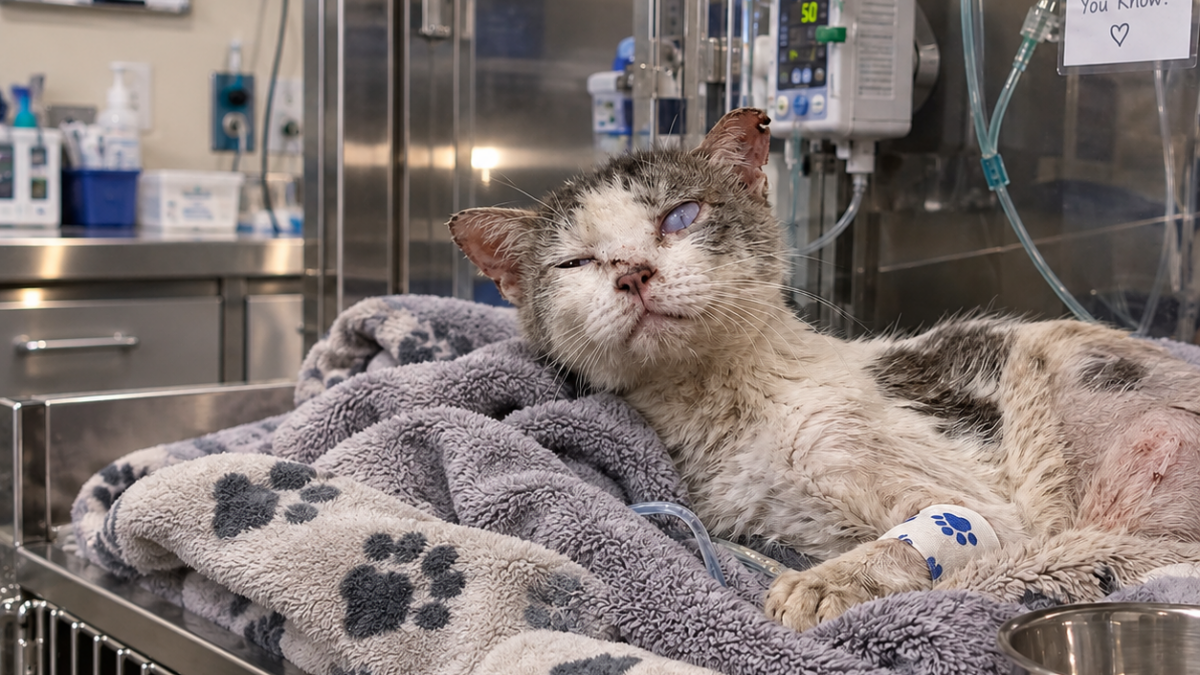
My Husband Found a Cat Sealed in a Plastic Box—But What He Did When a Hand Touched Him Broke Me.
My husband found him beside a pile of trash, sealed inside a clear plastic storage box with no air holes, no food, no water, and five days of late-season heat trapped around his body like an oven.
The veterinarian said his temperature was 107.4 degrees, his kidneys were failing, his paws were raw from standing in his own waste, and by every reasonable measure his body should have stopped fighting before anyone ever heard him scratch against the plastic.
But when a veterinary technician reached into his oxygen cage, that half-blind, burned little cat dragged his face toward her hand, pressed into her palm, and started to purr—and that was the part that broke me, because after everything human hands had done to him, he still wanted to believe the next one might be kind.
My name is Marianne Walker.
And I did not want a cat.
That is the first honest thing I need to say.
I was not one of those people who saw whiskers and immediately melted.
I did not follow rescue pages.
I did not keep a spare carrier in the garage.
I had no emergency bag of cat litter, no drawer full of toys, no secret dream about becoming the woman with six animals and a coffee mug that said RESCUE MOM.
I had two children.
A part-time job at the county library.
A husband who worked waste collection and came home smelling like diesel, rain, road dust, and hydraulic fluid.
A house already full of laundry, permission slips, cereal crumbs, forgotten shoes, half-finished school projects, and plastic cups that somehow migrated into bedrooms despite my daily objections.
I did not hate cats.
I simply did not have room in my life for another creature that needed something from me.
That was what I told myself.
Then Daniel found the box.
He had been working for Westford County Sanitation for almost eleven years.
Rural routes mostly.
Long roads.
Farmhouses.
Trailer homes.
Old properties tucked behind stands of pine.
PART2:
PART3:
The morning he found the cat was in October of 2023.
But the weather had forgotten the calendar.
By noon, it would reach ninety-two degrees.
Thirty-three Celsius.
The kind of heat that makes asphalt shimmer.
Daniel left home before sunrise.
Thermos.
Lunch.
Work gloves.
Old towel around his neck because the air conditioner in his truck only worked when it felt morally inspired.
At around ten that morning, he stopped on a rural road outside Westford.
Trash bags were stacked near the shoulder.
Beside them sat a plastic storage bin.
Clear sides.
Blue lid.
About the size of a microwave.
Silver duct tape wrapped around the rim.
Daniel almost lifted it directly toward the truck.
People taped containers closed all the time.
Paperwork.
Old clothes.
Household junk.
He expected a rattle.
Instead, he heard scratching.
Barely.
One slow drag against plastic.
Then nothing.
Daniel froze.
The bin was hot through his gloves.
He set it on the truck’s tailgate.
Leaned closer.
Flies.
Diesel.
Heat.
Hydraulics humming.
Then another scratch.
Weaker.
Daniel told me later the back of his neck went cold.
He pulled out his box cutter.
Slit the tape.
Peeled the lid back.
The smell hit before the sight.
Urine.
Feces.
Ammonia.
Heat.
Fear sealed into plastic.
Daniel stumbled backward.
Inside was a cat.
Small gray-and-white male.
Shorthaired.
So thin his spine looked drawn beneath the skin.
His fur was soaked.
Matted flat.
His mouth hung open.
Breathing came in shallow, rapid pulls.
One eye looked cloudy.
The other was red and wet.
The tips of both ears were crusted and curled from heat and chemical irritation.
His paw pads were raw.
There were no holes in the container.
None.
No air holes.
No food.
No water.
Nothing.
The only thing under him was a folded newspaper.
The date printed across the corner was five days old.
Five days.
That number stayed in our house.
Five mornings.
Five afternoons.
Five nights.
Inside a sealed plastic box beside garbage.
Waiting.
For someone.
For death.
For a truck.
Daniel called me.
I answered from the library workroom.
“Hey.”
He did not say hello.
“There’s a cat.”
“What?”
“A cat.”
“Where?”
“In a box.”
I waited.
“Daniel?”
He breathed once.
Then I heard it.
A rasp.
Not a real meow.
More like a body checking whether air still existed.
Daniel’s voice dropped.
“Who does this?”
I had no answer.
No good one.
“Get him help.”
“I’m taking him.”
“What about your route?”
“I don’t care about the route.”
That was when I knew.
Daniel cared about work.
Not passionately.
But responsibly.
He hated handing his job to someone else.
Hated unfinished tasks.
If Daniel Walker said he did not care about the route, whatever he had opened beside that dirt road had reached somewhere inside him that almost nothing touched.
He drove twenty miles to the nearest veterinary clinic.
A small place beside a feed store and tire shop.
Dogs.
Cats.
Goats.
Chickens.
Farm emergencies.
Roadside wildlife.
Dr. Evelyn Hart was on duty.
When Daniel walked through the front door carrying the plastic box, she smelled it before he reached the desk.
The cat was barely conscious.
His temperature was 107.4 degrees Fahrenheit.
Dr. Hart later explained normal feline temperature is roughly 101 to 102.5.
At 105, serious damage becomes likely.
Above 106, every minute matters.
His kidneys were already in crisis.
His liver values were so abnormal Dr. Hart repeated the bloodwork because she thought the analyzer might be wrong.
White gums.
Irregular heart rhythm.
Severe dehydration.
Starvation.
Chemical irritation from his own waste.
Heat injury.
Eye damage.
Pressure wounds from being unable to shift his body.
And yet—
Alive.
Dr. Hart and her technician Jenna moved fast.
Cooling.
Fluids.
Oxygen.
Blood tests.
Eye irrigation.
Pain control.
Cleaning in stages.
His body was too fragile for aggressive treatment.
Daniel sat in the waiting room.
The empty plastic box beside him.
A receptionist asked whether she could throw it away.
“No.”
Daniel rarely raises his voice.
She stopped immediately.
Later, I asked why he kept it.
He said:
“If he dies, I want somebody to see what he stayed alive inside long enough to be found.”
At first, the clinic called him the bin cat.
Nobody had a name.
Then Jenna reached into the oxygen enclosure.
That was the moment everything changed.
He lay on a towel.
Too weak to lift his head for more than a second.
Most whiskers on the right side were gone.
Burned.
Broken.
Destroyed by heat and ammonia.
The left side of his face was less damaged.
Not healthy.
Just less damaged.
Jenna slid one hand through the opening to adjust his IV.
The cat opened his one usable eye.
She froze.
Any injured animal can bite.
Especially one who has learned what humans are capable of.
Jenna expected recoil.
A hiss.
A strike.
Something.
He did none of it.
He dragged himself forward.
Barely.
One inch.
Then another.
Painfully.
Until the intact side of his face reached her palm.
He pressed into her hand.
Closed his eye.
And began to purr.
Jenna felt it before she heard it.
A vibration against her fingers.
His body was failing.
His eyes were damaged.
His ears burned.
His paws split.
He had spent five days sealed inside his own waste without water or moving air.
And the first time a hand touched him gently—
He leaned into it.
Jenna had to leave the room.
Dr. Hart found her crying in the hallway.
“He isn’t stupid,” Jenna said.
“He knows what hands did to him.”
Then:
“He just still wants to believe this one is different.”
Daniel came home that night with red eyes.
The children were asleep.
I had reheated dinner.
He did not eat.
He sat at the kitchen table and stared at his hands.
I poured coffee.
“Is he alive?”
“For now.”
“What did the vet say?”
Daniel rubbed his face.
“That he shouldn’t be.”
Then he told me everything.
No drama.
Daniel tells hard things plainly.
Sometimes that makes them worse.
Plastic box.
Tape.
No ventilation.
Newspaper.
Five days.
Heat likely well over 120 inside during afternoons.
Kidneys.
Liver.
Eyes.
Ears.
Paws.
Hip sores.
Still purring.
His voice broke on those last two words.
I reached across the table.
Took his hand.
“He pushed his face into Jenna’s palm,” he said.
“Like this.”
He pressed his cheek against our joined hands.
Then looked away.
I tried to imagine it.
I couldn’t.
It is one thing to feel sorry for suffering.
It is another to see trust surviving somewhere it has no rational reason to remain.
“What happens now?”
“Next forty-eight hours matter.”
“And after that?”
He looked at me.
“I don’t know.”
I recognized that expression immediately.
“Daniel.”
“I’m not saying anything.”
“You have the look.”
“What look?”
“The broken rocking chair look.”
He almost smiled.
Years earlier, he had brought home a rocking chair from the county transfer station because, according to him, it still had structure.
“This is not a chair.”
“I know.”
“He may die.”
“I know.”
I narrowed my eyes.
“Do not bring home a dying cat.”
“I didn’t say—”
“You were thinking it.”
“I was thinking if he survives, he needs somewhere quiet.”
“There are rescues.”
“Yes.”
“People who understand cats.”
“Yes.”
“We have never owned a cat.”
“I know.”
“Owen is loud.”
“I know.”
“Lily is three.”
“I know.”
“We don’t own a litter box.”
“We could.”
That word.
We.
Should have warned me.
The cat survived the first night.
Then the second.
His kidneys stabilized slowly.
Liver values came down enough that Dr. Hart stopped looking like she expected the phone to ring at 2 a.m.
His ears shed dead tissue.
Part of his left ear could not be saved.
The right healed curled inward.
Two rear paw pads required debridement.
A pressure sore on his hip became necrotic.
His organs were too unstable for full anesthesia at first, so treatment required careful local numbing and restraint.
Everyone expected resistance.
He purred.
IV changes.
Purr.
Bandages.
Purr.
Eye medication.
Purr.
Wound cleaning.
Purr.
The first soft bed they gave him?
He kneaded it.
Slowly.
Damaged paws flexing against fleece as if he needed to make sure softness was real.
Jenna sent photos to Daniel.
Daniel showed me.
“I am not getting attached.”
“I’m just showing you.”
“You’re preparing me.”
“For?”
“The sentence.”
“What sentence?”
I pointed at his phone.
On the screen was the cat lying on a blanket.
Cloudy eye.
Bandaged ear.
One paw resting against Jenna’s hand.
Daniel said:
“He needs somewhere to go.”
I sighed.
“Temporary.”
He nodded much too fast.
“Temporary.”
“I mean it.”
“I know.”
“I am not keeping a cat.”
“I know.”
“I have no idea how to care for an animal with this many medical problems.”
“We’ll learn.”
Again.
We.
Twelve days after Daniel found him, the cat came to our house.
Still nameless.
Dr. Hart called him Buddy.
Jenna called him Sweet Boy.
Daniel called him Little Guy.
I called him The Cat.
I thought language could preserve distance.
He weighed four pounds.
He should have weighed close to ten.
He looked too small for the carrier.
Left eye permanently cloudy.
Right eye functional but watery.
Left ear clipped from surgery.
Right ear curled.
Hip shaved.
Stitches.
Paws bandaged.
Medication bag large enough to qualify as luggage.
Antibiotics.
Eye ointment.
Liver support.
Paw balm.
Follow-up schedule.
Feeding instructions.
Warnings.
I opened his carrier in our spare bathroom.
Towels covered the floor.
Low litter box.
Food.
Water.
Soft bed.
Daniel stood behind me.
The cat stepped out.
Slowly.
Stopped.
Looked around.
Then walked straight to my hand.
I had not reached.
My palm was simply resting on the towel beside my knee.
He crossed the room.
Lowered his head.
Pressed the left side of his face into it.
I froze.
Daniel whispered:
“He does that.”
The cat closed his eye.
And purred.
Not soft.
A deep, broken, rumbling sound too large for his body.
I had planned to be organized.
Medication chart.
Feeding schedule.
Temporary foster.
Practical.
Instead, I sat on the bathroom floor with a half-blind, burned, scarred little animal pressing himself into my palm like he had been waiting for me.
“Oh.”
That was all I said.
And that was the beginning of the end of temporary.
I checked him at midnight.
Two.
Four.
Six.
No one told me to.
At six, I opened the door and found him waiting.
He looked up.
His damaged tail moved once.
I sat.
He climbed into my lap.
Slow.
Careful.
Every movement still expensive.
He pressed his face into my open hand.
Stayed there.
Thirty minutes.
My coffee went cold downstairs.
Children fought over cereal.
Daniel looked in once.
Saw us.
Said nothing.
At breakfast, Owen asked:
“Is the cat staying?”
“No.”
Daniel coughed into his mug.
Lily had oatmeal on her sleeve.
“Why not?”
“We’re helping him get better.”
“What’s his name?”
“He doesn’t have one.”
“He needs one.”
“No.”
Owen frowned.
“Everything needs a name.”
I hate when children are right.
For three days, I refused.
On the fourth morning, the cat climbed into my lap at the kitchen table.
His paws were healing.
He pressed his face into my hand.
Closed his eye.
Purrrr.
Lily started laughing.
“He sounds like Daddy’s truck.”
Daniel smiled.
I looked down.
Someone had sealed this cat inside a box.
Someone had placed him next to garbage.
Someone had decided he could disappear.
And yet here he was.
In my kitchen.
Trusting the hand of a woman who had not even wanted him.
“Kept,” I said.
Daniel looked up.
“What?”
“His name is Kept.”
Silence.
Owen repeated:
“Kept.”
Lily clapped.
“Keppy!”
Daniel turned toward the sink.
His eyes were wet.
That was his name.
Kept.
Because somebody had thrown him away.
And somebody else had decided he was not trash.
Caring for Kept was not beautiful.
Not most days.
Rescue stories get edited.
Before photo.
After photo.
Soft music.
Nobody shows the middle.
Medication alarms.
Eye ointment.
Paw soaks.
Bandage checks.
Accidents beside litter box because the entry hurt his feet.
Vet bills.
Special food.
Humidifier.
Paw balm.
Warm compresses.
Cleaning his eye every morning.
Checking hip scar.
Learning which sound meant pain.
Which meant hunger.
Which meant a door had been shut that he believed belonged open.
There were mornings I found blood spots from cracked pads.
Nights I cried because I was tired.
Days when Owen touched the ointment tube with dirty hands.
Days when Lily forgot “gentle.”
Days when Daniel worked late and everything smelled faintly of medicine and damp towels.
Kept trusted us through all of it.
Not blindly.
I came to hate that phrase.
People would say:
“He’s so trusting.”
“Like he doesn’t remember.”
No.
He remembered.
His body proved it.
Rip duct tape?
Kept disappeared under couch.
Open a plastic storage bin?
Panic.
Close a door too hard?
Ears flat.
Warm room?
Pacing until a window opened.
His nervous system remembered before his mind had language.
But he had made a choice I still do not understand.
Hands themselves were not the enemy.
Or maybe he knew one hand could hurt and another could heal.
That difference became his entire life.
He never bit.
Never scratched.
Never hissed at us.
One afternoon, Lily climbed onto couch with the reckless affection of a three-year-old.
Before I could stop her, she wrapped both arms around him and pressed one little hand against his damaged ear.
Kept tensed.
My heart stopped.
“Lily.”
She froze.
“Let go.”
Kept turned his head.
Slowly.
No snap.
No swipe.
He touched his nose to her fingers.
Then lay back down.
Lily whispered:
“Sorry, Keppy.”
I carried her to the kitchen.
Explained gentle again.
And again.
And again.
Then went into the bathroom.
Closed the door.
Cried.
Not because of his ear.
Not because of scars.
Because somebody had tried so thoroughly to teach him that hands meant pain.
Tape.
Heat.
Confinement.
Abandonment.
A closing lid.
And he had refused to finish the lesson.
What kind of creature does that?
I still do not have a word.
Kept grew stronger.
Four pounds became five.
Then six.
Then almost eight.
He never reached the ten pounds Dr. Hart thought he once should have been.
But he became sturdy.
His fur grew back.
Except over the hip scar.
The right whiskers partially returned.
Three never did.
Left eye remained cloudy and blind.
Right eye still watered.
Hearing was reduced from ear damage.
We learned to approach from the side he could see.
Tap the floor.
Let him smell us.
Owen became very serious about rules.
He told visitors:
“Don’t grab his ears.”
“Don’t touch his left hip hard.”
“Let him smell you first.”
“He likes open hands.”
Lily told people:
“Keppy was trash but now he’s not.”
I was horrified.
Dr. Hart laughed.
“Technically correct.”
Six months after Kept came home, the investigation closed.
No charges.
No useful fingerprints.
No camera footage.
No one claimed responsibility.
Whoever sealed that lid remained somewhere in the world with clean hands.
At least on the outside.
Daniel finally asked:
“Do you want to see the box?”
“No.”
Then:
“Yes.”
It sat in our garage inside an evidence bag.
Clear plastic.
Blue lid.
Tape residue.
No holes.
That was what made me furious.
No holes.
Not even one tiny opening.
No moment where someone thought:
Maybe this is too far.
No hesitation pushed through with a screwdriver.
No mercy.
Just a sealed box.
I stared for a long time.
“I hate it.”
Daniel stood beside me.
“I know.”
“He was in that.”
“Yes.”
“Five days.”
“Yes.”
“I want to break it.”
Daniel handed me a hammer.
That is marriage too.
I hit the lid.
Again.
One side.
Then another.
Plastic cracked across the garage floor.
I swung until my shoulders hurt.
Until pieces scattered.
Until I could no longer see a box.
Daniel did not stop me.
When I finished, he swept everything.
Took it away.
That night, Kept climbed into my lap.
Pressed his face against my sore hand.
As if he understood.
Or forgave something I had never done.
His story spread after Jenna posted about him with our permission.
Not every detail.
Enough.
The curled ear.
Cloudy eye.
Scarred paws kneading fleece.
Face against a human palm.
People donated.
Asked about him.
Asked whether he needed a home.
He did not.
Not anymore.
One comment stayed with me.
How can a cat forgive humans after that?
I stared at it.
Then wrote:
I don’t know if forgiveness is the right word.
Maybe he just refuses to let the worst human be the only human who gets to define us.
Jenna printed my reply.
Put it in staff room.
I was embarrassed.
But I believed it.
Kept did not forget.
He did not erase trauma.
He made new evidence.
A hand bringing food.
A hand applying medicine.
A hand stopping when he leaned away.
A child learning softness.
A veterinarian warming a blanket.
A husband opening a door.
Again.
Again.
Again.
Evidence.
That is what healing became.
Repeated evidence that the worst thing was not the only thing.
Every morning, Kept climbed into my lap at the kitchen table.
Daniel left early.
Children came downstairs loud.
Coffee brewed.
Toast burned.
Shoes went missing.
Forms appeared at the last second.
Life remained chaotic.
And Kept arrived.
Chair.
Lap.
Turn.
Left side of face toward me.
I opened my hand.
He pressed into it.
Closed his good eye.
Purrrr.
Some mornings, I had a thousand things to do.
Lunches.
Laundry.
Email.
Forms.
Groceries.
But Kept had waited five days inside a sealed box.
Thirty minutes of my morning seemed small.
So I gave it to him.
Eventually, I started waking earlier.
Fifteen minutes.
Then thirty.
So I would not resent the time.
Imagine that.
A discarded cat taught me not to treat tenderness like an interruption.
Years passed.
Kept became part of the grammar of our house.
“Don’t move, Kept’s on Mom.”
“Who used his last eye wipe?”
“Watch his paw.”
“Kept stole my blanket.”
“He’s purring again.”
Owen grew from little boy into serious preteen.
Lily became old enough that I barely remembered the child who had accidentally squeezed Kept’s ear.
To them, he had always been here.
People visited.
Kept approached slowly.
Sniffed.
Evaluated.
If they passed whatever test cats use, he leaned his face into their open hand.
Every time, I felt same thing.
Awe.
He still chooses this.
After everything.
One afternoon, Daniel found me sitting on the kitchen floor with Kept asleep against my leg.
I had been crying.
He crouched.
“What happened?”
“Nothing.”
“That usually means something.”
I wiped my face.
“A woman at the library was talking about another animal-abuse case.”
“She said she doesn’t understand why people get so emotional.”
“They’re just animals.”
Daniel looked at Kept.
“What did you say?”
“Nothing.”
“Probably wise.”
“I wanted to.”
“I know.”
I touched the fur between Kept’s shoulders.
“Just animals.”
He sighed in his sleep.
Daniel sat beside me.
“He changed our whole house.”
“Yes.”
“Changed my route.”
“Yes.”
“Changed the kids.”
“Yes.”
“Changed you.”
I looked at Daniel.
He smiled.
“Changed me too.”
Kept opened his good eye.
Saw both of us.
Started purring without moving.
Just animals.
No.
Not just.
Never just.
A living creature is never just anything.
Five years after Daniel found him, Dr. Hart invited us to a fundraiser for the clinic emergency-care fund.
I said yes too quickly.
Then panicked.
Kept disliked:
Noise.
Carriers.
Temperature changes.
Strangers.
Anything interfering with his naps.
But he surprised me.
The fundraiser was small.
Community hall.
Quiet.
Donated baskets.
Photographs of animals the clinic had treated.
Kept had a display.
One early image.
Burned face pressed to Jenna’s hand.
One recent image.
Kept in my lap at kitchen table.
People recognized him.
They approached carefully because a sign told them how.
Some cried.
Some whispered:
“Hi, Kept.”
Some just looked.
A little boy with glasses asked:
“Can I pet him?”
I knelt.
“Open hand.”
“Let him choose.”
The boy held his palm out.
Kept leaned forward.
Sniffed.
Then pressed his face into it.
The boy’s eyes became enormous.
“He likes me.”
“Yes.”
“How does he know I’m nice?”
I looked at Kept.
“I think he gives people a chance to be.”
The boy thought about that.
“That’s brave.”
“Yes.”
“It is.”
Later Dr. Hart asked me to say a few words.
I nearly refused.
I am not a speaker.
I shelve books.
Pack lunches.
Argue about screen time.
Refill prescriptions.
I do not stand in front of rooms and explain miracles.
Daniel squeezed my hand.
Kept sat in open carrier watching me.
So I stood.
“I didn’t want a cat.”
People laughed.
I told them about Daniel.
The plastic bin.
No air holes.
Five days.
The heat.
Burns.
Cloudy eye.
Missing ear.
Cracked paws.
Then Jenna’s hand.
My voice broke there.
I let it.
“People ask how he forgave.”
I looked at Kept.
“I don’t know that he did.”
“Forgiveness is a human word.”
“And sometimes humans use it too quickly because we want pain to become tidy.”
“What happened to Kept was not tidy.”
“His scars are not tidy.”
Kept shifted on his blanket.
“But every day, he chooses not to let the worst thing that happened become the only truth he believes.”
“Every morning, he climbs into my lap.”
“Presses his face into my hand.”
“And purrs like the world is still worth trusting.”
I swallowed.
“I don’t know what to call that.”
“I only know I have never seen anything stronger.”
People stood afterward.
I wished they had not.
Applause startled Kept.
But he only blinked.
Tucked his head down.
On the drive home, Daniel said:
“You did good.”
I looked at carrier.
“He did.”
“He always does.”
That night, after the children went upstairs, Kept climbed into my lap on couch.
Rain tapped windows.
Daniel sat beside me.
I opened my hand.
Kept pressed his face into it.
Purring filled room.
“He’s not what they did to him,” I said.
Daniel looked at me.
“He’s what he became after.”
Kept’s good eye closed.
His curled ear moved once.
Outside, rain washed windows.
Inside, a cat somebody had thrown away slept against the hands of people who decided to keep him.
That is really the story.
Not the box.
Not the tape.
Not even the five days.
The story is what happened after Daniel opened the lid.
A waste collector stopped.
A veterinarian fought.
A technician offered her hand.
A family learned.
Children became gentle.
A house made room.
And a cat named Kept kept choosing warmth.
Sometimes I still think about the person who sealed him inside.
Not every day.
But sometimes.
I wonder whether they remember.
Whether they know he lived.
Whether they care.
Whether they told themselves somebody would find him quickly.
Whether they convinced themselves animals don’t understand.
Whether they moved on.
Life did move on.
Just not the way they intended.
Kept did not disappear.
He was not crushed inside a garbage truck.
He did not become a sealed box in a landfill.
He lived.
He was treated.
Named.
Fed.
Held.
Loved.
He has a bed in nearly every room because Daniel claims he “found them on sale.”
He has a Christmas stocking.
Medication reminders.
Paw balm.
Special wipes.
A veterinarian who still calls him Sweet Boy.
Jenna’s hand in his history.
Mine in his mornings.
A place.
That is why we named him Kept.
Because keeping is not a feeling.
It is an action.
Keeping is medicine given on schedule.
It is paw balm in winter.
It is telling a child “gentle” for the hundredth time.
It is waking earlier so a scarred cat gets thirty quiet minutes.
It is paying another vet bill.
Cleaning another eye.
Opening another hand.
It is deciding every day to become the opposite of whoever closed that lid.
Kept is not whole in the way he might have been.
His left eye will never see.
His ear will never straighten.
His paw pads crack.
His hip scar stays.
Neither are most of us whole in every possible version.
But every morning, before the children come downstairs and before the coffee finishes brewing, Kept climbs into my lap.
He turns.
Offers the less-damaged side of his face.
I open my hand.
He presses into it.
And I feel the truth vibrate through his purr.
He is here.
He is safe.
He is not what someone threw away.
He is what we refused to lose.
If you stand in my kitchen early enough, before the day asks us for anything else, you can hear him from the next room.
A little gray-and-white cat.
One good eye.
Half an ear.
Scarred paws.
Missing whiskers.
A body that carries proof of what cruelty can do.
And a heart that somehow refused to let cruelty have the final word.
Purring like thunder.
Purring like evidence.
Purring like he is still choosing to believe that the next hand might be kind.




