PART 2: HOA Karen Paved Over My Private Driveway and Claimed It as Hers—So I Gave Her a Parking Lesson She’ll Never Forget
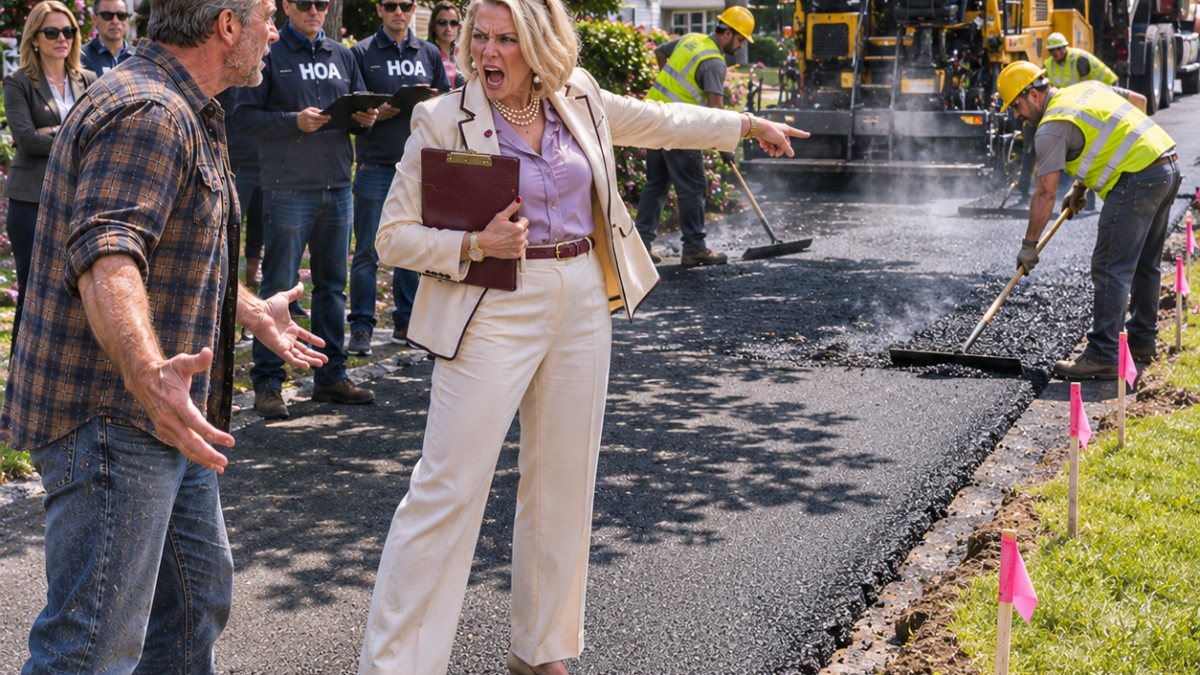
A paving crew was cutting into my private driveway when I came home, and the woman supervising them calmly told me the “HOA” had approved taking ten feet of my land.
There was only one problem: our neighborhood had never had an HOA, and every deed, county map, and survey proved that driveway belonged entirely to me.
Patricia Henderson thought confidence, a clipboard, and a few fake rules could move a property line—but she was about to discover that some boundaries become much more expensive after you cross them.
Before Patricia Henderson moved onto my street, life was boring.
I mean that as a compliment.
Our neighborhood was old enough that nobody remembered exactly when everyone had stopped trying to impress one another.
The houses didn’t match.
Some lawns were manicured.
Some weren’t.
Mr. Murphy across the street kept a twenty-year-old pickup under a maple tree that dropped leaves into the bed every fall.
Mrs. Turner had wind chimes that could probably be heard from another county.
One family kept bicycles beside their garage.
Another had a basketball hoop slightly crooked over the curb.
Nobody cared.
People waved.
They borrowed tools.
They watched one another’s houses during vacations.
And if a storm came through, half the neighborhood would be outside the following morning dragging broken branches toward the curb before anyone had even finished breakfast.
That was why I stayed.
I owned a small landscaping company, and my house doubled as the unofficial starting point for most of my workdays.
My property wasn’t impressive.
Two-bedroom house.
Detached garage.
Long gravel driveway running along the side and curving toward the rear.
But that driveway mattered.
Every morning my work truck sat there.
My trailer.
Mowers.
Trimmers.
Blowers.
Shovels.
Sometimes a small skid steer when a job required one.
My crew knew to meet there before sunrise, grab coffee, load what we needed, and get moving before traffic got ugly.
I had owned that land for eight years.
The driveway was shown on my deed.
On the recorded plat.
On the survey I’d ordered when I bought the property.
No easement crossed it.
No shared-access agreement existed.
No mystery.
Then the Hendersons moved in next door.
Her husband was Richard.
Her actual name was Patricia.
But within two weeks, half the block privately called her Karen.
Not because anybody wanted drama.
Because some people simply arrive already acting like they have been elected mayor of every place they can see.
Patricia showed up wearing expensive workout clothes, oversized sunglasses, and the expression of someone disappointed by the world before breakfast.
The movers had barely finished unloading when she walked across my yard.
“You must be the one with the work truck.”
Not hello.
Not nice to meet you.
The work truck.
“That’s me.”
She looked toward my driveway.
“Hm.”
“What?”
“It makes the street feel industrial.”
I thought she was joking.
She wasn’t.
“I run a landscaping company.”
“Yes, I gathered that.”
She looked at my trailer.
“Hopefully we can clean some of this up once neighborhood standards are established.”
I smiled.
“What standards?”
She smiled back.
“The community’s.”
“We don’t have an HOA.”
“Not yet.”
That should have told me everything.
Instead, I decided she was just adjusting to a new neighborhood.
A month later, I would stand in that same driveway watching asphalt cover ten feet of my property while Patricia calmly informed a paving crew that her imaginary HOA had authorized it.
But the takeover didn’t begin with asphalt.
It began with two orange traffic cones.
And because I treated those cones like an annoyance instead of the first flag planted in an invasion, Patricia Henderson started believing the most dangerous thing an entitled person can believe.
That my patience meant permission.
PART 2
The first morning I saw the cones, I assumed a contractor had left them there.
They sat maybe six feet inside my driveway.
Bright orange.
Perfectly spaced.
I picked them up and moved them onto the Henderson lawn.
No conversation.
No argument.
I had a crew waiting.
The next morning they were back.
Same place.
This time angled slightly as if they were marking a lane.
I moved them again.
Day three, they returned.
I stared at them for almost a minute.
My employee Caleb leaned against the truck.
“You starting a traffic-control business?”
“Apparently.”
“Want me to throw them away?”
“No.”
I lifted both.
“I’m going to find out what this is.”
Richard answered when I knocked.
He was a tall guy in expensive casual clothes with one of those carefully maintained beards that probably required more products than my entire bathroom cabinet.
“Morning.”
I held up a cone.
“Yours?”
“Oh.”
He smiled.
“Those.”
“Yes. Those.”
“We’ve been thinking about the driveway.”
I looked over my shoulder.
“My driveway?”
“The section between the houses.”
“There is no section between the houses. There’s your property and mine.”
He laughed lightly.
“Right, technically.”
“No.”
I shook my head.
“Not technically. Legally.”
He crossed his arms.
“Well, we entertain.”
“Good for you.”
“We could use additional parking.”
“Still good for you.”
“You have a lot of driveway.”
I waited.
He actually said it.
“We thought sharing the lower section made sense.”
“No.”
His smile disappeared.
“Excuse me?”
“No.”
“You don’t even know what we’re proposing.”
“You want to park on my land.”
“Occasionally.”
“No.”
“It would be neighborly.”
“No.”
He stared.
“You’re being inflexible.”
“I bought that driveway.”
“We’re willing to improve it.”
“I don’t need it improved.”
His jaw tightened.
“Fine.”
He took the cones.
“We’ll see.”
I almost asked what that meant.
Instead, I went to work.
Two days later, I found chalk lines across my gravel.
White.
Measured.
Straight.
Someone had drawn a rectangle from the Henderson property line into mine.
I photographed it.
Then washed it away.
The next morning, survey flags appeared.
Not professional markers.
Cheap plastic lawn flags.
I pulled one.
No survey company name.
No license information.
Just a handwritten “P.H.”
That afternoon Patricia stood at the edge of the road holding a clipboard.
“Are these yours?”
I held up the flag.
“They mark the shared access area.”
“No.”
She looked amused.
“You can’t just remove markers.”
“I can remove plastic somebody stuck into my property.”
“It’s preliminary planning.”
“For what?”
“Neighborhood improvements.”
I looked around.
“Which neighborhood appointed you?”
She smiled.
“We’ve been discussing community organization.”
“Who is we?”
She waved vaguely.
“People.”
“Names?”
“You don’t need names.”
“I do if they’re planning construction on my property.”
She turned away.
“You’re very defensive.”
“You’re very interested in land you don’t own.”
That ended the conversation.
Or so I thought.
The following Monday, there was a paper taped to my front door.
At the top, in bold:
**HOMEOWNERS ASSOCIATION VIOLATION NOTICE**
Underneath:
**UNAPPROVED COMMERCIAL VEHICLE STORAGE**
**DRIVEWAY AESTHETIC NONCOMPLIANCE**
**FAILURE TO MAINTAIN COMMUNITY APPEARANCE**
At the bottom:
**PATRICIA HENDERSON**
**COMMUNITY STANDARDS LIAISON**
I stood there laughing.
My neighbor Mrs. Turner saw me from across the street.
“What now?”
I held up the notice.
“Apparently we have an HOA.”
She frowned.
“Since when?”
“Exactly.”
She crossed the street in slippers.
Read it.
Then laughed harder than I had.
“Community standards liaison?”
“Apparently.”
“She moved here three weeks ago.”
“I know.”
“She complained about my wind chimes yesterday.”
“I heard.”
“She said they create excessive whimsical noise.”
I stared.
“She used the word whimsical?”
“Like it was a felony.”
We both laughed.
That should have been the end of it.
Everybody knew Patricia had no authority.
But there is a particular kind of person who interprets being laughed at as proof they need more authority.
Patricia was one of them.
Within a week, printed “community suggestions” appeared beneath doors.
Trash cans should not be visible from the street.
Outdoor décor should use neutral colors.
Work vehicles should be screened.
Dogs should not bark for longer than thirty seconds.
Children should keep sports equipment off front lawns.
Richard began walking the block with a tape measure.
Not metaphorically.
A literal tape measure.
He measured curb distances.
Sidewalk cracks.
Mailbox heights.
One afternoon I watched him measure the width of my driveway from the Henderson lawn.
I walked over.
“What are you doing?”
“Confirming dimensions.”
“For?”
“Potential shared use.”
“We discussed this.”
“You dismissed it.”
“Correct.”
“Patricia believes we should revisit it.”
“Patricia can believe whatever she wants.”
Richard pulled the tape farther.
I stepped on it.
He looked up.
“Could you move?”
“No.”
“You’re interfering.”
“You’re measuring my driveway.”
“It affects our property.”
“Everything affects something.”
He tugged.
I didn’t move.
“Richard.”
“What?”
“Stop.”
Something in my tone finally reached him.
He reeled in the tape.
“Fine.”
Then he smiled.
“But I think you’re going to regret being difficult.”
I looked at him.
“Get off my driveway.”
He did.
That same evening, Patricia walked over holding an iced matcha.
“You should pave this.”
She gestured toward the gravel.
“I like gravel.”
“It’s rustic.”
“I’m a landscaper.”
“That doesn’t mean you have to look like one.”
I laughed.
She didn’t.
“If we’re going to share the entrance, it should meet modern standards.”
“We aren’t sharing it.”
Her smile vanished.
“You keep saying that.”
“Because it keeps being true.”
“Things change.”
“Deeds don’t because you bought a blender and moved next door.”
She stared.
I hadn’t planned the blender line.
It just came out.
Caleb, loading equipment behind me, made a strangled sound trying not to laugh.
Patricia’s face hardened.
“I’m trying to improve the neighborhood.”
“Improve your house.”
She turned.
“You’ll understand eventually.”
That sentence stayed with me.
I wish I had understood what she meant.
—
The morning the paving crew arrived, I had been out quoting a retaining-wall job.
I returned just after ten.
My truck turned the corner.
Then I saw neon vests.
Orange cones.
A compact asphalt machine.
Three workers.
Fresh black pavement.
And Patricia.
Pink blazer.
Iced latte.
Clipboard.
For a second, I truly wondered whether I had turned onto the wrong street.
Then I saw my garage.
My mailbox.
My work trailer.
And ten feet of my gravel driveway disappearing beneath steaming asphalt.
I slammed the truck into park.
“Ma’am!”
The workers looked up.
“What exactly do you think you’re doing on my property?”
Patricia didn’t even flinch.
She pointed toward the paving crew.
“Finish the connection on our side.”
The foreman looked between us.
I walked closer.
“What connection?”
Patricia smiled.
“The driveway.”
“You are paving my driveway.”
“We’re improving access.”
“Stop.”
The foreman lowered his tool.
Patricia immediately said:
“Don’t.”
I stared at her.
She continued.
“The HOA approved this adjustment.”
“There is no HOA.”
“The community agreed.”
“What community?”
“Richard and I have been organizing.”
I actually laughed.
“Two people aren’t an HOA.”
She shrugged.
“You can discuss technicalities later.”
“No.”
I turned toward the foreman.
“You are working on parcel 117-B. That’s my property. I did not authorize this.”
He looked concerned.
Patricia stepped in front of him.
“I have documentation.”
“Show it.”
She tapped her clipboard.
“We’ve already verified the boundary.”
“With who?”
“Richard.”
I stared.
“Richard is not a surveyor.”
“He measured.”
“With what?”
She hesitated.
Then:
“A contractor-grade tape.”
I could feel my blood pressure rising.
“Stop the work.”
The foreman held up both hands.
“Look, man, I’m just here to pave where the customer marked.”
“I’m the property owner.”
Patricia snapped:
“Part owner.”
“No.”
“Shared zone.”
“No.”
The foreman looked from me to her.
“You two need to figure this out.”
“Easy.”
I pointed toward her house.
“Her property stops there.”
Patricia crossed her arms.
“According to your interpretation.”
“According to the county.”
She smiled.
“County maps aren’t always accurate.”
That sentence was so outrageous I almost respected it.
Almost.
I walked toward the crew.
“Stop.”
The foreman called his workers back.
Patricia stepped toward him.
“You have been paid.”
“Lady, I’m not getting arrested over a driveway.”
“Nobody is getting arrested.”
I said:
“Keep paving and we’re going to have a much more complicated conversation.”
He looked at the asphalt already down.
“We’re almost finished.”
That was the problem.
They were.
Before I arrived, most of the disputed strip had already been covered.
Fresh asphalt blended from Patricia’s side into mine, turning two clearly separate entrances into the appearance of one wide shared driveway.
Richard came outside carrying a coffee mug.
**BOSS MAN.**
Of course.
He looked around.
“Looks good.”
I stared.
“You paved my property.”
“No.”
He smiled.
“We improved ours.”
“Your property line is eight feet that way.”
“According to your paperwork.”
“According to everyone except your tape measure.”
Patricia sipped her latte.
“Honestly, you should thank us. It looks much better.”
I walked into my house.
Got the deed.
Recorded plat.
Survey.
GIS map printout.
Then returned.
I spread everything across the hood of my truck.
“Look.”
Patricia didn’t.
“Look at the survey.”
“I trust Richard’s.”
“He doesn’t have a survey.”
“He measured.”
“That’s not a survey.”
“He’s very precise.”
Richard nodded.
“I measured twice.”
I stared at both of them.
There are moments when continuing an argument lowers your own intelligence.
I gathered the papers.
“Fine.”
Patricia smiled.
I held up one finger.
“Not fine as in I agree.”
Her smile disappeared.
“Fine as in I’m done explaining facts to people committed to pretending they don’t exist.”
I photographed everything.
The crew.
The truck.
The asphalt.
Patricia.
Richard.
The property line.
Then I walked inside.
That night, I called my cousin David.
He worked as a paralegal for a real-estate attorney.
After I explained the situation, he stayed silent for several seconds.
“Say the tape-measure part again.”
“No.”
“Please.”
“I hate you.”
He laughed.
Then became serious.
“You still have the original survey?”
“Yes.”
“Recorded?”
“Yes.”
“Any easement?”
“No.”
“Did they get permits?”
“Not that I know.”
“Photographs?”
“Everything.”
“Video?”
“Starting tomorrow.”
He said:
“Don’t touch anything yet.”
“Why?”
“Document.”
“They’re on my land.”
“I know.”
“Should I rip up the asphalt?”
“No.”
“Fence?”
“What fence?”
I paused.
“There isn’t one.”
“Good.”
“There might be by morning.”
“Why would you say that?”
“Because I’ve met Patricia.”
David sighed.
“Call a lawyer.”
“I am calling you.”
“I’m not your lawyer.”
“Close enough.”
“No.”
“I want actual advice.”
“Actual advice is call an actual lawyer.”
“Fine.”
“And document everything.”
That phrase became my religion.
—
Patricia celebrated the asphalt like she’d annexed a country.
The next morning, I found decorative stones beside it.
Small solar lights.
A topiary in a giant ceramic pot.
And her SUV parked directly on the new section.
I stood at my window drinking coffee.
She saw me.
Waved.
I didn’t.
That afternoon, a note appeared on my door.
**Please move work equipment from shared driveway during visiting hours. It disrupts the aesthetic.**
I folded the note.
Placed it in a folder.
**HENDERSON.**
Caleb noticed.
“You saving those?”
“Every one.”
“Why?”
“Because one day somebody with authority is going to ask how this started.”
He pointed toward Patricia’s SUV.
“And you’re going to say?”
“Pink blazer.”
Two days later, I woke to the sound of a post-hole auger.
I ran outside.
A fencing crew was working beside the asphalt.
A wooden privacy fence had already been installed almost eight feet inside my legal boundary.
Lattice top.
Dark stain.
Expensive.
I walked toward it.
Patricia stood tying pastel ribbon around a temporary stake.
“Stop.”
She looked over.
“Morning.”
“You built a fence on my property.”
“Our property.”
“No.”
She smiled.
“We’re establishing the shared-use boundary.”
“With a fence eight feet inside mine?”
“Richard measured.”
I closed my eyes.
“Do not say contractor-grade tape.”
“It was.”
I looked toward Richard.
He emerged carrying a level.
“Everything’s straight.”
“That’s wonderful.”
I pointed.
“It’s straight on my land.”
He laughed.
“Well, it’s ours now.”
Something inside me cracked.
I walked inside.
Came back with every official document I owned.
Set them on the hood of Patricia’s SUV.
“Read.”
She photographed them.
I stared.
“What are you doing?”
“Documenting.”
“Read them.”
“Illegal documents.”
I thought I had misheard.
“What?”
“They aren’t HOA compliant.”
My mouth opened.
Then closed.
“Patricia.”
“Yes?”
“There is no HOA.”
She smiled.
“There will be.”
Richard stepped closer.
“We’ve established a preliminary council.”
I looked between them.
“A preliminary what?”
“HOA council,” Patricia said.
“With who?”
“Us.”
“Two homeowners?”
“We’re founders.”
I started laughing.
I couldn’t stop.
Patricia’s face stiffened.
“You think this is funny?”
“You formed an HOA with your husband and declared yourselves in charge of property you don’t own.”
“We are building structure.”
“No.”
I pulled out my phone.
“You are building evidence.”
Her expression changed.
“Don’t film me.”
“I’m on my property.”
“This is harassment.”
“No.”
I held the camera steady.
“This is documentation.”
She raised her hand.
“Stop.”
“Are you claiming this fence is legally on your property?”
“Yes.”
“Based on what?”
“Our measurements.”
“Licensed survey?”
“Richard measured.”
“County map?”
“Outdated.”
“Recorded deed?”
“Open to interpretation.”
I almost thanked her.
Instead, I kept recording.
Then turned toward the fence.
“This section is on parcel 117-B.”
“Shared zone.”
“There is no shared zone.”
She walked away.
“Your hostility will be noted.”
“Please spell my name correctly.”
—
The rest of the block started noticing.
Mrs. Turner walked over that afternoon.
She stared at the fence.
“What is this?”
“Apparently our HOA border.”
She looked around.
“We have an HOA now?”
“Two members.”
“Who?”
“Guess.”
She laughed.
Then stopped when she realized I wasn’t joking.
Mr. Murphy joined us.
He had lived on the street since 1974.
He looked at the fence.
Then Patricia’s house.
Then me.
“Son.”
“Yeah?”
“You got a survey?”
“Three.”
“Then let her keep digging.”
I frowned.
“What?”
“People like that trip over their own arrogance.”
He tapped the fence.
“Don’t help her stand up.”
That advice stayed with me.
Over the following week, Patricia expanded.
More stones.
More lights.
A wooden sign:
**HENDERSON DRIVEWAY ENTRANCE**
On my land.
Richard photographed everything.
Patricia began parking her SUV on the stolen section every day.
Then came the dinner party.
Thursday evening.
I had just finished a twelve-hour commercial landscaping job.
My shirt was soaked.
Hands dirty.
Back aching.
All I wanted was food and a shower.
Instead, the street was packed with cars.
Music drifted from the Henderson backyard.
Guests carried wine.
Charcuterie boards.
Flowers.
Three vehicles were parked across the asphalt they had installed on my parcel.
Another was partially on my original gravel.
One tire sat on my grass.
I stopped my truck.
Patricia walked toward me.
“Oh, good.”
I stared.
“My sister needed a closer space.”
“Your sister is parked in my driveway.”
“Shared driveway.”
“No.”
She smiled.
“Well, it is now.”
I wanted to scream.
Instead, I walked around the house.
Cool down.
Don’t make a mistake.
Then I heard Patricia talking to a guest.
“He’s been very difficult about the transition.”
The guest asked:
“Is this actually your driveway?”
“Oh, absolutely.”
Patricia laughed.
“We’re formally establishing the HOA soon. Once that’s done, he’ll have to comply.”
Comply.
I stopped walking.
That word did something.
Not because it frightened me.
Because I suddenly understood the scale of her plan.
She didn’t want ten feet of driveway.
She wanted precedent.
If I accepted one strip, she would treat every future demand as enforcement.
My truck.
My trailers.
My business.
My fence.
My yard.
Anything she decided violated her imaginary standards.
The next morning, tire marks covered my gravel.
A broken pathway light lay in the grass.
A napkin blew beside my trailer.
And another note was taped to my door.
**Please refrain from storing large work equipment in the shared community drive during visiting hours.**
I placed it in the folder.
That folder was getting thick.
Then I found the violation notice.
Official-looking logo.
Reference number.
**FAILURE TO MAINTAIN COMMUNITY STANDARDS**
**OBSTRUCTION OF SHARED ACCESS**
**IMPROPER COMMERCIAL ACTIVITY**
**HOA ENFORCEMENT NOTICE**
At the bottom:
A phone number.
Patricia’s cell.
I laughed so loudly Mrs. Turner heard me across the street.
She walked over.
“What now?”
I handed it to her.
She stared.
Then said:
“She gave me one yesterday.”
“For?”
“My garden hose.”
Mr. Walker emerged from the next house.
“She gave me one for my kid’s birthday party.”
Another neighbor:
“She cited my recycling bin.”
A woman farther down:
“She told me my porch furniture is ‘visually inconsistent.’”
Within ten minutes, six neighbors stood in my driveway.
Everybody had a Patricia story.
That changed everything.
It wasn’t only me.
She was testing the whole neighborhood.
My property just happened to be her biggest target because it sat beside hers.
Mrs. Turner lowered her voice.
“She keeps talking about forming an HOA.”
“Does anyone want one?”
Everyone answered at once.
“No.”
“Absolutely not.”
“I moved here specifically because there isn’t one.”
Mr. Murphy appeared behind them.
“Told you.”
I looked at him.
He smiled.
“She’s digging.”
I nodded.
Maybe it was time to stop arguing.
Maybe it was time to let ownership speak for itself.
—
I spent that evening on my back porch.
Cold beer.
Notebook.
Survey.
Property map.
I measured the disputed area.
Again.
Then again.
Ten feet of asphalt at the widest point.
Fence farther in.
Lights.
Stones.
Decorations.
Every inch documented.
I thought about filing immediately.
Lawsuit.
Injunction.
Demand letter.
I would do that.
Eventually.
But I also needed part of my property for work.
And Patricia had converted it into a driveway extension.
If she wanted to know what ownership meant, maybe I should simply use my own land.
I am a landscaper.
Which means I have access to materials most homeowners only see one bag at a time.
Mulch.
A lot of mulch.
The idea was so simple I laughed.
The next morning, I called my supplier.
“Ten yards.”
“Pine?”
“Brown hardwood.”
“Where?”
“My house.”
“Usual side?”
“Not exactly.”
The truck arrived around nine.
Patricia was watering her spiral topiary.
The diesel engine made her turn.
The driver stepped out.
“Where do you want it?”
I pointed toward the asphalt on my property.
“Right there.”
Patricia dropped the watering can.
“What is happening?”
“Delivery.”
“For who?”
“Me.”
“You cannot put mulch there.”
“Why?”
“That’s shared access.”
“No.”
She ran toward the driver.
“Don’t unload.”
He looked at me.
“You own this?”
“Yes.”
I handed him a copy of the survey.
He glanced.
Then shrugged.
“Your call.”
Patricia said:
“I’m telling you, this is HOA property.”
The driver looked around.
“What HOA?”
I almost hugged him.
I pointed.
“Drop it.”
The hydraulic bed rose.
Mulch started sliding.
A dark brown wave poured onto the stolen asphalt.
Patricia screamed.
Richard ran outside wearing pajama pants.
“STOP!”
The driver continued.
Ten yards became a mountain.
The asphalt vanished.
The connection between our driveways disappeared beneath wood chips.
The truck lowered.
The driver waved.
“Have a good one.”
Then left.
I stood looking at the pile.
Patricia stared at me.
Her face had gone pale.
“You blocked our driveway.”
“No.”
“You did.”
“You still have your original driveway.”
“This is the preferred entrance.”
“That sounds inconvenient.”
“You did this intentionally.”
“I ordered landscaping material.”
“On the driveway!”
“My property.”
“Shared property!”
I tapped the mulch with my boot.
“Then feel free to enjoy the smell.”
Richard stepped forward.
“This is childish.”
“You paved my land.”
“We improved it.”
“I’m storing material on my land.”
“You are obstructing us.”
“From using something you don’t own.”
Patricia shook.
“You’re going to regret this.”
I smiled.
“I’ve been hearing that a lot.”
For three days, the mulch stayed.
Patricia tried moving it with a shovel.
I watched from my porch.
She lasted eight minutes.
Maybe ten.
Then threw the shovel down.
The next morning, a pink notice appeared.
**EMERGENCY HOA CITATION**
**OBSTRUCTION OF COMMUNITY PASSAGE**
**FINE: $150**
**PAYABLE IMMEDIATELY**
In cash.
Placed under Patricia’s doormat.
I showed Mr. Murphy.
He stared.
Then said:
“That woman has either lost her mind or never had it.”
I photographed the notice.
Added it to the folder.
Richard came over later carrying tea.
“Can we be reasonable?”
“I’ve been reasonable for two months.”
“We need access.”
“You have access.”
“The other side is narrow.”
“Then widen your own driveway.”
“That costs money.”
I stared.
“So your solution was to take mine?”
He sighed.
“You’re oversimplifying.”
“No.”
I pointed toward the survey marker.
“I’m making it extremely simple.”
He looked at the mulch.
“We’ll handle this legally.”
I smiled.
“I’m counting on it.”
—
Mulch was temporary.
I actually needed most of it for two jobs.
My crew removed it over the next several days.
Patricia looked relieved.
Then she woke up to gravel.
I had ordered a load for a drainage project.
Ten tons.
I stored it on my land.
Exactly where the mulch had been.
The dump truck arrived before noon.
Patricia heard it.
She came running outside in slippers.
“No!”
The driver looked alarmed.
“No, no, no!”
I stepped out.
“Morning.”
“You cannot do this again.”
“Do what?”
“Block us.”
“I’m storing material.”
“Somewhere else!”
“This is close to my trailers.”
“You’re doing it to harass me.”
The driver looked at me.
I nodded.
He raised the bed.
Gravel thundered down.
A gray wall spread across the asphalt.
Patricia covered her ears.
Richard came outside.
“What the hell?”
The pile grew.
When the truck left, ten tons of stone stood between the Hendersons and the section of my driveway they had claimed.
Patricia immediately called the police.
I was delighted.
Not because I wanted anyone arrested.
Because finally somebody with no personal interest would look at the boundary.
An officer arrived.
Middle-aged.
Patient.
He listened to Patricia first.
“He has intentionally blocked a shared driveway.”
The officer asked:
“Shared how?”
“HOA access.”
“Do you have an HOA?”
“We’re establishing one.”
“So no.”
“We have a preliminary charter.”
He looked tired already.
Then he came to me.
“Your documents?”
I had them ready.
Deed.
Survey.
County map.
Photos.
He walked the line.
Looked at the new asphalt.
The fence.
The lights.
The gravel.
Then looked at Patricia.
“Ma’am.”
“Yes?”
“This appears to be his property.”
Her mouth opened.
“But the driveway—”
“Appears to be his.”
“He’s blocking us.”
The officer looked at the Henderson driveway.
“You still have access to your house.”
“It’s less convenient.”
He nodded.
“That’s not a crime.”
Richard said:
“We improved this strip.”
“On land you don’t own?”
Patricia interrupted.
“That’s disputed.”
The officer looked at my survey.
“Not by the county documents I’m seeing.”
She crossed her arms.
“So you’re taking his side?”
“No.”
He gestured toward the map.
“I’m taking the map’s side.”
Patricia glared.
“This is harassment.”
The officer sighed.
“Ma’am, if you built improvements over the property line, that is something you’ll need to resolve civilly.”
Then came the sentence I would remember for years.
“If you’re upset that he blocked your new driveway connection, maybe you shouldn’t have built the connection on his driveway.”
Mrs. Turner heard it.
So did Murphy.
By dinner, the entire block had heard it.
Patricia became furious.
Not because the officer disagreed.
Because neighbors laughed.
She could handle conflict.
What she could not handle was ridicule.
For two days, she stood beside the gravel pile looking like it had personally betrayed her.
She poked at it with a broom.
Photographed it.
Measured it.
Then Richard installed a sign.
**HOA ENFORCEMENT AREA**
**NO DUMPING**
**NO BLOCKING**
**NO PARKING**
**VIOLATORS SUBJECT TO FINES**
The sign was screwed into a post just beyond the gravel.
I walked outside.
Read it.
Then laughed.
Patricia came running.
“Stop.”
“What?”
“Mocking official notices.”
“This isn’t official.”
“We have bylaws.”
“You have a binder.”
“A charter.”
“From who?”
“Our council.”
“You and Richard?”
“Founding committee.”
I took a photograph.
“Delete that.”
“No.”
“That’s proprietary HOA material.”
“There is no HOA.”
“There will be.”
I took two more pictures.
Patricia screamed.
I went inside.
That night, I decided the final visual lesson needed to be something she couldn’t ignore.
Something completely legal on my side.
Something connected to my actual landscaping work.
My crew had a large commercial installation coming up the following week.
We needed a portable restroom.
Usually we placed it behind the garage.
This time I had a better location.
The next day, a delivery truck arrived carrying an electric-blue porta-potty.
The driver stepped out.
“Where?”
I pointed toward my property line.
“Right there.”
He looked.
“On the gravel edge?”
“Yes.”
Patricia’s front door flew open.
“No.”
She ran toward us.
“Absolutely not.”
The driver froze.
“What?”
“You cannot put that there.”
I said:
“He can.”
“This is a shared driveway.”
“No.”
“It will block our entrance.”
“Yes.”
Her eyes widened.
I added:
“The illegal one.”
She turned to the driver.
“Sir, I am the community standards liaison.”
He blinked.
“Okay.”
“I am instructing you not to place that object.”
He looked at me.
“You paying?”
“Yes.”
“You own the spot?”
“Yes.”
“Then we’re good.”
The porta-potty descended.
Blue.
Tall.
Impossible to miss.
It landed with a solid thud.
Patricia made a sound I had never heard from another adult.
“What is wrong with you?”
“Temporary work-site restroom.”
“You are mocking us.”
“No.”
I looked at the blue box.
“My crew starts a project Monday.”
“You chose this location to humiliate me.”
“I chose my property.”
She pointed.
“It ruins our view.”
I shrugged.
“So did your fence.”
Richard came outside.
He stared at the porta-potty.
“Seriously?”
“Completely.”
Patricia turned.
“Richard, do something.”
He stared.
“With what?”
“Call someone!”
So she did.
Police again.
Two officers this time.
One recognized me.
The other looked at the porta-potty.
Then Patricia.
Then the survey.
The first officer asked:
“Is it on his property?”
“Yes, but—”
“Does it block the public road?”
“No.”
“Any sanitation violation?”
Patricia looked offended.
“It’s ugly.”
The second officer said:
“That isn’t illegal.”
“It violates HOA standards.”
He looked at her.
“What HOA?”
“We are forming one.”
“So none.”
She practically gasped.
“We have a charter.”
“Ma’am.”
The officer rubbed his forehead.
“A group you’re trying to form does not currently have authority over Mr. Miller’s property.”
She pointed at me.
“He put that there to attack me.”
I answered:
“My crews need a portable restroom.”
That was true.
“He could put it somewhere else!”
Also true.
But not required.
The officers left.
Neighbors came outside.
Mrs. Turner crossed her arms.
“Oh my.”
Murphy grinned.
“That is placement.”
By sunset, somebody had started calling it:
**Karen’s Throne.**
I did not invent the name.
I wish I had.
Kids riding bikes whispered it.
Teenagers took photographs.
A paper crown appeared taped to the door one afternoon.
Patricia nearly exploded.
She marched onto my porch holding the crown.
“You did this.”
“No.”
“You encouraged them.”
“I didn’t.”
“This neighborhood is turning against me because of you.”
“No.”
I looked toward her house.
“They’re turning against you because you keep trying to govern people who never elected you.”
She shook the crown.
“This is harassment.”
“This is construction-site sanitation with accessories.”
She screamed.
Richard came over.
“Patricia.”
“Don’t.”
“You need to calm down.”
“Do not tell me to calm down!”
He backed away.
Even he was getting tired.
—
Patricia started campaigning.
Literally.
Flyers.
Door knocking.
Binders.
**PROTECT PROPERTY VALUES**
**RESTORE COMMUNITY STANDARDS**
**FORM WILLOW LANE HOMEOWNERS ASSOCIATION**
Nobody joined.
One neighbor shut the door in her face.
Another said:
“We moved here because there isn’t an HOA.”
Mr. Murphy told her:
“I’ve lived here fifty years without needing permission to paint my mailbox.”
Mrs. Turner asked whether her wind chimes would receive voting rights.
Patricia stopped asking her.
The most humiliating moment came courtesy of UPS.
The driver parked at the curb.
Perfectly legal.
Patricia stormed outside.
“You can’t park there.”
He looked around.
“On the street?”
“This area is under HOA review.”
He stared.
Then said:
“Ma’am, I deliver in two hundred neighborhoods a week.”
Pause.
“I know what an HOA is.”
Then walked away.
Mrs. Turner almost fell off her porch laughing.
Within hours, everybody had heard.
Karen got corrected by the UPS guy.
That became a neighborhood phrase.
Whenever anyone said something ridiculous, Murphy would answer:
“Ask UPS.”
Patricia’s campaign collapsed.
Then the lawsuit arrived.
Thick envelope.
Return address:
The Henderson house.
She was representing herself.
I opened it at lunch.
Then almost choked on my sandwich.
Claims included:
Property interference.
Emotional distress.
Neighborhood-standard violations.
Visual pollution.
Aggressive landscaping.
Obstruction of shared access.
And my personal favorite:
**Intent to provoke rebellion within the community.**
I read that phrase three times.
Then called an attorney.
Lillian Shaw.
Twenty years of property litigation.
Very little patience.
She read Patricia’s complaint.
Then looked at me.
“Is this real?”
“Yes.”
“She wrote this?”
“Yes.”
“Rebellion?”
“Yes.”
“Porta-potty?”
“Yes.”
Lillian covered her mouth.
I couldn’t tell whether she was coughing or laughing.
Finally:
“She has no HOA?”
“No.”
“Recorded easement?”
“No.”
“Licensed survey?”
“No.”
“Fence on your land?”
“Yes.”
“Asphalt?”
“Yes.”
“Parking?”
“Yes.”
“Fake fines?”
“Yes.”
“Police already reviewed the boundary?”
“Yes.”
Lillian closed the complaint.
“She’s suing you?”
“Apparently.”
Her smile appeared.
“Excellent.”
“Excellent?”
“Do you understand how rare it is for someone to package evidence against themselves this neatly?”
“What do we do?”
“Answer.”
“And?”
“Counterclaim.”
“For?”
“Trespass.”
“Unauthorized improvements.”
“Property restoration.”
“Potential damages.”
“Legal fees where recoverable.”
She paused.
“And we ask for injunctive relief regarding the fake HOA enforcement.”
I smiled.
“I like you.”
“You’ll like the invoice less.”
The counterclaim hit the Henderson house three days later.
Patricia screamed.
I heard it from my yard.
“HE’S SUING US!”
Richard came outside.
“What?”
“He’s counterclaiming!”
Richard took the papers.
Read.
Then said something I never expected.
“This is consequence.”
Patricia froze.
I froze.
Mrs. Turner, naturally, was outside watering flowers and heard everything.
She later told half the block.
Richard had finally cracked.
—
The weeks before court were quieter.
Patricia’s fence remained.
The asphalt remained.
The blue porta-potty remained because my crews were still using it.
The gravel pile slowly shrank as we used material for jobs.
I resisted doing anything else.
Lillian had been clear.
“No more theater.”
“It wasn’t theater.”
“The blue toilet is theater.”
“It is functional.”
“It can be both.”
She told me to preserve everything.
Original notices.
Photos.
Video.
Police reports.
Receipts.
Survey.
Deed.
County GIS.
Witness names.
I did.
Then she hired a licensed surveyor to confirm the property line independently.
He drove stakes.
Professional ones.
Stamped.
Documented.
The Henderson fence crossed the line.
The asphalt crossed.
Lights crossed.
Sign crossed.
No question.
Patricia watched from her porch.
When the surveyor placed one marker, she marched over.
“That is wrong.”
He looked at her.
“Ma’am, I’m licensed by the state.”
“Richard measured.”
The surveyor stared.
“With?”
I started walking away before I laughed.
Patricia answered:
“A contractor-grade tape.”
The surveyor turned toward me.
I kept walking.
I could feel him staring at my back.
Later he said:
“I’ve been surveying twenty-eight years.”
“Yeah?”
“That’s new.”
Court day arrived.
I was more nervous than I expected.
Not because I doubted the survey.
Because courts have consequences.
You can be right and still lose some arguments.
Evidence matters.
Procedure matters.
Credibility matters.
The courthouse hallway smelled like old paper and burnt coffee.
Patricia sat across from us.
Bright blazer.
Manila folder held against her chest.
Richard carried a thick binder labeled:
**HOA FILES — CONFIDENTIAL**
In gold stickers.
Lillian noticed.
She whispered:
“I need you not to laugh.”
“I wasn’t.”
“You were about to.”
“Maybe.”
Patricia approached.
“Before we go in, I’d like to discuss settlement.”
Lillian looked at me.
I nodded.
Patricia said:
“We’re willing to remove part of the fence.”
“No.”
Her jaw tightened.
“And perhaps two pathway lights.”
“No.”
“If you relocate the blue structure.”
“No.”
“And remove the gravel obstruction.”
“No.”
She stared.
“You’re not negotiating.”
Lillian answered:
“He’s asking for restoration of his property.”
Patricia turned toward her.
“We improved that land.”
Lillian smiled politely.
“Then the judge will appreciate hearing that.”
Patricia walked away.
Richard followed.
He looked back once.
Something in his expression said he knew.
The bailiff called us.
“Case 3874. Henderson versus Miller. Miller counterclaim.”
We entered.
Several neighbors sat in the gallery.
Mrs. Turner was there.
No actual popcorn.
She did have mints.
Murphy nodded at me.
The judge entered.
Silver hair.
Tired expression.
Everyone stood.
Patricia immediately raised her hand.
The judge hadn’t even sat.
“Ma’am.”
She froze.
“You will speak when addressed.”
Slowly, she lowered it.
Lillian looked down at her notes.
I could see the corner of her mouth twitch.
The judge reviewed the file.
Then sighed.
“Mrs. Henderson, you are claiming authority through a homeowners association?”
“Yes, Your Honor.”
“Registered name?”
“We’re finalizing formation.”
“So none.”
“Not formally.”
“Governing declaration recorded against Mr. Miller’s property?”
She hesitated.
“It’s a neighborhood understanding.”
“Recorded?”
“No.”
“Membership agreement?”
“He lives in the neighborhood.”
“That was not my question.”
Patricia’s confidence weakened.
The judge continued.
“Does Mr. Miller belong to this association?”
“He refuses to cooperate.”
“Does he belong?”
“No.”
“Does the organization legally exist?”
“We’re forming—”
“So no.”
Patricia looked toward Richard.
The judge said:
“Continue with your property claim.”
She stood straighter.
“We believed the driveway was shared.”
“Based on?”
“Our measurements.”
The judge waited.
Richard stood.
“Our survey.”
The judge looked toward him.
“You obtained a licensed survey?”
“Well.”
“No.”
“We measured the boundary ourselves.”
“With what?”
Richard hesitated.
Patricia answered proudly:
“A contractor-grade measuring tape.”
Silence.
The judge blinked.
Once.
Twice.
Lillian lowered her head.
Mrs. Turner made a sound that might have been a cough.
The judge asked:
“You determined a recorded property boundary with a household tape measure?”
Richard said:
“Contractor-grade.”
The judge looked at the ceiling.
Then at Lillian.
“Counsel?”
She stood.
“Your Honor, we have the recorded deed, subdivision plat, original survey, county GIS records, and a new survey performed by a licensed professional.”
She handed over the binder.
The judge reviewed it.
Each page.
Each stamp.
Each line.
Then looked at Patricia.
“Every document places the disputed strip inside Mr. Miller’s parcel.”
Patricia shook her head.
“That can’t be correct.”
“It is.”
“But our fence—”
“Is on his property.”
She stared.
“The asphalt?”
“Also appears to be on his property.”
“Our landscaping?”
“Same.”
Patricia looked physically wounded.
“But those are improvements.”
The judge leaned forward.
“Improvements made to another person’s land without permission.”
“They improved the appearance.”
“That is not a defense.”
She looked toward the gallery.
People were watching.
The humiliation bothered her more than the law.
The judge asked:
“Mr. Miller, what happened first?”
I stood.
“Cones.”
“Cones?”
“Yes, Your Honor.”
I explained.
Shared parking proposal.
Refusal.
Chalk.
Flags.
Fake notices.
Paving.
Fence.
Lights.
Parking.
Dinner party.
Violations.
Mulch.
Gravel.
Porta-potty.
When I reached the portable restroom, the judge stopped me.
“You placed it where?”
“On my property.”
“Purpose?”
“My landscaping crews needed one for an upcoming job schedule.”
“And also?”
I hesitated.
Lillian had told me honesty.
“Also, Your Honor, I knew Mrs. Henderson would dislike the location.”
The judge looked at me for a long moment.
“Thank you for not insulting my intelligence.”
A few people laughed.
He raised an eyebrow.
Silence returned.
“Was it legally placed?”
“Yes.”
“Evidence?”
Lillian provided the rental agreement and survey.
The judge continued.
“Mrs. Henderson claims emotional distress from the placement.”
I said nothing.
Patricia rose.
“It was humiliating.”
“Please sit until addressed.”
She sat.
The judge turned toward Lillian.
“What is your client’s actual requested relief?”
“Restoration.”
“Fence removal?”
“Yes.”
“Asphalt?”
“Yes.”
“Lighting and decorative structures?”
“Yes.”
“Correction of any physical damage?”
“Yes.”
“Legal fees?”
“Where permitted.”
“Anything else?”
“Injunction preventing defendants from issuing false HOA enforcement notices against Mr. Miller and representing authority over his parcel.”
The judge nodded.
Then:
“Mrs. Henderson, you mentioned a survey in your filing.”
Patricia shifted.
“Yes.”
“Where is it?”
Richard opened the glitter-letter binder.
Papers fell.
Several.
Then many.
One slid under the table.
Another into the aisle.
The gallery struggled not to laugh.
Richard finally found a hand-drawn map.
The judge stared.
“This?”
“Yes.”
“It has no surveyor seal.”
“No.”
“No parcel certification.”
“No.”
“No county reference.”
“It is based on measurements.”
The judge sighed.
“Who made it?”
“Richard.”
The judge looked at Richard.
“Qualifications?”
Richard paused.
“I’ve managed several renovation projects.”
“That was not my question.”
“No surveying license.”
“Engineering?”
“No.”
“Land-use profession?”
“No.”
The judge set the paper down.
Then something happened none of us expected.
He asked for the paving contractor.
Lillian had subpoenaed him.
I hadn’t known whether he would matter.
He did.
The contractor approached.
Swore in.
The judge asked:
“Who hired you?”
“Mrs. Henderson.”
“Did she tell you the disputed area belonged to her?”
“Yes.”
“What exactly?”
He looked uncomfortable.
“She said the neighbor had basically abandoned part of the driveway and they were reclaiming the access.”
I stared at Patricia.
Even I hadn’t heard that version.
The judge asked:
“Did you request proof?”
“No.”
“Permit?”
“No.”
“Why?”
The contractor swallowed.
“They paid cash.”
Patricia gasped.
“You weren’t supposed to say that.”
The courtroom went silent.
The contractor looked at her.
“I’m under oath.”
Richard closed his eyes.
The judge leaned back.
“Mrs. Henderson.”
She looked panicked.
“Yes?”
“You hired a contractor to pave land you did not own.”
“We believed—”
“You erected a fence beyond your property line.”
“We measured—”
“You installed fixtures.”
“For community improvement.”
“There is no HOA.”
“We were forming—”
“You issued enforcement notices under the name of an organization that did not legally exist.”
Patricia stopped.
The judge continued.
“You then sued the actual property owner for placing materials on his own property.”
Her mouth opened.
Nothing came out.
The judge looked at me.
“Mr. Miller.”
“Yes, Your Honor.”
“Your retaliation was childish in places.”
I nodded.
“Yes, Your Honor.”
Mrs. Turner looked personally offended for me.
“But.”
The judge looked at the survey.
“The law does not transfer land because one neighbor finds another neighbor’s property useful.”
Silence.
“The court finds the disputed area is part of Mr. Miller’s property.”
Patricia’s shoulders dropped.
“Defendants are ordered to remove the fence, asphalt extension, lighting, decorative stones, sign, and other encroachments.”
Richard sat harder.
“Defendants will restore the affected portion to substantially its prior condition.”
Patricia closed her eyes.
“Mr. Miller’s reasonable legal fees related to the successful property claim will be awarded as provided by the applicable rules and documentation.”
Her eyes opened.
“And Mrs. Henderson.”
“Yes?”
“You are to cease issuing notices or representing yourself as having HOA enforcement authority over Mr. Miller or other properties absent a legally formed organization and lawful jurisdiction.”
Patricia whispered:
“But we were trying to create standards.”
The judge’s expression softened slightly.
“Standards are not ownership.”
Then:
“Case resolved in favor of Mr. Miller on the property claims and counterclaim as stated.”
Gavel.
Done.
For a second, nobody moved.
Then somebody in the gallery started clapping.
The judge looked up sharply.
Everyone stopped.
Even he seemed close to smiling.
Outside the courtroom, Patricia stood near the wall.
Her face was pale.
Richard held the binder against his chest.
Lillian handed me the signed order.
“Congratulations.”
I looked at it.
Months of insanity reduced to a few pages.
“This is beautiful.”
“You have strange taste.”
Patricia looked at me.
For the first time since she moved in, she didn’t speak.
I almost walked away.
Then stopped.
“Patricia.”
Her eyes lifted.
“Next time?”
She stared.
“Measure twice before stealing.”
Lillian closed her eyes.
“Really?”
I walked away.
I couldn’t help it.
—
I expected victory to feel louder.
It didn’t.
Driving home, I felt tired.
Not triumphant.
Not angry.
Just lighter.
The sunlight looked cleaner.
Maybe because I had spent months looking at my driveway like a battlefield.
When I turned onto the street, the demolition had already begun.
The same paving crew.
Jackhammer.
Broken asphalt.
Fence panels leaning against Patricia’s lawn.
Richard stood watching.
Patricia sat on the porch steps with her face in her hands.
The contractor saw me.
“You won.”
“I did.”
He gestured toward the house.
“She is not happy.”
“I gathered.”
He lowered his voice.
“For what it’s worth, I should have checked.”
“Yes.”
He nodded.
“I know.”
That mattered.
I walked toward my property.
Patricia stood.
Richard said:
“Patricia.”
She ignored him.
Walked toward me.
Stopped three feet away.
“I hope you’re satisfied.”
The old version of me had a dozen answers.
Instead:
“I didn’t want any of this.”
She looked stunned.
“I wanted you to stay on your property.”
“We thought we were right.”
“You weren’t.”
She looked toward the jackhammer.
“I didn’t mean for it to become this.”
“You paved my land.”
She nodded.
“You built a fence.”
Another nod.
“You created a fake HOA.”
She closed her eyes.
“That part may have been excessive.”
“May?”
She almost smiled.
Then caught herself.
“We’ll fix everything.”
“The judge made that clear.”
Her shoulders lowered.
“And legal fees.”
“Yes.”
She looked at me.
“I really did think the neighborhood needed standards.”
“Maybe.”
That surprised her.
“What?”
“Maybe the neighborhood could use people talking more.”
I looked around.
“But authority isn’t something you declare because you bought stationery.”
Patricia looked toward Mrs. Turner’s wind chimes.
“They drive me crazy.”
I laughed.
“I know.”
“The recycling bins look awful.”
“Sometimes.”
“Murphy’s truck is ancient.”
“It is.”
She shook her head.
“And nobody cares.”
“That’s the point.”
She looked at me.
“I don’t understand people here.”
“Maybe you never tried.”
That hurt.
I could see it.
I almost apologized.
Then remembered the fence.
The fake fines.
The dinner-party parking.
The asphalt.
Not every uncomfortable truth needs softening.
Patricia walked back home.
The demolition continued.
The pathway lights came out first.
Then stones.
Then the **HENDERSON DRIVEWAY ENTRANCE** sign.
One worker yanked it.
The wood cracked.
Mrs. Turner clapped from her porch.
I looked at her.
“What?”
She shrugged.
“Mosquito.”
The fence took two days.
As each section disappeared, the block seemed wider.
The asphalt took longer.
Jackhammers.
Dust.
Chunks.
The crew peeled away the illegal extension until my original gravel edge reappeared.
Battered.
Uneven.
Mine.
The lead worker came over.
“All done.”
I looked at the strip.
“Thanks.”
“She tried convincing us to leave two fence posts.”
I smiled.
“Of course.”
“We said no.”
“Good.”
I paid my crew to regrade the gravel.
Not because Patricia owed me.
The court already ordered restoration.
But because I wanted my hands in the repair.
Caleb drove the skid steer.
I raked edges.
Murphy came over.
“You know you’re paying people to fix something she has to pay for.”
“I know.”
“Why?”
I looked at the driveway.
“Because I’m tired of waiting for Patricia to decide what happens here.”
He nodded.
“Fair.”
By sunset, it looked almost like before.
Not exactly.
There were marks.
Fresh gravel.
Different color.
The ground had memory.
So did I.
The porta-potty stayed.
For three more weeks.
Partly because my crews still used it.
Partly because every time I saw it, I smiled.
Mrs. Turner taped another paper crown to it.
This time Patricia ignored it.
Progress.
—
A month later, Patricia came over.
No clipboard.
No sunglasses.
No binder.
“We’re listing the house.”
I looked at her.
“Really?”
“This neighborhood isn’t what we expected.”
I nearly laughed.
Instead:
“I hope you find what you’re looking for.”
She nodded.
Then looked at my driveway.
“It does look better as gravel.”
That surprised me.
“Thank you.”
She turned.
Walked home.
Two months later, a moving truck arrived.
Richard loaded boxes.
Patricia loaded the spiral topiary.
I watched the binder marked **HOA DOCUMENTS** disappear into the truck.
That felt symbolic.
The Hendersons left before noon.
No goodbye.
No final argument.
No HOA notice taped to the mailbox.
Their SUVs turned the corner.
Gone.
Mrs. Turner walked over carrying lemonade.
“Is it safe?”
“I think so.”
Murphy joined us.
“Can we take down the imaginary checkpoint?”
“There wasn’t one.”
“That’s what the government wants you to think.”
I laughed.
Kids played in the street that afternoon.
Dogs barked.
Wind chimes rang.
UPS parked at the curb.
Nobody died.
Nobody’s property value collapsed because a recycling bin was visible.
Life became boring again.
Beautifully boring.
—
For months after Patricia left, neighbors still joked about Karen’s Throne.
The porta-potty company eventually picked it up.
Mrs. Turner took a final photograph.
Murphy suggested a historical marker.
I refused.
My landscaping business kept growing.
The driveway stayed gravel because I liked it that way.
Every morning, trucks lined up.
Trailers loaded.
People worked.
I stopped thinking about the Hendersons every day.
Then once a week.
Then almost never.
One Saturday, I found one of Patricia’s fake HOA notices in the garage.
I had kept copies for court.
This one said:
**OBSTRUCTION OF COMMUNITY STANDARDS**
I stared.
Then laughed.
Caleb walked by.
“What?”
I handed it to him.
He read.
“Keep it.”
“Why?”
“Frame it.”
“No.”
“Company history.”
I thought.
Then pinned it inside the equipment room.
Above it I wrote:
**KNOW YOUR PROPERTY LINE.**
It became a joke for new employees.
But privately, it reminded me of something bigger.
Patricia had not started with asphalt.
She started with cones.
That’s how entitlement works.
Small.
Test.
Wait.
See if anybody objects.
Then move another inch.
Another foot.
Another rule.
Another demand.
Eventually the person crossing the line forgets a line ever existed.
I had helped teach her that by trying too hard to be patient.
That bothered me.
Not because kindness was wrong.
Because kindness without boundaries can look exactly like surrender to someone who doesn’t respect either.
I thought about that often.
If I could go back to the first cones, would I do something differently?
Probably.
I would photograph them.
Knock once.
Say no.
Then send one formal written notice.
Not weeks of argument.
Not repeated explanations.
Facts.
Boundary.
Consequence.
Done.
The mulch was funny.
The gravel was satisfying.
The porta-potty became legendary.
But none of them was what ultimately protected the driveway.
The survey did.
The deed did.
Documentation did.
The law did.
My patience mattered only because I didn’t let anger make me destroy my own case.
That was the real parking lesson Patricia never forgot.
Not:
Don’t annoy a landscaper because he can order ten tons of gravel.
Although that’s also useful advice.
The real lesson was:
You cannot create ownership through repetition.
You can’t call something shared enough times until it becomes shared.
You can’t invent an HOA and acquire jurisdiction by printing a logo.
You can’t use a tape measure to erase a recorded survey.
And you cannot treat another person’s restraint as proof that they have no limit.
Everybody has a line.
Patricia found mine ten feet inside my driveway.
—
About a year later, a couple bought the Henderson house.
Young.
Two kids.
Golden retriever.
The husband, Adam, walked over while the moving truck was still unloading.
I almost laughed at the similarity.
“Hey.”
“Hey.”
“I’m Adam.”
We shook hands.
“Welcome.”
He looked at the driveway.
“I wanted to ask something before we start parking.”
Already I liked him.
“The realtor mentioned there was some kind of old boundary dispute.”
“Yes.”
He pulled out a copy of the survey.
A real one.
“This line?”
“That’s it.”
“So our driveway is entirely this side?”
“Yes.”
“Perfect.”
He folded the paper.
“Anything else I should know?”
“Mrs. Turner’s wind chimes are a protected cultural resource.”
He stared.
Then laughed.
“Got it.”
His wife came over later.
They invited neighbors to a barbecue.
Their guests parked on the street.
Not one tire touched my driveway.
At some point Adam walked toward me carrying a beer.
“I heard more of the story.”
“Oh?”
“Murphy.”
“Of course.”
“He says you buried their driveway under twenty tons of rocks and put a toilet on it.”
“Murphy exaggerates.”
“So only ten tons?”
“Approximately.”
Adam laughed.
“You actually put a porta-potty there?”
“I had work crews.”
“Convenient.”
“Very.”
He looked toward the property line.
“Patricia sounds insane.”
I thought about it.
“She was convinced.”
“Of what?”
“That wanting control and having authority were the same thing.”
Adam nodded.
“People do that.”
“Yes.”
We watched his kids chase the dog across the yard.
Then he asked:
“You hate HOAs now?”
I shook my head.
“No.”
“Really?”
“An HOA is paperwork.”
“That woman was the problem.”
“What about rules?”
“Rules can be useful.”
He looked surprised.
“From you?”
“I like rules.”
I pointed toward the street.
“Stop signs are excellent.”
He laughed.
“But rules need consent and authority.”
I looked at the driveway.
“Otherwise they’re just somebody’s preferences wearing a badge.”
That was the clearest way I had ever described Patricia.
Preferences wearing a badge.
Except she had made the badge herself.
—
Two years after the lawsuit, I attended a neighborhood cookout.
Murphy had retired from nearly everything except giving opinions.
Mrs. Turner’s wind chimes were louder.
Caleb had become my crew supervisor.
The street looked almost exactly like it had before Patricia arrived.
Except people talked more.
That was the unexpected gift.
Patricia’s attempt to control the neighborhood had forced neighbors to compare experiences.
People who once just waved now knew one another better.
Mrs. Turner organized storm cleanup.
Murphy kept spare tools for everyone.
Adam created a group chat.
No bylaws.
No fines.
Mostly lost dogs and borrowed ladders.
One evening after the cookout, Murphy sat beside me.
“You know.”
“What?”
“She did one useful thing.”
“Patricia?”
“Made everybody remember we like not having an HOA.”
I laughed.
“Fair.”
He looked toward my driveway.
“Still have the court order?”
“Of course.”
“Frame it?”
“No.”
“You should.”
“Why does everybody want me to frame legal documents?”
“Art.”
I shook my head.
Murphy sipped his drink.
“Proud of yourself?”
That caught me.
“For what?”
“Standing up.”
I thought.
“Some days.”
“Other days?”
“I wonder if I let it go too far.”
He nodded.
“Probably.”
I looked at him.
“Thanks.”
“You did.”
He pointed toward my driveway.
“She paved ten feet before you finally got serious.”
“I know.”
“But.”
He shrugged.
“People learn.”
“Meaning?”
“You learned where your boundary is too.”
That stayed with me.
Everyone talks about boundaries as though they’re fences built for other people.
Sometimes you don’t know your own until somebody crosses them.
Then you discover the distance between tolerance and self-respect.
Mine turned out to be about ten feet.
—
Years passed.
The landscaping company grew.
I bought a second truck.
Then a third.
Eventually I moved some equipment to a commercial yard instead of keeping everything at home.
The driveway became quieter.
One morning I stood there looking at it.
Gravel.
Tracks.
A few weeds.
No asphalt.
No fence.
No solar lights.
No topiary.
No fake signs.
Just a driveway.
I realized how ridiculous it was that something so ordinary had once consumed so much of my life.
But that is how property disputes work.
To outsiders, it was ten feet.
To me, it was:
My livelihood.
My access.
My right to say no.
My proof that the place I’d paid for still belonged to me.
People who haven’t had their boundaries challenged often misunderstand why the fight becomes emotional.
“It’s only ten feet.”
“It’s only parking.”
“It’s only a fence.”
“It’s only a light.”
Maybe.
Until somebody else decides your no doesn’t count.
Then it stops being about ten feet.
Patricia’s greatest mistake wasn’t paving the driveway.
It was believing I needed to justify why I wanted to keep what was already mine.
I didn’t.
Ownership was enough.
Consent mattered.
No was complete.
That lesson changed how I handled business too.
Customers sometimes asked for “just one extra thing” outside a contract.
Employees occasionally tested policies.
Vendors pushed terms.
I became better at being clear.
Not rude.
Clear.
There is a difference.
Patricia had called every boundary hostile.
That had nearly trained me to believe boundaries themselves were aggressive.
They aren’t.
A fence isn’t cruel.
A contract isn’t cruel.
A property line isn’t cruel.
A locked gate isn’t cruel.
They simply tell people where one person’s authority stops and another person’s begins.
That’s healthy.
—
Five years after Patricia left, I received an envelope with no return address I recognized.
Inside was a photocopy of a property listing.
A house in another state.
At the bottom, someone had handwritten:
**NO HOA**
Underlined three times.
Then:
**Thought you’d appreciate the irony. — Richard**
I stared.
Then laughed so hard Caleb came into the office.
“What?”
I handed him the page.
He read it.
“Richard?”
“Apparently.”
“No letter?”
“No.”
“Do you think Patricia knows he sent it?”
“Absolutely not.”
Caleb smiled.
“Frame it.”
I threw a pen at him.
But I kept the paper.
Not because I needed evidence anymore.
Because it meant even Richard had eventually understood.
They moved into a place with no HOA.
After spending months trying to force one on everyone else.
Life has a sense of humor.
—
One fall evening, years after the whole fight, I was washing my truck.
Adam’s daughter rode by on her bike.
She was maybe ten by then.
She stopped near the driveway.
“Mr. Miller?”
“Yeah?”
“Dad says this is famous.”
I looked around.
“What?”
“The driveway.”
I laughed.
“Your dad talks too much.”
“Did somebody really steal it?”
“Not exactly.”
“He said a woman built on it.”
“That happened.”
“Why?”
“She thought it belonged to her.”
“But it didn’t.”
“No.”
“How didn’t she know?”
That was a surprisingly hard question.
“She knew what she wanted.”
The girl frowned.
“That doesn’t answer it.”
I smiled.
“No.”
I set down the hose.
“Sometimes people want something badly enough that they stop checking whether they’re right.”
She considered.
“That’s dumb.”
“Very.”
“What happened?”
“She had to put everything back.”
“Did she say sorry?”
“No.”
“Why?”
“Some people have trouble with that.”
She shrugged.
Then looked at the gravel.
“Can I ride across?”
I smiled.
“Sure.”
“Really?”
“Yes.”
She pedaled across.
Same driveway Patricia had tried to take.
The difference couldn’t have been clearer.
I gave permission.
Permission is powerful because it belongs to the person with the right to give it.
That’s what Patricia never understood.
I had never wanted to block the world from using my land.
I had helped neighbors constantly.
Let trucks turn around.
Let kids cross.
Let Murphy borrow tools from my garage.
Ownership didn’t make me selfish.
It made generosity possible.
Because generosity without choice isn’t generosity.
It’s taking.
—
The older I got, the less I thought of the case as revenge.
At the time?
Absolutely.
When the mulch hit the asphalt, I felt satisfaction.
When the gravel truck arrived, I enjoyed every second.
When that blue porta-potty landed on the property line and Patricia screamed, I almost believed the universe had personally arranged the delivery.
When the police told her the land was mine, I felt vindicated.
When the judge dismantled her fake HOA claims, I wanted to stand and applaud.
Those emotions were real.
But time changes the shape of memory.
What I remember now isn’t her face when the gravel dropped.
It’s the morning after the fence came down.
I walked outside before sunrise.
The air was cool.
My truck was parked where it belonged.
The trailer sat straight.
No unfamiliar cars.
No cones.
No signs.
No camera in my face.
No clipboard.
Nothing dramatic.
I stood there holding coffee.
And I realized I could breathe.
That was victory.
Peace.
The right to use your own space without explaining yourself.
The right to live without somebody inventing authority over you.
That’s what I got back.
Not ten feet of gravel.
Peace.
And unlike revenge, peace doesn’t need an audience.
—
When I eventually sold the landscaping company, the buyer came to inspect my home office and equipment area.
He noticed the old folder.
**HENDERSON.**
“What is this?”
“You don’t want to know.”
He opened it.
Fake HOA notices.
Photographs.
Pink citations.
Survey copies.
Picture of the porta-potty wearing the paper crown.
He stared.
Then looked at me.
“What happened here?”
I told him.
Not every detail.
Enough.
He laughed at first.
Then stopped.
“Wait.”
“What?”
“They really paved your land?”
“Yes.”
“And built a fence?”
“Yes.”
“And sued you?”
“Yes.”
“Because you blocked the driveway they built on your driveway?”
“Correct.”
He shook his head.
“People are insane.”
“Sometimes.”
He held up the survey.
“You kept this ready?”
“After that case, always.”
He nodded.
“Smart.”
Before he left, he pointed at the porta-potty photograph.
“Can I get a copy?”
“No.”
“Why?”
“Historical archive.”
He laughed.
I wasn’t joking.
Some artifacts belong in museums.
—
On the tenth anniversary of buying my house, I replaced the gravel.
Not asphalt.
Never asphalt.
Fresh stone.
Properly graded.
Compacted.
Clean edges.
My crew did the work.
When they finished, I stood at the road looking up the long drive.
It curved beside the house exactly the way it always had.
Caleb came over.
“Looks good.”
“Yeah.”
“You sure you don’t want ten feet paved?”
I stared.
He grinned.
“You’re fired.”
He laughed.
We sat on the trailer.
Sunset behind the houses.
Mrs. Turner’s wind chimes in the distance.
Adam grilling next door.
Murphy had passed away the previous winter.
I thought about him.
**People like her always trip over their own arrogance.**
He had been right.
But he had also taught me something I understood only later.
Winning wasn’t about tripping Patricia.
It was about not falling with her.
She wanted screaming.
Threats.
Chaos.
A personal war.
I gave her documents.
Photos.
Police reports.
A survey.
And, yes, ten tons of gravel and a portable restroom.
Nobody is perfect.
But the final victory came from staying grounded in what was real.
Recorded line.
Recorded deed.
Recorded evidence.
Truth has an advantage over entitlement.
It doesn’t need to perform.
Patricia performed constantly.
Blazers.
Clipboards.
Binders.
Titles.
Notices.
Fake citations.
Imaginary councils.
She needed everybody to believe in her authority every minute because it existed only in their belief.
My property line existed whether anyone liked it or not.
That’s why, in the end, I never had to beat her at her own game.
I just had to stop playing.
—
Sometimes people still ask me:
“What would you have done if she had refused the court order?”
Easy.
Called Lillian.
That was another lesson.
Once you have an enforceable order, you don’t need a bigger porta-potty.
You let the system work.
Earlier me might have tried another stunt.
Older me understands that escalation feels satisfying until it creates a new problem.
The mulch was mine.
The gravel was mine.
The restroom was lawfully placed.
But each move carried risk.
One mistake and Patricia would have had something real to point at.
That mattered.
The strongest part of my case wasn’t that I embarrassed her.
It was that she had no legitimate answer to the question:
**What gave you the right to build on his land?**
She never had one.
Not the fake HOA.
Not the tape measure.
Not “community standards.”
Not convenience.
Not aesthetics.
Nothing.
Once a judge asked the question clearly, her entire empire disappeared.
That is why I tell people facing boundary disputes:
Don’t become the craziest person in the story.
You want the documents to look calm even when everyone else isn’t.
You want the photos.
Dates.
Notices.
Survey.
You want the truth boring.
Because boring truth survives dramatic lies.
Patricia was all drama.
The deed was one page.
Guess which one mattered.
—
One spring afternoon, Adam knocked on my door.
“Got a minute?”
“Sure.”
He held a fence brochure.
I felt my stomach tighten.
He laughed.
“Relax.”
“What?”
“I want to replace the back fence.”
“Okay.”
“One corner comes near the property line.”
He held out a survey.
“I thought I’d ask.”
I stared.
He smiled.
“Too soon?”
“It’s been years.”
“Still too soon?”
“Always.”
We walked the line.
He pointed.
“I want the post two feet inside mine.”
“Fine.”
“That way there’s no argument.”
“Even better.”
He nodded.
“See? Humans can do this.”
“I’m proud of you.”
The fence went up the following week.
Exactly inside Adam’s property.
No lawsuit.
No police.
No porta-potty.
It was almost disappointing.
Mrs. Turner said:
“Neighborhood’s getting boring again.”
“Good.”
She looked toward the new fence.
“Could use decorative lights.”
“Don’t.”
She smiled.
“I know where the line is.”
Everybody did now.
That’s the thing about boundaries.
After enough conflict, they become community memory.
Not because people fear consequences.
Because they understand respect.
—
If Patricia had asked me in the beginning:
“Can my guests use the edge of your driveway Saturday night?”
I might have said yes.
If she had asked during construction:
“Would you consider selling us a five-foot strip?”
I might have considered it.
If she had said:
“We’re forming a voluntary neighborhood group. Interested?”
I would have declined politely.
Everything could have been different.
But asking requires accepting the possibility of no.
Patricia couldn’t.
Her idea of cooperation meant:
You agree.
Her idea of community meant:
You comply.
Her idea of leadership meant:
I decide.
Eventually those ideas collided with a boundary that did not care about her confidence.
That boundary was drawn decades before either of us arrived.
Ink.
Survey stakes.
County records.
It didn’t move.
She did.
—
The final time I heard her name was almost twelve years after she moved away.
Lillian called.
We still occasionally talked.
“You remember Patricia Henderson?”
“Unfortunately.”
“She contacted my office.”
I sat up.
“Why?”
“She wants a referral.”
“For?”
“Property attorney.”
I started laughing.
“No.”
“Yes.”
“What happened?”
“Neighbor dispute.”
“Please tell me someone took her driveway.”
“Not quite.”
Lillian was laughing now.
“Apparently a neighbor built a shed several feet over her property line.”
I couldn’t speak.
“What did you tell her?”
“That I knew someone experienced in encroachment cases.”
“Who?”
“Me.”
“You’re representing her?”
“No.”
“Why?”
“She recognized my name.”
“Oh.”
“What did she say?”
Lillian paused.
Then:
“‘I suppose I understand Mr. Miller better now.’”
I stopped laughing.
For some reason, that sentence hit harder than an apology would have.
Patricia finally understood.
Not because she lost court.
Not because neighbors mocked her.
Not because she paid legal fees.
Because someone crossed her boundary.
Life had explained the lesson in the only language she fully understood.
I asked:
“Did you help her?”
“I referred her to another attorney.”
“Good.”
“Eric.”
“Yeah?”
“You sound satisfied.”
“I am.”
“Revenge?”
“No.”
I looked toward my driveway.
“Symmetry.”
—
That evening, I walked outside.
The sun was dropping behind the roofs.
My work trucks were gone.
I had mostly retired.
The gravel was quiet.
I could still identify, if I tried, roughly where Patricia’s illegal asphalt had once crossed the line.
Grass had changed.
Stones differed.
But most people would never notice.
I stood there.
The neighborhood sounded like it had before she arrived.
Dog barking.
Child laughing.
Lawn mower.
Mrs. Turner’s wind chimes.
Ordinary life.
That’s what property rights protect at their best.
Not greed.
Not isolation.
Ordinary life.
The ability to build something, use something, enjoy something, and decide who enters it.
Patricia had looked at ten feet of my driveway and seen unused opportunity.
I looked at it and saw years of work.
Morning crews.
Trailers leaving before sunrise.
Helping neighbors after storms.
A place where my father once stood admiring the first truck I bought.
A strip of gravel can hold history.
You don’t get to erase that because parking closer to your kitchen is convenient.
I smiled.
Then walked toward the garage.
Inside, the old Henderson folder still sat on a shelf.
I took it down.
Opened it.
Fake violation.
Photos.
Survey.
Police report.
Court order.
Then the picture.
Bright blue porta-potty.
Paper crown.
I laughed.
I considered throwing everything away.
The case was ancient.
No reason to keep it.
Then I remembered Murphy.
**Let her dig.**
Maybe somebody younger would need the lesson one day.
So I closed the folder.
Put it back.
Not because I wanted to remember Patricia.
Because I wanted to remember myself.
The version of me who learned that standing firm does not require shouting.
The version who finally stopped trying to convince someone committed to misunderstanding him.
The version who realized that truth doesn’t become more true because you scream it louder.
It becomes useful when you document it.
I turned off the garage light.
Outside, the driveway stretched toward the road.
Mine.
Still mine.
No cones.
No fake HOA.
No pink citations.
No decorative fence.
No stolen asphalt.
No SUV parked diagonally across the line.
Just gravel beneath the fading sunlight.
Years ago, Patricia Henderson thought taking ten feet would teach me to cooperate.
Instead, those ten feet taught both of us something neither of us forgot.
She learned that confidence does not move property lines.
I learned that patience without boundaries invites people to test them.
And the neighborhood learned that a self-appointed leader is still just a neighbor once everyone stops pretending otherwise.
The mulch disappeared.
The gravel got used.
The blue porta-potty eventually left.
The Hendersons moved away.
Even the court case became a story people laughed about.
But the line remained.
Quiet.
Unimpressed.
Exactly where it had always been.
I stood there for another minute, listening to the wind move through the trees.
Then I smiled.
Because after all the fake notices, all the shouting, all the ridiculous measurements, all the paving, parking, gravel, lawsuits, and humiliation, the final result was almost beautifully simple.
Patricia wanted my driveway.
She took ten feet.
And in the end, she had to give back every single inch.


