PART 2: HOA Karen Called the Cops Because I Refused to Let Her Park on My Private Driveway—Then Tried to Make Me the Criminal
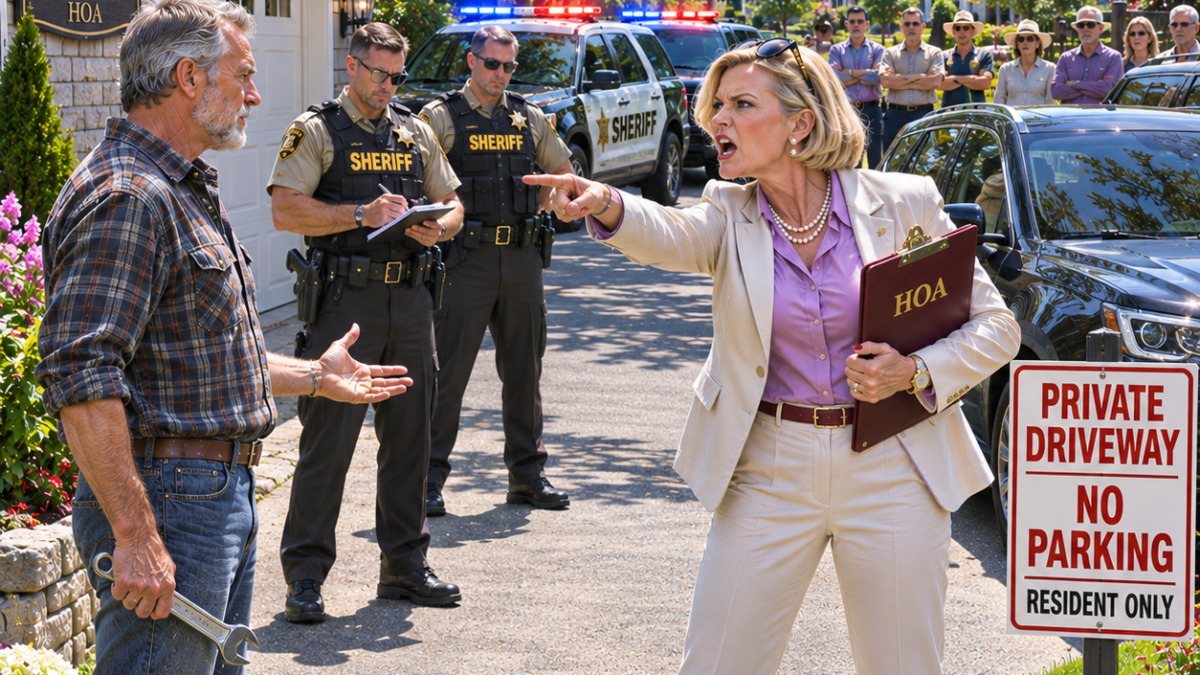
The first time two sheriff’s cruisers blocked my own driveway, their red-and-blue lights washing over the porch while Ruby Howard pointed at me and shouted that I had threatened her, I was sixty-five years old, holding a wrench in one hand and trying to understand how telling the HOA president to move her SUV off my private property had somehow turned me into the suspect.
What made it worse was that Ruby had already spent weeks pushing a new “community parking” policy that she claimed gave residents the right to use any open driveway during HOA events, and when I refused to let her turn the long private drive my late wife and I had maintained for twenty-five years into overflow parking, she decided the easiest way to win was to call the police and tell them I was dangerous.
I knew my deed, the county plat, and even the HOA’s own bylaws were on my side, but when the deputy opened my folder and began comparing those papers against Ruby’s claims while half the cul-de-sac watched from behind fences, I realized this argument was no longer about where one woman parked her car—it was about how far she was willing to go once someone finally told her no.
My name is Ethan Kelly, and before Ruby moved into Maple Grove Estates, our neighborhood was almost boring.
I mean that as a compliment.
I had lived there for twenty-five years. After my wife Mary passed, the house became more than a place to sleep. The oak trees lining the drive were trees we planted together. The rose bushes beside the porch were hers. The garage was where I spent quiet afternoons fixing things that didn’t really need fixing because sometimes keeping your hands busy is easier than sitting alone with memories.
My driveway was unusual for Maple Grove. It curved several hundred feet from the cul-de-sac to my west-facing garage, and the recorded deed made it private property from the road all the way to the house.
Not common space.
Not shared access.
Mine.
A wooden sign near the entrance said PRIVATE DRIVE — NO PARKING.
Nobody had questioned it in decades.
Then Ruby Howard arrived.
She was a realtor, worked in property management, and within weeks of moving into the large brick house across from me, she became acting HOA president after the previous president moved to Florida.
At first, most of us didn’t care.
That was our mistake.
Ruby cared enough for everyone.
She started with landscaping notices, trash-can rules, fence-height complaints, and what she called “beautification patrols.”
Then she noticed my driveway.
One morning while I was washing my truck, she stopped near the sign.
“Ethan, have you ever considered removing that?”
“No.”
“It looks exclusionary.”
“It’s informative.”
“We’re trying to make Maple Grove feel welcoming.”
“People are welcome. Their cars just can’t live in my driveway.”
She didn’t like that answer.
A few days later, her silver Lexus was parked halfway up my drive, blocking my garage while she took a phone call.
I asked her to move.
She rolled her eyes, called me territorial, and left.
After that came the letters.
My mailbox stain was wrong.
My fence looked too rustic.
Then Ruby introduced a temporary parking policy claiming that during community events, residents could use any “available driveway space” for overflow parking.
At the HOA meeting, I raised my hand.
“You can’t authorize parking on somebody else’s property.”
Ruby smiled across the room.
“Oh, Ethan. Don’t you think it’s selfish to hoard space when the community needs it?”
“You call it hoarding. I call it ownership.”
Her smile disappeared.
Two Saturdays later, I opened my front door and found three SUVs across my driveway.
Ruby’s Lexus sat in the middle.
She and two women were standing across the street with clipboards, taking pictures for an HOA inspection.
I walked outside.
“Move the cars.”
Ruby smiled.
“Overflow parking is allowed today.”
“Not here.”
“This driveway connects to the public road.”
“So does my front walk. That doesn’t make it a sidewalk.”
Her friends looked uncomfortable.
Ruby didn’t.
I warned her I would have the vehicles towed.
She took out her phone.
“Touch my car and I’ll call the police.”
“Go ahead.”
She did.
Now, nearly an hour later, Sheriff’s Deputy Daniels stood beside one cruiser while Ruby told him I had screamed at her, blocked her in, and threatened her for performing her HOA duties.
I handed him my deed, the plat map, and a printed copy of the HOA bylaws.
He read them without saying a word.
Ruby crossed her arms.
Then Daniels looked up at me, looked at the three SUVs, and turned slowly toward her.
PART 2
“Ms. Howard,” he said, “where exactly did you get the idea this driveway was common property?”
Ruby’s confidence didn’t disappear.
Not yet.
She lifted her chin.
“The HOA adopted a temporary parking resolution.”
Daniels nodded toward the documents in his hand.
“I’m not asking whether the HOA adopted a parking rule. I’m asking why you believe that rule applies to Mr. Kelly’s privately deeded driveway.”
“It connects directly to the community road.”
“So do forty other driveways.”
“This one has excess capacity.”
I actually looked behind me, wondering whether she could hear herself.
Daniels did not smile.
“Excess capacity doesn’t change ownership.”
Ruby crossed her arms tighter.
“You don’t understand our governing structure.”
“Maybe not.”
He held up my plat map.
“But I understand property lines.”
For the first time that morning, one of the women who had arrived with Ruby quietly moved toward her SUV.
Ruby noticed.
“Don’t go anywhere.”
The woman stopped.
Daniels looked at Ruby.
“Actually, they’re all going somewhere.”
“What does that mean?”
“It means these vehicles need to leave Mr. Kelly’s property.”
Ruby’s face changed.
Not dramatically.
Just a slight tightening around the mouth.
A little color rising in her cheeks.
“You’re taking his side.”
“I’m looking at the deed.”
“You haven’t seen the HOA resolution.”
“I don’t need an HOA resolution to determine whether the HOA owns his driveway.”
Ruby turned toward me.
“This is exactly the kind of hostility I’ve been documenting.”
I stared at her.
“I asked you to move your car.”
“You threatened to tow it.”
“Because it was on my property after I asked you to move it.”
“That’s intimidation.”
Deputy Daniels sighed.
The other officer, a younger man named Reed, was standing near the second cruiser taking notes. I saw him look down for a second, and I had the distinct impression he was hiding a smile.
Daniels handed my folder back.
“Mr. Kelly, your documents appear clear.”
Then he turned to Ruby.
“Ma’am, move your vehicle.”
“You can’t order me around on HOA business.”
“I’m not ordering you around as HOA president.”
He pointed toward the Lexus.
“I’m telling a driver to remove a vehicle from private property after the owner revoked permission.”
“There was no permission to revoke. Community parking rights already exist.”
“Not here.”
Ruby stepped closer.
“This is unbelievable.”
“No, ma’am. It’s fairly straightforward.”
One of her friends whispered:
“Ruby, maybe we should just go.”
Ruby spun toward her.
“No. If we leave, he’ll think he can bully the board whenever he wants.”
I laughed before I could stop myself.
Ruby glared at me.
“There. That. He’s mocking me.”
Daniels rubbed his forehead.
“Mr. Kelly, please don’t.”
“Fair enough.”
Then he looked at Ruby again.
“Move the cars.”
That time, there was no room left for argument.
Her friends got into their SUVs first.
Ruby remained planted beside the Lexus.
For a moment I wondered whether she was actually going to force a deputy to write her a citation over a parking spot she never had the right to use.
Finally, she yanked open her driver’s door.
Before getting in, she pointed at me.
“This is not over.”
I nodded.
“I figured.”
She slammed the door.
The Lexus reversed so quickly that gravel shot across the edge of my lawn.
Daniels watched her leave.
Then he looked at me.
“You two have history?”
“Not much.”
“Feels like much.”
“She moved in last summer.”
“That’s all?”
“She’s efficient.”
Reed laughed.
Daniels handed back the plat.
“You did the right thing calling instead of touching the vehicles.”
“I wasn’t going to damage anything.”
“Good.”
“I was considering having them towed.”
“That would have been your right after proper notice.”
He paused.
“But I’d recommend documenting everything.”
“I already do.”
I pointed toward the small security camera under the porch eave.
Daniels followed my finger.
“Smart.”
After the cruisers left, I stood in the middle of the driveway.
Empty again.
Quiet.
The concrete curved up beneath the oak trees exactly the way it had when Mary and I bought the house twenty-five years earlier.
I should have felt satisfied.
Instead, I felt tired.
That bothered me.
A driveway shouldn’t make a man tired.
Not at sixty-five.
Not after spending most of his life working, raising a family, burying a wife, retiring, and finally expecting the remaining years to be simpler.
But Ruby had discovered something I valued precisely because it was simple.
A boundary.
And she couldn’t stand a boundary she didn’t control.
***
That evening, I found an HOA letter in my mailbox.
**NOTICE OF COMMUNITY DISRUPTION**
I read it once.
Then again, slower.
According to Ruby, I had engaged in “hostile and uncooperative behavior toward HOA officials during an authorized community operation.”
Potential consequences included disciplinary review and “legal escalation.”
I carried the letter into the garage and laid it on my workbench.
Mary’s photograph sat on the shelf above it.
She was laughing in the picture, holding a paintbrush and wearing one of my old college sweatshirts. We had been repainting the porch that summer.
I looked at the letter.
Then at her photograph.
“You’d hate this woman,” I said.
The garage, being a garage, offered no opinion.
Mary would have, though.
She had been five feet four inches tall and possessed exactly zero tolerance for people who confused politeness with surrender.
If Ruby had parked on Mary’s driveway after being told not to, there was a fair chance Ruby’s Lexus would have been surrounded by lawn chairs before lunch.
That thought made me smile.
I folded the notice.
Put it into a file.
I labeled the file:
**RUBY**
It eventually became much thicker than I wanted.
***
For about a week, nothing happened.
Ruby still watched my house.
I noticed the curtains across the street moving whenever I worked near the front yard.
One afternoon, I was trimming roses when Linda Mercer walked over with her golden retriever, Daisy.
Linda had lived three houses down for nearly eighteen years and ran the neighborhood book club.
She stopped beside me.
“Is she watching?”
“Probably.”
Linda didn’t even look toward Ruby’s house.
“I can feel it.”
I clipped another dead bloom.
“You know what worries me?”
“What?”
“That everybody knew her parking policy was nonsense, but nobody said anything.”
Linda sighed.
“You know why.”
“Do I?”
“She wears people down.”
“That’s not a reason.”
“It is if you’re eighty-two and don’t want to spend six weeks arguing about a fence.”
That stopped me.
Linda continued.
“Ruby fined Mr. Carlson because his trash bin was visible from the side street.”
“I heard.”
“He appealed.”
“And?”
“She scheduled three hearings. Changed one at the last minute. Then told him his appeal was untimely.”
I set the clippers down.
“I didn’t know that part.”
“Most people don’t.”
She looked toward Ruby’s house now.
“People started deciding it was easier to pay.”
That was how control grows.
Not because everybody agrees.
Because disagreement becomes more expensive than surrender.
I understood systems.
Engineering teaches you to look for load paths.
Pressure never disappears.
It transfers.
Ruby had built a neighborhood where pressure moved from her to everybody else.
Now she had reached something that didn’t move.
Me.
I wasn’t brave.
I was just retired.
I had time.
And I had paperwork.
Sometimes that’s enough.
***
Two Saturdays later, Maple Grove held its annual open house.
Ruby had transformed what used to be a small neighborhood barbecue into what looked like a suburban campaign rally.
There were balloons at the entrance.
A banner stretched across the community lawn.
**MAPLE GROVE OPEN HOUSE — WELCOME FUTURE NEIGHBORS**
Folding tables appeared near the pond.
A realtor tent went up.
Ruby, naturally, was dressed in a bright pink blazer.
From my porch, I watched her direct cars with a clipboard.
I tried to ignore it.
I made coffee.
Worked on a cabinet hinge.
Checked the weather.
Then an unfamiliar sedan turned into my driveway.
I stood.
A second followed.
Then a third.
“No.”
I was halfway down the steps before the first car stopped.
The driver, a middle-aged man in a blue polo shirt, lowered his window.
“Morning.”
“You can’t park here.”
He looked confused.
“Ruby said overflow.”
“Ruby doesn’t own this driveway.”
“Oh.”
He glanced toward the street.
A volunteer wearing an HOA badge was waving cars toward us.
I pointed to the PRIVATE DRIVE sign.
“You’ll have to back out.”
“Sorry.”
He did.
The other two drivers weren’t as cooperative.
One had already parked.
The second pulled behind him.
Ruby arrived within a minute.
“Ethan.”
“No.”
She smiled.
“You don’t even know what I’m going to say.”
“I know what the cars are saying.”
“This is a community event.”
“This is my driveway.”
“We discussed temporary access.”
“No. You discussed it. I rejected it.”
Her smile remained, but there was tension behind it.
“Do you really want to embarrass guests?”
“I don’t know these people.”
“They’re potential buyers.”
“Then you should show them legal parking.”
She lowered her voice.
“Why are you always so difficult?”
That question irritated me more than it should have.
Because I wasn’t difficult.
For twenty-five years, I had been the neighbor who lent extension cords.
Fixed lawnmowers.
Helped Mark rebuild his deck.
Drove Linda to urgent care when she sprained an ankle.
I had never once called the HOA about anybody.
Ruby had arrived less than a year ago and somehow rewritten my refusal to surrender private property as a character defect.
“I’m not difficult,” I said. “I’m saying no.”
“To cooperation.”
“To parking.”
“It’s the same thing.”
“No, Ruby. That’s the problem. You think cooperation means doing whatever you want.”
Her expression went cold.
Behind her, several people had started watching.
She hated audiences she didn’t control.
She turned.
“Leave the cars.”
Then she walked away.
I stared at her.
“Ruby.”
She kept going.
“Move them.”
She raised one hand without turning around.
That was the moment something inside me settled.
Not exploded.
Settled.
I took photographs of both license plates.
Wide shots showing the vehicles on my driveway.
The posted sign.
My blocked garage.
Then I called the sheriff’s office.
Again.
***
Twenty minutes later, I saw two cruisers.
Officer Reed arrived first.
Daniels stepped out of the second.
The look on his face when he recognized my house would have been funny under different circumstances.
“Mr. Kelly.”
“Officer.”
“Please tell me somebody stole your mailbox.”
“Not yet.”
Ruby hurried toward them.
“Thank goodness.”
Daniels looked at me.
I shrugged.
Ruby began.
“This man is harassing HOA guests, photographing private vehicles without consent, obstructing a public event, and creating an unsafe atmosphere.”
Reed glanced toward the banner.
“Public event?”
“Yes.”
“In a private residential development?”
“It’s an open house.”
Daniels looked at the two vehicles.
“Whose cars?”
“Guests.”
“Who authorized them to park here?”
“The HOA.”
He closed his eyes briefly.
Then opened them.
“We’ve done this.”
“This is different.”
“How?”
“We passed a clarification.”
“A clarification of what?”
“Community access rights.”
I almost admired the phrase.
Daniels did not.
“Did Mr. Kelly sign anything?”
“No.”
“Did he give permission?”
“Permission is implied by participation in the association.”
Daniels turned toward me.
“You’re in the HOA?”
“My house is subject to Maple Grove’s basic declaration, but the driveway is separately deeded private property. The bylaws exclude individual driveways from common parking rules.”
I handed over the same folder.
Daniels barely needed to read it now.
Ruby’s voice rose.
“This is harassment.”
Reed looked at her.
“By who?”
“Him.”
“For what?”
“Photographing my car.”
“Your car is parked on his driveway?”
Ruby hesitated.
“Yes, but—”
“Then why is he not allowed to photograph it?”
“He’s intimidating me.”
“What did he say?”
“He threatened consequences.”
I frowned.
“I said I’d call the sheriff and document trespassing.”
Reed nodded.
“That’s not a threat.”
Ruby’s face reddened.
The crowd around the open house had grown.
Phones were out.
Neighbors leaned against fences.
I hated it.
I had never wanted an audience.
Ruby, on the other hand, had.
Until the audience stopped agreeing with her.
Daniels said:
“Move the cars.”
Ruby’s voice sharpened.
“You said that last time.”
“Yes.”
“You cannot keep undermining an elected official.”
“I’m enforcing property law.”
“You’re taking his side because he’s a man.”
The cul-de-sac went quiet.
Daniels stared at her.
“Ma’am.”
“You heard me.”
“No. What I’m hearing is a parking complaint.”
“You’re dismissing me.”
“I’m telling you to move vehicles off property where the owner has explicitly refused permission.”
Ruby turned toward the crowd.
“You see this? This is what happens when bullies weaponize law enforcement against women in leadership.”
I felt my face heat.
“Ruby, stop.”
She whipped around.
“Don’t tell me what to do.”
“Then stop lying about me.”
“There. Threatening again.”
“I’m standing twenty feet away.”
She reached her Lexus.
I thought she was going to move it.
Instead, she kicked the driver’s door.
Hard.
Metal boomed across the cul-de-sac.
Everyone froze.
Ruby grabbed her forearm.
Then pointed at me.
“He did that!”
I actually laughed once from pure disbelief.
“What?”
“He damaged my car!”
Officer Reed’s jaw dropped.
Daniels stared at her.
“Ma’am.”
“He kicked it.”
“Ruby,” Linda called from near the sidewalk, “we all saw you.”
Ruby’s face twisted.
Then she grabbed her arm.
“And he grabbed me.”
That changed everything.
Daniels stepped forward.
“Stop.”
“He assaulted me.”
“No.”
“Yes!”
“Ma’am, both officers were watching you.”
She looked at him.
For one second, I saw the exact moment she realized she had gone too far.
Most people would retreat.
Ruby doubled down.
“He’s violent.”
Daniels’s voice became flat.
“Turn around.”
Her eyes widened.
“What?”
“Turn around.”
“You’re arresting him?”
“No.”
The crowd went silent.
Daniels continued.
“You’ve repeatedly refused lawful instructions to remove your vehicle, you’ve created a disturbance, and now you’re making accusations about conduct we directly observed did not occur.”
“You cannot arrest the HOA president.”
Reed said quietly:
“The law doesn’t have an HOA-president exception.”
Ruby backed away.
“I’m leaving.”
“You were told to leave twenty minutes ago.”
“I’m leaving now.”
Daniels reached for her arm when she tried to push past.
Ruby screamed.
“Don’t touch me!”
“Turn around.”
“You’re hurting me.”
“I’m not.”
Within seconds, her hands were cuffed behind her.
Not violently.
No dramatic takedown.
Just practiced police procedure.
That almost made it more shocking.
Ruby Howard, who had spent months waving a clipboard like a badge, stood beside a sheriff’s cruiser with actual handcuffs on her wrists.
The pink blazer looked suddenly ridiculous.
Not because of the color.
Because she had dressed for authority and ended the afternoon learning the difference between authority and costume.
She looked at me.
“I’ll ruin you.”
Daniels opened the cruiser door.
“Ma’am, stop talking.”
“This is his fault.”
“No.”
She pointed as best she could with cuffed hands.
“Ethan Kelly, you will regret this.”
I didn’t answer.
The door closed.
For several seconds, nobody said anything.
Then Mark Collins walked up carrying a rake.
He was a retired firefighter and had known me almost as long as I’d lived there.
He watched the cruiser leave.
“Well.”
“That’s one word.”
“Did she really kick her own car and blame you?”
“Yes.”
“In front of two deputies?”
“Yes.”
Mark nodded.
“I’ve entered burning buildings with better judgment.”
That was when I finally laughed.
Not triumphantly.
From exhaustion.
The open house ended early.
***
By Sunday morning, the video was everywhere in Maple Grove.
Someone had recorded the entire confrontation.
Not me.
A teenager across the street.
The clip clearly showed Ruby kicking her own Lexus.
Then pointing at me.
Then claiming I did it.
I watched it exactly once.
That was enough.
Linda came over holding her phone.
“Three hundred comments.”
“I don’t want to know.”
“One person made a meme.”
“I especially don’t want to know.”
She turned the screen toward me anyway.
It was a picture of Ruby in the pink blazer with the words:
**WHEN THE HOA VIOLATION IS YOURSELF**
I laughed despite myself.
Then felt guilty.
Linda noticed.
“She did try to get you arrested.”
“I know.”
“You’re allowed to laugh.”
“Maybe.”
She sat beside me.
“Mary would’ve printed it.”
I turned toward her.
Linda smiled.
“You know she would.”
She was right.
Mary would have printed it, put it on the garage refrigerator, and waited for me to pretend not to find it funny.
The thought hurt and comforted me at the same time.
That was grief after enough years.
It stopped being a knife.
Became weather.
Some days gentle.
Some days sudden.
Ruby had disrupted more than parking.
She had taken a place Mary and I built around peace and filled it with vigilance.
I resented her for that more than I resented any fine.
***
Monday afternoon, Sarah Whitman called.
Sarah had handled our estate work after Mary died and had helped me update the deed records.
“Ethan.”
“Sarah.”
“You’re famous.”
“No.”
“Yes.”
“Please say this isn’t on television.”
“Channel 8.”
I closed my eyes.
“What did they call me?”
“Retired engineer.”
“Could be worse.”
“They called Ruby a ‘controversial HOA official.’”
“That seems generous.”
Sarah laughed.
Then her tone changed.
“She hired counsel.”
“Of course.”
“James Bolton.”
“Know him?”
“I know of him.”
“Good?”
“Persistent.”
“That doesn’t sound reassuring.”
“It’s not supposed to.”
She explained Ruby had filed a harassment complaint alleging intimidation, humiliation, interference with HOA operations, and reputational harm.
I stared at my coffee.
“She kicked her own car.”
“I saw.”
“She claimed I did it.”
“I saw.”
“Two deputies saw.”
“I know.”
“So why are we having this conversation?”
“Because filing nonsense is easier than winning nonsense.”
That sentence stayed with me.
People imagine law as a truth machine.
It isn’t.
Law is a process.
And process costs time.
Paper.
Money.
Energy.
Ruby knew that.
Even if she couldn’t win, she could make defending myself expensive.
Sarah seemed to hear the silence.
“Don’t talk to her.”
“I wasn’t planning to.”
“Don’t respond to posts.”
“I don’t use Facebook enough to know how.”
“Good.”
“Can I wave?”
“Only if you’re emotionally prepared for it to become Exhibit C.”
I smiled.
“Understood.”
***
The certified letter arrived Friday.
**NOTICE OF INTENT TO SUE**
Bolton accused me of creating an unsafe environment for HOA officers.
He demanded removal of my PRIVATE DRIVE — NO PARKING sign because it allegedly created a “hostile visual message inconsistent with community hospitality.”
I read that sentence aloud to Mark.
He stared.
“Hostile visual message?”
“Apparently.”
“It says no parking.”
“I know.”
“You should add flowers.”
“That might make the hostility worse.”
Mark drank his beer.
“You know what this is.”
“What?”
“She’s trying to make you tired.”
I looked at him.
“That’s exactly what it feels like.”
“She can’t beat the deed.”
“No.”
“So she’ll beat the man.”
That was smarter than Mark usually sounded after two beers.
I folded the letter.
“Not happening.”
But later, after he left, I sat alone in the kitchen.
The house was too quiet.
Legal invoices were already accumulating.
Nothing catastrophic.
But enough.
I thought about how easy it would be to take the sign down.
Let people park occasionally.
Avoid the meetings.
Avoid court.
Avoid Ruby.
Then I looked through the kitchen window toward the oak-lined driveway.
Mary and I planted those trees during our first spring in the house.
She had stood on one side of each sapling while I tamped soil around the root ball.
“Far enough from the pavement?” she asked.
“Plenty.”
“What if the road gets widened?”
“It won’t.”
“How do you know?”
“Because it’s ours.”
She smiled.
“Good answer.”
Twenty-five years later, those trees formed a canopy.
The driveway beneath them carried every memory of our life there.
Christmas mornings.
Our daughter learning to drive.
Mary coming home from chemotherapy.
The ambulance the final week.
That strip of concrete wasn’t valuable because cars parked on it.
It was valuable because it connected the outside world to my home.
Ruby wanted to turn it into overflow.
I couldn’t explain why that felt so insulting without sounding sentimental.
Maybe ownership is sentimental.
A deed is paper.
A home is everything behind it.
I called Sarah the next morning.
“Fight it.”
“I was hoping you’d say that.”
“Counterclaim if you think we should.”
“I do.”
“For what?”
“Trespass. Harassment. Property interference. False statements if appropriate.”
“Do it.”
She paused.
“You sure?”
“No.”
“That’s honest.”
“I’m tired.”
“I know.”
“But I’m not taking down the sign.”
“Good.”
***
The next HOA meeting drew more than fifty people.
Normally twelve was considered a crowd.
Ruby sat at the front beside Bolton.
No pink blazer.
Navy suit.
Pearls.
Controlled expression.
If I hadn’t seen her in handcuffs two weeks earlier, I might have believed she was the calmest person in the room.
Mark sat on my left.
Linda on my right.
Deputy Daniels stood near the back wall.
Not as security for me.
As security for everybody.
That told you what Maple Grove had become.
Ruby tapped the microphone.
“Good evening.”
Nobody answered.
She continued.
“We are here to address misinformation concerning recent events and the targeted harassment of association leadership.”
Mark leaned toward me.
“She means video.”
I whispered:
“Behave.”
“I am.”
Ruby looked directly at me.
“Certain individuals have deliberately undermined board authority.”
I raised my hand.
She ignored it.
“Through confrontational behavior, unauthorized recordings, and selective presentation of events.”
Linda raised her hand.
Ruby ignored her too.
Then Richard Thompson, one of the board members, spoke.
“Ruby, residents should be allowed to respond.”
She glared.
“This is my statement.”
“It’s a board meeting.”
“I know what it is.”
That small exchange mattered.
Before the driveway fight, nobody on the board challenged her.
Now Richard had.
Ruby finished her speech.
Then finally said:
“Mr. Kelly.”
I stood.
“Thank you.”
“Keep it brief.”
“I will.”
I held up the deed.
“My driveway is private property.”
Groans.
Not at me.
At the fact that this even needed repeating.
“The sheriff confirmed it twice.”
Ruby interrupted.
“We dispute the interpretation.”
Daniels spoke from the back.
“No, ma’am. We don’t.”
A few people laughed.
Bolton leaned toward Ruby.
She ignored him.
I continued.
“I didn’t ask for this fight. I asked cars to leave my driveway.”
Ruby slapped a hand on the table.
“You publicly humiliated me.”
“I didn’t arrest you.”
“You provoked the arrest.”
“You kicked your car.”
“I was under extreme stress because of your aggression.”
Linda stood.
“No.”
Ruby turned.
“Excuse me?”
Linda’s voice shook, but she continued.
“We watched you.”
“You’re not part of this.”
“We’re all part of this. You made sure of that.”
The room murmured.
Then Mark spoke.
“She’s right.”
Ruby’s face hardened.
“This meeting is becoming disorderly.”
Somebody near the back called:
“You called the cops over parking.”
Another voice:
“You lied about him damaging your car.”
Ruby stood.
“That recording was edited.”
That was when somebody connected a laptop to the community projector.
I still don’t know who.
The wall behind Ruby lit up.
The video began.
Her Lexus.
Her foot striking the door.
Her pointing at me.
“He did it!”
The room went silent.
Then somebody laughed.
A second person joined.
Within seconds, the entire room cracked.
Not cruel laughter.
Disbelief.
The kind people make when tension finally becomes absurd.
Ruby spun around.
“Turn that off!”
The video continued.
“I said turn it off!”
Bolton stood.
“Who is controlling the projector?”
Mark called:
“Internet.”
That made it worse.
Ruby’s face went deep red.
She looked around the room.
“You people think this is funny?”
The laughter faded.
Her voice broke slightly.
“I have spent months trying to improve this neighborhood.”
Nobody answered.
“I raised standards.”
Silence.
“I protected property values.”
Richard spoke quietly.
“Ruby, sit down.”
She stared at him.
“You too?”
“This isn’t working.”
Her eyes widened.
“What isn’t?”
“Your leadership.”
That landed harder than the laughter.
The board voted that night to suspend her pending a formal conduct review.
Five to one.
Ruby left before the vote was officially entered into the minutes.
The door slammed behind her.
For a long time, nobody moved.
Then Daniels said from the back:
“Well.”
Mark whispered:
“He stole my line.”
***
For four days, Maple Grove felt like the old neighborhood.
No violation notices.
No beautification patrol.
No photographs.
No Ruby standing near my driveway.
Kids rode bikes again.
Tom Alvarez, the mechanic two streets over, put his three ceramic gnomes back in the front garden.
Then added a fourth.
Linda noticed.
“He’s getting reckless.”
“Revolutionary.”
We laughed.
That was what peace used to feel like.
Small jokes.
Nothing at stake.
I should have known Ruby wouldn’t let it last.
***
Anonymous posts started appearing in the neighborhood Facebook group.
One accused me of “targeting women volunteers.”
Another said I had installed illegal surveillance equipment aimed at neighbors.
A third claimed my irrigation system was sending contaminated gray water into community drains.
Linda showed me her phone.
“Community Truth Teller.”
“That’s subtle.”
“Think it’s Ruby?”
“Could be anybody.”
“It says ‘collective harmony’ twice.”
“Ruby.”
I took screenshots.
Sarah had taught me well.
Document.
Do not engage.
Another post claimed I was running an unlicensed business from my garage.
That one amused me.
I had two old lawnmowers, a drill press, a 1968 radio I kept promising to repair, and more jars of mismatched screws than any reasonable man needs.
If that qualified as a business, the profit margin was terrible.
A county inspector arrived the following week.
He was almost apologetic.
“Complaint about commercial activity.”
“Want to buy a broken lawnmower?”
He laughed.
“No.”
I showed him the garage.
Then the irrigation system.
Then my outdoor lights.
Everything passed.
He closed his tablet.
“You’re fine.”
“Can you put that in writing?”
“You expecting more complaints?”
“Yes.”
He looked across the street.
“I’ve heard.”
I got the written report.
Added it to the Ruby file.
The folder now required two clips.
***
Then the lawsuit arrived.
Not a threat.
An actual filing.
Ruby and, through her allies, the HOA alleged defamation, harassment, invasion of privacy, and interference with association operations.
Sarah read the claims across from me in a diner booth.
She had a yellow highlighter in one hand.
Coffee in the other.
“This is garbage.”
“Legal term?”
“Highly technical.”
She marked a paragraph.
“They say you circulated the arrest video.”
“I didn’t.”
“Good.”
“Can they prove I did?”
“No.”
Another paragraph.
“They say your sign reduced community aesthetics.”
“My sign has been there since 1998.”
“Excellent.”
Another.
“They say you engaged in repeated verbal intimidation.”
“I told her to move her car.”
“Any witnesses?”
“Half the neighborhood.”
Sarah looked up.
“Ethan.”
“What?”
“This is the kind of case lawyers secretly enjoy.”
“Why?”
“Because the evidence is almost rude.”
I didn’t feel relieved.
I felt old.
“Sarah, what’s this going to cost?”
Her smile faded.
She gave me a realistic range.
Not ruinous.
Still more than I wanted to spend on something I never asked for.
I looked through the diner window.
People crossed the parking lot carrying groceries.
Normal lives.
Normal problems.
“I hate this.”
“I know.”
“I buried my wife three years ago.”
Sarah’s expression softened.
“I remember.”
“I retired because I wanted quiet.”
She set down the highlighter.
“Then let’s get you back to quiet.”
“How?”
“By finishing this.”
***
Court came six weeks later.
The county courthouse was an old brick building with polished wood benches and a ceiling fan that clicked once every rotation.
Sarah and I sat at the defense table.
Ruby entered wearing a navy suit.
Her hair was perfect.
Her posture perfect.
James Bolton carried two binders.
From a distance, they looked formidable.
Then Judge David Miller walked in.
He was in his sixties.
Gray eyebrows.
No patience for theater.
“Howard versus Kelly.”
He looked at the file.
Then at counsel.
“I have six HOA matters on the docket today. Please don’t make me regret public service.”
The gallery laughed.
Bolton began.
He described Ruby as a dedicated community leader subjected to a campaign of humiliation.
He talked about toxic hostility.
Gender dynamics.
Community cohesion.
Collective harmony.
Sarah wrote something on her pad.
I glanced.
**SIX**
I whispered:
“What?”
“That’s the sixth time he said collective harmony.”
I nearly laughed.
Bolton continued.
“Mr. Kelly repeatedly challenged lawful HOA policy, photographed Ms. Howard, interfered with official events, and contributed to a climate in which she was publicly humiliated.”
Judge Miller leaned forward.
“Counsel.”
“Yes, Your Honor?”
“Where was her vehicle parked during the incident that led to arrest?”
Bolton paused.
“On Mr. Kelly’s driveway.”
“Privately owned?”
“We dispute the scope of—”
“Do you dispute title?”
“No.”
“Easement?”
“No.”
“Common area?”
“No.”
The judge sat back.
“All right.”
Sarah’s turn.
She stood.
“My client’s driveway has been privately deeded for more than twenty-five years.”
She presented the plat.
The deed.
The HOA bylaws.
The sheriff’s incident reports.
The county inspection findings.
Then the videos.
Ruby parking after being told not to.
Ruby instructing guests to use my driveway.
Ruby kicking her Lexus.
Ruby accusing me.
Ruby claiming I grabbed her while officers stood between us.
The courtroom watched.
I didn’t.
I watched Ruby.
At first she stared at the screen.
Then down.
Bolton whispered something.
She shook her head.
The video ended.
Judge Miller was quiet.
Then:
“Ms. Howard.”
Ruby looked up.
“Yes, Your Honor?”
“Did you kick your own vehicle?”
She swallowed.
“I was frustrated.”
“Did you then state that Mr. Kelly caused the damage?”
“The situation was chaotic.”
“That is not what I asked.”
She looked at Bolton.
He could not answer for her.
“Yes.”
The judge nodded.
“Did Mr. Kelly grab you?”
“I felt physically threatened.”
“Did he touch you?”
Silence.
“No.”
“Did you tell law enforcement he did?”
“I believed—”
“Did you?”
“Yes.”
Judge Miller leaned back.
The fan clicked overhead.
Once.
Twice.
Three times.
“Counsel, help me understand the legal basis for this suit.”
Bolton tried.
HOA authority.
Community events.
Emotional distress.
Reputational harm.
But each argument kept colliding with the same facts.
Private property.
Clear notice.
Documented trespass.
Recorded false claims.
Sarah barely needed theatrics.
That was her strength.
She simply stacked fact upon fact until Ruby’s story had nowhere left to stand.
Then she said:
“Your Honor, this case is being presented as a dispute about community governance. It is not. My client never tried to govern Ms. Howard. He asked her not to park on his driveway.”
The judge nodded.
Sarah continued.
“Every escalation after that came because she refused to accept that one boundary.”
She sat.
The ruling came later that afternoon.
Ruby’s claims were dismissed.
The court awarded me legal fees associated with defending the baseless portions of the suit and damages related to repeated property interference.
It wasn’t a fortune.
I didn’t want a fortune.
I wanted my savings not to be drained because somebody couldn’t accept the word no.
Judge Miller looked at Ruby.
“Ms. Howard, HOA authority is contractual and limited. It does not give a board president personal control over private property.”
Ruby’s face was rigid.
He continued.
“I strongly suggest that you spend less time expanding your interpretation of other people’s obligations and more time respecting the written boundaries already in place.”
Gavel.
Done.
Outside the courthouse, Mark waited near the steps.
“How’d it go?”
Sarah held up the order.
Mark grinned.
“Frame it.”
“I already have too much Ruby memorabilia.”
“Tattoo it.”
Sarah laughed.
I didn’t.
Not immediately.
I stood at the top of the courthouse steps.
Cars moved on the street below.
Ruby walked toward the parking lot with Bolton.
She didn’t look at me.
For months, I had imagined how victory would feel.
I expected satisfaction.
What I felt was relief.
Heavy.
Deep.
Almost sad.
Sarah touched my arm.
“You okay?”
“I’m tired.”
“That’s allowed.”
“Is it over?”
She looked toward Ruby.
“The lawsuit is.”
Not the answer I wanted.
But the honest one.
***
Two days later, Richard and Paige Thompson came to my house.
They were both HOA board members.
Richard held his hat in both hands.
Paige looked like she had rehearsed what she wanted to say.
“Ethan.”
“Come in.”
We sat at the kitchen table.
Richard started.
“We owe you an apology.”
“The whole board?”
“Some more than others.”
Paige added:
“Ruby told us things that weren’t true.”
“I assumed.”
“She said you threatened her before the first police call.”
“I didn’t.”
“We know that now.”
“She said the driveway documents were ambiguous.”
“They weren’t.”
“We know.”
Richard looked embarrassed.
“We should’ve checked.”
“Yes.”
I didn’t soften it.
They needed to hear that.
He nodded.
“You’re right.”
Paige continued.
“We’re holding a special vote to remove Ruby permanently.”
“I thought she was suspended.”
“She is.”
“And?”
“There are additional concerns.”
“What concerns?”
They exchanged a look.
“Finances.”
That word changed the conversation.
“What kind?”
Richard hesitated.
“We’re still reviewing.”
I leaned back.
“This isn’t about me anymore.”
“No.”
“Then handle it properly.”
“That’s why we’re here.”
Paige slid a folded paper toward me.
“We’re creating a review committee for property-rights disputes.”
I stared.
“No.”
She blinked.
“You haven’t read it.”
“No.”
Richard almost smiled.
“We thought you might say that.”
“You want me inside the HOA after I just paid a lawyer to keep the HOA out of my driveway?”
“Not on the board.”
“Still no.”
“As an advisor.”
I stared at them.
Paige laughed nervously.
“You know the governing documents better than most of us.”
“That’s because I was forced to.”
“Exactly.”
I shook my head.
“Let me survive the next meeting first.”
“Fair.”
They left.
For the first time, I believed Maple Grove might actually change.
Then Mark came over with beer and proved things were about to get worse before they got better.
***
“Carl has receipts.”
We were sitting on the porch.
“Who’s Carl?”
“The treasurer.”
“I know who Carl is. What receipts?”
Mark took a drink.
“Ruby’s.”
“What did she buy?”
“Landscaping.”
“That’s not a crime.”
“For her house.”
I looked at him.
He continued.
“Dry cleaning.”
I frowned.
“HOA uniforms?”
“Ruby’s clothes.”
“Oh.”
“Security cameras.”
“For the community?”
“Her property.”
My stomach tightened.
“How much?”
“Carl says close to seven thousand he can’t explain.”
“Does the board know?”
“They do now.”
“Then why are you telling me?”
“Because I know everything.”
“That’s deeply unfortunate.”
Mark ignored me.
“Also a twelve-hundred-dollar consulting payment to her cousin’s real-estate business.”
“For what?”
“Community branding.”
I stared.
“Is that a real thing?”
“Probably somewhere.”
“Did he do anything?”
“No idea.”
I leaned back.
This explained something.
Not everything.
But something.
Ruby’s obsession with control had always looked personal.
Maybe some of it was defensive.
If board members started asking questions, other questions might follow.
People who build authority around intimidation often do it because scrutiny is dangerous.
“Carl needs to turn everything over to the board attorney.”
“He did.”
“And maybe county authorities.”
“He plans to.”
Mark grinned.
“Special meeting next Thursday.”
“You’re enjoying this.”
“I bought popcorn.”
“You’re sixty-eight.”
“Popcorn doesn’t have an age limit.”
***
The special meeting was standing room only.
Every folding chair was filled.
People lined the walls.
Even Daniels attended off duty.
Ruby arrived last.
Black pantsuit.
No pink.
No clipboard.
For the first time since I had known her, she looked tired.
Not weak.
Not defeated.
Just tired.
Richard opened the meeting.
“This session concerns allegations of financial misconduct involving former acting president Ruby Howard.”
Ruby shot upright.
“Former?”
“You remain suspended.”
“I was never lawfully suspended.”
“The minutes say otherwise.”
“This board has been corrupted.”
Mark whispered:
“Five minutes.”
I elbowed him.
Richard continued.
“Carl Patterson will present the audit findings.”
Carl stood.
He was a quiet man I had spoken to maybe four times in twenty years.
He opened a thick folder.
“During routine review following the litigation expenses, I found several reimbursements lacking proper authorization.”
Ruby’s eyes narrowed.
“These were presidential expenses.”
Carl looked at her.
“Our bylaws do not contain a category called presidential expenses.”
A few people laughed.
Ruby snapped:
“This isn’t funny.”
Nobody argued.
Carl read the transactions.
Personal landscaping.
Dry cleaning.
Home security equipment.
Consulting fees.
Small charges individually.
Together, significant.
Ruby interrupted.
“The landscaping enhanced the visual approach to the community.”
“It was at your house.”
“My house faces the entrance corridor.”
“Your dry cleaning?”
“I attended HOA events.”
A murmur went through the room.
Ruby raised her voice.
“The president represents Maple Grove. Presentation matters.”
Linda spoke from behind me.
“With our money?”
Ruby looked toward her.
“You have no idea what leadership costs.”
Linda answered quietly:
“Apparently seven thousand dollars.”
That hurt.
Ruby’s face changed.
She turned toward me.
“This is him.”
I stared.
“What?”
“He started this.”
Carl shook his head.
“No.”
Ruby pointed.
“He poisoned everyone against me.”
Richard said:
“Ruby, sit down.”
“You’re all doing this because he embarrassed me.”
Paige leaned forward.
“Ethan didn’t authorize these transactions.”
“He created the environment.”
“No.”
“You’re weak.”
Paige flinched.
Ruby kept going.
“All of you are weak. I’m the only person who ever made this community respectable.”
That was when Linda stood.
Her voice was soft enough that everybody leaned in.
“You didn’t make it respectable.”
Ruby stared.
Linda finished.
“You made it miserable.”
Silence.
No laughter.
No applause.
Just the kind of silence where truth lands cleanly.
Ruby looked around the room.
People she had fined.
People she had embarrassed.
People who once avoided eye contact.
Nobody looked away now.
Richard called the vote.
Forty-six in favor of permanent removal.
Two against.
One abstention.
Ruby sat completely still.
The count was read again.
Her presidency was over.
No police.
No handcuffs.
No courtroom.
Just votes.
In some ways, that seemed harder for her.
Authority had been the one thing she believed nobody could take.
Now her own neighbors had.
People began gathering coats.
Mark whispered:
“I expected more fireworks.”
“Give it time.”
I walked toward the exit.
As I passed Ruby, she spoke without looking up.
“Enjoy your victory, Ethan.”
I stopped.
“It isn’t a victory.”
She laughed bitterly.
“Of course you’d say that.”
“I wanted cars off my driveway.”
“You wanted me gone.”
“No.”
That made her look at me.
I continued.
“I wanted you to stop.”
Her eyes were wet.
Not crying.
Close.
“There’s no peace in places like this,” she said. “Only power.”
I thought about Mary.
The oak trees.
Twenty-five quiet years before Ruby arrived.
“That’s where you were wrong.”
She looked at me.
“Power without respect doesn’t last.”
Then I left.
Mark waited outside.
“What’d she say?”
“Nothing useful.”
He looked back toward the building.
“You feel sorry for her.”
“A little.”
“Don’t.”
“I didn’t say I trust her.”
“That’s better.”
***
That night, I repainted my driveway sign.
PRIVATE DRIVE — NO PARKING.
The original letters had faded from sun and rain.
I sanded the wood.
Brushed on fresh stain.
Then painted each letter slowly.
Linda walked past with Daisy.
“Looks good.”
“Thanks.”
“Strong message.”
“It was clear the first time.”
She smiled.
“Apparently not clear enough.”
When she left, I stood looking at the sign.
Mary helped me make the first one.
She had painted the letters because her hand was steadier.
Mine weren’t as neat.
That bothered me for maybe ten seconds.
Then I decided the imperfections suited the story.
The sign wasn’t decorative anymore.
It had become evidence of something larger.
Not ownership.
Boundaries.
The difference mattered.
***
The next morning, a small envelope waited in my mailbox.
No return address.
Inside:
**You win.**
**I’m leaving Maple Grove.**
**You won’t hear from me again.**
**But remember, every HOA needs a villain. Maybe someday that will be you.**
**R.H.**
I read it twice.
Then folded it.
I expected anger.
Instead, I felt exhausted.
Ruby still saw everything as roles.
Winner.
Loser.
President.
Villain.
Enemy.
She could not imagine a conflict where somebody simply wanted to be left alone.
I put the note into the file.
Then changed my mind.
I took it back out.
Mary’s photograph was on the garage shelf.
“What do you think?”
Silence.
I looked at the note again.
Then put it in a drawer instead.
Not evidence.
History.
There was a difference.
***
Ruby listed her house within the month.
A FOR SALE sign appeared on her lawn.
She stopped attending meetings.
Stopped walking past my driveway.
Stopped sending notices.
One morning, a moving truck arrived.
I watched from inside.
Not hiding.
Just not interested in making her departure another public event.
Workers carried boxes.
Furniture.
A large framed mirror.
Ruby stood near the truck wearing jeans and a plain sweater.
No blazer.
No sunglasses.
She looked smaller.
At one point, she glanced toward my house.
Our eyes met through the window.
Neither of us waved.
That was fine.
She got into her Lexus.
The same silver car that had started so much trouble.
She drove to the end of the cul-de-sac.
Paused.
Then turned away.
I never saw her again.
For several minutes, I stood at the window.
Then I went outside and swept leaves off the driveway.
That was the first thing I did after Ruby Howard left Maple Grove.
Swept leaves.
It felt perfect.
***
The neighborhood changed quickly.
Richard became interim HOA president.
Paige handled records.
Carl tightened the financial controls so aggressively that Mark joked you needed two signatures to buy a box of paper clips.
The first letter from the new board began:
**We apologize for prior overreach and are implementing procedures intended to restore trust.**
I didn’t throw it away.
That alone was progress.
They revoked Ruby’s temporary parking policy.
Clarified in writing that individual driveways could not be used without owner consent.
Ended beautification patrols.
Created a formal appeal process for violations.
Required recorded votes for fines above a threshold.
Required receipts and board approval for reimbursements.
None of it was revolutionary.
That was the point.
Good governance is usually boring.
Ruby had made everything dramatic because drama kept attention focused on her.
The new board made things dull again.
I loved them for it.
***
Mark came by one Friday carrying beer.
Linda followed with lemon pie.
We sat on my porch as the sun dropped behind the houses.
Mark said:
“You realize you’re famous now.”
“No.”
“Yes.”
Linda nodded.
“People call you the Driveway Defender.”
I stared at her.
“No.”
“I didn’t invent it.”
“Who did?”
“Probably Mark.”
Mark raised both hands.
“Innocent.”
“You’re never innocent.”
Linda cut pie.
“Someone made you a T-shirt.”
I stared.
She reached into her bag.
White shirt.
Black letters:
**DRIVEWAY DEFENDER**
Underneath was a cartoon tow truck.
I closed my eyes.
“Why?”
“Community healing.”
“That phrase is worse than collective harmony.”
They laughed.
I didn’t wear the shirt.
I kept it.
Mary would have loved it.
That was reason enough.
***
The new board eventually asked again whether I would serve as a property-rights advisor.
I said no.
Then they asked differently.
Once a month.
No voting authority.
No enforcement role.
Just review disputes involving boundaries, easements, and common areas before anybody sent threatening letters.
I thought about Mr. Carlson and his trash-bin appeal.
Tom and the gnomes.
Linda’s fence.
The people who had paid fines because arguing felt harder.
Then I thought about Mary.
She used to tell me retirement was not permission to become useless.
I joined.
Not the board.
Never the board.
A resident consultant.
My first meeting lasted forty-three minutes.
Nobody yelled.
I almost didn’t know what to do.
Richard handed me a proposed notice involving a fence line.
“Thoughts?”
I read it.
“Have you checked the recorded plat?”
“No.”
“Then you don’t have a notice yet.”
He nodded.
“Good point.”
That was it.
No argument.
No accusation that I hated community spirit.
They checked the plat.
The fence was legal.
No letter went out.
One conflict prevented before it existed.
That felt better than court.
***
A few months later, Paige stopped me in the community-center parking lot.
“Ethan.”
“Yeah?”
“You changed how we think about rules.”
“I hope not too much.”
“I’m serious.”
She leaned against her car.
“Ruby treated every rule as a weapon.”
“I noticed.”
“We started doing the same without realizing it.”
“You weren’t as bad.”
“That’s not much comfort.”
Fair.
She continued.
“You reminded us that rules should protect people, not punish them.”
I thought about that.
Then shook my head.
“I didn’t remind you.”
“What do you mean?”
“The lawsuit did.”
She laughed.
“Maybe.”
“But if you want my advice?”
“That’s literally why we keep you around.”
“Put fewer rules in the newsletter.”
She smiled.
“Done.”
***
The financial review involving Ruby went to county authorities.
I was not involved.
That mattered to me.
By then, I had learned the danger of making another person’s downfall your hobby.
The board recovered some funds through repayment arrangements and insurance mechanisms. I heard rumors of additional consequences, but I stopped asking.
It wasn’t my money.
It wasn’t my driveway.
It wasn’t my fight anymore.
That distinction became important.
For months, Ruby had occupied space in my head she had no deed to.
I decided to evict her.
No paperwork required.
***
The first spring after she left, Maple Grove held a neighborhood barbecue.
Not an open house.
Not a branding event.
A barbecue.
Kids played near the pond.
Mark burned hamburgers.
Linda brought too much pie.
Richard had one rule:
“No HOA speeches longer than thirty seconds.”
He broke it after twenty.
“Thanks for coming.”
Applause.
Done.
Somebody handed me the Driveway Defender shirt.
“No.”
“Put it on.”
“No.”
“Ethan.”
“No.”
Sarah Whitman arrived carrying lemonade.
She looked at the shirt.
“Oh, absolutely.”
“I pay you to defend me.”
“Not from fashion.”
Eventually, I wore it for one photograph.
Only one.
Sarah held up her glass.
“Was it worth it?”
“What?”
“All of it.”
I looked across the park.
Linda talking to Paige.
Mark arguing about charcoal.
Children running between picnic tables.
Nobody measuring grass.
Nobody photographing fences.
Nobody talking about driveway access.
“Yeah.”
Sarah looked surprised.
“Really?”
“I wouldn’t choose it again.”
“That’s different.”
“But we needed it finished.”
She nodded.
“You did lose your temper, you know.”
“Never publicly.”
“That’s what counts?”
“I hid it behind paperwork.”
She laughed.
Then her expression softened.
“Mary would’ve been proud.”
That got me.
I looked away toward the trees.
“You think?”
“I know.”
Sarah had known Mary.
Not well.
Enough.
“She would’ve been angrier than I was.”
“That too.”
I laughed.
My throat tightened.
Grief doesn’t ask permission before arriving.
I took a breath.
Sarah didn’t say anything.
That’s why she was a good friend.
***
Later that night, I walked home alone.
The moon was bright enough to silver the pavement.
When I reached the entrance to my driveway, I stopped beside the wooden sign.
PRIVATE DRIVE — NO PARKING.
The paint was fresh.
The oaks above it moved in the breeze.
For years, I had thought the sign was about keeping strangers away.
Ruby taught me something else.
Boundaries are not rejection.
They’re information.
This is mine.
That is yours.
Ask before crossing.
Respect the answer.
Simple things.
The kind of things communities survive on.
***
About a year after Ruby moved, a young couple bought her house.
Nathan and Claire Davis.
Two children.
One nervous rescue dog.
On moving day, Nathan walked across the street.
“Mr. Kelly?”
“Ethan.”
“I’m Nathan.”
“Welcome.”
He glanced toward the sign.
“Private driveway?”
“Very.”
He smiled.
“We heard.”
I groaned.
“How much?”
“Enough.”
“Great.”
“I promise we won’t park there.”
“Then we’re already friends.”
He laughed.
Later that evening, his daughter rode a bicycle too close to the edge of my driveway and fell.
I heard her cry.
Ran outside.
Scraped knee.
Nothing serious.
Claire hurried over apologizing.
“I’m so sorry. We know it’s private.”
I stared at her.
“She’s eight.”
Claire blinked.
“So?”
“She’s allowed to fall down.”
I brought out a bandage.
The little girl looked at my sign.
“Does that mean we can’t walk here?”
I crouched.
“It means cars can’t park here unless I say so.”
“Can dogs?”
“If they ask nicely.”
She looked at the rescue dog.
“He doesn’t talk.”
“Then you’ll have to ask for him.”
She considered that seriously.
“Can Cooper walk on your driveway?”
“Yes.”
She smiled.
Boundaries don’t have to make people enemies.
That might have been the most important thing Ruby never understood.
***
One afternoon, I found my old RUBY file while cleaning the garage.
Two thick clips.
Notices.
Letters.
Court papers.
Screenshots.
Photographs.
I carried it to the kitchen table.
Opened it.
The first orange flyer about landscaping.
The violation concerning my mailbox stain.
The temporary parking resolution.
The sheriff report.
Bolton’s cease-and-desist demand.
Court order.
Ruby’s resignation note.
I had spent so many months collecting evidence that throwing any of it away felt wrong.
Then I realized something.
Evidence is useful while a dispute is alive.
Afterward, some of it becomes weight.
I kept the deed.
Obviously.
The plat.
The court order.
Official documents.
I shredded duplicate notices.
Printed screenshots.
Anonymous posts.
Letters that no longer mattered.
The shredder ran for almost half an hour.
When I finished, the file was thin.
I felt lighter too.
***
There was one thing I kept that had nothing to do with law.
A photograph of Mary beside the original sign.
I found it behind some old insurance papers.
Summer of 1998.
She stood at the bottom of the driveway holding a paintbrush.
The sign was brand new.
PRIVATE DRIVE — NO PARKING.
Mary had paint on her cheek.
I remembered exactly what happened.
I told her.
She tried to wipe it off.
Made it worse.
I laughed.
She chased me up the driveway with the brush.
For twenty-five years, I had passed that sign thousands of times without remembering that afternoon.
Ruby’s fight had made the sign symbolic.
The photograph made it ours again.
That mattered.
I framed the picture.
Put it on the shelf in the garage.
Next to Mary’s other photograph.
No Ruby papers nearby.
***
A year and a half after the arrest, Deputy Daniels stopped by.
Off duty.
No cruiser.
He was helping his son look at a used truck Mark was selling.
Daniels wandered over.
“Driveway still yours?”
“So far.”
“No HOA invasion?”
“Quiet.”
“Good.”
We stood beside the sign.
He read it.
“You know, this thing caused me paperwork.”
“The sign?”
“The woman who ignored it.”
“That seems unfair to the sign.”
He laughed.
Then became thoughtful.
“You handled that first day better than most people would.”
“I was furious.”
“Didn’t look it.”
“I went inside and yelled at a pipe.”
“What?”
“I was fixing a leak.”
He laughed again.
Then said:
“You’d be surprised how often somebody gets arrested because they can’t stand being told no.”
I looked down the driveway.
“No is a short word.”
“Some people hear it as disrespect.”
“That was Ruby.”
“Yeah.”
He adjusted his cap.
“Thing is, authority isn’t getting everybody to say yes.”
“What is it?”
“Knowing when you don’t have the right to ask.”
That was better than anything I had come up with.
I remembered it.
***
Maple Grove never became perfect.
Thank God.
Perfect neighborhoods make me nervous.
Tom kept his gnomes.
Then added seasonal costumes.
Linda painted her fence a shade the old design committee might have called “nonconforming cream.”
Mark’s grandson parked an ugly project car beside the garage for three months.
Nobody collapsed.
Property values did not implode.
The pond remained a pond.
Grass grew.
Leaves fell.
Trash cans occasionally stayed out too long.
Life continued.
The HOA still existed.
But smaller.
Quieter.
Useful when it needed to be.
Invisible when it didn’t.
That was all most of us had wanted.
***
One October evening, Richard called.
“Need your opinion.”
“Property issue?”
“Yes.”
“Whose?”
“Yours.”
I sat up.
“What?”
He laughed.
“Relax.”
“Not funny.”
“A contractor resurfacing the cul-de-sac asked if he can stage equipment on the lower forty feet of your driveway for six hours.”
I waited.
Richard continued.
“We told him it’s private.”
“Good.”
“He asked if we could ask you.”
“That’s also good.”
“So?”
“What day?”
“Thursday.”
“Blocking access?”
“No.”
“Insurance certificate?”
“We have it.”
“Put plywood under any stabilizer legs.”
“Done.”
“Then yes.”
Richard was quiet.
“What?”
“Nothing.”
“Richard.”
“It’s just funny.”
“What?”
“After everything, you said yes.”
I smiled.
“Because you asked.”
That was the entire difference.
Thursday morning, the crew arrived.
The foreman knocked on my door.
“Mr. Kelly?”
“Ethan.”
“Thanks for letting us stage.”
“No problem.”
He placed cones carefully.
Protected the pavement.
Finished early.
Swept everything.
Left.
No police.
No lawsuit.
No HOA meeting.
Just permission.
I stood at the end of the driveway afterward.
Sometimes the best proof that a boundary works is that it lets you say yes without feeling taken from.
Ruby believed boundaries existed to deny people.
Mary had understood them better.
A good fence doesn’t stop friendship.
It tells friendship where to knock.
***
At sixty-seven, I finally stopped serving as the HOA’s property-rights advisor.
Richard protested.
“You can’t retire from retirement.”
“Watch me.”
“Who are we supposed to ask about easements?”
“A lawyer.”
“They charge more.”
“Exactly why they went to school.”
Paige handed me a small plaque at my last meeting.
I almost refused.
Then read it.
**TO ETHAN KELLY
FOR REMINDING MAPLE GROVE THAT NEIGHBORS ASK FIRST**
I stared at it.
“That’s actually good.”
“We had three drafts.”
“What were the others?”
“You don’t want to know.”
“Was Driveway Defender involved?”
Paige smiled.
“I said you didn’t want to know.”
I kept the plaque.
It went in the garage.
Beside Mary’s photograph.
Not because I wanted to remember the war.
Because I wanted to remember what came after.
***
Years later, I still sometimes get asked about Ruby.
People remember the dramatic parts.
The police lights.
The pink blazer.
The courtroom video.
The HOA vote.
They expect me to say I destroyed her.
I didn’t.
Ruby destroyed her own credibility one decision at a time.
I just stopped moving the boundary every time she pushed it.
That’s less exciting.
Also more accurate.
I never learned much about what happened after she moved away.
There were rumors.
Mark heard she worked part-time for another property-management company.
Linda heard she left HOA work entirely.
Someone claimed she remarried.
Someone else said she moved across the state.
I never checked.
At some point, not knowing became part of healing.
I didn’t need her life to go badly for mine to go well.
That realization surprised me.
During the worst months, I wanted consequences.
I wanted her embarrassed.
I wanted every person she had bullied to watch her authority disappear.
Some of that happened.
And yes, I found satisfaction in it.
I’m not going to pretend otherwise.
But satisfaction passes.
Peace stays longer.
***
On what would have been Mary’s seventieth birthday, I carried coffee to the porch before sunrise.
I still do that every year.
One mug.
Not two.
I sat in the swing.
The driveway disappeared into shadows under the oaks.
Morning slowly brightened the neighborhood.
A car passed at the cul-de-sac.
Kept going.
A delivery driver stopped near the sign.
Checked his phone.
Then came up the driveway.
He parked near the porch.
Exactly where deliveries had always parked.
I signed for a small package.
“Nice driveway,” he said.
“Thanks.”
“Long.”
“My wife liked trees.”
He looked up.
“They’re beautiful.”
“Yeah.”
He left.
I watched the van disappear.
Then opened the package.
It was a replacement part for the old radio I had been pretending to repair for six years.
Mary used to tell me I could rebuild anything except my habit of procrastination.
Maybe she was right.
I took another drink of coffee.
The porch swing creaked.
The neighborhood woke up.
Somebody started a mower.
A dog barked.
Linda walked Daisy’s successor, a younger golden retriever named Max.
Mark’s garage opened.
Normal sounds.
Nothing dramatic.
That was the ending I had wanted all along.
Not Ruby in handcuffs.
Not the judge ruling for me.
Not forty-six votes removing her.
Not memes or plaques or neighborhood praise.
Normal.
A driveway that was simply a driveway again.
A house that felt like a home instead of a defensive position.
Neighbors who understood that kindness and ownership were not opposites.
***
Later that morning, I walked to the bottom of the drive.
The wooden sign needed another coat of paint.
Age and weather had faded the letters.
I carried a brush.
Black paint.
Small stool.
I sanded the surface.
Wiped away dust.
Then painted:
PRIVATE DRIVE.
NO PARKING.
Slow strokes.
Not as clean as Mary’s.
Never as clean.
Halfway through, Nathan Davis from across the street walked over.
“Need help?”
“No.”
“You sure?”
“Yes.”
He stood watching anyway.
His daughter—older now—rode past on her bicycle.
“Hi, Mr. Ethan!”
“Morning.”
She pointed.
“Painting the famous sign?”
“Unfortunately.”
Nathan laughed.
“She told her class the sign arrested somebody.”
I stopped painting.
“It did not.”
“That’s not how the legend goes.”
“There will be no legend.”
“Too late.”
I shook my head.
Then finished the last letter.
Nathan looked at it.
“Funny.”
“What?”
“It doesn’t look hostile.”
“Imagine that.”
He smiled.
Then headed home.
I stepped back.
The sign stood straight.
The oak branches moved overhead.
Behind me, the long driveway curved toward the house Mary and I had chosen when we were younger than Nathan was now.
Ruby had looked at that same strip of pavement and seen unused space.
Mary saw the path home.
That difference explained almost everything.
***
I put the paintbrush away.
Carried my coffee back toward the porch.
Halfway up the drive, I turned.
No cars.
No flashing lights.
No clipboards.
No one shouting about jurisdiction.
Just morning sunlight across concrete.
For a long time after Ruby left, I thought the lesson was that you have to fight for what belongs to you.
That was partly true.
But fighting wasn’t the important part.
Knowing where to stop was.
Ruby never knew.
Every no became an insult.
Every limit became a challenge.
Every disagreement became a threat to her authority.
So she kept pushing until the people around her finally pushed back.
I nearly made the opposite mistake.
For a while, I became so focused on defending my boundary that I watched everybody approaching it like a potential enemy.
That wasn’t peace either.
Eventually, I learned the difference.
A boundary isn’t a wall around your life.
It is a door with a lock you control.
You decide when to open it.
You decide whom to welcome.
You decide when to say no.
That morning, I unlocked my front door.
Set the coffee cup beside Mary’s photograph.
From the window, I could still see the sign at the end of the oak-lined drive.
Fresh black letters.
Simple.
Clear.
The same message it had carried for decades.
My driveway was empty.
My garage was open.
My roses were blooming.
And Maple Grove was quiet enough that I could finally hear the porch swing moving in the breeze again.
That was all I had ever asked for.
And this time, nobody was parked in my way.
[END OF STORY]


