PART 2: HOA Karen Turned My Pasture Into Her Private Driveway—Then Claimed My Land Belonged to Her Community
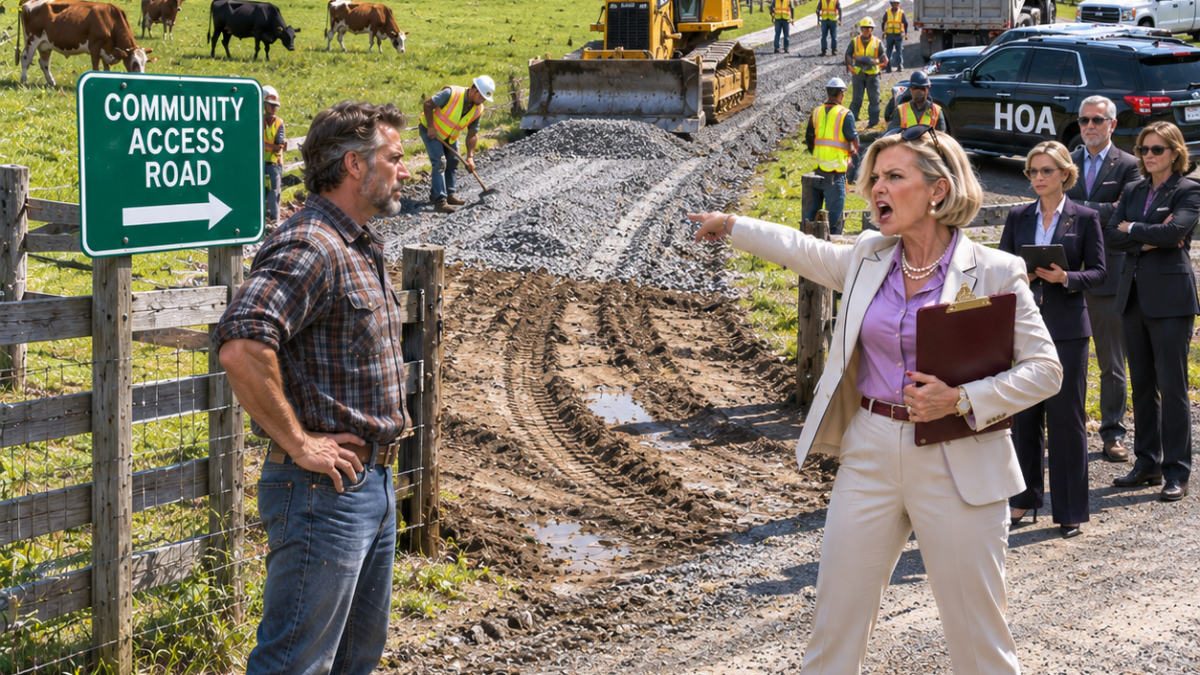
The first time I saw a shiny green sign pointing straight across my pasture and calling it the “COMMUNITY ACCESS ROAD,” I stood there with mud on my boots and realized the HOA president had taken a temporary construction favor and quietly turned it into what she believed was a permanent right to drive through land my family had owned for three generations.
Karen had spent months smiling at me, waving HOA paperwork, and telling contractors and new homeowners that the thirty-foot strip along the edge of my field belonged to the community now, but the signed agreement in my kitchen drawer said something very different—and I was beginning to understand that her confidence depended on me never reading every line carefully.
That night, with my wife sitting across from me and the contract spread between us, I found a clause Karen had apparently overlooked, and for the first time since the trucks started tearing up my pasture, I stopped feeling trapped and started thinking about what would happen if I gave the HOA exactly the access it kept insisting it had.
My name is Jack Turner, and that twenty-acre farm had been part of my life long before a subdivision appeared behind it.
My grandfather bought the property first. My father kept it. After Dad died, my wife and I moved into the old farmhouse and began fixing it one room at a time. Sanding his floors and repairing his fences gave me something useful to do with grief.
The place was simple—pasture, woods, a gravel drive, an old farmhouse, and enough open space that the cows usually noticed visitors before I did.
Behind us sat an untouched parcel of woods.
Then the survey flags appeared.
A developer bought the land, bulldozers came in, and within months a new subdivision started taking shape.
That was how I met Karen.
She walked up to my fence in a bright pink blazer with a clipboard tucked under one arm and studied my pasture as if it had personally lowered her property values.
“You must be the farmer,” she said.
“Jack.”
She gave me a tight smile.
“This area has enormous potential.”
“It has cows.”
She didn’t laugh.
A few weeks later, she came back with her first proposal.
The subdivision’s planned access road curved behind the woods. It was steep, prone to erosion, and expensive to improve. My eastern pasture, on the other hand, was flat and led almost directly to the county road.
“Think how much easier it would be if the community could use a straight route across your property,” Karen said.
“For the community?”
“For everyone.”
“Except the man losing part of his pasture.”
She waved that away.
At first I refused.
Then she returned with paperwork offering two hundred dollars a month for temporary construction access along a thirty-foot strip at the eastern edge. Maximum twelve months. Construction vehicles only. Full restoration afterward.
My wife hated it immediately.
“If you let them use it,” she said over dinner, “Karen will act like you gave it to her.”
“She signed an agreement.”
“She also thinks a blazer makes her governor.”
I should have listened.
I signed anyway.
Within a week, trucks were cutting through the middle of my pasture instead of staying on the agreed route.
I confronted the foreman, and he apologized. Karen called it “miscommunication.”
So I started documenting everything.
Photos. Dates. Tire ruts. Emails.
At month four, subcontractors told me Karen had described the whole area as HOA-approved land.
At month nine, families had started moving into the subdivision, and the traffic across my pasture was heavier than ever.
I walked over one afternoon to remind Karen that the agreement ended in three months.
That was when I saw the signs.
Big metal arrows.
Green background.
White lettering.
COMMUNITY ACCESS ROAD.
Every arrow pointed across my land.
I found Karen near Lot 14 directing a landscaper to shift a shrub.
“Karen.”
She turned and smiled.
“Jack. Isn’t it beautiful?”
“What are those signs?”
“Our permanent entrance.”
I stared at her.
“Your what?”
“The HOA voted.”
“You can’t vote on my property.”
She folded her arms.
“After nearly a year of continuous use, we’ve established a right-of-way easement.”
For a second I thought she was joking.
Then she added:
“I looked it up.”
I drove home without arguing.
My wife took one look at my face and said, “She’s trying to keep it, isn’t she?”
I laid the agreement on the kitchen table.
“Yes.”
Then I started reading.
Slowly this time.
Every sentence.
Every restriction.
Every thing the document allowed.
And every thing it never said I couldn’t do.
Halfway down the second page, I stopped.
My wife leaned forward.
“What?”
I tapped one paragraph with my finger.
And then I smiled.
PART 2
The paragraph itself wasn’t dramatic.
That was the beautiful part.
It said I retained full ownership and control of the property at all times and could take reasonable measures necessary to protect livestock, fencing, crops, and general farm operations so long as those measures did not intentionally revoke the temporary access granted under the agreement.
I read it twice.
Then a third time.
My wife leaned across the table.
“What are you thinking?”
“I’m thinking Karen wants access.”
“She wants your land.”
“No. She says she wants access.”
“Same thing to her.”
“Maybe.”
I tapped the page again.
“But not legally.”
My wife narrowed her eyes.
“I know that look.”
“What look?”
“The one you get right before you spend money on something stupid because you think you’re proving a point.”
“I don’t have that look.”
“You absolutely have that look.”
I sat back.
“Remember Dad’s old cattle gates?”
She stared at me for two seconds.
Then her mouth fell open.
“No.”
I smiled.
“Yes.”
“Jack.”
“She wants a road through an active pasture.”
“You’re enjoying this too much already.”
“Not yet.”
I grabbed my phone.
“I need to call a lawyer first.”
That sobered both of us.
Because despite how angry I was, I had no intention of becoming Karen.
She operated on confidence first and law second.
I wanted the opposite.
The next morning I drove thirty miles to meet a real-estate attorney named Daniel Price.
Daniel was in his late fifties, wore reading glasses low on his nose, and had the kind of dry personality that made every ridiculous situation sound even more ridiculous.
He read our agreement.
Then read Karen’s letter claiming a prescriptive easement.
Then he looked over his glasses.
“She wrote this?”
“The HOA’s attorney’s name is at the bottom.”
“Did the attorney sign it?”
“No.”
“Interesting.”
“What does that mean?”
“It means I’m not convinced the attorney has seen it.”
That made me pause.
Daniel continued.
“A prescriptive easement generally depends on use that is adverse, open, continuous, and without the owner’s permission for the required statutory period.”
“They had permission.”
“Exactly.”
“In writing.”
“Exactly.”
“For less than a year.”
“Exactly.”
I waited.
Daniel smiled.
“So no, Jack. Karen did not discover a magical shortcut to property ownership on Google.”
I exhaled.
“Can I shut the road?”
“When the agreement ends, assuming no other rights exist, you can terminate the permission.”
“What about now?”
He looked again at the clause I had noticed.
“You can secure your livestock.”
“With gates?”
“Yes.”
“Locked?”
His eyebrows rose.
“What exactly are you planning?”
“Two heavy farm gates.”
“One at each end?”
“Yes.”
“Access keys?”
“For the HOA.”
He leaned back.
“That would probably preserve access.”
“Probably?”
“I never promise outcomes before a judge does.”
“Fair.”
“You’re doing this to annoy them.”
“I’m doing it because I’m putting cattle back in the pasture.”
“Are you putting cattle back because you need the pasture?”
“Yes.”
“Or because you want to annoy them?”
“Yes.”
Daniel rubbed his forehead.
“Jack.”
“I’m not lying. Harris has a lease. He normally rotates cattle through that field.”
Daniel couldn’t argue with that because it was true.
Old man Harris had leased grazing rights on part of our farm for years.
During construction, we had moved his cows elsewhere because constant truck traffic made the pasture unsafe.
With the subdivision nearly finished, there was no reason not to restore the normal rotation.
Daniel closed the folder.
“If the cattle are legitimately returning and you need gates to secure them, then installing properly designed farm gates is reasonable.”
“And if Karen complains?”
“She can call me.”
That was all I needed.
***
I didn’t install the gates immediately.
That would have told Karen she had rattled me.
Instead, I waited three days.
Then I found her near the subdivision entrance supervising men who were replacing a perfectly healthy row of shrubs.
I walked over.
“Karen.”
She turned.
Her shoulders stiffened.
“Jack.”
“I’ve been thinking.”
“That’s encouraging.”
I ignored it.
“I don’t want a legal fight.”
Her entire posture changed.
Not much.
But enough.
Her shoulders relaxed.
Her chin rose.
I recognized the look.
She thought I had surrendered.
“I’m glad you’ve come to your senses,” she said.
“Have I?”
“You understand that this is bigger than one person now.”
“It’s certainly bigger than you.”
Her smile tightened.
I continued.
“I’ll continue honoring the written access agreement until it expires.”
Her expression changed again.
“And after that?”
“We can discuss whatever comes next.”
“That’s reasonable.”
“But I’m returning livestock to the pasture.”
She blinked.
“What?”
“Cows.”
“I know what livestock means.”
“Good.”
She glanced toward the road across my field.
“You can’t put cattle around community traffic.”
“Of course I can.”
“That’s dangerous.”
“That’s why I’m installing gates.”
Her mouth opened.
“Gates?”
“Steel farm gates at both ends.”
She stared at me.
“Across the road?”
“Across my pasture.”
“That would obstruct residents.”
“No. You’ll have keys.”
She looked genuinely offended by the idea of leaving her vehicle.
“You expect homeowners to get out, unlock a gate, drive through, close it, relock it, then do the same thing at the other end?”
“Yes.”
“That is completely unreasonable.”
“Then use your original entrance road.”
Her jaw tightened.
“You know that road is unsafe.”
“No, Karen. It’s expensive.”
She crossed her arms.
“This is retaliation.”
“No.”
“It obviously is.”
“It’s livestock management.”
“You’re doing this because I told you we have an easement.”
“You don’t have an easement.”
“Our attorney disagrees.”
“Has your attorney actually seen the agreement?”
The tiniest hesitation.
That answered me.
I smiled.
“Here’s the deal. The gates go up. The HOA gets keys. Your temporary permission continues exactly as written.”
“And if I refuse?”
I shrugged.
“Then I install the gates anyway because they’re on my property, and you can ask a judge to explain your prescriptive-easement theory.”
For the first time since I had met Karen, she had no immediate answer.
Her mouth opened.
Closed.
Opened again.
Finally:
“Fine.”
“Fine?”
“Install your stupid gates.”
I nodded.
“Thank you.”
“I’m not thanking you.”
“No problem.”
I walked away before she could change her mind.
That evening, my wife asked how it went.
“She called them stupid gates.”
“She hasn’t seen them yet.”
“No.”
She smiled.
“This is going to be awful.”
“For them.”
She raised her glass.
“To reasonable livestock management.”
I clinked mine against it.
***
Bruce installed the gates the following Tuesday.
He had been building farm fences for more than thirty years.
Thick hands.
Sunburned neck.
No patience for HOA politics.
He climbed out of his truck, looked at the green COMMUNITY ACCESS ROAD sign, then at me.
“Whose idea was that?”
“Karen.”
“Who’s Karen?”
I pointed toward the subdivision.
“You’ll know when she arrives.”
He nodded like a man who had lived long enough to understand everything from that sentence.
The gates were not decorative.
Heavy galvanized steel.
Wide enough for trucks.
Strong posts set deep in concrete.
Industrial latches.
Weather-resistant padlocks.
One at the county-road entrance.
Another near the subdivision boundary.
Bruce looked over my positioning.
“You could’ve put the second one fifty feet closer.”
“I could’ve.”
“You didn’t.”
“No.”
He grinned.
“Neighbor trouble?”
“HOA trouble.”
He stopped asking questions.
By noon, both gates stood locked.
I delivered two keys to Karen personally.
She stared at them in my palm.
“Two?”
“One for the board office. One spare.”
“We have sixty-two households.”
“Then make copies.”
“You’re serious.”
“Extremely.”
“We’ll need individual keys.”
“That’s between you and your locksmith.”
Her eyes moved toward the first gate.
“You expect every resident to deal with that?”
“You insisted on using my pasture.”
“It’s a road now.”
“No.”
I pointed toward the grass beyond the tire ruts.
“It’s still a pasture. You just keep driving through it.”
She looked like she wanted to say something vicious.
Instead she snatched the keys.
“This is going to cause problems.”
“I agree.”
She marched away.
***
The first resident reached the gate forty minutes later.
Silver SUV.
She approached at normal speed.
Then braked hard.
I was repairing a porch rail when I heard the tires.
The driver sat behind the wheel staring at the gate.
Then she honked.
I looked around as though the horn might be directed at somebody else.
She honked again.
Finally, she got out.
“Excuse me!”
I rested my hammer on the railing.
“Morning.”
“Why is this locked?”
“Livestock gate.”
“This is our entrance.”
“It crosses my pasture.”
“Karen said we had access.”
“You do.”
I nodded toward her key ring.
“HOA distributed keys yet?”
She stared at me.
“No.”
“Then I’d call Karen.”
“This is ridiculous.”
“Probably.”
She pulled out her phone.
Ten minutes later, Karen arrived.
Not in her SUV.
On foot.
Fast.
She opened the gate with one of the keys, waved the resident through, and slammed it.
Then she marched toward me.
“You did this intentionally.”
“We discussed it.”
“People are going to be late.”
“Karen.”
“What?”
“Did you distribute keys?”
“We didn’t have time.”
“You had four days.”
“I didn’t think you were actually going to do it.”
That sentence told me almost everything about our conflict.
Karen was used to people threatening boundaries.
She wasn’t used to people maintaining them.
“Now you know.”
She glared.
“Enjoy your little game.”
I picked up my hammer.
“Enjoy your road.”
***
By the end of the week, every household had a key.
That solved exactly one problem.
It created several more.
Residents now had to stop.
Get out.
Unlock the first gate.
Drag it open.
Get back in.
Drive through.
Stop again.
Get back out.
Close it.
Lock it.
Then travel a quarter mile across the field.
Then repeat the entire process at the second gate.
Four exits from the vehicle for one trip through.
Eight if they returned the same way.
The first week produced a symphony of car doors.
Slam.
Unlock.
Metal scrape.
Drive.
Slam.
Lock.
Drive.
Repeat.
People cursed.
Children complained.
Delivery drivers refused.
One Amazon van reached the first gate, sat there for twenty seconds, reversed, and disappeared.
I wasn’t laughing at first.
Mostly I felt guilty.
These homeowners hadn’t made the original decision.
Karen had.
Some had bought houses after she had already advertised my pasture as the community entrance.
One Saturday, a young father named Matt walked over.
His daughter sat in a wagon behind him.
“Jack?”
“Yeah?”
“Can I ask you something without you getting mad?”
“Sure.”
“Why are you doing this to us?”
The question landed differently than Karen’s accusations.
Because Matt wasn’t angry.
He was tired.
I set down the fence pliers in my hand.
“I’m not trying to punish you.”
“It feels like it.”
“I understand.”
“Karen said you’re trying to force the HOA to pay you.”
“Karen says a lot of things.”
“So what’s the truth?”
I looked across the pasture.
“The HOA had permission to use thirty feet along my eastern boundary for construction vehicles for twelve months.”
“Temporary?”
“Yes.”
“Karen told us the road was permanent when we bought.”
There it was.
Another layer.
“Did she put that in writing?”
“I’d have to check.”
“You should.”
Matt looked at the gate.
“So when twelve months ends?”
“The agreement ends.”
“You can close it?”
“Yes.”
He exhaled.
“Then why are we still being told it’s ours?”
“You should ask Karen.”
His daughter tugged on his coat.
“Daddy, cow.”
I looked over.
One of Harris’s heifers had approached the fence.
The girl smiled.
Matt didn’t.
“I think we got lied to.”
“I think you should read everything you signed.”
He nodded slowly.
That conversation stayed with me.
The more residents learned, the less this looked like Jack versus the subdivision.
It started looking like everybody versus Karen’s version of reality.
***
Then the cows came back.
Thirty-eight head.
Harris arrived before sunrise with two livestock trailers and the expression of a man attending a private comedy show.
“You sure about this?”
“It’s your leased pasture.”
“Been waiting months.”
We unloaded them in groups.
Big black Angus.
A few mixed breeds.
One elderly red cow named Dolly who had more curiosity than judgment.
The moment they were released, they spread across the field.
Some went for grass.
Some found shade.
Dolly walked directly onto the packed dirt route and stood in the middle of it.
Harris nodded toward her.
“She approves.”
“Of the road?”
“Of being inconvenient.”
By seven-thirty, the first school-run traffic appeared.
A minivan approached.
Dolly did not move.
The driver honked.
Dolly looked at the vehicle.
Chewed.
The driver honked again.
Dolly continued chewing.
I walked over.
“Don’t honk at them.”
The window came down.
“I need to get through.”
“She weighs fourteen hundred pounds.”
“So move her.”
“You’re welcome to ask.”
The woman stared.
I grabbed a feed bucket and rattled it.
Dolly followed me to the grass.
The minivan passed.
Two hours later, five cows surrounded a parked SUV while its owner tried to unlock the gate.
One licked the passenger mirror.
The driver screamed.
Harris laughed so hard he had to lean against the fence.
“Jack.”
“What?”
“I’m never giving up this lease.”
***
Then came the incident that changed the gates from inconvenience to necessity.
Someone left the county-road gate partly open.
I saw it from the kitchen.
By the time I reached the pasture, Dolly was already outside.
She had wandered thirty yards toward the shoulder.
A pickup came around the bend.
Too fast.
The driver saw her.
Hit the brakes.
Tires screamed.
The truck stopped maybe twenty feet away.
My heart slammed against my ribs.
I ran with the feed bucket.
“Dolly!”
She turned slowly.
Completely unbothered.
I coaxed her back through the gate.
Then locked it.
My hands shook afterward.
Not from anger.
Fear.
If that pickup had hit her, somebody could have died.
I called Daniel.
He drafted a formal notice that afternoon.
The HOA would be held responsible for damages resulting from negligent failure to close and secure gates while exercising access through active livestock property.
Animal injury.
Veterinary costs.
Recovery expenses.
Vehicle collisions.
Third-party claims.
Everything.
The notice went to Karen and the entire board.
Karen arrived the next morning.
She didn’t walk.
She stormed.
“Are you insane?”
“Morning.”
She waved Daniel’s letter.
“You’re threatening the HOA with millions in liability.”
“I’m informing you.”
“Because your cow escaped.”
“Because somebody using your shortcut left my gate open.”
“You’re using livestock to intimidate residents.”
I stared at her.
“They’re cows.”
“You deliberately put them here.”
“Harris has leased this pasture for years.”
“You removed them during construction.”
“Because I was being nice.”
She stopped.
I continued.
“Construction is almost finished. The cattle returned.”
“This road is incompatible with cattle.”
“Yes.”
“Then move them.”
“No.”
“Jack!”
“No.”
Her face reddened.
“This community has rights.”
“So do I.”
“You cannot deliberately make access dangerous.”
“I’m not.”
I pointed toward the original road behind the woods.
“You have another access route.”
“That road needs work.”
“Then repair it.”
“It would cost thousands.”
I shrugged.
“Sounds like an HOA problem.”
Karen pointed at me.
“This isn’t over.”
“I know.”
Then I looked toward the gray sky.
“Winter’s coming.”
She frowned.
I smiled.
“Have a good day.”
***
Winter did not arrive politely.
The first storm dropped six inches overnight.
Wet snow.
Then temperatures fell.
The gate latches froze.
The road turned from packed dirt to a mixture of ice, hardened mud, cow tracks, and ruts.
At 6:45 one morning, I stepped onto the porch with coffee after hearing someone shouting.
A man stood at the first gate wearing pajama pants under a winter coat.
He had one glove in his teeth while trying to force the frozen padlock open.
“Come on!”
He pulled.
Nothing.
He kicked the bottom rail.
Bad idea.
His boot slipped.
He fell flat on his back.
I winced.
He lay there staring at the sky.
Then he shouted something that would have made my father laugh.
I walked down with lock de-icer.
“You okay?”
“No.”
“Need help?”
He looked at me.
“Do you enjoy this?”
“Not the falling part.”
“The gate.”
“I enjoy my cattle staying in the pasture.”
He held up his hands.
“We hate these things.”
“I know.”
“Karen says you won’t negotiate.”
“I haven’t been asked to.”
He paused.
“What?”
“She hasn’t asked me for an alternative.”
He stared toward the subdivision.
“She told us you demanded a permanent easement fee.”
“I didn’t.”
“How much?”
“Nothing.”
“She said you wanted twenty thousand a year.”
I laughed.
His expression told me he wasn’t joking.
“She told you that?”
“Yes.”
I unlocked the gate.
“Go to your next HOA meeting.”
“And?”
“Ask her to show you my written demand.”
He studied me.
Then nodded.
“Okay.”
That was another crack.
***
By December, residents weren’t angry at me the way they had been.
They were angry at the situation.
And increasingly, they were asking who created it.
Packages stopped arriving at front doors.
School buses refused to cross private livestock property.
Parents organized pickup near the county road.
Two-wheel-drive cars got stuck.
One SUV lost a plastic underbody shield in a frozen rut.
Another driver backed into a gate post.
Cows gathered around warm engines.
Dolly licked another mirror.
She became locally famous.
Harris started calling her “the HOA inspector.”
My wife thought that was hilarious.
Karen did not.
Complaints flooded the HOA board.
I knew because residents began forwarding some of them to me.
**Why did we abandon the original entrance plan?**
**Why were buyers told the pasture road was permanent?**
**Who authorized the signs?**
**Why does Jack say the access agreement expires?**
**How much would it cost to repair the original road?**
Karen responded with the same language every time.
The community possessed a legal right of access.
The gates were retaliatory.
The road issue would be resolved.
My attorney advised me not to respond publicly.
“Let her keep talking,” Daniel said.
“Why?”
“Because every time she misstates the agreement, somebody else reads the agreement.”
He was right.
***
The first two residents came to my porch during a snowstorm.
Matt was one of them.
The other man was named Robert.
Both looked miserable.
“Jack.”
“Come inside.”
They shook snow from their coats.
My wife gave them coffee.
Matt wrapped both hands around the mug.
“We need a way out.”
“Of the subdivision?”
“The gates.”
Robert rubbed his wrist.
“My wife slipped last week.”
“I heard.”
“Sprain. Nothing broken.”
“I’m sorry.”
He nodded.
“Karen says you refuse to remove them.”
“I’ll remove them if nobody uses my pasture.”
Matt sighed.
“She says you’re trying to extort the HOA.”
“I’ve never made them an offer.”
They looked at each other.
Robert said:
“So what would you do?”
“Fix your original entrance.”
“Karen says it’s too expensive.”
“So she’d rather keep using mine.”
“Apparently.”
I leaned back.
“That decision belongs to you.”
Matt looked frustrated.
“Is there any option where we keep using your route without the gates?”
“No.”
“Why?”
“Livestock.”
“Could we pay you to keep the cows somewhere else?”
“No.”
My wife looked at me.
I knew what she was thinking.
Be nice.
So I softened my voice.
“Guys, I’m not trying to make your lives miserable. But this is the part everyone keeps skipping. It’s my farm. The road isn’t a road. It’s a permitted construction route through a pasture. Your board chose to treat it like infrastructure.”
Robert stared into his coffee.
“Then Karen screwed us.”
I didn’t answer.
He looked up.
“Say it.”
“I think Karen made promises she didn’t have the authority to make.”
“That’s lawyer talk.”
“My lawyer’s rubbing off on me.”
Matt asked:
“If the HOA wanted to buy the strip?”
There it was.
I kept my expression neutral.
“That would be different.”
“You’d sell?”
“I’d consider it.”
“How much?”
“I’d have it surveyed and appraised.”
Robert looked relieved.
“That’s something.”
“It’s not a promise.”
“It’s more than Karen gave us.”
They left an hour later.
My wife shut the door.
Then turned.
“You’ve been waiting for somebody to ask that.”
“Yes.”
“You already have an appraisal appointment, don’t you?”
“Thursday.”
She stared at me.
“You are terrifyingly patient.”
“Thank you.”
“That was not a compliment.”
***
The emergency HOA meeting happened outdoors because the clubhouse parking area was being resurfaced.
Snow lined the edges of the grass.
Cold air carried sound straight across the pasture.
My wife and I sat on our dark porch pretending we weren’t listening.
Karen’s voice came clearly.
“We will not be intimidated by one landowner.”
Someone shouted:
“Then why are we still using his land?”
“It is a legal access route.”
“Show us the easement!”
Murmurs.
Karen tried again.
“Our attorney is reviewing—”
A woman interrupted.
“You told us the easement already existed.”
Another voice:
“You told us he demanded money!”
Then Matt:
“He told us he never made any demand.”
The crowd erupted.
My wife whispered:
“Oh, she’s in trouble.”
I took a sip of coffee.
Karen raised her voice.
“Jack is manipulating residents.”
“Then why don’t we use our own road?”
“Because the cost—”
“The cost of what?”
“Drainage improvements.”
Someone yelled:
“What happened to the road reserve?”
Silence.
Then Karen said:
“Funds were reallocated.”
“To what?”
Nobody waited for her answer.
Another man shouted:
“The decorative entrance boulders!”
Laughter.
Then angry voices.
Those boulders had cost thousands.
Huge landscaping stones arranged beneath a Meadow Ridge sign nobody needed.
Karen tried to regain control.
“They improved property values.”
“My wife has a sprained wrist because we can’t drive home without unlocking two gates!”
“My daughter missed the school bus three times!”
“My delivery driver left a refrigerator at the county road!”
Then a voice rose above the others.
“Buy the land.”
Silence.
Another:
“What?”
“Buy the strip from Jack.”
Then Matt.
“He said he’d consider selling.”
Karen shouted:
“Absolutely not.”
That was the worst possible answer.
Because now everyone knew there was an option she didn’t want.
“Why not?”
“Because he’ll overcharge us.”
“You don’t know that.”
“The land isn’t worth anything.”
A resident yelled:
“Then why do we need it?”
The question landed so cleanly even I felt it.
Karen hesitated.
That hesitation changed everything.
My wife looked at me.
“There goes the crown.”
I didn’t smile.
Not yet.
***
Karen arrived at my porch the next morning.
Snow stuck to her boots.
Pink blazer under a long coat.
No clipboard.
She knocked hard enough to wake the dead.
I opened the door.
“We need to talk.”
“Coffee?”
“No.”
“Come in.”
She stepped into the kitchen.
My wife quietly disappeared into the living room.
Karen saw the folder waiting on the table.
Her eyes narrowed.
“You planned this.”
“No.”
“You installed those gates knowing residents would revolt.”
“I installed them because cattle require gates.”
“You knew they would hate it.”
“Yes.”
“You wanted them to pressure me.”
“I wanted you off my land.”
She stared.
“You enjoyed this.”
I considered lying.
“I enjoyed parts.”
“At least you admit it.”
“You still haven’t admitted you tried to turn temporary permission into permanent access.”
“The community needs that road.”
“That isn’t ownership.”
She sat.
“Fine.”
The word sounded painful.
“How much?”
I opened the folder.
“Thirty-foot strip. Approximately a quarter mile. Surveyed. Road frontage. Direct connection between your development and the county road.”
“I know what it is.”
I pushed the appraisal across the table.
“Forty thousand.”
She laughed.
Not because anything was funny.
It was an angry, disbelieving burst.
“Forty thousand dollars?”
“Yes.”
“For dirt?”
“For deeded access.”
“This is robbery.”
“No.”
“It’s worth ten at best.”
“The independent appraisal says forty.”
“Who hired the appraiser?”
“I did.”
“So he works for you.”
“Use another licensed appraiser.”
“We will.”
“Good.”
She shoved the paper back.
“The HOA will never pay this.”
“Then don’t.”
Her eyes flashed.
“You think you have us trapped.”
“No.”
“You do.”
“You have your original entrance.”
“That road is unusable in winter.”
“Repair it.”
“That could cost fifty thousand.”
I shrugged.
“Then forty sounds competitive.”
Her hands tightened.
“You’re enjoying this.”
“Karen, you came into my kitchen and asked me what my land costs.”
She stood.
“This isn’t finished.”
“You keep saying that.”
“I’ll take this to the board.”
“Please do.”
She reached the door.
Then I added:
“Karen.”
She turned.
“The appraisal is valid for thirty days.”
Her face changed.
“What does that mean?”
“If market conditions change, so can the price.”
“You wouldn’t.”
“I’m not threatening you. I’m telling you land doesn’t stay frozen because your board is arguing.”
She left without answering.
The door slammed.
My wife walked back in.
“Thirty days?”
“I may have enjoyed that.”
“I know.”
***
The HOA hired its own appraiser.
His number came back at thirty-eight thousand five hundred.
That ended most of the argument.
Karen still fought.
For two weeks.
She claimed the original access was adequate.
Then claimed the pasture strip was overpriced.
Then claimed they should sue for an easement.
Daniel sent the HOA attorney our agreement.
The attorney called him the next day.
Daniel later summarized the conversation.
“He asked whether Karen had ever shown him the signed temporary-access document.”
“And?”
“No.”
I laughed.
“What had she shown him?”
“Photographs of the road and a timeline of use.”
“So she told him they’d been using it without permission?”
“Apparently.”
“That’s unbelievable.”
“Not really.”
Daniel leaned back.
“People often seek legal advice by giving the lawyer the facts they wish existed.”
The HOA’s own attorney advised against litigation.
That was the end.
The board voted.
Four to three.
Purchase the strip.
Forty thousand dollars.
Karen voted no.
Every other member except two voted yes.
She came to tell me herself.
This time she didn’t storm.
She walked slowly.
“The board accepted.”
I nodded.
“Daniel will coordinate with your attorney.”
She stared across the pasture.
“You realize this is going to hurt people.”
“How?”
“Dues.”
“That wasn’t my decision.”
“You forced it.”
“You asked to use my land.”
“We needed it.”
“Then you should have negotiated before claiming it.”
Her eyes met mine.
For the first time, I saw something other than anger.
Fear.
Not fear of me.
Fear of losing control.
“You’ve turned everyone against me.”
I shook my head.
“I didn’t tell them anything they couldn’t verify.”
“You made me look incompetent.”
“No.”
I stepped closer.
“You made a temporary agreement and promised people it was permanent. You ignored your original road because mine was cheaper. Then you tried to bully me with a legal theory you didn’t understand.”
Her face hardened again.
“I hope that feels good.”
“It doesn’t.”
That surprised both of us.
I continued.
“I would rather none of this had happened.”
She looked away.
Then walked back toward the subdivision.
***
The sale took six weeks.
Survey stakes.
Legal description.
Title review.
County recording.
Every step cost money.
The HOA paid closing fees.
Attorney fees.
Survey costs.
Appraisal.
By the time the deed transfer was ready, their forty-thousand-dollar road had already cost noticeably more.
The closing room held the entire board.
Karen sat at one end.
I sat at the other.
Daniel sat beside me.
The HOA attorney looked tired.
The title representative pushed papers around.
I signed first.
Karen signed as board president.
Her hand pressed hard enough to leave an imprint on the page beneath.
The treasurer slid a cashier’s check toward me.
$40,000.
I placed it in my folder.
Then stood.
“Pleasure doing business.”
I offered Karen my hand.
She stared at it.
Didn’t move.
Before the silence became unbearable, the HOA secretary muttered:
“This whole thing was your fault anyway.”
Karen turned.
“What did you say?”
The secretary’s face flushed, but she didn’t back down.
“I said we wouldn’t be paying forty thousand dollars if you hadn’t promised everybody a road we didn’t own.”
Karen’s chair scraped backward.
“I did what was best for the community.”
An older board member named Frank slammed his pen down.
“No. You did what was easiest.”
Karen stared.
Frank continued.
“We had funds to improve our original entrance.”
“That road was inefficient.”
“We spent part of those funds on landscaping you wanted.”
“Those improvements increased value.”
“We just spent more than sixty thousand dollars cleaning up one decision.”
The room went quiet.
Karen’s face paled.
Frank looked toward the others.
“I’m calling for a vote of no confidence.”
Karen froze.
“You can’t do that here.”
The treasurer spoke.
“We can call a special meeting.”
“You’re overreacting.”
Nobody answered.
Daniel touched my elbow.
Time to leave.
I picked up the folder.
As we reached the hall, Karen’s voice rose behind us.
“You people have no idea what I’ve done for this community!”
The door closed.
I stood outside.
Daniel looked at me.
“Smile after we reach the parking lot.”
I made it halfway there.
***
One week later, a letter arrived.
The HOA board had removed Karen as president pending a special election.
She resigned before the final vote.
My wife read the letter twice.
Then found a cheap black frame in the closet.
“What are you doing?”
“History.”
She hung it in the mudroom.
“Seriously?”
“Yes.”
Every time I passed it, I remembered her first warning.
If you let them use it once, they’ll take whatever they want.
“I know,” I told her one evening.
“You know what?”
“You were right.”
She looked up from her book.
“Say it again.”
“No.”
“Jack.”
“I said it once.”
“I want it recorded.”
“Never.”
She smiled.
Victory enough.
***
The story should have ended there.
Karen gone.
Land sold.
HOA responsible for its own driveway.
I had my forty thousand.
They had permanent access.
Everybody moved on.
Except land does not care whether paperwork has been signed.
Spring came.
So did rain.
Six straight hours one Saturday.
The road had been built quickly over pasture soil.
No proper drainage system.
No engineered base.
No culverts sized for runoff.
The construction trucks had compacted some areas and destroyed others.
Water followed the ruts.
By afternoon, the lower section looked like a creek.
I stood on my porch with my wife.
A sedan entered the water.
“Think he’ll make it?” she asked.
“No.”
He made it halfway.
The tires sank.
Engine revved.
Mud sprayed.
The car stopped.
A pickup eventually pulled him out.
The next morning, three HOA board members inspected the road.
Frank saw me.
“Did it always flood like this?”
“The pasture?”
“Yes.”
“Parts of it.”
“Why didn’t you tell us?”
I laughed.
“You bought a road through a pasture.”
He rubbed his forehead.
“I mean the drainage.”
“You had it inspected.”
“The inspector said the land was serviceable.”
“It is.”
“For cattle.”
Frank gave me a tired look.
“Fair.”
They hired a road contractor.
The first estimate was more than twenty thousand dollars for grading, drainage improvements, stone, and compaction.
The board approved only part.
They brought in gravel.
Two weeks later, another storm washed part of it toward the ditch.
Then came the fence problem.
Now that the thirty-foot strip belonged to the homeowners’ association, it technically split my pasture.
My old fencing had been designed around the outer perimeter.
The road created an interior corridor.
That meant if they wanted cattle reliably excluded from HOA-owned land, they needed their own fencing.
The lowest professional estimate was around twelve thousand dollars.
One board member suggested volunteers.
That effort lasted half a day.
A post-hole auger jammed.
Someone dropped a tool on his boot.
Another resident threatened to sue if he got hurt doing unpaid HOA labor.
Professionals were hired.
More money.
I watched new fence posts appear along the road.
My wife stood beside me.
“They bought themselves a very expensive hallway.”
“That’s one way to put it.”
“Do you feel bad?”
“A little.”
She looked at me.
“Liar.”
“Fine. Not for Karen.”
“That’s different.”
It was.
The new board inherited a mess.
Many residents had been misled.
I wasn’t interested in making their lives worse.
But I also wasn’t going to rescue them from a purchase they had voluntarily made after having lawyers and appraisers involved.
They wanted independence from my gates.
They got ownership.
Ownership comes with responsibility.
***
The first email arrived in May.
**Jack, are you aware that cattle are damaging the edge of the community road?**
I replied:
**The roadway and fences are HOA property. My cattle are lawfully contained on my adjoining pasture. Please direct maintenance concerns to your board.**
Response:
**Understood.**
Then another.
**Can you prevent cows from leaning against our new fence?**
I stared at the screen.
My wife read over my shoulder.
“What are you going to say?”
“I’m considering several possibilities.”
“Say something normal.”
I typed:
**I can’t reasonably control where cattle stand inside their pasture. If your fence is built to livestock specifications, normal contact should not be a problem.**
My wife nodded.
“Very mature.”
“I hate it.”
A week later, Dolly discovered that the gravel road warmed nicely in sunlight.
She rested against the fence.
Three other cows joined.
The board added reinforcement.
More money.
***
By early summer, HOA dues increased nearly forty percent.
Two residents came to my porch.
Not Matt this time.
A man named Steve and another named Nolan.
Both looked exhausted.
“Jack.”
“Guys.”
“We need to ask something stupid.”
“That’s a dangerous opening.”
Steve sighed.
“Would you buy the road back?”
I thought he was joking.
He wasn’t.
“The land?”
“Yes.”
“The land you just bought from me?”
“Yes.”
“Because you needed permanent access?”
Nolan rubbed his face.
“We didn’t understand the maintenance costs.”
“You had inspections.”
“Apparently not good ones.”
“What happens if I buy it?”
“You can close it.”
“You’d lose access.”
“We know.”
“You’d go back to the original road.”
“We think so.”
“Then why not repair the original road now?”
They looked at each other.
Steve said:
“Because we’ve already spent so much on this one.”
I nodded.
“That’s called sunk cost.”
“We know.”
“No, I mean literally.”
They didn’t laugh.
I tried to soften it.
“What are you offering?”
“Thirty thousand.”
“For me to take back a road I didn’t want to sell.”
“Yes.”
“And inherit every drainage issue you created.”
“You could turn it back into pasture.”
“After removing gravel, fencing, culverts, signs?”
Silence.
Nolan said:
“We’d help.”
“No.”
“What if—”
“No.”
Steve exhaled.
“Can you think about it?”
“I already have.”
They stared.
“I warned Karen from the start. I told the board you had another access. I sold because you insisted the strip was necessary. I’m not reversing everything because ownership turned out to be expensive.”
Nolan nodded slowly.
“We understand.”
“I’m not angry at you.”
“It feels like punishment.”
“It isn’t.”
I looked toward the road.
“It’s just not my problem anymore.”
They thanked me and left.
My wife appeared with lemonade.
“They want you to save them.”
“Yes.”
“You going to?”
“No.”
“Good.”
“You’re ruthless.”
“No.”
She handed me a glass.
“I just remember dinner two years ago when you said, ‘It’s only temporary access. What could happen?’”
“Please stop.”
She smiled.
“I never will.”
***
Summer punished the road.
Dry weather created dust.
Heavy vehicles created washboarding.
Residents complained about potholes.
The HOA graded it.
Rain returned.
Potholes returned.
Dust returned.
They added speed-limit signs.
People ignored them.
They installed rubber speed bumps.
One came loose.
Harris found it near the fence.
Dolly spent twenty minutes pushing it with her nose.
Some teenager filmed her.
The video spread through the neighborhood.
Caption:
**DOLLY VS. HOA INFRASTRUCTURE**
Even I laughed.
The road gained a nickname.
The Great Cow Road.
Karen had wanted “Community Access Boulevard.”
The residents chose something more honest.
By September, kids at the school-bus stop were using the phrase.
“Mom, are we taking the Cow Road?”
Property marketing quietly stopped mentioning the “private secondary entrance.”
New listings emphasized the original rear access.
That told me the board already knew where this was headed.
***
Autumn brought the audit.
The HOA reserve fund had fallen below the level recommended by its financial policy.
Road maintenance.
Fence installation.
Drainage.
Emergency towing.
Legal bills from the land purchase.
Survey work.
Closing costs.
It all added up.
The forty-thousand-dollar purchase had now cost the community well over sixty thousand dollars, and maintenance kept climbing.
I didn’t learn about the audit through official channels.
I heard the meeting.
Open fields carry sound.
My wife and I were splitting kindling near the barn when voices rose from the subdivision.
“This is unsustainable!”
Another:
“Who approved this purchase?”
Then Frank:
“The previous board initiated the access arrangement.”
Someone shouted:
“Karen isn’t here anymore! Stop blaming Karen for everything!”
Another voice:
“We’re still paying for her decision!”
The argument grew.
My wife set down a piece of wood.
“Want coffee?”
“Yes.”
We moved to the porch.
I had learned that HOA meetings were better with beverages.
Someone yelled:
“We had a road!”
Another:
“It needed fifty thousand in repairs!”
A third:
“And how much have we spent now?”
Silence.
Then:
“More.”
That one word carried beautifully.
The board proposed a special assessment.
Several hundred dollars per household.
People lost their minds.
“My shocks are already ruined because of that road!”
“Why should I pay more?”
“We never voted for the original temporary agreement!”
“You voted to buy it!”
“We were trapped!”
The argument turned toward dissolution.
Some wanted to replace the board.
Others wanted to sell the road.
Then somebody shouted:
“Sell it back to Jack!”
I almost spilled my coffee.
My wife covered her mouth.
“No.”
“Yes.”
Two board members separated from the crowd.
Started walking toward us.
My wife stood.
“Be nice.”
“I’m always nice.”
She gave me a look.
“Try harder.”
***
Frank and the treasurer, a man named Paul, reached the porch.
Both looked exhausted.
“Jack.”
“Gentlemen.”
Frank removed his hat.
“We need to talk.”
“Road?”
They nodded.
I opened the porch gate.
They sat.
My wife brought coffee without being asked.
Frank stared into his cup.
“This thing is killing us.”
“Financially?”
“Financially. Politically. Personally.”
Paul laughed bitterly.
“I have neighbors who won’t speak to me because I voted for the purchase.”
“You voted yes?”
“Yes.”
“Why?”
“I thought it ended the dispute.”
“So did I.”
He looked up.
“You did?”
“I thought you’d buy it, maintain it, and we’d all stop arguing.”
Frank shook his head.
“We had no idea.”
“About what?”
“Drainage. Fencing. Winter maintenance. Insurance.”
“The appraisal didn’t cover maintenance.”
“We know that now.”
There was no satisfaction in seeing them defeated.
They weren’t Karen.
They were two men who had inherited a bad situation, made another decision under pressure, and now had residents furious at them.
Frank finally asked:
“Would you consider buying it back?”
“No.”
He blinked.
“You didn’t even ask the price.”
“Doesn’t matter.”
“Twenty-five thousand.”
“No.”
“Twenty.”
“No.”
Paul leaned forward.
“You could restore the pasture.”
“At my cost.”
“We might contribute.”
“Then I’d still have to remove gravel and fencing.”
“You could leave the fence.”
“And a quarter-mile strip cutting through my grazing rotation?”
Frank sighed.
“What if we give it to you?”
That surprised me.
“You’re serious?”
“Yes.”
“No.”
Paul stared.
“You wouldn’t take it for free?”
“No.”
“Why?”
“Because you don’t want to give me land. You want to give me a liability.”
That landed.
I continued.
“You own a road your residents use. If I take it, I either keep allowing traffic and assume the maintenance problem, or I close it and become the villain again.”
Frank looked down.
“You’re right.”
“I’m not doing that.”
Paul rubbed his face.
“Then the HOA may collapse.”
I looked across the pasture.
“That’s not my decision.”
“We’re begging you.”
“I know.”
“And you still won’t?”
“No.”
Frank nodded slowly.
“Fair.”
There was a long silence.
Then he said:
“I owe you an apology.”
“For what?”
“I believed Karen.”
“So did a lot of people.”
“I thought you were being difficult.”
“I was being difficult.”
He almost smiled.
“But you were right.”
I looked toward the framed resignation letter visible through the mudroom window.
“My wife keeps telling me that too.”
She called from inside:
“Because you were wrong first.”
Frank laughed.
It was the first relaxed sound I had heard from him.
When they left, they walked slowly back toward the meeting.
My wife stood beside me.
“You feel bad.”
“Yes.”
“Regret the gates?”
I thought.
“No.”
“Selling?”
“No.”
“Not buying it back?”
I watched Frank and Paul disappear toward the subdivision.
“No.”
She nodded.
“Then feeling bad is allowed.”
That was why I married her.
***
The special assessment became the breaking point.
Residents didn’t want to keep paying for a road many had stopped using.
More families switched to the original access behind the woods.
Ironically, as traffic increased there, residents pooled money for basic grading.
It turned out the original road wasn’t impossible.
Just neglected.
The more usable it became, the less reason anyone had to maintain the Cow Road.
The HOA entered a vicious cycle.
Fewer road users.
Same fixed costs.
More resentment.
Less support for assessments.
Someone proposed abandoning the road legally.
Another wanted to sell it.
Nobody wanted to buy.
A neighboring farmer laughed at the asking price.
One developer inspected it and declined.
Then residents started asking a bigger question.
Why did they need an HOA at all?
Karen had originally sold the association as the guardian of property values.
Now the HOA’s largest shared asset was an expensive road many residents hated.
Meetings became arguments about budgets.
Board positions went unfilled.
The treasurer announced he would not seek another term.
Frank resigned after someone accused him of conspiring with me.
He stopped by afterward.
“I lasted eight months.”
“Longer than I would.”
“You really won’t join?”
“I’m not in your HOA.”
“We could annex you.”
I looked at him.
He laughed.
“Kidding.”
“Good.”
“I’ve learned.”
***
Then came the email.
It was forwarded to me accidentally—or perhaps intentionally—by Matt.
Subject:
**EMERGENCY: MEMBER VOTE REGARDING ASSOCIATION DISSOLUTION**
I read it twice.
Then handed the phone to my wife.
She read it.
Looked at me.
Then burst out laughing.
Not a polite laugh.
The kind where she had to sit down.
“What?”
She wiped her eyes.
“You signed a temporary access agreement.”
“I know.”
“They tried to steal it.”
“Yes.”
“You put up two gates.”
“Yes.”
“They bought the road.”
“Yes.”
“And now the HOA might cease to exist.”
“That appears to be the sequence.”
She laughed again.
“You’re never allowed to negotiate anything without me.”
“Why?”
“Because somehow your bad decisions become regional events.”
Fair.
***
The dissolution process took weeks.
Lawyers had to determine outstanding contracts.
Insurance.
Common areas.
Road ownership.
Reserve funds.
The entrance landscaping.
The clubhouse.
The vote required a high percentage of homeowners.
At first, it seemed unlikely.
Then the board announced another possible assessment for road work.
Support for dissolution surged.
Karen returned for one meeting.
I didn’t attend.
Matt told me later.
“She showed up in pink.”
“Of course.”
“She said dissolving the HOA would destroy property values.”
“What happened?”
“Somebody asked whether she was volunteering to pay the road assessment.”
I laughed.
“And?”
“She left.”
That was Karen’s final public appearance in the saga.
No dramatic confrontation.
No police.
No screaming match.
She simply discovered that the title she once treated like a crown no longer commanded the room.
A week later, the vote passed.
The HOA dissolved.
Not instantly.
There were months of legal cleanup.
But the organization Karen had treated like her personal government ceased to exist.
The community created a small voluntary road-maintenance group for the original entrance.
Participation was practical rather than political.
No fines for decorations.
No committees inspecting shrubs.
No pink-blazer monarchy.
And the Cow Road?
Ownership was allocated through a shared arrangement among the homeowners who had taken title interests through the dissolution documents.
Nobody liked that.
But nobody could make the road disappear by voting.
Land is annoyingly real that way.
***
Traffic across my pasture started fading.
At first, only a few families switched to the rear road.
Then half.
Then almost everyone.
Without frequent traffic, maintaining the Cow Road made even less sense.
Gravel scattered.
Grass pushed through.
The speed-limit signs leaned.
One reflector disappeared.
I found Dolly chewing another.
Harris pointed.
“Your HOA inspector is doing final review.”
“She passed it?”
“Needs more grass.”
By the next spring, the road looked less like a road.
Green lines appeared down the center.
Weeds filled the shoulders.
Rain softened the edges.
Nature had no respect for committee decisions.
One afternoon, Matt came by.
His daughter, older now, rode a bicycle beside him.
“We stopped using it.”
“I noticed.”
“The old road’s better after we graded it.”
“That was always an option.”
“I know.”
He smiled sheepishly.
“We were idiots.”
“You were homeowners who trusted people.”
“Same difference sometimes.”
His daughter looked toward Dolly.
“Can I feed her?”
“Grass only.”
She ran toward the fence.
Matt watched her.
“Karen moved.”
“When?”
“Last month.”
I hadn’t known.
“Where?”
“Somewhere closer to the city.”
“Good for her.”
He looked at me.
“That’s it?”
“What do you want me to say?”
“I figured you’d celebrate.”
I considered it.
“I celebrated when she resigned.”
“Fair.”
He laughed.
Then his expression softened.
“She really did tell us that road belonged to the community from the beginning.”
“I believe you.”
“I feel stupid.”
“Don’t.”
“We signed closing documents believing the subdivision had two permanent entrances.”
“That wasn’t your fault.”
“We should’ve checked.”
“Maybe.”
I looked toward the old farmhouse.
“My wife told me not to sign the temporary agreement.”
“What’d you do?”
“Signed it.”
Matt laughed.
“So everybody was stupid.”
“Now you’re learning.”
***
The next fall, my wife and I walked the abandoned road.
Not drove.
Walked.
Grass had grown through much of the gravel.
Golden weeds leaned across the tire paths.
One rusted sign still stood near the far end.
**COMMUNITY ACCESS ROAD**
The lettering had faded.
My wife stopped.
“You keeping that?”
“The sign?”
“Yeah.”
“For what?”
“Memory.”
“I have enough reminders.”
She smiled.
“You framed Karen’s resignation.”
“You framed Karen’s resignation.”
“True.”
We continued.
At the place where the first gate had stood, only the post remained.
The actual gate had been removed after the sale.
For months I had missed it.
Not emotionally.
Physically.
I would look toward the field and expect to see steel.
Now there was open space again.
Cattle grazed on both sides of the fading road.
Dolly was still alive, older and wider, chewing near the weeds.
My wife leaned against me.
“It almost looks normal.”
“Almost.”
“Think the road will disappear?”
“Eventually.”
“Completely?”
“No.”
She looked at me.
“Why not?”
“Ground remembers.”
Ruts.
Compacted soil.
Changed drainage.
Old gravel.
Even after the grass came back, I knew I would always be able to trace the route if I looked carefully.
Some damage is like that.
It heals.
But not by pretending it never happened.
We walked farther.
Near the subdivision boundary, I saw one of the old survey stakes.
I stopped.
Dad had taught me property lines when I was twelve.
He would drive fence posts and make me hold the level.
Once, after I complained that moving a post three inches didn’t matter, he said:
“Three inches becomes three feet if nobody cares.”
At the time I thought he was being dramatic.
Standing there decades later, I finally understood.
Karen’s first request hadn’t been evil.
Temporary access could have worked.
The problem wasn’t asking.
The problem was assuming permission would become ownership if she acted confident long enough.
My father would have hated that.
Not because he was greedy with land.
He wasn’t.
Dad let neighbors hunt certain sections.
He let kids fish the creek.
He loaned equipment.
He believed in helping people.
But helping somebody is different from surrendering the right to say no later.
That was the line Karen never understood.
***
The forty thousand dollars went into the farm.
That surprised people.
Some assumed I would buy a truck.
My wife assumed I would buy something stupid with an engine.
Instead, we repaired Dad’s barn roof.
Replaced rotten siding.
Rebuilt part of the north fence.
Installed proper drainage near the lower pasture.
I kept the cashier’s-check stub in Dad’s old desk.
Not as a trophy.
As a reminder.
One evening while we were repairing the barn, my wife found me holding one of Dad’s old hammers.
“You okay?”
“Yeah.”
“You’ve been staring at that for five minutes.”
“I was thinking.”
“Dangerous.”
I smiled.
“Dad spent his whole life protecting this place.”
“So did you.”
“I almost gave part of it away for two hundred bucks a month.”
“You didn’t know.”
“I should’ve.”
She took the hammer from me.
“Jack, kindness isn’t stupidity.”
“Sometimes.”
“No.”
She pointed toward the fading road.
“Karen took advantage of kindness. That’s different.”
I knew she was right.
It just took me longer to accept.
For months after everything ended, I had replayed that first decision.
What if I had simply said no?
No trucks.
No gates.
No HOA purchase.
No sixty-thousand-dollar disaster.
No dissolution.
Peace.
Probably.
But then I thought about the homeowners.
Karen’s methods would have surfaced somewhere else.
Maybe over fences.
Maybe fines.
Maybe the road reserve.
She had already shown how she treated disagreement.
The driveway didn’t create Karen.
It exposed her.
***
Years later, people still told the story differently depending on who was talking.
Some said I tricked the HOA.
I didn’t.
I followed the written agreement.
Some said I intentionally weaponized cows.
That one was funnier.
The cattle were supposed to be there.
Some said I forced the HOA to buy the road.
I didn’t.
They could have used their original entrance.
They chose the purchase.
Some said Karen lost sixty thousand dollars.
Technically, the HOA spent it.
Karen lost something harder to calculate.
Trust.
Once the homeowners realized she had told them the temporary route was permanent, every other claim she made became questionable.
That was what ended her authority.
Not gates.
Not cows.
Not snow.
Trust.
The gates merely gave everybody enough time standing outside their vehicles to start asking questions.
***
One spring morning, years after the HOA disappeared, I was drinking coffee when a silver SUV approached the old route.
For one second, memory played a trick on me.
Karen.
Pink blazer.
Locked gate.
Angry face.
But the SUV slowed.
Stopped.
Then reversed.
The driver had realized the road no longer connected cleanly.
I smiled.
My wife joined me.
“What?”
“Nothing.”
She followed my gaze.
“Remember when Karen used to drive through every morning?”
“Unfortunately.”
“You were unbearable.”
“I was delightful.”
“You stood out here drinking coffee specifically so she could see you.”
“That is unprovable.”
“I was married to you.”
“Circumstantial evidence.”
She laughed.
That sound drifted across the pasture.
No engines.
No car doors slamming.
No residents cursing frozen locks.
No HOA meeting carrying through cold air.
Just cows.
Wind.
Our farmhouse.
Peace.
Real peace.
The kind that doesn’t require anybody else to lose.
That mattered to me in the end.
At the height of the fight, I had wanted Karen humiliated.
I wanted her to regret every conversation.
Every threat.
Every smug smile.
I wanted her to stand at those gates in expensive shoes, freezing in the snow, and understand what it felt like to have somebody else control the terms.
And yes, part of me enjoyed watching that happen.
I’m not going to rewrite myself into a saint.
But revenge gets boring faster than peace.
Once Karen was gone and the road stopped being used, I didn’t miss the conflict.
I didn’t sit around wishing another HOA president would appear.
I went back to repairing fences.
Helping Harris.
Working the pasture.
Drinking coffee with my wife.
Ordinary life.
That was what I had been defending all along.
***
One afternoon, I finally removed the faded COMMUNITY ACCESS ROAD sign.
The bolts had rusted.
I needed penetrating oil and a wrench.
My wife came outside halfway through.
“You’re taking it down?”
“Yeah.”
“I thought you were keeping it.”
“Changed my mind.”
“What are you doing with it?”
“Scrap.”
She watched me loosen the final bolt.
The sign fell into the grass.
For a moment, I looked at it.
That piece of metal had started everything.
Not literally.
Karen started everything.
But the sign was the moment her intentions became undeniable.
Temporary had become permanent in her mind.
Permission had become entitlement.
I loaded it into the truck.
At the recycling yard, the employee asked:
“Road sign?”
“Sort of.”
“County?”
“No.”
“Private?”
“Very.”
He tossed it into the metal pile.
That was it.
No ceremony.
No photograph.
No trophy.
I drove home.
When I reached the pasture, the empty post looked strange.
Then better.
A week later, I pulled the post too.
Grass filled the hole.
***
The following summer, Harris’s granddaughter came to help with the cattle.
She was seventeen and had heard pieces of the story.
“Is this where the HOA road was?”
“Yep.”
She looked across the field.
“I can barely see it.”
“Good.”
“Grandpa says you put gates everywhere.”
“Two.”
“He says people hated you.”
“Some did.”
“He says you made forty thousand dollars.”
“I sold land.”
“He says a cow brought down an HOA.”
I stared at her.
“That’s not remotely accurate.”
She pointed toward Dolly.
“Was it that one?”
Dolly was lying under an oak tree.
“Yes.”
“I knew it.”
“Don’t encourage your grandfather.”
She laughed.
Later that afternoon, I watched her drive the cattle across the old route.
No one stopped.
No gate keys.
No traffic.
No argument about rights.
Just livestock crossing a pasture.
Exactly what the land had been before Karen arrived.
***
The old subdivision survived just fine without its HOA.
That was another irony.
Homes didn’t collapse in value.
Lawns didn’t become jungles.
Nobody painted a house fluorescent orange.
At least not yet.
Neighbors created voluntary committees when they needed something.
They pooled money to maintain the rear access road.
The arrangement was simpler.
If a major expense came up, they discussed it.
No president pretending to be mayor.
No fines for decorative stones.
No community votes on somebody else’s land.
Matt eventually became one of the informal road coordinators.
He stopped by occasionally.
One morning he brought a folder.
I stared.
“Don’t.”
He laughed.
“No HOA.”
“Good.”
“Just estimates for grading.”
“Why are you showing me?”
“You know contractors.”
“I know farmers.”
“You know everybody.”
That was true enough.
I gave him two numbers.
Before leaving, he looked across the pasture.
“You know something?”
“What?”
“If Karen had just repaired our road when you first told her to, we would’ve saved a fortune.”
“Yes.”
“I hate when you say it that calmly.”
“I’ve had practice.”
He laughed.
Then asked:
“Ever hear from her?”
“No.”
“Me neither.”
We stood silently.
Then he said:
“Probably better.”
It was.
***
Karen never apologized.
Not to me.
Not publicly.
I heard through somebody that she still believed I had manipulated the situation.
Maybe she needed to believe that.
Because the alternative required admitting she had caused everything herself.
She asked for temporary access.
Then treated it as permanent.
She ignored the written limits.
She told buyers the route belonged to the community.
She let the original road deteriorate.
She invented an easement theory.
She forced the conflict.
She refused to negotiate until residents rebelled.
Then the HOA bought a piece of land it wasn’t prepared to maintain.
No trap I could have designed would have worked without Karen making every decision necessary to step into it.
That was the part I came to appreciate.
I didn’t destroy her.
I stopped protecting her from consequences.
There’s a difference.
***
One fall evening, my wife and I sat on the porch watching the sun sink behind the pasture.
Dolly had died that summer.
Old age.
Harris buried her near the far fence.
He put up a tiny wooden marker.
**DOLLY
THE HOA INSPECTOR**
I told him it was ridiculous.
He said history mattered.
My wife pointed toward the marker.
“She deserves a statue.”
“No.”
“A pink one.”
“Absolutely not.”
We laughed.
Then she grew quiet.
“Do you miss your dad more when things are peaceful?”
The question caught me off guard.
“Why?”
“You talked about him a lot during the driveway fight.”
I looked toward the barn.
Dad’s barn.
Dad’s pasture.
Dad’s fence lines.
“I think I wanted to know what he would’ve done.”
“What do you think?”
“He would’ve said no the first day.”
She smiled.
“Smart man.”
“Then he would’ve spent six months telling me I was an idiot for signing.”
“Smarter man.”
I nudged her shoulder.
She leaned into me.
Dad probably would have handled Karen differently.
Less theatrically.
Fewer gates designed for maximum inconvenience.
Maybe.
Then again, he had a wicked sense of humor.
I remembered one neighbor who repeatedly left a tractor blocking Dad’s access lane.
Dad never argued.
He simply parked a manure spreader in front of it.
Maybe the apple hadn’t fallen far.
***
When darkness settled, the pasture disappeared into shadow.
The old driveway line was almost invisible.
Only a slight change in grass showed where gravel remained underneath.
My wife whispered:
“Think it’ll ever be completely gone?”
“No.”
“You said that before.”
“Because it won’t.”
“Does that bother you?”
I thought.
“No.”
Scars aren’t always failures.
Sometimes they’re boundaries remembered.
The land had survived.
So had we.
And if someone someday bought the farm from us, they might notice that strange strip and ask what happened.
Maybe I’d tell them.
Maybe not.
Maybe all they needed to know was written in the deed.
Private property.
Clear boundary.
No easement.
No community access road.
Just a farm.
***
The next morning, I woke before sunrise.
Coffee.
Porch.
Same routine I’d had before construction ever started.
Mist rested low over the pasture.
Cattle moved like dark shapes in the distance.
A truck passed on the county road without turning into my field.
I listened until its engine faded.
Then I looked toward the place where the first gate had stood.
For months, that gate had represented revenge to me.
Then leverage.
Then protection.
Now it represented something simpler.
A line.
Karen’s biggest mistake was believing lines mattered only when she drew them.
HOA boundary.
Community rule.
Official entrance.
Approved landscaping.
She treated every boundary she created as sacred.
Mine as negotiable.
But a property line does not become less real because somebody finds it inconvenient.
Neither does a promise.
Neither does a signed agreement.
I finished my coffee.
The sun rose.
Light moved across the grass until the old road disappeared beneath it.
I smiled.
Karen wanted a permanent shortcut.
She got one.
For a while.
Then she lost her position.
The HOA spent more than sixty thousand dollars.
Residents inherited an expensive maintenance problem.
The association eventually dissolved.
And the shortcut they had fought so hard to own was abandoned for the original road they had refused to repair in the first place.
I didn’t have to destroy anything.
I didn’t tow cars.
I didn’t block emergency vehicles.
I didn’t tear up the road.
I didn’t threaten homeowners.
I simply stopped allowing somebody else’s convenience to outrank my ownership.
The rest happened on its own.
A cow moved near the far fence.
I could hear Harris calling to it.
My wife opened the front door behind me.
“Breakfast.”
“Coming.”
I stood.
Before going inside, I looked across the twenty acres my grandfather had bought, my father had protected, and I had nearly allowed somebody else to redefine with a green metal sign.
No traffic.
No gate.
No Karen.
Just pasture.
I went inside.
And for the first time in years, there was absolutely nothing left to argue about.
[END OF STORY]


