PART 2: HOA Karen Ordered Me to Tear Down My $5M Mansion—Then She Learned Who Really Enforces the Building Code
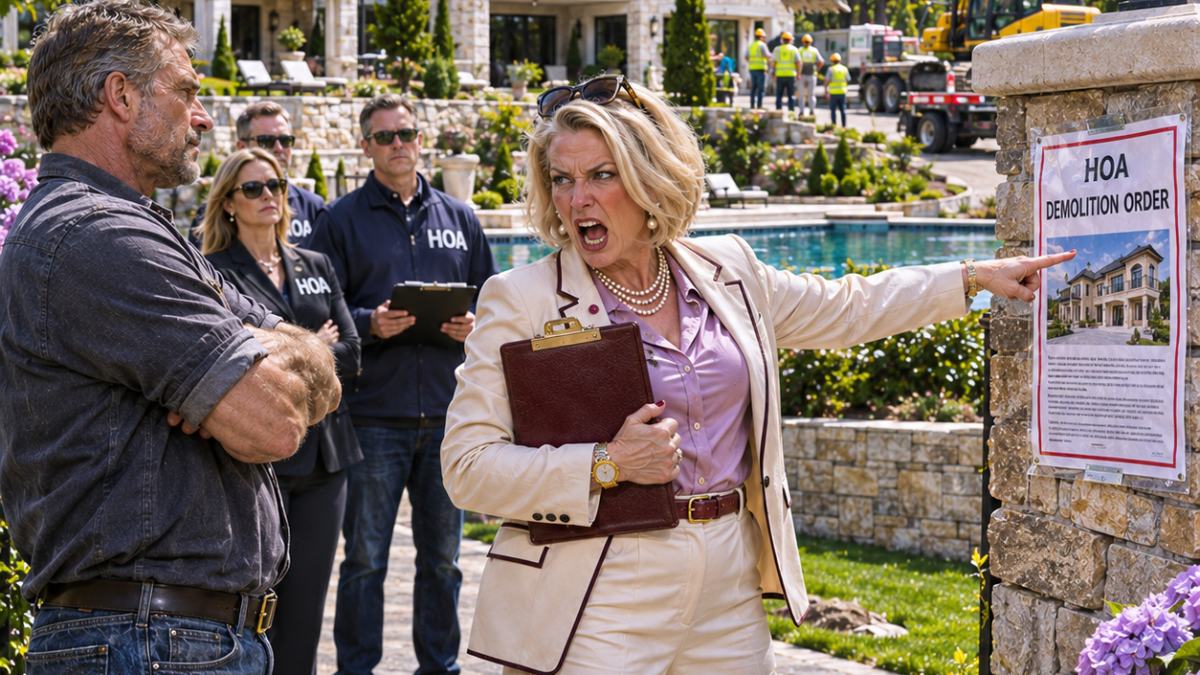
The letter taped to my front door gave me thirty days to tear down the five-million-dollar home my wife and I had spent years building.
The HOA president called my house “illegal,” threatened daily fines, and promised that if I refused to demolish it myself, she would hire a contractor and send me the bill.
What Karen Whitmore didn’t understand was that she had chosen a fight with the one homeowner in Maple Ridge who knew exactly how deep her paper trail could bury her.
My name is David Carter.
At the time, I had spent more than twenty years working in Fairview City’s Building and Safety Department.
I started as a junior plans examiner in my twenties, back when I still believed every problem could be solved with a codebook, a measuring tape, and enough coffee.
Over the years, I moved through inspections, plan review, permitting, enforcement, and eventually administration.
By the time this happened, I was the Chief Building Officer for the city.
That title sounded more dramatic than the day-to-day reality.
Most mornings involved permit disputes, structural drawings, appeals, contractor meetings, political pressure, and citizens who believed building codes existed specifically to ruin their Tuesday.
But I believed in the work.
Done correctly, building regulation isn’t about power.
It’s about making sure a roof doesn’t collapse on a family.
Making sure electrical work doesn’t burn down a restaurant.
Making sure a developer doesn’t cut corners and leave the next owner paying for it twenty years later.
Rules are supposed to protect people.
That belief mattered when Laura and I finally decided to build our own home.
We bought a lake-facing lot at the edge of Maple Ridge Estates.
The property wasn’t cheap.
Neither was the house we designed.
Laura and I had spent years saving, investing, and waiting for the right moment.
I wanted natural stone.
Timber.
Glass.
Warm wood instead of the sterile white-box modernism I hated.
An infinity pool facing Fairview Lake.
Solar.
Geothermal.
Rainwater collection.
A basement theater Emily could use with her friends.
A kitchen Laura could actually cook in without telling me to move every five seconds.
The final cost came close to five million dollars.
For us, it wasn’t a trophy.
It was the place where we intended to grow old.
And because of my job, I was almost obsessive about making sure nobody could ever accuse me of bending a rule for myself.
I disclosed my interest.
I recused myself from the final approval chain.
The deputy building official and independent reviewers handled the permits and inspections that required separation from my office.
Every structural drawing was reviewed.
Every inspection was logged.
Every correction was documented.
No favors.
No shortcuts.
No quiet signatures after hours.
When the certificate of occupancy finally came through, Laura stood barefoot on the front steps.
Morning light hit the lake behind her.
She looked at the house and whispered:
“You did it.”
I shook my head.
“We did.”
Emily ran through the front door yelling something about claiming the theater before either of us could change our minds.
For almost three years, the house gave us exactly what we had wanted.
Peace.
Then Karen Whitmore became HOA president.
The first time she showed up at my door, she complained about the driveway lighting.
Then the mailbox.
Then the roof.
Then the reflective glass.
Every time, I answered with approved drawings, HOA paperwork, or city documentation.
Every time, she retreated.
And every time, she came back with something new.
I kept telling myself she was annoying.
Laura called her jealous.
One neighbor eventually told me Karen had once tried to buy our exact lot before we did.
That should have bothered me more.
Instead, I kept trying to remain civil.
Then one Tuesday afternoon I came home and found the demolition letter taped to my front door.
Laura read it.
Her hands began trembling.
Emily looked from her mother to me.
“Dad?”
“Yeah?”
“Can they really take our house?”
I looked at the words again.
**THIRTY DAYS TO REMOVE NONCOMPLIANT STRUCTURE.**
**FAILURE TO COMPLY MAY RESULT IN HOA-ORDERED DEMOLITION AT OWNER EXPENSE.**
Underneath was Karen Whitmore’s signature.
For the first time since moving to Maple Ridge, I wasn’t irritated.
I wasn’t amused.
I was angry.
Because Karen had stopped threatening architecture.
She had frightened my family inside their own home.
And that was the moment I stopped treating her like an unpleasant neighbor with a clipboard.
I started treating her like a case.
PART 2
I took the demolition letter inside and laid it flat on the kitchen island.
Laura was still pale.
Emily had gone upstairs, but I could hear her bedroom door close harder than usual.
Laura stared at me.
“Tell me they can’t do this.”
“They can’t legally order demolition like this.”
“You hesitated.”
“I’m thinking.”
“That isn’t the same thing as answering.”
I looked at the letter again.
“An HOA can enforce legitimate covenants.”
“David.”
“But this?”
I tapped the paper.
“No.”
She sat down.
“Then why am I scared?”
Because that was what Karen understood better than building law.
Fear.
She knew most homeowners did not distinguish between a threatening letter and an enforceable order.
Put a logo on the top.
Use bold type.
Mention attorneys.
Add a deadline.
Most people start imagining courtrooms, liens, sheriffs, and moving trucks before they ever ask whether the person sending the letter actually has authority.
“I’m going to find out exactly what they’re claiming.”
Laura watched me.
“And then?”
“Then we decide how hard to push.”
She knew me well enough to hear what I wasn’t saying.
“You’re angry.”
“Yes.”
“Don’t let that make the decision.”
I looked toward the staircase.
“They scared Emily.”
“I know.”
“She asked if we were losing the house.”
“I know.”
My jaw tightened.
Laura put her hand over mine.
“Then beat them correctly.”
That was why I married her.
Not because she calmed me down.
Because she knew the difference between calming down and losing focus.
I scanned the demolition notice.
Saved copies.
Photographed exactly where it had been attached to the door.
Then I opened the locked cabinet in my home office.
Inside were three years of permits, design approvals, inspection reports, HOA architectural review documents, and construction correspondence.
Most homeowners throw that stuff into a box.
I don’t.
Occupational hazard.
I pulled the original HOA architectural approval.
There was Karen’s predecessor’s signature.
The board had approved the plans before construction.
The roof materials.
Exterior stone.
Glazing.
Lighting.
Driveway.
Fence.
Landscaping concept.
Everything.
I found the approval letter.
**MAPLE RIDGE ARCHITECTURAL REVIEW COMMITTEE — APPROVED.**
Then I pulled the city permit history.
Clean.
No unresolved inspections.
No violations.
No expired permits.
No open corrections.
My house was probably one of the most documented private residences in Fairview.
Yet Karen was calling it illegal.
That meant one of two things.
Either she was spectacularly incompetent.
Or she knew exactly what she was doing.
By then, I already suspected the second.
The demolition order did not come out of nowhere.
For nearly three years, Karen had been escalating.
At first the complaints were almost funny.
Our driveway lights were allegedly too bright.
I showed her the photometric plan.
Our mailbox was “architecturally inconsistent.”
I showed her the approved HOA selection sheet.
The stone used around our entry was “too warm.”
I showed her the exact sample the board had signed.
Window tint.
Fence height.
Pool lighting.
Tree spacing.
Even the sound of a wind chime Laura had hung beside the kitchen garden.
Each complaint failed.
So Karen changed tactics.
Instead of accusing me of clear violations, she started using vague language.
**Architectural disharmony.**
**Visual dominance.**
**Community inconsistency.**
Those phrases appeared nowhere meaningful in the original covenants.
But they sounded official.
That was the trick.
One Saturday at an HOA barbecue, Karen stood beside me near the pool.
She watched my house across the lake-facing road.
Then she said:
“You know, David, something can be technically permitted and still not belong.”
I turned.
“Belong where?”
“In a community like Maple Ridge.”
“My house was approved by Maple Ridge.”
“By the previous board.”
“The approval doesn’t expire because an election happened.”
She took a sip of wine.
“You’re very literal.”
“Building codes will do that to a person.”
She smiled.
“But aesthetics are about more than codes.”
“Then why are you quoting codes in every letter?”
Her smile disappeared.
That should have been the moment I understood.
She wasn’t trying to regulate the house.
She was trying to make me submit.
Later, Mrs. Larson told me the part Karen never wanted mentioned.
“She wanted your lot.”
We were sitting in the Larsons’ kitchen.
Mrs. Larson had lived in Maple Ridge from the earliest development phase.
“She made an offer before you bought.”
“I heard something about that.”
“She wanted the lake view.”
“So did half the city.”
“No.”
Mrs. Larson leaned closer.
“She wanted that exact lot.”
“Why didn’t she buy it?”
“Your offer was accepted first.”
“That happens.”
“You don’t know Karen.”
I smiled.
“I’m learning.”
“She still talks about it.”
“Three years later?”
Mrs. Larson nodded.
“She calls it the house she should have built.”
That sentence explained more than any HOA letter.
Karen didn’t dislike my architecture.
She disliked looking at the life she had imagined for herself.
The problem with envy is that reasonable people feel it and move on.
People like Karen turn it into policy.
—
After the demolition notice, I started reading the HOA records differently.
Not as a homeowner.
As an investigator.
The first problem appeared almost immediately.
Karen’s letter referenced a new document called the **Architectural Harmony Code**.
I had never seen it.
Neither had Laura.
Neither had several neighbors I called.
Three days later, the HOA attorney sent a certified packet.
Twenty-three pages.
New rules.
New definitions.
New enforcement powers.
The language was impressive if you didn’t read it carefully.
**No residential structure may exhibit excessive architectural divergence.**
**Modern structures inconsistent with the established visual language of Maple Ridge may be subject to corrective modification.**
Then the key clause:
**Existing structures may be reviewed retroactively for conformity.**
I read that line twice.
Then I laughed.
Not because the threat wasn’t serious.
Because Karen had finally become careless.
She had invented a new rule after my home was built and approved, then tried to use it to destroy the house retroactively.
Even if an HOA can amend some restrictions under its governing documents and applicable law, it cannot simply write itself unlimited retroactive authority and pretend previously approved property no longer exists.
I called Mark Hastings.
Mark was one of the best real-estate and land-use attorneys in Fairview.
We had worked opposite each other years earlier during a complex construction dispute.
He was irritatingly calm.
Which made him excellent.
“Send it.”
“I am.”
“I want original covenants too.”
“Already attached.”
“Architectural approval?”
“Attached.”
“Permit history?”
“Mark.”
“What?”
“I know how evidence works.”
“Then stop calling me while I’m trying to read it.”
He hung up.
Two hours later, he called back.
“You’re going to enjoy this.”
“That sounds unhealthy.”
“They didn’t just overreach.”
“How bad?”
“They’ve given us multiple procedural problems, retroactivity problems, notice problems, and potentially selective enforcement.”
“Potentially?”
“I haven’t seen enough yet.”
“What do you recommend?”
“Do nothing impulsive.”
“That sounds boring.”
“Legal victories often are.”
“Karen is threatening to demolish my home.”
“And if you respond emotionally, she gets exactly what she wants.”
I leaned back.
“So?”
“We make her prove every word.”
Mark drafted our response.
Calm.
Precise.
No insults.
We demanded the vote records adopting the new rules.
Notice to members.
Quorum records.
Board minutes.
Legal authority for retroactive application.
Specific provision authorizing demolition.
Evidence that my house had somehow become noncompliant after having been previously approved.
And every document Karen had relied upon.
The answer came a week later.
Not evidence.
Another fine.
Five hundred dollars per day.
Laura stared at the letter.
“Can they lien the property?”
“They can try things.”
“That is not comforting.”
“I know.”
“What if we just pay while we fight?”
“No.”
She looked at me.
“Why?”
“Because paying validates the debt they invented.”
“David, this isn’t one of your office appeals.”
“I know.”
“This is our house.”
“I know.”
Her voice cracked.
“I don’t want Emily hearing us talk about liens and lawsuits every night.”
That stopped me.
I crossed the kitchen.
Put my hands on Laura’s shoulders.
“You’re right.”
She looked up.
“I’m sorry.”
“You don’t have to apologize.”
“Yes, I do.”
I had turned the conflict into a professional puzzle because puzzles were easier than fear.
But Laura wasn’t looking at statutes.
She was looking at the home she loved.
“I promise you something.”
“What?”
“I will not let Karen turn this family into collateral damage.”
Her eyes filled.
“How can you promise that?”
“Because from now on, we do everything deliberately.”
That evening, Emily came downstairs.
She was sixteen.
Old enough to understand more than I wanted.
“Mom said we’re not moving.”
“We’re not.”
“Promise?”
“Yes.”
She studied my face.
“You promise a lot when you’re worried.”
Laura looked away, hiding a smile.
Emily was my daughter.
Of course she noticed everything.
I said:
“We built this legally.”
“Okay.”
“And I’m going to prove that.”
“What if they keep lying?”
I thought about it.
“Then they give us more evidence.”
She smiled faintly.
“That’s a very Dad answer.”
“Occupational hazard.”
—
The first anonymous envelope arrived two days later.
No return address.
Inside were printed screenshots.
Private HOA board messages.
Karen.
Vice President Rick Dalton.
Treasurer Susan Bell.
I sat in my office reading them.
One exchange made my stomach turn.
**Karen:** If we can’t fine him out, we’ll bleed him with lawsuits.
**Rick:** House hurts neighborhood value anyway.
**Susan:** Maybe offer to buy before escalation.
**Karen:** Exactly. Once he’s desperate enough, he’ll fold. I have a developer who’d pay cash.
I read it again.
Then again.
Laura came into the office.
“What?”
I handed her the pages.
She read.
Covered her mouth.
“They want the house.”
“Yes.”
“This isn’t about compliance at all.”
“No.”
“They’re trying to force us to sell.”
“Yes.”
“Is that illegal?”
“The messages alone don’t prove every legal element of a crime.”
She stared.
“David.”
“I need to be careful with words.”
“They are planning to financially destroy us.”
“Yes.”
I looked at the screenshots.
“And now I know what to look for.”
The next morning, I installed additional security cameras.
Not hidden.
Not aimed into neighbors’ homes.
My property.
Entrances.
Driveway.
Rear lot.
Pool perimeter.
Within three nights, one caught Rick Dalton walking our property line with a flashlight at eleven.
Measuring.
Photographing.
I stepped outside.
Floodlights came on.
He froze.
“Evening, Rick.”
He squinted.
“David.”
“Lose something?”
“No.”
“What are you doing?”
“Checking drainage alignment.”
“At eleven?”
“I was nearby.”
“With a tape measure?”
He put it into his pocket.
“The HOA has concerns.”
“Then communicate them through Mark.”
“You hired a lawyer?”
“You sued me.”
He looked uncomfortable.
“You don’t have to make everything adversarial.”
I almost laughed.
“Rick.”
“Yes?”
“You are on my property in the dark measuring my house after your board threatened demolition.”
He stepped backward.
“I’m leaving.”
“Good.”
“And David?”
“What?”
“You could make this easier.”
“So could you.”
He left.
The camera recorded everything.
I copied it.
Logged the date.
Put it in the file.
That was when neighbors began approaching quietly.
The Millers left a note beneath our door.
**You’re not the first. Karen has been doing this for years. We’re too scared to fight her.**
I called Tom Miller.
He came over the next evening.
Retired firefighter.
Quiet.
Honest.
The kind of man who apologized when he returned a borrowed ladder with one scratch.
He sat at our kitchen island turning a baseball cap in his hands.
“My wife doesn’t want trouble.”
“I understand.”
“We already had enough.”
“What happened?”
He slid an invoice across the counter.
A cedar fence replacement.
$1,400 more than competing estimates.
“HOA told us the old fence was deteriorated.”
“Was it?”
“Somewhat.”
“Then?”
“They told us we had to use their preferred contractor.”
I looked at the company.
**WHITMORE DESIGNS LLC.**
I stared.
“Karen?”
Tom nodded.
“On paper.”
“What happened if you refused?”
“Fines.”
“How much?”
“Started at two hundred fifty.”
“And then?”
“Five hundred.”
“Then they threatened a lien.”
Laura set down the coffee pot.
“Did you pay?”
Tom looked embarrassed.
“Yes.”
“You don’t have to be embarrassed.”
“I knew it felt wrong.”
I asked:
“Do you have the violation letters?”
“Everything.”
“Payment records?”
“Yes.”
“Would you testify?”
His hands tightened.
“I don’t know.”
I nodded.
“That’s okay.”
He looked at me.
“You’re not going to pressure me?”
“No.”
Karen used pressure.
I wasn’t building the same machine to defeat her.
“Think about it.”
Tom stood.
Then stopped at the door.
“David.”
“Yes?”
“If I do this…”
He swallowed.
“Can she take my house?”
That question told me exactly what Maple Ridge had become.
“No.”
I answered slowly.
“But I won’t lie to you. Fighting her may become uncomfortable.”
He nodded.
“I’ve been uncomfortable for years.”
Then he looked at me.
“Put my name down.”
—
I filed formal requests.
HOA financial disclosures available to members.
Vendor information.
Board resolutions.
Facility construction and permit history available through the city and county systems.
I did not use confidential city databases for personal revenge.
That would have been exactly the kind of abuse Karen wanted to accuse me of.
Everything I gathered came through ordinary lawful channels or through information residents voluntarily provided.
The results were ugly.
Clubhouse roof replacement.
No closed permit.
Pool modifications.
Missing safety documentation.
Parking-area electrical work.
No proper inspection history.
A new irrigation project.
Strange invoices.
Then the financial statements.
$4,200.
**LANDSCAPE ENHANCEMENT — LOT 9 PERIMETER.**
Lot 9.
Karen’s house.
I drove past the next morning.
New stone walkway.
Irrigation.
Fresh pergola.
Landscaping.
All private.
All recently installed.
I photographed only what could be seen from public areas.
Then I searched public business registrations.
**WHITMORE DESIGNS LLC.**
Karen.
**DALTON CONSULTING GROUP.**
Rick.
**SB MANAGEMENT.**
Susan.
That did not automatically prove criminal activity.
Board members can own businesses.
Associations can sometimes contract with affiliated companies if properly disclosed and approved.
But when you combine undisclosed relationships with inflated invoices, coercive vendor requirements, reserve transfers, and private-property improvements, questions become much more serious.
I created a new binder.
On the front:
**PATTERN — PROFIT — PRESSURE.**
Mark came over.
Read the documents.
“Where did you get this?”
“Public and HOA records.”
“Good.”
“Tom’s invoice.”
He examined it.
“Preferred vendor?”
“Yes.”
“Threatened fine if he didn’t use them?”
“Yes.”
“Karen-owned?”
“Yes.”
He put it down.
“We need more.”
“I know.”
“Do not call it fraud yet.”
“I haven’t.”
“Do not call it embezzlement.”
“I haven’t.”
“Do not call it racketeering.”
“I haven’t.”
“You’re thinking it.”
“Yes.”
Mark pointed at me.
“Stop thinking like an angry homeowner.”
“What should I think like?”
“Like the building official who would ruin my day with a three-page correction notice.”
I smiled.
“I can do that.”
“I know. It’s why I hate you professionally.”
—
The next break came from someone I never expected.
Susan Bell’s daughter.
Lena.
Seventeen.
She arrived one afternoon carrying a backpack.
Laura opened the door.
The girl looked terrified.
“Is Mr. Carter home?”
I came downstairs.
“Lena?”
“My mom can’t know I came.”
I immediately said:
“If this involves something sensitive, we may need another adult involved.”
She nodded.
“Mrs. Carter can stay.”
We sat in the kitchen.
She placed a flash drive on the table.
Then printed screenshots.
“I shouldn’t have this.”
“What is it?”
“The board group chat.”
“How?”
“My mom’s laptop syncs.”
I did not touch the drive.
“Lena.”
She started crying.
“I know.”
“No. Listen.”
She wiped her face.
“If there’s private information here, I need to handle it carefully.”
“They’re stealing.”
“I don’t know that yet.”
“They talk about moving money.”
She unfolded one page.
Karen’s message:
**Call it operational overhead. Move it from reserve into beautification. Nobody checks.**
Another:
**Carter is educated. He’ll resist. Pick optics first—roof, glass, lighting. Then fines. He’ll crack or sell.**
Rick replied with a laughing emoji.
Susan had posted a spreadsheet:
**COMPLIANCE ROADMAP.**
Families listed.
Potential violations.
Estimated fine leverage.
Ability to pay.
I felt sick.
People reduced to numbers.
What they owned.
How much pressure they could tolerate.
Whether a lien threat might work.
Laura put her hand over mine.
I looked at Lena.
“Why are you giving this to me?”
She stared at the table.
“Mom keeps saying Karen is going to make it up to her.”
“Make what up?”
“All the work she’s done.”
“How?”
“She says once the money settles down, there’ll be enough for my college.”
Lena started crying again.
“I don’t want that money if it’s from people like Mr. Miller.”
Laura moved beside her.
The girl whispered:
“I don’t want my mom to go to jail.”
That sentence cut through everything.
This was not a victory.
Not yet.
Maybe not ever.
This was a family.
“I can’t promise what happens.”
She nodded.
“But you did the right thing by speaking up.”
“Are you sure?”
“Yes.”
“Even if she hates me?”
I thought of Emily.
“If the truth threatens a relationship, hiding the truth doesn’t fix the relationship.”
Lena nodded slowly.
Mark arranged proper handling of the material.
We preserved the source.
We did not alter it.
We did not post it online.
We did not use Lena as a weapon in a neighborhood fight.
She was a witness.
A kid trying to do the right thing.
That distinction mattered.
—
Then came Harlon Pierce.
Electrical contractor.
Well, not exactly.
He had done repair work around Maple Ridge.
I found his name on split invoices.
When I tracked him down at a repair shop, he looked at me and said:
“You’re here about the HOA.”
“Yes.”
He rubbed his jaw.
“I told them.”
“Told them what?”
“Parking lights needed inspection.”
“Why?”
“We replaced more than they said.”
“Who hired you?”
“Rick.”
“Paid how?”
“Some check.”
“Some cash.”
“Any permit?”
“They said HOA had internal approval.”
I smiled without humor.
“That’s not a thing.”
“I told him that.”
“Do you have receipts?”
Harlon walked into the office.
Returned with carbon copies.
One:
**MAPLE RIDGE HOA — $4,900.**
Second.
Same date.
Similar work description.
**WHITMORE DESIGNS — $3,200.**
Susan Bell’s signature appeared on part of the paperwork.
“Harlon.”
“Yeah?”
“Would you state under oath how this work was arranged?”
He looked away.
“I have grandkids who swim in that pool.”
I waited.
“The lights flicker when it rains.”
I felt the case change inside my head.
Until then, corruption was financial and political.
Now safety was involved.
“If somebody gets hurt…”
He nodded.
“I know.”
“Would you testify?”
“Yes.”
That night, Mark came over.
I laid everything across the dining table.
Tom’s invoice.
Lena’s chat records.
Public corporate filings.
Board resolutions.
Reserve transfers.
Harlon’s invoices.
Permit gaps.
Photos.
Mark went quiet.
That worried me.
“What?”
“This is bigger than your house.”
“I know.”
“No.”
He looked at me.
“You know intellectually.”
He tapped the binders.
“If this holds, you’ve got coercive enforcement, self-dealing, financial misuse, possibly false records, unpermitted construction, safety exposure…”
He stopped.
“We need independent oversight.”
“I agree.”
“And David?”
“Yes?”
“You cannot be the city official making discretionary enforcement decisions against the same HOA you’re personally suing.”
“I know.”
“You recuse.”
“Already drafting it.”
That was the most important decision I made.
Not the reveal.
Not the meeting.
Recusal.
If I was going to expose Karen for abusing power, I could not answer by abusing mine.
The city attorney assigned independent oversight for Maple Ridge-specific enforcement.
My department could inspect objectively.
But another official would supervise decisions tied directly to my personal dispute.
That way, when Karen inevitably screamed retaliation, we would have a record.
Procedure mattered.
Maybe more than revenge.
—
Karen gave me the stage herself.
A letter arrived:
**NOTICE OF DISCIPLINARY HEARING**
**DAVID CARTER**
**ARCHITECTURAL NONCOMPLIANCE**
**FAILURE TO PAY FINES**
**POTENTIAL TERMINATION OF COMMUNITY PRIVILEGES**
Fifty residents invited.
Thursday.
Seven p.m.
Laura read it.
“She’s really doing this?”
“Yes.”
“She wants an audience.”
“Yes.”
“Why?”
“Because she thinks humiliation is leverage.”
“And you’re going?”
“Absolutely.”
Emily appeared in the doorway.
“Is this the meeting?”
“Yes.”
“Can I come?”
Laura answered before I could.
“No.”
Emily crossed her arms.
“I’m sixteen.”
“Exactly.”
“But it’s our house.”
I looked at Laura.
Then at Emily.
“You can come.”
Laura’s head snapped toward me.
“But you sit with Mom.”
Emily nodded.
“And if things become chaotic, you leave.”
“Dad—”
“That’s not negotiable.”
“Fine.”
That evening I arranged the binders.
Permits.
Safety.
Financial.
Communications.
Conflict disclosures.
Recusal documentation.
Badge.
City ID.
Not for intimidation.
Identification.
When a city official speaks in an official capacity, people should know what role he’s speaking from.
I rehearsed with Mark.
“No speeches,” he said.
“I know.”
“Don’t enjoy it too much.”
“I know.”
“Don’t call Karen corrupt.”
“I know.”
“Don’t say embezzlement until an investigator says it.”
“I know.”
“Don’t threaten criminal charges.”
“I know.”
“David.”
“What?”
“You’re smiling.”
“I know.”
—
Thursday night arrived with the feeling of an approaching storm.
The Maple Ridge clubhouse was packed.
Cars lined the streets.
Neighbors stood outside talking quietly.
When Laura, Emily, Mark, and I walked toward the entrance, people stared.
Some looked nervous.
Some looked hopeful.
Tom Miller stood near the back.
He nodded.
Mrs. Larson squeezed Laura’s hand.
At the front:
Karen.
Pink suit.
Perfect hair.
Rick Dalton.
Susan Bell.
And an attorney I had never met.
Karen tapped a gavel.
Of course she had a gavel.
“This meeting is called to order.”
The room quieted.
“Tonight we will address ongoing violations involving Mr. David Carter and his nonconforming residence.”
Her attorney stood.
“The association maintains that the Carter property violates the recently adopted Architectural Harmony Code.”
I raised my hand.
Karen frowned.
“You’ll have your opportunity.”
“Point of procedure.”
Her face tightened.
“Go ahead.”
“Please identify the adoption date of the provision you’re using.”
Her attorney answered.
“March fourteenth.”
“My home received HOA approval and certificate of occupancy nearly three years earlier.”
He nodded.
“The association retains retroactive review authority.”
“Under which recorded provision?”
He looked down.
Karen interrupted.
“We’re not here to debate technical minutiae.”
A few people murmured.
I smiled.
“Then why did you invite an attorney?”
Silence.
Her attorney looked annoyed.
Karen said:
“You will speak when recognized.”
“Fine.”
She continued presenting photographs.
My roof.
Windows.
Driveway lights.
Stone wall.
The entire time I watched residents.
Some looked embarrassed.
Others angry.
Then Karen reached the demolition threat.
“If Mr. Carter refuses to bring the home into conformity, the board reserves all legal remedies, including structural removal where permitted.”
Laura’s hand tightened around Emily’s.
That did it.
Not anger.
Focus.
I stood.
Karen said:
“You may respond.”
I walked to the front carrying the first binder.
Set it down.
Heavy.
The sound echoed.
“This is the complete permit history for my home.”
Karen smiled dismissively.
“We’ve reviewed permits.”
“No.”
“You reviewed whatever your attorney gave you.”
I opened the binder.
“Structural permit.”
“Electrical.”
“Mechanical.”
“Plumbing.”
“Grading.”
“Pool.”
“Solar.”
“Geothermal.”
“Final inspection.”
“Certificate of occupancy.”
I looked at the attorney.
“Every item approved through ordinary city process.”
He said:
“By your department.”
“Yes.”
Karen’s smile returned.
“There we have it.”
I waited.
She looked at the audience.
“Mr. Carter used his position.”
That was the accusation she had been waiting to make.
I nodded.
“Good.”
Her smile faltered.
“Let’s discuss that.”
I opened another folder.
“When I built my home, I formally disclosed my ownership interest.”
I handed copies to Mark, then to the board.
“I recused myself from the final approval chain where required.”
Another document.
“Independent deputy review.”
Another.
“Inspector assignments outside my direct personal involvement.”
Another.
“Public audit trail.”
I looked toward Karen.
“My house was intentionally reviewed more carefully because I knew exactly what someone like you might someday claim.”
The room murmured.
Karen pointed.
“Anyone can print documents.”
I nodded.
“Correct.”
Then I reached into my jacket.
Opened my identification wallet.
Gold city badge.
Official ID.
**DAVID CARTER**
**CHIEF BUILDING OFFICER**
**CITY OF FAIRVIEW**
The room changed.
A pen hit the floor somewhere.
Karen stared.
Her attorney straightened.
Susan lifted her head.
Rick whispered something I couldn’t hear.
Karen finally said:
“What?”
“My name is David Carter.”
I kept my voice even.
“I am the Chief Building Officer for Fairview City.”
Nobody moved.
“That means I oversee the department responsible for building-code administration, permitting systems, inspection standards, and enforcement procedures within the city.”
Karen stood.
“You approved your own mansion!”
“No.”
I turned toward her attorney.
“The records you’re holding prove that.”
Then back to her.
“I recused.”
I placed the documentation on the table.
“I did the exact opposite of pulling strings.”
The attorney began reading.
His expression changed.
Karen looked from him to me.
“You deliberately hid this.”
“No.”
“Everybody here knew you worked for the city.”
“I never hid that.”
“You never told me your title.”
“You never asked.”
A few people laughed.
Karen flushed.
“This changes nothing.”
“Correct.”
That surprised her.
“The fact that I’m Chief Building Officer does not make my house legal.”
I pointed toward the permit binder.
“The permits do.”
Then I connected my laptop to the projector.
“And the same principle applies to you.”
Karen’s eyes narrowed.
“What does that mean?”
The first photograph appeared.
Maple Ridge clubhouse roof.
Workers.
No fall protection visible.
No permit record.
Another photograph.
Pool enclosure.
Another.
Parking-light electrical cabinets.
Another.
Open splice condition documented by the contractor.
I said:
“While reviewing the HOA’s claims, I checked publicly available permit records for association-owned facilities.”
Karen’s attorney leaned forward.
“These matters are unrelated.”
“No.”
Mark stood.
“They are relevant to the board’s representations concerning compliance and enforcement, and any official city action is subject to independent oversight because Mr. Carter has disclosed his personal conflict.”
I held up my recusal memorandum.
“I am not here threatening enforcement because you annoyed me.”
I looked at Karen.
“I am informing residents about documented safety and permit issues involving facilities they pay to maintain.”
Karen’s voice rose.
“This is retaliation.”
“No.”
I clicked.
A city routing record appeared.
“Clubhouse reroof.”
“No valid closed permit.”
Another.
“Pool modification.”
“Missing required safety inspection.”
Another.
“Parking-area electrical changes.”
“No completed inspection record.”
People began whispering.
Rick turned toward Karen.
“You said those were handled.”
She ignored him.
Then I clicked again.
Financial resolution.
**$4,200 — LOT 9 LANDSCAPE ENHANCEMENT.**
I said:
“Lot 9 is Mrs. Whitmore’s private residence.”
The room went silent.
Karen stood.
“That was perimeter beautification.”
“Paid by HOA funds?”
“It benefited the neighborhood.”
A resident shouted:
“You used our dues on your yard?”
Karen snapped:
“Sit down!”
That was a mistake.
The man stood instead.
“So that’s a yes?”
Karen’s lawyer whispered urgently.
She pushed him away.
I continued.
“Whitmore Designs LLC.”
Another slide.
Public registration.
Karen Whitmore.
“Dalton Consulting.”
Rick.
“SB Management.”
Susan.
Susan went white.
Someone behind me whispered:
“Oh my God.”
I held up one hand.
“I am not standing here declaring anyone guilty of a crime.”
That mattered.
“These records raise questions requiring independent investigation.”
Then came Harlon’s invoices.
Split billing.
Same date.
Similar electrical work.
Different payees.
Karen stared.
“Where did you get those?”
“From the contractor who retained copies.”
Rick looked at Susan.
Susan started crying.
Then I showed the communications.
Not every message.
Only those properly preserved and cleared with counsel.
**If we can’t fine him out, we’ll bleed him with lawsuits.**
The room exploded.
Karen stood.
“This is stolen private correspondence!”
Mark answered:
“The source and admissibility will be addressed through proper legal channels. Right now, we’re discussing what the messages say.”
Another:
**Once he’s desperate, he’ll sell.**
Another:
**Public opinion is leverage.**
Then the compliance roadmap.
Families.
Fines.
Pressure.
Tom Miller stood.
Karen saw him.
“Tom, sit down.”
“No.”
His voice was quiet.
“I used Whitmore Designs because you threatened a lien.”
Karen shook her head.
“No.”
“I have the letters.”
Mrs. Larson stood.
“So do I.”
Another neighbor rose.
Then another.
Karen looked around the room.
For years, fear had worked because everyone thought they were alone.
Now they were standing together.
That was when Karen truly lost control.
Not when I showed the badge.
When the neighbors realized the badge wasn’t what protected them.
Evidence did.
Their own voices did.
Karen slammed the gavel.
“This meeting is adjourned!”
Nobody moved.
She hit it again.
“Adjourned!”
Tom shouted:
“We’re not done.”
Karen pointed at me.
“You planned this.”
“Yes.”
I wasn’t going to pretend otherwise.
“You wanted to humiliate me.”
“No.”
“What do you call this?”
“Documentation.”
Her face twisted.
“You think your job gives you authority over us?”
“No.”
I stepped closer.
“My job gives me responsibilities.”
I looked toward the photographs.
“Unsafe wiring doesn’t become safe because an HOA installed it.”
Then toward the financial records.
“Association money doesn’t become personal money because the president controls the checkbook.”
Then toward the chat messages.
“And fear does not become leadership because you call it community standards.”
The room went silent.
Karen whispered:
“You have no authority over this association.”
“I have no authority to run your HOA.”
I nodded.
“But Fairview City does have authority over building and safety violations within its jurisdiction.”
I held up the recusal memo.
“And because I’m personally involved here, independent officials will oversee all Maple Ridge-specific decisions.”
Her lawyer finally spoke.
“Mrs. Whitmore.”
She ignored him.
I closed the laptop.
“You ordered me to tear down my home.”
I picked up the permit binder.
“The house stays.”
Then I looked at the facility photos.
“Now the city will determine what has to be corrected at yours.”
I turned.
Walked toward Laura.
Emily was crying.
Not from fear this time.
Relief.
Laura hugged me.
Then whispered:
“You enjoyed that last line.”
“A little.”
“David.”
“Fine.”
“A lot.”
Behind us, Karen shouted:
“This isn’t over!”
I turned at the door.
“No.”
I said it quietly.
“The audit starts Monday.”
—
Monday morning, I did not personally storm into Maple Ridge waving violation notices.
That would have made a good story.
It would also have been irresponsible.
Independent oversight mattered.
The city attorney had assigned Assistant Building Official Arman Patel to supervise Maple Ridge enforcement because of my personal involvement.
Gina Flores, one of our senior inspectors, handled the pool and electrical safety coordination.
I attended only where my role required and where counsel approved.
At seven-thirty, official inspection teams arrived.
Residents gathered.
Karen arrived in her Lexus.
She practically jumped out before the car stopped moving.
“You’re shutting down our clubhouse?”
Arman held up his identification.
“Ma’am, we’re inspecting documented safety and permitting issues.”
“This is Carter!”
“No.”
He pointed toward me standing several yards away.
“Mr. Carter has recused himself from discretionary enforcement decisions directly affecting this matter.”
Karen stared at me.
“You’re hiding behind them.”
I almost answered.
Arman beat me to it.
“He’s doing exactly what ethics rules require.”
Gina examined the clubhouse.
The rooftop work.
Electrical areas.
Pool enclosure.
Parking lights.
Within hours, the problems were worse than we expected.
Exposed splices.
Improper protection.
Pool equipment deficiencies.
Incomplete barrier conditions.
Work that should have been inspected but apparently never had been.
Arman issued the necessary closure and correction notices.
Not because Karen was awful.
Because facilities used by families had safety problems.
That distinction mattered.
Karen ripped off her sunglasses.
“This is harassment.”
Gina looked at her.
“Your pool pump circuit lacks required protection.”
Karen stared.
“What?”
“That can injure someone.”
“We’ve never had a problem.”
Gina’s expression hardened.
“The absence of a body is not a safety standard.”
I liked Gina.
Tom Miller arrived carrying coffee.
He handed one to her.
“Thank you.”
Karen shouted:
“This is inappropriate!”
Tom looked at the cup.
“What?”
“Residents fraternizing with inspectors.”
Gina took a sip.
“Ma’am, unless the coffee contains an illegal permit, we’re fine.”
Even Arman laughed.
By noon, the clubhouse was closed pending corrections.
Pool access suspended until safety items were resolved.
Electrical work isolated.
The neighborhood didn’t celebrate.
Not exactly.
Parents looked at the pool differently.
People who had trusted the board realized how many shortcuts had been hidden behind Karen’s obsession with mailbox colors.
That irony cut deeper than anything I could have said.
She had threatened demolition of one of the most carefully permitted homes in Fairview while association facilities had unresolved safety work.
—
Mark moved next.
Civil counterclaims.
Injunction against improper lien action.
Petition for financial audit.
Multiple residents joined.
Tom.
The Larsons.
The Thompsons, who had moved away but still had records.
Families who had paid inflated vendor bills.
Parents who had been threatened over trivial violations.
The court issued preservation orders.
Records could not be destroyed.
Bank documentation began moving through proper channels.
Ruth Alvarez, compliance director at the HOA’s bank, did not hand me confidential account information simply because she knew me.
Instead, investigators, auditors, and attorneys used lawful processes.
Publicly releasable board resolutions showed enough to deepen the questions.
Transfers.
Reserve movements.
Affiliated vendors.
By Tuesday, Maple Ridge had a new group chat.
Not HOA-controlled.
**MAPLE RIDGE — ACTUAL NEIGHBORS**
Tom invited me.
The first message:
**Enough is enough. Recall meeting.**
Signatures came quickly.
Forty.
Sixty.
Eighty.
More than required.
Karen sent a mass email.
**PROTECT OUR COMMUNITY FROM GOVERNMENT ABUSE.**
She accused me of using city resources for personal revenge.
Someone replied with the screenshot:
**If we can’t fine him out, we’ll bleed him with lawsuits.**
Karen deleted the reply.
Too late.
Another resident posted invoices.
Then another posted a violation letter.
Then photographs.
Not memes.
Not insults.
Evidence.
That was the most damaging thing they could have done.
When people stop arguing emotion and start comparing documents, corrupt systems become fragile.
—
Lena gave a formal statement.
She called afterward.
“You said I did the right thing.”
“You did.”
“My mom won’t talk to me.”
I closed my office door.
“I’m sorry.”
“What if I ruined everything?”
“You didn’t create the choices she made.”
“She says Karen manipulated her.”
“Maybe she did.”
“Does that matter?”
“Yes.”
“How?”
“It matters when investigators decide what your mom knew, what she did, and why.”
Lena was quiet.
“Do you hate her?”
“Your mother?”
“Yes.”
“No.”
“Why?”
“I don’t know enough yet.”
“But the messages—”
“Lena.”
I stopped her gently.
“You are allowed to love your mom and still tell the truth about something she did.”
She started crying.
“That doesn’t feel possible.”
“I know.”
“Does Emily hate Karen?”
That surprised me.
“I don’t know.”
“Do you?”
I looked out my office window.
“No.”
That surprised me too.
“What do you feel?”
“Tired.”
That answer was true.
Anger burns hot.
Responsibility lasts longer.
—
Thursday evening, two investigators arrived at Karen’s house.
No sirens.
No dramatic raid.
Just badges.
Documents.
Due process.
The financial investigation had moved beyond the HOA dispute.
Karen was informed she was under investigation for suspected misuse of association funds and falsification-related conduct.
At that stage, details mattered more than spectacle.
People gathered on lawns anyway.
Not cheering.
Watching.
Karen stood at her doorway.
For the first time, she looked small.
She said:
“This is humiliating.”
One investigator answered:
“Ma’am, this is process.”
That line spread through Maple Ridge.
Not because it was cruel.
Because it captured everything Karen had forgotten.
Process.
Rules.
Evidence.
Not power.
The board began collapsing.
Rick resigned first.
His letter used phrases like:
**personal reasons**
and
**in the best interest of the community.**
Susan resigned the next morning.
Her attorney issued a statement saying she was cooperating.
Karen refused to resign voluntarily.
So residents removed her.
The recall meeting filled the clubhouse overflow location because the actual clubhouse remained closed.
A neutral parliamentarian ran the vote.
No Karen gavel.
No pink violation folders.
One by one, residents spoke.
Tom described the fence contract.
Mrs. Larson described years of intimidation.
A mother described paying HOA fines instead of putting money toward her son’s orthodontic work.
Another family described receiving midnight emails threatening escalating penalties.
The Thompsons joined remotely and explained how the HOA had pressured them until they sold.
Nobody needed to shout.
Receipts are louder.
When the recall vote came, it wasn’t close.
Karen Whitmore was removed.
The remaining board was dissolved.
An interim committee took control.
Independent management was hired.
Forensic audit approved unanimously.
Conflict-of-interest rules adopted.
No board member or immediate relative could receive association contracts without full disclosure, competitive bidding, and independent approval.
When they offered me the microphone, I declined.
Tom frowned.
“You sure?”
“Yes.”
“People want to hear from you.”
“They’ve heard enough from me.”
I looked toward Mrs. Larson.
“Give it to her.”
She took the microphone.
The woman who had once warned me that Karen never forgot losing our lot stood before the neighborhood.
She said only:
“We forgot we were neighbors before we were an association.”
Silence.
“Let’s remember.”
Then applause.
That was better than any speech I could have made.
—
Six months later, the forensic audit was complete.
The numbers were ugly.
Association money had been misused across multiple years.
Some vendor transactions involved undisclosed or inadequately disclosed conflicts.
Reserve funds had been moved in ways auditors flagged.
Private-property improvements had been paid through community accounts.
Duplicate and questionable invoices appeared.
By the time investigators, insurers, civil attorneys, and prosecutors were finished sorting through it, the amount under dispute was far beyond the $4,200 that first caught my attention.
The legal consequences differed for each board member.
Rick cooperated.
Susan eventually accepted responsibility for part of what she had done.
Karen fought everything.
Every allegation.
Every document.
Every witness.
That was her nature.
Her criminal case took longer than neighborhood rumor wanted.
Real cases do.
Discovery.
Motions.
Accounting experts.
Intent.
Authentication.
Testimony.
Eventually, a jury convicted her on the charges prosecutors were able to prove.
Restitution followed.
So did a custodial sentence.
I wasn’t in the courtroom when the verdict came down.
Mark called.
“Guilty.”
I sat in my downtown office.
Building plans open on my desk.
“How long?”
He told me.
I leaned back.
“David?”
“Yeah?”
“You there?”
“Yes.”
“You don’t sound happy.”
I looked through the glass wall toward my staff.
“I don’t know what I’m supposed to feel.”
“Relief?”
“Maybe.”
“Vindication?”
“Some.”
“Sympathy?”
I thought of Lena.
“Some.”
Mark was quiet.
Then:
“That’s probably healthy.”
After we hung up, I called Laura.
“It’s done.”
“What happened?”
I told her.
She didn’t cheer.
Neither did I.
That evening, Emily asked:
“Does this mean we won?”
I looked at her.
By then, she had started sketching houses constantly.
Architecture.
Design.
Spaces.
She was thinking seriously about studying it in college.
“What do you think?”
She looked toward the lake.
“Our house is still here.”
“Yes.”
“Karen can’t hurt the neighbors anymore.”
“No.”
“The pool is safe now.”
“Yes.”
“People got money back.”
“Some did.”
“Then we won.”
I smiled.
“Maybe.”
She frowned.
“What?”
“I think winning is the wrong word.”
“What word?”
“Rebuilding.”
She thought.
“That sounds like something a building inspector would say.”
“Chief Building Officer.”
She rolled her eyes.
“Dad.”
I laughed.
For the first time in months, the house felt like ours again.
—
Maple Ridge changed.
That was the part I never expected.
I thought removing Karen would leave a vacuum.
Instead, people filled the space with community.
The association wasn’t abolished completely.
There were legitimate shared responsibilities.
Road landscaping.
Gate maintenance.
Lake access areas.
Stormwater.
Insurance.
A neighborhood needs some structure.
But structure became transparent.
Quarterly financial reports.
Open meetings.
Recorded votes.
Clear enforcement procedures.
No secret fines.
No preferred vendors tied to board members.
No midnight intimidation.
No drones flying low over pools.
The new board renamed itself the Maple Ridge Neighborhood Council in everyday use, even though the legal association structure still existed.
Tom joined.
Mrs. Larson joined.
Gina Flores—not my city inspector Gina, but a resident accountant with the same first name—became treasurer.
Two younger couples joined.
People argued.
That was healthy.
One meeting spent forty minutes debating tree species along the gate.
Nobody threatened a lien.
Beautiful.
The clubhouse reopened only after the necessary permits, corrections, and inspections were completed under independent supervision.
New electrical work.
Pool safety improvements.
Roof documentation.
Proper contractors.
The work cost money.
Residents were angry about that.
But the anger was directed correctly.
At years of deferred responsibility.
Not at the inspectors who finally found it.
One afternoon, Tom stood beside the repaired electrical panel.
“Funny.”
“What?”
“Karen spent three years worried about your window tint.”
“Yeah.”
“This thing could’ve shocked someone.”
“Yeah.”
He shook his head.
“She never cared about rules.”
“No.”
“What did she care about?”
“Control.”
Tom looked toward the clubhouse.
“Same difference to some people.”
“Only until someone gets hurt.”
—
Karen’s house eventually sold.
Lot 9.
The lake view she had once wanted badly enough to resent mine.
A young couple bought it.
They removed the heavy iron gate Karen had installed.
Replaced it with an open wooden arbor covered in climbing ivy.
They took down several ornamental walls.
Simplified the landscaping.
The pergola remained.
Ironic.
Partly paid for by the very HOA dues that helped expose everything.
The new owners asked the board how to reimburse or regularize anything legally necessary.
Nobody demanded demolition.
Nobody screamed.
Documents were reviewed.
Issues resolved.
Normal.
I drove past one afternoon.
Laura was beside me.
She looked at the house.
“Do you ever think about her?”
“Karen?”
“Yes.”
“Sometimes.”
“Hate her?”
“No.”
“Really?”
I turned toward her.
“You sound disappointed.”
“I’m impressed.”
I laughed.
Then grew serious.
“I hate what she did.”
“That’s different?”
“Yes.”
“How?”
“If I hate her forever, she keeps living in our house.”
Laura looked at me.
“That was almost profound.”
“Don’t tell Mark.”
She smiled.
We drove home.
Our mansion rose above the lake.
Stone.
Timber.
Glass.
Exactly as we had built it.
Still legal.
Still ours.
But it looked different to me.
Before Karen, the house represented achievement.
Career.
Money.
Design.
Work.
After Karen, it represented something quieter.
Safety.
Not because of the walls.
Because Laura and Emily could walk through the door without wondering whether another threatening notice was waiting.
—
The local news eventually told the story.
Too dramatically, of course.
**CITY BUILDING CHIEF DEFEATS CORRUPT HOA.**
I hated that headline.
It made it sound like I had used my title as a hammer.
The truth was the opposite.
My title made everything harder.
I had to recuse.
Document.
Create distance.
Ask independent officials to review decisions that under ordinary circumstances would have passed through my office.
A reporter asked:
“Did being Chief Building Officer help you win?”
I said:
“It helped me recognize where to look.”
“But your authority mattered.”
“The law mattered.”
“Would an ordinary homeowner have been able to fight this?”
That question bothered me.
Because the honest answer was:
Not as easily.
I knew the system.
I knew lawyers.
I knew permits.
I knew the language.
I knew when a letter sounded official but wasn’t.
Mrs. Patterson—no, wrong neighborhood, I caught myself mentally.
Tom Miller wasn’t a building official.
Mrs. Larson wasn’t.
Families who had paid fines instead of fighting didn’t lack courage.
They lacked time.
Money.
Knowledge.
That realization influenced me more than the entire conflict.
At the Building Department, I started pushing for clearer public guidance.
How to verify permits.
How to check code violations.
How to distinguish municipal authority from private association rules.
How to file complaints.
How to request records.
Not because every HOA was corrupt.
Most weren’t.
But government and private organizations become dangerous when ordinary people feel the language is too complicated to challenge.
Rules should be understandable to the people they govern.
Otherwise the people who understand the paperwork gain power simply because others are exhausted.
Karen had built an empire out of exhaustion.
I wanted to make that harder for the next person.
—
Emily decided to study architecture.
I tried not to influence her.
Failed.
Completely.
She applied to several programs.
One evening she showed me a portfolio piece.
A community center.
Warm wood.
Large windows.
Covered gathering spaces.
Accessible paths.
Flexible rooms.
“What’s this?”
“My application project.”
“It’s good.”
“You didn’t look long enough.”
“I’m your father. I’m legally obligated to say it’s good.”
“Dad.”
I laughed.
Then studied it seriously.
There was a note at the bottom:
**DESIGN GOAL: MAKE AUTHORITY VISIBLE, ACCESSIBLE, AND HUMAN.**
I looked at her.
“What does that mean?”
“Places change how people behave.”
“Okay.”
“If a board sits on a platform above everyone, it feels different than sitting around one table.”
I smiled.
“Go on.”
“If records are hidden in an office, people feel shut out.”
She pointed.
“I put public displays here.”
“And the courtyard?”
“No private executive entrance.”
“Why?”
“Everybody walks in the same door.”
I felt something tighten in my chest.
“Your mom helped you with that?”
“No.”
“Professor?”
“No.”
“Then where did you get it?”
Emily gave me a look.
“Seriously?”
I laughed.
Our family’s worst year had become part of how she thought about buildings.
Not as trophies.
As places that either make people feel small or make them feel welcome.
Maybe that was the best thing to survive Karen.
Something useful.
—
One year after the recall, Maple Ridge held a neighborhood picnic.
No formal speeches.
At least that was the plan.
Burgers.
Ribs.
Kids.
Dogs.
An acoustic guitar nobody had requested.
The new board hung a sign:
**WELCOME HOME, MAPLE RIDGE**
Underneath, somebody had added:
**NO DEMOLITION ORDERS TODAY**
Laura saw it first.
“David.”
“What?”
She pointed.
I groaned.
Tom was laughing.
“You did that.”
“No.”
“Yes.”
“I have witnesses.”
“Who?”
He pointed at Mrs. Larson.
She looked away.
Traitor.
Tom handed me a plate.
“You realize your house changed this place.”
“No.”
“It did.”
I looked across the park.
Families.
Neighbors.
People who once avoided eye contact.
Now sharing food.
“No.”
I shook my head.
“The house didn’t change anything.”
“You fighting did.”
“I didn’t free anyone.”
He looked skeptical.
“I reminded people they could stand together.”
Tom smiled.
“Still sounds heroic.”
“I hate that word.”
“Chief?”
“Worse.”
“Your Highness?”
I laughed.
“Go away.”
Laura joined me.
She slipped her hand through my arm.
The sun was setting over Fairview Lake.
Across the water, our home caught the light.
For a second, I remembered Emily standing in the kitchen asking whether they were going to take it.
Laura whispered:
“Was it worth it?”
“The house?”
“Everything.”
I thought about Karen.
Lena.
Susan.
Rick.
Tom.
The Thompsons.
Legal bills.
Sleepless nights.
Inspections.
Fear.
The demolition notice.
“No.”
Laura looked surprised.
“No?”
“I wish none of it happened.”
She nodded.
“But?”
“But once it happened…”
I looked around.
“I’m glad we didn’t surrender just because fighting was uncomfortable.”
She leaned against me.
“Better answer.”
“I practice.”
—
Months later, I archived the final Maple Ridge file in my home office.
The first demolition letter sat on top.
**TEAR DOWN WITHIN THIRTY DAYS.**
I read it again.
It felt almost absurd.
Not because the threat had never been dangerous.
Because I knew what happened after.
I opened another folder.
My home permits.
Clean.
Approved.
Legal.
Then the audit.
Karen’s records.
Then the community reforms.
The contrast struck me.
Karen believed authority meant writing the most threatening letter.
I had spent my entire career learning the opposite.
Real authority is constrained.
Documented.
Reviewable.
Appealable.
That can make it slower.
Frustrating.
Less satisfying than simply ordering people around.
But the limits are the point.
Power says:
**Do this because I said so.**
Authority says:
**Here is the rule. Here is the evidence. Here is your right to challenge me.**
Power hides.
Authority keeps records.
Power humiliates.
Authority explains.
Power protects itself.
Authority is supposed to protect everyone else.
Karen had confused those things.
And if I’m honest, I came dangerously close to confusing them too.
The night of the HOA hearing, when I opened that badge, part of me enjoyed watching her face change.
Part of me liked finally having the bigger title.
That feeling scared me more later than it did in the moment.
Because that is how abuse begins.
Not with villains deciding to become villains.
With ordinary people enjoying the moment everyone else has to listen.
I could have become exactly what I hated.
The only thing stopping that was procedure.
Recusal.
Independent review.
Lawyers telling me no.
Colleagues checking my work.
Rules.
That was the final lesson Karen gave me.
Good systems do not depend on good people remaining good forever.
They create boundaries around everybody.
Even the people in charge.
Especially the people in charge.
I closed the file.
Wrote:
**CASE CLOSED — COMMUNITY RESTORED.**
Then locked it away.
—
Several years later, a young plans examiner joined my department.
Smart kid.
Confident.
Maybe too confident.
During his first month, he came into my office angry.
A contractor had challenged one of his corrections.
“The guy is obviously wrong.”
“Maybe.”
“He is.”
“Then show him.”
“I already told him.”
“That isn’t showing.”
He frowned.
“I’m the examiner.”
I looked at him.
“And?”
“He has to follow the correction.”
“Why?”
“Because I issued it.”
I leaned back.
There it was.
The tiny seed.
Not corruption.
Not cruelty.
Something more ordinary.
The assumption that authority proves itself.
I said:
“Sit.”
He did.
I opened the code section.
“Walk me through it.”
He explained.
I found the ambiguity.
The contractor had a legitimate alternative interpretation.
We talked.
The examiner finally said:
“So I might be wrong.”
“Yes.”
He looked horrified.
“Am I in trouble?”
“No.”
“Then why are you looking at me like that?”
“Because twenty years from now, whether you’re good at this job will depend on what you do the first thousand times you discover that having authority doesn’t guarantee you’re right.”
He stared.
“That specific?”
“Very.”
“Something happen to you?”
I smiled.
“HOA.”
He laughed.
I didn’t.
His expression changed.
“Oh.”
“Long story.”
“Did you win?”
I thought.
“Eventually.”
“How?”
“Documentation.”
He looked disappointed.
“No dramatic ending?”
“Oh, there was drama.”
“Then?”
I pointed at his correction notice.
“But drama wasn’t what made the decision right.”
He nodded slowly.
Then took the plans back.
An hour later, he called the contractor.
Not to surrender.
To explain.
They resolved it.
That mattered more to me than another newspaper story ever could.
—
By the time I approached retirement, Maple Ridge had become boring again.
Wonderful, beautiful boredom.
The Neighborhood Council argued about landscaping budgets.
Families complained about potholes.
Someone wanted pickleball courts.
Someone else believed pickleball was destroying civilization.
Normal.
No threats.
No fake demolition orders.
No secret vendor schemes.
No midnight enforcement emails.
Tom still lived there.
Mrs. Larson still knew everything before anyone else.
Lena graduated college.
Her relationship with Susan took years to repair, but they worked at it.
Susan had to live with what she had done.
So did Rick.
Accountability does not always mean a person disappears.
Sometimes it means they remain and spend years rebuilding trust one ordinary decision at a time.
Karen never returned to Maple Ridge.
Her old house changed owners twice.
The ivy on the wooden arbor grew thick.
If you didn’t know the history, you would never guess the place once sat at the center of a financial investigation.
Maybe that’s good.
Not every scar needs a plaque.
Our home remained.
The supposedly illegal five-million-dollar architectural disaster Karen had wanted demolished.
Years later, its permits were still good.
Its systems still worked.
The rainwater tanks needed repairs once.
The geothermal pumps needed service.
One solar inverter failed.
Because buildings age.
Even expensive ones.
Emily eventually became an architect.
The first house she designed independently was not a mansion.
It was a modest accessible home for an older couple.
She sent me the plans.
I found three things I wanted to comment on.
Then remembered I was her father.
I only mentioned two.
Growth.
She called.
“What do you think?”
“I like it.”
“That’s it?”
“Do you want Chief Building Officer Dad or normal Dad?”
“Normal.”
“I love it.”
Silence.
Then:
“And Chief Building Officer Dad?”
“The west stair detail needs work.”
“I knew it.”
We laughed.
Before hanging up, she said:
“Dad?”
“Yeah?”
“I still remember that demolition letter.”
I became quiet.
“So do I.”
“I thought we were going to lose everything.”
“I know.”
“You looked scared.”
I had thought I’d hidden that.
“I was.”
“You told me you weren’t.”
“Parents lie sometimes.”
“Great.”
“Small lies.”
She laughed.
Then said:
“I think that’s why I became an architect.”
“Because your father lied?”
“Because I wanted to build things nobody could make people afraid of losing.”
That sentence broke me a little.
Buildings cannot do that.
Homes can burn.
Flood.
Fail.
Be sold.
Be taken through legitimate process.
Nothing physical is permanent.
But I understood what she meant.
Safety isn’t the promise that nothing can happen.
It’s knowing there are rules protecting you when something does.
Karen had tried to weaponize rules.
Emily wanted to design places that restored trust in them.
That was enough.
—
On my final official day as Chief Building Officer, my staff gave me a framed photograph.
Not the skyline.
Not city hall.
My house.
Across Fairview Lake at sunset.
Underneath:
**APPROVED.**
I laughed so hard I nearly cried.
Arman Patel stood beside me.
“Thought you’d appreciate that.”
“You’re all fired.”
“Too late. You’re retiring.”
Gina Flores handed me another envelope.
Inside was a photocopy of Karen’s old demolition notice.
Across it someone had stamped:
**FINAL INSPECTION — PASSED**
I shook my head.
“Where did you get this?”
“Public record.”
“That is deeply unprofessional.”
“Frame it next to the other one.”
I did.
At home.
Laura hated it.
For three days.
Then I caught her showing it to friends.
Retirement changed my routine.
No dawn permit meetings.
No inspectors calling about collapsing retaining walls.
No contractors arguing over occupancy loads.
I sat by the infinity pool more.
Walked along the lake.
Cooked.
Badly.
Laura took over before I injured anyone.
One evening, we sat on the patio.
The house glowed behind us.
Stone.
Timber.
Glass.
Exactly what we had imagined years earlier.
Laura asked:
“If you could go back to the day we bought this lot, knowing everything that would happen, would you still build here?”
I looked across Maple Ridge.
Kids riding bikes.
Neighbors walking dogs.
Tom waving from farther down the street.
The community center lit safely in the distance.
“Yes.”
“No hesitation?”
“Some.”
She smiled.
“What would you change?”
“I’d recognize Karen earlier.”
“Anything else?”
“I’d listen to you sooner.”
She laughed.
“Correct answer.”
Then:
“Do you think she ever understood?”
“Karen?”
“Yes.”
I thought about it.
“Maybe.”
“That’s generous.”
“I don’t mean she agreed.”
“What then?”
“I think eventually she understood the house was never the problem.”
Laura rested her head on my shoulder.
“What was?”
“Someone told her no.”
We sat quietly.
Somewhere near the lake, music played.
Not loud.
No one issued a violation.
—
People always remember the badge reveal.
Of course they do.
It makes a good story.
HOA president orders man to demolish mansion.
Man reveals he is Chief Building Officer.
Everyone gasps.
Perfect headline.
But the badge was never the most important part.
If my house had been illegal, being Chief Building Officer would have made the situation worse, not better.
My title did not change the facts.
The permits did.
The inspections did.
The approved HOA plans did.
The recorded procedures did.
Karen’s documents did.
Her financial records did.
The witnesses did.
The neighbors who finally stood up did.
That is what saved us.
Evidence.
And that is what destroyed the system she built.
Evidence.
Karen’s real mistake was believing authority was something a person could possess privately.
Like a luxury car.
Or a lake view.
Or an HOA presidency.
Real authority is borrowed.
From law.
From voters.
From governing documents.
From members.
From public trust.
And because it is borrowed, it can be taken away when abused.
Karen forgot that.
I almost forgot it too.
The difference was that I had people and systems around me willing to remind me.
That is why I no longer tell the Maple Ridge story as the time I destroyed a corrupt HOA.
I didn’t.
The residents did.
Auditors did.
Inspectors did.
Investigators did.
Courts did.
Documents did.
I just refused to let Karen scare my family into surrendering before all of those things had a chance to work.
That refusal mattered.
Sometimes that is all courage is.
Not feeling fearless.
Laura was scared.
Emily was scared.
I was scared.
The difference is that fear stopped deciding what we did.
—
Years after everything ended, I found the original demolition letter while cleaning my office.
The tape marks were still on the corners.
Karen’s signature remained sharp.
Thirty days.
Demolish the mansion.
Pay all costs.
I walked outside with it.
Laura was gardening.
She looked up.
“What is that?”
“The beginning.”
She read it.
Then laughed.
“God, I hated that letter.”
“Me too.”
“What are you going to do with it?”
“Throw it away.”
She looked surprised.
“You kept it all these years.”
“Evidence.”
“Case closed.”
I smiled.
“Exactly.”
I carried it toward the recycling bin.
Then stopped.
Emily happened to be visiting that weekend.
She walked outside.
“What are you doing?”
“Getting rid of history.”
She took the letter.
Read it.
“Can I have it?”
“Why?”
“I want to frame it.”
I stared.
“You and the city staff have the same terrible taste.”
“No.”
She turned the paper over.
“I want it in my architecture office.”
“Seriously?”
“Yes.”
“Why?”
She thought for a moment.
“Because buildings mean things to people that drawings don’t show.”
I waited.
“And because when someone tells me design is only aesthetics, I want to remember what happens when people use aesthetics to justify control.”
I looked at Laura.
She smiled.
“Give it to her.”
So I did.
Emily framed it.
Underneath she added a small line:
**A HOME IS NOT A WEAPON.**
I liked that.
Better than **APPROVED.**
Almost.
—
The final lesson came years after Karen was gone.
A family in another part of Fairview contacted me after my retirement.
They knew the Maple Ridge story.
Their HOA was threatening them over an addition.
They asked:
“Can you tell us how to beat them?”
I answered:
“Is your addition permitted?”
Pause.
“Mostly.”
That told me everything.
“What does mostly mean?”
“We converted part of the garage.”
“With permits?”
“No.”
“Then don’t start with revenge.”
They sounded disappointed.
“What should we do?”
“Get legal advice.”
“Bring the work into compliance.”
“Read the HOA documents.”
“Separate what the city can require from what the HOA can require.”
“Document every conversation.”
“And if you’re wrong about something, fix it.”
The husband said:
“But your HOA was corrupt.”
“Yes.”
“So you fought.”
“Yes.”
“Why shouldn’t we?”
“Fight what is wrong.”
I paused.
“Not what is inconvenient.”
That was the distinction Karen never learned.
Neither law nor justice exists to guarantee we always get what we want.
Sometimes the city says no.
Sometimes an HOA legitimately says no.
Sometimes your neighbor says no.
Maturity is not assuming every no is oppression.
Karen could not tolerate no.
So eventually the entire neighborhood had to say it together.
No to fake fines.
No to hidden vendors.
No to fear.
No to retroactive rules invented to steal leverage.
No to using community power for private revenge.
And yes to something much harder.
Transparency.
Process.
Accountability.
Difference.
That was how Maple Ridge survived.
Not by eliminating authority.
By making authority answerable.
—
One summer evening, long after I retired, Maple Ridge held another picnic by the lake.
Laura and I walked down together.
Emily had come home with her husband.
Yes.
I became that father too.
She was expecting their first child.
Tom stood near the grill.
Mrs. Larson sat beneath a canopy holding court over three generations of neighborhood gossip.
Kids chased one another across the grass.
Someone had hung the old sign again.
**WELCOME HOME, MAPLE RIDGE.**
No joke underneath this time.
Just welcome home.
Tom handed me lemonade.
“Chief.”
“Retired.”
“Still Chief.”
“No.”
He looked toward our house.
“Remember when she wanted to tear that down?”
“I try not to.”
“Impossible.”
Emily joined us.
She rested one hand on her stomach.
Tom said:
“You going to tell the kid the story?”
She smiled.
“Eventually.”
I groaned.
“No.”
“Absolutely.”
“Leave out the badge reveal.”
“That’s the best part.”
“It isn’t.”
Tom and Emily both looked at me.
I knew I was losing.
Laura arrived.
“What are we arguing about?”
“Your daughter wants to turn my professional trauma into family folklore.”
Laura took a lemonade.
“Good.”
Traitors.
We walked toward the pier.
The lake reflected our house.
Same view Karen had wanted.
Same house she called an architectural violation.
But looking at it now, I didn’t feel victory over her.
I felt gratitude.
Gratitude that Laura stayed beside me while I became obsessed with binders.
That Emily turned fear into purpose.
That Tom spoke.
That Lena spoke.
That Harlon spoke.
That residents eventually chose one another over fear.
That my colleagues insisted on ethics and recusal even when retaliation would have been emotionally satisfying.
That the law, imperfect and slow, still worked well enough when people respected process.
Emily stood beside me.
“Dad.”
“Yeah?”
“You know what I remember most?”
“What?”
“Not the meeting.”
“Really?”
“Not your badge.”
“Good.”
“The night Mom was scared.”
I looked at her.
“You sat at the kitchen island and told us the house was staying.”
I remembered.
“I wasn’t certain.”
“I know that now.”
She smiled.
“But you acted like there was a way forward.”
I looked across the water.
“That’s most of adulthood.”
“What?”
“Not knowing for certain.”
I squeezed her shoulder.
“Just knowing what the next right step is.”
She leaned against me.
Behind us, people laughed.
No gavel.
No clipboard.
No fear.
The word *home* finally meant what Laura and I intended when we bought that empty lot.
Not five million dollars.
Not glass.
Not stone.
Not a lake view.
A place where the people inside could feel safe.
Karen Whitmore tried to make our home a weapon she could use against us.
In the end, she failed because a house is more than something you can threaten on paper.
It is every morning inside it.
Every birthday.
Every argument.
Every quiet dinner.
Every child who asks if they’re safe and every parent who promises to try.
Our mansion never needed Karen’s approval to be meaningful.
It only needed lawful permits to stand.
And those had been there from the beginning.
I looked at the house one last time as the sun disappeared behind it.
For years, Karen’s demolition notice had been the symbol of that entire war.
Now Emily owned the letter.
The neighborhood owned the lesson.
And Laura and I still owned the house.
Every legal, inspected, fully approved square foot of it.
Karen had given us thirty days to tear it down.
Instead, all those years later, it was still standing.
So was Maple Ridge.
The only thing that had truly been demolished was the idea that fear and authority were the same thing.
And if there was one lesson I carried from the whole fight, it was this:
Power can threaten.
Power can intimidate.
Power can dress itself in official language and tape demands to your front door.
But real authority has to survive evidence.
Karen’s never did.
Mine had to.
That was the difference.
And that was why, when everything was finally over, I didn’t feel like the man who had defeated an HOA president.
I felt like a building officer who had watched the most important structure in Maple Ridge pass its hardest inspection.
Not my mansion.
The community.
And this time, it finally met the code that mattered most.
Trust.



