I Walked Out of the ICU and Found 30 Bikers on Their Knees Praying for My 9-Year-Old Son—Then One of Them Showed Me a Photo Mason Had Never Meant for Me to See.
PART3:
Not because I wanted to leave him.
Because Sarah’s parents needed an update, and Sarah could no longer say the words out loud.
Your grandson is still on a ventilator.
Your grandson has not woken up.
Your grandson is alive, but nobody will tell us what that means.
I walked into the hall holding my phone and nearly fell over a man kneeling on the floor.
“Sorry,” I muttered automatically.
Then I looked up.
And saw them.
All of them.
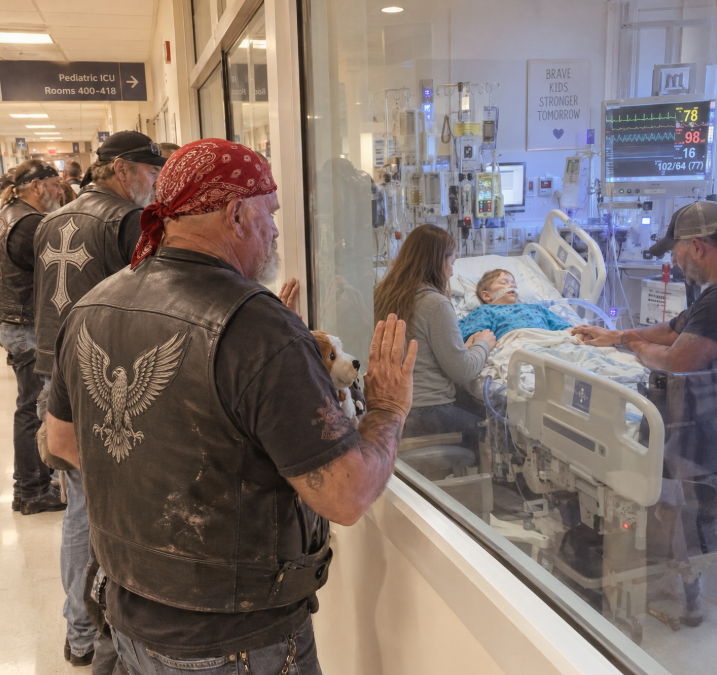
Thirty bikers on their knees.
Outside my son’s ICU room.
I am an accountant.
I drive a silver Honda Accord.
I own three pairs of khakis that are nearly identical.
I use spreadsheets for things other people use memory for.
Nobody in our family has ever owned a motorcycle.
Nobody in our family knows bikers.
At least, that was what I thought.
“Excuse me,” I said.
My voice sounded wrong.
Thin.
Angry because it was afraid.
“Are you in the wrong wing?”
A big man near the front stood slowly.
He had to be in his sixties, maybe older, with arms like tree trunks, a gray beard, and eyes so swollen from crying they looked painful. His leather vest had patches on it I did not understand. His hands were huge, scarred, and folded awkwardly in front of him like he did not know what to do with them now that he was standing.
He looked at me and said, “You’re Mason’s dad.”
It was not a question.
Every nerve in my body tightened.
“How do you know my son?”
The man glanced back at the others.
Not nervously.
Almost like he was asking permission.
A couple of them nodded.
The woman with the gray braids pressed the stuffed dog tighter against her chest.
The big man turned back to me.
“Sir,” he said quietly, “your boy’s been coming to see us every Saturday for about a year.”
The hallway tilted.
“What?”
“He rides his bicycle over to our clubhouse on Mill Street.”
My stomach dropped so fast I had to put one hand against the wall.
Mill Street was two miles from our house.
Two miles.
Across Briar Avenue.
Past the old train overpass.
Past the gas station where Sarah had told Mason not to go alone.
Every Saturday for months, Mason had told us he was going to his friend Tyler’s house.
Tyler lived three blocks away.
Tyler’s mother sometimes texted Sarah pictures of the boys playing video games.
Apparently, some of those Saturdays, Mason never went there at all.
“That’s not possible,” I said.
The big man’s face changed.
Not defensive.
Sad.
Like he had expected me to say exactly that.
He pulled out his phone, tapped the screen with one thick thumb, and turned it toward me.
There was Mason.
My Mason.
Sitting on a Harley.
Grinning so wide his face looked like it might split open.
He wore a leather vest so big it hung off his shoulders like a costume. Behind him stood at least a dozen bikers with crossed arms, serious faces, and the unmistakable posture of bodyguards protecting royalty.
Mason’s right hand was raised in a thumbs-up.
His front tooth was missing.
He looked happier than I had seen him in months.
The phone blurred.
I blinked hard.
“He never told you,” the big man said.
His voice cracked.
“Of course he didn’t. He said you’d worry.”
“Worry about what?” I snapped. “Why is my nine-year-old at a biker clubhouse?”
The words came out louder than I meant them to.
A nurse at the far end of the hall looked over.
A few bikers lowered their heads.
The big man did not react to my anger.
He stepped closer, then crouched slightly so we were almost eye level. He placed one hand on my shoulder like he had known me for years.
“Because the day he first showed up,” he said, “he walked right up to me, put his backpack down, and told me he was there to find out who his Uncle Danny was.”
The floor vanished under me.
Danny.
For fourteen years, that name had been a locked room in my marriage.
Danny Whitfield was my wife Sarah’s older brother.
He died sixteen years ago.
Four years before Mason was born.
A motorcycle accident on a wet road outside Reno.
Sarah had been twenty-three.
I learned his name on our third date.
We were sitting in a diner near campus, the kind of place that served breakfast all day and refilled coffee without asking. Sarah had been laughing about something, then stopped because a song came on the radio. Johnny Cash. “Ring of Fire.”
Her face changed so completely that I asked if she was okay.
She said, “My brother loved this song.”
Then she went silent.
Later, in the parking lot, she told me his name.
Danny.
She told me he had died.
She told me her family did not talk about him.
Not because they did not love him.
Because they loved him so much that the name itself had become dangerous.
Her mother took down every photograph of him within a month of the funeral.
Her father packed his room into boxes and put them in the attic.
Sarah said if I ever wanted to be part of her life, I had to promise never to ask.
Never bring him up.
Never press.
Never try to fix that grief.
I promised.
I kept that promise for fourteen years.
In all that time, Sarah said Danny’s name maybe twice.
Once in her sleep.
Once the day Mason was born, when she looked at our son and whispered, “He has Danny’s mouth.”
Then she cried so hard the nurse thought something was wrong.
Now a biker in an ICU hallway was telling me my nine-year-old son had been visiting them for a year to learn about the man my wife’s family had buried twice—once in the ground, and once in silence.
“How does my son know that name?” I asked.
My voice sounded high and strange.
The big man looked down the hall toward Mason’s room.
“My name is Frank,” he said. “But everybody calls me Bear.”
Of course they did.
He looked like a Bear.
He sounded like one too, if bears could cry.
“Come sit down, brother,” he said. “This is gonna take a minute.”
“I need to call—”
“This first.”
Something in his voice made me follow him.
Bear walked me past the kneeling bikers, past the vending machines, to a little waiting area with two cracked vinyl chairs and a coffee maker with an OUT OF ORDER sign that had probably been there since the Clinton administration.
He lowered himself into one chair with a grunt.
I sat in the other, still holding my phone.
Bear rubbed both hands over his face.
“Your boy showed up at our gate on a Saturday morning last September,” he said. “Rode his bike right up like he owned the place. Helmet still on. Backpack twice the size of him. Rang the buzzer.”
I tried to picture Mason doing that.
My careful boy.
My rule-following boy.
The kid who still asked before opening a soda at someone else’s house.
“He walked into a biker clubhouse alone?”
Bear gave me a look.
“He walked up to the gate. We weren’t going to let a kid inside without knowing what was going on. I opened up, and first thing he says is, ‘Are you Bear? My uncle used to know you.’”
I closed my eyes.
“He said Danny Whitfield,” Bear continued. “I hadn’t heard that name from a family member in fifteen years.”
He stared at his hands.
“Danny rode with us. He wasn’t full patch yet. He was a prospect. Sweetest kid you ever met. Twenty-two years old. Biggest laugh in the county. Scared of spiders, cried at movies, ate like a horse, rode like the devil was chasing him.”
Bear smiled once.
Then it broke.
“He crashed coming home from our anniversary run in October 2010. Road was slick. Deer came out. He hit the guardrail.”
“I know.”
“No,” Bear said gently. “You know the fact. You don’t know the boy.”
That silenced me.
He was right.
I knew Danny as an absence.
A rule.
A photograph that never sat on a shelf.
A grief that entered rooms before holidays and left after everyone was exhausted.
I did not know the boy.
Bear swallowed.
“We paid for half his funeral. His mama wouldn’t let us come. Wouldn’t let us near the church. Blamed us. Blamed the bike. Blamed the club. We understood. Grief does what it does. But we never got to say goodbye to that kid.”
I thought of Sarah’s mother, Elaine.
Rigid.
Careful.
A woman who folded napkins into perfect squares and kept a spotless house where no one ever said Danny.
I tried to imagine her at twenty-something, burying her son.
I could not.
“So Mason shows up,” Bear said, “and tells me he found a box in his grandma’s attic.”
My breath caught.
“Old vest. Photos. A patch with our club name. He said he’d been looking for us for months. Library computer. Old newspaper articles. Asked some questions around town. That kid did detective work like he was working a federal case.”
Despite everything, I almost laughed.
That sounded like Mason.
When he got interested in something, he built a whole world around it. Dinosaurs. Meteor showers. Civil War coins. For two months last year, he knew more about bees than anyone in our house wanted to know.
“Why?” I asked.
Bear looked at me for a long moment.
“Because his mama was sad.”
The words hit softly.
Then deeply.
“That’s what he said,” Bear continued. “‘My mom is sad all the time and I don’t know why and my grandma won’t tell me and I found this stuff and I think it’s about him.’”
I covered my mouth.
“He wanted to know who his uncle was so he could tell her. Said he was making her a book.”
“A book?”
“A photo book. For her birthday.”
Sarah’s fortieth birthday was in three weeks.
October 18.
I had been planning to buy her earrings and take her to dinner if Mason was well enough by then.
Mason had been planning to give her back her brother.
Bear reached into his vest.
He pulled out something wrapped in a red bandana, then unfolded it carefully, the way someone might unwrap a wounded bird.
It was a spiral notebook.
Red cover.
Worn soft at the corners.
Mason’s notebook.
“He left this at the clubhouse last Saturday,” Bear said. “Said he’d finish next weekend. When we heard on the news about a boy hit at Elm and Fourth, we called every hospital in the county till we found him.”
I took the notebook.
My hands shook.
The cover had a title written in Mason’s crooked slanted handwriting:
UNCLE DANNY BOOK
FOR MOM
SECRET UNTIL BIRTHDAY
Underneath, he had drawn a motorcycle.
The wheels were uneven.
The handlebars were too tall.
It was the most beautiful motorcycle I had ever seen.
I opened the first page.
Mason’s handwriting filled the notebook.
There were drawings.
Photos taped carefully into place.
Quotes written in pencil with names beside them.
Bear says Uncle Danny could eat a whole pizza by himself and still have room for ice cream.
Tommy says Uncle Danny was scared of spiders even though he was six foot two.
Rosa says Uncle Danny cried at the end of every movie including cartoons.
Bear says Uncle Danny’s favorite song was “Ring of Fire” but he sang it badly.
Uncle Danny wanted to teach Mom how to ride when she got older but Grandma said absolutely not.
Uncle Danny called Mom “Little Bird.”
My chest collapsed inward.
Little Bird.
I had heard that once.
Years ago.
Sarah had been half-asleep on the couch, Mason a newborn on her chest, and she whispered, “Don’t call me that,” to no one in the room.
I kept reading.
Mason had written questions at the top of pages.
What made Uncle Danny laugh?
Did Uncle Danny ever get in trouble?
Was Uncle Danny brave?
Did Uncle Danny love Mom?
Each answer had a name.
Sometimes several.
Every page was full of love people had been holding for sixteen years with nowhere to put it.
Then I turned to a page near the back and stopped breathing.
It was an old photograph.
A boy of maybe twelve sat on a couch holding a baby wrapped in a pink blanket. He was grinning down at her like the sun had risen inside his arms.
On the back of the page, Mason had written:
This is Uncle Danny holding Mom when she was born. He looks like he loves her the most out of anyone in the world. I want Mom to see this face. I want her to know he loved her the most.
I put my head down on my knees and cried.
Not like an adult.
Not like a father trying to be strong.
I cried like something had broken open inside me.
Bear placed one huge hand on my back and left it there.
He did not tell me it was okay.
He did not say be strong.
He did not try to fill the silence.
Down the hall, someone was praying out loud in Spanish.
Softly.
Again and again.
When I could finally sit up, I wiped my face with my sleeve.
“Why are you all here?” I asked. “All of you?”
Bear’s answer was simple.
“Because that boy is one of ours now. He’s family. And when family’s in trouble, we show up.”
“But the nurses—”
“Been trying to move us for two days.”
“Two days?”
“We got here the night after the accident. Once we found him. We take shifts. Security tried to talk to us. We told them we weren’t blocking anything important.”
“You’re filling the whole hallway.”
Bear shrugged.
“Mason fills a whole room when he walks in. We learned from him.”
I looked toward the ICU.
“I need to get my wife.”
Bear nodded.
“Take your time, brother.”
I walked back down the hall past men and women still on their knees.
A bald man with a long white beard looked up.
“How’s our boy?”
Our boy.
I could not answer.
I nodded because speaking would have destroyed me again.
The woman with gray braids held out the stuffed dog slightly.
“This is for him,” she whispered. “He named it Kickstand.”
I took it.
It was small, brown, floppy-eared, worn already from being clutched too tightly.
“Thank you.”
She nodded and lowered her head again.
Sarah was exactly where I had left her.
Curled in the chair beside Mason’s bed, her hand under his, eyes fixed on his face.
His chest rose and fell with the ventilator.
Machines beeped.
Clear fluid dripped through lines.
The room smelled like alcohol wipes, plastic tubing, and fear.
“Sar.”
She looked up.
Her face had gone hollow.
That is the only way I can describe it.
Four days of not eating, not sleeping, and staring at your child’s still body will carve a person from the inside.
“There’s something I need to show you.”
“Is he—”
“No. He’s stable.”
I hated that word now.
Stable did not mean safe.
Stable did not mean awake.
Stable did not mean coming home.
“What is it?”
“There are people in the hallway.”
“I know. I heard voices.”
“You need to see them.”
“I can’t leave him.”
“Just for a minute. The nurse is right there.”
Her eyes sharpened with exhaustion.
“I said I can’t leave him.”
I walked to her and knelt.
“Sarah. Mason left something.”
She looked at the stuffed dog in my hand.
“What is that?”
“Kickstand.”
Confusion crossed her face.
Then I placed the red notebook in her lap.
She stared at the cover.
UNCLE DANNY BOOK
FOR MOM
SECRET UNTIL BIRTHDAY
The blood seemed to drain from her face.
“Where did you get this?”
“Open it.”
“No.”
“Sar.”
“No.”
But her hands were already moving.
She opened the first page.
Read.
Her fingers tightened.
She turned the page.
Then another.
Her hand went to her mouth.
She did not cry at first.
That was worse.
She read standing beside Mason’s bed, one hand still touching his fingers as if she could not break contact with him even while the past opened under her feet.
Then she reached the photograph.
Danny holding her as a baby.
The sound she made did not sound human.
It came from somewhere so deep I felt it in my own body.
She sank down against the wall.
I sat beside her on the floor.
She held the notebook like it might vanish.
“Where did this come from?” she whispered.
“From Mason.”
“No.”
“Yes.”
“How?”
“There are people in the hallway who knew Danny. Mason found them.”
She looked at me.
Her eyes were not just full of grief.
They were full of sixteen years.
“My brother?”
I nodded.
“Mason has been visiting them every Saturday. He was making this for your birthday.”
Sarah looked back at the photograph.
“He loved me,” she whispered.
The sentence broke my heart.
Because she had not said, I loved him.
She said, He loved me.
As if some part of her needed proof.
As if sixteen years of silence had made even that uncertain.
“He loved you the most,” I said.
Her face crumpled.
“I need to show you,” I told her. “Come on.”
“I can’t.”
“You can.”
“I can’t see them.”
“They came for Mason.”
She looked toward our son.
Then at the notebook.
Then she stood, shaking so hard I had to steady her.
I opened the ICU room door.
Sarah stepped into the hallway.
And saw them.
Thirty bikers on their knees, praying for her son.
For a moment, she did not understand.
I watched her eyes move from face to face, searching for danger, then explanation, then memory.
Bear stood.
He walked toward her slowly, hands visible, as if approaching a frightened animal.
He stopped several feet away.
“Ma’am.”
His voice broke on the word.
“My name is Frank. Your brother called me Bear. I loved him like he was my own blood. I have wanted to tell you that for sixteen years.”
Sarah’s mouth opened.
No sound came out.
Bear’s eyes filled.
“Your boy found us. He came looking for his uncle. He’s been sitting with us every Saturday for a year, asking questions, writing everything down. He’s been keeping your brother alive in that little notebook. And now he’s ours too.”
Sarah’s knees went.
I caught one side.
Bear caught the other.
Together, we lowered her gently to the floor.
She sat there in her wrinkled sweater and four-day-old jeans, hair coming loose from its bun, face pale and wrecked, looking up at a hallway full of bearded, tattooed strangers who had loved her brother in a part of his life her family had tried to erase.
“Tell me about him,” she whispered.
Bear bent his head.
“Anything.”
Sarah’s hands closed around the notebook.
“Please. Somebody tell me about my brother.”
The woman with gray braids came first.
She sat cross-legged on the hospital floor in front of Sarah, still holding the stuffed dog.
“I’m Rosa,” she said. “Your brother once brought a stray cat to the clubhouse tucked inside his jacket. Poor thing was skinny as a rail and meaner than sin. Danny named him Kickstand because he said the cat leaned funny. That cat lived at the clubhouse eight years after Danny passed. Wouldn’t let most of us touch him, but he slept on Danny’s old chair every day.”
Sarah made a sound that was half laugh, half sob.
“He did that when we were kids,” she said. “He brought home animals. Mom hated it.”
Rosa smiled through tears.
“He never stopped.”
Then the bald man with the white beard came forward.
“Name’s Tommy. Danny sang Johnny Cash off-key at every party we ever had. Didn’t matter what song was playing. He’d find a way to make it Johnny Cash.”
Sarah covered her face.
“He sang to me when I was little.”
“He told us that,” Tommy said. “Said you wouldn’t sleep unless he sang ‘Ring of Fire,’ which is a strange lullaby for a baby, but Danny wasn’t known for good judgment.”
Sarah laughed.
Actually laughed.
It came out broken, but it was real.
One by one, they came forward.
They told stories.
Danny burning pancakes at a charity breakfast.
Danny crying at the end of a cartoon movie because the dog found its way home.
Danny staying up all night with Tommy when his marriage fell apart, twenty-two years old and somehow wiser than men twice his age.
Danny fixing Rosa’s car and forgetting to reconnect the horn.
Danny refusing to step on spiders but riding his motorcycle too fast in the rain.
Danny calling Sarah Little Bird.
Danny carrying a photograph of his baby sister in his wallet.
Danny saying he was going to visit his mom the next day.
Danny loving them.
Danny loving her.
Every story was handed to Sarah carefully, like something breakable they had been holding for sixteen years.
I stood behind her with one hand on her shoulder and watched my wife meet her brother again.
Not as a tragedy.
Not as a name no one could say.
As a person.
Funny.
Flawed.
Soft-hearted.
Alive in the mouths of people who remembered him.
After a while, Sarah stood.
Her legs shook, but her voice was steady when she spoke.
“I want you to come in.”
Bear looked at me.
I nodded.
Sarah said, “I want you to see Mason. He would want you to see him.”
The nurse at the ICU desk started to object.
Then she saw Sarah’s face and stopped.
“Two or three at a time,” she said softly. “No touching lines. No crowding the equipment.”
They came in small groups.
Two and three at a time.
The bikers who had looked so intimidating in the hallway became careful as church ladies beside Mason’s bed. They did not touch him, not with all the tubes and wires, but they put their hands on the bedrail, on each other’s shoulders, on Sarah’s back, on mine.
Bear came last.
He stood beside Mason for a long time.
Then he leaned down near my son’s ear.
“Hey, little brother.”
His voice was thick.
“Your mama knows now. You did it. You did the thing you set out to do.”
Sarah started crying again.
Bear continued.
“Now you gotta come back and finish the book, alright? We ain’t done. There’s stories we haven’t told you yet. Your Uncle Danny had a lot of stories. You come on back, buddy.”
I was looking at Sarah’s hand under Mason’s.
I do not know why.
Maybe because I had been looking for movement there for four days.
Maybe because some part of me needed a miracle so badly I had started searching for one in every twitch of light.
His fingers moved.
Small.
Slow.
A curl against his mother’s palm.
Sarah went completely still.
Her eyes widened.
“He squeezed,” she whispered.
I stared.
Mason’s fingers curled again.
“He squeezed my hand!”
The nurse moved fast.
Then another nurse.
Monitor checked.
Pupils checked.
Doctor called.
Bear stepped backward, both hands over his mouth, tears running into his beard.
“He squeezed,” Sarah kept saying. “He squeezed. He squeezed.”
Mason did not wake that day.
Hope is cruel that way sometimes.
It gives you one flash and then makes you wait.
But the doctors said the movement mattered.
They said words like response and encouraging and cautious optimism, and we held onto them like ropes over a cliff.
Mason woke on Sunday at 4:17 in the morning.
I know the exact time because I was watching the clock, bargaining with God in ways I had not tried since childhood.
His eyes opened slowly.
Unfocused at first.
Then frightened.
The ventilator was gone by then, replaced by oxygen. His throat was raw. His face was still swollen. He looked so small inside that hospital bed.
Sarah leaned over him.
“Mason?”
His lips moved.
No sound came.
The nurse told us not to overwhelm him.
Sarah nodded like she understood, then immediately whispered, “Baby, it’s Mom. I’m here.”
Mason swallowed.
His voice came out like paper.
“Mom.”
Sarah broke.
She folded over the bedrail, careful of the lines, sobbing into the blanket.
His second word came two hours later.
Bear had been sleeping in the corner chair, chin to chest, leather vest still on.
Mason turned his head.
His eyes found him.
The corner of his mouth moved.
“Bear.”
Bear stood so fast the chair nearly fell over.
“Hey, little brother.”
Mason blinked slowly.
“Mom knows?”
Sarah laughed and cried at the same time.
“Yes,” she said, taking his hand. “Mom knows.”
Mason closed his eyes.
A tear slid down his temple.
“I didn’t finish.”
Bear leaned closer.
“We got time.”
Mason spent three more weeks in the hospital.
Every single day, at least four bikers were in the waiting room.
They brought Sarah food.
They brought me coffee that was actually drinkable.
They brought crossword puzzles, blankets, phone chargers, socks, homemade soup, and once, inexplicably, a whole chocolate cake that said GET WELL LITTLE BROTHER in blue frosting.
Bear was there almost every night.
He slept in the chair so often the nurses stopped pretending he was a visitor and started handing him extra pillows.
The ICU staff learned their names.
Rosa organized meal trains without asking permission.
Tommy fixed the vending machine coffee dispenser with a paperclip and what I assume was a minor felony.
A younger biker named Cal sat with me during one of Mason’s scans and told me stories about Danny until I could breathe normally again.
My view of the world changed in that waiting room.
Before, I would have seen a leather vest and made assumptions.
Danger.
Noise.
Trouble.
Bad influence.
Now I watched a seventy-year-old man with a skull tattoo on his hand crochet a blanket for my son because, as he explained, “Hospitals are cold and I got restless fingers.”
People are rarely what our fear makes them.
On the day we brought Mason home, the doctor discharged him with a list of medications, restrictions, follow-up appointments, warning signs, and a tone that said we had been given something precious and fragile.
Mason left the hospital in a wheelchair.
Thin.
Bruised.
One arm in a sling.
A scar hidden beneath his shirt.
But alive.
When we rolled him through the doors, the parking lot began to rumble.
Thirty motorcycles lined the curb.
Helmets on.
Engines idling low.
Not loud enough to scare him.
Just enough to be felt.
Mason’s eyes widened.
Bear stood beside the first bike.
“You ready, little brother?”
Mason looked at us.
“Can they come home?”
Sarah looked at me.
I looked at Sarah.
“Yes,” she said.
So thirty motorcycles escorted our silver Honda all the way from the hospital to our driveway.
The neighbors came out onto porches.
A few recorded videos.
Mrs. Delaney from next door crossed herself like either a miracle or a crime was occurring.
Mason sat in the back seat, waving weakly at Bear through the window the entire way.
Two weeks after Mason came home, Sarah turned forty.
We held a small party in our backyard.
At least, it started small.
Her parents came.
That was the difficult part.
Elaine and Robert Whitfield had not spoken to a member of Danny’s motorcycle club in sixteen years. Elaine still believed grief had rules, and the first rule was silence. But Mason had asked them to come, and nobody said no to Mason anymore if the request did not violate medical instructions.
He wore a soft blue sweater because buttoning shirts still hurt.
His notebook sat on the picnic table beside the cake.
Sarah had finished it with him during his recovery, both of them curled on the couch beneath the same blanket. She added her own pages now.
What she remembered.
How Danny taught her to ride a bike.
How he called her Little Bird.
How he let her sleep in his room during thunderstorms.
How he promised to teach her to drive but died before she got her permit.
She placed the photograph of Danny holding baby Sarah beside a new photograph: Sarah holding baby Mason.
Underneath, Mason had written:
Mom says Uncle Danny would have loved me. I think I would have loved him too.
After cake, Sarah stood.
Her hands shook, but she opened the notebook.
She read it aloud.
At first, Elaine sat stiffly with her hands folded in her lap.
Then Sarah read the page about Danny carrying her picture in his wallet.
Elaine’s face cracked.
By the time Sarah reached the final page, her mother was crying for the first time I had ever seen.
Not quiet tears.
Real grief.
Sixteen years late.
Still grief.
Then Sarah closed the notebook and walked to the backyard gate.
Thirty bikers stood on the street outside.
Quiet.
Helmets held against their chests.
Waiting.
Not assuming.
Not entering.
Waiting to be invited into the space grief had kept them from for sixteen years.
Sarah opened the gate.
Then she turned to her mother.
Elaine stood slowly.
She wiped her face with both hands.
For a moment, I thought she would ask Sarah not to.
Instead, she walked to the gate and looked out at those men and women who had loved her son in the years when she had not known how to share him.
Her voice shook.
“Please come in.”
Bear lowered his head.
Elaine started crying again.
“Please,” she said. “Come tell me about my boy.”
Bear was the first through the gate.
Mason grabbed his hand and led him straight to the picnic table.
“There’s cake,” he said, as if Bear had not spent most of the previous month eating hospital cafeteria food and prayer.
Bear smiled.
“Best news I heard all day.”
I watched my wife’s mother sit across from a seventy-year-old biker with a white ponytail and hands like shovels. I watched him tell her, careful and slow, about the last thing Danny said before he got on his bike that October afternoon in 2010.
“He said he was going to come see you the next day,” Bear told her. “Said he hadn’t called enough. Said you were gonna be mad but you’d feed him anyway.”
Elaine pressed a napkin to her mouth.
Bear’s voice broke.
“He said he loved you.”
The whole backyard went still.
Elaine had waited sixteen years to hear that.
My nine-year-old son gave it to her.
Mason is ten now.
He walks with a slight limp when he is tired.
He has scars he pretends are no big deal.
He had nightmares for a while.
So did we.
He still rides his bike to Mill Street every Saturday.
The first time he asked after the accident, Sarah and I looked at each other for a long moment.
Then I said, “I’m going with you.”
Mason grinned.
“Okay.”
So now I go too.
Every Saturday.
An accountant in khakis at a biker clubhouse on Mill Street, sitting at a long wooden table while Bear tells stories, Rosa feeds everyone too much, Tommy sings badly, and Mason keeps adding to the book.
It is no longer a birthday surprise.
It has become something larger.
A family record.
A bridge.
A place where Sarah’s grief can go without drowning her.
Sometimes she comes with us.
Sometimes Elaine comes too.
The first time Elaine walked into the clubhouse, nobody moved too fast. Bear stood near the door with his hands visible, the way he had approached Sarah in the hospital hallway.
Elaine looked around at the photos on the walls.
There was one of Danny near the bar.
Young.
Laughing.
Alive.
She walked to it and touched the frame.
“I forgot his face like this,” she whispered.
Bear stood behind her.
“We didn’t.”
That was when she turned and hugged him.
Not neatly.
Not gracefully.
Like a mother finally reaching someone who had been holding part of her son for sixteen years.
There are still hard days.
Mason’s recovery is not a straight line.
Sarah still cries sometimes when Johnny Cash comes on the radio.
Elaine still apologizes to Bear too often.
Bear always says, “You were grieving, ma’am.”
She says, “So were you.”
He says, “Yes.”
Then they sit with that.
I think that is what healing looks like more often than people admit.
Not closure.
Not everything tied up cleanly.
Just people who were hurt sitting closer than they used to.
I think often about the moment I walked out of ICU and nearly tripped over a biker in the hallway.
I think about how close I came to asking security to remove them.
I think about how easily fear could have turned away the very people carrying answers my family had needed for sixteen years.
Thirty bikers on their knees looked strange to me because I did not know the story yet.
That is true of most people we judge.
We see the leather.
The tattoos.
The motorcycles.
The silence.
The grief.
The child on a bike saying he is going to Tyler’s house.
We do not see the hidden notebook.
The old photographs.
The clubhouse table.
The lost brother.
The family who never got to say goodbye.
The boy trying to heal his mother with a birthday present.
The strangers who became his guardians because he asked them who Danny was and they loved him for asking.
Mason once told me why he never told us.
We were sitting on the porch after physical therapy. His leg hurt, though he insisted it didn’t.
“You would’ve said no,” he said.
“Yes,” I admitted.
“You would’ve thought they were scary.”
“Yes.”
“They’re not.”
“I know that now.”
He looked out at the street.
“Bear cried the first day I said Uncle Danny’s name.”
“He did?”
“Yeah. He turned around so I wouldn’t see, but I saw.”
I put an arm around him carefully.
“Mase, you should have told us.”
“I know.”
“Riding across town alone wasn’t safe.”
“I know.”
“You scared us.”
“I know.”
He leaned against me.
“I just wanted Mom to not be sad when she heard his name.”
What do you say to that?
How do you discipline love that pure and reckless?
I kissed the top of his head.
“You did something beautiful,” I said. “And dangerous.”
He nodded.
“Can both be true?”
“Yes.”
He thought about that.
“Bear says that about motorcycles.”
Of course Bear did.
Mason’s notebook sits now in our living room.
Not hidden.
Not in an attic.
Not wrapped in silence.
On the coffee table.
People can open it.
Read it.
Add to it.
There is a new section in the back called Stories I Still Need To Ask.
Mason wrote the title.
Under it, he listed names.
Bear.
Rosa.
Tommy.
Grandma.
Mom.
Dad.
I asked why my name was there.
He shrugged.
“You’re in the story now too.”
He is right.
I am.
We all are.
Danny’s story did not end on a wet road outside Reno.
It continued in a boy who never met him but loved his mother enough to go looking.
It continued in thirty bikers kneeling outside an ICU room.
It continued in a grandmother opening a gate.
It continues every Saturday on Mill Street, when my son pedals his bike beside my very sensible Honda and waves like he is leading a parade.
He is ten years old now.
He still has the stuffed dog Rosa brought to the hospital.
Kickstand sleeps on his bed.
His scars are fading.
His limp is getting better.
His handwriting is still terrible.
His heart is enormous.
And every Saturday, when we reach the clubhouse, Bear stands at the gate.
He always says the same thing.
“Little brother.”
Mason always grins.
“Bear.”
Then we go inside, where the coffee is terrible, the stories are endless, and the people I once mistook for strangers are waiting like family.
Because that is what they became.
And because my son, lying between life and death in an ICU bed, had already understood something the rest of us were late to learn.
Family is not only the people who share your blood.
Sometimes family is the people who remember the names everyone else stopped saying.
Sometimes family is the people who kneel in a hospital hallway for a child they love.
Sometimes family is a room full of bikers holding sixteen years of stories until one brave little boy comes asking for them.
And sometimes, when grief has locked every door, it is a nine-year-old on a bicycle who finds the key.




