I Found My Missing Father 200 Miles Away on a Biker’s Harley, Laughing
PART3:
By the time I arrived, two police cars were in the parking lot, and staff members in scrubs were walking the grounds calling his name.
“Robert!”
“Mr. Patterson!”
“Robert, can you hear me?”
The sky was pale and colorless.
The air already felt warm.
That scared me.
Heat can become dangerous quickly for an elderly man without water, medication, or any idea where he is.
A police officer met me near the front entrance.
“Jennifer Patterson?”
“Yes.”
He had kind eyes, which made me hate him for no reason at all.
“We’ve issued a Silver Alert. We have units checking nearby roads, businesses, drainage areas, and neighborhoods.”
“How long has he been gone?”
“We’re estimating a little over an hour.”
“He could be farther than that.”
“Most dementia patients are found within a few hours, often close by.”
“Most?”
He did not answer.
I spent the morning searching.
That sentence makes it sound organized.
It was not.
It was panic with a steering wheel.
I drove every street near the facility.
I checked gas stations.
Parks.
Church parking lots.
The grocery store my father used to visit before we moved him into care.
I stopped strangers.
Showed his picture.
Gray hair.
Blue eyes.
Cardigan sweater.
Slippers.
His name is Robert Patterson. He has dementia. Have you seen him?
No.
Sorry.
No.
I hope you find him.
By ten o’clock, volunteers had joined.
By noon, my sister Claire was driving in from Tulsa, sobbing so hard on the phone I could barely understand her.
By one, I was no longer angry at Willow Creek.
Anger required energy.
Terror had eaten everything else.
Dad had not eaten breakfast.
He had not taken his blood pressure medication.
He had no hat.
No phone.
No wallet, I thought then.
Later, I learned he had taken the old leather wallet he always carried before the dementia got bad.
The one with a faded photo of my mother tucked behind his Navy ID card.
At 2:17 p.m., I pulled into a gas station parking lot and cried so hard I could not breathe.
I had spent the previous two years losing my father slowly.
One word at a time.
One memory at a time.
One ability at a time.
I thought dementia had already taught me every kind of loss.
I was wrong.
There is a special horror in losing someone who is still alive and knowing they may not know how to come back.
At 3:42 p.m., my phone rang.
Unknown number.
I almost dropped it answering.
“Hello?”
“Is this Jennifer? Robert Patterson’s daughter?”
My whole body went cold.
“Yes. Who is this?”
“My name’s Hank,” the man said. “Your dad’s safe.”
I closed my eyes.
The gas station disappeared.
“What?”
“He’s safe. He’s with me at a diner about two hundred miles east of you.”
My eyes opened.
“What?”
“I found him walking on Route 40 this morning. I gave him a ride.”
“You did what?”
There was a brief silence on the other end.
The man’s voice softened.
“I know how that sounds. But he’s safe. He’s sitting right here eating cherry pie and telling three of us about your mother.”
I gripped the phone so hard my hand hurt.
“My father has dementia.”
“I figured that out.”
“You took him two hundred miles?”
“He climbed on my bike before I understood the situation.”
“Your bike?”
“My Harley.”
I think I stopped breathing.
“Where are you?”
He gave me the name of a diner I had never heard of, off Route 40, east of Amarillo.
“Stay there,” I said.
“We’re not going anywhere.”
“If you move him—”
“We won’t.”
I drove there in just under three hours.
I do not remember most of the drive.
I remember calling the police.
Calling Willow Creek.
Calling Claire.
Crying.
Yelling.
Praying.
Swearing at traffic.
Imagining every possible version of what I would find.
My father frightened.
Injured.
Taken advantage of.
Humiliated.
Confused.
Dead.
I did not imagine what was actually waiting for me.
The diner sat beside a two-lane stretch of highway with a gravel lot, a faded sign, and three motorcycles parked near the entrance.
Big bikes.
Chrome catching the late-afternoon sun.
I parked crookedly and ran inside.
The place smelled like coffee, fryer oil, pie crust, and old wood.
A waitress turned when the bell over the door rang.
I spotted them immediately.
Three bikers in a corner booth.
Leather vests.
Gray beards.
Road-worn faces.
And sitting with them, eating cherry pie with whipped cream on his chin, was my father.
My father.
Laughing.
Not smiling vaguely.
Not mumbling.
Not staring through people.
Laughing.
His eyes were bright.
His cheeks had color.
His hands moved as he talked.
For one dizzy second, I saw him as he had been before the diagnosis.
Not completely.
Dementia had still left its marks.
He looked older.
Thinner.
More fragile.
But something in him had stepped forward from behind the fog.
The man in the booth beside him stood.
Tall.
Broad.
Gray beard.
Leather vest covered in patches.
“You must be Jennifer.”
I could not decide whether to hit him or hug him.
“My father has been missing for twelve hours.”
“I know.”
“Do you?”
“Yes, ma’am.”
“Do you have any idea what we’ve been going through?”
His face did not harden.
That made it harder to stay angry.
“I do now.”
My father looked up then.
Really looked.
His whole face lit.
“Jenny!”
I froze.
He had not called me Jenny in a year.
Not correctly.
Not with recognition attached.
“Dad.”
He waved me over as if we had met for lunch by arrangement.
“Look who I met!”
His hand landed on the table between the bikers.
“These fellas ride. Real riders. This is Hank. That’s Bear. And that skinny one’s Rabbit.”
The skinny one was not skinny.
He was just smaller than the other two, which still made him larger than most furniture.
My father looked at them proudly.
“This is my daughter. She’s a teacher. Makes me so proud.”
I had been a teacher twenty years ago.
Before I became a school administrator.
Before the paperwork swallowed the classroom.
Before my father forgot most of my adult life.
I did not correct him.
I sat down because my legs were shaking.
Hank slid a mug of coffee toward me.
“It’s kind of a long story.”
“I bet it is.”
He nodded once.
“Let me tell it.”
My father leaned toward Bear.
“Did I tell you about Margaret’s blue dress?”
Bear smiled gently.
“Only three times, Robert. I’m hoping for four.”
Dad’s face softened.
“Best day of my life. Saw her at a dance. She wore a blue dress. Not fancy. Just blue. Had white buttons down the front. I knew right then I was going to marry her.”
My throat closed.
He remembered.
For months, he had asked where Margaret was, forgetting she had died six years earlier.
For months, I had watched grief hit him fresh each time we had to decide whether to tell him the truth.
Some days we said she was at the store.
Some days we said she would visit soon.
Some days, when he was already upset, we told him gently that she was gone.
And each time, he mourned her like the first time.
But now he remembered the blue dress.
He remembered meeting her.
He remembered the best day.
Hank sat across from me.
“I was heading east on Route 40 around seven this morning,” he began. “Middle of nowhere. I see this old guy walking on the shoulder in slippers and a cardigan. No hat. Sun coming up. Already getting warm.”
I looked at my father’s feet.
Facility socks.
Slippers.
Dust around the edges.
“I pulled over,” Hank said. “Asked if he needed help. He told me he was fine. Said he was going home. Gave me an address.”
I knew before Hank said it.
“Our old house.”
“Yes.”
The house on Maple Ridge.
Sold fifteen years ago after Mom got sick the first time.
The house where she died.
“He said his wife was waiting,” Hank continued. “Said he’d been at work and needed to get back before dinner.”
Dad worked at the same factory for thirty-eight years.
Retired before I had my second child.
“I didn’t know about the dementia at first,” Hank said. “He seemed a little confused, sure, but not scared. I asked if he wanted a ride. He saw the bike and lit up like a kid on Christmas.”
My father laughed from the other side of the table.
“I told him I used to ride.”
“You did,” Hank said.
“I had a Honda.”
“You told us that too.”
“Margaret loved that bike.”
“She did,” Rabbit said.
Dad nodded seriously.
“She said she hated it, but she held on tight. That’s how I knew.”
Bear grinned.
“How you knew what?”
“That she trusted me.”
The three bikers went quiet.
So did I.
Hank continued.
“I had an extra helmet. He climbed on before I could talk myself out of it. I figured I’d take him a few miles down the road, maybe get him somewhere safe.”
“You should have called the police immediately.”
“I know.”
I expected him to defend himself.
He did not.
“That’s what I should have done.”
“Then why didn’t you?”
He looked at my father.
“Because when the wind hit him, he laughed.”
I said nothing.
“I mean, laughed,” Hank said. “Full-body. Like something opened. I’ve heard joy before. This was different.”
Rabbit leaned forward.
“Hank called us twenty minutes in. Said he had an old man on the back of his bike who might be lost and might also be having the best day of his life.”
“We met at a rest stop,” Bear said. “That’s when we realized something wasn’t right.”
Hank nodded.
“He kept asking where Margaret was. Then he got upset because he couldn’t remember the house number. I checked his wallet. Found the facility card. Called them. They said you’d been notified and gave me your number.”
My anger rose again.
“That was hours before you called me.”
The three men exchanged a look.
Not guilty exactly.
Something more complicated.
“Why didn’t you take him back?” I asked.
Bear answered.
“Because he was happy.”
I stared at him.
He held my gaze.
“I know that might not be enough. Maybe it shouldn’t be. But he was happy. Happiest old man I’ve ever seen. Kept talking about how he hadn’t been on a motorcycle in forty years. Kept asking if we could go just a little farther.”
“You kidnapped my father.”
Hank nodded slowly.
“If that’s how you feel, I understand.”
The honesty disarmed me.
I wanted him to argue so I could stay angry.
Instead, my father laughed at something Rabbit said and wiped whipped cream from his chin with a napkin.
Hank’s voice softened.
“We called the facility every couple hours. There’s a trucker friend of ours named Dale who helped coordinate. They knew he was safe. They knew he was with us. We should’ve called you sooner. That’s on me.”
I looked at Dad.
He was telling Bear about the factory.
Accurately.
Names.
Machines.
Shift times.
Stories I had not heard in years.
“How is he doing this?” I whispered.
Hank leaned back.
“My mother had dementia.”
I looked at him.
“By the end, she didn’t know anyone,” he said. “Not me. Not my brothers. Not herself. But once, near the end, someone played a song she used to dance to, and she came back for about three minutes. Sang every word. Knew my name. Asked me why I looked so old.”
His smile was sad.
“Then she was gone again.”
I swallowed.
“The bike did that for him?”
“Maybe. The wind. The sound. The motion. The memories. I’m not a doctor. I just know your father climbed on my Harley as a lost old man and for a while became Robert again.”
Robert.
Not Dad with dementia.
Not Mr. Patterson from Willow Creek.
Robert.
The man who loved motorcycles and Margaret and open roads.
“What did you do all day?” I asked.
Rabbit brightened slightly, like a child caught doing something he was proud of and not sure he should be.
“We took him to a lake.”
“A lake?”
“About forty miles from here,” Hank said. “He said water sounded good. So we went.”
Bear added, “He took his shoes off and walked in up to his ankles. Said it reminded him of being a kid.”
“He shouldn’t be walking barefoot,” I said automatically.
“I know,” Hank said. “I watched him like he was made of glass.”
My father called across the table, “Jenny, did I ever tell you I wanted to be a pilot?”
“No,” I said honestly.
His eyes widened as though I had missed a crucial family fact.
“I took lessons once. Before I met your mother. Too expensive to keep going.”
Bear nodded.
“So we took him to a little airfield with vintage planes.”
“You what?”
“He stood there twenty minutes talking about wanting to fly,” Rabbit said. “Knew more about the planes than any of us.”
My father smiled into his coffee.
“Could’ve been good at it too.”
I stared at him.
Who was this man?
My father had become so defined by what he had lost that I had forgotten there were things I never knew.
Dreams he put down before I was born.
Versions of him that existed before Dad.
Before husband.
Before patient.
Before dementia.
“What else?” I asked quietly.
Hank’s eyes met mine.
He heard the change in my voice.
“We stopped at a music store.”
I almost laughed.
“What?”
“Rabbit needed guitar strings,” Bear said.
“I did not,” Rabbit said. “I said that as an excuse because Robert saw the piano through the window.”
Dad looked at me.
“They had a piano, Jenny.”
“I heard.”
“Nice upright. A little out of tune.”
Hank smiled.
“He sat down and played.”
My hand went to my mouth.
“What did he play?”
“Moonlight Serenade.”
The room blurred.
My mother’s favorite song.
We played it at her funeral.
Dad had not played piano in forty years, maybe longer. We had an old one when I was little, but it mostly held framed photos and Christmas cards. I remembered him playing sometimes when I was small. After Mom died, I asked once if he wanted a keyboard for the apartment.
He said his hands had forgotten.
Apparently, they had not.
“They remembered,” Hank said, as if reading my face.
I turned toward my father.
“Dad?”
He looked at me.
“You played piano today?”
His expression flickered.
For a second, I thought the fog had returned.
Then he smiled.
“Margaret liked that one.”
I started crying.
Not dramatically.
Just tears spilling before I could stop them.
Hank pushed a napkin across the table.
“There’s more.”
“I don’t know if I can take more.”
“We stopped at a church,” Bear said gently.
My father lowered his eyes.
“He lit a candle for Margaret,” Hank said. “Stood there a long time.”
I could hardly breathe.
“When he came out, he said, ‘I told her I’m okay. I told her I’m coming soon.’”
The diner noise faded.
My father reached for my hand.
His grip was weak.
Warm.
“Don’t be sad, Jenny.”
I looked at him.
Really looked.
For months, I had been trying to reach him through the fog.
Begging for pieces.
A glance.
A word.
A moment of recognition.
Now here he was, sitting in a diner between strangers in leather, speaking to me with a clarity I had stopped praying for because hope had become too expensive.
“I had a good life,” he said.
My breath caught.
“I had Margaret. I had you and your sister. I got to ride one more time.”
His eyes were blue.
So blue.
“I’m okay.”
Somewhere inside him, he knew.
Not everything.
Not in the way healthy people know.
But some deep part of him understood this day had been a gift, and maybe a farewell.
“I love you, Dad.”
His thumb moved over my hand.
“I love you too, sweetheart.”
Then his eyes shifted.
The light changed.
He looked around the diner, confused.
“Where are we?”
The loss was so fast it felt violent.
I closed my fingers around his.
“At a diner, Dad. With friends.”
He nodded uncertainly.
“Is Margaret coming?”
I looked at Hank.
Hank looked down.
“Yes,” I said softly. “Someday.”
Dad relaxed.
“Good.”
Hank pulled out his phone.
“I took pictures. Videos too.”
He handed it to me.
Photo after photo filled the screen.
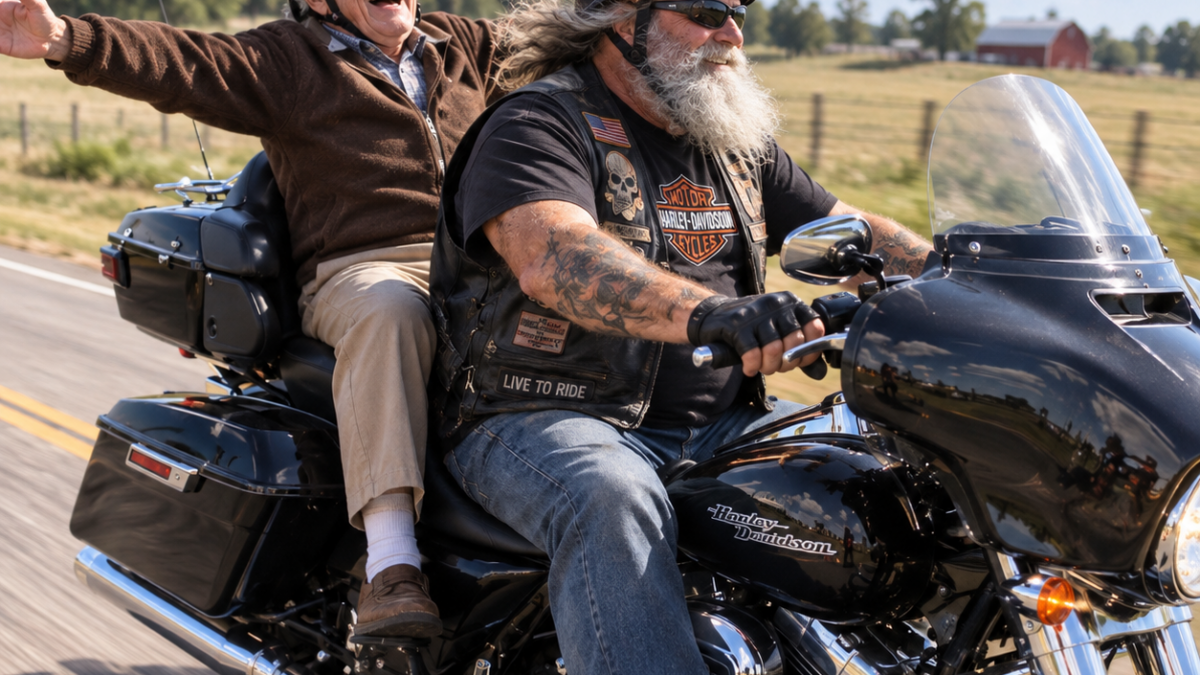
My father on the back of Hank’s Harley, helmet too big, arms spread wide like he was flying.
My father at the lake with his pants rolled above his ankles.
My father in front of a silver vintage plane, saluting badly.
My father at a piano, head bent, hands on the keys.
My father standing in a church, candlelight on his face.
My father in the diner booth with Hank, Bear, and Rabbit, holding up a forkful of pie.
In every photo, he was smiling.
Not polite smiling.
Not dementia confusion smiling.
Alive smiling.
“Already sent them to you,” Hank said.
I covered my mouth.
“You took these for me?”
“For later,” he said. “When he’s gone. So you can remember him like this. Happy. Free. Himself.”
I looked at this stranger.
This biker who had taken my missing father two hundred miles away on a motorcycle.
This man I had been prepared to hate.
And I realized he had given me something I did not know I needed.
Not proof that my father had once been himself.
Proof that he still was, somewhere.
We stayed at the diner until nearly midnight.
That sounds irresponsible.
Maybe it was.
But I called Willow Creek. I called the police. I called Claire. Everyone knew where he was. Everyone knew he was safe. The facility nurse said his medication could be given late with doctor approval, which she got. Claire cried when I sent the first photo.
“Is he laughing?” she asked.
“Yes.”
“Jen.”
“I know.”
Dad drifted in and out.
Sometimes he asked where we were.
Sometimes he told the same story twice.
Sometimes he stared at the pie case and hummed.
Once, Hank described the ride along a ridge road, and Dad laughed again.
“Faster,” Dad said.
Hank grinned.
“You did keep saying that.”
“Did you go faster?”
“Not as fast as you wanted.”
Dad shook his head.
“Coward.”
Bear laughed so hard he coughed.
When it was finally time to leave, Dad did not want to get into my car.
“Where’s the motorcycle?”
“It’s late, Dad.”
“Hank’s taking me?”
“I’m taking you back.”
He looked disappointed, then confused, then tired.
Hank crouched beside him.
“Robert, I’m gonna come visit. We’ll talk bikes.”
Dad studied him.
“I know you.”
“Yes, sir.”
“You’re Hank.”
“That’s right.”
“I like Hank.”
Hank’s face tightened.
“I like you too, brother.”
Brother.
The word did something to Dad.
He straightened slightly.
“Brother,” he repeated.
Bear handed me a card.
“Club information. Rides to appointments. Help with the facility. Anything. You call.”
Rabbit hugged me before I knew what was happening.
“It was an honor riding with him.”
Hank walked me to the driver’s side.
Dad was already buckled in, half-asleep.
Hank leaned one arm on the car roof.
“I’m sorry for how I handled it.”
I looked at him.
“You should have called me sooner.”
“Yes.”
“You scared me to death.”
“Yes.”
“You gave him the best day he’s had in years.”
Hank looked toward Dad.
“He gave us one too.”
I hugged him then.
This stranger.
This biker.
This man who had broken every rule and somehow found my father inside the ruins of his mind.
“Thank you,” I whispered.
He patted my back once.
Awkward.
Kind.
“Just get him home safe.”
Back at Willow Creek, the night staff cried at the photos.
Dad woke as we helped him into bed.
“Where’s Hank?”
“He went home, Dad. But he’ll visit.”
“Good. I like Hank.”
“I know.”
A nurse handed him his medication.
For the first time in months, he took it without fighting.
Then something flickered in his eyes.
“I rode a motorcycle.”
“You did.”
“It was fast.”
“Yes.”
“The wind was loud.”
I sat beside his bed.
“Yes.”
“And I wasn’t scared.”
My throat closed.
“No, Dad. You weren’t.”
He closed his eyes.
“I was free.”
I held his hand.
“Tell Margaret I’ll be home soon,” he murmured.
Then he fell asleep still smiling.
My father lived eight more months.
Dementia did what dementia does.
It took.
And took.
And took.
He stopped telling stories.
Stopped feeding himself.
Stopped saying my name.
Eventually he stopped speaking almost entirely.
There were no more full days of clarity.
No more long returns.
But there were flickers.
Hank visited twice.
The first time, he brought motorcycle magazines and sat beside Dad’s bed describing every bike in detail.
Dad did not know him.
Not really.
But when Hank described the lake, Dad’s eyes focused for just a second.
The corner of his mouth lifted.
Gone almost immediately.
But it was there.
The second time, Hank brought a framed photograph from their ride: Dad on the back of the Harley, arms out, laughing into the wind.
He placed it on the dresser where Dad could see it.
“He looks good there,” Hank said.
“He does.”
My father stared at the photo for a long time.
Then whispered one word.
“Fast.”
Hank turned away.
I pretended not to see him wipe his eyes.
When my father died, the facility called just after dawn.
This time, there was no panic.
No search.
No sirens.
Just an ending we had known was coming and still could not prepare for.
Claire and I sat with him until the funeral home arrived.
He looked smaller than he had ever looked.
Peaceful, people say.
I do not know if peaceful is the word.
Empty, maybe.
Not in a cruel way.
Just true.
Whatever had made him Robert had finally gone where dementia could not follow.
At the funeral, Hank arrived with twelve members of his club.
Full dress.
Leather vests.
Polished boots.
Helmets tucked under their arms.
They stood at the back of the chapel during the service and at attention at the cemetery.
My father’s old Navy friends were gone.
Most of his factory friends had passed or moved away.
Many people who knew him as Robert had already disappeared from his life before death took the last of him.
But the bikers came.
For a man they had known fully for one day.
After the burial, Hank handed me a small wooden box.
Inside was a vest patch.
Black background.
White stitching.
ROBERT PATTERSON
HONORARY BROTHER
I touched the letters.
“That day,” Hank said, “he became one of us.”
Bear handed me a photograph.
Dad in the diner booth between the three of them.
On the back, someone had written:
Robert Patterson.
Best riding partner we ever had.
I pressed the photo to my chest.
“You gave him himself back,” I whispered.
Hank shook his head.
“No. He was still there.”
He looked toward the fresh grave.
“We just gave him room to come out.”
Three years have passed.
I joined a dementia support group after Dad died.
At first, I went because grief had nowhere else to go.
Then I stayed because every room like that has someone sitting in a chair, exhausted, terrified, and convinced they are failing the person they love.
I tell them Dad’s story.
Not because everyone with dementia can safely ride a motorcycle.
They cannot.
Not because strangers should ignore protocols.
They should not.
I tell it because the disease can make families forget that the person is still in there.
Changed.
Hidden.
Harder to reach.
But still there.
Sometimes music reaches them.
Sometimes water.
Sometimes touch.
Sometimes prayer.
Sometimes a photograph.
Sometimes the impossible rumble of a Harley under an old man’s hands.
Families cry when I tell the story.
They say, “I wish my mother could have one more good day.”
“I wish my husband could feel like himself again.”
“I wish I knew what would bring my father back, even for a minute.”
I tell them to look for the Hanks of the world.
They are out there.
On motorcycles and in minivans.
In grocery stores and churches.
In diners at midnight.
People who understand that joy is not wasted just because someone will forget it.
That matters.
I used to think if Dad could not remember something, it did not count.
Dementia taught me how wrong that was.
He might not have remembered the lake an hour later.
But he felt the water.
He might not have remembered the piano the next day.
But his hands found the song.
He might not have remembered Hank’s name every time.
But somewhere in him, the feeling remained.
Safety.
Wind.
Brotherhood.
Freedom.
Last month, Hank called.
I still answer when he does.
“Jennifer,” he said, “you sitting down?”
My heart jumped.
“Hank, what happened?”
“Nothing bad. Found something in my garage.”
“What?”
“Old GoPro. Thought it was broken. Turns out it has footage from your dad’s ride.”
I stopped moving.
“How much?”
“Twenty minutes.”
He brought it over that weekend.
We sat at my kitchen table, the same place where I had filled out Dad’s facility paperwork, argued with insurance companies, signed hospice forms, and cried into too many cups of coffee.
Hank placed a laptop in front of us.
The video began with road noise.
Wind.
Engine.
Sky.
Then the camera angle shifted, mounted somewhere near Hank’s chest or helmet. I could see the highway ahead. Fields blurring past. Sunlight flashing across chrome.
Then Dad’s voice.
Clear.
Bright.
“Faster!”
Hank laughed on the video.
“You’re gonna get me arrested, Robert.”
“Worth it!”
I covered my mouth.
On screen, they stopped at a red light.
Dad leaned slightly into view behind Hank’s shoulder. Helmet on. Goggles crooked. Face alive with joy.
He tapped Hank’s shoulder.
“Thank you,” Dad said, clear as day.
Hank turned his head slightly.
“For what?”
Dad looked out at the open road.
“For reminding me what it feels like to be alive.”
The light turned green.
The bike moved forward.
Dad laughed.
The sound filled my kitchen.
I broke.
Not softly.
Not neatly.
Hank sat beside me, crying too.
We watched the whole twenty minutes.
Then we watched it again.
I have watched it more than a hundred times since.
When I miss him, I watch it.
When I accidentally remember only the worst parts—the confusion, the anger, the fear, the blankness—I watch it.
When someone in support group says their loved one is gone before they are gone, I think of my father’s voice shouting faster into the wind.
That was Robert.
Not the disease.
Not the forgetting.
Not the facility room.
Not the man who could not remember my name.
The man on the back of that Harley.
The man who loved Margaret in a blue dress.
The man who wanted to fly.
The man whose hands remembered Moonlight Serenade.
The man who stood in a church and told his dead wife he was okay.
The man who became an honorary brother to three bikers who understood, somehow, that one good day can be a sacred thing.
For one perfect day, thanks to a stranger on a motorcycle, my father got to be himself one more time.
And because Hank took pictures, because he recorded the wind, because he saw Robert and not just dementia, I get to remember him that way too.
Arms spread wide.
Laughing into the wind.
Free.




