I Fixed a Stranger’s Motorcycle for Free So He Could Reach His Dying Mother—The Next Morning, My Street Filled With Bikers Carrying Her Final Message to Me.
PART2:
But in our part of Jacksonville, everybody knew if you had an engine that coughed, a mower that died, a truck that would not turn over, or a generator that quit right before hurricane season, you called Jerome Brooks.
He had big hands, patient eyes, and a rule for every tool.
Never force what should turn.
Never trust a part you have not checked twice.
Never take money from someone who needs gas more than you need pride.
I kept his old tool roll under my bed for two months after he died before I could bring myself to open it.
The first time I did, the smell hit me.
Grease.
Canvas.
Metal.
A little bit of his soap.
I sat on the floor and cried so hard I could not breathe.
Then, slowly, I started using the tools again.
At first, just to keep our own mower running.
Then Mrs. Ellis asked if I could fix her grandson’s bike.
Then Mr. Holloway’s weed trimmer.
Then a push mower.
Then a pressure washer.
Word traveled the way it does in neighborhoods where people do not have extra money for shops and service calls. By June, there were usually two or three broken things waiting near our porch, each with a piece of masking tape and a name written on it.
Mom worked evening shifts at St. Catherine’s Hospital.
She cleaned rooms, changed linens, carried supplies, helped nurses find things, calmed families when she could, and came home with her feet swollen and her smile still working harder than it should have. She always smelled faintly of disinfectant and hand lotion when she stepped off the bus. On nights the bus ran late, Marcus, Ben, and I waited near the corner store, then walked her home.
She said we did not have to.
We did it anyway.
Marcus lived three blocks over with his grandmother, two younger sisters, and a basketball hoop with a bent rim. He was tall, fast, and could make my mother laugh after a twelve-hour shift by telling stories about our school principal like he was narrating a crime documentary.
Ben lived across from us with his uncle. He was quiet unless he trusted you, and even then, his words came carefully, like he had to sketch them in his head before saying them out loud. He drew motorcycles in a notebook he never let anyone see for long. He drew engines too, wheels, headlights, handlebars, suspension parts, whole bikes from angles he had only imagined.
He said they were just doodles.
They were not just doodles.
They were dreams he was afraid to say out loud.
Marcus and Ben were at our house so often that Mom had started buying the cereal they liked. She called them “my bonus sons,” which made Marcus grin and Ben look down like he was trying to hide how much he needed to hear it.
That evening, we were waiting by the corner store when the black motorcycle coughed its way off the road beneath the overpass.
The sun was low over Jacksonville, turning the concrete pillars orange and throwing long shadows across the cracked parking lot. Traffic rolled overhead in waves. The overpass always sounded like thunder trapped in a ceiling—tires humming, trucks rattling, horns barking somewhere above us. The corner store sign flickered blue and red, and the smell of fried chicken from the gas station drifted through the humid air.
We were sharing a bag of chips on the curb because Mom’s bus was late again.
Then the motorcycle sputtered.
Not a normal engine sound.
Not the deep steady growl bikers liked.
This was uneven.
Sick.
The rider coasted into the lot, boots down, one hand working the throttle like he was trying to talk the machine into staying alive. He stopped near the air pump and tried the starter twice. The engine caught, stumbled, coughed, and died.
He sat there for a moment.
Helmet still on.
Hands on the grips.
Then he slowly leaned forward until his forehead rested against the tank.
Marcus lowered his voice.
“We should probably stay out of that.”
Maybe we should have.
The man was big.
Broad-shouldered.
Leather vest full of patches.
Gray beard.
Heavy boots.
The kind of man adults warn teenagers not to stare at.
He took off his helmet and looked at the motorcycle like it had betrayed him personally. Then he pulled out his phone, tapped the screen, held it up, tapped again, and stared at it.
Dead.
Or close enough.
He sat heavily on the curb.
He did not look angry.
That was what made me stand up.
Angry would have been easy to avoid.
This man looked frightened.
Not scared of us.
Not scared of the neighborhood.
Scared of time.
I knew that look because I had seen it on my mother’s face in the hospital hallway when the doctor told us Dad might not wake up.
I crossed the lot before I could talk myself out of it.
“Owen,” Marcus hissed.
I ignored him.
The biker looked up when my shadow crossed his boot.
“Want me to take a look?”
He blinked, then glanced at my hands.
They were still marked with grass stains and grease from a mower I had finished that afternoon.
“You know motorcycles?”
“A little,” I said.
It was honest.
Dad had worked on plenty of bikes, but I was not him. I knew engines better than most sixteen-year-olds, worse than every real mechanic, and enough to be dangerous only if I pretended I knew more than I did.
“What was it doing before it stopped?”
The man looked at the road.
“Losing power for miles. Started sputtering near the river. I kept hoping I could make it.”
“Make it where?”
He swallowed.
“Savannah.”
Ben, who had followed us despite Marcus trying to pull him back, looked up.
“Georgia?”
The man nodded.
“My mother’s in a hospital there. She had a bad night. My sister called. Said if I was coming, I should come now.”
The words settled over us.
Even Marcus stopped looking suspicious.
“Can’t you get a ride?” Ben asked.
“Not fast enough from here.” The man rubbed a hand over his face. “My phone’s dying. My charger’s in my saddlebag, but the port on the bike quit last week. My buddy’s two hours west. I thought I could make it.”
“What’s your name?” I asked.
“Daniel.”
“I’m Owen. That’s Marcus and Ben.”
Daniel nodded to them.
“Appreciate you boys stopping, but I don’t want to get you in trouble.”
Marcus muttered, “Too late.”
I crouched beside the bike.
It was a black cruiser, old but cared for. Not showroom clean. Road clean. The kind of bike that had seen miles and earned every scratch. Dad would have liked it.
I checked what I could safely reach in the parking lot.
Fuel.
Connections.
Lines.
The chain needed attention, but that was not what had killed the engine. The battery seemed weak but not dead. The starter tried. The engine wanted to catch. It was not getting what it needed.
“How long since it was serviced?” I asked.
Daniel winced.
“That bad?”
“Just asking.”
“Too long.”
I looked up at him.
“Fuel’s not getting through right. Could be blockage. Could be filter. Could be something I can clean enough to get you to a proper shop, but I can’t promise more than that.”
Daniel stared at me.
“Can you try?”
I heard everything under those three words.
Can you help me get to my mother?
Can you give me one more chance?
Can you stop time from taking something I am not ready to lose?
“Yes,” I said.
Marcus groaned softly, but he was already walking toward the store.
“I’ll get water.”
Ben crouched beside me with his eyes bright in the way they got around machines.
“What do you need?”
“Light. And don’t lose any screws.”
“I never lose screws.”
“You lost two from your uncle’s fan last week.”
“They were emotionally unnecessary.”
Daniel laughed once.
It came out broken, but it was still a laugh.
For the next forty minutes, the three of us worked under the overpass while Daniel held himself together by sheer force.
Marcus bought bottled water and a cheap pack of paper towels from the store. Ben held the flashlight after Daniel’s phone died completely. I used Dad’s small wrench from the tool roll I carried in my backpack because I never went far without it anymore. Old habit. Or grief. Sometimes they look the same.
The blockage was small, stubborn, and exactly the kind of thing that makes a machine seem dead when it is only waiting for someone patient enough to clear the path.
I got fuel moving again.
Checked the line.
Reconnected.
Wiped my hands.
“Try it.”
Daniel swung onto the bike.
For a second, I saw how tired he was. The way he gripped the handlebar. The stiff way he lifted his leg. The dust on his boots. The dark circles under his eyes.
Then he pressed the starter.
The engine turned.
Once.
Twice.
Caught.
Stumbled.
Then settled into a steady rumble.
Daniel closed his eyes.
Not long.
Just one second.
But in that second, he looked like a man hearing a door open.
Marcus slapped my shoulder.
Ben grinned.
I tried not to grin too hard because mechanics were supposed to be calm about their miracles.
“What do I owe you?” Daniel asked, already reaching for his wallet.
“Nothing.”
He looked at me.
“No, son. I’m paying you.”
I shook my head.
“I didn’t fix it like a shop. I cleaned it enough. You need to stop at the next open service station or shop and get it looked at before the long stretch north.”
“I hear you.”
“And you don’t owe me.”
He pulled cash halfway from his wallet.
I stepped back.
“No.”
His eyes searched my face.
I did not say the part that was too heavy for the parking lot.
That I had spent most of the past year wishing someone could have given me one more hour with Dad.
That if a working motorcycle could give this stranger one more hour with his mother, then money had nothing to do with it.
Instead, I said, “Just get there safely.”
Daniel stood still for a moment.
Then he reached into his vest and pulled out a business card.
Daniel Reyes.
Reyes Custom Cycles.
Savannah, Georgia.
There was a shop address, phone number, and a small logo of a wrench crossed with a motorcycle chain.
“If you ever need a favor,” he said, “call.”
I took the card.
“I probably won’t.”
“You might.”
He turned to Marcus and Ben.
“Thank you too.”
Marcus shrugged.
Ben nodded, eyes still on the bike.
Daniel put on his helmet.
The engine rumbled smoother now.
Not perfect.
But alive.
He eased the motorcycle out of the lot and onto the road. We stood beneath the overpass watching his taillight disappear into traffic, red and small, heading north.
For a while, none of us spoke.
Then Marcus said, “Man, if he’s secretly part of a biker gang and comes back to recruit you, I’m blaming your whole personality.”
Ben said, “That bike sounded better after.”
I looked at Dad’s wrench in my hand.
“Yeah.”
Mom’s bus came forty minutes later.
She stepped down tired, hair pinned back, hospital bag over one shoulder. She saw the grease on my hands before I said anything.
“What did you fix?”
“A motorcycle.”
“At the bus stop?”
“Near the bus stop.”
She looked at Marcus and Ben.
Marcus said, “In our defense, he was going to Savannah to see his mom in the hospital.”
Mom’s expression changed.
I told her the whole story as we walked home beneath the streetlights. She listened without interrupting, the way she did when she was deciding whether to be proud or terrified.
“Did you check that he was all right to ride?” she asked finally.
“I told him to stop at the next open service station and have it looked at before the long stretch north.”
“Good.”
She squeezed my shoulder.
“Your daddy would have asked that too.”
I swallowed.
“Yeah.”
When we got home, Ben took the couch, Marcus took the floor, and I put Daniel’s business card on my dresser. I thought about calling the number later just to see if he made it, but that felt weird. Adults did not need sixteen-year-olds checking on them.
At least, that was what I told myself.
By morning, I had almost forgotten the card.
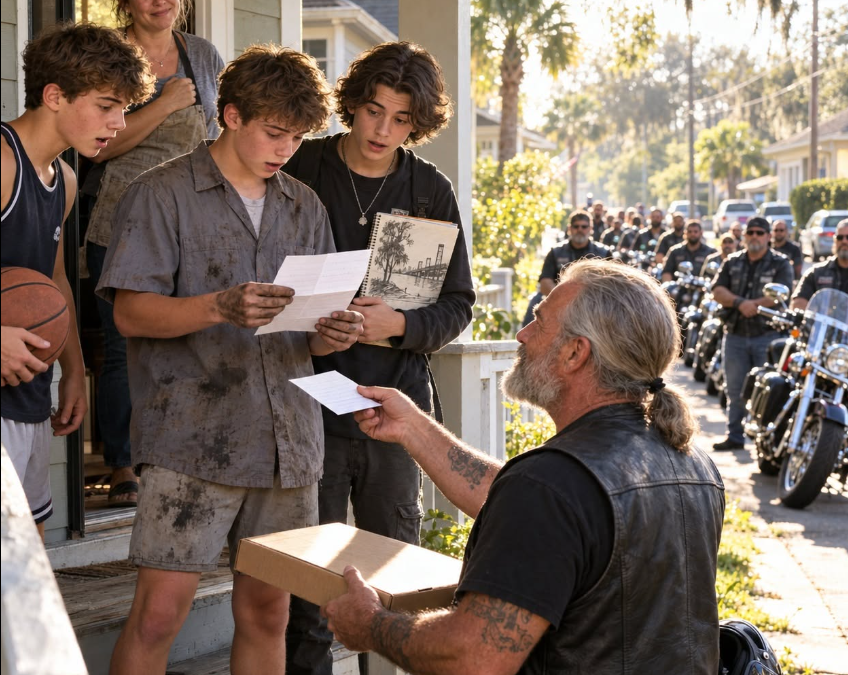
Then the motorcycles came.
Now our street was lined with them.
Not five.
Not ten.
Dozens.
Maybe more than fifty.
Some riders wore leather vests with patches. Some wore denim. Some were older men with gray beards like Daniel. Some were women with sunglasses and boots. One rider had a prosthetic leg and moved with practiced balance. Another had flowers strapped to the back of her bike. They were not acting wild. They were not blocking driveways. They were parking carefully, one after another, engines shutting off until the rumble faded into a strange, heavy silence.
Our neighbors stared from porches.
Mrs. Ellis crossed herself.
Mr. Holloway came outside holding a screwdriver like that was going to help.
Mom stepped in front of me.
Not dramatically.
Just enough.
That broke my heart a little.
Because she had already lost Dad, and now a street full of strangers had come looking for her son.
The engines fell quiet one by one.
A rider near the front removed his helmet.
It was Daniel.
He looked up at our porch and saw all three of us.
For a moment, he smiled.
Then I noticed the dark circles under his eyes.
Deeper than the night before.
His beard looked rougher. His shoulders hung lower. He had ridden too far, slept too little, and carried something back that seemed heavier than the miles.
He walked toward us carrying a flat cardboard box and a folded piece of paper.
Mom’s voice was careful.
“Can we help you?”
Daniel stopped at the bottom step.
“Yes, ma’am.”
He looked at me.
“I made it to Savannah.”
I felt myself breathe again.
“Your mom?”
“She was awake when I got there.”
The street seemed to soften around that sentence.
Even Marcus let out a breath.
“How is she?” I asked.
Daniel looked down at the folded paper in his hand.
“She’s resting now. My sister’s with her.”
He paused.
“She asked me to bring this to the boy who gave me one more night with her.”
He held out the paper.
My name was written across the front in careful, uneven letters.
Owen.
Not printed by a computer.
Not written by Daniel.
Old-fashioned handwriting.
A little shaky.
Mom turned toward me.
I took it with fingers that suddenly did not feel like mine.
The riders waited by their motorcycles.
Nobody talked.
Even the dogs had stopped barking.
I unfolded the paper.
Dear Owen,
My son says you fixed his motorcycle when he was stranded under an overpass and would not take his money because you wanted him to reach me.
I am writing this from a hospital bed with a pen that does not want to work and a son who keeps telling me not to tire myself out. He has always been bossy when he is scared.
Because of you, he got here before the night ended.
Because of you, I got to hold his hand while I was still awake enough to know it.
Because of you, I was able to tell him a story I should have told him years ago, about the first time his father let him sit on a motorcycle and how Daniel cried when the engine shut off because he thought the bike had died.
He needed that story.
Maybe I needed to tell it more.
I do not know you, but I know this: when someone helps a stranger reach the person they love, that is not a small thing.
Thank you for being the kind of young man who stopped.
Thank your friends for staying.
Thank your mother for raising a son who understands that sometimes the most important repairs are not the ones we can see.
I hope the people you love get home to you safely, too.
With gratitude,
Rosa Reyes
I read the last line twice.
I hope the people you love get home to you safely, too.
The letters blurred.
For a second, I was not on the porch.
I was back in the hospital hallway the day Dad did not come home.
I was standing beside Mom while she held his work shirt in both hands because she did not know what else to hold.
I was twelve months younger and a hundred years smaller.
I handed the letter to Mom because my eyes had gone too blurry to keep reading.
She read it.
Her hand went to her mouth.
When she finished, she pressed the paper to her chest like it had weight.
“She wrote this herself?” I asked.
Daniel nodded.
“Yesterday afternoon. Made me find a pen before she’d let me leave her room.”
His voice cracked on leave.
Mom stepped down from the porch.
She moved slowly, giving Daniel time to decide whether he wanted a handshake, space, or something else. That was my mother. She had worked in hospitals long enough to know grief made people particular about distance.
“Thank you for bringing it,” she said.
Daniel took one step back, then stopped.
For a second, I thought he might shake her hand.
Instead, he bowed his head.
“Your son did something my family won’t forget.”
Mom looked past him at the long line of motorcycles.
“I can see that.”
Daniel seemed to hear the question before she asked it.
“These riders were coming through Jacksonville on their way to an event,” he said. “A memorial ride. I told them what happened. Some wanted to meet the kids who stopped for me.”
A woman beside the first motorcycle lifted one hand.
“Thank you, boys,” she called.
Marcus, who usually had an answer for anything, looked down at his socks like they had become extremely interesting.
Ben stood frozen beside the porch post, clutching his notebook to his chest.
Daniel turned toward the riders.
“Let’s make room for the neighbors.”
They moved instantly.
Bikes rolled into a single clean line along the curb. Riders pushed some by hand rather than starting the engines again. Driveways opened. The street looked less like an invasion and more like a parade that had accidentally chosen our house as the destination.
Mrs. Ellis crossed the road first.
Of course she did.
She was seventy and fearless in the way only neighborhood women with casserole dishes can be.
“Anybody want coffee?” she asked.
Within minutes, she and Mom were in our kitchen filling paper cups. Our porch filled with riders, neighbors, Marcus, Ben, and me standing in the middle of it all like we had built something and had no idea what it was.
Daniel set the flat cardboard box on the porch rail.
“I brought something.”
I shook my head immediately.
“No. You already brought the letter.”
“This isn’t payment.”
“That sounds like payment.”
He smiled faintly.
“Smart kid.”
He opened the box.
Inside was a used but carefully arranged set of tools.
Sockets.
Wrenches.
Pliers.
A multimeter.
A torque wrench in its case.
Screwdrivers with worn handles.
Three pairs of safety glasses.
A small magnetic tray.
A shop light.
Nothing was new.
Everything was clean.
Everything had been chosen by someone who knew what a young mechanic would actually use.
My throat closed.
Dad’s tool roll was good, but it was small. He had sold some of his bigger tools before he died to cover bills when work got slow. What I had left was enough to fix lawn mowers and bikes if I got creative. This was different.
This was a beginning.
“I asked around after I got to the hospital,” Daniel said. “A few riders had things they weren’t using. I checked everything myself.”
I touched the handle of a socket wrench.
It had scratches from years of work.
“We can’t take all this.”
Daniel kept his hands at his sides.
No pressure.
No big performance.
“You can turn it down,” he said. “I’d understand.”
He meant it.
That made it harder.
I looked at Mom.
She looked at the tools, then at me.
The expression on her face was the one she used when she wanted to give me something life had not made room for.
“You’d use them,” she said.
I nodded.
Marcus had already leaned closer and was counting socket sizes under his breath.
Ben picked up the multimeter like it might explain electricity if he held it respectfully enough.
Daniel gave us another envelope.
“This is not a promise,” he said. “It’s a chance.”
Mom opened it first, because Daniel handed it to her.
Inside was a note from a motorcycle repair shop on the other side of Jacksonville.
Moreno Performance & Repair.
The owner, April Moreno, was willing to meet us about paid summer work. Not guaranteed jobs. Not charity. An interview. A chance to show what we knew. The note listed safety rules, work permit requirements, possible hours, and a phone number.
“I told her about the three of you,” Daniel said. “If you’re interested, call her yourselves. Your mom should come meet her too.”
Mom read the note carefully.
“That sounds fair.”
Fair mattered to her.
She hated pity almost as much as debt.
Ben leaned toward me.
“An actual bike shop.”
Marcus said, “Hours matter. I’ve got practice, and I watch Nia on weekends.”
Daniel nodded.
“April can answer better than I can. She runs the place. Nobody runs April.”
A rider behind him laughed.
“That is true and legally documented.”
For the first time that morning, Mom smiled.
The riders did not stay long.
That surprised me.
I had thought all those motorcycles had come to deliver some enormous dramatic surprise that would change our lives before lunch. Instead, Daniel had brought a letter, a box of used tools, and a phone number.
Each one gave us something to do next.
That felt more real.
That felt like something Dad would have respected.
A woman named Denise, not Daniel’s sister but a rider from Tampa, introduced herself to Ben and asked what he was drawing in the notebook tucked under his arm.
Ben froze.
“He draws bikes,” Marcus said before Ben could hide the notebook.
Ben glared at him.
Denise smiled.
“Can I see?”
Ben hesitated.
Then he opened the notebook.
On the page was a sketch of the motorcycle nearest our steps. He had drawn most of it in the fifteen minutes since it arrived. The tank curve was perfect. The front fork angle was clean. Even the reflections on the headlight looked intentional.
Denise stared.
“You drew that just now?”
“Most of it,” Ben said quietly.
She pointed to the tank.
“You ever thought about design?”
Ben blinked.
“Design?”
“Somebody has to draw what gets built. Somebody has to understand shape and function.”
Ben looked down at the notebook like it had become a door.
“I just draw.”
“That’s where it starts.”
He carried that sentence around for the rest of the day. I knew because Marcus teased him twice and Ben did not answer either time.
Before Daniel put on his helmet, I asked the question that had been sitting in my chest since he arrived.
“Why did you come all the way to our house? You could’ve mailed the letter.”
Daniel looked toward the folded paper in my mother’s hand.
“She wanted me to see you read it.”
He paused.
“I wanted to, too.”
His eyes moved to my shirt.
I looked down.
I had pulled it on without thinking when the engines woke us.
It was Dad’s old blue work shirt, the one with BROOKS stitched over the pocket in faded white thread.
“Is that your father’s?” Daniel asked.
I nodded.
“Yes.”
“He taught you well.”
I did not know what to say.
Dad had taught me to set a wrench down when I was frustrated. To test something twice before I called it fixed. To listen to an engine before blaming a part. To treat every machine like it belonged to somebody who needed it.
I had wanted him there the night Daniel’s bike started.
I had wanted him to see me do it.
Hearing a stranger recognize a little of him in my work hurt and helped at the same time.
Daniel held out his hand.
This time, I shook it.
His grip was strong, warm, and tired.
“Call April,” he said.
Then he looked at Marcus and Ben.
“All three of you.”
Marcus nodded.
Ben nodded too.
Daniel got on his bike.
The riders put on helmets.
Engines woke one by one, filling the street again, but now the sound felt different. Less like threat. More like blessing. Or maybe that is too sentimental. Maybe it was just engines, and I was sixteen, and grief makes meaning stick to anything that rumbles loud enough.
They rolled away slowly.
Neighbors stayed outside long after the last motorcycle disappeared.
People talked over fences.
Mrs. Ellis cried into her coffee and denied it when asked.
Mr. Holloway inspected the tools like he was pretending he had come over for technical reasons.
Mom brought the box inside.
We laid everything out on the kitchen table.
Nothing was new.
Several pieces needed cleaning.
One screwdriver had initials carved into the handle.
The torque wrench case was cracked at one corner but still latched.
The multimeter needed batteries.
I liked that.
I liked knowing these tools had already been used to solve problems.
Dad used to say old tools carried patience in them.
That afternoon, after Marcus went home to help his grandmother and Ben went across the street to shower because Mom said he smelled like couch and fear, I sat alone at the kitchen table with Rosa Reyes’s letter.
Mom stood at the sink washing cups.
“Read it again,” she said.
“I already read it.”
“I know.”
So I did.
Out loud this time.
When I reached the last line, my voice cracked.
I hope the people you love get home to you safely, too.
Mom dried her hands.
“She knew,” I said.
“Knew what?”
“What that would mean.”
Mom came to the table and sat across from me.
“She probably knew what it means to wait for somebody.”
I looked at Dad’s shirt sleeve hanging loose on my arm.
“I couldn’t help Dad get home.”
Mom closed her eyes.
For one second, I regretted saying it.
Then she reached across the table and took my hand.
“No,” she said. “You couldn’t.”
I looked down.
“But you sat with him,” she said. “You held his hand. You told him we were there. That mattered.”
“He didn’t wake up.”
“It still mattered.”
I swallowed hard.
“When Daniel said his mom was in the hospital, I just kept thinking…”
“I know.”
Of course she knew.
Mothers know what their children do not say because they have heard the silence since birth.
Mom squeezed my hand.
“Your father would be proud.”
I wanted that sentence to fix something.
It did not.
But it held me together for the rest of the day.
Two days later, Mom drove us to April Moreno’s shop.
Moreno Performance & Repair sat behind a row of warehouses on the other side of Jacksonville, with three open bays, a faded sign, and motorcycles lined up outside like impatient animals. The air smelled like rubber, oil, metal, and hot pavement. A radio played low somewhere in the back. Tools clinked. An impact wrench rattled. Somebody laughed from under a lift.
April Moreno came out wiping her hands on a red rag.
She was maybe forty, with dark hair tied back, safety glasses pushed up on her head, and forearms marked with small burns and old scars. She looked at the three of us, then at Mom.
“You must be Mrs. Brooks.”
“Naomi,” Mom said.
“April.”
They shook hands.
April looked at me.
“You fixed Daniel’s fuel issue under an overpass?”
“I cleaned a blockage. Enough to get him moving. I told him to stop before Savannah.”
“Good answer.”
Then she looked at Marcus.
“You?”
“I mostly got water and tried to keep him from doing something dumb.”
“Useful shop skill.”
Then Ben.
“And you draw?”
Ben looked like he might swallow his tongue.
“A little.”
April held out her hand.
“Notebook.”
He clutched it.
Marcus whispered, “You better hand it over before she puts you on tire duty forever.”
Ben handed it to her.
April flipped through the pages.
Her expression changed.
Not dramatically.
But enough.
She stopped on a sketch of an engine exploded into parts, each piece shaded carefully.
“You traced this?”
“No.”
“Copied from a manual?”
“No.”
“From memory?”
Ben shrugged.
“I saw a video.”
April looked at Mom.
“You know he can see mechanical relationships?”
Mom smiled faintly.
“I know he draws on every receipt in my house.”
April closed the notebook.
“Good. We’ll find out what that’s worth.”
She did not hire us immediately.
That was the first reason I trusted her.
She gave each of us a short, supervised task.
Marcus organized tire sizes and found a mislabeled shelf because Marcus, despite acting like chaos was his religion, noticed patterns fast.
Ben drew a bracket so clearly that April used his sketch to explain a repair to a customer.
I traced an electrical fault on an old bike with help from April’s lead mechanic, a quiet man named Roy who looked like he had been born disappointed in wiring. I guessed wrong at first and had to go back to the diagram.
That stung.
April watched me correct it.
“You hate being wrong,” she said.
“Yes, ma’am.”
“Good mechanics are wrong all the time. Bad mechanics stay wrong because their ego gets expensive.”
I nodded.
At the end of the afternoon, she offered us part-time summer hours.
Real hours.
Legal hours.
Paid hours.
She explained safety rules, what we could and could not do at sixteen, when gloves were mandatory, when eye protection was not optional, how breaks worked, and how pay would be handled. Mom asked more questions than any of us did.
April answered every one.
When we left, Marcus said, “We have jobs.”
Ben said, “In a bike shop.”
I said nothing because if I opened my mouth, I might make a sound none of us would recover from.
Our first week at Moreno Performance humbled all three of us.
Knowing how to fix a neighbor’s mower did not make me an expert on motorcycles. Not even close. There were systems I had never seen, tools I had only read about, tolerances that mattered more than confidence, and customers who could hear a noise once and describe it like poetry written by panic.
Roy corrected me constantly.
Not cruelly.
Precisely.
“Don’t guess.”
“Read the diagram.”
“Clean before inspection.”
“Label what you remove.”
“Torque specs exist because somebody smarter than you broke something first.”
I wrote that one down.
Marcus discovered he was patient with jobs the rest of us rushed through. He could organize parts, track inventory, prep tires, clean chains, and notice when a customer was lying about how long a bike had been making a sound. April started trusting him with intake notes because he remembered details people did not think mattered.
Ben drew during breaks.
At first, he hid it.
Then April caught him sketching a modified bracket and said, “Put that on the shop computer.”
He stared.
“What?”
She opened a drafting program and showed him the basics.
Ben sat there like someone had just handed him a new language and told him he had been speaking it silently for years.
By the end of the second week, we came home tired, greasy, paid, and proud of things small enough to describe honestly.
I changed oil correctly.
Marcus found an inventory error before it cost money.
Ben made a clean digital drawing of a part.
Nothing dramatic.
Everything real.
Daniel texted after the first week.
How’d the interview go?
I told him we got summer hours.
He replied with a photo of his mother in a garden, sitting beneath an umbrella with a blanket over her knees. She was smiling at the camera. Thin, tired, but smiling.
Mom saw the photo before I replied.
“Tell her thank you,” she said.
So I did.
A few minutes later, Daniel sent another message.
She says keep your tools clean and your heart cleaner.
I stared at that sentence for a long time.
Then I wrote it on a scrap of cardboard and taped it above my workbench.
That summer changed us.
Not all at once.
Life did not become easy because a biker brought tools to our porch.
Mom still worked too much.
Bills still came.
Our kitchen faucet still leaked unless you turned the handle exactly right.
Marcus still had to leave early some days to watch his sisters.
Ben still had nights when his uncle drank too much and he ended up sleeping on our couch without wanting to explain why.
I still missed Dad so sharply some mornings that touching his tool roll felt like pressing on a bruise.
But something had shifted.
A path had opened where before there had only been survival.
April taught us more than repair.
She taught us shop discipline.
How to write a work order clearly.
How to tell a customer bad news without sounding like you enjoyed it.
How to refuse unsafe shortcuts.
How to admit when a job was beyond you.
How to sweep the floor like you cared about the place that paid you.
She also taught us that help was not the same as rescue.
“I’m not saving you,” she told us one afternoon after Marcus joked that she was our fairy godmother with a torque wrench. “I’m hiring you. That means I expect work.”
Marcus saluted with a rag.
“Yes, boss.”
“I’m not your boss because you need help. I’m your boss because you applied and showed up.”
That mattered.
Especially to Mom.
She visited the shop often at first, not because she did not trust us, but because she wanted to know the adults around us. April never acted bothered. She gave Mom coffee, explained what we were learning, and once sent her home with brake cleaner because Mom mentioned the oven hood filter looked terrible.
“You can use brake cleaner on that?” Mom asked.
“No,” April said. “I wanted to see your face.”
Mom laughed so hard she had to sit down.
By August, Ben had designed a small bracket for a custom restoration project, with supervision. April paid him for the design time. He carried the printed drawing home in a folder like it was a birth certificate.
Marcus saved enough money to buy his sister new school shoes without telling anyone. His grandmother told Mom anyway.
I saved mine in a coffee can Dad used to keep old bolts in. The label still said MIXED HARDWARE in his handwriting. Under the bolts, I hid cash.
College felt like a word other people used.
Trade school felt possible.
A certification program felt possible.
Maybe working toward becoming a real mechanic, not just a kid with his father’s wrenches and a porch full of broken lawn equipment, felt possible.
Then September came.
School started.
Our hours changed.




