I Bought a $62,000 Abandoned Railway Depot—Then a Survey Revealed the HOA Had Paved Its Only Supply Road Across My Land.
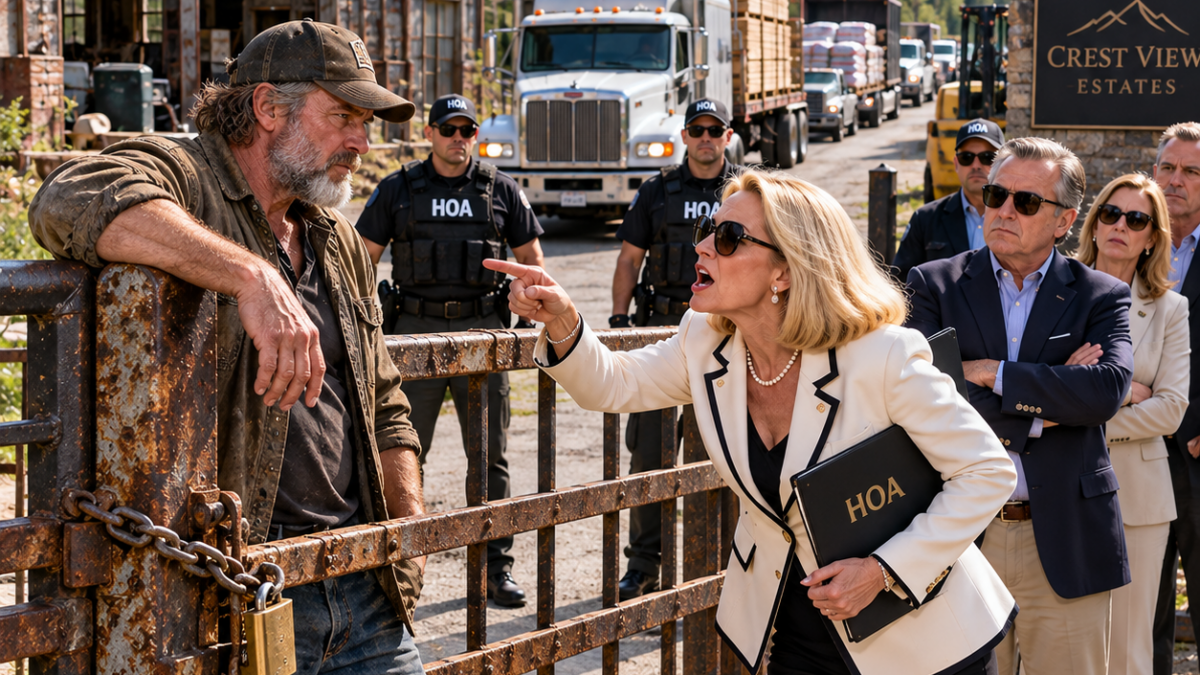
PART3:
It also eventually made me a millionaire.
The first morning I officially owned the place, I arrived in my 1978 Ford F-250.
Blue.
Long bed.
Three different shades of paint if you looked closely.
My father bought it used in 1989.
I learned to drive in it.
Rebuilt the engine twice.
Anybody else would have called it an old truck.
I called it family.
The depot gate was secured with a rusted chain whose padlock had probably survived the Reagan administration.
I cut it.
Drove inside.
Closed the gate behind me.
Then stood in silence.
My shop.
Mine.
No landlord.
No neighbor sharing a wall.
No lease renewal.
No one calling because a grinder was running after six.
I walked through the warehouse for almost an hour.
Sunlight came through broken clerestory windows.
Dust floated in beams.
My boots echoed.
The building smelled like wet timber, old grease, rust, and possibility.
I could put the CNC table there.
Welding booths along the west wall.
Material racks near the freight door.
Office in the old dispatcher room.
Paint area in the detached shed.
I could finally take large structural jobs without begging somebody to let me rent floor space.
I had maybe forty thousand dollars left after the purchase.
Not enough.
But enough to begin.
At eleven, I started pulling rotten plywood from the main bay doors.
At 11:37, a white golf cart appeared.
It came from the north along a narrow paved lane I had assumed belonged to the neighboring development.
The cart stopped just beyond my old gravel boundary.
The woman driving it looked like she had been sent by central casting to play Wealthy Person Offended by Reality.
Cashmere sweater draped over her shoulders.
Designer sunglasses.
White pants.
Leather sandals that had never met mud voluntarily.
She looked at the depot.
Then me.
Then the depot again.
“Excuse me.”
I lowered the crowbar.
“Morning.”
“What are you doing?”
“Taking plywood off a door.”
“I can see that.”
“Great.”
“Why?”
I smiled.
“Door underneath.”
She did not.
“This property is not open to the public.”
“Correct.”
“So why are you here?”
That was my first clue.
“I own it.”
Her face changed.
Not much.
Just enough.
“No.”
“Yes.”
“That parcel is abandoned railroad land.”
“Was.”
“It is slated for conservation integration.”
“I don’t know what that means.”
She removed her sunglasses.
It somehow made her look more hostile.
“Crest View Estates has been in discussions for years regarding the southern buffer.”
“Good for Crest View.”
“You cannot simply come in here and begin altering structures.”
“Actually, I can.”
“Who authorized this sale?”
“The county.”
“That is impossible.”
I leaned the crowbar against the wall.
“Would you like the parcel number?”
She stared.
Then asked:
“What is your name?”
“Jack Higgins.”
“I’m Patricia Carmichael.”
I waited.
She clearly expected recognition.
Nothing.
“President of the Crest View Estates Homeowners Association.”
“Congratulations.”
Wrong answer.
Her mouth tightened.
“This parcel adjoins our residential property.”
“I noticed the houses.”
“You will need to comply with visual and noise restrictions.”
“No.”
She blinked.
“Excuse me?”
“I’m industrial zoned.”
“You are within five hundred yards of a residential community.”
“That sounds like your community’s geographic problem.”
Patricia stared long enough that I could almost hear the filing cabinet in her brain opening.
“You clearly don’t understand where you purchased.”
“I’m learning quickly.”
“You should.”
Then she drove away.
I assumed that was it.
Five minutes of territorial posturing.
Rich neighbor unhappy about ugly building.
I had real work.
At noon, I went back to demolition.
At 2:15, the golf cart returned.
Nobody got out.
It stopped by my gate.
Patricia reached over.
Taped a paper to the chain-link panel.
Then drove away.
I walked over.
CREST VIEW ESTATES HOMEOWNERS ASSOCIATION
NOTICE OF VIOLATION
UNAUTHORIZED STRUCTURAL MODIFICATION
INDUSTRIAL NUISANCE / VISUAL BLIGHT
FINE: $500
CURE PERIOD: 24 HOURS
I laughed so hard I had to sit on the tailgate.
I wasn’t in Crest View.
Never signed their covenants.
Wasn’t part of their plat.
They had as much authority to fine me as a bowling league.
I crumpled the notice.
Threw it into an old barrel.
That was mistake number two.
Not because the fine mattered.
Because I underestimated Patricia.
Patricia Carmichael was not a bored woman with a clipboard.
She was a bored woman with a board, lawyers, service contracts, municipal relationships, and enough free time to turn resentment into a full-time job.
The next morning, county code enforcement arrived.
A man named Ben Holloway stepped from a white pickup.
Clipboard.
Reflective vest.
Tired eyes.
“You Jack Higgins?”
“Yes.”
“We received a complaint.”
“Of course.”
“Hazardous waste.”
I laughed.
Ben did not.
“Mind if I inspect?”
“No.”
We walked.
Old drums.
All empty.
No chemical storage beyond legal welding supplies.
No active waste discharge.
No buried tanks visible.
He photographed.
Took notes.
Then said:
“This is mostly abandoned rail equipment.”
“Yes.”
“Complaint said toxic processing.”
“I’ve owned it two days.”
He sighed.
“I’ll close it.”
“Who filed?”
“Anonymous.”
“Crest View?”
“Anonymous.”
He looked north toward the mansions.
Then back to me.
“Have a good day.”
Two days later:
Animal control.
Complaint that I was harboring dangerous animals.
I owned zero animals.
The officer checked.
Left.
Then fire marshal.
Illegal hot work.
I had not even installed my welding machines yet.
Then county environmental services.
Illegal dumping.
Nothing.
Then health department.
Human habitation in industrial structure.
I did not live there.
Each inspector was professional.
Each eventually realized they were being used.
But every visit cost me time.
Patricia escalated.
Anonymous letters.
One:
YOU DO NOT BELONG HERE.
Another:
SELL BEFORE THIS RUINS YOU.
Another:
WE CAN OUTSPEND YOU FOREVER.
No signature.
I installed cameras.
Then drones started appearing.
Small quadcopters.
Hovering above the property.
Filming.
I called the sheriff.
Officer Miller—not related to the depot, just a coincidence—came out.
Late fifties.
County patrol.
Permanent expression of mild disappointment with civilization.
He watched one drone hover.
“You know who owns it?”
“No.”
“Flying over private property isn’t automatically illegal.”
“It’s looking through windows.”
“That can become different.”
“What can I do?”
“Document.”
“I hate that answer.”
“So do I.”
I bought privacy film.
More cameras.
Then one evening I returned from buying grinding discs and found superglue inside my gate padlock.
Another time nails appeared near my tire track.
Couldn’t prove who.
Security footage showed a hooded figure at 2:11 A.M.
No face.
Patricia sent another formal letter.
CESSATION OF INDUSTRIAL ACTIVITY.
I wrote back:
NO.
My lawyer friend laughed when I showed him.
“You know legal correspondence usually has more words.”
“They used enough for both of us.”
I kept renovating.
New electrical service.
Roof patching.
Drainage.
Bay-door repairs.
Concrete.
Material racks.
I hired two assistants.
Then came the Tuesday that changed everything.
Rain.
Cold.
October.
I had twenty tons of structural steel scheduled for delivery.
I was fabricating a staircase package for a hotel project.
Big job.
The kind that could pay for the next stage of the shop.
The steel truck was due at nine.
I arrived at 8:20.
A tow truck was backed through my gate.
Hooked to my Ford.
My truck.
Parked thirty feet inside my fence.
Standing beside it:
Richard Avery.
Vice president of Crest View HOA.
Dark suit.
Umbrella.
Gray hair.
The relaxed expression of a man who believed somebody else would pay for the consequences.
“HEY!”
The tow operator looked up.
Richard did not move.
“Unhook that truck!”
The operator looked at Richard.
Richard nodded once.
Winch engaged.
My Ford rolled backward.
I ran.
“Stop!”
Richard raised his voice calmly.
“Mr. Higgins.”
“Get your truck off mine.”
“Your vehicle is obstructing a designated emergency egress easement.”
“It’s parked on my property.”
“No.”
I stopped inches from him.
“What?”
He smiled.
“Check your deed.”
“I have.”
“The former railroad approach reverted when rail service ended.”
“Reverted to who?”
“The dominant adjacent estate.”
“That is nonsense.”
“It is property law.”
I looked at the tow truck.
“Avery Towing & Recovery.”
Then Richard’s business card.
Richard Avery.
Owner.
Avery Towing & Recovery.
I laughed once.
“You hired your own company.”
“The HOA has an approved vendor agreement.”
“You are towing my truck with a company you own from land you say the HOA controls.”
“Correct.”
“That doesn’t bother you?”
“Why would it?”
Conflict of interest was apparently more of a decorative concept in Crest View.
I stepped toward the operator.
Richard said:
“If you interfere with the tow, we will request law enforcement.”
“Please.”
I dialed myself.
Officer Miller arrived twelve minutes later.
By then my Ford was already loaded.
I showed him the deed.
Richard showed him an old property map.
Railroad corridor.
Abandonment note.
Subdivision plat.
Miller studied both.
Then looked annoyed.
“This is not something I can resolve roadside.”
Richard smiled.
“It’s quite clear.”
Miller looked at him.
“No.”
“It’s complicated.”
Richard’s smile weakened.
Miller said:
“Mr. Higgins, the tow is already in process under a claimed private easement.”
“You can seek civil relief.”
I wanted to explode.
Instead I asked:
“Can he tow it?”
Miller answered carefully.
“I cannot adjudicate title here.”
Richard said:
“Exactly.”
Then my steel delivery arrived.
Forty-foot trailer.
Twenty tons.
Driver stopped outside.
Saw tow truck.
Police cruiser.
Blocked gate.
Called dispatch.
Two minutes later, he said:
“I’m not entering this.”
“I’ll clear it.”
“Company policy.”
“Give me twenty minutes.”
“I have another drop.”
He left.
Restocking and redelivery:
$2,000.
I watched my Ford disappear on Richard Avery’s truck.
Then watched my steel disappear in the opposite direction.
Something inside me changed.
Not rage exactly.
Rage burns hot.
This became cold.
I had spent three weeks reacting.
Inspectors.
Letters.
Glue.
Drones.
Fines.
Now they had reached into my property, removed my truck, disrupted my business, and charged me for the privilege.
I drove a rental car to Avery Towing.
Paid the impound charge.
$780.
Cashier slid the receipt under glass.
I smiled.
She looked confused.
“Everything okay?”
“No.”
But I was smiling because I had finally decided what to do.
Not fight their interpretation.
Find the original one.
Next morning I called Thomas Gable.
Surveyor.
Sixty.
Chain-smoker.
Gray beard.
Voice like gravel in a coffee can.
He had surveyed half the industrial corridors in the county.
Mike gave me his number.
“Tell him it involves a railroad.”
“Why?”
“He likes old railroad deeds.”
People have hobbies.
Thomas apparently enjoyed dead transportation companies.
We met at the depot.
I showed him everything.
Tax-auction deed.
Richard’s map.
Subdivision plat.
Railroad abandonment references.
Thomas sat on my loading dock smoking.
“Richard’s relying on reversion.”
“Explain.”
“Railroads often occupied strips under easements.”
“When rail use ends, easement may extinguish.”
“Underlying land reverts or remains with servient estate depending on deed.”
“So Crest View could be right.”
“Yes.”
My stomach dropped.
Thomas smiled.
“But.”
I waited.
“Railroads also sometimes bought fee title.”
“Meaning?”
“They owned the dirt.”
“Not just the right to run trains.”
“Exactly.”
“And?”
“If Miller’s Creek Railway bought fee simple, there may be nothing to revert.”
I looked at the depot.
“When I bought the tax deed…”
“You may have bought everything remaining in that title chain.”
“How do we know?”
Thomas smiled.
“Archives.”
Four days.
That is how long we spent.
County records.
State archives.
Microfilm.
Old assessor books.
Recorded plats.
Railway acquisitions.
I had never seen so much paper.
Thomas loved every second.
He found the first key deed on day two.
Miller’s Creek Railway Company purchased fourteen acres from the Weller family.
Not an easement.
Fee simple.
Then a separate strip:
sixty feet wide.
Running from the depot parcel southeast toward the county highway.
Purpose:
rail access and freight service corridor.
But the conveyance language transferred title.
Not merely use.
Thomas read it twice.
Then:
“Oh, Patricia.”
“What?”
“We’re not done.”
He traced subsequent records.
Railway ceased freight service in 1982.
Company dissolved later.
Depot passed through holding entities.
Taxes delinquent.
County acquired.
Tax auction.
Me.
Thomas overlaid the 1924 strip on a 2018 Crest View Phase Three plat.
Then stopped.
He called me across the drafting table.
“Jack.”
“What?”
“Look.”
I didn’t understand at first.
Old strip.
New road.
Same alignment.
Almost exact.
Crest View’s heavy commercial access road had been paved directly over the old rail corridor.
Thomas tapped it.
“This is theirs?”
“According to them.”
“No.”
He moved his finger.
“This is yours.”
I stared.
“No.”
“Yes.”
“The whole road?”
“Within the original sixty-foot strip.”
“How long?”
“Roughly a mile.”
I laughed because my brain had no other response.
He continued.
“Crest View Phase Three needed secondary heavy access.”
“Main entrance is steep.”
“I’ve seen it.”
“Tight turns.”
“Decorative gate.”
“Garbage trucks?”
“Supply route.”
“Fire apparatus overflow.”
“Landscape crews.”
“Construction.”
“Utility service.”
All on the old rail bed.
All on title attached to my depot parcel.
The source premise hinges on exactly this discovery: the 1924 railway company had bought the corridor outright rather than merely holding an easement, and the later HOA paved its essential heavy-service road directly across that same strip without realizing title had passed with the depot.
I asked:
“Are you sure?”
Thomas looked insulted.
“No.”
My face fell.
He grinned.
“I’m a surveyor.”
“I verify before saying sure.”
“I hate surveyors.”
“Everybody does until they need one.”
He spent two more days in the field.
Recovered monuments.
Compared deeds.
Reconstructed line.
Then filed a certified survey with the county.
Final answer:
The corridor belonged to me.
That changed the game.
My first instinct was simple.
Gate.
Big gate.
Lock it.
Make them feel what I had felt watching my truck leave.
Thomas warned me.
“Talk to a lawyer.”
“I’m going to fence my land.”
“Maybe legal.”
“Maybe stupid.”
“What’s the difference?”
“About forty thousand dollars in legal fees.”
Fair.
I hired Amanda Brooks.
Real-estate attorney.
Five-foot-four.
Red hair.
Soft voice.
Absolute predator in a conference room.
She reviewed everything.
Then said:
“Do not physically block emergency vehicles.”
“I wasn’t planning—”
“You were.”
“I was planning to block commercial traffic.”
“Different.”
“But still needs structure.”
“Because?”
“They will argue easement.”
“What easement?”
“Prescriptive.”
“Implied.”
“Necessity.”
“Estoppel.”
“Public safety.”
“They’ll throw everything.”
“Do they have a case?”
“They’ve used the road since 2018.”
“Eight years.”
“Our state’s prescriptive period is ten.”
She smiled.
“That helps.”
“So I can close it?”
“After formal notice.”
“Reasonable access considerations.”
“And making sure emergency-response obligations are addressed.”
I hated reasonable.
Reasonable is what lawyers say when your revenge plan needs editing.
Amanda sent notice.
Crest View responded with three pages of hostility.
Patricia called the survey fraudulent.
Richard claimed the railway corridor had reverted.
Their attorney threatened injunctive relief if I interfered.
Amanda replied:
Please identify recorded instrument conveying title or easement rights to Crest View Estates.
They did not.
That silence was louder than the letters.
I paid Richard’s towing bill without protest.
Paid the steel redelivery.
Saved receipts.
Then I built the gate.
Not a random barricade in the center of a public safety route.
A properly noticed private commercial-control gate positioned within my parcel, with emergency-access coordination handled through counsel while ownership was disputed.
Still bright yellow.
I insisted.
Crest View had an approved color palette emphasizing earth tones.
I chose industrial safety yellow because childishness has its place.
Eight-inch tubular steel posts.
Four feet deep.
Concrete.
Dual swing.
Heavy bracing.
Reflective panels.
Electronic camera coverage.
Private Property.
Commercial Access By Authorization Only.
Unauthorized Vehicles Subject to Tow.
I added a smaller sign underneath:
OWNER: MILLER’S CREEK DEPOT LLC.
Amanda refused to let me add:
ASK PATRICIA.
She was right.
Monday morning became chaos.
At 6:11, first landscaping truck.
Six vehicles total.
Stopped.
Then garbage.
Delivery vans.
Pool service.
Concrete mixer.
Utility contractor.
All stacked.
The main gated residential entrance could handle cars and small vans.
Heavy trucks struggled.
Tight turn radius.
Weight limitations.
Decorative arch clearance.
The old rail corridor was the practical supply artery.
At 7:22, Patricia arrived in a silver G-Wagon.
Richard beside her.
She slammed the door.
Walked straight to the gate.
“OPEN THIS.”
I was sitting on the depot loading dock.
Coffee.
I walked down.
“Morning.”
“This is criminal.”
“That seems dramatic.”
“You are obstructing Crest View property.”
“No.”
“You have blocked emergency access.”
“Emergency access coordination was provided to county services Friday.”
Richard stepped forward.
“You have no authority.”
I held up the survey.
“Actually, that’s what we’ve been discussing.”
“You’re going to jail.”
“Then I hope somebody feeds my shop plants.”
“You don’t have plants.”
“Exactly.”
Patricia grabbed the gate.
“You cannot hold forty families hostage.”
“I’m not holding residents.”
“Open the road.”
“For commercial access?”
“Yes.”
“That requires permission.”
“This is an easement.”
“Show me.”
Richard shouted:
“The railway easement reverted.”
“It wasn’t an easement.”
His face changed.
Tiny.
He had not expected me to know the exact weakness.
Officer Miller arrived at 7:40.
Not sirens this time.
Just lights.
He walked through the line of trucks.
“This again.”
Patricia pointed at me.
“Arrest him.”
Miller looked at the gate.
Then me.
“Morning.”
“Morning.”
“You own this?”
“That’s what the county record now says.”
I handed him the packet.
Certified survey.
1924 deed.
Current title.
Amanda’s notice.
He read.
Slowly.
Truck drivers stopped honking.
Everyone watched.
Finally Miller handed it back.
Turned to Patricia.
“Ma’am.”
“No.”
She said it before he finished.
“This cannot be legitimate.”
“I’m not a judge.”
Miller pointed toward the documents.
“But the current county records support his ownership claim.”
Richard stepped in.
“We have longstanding access.”
“Civil matter.”
“Prescriptive rights.”
“Civil matter.”
“He is violating fire code.”
Miller looked at me.
“Emergency vehicles?”
“County has access protocol.”
Amanda had made sure.
Miller nodded.
Then Patricia said:
“This is our road.”
He sighed.
“That is exactly the kind of sentence a judge decides.”
She stared at him.
“So you’re doing nothing?”
“I’m telling both sides not to create a criminal problem out of a civil dispute.”
Then he looked at the trucks.
“Commercial drivers should not enter disputed private property without authorization.”
Richard’s mouth dropped.
I pulled his Avery Towing card from my wallet.
I had kept it.
I slid it beneath the gate.
It landed near his shoe.
“You guys might want to clear the lane.”
“I’d hate to have anybody towed.”
One landscaper laughed.
Richard turned purple.
The story spread through Crest View by lunch.
Garbage delayed.
Landscaping delayed.
Home construction stopped.
Bulk deliveries redirected.
The HOA used smaller vehicles through the main entrance where possible, but costs exploded.
Some services simply refused.
Garbage was the crisis.
By day three, residents were furious.
Not at me yet.
Mostly at the board.
Then Patricia sent a community email:
A hostile industrial landowner has unlawfully obstructed critical association infrastructure.
Amanda loved that.
“Keep it.”
“Why?”
“Evidence.”
The HOA sued Thursday.
Emergency injunction.
Prescriptive easement.
Implied necessity.
Public safety.
Malicious interference.
Nuisance.
Amanda filed our response.
Title.
Survey.
Chain of deeds.
Trespass.
Unjust enrichment for paving my land.
Conversion related to the tow incident.
Business losses.
Conflict-of-interest issues involving Avery Towing.
Hearing was Monday.
Judge Caldwell.
Sixties.
Silver hair.
No patience for speeches.
The HOA attorney, Harrison Cole, gave one anyway.
He described Crest View as a peaceful residential community “suddenly isolated by the opportunistic actions of a recent purchaser.”
Recent purchaser.
Meaning me.
He argued the road had operated openly for eight years.
Essential service.
Reliance.
Safety.
Then Amanda stood.
“Your Honor, the plaintiffs’ hardship is real.”
Harrison looked pleased.
Amanda continued:
“It is also largely self-created.”
Less pleased.
She showed the 1924 deed.
Fee-simple corridor.
Current tax deed.
Certified survey.
Then the statute.
Ten-year prescriptive period.
Crest View paved the road in 2018.
Eight years.
Two short.
She said:
“They are not asking the court to preserve a matured property right.”
“They are asking the court to accelerate one because checking title now has become inconvenient.”
Judge Caldwell asked:
“What did the association rely on when paving?”
Harrison answered:
“Subdivision planning records and presumed railroad abandonment.”
“Title opinion?”
Pause.
“I don’t have that in front of me.”
“Recorded easement?”
“No.”
“Purchase?”
“No.”
“Written permission?”
“No.”
The judge looked at him.
“So they paved first and researched later.”
Silence.
Injunction denied.
Not total victory.
The judge required temporary emergency access arrangements.
Reasonable negotiation over essential waste and utility service pending full litigation.
But she refused to order me to open the road for unrestricted commercial use.
Outside, Patricia approached.
“You think you won.”
I said nothing.
“We will appeal.”
Amanda stepped between us.
“Then appeal.”
Patricia glared.
Amanda handed her a document.
“What is this?”
“Temporary commercial-access proposal.”
Patricia read.
Her face changed.
Not because it was insane.
Because it was expensive.
Amanda had killed my original fantasy of charging $1,000 per axle.
“Punitive tolls make us look bad,” she said.
Instead we proposed a licensed-use agreement.
Weekly commercial-access charge reflecting market use, maintenance, liability insurance, road wear, administrative control, and past unauthorized occupation.
Still high.
Very high.
Enough to hurt.
Not enough to look like extortion.
The HOA needed the road.
They signed a thirty-day interim agreement.
My depot began making more money from access than from welding.
That was absurd.
I kept fabricating anyway.
My first steel shipment after the dispute arrived through my own gate.
The driver asked:
“You the road guy?”
“No.”
“The welder.”
He looked at the yellow barricade.
“Sure.”
Money from the interim agreement paid for roof repairs.
Electrical upgrade.
CNC plasma table.
Ventilation system.
New compressor.
I refused to touch the principal beyond legitimate shop improvements and legal reserve.
Amanda approved.
“You finally sound responsible.”
“Don’t spread it around.”
Residents eventually learned why the HOA was bleeding cash.
Susan from Lot 31 posted the original deed chain in the neighborhood group.
Someone obtained Patricia’s first fake violation against me.
Then Richard’s tow invoice.
Then my survey.
Public opinion collapsed.
Emergency meeting.
I did not attend.
I received video later.
Patricia at the front.
Residents shouting.
A man asked:
“Why did we fine property outside the HOA?”
She answered:
“Because industrial activity affected community standards.”
Wrong answer.
Another:
“Why did Richard’s company tow his truck?”
Richard said:
“Emergency easement violation.”
Then someone held up the survey.
“What easement?”
Silence.
Then:
“Did we verify ownership before paving the road?”
Nobody answered.
Arthur Campbell, orthopedic surgeon, stood.
“I move to recall the president and vice president.”
Seconded.
Vote.
Overwhelming.
Patricia removed.
Richard removed.
A week later, Arthur called me.
“Can we talk?”
“Yes.”
He arrived in a golf cart.
The absurdity made me smile.
He noticed.
“Please don’t.”
“Sorry.”
He stopped outside my gate.
Did not cross.
That mattered.
“Mr. Higgins.”
“Jack.”
“Jack.”
He looked tired.
“We need peace.”
“I agree.”
“The interim road charges are unsustainable.”
“I know.”
“Legal fees are worse.”
“I know.”
“Residents are angry.”
“I know.”
He smiled weakly.
“You enjoy saying that.”
“A little.”
“What do you want?”
That was the question.
Not:
How much can you make?
Not:
How badly can you hurt them?
What do you want?
I looked toward the depot.
My roof fixed.
Machines running.
Steel racks full.
The shop I had wanted.
“I want to weld.”
Arthur laughed.
“That simple?”
“No.”
“But start there.”
We met with lawyers.
Permanent easement.
Commercial heavy-vehicle use.
Defined width.
Maintenance paid by Crest View.
Liability insurance.
Gate-access system.
Emergency service unrestricted.
No expansion beyond defined route without consent.
And my favorite provision:
Miller’s Creek Depot parcel permanently recognized as outside Crest View HOA jurisdiction.
No HOA fines.
No covenant enforcement.
No aesthetic regulation.
No attempt to characterize lawful industrial use as HOA violation.
Nuisance complaints preserved only to the extent any ordinary neighboring landowner could make them under actual law.
Amanda would not let me include “I may build scrap-metal dinosaurs.”
She said normal zoning already controlled that.
So I built one later.
Sixteen-foot steel brontosaurus.
Perfectly legal.
The purchase price for the permanent easement was $1.2 million.
Arthur did not like it.
Residents liked continued access more.
The HOA financed part.
Used reserves for part.
Reduced legal spend.
The agreement was approved.
Wire cleared Tuesday morning.
I sat in my office staring at the account.
$1,200,000.
I called Amanda.
“It’s there.”
“Yes.”
“What now?”
“Pay taxes.”
“You ruin everything.”
“Then don’t get sued.”
I walked to the gate.
Unlocked it.
Opened both yellow leaves.
The first truck through was garbage.
Driver leaned out.
“Finally!”
I raised my coffee.
“Welcome to Miller’s Creek.”
He laughed.
Then six more trucks followed.
Landscapers.
Delivery van.
Pool service.
Normal life.
The road stopped being a weapon.
That was a relief.
Patricia sold her house two months later.
Moved to Arizona according to neighborhood gossip.
Richard Avery lost the HOA towing contract.
Then his company became subject to questions about conflict-of-interest procurement.
I didn’t pursue him beyond my own claim.
My Ford came home.
Still runs.
I painted one small line on the inside of the tailgate:
$780 LESSON.
The depot transformed.
New roof.
Restored windows.
Three welding bays.
CNC table.
Material crane.
Finishing area.
Office.
I hired four people.
Then six.
We began taking larger architectural contracts.
I kept the old brick.
The old timbers.
The loading dock.
Restored the 1936 MILLS CREEK lettering on one wall.
Thomas Gable came to the grand opening.
He stood beneath the old sign.
“You misspelled Millers.”
“No.”
“Original company dropped the apostrophe in 1936.”
“Surveyors.”
“Historical accuracy.”
“You want beer?”
“Yes.”
I gave him one.
Arthur attended too.
So did several Crest View residents.
That surprised me.
Susan from Lot 31 bought one of my steel patio tables.
The retired surgeon commissioned a sculpture.
A teenager from Crest View asked for a summer job.
I hired him.
His mother almost fainted when she saw the welding sparks.
He became one of my best apprentices.
The relationship between the depot and Crest View became almost normal.
Almost.
Residents still hated noise occasionally.
I kept the loudest work inside at night because being legally allowed to be obnoxious is not the same as needing to be.
That disappointed Mike.
“You fought for freedom.”
“I fought for property rights.”
“Same thing.”
“No.”
“Can we still build the dinosaur?”
“Yes.”
We did.
Bright orange.
Visible from the southernmost Crest View homes.
Arthur called.
“Is that permanent?”
“Yes.”
Long pause.
“Kids love it.”
“Good.”
Then:
“Patricia would have died.”
“Also good.”
We both laughed.
Years later, I learned the full story behind the road.
Crest View’s developer had discovered the abandoned rail grade during Phase Three planning.
The corridor appeared on several GIS layers as “railroad easement / abandoned.”
Someone assumed abandonment meant local reversion.
The developer used it as a service lane.
The HOA later paved and maintained it.
Nobody pulled the original 1924 conveyance.
Why?
Because everyone assumed someone else had.
Title company reviewed residential lots.
County reviewed construction plans.
Engineer reviewed road geometry.
Fire reviewer checked access dimensions.
HOA reviewed costs.
Everybody checked their piece.
Nobody asked:
Who owns the dirt?
That became Thomas’s favorite cautionary story at surveying conferences.
He called it:
“The Million-Dollar Missing Deed.”
I hated the title.
“It was 1.2 million.”
“That’s less catchy.”
“Accuracy matters.”
“Not in conference titles.”
Hypocrite.
One year after the settlement, the county widened the highway intersection near the corridor.
The transportation engineer called me.
Not Crest View.
Me.
Because I owned the underlying strip.
We negotiated a small public-turning easement.
Routine.
Fair.
No drama.
I signed.
That was when the reality fully sank in.
I had bought fourteen acres and an abandoned warehouse for $62,000.
The piece everyone mocked was not the depot.
It was the paperwork nobody read.
People think abandoned things have no value.
Old buildings.
Old railways.
Old deeds.
Old easements.
But abandonment in appearance and abandonment in law are not the same thing.
The depot looked worthless.
The corridor looked forgotten.
Crest View treated it as empty space.
That assumption was their biggest mistake.
I made mistakes too.
I underestimated Patricia.
Ignored early notices rather than formally responding.
Didn’t fully read my deed package at purchase.
Reacted emotionally after the tow.
Wanted punishment more than resolution.
Amanda told me that bluntly.
“You were lucky your anger pointed you toward research instead of sabotage.”
She was right.
If I had chained their road first and researched second, I might have been wrong.
If Thomas had found an easement instead of fee title, everything changed.
If prescriptive rights had matured ten years instead of eight, different case.
If public emergency access depended entirely on that route with no temporary arrangement, different case.
Facts matter.
That is the less entertaining version.
People want the story to be:
HOA bullies welder.
Welder discovers secret deed.
Locks gate.
Rich people panic.
Welder gets $1.2 million.
Fun.
But the real lesson is not:
Build a bigger gate.
It is:
Read what you own.
Verify what others claim.
Document harassment.
Use surveyors.
Use lawyers before excavators.
And never confuse confidence with title.
Patricia’s power came from acting certain.
She never said:
I think the HOA controls this.
She said:
You are trespassing.
Richard never said:
We believe the railway interest reverted.
He said:
We own the first fifty feet.
Certainty makes people hesitate.
I did.
For a while.
That is why the certified survey mattered so much.
Not because paper is magic.
Because it replaced volume with evidence.
I still have Patricia’s first fine.
Not the original.
That one went into the burn barrel.
I later found a scanned copy attached to an HOA email obtained during discovery.
$500.
Unauthorized structural modification.
Issued four hours after I arrived.
I framed it in my office.
Below it:
The 1924 deed.
Not the whole thing.
Just the property description showing the sixty-foot corridor.
Below that:
A photograph of my yellow gate.
Below that:
A small plaque Mike made without asking.
IT HELPS TO KNOW WHERE YOUR PROPERTY ENDS.
I hate inspirational plaques.
I kept it.
My mother visited after the shop was finished.
She walked through slowly.
New machines.
Clean bays.
Office.
Restored brick.
Then she looked at the old roof trusses.
“You did okay.”
High praise.
“Remember when you thought it was a meth lab?”
“I said it looked like one.”
“Different.”
She smiled.
“Your father would’ve liked this.”
That got me.
My father worked maintenance for thirty-five years.
Could fix anything.
He taught me welding behind our garage using a machine older than both of us.
The Ford had been his.
I wish he could have seen the depot.
Not the money.
The shop.
That mattered more.
Eventually I bought the neighboring six-acre industrial parcel when its owner retired.
Expanded material storage.
Added a training space for apprentices.
The depot became more valuable as a business than any easement settlement.
That is exactly how I wanted it.
For a while, strangers online knew me as “the guy who owned the HOA road.”
I hated that.
I was a fabricator.
The road fight was something that happened.
Not the business.
One afternoon, a man drove two hours to meet me.
He owned rural land beside a new subdivision.
He brought maps.
“I think they built drainage on me.”
I pushed them back.
“I’m not a surveyor.”
“But your case—”
“Hire one.”
“I thought you could tell.”
“No.”
He looked disappointed.
I said:
“That disappointment is how people get in trouble.”
He eventually hired Thomas.
Turned out the subdivision was entirely on its own land.
Drainage easement valid.
No conspiracy.
Good.
Not every boundary dispute hides a million dollars.
Sometimes the other person is right.
That matters too.
Crest View eventually improved its governance.
Arthur created conflict-of-interest rules.
Board members had to disclose vendor ownership.
Richard’s towing arrangement would have been prohibited.
Outside counsel reviewed property claims before enforcement.
The HOA stopped sending me fake fines.
Mostly because the easement contract had consequences if they did.
Once, years later, I received an automated violation email.
TRASH RECEPTACLE VISIBLE.
I did not own a residential trash receptacle.
I forwarded it to Arthur.
He replied:
PLEASE FRAME THIS ONE TOO.
Then apologized.
Automation error.
I did not sue.
Growth.
The old supply road still crosses my corridor.
Traffic is constant.
Garbage.
Landscaping.
Delivery.
Construction.
Utility.
Occasional fire apparatus.
Every vehicle travels under a recorded easement now.
Legal.
Insured.
Maintained.
Boring.
Best outcome.
The yellow gate remains.
Normally open.
I refuse to repaint it.
Crest View landscaping installed a tasteful dark-green access-control post beside it.
My gate is still bright safety yellow.
Visual compromise.
There is a sign.
MILLER’S CREEK DEPOT
PRIVATE INDUSTRIAL PROPERTY
AUTHORIZED ACCESS ONLY
Underneath, smaller:
PLEASE DON’T BLOCK THE GATE.
No jokes.
No threat.
No mention of tow trucks.
I matured.
Slightly.
Richard and I met once after everything.
Hardware store.
He was buying chain.
Of course.
I said:
“Careful.”
He looked at me.
Then chain.
Then laughed despite himself.
“That joke cost you five years.”
“Worth it.”
He shook his head.
His towing company still operated.
Smaller.
No HOA contract.
He said:
“You know Patricia blamed me.”
“For?”
“Everything.”
“Healthy.”
“She said I should’ve researched the railroad claim.”
“She was right.”
He glared.
“You could’ve been gracious.”
“I could have.”
Then he asked:
“Did you know before I towed the Ford?”
“No.”
That surprised him.
“What?”
“I didn’t know about the corridor.”
“You found it because of the tow?”
“Yes.”
Richard stared.
Then began laughing.
Hard.
An employee looked over.
When he finally stopped:
“Oh my God.”
“What?”
“I paid eight hundred dollars to tow your truck.”
“Seven-eighty.”
“And it cost the HOA…”
“One point two million plus legal fees.”
He wiped his eyes.
“That may be the worst-returning tow in American history.”
“I framed the receipt.”
“Of course you did.”
For the first time, I almost liked him.
Almost.
Then he said:
“Still ugly gate.”
“No.”
“Beautiful gate.”
Some wounds remain.
Patricia never came back.
Fine.
Not every antagonist deserves reconciliation.
I heard she joined another community board in Arizona.
If true, may God help them.
Arthur says the story still gets told at Crest View annual meetings.
Usually when somebody proposes a major project.
Someone inevitably asks:
“Did we check the deed?”
Everybody laughs.
Then they actually check.
Good.
That may be the best thing Patricia accomplished unintentionally.
The depot itself still contains railway history.
I preserved one short segment of track inside the yard.
Cleaned.
Mounted an old freight sign nearby.
MILLER’S CREEK RAILWAY.
Visitors think it is decorative.
It isn’t.
That track once connected timber, machinery, and freight to the highway.
A century later, the land under the same route connects garbage trucks and landscapers to multimillion-dollar houses.
Use changes.
Title lasts.
One evening, I sat on the loading dock after everyone left.
Rain on the metal roof.
Same sound as the night after I found the deed.
I had a beer.
Ford parked nearby.
Shop lights behind me.
CNC table cooling.
The road visible through trees.
A garbage truck passed.
Driver honked twice.
I raised the bottle.
I thought about the first day.
Patricia arriving in a white golf cart.
“You cannot be here.”
That sentence began everything.
Not because it angered me.
Because it captured the assumption behind every decision she made afterward.
She looked at the depot and saw something abandoned.
Therefore ownerless.
She looked at me and saw somebody dirty.
Therefore temporary.
She looked at Crest View and saw wealth.
Therefore authority.
All three conclusions were wrong.
The depot had an owner.
I wasn’t leaving.
And Crest View’s money did not move the boundary.
The source story’s final settlement gives Jack a permanent $1.2 million easement payment and full protection from HOA interference while preserving the supply route needed by the community.
That ending is satisfying.
But the thing I value more than the money is that the road became ordinary again.
No lines of garbage trucks.
No police.
No shouting.
No attorneys.
Things move.
People work.
The neighborhood gets supplied.
My shop gets deliveries.
Everybody stays on the rights they actually own.
Property law at its best is boring.
You know your line.
I know mine.
We record the places they overlap.
Then life continues.
The conflict only began because Patricia wanted more than that.
She wanted submission.
Her first notice did not ask whether I was legally subject to Crest View.
It declared I was.
Richard did not ask whether his road crossed my land.
He declared I was parked on his.
They used certainty like a bulldozer.
So eventually I brought out a survey.
And a title search.
And a lawyer.
And yes, a very large yellow gate.
Sometimes people only become interested in boundaries when the boundary inconveniences them.
Crest View ignored mine while trucks used the road.
Then became obsessed with access the morning the gate closed.
That contradiction made negotiation simple.
If the road was worthless land I had no right to control, why did they need it so badly?
Because ownership and usefulness are not the same thing.
The depot parcel had looked useless.
The corridor looked abandoned.
But utility had been flowing across it every day.
Garbage.
Concrete.
Pools.
Landscaping.
Construction.
Food deliveries.
Emergency service.
Forty luxury homes depended on a strip of land their HOA had never bothered to verify.
That is how $62,000 became leverage worth more than the building itself.
Not magic.
Not luck alone.
Neglected paperwork.
Their neglect.
My purchase.
Thomas’s research.
Amanda’s restraint.
A gate built only after we knew what we were doing.
When young fabricators visit my shop now, they notice the equipment first.
CNC plasma cutter.
Press brake.
TIG stations.
Overhead material system.
Then somebody sees the framed deed.
“What’s that?”
“Property lesson.”
They ask the story.
I tell a shorter version.
Usually ends with:
“Always read the deed.”
They laugh.
I make them read contracts before I let them quote a big job.
Same lesson.
Small print becomes big money when something goes wrong.
Mike says I’ve become old.
He may be right.
Last summer, we replaced one of the yellow gate hinges.
Twenty-minute job.
I watched my apprentice measure.
Then measure again.
I asked:
“Why twice?”
He said:
“Because you’re going to tell me about property lines if I get it wrong.”
I smiled.
“Good.”
He groaned.
The road remained open behind him.
A landscaping truck rolled through.
Then a delivery van.
Then quiet.
The depot stood in afternoon sun.
Brick cleaned but still scarred.
Old railway lettering visible.
Steel dinosaur rusting attractively near the south fence.
Crest View mansions visible through trees.
Two worlds.
Industrial and residential.
Not enemies anymore.
Just neighbors with a very expensive understanding.
I sometimes wonder what would have happened if Patricia had shown up differently that first day.
Suppose she had said:
“Hi, I’m Patricia from Crest View.”
“We thought this property might become conservation land.”
“Congratulations on the purchase.”
“Can we discuss noise and access so we’re good neighbors?”
I would have listened.
I might even have agreed to reasonable hours near the property line.
Landscaping buffer.
Lighting controls.
Normal things.
Then Richard never tows my truck.
I never hire Thomas.
Maybe the old deed sits unread for another decade.
The HOA keeps using the road.
Prescriptive period eventually matures.
My legal position changes.
The million-dollar easement never happens.
Patricia’s aggression prevented that.
By trying to take control immediately, she forced me to investigate before their use matured into something stronger.
That is the strange irony.
She lost the road because she couldn’t leave me alone long enough to possibly lose it myself.
Thomas laughed when I pointed that out.
“Bullies are impatient.”
“Surveyors aren’t?”
“We bill hourly.”
Fair.
The tenth anniversary of my buying the depot is still years away.
I already know what I’ll do.
Nothing dramatic.
Shop barbecue.
Employees.
Families.
Maybe Crest View neighbors if Arthur convinces me.
I’ll park the Ford outside.
Open the yellow gate.
Let trucks pass.
Maybe put the original tax-auction notice on the wall.
$62,000.
People will joke about return on investment.
But I’ll be thinking about the first morning.
Standing in a rotten warehouse.
No electricity.
Broken glass.
Weeds.
Wondering whether I had made the biggest financial mistake of my life.
I had no idea the ugly old corridor attached to that deed would become more valuable than any sculpture I could build.
And that lesson still feels appropriate for a welder.
Most people look at steel before it is shaped and see material.
I see what it might become.
Most people looked at Miller’s Creek and saw rot.
Patricia saw blight.
Richard saw abandoned easement.
The developer saw a convenient strip of pavement.
Thomas looked at it and saw history.
Amanda saw title.
I eventually saw a future.
That is what ownership really gave me.
Not the right to punish Crest View.
The right to decide what happened on land everyone else had treated as theirs.
I chose an easement.
They got their road.
I got my shop.
The garbage got collected.
Nobody went bankrupt.
No one lost a home.
Patricia lost her office.
Richard lost his towing contract.
Those were consequences.
Not the purpose.
If you ask me now whether I regret building the yellow gate, no.
I regret enjoying it as much as I did that first morning.
Sitting with coffee while trucks stacked up.
That felt good.
Too good.
Amanda later said:
“Never fall in love with leverage.”
“Why?”
“Because leverage exists to reach a deal.”
“If you keep using it after you can solve the problem, it becomes abuse.”
That sentence stayed.
Patricia had fallen in love with leverage.
Fines.
Inspectors.
Lawyers.
Tow trucks.
Community money.
She stopped seeing tools as means.
They became identity.
I could have done the same with the gate.
I didn’t.
Eventually I opened it.
That is the part I am proud of.
Not that I closed their route.
That I knew when to stop.
A boundary should protect peace.
Not become an excuse for endless war.
Today, if you drive through Crest View’s service entrance, you pass beneath the yellow gate.
Small metal plaque on the side:
MILLER’S CREEK INDUSTRIAL ACCESS EASEMENT.
RECORDED 2026.
Nothing dramatic.
No revenge quote.
No mention of Patricia.
Just a fact.
The road exists because the person who owns it agreed to let others use it.
That agreement has value because ownership was first respected.
The depot hums behind the trees.
Welders spark.
Grinders scream.
Steel gets cut.
Sometimes at eight in the morning.
Never three unless we genuinely need to.
Crest View survives.
Lawns trimmed.
Trash collected.
Pools clean.
Construction finished.
Their multimillion-dollar houses remain exactly as expensive and ridiculous as before.
Mine remains an old brick freight depot.
I prefer mine.
Every once in a while, a delivery driver stops at the office.
“Is this really an old railway station?”
“Yes.”
“You own that road too?”
“Part of the corridor underneath it.”
“Huh.”
Then they unload steel.
That is the best reaction.
Not awe.
Not outrage.
Just:
Huh.
Because once the fight is over, property should become boring again.
And Miller’s Creek finally is.
Mostly.
Except for the dinosaur.
That thing is still neon orange.
Crest View can see it from three houses.
I call that artistic continuity.
Nobody has fined me yet.




