HOA Locked My 112-Year-Old Farm Behind an Iron Gate Over $18,450 in Fake Fees—Then an Armored Federal Convoy Smashed Straight Through It.
PART3:
“Hayes Farm.”
“That’s not showing in Oak Ridge.”
“I know.”
He looked confused.
I smiled.
“Open the gate.”
The developer’s attorney called me later that afternoon.
Much more polite.
He explained that the subdivision’s private infrastructure did not extinguish my easement.
I explained that I already knew.
For two years, the arrangement remained tense but functional.
I drove tractors through million-dollar houses.
My grain truck left dust on their new pavement.
Residents complained about rooster noise.
I received one handwritten note informing me that manure smell lowered “community enjoyment.”
I taped it to the wall in our barn.
Underneath I wrote:
COW REFUSES COMMENT.
Most residents were fine.
Some actually liked the farm.
Kids stopped their bicycles to watch calves.
A retired engineer named Harold Greene bought eggs from me every Saturday.
The Wilson family invited me to their barbecue.
A twelve-year-old boy named Tyler asked if he could work for me someday because he wanted to learn tractors.
People were people.
Then Carlisle turned management over to the homeowners.
And Patricia Simmons became president.
The first time Patricia drove onto my property, she did it without asking.
She arrived in a champagne-colored golf cart wearing white pants, loafers, and sunglasses large enough to monitor weather systems.
I was repairing an irrigation fitting.
She stopped ten feet away.
“Mr. Hayes?”
“That depends.”
“On?”
“Whether you’re selling something.”
She smiled.
“I’m Patricia Simmons.”
“I know.”
People had warned me.
Retired corporate attorney.
Thirty years in commercial litigation.
Recently moved from Charlotte.
Newly elected HOA president by a landslide because, according to Harold, nobody else wanted the job.
She looked across the field.
“You have a lovely piece of land.”
Whenever someone who doesn’t farm calls farmland lovely, prepare to lose money.
“Thank you.”
“There’s tremendous potential here.”
“There are soybeans here.”
“Yes.”
She smiled.
“That’s what I mean.”
I stood.
“What can I do for you, Mrs. Simmons?”
“Patricia.”
“I’m good with Mrs. Simmons.”
That irritated her.
Barely.
But I saw it.
She took off her sunglasses.
“We’ve received complaints.”
“About?”
“Road debris.”
“County?”
“Residents.”
“Then residents can call the county.”
“Old Mill Road is maintained by the association.”
“My easement requires access.”
“Access isn’t the issue.”
“What is?”
“Respect.”
There it was.
The word people use when they want obedience without admitting it.
Patricia continued.
“Your equipment tracks mud onto a road our residents pay to maintain.”
“My equipment has used that road since before your subdivision existed.”
“Before it was paved.”
“True.”
“Which means circumstances changed.”
“The easement didn’t.”
Her smile tightened.
“I was an attorney for thirty years, Mr. Hayes.”
“Then you should know how to read a deed.”
That ended our first conversation.
It did not end Patricia.
The first letter arrived six days later.
Cream-colored paper.
Embossed gold crest.
NOTICE OF COMMUNITY STANDARDS VIOLATION.
I was apparently violating Section 4(B) of Oak Ridge’s covenants because “commercial agricultural vehicles” were depositing dirt on community roads.
I wrote one sentence across the notice.
NOT A MEMBER.
Then mailed it back.
The second letter claimed my roadside mailbox did not conform to Oak Ridge architectural standards.
I didn’t respond.
The third demanded I repaint my equipment shed because its faded red siding was visible from two properties on Magnolia Crest.
I mailed them a photograph of the shed.
Nothing else.
My sister, Hannah, told me that was childish.
“It was accurate.”
“You’re provoking her.”
“She mailed me a color palette.”
“Just ignore it.”
“I am ignoring it visually.”
Hannah managed the farm books part-time and taught accounting at a community college.
She was the reasonable Hayes.
Every family should have one.
Unfortunately, she lived forty minutes away and could leave.
I had to share a road with Patricia.
When the letters failed, the sheriff complaints started.
Roosters.
Tractor noise before seven.
Dust.
Farm odors.
A hay trailer allegedly moving too slowly.
Sheriff David Miller visited once.
He had gone to school with my father.
He stood beside my barn drinking coffee.
“You got twelve roosters?”
“Three.”
“She reported twelve.”
“They’re talented.”
Miller sighed.
“I explained the county Right to Farm protections.”
“How’d she take it?”
“She explained the law back to me.”
“You enjoyed that.”
“Immensely.”
He took another drink.
“Wyatt.”
“Yeah?”
“She isn’t going away.”
“I know.”
“Don’t give her anything stupid.”
“I’m never stupid.”
Miller stared at me.
I corrected myself.
“I try to schedule it.”
“Good.”
Then came the invoices.
$500 road maintenance assessment.
I ignored it.
$1,250 plus administrative penalty.
Ignored.
$2,400.
$4,875.
By spring, according to Oak Ridge Estates, Hayes Farm owed $11,300.
Hannah spread the notices across my kitchen table.
“They know this is nonsense.”
“I know.”
“Why keep escalating?”
“To scare me.”
“No.”
She tapped the latest statement.
“This is too organized.”
“What does that mean?”
“Somebody wants a record.”
I looked at her.
“For what?”
“Lien attempt.”
“They can’t lien property outside their association.”
“I know.”
“You think Patricia doesn’t?”
“No.”
Hannah leaned back.
“I think she knows exactly where the line is.”
“And?”
“She’s trying to make you spend money proving it.”
That made sense.
Legal harassment is still harassment even when every individual move can be answered.
A letter costs them postage.
Answering it can cost you a lawyer.
The vice president joined the campaign that summer.
Greg Higgins.
Fifty-three.
Former regional operations manager for some logistics company.
Aviator sunglasses in weather that did not require sunglasses.
Greg had the unique ability to make holding a clipboard look threatening.
He began photographing my property.
Fence lines.
Tractors.
Drainage ditches.
One morning I caught him crouched beside our east boundary taking pictures.
“What are you doing?”
“Documenting runoff.”
“You’re on my land.”
“I’m standing on common property.”
“You’re thirty feet inside my fence.”
He looked down.
There was literally a fence between him and Oak Ridge.
Greg stepped backward.
“Your drainage is affecting subdivision infrastructure.”
“It’s raining.”
“You don’t need to be hostile.”
“I’m not hostile.”
I opened the truck door.
“I’m confused how you graduated from a logistics job without understanding fences.”
His face reddened.
That afternoon I received an email from Patricia alleging “threatening conduct toward an HOA officer.”
I forwarded it to Sheriff Miller.
He responded:
PLEASE STOP MAKING MY WEEK INTERESTING.
Things might have remained stupid instead of dangerous if farming had still paid the way it once did.
It didn’t.
The previous four years had been brutal.
Input costs rose.
Equipment financing hurt.
A drought cut yields.
One of our tractors needed a transmission rebuild that cost more than my first house.
My father had taken out debt during his final years to keep the operation expanding.
When he died, I inherited both the farm and the notes.
By 2024, we were close to losing it.
Not emotionally close.
Bank close.
Thirty-seven days from default on a line of credit.
That was when I applied for a federal research partnership.
The program was run through a USDA agricultural resilience initiative working with universities and private growers to develop drought-resistant soybean lines suited to extreme heat conditions.
The source story calls it a protected agricultural defense project, which is the framing I kept for this fictionalized version.
The contract changed everything.
Not because it made me rich.
It didn’t.
It made survival possible.
We dedicated twenty-two acres to controlled seed production.
Special handling.
Restricted inputs.
Documented equipment sanitation.
Soil sampling.
Camera monitoring.
Secure storage after harvest.
The seed stock had enormous research value because of the years of breeding behind it.
Our farm was one small link in a much larger project.
The protocols were strict enough that even Hannah stopped making fun of my paperwork.
“You have more forms than I do.”
“That should frighten everybody.”
Federal inspectors visited monthly during the growing season.
The primary field inspector was Thomas Croft.
Croft was forty-eight and spoke as if every extra syllable had to be justified to Congress.
First visit, he walked the plots for forty minutes.
Then said:
“Acceptable.”
I waited.
“That’s it?”
“What else do you need?”
“I don’t know. Enthusiasm?”
“Plants appear indifferent to encouragement.”
I liked him immediately.
By the second season, our yields were excellent.
The final seed extraction was scheduled for mid-October.
It was the biggest operation our farm had hosted.
Two climate-controlled transport rigs.
Government seals.
Sampling team.
Security escort because of the value and chain-of-custody requirements.
Every movement had a time.
Harvest transfer beginning 08:15.
Sampling 08:25.
Seal verification 09:40.
Outbound transport by 11:30.
Croft sent the schedule three times.
The night before pickup, I checked everything myself.
Storage.
Gate.
Driveway.
Generator backup.
Paperwork.
At 9:20 P.M., I drove to the farm entrance.
Our old cattle gate was there.
Normal.
Unlocked.
I went to bed at 11:10.
At 5:43 the next morning, I woke.
Coffee.
Boots.
Truck.
At 6:00 sharp, I drove down the gravel lane to open the entrance before the support crew arrived.
My headlights reached Old Mill Road.
I hit the brakes so hard my coffee flew into the dashboard.
My gate was gone.
Not chained.
Gone.
Sometime between nine-thirty and dawn, somebody had removed the old metal cattle gate from its hinges.
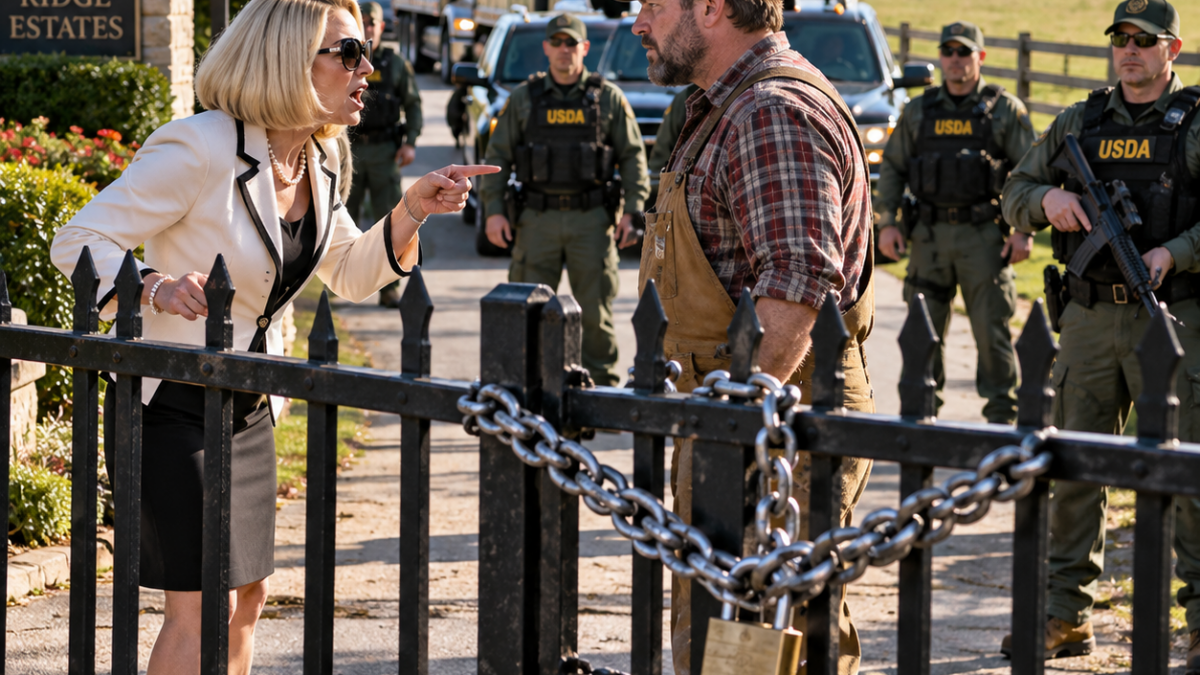
In its place stood an eight-foot decorative wrought-iron barrier.
Black.
Heavy.
Brand-new.
Two masonry posts had been drilled into the edge of the paved easement.
A forged steel chain wrapped the center.
Industrial padlock.
And hanging from it was a laminated sign with the Oak Ridge crest.
NOTICE OF ROAD ACCESS SUSPENSION.
I got out.
Read it once.
Then again.
ACCOUNT BALANCE: $18,450.
ACCESS TO HOA-MAINTAINED ROADWAYS IS SUSPENDED UNTIL ALL COMMUNITY ASSESSMENTS, PENALTIES, AND ADMINISTRATIVE FEES ARE SATISFIED.
PATRICIA SIMMONS
PRESIDENT
OAK RIDGE ESTATES HOMEOWNERS ASSOCIATION
For about ten seconds, I was too angry to think.
Then I checked the time.
6:07.
The convoy was scheduled for eight.
My first instinct was bolt cutters.
I had a pair in the shop.
My second was the tractor.
I owned enough machinery to make that gate a brief memory.
Then my grandfather’s voice appeared.
Land gets stolen with paper more often than guns.
I photographed everything.
Gate.
Chain.
Posts.
Sign.
Road.
Timestamp.
Then called Hannah.
She answered half asleep.
“What happened?”
“Patricia locked the road.”
Silence.
“What?”
I explained.
Hannah woke instantly.
“Do not touch it.”
“I know.”
“I mean it.”
“I know.”
“Call Croft.”
“I’m calling.”
“Then call our lawyer.”
“After.”
“Wyatt.”
“What?”
“Do not ram it with the tractor.”
I looked at the tractor shed in the distance.
“I wasn’t going to.”
“You were thinking it.”
“I think about lots of things.”
“Do not become Dad today.”
Then she hung up.
At 6:13, Croft answered.
“Hayes.”
“We have a problem.”
“Define problem.”
“HOA installed a locked iron gate across the easement overnight.”
Silence.
Not confusion.
Processing.
“Photographs?”
“Yes.”
“Send them.”
I did.
His phone remained open.
Thirty seconds.
Then:
“Is the gate physically preventing heavy transport access?”
“Yes.”
“Alternate route?”
“Not without crossing Miller Creek or two neighboring parcels.”
“Any existing legal farm access besides Old Mill?”
“No.”
“Who installed it?”
“HOA notice signed by Patricia Simmons.”
“Reason?”
“She claims I owe eighteen thousand four hundred fifty dollars in assessments.”
“Do you?”
“No.”
“Are you a member?”
“No.”
“Is the easement recorded?”
“Yes.”
“How old?”
“Original language dates to 1936. Reaffirmed in later deeds.”
Croft paused.
“Do not touch the barrier.”
“I assumed.”
“Do not confront the HOA.”
“I can try.”
“Mr. Hayes.”
His tone changed.
“You will do more than try.”
I straightened.
“All right.”
“Our convoy is already moving.”
“How far?”
“One hour forty-seven.”
“What are you going to do?”
“Continue.”
I looked at the iron gate.
“You’re bringing two rigs that physically cannot pass.”
“Correct.”
“Croft.”
“The transport schedule is mandatory for today’s collection.”
“How exactly—”
“Maintain your position inside the farm.”
“Are you planning to cut it?”
“No.”
That answer bothered me.
“Then what?”
“You will find out at eight.”
“Thomas—”
The line went dead.
I stared at the phone.
Croft never hung up dramatically.
That was the moment I became nervous.
By 6:30, Oak Ridge started waking.
Lights.
Garage doors.
Dog walkers.
A woman jogging stopped when she saw the gate.
“That new?”
“Very.”
“Looks expensive.”
“I’m hoping it was.”
She noticed the sign.
“Oh.”
Then kept jogging.
At 6:42, Harold Greene arrived on foot.
Seventy-one years old.
Retired civil engineer.
Bathrobe under a winter coat.
Coffee mug in hand.
He stood on the Oak Ridge side.
“Patricia?”
“Signed personally.”
Harold read the notice.
“She called an emergency board meeting last night.”
My stomach tightened.
“You attended?”
“Zoom.”
“What did she say?”
“Road security improvement.”
“Did she say she was blocking my farm?”
“No.”
“Vote?”
“Four to two.”
“For this?”
“For authorizing ‘temporary infrastructure controls related to delinquent user assessments.’”
I stared.
“She hid it.”
Harold nodded.
“I think so.”
“Who voted no?”
“Me and Evelyn Park.”
“Greg?”
“Strong yes.”
Of course.
Harold lowered his voice.
“Wyatt.”
“What?”
“There’s more.”
I waited.
“She’s been talking to Carlisle Development again.”
I went still.
“About what?”
“Your farm.”
That hit differently.
Carlisle had approached me twice.
First offer: $4.2 million.
Second: $5.1 million.
It sounded enormous until you considered taxes, debt, relocation, and the fact that once a family farm is sold, you don’t buy the same century back somewhere else.
I refused.
“What exactly did she say?”
“I overheard her after a board meeting.”
Harold looked uncomfortable.
“She told Greg that if you ‘felt enough pressure,’ you’d eventually take the developer’s offer.”
There it was.
Not road maintenance.
Not mud.
Not community standards.
Land.
My land.
“Why would she care?”
“Property values.”
Harold shook his head.
“Or something else.”
“What something else?”
“I don’t know.”
At 7:04, my lawyer called.
Martha Givens had handled my family’s property matters for twenty years.
I sent the photographs.
Her reaction was less controlled than Croft’s.
“She did what?”
“Installed a gate.”
“On the easement?”
“Across it.”
“Overnight?”
“Yes.”
“Is she insane?”
“Professional opinion?”
“Preliminary.”
Martha immediately pulled the recorded deed.
She confirmed what we already knew.
Patricia had no authority to suspend access.
“Do not damage the gate unless there is an emergency.”
“I have a federal convoy arriving.”
“That may qualify as somebody else’s emergency.”
“What does that mean?”
“It means let the federal people decide what federal people do.”
Good advice.
At 7:28, a champagne golf cart came down Old Mill Road.
I laughed when I saw it.
Not because anything was funny.
Because arrogance has a visual language, and Patricia Simmons arriving to an illegal barricade in a golf cart with a stainless steel travel mug was almost too perfect.
Greg sat beside her.
Clipboard.
Aviators.
It was fifty-two degrees and cloudy.
The sunglasses were an ideological commitment.
Patricia parked.
Stepped out.
Beige pantsuit.
Pearl earrings.
Hair lacquered into absolute obedience.
“Good morning, Wyatt.”
“Patricia.”
“I see you discovered the new access control.”
“Access control.”
“Yes.”
“That what we’re calling extortion?”
Her smile vanished.
“You were provided repeated notices.”
“For fees I don’t owe.”
“You utilize Oak Ridge infrastructure.”
“I utilize an easement.”
“Maintaining the road costs our residents money.”
“Then negotiate with the county or the developer who built over the easement.”
“Your family receives a direct benefit.”
“My family received that benefit before your HOA existed.”
Greg stepped forward.
“We’re not arguing deed history again.”
I looked at him.
“You’re standing beside a gate you drilled across my deed history.”
He pointed at the notice.
“Eighteen thousand four hundred fifty dollars.”
“Not happening.”
“Then gate stays closed.”
I checked my watch.
7:31.
“Remove it.”
Patricia sipped her coffee.
“No.”
“I’m giving you one chance.”
“How theatrical.”
“You need to listen carefully.”
She rolled her eyes.
“I have a federally scheduled agricultural pickup arriving at eight.”
Greg laughed.
Actually laughed.
“I’m serious.”
Patricia smiled with the patience of someone talking to a child.
“Wyatt.”
“What?”
“You grow beans.”
“Correct.”
“This entire performance about government operations isn’t persuasive.”
“I’m not trying to persuade you.”
“You’ve spent two years behaving as though normal community rules don’t apply to you.”
“They don’t.”
Her face sharpened.
“There.”
She pointed.
“That attitude.”
“I am literally not in your HOA.”
“You exploit our roads.”
“My legal right predates your houses.”
“You refuse every attempt at cooperation.”
“You sent me a mailbox color palette.”
“That’s not relevant.”
“It was taupe, Patricia.”
Greg stepped closer to the gate.
“You can write the check.”
I ignored him.
“Federal vehicles will be here in twenty-nine minutes.”
Patricia set her mug on the golf cart.
“Then I suggest you tell your imaginary convoy to reschedule.”
“They can’t.”
“Not my problem.”
“It’s about to become your problem.”
She laughed.
“I was a corporate attorney for thirty years.”
“You keep saying that.”
“Because unlike you, I understand civil liability.”
“And unlike you, I understand what a soybean looks like.”
Greg snorted.
Patricia gave him a look.
I continued.
“This farm operates under a controlled federal research contract.”
That got a flicker.
Not belief.
Interest.
“The crop being collected today is under chain-of-custody requirements.”
Patricia folded her arms.
“I assume this is the point where black helicopters arrive.”
“No helicopters.”
“Shame.”
“Just move the gate.”
“No.”
“Please.”
That word surprised all three of us.
I meant it.
“Patricia, I’m asking because once they arrive, this stops being our stupid neighborhood fight.”
For half a second, she considered.
Then pride returned.
“No.”
She unfolded a lawn chair from the back of her golf cart.
Harold, watching from forty feet away, whispered:
“Oh, for God’s sake.”
Patricia placed the chair directly beside the gate.
Sat.
Crossed one leg.
“I’ll wait.”
Greg smiled.
I checked the time.
7:36.
Residents started gathering.
Phones.
Coffee.
A man still in pajama pants.
Evelyn Park, an HOA board member, arrived furious.
“Patricia, what did you do?”
“I authorized enforcement.”
“You told us temporary access controls.”
“This is temporary.”
“You installed masonry columns.”
“Removable.”
“They’re concreted into the road.”
“Evelyn.”
“No.”
Evelyn looked at me.
“I did not approve blocking Wyatt.”
“I know.”
Greg said:
“You voted on it.”
“I voted no.”
“Still board action.”
Evelyn turned toward Patricia.
“You need to open this.”
Patricia didn’t even look at her.
“Meeting Wednesday.”
“There will be a meeting today if you don’t.”
Patricia smiled.
“I am president.”
Harold muttered:
“Not queen.”
At 7:47, Sheriff Miller called me.
“You call us?”
“No.”
“Dispatch says Oak Ridge residents are reporting a road disturbance.”
“Patricia installed an iron gate.”
Silence.
“Across your easement?”
“Yes.”
“Sweet Jesus.”
“She’s here.”
“Of course she is.”
“Federal convoy arrives in thirteen minutes.”
Another silence.
“Federal what?”
I explained.
Miller sighed so deeply I heard his soul leave.
“I’m coming.”
“You might miss the interesting part.”
“I was afraid you’d say that.”
7:54.
Nothing.
Patricia checked her watch theatrically.
“Where’s your government, Wyatt?”
“Two minutes early for mocking.”
Greg laughed.
“Maybe the Department of Beans got lost.”
Harold said:
“Greg, you should really stop talking.”
At 7:56, we heard it.
Not sirens.
Engines.
Heavy diesel.
Low.
Distant.
Then closer.
The sound traveled through pavement before the vehicles appeared.
Residents turned toward the curve.
Patricia’s smile changed.
Not gone.
Just uncertain.
At 7:57, red and blue lights reflected against the wet leaves.
The first black Tahoe rounded the corner.
Large.
Tinted windows.
Government plates.
Push bumper.
Behind it came a second SUV.
Then two white climate-controlled transport rigs.
Then another black vehicle.
The entire road filled with them.
Phones rose everywhere.
Greg removed his sunglasses.
That was how I knew he was scared.
The convoy slowed.
The lead Tahoe stopped twenty feet from Patricia’s gate.
Engines idled.
Doors opened.
Thomas Croft stepped out.
Dark jacket.
Federal identification visible.
Two other agents exited behind him.
No dramatic weapons.
No movie-style shouting.
They looked worse than that.
They looked like people who had paperwork authorizing exactly why they were there.
Croft walked toward the gate.
He saw me through the bars.
“Mr. Hayes.”
“Morning.”
He examined the posts.
Chain.
Lock.
Notice.
Then photographed everything himself.
Patricia stood.
“Excuse me.”
Croft continued photographing.
“Excuse me.”
He finished.
Then looked at her.
“Who are you?”
Patricia visibly disliked being asked.
“Patricia Simmons.”
“Role?”
“President of Oak Ridge Estates Homeowners Association.”
“You authorized this barrier?”
“Yes.”
Croft nodded once.
“Thank you.”
That frightened Greg more than yelling would have.
Patricia recovered.
“This is private property.”
Croft looked down at the road.
“Recorded easement says otherwise for the access purpose relevant today.”
Patricia blinked.
“You’ve seen the deed?”
“Yes.”
“How?”
“I have an internet connection.”
Harold coughed to hide a laugh.
Patricia’s face reddened.
“You cannot simply enter a private residential community with government vehicles.”
“We already did.”
“I demand to see a warrant.”
Croft looked at her.
“For what?”
“To trespass.”
“Ma’am, your gate is obstructing lawful access to a contracted federal agricultural site.”
“I dispute that characterization.”
“Noted.”
She stiffened.
“Mr. Hayes owes this association more than eighteen thousand dollars.”
Croft looked at me.
Then her.
“That dispute has no effect on this operation.”
“It affects his road privileges.”
“His access is recorded.”
“I was an attorney for thirty years.”
Croft stared for two seconds.
Then:
“Congratulations.”
Harold walked away because he could no longer hide laughing.
Patricia’s voice rose.
“You do not have authority to destroy HOA property.”
Croft stepped closer to the barrier.
“You were instructed by Mr. Hayes that federal transport was scheduled?”
“He made an absurd claim.”
“That was yes or no.”
“Yes.”
“You maintained the obstruction after notification?”
“I maintained lawful control of our road.”
Croft nodded.
One of the agents wrote something.
Patricia saw.
“What is he writing?”
Croft ignored the question.
“Ms. Simmons, I am directing you to clear yourself and all civilians away from this access point.”
“No.”
The word surprised even Greg.
“Patricia,” he whispered.
She raised a hand.
“No.”
Croft’s voice remained calm.
“This transport is time-sensitive.”
“Then reschedule.”
“No.”
“You cannot bully private citizens because you work for the government.”
“We’re not discussing philosophy.”
“You need a court order.”
“Our legal authority for access has been confirmed.”
“I disagree.”
“You are free to disagree from the shoulder.”
Patricia stepped directly in front of the gate.
“Then arrest me.”
Croft looked almost tired.
“I would prefer not to delay the transport.”
“Then turn around.”
“Move.”
“No.”
Evelyn shouted from the crowd:
“Patricia!”
Greg backed away.
Croft looked at him.
“You affiliated with the HOA?”
Greg shook his head.
Then realized how absurd that was.
“I mean—vice president.”
“Did you authorize the barrier?”
Greg pointed at Patricia.
“She handled the contractor.”
The betrayal happened fast.
Patricia turned.
“Greg.”
“I’m just answering.”
“You voted for it.”
“So did the board.”
“Not all of us,” Evelyn snapped.
Croft spoke into his radio.
Then looked at Patricia.
“Last instruction.”
She crossed her arms.
“I know my rights.”
“Good.”
Croft stepped forward with another agent.
They took Patricia gently but firmly by both arms.
“What are you doing?”
“Moving you out of the operational path.”
“Take your hands off me!”
“You were instructed.”
“I’ll sue every one of you!”
They guided her onto the grass.
She fought enough to lose one shoe.
That was the moment every phone camera in Oak Ridge captured.
Patricia Simmons.
Bare left foot.
Beige pantsuit.
Standing on wet grass while shouting about constitutional rights.
Croft waited until she was well clear.
Then he looked at the lead Tahoe driver.
One motion.
Forward.
The Tahoe rolled.
Slowly at first.
Patricia stopped shouting.
“What are you doing?”
The driver aligned the steel push bumper with the center of the wrought iron gate.
“NO.”
Engine.
Low.
Then acceleration.
The bumper hit.
Metal screamed.
Not an explosion.
A deep twisting shriek.
The chain held.
The hinges did not.
One masonry anchor tore free.
The right post cracked.
The gate folded inward.
The Tahoe continued.
Black iron bent beneath three tons of vehicle.
The second anchor tore out.
Concrete burst across the edge of the roadway.
The gate disappeared beneath the bumper.
Then under the tires.
I had spent two years imagining satisfying ways Patricia might finally lose.
None involved a federal Tahoe flattening twelve thousand dollars of decorative iron.
I will admit something.
It felt excellent.
The lead vehicle crossed onto my farm.
Second SUV followed.
Transport rigs.
Rear escort.
Nobody cheered.
That would have felt cheap.
Instead there was one collective sound from Oak Ridge residents.
The kind people make when something so unbelievable happens that the body reacts before language.
Patricia stared at the wreckage.
Her authority had become scrap metal in less than twenty seconds.
Croft stepped over one twisted bar.
“Mr. Hayes.”
“Yes?”
“Access restored.”
I looked at the gate.
“Technically.”
“Your staging area ready?”
“Yes.”
“Then let’s work.”
That was Croft.
No victory speech.
Beans were waiting.
The convoy moved up my driveway.
Patricia found her voice again.
“This is criminal!”
Croft turned.
“You may document your complaint.”
“Oh, I will.”
“I recommend preserving all records related to installation of the barrier.”
Something in that sentence made Greg visibly pale.
Patricia did not notice.
“I’m calling the sheriff.”
Croft nodded.
“Please do.”
She dialed 911.
Twenty-two minutes later, Sheriff Miller arrived.
By then the federal team had already established the transfer perimeter.
The iron gate lay flattened beside Old Mill Road.
Miller stepped from his cruiser.
Saw Patricia.
Saw the gate.
Saw Croft.
Closed his eyes.
Just briefly.
As though asking God why retirement was still eleven years away.
Patricia charged him.
“David!”
“Morning, Patricia.”
“They assaulted me.”
Miller looked at Croft.
“Did you arrest her?”
“No.”
“Shame.”
Patricia stared.
“Excuse me?”
Miller rubbed his forehead.
“What happened?”
Croft introduced himself.
Credentials.
Purpose.
Recorded access rights.
Barrier.
Warning.
Removal.
Patricia interrupted every fifteen seconds.
Finally Miller held up one hand.
“Stop.”
She stopped only because nobody had ever used that tone with her publicly.
“Patricia, I warned you.”
“This is not about rooster complaints.”
“I warned you about the easement.”
“The HOA maintains the road.”
“You don’t own Wyatt’s access rights.”
“He owes assessments.”
“He isn’t a member.”
“He benefits—”
“Stop.”
Miller looked at the shattered gate.
“You installed that last night?”
“It was lawful enforcement.”
“Did you get a court order?”
She hesitated.
“No.”
“Did you get county road approval?”
“It’s private.”
“Did you check where the easement boundaries were?”
“I know where they are.”
Miller laughed once.
“That is not the answer you think it is.”
Patricia pointed toward my farm.
“They destroyed property worth nearly twenty thousand dollars.”
Croft corrected:
“Contract invoice we found attached to the gate paperwork lists twelve thousand eight hundred.”
Patricia turned.
“How did you—”
“It was in the plastic sleeve.”
Greg looked ready to disappear into the earth.
Miller said:
“You can file a civil claim.”
“I want arrests.”
“No.”
“Why?”
“Because I don’t see probable cause to arrest Wyatt for standing behind his own gate while somebody else removed an obstruction.”
“What about them?”
She pointed at federal agents.
Miller looked at Croft.
Then her.
“You’re welcome to contact their agency.”
“I’m ordering you to arrest them.”
Miller stared.
“Patricia.”
“What?”
“You do not order the county sheriff.”
A few residents murmured.
Her face flushed.
“If you refuse to protect Oak Ridge—”
“I am protecting Oak Ridge.”
“From what?”
“Today?”
Miller looked at Greg.
“Mostly itself.”
He left.
Patricia stood beside the remains of her gate.
I should have felt finished.
Instead, when I glanced at Greg, I noticed something.
He wasn’t angry.
He was afraid.
Not of the gate.
Of Croft.
Specifically of Croft preserving records.
That mattered.
Four hours later, the transport operation finished.
Federal agronomists sampled the lots.
Seed containers were sealed.
Every weight documented.
The two rigs were locked.
Croft checked the final chain-of-custody sheet.
Then handed me my copy.
“Good yield.”
“That enthusiasm?”
“Don’t push it.”
I smiled.
“Gate okay?”
“I liked the old one.”
“You should invoice whoever removed it.”
“The HOA?”
“No.”
He looked toward Old Mill Road.
“Whoever physically removed your original cattle gate.”
I stopped.
“I assumed HOA contractors.”
“Assume less.”
“What does that mean?”
“Photograph everything.”
“You know something?”
“I know people make poor decisions when they think civil disputes make evidence unimportant.”
Then he walked away.
Three days later, a process server found me repairing fence.
“Wyatt Hayes?”
“Depends.”
He held up papers.
“It’s never good when people say that.”
He handed me a stack thick enough to stun livestock.
Oak Ridge Estates Homeowners Association and Patricia Simmons v. Wyatt Hayes, Hayes Farm LLC, and various federal defendants.
Demand:
$2.5 million.
Property destruction.
Trespass.
Emotional distress.
Interference with contractual rights.
Unpaid assessments.
I called Hannah.
“She sued.”
“How much?”
“Two and a half.”
Hannah went silent.
Then started laughing.
“What’s funny?”
“She actually sued the federal government?”
“Yes.”
“Send me everything.”
Martha Givens called twenty minutes later.
Her reaction was different.
“This is wonderful.”
“You and my sister are both sick.”
“No, Wyatt.”
Paper rustled.
“This is genuinely wonderful.”
“I am being sued for two and a half million dollars.”
“She pleaded the assessments as legitimate HOA receivables.”
“So?”
“She put their books at issue.”
I stopped.
“What?”
“If she claims your unpaid eighteen thousand caused financial harm, she may need to establish the basis of the charge.”
“And?”
“Discovery.”
I understood.
Not fully.
Enough.
“Her records.”
“Potentially.”
“Would she really be that stupid?”
Martha laughed softly.
“Intelligence and arrogance are not opposites.”
The federal response was faster than mine.
Croft called that afternoon.
“You received service?”
“Yes.”
“You upset?”
“A little.”
“Don’t be.”
“That phrase means very little from you.”
“Preserve all correspondence.”
“I have.”
“Any HOA invoices?”
“Every one.”
“Good.”
“Why?”
“Because the complaint references financial loss tied to alleged assessment obligations.”
“Martha said the same.”
“She is correct.”
“Are you investigating them?”
Pause.
“Mr. Hayes.”
“Yes?”
“I inspect agricultural contracts.”
“That was not an answer.”
“It was the answer you’re getting.”
Then something unexpected happened.
The residents turned on the HOA before the government did.
Evelyn Park circulated the lawsuit.
Homeowners discovered the board had approved using reserve money for Patricia’s legal strategy.
Roof fund.
Road fund.
Pool reserve.
More than $90,000 moved to a litigation retainer.
Nobody had voted on that publicly.
A neighborhood email chain exploded.
Patricia responded with a seventeen-paragraph message accusing “outside agitators” of undermining community governance.
That made it worse.
Harold came to my farm.
“Meeting Friday.”
“HOA?”
“Emergency.”
“You going?”
“I’m not a member.”
“You should come.”
“They won’t let me.”
“Half the neighborhood wants you there.”
“Why?”
Harold smiled.
“Because you’re currently the only person with better entertainment than cable.”
I declined.
At that stage, I still thought the fight was about me.
It wasn’t.
Two weeks after the lawsuit, federal investigators served document requests relating to the claimed road assessments and the barrier incident.
Then an inspector noticed something odd.
Oak Ridge’s road maintenance expenses were extraordinarily high.
Not a little high.
Absurd.
In two years, the HOA had paid more than $400,000 to a company called Dalton Landscape & Site Services.
I only learned that later.
At the time, I noticed Greg disappear.
Not literally.
He stopped driving around.
His house went dark for two nights.
His wife told neighbors he was “traveling.”
Then Harold called me at 6:10 one morning.
“You awake?”
“I farm.”
“Right.”
“What happened?”
“You know Dalton Landscape?”
“No.”
“The company doing Oak Ridge landscaping.”
“All right.”
“Registered owner is Richard Dalton.”
“Should that mean something?”
“Greg’s wife’s maiden name is Dalton.”
I sat down.
“Brother?”
“Brother.”
There it was.
The rot.
Over the next week, more came out.
Dalton Landscape owned no commercial mowers.
No dump trucks.
No crews.
Its listed office was a rented mailbox.
Actual work had been subcontracted to legitimate landscapers for a fraction of what Oak Ridge paid.
The difference?
Moved through accounts.
Consulting fees.
Management fees.
Emergency project fees.
Some money went to entities linked to Greg.
Some into an investment account tied to Patricia through a holding company.
The investigation widened.
Now the fabricated fees made sense.
They had not merely wanted to annoy me.
Oak Ridge’s reserves were draining.
Patricia and Greg needed cash.
I was an easy target.
A valuable neighboring property outside the HOA.
A farm they believed could be pressured into paying.
And if I sold?
Even better.
The developer had quietly offered a “community transition consulting fee” to certain board members if the Hayes tract eventually became available for annexation.
Not illegal by itself depending on structure.
But very relevant when the people receiving it spent two years harassing the owner to sell.
Martha called.
“You sitting?”
“Yes.”
“You were right about land.”
“I didn’t say that.”
“Hannah did.”
“Never tell her.”
“Too late.”
“What’s happened?”
“The developer produced emails.”
My jaw tightened.
“What emails?”
“Patricia to a Carlisle vice president.”
Martha read one.
If Hayes can be induced to reconsider, the parcel would complete the eastern development plan and significantly increase long-term values.
Another.
Continued pressure through access cost recovery may make agricultural operations less attractive.
Then one from Greg.
We just need him tired enough to take the check.
I sat in silence.
Martha said:
“You there?”
“Yes.”
“Wyatt?”
“They tried to bankrupt me into selling.”
“Yes.”
All the letters changed meaning.
Mailbox.
Mud.
Roosters.
Noise.
Fees.
It was never standards.
It was attrition.
I thought about my father signing bank papers.
My grandfather fixing that road after storms.
My great-grandfather pulling stones from the field with mules.
People love saying land is just property.
Legally, it is.
Emotionally, sometimes it is where generations stored their effort.
Patricia wanted it because it completed a map.
Three weeks later, Oak Ridge called another emergency meeting.
This time Harold called at noon.
“You need to come.”
“Why?”
“Because federal investigators are attending.”
That got me.
The clubhouse parking lot was full.
More than two hundred residents.
Some standing.
Some angry.
Some frightened.
The swimming pool outside was covered for winter.
Through the glass I could see one corner of the old guardhouse.
Patricia stood at the front.
Same immaculate hair.
Navy blazer this time.
Greg sat at the board table.
No sunglasses.
That was becoming a reliable indicator of disaster.
When I walked in, the room changed.
Not applause.
Not boos.
Heads turned.
Patricia saw me.
Her mouth tightened.
“You are not an association member.”
Harold stood.
“He’s my guest.”
Several people said:
“Let him stay.”
Patricia banged the gavel.
“This is a private association meeting.”
Evelyn Park spoke from the board table.
“Motion to allow Mr. Hayes.”
“Second.”
Patricia stared.
A vote happened.
Five to one.
Greg abstained.
I sat in the back.
Patricia began.
“Neighbors, I recognize recent federal actions have created concern.”
Someone shouted:
“You spent our reserve fund!”
Another:
“Where’s four hundred grand?”
Patricia raised her voice.
“Misinformation is spreading.”
“Is Dalton fake?”
“Let her speak!”
“Where’s the money?”
She tried again.
“The federal investigation is an aggressive response to a legitimate property dispute.”
The rear doors opened.
Thomas Croft entered.
Beside him walked a woman in a charcoal suit carrying a thick binder.
Sarah Jenkins.
Financial investigator.
Two other officials followed.
The room went silent.
Croft did not march dramatically to the stage.
He approached the board’s attorney first.
Quiet conversation.
Documents exchanged.
The attorney’s face changed.
Then he leaned toward Patricia.
She shook her head.
Hard.
“No.”
Everyone saw.
Croft stepped back.
Sarah Jenkins moved to the microphone after receiving permission from the court-appointed counsel who had begun advising the association.
“Residents of Oak Ridge Estates.”
Her voice was calm.
“I cannot discuss every aspect of an active investigation.”
Disappointment moved through the room.
She continued.
“But because your association funds are directly implicated and emergency preservation orders have been entered, there are facts you need to understand.”
Nobody moved.
“The investigation began after your association claimed legally enforceable debts against a neighboring agricultural property during a federal transport obstruction dispute.”
She looked toward me briefly.
“That claim required verification.”
Patricia interrupted.
“This is intimidation.”
Jenkins turned toward her.
“Ms. Simmons, please allow me to finish.”
Patricia crossed her arms.
Jenkins opened the binder.
“Over the previous twenty-four months, Oak Ridge Estates paid $417,600 to Dalton Landscape & Site Services.”
Noise.
“Records indicate Dalton Landscape performed only a small portion of the billed work directly.”
Greg lowered his head.
“Subcontracted services documented to date total approximately $126,000.”
Someone shouted:
“Where’s the rest?”
Jenkins waited.
“Approximately $291,000 was routed through additional entities, consulting accounts, and transfers currently under review.”
People stood.
Patricia grabbed the microphone.
“This is a gross misrepresentation of legitimate management expenditures.”
Jenkins removed a page.
“Richard Dalton is the brother-in-law of Vice President Gregory Higgins.”
All eyes moved to Greg.
He looked physically ill.
A man in the front row shouted:
“Is that true?”
Greg said nothing.
“Greg!”
His wife was somewhere in the room.
He looked toward Patricia.
She stared back with pure warning.
That was the moment he broke.
“I didn’t set it up.”
Pandemonium.
Patricia spun.
“Greg.”
“I didn’t.”
“You signed every authorization.”
“Because you told me to!”
Residents screamed.
Jenkins stepped away from the microphone until security calmed the room.
Greg’s breathing became frantic.
“She said it was temporary.”
Patricia’s face went white.
“Stop talking.”
“You said we’d replace the money after Hayes paid.”
The room erupted again.
My stomach tightened.
There it was.
Public.
Unrehearsed.
Greg pointed toward me.
“She said he’d pay or sell.”
Patricia lunged for the microphone.
“That is false.”
Greg stood.
“You wrote the fees.”
“You approved them.”
“You told me Carlisle would buy his land before the audit!”
Silence.
Not gradual.
Instant.
Patricia realized what he had said.
Too late.
Evelyn Park whispered:
“Oh my God.”
Jenkins’s expression did not change.
But Croft glanced toward one of the investigators.
They were already writing.
Patricia regained her voice.
“Anything Mr. Higgins says should be viewed as self-serving.”
Greg laughed hysterically.
“Self-serving?”
“Sit down.”
“You transferred money too!”
People started shouting questions.
“How much?”
“Where?”
“Did you steal from us?”
Patricia backed away from the podium.
Croft approached.
“Ms. Simmons.”
She stared.
“Gregory Higgins.”
Greg froze.
“Based on warrants issued this afternoon, you are both being taken into custody in connection with the financial investigation.”
Phones appeared everywhere.
Patricia’s face changed.
Not fear first.
Humiliation.
“No.”
Croft continued.
“You’ll have an opportunity to speak with counsel.”
“This is because of Hayes.”
I had not spoken once.
She found me in the back.
Pointed.
“You did this.”
I stood.
“No.”
“You called them.”
“You locked the gate.”
Her face twisted.
“You think you won?”
I looked around.
At two hundred homeowners staring at her.
At Greg crying.
At Sarah Jenkins’s binder.
At Croft.
At the remains of a community trust that had been hollowed out by people who thought nobody would inspect the books.
“I think you sent the invitation.”
She was escorted out.
No cheering.
That surprised me.
Residents were too shocked.
These were not people watching a villain lose.
They were homeowners realizing the woman they trusted with their money may have stolen from them.
Some looked angry.
Some devastated.
One elderly woman cried because her husband had died the previous year and Patricia had personally assured her that rising dues were necessary to protect property values.
Greg followed.
He looked at me as he passed.
“I’m sorry.”
I did not answer.
I wasn’t ready.
Consequences took months.
Real consequences usually do.
The lawsuit against me collapsed quickly.
The claims against the federal agencies went nowhere.
The fabricated assessments were voided.
A judge froze HOA accounts while investigators sorted legitimate obligations from questionable transactions.
A receiver was appointed.
Residents voted out the remaining board.
Evelyn declined the presidency.
“I enjoy sleeping.”
Harold accepted temporary service because apparently retirees lie when they claim they want peace.
Carlisle Development denied knowledge of any illegal conduct.
Some of its emails were embarrassing.
The company eventually withdrew interest in my property.
Greg cooperated.
That mattered at sentencing later.
Patricia fought everything.
Also her right.
Eventually both entered different plea agreements on financial charges.
I did not attend sentencing.
People expected me to.
I didn’t need to watch.
The gate had been enough.
What mattered more was restoring the easement permanently.
That happened in county court.
Martha stood beside me.
The receiver’s attorney stood opposite.
The judge reviewed the original deeds.
Surveys.
Subdivision approvals.
Road maintenance agreements.
Then said:
“This dispute appears to exist primarily because everybody involved spent several years pretending clear language was ambiguous.”
Martha whispered:
“I like her.”
The court confirmed my unrestricted agricultural right-of-way.
Oak Ridge could maintain Old Mill Road.
It could not gate, suspend, condition, or charge my access without a separately negotiated legal agreement.
The county later accepted dedication of the main stretch of Old Mill Road as public roadway after the receiver and residents approved the transfer.
That ended the gate question forever.
Almost.
Two months later, a county truck came down my driveway.
Behind it was a flatbed carrying steel.
My old cattle gate had disappeared the night Patricia’s contractors installed theirs.
The contractor claimed it had been scrapped.
The receiver agreed to restitution.
I expected a normal farm gate.
What arrived was ridiculous.
Twelve feet wide.
Heavy galvanized agricultural steel.
Powder-coated green.
Commercial hinges.
Concrete posts.
County-approved setback.
My name cut into a small metal plate.
HAYES FARM.
I stared.
Hannah arrived.
She started laughing.
“What?”
“It’s green.”
“Tractor green.”
“You hate decorative gates.”
“This is not decorative.”
“It has your name laser-cut into it.”
“Identification.”
“It has an automatic opener.”
“Security.”
“It has solar panels.”
“Efficiency.”
She smiled.
“You love it.”
“I tolerate it.”
“Wyatt.”
“I love the gate.”
We stood there while the crew worked.
Residents drove past.
Some waved.
At first awkwardly.
Then normally.
The strange part was that Oak Ridge became a better neighbor after the HOA collapsed.
Not perfect.
No neighborhood is.
But human.
Residents formed a voluntary road and landscaping committee for the parts the county did not maintain.
Finances were posted publicly.
Vendor relationships disclosed.
Meetings streamed.
No anonymous fines.
No architectural enforcement for properties outside the actual covenants, which should not have required reform but apparently did.
Harold remained my best egg customer.
Evelyn brought her grandchildren to see the calves.
Tyler, the boy who wanted to learn tractors, started working Saturdays at sixteen.
He was terrible at gates.
Excellent with engines.
One afternoon he asked:
“Did the feds really ram the old HOA gate?”
“Yes.”
“How fast?”
“Not very.”
“My dad says twenty-five.”
“Your dad exaggerates.”
“Mr. Greene says forty.”
“Harold lies for entertainment.”
Tyler looked disappointed.
“Was it cool?”
I thought about Patricia standing barefoot in the grass.
Twisted iron.
Diesel engines.
Croft saying access restored as though he had moved a traffic cone.
“Yes.”
Tyler smiled.
“Very.”
The federal crop project continued.
Our seed line performed well in drought trials.
The next season we expanded from twenty-two acres to thirty.
Not classified.
Not secret.
Still heavily documented.
Still important.
Croft returned in spring.
He stopped at the new gate.
Looked at it.
“Excessive.”
“You drove through the last one.”
“That was not my design feedback.”
“You like the green?”
“No.”
“Liar.”
He entered.
We walked the new plots.
Halfway across the field he said:
“How are the neighbors?”
“Better.”
“Any invoices?”
“None.”
“Rooster complaints?”
“Only legitimate ones.”
He nodded toward the farmhouse.
“What happened to the cream-colored notices?”
“Barn wall.”
“All of them?”
“Most.”
“Why?”
“Historical documents.”
Croft almost smiled.
At the end of the inspection, he handed back my paperwork.
“Acceptable.”
I laughed.
“Two years and that’s still all I get?”
“Yield looks strong.”
I stared.
“Was that praise?”
“Do not make this uncomfortable.”
Then he left.
That fall marked 113 years since Elias Hayes first cleared stones from the lower field.
I found an old photograph of him.
Standing beside a mule.
Hat pushed back.
Overalls.
Thin man with a mustache.
Behind him was nothing but farmland.
No pavement.
No houses.
No HOA.
No federal convoy.
I put the picture beside the framed easement in my office.
Hannah saw it.
“You thinking deep thoughts?”
“No.”
“You have the face.”
“What face?”
“Grandpa face.”
I looked again at Elias.
“He’d hate the subdivision.”
“Yes.”
“He’d like the federal contract.”
“Probably.”
“He’d love the gate.”
“Absolutely.”
Then Hannah became serious.
“You know we almost lost this place before any of this.”
“I know.”
“If you hadn’t gotten that contract…”
“I know.”
“And if Patricia hadn’t been so aggressive…”
I looked at her.
“What?”
“She exposed herself.”
I nodded.
That was the part I thought about most.
Patricia was not caught because I outsmarted her.
I didn’t investigate her finances.
Didn’t set a trap.
Didn’t plan revenge.
I kept records.
Paid my debts.
Refused fake ones.
Protected the easement.
Called the correct people when she blocked a scheduled operation.
Patricia did the rest.
She needed me to surrender.
When I didn’t, she escalated.
Letters became invoices.
Invoices became threats.
Threats became a gate.
The gate brought scrutiny.
Scrutiny reached the books.
The books told the truth.
Arrogance rarely destroys people by itself.
It convinces them they can safely take one more step.
Patricia took one more step for two years.
Until she chained steel across a road federal trucks were scheduled to use ninety minutes later.
There’s a photograph from that morning that somebody in Oak Ridge sent me.
I keep it in my office.
Not the dramatic one.
Not the Tahoe hitting the gate.
This one was taken maybe thirty seconds earlier.
Patricia is standing beside the barrier.
Arms crossed.
Perfect pantsuit.
Chin high.
Croft is twenty feet away.
The black Tahoe waits behind him.
I’m visible through the bars on the farm side.
You can’t tell from the photograph what happens next.
That’s why I like it.
It is the exact second before certainty meets reality.
Patricia is absolutely convinced the gate represents control.
Croft knows it is an obstruction.
I know it is about to become scrap.
Three people looking at the same object.
Three completely different understandings.
My grandfather used to say fences are useful because they tell honest people where not to go.
Gates are different.
A gate means somebody still needs passage.
That old easement had survived developers, subdivisions, lawyers, and one HOA president because generations before any of us understood something simple.
A landlocked farm isn’t a farm.
Access matters.
That sounds boring until someone takes it away.
Most rights do.
You don’t think about the road when it is open.
You think about it when somebody locks you behind a gate and tells you freedom costs $18,450.
Patricia thought the neighborhood had grown powerful enough to rewrite what existed before it.
The farm was ugly to her.
Tractors.
Mud.
Noise.
Old fencing.
Working land beside manicured homes.
She looked at 110 acres and saw unfinished development.
I looked at it and saw my great-grandfather.
My grandfather.
My father.
Debt.
Failure.
Work.
Possibility.
The lower field where I learned to drive.
The creek where my sister broke her wrist at eleven.
The barn where my father taught me to weld badly.
The kitchen where my mother canned tomatoes until midnight.
The office where I signed a federal contract because I was terrified the bank would take everything.
Land is property.
Of course it is.
It is also memory with boundaries.
That does not make you entitled to keep it forever.
Taxes exist.
Mortgages exist.
Markets exist.
Sometimes farms fail.
But if Hayes Farm was going to end, it would not end because Patricia Simmons invented a bill and locked me behind a decorative gate.
That mattered.
A year after the arrest, I saw Patricia once.
Not at court.
At a grocery store.
She had resolved most of her case by then.
No beige pantsuit.
No perfect bob.
Jeans.
Gray sweater.
We saw each other near produce.
She froze.
So did I.
For a moment I considered walking away.
Then she said:
“Wyatt.”
“Patricia.”
Silence.
“You still have the farm.”
“Yes.”
“I heard.”
I nodded.
She looked older.
Not broken.
Just older.
“You hate me?”
The question surprised me.
I thought carefully.
“No.”
She almost looked offended.
“I should.”
“You tried to take my access.”
“I know.”
“You helped bleed your neighbors’ finances.”
Her jaw tightened.
“I know what I did.”
“Then why ask?”
She looked toward the apples.
“Because hatred would make sense.”
I thought of all the nights I had been angry.
All the letters.
The invoices.
The gate.
Then Greg blurting the truth in front of two hundred residents.
“I was angry.”
“And now?”
“Busy.”
She laughed.
One small, bitter laugh.
“That might be worse.”
“Maybe.”
She picked up an apple.
Turned it in her hand.
“I thought you’d sell.”
“I know.”
“Carlisle’s offer was good.”
“For you.”
“For you too.”
“That wasn’t your decision.”
“No.”
First time I had ever heard Patricia Simmons say that word without argument.
No.
She looked at me.
“I convinced myself you were being irrational.”
“Maybe I was.”
“Probably.”
We both almost smiled.
Then she said:
“I kept thinking if I pushed hard enough, eventually the situation would become obvious to you.”
I looked at her.
“It did.”
She understood.
I left first.
No reconciliation.
No forgiveness speech.
No humiliation.
Just two people in a grocery store.
Consequences had already happened.
I didn’t need more.
The farm had survived.
That was enough.
Today, when I drive down Old Mill Road, I pass houses where fields used to be.
Kids play basketball.
People walk dogs.
Lawns get mowed.
The world changed around Hayes Farm.
That isn’t automatically evil.
The subdivision is somebody else’s home now.
Their memories will grow there too.
The mistake was believing one kind of home gave them the right to erase another.
At my driveway stands the green steel gate.
Most days it stays open.
I could keep it closed.
Remote opener.
Cameras.
Locks.
I don’t.
During daylight, it is usually wide open.
Feed trucks come.
Veterinarians.
Federal inspectors.
Neighbors buying eggs.
Tyler showing up late for work.
Sometimes children stop with their parents to watch tractors.
Once an Oak Ridge mother asked if her daughter could see a calf.
I said yes.
Patricia would have hated that.
Not because she hated children.
Because informal things bothered her.
No form.
No rule.
No approved visitation window.
Just a little girl petting a calf beside a farm that had refused to disappear.
Every October, around the anniversary of the convoy, somebody makes a joke.
Harold is usually responsible.
He once left a toy black SUV on my gatepost.
Another year Tyler hung a miniature chain from it.
I pretend to be annoyed.
I am not.
The real reminder is less funny.
Inside my office is the original laminated HOA notice.
Bent.
Dirty.
One corner cracked from when the gate went down.
ACCOUNT BALANCE: $18,450.
ACCESS SUSPENDED.
I framed it.
Underneath, Hannah added a small brass plate for my birthday.
It says:
ACCESS RESTORED.
That makes me laugh every time.
People hear this story and focus on the federal convoy.
Of course they do.
A government Tahoe driving through an illegal HOA gate is satisfying.
I understand.
I was there.
The metal noise alone could cure stress.
But that isn’t the part I think mattered most.
The important part came before.
I did not touch the lock.
I did not threaten Patricia.
I did not ram the gate myself.
I documented it.
Called my lawyer.
Called the agency responsible for the transport.
Let Patricia keep talking.
That was difficult.
I am a farmer.
We solve physical problems.
Fence broken?
Fix it.
Tree down?
Cut it.
Tractor stuck?
Pull it.
Gate locked illegally across your road?
Every cell in your body wants to get the loader.
But some problems get worse when you treat them like fence posts.
My grandfather’s old sentence turned out to be right twice.
Land gets stolen with paper more often than guns.
It also gets protected with paper.
Deeds.
Records.
Contracts.
Photographs.
Invoices.
Bank statements.
Emails.
The HOA had power because homeowners trusted it.
Patricia abused that power because she thought nobody outside the neighborhood would care.
Then she created a conflict large enough to make outsiders care.
The same paperwork she used to frighten me became the trail investigators followed back to her.
That is the irony I appreciate most.
Her letters were beautiful.
Cream stock.
Gold crest.
Perfect legal language.
Mine were mostly mud-stained copies stored in a farm office.
But truth does not become stronger because it is embossed.
The morning the gate came down, Patricia stood on one side of it believing title and appearance were power.
On the other side stood a farmer with an old deed.
Behind her was an HOA.
Behind me was 112 years of recorded access and a federal transport schedule she had been warned about.
She chose the gate.
The gate chose the rest.
Sometimes I still wake early enough to see fog lying low over the soybean fields.
Those are my favorite mornings.
No engines.
No lawyers.
No flashing lights.
Just land.
I take coffee to the entrance.
Lean against the green gate.
Old Mill Road stretches through Oak Ridge.
Clean pavement.
Streetlights.
New houses.
Then behind me, gravel.
Barns.
Fields.
Two worlds joined by one road.
That road almost destroyed the relationship between them.
Now it connects us.
Harold walks by sometimes.
“Morning.”
“Morning.”
“Gate still standing?”
“So far.”
“Federal government slipping.”
“I’ll file a complaint.”
He laughs.
Then keeps walking.
The sun comes up.
Farm wakes.
Birds.
Equipment.
Somewhere a rooster makes a completely legal amount of noise.
And the only thing I hear from Oak Ridge is life.
Not letters.
Not threats.
Not invoices.
Life.
I used to think winning meant watching Patricia lose.
It didn’t.
Winning was reaching the point where I stopped thinking about her every morning.
Winning was planting again.
Paying the bank.
Hiring Tyler full-time after high school.
Watching my niece drive the same lower field where I learned.
Seeing drought-resistant beans come up green despite six weeks without real rain.
Watching neighbors wave instead of photograph my tractor.
Winning was ordinary.
That may disappoint people who want revenge.
But revenge keeps the person who hurt you in the center of your story.
I prefer crops.
They require enough attention.
Still, I will admit there are nights when somebody new moves into Oak Ridge and Harold tells the story at a neighborhood cookout.
By the time it gets back to me, the Tahoe is doing sixty.
Croft is wearing body armor and sunglasses.
Patricia is apparently waving a sword.
One version has helicopters.
I correct none of it anymore.
Except one detail.
The gate.
Everyone calls it Oak Ridge’s gate.
It never was.
It was an obstruction built across my family’s right-of-way.
That distinction was the whole story.
Patricia thought putting steel across a road meant she controlled who passed.
She was wrong.
A gate only has authority when the person who closes it has the right to say no.
She didn’t.
And at exactly eight o’clock on a cold October morning, the United States government arrived in three black SUVs and two transport rigs to explain the difference.
Not with a speech.
Not with a neighborhood vote.
Not with another cream-colored letter.
The driver simply lined up a reinforced bumper.
Croft raised one hand.
Patricia screamed that nobody had the authority.
Then the engine rose.
Steel bent.
Concrete cracked.
The road opened.
And behind that wreckage sat the same farm my family had been trying to keep open for 112 years.
That morning the convoy came through.
The next spring, so did the seed.
The year after that, so did another harvest.
Life kept using the road.
And that, more than the lawsuit, the audit, the arrests, or the sight of Patricia’s iron barricade folded beneath a federal Tahoe, was the part that finally felt like justice.
She had tried to close the way home.
All she accomplished was making sure nobody could ever legally close it again.





