HOA Karen Ripped Out My Drainage and Demanded I Pave Her Easement Road—Then One Storm Washed Out 50 Feet and Trapped All 45 Homes.
PART2:
And in Brenda’s mind, if a road existed for her use, somebody else should pay to make it pretty.
My family’s land sits in the foothills east of the Cascade Range.
Forty acres.
Heavy Douglas fir.
Alder.
Sword ferns.
Blackberries.
Moss that grows on anything stationary for longer than a week.
My grandfather, Samuel Hayes, bought the property in 1978.
Back then, the county road ended nearly a mile before our place.
He improved an old logging track himself.
Gravel.
Drainage.
Culverts.
Ditches.
No sidewalks.
No lights.
No decorative entrance monument.
Just a road that functioned.
He built the cabin in the middle of the acreage with friends from a logging crew.
Two bedrooms then.
One bathroom.
Wood stove.
Metal roof.
He added a porch in the eighties.
PART3:
My father added a workshop in the nineties.
I added another bedroom after I inherited the place.
Nothing matches perfectly.
I like it that way.
The property’s odd feature was the easement.
In 1992, the owner of the two hundred acres behind us wanted to sell to a developer.
The parcel had no independent connection to the county highway.
Landlocked.
The county would not approve future development without legal ingress and egress.
My grandfather agreed to help.
That decision would outlive him by decades.
He granted a twenty-foot-wide nonexclusive access easement along the eastern edge of our property.
It followed an old logging road.
Approximately half a mile from the highway to the rear parcel.
The wording mattered.
Grandpa made sure of that.
He didn’t have much formal education, but he distrusted vague agreements.
His lawyer drafted the terms.
The dominant estate—the land behind us—could travel over the road.
Our property remained the servant estate.
We owned the ground.
They received a defined right of access.
Nothing more.
No automatic ownership.
No right to expand the corridor.
No right to alter drainage.
No right to remove trees outside the twenty-foot strip.
And most important:
Maintenance, paving, widening, drainage alteration, or other improvements required agreement of the servant-estate owner and were to be funded by the dominant estate.
Grandpa underlined that paragraph in his copy.
Beside it he wrote:
THEY USE IT, THEY MAINTAIN IT.
I still have that deed.
The source story centers on those same terms: the rear parcel received a nonexclusive right-of-way, while Nolan’s family retained the land and specifically required the dominant estate to pay for maintenance or improvements without damaging drainage.
For nearly twenty years, the agreement barely mattered.
The developer went broke.
The rear acreage stayed mostly timber.
A few surveyors came through.
Then nothing.
I walked the easement with Duke.
Deer used it.
Black bears occasionally crossed.
During summer, I used it to move firewood with the tractor.
Grandpa’s drainage system worked quietly.
That was the beauty of it.
The hillside rises west of the road.
During Oregon’s wet season, water comes down hard.
Not only rainfall.
Groundwater.
Spring seepage.
Runoff from higher timber.
Grandpa dug deep ditches along the uphill side.
At three major points, he installed corrugated steel culverts beneath the road.
Water entered ditch.
Hit culvert.
Passed under gravel.
Discharged downslope into natural channels leading eventually to Mill Creek.
Simple.
Effective.
Unglamorous.
Which meant, years later, Brenda considered it ugly.
Oakidge Estates arrived in 2018.
A corporate developer bought the old rear parcel.
Within two years, most of the trees were gone.
The ridge changed.
Blasting.
Grading.
Trucks.
Forty-five houses.
Large.
Modern.
Lots smaller than mine but homes probably ten times the price of my cabin.
White siding.
Dark roofs.
Walls of glass.
Three-car garages.
Outdoor kitchens.
Hot tubs.
Every house looked ready for a magazine shoot.
The neighborhood entrance was placed at the end of Grandpa’s logging road.
The developer could have built a new road.
Technically.
It would have required buying additional frontage, stabilizing a steep slope, and constructing an expensive bridge.
Instead, they used the existing easement.
Smart financially.
Legal too.
At first.
They added gravel.
Did basic grading.
Installed a gate at their end, not mine.
Construction traffic rolled across my property for months.
I complained once about trucks exceeding the easement width.
The site superintendent apologized.
Moved markers.
Fixed the shoulder.
No fight.
That’s how normal people handle things.
Then the developer finished most homes.
Turned common property and infrastructure over to the homeowners association.
And the residents elected Brenda Carmichael.
If Brenda had been merely annoying, none of this would have happened.
She was organized.
That made her dangerous.
Retired corporate HR director.
Fifty-seven.
Sharp asymmetrical haircut.
White Mercedes GLE.
Tennis skirts.
Designer rain jackets.
Clipboard.
Always a clipboard.
Her vice president, Patricia Rollins, followed her almost everywhere.
Patricia’s primary talent seemed to be agreeing before Brenda finished speaking.
Brenda’s first year was spent regulating Oakidge itself.
Garbage bins.
Exterior lights.
Holiday decorations.
Guest parking.
Grass height.
Dog waste.
A resident received a warning because a child’s basketball hoop remained near the curb overnight.
Another because garden furniture was “inconsistent with mountain-modern aesthetics.”
I watched from a distance.
Not my association.
Not my problem.
Then came summer.
Dry.
The road became dusty.
Forty-five families meant a lot of traffic.
SUVs.
Delivery vans.
Contractors.
Landscapers.
Amazon.
Food delivery.
When the gravel dried, tires threw dust.
My cabin sat nearly three hundred yards away.
Didn’t affect me.
Oakidge’s entrance monument sat directly at the road’s northern end.
Dark stone.
Backlit lettering.
Ornamental grass.
The dust coated everything.
Brenda hated it.
The first time we properly met, I was fixing wire fence near the easement.
White Mercedes stopped beside me.
Window lowered three inches.
“Excuse me.”
I looked up.
“Yes?”
“Are you the property caretaker?”
“No.”
She looked confused.
“I own it.”
Her eyes traveled over my muddy boots, work pants, old shirt.
“Nolan Hayes.”
She took off her sunglasses.
“Brenda Carmichael.”
“Okay.”
“I’m president of Oakidge Estates.”
“Congratulations.”
She ignored the tone.
“We need to discuss your access road.”
“My what?”
“This road.”
She pointed.
“The dust has become unacceptable.”
“Then drive slower.”
Her face changed.
“This is not caused by speed.”
“It’s a gravel road in August.”
“We have residents paying substantial association fees.”
“I’m sure.”
“The entrance landscaping was installed at significant cost.”
“All right.”
“Your road is degrading it.”
I leaned against the fence.
“It isn’t my road.”
“Obviously it is.”
“No.”
“It crosses your property.”
“The land is mine.”
“The access is yours.”
“No.”
She frowned.
I said:
“It’s an easement serving your property.”
She waved one hand.
“Semantics.”
That word almost predicts disaster in property disputes.
“No.”
I wiped sweat from my forehead.
“It really isn’t.”
“Well, regardless, we expect it paved.”
I laughed.
Not intentionally cruel.
It just came out.
Brenda stared.
“Something funny?”
“Half a mile?”
“Yes.”
“You want me to pave half a mile because your sign gets dusty?”
“It serves your property too.”
“I use it maybe twice a month.”
“That’s irrelevant.”
“Do you know what paving costs?”
“That is not my concern.”
“Exactly.”
She did not understand that answer.
I explained.
“If Oakidge wants paving, send me an engineered proposal.”
“Drainage.”
“Base.”
“Width.”
“Runoff.”
“Then you pay for it.”
Her face tightened.
“This is your land.”
“Yes.”
“Your responsibility.”
“No.”
“Mr. Hayes—”
“Nolan.”
“You cannot simply refuse to maintain critical infrastructure.”
“I can maintain my land however the easement agreement allows.”
She leaned toward the window.
“You’ll have this paved by the end of the month.”
“No.”
“We’ll involve the county.”
“Please.”
“And legal counsel.”
“Fine.”
“And if necessary, assessments.”
“You can’t assess me.”
She stared.
“I’m not in your HOA.”
Her lips compressed.
The window went up.
Then she accelerated hard enough to throw dust directly over me.
Duke sneezed.
I watched the Mercedes disappear.
“Good talk.”
That began it.
The first certified letter arrived eleven days later.
Heavy paper.
Gold embossed oak tree.
NOTICE OF INFRASTRUCTURE VIOLATION.
FAILURE TO MAINTAIN PRIMARY ACCESS THOROUGHFARE.
$500 DAILY FINE EFFECTIVE SEPTEMBER 1.
I read it twice.
Then called Harrison Reed.
Harrison had handled my father’s estate.
Property lawyer.
Tall.
Bald.
Calm to the point of irritation.
I laid the letter on his desk.
He read maybe half.
Then dropped it in the wastebasket.
“That’s it?”
“Yes.”
“They’re threatening five hundred a day.”
“They can threaten five million.”
“Can they lien me?”
“No contractual relationship.”
“No covenant.”
“No assessment authority.”
“What about the road?”
He pulled my easement deed.
Read the maintenance clause.
Smiled.
“Your grandfather was careful.”
“Meaning?”
“They have access.”
“They maintain what they need.”
“Any major improvement requires your approval.”
“And they pay.”
“Yes.”
“If I refuse paving?”
“Unless required by some separate governmental safety order, nothing in this easement obligates you to provide pavement.”
I sat back.
“Brenda won’t like that.”
“I don’t bill based on Brenda’s emotional state.”
He drafted a cease-and-desist.
Professional.
No jokes.
No anger.
Explained servant estate.
Dominant estate.
No HOA jurisdiction.
No fraudulent fine collection.
No alteration without written consent.
Three weeks of silence followed.
I thought maybe that was it.
Then the county called.
Brenda had filed a complaint alleging unsafe roadway.
An inspector visited.
He drove the road.
Checked width.
Surface.
Sightlines.
Then said:
“It’s rough.”
“Logging road.”
“But passable.”
“Yes.”
“No immediate violation.”
He left.
Brenda filed another complaint.
Dust pollution.
Another.
Emergency access.
Another.
Stormwater.
Each time, people inspected.
Each time, no order requiring me to pave.
Then came her proposal.
Forty-eight pages.
Paving design.
Or what Brenda called a design.
It was really a contractor estimate attached to a sketch.
Widen from twenty feet to twenty-eight.
Fill ditches.
Straighten two curves.
Asphalt.
Decorative curbing near Oakidge.
Estimated cost:
$186,000.
Cost allocation:
100% Nolan Hayes.
I mailed it back unsigned.
Two days later Brenda called.
“You didn’t sign.”
“Correct.”
“Why?”
“Because you’re widening beyond the easement.”
“The current width is unsafe.”
“Then petition properly.”
“And your drainage ditches are unsightly.”
I paused.
“What?”
“The trenches.”
“Ditches.”
“They create a hazard.”
“They keep the road from washing away.”
She laughed.
Actually laughed.
“Nolan, we have professional landscapers.”
“I have fifty years of water coming down that hill.”
“We are not discussing aesthetics.”
“You just called drainage unsightly.”
“It looks primitive.”
“Water doesn’t care.”
She hung up.
For the next two years, the conflict became background noise.
Letters.
Lawyer responses.
Board threats.
Occasional attempts to pressure county agencies.
Nothing changed.
Oakidge residents complained among themselves.
Some were decent.
One man, Gregory Simmons, stopped while I cleared a fallen branch.
Tall.
Big shoulders.
Forensic accountant.
He said:
“I know Brenda is driving you crazy.”
“She’s trying.”
“I told her paving isn’t your obligation.”
“Thank you.”
“She doesn’t listen to me either.”
“Why keep her president?”
Gregory laughed.
“Because most people hate HOA work.”
“Fair.”
Then:
“I hope we figure something out.”
“So do I.”
We shook hands.
That was the last normal conversation before the road disappeared.
The breaking point came in October.
Tuesday.
Cold morning.
I was drinking coffee on the porch when diesel engines approached.
Not resident SUVs.
Heavy equipment.
I walked down.
Flatbed with bulldozer.
Dump truck full of river rock.
Backhoe.
Workers.
Brenda.
Patricia.
Clipboard.
Of course.
“What are you doing?”
Brenda smiled.
“Solving the road problem.”
“No.”
“Yes.”
She pointed to a contractor.
“Gary is going to grade, widen, and stabilize.”
“You don’t have permission.”
“The HOA has an easement.”
“For passage.”
“And maintenance.”
“Not alteration.”
“This is maintenance.”
“Twenty-eight feet is not twenty.”
Gary looked between us.
“You own the dirt?”
“Yes.”
Brenda snapped:
“The HOA owns the easement.”
Gary frowned.
“That’s not the same thing.”
Smart man.
I pointed toward the machine.
“No blade touches my property without agreement.”
Brenda raised her chin.
“We sent notice.”
“A notice is not permission.”
“You are obstructing required maintenance.”
“Call Harrison.”
“I’m not calling your lawyer.”
“Then call yours.”
She turned to Gary.
“Begin.”
Gary didn’t.
“Ma’am, I need clarity.”
“You have a signed contract.”
“With the HOA.”
“Yes.”
“That doesn’t tell me land ownership.”
Brenda’s voice rose.
“This is absurd.”
Then I saw movement farther uphill.
The backhoe.
One worker had already started.
He was digging along the ditch.
I ran.
“STOP!”
The operator couldn’t hear.
I waved.
He finally killed the engine.
I stared at the ground.
A corrugated steel culvert sat partly exposed.
Bent.
One end torn free.
The ditch behind it had been filled with soil and rock.
My stomach went cold.
“What did you do?”
Brenda walked up.
“We’re widening.”
“You pulled the culvert.”
“It was rusted.”
“It works.”
“It was ugly.”
I turned.
“Ugly?”
Patricia said:
“It creates standing water.”
“It carries runoff.”
Brenda rolled her eyes.
“Don’t start pretending you’re an engineer.”
“I don’t need an engineering degree to understand downhill.”
“Nolan—”
“This ditch takes water from half this slope.”
“It’s a ditch.”
“Yes.”
“That is what ditches do.”
Gary came over.
Saw the culvert.
His face changed.
“Who told him to remove that?”
Brenda pointed at the plans.
“We need road width.”
Gary looked.
“This sheet doesn’t show existing drainage.”
“That is because we’re replacing it with modern grading.”
“Where’s drainage plan?”
Silence.
Gary folded the paper.
“No.”
Brenda stared.
“What?”
“I’m done.”
“You have a contract.”
“You represented this as HOA-controlled road work.”
“It is.”
“He owns the underlying land and disputes authorization.”
“I’m not putting my license in the middle.”
She shouted:
“Your crew already started!”
“Then I’m stopping.”
He turned to his workers.
“Load up.”
Brenda’s face went crimson.
“You will finish this job.”
“No.”
“I’ll sue.”
“Call my insurer.”
Within fifteen minutes, Gary’s crew was leaving.
But the damage was done.
One primary culvert ripped out.
Large section of ditch filled.
Tons of cheap river rock dumped across the easement.
I called the sheriff.
Deputy Jenkins arrived.
Took statements.
Photographed.
He could not decide civil liability roadside.
But he issued a trespass warning against Brenda leaving the defined easement corridor.
That mattered.
Harrison came out that afternoon.
He walked the ditch.
Swore.
Harrison almost never swore.
“That bad?”
“Yes.”
“Can I fix it?”
“You can.”
“Should I?”
He thought.
Then:
“Document first.”
We did.
Drone photos.
Ground photos.
Measurements.
Video.
Old maintenance records.
Original culvert locations.
Then Harrison said:
“Send them formal notice.”
I wrote the first draft angry.
He deleted half.
Final version:
The HOA’s unauthorized work removed established drainage infrastructure and altered the grade and hydraulic function of the easement.
This creates a foreseeable risk of erosion and road failure during winter precipitation.
The HOA is directed to retain a licensed engineer and restore the drainage system at its sole cost.
If it refuses, Mr. Hayes will not accept responsibility for future failure attributable to the HOA’s alterations.
Photos attached.
Brenda responded at 11:45 that night.
No lawyer.
Her.
Mr. Hayes,
Your attempts to obstruct necessary modernization are increasingly unreasonable.
The HOA has improved the road by eliminating dangerous open trenches and widening the usable surface.
Our landscaping consultant has confirmed there is no drainage concern.
The roadway is now safer than before.
Cease your harassment of board members.
This matter is closed.
I printed it.
Harrison read it the next morning.
“Keep this forever.”
“I was planning to.”
“She just admitted authorization.”
“Yes.”
“And rejected warning.”
“Yes.”
“Do not lose it.”
I put it in my fireproof safe.
The source story likewise has Brenda’s crew destroy the culvert and fill the drainage ditch, followed by Nolan’s written warning and Brenda’s late-night email insisting the altered road was “perfectly fine.”
Then November arrived.
Pacific Northwest November can be gentle misery.
Gray.
Drizzle.
Cold.
Or it can become violent.
That year meteorologists started using the phrase atmospheric river almost a week early.
Moisture plume from the Pacific.
Warm air.
Mountain uplift.
Rainfall projections climbing.
Four inches.
Six.
Some models:
Eight inches in forty-eight hours.
I checked county alerts.
Flood watch.
Landslide risk.
Streams high.
Soil already wet.
I walked the easement.
Brenda’s “modernization” looked terrible.
The widened road had no real compaction on the outer fill.
Cheap rock sat loose.
The former drainage ditch had become a shallow depression.
The culvert opening was gone.
Water would come down the hill.
Hit road.
Stop.
Pool.
Then find somewhere else to go.
Water always finds somewhere.
The question was what it destroys while looking.
I called Harrison.
“Storm forecast.”
“I saw.”
“Should I repair?”
“What would it cost?”
“Emergency excavation.”
“New pipe.”
“Maybe six or eight thousand.”
“Would that alter evidence?”
“Yes.”
“Would it protect access?”
“Probably.”
He paused.
“What do you want to do?”
I hated that question.
Part of me wanted to fix it.
Not for Brenda.
For safety.
Another part remembered three years of demands.
Fake fines.
County complaints.
Her contractor on my land.
Her email.
The easement placed maintenance burden on Oakidge.
They broke it.
They refused repair.
If I fixed every consequence, they would learn exactly nothing.
Harrison said:
“You do not have a general duty under this agreement to correct unauthorized damage caused by the dominant estate.”
“But?”
“Emergency conditions complicate everything.”
“If someone gets hurt?”
“Then facts matter.”
I decided on one thing.
I would warn them again.
Harrison sent formal notice to the entire board.
Not only Brenda.
Forecast attached.
Photos.
Engineer recommendation from a consultant I hired for two hours.
The engineer’s note was blunt:
Current drainage alteration creates high probability of overtopping and severe erosion under projected storm conditions.
Immediate restoration recommended.
Gregory Simmons replied:
Received.
I support emergency restoration.
Patricia replied:
Defer to president.
Brenda replied to the board:
No action needed.
Consultant already addressed.
There it was.
Not ignorance.
Choice.
I prepared my own property.
Roof drains.
Generator.
Fuel.
Firewood.
Tractor moved.
Loose equipment secured.
Culvert farther west cleared.
Duke’s food stocked.
Then I filmed the road.
Date.
Time.
Weather forecast.
Destroyed ditch.
Missing pipe.
Loose fill.
I narrated everything.
No theatrics.
Just evidence.
Thursday at 2:07 A.M., rain began.
Not drizzle.
Instant pounding.
By six, the hillside ran with water.
Every depression filled.
Small streams formed where none existed.
I wore yellow rain gear and checked my house.
Fine.
Grandpa had built above the low ground.
The cabin’s drainage worked.
At eleven, I hiked toward the road.
The problem was already visible.
Water pooled against the uphill edge.
Normally it would have entered the ditch.
Instead, the filled area acted like a berm.
A muddy lake formed.
Brown water.
Leaves.
Branches.
Then runoff began spreading over the widened gravel.
Loose rock moved.
Small at first.
Pebbles rolling.
Then channels.
At 12:20, a silver Lexus from Oakidge came downhill.
I waved.
“TURN AROUND!”
Driver stopped.
Window opened.
“I have to get to Portland.”
“Road is failing.”
“Can I make it?”
“I wouldn’t.”
He looked.
Mud maybe eight inches deep.
He tried anyway.
SUV entered.
Tires spun.
Mud sprayed.
Vehicle fishtailed.
Nearly slid toward the ditch.
Then caught.
Made it through.
Driver never looked back.
Twenty minutes later Brenda’s Mercedes appeared.
Slow.
She stopped before the mud.
Window lowered slightly.
“What happened?”
I laughed from disbelief.
“What do you mean?”
“This road is impassable.”
“Yes.”
“Fix it.”
“I warned you.”
“Nolan.”
“You removed the culvert.”
“We improved the road.”
“Then enjoy the improvement.”
Her face hardened.
“Get your tractor.”
“No.”
“You cannot deny easement access.”
“I’m not blocking anything.”
“This is your responsibility.”
“No.”
“People need to leave.”
“Then your HOA should have restored the drainage Tuesday.”
She shouted:
“I’m not arguing in this rain.”
“You started three years ago.”
Window slammed.
Mercedes reversed.
She disappeared uphill.
The rain continued.
By afternoon, the pooled water reached almost two feet in depth along the embankment.
At six, runoff crossed the road continuously.
I stayed away after dark.
Too dangerous.
Power failed around nine.
Generator started.
Radio reported landslides.
Road closures.
Flooding.
One bridge gone south of town.
At 3:14, the tearing sound came.
I knew.
Friday morning the rain eased.
Not stopped.
Eased.
I put on boots.
Yellow slicker.
Camera.
Hiked.
At first everything looked familiar.
Trees.
Ferns.
Mud.
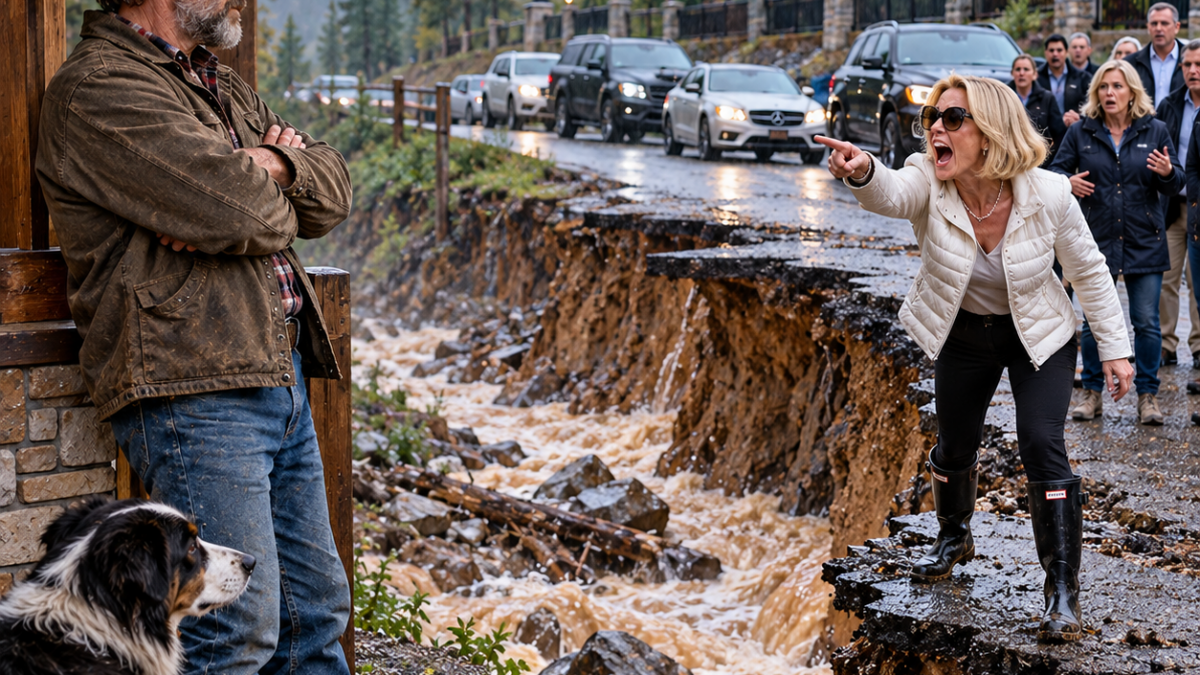
Then the road ended.
Literally.
Where fifty feet of gravel had been, there was air.
A ravine.
Fifteen feet deep at the center.
Thirty feet across in places.
Jagged walls of clay.
Tree roots exposed.
At the bottom, brown water roared toward Mill Creek.
The widened road fill had disappeared.
River rock.
Gone.
Soil.
Gone.
Part of the old road bed.
Gone.
The water had pooled until overtopping.
Once it cut a small path, velocity did the rest.
Erosion accelerated.
Road became dam.
Then breach.
Nature completed the engineering review.
I photographed.
Video.
Coordinates.
Then heard voices.
Across the chasm.
Brenda.
Patricia.
Maybe six residents.
Colorful umbrellas.
White Mercedes visible behind them.
Brenda reached the edge.
Stopped.
She looked down.
Then at me.
“What did you do?”
That sentence made me angrier than the entire road fight.
I shouted:
“Nothing.”
“You destroyed the road!”
“I was asleep.”
“You knew this would happen.”
“Yes.”
“And you let it?”
I stared.
“I warned you.”
“We’re trapped!”
Patricia shouted:
“People have work.”
“Children have school.”
“You need to repair this.”
I took my phone from my pocket.
Held it up.
“I have your email.”
Brenda’s face changed.
“What?”
“The one where you say you improved the road.”
“This is not the time.”
“You removed drainage.”
“You refused repair.”
“You said the road was safer.”
“Nolan—”
“This is your road maintenance.”
She pointed at me.
“This land belongs to you.”
“Yes.”
“The easement belongs to us.”
Finally.
After three years.
She almost understood.
I said:
“Exactly.”
“You have access rights.”
“Maintenance responsibility.”
“Your crew caused the failure.”
Brenda shouted:
“I’m calling the sheriff.”
“Please.”
“Fire department too.”
“Good.”
“You cannot hold residents hostage.”
“I didn’t move the mountain.”
Then I walked home.
Not triumphantly.
Mostly because standing near an unstable washout in rain is stupid.
By noon, emergency crews had reached the area.
Not by road.
The road was gone.
Deputy Miller—different Miller from other stories, but our county really had one—came through a forest route with search and rescue.
County transportation engineer Martin Higgins joined.
No relation to me.
They arrived at my porch covered in mud.
Miller looked exhausted.
“Mr. Hayes?”
“Nolan.”
“We got a call alleging you intentionally destroyed access.”
I poured coffee.
“Who called?”
He gave me a look.
“Guess.”
“Brenda.”
“Mrs. Carmichael.”
“Same thing.”
Martin accepted coffee too.
“We need to see the site.”
“After you drink.”
Miller almost smiled.
We hiked.
Across the chasm, residents gathered again.
Brenda saw the uniform.
Immediately shouted:
“ARREST HIM!”
Miller ignored her.
Martin inspected.
He didn’t speak for several minutes.
Laser.
Photos.
Soil.
Bank.
Flow.
Then:
“Where was drainage?”
I pointed.
“Upstream ditch.”
“Culvert crossed there.”
“Diameter?”
“Thirty-six-inch corrugated steel.”
“Any additional?”
“Two farther south.”
“Primary one here was removed.”
“When?”
“Three weeks.”
“By who?”
“HOA contractor.”
Martin looked at me.
“You have proof?”
I handed him the video.
Backhoe.
Culvert.
Me yelling.
Brenda instructing crew.
Then email.
He read.
His jaw changed.
“Landscaper?”
“Gary Mason.”
“Licensed excavation contractor?”
“He withdrew.”
“Who performed the actual initial removal?”
“One of his operators before dispute became clear.”
“Any permit?”
“None I know of.”
Martin stepped to the edge again.
“Look.”
Miller joined.
Martin pointed.
“The original ditch would have intercepted sheet flow.”
“With it filled, water ponded here.”
“Road became barrier.”
“Overtopping concentrated flow.”
“Then headcut.”
“Full breach.”
He looked at me.
“This wasn’t caused by you refusing to maintain gravel.”
“No.”
Then he looked across.
At Brenda.
“This was caused by drainage alteration.”
Brenda shouted:
“What is he saying?”
Miller eventually used a megaphone.
Not dramatic.
Necessary.
Water was loud.
“Residents of Oakidge Estates.”
The crowd quieted.
“The road failure is under investigation.”
“Current evidence shows recent drainage modifications contributed substantially to the washout.”
Brenda started yelling.
Miller raised the megaphone.
“Mr. Hayes is not under arrest.”
A resident actually applauded.
Brenda turned.
“Who did that?”
Wrong instinct.
Martin then contacted environmental officials.
The washout had sent huge sediment load into Mill Creek tributaries.
Salmon habitat.
That became a separate problem.
State environmental personnel arrived later by ATV route.
Photos.
Samples.
Documentation.
Nobody announced dramatic fines at the ravine.
Real agencies usually investigate first.
But everyone understood this was expensive.
By evening, county emergency management had one priority:
Get people out safely.
Oakidge had forty-five homes.
No vehicular access.
A few residents had medical needs.
One woman was seven months pregnant.
Another resident used oxygen.
The county asked permission to establish a temporary pedestrian corridor through another section of my woods.
I said yes immediately.
Brenda was not the neighborhood.
That mattered.
Search and rescue flagged a path.
Rope handlines.
Temporary plank crossings over smaller drainage.
Residents could walk about half a mile to the county highway.
Not pleasant.
But possible.
Emergency supplies could be carried in.
Medical evacuation could use ATVs on a separate controlled track with my permission until weather allowed better planning.
The first morning after the storm, I watched residents emerge.
Rubber boots.
Rain jackets.
Suitcases.
Groceries.
Children.
Corporate executives who probably had offices forty floors above downtown Portland.
Now stepping through mud.
Some angry at me.
Some at Brenda.
Some simply exhausted.
Gregory Simmons stopped at my gate.
“Nolan.”
“Gregory.”
“I voted to repair.”
“I saw.”
“I should have pushed harder.”
“You were one vote.”
“That’s an excuse.”
He looked toward the washout.
“My wife is pregnant.”
“I heard.”
“She’s okay.”
“Good.”
“If we need emergency ATV access?”
“Call me.”
His shoulders relaxed.
“Thank you.”
“Don’t thank me for basic humanity.”
He nodded.
Then:
“Brenda told people you sabotaged it.”
“I know.”
“She’s losing them.”
“Not my problem.”
He looked back toward Oakidge.
“It’s becoming yours whether you want it or not.”
He was right.
The emergency meeting happened Monday evening.
They held it near the washout because nobody could easily reach the clubhouse from outside, and several board consultants needed access.
Portable construction lights.
Rain tarps.
Residents in boots.
I stayed on my side.
Cold beer.
Not because I was celebrating suffering.
Because after four days of rain, I wanted a beer.
The ravine amplified voices.
Brenda stood on a plastic step.
Clipboard.
Her authority looked smaller outdoors.
“We need to remain calm.”
Nobody did.
A man shouted:
“How much?”
Brenda said:
“We are obtaining bids.”
“How much?”
“Preliminary—”
“HOW MUCH?”
Gregory stepped forward.
“How much, Brenda?”
She looked at papers.
“Lowest preliminary estimate for permanent repair is approximately four hundred fifty thousand.”
Silence.
Then noise.
“What?”
“Four-fifty?”
“Where’s the reserve?”
Gregory shouted:
“I asked for financial statements this morning.”
He turned.
“Tell them.”
Brenda looked trapped.
“Emergency reserves are approximately forty-two thousand.”
A woman yelled:
“Where did the money go?”
“Routine improvements.”
“What improvements?”
“Entrance landscaping.”
“Clubhouse renovation.”
“Signage.”
Someone shouted:
“THE MARBLE SIGN?”
Yes.
They had spent nearly seventy thousand dollars replacing a perfectly functional entrance sign with imported stone and lighting.
Brenda’s priorities had come home.
Then environmental exposure.
Possible penalties.
Engineering.
Slope stabilization.
Temporary access.
Insurance questions.
Special assessment.
Gregory did rough math aloud.
Ten.
Eleven.
Maybe twelve thousand per home before financing costs.
People erupted.
William, a pediatric dentist, stepped toward Brenda.
“You were warned.”
“That’s not fair.”
“Nolan sent you the engineer letter.”
“I received competing advice.”
“From who?”
“Landscaper.”
Laughter.
Angry laughter.
William shouted:
“You removed a culvert because it was ugly.”
“That is not what happened.”
I called across:
“I have video.”
Everyone turned.
Brenda glared.
Gregory said:
“I’ve seen it.”
Then he raised his hand.
“I move for immediate no-confidence vote.”
Brenda stared.
“You cannot do that here.”
“Bylaws allow emergency board action with quorum.”
“Gregory.”
“I move to remove Brenda Carmichael as president pending full investigation.”
William seconded.
Hands.
Almost every one.
Patricia hesitated.
Brenda looked at her.
Patricia slowly raised her hand.
That hurt more than any speech could.
Brenda lowered the clipboard.
For the first time since I had known her, she had nothing to say.
The source account similarly places the board revolt at the washout itself, after residents learn the repair and environmental costs could exceed half a million dollars and force a five-figure special assessment on every household.
I did not cheer.
Gregory became interim president.
His first call the next morning was to Harrison.
His second was to me.
“We need to rebuild.”
“Yes.”
“We’re hiring engineers.”
“Good.”
“We need your authorization.”
“Yes.”
He paused.
“That easy?”
“No.”
“I need plans.”
“Drainage.”
“Environmental review.”
“Boundary survey.”
“Contractor insurance.”
“Maintenance agreement.”
“Everything in writing.”
Gregory sighed.
“Understood.”
Then:
“We’re suing Brenda.”
“That’s your business.”
“She acted outside approved procurement.”
“Maybe.”
“You have evidence.”
“I’ll provide whatever a lawful subpoena asks for.”
He laughed.
“You really have been talking to Harrison.”
“Too much.”
Winter became miserable.
Engineering took time.
The soil around the washout was unstable.
County would not permit a quick fill.
Right call.
People wanted dump trucks and dirt.
Engineers wanted geotechnical review.
The ravine walls needed stabilization.
Hydraulic capacity needed redesign.
The old thirty-six-inch pipe my grandfather used had worked for a dirt road and older runoff.
Now the hillside upstream included Oakidge’s roofs, driveways, landscaping, and changed drainage.
A modern structure needed more.
The preliminary repair became a reinforced box crossing.
Then twin large culverts.
Retaining walls.
Riprap.
Slope protection.
Proper ditch restoration.
The bill climbed.
Meanwhile, residents walked.
Every day.
Through my temporary pedestrian corridor.
I watched relationships change.
The first week, some refused to make eye contact.
By December, people said morning.
By January, several knew Duke’s name.
One resident, Linda Cho, started leaving a bag of coffee beans at my gate once a week because I let county ATVs carry her elderly father’s oxygen tanks.
I told her unnecessary.
She kept doing it.
Kids adapted fastest.
They treated the muddy path like an adventure.
Parents did not.
Garbage became a nightmare.
No truck access.
Residents carried bags to a highway-side dumpster.
Delivery services stopped door service.
Mail rerouted.
Cars remained trapped in garages.
Some households bought cheap used vehicles and parked them outside near the county road.
Others carpooled.
Home values did not collapse overnight, but transactions froze.
No buyer wanted a house with pedestrian-only access and a giant infrastructure assessment pending.
Brenda’s house went up for sale in January.
No offers.
By then, lawsuits had begun.
The HOA’s new board alleged she exceeded authority.
Contractor procurement.
Unauthorized alteration.
Environmental liability.
Brenda’s insurer disputed portions.
Her lawyer argued board members knew about road improvements.
Maybe some did.
That dispute was not mine.
I refused to turn her legal collapse into entertainment.
She had done wrong.
Consequences were coming.
That was enough.
One snowy afternoon, I saw her on the path.
Two grocery bags.
Rubber boots.
No Mercedes.
The Mercedes remained inside Oakidge.
She slipped.
One bag split.
Cans rolled into mud.
For a second I considered walking past.
Then I didn’t.
I helped pick them up.
Brenda looked at me.
“You don’t have to.”
“I know.”
We gathered soup cans.
A jar of pasta sauce.
Bread in plastic.
She said:
“You must enjoy this.”
“No.”
“You warned me.”
“Yes.”
“You get to watch everybody suffer.”
“That’s not what I wanted.”
She laughed bitterly.
“You didn’t fix the road.”
“No.”
“You could have.”
“With what authority?”
“It’s your land.”
“There it is again.”
She stared.
“I own land.”
“You own access responsibility.”
“That is what the deed says.”
Her face tightened.
“Nobody understands those documents.”
“Harrison did.”
“You know what I mean.”
“No.”
“I don’t.”
She picked up the last can.
“You wanted to teach me a lesson.”
I thought.
“Yes.”
She looked almost satisfied.
Then I continued.
“At first.”
“What changed?”
“I watched children walking groceries through mud.”
Brenda looked away.
“That’s on you.”
“No.”
“It’s on the board that refused repair.”
“Mostly you.”
She flinched.
I regretted how sharp it sounded.
But not the truth.
I said:
“I should’ve pushed harder for emergency correction before the storm.”
She looked surprised.
“You’re admitting responsibility?”
“No.”
“I’m admitting hindsight.”
“Different thing.”
She almost smiled.
“You always have an answer.”
“Not really.”
We walked in silence.
At the county-road staging area, a friend waited to drive her.
Before getting in, Brenda said:
“I really thought the ditches were unnecessary.”
“I know.”
“They looked dangerous.”
“To who?”
“Children.”
“No children lived on my land.”
“I know that now.”
She got into the car.
That was the first time I saw something other than arrogance.
Not redemption.
Just exhaustion.
Gregory handled reconstruction exactly the way Brenda should have handled maintenance from the beginning.
Formal meeting.
Harrison’s office.
Licensed civil engineer.
Geotechnical consultant.
Environmental report.
Hydraulic study.
Detailed drawings.
Insurance certificates.
Work limits.
Restoration plan.
He slid a binder across the table.
“Everything.”
I read slowly.
Harrison read slower.
The proposed crossing was impressive.
Reinforced concrete structure.
Twin ten-foot drainage barrels beneath the road.
Ditches restored upstream.
Energy dissipation downstream.
Guardrails.
Proper road base.
Asphalt only within easement.
No widening beyond legal width without separate agreement.
Construction access defined.
Vegetation restoration.
Monitoring.
Gregory said:
“We pay all costs.”
“Of course.”
“No assessment to you.”
“Of course.”
He winced.
“I deserve that.”
“Yes.”
I signed.
Then added:
“If anyone deviates, work stops.”
“Agreed.”
“I’m serious.”
“I believe you.”
Construction began late January.
Equipment staged from highway side.
For eight weeks the woods sounded like an industrial site.
Excavators.
Concrete trucks.
Cranes.
Compactors.
But this time the work made sense.
I walked it often.
The engineers respected the land.
They rebuilt ditches.
Stabilized banks.
Installed erosion mat.
Hydroseeded exposed soil.
Environmental monitors checked creek turbidity.
No shortcuts.
Final cost:
$485,000.
Not counting fines, legal fees, temporary access, or resident losses.
A half-million-dollar consequence from removing a piece of pipe because Brenda thought it looked primitive.
That number spread through the county.
Contractors knew.
Surveyors knew.
County staff knew.
People joked about the “Carmichael Culvert.”
I never used the term.
Mostly because Gregory hated it.
The road reopened in March.
No ribbon.
No speeches.
County inspector signed.
Barricades removed.
First car crossed.
Slowly.
Driver lowered the window.
Gave me a tired wave.
I waved back.
Then another.
Then another.
Within twenty minutes, normal traffic.
SUVs.
Cars.
A delivery van.
Life returning.
I stood by the ditch.
Water from spring runoff entered.
Flowed through the huge culvert.
Exited safely.
Road stayed dry.
Grandpa would have approved.
Probably complained it was overbuilt.
A week later, I was pulling deadfall with the tractor when a moving truck came downhill.
Behind it:
White Mercedes.
Brenda.
She stopped beside me.
Window lowered.
I turned the tractor off.
She looked different.
Hair pulled back.
No sunglasses.
Tired.
The car had scratches.
Mud.
Dent in rear bumper.
“You’re leaving.”
She nodded.
“House sold?”
“Short sale.”
“I’m sorry.”
She looked at me sharply.
“You don’t have to pretend.”
“I’m not.”
She stared toward the rebuilt crossing.
“My entire life was in that house.”
“I know.”
“I lost most of the equity.”
I said nothing.
“The association lawsuit settled.”
“I heard.”
“I have to reimburse part of the environmental penalty.”
Again silence.
“My retirement account…”
She stopped.
I didn’t ask.
She looked at the restored drainage ditch.
“You’re happy now?”
“No.”
That surprised her.
“You won.”
“No.”
“The road is fixed.”
“Yes.”
“Your land is protected.”
“Yes.”
“I’m gone.”
“Yes.”
“What else did you want?”
That question stayed in the air.
Finally:
“I wanted you to leave the drainage alone.”
Her eyes filled.
She looked forward.
“I thought you were trying to control us.”
“I thought you were trying to control me.”
“I was.”
That honesty surprised both of us.
Brenda exhaled.
“I spent thirty years in HR.”
“People listened when I said something had to be done.”
“That was my job.”
“Then I retired.”
“Suddenly nobody had to listen.”
I understood more than I wanted.
“The HOA gave me something to run.”
“And you liked it.”
“Yes.”
She nodded.
“Too much.”
Moving truck ahead honked.
She looked toward it.
Then back.
“I should have listened.”
“Yes.”
No softening.
That was the truth.
She rolled the window up.
Mercedes crossed the new bridge.
Disappeared toward highway.
I never saw her again.
Gregory pulled up ten minutes later.
Black pickup.
He leaned against my fence.
“She gone?”
“Yes.”
He watched the road.
“We passed something last night.”
“What?”
He smiled.
“Permanent board resolution.”
“No road work inside the Hayes easement without your written approval.”
“That’s already the deed.”
“I know.”
“This one is for people who don’t read deeds.”
I laughed.
“Smart.”
“We also hired a property attorney.”
“Smarter.”
“And created a reserve schedule for infrastructure.”
“Miracle.”
He smiled.
“We’re broke.”
“How bad?”
“Bad.”
“But we’ll recover.”
“You will.”
Then he looked at the culvert.
“Solid.”
“Yes.”
“Dust will come back this summer.”
“Probably.”
He glanced at me.
“We’re applying dust-control treatment.”
“Within existing road width?”
“Yes.”
“Environmentally approved?”
“Yes.”
“Paid by HOA?”
He sighed.
“Yes, Nolan.”
“Then I don’t care.”
“That easy?”
“That was always the deal.”
Gregory laughed.
The absurdity finally landed.
Three years of war because Brenda could not accept an agreement that had always been simple.
You have the right to cross.
You pay to maintain what you need.
You do not damage the rest of my land.
Ask before changing anything.
That was it.
The conflict could have ended in ten minutes.
Instead:
Fake fines.
Lawyers.
County complaints.
Destroyed culvert.
Washout.
Environmental damage.
Half-million-dollar crossing.
Special assessments.
Recall.
Lawsuits.
One family’s financial ruin.
Forty-five households trapped for months.
People like to say HOAs are evil.
Too simple.
An HOA is paperwork plus people.
Under decent people, it can arrange garbage service and road repairs.
Under someone who treats authority as personal validation, it can become destructive fast.
Oakidge changed after Brenda.
Gregory remained president two years.
Then refused another term.
He created committees.
Budget controls.
Independent review for contracts over $10,000.
Conflict disclosure.
Infrastructure reserve.
Emergency plan.
The boring stuff.
Best stuff.
Residents stopped seeing me as the enemy.
Not everyone became a friend.
That would be unrealistic.
But we became neighbors.
Linda still brought coffee occasionally.
William invited me to a barbecue.
I went once.
The food was terrible.
Beautiful house though.
Gregory’s daughter was born in April.
Healthy.
They named her Emma.
The first time he brought her down the road, he stopped at the culvert.
I stood nearby with Duke.
He rolled down the window.
“This is the kid everybody was yelling about.”
Emma slept.
“Looks unconcerned.”
“She cost me eleven thousand dollars before birth.”
“Good start.”
Gregory laughed.
Then drove on.
The environmental damage repaired slowly.
Sediment had reached downstream salmon habitat.
The state required restoration.
Plantings.
Monitoring.
Bank stabilization.
The HOA paid.
No dramatic government raid.
No cartoon punishment.
Just paperwork.
Invoices.
Compliance.
Years.
That is how real environmental consequences usually feel.
Boring and expensive.
Duke died two winters later.
Fourteen.
Good dog.
I buried him uphill from the easement where he used to watch cars.
Gregory helped dig.
He didn’t ask.
Just showed up with a shovel.
That mattered more than all the HOA apologies.
One summer, Oakidge residents voted to pave part of the road.
Not the whole thing.
The northern section nearest their entrance.
They asked first.
Engineering plan.
Drainage preserved.
Their expense.
I approved.
Harrison nearly framed the request.
“Look at this.”
“What?”
“Consent.”
“Civilization advances.”
The lower half remained gravel because I preferred it.
Dust control kept complaints low.
Everybody survived.
The washout became part of neighborhood mythology.
New residents heard versions.
In some, Brenda personally bulldozed the culvert.
Not exactly.
In some, I blew up the road.
Definitely not.
One child told me:
“My dad says you made a canyon because the HOA was mean.”
I crouched.
“Your dad tells bad stories.”
“Did you?”
“No.”
“Rain did.”
“Why?”
“Because grown-ups made a bad drainage decision.”
He looked disappointed.
“Canyon is cooler.”
“Canyon is cooler.”
I let him have that.
The truth was dramatic enough.
I still keep Brenda’s email.
Fireproof safe.
Beside Grandpa’s original easement.
One says:
No alteration may adversely affect drainage of the servant estate.
The other says:
The HOA improved the road by eliminating dangerous open trenches.
Two documents thirty years apart.
One written by people thinking ahead.
One written by someone defending what she had already decided.
Sometimes I take them out together.
Not often.
Mostly when someone new on the board starts using phrases like:
“Obviously.”
“Clearly.”
“No need for further review.”
Those words make me nervous now.
Certainty should be earned.
Especially when dealing with land.
Water.
Structures.
Other people’s rights.
I also keep one photograph from the morning after the storm.
The ravine.
Raw clay.
Brown river at bottom.
Brenda standing opposite beneath an umbrella.
I don’t display it.
Not a trophy.
It reminds me how close everything came to something worse.
No one died.
That matters.
A car could have been crossing when the road failed.
An ambulance could have needed access at the wrong hour.
The pregnant resident could have had an emergency.
We were lucky.
That is why I reject the version of the story where I “got revenge by letting them get trapped.”
I did not destroy the road.
I warned them.
I documented.
I refused to repair damage they caused after they rejected responsibility.
But there is still a hard question:
Could I have prevented the washout myself?
Probably.
With enough money.
Equipment.
Emergency work.
Would doing so have been morally better?
Maybe.
Some nights I think yes.
Other nights I remember that the HOA had authority, notice, money, and responsibility.
If every property owner silently repairs every unauthorized alteration because the party responsible refuses, accountability disappears.
There is no clean answer.
Harrison once told me:
“Legal responsibility and moral responsibility are cousins, not twins.”
I hated that sentence.
Because it was true.
Legally, the easement agreement was clear.
Morally, forty-five families lived behind it.
That is why I opened my woods to emergency pedestrian access.
Why I helped medical deliveries.
Why I approved proper reconstruction immediately.
Why I never blocked people after the storm.
I was angry at Brenda.
Not at children.
Not at oxygen tanks.
Not at grocery bags.
That distinction kept me from becoming what I hated.
Years later, the culvert is still there.
Overbuilt.
Twin barrels large enough for me to stand in.
Concrete wing walls.
Steel guardrails.
Proper ditch.
Every winter I walk it before major storms.
Not because I am responsible for the road.
Because it crosses my land.
And I care what water does there.
Gregory sometimes joins.
We inspect debris.
Clear branches.
The HOA pays contractors for real maintenance.
No one argues about responsibility anymore.
One November morning, another atmospheric river was forecast.
Not as severe.
Still heavy.
I walked the drainage with the current HOA president, a woman named Rachel Chen.
She carried plans.
Actual plans.
“Anything worry you?”
“Debris at north inlet.”
“We’ll clear it.”
“Bank here needs vegetation.”
“I’ll call contractor.”
She looked at the giant culvert.
“Hard to believe there used to be a dirt road here.”
“There still would be if Brenda hadn’t widened it.”
Rachel smiled cautiously.
“I’ve heard the stories.”
“Most are wrong.”
“Did she really fine you five hundred a day?”
“Tried.”
“Did you really drink beer while they voted her out?”
“Yes.”
She laughed.
“Okay, that part stays.”
Rain started.
Light.
Rachel said:
“Anything else?”
“Yeah.”
“What?”
“Don’t fill the ditch.”
She laughed all the way back to her car.
That storm dropped five inches.
Road stayed open.
Water moved beneath it exactly as designed.
No drama.
I sat on the porch.
Coffee.
Watched rain.
That was better than vindication.
Infrastructure functioning is boring.
Boring is underrated.
People notice roads when they fail.
Drainage when it floods.
Power when it goes out.
Property rights when someone crosses them.
My grandfather understood that.
He built systems meant to disappear into daily life.
Ditches.
Culverts.
Legal clauses.
Not glamorous.
But when people respected them, nobody thought about them.
Brenda saw all three as obstacles.
The ditch ruined aesthetics.
The easement terms ruined control.
My ownership ruined her assumption that HOA authority followed residents outside their boundaries.
So she tried to erase the obstacles.
Nature responded first.
Law came after.
I sometimes imagine telling Grandpa the whole story.
He died before Oakidge existed.
He would ask one question:
“Why’d they take out the pipe?”
I would say:
“They thought the ditch was ugly.”
He would stare.
Then probably walk away because some explanations insult intelligence.
He was not sentimental about roads.
He was practical.
Water goes downhill.
Keep a path open.
Don’t build where it needs to flow.
That was his entire engineering philosophy.
Worked thirty years.
Then one HOA meeting overruled it.
The half-million-dollar bridge now performs the same fundamental job.
Just with more concrete.
There is humor in that.
A resident once asked:
“Couldn’t your grandfather have built the bridge originally?”
“Yes.”
“Why didn’t he?”
“Because the culvert cost a thousand dollars and worked.”
The man looked at the $485,000 structure.
“Right.”
Exactly.
Brenda’s mistake wasn’t merely removing drainage.
It was assuming expensive-looking was better than functional.
Oakidge was built around appearance.
Stone entrance.
Perfect lawns.
Matching architecture.
Brenda applied the same instinct to a mountain road.
Open ditch looked crude.
Flat widened gravel looked modern.
Problem solved.
Except water doesn’t recognize prestige.
It found the missing ditch.
Then wrote a new one through the center of the road.
Fifteen feet deep.
Thirty feet wide.
That was the brutal simplicity of it.
The storm never cared who was president.
Never read her email.
Never saw the marble sign.
It followed grade.
Pressure.
Velocity.
Soil.
Eventually, Brenda’s old house sold.
New owners.
Young couple from Portland.
Two kids.
They introduced themselves.
Had no idea who she was.
I liked that.
Not every piece of ground needs to carry old conflict forever.
Their daughter rides a bicycle down the easement sometimes.
Waves.
I wave back.
The white Mercedes never returned.
Good.
The marble Oakidge entrance sign remains.
The board considered selling it to pay repairs.
Nobody wanted a used neighborhood monument.
So it stays.
Sometimes rain leaves mud splashed across the base.
No one panics.
They wash it.
Progress.
Harrison retired last year.
At his retirement dinner, he told the road story.
Shorter version.
He ended:
“The most expensive words in property law are usually ‘I’m sure.’”
Everyone laughed.
Then he handed me Grandpa’s deed copy.
He had preserved a scanned legal file, but returned the old paper.
“Keep it.”
“I already have copies.”
“Keep this one.”
I did.
It sits in the safe beside Brenda’s email.
People ask what I would tell anyone dealing with an easement conflict.
Not:
Let the road wash out.
Definitely not.
I’d say:
Read the deed.
Understand who owns the land.
Understand who holds the right.
Understand maintenance obligations.
Document every alteration.
Use professionals.
Don’t let anger make construction decisions.
And if someone wants to change drainage on a mountain road before winter, make them bring an engineer before they bring a backhoe.
That advice lacks viral drama.
It is still better.
The story people like is the morning after.
Brenda across the canyon.
“What did you do?”
Me:
“Nothing.”
That happened.
But the important part occurred three weeks earlier.
At 11:45 P.M.
Her email.
The moment someone with authority received a technical warning and chose pride over verification.
The storm only revealed that choice.
Disasters do that.
They expose invisible decisions.
You see the collapsed road.
Not the meeting where the drainage budget was cut.
You see the flooded house.
Not the permit exception ten years earlier.
You see the bridge crack.
Not the inspection someone rushed.
Oakidge saw a ravine.
I saw every warning that came before it.
When the new bridge opened, Gregory asked if I wanted to name it.
“Absolutely not.”
He suggested:
Hayes Crossing.
“No.”
Iron Ridge Bridge.
“No.”
Carmichael Memorial.
I laughed.
“Cruel.”
“Accurate.”
We finally left it unnamed.
County documents call it Oakidge Access Culvert No. 1.
Perfect.
Boring.
Functional.
Grandpa would approve.
Sometimes, just before sunset, I park the tractor near the bridge.
The concrete catches orange light.
Douglas fir shadows stretch across the road.
Cars move home.
One by one.
Workers.
Families.
Groceries.
Children.
Every car crosses my land under the same easement my grandfather signed more than thirty years ago.
Nothing about the basic arrangement changed.
The people did.
They know now that a right of passage is not ownership.
That use carries responsibility.
That access is valuable precisely because somebody else agreed to burden their land with it.
That agreement deserves respect.
Brenda saw the road as something I owed her.
Gregory eventually understood it as something his neighborhood depended on.
That difference saved the relationship.
The road is still Oakidge’s only practical way home.
But I don’t think of that as leverage anymore.
It is simply a fact.
And facts are safer when nobody needs to turn them into weapons.
The last HOA notice I ever received from Brenda is also in the safe.
Failure to pave.
$500 per day.
Gold embossed logo.
I once considered framing it.
Didn’t.
Too much energy.
The landscape already keeps the better reminder.
A half-million-dollar concrete crossing where a dirt road used to be.
Two giant culverts beneath it.
Restored drainage ditches.
Revegetated banks.
Steel guardrails.
Every inch engineered around the lesson she refused to hear.
Water needs somewhere to go.
And people who use someone else’s land eventually learn the same thing:
Access works only as long as you respect the ground carrying you.
Brenda spent three years trying to make me responsible for her road.
Then she tore out the one system protecting it and told me the matter was closed.
One storm later, the mountain reopened the discussion.
It did not care about her title.
Her Mercedes.
Her clipboard.
Her HOA fines.
It washed through the cheap fill, cut fifteen feet down, and left forty-five expensive homes on the wrong side of a canyon.
The county eventually built them a better road.
The HOA eventually became a better neighbor.
The ecosystem slowly recovered.
My land remained mine.
And I never had to pave the half-mile driveway Brenda once insisted was my responsibility.
They paid for it.
They engineered it.
They maintain it.
Exactly the way my grandfather’s deed said they should have from the beginning.
Every now and then a summer SUV kicks up a little dust on the remaining gravel.
I see it from the porch.
I smile.
And I leave it alone.




