HOA Karen Ignored My Bridge’s 5-Ton Limit—Then Her Forged Easement Sent a 30-Ton Concrete Truck Through It and Took Down the HOA
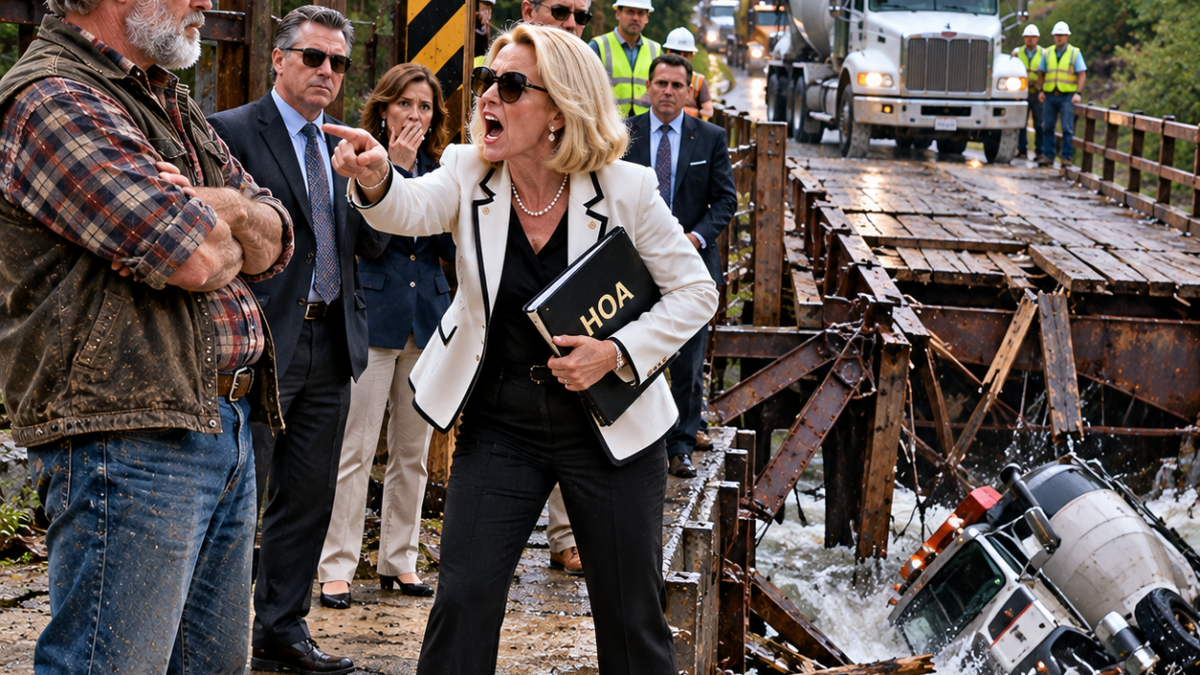
HOA Karen Ignored My Bridge’s 5-Ton Limit—Then Her Forged Easement Sent a 30-Ton Concrete Truck Through It and Took Down the HOA.
The HOA president cut the lock off my private bridge and waved a sixty-thousand-pound concrete truck past a permanent five-ton weight-limit sign after I had already sent her a certified engineer’s warning that the bridge could catastrophically fail.
She thought the fake “emergency easement” in her clipboard made her untouchable—until the truck shattered the deck, snapped a tension cable, contaminated a protected creek, and left half a million dollars of construction equipment stranded on my property.
What finally destroyed Brenda Carmichael wasn’t the bridge collapse itself, but the camera footage proving she had forged the document, overruled the real contractor, and personally ordered the exact convoy I had warned would bring her entire HOA empire down.
Nothing exposes arrogance faster than physics.
Lawyers can argue.
Boards can vote.
Presidents can issue letters.
People can invent titles, reinterpret maps, create committees, stamp paperwork, and convince themselves authority means reality will eventually cooperate.
Steel does not care.
Timber does not care.
Gravity does not care.
And the five-ton weight limit bolted to the concrete pillar at the entrance of Miller’s Crossing had never cared what Brenda Carmichael thought.
My name is Arthur Mercer.
My family had owned sixty acres around Copper Creek for four generations.
Technically, the creek crossing my property was called Miller’s Run on county maps, but everybody who grew up near us called it Copper Creek because of the reddish mineral streaks that showed through the stone after heavy rain.
My great-grandfather bought the land when the valley was still mostly logging country.
My grandfather planted apples on one hillside.
My father raised horses.
I did a little of everything.
Two rescue horses.
Small orchard.
Workshop.
Timber.
Some hay.
Enough room that nobody bothered me.
That was the point.
PART2:
The house sat almost three hundred yards from the county road.
Between the road and the house ran the creek.
Deep.
Fast.
Cold.
Not enormous, but violent during spring melt.
The only vehicular way across was our bridge.
Miller’s Crossing.
Ninety feet from abutment to abutment.
Timber deck.
Steel support beams.
Suspension cables reinforced during a major rebuild in 1998.
The bridge had never been meant for commercial traffic.
My father rebuilt it for pickups, horse trailers, tractors, propane deliveries, and occasional agricultural equipment.
That was enough.
A structural engineer named David Hobb inspected it every two years.
David had known my father.
He was one of those engineers who could look at a steel connection from thirty feet away and become personally offended by the wrong bolt.
After every inspection, he issued the same restriction.
Maximum gross vehicle weight:
PART3:
10,000 pounds.
Five tons.
Not because the bridge was about to fall down.
Because bridges are rated around load paths, fatigue, cable forces, deck capacity, dynamic movement, axle distribution, and safety factors.
Five tons was the number.
We posted it.
Huge reflective sign.
PRIVATE PROPERTY.
NO TRESPASSING.
MAXIMUM VEHICLE WEIGHT 5 TONS.
Nobody misunderstood it accidentally.
For twenty-five years, that was enough.
Propane company sent a smaller truck.
Hay suppliers stopped at the road and transferred loads.
If I rented anything heavy, it stayed on the road side.
Inconvenient sometimes.
Still cheaper than replacing a bridge.
Then Crest View Valley Estates appeared.
Developers clear-cut the forest north of the county highway and built eighty-six houses where deer trails had been.
Big houses.
Tight lots.
Three stories.
Stone facades.
Black roofs.
Three-car garages.
Everything looked expensive and strangely identical.
Their entrance sat almost directly across the county road from Miller’s Crossing.
At first I didn’t care.
People need homes.
Development happens.
My mistake was believing geography would be enough separation.
Then the HOA elected Brenda Carmichael.
Brenda sold luxury real estate.
She was fifty-five.
White Lexus RX.
Oversized sunglasses.
Perfect blond bob.
The kind of person who could turn saying good morning into a warning.
Within months of becoming HOA president, she was issuing fines like parking tickets.
Wrong mailbox.
Wrong landscaping rock.
Wrong patio umbrella.
Grass too tall.
Trash bin visible.
Kids leaving bicycles near driveways.
One homeowner painted his front door dark blue.
Crest View’s approved shade was apparently “heritage navy.”
His was simply navy.
Brenda fined him.
That was the level.
I was not part of Crest View.
My property predated the subdivision by generations.
No covenants.
No association membership.
No obligations.
That should have protected me.
Instead, Brenda treated my independence as an administrative mistake she intended to correct.
The first letter claimed my barn roof violated Crest View visual standards.
I ignored it.
Second complained that my horses were visible from the subdivision entrance.
Third said my mailbox was not the approved bronze design.
I mailed that one back with two words:
NOT MEMBER.
A week later she sent another.
Failure to comply may result in enforcement escalation.
I fed it into the wood stove.
My attorney, Michael Turner, told me I should preserve future letters rather than burn them.
“Why?”
“Because crazy people eventually create useful evidence.”
He was right.
After that, I kept everything.
The real trouble started when Crest View approved what Brenda called the Community Lifestyle Pavilion.
Everyone else called it the clubhouse.
But clubhouse sounded too ordinary.
This thing was massive.
Olympic-length pool.
Fitness center.
Tennis courts.
Event hall.
Commercial kitchen.
Spa rooms.
Covered patios.
Outdoor fireplaces.
Architectural renderings showed people in white linen drinking wine beside an infinity edge overlooking the valley.
Residents were hit with a special assessment.
Some hated it.
Brenda promoted it as an investment in property values.
Construction site sat on the back side of Crest View.
And the geography was terrible.
From the public road, heavy construction trucks had to travel fifteen miles around the ridge.
Then up a winding grade.
Then through a secondary contractor entrance.
The route worked.
But it added nearly forty-five minutes to each trip.
For dump trucks, concrete mixers, lowboys, steel deliveries, that became expensive.
Then someone noticed Miller’s Crossing.
Cross my bridge.
Drive across the western edge of my land on an old logging track.
Come out near the Crest View construction site.
Three miles instead of fifteen.
Perfect shortcut.
Except it crossed my property.
And the bridge could not handle the weight.
The first time Brenda asked, I thought she had misunderstood.
I was repairing fence near the bridge when her Lexus stopped.
A man in a hard hat stood beside her.
Logo:
Concaid Heavy Earth Moving.
I rode the ATV down.
“Can I help you?”
Brenda did not greet me.
She pointed toward my locked gate.
“We’ll need this left open beginning Monday.”
I looked at the contractor.
Then her.
“For?”
“Construction access.”
“No.”
She blinked.
“We have approximately forty heavy deliveries scheduled over the next three weeks.”
“No.”
“The public detour is creating unreasonable delay costs.”
“No.”
Her jaw tightened.
“You haven’t even heard the plan.”
“I heard heavy deliveries.”
She pointed at my bridge.
“Your road connects directly to our western construction zone.”
“My road.”
“Exactly.”
“No.”
The contractor looked uncomfortable.
Brenda sighed loudly.
“Arthur, please.”
I hated when she used my name like that.
“This project benefits the entire community.”
“Not my community.”
“The bridge appears substantially overbuilt.”
“It has a five-ton limit.”
She glanced at the sign.
“I’ve seen it.”
“Then why are we talking?”
“My brother-in-law looked at the structure.”
I stared.
“What does he do?”
“Construction consulting.”
“Structural engineer?”
“No.”
“Bridge engineer?”
“No.”
“He has forty years of building experience.”
“Then he should know what five tons means.”
Brenda rolled her eyes.
“A truck crossing slowly does not impose the same force as highway travel.”
I looked at the contractor.
He looked away.
I said:
“A loaded mixer can weigh thirty tons.”
“We won’t be reckless.”
“Six times the limit is reckless.”
“The bridge was rebuilt.”
“In 1998.”
“Exactly.”
“That does not help your argument.”
She turned toward the hard-hat man.
“Gary, tell him.”
Gary raised both hands.
“Ma’am, I haven’t inspected the bridge.”
Brenda snapped:
“You told me it looked substantial.”
“I said it looked substantial.”
“That’s different.”
I liked Gary immediately.
Brenda turned back.
“We need temporary use only.”
“No.”
“We will repair any road surface damage.”
“No.”
“We can pay.”
“No.”
“How much?”
“It isn’t for rent.”
Her face hardened.
“You are deliberately obstructing a major community investment.”
“No.”
“I am preventing a concrete truck from landing in a creek.”
“You’re being theatrical.”
“Have your licensed engineer certify it for sixty thousand pounds.”
Silence.
“Until then, no commercial trucks.”
Brenda stepped closer.
“There is an implied emergency access right connecting this property to the ridge.”
“No.”
“We have counsel.”
“So do I.”
“I have already authorized Concaid to begin using this route.”
Gary looked at her.
“You did?”
I laughed.
“You authorized a contractor to use my property?”
“It is necessary access.”
“It is trespassing.”
“The HOA has more lawyers than you have teeth.”
That line was so ridiculous I almost admired it.
Almost.
I pointed toward the sign.
“One truck over five tons crosses that bridge, I call the sheriff.”
She put her sunglasses back on.
“Do not test me.”
Then left.
Gary remained.
He watched the Lexus pull away.
Then turned.
“For what it’s worth, I’m not putting my rigs over that bridge without engineering.”
“Thank you.”
“Five tons is five tons.”
“Exactly.”
He gave me his card.
“If she tells you I authorized something, call me.”
That card mattered later.
I called David Hobb before Brenda reached home.
He came the next morning.
Inspection took four hours.
Deck.
Cables.
Anchorages.
Beam connections.
Abutments.
Corrosion.
Bearings.
He ran calculations from the original reinforcement drawings.
Then sat at my kitchen table.
“How heavy are we talking?”
“Concrete mixer.”
He stared.
“Full?”
“Yes.”
“No.”
“Excavator?”
“No.”
“Lowboy?”
“No.”
“Dump truck?”
“No.”
“So five tons.”
“Still five tons.”
“Arthur, the structure is safe for rated use.”
“But heavy axle load on that timber deck could punch through.”
“Primary suspension system could also see loads well beyond rating.”
“How bad?”
“Catastrophic is possible.”
“Put that in writing.”
He looked at me.
“I was planning to.”
The report was six pages.
Stamped.
Signed.
It stated explicitly that vehicles above 10,000 pounds should not cross and that commercial heavy-equipment loading could result in severe deck failure, permanent deformation of steel members, cable overstress, abutment damage, or total collapse.
Michael drafted a cease-and-desist.
We sent both certified.
Brenda.
Entire HOA board.
Concaid corporate office.
Project architect.
General contractor.
Everybody.
The Concaid site manager called two days later.
“Mr. Mercer?”
“Yes.”
“This is Gary Nelson.”
“We met.”
“I received your engineer report.”
“Good.”
“Nobody from Concaid will cross that bridge.”
“Thank you.”
“Our trucks are staying on approved public route.”
“Appreciate it.”
“Honestly, I’m not sure why this became a conversation.”
“Brenda.”
Gary laughed once.
“Fair.”
I thought that ended it.
It should have.
Instead, Brenda interpreted every professional refusal as a personal challenge.
Her problem was money.
The clubhouse budget was already strained.
Residents had been promised completion before summer.
Concrete schedule was tight.
The mountain detour added transportation hours and standby charges.
Brenda’s reelection was coming.
She had attached her identity to delivering the project under budget and ahead of schedule.
I did not know how desperate she was until later.
What I knew was that she stopped writing to me.
That worried me more than the letters.
I called Michael.
“She’s quiet.”
“Good.”
“No.”
“What?”
“Brenda quiet is not good.”
He sighed.
“What are you thinking?”
“I want cameras.”
“Legal on your property.”
“Boundary survey too.”
“Why?”
“Because if she tries anything, I want zero ambiguity.”
Thomas Caldwell from Meridian Land Surveying marked every corner.
Bridge entirely within my deed.
Logging track entirely mine until it reached Crest View boundary.
No easement to HOA.
No public right-of-way.
Nothing.
Cameras came next.
Four.
One at gate.
One bridge deck.
One angled toward county road.
One covering the logging road.
4K.
Timestamp.
Cloud backup.
Night vision.
License plate coverage.
Then I replaced the gate chain.
Hardened boron.
Commercial puck lock.
Not because I wanted a trap.
Because I wanted a record of someone deliberately defeating a secure barrier if they tried.
The title people later gave it—“the trap”—always bothered me.
I did not weaken the bridge.
I did not lure a truck onto it.
I did not hide the weight sign.
I did not sabotage anything.
My “trap” was documentation.
A locked gate.
A certified warning.
Cameras.
Survey stakes.
And the decision not to rescue Brenda from her own deliberate choices before I had proof.
Wednesday morning, 6:15.
My phone vibrated.
Motion alert.
I was making coffee.
Camera one showed Brenda’s Lexus at the gate.
A locksmith van beside it.
I froze.
Brenda got out carrying a clipboard.
Locksmith followed.
She pointed at my lock.
He shook his head.
She shoved paper at him.
They argued.
No audio from that camera.
Then the locksmith opened his van.
Pulled an angle grinder.
I called Michael.
He answered half asleep.
“Morning.”
“She’s cutting my gate.”
“What?”
“Camera live.”
“Call sheriff.”
I looked at the screen.
Then hesitated.
“Arthur.”
“I’m recording.”
“Call sheriff.”
“I want to see what she does.”
“That sentence makes lawyers nervous.”
“She has not entered yet.”
“Breaking the lock is enough.”
I dialed 911.
Reported active property damage.
Then returned to the feed.
Sparks sprayed.
Four minutes.
Chain separated.
Lock dropped.
Brenda swung the gate open.
She looked directly at the five-ton sign.
I know because camera two captured her.
She did not miss it.
She looked.
Then turned toward county road.
The locksmith packed quickly.
Later, investigators determined Brenda had given him an HOA document stating that Miller’s Crossing had been annexed as an emergency construction access point.
It carried signatures.
A notary seal.
Official letterhead.
Almost none of it was real.
The source story makes that forgery one of the central reversals: Brenda cut Arthur’s lock using purported HOA authority despite a certified engineering warning, then personally waved a massively overweight concrete truck onto the bridge.
At 6:24, the first truck appeared.
Not Concaid.
Different logo.
APEX CONCRETE & PAVING.
My stomach tightened.
Brenda had found another company.
A ten-wheel concrete mixer.
Full drum turning.
The truck slowed.
Stopped before the bridge.
Driver leaned out.
He could clearly see the sign.
Brenda walked to the cab.
Pointed at clipboard.
Driver shook his head.
She pointed again.
Then toward bridge.
The driver climbed out.
Actually walked to the sign.
Read it.
Good.
For a second, I thought the situation would end.
Then Brenda followed.
They argued.
She held up the paperwork.
He returned to the cab.
I was already moving.
Coffee abandoned.
Boots.
Jacket.
Phone.
ATV.
My house was three hundred yards away.
By the time I started down, the truck moved.
Front axle reached the bridge.
I screamed even though they could not hear.
“STOP!”
Camera feed on my phone bounced in the ATV holder.
The front wheels rolled onto timber.
Bridge dipped slightly.
Normal under load.
Then second axle.
The deck complained.
The driver slowed.
Brenda waved him forward.
I reached maybe halfway down the dirt road.
Then the rear tandem came onto the suspended span.
The sound was unbelievable.
Not a creak.
Explosion.
A section of deck beneath the rear wheels shattered.
Timber splinters flew.
The truck dropped maybe eighteen inches instantly.
Then steel screamed.
Deep.
Metal under load.
The whole bridge twisted left.
A tension cable snapped.
The crack echoed up the valley like a rifle.
The driver braked.
Too late.
Rear passenger wheels punched through the deck.
Mixer tilted.
Cab remained closer to the far abutment.
Rear half hung over the creek.
The drum continued turning.
Slow.
Heavy.
The bridge stayed under it.
Barely.
I killed the ATV fifty yards away and ran.
Driver kicked his door open.
Climbed out onto the step.
Jumped toward the county-road side.
Landed.
Fell.
Rolled.
Got up.
Brenda stood frozen.
Hands against her mouth.
Then she looked at me.
The first thing she said was:
“What did you do?”
I stopped.
“What?”
“You knew this bridge was unsafe!”
The driver turned.
“You told me it was rated!”
Brenda ignored him.
She pointed at me.
“You deliberately failed to maintain this structure.”
I pulled out my phone.
“911 is already on the way.”
Her face changed.
“You called them?”
“When you cut my lock.”
The driver looked from her to me.
“Cut your lock?”
“Yes.”
He swore.
Brenda shouted:
“This is emergency access.”
“No.”
She held up the document.
“Yes.”
I looked at the creek.
A thin rainbow sheen spread beneath the truck.
Hydraulic fluid.
Maybe diesel.
I called dispatch again.
“Update.”
“Truck partially through bridge.”
“Possible fluid release into Miller’s Run.”
“Notify environmental response.”
“Bridge unstable.”
The driver sat on roadside grass shaking.
I asked:
“You hurt?”
“No.”
“You sure?”
He nodded.
Then:
“She told dispatch it was cleared.”
Brenda said:
“Don’t say another word.”
The driver stared at her.
“You told me the engineer approved it.”
“I said we had clearance.”
“No.”
“You said engineer.”
That would matter.
Deputy Miller arrived first.
He parked on county side.
Walked carefully toward the abutment.
Saw the truck.
Saw deck.
Saw Brenda.
Then me.
“Arthur.”
“Morning.”
He looked at the collapsed bridge.
“Not especially.”
I gave him the tablet.
He watched.
Locksmith.
Chain.
Brenda.
Truck.
Weight sign.
Her waving driver forward.
Then I gave him David’s report.
Certified-mail receipts.
Michael’s cease-and-desist.
Survey.
Miller looked at Brenda.
“Ma’am.”
She immediately said:
“This was a trap.”
He sighed.
“What does that mean?”
“He knew the bridge would fail.”
“He refused to repair it.”
“It was structurally deficient.”
I said:
“It was structurally rated five tons.”
“Truck weighs over thirty.”
Miller looked at driver.
The driver nodded.
“About thirty-one loaded.”
Miller looked back.
“Why did you cross?”
Driver pointed at Brenda.
“She gave us clearance.”
Brenda snapped:
“I gave your company legal access.”
“You said structural clearance.”
“I said documentation.”
He stood.
“You pointed at the engineer sign and told me the restriction was outdated.”
Brenda went pale.
Miller wrote.
Then county structural engineer Lewis arrived.
David arrived after I called him.
Environmental response came later.
Nobody wanted to touch the truck.
Lewis inspected from safe points.
Laser.
Photos.
Binoculars.
Bridge deformation.
Anchor movement.
Abutment cracking.
Then said:
“It’s closed.”
Brenda laughed nervously.
“For the truck?”
“For everything.”
“What does that mean?”
“No pedestrian crossing.”
“No ATV.”
“No vehicle.”
“Nothing.”
Her face drained.
“They need to move that truck.”
“Not across this bridge.”
“We have more deliveries.”
“Not across this bridge.”
“When can you fix it?”
Lewis looked at me.
“It is his bridge.”
Brenda said:
“We have an easement.”
I laughed.
Miller looked at me.
“Do they?”
“No.”
Survey packet.
He read.
“No recorded easement?”
“None.”
Brenda held up the forged document.
“Yes we do.”
Miller took it.
Looked.
“Who notarized this?”
Brenda hesitated.
“Our management office.”
“That is not a person.”
“Pinnacle handled it.”
That lie created her next problem.
The environmental officer inspected creek.
Hydraulic fluid was already reaching water.
Containment boom.
Absorbent pads.
Emergency mitigation.
The truck had to be stabilized.
A crane would be required.
But getting a crane to the site was difficult because the bridge itself was unusable.
A recovery company arrived.
Then Apex’s owner.
Then lawyers.
The morning became a parking lot of people discovering one bad decision after another.
Apex’s owner, Mitchell Grant, approached Brenda.
“You represented this route as certified.”
“It was authorized.”
“Authorized by who?”
“The HOA.”
“That is not what my dispatcher was told.”
She pointed at me.
“This landowner created an unsafe bridge condition.”
Mitchell stared at the five-ton sign.
Then at the thirty-ton mixer.
Then at her.
“You’re joking.”
By noon, everyone understood the first mixer was not the only financial problem.
Two additional Apex mixers had already entered my logging road behind the first before the collapse completely blocked passage.
They had crossed while the first truck was moving farther onto the bridge.
When it failed, they stopped on my side.
They were now trapped.
Their wet concrete was still rotating.
A load of ready-mix has a time window.
You cannot keep it spinning forever.
The only direction out was forward across my land toward Crest View.
My gate at that end remained locked.
Unlike the bridge gate, Brenda had not reached that one.
Michael arrived.
He looked at the situation.
Then at me.
“Do not say anything clever.”
“I wasn’t going to.”
“You absolutely were.”
Apex foreman Gary—different Gary from Concaid—ran up.
“Mr. Mercer.”
“Arthur.”
“We need that west gate open.”
“I understand.”
“We have two mixers with live loads.”
“I understand.”
“Each load is going to set.”
“I understand.”
He stared.
“Please stop saying that.”
Michael almost smiled.
Brenda arrived moments later after walking around through a county trail with a deputy.
“Open the gate.”
Michael stepped forward.
“Ms. Carmichael, do not instruct my client.”
“We have emergency equipment trapped.”
“Your contractor has equipment trapped on his property after unauthorized access.”
“This is extortion.”
“No one has asked for money.”
“Then open it.”
Michael said:
“We need county direction because the exit crosses directly into your active construction site.”
Gary said:
“I’ll sign anything.”
“I just need the trucks out.”
Brenda shouted:
“You work for us.”
Gary turned.
“No.”
“I work for Apex.”
“You hired us under false access information.”
“I am trying to save two mixers.”
The drums continued turning.
Time passed.
County emergency management coordinated.
The direct west exit from my property would put heavy trucks onto unfinished Crest View terrain.
Normally not allowed.
But environmental risk from stranded concrete vehicles changed things.
Temporary egress was eventually authorized.
Brenda hated the route because it crossed the golf course.
I had never realized how central the golf course was to her identity.
Crest View had an eighteen-hole private course.
The eighteenth fairway ran between my west boundary and their clubhouse construction zone.
To evacuate trapped heavy equipment without using the destroyed bridge, crews needed temporary timber mats across a portion of the course.
Brenda refused.
“This is private recreational property.”
Michael said:
“So is Arthur’s bridge.”
She glared.
County engineer explained:
“You wanted the equipment off his land.”
“Yes.”
“This is the safest route.”
“No.”
“Alternative is dismantling trucks onsite.”
“No.”
“Then this is the route.”
Temporary authorization came through HOA counsel after the board learned what happened.
The two mixers exited.
Too late.
Concrete inside had already begun setting.
One drum could still be salvaged after emergency washout.
The other could not.
The first mixer remained hanging in the bridge until specialized crane recovery could happen.
Damage accumulated by the hour.
The clubhouse project stopped immediately.
Then Pinnacle Community Management arrived.
Pinnacle was the professional management company administering Crest View’s HOA finances.
Until that day, I had barely heard of them.
Three executives.
Two attorneys.
One risk manager.
They wanted the “emergency access easement.”
Brenda handed them the document.
Their counsel looked at it.
Then looked at her.
“Where did this come from?”
“Our files.”
“No.”
“What?”
“This did not come from our legal department.”
“Yes, it did.”
“No.”
He pointed at the notary seal.
“This notary does not work for Pinnacle.”
Brenda looked toward Richard, the HOA treasurer.
Richard looked horrified.
Pinnacle attorney asked:
“Did the board approve this?”
Brenda said:
“Yes.”
Richard said:
“No.”
Same second.
Everyone stopped.
Brenda turned.
“Richard.”
He stepped backward.
“We discussed access.”
“We did not approve annexation.”
“We voted on construction logistics.”
“You signed.”
“No.”
She held the document.
Richard looked.
“That is not my signature.”
There it was.
Michael later told me that was the exact moment the bridge stopped being Brenda’s biggest problem.
Investigators examined the paperwork.
Two board signatures appeared.
Both disputed.
Notary seal traced to an online stamp supplier.
No recorded easement.
No board resolution.
No attorney authorization.
No county instrument.
No emergency right.
Nothing.
Brenda had created a document that looked official enough to fool a locksmith and subcontractor.
Why?
Because Concaid refused to use my bridge after receiving the real engineering report.
Brenda secretly hired Apex.
She needed a way to convince them access was legal and cleared.
So she manufactured one.
The source story’s later reveal follows the same essential chain: there was no valid easement, the HOA had never approved one, and Brenda had forged signatures and a notary stamp to force construction traffic across the bridge.
I wish I could say that revelation made me happy.
It didn’t.
The bridge was destroyed.
My property was full of recovery equipment.
The creek had been contaminated.
A truck driver could have died.
I had watched the mixer roll forward and known the bridge might fail.
That fact sat heavily.
Michael knew.
“You’re thinking you should’ve physically blocked him.”
“Yes.”
“You had a locked gate.”
“She cut it.”
“I could’ve driven down faster.”
“Maybe.”
“Called the driver.”
“You didn’t have his number.”
“Fired a warning shot?”
He stared.
“That would have made everything dramatically worse.”
“Still.”
Michael sat on my porch.
“Arthur.”
“What?”
“You gave written engineering notice.”
“Locked gate.”
“Weight sign.”
“Cease-and-desist.”
“Called law enforcement when she cut the lock.”
“You did not create the danger.”
“I watched it happen.”
“Yes.”
That never became easy.
The driver, Evan Morales, visited me after.
Broken wrist from the jump.
Nothing worse.
He stood at my temporary footbridge while reconstruction planning happened.
“I’m sorry.”
“You don’t owe me that.”
“I saw the sign.”
I said nothing.
“She told me it was old.”
“I know.”
“I should have refused.”
“Probably.”
He looked at the remains.
“I’ve driven concrete twelve years.”
“I knew it felt wrong.”
“Then why?”
He rubbed his wrist brace.
“Because dispatch said customer had approval.”
“Customer was screaming.”
“I was behind schedule.”
“Supervisor wanted load delivered.”
“Everybody had one little reason to keep moving.”
He looked at me.
“Then the bridge broke.”
That sentence stayed.
Everybody had one little reason to keep moving.
Brenda wanted budget savings.
Apex wanted delivery completed.
Locksmith saw paperwork.
Driver trusted dispatch.
HOA board trusted president.
Nobody stopped long enough.
That is how catastrophes often work.
Not one enormous choice.
Several smaller ones all leaning in the same wrong direction.
The county red-tagged Miller’s Crossing.
David said full replacement.
Couldn’t simply patch deck.
Cable overstress.
Abutment cracking.
Steel deformation.
Estimated cost:
$350,000.
Environmental penalties and cleanup:
significant.
Apex pursued losses.
Bridge recovery.
Mixer damage.
Lost concrete.
Project delay.
Vehicle repairs.
Then golf course.
The temporary timber mats prevented catastrophic turf damage in some places.
Not all.
Crane.
Tow tractors.
Lowboys.
Recovery equipment.
I watched the eighteenth hole turn into mud.
Sprinkler lines broke.
Drainage crushed.
Brenda stood beside it one afternoon wearing rubber boots.
No sunglasses.
She looked lost.
I almost felt sorry for her.
Almost.
Then the HOA financial meeting happened.
Residents filled the clubhouse.
The old clubhouse.
The one Brenda had declared inadequate.
Pinnacle counsel explained.
$350,000 bridge replacement exposure.
Environmental penalties and remediation.
Potential Apex settlement.
Golf course restoration.
Legal fees.
Abandoned pavilion costs.
Insurance reservation of rights because alleged fraud and intentional acts complicated coverage.
Someone shouted:
“How much?”
No one wanted to say.
Eventually the projected liability exceeded $1.2 million.
The room erupted.
Brenda attempted to defend herself.
“I acted to preserve the pavilion budget.”
A woman shouted:
“You forged my husband’s signature!”
Brenda denied it.
Richard stood.
“The signature on the access authorization is not mine.”
Another board member, Carol Meyers, stood.
“Mine either.”
Brenda looked toward Pinnacle.
“I had verbal authority.”
Pinnacle’s president said:
“You did not have authority to fabricate recorded access rights.”
“This was an emergency.”
“What emergency?”
“Construction schedule.”
People laughed.
Not kindly.
Another homeowner yelled:
“You risked a man’s life for a swimming pool.”
That was the sentence that ended her.
Not legally.
Politically.
The room went silent.
Brenda sat.
Recall vote happened that night.
Unanimous except one abstention.
Brenda herself.
Removed as president.
Removed from board.
Richard and Carol remained only temporarily pending review.
The pavilion project was suspended.
Eventually abandoned.
Residents had already paid millions into early construction.
Foundations existed.
Partial structure.
Steel ordered.
Some deposits unrecoverable.
Nobody cared anymore.
The bridge came first.
Because whether Crest View liked me or not, the damaged structure belonged to my property and their president caused the loss while acting under HOA authority.
Pinnacle negotiated.
Insurance covered parts unrelated to intentional fraud.
HOA paid the rest.
Miller’s Crossing was rebuilt.
But not exactly the same.
David redesigned.
Deeper drilled piers.
Modern steel girders.
Improved timber deck.
New cable system.
Better abutments.
Five-ton limit?
Raised.
The new bridge could safely carry twenty tons.
I still posted a conservative ten-ton operational limit for normal private use.
No one from Crest View ever asked for a concrete truck shortcut again.
During construction, I had to use a temporary pedestrian bridge and park vehicles on county-road side.
Inconvenient.
Worth it.
First day new bridge opened, David drove across in his pickup.
Stopped.
Got out.
“Good.”
“That’s all?”
“What?”
“You designed a beautiful bridge.”
“Good.”
“You engineers are emotionally exhausting.”
He touched one steel connection.
“Torque check was perfect.”
That was apparently joy.
Financial fallout continued.
Apex sued.
Settled for hundreds of thousands.
Golf course repairs ran deep into six figures.
Environmental agency penalties came.
Not because concrete fell into the creek completely—it didn’t—but because hydraulic fluid and construction debris did, and the failed abutment posed contamination risk to protected steelhead habitat.
Brenda’s forged paperwork changed insurance.
Intentional conduct.
Personal exposure.
Civil claims from residents.
Pinnacle cut ties with her personally.
HOA counsel referred documentation to authorities.
I was interviewed twice.
Locksmith cooperated.
He had kept a copy of Brenda’s fake authorization.
Apex had copies.
Cloud footage captured everything.
The criminal process moved slower than neighborhood rumor.
Forgery.
Property destruction.
Trespass-related allegations.
False instrument issues.
I did not follow every charge.
By then, I wanted my bridge.
Peace.
And Evan alive.
That was enough.
Brenda’s house went on market six months later.
Not the dramatic mansion-foreclosure spectacle residents imagined.
She sold because legal fees and civil exposure were crushing her.
The white Lexus disappeared first.
Then a smaller used sedan appeared.
One afternoon I saw moving boxes.
I almost kept driving.
Then she noticed me.
We stood across the county shoulder.
No gate between us anymore.
Temporary construction had removed it.
Brenda looked older.
“I suppose you’re happy.”
“No.”
She laughed without humor.
“You got everything.”
“Bridge replaced.”
“HOA paid.”
“Pavilion gone.”
“I lost my position.”
“My reputation.”
“My house.”
I said:
“You nearly killed a driver.”
Her face changed.
That was cruel.
Also true.
She looked toward the rebuilt bridge.
“I thought your engineer was exaggerating.”
“Why?”
“Because people use liability language.”
“What?”
“Worst-case warnings.”
“Lawyers.”
“Engineers.”
“Insurance.”
“They always say catastrophic failure.”
“Most of the time nothing happens.”
I stared at her.
“You gambled a person’s life because warnings sometimes sound conservative.”
She looked down.
“I didn’t think it would fail.”
“I know.”
That was the problem.
She asked:
“Did you?”
“Did I what?”
“Think it would actually collapse.”
“Yes.”
Her eyes lifted.
“Then why didn’t you stop us?”
There it was.
The question I had been asking myself.
I answered carefully.
“I locked the gate.”
“Sent your engineer.”
“Sent legal notice.”
“Called police when you cut it.”
“I was driving down when the truck entered.”
“But you recorded.”
“Yes.”
“You wanted proof.”
“Yes.”
She stared.
“Part of you wanted me caught.”
“Yes.”
Silence.
That honesty cost me something.
Brenda said:
“So you’re not innocent either.”
“No.”
That surprised her.
“I never said I was perfect.”
“I said you were warned.”
She looked at the new bridge.
“Do you regret it?”
“Watching the truck roll on?”
“Yes.”
“I regret not getting there thirty seconds earlier.”
“Do you regret what happened to me?”
Different question.
I thought.
“I regret how many other people paid for your decision.”
Her face tightened.
“But not me.”
“I don’t know.”
That was honest too.
She turned toward her sedan.
Before leaving:
“I was trying to save the clubhouse.”
“I know.”
“People wanted it.”
“Some did.”
“The detour was costing us thousands every day.”
“And replacing the bridge cost hundreds of thousands.”
She nodded.
“I understand math now.”
Then she drove away.
That was the last conversation we had.
Crest View changed.
It had to.
New board.
Independent project review.
Conflict rules.
No individual officer could authorize major contracts.
No access agreements without counsel.
No vendor with board-member ownership absent disclosure and competitive review.
Engineering reports went to full board.
Residents suddenly became interested in governance.
Nothing makes homeowners read bylaws faster than a fifteen-thousand-dollar special assessment.
The pavilion foundation remained unfinished for a year.
Eventually Crest View scaled the project down.
Smaller pool.
Modest gym.
No extravagant second story.
Existing public route used for construction.
Detour included in bids.
Funny how manageable it became once nobody tried to cheat geography.
My relationship with the neighborhood improved.
Slowly.
One resident, Dr. Samuel Price, stopped at my mailbox.
“I owe you an apology.”
“For?”
“I called you obstructionist at two meetings.”
“I wasn’t there.”
“I know.”
“That makes it easier.”
He laughed.
“Still.”
Another resident brought a bottle of whiskey.
I accepted that apology immediately.
Kids from Crest View occasionally stopped near bridge to look at horses.
Parents stayed on road side.
Fine.
The HOA never again sent me a letter about barn color.
Also fine.
A year after reconstruction, I installed a new sign.
Same wording.
PRIVATE PROPERTY.
NO TRESPASSING.
MAXIMUM VEHICLE WEIGHT 10 TONS.
Below it, smaller:
WEIGHT LIMIT IS STRUCTURAL, NOT NEGOTIABLE.
David hated the second line.
“Redundant.”
“Necessary.”
“People know what weight limit means.”
I looked at him.
He sighed.
“Fair.”
Evan Morales came to see the new bridge.
He brought his daughter.
Eight years old.
She held his hand as we walked to the midpoint.
He looked down at the creek.
“I hate bridges now.”
“Reasonable.”
His daughter said:
“Dad says a bridge tried to eat his truck.”
I looked at Evan.
He shrugged.
“Child-friendly version.”
She asked:
“Did you build this one?”
“No.”
“Mr. Hobb designed it.”
“Is it strong?”
“Yes.”
“How strong?”
I pointed at sign.
“Ten tons.”
She thought.
“How much is an elephant?”
Evan laughed.
We spent ten minutes discussing elephants.
That felt like the right way to reclaim the bridge.
Not lawsuits.
Kids asking how much elephants weigh.
The environmental cleanup lasted months.
Booms.
Soil sampling.
Creek monitoring.
Fortunately, no major long-term contamination was documented.
That was luck.
If the mixer had gone fully into the water, it would have been different.
Thirty tons of truck.
Fuel.
Hydraulics.
Wet concrete.
Protected spawning habitat.
Brenda had been seconds away from creating a far worse disaster than the one she already caused.
That thought never left me.
It changed how I told the story.
At first, friends called it karma.
“Brenda ignored five-ton sign.”
“Truck broke bridge.”
“Perfect.”
No.
Not perfect.
Evan could have died.
The creek could have been destroyed.
Perfect would have been Brenda seeing the engineering report and saying:
“All right.”
“We’ll take the detour.”
That would have been boring.
Boring would have been beautiful.
People confuse dramatic justice with good outcomes.
Usually, good outcomes happen when drama is avoided.
I learned that.
Pinnacle’s final damage report was enormous.
Bridge replacement.
Environmental response.
Vehicle losses.
Golf-course damage.
Legal expenses.
Project delay.
Engineering.
Insurance deductibles.
Resident assessment.
Well over a million.
All to avoid forty-five minutes per heavy delivery.
That is the math of arrogance.
Spend a dollar to avoid admitting somebody else has the right to say no.
Then spend a million fixing what happens when you ignore them.
My father would have loved that lesson.
He had one saying:
“Shortcuts are only short if they work.”
I wrote it on a steel plate.
Mounted it in the workshop.
Mike, my neighbor, read it.
“That about Brenda?”
“About everybody.”
“You?”
“Especially me.”
Because I had shortcuts too.
I wanted documentation rather than immediate confrontation.
I wanted proof strong enough that Brenda could never twist the story.
That instinct was legally useful.
Morally, it still bothered me.
Would she have stopped if I drove the ATV across county road and physically stood in front of the truck?
Maybe.
Would she have called sheriff and had me removed?
Maybe.
Would Evan have refused if I reached him?
Probably.
Thirty seconds.
That’s all.
Sometimes you do almost everything right and still wish you had done one more thing.
That stays with you.
Michael told me to stop trying to retroactively control time.
Lawyers occasionally say useful things.
Years later, Miller’s Crossing became something like a local legend.
County road crews knew it.
Delivery drivers knew it.
One UPS driver called it “the HOA bridge.”
I corrected him every time.
“Mercer bridge.”
He said:
“Nobody calls it that.”
“I do.”
The horses didn’t care.
My life returned to normal.
Morning coffee.
Workshop.
Fence repair.
Creek.
The new bridge barely moved when my pickup crossed.
Still, I slowed.
Habit.
The old five-ton sign hangs inside my barn now.
Bent slightly from removal.
Reflective coating faded.
One corner scarred.
I considered throwing it away.
Couldn’t.
Not a trophy.
A reminder.
Warnings only protect people who respect them.
A sign cannot physically stop thirty tons.
An engineer cannot stop someone from ignoring a report.
A law cannot stop someone determined to forge around it.
Systems depend on people deciding reality matters more than convenience.
That failed at Crest View.
After Brenda left, the new president was a woman named Carol Myers.
Accountant.
Quiet.
She came to my porch the first week.
No entourage.
No clipboard.
“Mr. Mercer.”
“Arthur.”
“I wanted to apologize.”
“You didn’t drive the truck.”
“I was on the board.”
“Did you vote for bridge access?”
“No.”
“Did you know Brenda had created the document?”
“No.”
“Then apologize for what you actually did.”
She thought.
“I didn’t ask enough questions.”
That I accepted.
Carol handed me a binder.
HOA reforms.
Then:
“We want a formal neighbor agreement.”
My shoulders tightened.
“No easement.”
She raised both hands.
“Not access.”
“Communication.”
That was different.
Emergency contacts.
Fire response coordination.
Creek incident notification.
No use of my road without written authorization.
No complaints about ordinary lawful agricultural activity.
Nothing dramatic.
I signed.
That agreement probably prevented three future arguments.
One year, wildfire closed the mountain route.
Crest View called.
Not demanded.
Called.
“Can emergency vehicles stage on your road?”
Fire chief provided weights.
Pickup brush trucks under limit.
I approved.
No concrete mixers.
During another winter, county ambulance needed quicker pedestrian access after a landslide.
They asked.
I opened.
That is what Brenda never understood.
“No” to one use is not “no” forever.
Property rights are not hostility.
They are the framework that makes consent meaningful.
If you assume access, you create conflict.
If you ask, sometimes people say yes.
I said yes plenty after Brenda.
Just never to a thirty-ton truck on a five-ton bridge.
The clubhouse eventually opened four years late.
Smaller.
Still nice.
Carol invited me.
I declined.
Then she sent a second invitation.
“Why?”
“Because you paid for part of it indirectly.”
“I paid with a bridge.”
“Exactly.”
I went.
The pool was normal size.
Fitness center one story.
Tennis courts.
Residents seemed happy.
At the entrance, a plaque listed board members.
No Brenda.
Good.
Someone asked me to say a few words.
“No.”
Carol insisted.
I stood near the microphone.
Looked at maybe a hundred residents.
Then said:
“Use the mountain road for deliveries.”
Everyone laughed.
That was my speech.
Perfect length.
Afterward, Dr. Price handed me a beer.
“You really hate public speaking?”
“Yes.”
“Thought you’d lecture us about property rights.”
“You already paid tuition.”
He laughed.
Exactly.
Brenda’s legal matters resolved over time.
Some civil judgments.
Settlement.
Restitution tied to property damage.
I never learned every detail.
Did not need to.
I received reimbursement for lock, gate damage, legal fees not otherwise covered, and bridge-related losses through settlement and HOA insurance arrangements.
The replacement itself was funded through association liability coverage, HOA funds, and litigation recovery.
It wasn’t some magic court liquidation handing me a new bridge.
Real money moved through real insurers, lawyers, and settlement documents.
Much less cinematic.
Much more expensive.
I preferred accuracy.
The most surprising person to return years later was the locksmith.
His name was Daniel Reese.
He arrived in a work van.
Different company.
“Mr. Mercer?”
“Yes.”
“You probably don’t remember me.”
“I do.”
He looked embarrassed.
“I cut your lock.”
“Yes.”
“I wanted to apologize.”
“You already cooperated with investigators.”
“I know.”
“But I should’ve called county.”
“Why didn’t you?”
He looked toward the bridge.
“She had paperwork.”
“Official letterhead.”
“Seal.”
“She was yelling.”
“I had three jobs after yours.”
“I figured if there was a dispute, somebody else had verified it.”
There it was again.
Somebody else.
I said:
“Next time?”
“Call.”
“Good.”
He handed me a new commercial lock.
“On me.”
I still use it on the equipment barn.
People think the whole disaster happened because Brenda was uniquely evil.
I don’t think so anymore.
She was arrogant.
Controlling.
Dishonest when cornered.
Yes.
But what made the event possible was a chain of people assuming somebody else had verified something.
Locksmith assumed paperwork valid.
Apex assumed access cleared.
Driver assumed structural approval.
HOA members assumed president followed board procedure.
Management company assumed board would not fabricate documents.
Brenda exploited those assumptions.
Then physics audited everyone at once.
That is the phrase David uses now.
“Physics audit.”
He gives talks to younger engineers.
Shows a photograph of the collapsed bridge.
No names.
Just load rating.
Truck weight.
Failure.
His lesson:
A posted load limit is the end of an engineering conversation, not the beginning of a negotiation.
I asked whether he uses my bridge as a cautionary example.
He said:
“Every year.”
“Do students laugh?”
“No.”
“Good.”
He looked at me.
“You still blame yourself?”
Engineers can be annoyingly perceptive.
“Less.”
“Good.”
“Still some.”
“Also good.”
“What?”
“People who feel nothing after almost watching someone die worry me more.”
Fair.
Miller retired two years ago.
At his retirement barbecue, he introduced me to his wife as:
“The bridge guy.”
I said:
“I have a name.”
She said:
“He calls everyone by incidents.”
Apparently there was Fence Goat Guy.
Mailbox Explosion Lady.
Kayak Naked Man.
Bridge Guy was not bad.
Miller told the story badly.
He claimed Brenda shouted for arrest seven times.
It was probably four.
He said the truck “nearly somersaulted into a federally protected river.”
It tilted.
No somersault.
Law enforcement retirement stories gain velocity.
I let him have it.
Brenda became almost mythological in Crest View.
New residents had no idea she was a real person.
They heard:
The president who forged the bridge easement.
The woman who wrecked the golf course.
The reason the clubhouse shrank.
A warning in HOA governance training.
That is strange.
People become stories.
Stories simplify.
Good people become perfect.
Bad people become monsters.
Reality is messier.
Brenda had raised money for community projects people wanted.
She organized wildfire evacuation drills.
She helped an elderly resident after surgery.
She also became addicted to being obeyed.
Both can be true.
That is what made her dangerous.
Pure villains are easy to identify.
Competent people convinced that good intentions excuse limits are harder.
Brenda believed the clubhouse benefited Crest View.
Probably sincerely.
Then every obstacle became immoral because it stood between her and what she had defined as good.
Detour costs?
Wasteful.
My refusal?
Obstruction.
Five-ton sign?
Overcautious.
Engineer report?
Liability language.
Locked gate?
Something to cut.
Board process?
Too slow.
Signatures?
Technicalities.
By the time the mixer reached the bridge, she had converted reality into one long series of things that should get out of her way.
Then the deck broke.
That is why I still tell younger people this story when they ask about leadership.
Authority should create more caution, not less.
If people stop challenging you because you hold the chair at the front of the room, you need to challenge yourself harder.
Brenda did the opposite.
The more power she had, the less verification she believed necessary.
Eventually, nobody around her could stop momentum.
Not until steel did.
One autumn morning, nearly ten years after the collapse, I replaced one deck plank.
Routine wear.
David had retired.
His daughter Emily now ran Hobb & Associates.
She inspected.
Same mannerisms.
She looked at the bridge.
“Good.”
I laughed.
“What?”
“Your father used to say exactly that.”
“He says more now.”
“Retirement.”
She checked the weight sign.
“You could raise operational limit.”
“I know.”
“Structure can safely handle more.”
“I know.”
“Why keep ten tons?”
I looked down at Copper Creek.
“Margin.”
She nodded.
“Fair.”
Then:
“You know a standard concrete mixer still can’t cross.”
“Excellent.”
She smiled.
The new bridge is stronger than the old one ever was.
Beautiful too.
Polished timber.
Galvanized steel.
Deep foundations.
But I don’t love it because Crest View had to pay.
I love it because it works.
Horses cross in trailer.
Pickup crosses.
Tractor crosses.
Creek moves below.
No drama.
That’s what infrastructure should be.
The damaged five-ton sign remains in the barn.
Sometimes visitors ask.
I tell them:
“That sign once cost an HOA more than a million dollars.”
They think I mean the sign had some magical legal power.
No.
The expensive part was ignoring it.
Warnings are cheap.
Consequences are expensive.
That applies to more than bridges.
Brenda’s mistake did not happen Wednesday morning.
It happened every time before Wednesday when someone told her no and she decided no merely meant she had not applied enough pressure.
The engineer said no.
Attorney said no.
Original contractor said no.
Property owner said no.
Gate said no.
Weight sign said no.
The bridge finally gave the answer in a language she could not overrule.
Crack.
Snap.
Collapse.
I wish it had never reached that point.
That is the truth.
Because the best ending would have been forty concrete trucks taking the mountain detour.
Residents complain about cost.
Clubhouse finishes a few weeks late.
My bridge remains intact.
Evan goes home to his daughter without a broken wrist.
Nobody pays environmental fines.
Golf course remains green.
Brenda possibly wins reelection.
Boring.
Safe.
Better.
But that isn’t what happened.
What happened was an HOA president believed her title outranked a structural limit.
A forged paper opened a locked gate.
A driver trusted the wrong person.
A thirty-ton truck rolled onto a five-ton bridge.
And for one terrible second, everything became gravity.
Afterward came law.
Insurance.
Money.
Blame.
Elections.
Lawsuits.
Repairs.
Consequences.
But the bridge itself delivered the first verdict.
Too heavy.
That was all.
No anger.
No politics.
No HOA.
Too heavy.
When I sit on my porch now, I can see part of the new bridge through the trees.
In winter, more.
Copper Creek below.
Crest View roofs beyond the county road.
Sometimes I hear golf-course maintenance equipment.
Sometimes kids.
Sometimes nothing.
Nobody sends me fines anymore.
No one comments on my horses.
Mailbox remains plain galvanized metal.
Barn roof remains red.
Crest View survives.
I survive.
The bridge survives.
Even the clubhouse survives, just smaller than Brenda imagined.
That is enough.
One morning Carol drove over in a small SUV.
Stopped before bridge.
Read the sign.
Called me.
“I have a furniture delivery coming.”
“How heavy?”
“Truck says twelve thousand pounds.”
“Six tons.”
“Limit ten.”
“So okay?”
“Yes.”
Pause.
Then she asked:
“You sure?”
I laughed.
“Very.”
“That laugh worries me.”
“Come across.”
The truck crossed.
Nothing happened.
That may be the best sequel imaginable.
Someone checked.
Asked.
Received answer.
Followed it.
No lawyers.
No cameras.
No collapsing steel.
Just a truck crossing safely because everybody respected the number on the sign.
That is progress.
Not the kind Brenda meant when she said progress could not be stopped.
Something better.
The kind where people learn.
The old five-ton sign had never been an insult.
It was information.
My locked gate had never been an attack.
It was a boundary.
My engineer’s report had never been obstruction.
It was a warning.
And my refusal had never been a challenge to Brenda’s authority.
It was the simple statement every property owner is allowed to make:
Not here.
Not this way.
Not with that truck.
She spent thousands of dollars trying to turn those three words into a power struggle.
The bridge turned them back into fact.
So when people ask what trap I set for Brenda Carmichael, I tell them they’ve got it wrong.
I didn’t loosen bolts.
I didn’t damage cables.
I didn’t hide the sign.
I didn’t invite the truck.
I reinforced the gate.
Hired an engineer.
Surveyed the boundary.
Sent certified warnings.
Installed cameras.
Called law enforcement.
Then I let Brenda create a record of every decision she made after she knew the truth.
That was the trap.
Evidence.
Her own signatures.
Her own forged document.
Her own voice.
Her own hand waving a sixty-thousand-pound mixer toward a bridge marked FIVE TONS.
And in the end, that was what brought down the empire she had built around herself.
Not me.
Not the HOA residents.
Not even the lawyers.
Brenda destroyed her authority the same way she destroyed Miller’s Crossing.
She kept adding weight long after everyone warned her the structure could no longer carry it.




