HOA Karen Cut Down His 380-Year-Old Heritage Oaks—Then a 90-Foot Privacy Wall Buried Her Sunset Forever
PART2:
He pruned deadwood only when necessary. He mulched the drip lines. He kept vehicles away from root zones. He refused offers from wedding photographers who wanted to string lights through the branches. He turned down a wine brand that wanted Big Cyrus in a commercial. He fought with the county twice over road runoff and won both times.
He did not baby the oaks.
You could not baby trees that had survived drought, fire smoke, earthquakes, beetles, family arguments, recessions, wars, and four generations of men named Cyrus who all believed they knew best.
You respected them.
There was a difference.
Holden taught that difference to his son, Mateo, who was thirteen and already taller than his mother, though still boyish in the way he stood beside his father with his hands in his pockets, pretending not to listen too hard.
Mateo loved Big Cyrus.
When he was little, he called it “Grandpa Tree.”
After Holden’s father died, the name stuck in the family, though nobody said it in front of clients.
Holden’s wife, Elena, was the practical one. She ran the accounting for the tree business, managed clients, handled permits, and knew exactly how much every legal fight cost before Holden admitted there was a legal fight. She had grown up in Salinas, daughter of farmworkers, with a mother who trusted no one who used the word “vision” in a business meeting.
When Vista Verde Estates was built above them, Elena said, “They’re going to be a problem.”
Holden said, “They’re just houses.”
Elena looked at the ridge where construction crews were carving driveways into what used to be chaparral.
“Houses don’t write letters,” she said. “People with new views do.”
She was right.
Vista Verde Estates had arrived in phases.
At first it was signs and grading equipment.
Then model homes.
Then a gatehouse with stacked stone and bougainvillea.
Then twelve luxury homes with infinity pools pointed west toward the Marquetti land and the hills beyond.
The marketing brochure called the development “a private wine-country sanctuary with protected views, curated privacy, and timeless California oakland character.”
Holden still had a copy of that brochure in a file.
Not because he liked it.
Because one of the glossy photos showed his heritage grove without permission.
Big Cyrus stood in the center, its wide canopy framed by golden grass, used as visual proof that Vista Verde offered buyers “authentic heritage landscape.”
Authentic.
Holden remembered Elena slapping the brochure on their kitchen table.
“They’re selling your trees.”
“They can photograph from their land.”
“They’re not photographing. They’re implying ownership.”
“They’ll get bored.”
“They won’t.”
They did not.
The first HOA notice came six months after residents moved in.
It stated that certain tree canopies on the Marquetti parcel were “creating visual obstruction inconsistent with Vista Verde’s community view expectations.”
Holden wrote back:
Vista Verde has no authority over my property.
The second notice claimed “excessive unmanaged vegetation” posed a wildfire concern.
Holden replied with inspection reports, defensible space maps, and photos showing the grove had been professionally maintained.
The third notice requested “collaborative canopy reduction.”
Holden responded with two words:
Absolutely not.
That was before Bridget Holloway became HOA president.
After Bridget took over, the letters changed tone.
Bridget did not request.
She directed.
She ordered.
She announced.
She wrote as if the entire ridge, valley, and sky had been elected to her board.
Her first letter included a photograph taken from her balcony. Red circles had been drawn around the upper limbs of Big Cyrus and two companion oaks.
“Priority visual obstruction areas,” she had labeled them.
Holden drove up to the Vista Verde gatehouse with the letter in hand.
The guard, a young man named Travis who always looked embarrassed by his job, buzzed Bridget.
She arrived in a white golf cart with tan leather seats and a monogrammed cup in the holder.
She was in her mid-fifties, though she spent money fighting that fact. White-blonde hair. Large sunglasses. Linen pants. Gold sandals. A smile that belonged on someone selling a house with foundation issues.
“Holden,” she said, as if they were old friends. “I’m glad you came.”
“I didn’t come to negotiate.”
Her smile did not move.
“Everything is a negotiation.”
“Trees aren’t.”
She gave a soft laugh.
“That is charming, but not realistic.”
He held up the photo.
“You marked branches on state-registered heritage trees.”
“I marked view obstruction.”
“You marked protected growth.”
“We’re not asking you to remove the trees.”
“You’re asking me to damage them.”
“We’re asking you to be a reasonable neighbor.”
Holden looked past her to the ridge homes, their glass walls flashing in the afternoon sun.
“You bought a view over someone else’s land.”
“We bought protected view rights.”
“No. You bought houses on a hill.”
Her eyes hardened behind the sunglasses.
“You know, your grove creates fuel concentration.”
“I am a certified arborist. I maintain it to code.”
“I have consultants who disagree.”
“Your consultants sell reports.”
“And you sell trees.”
“No,” Holden said. “I protect them.”
Bridget’s smile dropped.
Only for a second.
Then she leaned closer.
“Let me be frank. Your family has enjoyed that land for a long time. Now this is a community. Communities require compromise.”
“My family’s land did not become smaller because your developer built balconies.”
Her lips pressed together.
“Careful, Holden. People who refuse compromise often end up with none of the control they thought they had.”
He studied her.
That was the first time he truly understood she was not merely annoying.
She was dangerous.
Not because she shouted.
Because she believed herself.
The fight worsened over the next six years.
Vista Verde filed complaints with the county.
Holden answered them with documentation.
Vista Verde claimed the trees were diseased.
Holden brought in two independent arborists, both of whom confirmed the trees were structurally sound with manageable age-related deadwood.
Vista Verde claimed fire danger.
Holden submitted defensible-space maintenance records, photos, and Cal Fire inspection notes.
Vista Verde claimed the trees blocked emergency aerial visibility.
The county laughed quietly and dismissed it.
Bridget did not.
Every dismissal made her more determined.
Holden’s son Mateo grew up hearing her name like weather.
Bridget letter today.
Bridget complaint next week.
Bridget called the county again.
Bridget’s board wants mediation.
Bridget photographed the grove from a drone.
The drone incident nearly broke Holden’s patience.
He found the small white drone hovering low over Big Cyrus one evening while he was checking soil moisture. It dipped between branches, buzzing like an insect. Mateo stood beside him, fists clenched.
“Can they do that?” Mateo asked.
“No.”
Holden threw his cap at it.
He missed, but not by much.
The drone jerked upward and retreated toward Vista Verde.
Two days later, Bridget emailed to accuse him of “aggressive anti-monitoring conduct.”
Elena read it aloud at dinner and said, “You threw a hat?”
“It was the closest object.”
Mateo said, “I would’ve used a rock.”
Elena pointed her fork at him.
“You will use nothing until you finish algebra.”
There were still good days.
Most days, really.
The grove remained.
The business ran.
Mateo grew.
Elena planted herbs near the porch and fought gophers with spiritual intensity.
Holden took clients to see Big Cyrus when they needed to understand what mature trees could become if human beings stopped making everything worse.
He hosted school groups under the oaks.
He showed children how acorns sprouted, how roots extended beyond branches, how bark carried scars without dying.
He told them, “A tree is not just what you see above ground.”
That was true of families too.
The Marquetti roots were deep, tangled, hidden, and strong enough to hold against storms until someone came with chainsaws when nobody was home.
The week of the arborist conference was supposed to be ordinary.
Holden almost did not go.
Sacramento in July was too hot, the panels too repetitive, and the hotel too expensive. But he had been asked to speak about heritage tree documentation, and Elena insisted he needed to get out of the county before he turned into “a man who argues with emails until his face freezes that way.”
Mateo had a regional soccer camp near Sacramento the same week, so they decided to make it a family trip.
Before leaving, Holden walked the grove.
He checked Big Cyrus last.
He placed his palm against the trunk, as his father had done every Sunday.
The bark was warm from morning light.
“I’ll be back Friday,” he said.
He knew talking to trees was not scientific.
He also knew science was not weakened by reverence.
The trip began well.
Holden spoke on Tuesday morning to a room of municipal arborists, planners, and tree advocates. He showed slides of Big Cyrus: the 1986 heritage tag, historical records, ring estimates from non-invasive testing, old family photographs, soil-care maps, and a photo of his father standing under the canopy in 1992.
He told the audience, “The hardest part of heritage preservation is not identifying what matters. It is making other people slow down long enough to understand why it matters.”
People clapped.
An older arborist from Sonoma shook his hand afterward and said, “Beautiful tree.”
Holden smiled.
“It is.”
That afternoon, Bridget Holloway stood on her balcony and watched the chainsaw trucks arrive below.
She had hired Ortega Brush and Fire Mitigation out of Fresno.
That was the name on the trucks.
Later, Holden would learn the company had no proper heritage tree permit authorization, no valid county removal approval, no consulting arborist report, and no insurance coverage for protected tree work. They had been told the trees were dead, dangerous, and already approved for emergency removal by “the adjacent community authority.”
Bridget had sent them a packet.
It included maps.
Photos.
A forged fire-safety notice.
A fake county email chain.
And a letter on Vista Verde HOA letterhead stating that the Marquetti parcel had failed to perform required mitigation under “mutual defensible-space obligations.”
It was complete nonsense.
But it looked official enough to men who wanted a check.
A neighbor from below, old Mrs. Alvarez on the eastern parcel, heard the first saw and called Bridget’s gatehouse.
“What are they cutting?” she asked.
The guard said, “Fire mitigation.”
“On whose land?”
There was a pause.
“HOA adjacent management area.”
Mrs. Alvarez was eighty-one and had lived in the valley longer than Bridget had owned sunglasses.
“There is no such thing,” she said.
Then she drove her Subaru toward the Marquetti gate.
Bridget saw her.
That was when she came down from the balcony.
Mrs. Alvarez found the gate chained open and two workers already cutting into the first companion oak. Sawdust sprayed from the trunk in wet-looking ribbons.
She shouted for them to stop.
No one heard over the saws.
Bridget arrived in her golf cart, followed by two HOA board members: Martin Vale, who owned three short-term rentals and spoke mostly in liability concerns, and Jenna Price, a real estate agent who owed half her listings to Bridget’s approval.
“Gloria,” Bridget said, voice bright and hard. “This is an active fire-safety operation. Please leave the work zone.”
“You have no right to be on this land,” Mrs. Alvarez said.
“We have emergency authority.”
“You have what?”
Bridget held up a folder.
“Documentation.”
Mrs. Alvarez tried to step past her.
One of the crewmen shut off his saw.
“What’s going on?” he called.
Bridget snapped, “Continue.”
Mrs. Alvarez pulled out her phone.
“I’m calling Holden.”
Bridget’s smile sharpened.
“He’s unavailable.”
That was when Mrs. Alvarez understood.
Not all of it.
Enough.
She called Holden anyway.
He was in a panel discussion on urban canopy policy when his phone buzzed.
He ignored the first call.
Then the second.
Then Elena’s phone buzzed.
She stepped out.
When she came back, her face was white.
“Holden,” she whispered.
He knew before she said it.
Something inside him dropped through the floor.
They left Sacramento within twenty minutes.
But four hundred miles is four hundred miles.
By the time Holden reached the ranch, the sun was low and the grove was gone.
He stopped the truck in the driveway.
For several seconds, he did not move.
Elena sat beside him, one hand over her mouth.
Mateo, in the back seat, unbuckled slowly.
“No,” the boy whispered.
The word was not loud.
That made it worse.
Holden opened the door and stepped out.
The air smelled wrong.
Fresh oak heartwood.
Hot sawdust.
Diesel.
Chipped leaves.
The smell of injury.
He walked toward the grove.
Not quickly.
His body would not let him.
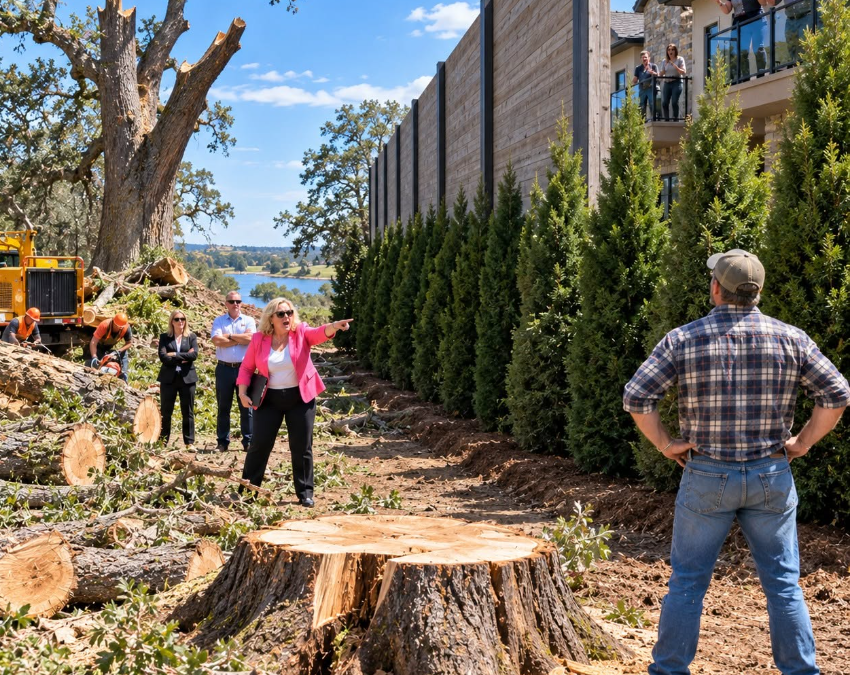
The trees that had shaped his life lay in pieces or were already gone into the chipper truck. Seven stumps stood like amputations in the grass. The soil was torn by tire tracks. Crushed acorns and shredded leaves scattered across the ground.
Big Cyrus was the last stump.
It was huge.
Four feet across.
Pale wood exposed to the evening like bone.
The heritage tag had been pried from the trunk and lay bent in the sawdust.
Number 147.
Holden picked it up.
His hand began to shake.
He could hear Mateo crying behind him.
Not sobbing.
Trying not to.
That sound broke something in him.
Elena went to their son, pulling him against her. She was crying too, but silently, eyes fixed on the stumps.
From above, glass clinked.
Holden looked up.
Bridget stood on her balcony.
White blouse.
Gold earrings.
Chardonnay in hand.
The sunset she had wanted was spread behind her, wide and orange, unobstructed for the first time.
She lifted the glass.
“Sorry, Holden,” she called down. “Fire hazard.”
The words carried across the torn hillside.
Mateo looked up at her.
Elena stiffened.
Holden stood with the bent brass tag in his palm.
Every instinct in him wanted to shout.
To curse.
To climb that hill and ask her what kind of person toasted over the bodies of trees older than her family name.
But his father’s voice rose inside him.
People forget.
Trees don’t.
Holden understood then that rage would not be enough.
Rage would burn out by morning.
Documentation would last.
He turned away from Bridget.
He knelt by Big Cyrus.
He placed the brass tag in his shirt pocket.
Then he took out his phone and began photographing.
Every stump.
Every tire track.
Every cut surface.
Every sawdust pile.
Every remaining branch.
Every piece of torn bark.
Every footprint.
Every broken root flare.
He photographed the chipper truck’s tracks. He photographed the gate. He photographed the discarded water bottles left by the crew. He photographed a cigarette butt near the stump of a tree that had survived nearly four centuries and died beside someone’s trash.
Bridget shouted something else from above.
He did not listen.
Elena knew what he was doing.
She wiped her face, took out her own phone, and started recording video.
Mateo stood beside Big Cyrus, trembling.
“Dad,” he said.
Holden looked at him.
The boy’s face was wet and furious.
“Do something.”
“I am.”
“No.” Mateo pointed at Bridget’s house. “Do something now.”
Holden walked to him.
Every step hurt.
He put both hands on his son’s shoulders.
“I know what you want.”
“She killed Grandpa Tree.”
“I know.”
“Then why aren’t you yelling?”
Holden’s throat tightened.
“Because she wants a scene. She wants us angry and messy and easy to dismiss. We’re going to give her something worse.”
“What?”
“The truth. Organized.”
Mateo looked at him like he did not understand how truth could possibly be enough.
Holden did not blame him.
That evening, truth looked like seven stumps and a woman drinking wine above them.
“Go inside with your mother,” Holden said gently.
“I don’t want to.”
“Mateo.”
The boy pulled away.
“I’m not leaving them.”
Them.
Not it.
Them.
Holden nodded.
“Then stay near me.”
They stayed in the grove until dark.
Mrs. Alvarez came down the lane crying so hard she could barely speak. She had photos. Videos. The truck plates. Bridget shouting. The crew cutting. The chipper running. She had called the county, but by the time anyone responded, the crew was gone.
“They told me it was approved,” she kept saying. “They told me it was approved.”
Holden hugged her.
“It’s not your fault.”
“I should have blocked the road.”
“Gloria.”
“I should have done more.”
He looked at the stumps.
“We all think that after something is gone.”
At 9:17 p.m., Holden made the first call.
Not to the county.
Not to the sheriff.
To Margaret Wynn.
Margaret was a Sacramento attorney who specialized in environmental and heritage-resource litigation. She was sixty-three, sharp-voiced, and so allergic to careless tree removal that other lawyers joked she could smell a chainsaw through a phone.
She answered on the second ring.
“Holden?”
“They cut them.”
A pause.
“How many?”
“Seven.”
“Big Cyrus?”
“Yes.”
The silence on the line changed.
Margaret had stood under Big Cyrus once during a site visit. She had placed her hand against the bark and said, “If anyone ever touches this tree, call me before you call God.”
Her voice came back colder.
“Do not disturb anything. Not a chip. Not a leaf. Photograph everything. Drone images at first light. I will file emergency preservation orders by morning.”
“I have photos.”
“Good. Call the sheriff for trespass and vandalism. Call county code enforcement. Call the state heritage registry office. Call your insurance, but do not give a recorded statement without me. Do not speak to Bridget Holloway.”
“She toasted from her balcony.”
Margaret exhaled through her nose.
“Please tell me your wife recorded it.”
“Yes.”
“I love Elena.”
Holden almost smiled.
Almost.
Then Margaret asked, “Holden, are you safe?”
He looked toward the hill.
Bridget’s balcony lights glowed above the ruined grove.
“No,” he said. “But not the way you mean.”
By midnight, the Marquetti house was full of paper.
Elena pulled family files from the office closet. Mateo brought in old photo albums from the hall cabinet. Holden opened his father’s metal document boxes, the ones that smelled like dust, cedar, and the past.
There were handwritten maps from the 1800s.
A photograph from 1912 showing Big Cyrus behind Holden’s great-grandfather and a horse named Lady.
A 1934 letter from the county surveyor referencing “the old oak landmark on the Marquetti ridge.”
His grandfather’s 1958 pruning notes.
His father’s 1986 heritage tree registration certificate.
The brass tag record.
Annual inspection logs.
Soil reports.
Arborist assessments.
Fire clearance reports.
County correspondence.
Everything Bridget thought was gone had left proof behind.
Trees remember in rings.
Families remember in files.
At 2:00 a.m., Mateo sat at the kitchen table, turning pages of his grandfather’s old calendar.
Holden had not meant for him to see the worst of it. But grief does not obey bedtime, and Mateo refused to leave.
The calendar was from 2017.
The year Holden’s father died.
Every Sunday before the hospitalization had a note.
Walk grove.
Check C3 limb.
Mulch east side.
Show Mateo acorns.
Mateo stopped at that one.
His fingers rested on the page.
“I remember that,” he whispered.
Holden sat across from him.
“You were six.”
“Grandpa gave me a cracked acorn and said it wasn’t broken. It was starting.”
Holden closed his eyes.
He remembered too.
His father kneeling slowly, pain hidden badly, placing a sprouting acorn in Mateo’s palm.
Everything alive breaks open first, he had said.
Mateo looked up.
“Can they grow back?”
Holden took a breath.
The honest answer was complicated.
Oaks could sprout from stumps sometimes. Not like before. Not Big Cyrus as it was. Not a canopy that had taken centuries to build. But life had stubborn habits.
“Some may resprout,” Holden said. “If the roots weren’t too damaged.”
“So they’re not dead?”
Holden looked toward the dark window.
“I don’t know yet.”
Mateo nodded.
In that nod, Holden saw a child trying to decide whether hope was safe.
He hated Bridget for that too.
The next morning, the county arrived before sunrise.
Then the sheriff.
Then state heritage registry staff.
Then Margaret Wynn, who had driven through the night from Sacramento with a paralegal asleep in the passenger seat and a legal pad already full of fury.
By 8:00 a.m., the grove had been taped off like a crime scene.
Bridget came down at 8:30 wearing pale linen and indignation.
She did not come alone.
She brought Martin Vale, Jenna Price, and a man Holden had never seen before: tall, tan, expensive sunglasses, vineyard-logo polo.
Bridget walked to the edge of the tape and stopped when a deputy raised a hand.
“This is absurd,” she said. “We performed emergency fire mitigation.”
Margaret turned slowly.
Holden had rarely seen her look pleased.
This was one of those times.
“Mrs. Holloway,” Margaret said. “How lovely of you to come down before I had to subpoena you.”
Bridget blinked.
“Who are you?”
“Margaret Wynn. Counsel for the Marquetti family.”
Bridget looked at Holden.
“You hired a lawyer overnight?”
Holden said nothing.
Margaret smiled.
“He hired me years ago. Sensible people plan for vandals with money.”
The man in the vineyard polo stepped forward.
“Let’s keep this civil.”
Margaret looked at him.
“And you are?”
“Grant Holloway.”
Bridget’s husband.
Holden had seen him in passing, usually driving a black Range Rover or standing at Vista Verde wine events with a glass in one hand and a laugh too loud for the joke. Grant owned a boutique wine label called Hollow Ridge Cellars, though locals knew most of his grapes came from other growers and most of his prestige came from investors who liked the sound of themselves saying “estate reserve.”
Margaret glanced at Holden.
He gave the smallest shrug.
Grant extended a hand.
Margaret did not take it.
He lowered it slowly.
“This was unfortunate,” Grant said. “But I think emotions are running high.”
Margaret looked at the seven stumps.
“Excellent observation.”
Bridget folded her arms.
“This grove was a documented fire hazard.”
“No,” Holden said.
It was the first word he had spoken to her since coming home.
Everyone looked at him.
He stepped forward, stopping just inside the tape.
“The grove was maintained. Inspected. Documented. You knew that. I sent you the records.”
Bridget lifted her chin.
“Your records were self-serving.”
“The county accepted them.”
“The county is slow.”
“The state accepted them.”
“The state doesn’t live with fire risk.”
Holden looked at the stumps again.
“Those trees survived fires before your house existed.”
Her expression hardened.
“That kind of romantic thinking is exactly the problem.”
Margaret said, “Mrs. Holloway, did you authorize the cutting crew?”
“I coordinated emergency mitigation.”
“Did you have a county removal permit?”
“Emergency actions do not require—”
“Did you have a permit?”
Bridget’s lips pressed together.
“I had fire-safety authority.”
“From whom?”
“The HOA.”
“The HOA has no authority over Marquetti land.”
“We have adjacent risk responsibility.”
Margaret almost laughed.
“Is that a phrase from a lawyer or a brochure?”
Grant stepped in.
“What Bridget means is that Vista Verde faces unique wildfire exposure due to unmanaged neighboring vegetation.”
Holden turned to him.
“Unmanaged?”
Grant’s face stayed smooth.
“In perception, Holden.”
“In what?”
“Public perception. Buyer perception. Investor perception. These things matter.”
There it was.
Investor.
Margaret heard it too.
“Investor perception of what, Mr. Holloway?”
Grant’s jaw tightened.
“Our community values.”
Before Margaret could answer, a state heritage officer named Daniel Kwon approached from Big Cyrus’s stump carrying an evidence bag.
Inside was the bent brass tag.
Number 147.
Daniel Kwon’s face was grim.
“Mr. Marquetti,” he said, though his eyes stayed on Bridget. “We found pry marks where the tag was removed before the final cut.”
Bridget went still.
Margaret’s smile disappeared.
Holden felt something cold move through him.
Before the final cut.
They had not accidentally destroyed a tagged tree.
Someone had seen the tag.
Removed it.
Then cut anyway.
The deputy beside the tape began writing.
Margaret looked at Bridget.
“Emergency mitigation crews usually preserve heritage tags for reporting,” she said softly. “They don’t pry them off and keep cutting.”
Bridget looked toward Grant.
Grant looked at the ground.
It was quick.
But Holden saw it.
So did Margaret.
That glance changed everything.
By noon, Bridget had issued a statement to Vista Verde residents.
It said the HOA had “taken necessary emergency action to reduce catastrophic fire risk from adjacent neglected vegetation.”
It said Holden Marquetti had been “repeatedly warned.”
It said the HOA would “vigorously defend responsible community protection.”
By 1:00 p.m., Elena posted the video of Bridget on her balcony raising the glass and saying, “Sorry, Holden. Fire hazard.”
By 1:15, Bridget’s statement began collapsing.
By 2:00, the county announced there was no emergency order authorizing tree removal.
By 3:30, the state heritage registry confirmed Big Cyrus had been listed as protected for decades.
By sunset, the story was everywhere in the county.
Seven heritage oaks cut while owner away.
HOA president claims fire emergency.
Video shows wine toast.
The internet loves a villain with a glass of Chardonnay.
Bridget became one by breakfast.
But Holden did not care about online outrage.
Online outrage could not put shade back on the hillside.
It could not return the wood chips to branches.
It could not make Mateo stop waking up at 3:00 a.m. and walking barefoot to the porch to stare at the stumps.
The first week after the cutting, Holden barely slept.
He inspected stump tissue for resprout potential. He documented root damage. He gathered acorns from the ground that had escaped the chipper. He met with state officials, sheriff’s investigators, county counsel, and Margaret.
He avoided Bridget.
That was harder than it sounded.
Her house loomed above the grove.
Without the trees, her balcony had a perfect line of sight into the Marquetti yard, porch, kitchen windows, and the family cemetery near the lower slope.
That was one of the things outsiders did not understand.
The oaks had not only shaded the land.
They had protected privacy.
For generations, the grove had formed a living wall between the Marquetti home and the ridge. After Vista Verde arrived, the oaks became even more important. Their canopies softened the intrusion of glass balconies and outdoor speakers. They screened Mateo’s bedroom window from houses above. They kept the family from feeling watched in their own yard.
Bridget had not merely opened her view.
She had opened their life.
On Friday morning, Holden stepped onto the porch and found Bridget standing on her balcony with binoculars.
Not even hiding them.
He stood still.
She lowered them slowly.
Then waved.
That was when Elena said, “Build the wall.”
She stood in the kitchen doorway behind him, coffee in hand, face pale with exhaustion and rage.
Holden turned.
“We need to finish the legal—”
“No,” she said. “We need to breathe in our own house.”
He knew which wall she meant.
Six years earlier, during the final phase of Vista Verde approvals, the county required the developer to fund a ridge-line privacy and erosion-control barrier if view-side conflicts with adjacent legacy parcels could not be resolved. The condition had been added after Holden objected to the placement of several homes overlooking his property.
The developer hated it.
Vista Verde buyers hated it.
Bridget hated it most of all.
A ninety-foot privacy wall along the western ridge would block sightlines from several luxury homes, including hers. Not completely everywhere, but enough to destroy the sweeping sunset view that had added seven figures of value to the ridge lots.
The developer posted a $2.4 million bond in county escrow as a condition of final approval.
The wall was never built because Bridget, then head of the design committee, pushed relentlessly for “vegetative screening alternatives.”
The compromise was simple: as long as the Marquetti heritage grove remained intact and documented privacy impacts were controlled, the county would hold the bond but not release wall construction funds.
If the grove was removed, damaged, or no longer provided screening, the wall condition could be activated.
Bridget had spent six years blocking the wall.
Then she cut down the only thing preventing it.
Holden had not thought about the escrow bond in months.
Elena had.
“Build the wall,” she repeated.
Holden looked toward the stumps.
“It will start another war.”
Elena’s laugh was sharp.
“What do you call this?”
Mateo appeared in the hallway.
His hair was messy. His eyes were shadowed.
“They can see my room,” he said.
Holden’s chest tightened.
“What?”
“Last night. I saw somebody’s phone light up on the balcony. I think they were filming.”
Elena turned away, one hand over her mouth.
Holden walked to his son.
“Why didn’t you tell us?”
Mateo shrugged, trying to look older than he was.
“You were already mad.”
That broke Holden more than tears would have.
He looked at Elena.
Then back at the ridge.
“Okay,” he said.
Margaret filed the petition Monday.
Emergency enforcement of Vista Verde Condition 18-B: privacy wall construction due to loss of vegetative screening and documented privacy invasion.
Bridget’s reaction arrived in less than an hour.
All caps.
To the county.
To the HOA board.
To every resident.
To Holden.
THIS IS RETALIATION.
Holden did not answer.
Margaret did.
Dear Mrs. Holloway,
Retaliation implies Mr. Marquetti is responding unlawfully to lawful conduct.
Your premise is defective.
Regards,
Margaret Wynn.
The county hearing was scheduled for the following Thursday.
Before then, the secrets started falling.
Not all at once.
Secrets rarely do.
They leak.
The first leak came from Ortega Brush and Fire Mitigation.
Their owner, Luis Ortega, was not a villain.
Careless, yes.
Greedy, probably.
But not Bridget Holloway.
He came to Holden’s property three days after the story broke, hat in hand, face gray with stress.
Margaret told Holden not to meet him alone.
So Holden met him at the gate with Margaret, Elena, and a sheriff’s deputy present.
Luis looked at the stumps and seemed smaller.
“I didn’t know,” he said.
Holden said nothing.
Luis swallowed.
“They told us the trees were dead. Dangerous. Approved. We got paperwork.”
Margaret held out a hand.
“Give it to me.”
Luis handed over copies.
Forgery had a smell once you knew it.
Not literal.
Pattern.
Too many official-looking details. Strange wording. A county logo slightly stretched. An email domain off by one word. A signature pasted poorly but confidently.
Margaret flipped through it.
“Who sent you this?”
“Mrs. Holloway.”
“Directly?”
Luis hesitated.
“And Mr. Holloway. He wired the deposit.”
Holden looked up.
“Grant?”
Luis nodded.
“He said it was part of a larger vineyard fire corridor project.”
Margaret’s eyes sharpened.
“What vineyard project?”
Luis looked confused.
“The Hollow Ridge expansion. He said the ridge had to be cleared for insurance before investor inspection.”
Elena whispered, “Oh my God.”
Grant Holloway did not just want the view.
He needed it.
Two months before the cutting, Grant had pitched investors on a new tasting terrace and private wine club experience at Vista Verde, marketed as “uninterrupted sunset tastings over heritage oak country.”
He planned to use Bridget’s home and two adjacent HOA-owned open-space parcels as the flagship experience for Hollow Ridge Cellars.
The old oaks blocked most of that view.
They also blocked photographs.
Investor packets showed renderings where the Marquetti grove had been thinned dramatically.
Not removed.
Thinned.
Enough to reveal sunset lines.
Grant had no permission.
Bridget had no authority.
Together, they had decided reality was an obstacle.
The second leak came from Jenna Price.
Jenna, the real estate agent, requested a private meeting with Margaret and county investigators. She arrived shaking, carrying a laptop and a folder of printed emails.
“I didn’t know they’d cut all of them,” she said.
That was not the same as innocence.
Margaret made no comforting sound.
Jenna cried anyway.
She admitted Bridget had been trying to remove or top the oaks for years because they affected ridge property values. She admitted the HOA board had discussed “forcing a fire determination.” She admitted Grant had promised wine-club access to certain board members if they supported the emergency action. She admitted Martin Vale had asked whether the heritage tags could be “handled quietly.”
Then she handed over the email that broke the board.
From Bridget to Grant, Martin, and Jenna:
Holden is in Sacramento July 9-12. Elena and the boy are with him. If we complete removal midweek and frame as urgent fire mitigation, he’ll spend months fighting paperwork while the view is already restored. Once trees are gone, nobody can make us put them back.
Nobody can make us put them back.
Holden read that line in Margaret’s office.
He did not rage.
He sat down.
For a long time, he stared at the paper.
Elena stood behind him, one hand on his shoulder.
Mateo was not there.
Thank God.
Finally Holden said, “She’s right.”
Margaret looked at him.
“She’s not.”
“She is. Nobody can make her put them back.”
“No,” Margaret said. “But we can make sure she spends the rest of her life understanding what gone costs.”
The hearing drew more people than the county room could hold.
Residents from Vista Verde came in linen and anger.
Farmers came in boots.
Arborists came in work shirts.
Reporters came with cameras.
A group of high school environmental science students sat in the back holding hand-painted signs that said OLD TREES ARE NOT OBSTACLES.
Holden did not know who invited them.
He suspected Elena.
Bridget arrived with Grant and a new attorney from Los Angeles.
She looked different.
Still polished.
Still expensive.
But strained.
Public hatred had not broken her, but it had reached her. She walked into the hearing room as if every phone might be recording, because every phone probably was.
Grant looked worse.
His wine label had already lost two restaurant placements. Investors had paused the Vista Verde tasting terrace. Someone had edited the Hollow Ridge Cellars online reviews so that every five-star note was buried under hundreds of comments about “notes of chainsaw and entitlement.”
The county planner presented first.
He explained Condition 18-B.
He confirmed the privacy wall bond existed.
He confirmed the heritage grove had served as the accepted vegetative privacy screen.
He confirmed the grove no longer existed.
Then Daniel Kwon from the heritage registry presented the damage report.
Seven protected coast live oaks.
Estimated ages ranging from 160 to approximately 380 years.
Unauthorized removal.
Evidence of heritage tag removal prior to cutting.
Potential civil penalties, restoration orders, and referral for criminal investigation.
When he put Big Cyrus’s old photograph on the screen, the room changed.
It showed Holden’s father as a young man standing beneath the giant canopy, one hand on the trunk, sunlight breaking through leaves above him.
Then Daniel showed the stump photo.
Someone in the room gasped.
Mateo, sitting between his parents, looked down at his hands.
Holden wanted to cover his son’s eyes, but Mateo was thirteen. Old enough to know what adults did when they thought nobody could stop them.
Margaret spoke next.
She did not perform grief.
That was not her style.
She performed facts like a blade being sharpened.
She established Bridget’s repeated attempts to force canopy reduction.
The rejected county complaints.
The documented maintenance.
The heritage registrations.
The forged emergency paperwork.
The balcony video.
The privacy invasion after removal.
The escrow bond.
Then she played the video from Elena’s phone.
Bridget lifting Chardonnay.
“Sorry, Holden. Fire hazard.”
The sound filled the room.
Bridget stared straight ahead.
Her attorney objected to “prejudicial theatrics.”
The county chair said, “Overruled. This is not a courtroom, and frankly, counsel, it is very relevant to intent.”
Then Bridget spoke.
It was astonishing.
Not because she apologized.
She did not.
Because even then, with the evidence stacked around her like felled wood, she still believed she could sell herself as the victim.
She walked to the podium in a cream suit and soft gold jewelry.
Her voice trembled at exactly the right volume.
“My family moved to Vista Verde because we believed in community,” she began. “We believed in safety, stewardship, and responsible land management. For years, our residents have lived under increasing wildfire anxiety due to unmanaged vegetation below our homes.”
Holden felt Mateo stiffen beside him.
Elena took the boy’s hand.
Bridget continued.
“I understand Mr. Marquetti feels sentimental attachment to these trees. I do. I have always respected heritage. But heritage cannot be allowed to endanger living families. Children sleep in those homes. Seniors live there. Fire does not care about brass tags.”
A murmur rose from some Vista Verde residents.
Bridget turned slightly toward Holden.
“I regret the pain this has caused. But I will not apologize for acting to protect my community.”
Margaret leaned toward Holden and whispered, “She is hanging herself in cursive.”
Grant spoke after her.
He tried to sound reasonable.
He acknowledged “procedural irregularities.”
He blamed contractors.
He described the forged documents as “confusing packet assembly.”
He said the wine terrace project was unrelated.
Then the county attorney asked him one question.
“Mr. Holloway, did you wire the deposit to Ortega Brush and Fire Mitigation?”
Grant hesitated.
“Yes, from a business account.”
“Why would your wine business pay for an HOA fire emergency on private land?”
The room went silent.
Grant adjusted his cuff.
“It was a temporary funding accommodation.”
“For whose benefit?”
“The community’s.”
“Not your proposed tasting terrace?”
His mouth tightened.
“No.”
The county attorney held up an investor rendering.
It showed the Hollow Ridge tasting terrace.
Sunset.
Wine glasses.
The hillside.
And no Marquetti oaks.
Grant’s face changed.
Only slightly.
But enough.
The attorney asked, “Who authorized this rendering?”
Grant did not answer.
Bridget stared at the table.
The hearing lasted five hours.
At the end, the county board voted unanimously to activate Condition 18-B.
The escrow bond would be released.
The ninety-foot privacy wall would be built along the western ridge.
Not a wooden fence.
Not shrubs.
A reinforced, fire-rated, sound-dampening, privacy barrier engineered into the slope, rising in sections up to ninety feet where grade required it, with an earth-toned concrete face toward the Marquetti side and a smooth, non-climbable surface toward Vista Verde.
The board also referred the tree removal matter for civil enforcement and criminal review.
Bridget stood as the vote was read.
“No,” she said.
The chair looked at her.
“Mrs. Holloway, sit down.”
“You cannot destroy our property values because of trees.”
The chair’s face hardened.
“Mrs. Holloway, you destroyed the trees.”
That line traveled far.
By evening, it was quoted across the county.
By morning, it was on T-shirts.
The wall did not rise overnight.
Consequences rarely do.
First came survey crews.
Then engineers.
Then soil testing.
Then erosion-control barriers.
Then construction fencing.
Every stage enraged Vista Verde.
Residents who had ignored Bridget’s campaign against the oaks suddenly discovered they had concerns about process, aesthetics, mental health, natural light, property value, and whether a ninety-foot wall was “emotionally aggressive.”
One man said at a meeting, “It feels punitive.”
Mrs. Alvarez, sitting in the back, replied, “So did chainsaws.”
Holden did not attend most of those meetings.
He had work to do.
The stumps required care.
Not because it would restore what was lost, but because the root systems deserved a chance. He and two arborist friends cleaned torn edges, protected soil, fenced off the grove, watered strategically, and monitored for stress.
For weeks, nothing happened.
Big Cyrus’s stump remained pale and silent.
Mateo checked every morning.
Before school.
After school.
At sunset.
He took photos from the same angle, creating a record no one had asked for and Holden could not bring himself to stop.
One evening in late August, Mateo called from the grove.
His voice cracked.
“Dad!”
Holden ran.
So did Elena.
Mateo was kneeling beside the stump of one of the companion oaks, pointing at the base.
A tiny green shoot had emerged from the root crown.
Small.
Almost ridiculous against the massive stump.
But alive.
Elena covered her mouth.
Holden knelt.
He touched the soil beside it, not the shoot.
Mateo whispered, “It’s starting.”
Holden closed his eyes.
Everything alive breaks open first.
Within three weeks, four stumps showed sprouts.
Big Cyrus did not.
Not yet.
Maybe never.
Holden prepared himself for that.
He prepared Mateo too, gently.
But grief is stubborn where love is older than reason.
The lawsuit landed in September.
Marquetti v. Holloway, Vista Verde HOA, Hollow Ridge Cellars, and Ortega Brush and Fire Mitigation.
Causes of action filled pages.
Trespass.
Timber conversion.
Destruction of protected heritage trees.
Fraud.
Forgery.
Civil conspiracy.
Emotional distress.
Privacy invasion.
Damage to property value.
Environmental harm.
Unfair business conduct.
Bridget countersued.
Of course she did.
She claimed Holden had weaponized heritage protections to punish Vista Verde. She claimed the wall violated residents’ rights. She claimed emotional distress from public criticism. She claimed harassment because people kept mailing her acorns.
Margaret read the countersuit at Holden’s kitchen table and said, “This is not a legal document. This is a diary entry with exhibits.”
Elena said, “Can we say that in court?”
“Not as often as I’d like.”
The first deposition was Bridget’s.
Holden did not attend.
Margaret advised against it.
But he read the transcript.
That was almost worse.
Question: Did you know Big Cyrus was registered as a state heritage tree?
Bridget: I was aware Mr. Marquetti claimed certain designations.
Question: Did you see a brass tag on the tree?
Bridget: I saw many things in a chaotic emergency setting.
Question: Did you instruct anyone to remove a tag?
Bridget: I don’t recall.
Question: Did you write, “Once trees are gone, nobody can make us put them back”?
Bridget: That statement has been taken out of context.
Question: What context makes it appropriate?
Bridget: Fire safety.
Question: Why mention Mr. Marquetti’s travel schedule?
Bridget: Availability.
Question: His availability to object?
Bridget: That is argumentative.
Question: Did you toast the removed trees from your balcony?
Bridget: I raised a glass after a stressful day.
Question: To whom did you say, “Sorry, Holden. Fire hazard”?
Bridget: I don’t recall the emotional specifics.
The emotional specifics.
Holden put the transcript down and walked outside.
Elena found him near Big Cyrus’s stump.
“You okay?”
“No.”
She stood beside him.
The sunset was sharp and beautiful through the empty air where branches used to be.
“I keep thinking,” he said, “if I hadn’t gone to Sacramento…”
“She would have waited for another chance.”
“If I had installed cameras…”
“She would have lied differently.”
“If I had taken the legal threats more seriously…”
Elena took his hand.
“Holden. She did this. Not you.”
He knew that.
He did not always feel it.
Guilt is a weed grief grows when it cannot find answers.
The wall foundation was poured in October.
Vista Verde watched in horror as trucks climbed the ridge and concrete forms rose.
Bridget’s balcony became a front-row seat to her own consequences.
At first, she filmed construction and posted dramatic updates.
Day 1 of Marquetti’s revenge wall.
Day 5: Our community under siege.
Day 12: Concrete tyranny.
The posts did not help her.
People responded with photos of the stumps.
Eventually, she stopped posting.
The HOA board removed her as president in November after residents learned the association’s insurance carrier might deny coverage due to intentional misconduct. Martin Vale resigned. Jenna Price had already flipped to cooperating witness and moved her listings out of Vista Verde before anyone could publicly blame her for everything.
Grant’s investors pulled out in December.
Hollow Ridge Cellars announced it was “pausing expansion to reassess market conditions.”
That was the public version.
The private version came from a banker who knew Elena’s cousin: Grant had personally guaranteed too much, promised too much, and assumed Bridget’s view campaign would solve more than trees.
By January, the Holloways listed their Vista Verde home quietly.
Nobody bought it.
Everyone knew the wall was coming.
The criminal charges came slower.
Bridget was charged with conspiracy, vandalism, trespass, filing false documents, and destruction of protected natural resources.
Grant was charged with conspiracy and fraud-related counts tied to the forged fire packet and business payments.
Luis Ortega accepted a plea for negligence and cooperation.
Holden had mixed feelings about Luis.
The man had cut the trees.
That fact did not change because he had been misled.
But he also testified truthfully, turned over documents, and later donated equipment and labor toward restoration plantings. Holden did not forgive him. Not exactly.
But he understood the difference between the person who swings a blade and the person who points it.
The restitution hearing for civil damages took place nearly one year after the cutting.
By then, the wall was halfway up.
It rose along the ridge like an answer made of concrete.
From the Marquetti side, it was not beautiful, but it was quiet. It had texture, earth color, and planting pockets designed for native vines and shrubs. From Vista Verde, it was brutal. Smooth. High. Implacable. It erased the sunset line from Bridget’s balcony entirely.
The house that had once marketed itself as having “the crown view of the valley” now looked at a wall built by its own arrogance.
In court, experts testified about tree valuation.
Ancient trees are difficult to value because they are not replaceable in a human lifetime. The defense tried to argue that tree damages should be calculated by timber value, which was grotesque enough that even the judge looked offended.
Margaret’s experts valued the trees based on heritage significance, ecological value, replacement impossibility, property impact, documented family history, and statutory penalties.
Big Cyrus alone carried a valuation that made Grant Holloway’s attorney go pale.
Then Holden testified.
He had dreaded it for weeks.
Not because he feared speaking.
Because he feared the moment grief would become a question-and-answer format.
Margaret guided him gently.
She asked about the land.
The grove.
His father.
The heritage tag.
His maintenance.
His son.
She showed a photograph of Mateo at age six holding a sprouting acorn beside Holden’s father.
Holden had not seen that picture in years.
His voice almost failed.
Margaret waited.
The judge waited.
Even Bridget, sitting at the defense table, seemed still.
Holden said, “My father believed stewardship meant you take care of things you will never fully own because they belong partly to the future.”
Margaret asked, “Did Big Cyrus belong to the future?”
“Yes.”
“What was taken from you?”
The defense objected.
The judge allowed the question.
Holden looked at Bridget.
She did not look away.
He said, “Shade. Privacy. History. A living thing my family protected for 170 years. My son’s sense that old things are safe if you love them enough. The promise I made my father.”
The courtroom remained silent.
Margaret asked, “Can money replace that?”
“No.”
“Then why are we here?”
Holden took a breath.
“Because if there is no cost, people like Bridget Holloway will keep mistaking irreplaceable things for obstacles.”
That became the sentence newspapers used.
At the end of the hearing, the judge awarded damages, penalties, restoration costs, attorney fees, and enforcement obligations totaling more than Bridget and Grant could easily survive.
Insurance denied most of their claim due to intentional acts.
Vista Verde HOA was separately liable for portions of the conduct authorized under its name.
Residents erupted when they learned special assessments might follow.
Bridget tried to blame Holden.
At the final HOA meeting she attended, she stood in the clubhouse and said, “He is destroying this community over trees.”
A man in the back, one of her former supporters, stood and said, “No, Bridget. You did that over a view.”
She walked out.
The wall was completed in late spring.
Holden did not attend the final inspection.
He stayed in the grove.
Mateo was with him.
They had built protective cages around the sprouts. Native grass was coming back where the chipper had scarred the soil. New plantings, grown from acorns collected from the grove in previous years, stood in small tubes across the slope.
Big Cyrus still had not sprouted.
Holden had accepted it, or told himself he had.
Mateo had not.
The boy knelt at the base of the old stump and brushed away leaves.
“Dad.”
Holden heard something in his voice.
Not panic.
Wonder.
He moved closer.
There, on the north side of Big Cyrus, tucked low against the root crown where shade remained longest, was a tiny green point.
Smaller than a fingernail.
Almost invisible.
A sprout.
Holden stared.
Mateo looked up at him, eyes wide.
“He’s not dead.”
Holden knelt slowly.
His hand hovered above the shoot.
He did not touch it.
Not yet.
The wind moved through the empty grove.
For a second, Holden imagined his father standing behind him, hands in his pockets, pretending not to cry.
Elena came down the hill carrying water bottles.
She saw their faces and stopped.
Then she saw the sprout.
“Oh,” she whispered.
Just that.
Oh.
They stayed there together for a long time.
The wall inspection ended somewhere above them. County vehicles came and went. Vista Verde residents complained behind concrete. Bridget’s balcony faced nothing but the smooth surface of the condition she had triggered.
Below, Big Cyrus began again.
Not as a ninety-five-foot giant.
Not as the tree Holden had promised his father would outlive him.
But as a green insistence against everything Bridget believed.
The criminal sentencing happened in July.
One year after the cutting.
Bridget took a plea to avoid trial.
Grant did too.
Neither went to prison for as long as the internet wanted, which was forever. But they received probation, heavy fines, community service tied to environmental restoration, restrictions on HOA leadership and development involvement, and financial judgments that forced the sale of their Vista Verde home at a catastrophic loss.
The buyer was not a wine investor.
It was a retired dentist from Fresno who liked privacy and reportedly did not mind walls.
At sentencing, Bridget read a statement.
It was polished.
Regretful.
Full of passive verbs.
“Mistakes were made.”
“Actions occurred.”
“Pain resulted.”
Margaret leaned toward Holden and whispered, “If grammar could commit perjury, that statement would be arrested.”
Holden almost laughed.
Then the judge interrupted Bridget.
“Mrs. Holloway,” he said, “I would like you to say the sentence, ‘I cut down protected trees that did not belong to me.’”
Bridget froze.
Her attorney whispered urgently.
The judge waited.
Bridget’s face flushed.
Finally she said, “I authorized removal of protected trees that did not belong to me.”
“Again,” the judge said. “Without authorized.”
Her mouth tightened.
“I cut down protected trees that did not belong to me.”
The courtroom was silent.
The judge nodded.
“Accountability begins when language stops hiding you.”
Holden wrote that down.
Later, outside the courthouse, reporters asked Bridget if she had anything to say to the Marquetti family.
She looked at the cameras.
Then at Holden.
For a moment, he thought she might actually apologize.
Instead she said, “I hope one day they choose healing over revenge.”
Elena stepped forward before Holden could stop her.
“Healing is what trees do after people like you leave,” she said.
Then she took Holden’s hand, and they walked away.
The restoration took years.
It would take more than Holden’s lifetime to become what had been lost.
That was the truth.
The new oaks grew slowly.
The sprouts needed protection from deer, drought, gophers, heat, and human stupidity. Holden installed irrigation. Mateo checked cages. Elena coordinated volunteers. Mrs. Alvarez brought lemonade on planting days and yelled at anyone who stepped too close to root zones.
School groups returned.
At first, Holden did not want them to see the stumps.
Then Mateo said, “They should.”
So he taught differently.
He showed children the cut surfaces.
He showed them the sprouts.
He showed them the wall.
He told them, “This is what happens when people think wanting something is the same as having a right to it.”
A girl asked, “Will the trees be big again?”
Holden looked at the sprout from Big Cyrus, now three feet tall and leafing strongly from the old root.
“Yes,” he said. “But not for us.”
The girl frowned.
“Then why take care of them?”
Mateo answered before Holden could.
“Because someone took care of them before us.”
Holden looked at his son.
In that moment, he saw the promise had moved.
From father to son.
From stump to sprout.
From grief to duty.
Five years after the cutting, the grove had a new name.
Not officially.
Families do not need committees for everything.
They called it The Returning.
The wall was covered now on the Marquetti side with native vines, shrubs, and climbing greenery. Birds nested there. Lizards warmed themselves on the lower stones. The concrete had become less like a scar and more like a boundary.
From Vista Verde, it remained a wall.
That was fine.
Some people need plain lessons.
Bridget and Grant left California after the house sold. Rumor placed them in Arizona, then Idaho, then nowhere Holden cared to know. Once, a reporter reached out asking if Holden had any comment on Bridget’s attempt to launch a “property rights consulting” blog.
He declined.
A year later, the blog disappeared.
Vista Verde changed too.
Not completely.
Wealth still sat on the ridge behind gates.
People still complained about dust, coyotes, farm smells, and the fact that rural darkness did not include enough landscape lighting.
But the HOA changed its bylaws.
No enforcement beyond property lines.
No environmental claims without licensed independent review.
No drone flights over neighboring parcels.
No board member could hold undisclosed financial interests in projects affected by HOA actions.
And every new homeowner received a disclosure packet with one full page titled:
ADJACENT HERITAGE GROVE AND MARQUETTI PROPERTY RIGHTS
Elena framed the first copy.
For fun.
Holden pretended not to find that funny.
On the tenth anniversary of the cutting, Mateo came home from college.
He was studying environmental law.
That surprised no one.
He arrived late on a Friday, tall and lean, with his grandfather’s old field hat in his backpack and a stack of books Holden did not understand but respected.
The next morning, father and son walked the grove.
Big Cyrus’s sprout was no longer a sprout.
It was a young tree rising from the ancient root crown, twenty feet tall, branches reaching outward with the strange confidence of life that had already survived the worst human beings could do.
Holden stood before it.
Mateo touched the trunk gently.
“Do you think it’s the same tree?” he asked.
Holden considered.
A decade earlier, he might have given an arborist’s answer.
Root continuity.
Genetic identity.
Basal sprouting.
Physiological regeneration.
Now he gave the truer one.
“It remembers.”
Mateo nodded.
Above them, the wall blocked Vista Verde from view.
Below them, the Marquetti house stood in morning light, porch repaired, herb garden wild, Elena’s laundry moving on the line because she refused to stop using the sun just because rich people once looked down from the ridge.
Mrs. Alvarez’s Subaru rattled by on the road.
Somewhere a hawk cried.
Wind moved through young leaves.
Not the deep, oceanic sound Big Cyrus once made.
Not yet.
But a beginning.
Holden reached into his pocket and took out the bent brass tag.
Number 147.
He had kept it in a drawer for years, unable to decide what to do with it.
The original tree was gone.
The root lived.
The tag belonged to both.
Mateo watched as Holden knelt and fastened the tag to a small cedar post beside the young trunk, not into the living bark. Beneath it, he had placed a new plaque.
BIG CYRUS
HERITAGE OAK NO. 147
FIRST RECORDED BY THE MARQUETTI FAMILY IN 1854
CUT ILLEGALLY IN 2024
RETURNED FROM THE ROOT IN 2024
PROTECTED FOR THE FUTURE
Mateo read it twice.
Then he said, “Grandpa would like that.”
Holden swallowed.
“Which one?”
Mateo smiled.
“All of them.”
They stood together under the young oak.
It gave almost no shade yet.
A person had to imagine the future to feel it.
But Holden could.
He imagined his son old and gray, standing there with a child who had never met Bridget Holloway and maybe never heard her name except as a cautionary footnote.
He imagined the wall covered completely in green.
He imagined the new oaks tall enough to hold birds, then nests, then generations.
He imagined a time when Big Cyrus’s new canopy would rise higher than the wall, not to give Bridget back her view, but to prove that living things do not grow for the convenience of those who tried to destroy them.
That evening, Holden sat on the porch with Elena.
The sunset burned gold beyond the western hills.
They could not see Vista Verde from where they sat.
That was the gift the wall had given them.
Not revenge.
Silence.
Privacy.
A horizon of their own.
Elena leaned against him.
“Do you ever wish we had done something different?” she asked.
“Every day.”
She looked up.
“Really?”
“I wish I had built the wall before. I wish I had installed more cameras. I wish I had skipped Sacramento. I wish I had known how far she’d go.”
Elena took his hand.
“And now?”
He watched the young leaves move in the evening wind.
“Now I think wishing is just another way grief tries to edit the past.”
She nodded.
They sat quietly.
Then Elena said, “For the record, I still think building the wall was one of my best ideas.”
“It was your loudest idea.”
“My best ideas often are.”
He laughed.
The sound surprised him.
Even after all those years, laughter sometimes felt like betrayal near what had been lost.
But the grove had taught him better.
Loss and life did not take turns.
They grew together.
The next spring, Holden held a public workshop beneath The Returning.
The county asked him to speak about heritage tree protection, documentation, and how landowners could defend old trees before conflict became destruction. People came from all over the region: ranchers, vineyard owners, planners, students, neighborhood groups, even a few HOA board members who looked appropriately nervous.
Holden stood beside Big Cyrus’s young trunk and told the whole story.
Not for pity.
For instruction.
He showed the records.
The brass tag.
The forged fire packet.
The wall condition.
The damage assessment.
The restoration plan.
Then he said, “People think heritage protection begins when a tree is threatened. It doesn’t. It begins decades earlier, when someone writes things down, takes pictures, files forms, saves maps, keeps promises, and refuses to treat memory like clutter.”
A man in the crowd asked, “Do you feel like justice was done?”
Holden looked toward the wall.
Then toward the young oaks.
Then toward Mateo, who stood near the back with a notebook, listening like a lawyer already.
“No,” Holden said.
The crowd quieted.
“Justice would be seven old oaks still standing. Justice would be my son never seeing stumps where his childhood had shade. Justice would be my father’s promise not being tested by someone else’s arrogance.”
He paused.
“What we got was accountability. That matters. But it is not the same thing as restoration.”
A woman wiped her eyes.
Holden continued.
“Restoration is slower. Restoration is watering a sprout you may never sit under. It is telling the truth long after the headlines move on. It is building boundaries where trust was abused. It is teaching the next person how to fight sooner.”
After the workshop, people walked quietly through the grove.
No one touched the trees without asking.
That mattered to Holden more than applause.
At sunset, after everyone left, Mateo found him beside Big Cyrus.
“You sounded like Grandpa today.”
Holden smiled.
“Which one?”
Mateo looked at the tree.
“All of them.”
The wind moved through the leaves.
Holden thought of Bridget Holloway on her balcony, lifting a glass over destruction. He thought of her saying fire hazard as if two words could bury 380 years. He thought of all the people like her, people who saw the world through windows and believed whatever blocked their view had less right to exist.
He knew there would always be Bridgets.
Different names.
Different balconies.
Different excuses.
Fire safety.
Community standards.
Progress.
Investment.
Aesthetic harmony.
Words used like chainsaws.
But there would also be people like his father.
People like Elena.
Mateo.
Mrs. Alvarez.
Margaret Wynn.
Daniel Kwon.
Children who asked why they should care for trees they would never see grown.
People willing to remember out loud.
That had to be enough.
Not because it fixed everything.
Because it gave the future a chance.
Years later, when Holden was old enough for Mateo to worry about him walking the grove alone, Big Cyrus’s new trunk had thickened beyond what any visitor expected. The wall was almost invisible from the Marquetti side, swallowed in green. Birds nested where concrete once looked harsh. The companion oaks rose in uneven, stubborn clusters around their old stumps.
Holden still walked the grove every Sunday.
Slower now.
With a cane sometimes.
He checked for borers, fungus, cracked limbs, soil compaction, and anything else that might threaten trees young enough to need him and old enough to have survived before.
One Sunday, his granddaughter Lucia walked with him.
She was six.
She had Mateo’s serious eyes and Elena’s habit of asking questions that made adults reconsider their lives.
At Big Cyrus, she stopped.
“Is this the tree the bad lady cut?”
Holden looked at the young oak, now tall enough to shade them both.
“Yes.”
“But it came back?”
“From the root.”
Lucia placed her small palm against the bark.
“Did it forgive her?”
Holden thought about that for a long time.
Children often mistake survival for forgiveness because adults teach them too many soft words.
“No,” he said gently. “Trees don’t forgive the way people talk about forgiveness.”
Lucia frowned.
“What do they do?”
He looked up into the leaves.
“They keep growing.”
She considered this.
Then nodded.
“That’s better.”
Holden smiled.
“Yes,” he said. “Sometimes it is.”
From the ridge, no balcony watched them.
No glass caught the sun.
No one lifted wine over their grief.
The wall stood.
The oaks grew.
The land remembered.
And in the end, Bridget Holloway got exactly what she had demanded.
An unobstructed lesson.
She had wanted the trees gone so badly that she never asked what stood behind them.
Not just land.
Not just a family.
Not just records, laws, tags, escrow bonds, and a lawyer with a memory like a steel trap.
Behind those oaks stood a promise.
A father’s hand on bark.
A son’s duty.
A boy’s heartbreak.
A root older than every house on the hill.
And when Bridget cut down seven ancient trees to steal a sunset, she awakened everything underneath.
The lawsuit took her title.
The investigation took her reputation.
The damages took her money.
The wall took her view.
But the grove took something greater.
It took away the lie that people like Bridget tell themselves in every generation: that if they destroy something fast enough, the world will accept the empty space as theirs.
The world did not.
The roots held.
The records spoke.
The wall rose.
And Big Cyrus, cut to the ground by arrogance, reached back into the California light one green leaf at a time.




