HOA Karen Called Police Because I Refused to Give Her My Cabin Keys—Then She Tried to Break In and Met a Lock She Couldn’t Pick, Drill, or Pry Open.
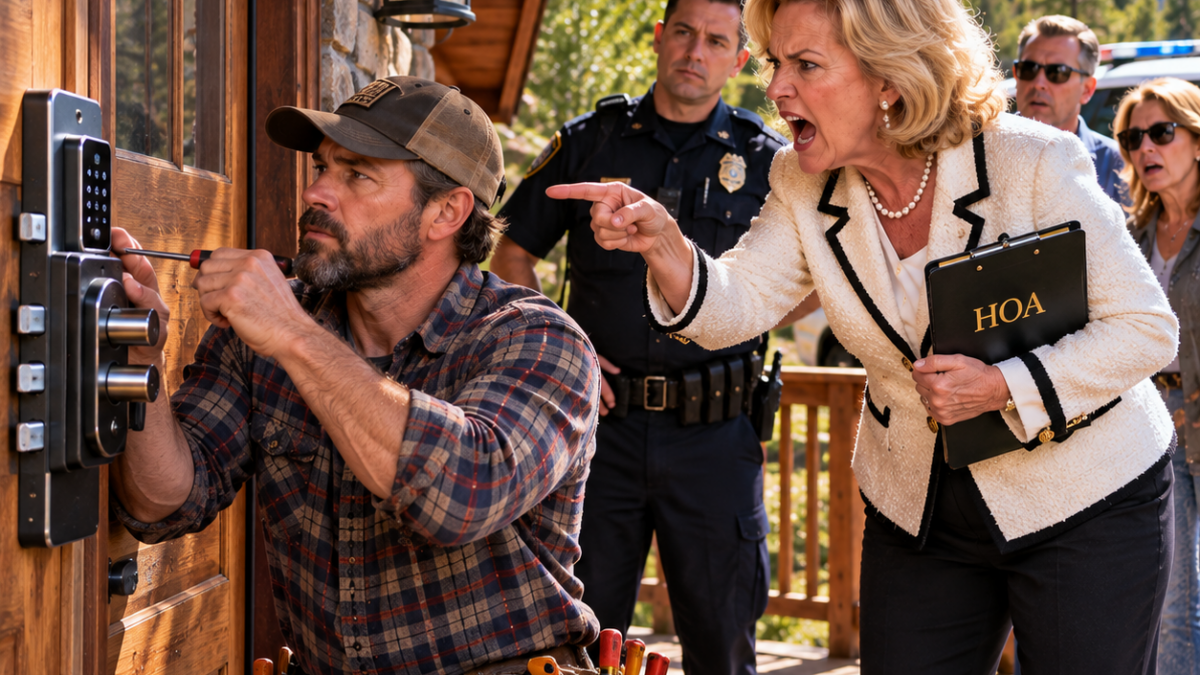
HOA Karen Called Police Because I Refused to Give Her My Cabin Keys—Then She Tried to Break In and Met a Lock She Couldn’t Pick, Drill, or Pry Open.
Seventy-two hours after I moved into my mountain cabin, the HOA’s self-appointed safety queen stood on my deck demanding a spare key and my alarm code because she claimed the board had the right to enter every home whenever it considered an “emergency.”
When I refused, Margaret Halloway sent a handyman to pick my lock, fabricated a police report about a chemical lab inside my cabin, and warned me that sooner or later she would get through my door whether I gave permission or not.
So before my next business trip, I rebuilt that door into something she could neither pick, drill, nor pry open—and when she finally returned with tools and witnesses, the cameras were already recording every word.
My name is Harrison Cole, and I bought the cabin because I was tired of people having access to me.
That sounds dramatic.
It wasn’t.
For fifteen years, I worked corporate logistics.
The kind of job where your phone becomes a second nervous system.
Warehouses.
Freight delays.
Vendor failures.
Customs problems.
Weather disruptions.
Missing containers.
Drivers calling at midnight.
Executives emailing at 5:00 a.m. because they had suddenly discovered a crisis everyone beneath them had been warning about for three weeks.
I made good money.
I also spent most of my thirties and early forties feeling like somebody was always knocking on an invisible door in my head.
Can you fix this?
Can you call them?
Can you get on a plane?
Can you join another meeting?
Can you solve a problem created by somebody who will receive credit afterward?
At forty-three, I sold the small condo I had barely lived in, moved into remote consulting, and started looking for somewhere quiet.
Pine Valley Estates sounded terrible on paper.
HOA.
Private mountain roads.
Architectural guidelines.
Seasonal snow rules.
Shared forest-management assessments.
Normally I would have rejected it immediately.
Then I saw the cabin.
A-frame.
Three stories of dark cedar and glass.
Massive windows facing a ridge of pine and granite.
Stone fireplace.
Wraparound deck.
Small workshop.
No house visible from the back side.
At night, there were more stars than porch lights.
I sat on the deck during the showing for ten minutes without speaking.
The realtor finally asked:
“What do you think?”
“I think you can stop showing me houses.”
I read the governing documents before closing.
Or I thought I did.
Noise restriction after 10:00 p.m.
No commercial signs.
Exterior colors limited.
Snow removal obligations.
Fire-safe vegetation rules.
Trash containers stored out of sight.
Nothing unusual for a mountain community.
PART2:
There was one paragraph regarding “emergency property access.”
It said the association could coordinate entry during imminent threats involving shared infrastructure, wildfire, flooding, or life safety, subject to applicable law and reasonable efforts to contact the owner.
That sounded normal.
If smoke poured from my cabin while I was gone, I expected firefighters to enter.
What I did not see anywhere was:
Give Margaret Halloway your house key.
I learned about that policy three days after moving in.
Tuesday afternoon.
Clear sky.
Forty-nine degrees.
Coffee on the deck.
I was assembling a patio chair badly enough that whoever wrote the instructions should have been investigated.
Then tires crunched on gravel.
White Lexus.
Perfectly clean.
It parked with its wheels exactly parallel to the retaining wall.
A woman stepped out.
Late fifties.
Blonde-gray hair styled into something that appeared immune to wind.
Pale pink sweater set.
Cream trousers.
Pearl earrings.
PART3:
Clipboard against her chest.
She climbed the stairs without waiting to be invited.
“Mr. Cole?”
“Harrison.”
Her smile tightened slightly.
“Margaret Halloway.”
She did not offer her hand.
“HOA secretary and chair of the safety committee.”
“Nice to meet you.”
She clicked a pen.
“Welcome to Pine Valley.”
“Thanks.”
“I just need to complete your new-owner safety intake.”
That phrase made me nervous immediately.
“What does that involve?”
“Emergency contacts, vehicle information, occupancy schedule, spare key, alarm bypass codes.”
I held a wrench halfway between the chair leg and my lap.
“Sorry?”
She looked up.
“Spare key.”
“To my cabin.”
“Yes.”
“No.”
The answer came so naturally I almost surprised myself.
Margaret smiled patiently.
“I don’t think you understand.”
“I do.”
“We require emergency access.”
“No, you don’t.”
Her eyes narrowed.
“Section Four, Paragraph B.”
“I read it.”
“Then you know the association maintains emergency-entry authority.”
“No.”
I put the wrench down.
“It says the HOA can coordinate emergency access when necessary. It does not say I hand you a key.”
“All owners participate.”
“I don’t.”
“That isn’t optional.”
“Then show me the signed covenant requiring it.”
She flipped several pages on the clipboard.
Not because she needed them.
Because people like Margaret enjoy the sound of paper before saying something authoritative.
“This community has had frozen pipes.”
“Okay.”
“Water damage.”
“Okay.”
“Gas leaks.”
“Okay.”
“Residents who fell and couldn’t answer the door.”
“Those are emergencies.”
“Exactly.”
“In an emergency, call 911.”
“That delays response.”
“If my cabin is on fire, your master key isn’t solving the important part.”
Her artificial smile disappeared.
“You’re being unnecessarily difficult.”
“No.”
“I live here year-round.”
“That is not guaranteed.”
“Nothing is.”
“You travel.”
I paused.
“How do you know that?”
“Closing records list your employer out of state.”
That annoyed me more than the key demand.
“My travel schedule is not HOA business.”
“It becomes community business if a pipe freezes while you’re away.”
“My house has smart thermostats, leak sensors, automatic shutoff, and a monitored alarm.”
“We require independent access.”
“No.”
She stared at me.
I stared back.
Then she tried a softer tone.
“Mr. Cole, Pine Valley works because residents cooperate.”
“Cooperation is fine.”
I picked up the wrench.
“Access to my home is not.”
“You are making a mistake.”
“Probably not my first.”
“We have procedures for noncompliant owners.”
“I am sure you do.”
“Fines.”
“Show me the rule.”
“Inspections.”
“Schedule them.”
“Emergency entry.”
“Call emergency services.”
Her knuckles whitened around the clipboard.
“This attitude will not serve you well here.”
I smiled.
“Have a nice afternoon, Margaret.”
She stood another five seconds.
Then marched back to the Lexus.
Gravel sprayed as she left.
I remember thinking:
Annoying.
That was all.
Not dangerous.
Not obsessive.
Not criminal.
Annoying.
Two days later came the first violation.
Trash cans retrieved at 7:14 p.m.
Required by 5:00.
Fifty dollars.
I had been waiting for a furniture delivery.
I paid it.
Not because I agreed.
Because fifty dollars was cheaper than my attention.
That was my first mistake.
Second letter:
New cedar deck boards treated with unapproved finish.
One hundred dollars.
They had clear waterproofing on them.
No color.
I appealed.
Margaret denied it.
I appealed to the board.
Fine suspended pending review.
Then came a notice that stacked firewood was visible from a secondary road.
Then a reminder that outdoor furniture required “earth-tone compatibility.”
I started saving everything.
The white Lexus appeared constantly.
6:20 a.m.
Late evening.
Slow pass.
Another slow pass.
Once I watched Margaret stop near the bottom of my driveway and photograph my shed.
Another time she stood across the road with binoculars.
I texted my neighbor Greg Peterson.
Retired schoolteacher.
Seventy-two.
Cabin two lots down.
Do HOA people normally birdwatch houses?
He replied:
You met Margaret.
Yes.
Then yes.
Greg came over that evening.
He drank bourbon neat and regarded my growing stack of violation notices.
“She wants your key.”
“Yes.”
“She gets fixated.”
“On keys?”
“Control.”
That was more accurate.
“How many residents gave her one?”
“Most older owners.”
“Why?”
“She scares them.”
“How?”
“Fines. Inspections. Safety letters. Says insurance might deny claims if the HOA can’t access the house.”
“Is that true?”
“No idea.”
“Probably not.”
Greg sipped.
“She once entered the Miller cabin at six in the morning.”
“Emergency?”
“She claimed she smelled gas.”
“Was there gas?”
“No.”
“What did she want?”
“She suspected they were renting on weekends without registering guests.”
I stared.
“She walked into sleeping people’s house?”
“Used the key.”
“They called police?”
“No.”
“Why?”
Greg shrugged.
“People up here don’t like trouble.”
“That’s how you get more trouble.”
“Yes.”
He smiled sadly.
“Welcome to Pine Valley.”
A week after my first meeting with Margaret, I drove into town for hardware.
Twenty minutes away.
Halfway down the plumbing aisle, my phone vibrated.
MOTION — FRONT PORCH.
Temporary battery camera above the door.
I opened the feed.
A man stood at my lock.
Heavyset.
Brown work jacket.
Dirty overalls.
Canvas tool bag.
He held a ring of keys in one hand.
Something narrow and metal in the other.
Margaret stood three steps below him.
Arms folded.
I increased volume.
The man said:
“This isn’t opening.”
Margaret:
“Use the other key.”
“I’ve tried all of them.”
“Then pick it.”
I froze.
The man looked at her.
“You said we had authorization.”
“We do.”
“From him?”
“From the association.”
“Margaret—”
“Carl, please.”
She sounded annoyed.
“Safety inspection.”
Carl crouched.
Inserted a tension wrench.
My heart started hammering.
I hit two-way audio.
“CARL.”
He jumped.
Tool hit the deck.
Both looked upward.
I said:
“Step away from my door.”
Margaret’s face twisted.
Carl looked at her.
“You told me he gave permission.”
“I did not.”
She snapped toward him.
“I said the HOA has authority.”
Carl backed down the stairs.
“No.”
Margaret glared.
“What?”
“I am not catching a burglary charge for your HOA.”
“It’s not burglary.”
I spoke through camera.
“Carl, leave.”
He grabbed his bag.
“Already doing it.”
Margaret hissed:
“Coward.”
Carl turned.
“You said there was a leak.”
“There could be.”
“There’s no water anywhere.”
“Get back up here.”
“No.”
He left.
Margaret stood alone.
Then looked directly at the camera.
Her expression changed.
Not embarrassed.
Not apologetic.
Angry.
“This isn’t over, Harrison.”
I saved the recording before leaving the hardware store.
Drove home.
Did not speed despite wanting to.
Called sheriff’s office non-emergency line.
They suggested I file a report if I believed attempted unlawful entry had occurred.
I did.
No arrest at that stage.
Carl hadn’t entered.
Margaret claimed the HOA believed it had authority under its emergency policy.
Still, the incident was documented.
Then I went to Greg.
He watched the footage.
His face fell.
“She’s getting worse.”
“You knew Carl?”
“Community handyman.”
“He does this regularly?”
“He does locks.”
“For owners?”
“For the HOA.”
“Those are different answers.”
Greg nodded.
“Margaret tells him they’re the same.”
That night I ordered better cameras.
Not locks.
Yet.
The next morning, pounding woke me at 7:11.
Not knocking.
Pounding.
I walked to the windows.
Two sheriff’s cruisers.
Lights on.
Margaret stood near the driveway wearing pearls and an expression of concerned citizenship.
I opened the door.
Two deputies.
Lead officer:
DEMPSEY.
“Mr. Cole?”
“Yes.”
“We received a report involving possible hazardous activity inside this residence.”
I looked at Margaret.
“What kind of hazardous activity?”
Dempsey checked his notes.
“Possible chemical processing.”
I laughed.
Couldn’t help it.
The second deputy did not.
“The caller reported blue storage drums, tubing, unusual deliveries, and refusal to allow a safety inspection.”
I looked past them.
Margaret lowered her eyes dramatically.
Oscar performance.
“Deputy, the blue drums are emergency potable-water storage.”
Dempsey waited.
“The tubing is PVC for irrigation.”
“Can we see?”
“Yes.”
I stepped aside.
Then pointed at Margaret.
“She does not enter.”
Margaret immediately spoke.
“I am required to accompany—”
Dempsey turned.
“Ma’am.”
She stopped.
“This is his residence.”
“I represent the association.”
“Stay outside.”
Her jaw tightened.
The deputies entered.
Mudroom.
Two blue water barrels.
Factory labels intact.
Emergency Water Storage.
Spare room.
PVC.
Sprinkler valves.
Garden hose.
Four minutes.
Dempsey stared at the barrels.
Then:
“That’s it?”
“Yes.”
“You manufacture anything?”
“Bad coffee.”
The second deputy almost laughed.
Dempsey did not.
I showed him the previous day’s footage.
He watched all of it.
Once.
Then again.
“Who’s the man?”
“Carl. HOA handyman, apparently.”
“And she directed him to pick the lock?”
“Yes.”
Dempsey’s jaw tightened.
“Save this.”
“Already backed up.”
“Good.”
“Did she tell you I was barricaded?”
He looked at his notes.
“She said you were refusing lawful entry.”
“I opened the door immediately.”
“I noticed.”
We walked outside.
Margaret stepped forward.
“Officer?”
Dempsey looked at her.
“Well?”
She smiled nervously.
“Were there hazardous materials?”
“No.”
“Oh.”
“You reported suspected chemical manufacturing.”
“I reported suspicious barrels.”
“You used language indicating an immediate public-safety concern.”
“I was worried.”
“Mrs. Halloway.”
His tone changed.
“If you knowingly use emergency or law-enforcement resources to gain leverage in a private HOA dispute, that can become a legal problem.”
She looked offended.
“I am responsible for community safety.”
“You are not law enforcement.”
“I never said—”
“You also do not get to enter this man’s home because he refused to give you a key.”
Her face reddened.
“I have bylaws.”
Dempsey nodded toward the cabin.
“He has a deed.”
Beautiful.
Then he pointed toward her Lexus.
“Go home.”
Margaret remained.
“Officer—”
“Go.”
She did.
Before leaving, she turned toward me.
“This isn’t over.”
Dempsey heard it.
He watched her leave.
Then looked at me.
“You have cameras?”
“Upgrading today.”
“Good.”
That afternoon, I did something I should have done immediately.
I hired an attorney.
Dana Mercer.
Property and association law.
Mid-forties.
Direct.
No interest in theatrics.
She read the bylaws.
Then asked:
“Where does it require you to hand over a key?”
“Margaret says Section Four B.”
Dana read it.
“It doesn’t.”
“I know.”
“Has the board adopted a separate policy?”
“I haven’t found one.”
“Request it.”
We did.
Pine Valley produced a two-page “Emergency Access Protocol.”
Adopted seven years earlier.
It encouraged owners to provide voluntary keys to a secure HOA lockbox system.
Voluntary.
Capital letters would not have made it clearer.
VOLUNTARY.
Dana smiled.
“This is excellent.”
“Why?”
“Because she turned voluntary into mandatory.”
“Can we stop her?”
“Yes.”
Cease-and-desist.
No entry.
No key demand.
No inspection without notice except genuine emergency.
No surveillance on property.
No contact except through management or counsel regarding access.
The board’s lawyer acknowledged.
I assumed Margaret would finally stop.
Then she drove past my house at 11:47 that night.
Slowly.
I watched from the window.
White Lexus.
She stopped.
Thirty seconds.
Then continued.
The next morning a violation arrived for “unshielded exterior security illumination.”
I had installed no new lights.
Only cameras.
I called Dana.
“She is escalating because you used counsel.”
“What now?”
“Document.”
“I hate that word.”
“You will love it later.”
The phrase should be printed above every lawyer’s desk.
Document.
Photograph.
Save.
Don’t threaten.
Don’t retaliate.
Don’t give the angry person what they need to make you look unreasonable.
So I documented.
Then Margaret made the mistake that changed my thinking.
Two days after the police visit, she came back.
Stayed at the edge of the driveway.
Did not cross.
Smart enough to learn slightly.
I stepped onto the deck.
“What?”
“You embarrassed me.”
“No.”
“You manipulated that officer.”
“I showed him what was in my house.”
“You knew what I meant.”
“Then say what you mean.”
She pointed at the door.
“That cheap residential lock will not defeat association authority.”
I stared.
“Excuse me?”
“If a legitimate emergency occurs, we will enter.”
“Fire department can enter.”
“The HOA has protocols.”
“You don’t have my permission.”
“We don’t need it in an emergency.”
“What’s the emergency today?”
“Today?”
“Yes.”
“None.”
“Then leave.”
She smiled.
Not nice.
“We have ways into cabins.”
That was a threat.
Maybe not legally.
Emotionally, absolutely.
“What exactly are you telling me, Margaret?”
“That refusing reasonable cooperation can become expensive.”
“Go home.”
“You’ll regret making this adversarial.”
She drove away.
I called Dana.
Then a locksmith.
Not because I wanted an impossible booby-trapped fortress.
Because I wanted a door that resisted unauthorized entry long enough for law enforcement to arrive.
His name was Miguel Santos.
Twenty-three years in commercial security hardware.
He walked through the cabin.
Looked at my existing door.
“Good door.”
“Bad lock?”
“Average.”
“Can it be picked?”
“Everything can be attacked.”
“Can it be made harder?”
“Yes.”
“What do you recommend?”
Miguel did not recommend internet fantasy.
No hidden electrified bars.
No traps.
No dangerous modifications.
He recommended boring professional things.
Which were better.
High-security restricted-keyway cylinder.
Hardened anti-drill components.
Commercial-grade deadbolt.
Full-length reinforced strike.
Three-inch and four-inch structural screws into framing.
Hinge reinforcement.
Door-jamb armor.
Secondary interior security bar for use when occupied.
Monitored contact sensors.
Hardwired cameras.
Local recording backed up to cloud.
And one thing I especially liked:
No master-key compatibility.
“Can the HOA locksmith open it?”
“Not without your key, destructive tools, or authorization from somebody who can legally force entry.”
“Perfect.”
“I want to be clear.”
Miguel looked at me.
“If firefighters need in, they will get in.”
“Good.”
“They may destroy the door.”
“Fine.”
“Security isn’t about making entry impossible.”
“What is it?”
“Making unauthorized entry difficult, slow, noisy, and obvious.”
That was exactly what I wanted.
He installed everything over three days.
The lock was expensive.
The door-frame reinforcement more expensive.
Four wired cameras covered:
Driveway.
Front steps.
Door.
Side approach.
No Wi-Fi-only vulnerability.
Local recorder hidden in locked utility cabinet.
Cloud backup.
Microphones where legal.
Motion alerts.
I added a monitored leak system precisely so Margaret could never claim concern about plumbing again.
Valve sensors.
Automatic main shutoff.
Temperature sensors.
Smoke.
CO.
I sent Dana the installation summary.
She sent the HOA a notice:
Mr. Cole has installed professionally monitored fire, temperature, intrusion, and water-leak detection. There is no basis for association possession of keys or alarm credentials.
Margaret replied personally.
Not through counsel.
Technology fails.
That was the entire email.
Dana replied:
So do boundaries.
I liked Dana.
Then work scheduled me for Chicago.
Five days.
Normally, I might have postponed.
Instead I went.
Not to bait Margaret.
I wasn’t staging a trap.
I needed to attend.
I told nobody in Pine Valley except Greg because he agreed to collect any package deliveries.
Monday morning I flew out.
By noon, my SUV was absent.
At 9:17 Tuesday morning, the first alert appeared.
DRIVEWAY MOTION.
White Lexus.
Margaret.
Second vehicle.
Carl’s pickup.
Third person.
Thomas Jenkins.
HOA treasurer.
Gray hair.
Tweed jacket.
Nervous expression.
I put in earbuds.
Opened feeds.
Margaret walked toward the porch.
Thomas said:
“I really think we need written notice.”
Margaret:
“It is an emergency inspection.”
“What emergency?”
“I smell standing water.”
He stopped.
“So call Harrison.”
“He won’t answer.”
She had not called me.
“Did you try?”
Margaret did not respond.
Carl carried a tool bag.
Thomas noticed.
“Why does Carl need that?”
“In case the lock is jammed.”
“Margaret.”
“Thomas, please.”
They reached porch.
I started screen-recording.
Cloud system already saved everything.
Carl examined the lock.
“This is new.”
Margaret crossed her arms.
“Open it.”
He looked at her.
“I need paperwork.”
“You have me.”
“That isn’t paperwork.”
I almost laughed.
Carl had learned something.
Margaret removed a document from her folder.
“Emergency Access Authorization.”
Thomas leaned over.
“Who signed this?”
“I did.”
“You authorized yourself?”
“I chair safety.”
Thomas looked horrified.
“That is not what this form means.”
“Carl.”
Carl sighed.
He tried a spare HOA key.
Did not fit.
Second.
Third.
Margaret said:
“He changed the cylinder deliberately.”
Thomas:
“Of course he did.”
Carl looked into the keyway.
“Restricted profile.”
“Pick it.”
“I don’t think—”
“Try.”
Carl removed tools.
He worked.
One minute.
Two.
Nothing.
Then:
“This isn’t a normal residential core.”
Margaret tapped her foot.
“You told us you could open locks.”
“I can service standard locks.”
“Then service it.”
“I don’t have authorization from the owner.”
“You have authorization from me.”
Carl stood.
“No.”
Margaret stared.
“What?”
“I made that mistake last time.”
“Carl.”
“No.”
For a second, I thought the entire thing might end there.
Then Margaret took something from her folder.
A check.
She held it out.
I could not hear the amount.
Carl stared.
Thomas said:
“Oh, for God’s sake.”
Carl shook his head.
“I am not picking it.”
Margaret’s face transformed.
“Fine.”
She pointed at his bag.
“Drill.”
Thomas stepped back.
“Absolutely not.”
Margaret ignored him.
“Carl, drill the cylinder.”
“No.”
“I am instructing you as the safety chair.”
“And I’m telling you I am not destroying a man’s door because you say you smell imaginary water.”
Thomas said:
“Thank you.”
Margaret looked between them.
Then:
“Give me the drill.”
Carl stared.
“No.”
“Give it to me.”
“You don’t know how.”
“How difficult can it be?”
That is an extremely dangerous sentence in many contexts.
Carl reluctantly handed her nothing.
He zipped the bag.
Margaret snapped:
“What are you doing?”
“Leaving.”
“You are employed by Pine Valley.”
“Not to burglarize houses.”
Thomas said:
“I’m leaving too.”
Margaret stepped between them and the stairs.
“If you abandon an official inspection, I will report both of you for dereliction.”
Thomas actually laughed.
“Dereliction?”
“I am documenting this.”
“Please do.”
He pointed at my camera.
“So is Harrison.”
Margaret looked up.
Saw the camera.
For a second, I thought she might stop.
Instead she waved.
“Mr. Cole, since you are obviously monitoring this, we have reason to believe your property has a water emergency. You have failed to provide access, so the association is exercising its emergency authority.”
I unmuted.
“Margaret.”
Everybody froze.
My voice came through the porch speaker.
“There is no water emergency.”
She smiled.
“You cannot verify that from Chicago.”
“Yes, I can.”
“How?”
“I have water sensors on every major line.”
“That equipment is not HOA-certified.”
Thomas muttered:
“Oh, my God.”
I said:
“Leave my property.”
Margaret pointed at the camera.
“You are refusing a lawful safety inspection.”
“I am revoking any claimed permission and explicitly ordering you to leave.”
Carl picked up his bag.
“I’m gone.”
He walked down the steps.
Thomas followed.
Margaret stayed.
“You do not understand the consequences.”
“Margaret.”
“What?”
“You are trespassing.”
“I am an officer of the association.”
“You are trespassing.”
“This is community-regulated property.”
“My deed says otherwise.”
“This cabin is inside Pine Valley.”
“That does not make my living room common property.”
She walked to the door.
Tried the handle.
Locked.
Then she did something almost unbelievable.
She kicked the lower panel.
Once.
Not enough to damage.
Enough to change the legal picture.
I dialed sheriff’s office.
Non-emergency first.
The dispatcher listened.
“Is she actively trying to enter?”
“Yes.”
“Any weapons?”
“Not currently.”
“Are you inside?”
“Chicago.”
Pause.
“You’re watching remotely?”
“Yes.”
I gave address.
Then:
“Officer Dempsey responded last week.”
The dispatcher transferred notes.
While I waited, Margaret called Carl back from the driveway.
“Bring the tools.”
He shouted:
“No!”
She walked down.
They argued.
Thomas stood near his car.
Then Margaret reached into the open truck bed.
Pulled out a pry bar.
Carl yelled:
“Put that down!”
I stopped breathing.
Margaret carried it up the steps.
Thomas shouted:
“Margaret, if you touch that door, I’m calling the sheriff.”
“Call them.”
“They’ll arrest you.”
“For maintaining community safety?”
She wedged the bar near the jamb.
My reinforced strike held.
She pushed.
Nothing.
Again.
Wood trim cracked.
Not the structural frame.
She changed position.
Levered harder.
Carl came halfway up the stairs.
“Stop.”
She screamed:
“You are useless!”
Then swung the bar against the decorative trim.
Crack.
Again.
I was now connected to Dempsey.
He had been patched onto the live camera link.
For about fifteen seconds he said nothing.
Then:
“Well.”
“Yep.”
“She really came back.”
“Told you.”
“Do not talk to her.”
“Okay.”
“Do not warn her we’re coming.”
“Okay.”
“Are your alarms active?”
“Yes.”
“Stay on the line.”
Margaret struck the trim again.
Thomas backed farther away.
He said clearly:
“I want the record to show I told you not to do this.”
Margaret shouted:
“The record will show you abandoned your fiduciary responsibility.”
Then she tried the pry bar again.
The door flexed slightly.
Held.
Carl said:
“That frame is reinforced.”
“How?”
“Steel.”
She stared at the door like it had personally betrayed her.
Then:
“We’ll remove the hinges.”
Carl laughed once.
“Hinges are inside.”
“Then cut around it.”
Thomas said:
“I am resigning.”
Margaret turned.
“What?”
“Effective immediately.”
“You cannot resign during an inspection.”
“Watch me.”
He started down the driveway.
Margaret shouted after him.
“You coward!”
Then she raised the pry bar again.
A sheriff’s cruiser turned onto my road.
No siren.
Lights only.
Second behind.
They blocked Margaret’s Lexus and Carl’s truck.
Carl immediately placed both hands on top of his head.
Smart man.
Margaret froze.
Dempsey got out.
“PUT THE BAR DOWN.”
She did.
Slowly.
“Step away from the door.”
“Officer Dempsey, thank God.”
He stared at her.
“We have an emergency.”
“Hands where I can see them.”
“There is water damage—”
“Hands.”
She raised them.
Deputies separated everyone.
Dempsey walked onto the porch.
Looked at the gouges.
Pry bar.
Lock-pick tools still sitting near Carl’s bag.
My camera.
Then looked directly at it.
“Harrison?”
I unmuted.
“I’m here.”
“You recording?”
“Multiple angles.”
“Save everything.”
“Already saved.”
Margaret said:
“He has manipulated the situation.”
Dempsey turned.
“Ma’am.”
“I am authorized under Section Four—”
“No.”
She blinked.
“No?”
“I read the section after our last visit.”
Beautiful.
“It does not authorize you to force entry whenever you choose.”
“There was an emergency.”
“What emergency?”
“Possible standing water.”
“Where?”
“Inside.”
“How do you know?”
“I smelled moisture.”
Dempsey looked toward the forest.
It had rained the previous night.
“I smell moisture too.”
One deputy coughed to hide a laugh.
Margaret said:
“He is absent.”
“Not an emergency.”
“His blinds are closed.”
“Not an emergency.”
“His vehicle is gone.”
“Not an emergency.”
“He refused to provide a key.”
“Not an emergency.”
Her face reddened.
“I have a duty.”
Dempsey pointed at the damaged frame.
“You had a duty to call him.”
“I did.”
I spoke through camera.
“No, she didn’t.”
Margaret looked upward.
Traitorous camera.
Dempsey asked:
“Mr. Cole, did the HOA have permission to enter?”
“No.”
“Did you tell them to leave?”
“Multiple times.”
“Did you authorize damage to the door?”
“No.”
He looked at Margaret.
Then Carl.
Then Thomas.
Carl immediately said:
“I told her no.”
Margaret spun.
“Carl!”
He continued.
“She tried to get me to pick it. I stopped. She took the bar herself.”
Thomas said:
“That’s accurate.”
Margaret looked like she had been abandoned by civilization.
Dempsey spoke with deputies.
Then approached her.
“Mrs. Halloway, you’re being placed under arrest for suspected attempted unlawful entry, criminal trespass, and property damage. Exact charges will be reviewed by investigators and prosecutors.”
She stared.
“You can’t arrest me.”
“Yes, ma’am.”
“I am the HOA secretary.”
Dempsey said:
“That is not a criminal immunity program.”
“Call Magistrate Wilkins.”
“Why?”
“He is my brother-in-law.”
Dempsey’s face became still.
“Are you asking a judicial officer related to you to interfere with this arrest?”
“No.”
“Good.”
He turned her around.
Handcuffs.
No dramatic slamming against the car.
No theatrical speech.
Professional.
Margaret kept talking.
“This is going to destroy your career.”
Dempsey ignored it.
Carl was detained for questioning.
Not immediately booked.
The footage showed he had initially participated by attempting the lock but ultimately stopped and repeatedly objected before property damage escalated.
He later cooperated.
Thomas provided a full statement.
Then resigned from the board in writing before sunset.
I watched the cruiser leave through my security feed from a Chicago hotel.
Then closed the laptop.
Sat alone.
And felt nothing like victory.
Mostly exhaustion.
Because home is supposed to be the place where you do not need a legal strategy to close the door.
I flew back Friday.
Miguel inspected the damage.
The actual reinforced frame remained solid.
Decorative cedar trim was destroyed.
Lock had tool marks from Carl’s earlier attempt but still functioned.
“Good system.”
“Worth it.”
He looked at me.
“You understand this is not normal.”
“I am beginning to.”
Dana arrived with documents.
Then Greg.
Then bourbon.
Apparently crises attract paperwork and alcohol.
Dana said:
“The board called.”
“Already?”
“They are terrified.”
“Good.”
“No.”
I looked at her.
“You want them rational.”
“Why?”
“Rational people settle.”
Excellent point.
The board scheduled emergency meeting.
Margaret was suspended pending investigation.
Safety committee powers frozen.
Key-storage program halted.
HOA counsel reviewed the underlying documents.
What they found was worse than I knew.
There had never been a mandatory-key rule.
Seven years earlier, after two severe winter pipe failures, the board approved a voluntary emergency-key program.
Owners could place a spare key in a secure lockbox controlled by management.
Margaret became safety-chair three years later.
She changed implementation without changing the bylaws.
New residents were simply told keys were mandatory.
Most believed her.
Older residents complied.
Management staff assumed the board had approved it.
Board members assumed management had legal language somewhere.
Everyone assumed somebody else had checked.
Classic.
Dana summarized:
“Policy by repetition.”
“How many keys?”
“Forty-eight.”
My stomach tightened.
“Who had access?”
“Management office and Margaret.”
“Personally?”
“Apparently.”
“Records?”
“Bad.”
“Usage logs?”
“Worse.”
The board hired an independent locksmith to rekey the emergency storage cabinet.
Then decided that was not enough.
Every key was returned to its owner.
Program suspended permanently pending legal review.
Residents began telling stories.
The Millers.
Entered while sleeping.
Greg.
Margaret once unlocked his mudroom because he had not answered his phone during a snowstorm.
A widow named Elaine Porter said Margaret entered after her husband died “to check pipes” and later mentioned personal items she could only have seen in the bedroom hallway.
Another owner discovered his cabin had been inspected while he was abroad.
No damage.
No emergency.
Just access.
The more people talked, the less my situation looked isolated.
At the emergency town hall, the room was packed.
Margaret could not attend due to advice of counsel.
Good.
The board president, Dennis Ward, looked like a man who had not slept.
He opened:
“We need to acknowledge serious failures in the way emergency-access policies were administered.”
A resident shouted:
“Administered? She broke into houses!”
Noise.
Dennis raised his hands.
“Please.”
Greg stood.
“Did the board know she was telling residents keys were mandatory?”
Dennis hesitated.
“That is under review.”
“That’s not an answer.”
Board attorney leaned to microphone.
“No board resolution we have located made key surrender mandatory.”
The room erupted.
One woman shouted:
“I PAID A LOCKSMITH TO COPY MINE FOR HER!”
Another:
“She threatened to fine me!”
Another:
“She entered my house!”
Dennis looked sick.
Thomas Jenkins sat in the audience.
No longer treasurer.
He stood.
“I owe everyone an apology.”
Room quieted somewhat.
“I saw behavior I disagreed with and treated it as Margaret being Margaret.”
That phrase landed.
Margaret being Margaret.
How often bad behavior survives under a nickname.
Thomas continued:
“I told myself she was difficult but useful.”
Pause.
“I was wrong.”
He looked around.
“The day at Harrison’s cabin, I went because she said there was a legitimate welfare concern.”
He swallowed.
“When it became clear there wasn’t, I should’ve called law enforcement immediately.”
Someone said:
“You did eventually.”
“Too late.”
I respected that.
Then Dana spoke briefly on my behalf.
No theatrics.
She outlined:
Repeated key demands.
Attempted lock entry.
False or grossly misleading police complaint.
Written cease-and-desist.
Second attempted forced entry.
Recorded explicit demand to leave.
Property damage.
No emergency.
The facts were enough.
The board voted that night.
Safety committee dissolved.
Voluntary key program terminated.
No board officer permitted to possess private residence keys in an official capacity.
Emergency procedures rewritten:
Call owner.
Call emergency services.
Use licensed professionals.
No forced entry by HOA personnel absent owner consent or legally recognized emergency necessity.
Simple.
Boring.
Good.
Then came Margaret’s criminal case.
Less cinematic than neighborhood rumors.
More serious than she expected.
Her lawyer argued she genuinely believed HOA emergency provisions authorized entry.
That could matter to intent.
But recordings hurt.
Especially:
He embarrassed me in front of the police.
And:
We are going inside.
And her refusal to leave after explicit instruction.
And the pry bar.
The prosecutor eventually negotiated a plea involving criminal trespass and property-damage offenses, with the most serious burglary allegation reduced.
Probation.
Restitution.
Community service.
No prison.
No dramatic felony destruction of her life.
Some neighbors were disappointed.
I wasn’t.
The point was accountability.
Not spectacle.
Carl was not convicted of burglary.
He admitted attempting the lock initially under Margaret’s representation that there was association authorization.
He paid a fine related to unlawful entry activity, surrendered his HOA handyman contract, and testified.
Months later he came to my cabin.
Stayed at bottom of the steps.
“Can we talk?”
I went outside.
He looked embarrassed.
“I owe you.”
“Yes.”
“I thought she had authority.”
“You also knew you didn’t have my permission.”
He nodded.
“Yeah.”
Silence.
“I should’ve left the first time.”
“Yes.”
“I shouldn’t have come back.”
“Yes.”
He almost smiled.
“You’re not making this easy.”
“You came for honesty.”
“Fair.”
He looked at the repaired door.
“That lock really is nasty.”
I laughed.
“Miguel picked it.”
“Of course he did.”
“No.”
I meant chose it.
Carl laughed.
First time.
Then:
“I’m sorry.”
I believed him.
“Thank you.”
He left.
Thomas returned to teaching part-time at the community college.
He never joined another HOA board.
Smart man.
Officer Dempsey became something of a local legend, which annoyed him.
Greg printed a still image from the footage showing Dempsey pointing at the pry bar while Margaret stood beside the damaged door.
Caption:
SECTION FOUR, PARAGRAPH NO.
I refused to hang it.
He hung it in his own garage.
The civil settlement took longer.
Pine Valley’s insurer covered part of the property damage.
The association reimbursed:
Door trim.
Lock inspection.
Camera-related expenses tied to documented harassment.
Attorney fees under a negotiated settlement.
And a modest amount related to the association’s failure to control an officer acting under color of board authority.
I did not get millions.
My cabin was not burned down.
My life was not ruined.
I wanted the legal fees paid and the behavior stopped.
That happened.
Margaret personally paid restitution for the door damage not covered under association protections.
Her board indemnification failed for conduct deemed outside authorized duties.
She resigned.
Then listed her cabin six months later.
I did not stand outside watching moving trucks.
I happened to be home when she left.
White Lexus came down the road.
Stopped near my driveway.
Window lowered.
Margaret looked older.
No clipboard.
“Harrison.”
“Margaret.”
She stared at the cabin.
“Are you happy?”
I knew what she meant.
“No.”
That surprised her.
“You got everything you wanted.”
“No.”
“What else could you possibly want?”
“To have moved here and never met you.”
She looked hurt.
Good.
Then I felt bad.
Not because it wasn’t true.
Because cruelty after victory is still cruelty.
I softened slightly.
“I wanted privacy.”
She looked toward the door.
“You made me look insane.”
“No.”
Her eyes hardened.
“You filmed me.”
“The cameras filmed my porch.”
“You knew I would come.”
“I suspected.”
“So it was a trap.”
“No.”
I walked closer to the road.
“Margaret, the lock wasn’t a trap.”
“Of course it was.”
“It was a locked door.”
She stared.
“That is the whole point.”
Silence.
“You only experienced it as a trap because you decided you were entitled to get past it.”
Her face changed.
That landed.
For once she had no response.
I continued:
“If you had stayed off the porch, nothing happened.”
“If you had called me, nothing happened.”
“If you had followed the rules you kept quoting, nothing happened.”
She looked away.
Then:
“I was trying to protect the community.”
“I believe you believed that.”
That surprised both of us.
“But you started treating disagreement as danger.”
She swallowed.
“You thought if somebody said no, they must be hiding something.”
Margaret’s eyes filled.
Not enough to cry.
Close.
“I made mistakes.”
“Yes.”
“Everyone turned on me.”
“They were angry.”
“I gave years to this place.”
“I know.”
“Nobody remembers the good.”
That was probably true.
People rarely do after trust breaks.
I said:
“Then carry the good with you.”
She looked at me.
“But don’t use it to erase the bad.”
Long silence.
Finally:
“I hate that door.”
I laughed.
She almost smiled.
Then drove away.
That was the last time I saw her.
Pine Valley became quieter afterward.
Not because conflict disappeared.
The board still argued about snow-removal contracts.
Someone still complained that Greg’s porch light was too bright.
A committee spent four months debating whether decorative firewood racks counted as outdoor storage.
HOAs remain themselves.
But boundaries improved.
The new board president was Melissa Grant.
Emergency-room nurse.
Practical.
Her first announcement said:
THE HOA DOES NOT NEED YOUR HOUSE KEY.
People printed it.
Someone taped it inside the clubhouse.
Melissa visited me once.
She stopped at the bottom of the stairs.
“May I come up?”
I laughed.
“What?”
“Nothing.”
“What?”
“You asked.”
She looked confused.
“Why wouldn’t I?”
Exactly.
“Come up.”
She inspected the repaired cedar trim.
“That’s the famous door?”
“Apparently.”
“Looks normal.”
“That was the goal.”
She examined the lock.
“Can firefighters get through?”
“Yes.”
“Good.”
“Why?”
“Because half the neighborhood thinks you installed a bank vault.”
“Greg talks.”
“Greg absolutely talks.”
She smiled.
“We’re rewriting safety procedures.”
“Dana already reviewed?”
“Yes.”
“Then I don’t need to.”
“I wanted a homeowner perspective.”
That was new too.
She asked:
“If you’re gone and a neighbor sees water pouring out under your door, what should we do?”
“Call me.”
“Then?”
“Call fire department if severe.”
“Can management shut water from outside?”
“Yes.”
“Where?”
I showed her exterior shutoff.
She wrote it down.
No key.
No alarm code.
No problem.
That is what competent safety planning looks like.
It works around privacy instead of demanding surrender of it.
Months later Pine Valley installed exterior emergency shutoffs for several older cabins after owners consented.
They upgraded shared fire-hydrant access.
Published evacuation plans.
Created voluntary contact forms.
Useful safety work.
No master keys.
Margaret had spent years believing safety meant access.
Melissa understood safety meant systems.
Big difference.
My cabin finally became what I bought it to be.
Quiet.
I worked mornings.
Hiked afternoons.
Built furniture badly.
Learned to split wood properly.
Greg taught me cross-country skiing.
I taught him how to automate his thermostat.
We both regretted the exchange.
The reinforced front door became ordinary.
That was the best outcome.
For the first few months, every camera alert tightened my chest.
Then fewer alerts.
Delivery driver.
Deer.
Greg.
Snow sliding off roof.
Nothing.
One evening I realized I had gone three days without checking the camera history.
Progress.
Dana called about a year later.
“Still have the lock?”
“Yes.”
“Any HOA invasions?”
“None.”
“Disappointing.”
“You sound like Richard Gable.”
“Who?”
“Different lawyer.”
“Should I be jealous?”
“No.”
She said:
“I use your case as an example now.”
“Of what?”
“Why informal governance is dangerous.”
I leaned back.
“Explain.”
“Boards adopt a loose policy.”
“Okay.”
“Then one person administers it.”
“Margaret.”
“They add interpretations.”
“Keys mandatory.”
“Nobody corrects them.”
“Right.”
“Years pass.”
“Then interpretation becomes tradition.”
I nodded.
“Tradition becomes authority.”
“Exactly.”
“And everyone forgets where the original rule ends.”
“That.”
I looked at the framed copies I kept in the office.
Voluntary protocol.
Margaret’s mandatory intake sheet.
Same system.
Different claim.
Dana said:
“The dangerous phrase is ‘We’ve always done it this way.’”
I smiled.
“Second only to ‘It’s for your safety.’”
“Careful.”
“Why?”
“Sometimes it is.”
Fair.
Years later, Pine Valley experienced a real emergency.
February.
Severe freeze.
Power outage.
Temperatures below zero.
A cabin three roads over had a pipe rupture while the owners were away.
Neighbor saw water flowing beneath garage door.
Called HOA emergency number.
Melissa called owner.
No answer.
Called fire department.
Fire department arrived.
Utility shut off outside.
No forced entry needed.
Damage limited.
At the next HOA meeting Melissa said:
“That is what emergency response looks like.”
Everybody knew what she meant.
Nobody said Margaret’s name.
The irony was obvious enough.
Officer Dempsey retired eventually.
Greg and I attended his retirement breakfast.
I gave him a small gift.
A decorative key mounted in a frame.
Plaque:
FOR HOA EMERGENCIES ONLY.
He stared.
Then laughed.
“I should arrest you.”
“Retired.”
“Still know people.”
He hung it in his garage.
We talked afterward.
He said something that stayed with me.
“You know why your situation bothered me?”
“Because Margaret lied to you.”
“That.”
He took a drink.
“But more.”
“What?”
“She thought calling police transferred her authority problem onto us.”
I waited.
“A lot of people do that.”
“How?”
“They’re in a dispute.”
“Okay.”
“They can’t get what they want.”
“So they describe the other person as dangerous, suspicious, unstable, threatening.”
He shook his head.
“Then they expect a badge to turn their preference into law.”
I thought about the chemical-lab call.
“Does it work?”
“Sometimes enough to cause damage.”
That was uncomfortable.
I asked:
“What should people do?”
“Tell the truth.”
“Revolutionary.”
“Facts give us options.”
He looked at me.
“Exaggeration creates risk.”
That was another reason I stopped telling the story like some triumphant trap.
Yes, the lock mattered.
Yes, the cameras mattered.
But the most important thing was documentation.
My first instinct had been:
Build an unbeatable door.
My better instinct became:
Build an undeniable record.
Because locks stop hands.
Evidence stops stories.
Margaret could say:
Emergency.
The camera showed:
Revenge.
She could say:
Authorized inspection.
Audio showed:
He embarrassed me.
She could say:
Jammed lock.
Video showed:
Pry bar.
The truth was not more dramatic.
It was clearer.
Eventually I replaced the front door.
Not because Margaret damaged it beyond repair.
Because eight years later the wood warped.
Mountain weather.
Miguel came back.
Older.
More gray.
“You want the same hardware?”
“Yes.”
“Still scared of HOA?”
“No.”
“Then residential lock?”
I looked at him.
“No.”
He laughed.
“Thought so.”
We reused the high-security cylinder after servicing it.
New reinforced frame.
Updated camera.
Nothing exotic.
Nothing intended as a challenge.
Just a good door.
Miguel said:
“You know people online think this thing is unpickable.”
“Nothing is unpickable.”
“Correct.”
“They also think I had magnetic bars and hidden RFID birdhouses.”
He stopped.
“What?”
“Never mind.”
He shook his head.
“Internet.”
“Yep.”
The real system had been better precisely because it was boring.
Certified hardware.
Reinforced frame.
Professional installation.
Monitoring.
Evidence.
No tricks.
I came to appreciate boring.
Boring means engineered.
Boring means tested.
Boring means something works after the story ends.
Greg sold his cabin before I did.
Moved closer to grandchildren.
The day he left, he handed me a box.
Inside:
Bourbon.
Old binoculars.
A spare key.
I held it up.
“What’s this?”
“My old cabin.”
“Why?”
He smiled.
“Thought you’d appreciate the irony.”
“Does the new owner know?”
“Absolutely not.”
I threw it at him.
He laughed.
Then hugged me.
“Don’t let these people make you weird.”
“Too late.”
After Greg left, Pine Valley felt emptier.
Not bad.
Just changed.
New neighbors moved in.
Young couple.
First week, they knocked.
Actually knocked.
I opened.
“Hi.”
They introduced themselves.
Brought cookies.
Then the husband asked:
“Are you the lock guy?”
I closed my eyes.
His wife elbowed him.
“What? Everyone told us.”
“Yes.”
“Can we see it?”
“No.”
He looked disappointed.
“Is Margaret really banned from every HOA in the state?”
“No.”
“Oh.”
“Did she really call SWAT?”
“No.”
“Did you electrify the door?”
“Absolutely not.”
His wife said:
“I told you TikTok lied.”
I stared.
“There’s a TikTok?”
Bad day.
Apparently my quiet mountain dispute had become internet folklore.
The most popular version involved:
Twelve armed officers.
A federal warrant.
A titanium vault door.
A corrupt judge arrested with Margaret.
None true.
I told the neighbors what actually happened.
The husband looked disappointed.
Then thoughtful.
“So she got arrested because she wouldn’t accept no.”
“Basically.”
“That is still pretty good.”
Fair.
I kept living there.
That is the ending people overlook.
Revenge stories always end with the villain leaving.
But the protagonist has to wake up the next morning.
Pay property taxes.
Shovel snow.
Replace water heater.
Attend HOA meetings if he wants things to improve.
Live in the place where the conflict happened.
That is why I eventually joined one committee.
Not safety.
Never safety.
Road maintenance.
Boring.
Snowplow bids.
Drainage.
Gravel.
Culverts.
Perfect.
At my first meeting, Melissa handed me a key to the maintenance shed.
I stared.
She immediately said:
“Voluntary.”
The entire room laughed.
I took it.
That mattered too.
The issue was never keys.
It was consent.
I will give a trusted person access when I choose.
I will let emergency services enter when required.
I will hand you a key to a maintenance shed because I agreed to take responsibility.
Consent turns access into cooperation.
Without it, access becomes intrusion.
Margaret never understood that.
She thought refusal itself was evidence of wrongdoing.
A locked door offended her because it represented authority she did not possess.
So she kept testing it.
First words.
Then fines.
Then a handyman.
Then police.
Then a pry bar.
Each escalation was her attempt to prove that my no was temporary.
The lock finally made the no physical.
Not unbeatable.
Just expensive enough, slow enough, and documented enough that she could no longer pretend she had slipped across a boundary accidentally.
She had to choose.
Leave.
Or force.
She chose force.
After that, nobody needed my opinion about what she intended.
The video answered.
I am fifty-six now.
Still in the cabin.
Still consulting, though less.
The deck boards have been replaced again.
With the same clear sealant that once earned me a violation.
No citation this time.
The white Lexus never came back.
Sometimes I sit outside in winter and watch snow cover the driveway until the world becomes completely quiet.
That was what I wanted from the beginning.
Quiet.
Not victory.
Not a viral story.
Not handcuffs.
Quiet.
People confuse peace with passivity.
They’re different.
Peace sometimes requires saying no early enough and clearly enough that another person cannot reinterpret your silence as permission.
I learned that late.
When Margaret first asked for my key, I thought the disagreement was ridiculous.
Small.
Petty.
It was.
Most boundary violations begin small.
Give me a key.
Why?
Because everybody does.
Let me inspect.
Why?
Because I said safety.
Let me enter.
Why?
Because you refused before.
Each step becomes easier if the previous one went unchallenged.
That is why the most important moment in the entire story was not the arrest.
Not the cameras.
Not the reinforced door.
It was the first afternoon on the deck when Margaret held out her hand and said:
“Spare key.”
And I said:
“No.”
Everything after that was simply her refusing to believe the answer.
The cabin door still has the same high-security lock.
Miguel polishes it when he services the hardware.
No scars from Margaret remain on the new cedar trim.
The cameras are smaller now.
Better.
Less obvious.
The HOA does not have the key.
Nobody in management has the alarm code.
Melissa has my phone number.
Fire department knows the address.
Leak system works.
Smoke detectors work.
That is enough.
Inside my office, I keep three things framed together.
Margaret’s original emergency-access form.
The voluntary policy proving it was never mandatory.
And a still image from my porch camera.
Margaret holding the pry bar.
Not because I enjoy looking at her humiliation.
Because those three pieces tell the entire story.
Rule.
Distortion.
Consequence.
The original rule was reasonable.
The distortion made it abusive.
The consequence arrived when somebody finally insisted on the difference.
People sometimes ask what lock they should buy if they have an HOA like mine.
I tell them the lock was not the first thing that protected me.
The first thing was reading the documents.
The second was keeping evidence.
The third was getting a lawyer before anger made decisions for me.
The fourth was calling law enforcement when conduct crossed from annoying into criminal.
The hardware came after.
Still useful.
Very satisfying.
But metal alone cannot fix bad governance.
Only accountability does that.
Margaret thought my new lock was a declaration of war.
It wasn’t.
It was a boundary.
She thought the cameras were a trap.
They weren’t.
They were witnesses.
She thought Officer Dempsey was supposed to enforce her version of the HOA rules.
He didn’t.
He enforced the actual law.
And she thought being chair of a safety committee meant every locked door in Pine Valley was eventually hers to open.
That belief lasted right up until the afternoon she stood on my porch with a steel pry bar at her feet, two deputies behind her, and a reinforced cabin door still locked exactly the way I had left it.
In the end, the lock never had to beat Margaret.
It only had to hold long enough for Margaret to beat herself.




