HOA Hired a Crew to Cut the 12,400-Volt Power Line Across My Ranch—Then All 300 Luxury Homes Went Dark in a Freezing Storm.
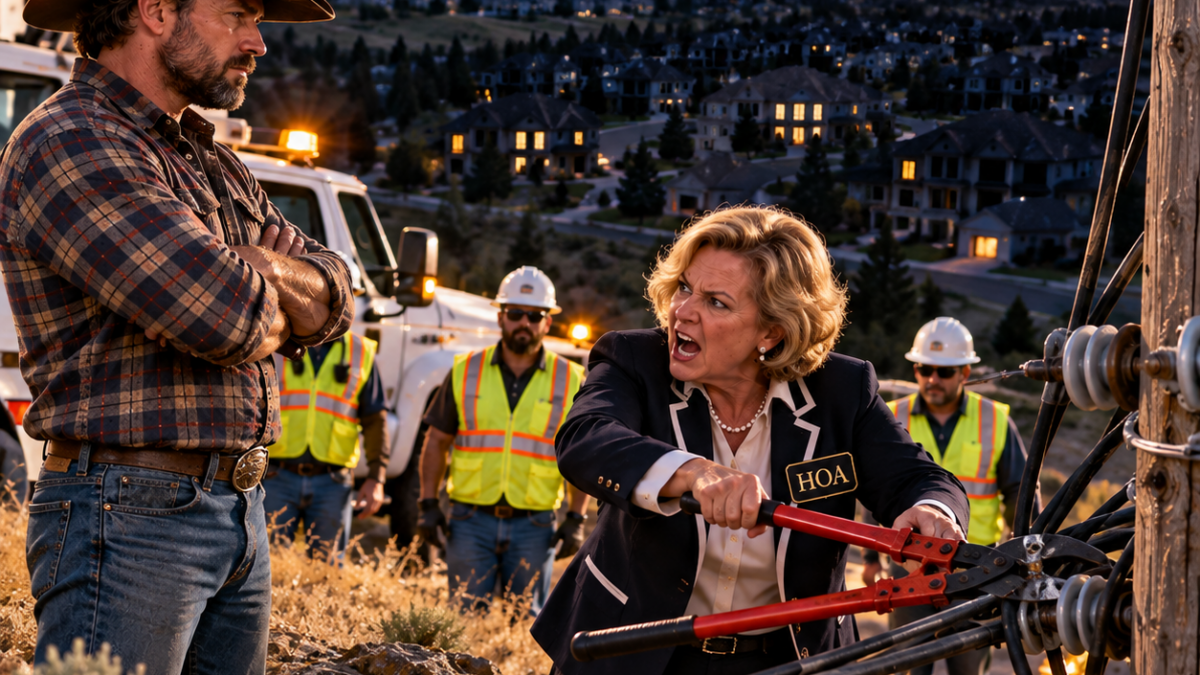
PART2:
“I always look like this.”
“They’re building houses.”
“They own the dirt.”
“That’s surprisingly reasonable.”
“Don’t tell anyone.”
The houses came quickly.
Oak Creek Estates.
Phase One.
Then Phase Two.
Large stucco homes with faux-stone fronts.
Half-acre lots.
Curving streets.
Entry fountains.
Decorative ponds.
Matching street lamps.
Gated entrance.
Houses started around $1.8 million.
Some went above three.
I did not care.
People want a big house near cattle?
Fine.
They want a heated pool?
Fine.
They want imported trees planted in Colorado clay?
Their money.
The problem began when Oak Creek stopped treating the ranch like a neighbor and started treating it like unfinished development.
The first letter arrived six months after Richard Caldwell became HOA president.
Thick envelope.
Watermarked paper.
Embossed crest.
Sarah found me reading it beside the mailbox.
“What is that?”
“Comedy.”
She took it.
Violation One:
UNAPPROVED LIVESTOCK ODOR.
Fine: $250.
Violation Two:
IMPROPER STORAGE OF AGRICULTURAL MACHINERY VISIBLE FROM RESIDENTIAL LOTS.
Fine: $100.
Sarah looked up.
“Livestock odor?”
“Apparently cows have failed architectural review.”
“Are we paying it?”
“No.”
“What are you doing with it?”
I walked toward the shop.
Sarah followed.
“Dad.”
I opened the stove.
“Dad.”
Dropped the notice in.
“Evidence.”
“You’re burning evidence.”
“It was emotionally necessary.”
She sighed.
“If this becomes a lawsuit, I’m telling Tom.”
Tom Henderson was my lawyer.
Also my high-school football teammate.
Also the only man I knew who could insult somebody for forty-five minutes without raising his voice.
A second letter came.
Then third.
Tractor operation before seven.
Dust migration.
Barbed-wire fencing visible from “premium residential sightlines.”
Improper nighttime livestock noise.
I did not know cows could violate quiet hours.
Sarah started saving every letter.
“Stop burning them.”
“Yes, Mom.”
“I’m serious.”
“So am I.”
“Dad.”
I handed her the latest.
She scanned it.
“This one says your hay shed roof isn’t an approved color.”
“It was built in 1964.”
“Rust wasn’t approved?”
“Apparently not.”
Then Richard Caldwell appeared at the fence.
White Range Rover.
Pristine.
Not normal clean.
Museum clean.
A vehicle that had never carried feed, tools, fencing wire, or anything dirtier than golf clubs.
Richard wore cream pants and a pale-blue shirt with a sweater tied across his shoulders.
In August.
I was repairing a trough.
He stopped his SUV on his side and walked to the fence.
“Mr. Pendleton.”
I kept tightening the fitting.
“That depends.”
“Richard Caldwell.”
“I know.”
That surprised him.
“President of Oak Creek Estates.”
“That explains the mail.”
His smile became thinner.
“I wanted to discuss the appearance of this section of your ranch.”
“No.”
He blinked.
“No?”
“You wanted to discuss it.”
“Yes.”
“I don’t.”
He stared.
“Your agricultural operations are materially affecting the enjoyment and value of our Phase Two homes.”
“Then your developer should’ve bought land farther from cattle.”
“That’s dismissive.”
“Correct.”
“People paid significant premiums for those views.”
I finally looked at him.
“What view?”
He pointed.
“The valley.”
“That’s still there.”
“And unfortunately industrial ranch infrastructure.”
I looked behind me.
Trough.
Fence.
Tractor.
Barn.
“Working ranch.”
“It can be screened.”
“With what?”
“Landscaping.”
“For six thousand acres?”
“The boundary area.”
“Who pays?”
“The ranch owner should maintain reasonable compatibility with adjacent residential communities.”
I laughed.
He did not.
“Richard, this ranch has been here since 1942.”
“Things change.”
“Your neighborhood changed.”
“Growth benefits everyone.”
“Didn’t ask.”
His jaw tightened.
“We have executives, physicians, attorneys, entrepreneurs.”
“Good.”
“They expect standards.”
“Then hold yourselves to them.”
“You know what I mean.”
“I do.”
He leaned on the top fence wire.
I looked at his hand.
“Wouldn’t.”
“What?”
“Barbed wire.”
He jerked back.
Good.
“You are hurting the value of a development worth more than fifty million dollars.”
“Then you overpaid.”
His face turned red.
“If you won’t voluntarily mitigate the nuisance, the board will examine legal remedies.”
“Have fun.”
“We will.”
“And Richard?”
He turned.
“Stay off my fence.”
That should have been the end.
It wasn’t.
Men like Richard rarely become less interested after somebody tells them no.
They become curious about what the word really means.
The next battle began on the southeast ridge.
Six wooden utility poles had crossed that ridge for almost fifty years.
Tall.
Weathered.
Ugly.
Functional.
In 1978, Colorado Valley Electric needed a new feeder route into the southern end of Red Valley.
My father granted an easement.
The utility installed six poles across our property.
The easement was recorded.
Permanent for utility purposes.
Colorado Valley Electric owned and maintained the poles and lines.
We owned the ground beneath them subject to the easement.
In exchange, Red Valley Ranch received a favorable connection arrangement and access for agricultural service.
Routine rural stuff.
Then Oak Creek expanded directly beneath the ridge.
From Phase Two’s newest back patios, the poles stood against the western skyline.
Richard hated them.
I learned this when the certified letter arrived.
Dear Mr. Pendleton,
It has come to the Board’s attention that obsolete overhead utility structures located on your ridge substantially impair designated scenic-view corridors serving Oak Creek Estates.
You are directed to underground all visible electrical lines and remove the existing wooden poles within thirty days.
Cost shall be borne by the responsible property owner.
Failure to comply may result in HOA abatement and recovery of costs.
I read it twice.
Then drove to Tom’s office.
He read it.
Removed his glasses.
Read it again.
Then started laughing.
“What?”
He held up one finger.
Needed a moment.
Finally:
“This may be the stupidest letter I’ve received professionally.”
“High praise.”
“He thinks these are your poles?”
“Apparently.”
“Does he understand what easement means?”
“Apparently not.”
Tom pulled the recorded agreement.
“Colorado Valley owns the facilities.”
“I know.”
“The HOA has no authority over your parcel.”
“I know.”
“The lines feed their neighborhood.”
“I know.”
Tom stopped.
“What?”
“You heard me.”
He looked at the utility map.
Then started laughing again.
“Oh, Arthur.”
“What?”
“This is extraordinary.”
Oak Creek’s electrical distribution was mostly underground.
That was what confused Richard.
People saw green transformer cabinets near sidewalks and assumed power appeared there by suburban magic.
The buried distribution network connected to a primary feeder entering from the north.
That feeder came over my ridge.
Those ugly wooden poles were the neighborhood’s electrical umbilical cord.
“Tell him.”
Tom nodded.
“I’ll be painfully clear.”
The letter went out next day.
It attached:
Recorded easement.
Utility ownership documentation.
Service map.
Notice that interference with energized infrastructure could result in severe injury or death.
Notice that trespass onto the ranch would be prosecuted.
And one line Tom enjoyed:
The Association is neither owner, operator, regulator, nor engineering authority over the referenced electrical facilities and is instructed to take no action whatsoever concerning them.
Richard called me that afternoon.
“You hired a lawyer.”
“You wrote me legal threats.”
“Henderson’s letter is nonsense.”
“Call Colorado Valley Electric.”
“I already had our landscape consultant inspect the poles.”
I paused.
“Your landscape consultant?”
“Yes.”
“To inspect 12.4-kilovolt electrical infrastructure?”
“They appear antiquated.”
“That isn’t a technical diagnosis.”
“They’re wood.”
“So?”
“Modern developments bury utilities.”
“Oak Creek does.”
“Exactly.”
“The feeder doesn’t.”
“It could.”
“Sure.”
“Then bury it.”
“You want me to pay to redesign your neighborhood’s electric supply?”
“I want you to correct a nuisance on your property.”
“They are not my poles.”
“They stand in your soil.”
“Your water meter stands in county right-of-way. Doesn’t make the county responsible for your shower.”
“Don’t be cute.”
“I am begging you, Richard.”
“What?”
“Call the utility.”
Silence.
Then:
“You think you’re clever.”
“No.”
“You think because you’re some old rancher with historical documents you can obstruct progress indefinitely.”
“I’m fifty-eight.”
“What?”
“Old rancher felt hurtful.”
He hung up.
Two weeks later, Richard came to the ridge.
I was checking fence.
His Range Rover appeared on a private ranch track that should never have had a Range Rover on it.
I drove my F-250 across the path.
He stopped.
Got out.
Tom’s letter crumpled in one fist.
“This ends now.”
“Good.”
“You are deliberately refusing to remove a hazard.”
“No.”
“Our counsel believes the association has nuisance-abatement rights.”
“Your counsel told you that?”
His eyes moved.
Interesting.
“Who is your counsel?”
“None of your business.”
“Because I think your counsel would faint if he knew you were threatening live utility facilities.”
“These are abandoned lines.”
I stared.
“What?”
“Your scare tactics aren’t working.”
“Richard.”
“Our main power comes from Highway 17.”
“Eventually.”
“These poles feed your barns.”
“They also carry the feeder into Oak Creek.”
“No.”
“Yes.”
“I asked someone.”
“Who?”
“Our development engineer.”
“Electrical engineer?”
“Site engineer.”
“Call Colorado Valley.”
“You keep saying that because they’re your friends.”
I laughed.
“It’s an electric cooperative, not my bowling team.”
“You’ve obviously told them to support your position.”
“Richard, those lines are 12,400 volts.”
“So?”
I actually stepped closer.
“So if you send somebody up here with a chainsaw, you may kill them.”
He scoffed.
“They’re wooden poles.”
“With energized conductors on top.”
“We have contractors.”
“What kind?”
“Qualified.”
“Qualified line crews?”
He did not answer.
“Richard.”
“I am done discussing this.”
“Listen.”
“No, you listen.”
His voice rose.
“You have until Friday.”
“For what?”
“Remove them.”
“Or?”
“We will.”
I stared at him.
Everything in my body told me he was bluffing.
He had to be.
Nobody could be that reckless.
“If anyone enters this ranch to touch those poles, I’m calling the sheriff and Colorado Valley Electric.”
“You’ve been warned.”
He returned to the Range Rover.
I called Tom before Richard reached pavement.
Then Colorado Valley.
The operations supervisor was Dave Bronson.
I had known him for years.
He used to hunt elk with my brother.
I explained.
Dave went quiet.
“He threatened to do what?”
“Remove the poles.”
“Arthur.”
“Yes?”
“Is he mentally competent?”
“Debatable.”
“These are energized.”
“I told him.”
“We’ll send a formal notice.”
“Do.”
Dave emailed HOA management.
Certified letter next morning.
UTILITY PROPERTY.
ENERGIZED.
NO UNAUTHORIZED ACCESS.
NO TREE WORK.
NO EXCAVATION.
NO ALTERATION.
CONTACT COLORADO VALLEY ELECTRIC.
That should have ended it.
Again.
It did not.
Friday arrived with weather.
Cold front.
Wind.
Mountain storm forecast.
Temperatures expected to fall below freezing overnight.
Sarah cooked chili.
Buster slept near the wood stove.
I was reading a cattle journal when Buster raised his head.
One bark.
Then another.
Then ran to the back door.
“What?”
He barked again.
I opened it.
Wind.
Leaves.
Then something underneath.
Chainsaw.
Far away.
My stomach dropped.
Second chainsaw joined.
“Sarah!”
She came from the kitchen.
“What?”
“Call the sheriff.”
“What happened?”
“Ridge.”
I grabbed my coat.
“Tell them trespassers are cutting energized utility poles.”
Her face changed.
“No.”
“Yes.”
“Dad—”
“Call Colorado Valley too.”
I took the F-250.
Four-wheel drive.
Ranch road.
Rain beginning.
Wind rocking the truck.
As I climbed the ridge, orange work lights appeared between trees.
Then headlights.
White Range Rover.
My worst suspicion became reality.
Three men in orange safety vests stood on my land.
One operated a rented skid steer.
Two had chainsaws.
No utility bucket truck.
No insulated equipment.
No grounding gear.
No line crew.
Tree service.
Maybe.
Cheap one.
They were cutting the first pole.
I hit horn.
Held it.
Headlights swept them.
“STOP!”
Nobody heard.
I drove closer but stayed well away from the pole.
Richard stood on the HOA side of the boundary.
Arms crossed.
Watching.
He saw me.
Waved.
Actually waved.
I jumped out.
“SHUT THEM DOWN!”
One worker looked.
Chainsaw slowed.
I screamed:
“LIVE POWER!”
The other kept cutting.
Then the pole moved.
There is a sound wood makes when it stops being structure.
Deep crack.
The skid-steer operator panicked.
Backed away.
The pole leaned.
Conductors tightened.
Second pole flexed.
Everything happened fast.
“RUN!”
The workers scattered.
I dove behind the front wheel of my truck.
Pole fell.
The electrical arc turned night blue.
Not metaphorically.
The whole ridge flashed.
White-blue.
Violent.
A blast like a giant welding arc amplified across the valley.
One conductor snapped.
Another slapped ground.
Sparks showered into wet grass.
Protective equipment somewhere upstream operated.
A deep electrical hum vanished.
Then:
Darkness.
Every light below us disappeared.
Oak Creek entrance.
Street lamps.
Homes.
Clubhouse.
Pools.
Everything.
Gone.
Black.
Only vehicle headlights remained.
My ranch power flickered.
Then dropped.
Ten seconds later, the backup generator started automatically.
Farmhouse lights returned in the distance.
Sarah had insisted we install that generator after a three-day winter outage six years earlier.
Best money I ever spent.
I stood behind the truck.
Did not approach the line.
Nobody did.
The crew members stared.
One yelled:
“Is that live?”
I shouted:
“ASSUME YES!”
Richard stood beside his Range Rover.
No smug smile.
His face was gray.
I looked downhill.
Three hundred luxury houses.
Dark.
Then I looked at him.
“Richard.”
He didn’t answer.
“You finally improved the view.”
Sirens came fast.
Sarah had described the problem correctly.
Downed high-voltage line.
Possible injuries.
Trespass.
Utility damage.
Sheriff Jim Miller arrived first.
Fire engine next.
Then Colorado Valley’s emergency response vehicle.
Nobody crossed into the danger zone until utility workers verified isolation.
Sheriff Miller shouted from behind his cruiser:
“Arthur!”
“Here!”
“Anybody hit?”
“No.”
“Burns?”
“Not that I know.”
He pointed at the contractors.
“They do this?”
“Yes.”
One man immediately shouted:
“We were hired!”
Jim looked at Richard.
“By who?”
Richard raised both hands.
“This is a civil property dispute.”
Jim stared at the downed feeder.
Then at him.
“Not anymore.”
Colorado Valley crew grounded the line.
Dave Bronson arrived.
Hard hat.
Rain gear.
Anger.
I’ve known Dave twenty years.
Never seen him move that fast.
He walked to the cut stump.
Shined his flashlight.
Chainsaw kerf.
Clean evidence.
Then looked at Richard.
“You authorized this?”
Richard said:
“These poles were a nuisance.”
Dave’s face became almost peaceful.
That scared me.
“These poles belong to Colorado Valley Electric.”
“You had no right to maintain them where they interfere with residential—”
Dave held up one hand.
“No.”
Richard blinked.
“You received our notice.”
“My lawyer—”
“You received it.”
Silence.
“Certified.”
Richard looked toward his SUV.
Dave continued:
“You cut an energized primary feeder.”
“I didn’t cut anything personally.”
“Who hired them?”
Richard said nothing.
One worker immediately pointed.
“Him.”
Richard turned.
“Shut up.”
Sheriff Miller stepped between them.
“Everybody stops talking.”
Good cop.
The three contractors were separated.
Names.
IDs.
Company information.
Turns out they worked for Summit Tree & Land Clearing.
Small outfit.
Licensed for tree work.
Not utility line work.
Their owner hadn’t even been present.
Richard had allegedly told them the lines were abandoned and scheduled for removal.
One worker showed Jim the work order on his phone.
REMOVE SIX UNUSED WOOD POLES.
NO LIVE UTILITY.
PROPERTY OWNER AUTHORIZATION PROVIDED BY OAK CREEK HOA.
Jim looked at Richard.
“This your signature?”
“I need my attorney.”
Finally.
Correct answer.
No dramatic handcuffs immediately.
Real investigations require facts.
But Jim told Richard not to leave.
The workers stayed too.
Meanwhile Dave assessed damage.
First pole destroyed.
Conductors down.
Adjacent pole damaged by loading.
Crossarm fractured.
Protective devices had tripped.
Possible downstream surge.
Possible transformer damage.
“How long?” I asked.
Dave looked downhill.
“In this weather?”
“Yeah.”
“Best case tomorrow afternoon.”
Richard overheard.
“Tomorrow?”
Dave ignored him.
“Worst case couple days.”
Richard walked closer.
“You need to restore us tonight.”
Dave turned.
“We need to make the system safe tonight.”
“I have three hundred homes.”
“You had three hundred homes before you cut my feeder.”
“It isn’t your feeder.”
Dave stared at him.
“Correct.”
That sentence landed.
“It is ours.”
Richard looked around.
For the first time, I think he understood.
The poles weren’t mine.
Therefore his argument against me had been irrelevant from the beginning.
He had not punished Arthur Pendleton.
He had destroyed utility infrastructure.
Dave radioed dispatch.
Requested pole-setting truck.
Line crew.
Transformer inspection.
Substation relay checks.
Tree-clearance support.
Materials.
Storm was worsening.
Temperature falling.
Oak Creek residents began driving uphill toward the gate.
Phones lit the darkness.
No streetlights.
Some houses had generators.
Most did not.
One neighbor shouted across the fence:
“What happened?”
Richard said:
“Utility failure.”
I laughed.
Could not help it.
The neighbor heard.
“What?”
I called:
“Your HOA hired people to cut the feeder.”
Silence.
Then:
“They WHAT?”
Richard yelled:
“Arthur, shut your mouth!”
Sheriff Miller turned.
“Mr. Caldwell.”
Richard stopped.
“Maybe don’t instruct witnesses.”
That was satisfying.
By midnight, county emergency management became involved.
Not because Oak Creek was special.
Because temperatures were forecast into the twenties and several residents had medical equipment requiring electricity.
Fire department opened warming space at the school.
Residents with oxygen concentrators were prioritized.
Emergency generators were brought to the neighborhood water-pressure station.
Manual access was established at the electronic gate.
Contrary to later gossip, nobody was “trapped” for three days.
Firefighters knew how to open gates.
But it was chaos.
Expensive chaos.
Smart-home systems went offline.
Internet.
Security.
Garage doors.
Some backup batteries failed.
One elderly resident had to be transported because his home medical equipment exceeded available battery duration.
That bothered me more than Richard’s embarrassment pleased me.
Consequences rarely stay attached only to the idiot who created them.
At 1:30 a.m., Sarah brought coffee to the utility crew.
Dave took one.
“You raised her right.”
“She raised herself.”
Sarah pointed toward Richard.
“Is he arrested?”
“Not yet.”
She looked disappointed.
Dave laughed.
“Give law enforcement time.”
“I’m impatient.”
“Family trait.”
Sheriff investigators collected the cut pole sections.
Work orders.
Texts.
HOA notices.
My attorney’s cease-and-desist.
Utility warning.
Photos.
Sarah’s security-camera footage.
Yes.
She had put a camera on the ridge access road after Richard’s second visit.
I had mocked her.
I apologized.
Once.
She saved the video.
It showed Richard’s Range Rover entering near dusk.
Contractor vehicles behind.
It showed them crossing the fence line.
It showed the work beginning.
It showed me arriving.
Very useful.
At 3:10 a.m., Jim came to the farmhouse.
Richard had been allowed to leave after formal questioning.
No immediate arrest.
Sarah complained.
Jim took coffee.
“He’s not going anywhere.”
“You sure?”
“He owns a two-million-dollar house behind a dead electric gate.”
“Point.”
“What charges?”
“Not discussing active case.”
“Jim.”
“Arthur.”
“What can you tell me?”
“We have trespass.”
“Okay.”
“Property damage.”
“Okay.”
“Possible reckless endangerment-type issues.”
“Good.”
“Utility investigators are involved.”
“Federal?”
“Maybe regulators, maybe others. Don’t get ahead.”
I nodded.
He looked at me.
“Did you know he was actually going to cut them?”
“No.”
“Did you invite this?”
I stared.
“What?”
“Have to ask.”
“No.”
“Did you alter anything?”
“No.”
“Threaten him?”
“Told him he’d kill somebody.”
“Accurate.”
Jim wrote.
“Tom have copies of everything?”
“Yes.”
“Good.”
“Why?”
“Because this is going to get ugly.”
It did.
The storm turned to snow before dawn.
Heavy wet snow.
Utility crews worked all night.
They could not simply stand one pole back up.
The fallen conductor had damaged adjacent equipment.
A transformer bank at the highway junction failed inspection after the fault.
Two poles required replacement.
Several spans needed restrung.
Dave estimated forty-eight hours.
Oak Creek residents were furious.
The HOA sent an emergency email blaming:
UNAUTHORIZED INTERFERENCE WITH REGIONAL UTILITY INFRASTRUCTURE DURING AN ONGOING PROPERTY DISPUTE.
That wording lasted twenty minutes.
Then Sarah posted the security video to the neighborhood legal committee after counsel approved release of a short clip.
Richard standing beside contractor trucks.
Workers crossing the fence.
Chainsaws.
No audio commentary.
Just evidence.
Oak Creek’s private community forum exploded.
Someone forwarded screenshots to me.
DID RICHARD ORDER THIS?
WHY WERE THEY ON PENDLETON PROPERTY?
DID THE UTILITY WARN US?
MY MOM IS ON HOME OXYGEN.
WHO AUTHORIZED CONTRACTORS?
WHERE IS THE BOARD?
Then one resident posted a copy of the Colorado Valley warning.
Apparently she had obtained it from an HOA email chain.
Clear as daylight.
The board had received it four days before the cutting.
No alteration.
Live feeder.
Utility property.
Danger.
The comments changed.
At noon, three board members issued a statement:
The Board did not vote to authorize cutting energized utility facilities.
That was the beginning of Richard’s collapse.
Sarah read it.
“They’re abandoning him.”
“Correct.”
“Good.”
“Don’t enjoy it too much.”
She stared at me.
“You told him his fence wasn’t rated for his ego.”
“That was educational.”
At 6 p.m. Saturday, utility power was still out.
Some homes had standby generators.
Maybe one in six.
The rest used fireplaces, portable heaters where safe, hotels, relatives, warming shelters.
County officials repeatedly warned against running generators inside garages.
One family ignored them.
Carbon monoxide alarm saved them.
Again:
This stopped being funny.
I sat by our wood stove.
Generator humming outside.
Sarah looked at me.
“You okay?”
“Yeah.”
“You look guilty.”
“I didn’t cut the line.”
“I know.”
“People down there are freezing.”
“You warned him.”
“I know.”
“Utility warned him.”
“I know.”
“Tom warned him.”
“I know.”
She waited.
“Still feels bad?”
“Yes.”
Sarah sat across from me.
“That’s probably good.”
“What?”
“If you were delighted that three hundred families were freezing because you won an argument, I’d be concerned.”
I looked at her.
“Your mother used to say things like that.”
“Someone has to.”
Sunday morning, repair crews set the first replacement pole.
Watching professionals work made Richard’s hired tree crew look even more absurd.
Bucket trucks.
Grounding.
Insulated tools.
Spotters.
Communication.
Traffic control.
Test equipment.
Pole-setting auger.
Line tension equipment.
Years of training.
The work was dangerous even when done correctly.
Dave stood beside me outside the ranch fence.
“See why I get angry?”
“Yes.”
“People see wood.”
He pointed.
“They don’t see the system.”
That sounded familiar.
“They assume if they own dirt under something, they own the something.”
“Yes.”
He shook his head.
“Your father knew better.”
“He negotiated the easement.”
“Good easement too.”
“What happens now?”
Dave looked at the new pole.
“Temporary restoration first.”
“Then?”
“Engineering wants to redesign this section.”
“Why?”
“Residential load increased.”
He pointed downhill.
“Those six poles used to serve farms and a few houses.”
“Now three hundred mansions.”
“Exactly.”
“Underground?”
“Too expensive across the ridge.”
“New poles?”
“Maybe.”
“How new?”
Dave smiled.
That worried me.
“What?”
“Bigger.”
I started laughing.
“What?”
“Richard wanted them gone.”
“Don’t.”
“How much bigger?”
“Probably steel monopoles.”
“Dave.”
“Seventy to eighty feet.”
I laughed harder.
“That is cruel.”
“No.”
He became serious.
“It’s grid hardening.”
“Cruel grid hardening.”
“Coincidental.”
Monday afternoon, electricity returned.
Cheers from Oak Creek.
Utility trucks still working.
The final outage was about sixty-seven hours for much of the neighborhood.
Some sections restored earlier.
Some later.
Damage inside homes varied.
Most were inconvenient.
A few serious.
The electrical fault damaged several neighborhood components.
Some electronics failed.
Several smart-home controllers fried.
One private lift station lost equipment.
A few basements took water when backup pumps failed.
The cold caused frozen plumbing in multiple houses, though nowhere near every home.
Claims piled up.
Then came the HOA meeting.
Oak Creek’s clubhouse had power again.
More than two hundred residents attended.
Tom knew one of the homeowners.
He got the meeting recording later.
Richard stood at front.
Still president.
Technically.
He began:
“We experienced an unfortunate infrastructure incident caused by an escalating boundary dispute with an adjacent ranch owner—”
Boos started.
A woman yelled:
“YOU HIRED THE CHAINSAWS!”
Richard continued:
“Our intent was to remove obsolete structures that we reasonably believed were abandoned—”
Someone shouted:
“THE POWER COMPANY TOLD YOU THEY WERE LIVE!”
Applause.
Richard raised his hands.
“Our consultants gave us conflicting information.”
A board member stood.
“What consultants?”
Richard turned.
“Excuse me?”
Board member:
“You keep saying consultants.”
Silence.
“Who told you the lines were abandoned?”
Richard looked toward counsel.
Counsel did not rescue him.
Finally:
“Our landscape team.”
The room erupted.
A man laughed so hard he stood bent over.
“LANDSCAPE?”
Another:
“You let a landscaper decide whether power lines were live?”
Then Mrs. Evelyn Gable stood.
Retired corporate attorney.
Seventy.
Terrifying.
She held a binder.
“I move that Richard Caldwell be removed immediately as president and from all board authority pending full investigation.”
Second.
Third.
Vote.
Unanimous among other directors.
Richard stared.
“You cannot do this in the middle of a crisis.”
Mrs. Gable answered:
“You are the crisis.”
That line traveled through Oak Creek for years.
The new interim board contacted me the next morning.
Not Richard.
Not attorneys.
Board treasurer named Michael Santos.
“Mr. Pendleton.”
“Arthur.”
“Arthur.”
He sounded exhausted.
“I want to apologize.”
“You don’t need to apologize for him.”
“I need to apologize for the board.”
Fair.
“We should have stopped this.”
“Yes.”
“You warned us.”
“Yes.”
“Colorado Valley warned us.”
“Yes.”
“Tom Henderson warned us.”
“Yes.”
Michael sighed.
“You’re making this difficult.”
“You called for honesty.”
He laughed despite himself.
“We are rescinding every HOA notice ever sent to the ranch.”
“You never had authority.”
“I know.”
“We aren’t paying them.”
“I know.”
“Anything else?”
“We would like to discuss repairing the fence and road damage caused by contractor access.”
“Send it to Tom.”
“Reasonable.”
Pause.
“Arthur?”
“Yes?”
“Were those lines really feeding Oak Creek?”
I closed my eyes.
“You’re treasurer.”
“I handle finances.”
“Fair.”
“Yes.”
“Unbelievable.”
“Apparently not unbelievable enough.”
The criminal side moved slower.
Investigators determined the contractors had been told in writing the poles were abandoned.
That mattered.
Their owner had failed to independently verify.
Bad.
But Richard’s authorization was worse.
He had received utility notice.
He had Tom’s letter.
He had been personally warned.
And evidence showed he told the contractor:
Rancher falsely claims lines are active. Proceed.
That message changed everything.
Richard eventually faced state charges associated with criminal mischief, reckless conduct, trespass conspiracy, and damage to utility property, while utility and regulatory authorities pursued their own remedies.
I did not care what dramatic label reporters wanted.
I cared that the evidence was accurate.
Nobody died.
That was the miracle.
The worker making the final cut had been standing only yards from the pole.
If the line had fallen differently—
I didn’t like thinking about it.
The tree-service company lost significant work.
Its owner paid penalties.
Entered settlement with Colorado Valley.
Implemented mandatory utility-clearance verification.
The workers themselves were not treated as cartoon villains.
They had been reckless.
They had also been lied to.
One came to the ranch months later.
His name was Cody.
Twenty-nine.
Two kids.
He stood outside my fence.
“Mr. Pendleton?”
“Yeah.”
“I’m the guy who made the last cut.”
I knew.
He looked haunted.
“I thought it was dead.”
“I know.”
“I should’ve checked.”
“Yes.”
He nodded.
“I’ve replayed that flash every night.”
I didn’t know what to say.
Then:
“You alive?”
“Yes.”
“Other guys?”
“Yes.”
“Learn something?”
He almost laughed.
“More than one thing.”
“Then use it.”
He looked toward the replacement pole.
“I could’ve killed somebody.”
“Yes.”
His eyes watered.
“I’m sorry.”
“Thank you.”
He wiped his face.
I opened the gate.
“Coffee?”
He looked surprised.
“Sure.”
Sarah found us at the kitchen table.
Later she said:
“That was nice.”
“Don’t tell anyone.”
Richard did not receive a cartoonish twenty-year federal prison sentence.
Reality was uglier in quieter ways.
He accepted a negotiated plea on state offenses and related utility-damage conduct.
Probation.
Restitution.
Substantial fines.
Community service.
Restrictions relating to serving in positions of financial or property-management authority for a period set by the judgment.
Then the civil claims began.
Colorado Valley Electric wanted repair costs.
Emergency labor.
Materials.
Engineering.
Oak Creek wanted indemnification.
Residents filed individual claims for property losses.
Insurers argued exclusions.
Richard’s personal umbrella insurer disputed coverage because some conduct was intentional.
The tree company sued Oak Creek.
Oak Creek sued Richard.
Richard sued everybody he could think of.
Tom said:
“Litigation is nature’s way of redistributing Range Rovers.”
Eventually the cases settled.
The HOA’s insurer covered some damages.
The tree company’s insurer covered some.
Richard paid personally.
The HOA paid some because the work order carried his board title.
Residents paid indirectly through deductibles and higher future premiums.
Again:
The innocent never escape entirely.
That was what bothered me most.
My own claim was simpler.
Trespass.
Fence damage.
Road damage.
Agricultural disruption.
Utility-easement interference on my property.
Legal fees.
I did not ask for emotional distress.
Tom suggested it.
I said:
“I was emotionally distressed before Richard.”
He laughed.
Settlement covered restoration.
Legal costs.
Additional compensation.
Enough to replace damaged fencing, repair the ranch track, upgrade backup systems, and put a healthy amount into savings.
Sarah called it “Richard’s scholarship fund” when we moved some money into accounts for my two grandkids.
I told her that was cruel.
She said:
“Accurate.”
Then Colorado Valley returned with engineering plans.
Dave laid them on my dining table.
“Here’s where things get fun.”
“You’re a public utility employee. Nothing gets fun.”
“Steel.”
He showed me.
The old wooden line had become marginal for modern loading and wildfire-hardening standards.
Utility planned to rebuild the ridge section.
Galvanized steel monopoles.
Stronger foundations.
Improved clearances.
Better insulators.
Remote fault protection upgrades.
Vegetation-management corridor.
“How tall?”
“Seventy-eight feet average.”
I started laughing.
“Don’t.”
“Richard wanted sixty-foot wood poles removed.”
“This is not revenge.”
“Of course.”
“Grid resilience.”
“Naturally.”
“Load growth.”
“Absolutely.”
“Wildfire mitigation.”
“Sure.”
Dave finally smiled.
“Okay, it’s a little funny.”
The recorded easement allowed upgrades within defined limits.
Colorado Valley did not need Richard’s permission.
Oak Creek had no control over it.
The utility conducted proper review.
Environmental checks.
Notice.
Survey.
Crews arrived.
Real crews.
Cranes.
Augers.
Concrete foundations.
Steel sections.
The new poles rose slowly against the ridge.
Silver.
Tall.
Impossible to ignore.
Oak Creek residents complained.
Not at me.
Mostly at Richard.
One online comment read:
WE HAD WOODEN POLES THAT BLENDED WITH THE RIDGE. NOW WE HAVE THE EIFFEL TOWERS OF ELECTRICITY BECAUSE RICHARD WANTED A VIEW.
Not technically Eiffel Towers.
Still funny.
Richard’s house sat in Phase Two.
Large rear windows.
Expensive terrace.
Direct view toward the ridge.
One new steel monopole aligned almost perfectly with his breakfast room.
Pure engineering coincidence.
I asked Dave.
He became offended.
“We place structures based on span geometry.”
“Of course.”
“And easement constraints.”
“Absolutely.”
“And terrain.”
“Naturally.”
“Not suburban comedy.”
“I never suggested it.”
“You’re smiling.”
“Facial condition.”
Then came vegetation management.
The old line corridor had become overgrown near Oak Creek’s edge.
Imported screening trees had been planted too close.
Utility arborists marked them.
Richard objected.
“These are mature Austrian pines.”
Utility representative said:
“They’re inside our clearance zone.”
“They’re worth thirty thousand dollars.”
“They’re inside our clearance zone.”
“My privacy will be destroyed.”
The representative looked toward the seventy-eight-foot pole.
“I understand.”
I had to walk away.
Sarah was laughing so hard beside the truck she couldn’t speak.
The trees came down.
Not every tree.
Only those within required clearance.
Richard’s rear view became:
Ridge.
Cattle.
Steel utility infrastructure.
Exactly the landscape he had tried to erase.
He listed his house.
Contrary to neighborhood legend, it did sell.
Everything sells at the right price.
Just less than he wanted.
He moved about a year after the outage.
Before leaving, he drove to my ranch.
For once, the Range Rover had mud on it.
He stopped at the gate.
I walked out.
“Arthur.”
“Richard.”
He looked toward the steel poles.
“You enjoying this?”
“No.”
“Bull.”
“Maybe ten percent.”
He almost smiled.
Then:
“I made a mistake.”
“One?”
He laughed quietly.
“I deserved that.”
We stood.
He looked older.
“I really thought those lines were abandoned.”
“You were told otherwise.”
“I thought you were bluffing.”
“Utility wasn’t.”
“I thought they were protecting you.”
“Why?”
“Because people around here all know each other.”
“That is called a community.”
He winced.
“Fair.”
I leaned against the fence.
“Why didn’t you call them?”
He didn’t answer immediately.
Finally:
“Because if I called them, I might find out I was wrong.”
That was the most intelligent thing Richard Caldwell ever said to me.
I nodded.
“There it is.”
He looked at me.
“What?”
“The real problem.”
His face tightened.
“I wasn’t stupid.”
“No.”
That surprised him.
“I never thought you were.”
“Then what?”
“You wanted the answer to be what you already decided.”
He looked toward the poles.
“That cost me a lot.”
“Almost cost those workers more.”
His expression changed.
“I know.”
That was the wound he carried.
Good.
Some guilt should not disappear quickly.
Richard held out his hand.
I looked at it.
Then shook.
Not forgiveness exactly.
Closure.
He drove away.
The new board changed Oak Creek.
Meeting minutes public.
Contracts reviewed.
No HOA enforcement outside recorded boundaries.
Any infrastructure complaint routed first to actual infrastructure owners.
Revolutionary idea.
Mrs. Gable became president for one year.
Residents begged her to continue.
She refused.
“I’m seventy-two. I have earned the right not to discuss mailbox colors.”
Smartest president they ever had.
Michael Santos took over.
Practical.
Quiet.
He came to the ranch occasionally.
One day he brought his teenage son.
The boy stared at the steel poles.
“Those are because of Richard?”
Dave happened to be there inspecting.
He said:
“No.”
Everyone looked at him.
“Those are because the old line needed upgrading.”
The boy nodded.
Dave waited.
Then:
“Richard just helped accelerate the schedule.”
We laughed.
Years passed.
Oak Creek trees matured.
Houses changed owners.
People forgot details.
The outage became local legend.
Stories exaggerated.
According to one version, Richard personally climbed a pole with an axe.
Not true.
Another claimed I had secretly disconnected Oak Creek after warning them.
Absolutely false.
Another said federal agents arrived by helicopter.
I wish.
Reality was enough.
One arrogant HOA president.
Three underqualified workers.
One chainsaw cut.
One live feeder.
Sixty-seven hours.
Millions in combined repair, property loss, emergency response, insurance, legal fees, and system upgrades.
No embellishment necessary.
The ranch continued.
Cattle don’t care about neighborhood scandals.
Hay doesn’t postpone cutting because attorneys are arguing.
Winter comes whether your HOA president is indicted or not.
Sarah modernized our accounting.
I complained.
She installed remote tank monitors.
I complained.
She added GPS tracking to some equipment.
I complained.
Then secretly used all of it.
One evening we sat on the porch.
Steel poles humming faintly in the distance.
Sarah asked:
“Do they bother you?”
“What?”
“The new poles.”
“No.”
“They’re ugly.”
“Functional.”
“Mom would’ve hated them.”
“Your mother hated the old ones.”
“She did?”
“She said they ruined sunsets.”
Sarah laughed.
“What did you tell her?”
“That electricity also improves sunsets because it powers the refrigerator holding her wine.”
“Romantic.”
“Why do you think she married me?”
“No idea.”
We watched Oak Creek lights come on as dusk settled.
Street by street.
House by house.
The same power line.
Different poles.
A grid doing what grids should do:
Working quietly enough that nobody thinks about it.
That is the strange thing about infrastructure.
Nobody loves it while it works.
Poles are ugly.
Substations are ugly.
Drainage ditches are ugly.
Pump stations.
Transmission corridors.
Transformers.
Culverts.
We treat them like visual annoyances until the minute they stop functioning.
Then they become the most important objects in civilization.
Richard saw six wooden poles.
Dave saw a 12.4-kilovolt feeder serving a growing load center.
Same objects.
Different understanding.
The difference cost millions.
A few years later, Colorado Valley held an open-house safety demonstration for Oak Creek residents.
Dave asked if I would attend.
“No.”
“Why?”
“You invited me to an electricity seminar.”
“You are part of the story.”
“I am a rancher.”
“Exactly.”
“That’s not an argument.”
Sarah made me go.
Utility crews showed people what arcing looked like.
Safe distance from downed wires.
Why you never assume a conductor is dead.
Why private contractors need utility clearance.
Why poles, even on private land, may belong to somebody else.
One resident asked:
“Why weren’t the lines buried after the accident?”
Engineer explained terrain.
Rock.
Cost.
Maintenance access.
Loading.
Wildfire considerations.
The resident said:
“So Richard was wrong.”
Engineer paused diplomatically.
“I cannot comment on former HOA governance.”
Dave coughed.
Sounded suspiciously like laughter.
Then a little girl asked:
“What happens if somebody cuts one now?”
Dave answered:
“Hopefully nobody is ever that silly again.”
I looked at Sarah.
She whispered:
“Family-friendly version.”
The utility installed a sign near the access gate to the ridge.
DANGER
HIGH VOLTAGE
UTILITY FACILITIES
AUTHORIZED PERSONNEL ONLY
Someone in Oak Creek added a small unofficial sign below it one night.
RICHARD, THIS MEANS YOU.
Colorado Valley removed it.
Eventually.
Dave kept a photo.
So did I.
At sixty-five, I reduced my day-to-day ranch work.
Sarah took over operations.
That sentence was difficult for me.
She handled it better.
One morning she found me repairing fence.
“You’re supposed to be semi-retired.”
“Fence doesn’t know.”
“I hired Luis to do this.”
“Luis uses those cheap clips.”
“He uses the clips you buy.”
“Exactly.”
She took the pliers from me.
“Go drink coffee.”
“This is age discrimination.”
“Yes.”
I walked back toward the house.
Past the ridge.
Past the steel poles.
For the first time, I stopped and looked at them from Richard’s old perspective.
Tall.
Industrial.
Dominating skyline.
Ugly.
He hadn’t been wrong about that.
He had been wrong about what ugliness entitled him to do.
That distinction matters.
You are allowed to dislike something.
You are allowed to complain.
Petition.
Negotiate.
Offer money.
Request redesign.
Ask the utility to study burial.
You are even allowed to think your neighbor’s ranch smells terrible.
What you are not allowed to do is invent ownership because reality inconveniences you.
Richard skipped every question between:
I hate those poles
and
I have the authority to remove them.
That gap destroyed him.
Authority should survive verification.
If you cannot call the actual owner because you’re afraid they’ll tell you no, you probably don’t have authority.
Simple.
A couple of years after Richard moved, a new family bought his house.
Nice people.
The Reynolds.
Dr. Reynolds worked in emergency medicine.
His wife taught music.
Two children.
They came to introduce themselves.
Mrs. Reynolds looked toward the ridge.
“My husband said there’s a famous power pole story.”
I sighed.
Sarah laughed.
“Dad loves telling it.”
“Liar.”
Their son asked:
“Is that the pole?”
“Not the original.”
“Where is the original?”
“Recycled, probably.”
“Did it explode?”
“No.”
He looked disappointed.
“The electricity arced when the conductor fell.”
“Was it awesome?”
His mother said:
“Ethan.”
I considered.
“Visually?”
She glared.
“No.”
He whispered:
“Visually?”
“Yes.”
Best to be honest with children.
The Reynolds planted low native shrubs instead of tall screening trees.
Good decision.
They sent us Christmas cookies.
No citations for cattle smell.
Progress.
Tom Henderson retired before I did.
At his retirement barbecue, he handed me a framed copy of Richard’s original letter.
The one ordering me to bury the line.
I stared.
“You kept this?”
“Of course.”
“Why?”
“Best legal document I’ve ever received.”
Under it he’d mounted the utility rebuild photograph.
Old wooden poles gone.
New steel monopoles rising.
Plaque:
REQUEST SATISFIED.
I laughed.
“That’s cruel.”
“Yes.”
I hung it in the shop.
Sarah says that proves I am not as mature as I claim.
I’ve never claimed maturity.
One winter evening, a blizzard rolled through Red Valley.
Power flickered.
Held.
The upgraded feeder performed exactly as designed.
Oak Creek lights stayed on.
Our ranch generator never started.
I stood at the window listening to wind.
The steel poles barely moved.
Sarah came beside me.
“You thinking about him?”
“Who?”
“Richard.”
“No.”
“You’re smiling.”
“Grid resilience.”
“Sure.”
The storm passed.
Morning came clear.
Sunlight hit the galvanized poles.
They shone silver against snow.
Even I had to admit:
Awful.
Absolutely awful.
But lights were on.
Barn heaters working.
Water systems running.
Oak Creek warm.
Nobody cared about the view that morning.
That is how priorities work.
Years later, a county planning group invited me to speak at a rural-urban boundary meeting.
I refused.
Sarah accepted for me.
Betrayal.
The audience included farmers, developers, HOA managers, utility representatives, county planners.
I told the story.
Not the dramatic version.
I talked about land-use transitions.
Agricultural nuisance expectations.
Utility easements.
Recorded rights.
Communication.
Then I said:
“When you buy a million-dollar house beside a ranch, the ranch does not become decorative scenery included in your purchase.”
A few developers shifted.
“When you see infrastructure you dislike, figure out who owns it before you start sending letters.”
Utility people smiled.
“And if somebody tells you a wire carries twelve thousand volts…”
Pause.
“You should probably verify that before introducing a chainsaw.”
Laughter.
Afterward, an HOA manager approached.
“Most associations aren’t like Oak Creek.”
“I know.”
“I feel like these stories make us all look insane.”
“Then don’t be insane.”
She laughed.
“Fair.”
She asked:
“What should boards do differently?”
I thought.
“Know where your authority ends.”
Simple.
It applies to more than HOAs.
Farmers too.
Government.
Corporations.
Parents.
Neighbors.
Everybody likes authority near the center.
The mature part is understanding the edge.
Richard never respected edges.
Property line.
Utility easement.
Expertise.
Jurisdiction.
Common sense.
He treated every limit as a challenge.
Eventually he reached a limit carrying 12.4 kilovolts.
That one did not negotiate.
Red Valley Ranch is still here.
Six thousand acres minus a few conservation easements Sarah convinced me to sign.
Cattle.
Hay.
Mud.
Rust.
Barbed wire.
The barn roof remains unapproved by Oak Creek standards.
Tragic.
Oak Creek remains below us.
Three hundred houses became almost four hundred over time.
Another feeder was eventually added from the highway, giving the subdivision redundancy.
Good engineering.
Nobody should lose power because one ridge line fails.
The new HOA supported that project.
Even paid part of local distribution upgrades.
Also good.
One afternoon Michael Santos called.
“Arthur.”
“What did you break?”
“Nothing.”
“Then why call?”
“We’re dedicating a backup feeder.”
“That sounds extremely boring.”
“It is.”
“Congratulations.”
“We’re putting a small plaque in the utility building.”
“Why?”
“History.”
“No.”
“You haven’t heard it.”
“No.”
“It doesn’t mention you.”
“Better.”
“It says: REDUNDANCY IS CHEAPER THAN ASSUMPTION.”
I paused.
“That’s actually good.”
“Coming?”
“No.”
Sarah took me anyway.
They unveiled the plaque.
Dave Bronson, now retired, stood beside me.
He read it.
“Should say: CALL THE POWER COMPANY BEFORE USING CHAINSAWS.”
“Too long.”
“More direct.”
We laughed.
The lights stayed on.
That was the point.
Eventually even the incident became useful.
Oak Creek learned.
Colorado Valley hardened the grid.
The county improved contractor notification procedures.
Summit Tree implemented verification requirements.
Residents became more attentive to board authority.
Sarah got a story she tells my grandkids every Thanksgiving.
I received a steel-pole view that I never asked for.
Could be worse.
When my grandson Luke was eleven, he asked:
“Grandpa, did you beat the HOA?”
“No.”
“Mom says you did.”
“Your mother exaggerates.”
“Did Richard lose?”
I considered.
“Yes.”
“So you won.”
“No.”
“That’s how games work.”
“This wasn’t a game.”
“What was it?”
I pointed toward the ridge.
“Consequences.”
He thought.
“That’s boring.”
“Most important things are.”
He went back to throwing sticks for Buster’s successor, another cattle dog named Scout.
I sat on the porch.
Power lines humming.
Cattle moving through lower pasture.
Oak Creek glowing below as evening settled.
I thought about the night everything went dark.
People tell stories like that backward.
Once you know the ending, every warning feels prophetic.
Tom’s letter.
Dave’s notice.
My conversation with Richard.
Twelve thousand four hundred volts.
Don’t touch the poles.
Of course he should have listened.
But human beings rarely experience mistakes as obvious before making them.
Richard had spent decades being successful.
Money.
Career.
Negotiation.
Influence.
People listened when he spoke.
Oak Creek listened.
Board members listened.
Contractors listened.
Eventually he mistook being listened to for being correct.
That’s a dangerous upgrade.
The electricity didn’t care about his résumé.
The utility easement didn’t care about his development budget.
The property line didn’t care that his homeowners preferred an unobstructed sunset.
The system simply existed.
And when he interfered with it, the system reacted.
Breaker opened.
Lights went out.
Crews came.
Bills arrived.
Lawyers followed.
Consequences.
I sometimes wonder what would have happened if Richard had made one phone call.
“Colorado Valley Electric? I’m Richard Caldwell. We have six overhead poles affecting views in Oak Creek. Can they be undergrounded?”
Dave would probably have said:
“Technically yes.”
Then quoted the cost.
Richard might have decided wooden poles were charming.
Or Oak Creek might have paid.
Either outcome would have been legal.
Safe.
Boring.
Instead he needed to win.
Winning is expensive when you’re fighting the wrong thing.
Especially electricity.
The original cut section of pole sat at Colorado Valley’s maintenance yard for years.
Dave eventually gave me a six-inch slice after the investigation closed.
Heavy treated timber.
Visible chainsaw cut.
I keep it on a shelf.
Underneath I wrote:
VERIFY BEFORE CUTTING.
That’s it.
No clever revenge quote.
No karma.
No thunder.
Because the older I get, the less I believe in karma.
Consequences are enough.
Karma suggests the universe punishes arrogance.
Sometimes it doesn’t.
Sometimes terrible people prosper.
Sometimes careful people lose.
Richard’s outcome wasn’t supernatural justice.
It was cause and effect.
He ignored ownership.
Ignored engineering.
Ignored warnings.
Hired people to alter infrastructure he did not understand.
The result followed.
There is something more satisfying about that.
No magic required.
Only a live wire.
One night, many years after, the power went out during a summer storm.
Whole valley.
Lightning strike at a distant substation.
Not our ridge.
Oak Creek dark.
Ranch dark.
Generator started.
I stood on the porch.
Sarah came out.
“Dad.”
“Yeah?”
“Don’t.”
“What?”
“I know what you’re thinking.”
“I wasn’t thinking anything.”
“You’re smiling at Oak Creek being dark.”
“It is nostalgic.”
“Go inside.”
I laughed.
Power returned forty minutes later.
Lights spread across the valley.
I watched them come back.
And for once there was no HOA president, no chainsaw, no lawsuit, no feud.
Just infrastructure failing temporarily and professionals fixing it.
Normal.
Beautifully normal.
That’s all I ever wanted from Oak Creek.
Normal neighbors.
Normal boundaries.
Normal respect.
You stay on your side.
I stay on mine.
If something crosses both, we figure out who actually owns it before anybody starts cutting.
Simple rules.
Harder than they sound.
Today, when I look toward the southeast ridge, the old wooden poles are gone.
Richard got what he wanted.
Technically.
In their place stand taller steel structures that shine in afternoon sunlight and can be seen from nearly every Phase Two backyard.
The utility maintains a cleared corridor beneath them.
No imported privacy trees.
No decorative screening inside the safety zone.
Nothing pretending electricity is aesthetically optional.
Every once in a while, somebody new to Oak Creek asks why the utility route looks so industrial.
Someone tells them.
Details vary.
But the ending stays the same.
The HOA president wanted the old poles gone.
He sent contractors to cut them.
The poles came down.
So did every light in his neighborhood.
Then the electric company came back and built something he could never mistake for abandoned again.
And if Richard Caldwell ever learned one useful thing from the night Oak Creek disappeared into darkness, I hope it was this:
Before you decide an ugly piece of infrastructure is useless, you should probably find out what happens when it stops working.




