HOA Guards Tried to Zip-Tie Me at My Own Gate for “Trespassing”—Then My U.S. Marshal Badge Came Out and They Were the Ones Leaving in Handcuffs.**
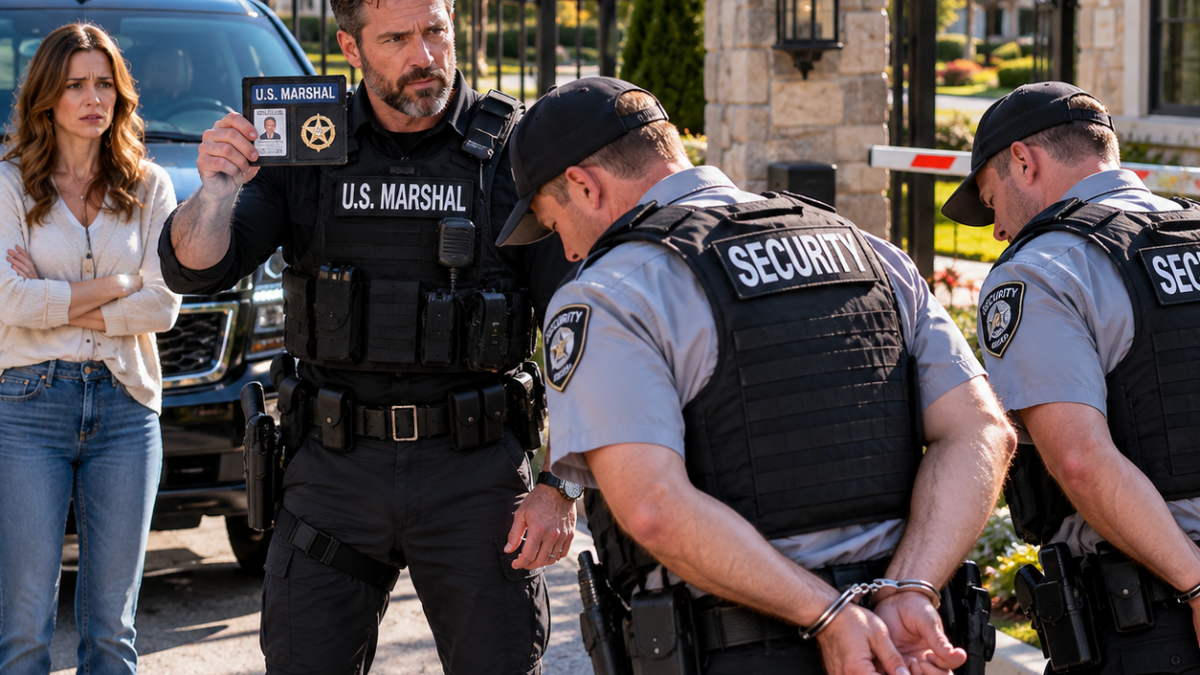
HOA Guards Tried to Zip-Tie Me at My Own Gate for “Trespassing”—Then My U.S. Marshal Badge Came Out and They Were the Ones Leaving in Handcuffs.
I had spent fourteen straight days hunting a violent federal fugitive, but the most surreal arrest of my career began when two private HOA guards blocked the gate to my own neighborhood and ordered me out of my government vehicle with plastic restraints already in their hands.
They had been told I was a “hostile resident,” that my black Tahoe was banned, and that the homeowners association president had authorized them to hold me for trespassing until police arrived—even though the address on my driver’s license was thirty seconds beyond the gate.
Then one of them reached for my locked door, I opened my federal credentials, and the little neighborhood dictatorship that had terrorized my wife for months began collapsing faster than anyone behind those iron gates could have imagined.
My name is Wyatt Garrison.
For most of my adult life, the word “home” meant wherever I happened to put my boots after the job was finished.
Hotel rooms.
Government apartments.
A friend’s spare bedroom during a long assignment.
Once, for almost three weeks, the back seat of a surveillance van that smelled like cold coffee, gun oil, and somebody else’s gym bag.
That was the life.
When you work fugitive operations, you get used to being gone.
You get used to cancelled dinners.
Missed birthdays.
Calls at 2:00 a.m.
You get used to your spouse asking whether you’ll be home Friday and having to answer:
“I think so.”
Evelyn hated that answer.
Not because she resented the job.
Because she understood it.
That was somehow worse.
We had been married eight years when we started looking for a house outside Denver.
Evelyn’s only request was simple.
“I want somewhere I don’t have to worry when you’re gone.”
I told her:
“That doesn’t exist.”
She gave me the look wives reserve for husbands who answer emotional questions like police reports.
“You know what I mean.”
I did.
Quiet neighborhood.
Low crime.
Neighbors who noticed unfamiliar vehicles.
Somewhere she could come home after dark without checking the mirrors twice because she had spent too many years married to a man who occasionally brought unpleasant work home in his head.
Then our realtor showed us Whispering Pines.
The name should have warned me.
PART2:
Anything with a name that peaceful usually has rules.
Whispering Pines sat about thirty-five minutes outside Denver in the kind of rolling foothill country where expensive homes appeared between stands of pine and scrub oak.
Four hundred and twelve properties.
Private roads.
Decorative stone walls.
One main entrance.
Two emergency gates.
The front gate was real steel, not decorative aluminum.
Residents used windshield transponders.
Visitors checked in with a guard.
The streets were immaculate.
Lawns looked like somebody vacuumed them.
No broken fences.
No abandoned vehicles.
No teenagers doing donuts at midnight.
Evelyn loved it.
I liked the gate.
PART3:
That sounds ridiculous in hindsight.
But my work involved violent fugitives.
Men who remembered names.
Men whose friends sometimes remembered badge numbers.
I did not want to turn our home into a fortress.
I just wanted one more layer between my wife and anybody who should not be standing on our porch.
The house was at 442 Oakmont Drive.
Four bedrooms.
Brick and white siding.
Two-car garage.
Small office for Evelyn.
A back deck facing open space.
The master bedroom window caught the mountains at sunset.
Evelyn stood there on our first tour and whispered:
“This one.”
I knew we were buying it before the realtor finished describing the kitchen.
Closing involved the usual mountain of paper.
Mortgage.
Insurance.
Community covenants.
HOA rules.
Evelyn read everything.
I skimmed.
That was my first mistake.
We moved in on a Tuesday.
By Saturday, Bradley Harrington was standing in my driveway.
I was washing my work vehicle.
Black Chevrolet Tahoe.
Government-owned.
Unmarked.
Tinted windows within agency specifications.
Hidden emergency lights.
Radio equipment.
Secure storage.
Two antennas that made suburban people assume either police or very committed ham-radio hobbyist.
The Tahoe came home with me because I was on a fugitive task force and subject to callout.
Bradley walked directly up the driveway.
No wave from the sidewalk.
No introduction until he was six feet away.
Pastel green polo.
Khaki shorts.
Loafers without socks.
Clipboard.
Silver BMW parked at the curb.
“Afternoon.”
I turned off the hose.
“Afternoon.”
“Bradley Harrington.”
He held out one hand.
“President of the Whispering Pines Homeowners Association.”
I shook it.
“Wyatt Garrison.”
“I know.”
That was the first little thing.
I know.
Not nice to meet you.
Not welcome.
I know.
Bradley’s eyes moved toward the Tahoe.
“You folks settling in?”
“Getting there.”
“Beautiful home.”
“Thank you.”
“Former Patterson property.”
“So I heard.”
“Good family.”
I waited.
Bradley tapped his clipboard.
“We like to get new owners squared away quickly.”
“Okay.”
“Prevents misunderstandings.”
There it was.
“What misunderstanding?”
He pointed his pen toward the Tahoe.
“Commercial vehicles are prohibited from overnight driveway parking.”
“It isn’t commercial.”
“Dual antennas.”
“Yes.”
“Tinted rear glass.”
“Yes.”
“Black fleet finish.”
I laughed.
“Fleet finish?”
Bradley didn’t.
“It appears to be a security vehicle.”
“It’s law enforcement.”
His eyes returned to mine.
“What agency?”
I did not make a habit of announcing specifics to neighbors I had met thirty seconds earlier.
“Federal.”
That should have ended it.
Instead Bradley’s mouth tightened.
“Our rules do not provide an exemption for federal employment.”
“This isn’t an employee’s delivery van.”
“Regardless.”
“No.”
He blinked.
“What?”
“No.”
I picked up the hose.
“It stays.”
His face changed.
Very slightly.
Some men treat disagreement as information.
Bradley treated it as insubordination.
“All resident vehicles must also display a Whispering Pines RFID decal.”
“Not happening.”
“That is mandatory.”
“Not on a federal vehicle.”
“You signed the covenants.”
“And the federal government didn’t.”
Bradley stared.
“You could place it inside the lower windshield.”
“No.”
“Why?”
“Because I’m not modifying or marking an unmarked government vehicle for your convenience.”
His lips pressed together.
“We’ll see.”
I remember smiling.
That line felt absurd.
I had spent the previous month tracking a bank robbery suspect who had threatened to shoot his own brother rather than surrender.
Bradley Harrington and his clipboard barely registered.
“Sure.”
I turned the hose back on.
He stood another second, waiting for something.
An apology.
Compliance.
Concern.
He received water spraying across a government Tahoe.
Then he walked away.
That evening Evelyn asked:
“Who was pastel shorts?”
“HOA president.”
“Oh no.”
“What?”
“I met his wife.”
“When?”
“Welcome committee.”
“Nice?”
“Yes.”
“That sounded ominous.”
“She apologized for him before I met him.”
I stopped eating.
“What exactly did she say?”
“Something like, ‘Bradley takes community standards very seriously.’”
I laughed.
Evelyn didn’t.
“Wyatt.”
“He wants me to sticker the Tahoe.”
“You said no.”
“Obviously.”
“That means he’s coming back.”
“Let him.”
Evelyn looked at me over her wineglass.
“You deal with armed fugitives for a living.”
“Correct.”
“I manage accountants.”
“Also dangerous.”
“I’m serious.”
“So am I.”
She pointed her fork at me.
“You are psychologically incapable of understanding people whose only weapon is paperwork.”
That sentence aged extremely well.
The first violation letter arrived six days later.
COMMERCIAL VEHICLE VISIBLE FROM ROADWAY.
Fine: warning.
The second arrived the following week.
FAILURE TO DISPLAY COMMUNITY VEHICLE IDENTIFICATION.
Fine: $100.
I emailed management.
Explained the Tahoe was government property.
Attached a bland agency letter confirming I was authorized to possess and park a take-home government vehicle at my residence.
I removed the agency unit details.
The property manager responded:
Thank you. We will forward to the board.
Bradley responded separately:
Federal employment does not exempt owners from private covenants voluntarily accepted at purchase.
I replied:
The HOA is not authorized to place stickers, immobilization devices, or adhesive notices on federal property. Do not touch the vehicle.
He answered seven minutes later.
Threats are unnecessary.
I hadn’t threatened him.
That was mistake number two.
I assumed he understood the difference between a warning and a threat.
The next letter involved trash cans.
Evelyn rolled them in at 7:16 p.m.
Community deadline: 7:00.
Violation.
Then window coverings.
Our white blinds were allegedly “cool white” instead of “approved colonial white.”
I genuinely believed Evelyn was making that one up until she showed me the notice.
I held the paper beneath the kitchen light.
“These are the same color.”
“I know.”
“It says visible tonal incompatibility.”
“I know.”
“Who writes like this?”
“People who need hobbies.”
The fine was fifty dollars.
I refused to pay.
Not because of fifty dollars.
Principle.
That was mistake number three.
Bradley loved principle too.
Just a different kind.
Within eight weeks, the warnings became surveillance.
Evelyn called while I was in Utah on a fugitive case.
I was sitting in a government vehicle eating a turkey sandwich that had been purchased approximately nine hours earlier.
Her voice was tight.
“Where are you?”
“Outside Provo.”
“Busy?”
“Not currently.”
“That answer means yes.”
“What happened?”
She paused.
“I got stopped.”
My sandwich went down.
“By police?”
“No.”
“Who?”
“The new security people.”
I sat straighter.
“What new security people?”
“The HOA replaced the gate staff.”
“When?”
“This week.”
“With who?”
“Ironclad Security.”
Of course they were called Ironclad.
“What happened?”
“I walked to the cluster mailboxes.”
“Okay.”
“One of their patrol SUVs pulled behind me.”
“While you were walking?”
“Yes.”
“They stopped you?”
“The guard got out and asked for ID.”
My jaw tightened.
“Why?”
“He said residents are required to prove occupancy on request.”
“No, they aren’t.”
“I told him that.”
“Good.”
“He said refusal would be documented.”
“Name?”
“I don’t know.”
“Uniform number?”
“Wyatt.”
“What?”
“You’re doing the voice.”
“What voice?”
“The one before somebody has a very bad afternoon.”
I closed my eyes.
“I’m not doing anything from Utah.”
“Good.”
“Take photos if it happens again.”
“I already did.”
That was Evelyn.
Smarter than me in all the ways that mattered.
Then she said:
“There’s something else.”
“What?”
“They put a sticker on the Tahoe.”
I stopped breathing for half a second.
“What kind?”
“Neon green.”
“Where?”
“Driver’s window.”
“What does it say?”
“Unauthorized vehicle. Subject to tow or immobilization.”
“Do not remove it.”
“I tried.”
“Stop.”
“Why?”
“Photograph everything.”
“It’s disgusting adhesive.”
“I know.”
“Is that illegal?”
“Possibly.”
That was my careful answer.
My less careful thoughts were different.
Government vehicles aren’t personal toys.
Tampering with them creates potential safety and operational issues.
At minimum, somebody had ignored explicit notice not to touch it.
Then Evelyn said:
“Certified letter came too.”
I heard paper.
“Read it.”
“Vehicle fine five hundred. Trash can two hundred. Window violation two hundred. Fifty dollars per day for failure to tag the Tahoe.”
“Anything else?”
“They say if the balance isn’t paid within thirty days, they may pursue a lien.”
I leaned my head against the headrest.
“How much total?”
“Currently fourteen-fifty.”
“For blinds, trash cans, and refusing to sticker a government truck.”
“Basically.”
“Where’s Bradley?”
“Probably measuring somebody’s mailbox.”
I nearly laughed.
Then her voice changed.
“Wyatt, I’m not joking anymore.”
I sat upright.
“What happened?”
“He came by yesterday.”
“You didn’t tell me.”
“I didn’t want you distracted.”
“Evelyn.”
“He stood outside the house and told me we were ‘creating a hostile relationship with the association.’”
“Did he threaten you?”
“Not exactly.”
“What exactly?”
“He said homeowners who refuse cooperation often discover living here becomes uncomfortable.”
My hand tightened around the phone.
“Did you record it?”
“No.”
“Okay.”
“I told him all communication goes through you.”
“Good.”
“He smiled.”
I knew that smile.
Men like Bradley smiled when they thought another person’s attempt to establish boundaries was cute.
“I’m coming home in four days.”
“Don’t get fired over an HOA.”
“I won’t.”
“Or arrested.”
“No promises.”
“Wyatt.”
“Kidding.”
I wasn’t.
When I came home, Ironclad had transformed the front entrance.
The old gate attendants had been retired men.
Polite.
Radio.
Coffee.
One had kept dog treats for residents.
Ironclad looked like a low-budget tactical convention.
Black polos.
Black cargo pants.
Heavy duty belts.
Pepper spray.
Batons.
Handcuffs.
Tasers.
No firearms, at least visibly.
The first guard I met had TODD WELLS embroidered over his chest.
He was maybe twenty-seven.
Stocky.
Buzz cut.
Mirrored sunglasses on a cloudy afternoon.
I rolled down my window.
“Afternoon.”
His eyes went to the windshield.
“RFID?”
“No.”
“Then visitor lane.”
“I live here.”
“RFID?”
“I don’t have one.”
“Visitor lane.”
I showed my driver’s license.
“Address.”
He barely looked.
“Mr. Harrington gave instructions.”
That interested me.
“What instructions?”
“Black Tahoe doesn’t use resident gate without sticker.”
“Open the gate.”
“You don’t give me orders.”
I stared.
That sentence told me everything about Ironclad training.
They had hired men who thought gate access was a contest of dominance.
I opened my credentials wallet.
Held it where he could see.
The silver star caught daylight.
DEPUTY UNITED STATES MARSHAL.
Todd stopped.
“This is a government vehicle.”
Silence.
“You have my license showing I live here.”
He looked toward the guardhouse.
“Open the gate.”
For once, he did.
I drove through.
Twenty minutes later I was scraping adhesive from the driver’s window.
It took solvent.
A razor.
Patience I did not have.
Evelyn stood in the garage.
“Still think this is funny?”
“No.”
“Good.”
When the glass was clean, I photographed it.
Then photographed the removed sticker.
Then drove to Bradley’s house.
Evelyn followed me to the door.
I turned.
“No.”
“I am part of this.”
“Yes.”
“Then I’m coming.”
“No.”
Her eyes narrowed.
“Why?”
“Because if he says something stupid, I don’t want you standing between us.”
“That is the least romantic thing you have ever said.”
“Thank you.”
“I’m coming.”
Marriage.
Bradley answered wearing pink.
Not metaphorically.
A pink polo.
“Wyatt.”
“Bradley.”
His eyes moved to Evelyn.
“Mrs. Garrison.”
She did not smile.
I held up the damaged tow notice.
“Your security contractor put this on federal property after you were told not to.”
Bradley folded his arms.
“They enforce community rules.”
“You will tell them not to touch that vehicle again.”
“You’re delinquent.”
“That’s a separate civil dispute.”
“The vehicle violates our rules.”
“It does not authorize damage.”
“No damage.”
“Adhesive obstructed my driver’s window.”
“Temporary.”
I stepped closer.
Not threatening.
Enough that he had to look up slightly.
“Listen carefully.”
Evelyn touched my elbow.
I kept my voice level.
“You may send letters.”
Bradley smiled.
“You may assess whatever fines your attorney tells you are lawful.”
His smile faded.
“You may take whatever civil process your covenants actually permit.”
I pointed at the sticker.
“You do not touch federal equipment.”
Bradley said:
“You seem to believe your badge places you above the community.”
“No.”
I put the sticker on his porch table.
“I believe your HOA places you below federal jurisdiction.”
His face reddened.
“This community owns its private roads.”
“Congratulations.”
“We control access.”
“You cannot lock an owner out of his home to coerce payment of disputed fines.”
“You’re not our attorney.”
“And you’re not a judge.”
Bradley stepped forward.
“I will use every enforcement mechanism available.”
“Then use lawful ones.”
His nostrils flared.
“If you continue defying community standards, we will pursue a lien and all remedies authorized by the covenants.”
“Through counsel.”
“Yes.”
“Good.”
I nodded.
“Do that.”
That answer angered him more than yelling would have.
Because I wasn’t afraid of court.
Bradley needed fear.
“Have a good evening.”
He shut the door.
Evelyn waited until we reached the sidewalk.
“You enjoyed that.”
“No.”
“You absolutely did.”
“Five percent.”
“Twenty.”
“Ten.”
She looked back at Bradley’s house.
“He’s going to escalate.”
“Probably.”
“What do we do?”
“Document.”
That became our life.
Photograph.
Save.
Log.
Every letter.
Every security encounter.
Every vehicle that followed Evelyn.
Every email.
I set up a folder.
Evelyn made a spreadsheet.
Again, accountants.
Fear them.
The HOA filed a lien notice for $3,400.
My attorney challenged the charges.
The HOA’s attorney responded with the usual language about ongoing covenant enforcement.
Nothing explosive.
Just expensive.
Then neighbors started contacting us.
First was Mrs. Alvarez from two streets over.
Seventy-one.
Widow.
She brought banana bread.
People who bring banana bread are usually either very kind or delivering serious information.
She was both.
“Your wife said you’re fighting Bradley.”
“I wouldn’t call it fighting.”
Evelyn coughed from the kitchen.
Mrs. Alvarez smiled.
“Good husband answer.”
Then she opened a folder.
Fines.
Bushes two inches too tall.
Holiday lights removed four days late.
Grandson’s pickup parked overnight.
One letter threatened towing.
Another threatened a lien.
“How much?”
“Almost six thousand.”
My eyebrows rose.
“Why haven’t you challenged it?”
“My husband handled money.”
“He passed?”
“Three years.”
She looked embarrassed.
“I don’t know lawyers.”
Evelyn sat beside her.
“We’ll help you find one.”
Mrs. Alvarez cried.
Then came the Parkers.
Their teenage son had been stopped by Ironclad while jogging after dark and ordered to empty his pockets.
The guard claimed there had been reports of vehicle break-ins.
No police report.
No legal authority.
Then Mr. Chen.
Security photographed his visitors’ licenses with personal phones.
Then a nurse named Rachel Moore.
Guard followed her through the neighborhood because her hospital scrubs supposedly didn’t match the resident profile associated with her vehicle.
“What does that even mean?” Evelyn asked.
Rachel laughed bitterly.
“I asked the same thing.”
Then came Marcus Bell.
Black.
Thirty-eight.
Software engineer.
Owned one of the largest homes in the subdivision.
Ironclad stopped him six times in one month.
He recorded the seventh.
Guard:
Resident ID.
Marcus:
You watched me open my garage ten minutes ago.
Guard:
ID.
Marcus:
No.
Guard:
Then we’ll remain here.
Marcus:
For what?
Guard:
Until identity is verified.
Marcus’s five-year-old daughter was visible inside the garage.
That video changed the way I saw the problem.
This wasn’t only Bradley versus me.
This was a board that had given private guards enough perceived authority to intimidate residents and call it security.
I forwarded nothing to law enforcement yet.
Private misconduct in a private neighborhood can be messy.
Some behavior was obnoxious, not necessarily criminal.
We needed evidence.
We kept collecting.
Then an HOA board member contacted Evelyn.
Not me.
Her name was Caroline Pierce.
Treasurer.
She asked to meet at a coffee shop.
Evelyn went alone initially.
Then called me.
“You need to hear this.”
Caroline looked terrified when I arrived.
She was maybe fifty.
Perfect hair.
Perfect nails.
The kind of woman I had assumed liked Bradley because she always sat beside him at meetings.
I was wrong.
“He’s lost control.”
She stirred coffee she wasn’t drinking.
“How?”
“Ironclad.”
“What about them?”
“Bradley doesn’t run decisions through the full board anymore.”
“Then who approved the contract?”
“We did.”
She looked ashamed.
“He sold it as upgraded security after package theft complaints.”
“And after?”
“Standing orders.”
My attention sharpened.
“What standing orders?”
“Individual residents.”
“Written?”
“Some.”
“Do you have copies?”
“No.”
“Can you get them?”
Caroline looked at me.
“I don’t want to go to jail.”
“For what?”
“I signed some resolutions.”
“Did you knowingly authorize unlawful detention?”
“No.”
“Then don’t jump ahead.”
She lowered her voice.
“Bradley tells the guards which homes are ‘problem addresses.’”
“How do you know?”
“I saw an email.”
“Who was on it?”
“Bradley, Craig Higgins, the Ironclad owner, property management.”
“Anyone else?”
“Sometimes board members.”
“Do you still have it?”
She nodded.
“Don’t delete anything.”
Her face went pale.
“Are you investigating me?”
“No.”
“Are you acting as a marshal?”
“No.”
That was important.
I was a homeowner talking to another homeowner.
“If this becomes criminal, I will remove myself from investigative decisions as appropriate.”
She nodded slowly.
“What should I do?”
“Talk to your own attorney.”
“I can’t afford—”
“Then talk to police if you believe a crime occurred.”
Caroline looked toward Evelyn.
“Bradley says Wyatt is dangerous.”
Evelyn almost laughed.
“He is terrible at loading a dishwasher.”
“Evelyn.”
“What? I’m reducing tension.”
Caroline smiled despite herself.
Then:
“He said the badge was fake.”
I stopped.
“What?”
“After you showed it at the gate.”
“Why?”
“He said federal agents don’t live in neighborhoods like ours.”
I stared.
Evelyn said:
“What does that mean?”
Caroline shrugged.
“I don’t know.”
I did.
Bradley had constructed a reality where information that challenged his authority became false by definition.
Dangerous trait.
Especially when combined with private guards willing to please him.
Two weeks later, I left for the operation that nearly broke everything open.
A fugitive named Raul Velez had skipped federal court after being charged in a violent trafficking case.
He had made threats.
Moved through multiple states.
We tracked him into the mountains.
Three days surveillance.
Rain.
Cold.
No sleep.
Then the arrest.
By the time paperwork ended, it was after two in the morning.
I had been awake almost thirty hours.
My tactical vest sat on the passenger seat.
Agency credentials in the center console.
Duty weapon on my hip.
All I wanted was Evelyn.
Shower.
Bed.
In that order if I could stay conscious.
Rain hammered the Tahoe.
I turned onto Whispering Pines Drive.
Saw flashing amber lights.
At first I assumed an accident.
Then I saw the Ironclad Explorer parked sideways across both entrance lanes.
Not partially.
Completely.
The gate was closed behind it.
I stopped.
Horn.
One short tap.
Nothing.
Second.
Longer.
Guardhouse door opened.
Todd stepped out.
Yellow rain shell over tactical uniform.
Another guard followed.
Mitchell Crane.
I knew the name from Evelyn’s notes.
Six-two.
Heavy build.
Former nightclub bouncer according to the Ironclad website.
Flashlight in one hand.
He walked straight toward my windshield.
Beam hit my eyes.
White.
Blinding.
I raised one hand.
Rolled window down three inches.
“Move the light.”
“Turn off the engine.”
I stared.
“Move the vehicle.”
“Engine off.”
Todd came to the driver’s side.
“Mr. Garrison.”
The fact that he used my name told me this wasn’t routine.
“What is this?”
“Step out.”
“No.”
Mitchell moved closer.
“You are entering private property in violation of an active trespass notice.”
“I own 442 Oakmont.”
“Your vehicle has been barred.”
“Move your vehicle.”
Todd leaned toward the opening.
“Outstanding balance is thirty-four hundred dollars.”
I laughed once.
“This is debt collection now?”
“You were notified.”
“I was notified of disputed HOA fines.”
“Mr. Harrington issued a no-entry directive.”
“To my vehicle?”
“To you if operating the prohibited vehicle.”
“That isn’t how property law works.”
Mitchell shined the flashlight again.
“Step out.”
I watched his hands.
Always hands.
“Are you ordering me out?”
“Yes.”
“Under what legal authority?”
“Citizen detention for criminal trespass.”
I thought I had misheard.
“Say that again.”
Todd smiled.
“You’re trespassing.”
“On the road to the house I own.”
“The association owns the road.”
“So?”
“Your privileges are suspended.”
“No.”
Mitchell slapped the Tahoe’s roof.
“Out.”
Adrenaline began replacing exhaustion.
Not rage.
Focus.
“You need to listen very carefully.”
Todd said:
“We’ve heard that speech.”
Interesting.
I reached slowly toward the console.
Mitchell’s hand moved toward his belt.
“Hands where I can see them.”
I stopped.
“I’m retrieving identification.”
“Keep your hands up.”
I put both on the wheel.
“Fine.”
Rain poured through the cracked window.
“Do you know what I do?”
Todd said:
“You claim you’re federal law enforcement.”
“Claim?”
Mitchell laughed.
“Mr. Harrington already checked.”
“With who?”
“He says your badge doesn’t matter here.”
That wasn’t an answer.
Todd removed pepper spray.
Did not point it yet.
Mitchell opened a pouch.
Heavy plastic restraint loops.
I stared at them.
Not handcuffs.
Zip restraints.
“You are planning to restrain me?”
“If necessary.”
“Why?”
“Until local police arrive.”
“Call them.”
Todd blinked.
“What?”
“Call local police right now.”
“We will after you’re secured.”
“No.”
Mitchell reached for the door handle.
It was locked.
He pulled anyway.
“Open it.”
I lowered my voice.
“I am giving you a final opportunity to back away and call actual law enforcement.”
Todd raised the spray.
“Final warning.”
I looked from him to Mitchell.
“I’m a deputy United States marshal.”
Mitchell rolled his eyes.
I continued:
“This is a government vehicle.”
“Sure.”
“You have already been shown credentials.”
“Fake badges exist.”
“Call 911.”
“We don’t take orders from trespassers.”
That sentence would sound very bad on body-camera audio later.
I said:
“Are you wearing cameras?”
Neither answered.
Good.
Maybe the guardhouse had video.
Mitchell hammered his flashlight once against my side window.
“OUT.”
The glass vibrated.
Enough.
I put the vehicle in park.
“Back away from the door.”
Mitchell smiled.
“Finally.”
“Back away.”
He didn’t.
I reached for my tactical vest from the passenger seat.
Todd shouted:
“Hands!”
I held it up where they could see the reflective panel.
POLICE
U.S. MARSHAL
Mitchell stopped smiling.
I put it on.
Opened my credentials.
Held them against the window.
“Read.”
Todd’s face changed.
Mitchell did not.
He had committed too emotionally to retreat.
“Could still be fake.”
“Then call police.”
“We have authority.”
“No.”
I unlocked the door.
Opened it carefully.
Not kicked.
Not slammed.
Carefully.
Mitchell stepped back.
I exited with both hands visible.
Rain hit immediately.
I kept my weapon holstered.
My right hand stayed away from it.
“Back away.”
Todd’s pepper spray was now pointed at me.
“Don’t move.”
I stared at the nozzle.
“Lower it.”
Mitchell held the restraints.
“You’re being detained.”
“No.”
He reached for my left wrist.
Training takes over before thought.
I pivoted.
Caught his forearm.
Turned him into the side of the Tahoe.
Controlled.
No punch.
No dramatic throw.
His flashlight hit the pavement.
I pinned his wrist.
“Stop resisting.”
Todd shouted:
“Let him go!”
I looked.
Spray still raised.
“Put that down.”
He hesitated.
“Now.”
The federal credentials were inches from Mitchell’s face.
He finally read them.
His body changed.
“Jesus.”
Todd said:
“Mitchell?”
Mitchell stopped struggling.
“It’s real.”
Todd lowered the spray.
That was the moment the whole scene could have ended.
Then headlights appeared behind me.
Another Ironclad patrol vehicle.
Two more guards.
Wonderful.
I released enough pressure for Mitchell to stand but kept his arm controlled.
“Everyone stay where you are.”
One new guard stepped out.
“What happened?”
Todd shouted:
“He assaulted Mitchell!”
I raised my voice.
“Call 911.”
The new guard stared at my vest.
“Are you police?”
“Federal.”
He immediately pulled out his phone.
Smartest man Ironclad employed.
Within minutes, county deputies and local police were on the way.
I called my agency duty desk too.
Not to summon an army.
To document that a federal officer had been physically confronted at his residence by private security while operating a government vehicle.
Mitchell muttered:
“This is ridiculous.”
“Agreed.”
“Bradley said—”
I looked at him.
“Bradley said what?”
He stopped.
Todd said:
“Don’t.”
That mattered.
“Bradley said what?”
Mitchell looked at Todd.
Then at me.
“He said if you refused to comply, we were authorized to hold you.”
“Authorized by who?”
“HOA.”
“Who specifically?”
“Mr. Harrington.”
“Verbally?”
Mitchell hesitated.
“Written order.”
There it was.
I did not ask another question.
Not because I didn’t want answers.
Because now it belonged to responding investigators.
Sergeant Alan Hayes arrived first.
I knew him from a joint task force case.
He got out, saw me, saw Ironclad, saw the restraints on the ground.
“Wyatt?”
“Hey, Alan.”
“What happened?”
“I’d rather give you a formal statement.”
That made his face serious.
“Everybody safe?”
“Yes.”
“Anyone injured?”
“No.”
“Any weapons deployed?”
“No.”
“Why is that guy against your truck?”
“Attempted to restrain me.”
Hayes looked at Mitchell.
Mitchell immediately said:
“He’s trespassing.”
Hayes stared at him.
Then at me.
Then back.
“Where does he live?”
Mitchell pointed beyond the gate.
“Inside.”
Hayes rubbed his face.
“Okay.”
That was all.
Okay.
The sound of a veteran cop realizing paperwork was about to ruin his night.
Two patrol officers separated us.
Statements.
Photographs.
Recovered restraints.
Pepper spray.
Flashlight.
Security vehicle placement.
Gate video preserved.
Then Hayes asked:
“You said written order?”
Mitchell looked toward the guardhouse.
Todd closed his eyes.
Hayes saw.
“What’s in there?”
No answer.
Hayes entered with consent from the on-duty supervisor, who had just arrived and was rapidly discovering tonight was not going according to the company handbook.
On the desk sat a black binder.
STANDING ORDERS.
Inside:
Gate procedures.
Visitor lists.
Emergency contacts.
Then tabs.
High Priority.
Resident Restrictions.
My name.
WYATT GARRISON – 442 OAKMONT DRIVE.
Directive 44A.
Vehicle prohibited.
Resident considered hostile and noncompliant.
If attempt made to enter using barred vehicle, guards authorized to prevent entry pending law enforcement response.
Then the line that mattered:
Physical detention may be employed if subject refuses to remain voluntarily.
Signed:
Bradley Harrington, HOA President.
Craig Higgins, Ironclad Security, Managing Director.
Hayes read it twice.
Then:
“Jesus Christ.”
I stayed silent.
He continued.
“They wrote this.”
“Yes.”
“And signed it.”
“Yes.”
One officer asked:
“Can an HOA authorize citizen detention?”
Hayes looked at him.
“What do you think?”
The young officer wisely stopped.
They arrested Mitchell and Todd on state charges related to attempted unlawful restraint and assaultive conduct.
Not because I shouted federal arrest.
Not because my badge was magical.
Because responding law enforcement reviewed what had happened and found probable cause.
That distinction mattered to me.
I had spent my career around men who abused authority.
I wasn’t becoming one because I was angry at Bradley Harrington.
Federal investigators were notified because the encounter involved interference with a federal employee operating a government vehicle after repeated notice regarding his status.
I recused myself from every decision I could.
I was a victim and witness now.
Not case agent.
At 4:18 a.m., I finally entered my neighborhood.
Hayes followed me to the house.
Evelyn opened the front door before I reached it.
Barefoot.
Sweatshirt.
Face terrified.
She saw my vest.
Police cruiser.
Then ran.
“What happened?”
I hugged her.
“I’m okay.”
“What happened?”
“The guards tried to detain me.”
Her body went rigid.
“What?”
“They’re in custody.”
She pulled back.
“You’re hurt?”
“No.”
She checked anyway.
Wives.
Hayes stayed at the walkway.
Evelyn saw him.
“Sergeant?”
“Ma’am.”
“What is going on?”
Hayes looked at me.
I nodded.
He said:
“We recovered a written directive from the security gate authorizing guards to physically detain your husband over the HOA dispute.”
Evelyn stared.
“Written?”
“Yes.”
“Bradley signed it?”
“Yes.”
She became very still.
I knew that version of Evelyn.
The version accountants probably saw right before an audit destroyed somebody.
“Good.”
I looked at her.
“Good?”
“He signed it.”
Hayes smiled despite himself.
“I like your wife.”
“So does the IRS.”
I slept ninety minutes.
At seven, my phone started ringing.
Agency counsel.
Assistant U.S. Attorney.
Internal notification.
Property attorney.
Evelyn’s mother.
Mrs. Alvarez.
Marcus Bell.
Caroline Pierce.
Then Caroline called again.
“Wyatt.”
Her voice was shaking.
“I heard police were at the gate.”
“Yes.”
“Bradley is texting the board.”
“What is he saying?”
“That you assaulted guards.”
“Do not forward anything to me.”
“Why?”
“Preserve it.”
“I have screenshots.”
“Send them to your attorney or responding investigators.”
Silence.
“Are they going to arrest us?”
“I don’t know.”
“I never voted on that directive.”
“Then document that.”
“Bradley told us he had counsel approval.”
“Whose counsel?”
“I don’t know.”
“Document that too.”
By eight-thirty, Bradley had sent a community-wide email.
SUBJECT: SECURITY INCIDENT INVOLVING RESIDENT.
It described me as “an armed resident who became physically aggressive toward contracted security staff performing their duties.”
No mention of U.S. marshal.
No mention of restraints.
No mention of the written directive.
Evelyn read it.
Then laughed.
Not humor.
“Can we sue him now?”
“Talk to our lawyer.”
“I already emailed him.”
Of course she had.
At 9:10, local police served a preservation request for HOA communications related to Ironclad and designated resident enforcement.
At 10:30, federal agents interviewed me.
At noon, Craig Higgins arrived at Ironclad headquarters to discover investigators waiting.
He did not attempt to shred evidence like a movie villain.
Reality was less cinematic.
His attorney told him to say nothing.
Computer systems were preserved.
Email accounts.
Standing orders.
Contracts.
Training policies.
Things became worse for Bradley not because of one dramatic confession but because he loved email.
Bradley Harrington documented everything.
He wrote like a man creating a historical archive of his own importance.
Problem resident Garrison continues to hide behind supposed federal status.
We need firm enforcement.
Another email:
Residents must learn that access is a privilege contingent upon compliance.
Another:
Ironclad personnel should not hesitate to use citizen detention authority when confronted with hostile trespassers.
Another, from Craig Higgins:
Our officers are not sworn police. We need legal review before any physical detention policy.
Bradley replied:
Counsel is overly cautious. The HOA owns the roads.
That email became very important.
So did another.
Craig:
Do not attempt handcuffing unless an actual crime occurs in your presence.
Bradley:
Fine. Use temporary restraints if needed until police arrive.
Higgins had pushed back.
Then signed Directive 44A anyway.
His problem.
Investigators discovered twenty-seven special resident directives.
Not all involved physical detention.
Most were targeted enforcement.
Photograph visitor plates.
Monitor overnight parking.
Stop particular vehicles.
Document “suspicious” walking.
Mrs. Alvarez had one.
Marcus Bell had one.
Rachel Moore had one.
Mine was the only document explicitly authorizing physical restraint.
Then the finances surfaced.
Ironclad billed additional “enhanced enforcement hours.”
Those hours were charged to the HOA.
Some came from fines.
Some from special assessments.
Bradley had negotiated the contract personally.
Caroline, the treasurer, began cooperating fully.
She produced minutes showing the board had approved basic security services.
Not resident-specific detention policies.
She also produced invoices.
Evelyn found something investigators initially missed.
Remember what I said about accountants?
One evening she spread HOA financial statements across our dining table.
“What?”
I asked.
“Look.”
“I see numbers.”
“Exactly why you’re useless.”
“Marriage remains healthy.”
She pointed.
“Ironclad invoices go up every month.”
“Yes.”
“Fine revenue also goes up.”
“Okay.”
“Look at the dates.”
I did.
Nothing.
“Help.”
“Every time fine revenue drops, enhanced enforcement hours increase the following month.”
I stared.
“So?”
“So Bradley had created incentives to generate violations.”
“Possible.”
“Then look here.”
Special administrative recovery fee.
Thirty percent.
“What’s that?”
“HOA retained thirty percent of certain collected security-related fines before the remainder went into the general fund.”
“Legal?”
“Don’t know.”
She looked at me.
“But guess who chaired the compliance committee?”
“Bradley.”
“And who negotiated Ironclad’s performance bonus?”
“What performance bonus?”
She slid over a contract page.
Monthly bonus based on reduction in unresolved violations.
My wife smiled.
Not pleasantly.
“If the guards issued enough citations and pressured residents into paying quickly, Ironclad made more money.”
“And Bradley got to brag about compliance.”
“Exactly.”
That was not automatically criminal.
It was ugly.
Investigators would decide the rest.
But it explained the escalation culture.
Security wasn’t protecting residents.
It had been turned into enforcement theater.
Then another neighbor came forward.
An elderly veteran named Harold Crane.
He had parked an RV in his driveway for forty-eight hours before a trip.
Ironclad blocked it in with a patrol car until he signed an acknowledgment of violation.
He had kept the paper.
Another family had been threatened with towing while loading furniture during a move.
A divorced mother had been fined when her teenage daughter’s car remained overnight too many days in one month.
A contractor had been escorted from the property because Bradley disliked where he parked.
The pattern wasn’t federal.
It wasn’t glamorous.
It was petty power accumulating because most people paid whatever amount made the harassment stop.
That was Bradley’s real system.
Not one huge abuse.
A hundred small ones.
Most people don’t hire attorneys over two hundred dollars.
They pay.
Most people don’t call police because a private guard asks for ID.
They comply.
Most people don’t challenge a board president because they have jobs, kids, aging parents, medical bills.
Bradley had confused exhaustion with consent.
Then he picked a house where one resident documented evidence for a living and the other balanced financial controls for one.
Bad combination.
Three days after the gate incident, investigators served warrants for records at the HOA management office and Ironclad.
Bradley was interviewed.
He brought an attorney.
Smart.
He claimed Directive 44A was intended only to keep me waiting voluntarily for police.
Investigators showed him the line:
Physical detention may be employed.
He blamed Ironclad.
Ironclad blamed Bradley.
Classic.
Neither blamed themselves.
The HOA board called an emergency meeting.
More than three hundred residents showed.
Fire marshal nearly shut it down.
Bradley did not attend.
His attorney advised against it.
Caroline sat at the front.
Two other board members looked physically ill.
The HOA attorney spoke first.
“Given ongoing investigations, we cannot discuss individual criminal matters.”
The crowd exploded.
Mrs. Alvarez shouted:
“You discussed my bushes for forty minutes last month!”
That was the best line of the evening.
The attorney raised both hands.
The board announced:
All resident-specific security directives suspended.
All pending Ironclad-related fines under independent review.
Lien actions paused.
Ironclad contract terminated.
External management audit authorized.
Then Marcus Bell stood.
He held his phone.
“I want the board to watch something.”
His seventh security stop.
The room saw the guard demand ID from a Black homeowner while his child waited in the garage.
No one spoke when the video ended.
Marcus said:
“I’ve lived here nine years.”
Pause.
“I pay the same dues everybody else pays.”
Another pause.
“I should not have to prove to a twenty-five-year-old security guard that I’m allowed to walk past my own mailbox.”
Applause started.
Marcus didn’t smile.
“This isn’t about one federal marshal.”
He looked at me.
I nodded.
“It isn’t about one bad night.”
He looked toward the board.
“You gave people authority and stopped asking how they were using it.”
That sentence did more than anything I could have said.
Then Rachel spoke.
Then Harold.
Then Mrs. Alvarez.
Then Evelyn.
I had not known she planned to.
She walked to the microphone.
“My husband carries a badge.”
She paused.
“I don’t.”
The room quieted.
“Bradley treated Wyatt differently once he saw federal credentials.”
True.
“He did not extend that caution to me.”
She described being followed.
Stopped.
Threatened with liens.
Afraid to walk alone in the neighborhood we had bought because it was supposed to feel safe.
Then she said:
“If your system only becomes respectful when someone can produce a badge, your system isn’t respectful.”
I loved her more in that moment than I knew how to explain.
The board voted that night to remove Bradley as president pending formal recall procedures.
Unanimous among remaining members.
He responded through counsel, claiming the vote violated governance requirements.
For once, I enjoyed HOA bylaws.
Caroline had read them.
Twice.
The removal was valid.
That should have satisfied me.
It didn’t.
Not because I wanted revenge.
Because the criminal case remained.
And because Bradley had sent men to physically detain me over money.
Once power crosses that line, resignation doesn’t erase it.
The state case against Todd and Mitchell moved first.
Body-camera recordings from responding police showed Mitchell repeatedly claiming:
“The HOA gave us jurisdiction.”
He genuinely believed it.
Todd was more careful.
He admitted Bradley told them I was “dangerous” and “likely to flash a fake badge.”
That explained why credentials hadn’t immediately resolved the encounter.
Ironclad had trained them badly.
Bradley had poisoned the context.
The prosecutors charged both with attempted unlawful imprisonment and assault-related offenses under state law.
Federal prosecutors separately reviewed possible obstruction and interference charges connected to my official status and vehicle.
No one announced twenty-year sentences.
No dramatic television justice.
Real prosecutors build cases slower than viral stories.
Craig Higgins eventually cooperated.
Not heroically.
Strategically.
His company was collapsing.
Its insurer withdrew coverage.
State licensing regulators opened administrative proceedings.
Several clients terminated contracts.
Higgins produced messages.
Hundreds.
One mattered more than the others.
Sent by Bradley at 11:42 p.m., less than three hours before the gate confrontation.
Wyatt Garrison returned tonight or tomorrow. Black Tahoe remains prohibited. Do not let him bully staff with supposed credentials. He has been advised repeatedly. If he refuses to wait for police, physically hold him. I will accept responsibility.
I will accept responsibility.
Four words every prosecutor loves.
Bradley had written them.
At 6:12 the following morning, weeks after the original incident, federal agents and local detectives served an arrest warrant at Bradley’s house.
I was not there.
That surprised the neighbors.
Some expected me to lead a convoy.
That’s not how professional law enforcement works.
I was the victim.
I stayed home.
Evelyn and I drank coffee on our deck.
At 6:18, Mrs. Alvarez texted:
THEY GOT HIM.
Then:
HE IS IN PAJAMAS.
Then:
BURGUNDY.
Then a photograph from across the street.
Bradley being escorted toward an unmarked vehicle.
Burgundy pajamas.
Even I had to laugh.
Evelyn looked.
“That’s unfortunate.”
“For him?”
“For burgundy.”
The story hit the news.
HOA PRESIDENT ACCUSED IN PRIVATE SECURITY DETENTION SCHEME.
LOCAL HOA DISPUTE ESCALATES INTO CRIMINAL INVESTIGATION.
FEDERAL OFFICER AMONG RESIDENTS TARGETED BY PRIVATE SECURITY DIRECTIVES.
I declined interviews.
So did Evelyn.
Marcus did one.
He made the story better.
He told the reporter:
“The badge got attention because it involved federal law. But residents without badges were being intimidated long before that.”
Exactly.
That became the real turning point.
Public outrage broadened beyond me.
The HOA hired an independent law firm to audit three years of enforcement activity.
The report was ugly.
Improper fines.
Inconsistent notice.
Poor appeal procedures.
Selective enforcement.
Unauthorized delegation to security personnel.
Conflicts between written covenants and Bradley’s internal “policy directives.”
No evidence every board member had knowingly participated.
Plenty of evidence that several had stopped asking questions because Bradley “handled compliance.”
That phrase appeared over and over.
Bradley handles it.
That was the institutional failure.
One person accumulates authority because everybody else is tired.
Then everybody is shocked when authority becomes power.
The HOA rescinded hundreds of fines.
Released several liens.
Reimbursed homeowners.
Our $3,400 disappeared.
So did Mrs. Alvarez’s balance.
She brought another banana bread.
“For victory.”
I said:
“This bread is going to kill me before Bradley does.”
She slapped my shoulder.
“Eat.”
Todd accepted a plea.
No prison.
Probation.
Community service.
Permanent loss of his state security credentials for a period set by regulators.
Mandatory training if he ever sought licensure again.
He wrote me an apology.
I did not expect one.
It was brief.
Mr. Garrison,
I believed what my employer told me and let that belief become an excuse not to verify what authority I actually had. I should have called the police instead of trying to become them. I am sorry for what I did to you and your wife.
I showed Evelyn.
“What do you think?”
She read it again.
“Better than pretending.”
“Should I respond?”
“Do you want to?”
“No.”
“Then don’t.”
Mitchell took longer.
He initially wanted trial.
Then gate video surfaced.
Clear audio.
Me saying:
Call actual law enforcement.
Him saying:
We have authority here.
Me identifying myself.
Credentials visible.
Him reaching for restraint.
His attorney changed strategy.
He pled too.
His apology came through counsel.
I never read it.
Craig Higgins cooperated in exchange for reduced exposure.
Ironclad lost its Whispering Pines contract immediately and later shut down after other clients left.
Higgins admitted he signed Directive 44A even though his own operations manager warned that private guards lacked authority to detain a homeowner simply over association fines.
Why sign?
Money.
Bradley had threatened to terminate the contract.
Higgins had payroll.
Trucks.
Employees.
He chose the contract over the law.
There are always explanations.
They aren’t always excuses.
Bradley’s case took almost a year.
His attorneys attacked everything.
The directive was misunderstood.
My physical response escalated the event.
The HOA had legitimate property rights.
Ironclad independently misinterpreted instructions.
Bradley’s emails were “rhetorical.”
The prosecutors had plenty.
The most damaging testimony came from Caroline.
She described a board meeting where counsel warned Bradley that security personnel should never attempt to enforce civil debts through physical restraint.
Bradley allegedly responded:
“Then don’t call it debt enforcement. Call it trespass control.”
That was the moment several jurors later remembered.
He knew the distinction mattered.
He tried to rename the behavior rather than change it.
Bradley ultimately accepted a plea rather than take every charge to trial.
The final conviction involved felony conspiracy tied to unlawful restraint and interference with a federal officer, along with state-level consequences arising from the broader resident harassment scheme.
His sentence did not satisfy internet commenters.
It never would.
People wanted fifteen years.
Twenty.
A judge throwing away a key.
Reality was more measured.
No prior criminal history.
No serious physical injury.
Cooperation after indictment was limited but not nonexistent.
Restitution.
Financial penalties.
Confinement followed by supervised release.
Court-ordered restrictions on management of security operations and association boards.
The number of months mattered less to me than something else.
Bradley had to sit in a courtroom while residents described what his “community standards” had done to them.
Mrs. Alvarez.
Rachel.
Marcus.
Evelyn.
Harold.
I testified too.
I was asked whether Bradley knew I was federal law enforcement.
“Yes.”
“How?”
“I told him personally.”
“More than once?”
“Yes.”
“Did you ask the guards to contact actual police?”
“Yes.”
“Why?”
“Because I wanted the dispute handled by people with lawful authority.”
“Did they?”
“Not until after they attempted to restrain me.”
Bradley’s attorney asked whether I physically controlled Mitchell.
“Yes.”
“Did you throw him to the ground?”
“No.”
“You used force.”
“Yes.”
“You are highly trained in defensive tactics.”
“Yes.”
“And Mr. Crane was not?”
“I don’t know his training.”
“You outweighed him?”
“No idea.”
“You were armed?”
“Yes.”
“He was not carrying a firearm?”
“Correct.”
The attorney walked closer.
“So from his perspective, he was dealing with an armed, aggressive resident who refused security instructions.”
I looked at Bradley.
Then the jury.
“From his perspective, maybe.”
Pause.
“That is why I repeatedly told him to call police instead of trying to arrest me himself.”
The attorney moved on.
Evelyn’s testimony hurt Bradley more.
She did not talk about federal law.
She talked about fear.
About checking the street before getting mail.
About changing grocery times because Ironclad followed her.
About sitting alone at night while I was on fugitive operations and realizing the people supposedly hired to keep the neighborhood safe had become the people she was afraid of.
Then she said:
“We moved there because I wanted peace when my husband was gone.”
Her voice almost broke.
“Bradley taught me that a gate doesn’t make you safe if the wrong person controls who gets through it.”
The courtroom stayed quiet.
After sentencing, Bradley did not look at us.
His wife did.
She approached Evelyn in the hallway.
I stiffened.
Evelyn touched my arm.
Stay.
Mrs. Harrington looked exhausted.
“I am sorry.”
Evelyn nodded.
“You don’t have to apologize for him.”
“I know.”
Tears filled the woman’s eyes.
“I should have stopped him earlier.”
Evelyn said nothing.
“I knew he was becoming obsessed.”
She wiped her cheek.
“He talked about the HOA constantly.”
“What would you have done?”
Mrs. Harrington gave a broken laugh.
“I don’t know.”
Then:
“I spent thirty years letting him be right because it was easier.”
That sentence followed me.
People like Bradley do not become powerful alone.
Sometimes they are helped by fear.
Sometimes laziness.
Sometimes good people avoiding conflict.
Sometimes everybody agreeing that one person can “handle it.”
Evelyn hugged her.
I would not have.
That is one reason Evelyn is better than me.
Then came the twist that made Whispering Pines laugh harder than anything prosecutors did.
The covenants.
Bradley loved the covenants.
He had amended them repeatedly.
Two years before our arrival, after a resident with a violent felony conviction purchased a property through an LLC, Bradley had championed a “community safety eligibility” provision.
It was aggressive.
Possibly vulnerable to challenge.
Our new board counsel hated it.
But the language existed.
A person convicted of specified violent felony conduct could be restricted from serving on the board, holding certain community positions, and—under a disputed occupancy provision—might trigger association action if ownership and residency conditions were implicated.
Contrary to neighborhood gossip, the HOA could not simply order Bradley to sell his home because somebody waved section twelve around.
Property law does not work like poetic revenge.
Bradley’s own rulebook could remove him from power.
It could not magically erase his deed.
That disappointed people.
Mrs. Alvarez said:
“Shame.”
But the board had other leverage.
Bradley had already fallen behind on association obligations related to legal fees not covered under the board’s indemnification provisions because some conduct had been outside authorized duties.
His wife filed for divorce.
Their home went on the market voluntarily months later.
Nobody cheered publicly.
Privately?
Different story.
The day the moving truck arrived, Evelyn and I were in our driveway.
The Tahoe beside me.
No sticker.
Never had one.
Bradley emerged wearing jeans and a gray shirt.
No pastel polo.
He saw me.
Stopped.
For a moment, I thought he might walk over.
He didn’t.
He got into a car.
The moving truck followed.
At the gate, the arms opened.
Then closed behind him.
Evelyn handed me coffee.
“You feel victorious?”
I thought.
“No.”
“Really?”
“Relieved.”
“That’s probably healthier.”
“I was hoping for victorious.”
She leaned against me.
“What did we win?”
I looked down the street.
Kids riding bikes.
Marcus walking with his daughter.
Mrs. Alvarez arguing with a landscaper.
The new security officer waving at somebody instead of stopping them.
“Normal.”
Evelyn smiled.
“That’ll do.”
Whispering Pines changed.
Not instantly.
People imagine removing one bad leader fixes institutions.
It doesn’t.
Systems learn habits.
Residents had gotten used to reporting each other.
Board members had gotten used to closed meetings.
Property management had gotten used to saying:
That’s the board’s decision.
The reform committee rewrote enforcement procedures.
Written notice.
Opportunity to cure.
Appeal.
No security personnel used for civil covenant enforcement.
No resident identification demands except at controlled access points.
No photographing IDs on personal devices.
Body cameras for security contacts involving suspected criminal activity.
Mandatory police referral for actual crimes.
No physical detention except where state law clearly allowed ordinary citizens to act—and company policy strongly discouraged it.
Most importantly:
Security guards protected property.
They did not become neighborhood police.
The next contractor hired mostly retired law enforcement officers and military veterans.
Unarmed.
Polite.
Their supervisor, a woman named Dana Ruiz, introduced herself at a community meeting.
“Our job is very simple.”
She held up one finger.
“Access control.”
Second finger.
“Emergency reporting.”
Third.
“Visibility.”
Then:
“If somebody’s trash can is ugly, we do not care.”
Standing ovation.
I meant that literally.
People stood.
Mrs. Alvarez whistled.
Months passed.
Work returned to normal.
Which meant abnormal by normal standards.
Fugitives.
Court.
Travel.
Surveillance.
One night around eleven, I came through the gate after six days away.
Dana was working.
She leaned from the booth.
“Evening, Marshal.”
“Dana.”
She glanced at my windshield.
“No sticker.”
I stared.
She kept a straight face for maybe two seconds.
Then laughed.
“Welcome home.”
Gate opened.
That phrase hit me differently.
Welcome home.
I drove to Oakmont.
Porch light on.
Evelyn opened the door.
No security truck behind her.
No certified letters on the table.
No fear.
That was all I had ever wanted.
A year after Bradley left, the community held a summer picnic.
I tried not to attend.
Evelyn forced me.
“You owe these people one hamburger.”
“I owe nobody meat.”
“You’re going.”
Marcus ran the grill.
Mrs. Alvarez controlled desserts with military discipline.
Caroline Pierce no longer served on the board.
She came anyway.
We talked.
“Do you regret cooperating?”
“No.”
“Regret joining the board?”
She laughed.
“Every day.”
Then became serious.
“I keep thinking about when I should have spoken.”
“Don’t.”
“Easy for you.”
“No.”
I looked at her.
“Not easy.”
She waited.
“You speak when you realize silence has become participation.”
She nodded.
“That’s probably what I did.”
“You changed it.”
“Late.”
“Still changed.”
Caroline looked toward kids playing near the pool.
“Bradley used to say order requires somebody willing to be unpopular.”
“He wasn’t wrong.”
She laughed.
“I knew you’d say that.”
“The problem wasn’t that he was unpopular.”
“What was it?”
“He thought being opposed proved he was right.”
Caroline considered.
“That’s him.”
Then Marcus joined us.
He had become part of the new safety committee.
I asked:
“How’s power?”
“Terrible.”
“Good sign.”
He smiled.
“We’re voting on security camera placement next week.”
“Anything controversial?”
“One guy thinks cameras violate privacy.”
“They can.”
“Another wants license plate readers on every street.”
“Absolutely not.”
Marcus pointed.
“See? You’re joining the committee.”
“No.”
“Already nominated.”
I looked at Evelyn.
She avoided eye contact.
“Traitor.”
She kissed me.
Two years later, I testified before a state legislative committee considering tighter private-security rules.
Not because I enjoyed politics.
Because one prosecutor asked.
I kept it simple.
Private security can be useful.
Most guards do their jobs professionally.
But uniforms, tactical gear, flashing lights, and vaguely written contracts create dangerous confusion when guards and residents do not understand the limits of private authority.
One legislator asked:
“Do you believe your federal status prevented serious injury?”
I thought.
“No.”
He looked surprised.
“My federal status made the consequences obvious once police arrived.”
I paused.
“But the safest thing would’ve been for the guards to understand their authority before they approached the car.”
Another legislator asked:
“If you weren’t a marshal?”
“That is the better question.”
Silence.
“If I were a teacher?”
Pause.
“A mechanic?”
Another.
“A nineteen-year-old returning home?”
Another.
“Somebody who panicked when surrounded?”
I shook my head.
“The law should not depend on whether the resident happens to know defensive tactics and carry federal credentials.”
That was the point.
My badge wasn’t a magic shield.
It was evidence.
Evidence that Bradley’s claim I was impersonating law enforcement was absurd.
Evidence that guards had ignored verification.
Evidence that the situation involved somebody whose identity could have been confirmed with one phone call.
But residents should not need federal badges to be treated lawfully.
That became the part of our story I cared about most.
The title people gave it later was always some version of:
HOA Tried to Arrest a U.S. Marshal.
Funny.
Dramatic.
Easy.
But the real story was:
HOA Practiced on Everybody Else First.
By the time they reached me, they had spent months learning that most people backed down.
Mrs. Alvarez paid.
Rachel showed ID.
Marcus tolerated stops.
Visitors handed over licenses.
Homeowners accepted adhesive tow warnings.
Everyone wanted peace more than a fight.
Bradley interpreted every surrender as proof of authority.
Then one rainy night his private guards met somebody too tired to be intimidated and too trained to confuse a costume with legal power.
That exposed everything.
Six years after the gate incident, I received a promotion.
Texas.
New task force.
We decided to move.
Evelyn surprised me.
I thought she would want out of Whispering Pines the moment she could leave.
Instead, packing made her sad.
“This place almost destroyed your sanity.”
“You assume I had some.”
“Fair.”
She looked out the kitchen window.
“I like it now.”
“So do I.”
“That’s annoying.”
“Very.”
The neighbors threw a goodbye party.
Mrs. Alvarez cried.
Marcus gave me a framed neon-green paper square.
I stared.
It was an original Ironclad tow sticker.
He had somehow obtained one.
Under it, a plaque:
AUTHORIZED PARKING SUBJECT TO WYATT’S APPROVAL.
I laughed until my stomach hurt.
“Where did you get this?”
“No questions.”
“This may be stolen evidence.”
“It isn’t.”
“Marcus.”
“Retired prop.”
Evelyn immediately hung it in our new garage in Texas.
The final morning, I loaded the Tahoe.
Same vehicle model.
Different government unit.
Still black.
Still no HOA sticker.
Dana Ruiz was at the gate.
She stepped out.
“Last time?”
“Looks that way.”
“Going to miss the excitement.”
“You say that because you weren’t here.”
“True.”
She shook my hand.
Then Evelyn’s.
“Safe travels.”
Gate opened.
I started forward.
Then stopped.
Looked in the mirror.
Whispering Pines behind us.
The walls.
Trees.
Gatehouse.
Road where two men once stood in rain convinced a homeowners association had granted them arrest powers.
Evelyn touched my arm.
“What?”
“Nothing.”
“You’re doing reflective old-man face.”
“I’m not old.”
“You make noises getting out of chairs.”
“Occupational injuries.”
“Drive.”
I drove.
The gates closed.
I never saw Bradley again.
I heard things.
He moved south.
Marriage ended.
Worked consulting briefly.
Stopped.
Whether he became better, I don’t know.
I hope so.
Not for him.
For whoever lived near him next.
I have arrested people who were truly dangerous.
Men who planned violence.
Men who enjoyed causing pain.
Men who would kill strangers for money.
Bradley wasn’t one of them.
That is what made the whole experience useful.
You do not need to be a monster to hurt people.
Sometimes all you need is authority nobody checks.
A rulebook.
A title.
Employees willing to obey.
Neighbors too exhausted to resist.
And the belief that being in charge means being right.
Private power grows the same way public power can.
Quietly.
One exception.
One convenience.
One person saying:
Just let him handle it.
Bradley had started with lawns.
Paint colors.
Parking.
Then fines.
Then surveillance.
Then security.
Then lists.
Then special directives.
Then finally a signed piece of paper telling two men they could physically restrain another homeowner because he refused to pay.
Nobody woke up one morning and voted for that exact outcome.
They arrived there one small surrender at a time.
That is why the night at the gate stayed with me longer than some fugitive arrests.
Mitchell’s hand on my door.
Todd holding spray.
Rain pouring through the window.
The ridiculous certainty in their voices.
We have authority here.
They believed it.
That was the dangerous part.
Not uniforms.
Belief.
Real authority carries limits.
Real law enforcement drills those limits constantly.
Warrants.
Probable cause.
Jurisdiction.
Policy.
Reporting.
Review.
Private power without discipline can become theater very quickly.
The costumes remain.
The restraint remains.
Accountability disappears.
I still have the photograph Evelyn took of the Tahoe after the original neon sticker.
You can see the adhesive all over the driver’s glass.
At the time, I thought that sticker was the problem.
It wasn’t.
It was a warning.
A small ugly square telling us somebody had stopped asking:
Are we allowed to do this?
And started asking only:
Will he let us?
There is a huge difference.
Years later, a younger deputy asked me about the story.
He had heard the exaggerated version.
“So you really arrested your HOA security guards?”
“No.”
He looked disappointed.
“I restrained one when he tried to grab me. Local police made the arrests.”
“But you flashed the badge.”
“Yes.”
“And they freaked out.”
“Eventually.”
“And the HOA president went to prison.”
“Case was more complicated than that.”
He frowned.
“You’re ruining the story.”
“Welcome to federal work.”
He laughed.
Then asked:
“What would you have done differently?”
I thought about it.
“Read the HOA documents before buying.”
He laughed harder.
“Seriously.”
“I am serious.”
Then I answered for real.
“I would have paid attention earlier.”
“To what?”
“The other residents.”
He expected something tactical.
Instead I told him:
“I thought Bradley was a nuisance until it affected Evelyn.”
I looked at him.
“Then I thought it was personal until neighbors started talking.”
Pause.
“By the time those guards blocked me, the important story had already happened to a lot of people.”
The deputy nodded slowly.
“That bother you?”
“Yes.”
“Why?”
“Because I wore a badge and still almost assumed it wasn’t my problem until it reached my driveway.”
That was uncomfortable to admit.
Still true.
Bad systems survive when every person sees only their own inconvenience.
Bradley fined me.
Bradley stopped Marcus.
Bradley scared Evelyn.
Bradley pressured Mrs. Alvarez.
Separate stories.
Until they weren’t.
Once everybody compared notes, his power collapsed.
Not because I was a marshal.
Because evidence connected.
Emails.
Videos.
Invoices.
Letters.
Witnesses.
That is what accountability usually looks like.
Not one dramatic badge flash.
A pile of boring proof.
People willing to say:
This happened to me too.
I retired from federal service years later.
Evelyn claims I lasted eleven days before I began reorganizing the garage like an evidence room.
Probably true.
We live somewhere without an HOA now.
That was non-negotiable.
A county road.
Six acres.
One neighbor close enough to wave, far enough not to inspect my trash cans.
My Tahoe now is personal.
Still black.
Some habits stay.
One afternoon a delivery driver pulled up.
He glanced at the framed neon sticker in the garage.
“What is that?”
Evelyn heard from inside.
“Oh, don’t ask.”
He did.
Big mistake.
I told him.
Short version.
Mostly.
When I reached the part about the guards, he laughed.
“No way.”
“Way.”
“They tried to arrest you at your house?”
“Yep.”
“And you were a marshal?”
“Yep.”
“What did you say?”
I thought back.
Rain.
Flashlight.
Restraints.
Exhaustion.
The moment my credentials opened under the gate lights.
“I told them to call real cops.”
The driver laughed.
“What happened?”
I looked at the sticker.
“The real cops came.”
That was enough.
Because in the end, that was the whole thing.
Bradley Harrington spent months teaching everyone in Whispering Pines that he was the highest authority that mattered.
Then one stormy night, his guards put plastic restraints in their hands and tried to make that fiction physical.
They had a gate.
Uniforms.
A written directive.
Flashing lights.
An HOA president’s signature.
They thought those things added up to law.
They didn’t.
And once my badge forced everybody to stop pretending otherwise, the cuffs ended up on the people who had forgotten the difference.





