HOA Gave Me 48 Hours to Tear Down My Fence Over an “18-Inch Encroachment”—Then a Survey Proved I Owned the Road to 17 Luxury Lots Worth $4.2 Million.
PART3:
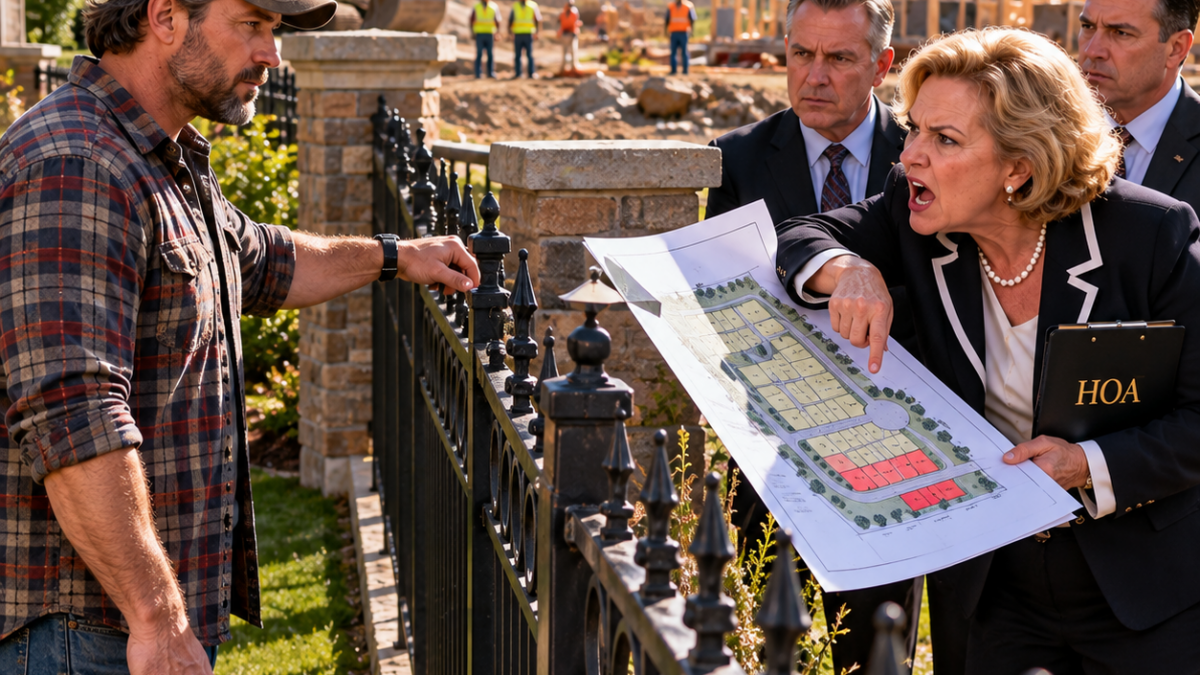
Not decorative little metal panels from a hardware store.
This thing was serious.
Brick columns every twelve feet.
Black wrought iron between them.
Deep concrete footings.
Heavy gate.
It probably cost thirty thousand dollars twenty years ago.
When I bought the house, the fence was one of the things I loved.
Privacy.
Security.
Character.
I had the original closing documents.
Property disclosure.
HOA approval from the original developer.
Fence permit.
Everything.
For eight years, nobody questioned it.
Then Phase Three reached my backyard.
At first the construction was merely annoying.
Bulldozers.
Dump trucks.
Backup alarms at seven in the morning.
Dust.
Workers.
Richard’s company cleared trees behind my fence.
Then grading began.
One afternoon I stood on my back patio and noticed something strange.
The new road was close.
Too close.
Maybe fifteen or twenty feet from my fence at one point.
I remember thinking:
That seems tight.
Then I assumed their engineers knew what they were doing.
That sentence would become funny later.
On Thursday, October 24, rain started around four.
At 6:11, someone hammered my front door.
Not knocked.
Hammered.
I was on the couch with a bowl of chili.
The glass panel beside the door rattled.
When I opened it, Cynthia stood on the porch.
No umbrella.
Beige trench coat.
Black boots.
Red clipboard.
Gregory behind her beneath a large umbrella that somehow covered only himself.
“Mr. Hayes.”
“Cynthia.”
She smiled.
Not friendly.
Official.
“We need to discuss a severe encroachment.”
I looked behind her.
“Did my garden hose escape again?”
Gregory’s mouth twitched.
Cynthia did not appreciate the joke.
“This is serious.”
She pushed a manila envelope against my chest.
“Your rear fence.”
I looked at the envelope.
Then her.
“What about it?”
“Our land assessment for Phase Three integration has identified an eighteen-inch encroachment onto association-owned common green belt.”
I stared.
“What?”
“Eighteen inches.”
“I heard the measurement.”
“Then you understand.”
“No.”
I opened the envelope.
Survey-looking diagram.
Violation notice.
Demand.
FORTY-EIGHT-HOUR CURE PERIOD.
I looked back up.
“My fence has been there twenty years.”
“Nineteen.”
“Congratulations.”
“The age of the violation doesn’t legalize it.”
“The original developer approved it.”
“The original developer went bankrupt.”
“So?”
“The association now controls the common property.”
“That doesn’t erase approvals.”
Cynthia’s eyes narrowed.
“Mr. Hayes, I’m not here to debate obsolete paperwork.”
I laughed.
“Obsolete paperwork is an interesting phrase for somebody claiming a property boundary.”
Gregory shifted beneath his umbrella.
Cynthia tapped the red clipboard.
“Our current GIS assessment shows your fence eighteen inches over the line.”
“GIS assessment?”
“County mapping and development records.”
“You had a survey done?”
“Yes.”
“Physical boundary survey?”
Pause.
“We had a professional site assessment.”
That wasn’t the same thing.
I didn’t know yet how important that difference was.
I asked:
“Where’s the surveyor’s seal?”
Cynthia’s tone hardened.
“You have forty-eight hours.”
“To do what?”
“Remove the fence.”
“All of it?”
“The encroaching structure is continuous.”
“That’s one hundred twenty feet of brick and iron.”
“Yes.”
“You expect me to remove a twenty-year-old masonry fence by Saturday?”
“Monday.”
She smiled.
“Eight A.M.”
“That’s not forty-eight hours.”
“It is substantially equivalent.”
I looked at the paper again.
Failure to cure would result in HOA-arranged demolition.
All costs assessed to my account.
$500 daily continuing violation fine.
Legal expenses.
Collection expenses.
Lien rights.
The word foreclosure appeared in the final paragraph.
My stomach changed.
I owned my house.
Mostly.
I still had a mortgage.
And while HOAs can’t simply steal a home because they are annoyed, legal fights cost money long before anybody is proven right.
“Cynthia.”
“Yes?”
“This is insane.”
“No.”
She pointed toward the backyard.
“What’s insane is using community property as your private yard for almost two decades.”
“I bought the property eight years ago.”
“Then you inherited the problem.”
“Why now?”
Her expression changed.
Tiny.
Half a second.
Then back.
“We recently reviewed boundaries due to Phase Three.”
There.
Phase Three.
I heard it.
“You need the fence moved for Richard’s development.”
Her jaw tightened.
“My husband’s company is irrelevant.”
“Is it?”
“Completely.”
“Then why does the line suddenly matter after twenty years?”
“Because violations discovered must be corrected.”
I stepped onto the porch.
Rain blew sideways.
Gregory moved his umbrella.
“Eighteen inches.”
I said.
“Yes.”
“You’re threatening to demolish a thirty-thousand-dollar fence over eighteen inches.”
“Property theft is property theft.”
That phrase stayed with me.
Property theft.
Cynthia turned.
“Monday morning, Thomas.”
She stopped at the steps.
“If the fence is still standing, our contractor removes it.”
“You come onto my property with equipment and—”
She turned back.
“Be careful.”
Her voice became quieter.
“Our counsel reviewed this.”
“You will be responsible for demolition charges.”
She smiled.
“Those may exceed twenty thousand dollars.”
Then she walked into the rain.
Gregory followed.
I stood there holding the envelope.
My chili went cold.
For the next twelve hours, I panicked.
I wish I could pretend I immediately became clever.
I didn’t.
I believed them just enough to be terrified.
That is how intimidation works.
Not by convincing you completely.
By creating enough uncertainty that fear fills the rest.
At 6:45, I called the fencing company whose sticker was inside my closing folder.
Out of business.
Called another.
“No emergency removals.”
Third.
“Monday at earliest.”
Fourth.
A man named Luis listened.
“One hundred twenty feet?”
“Yes.”
“Brick columns?”
“Yes.”
“Concrete footer?”
“Yes.”
“How many days?”
“Two.”
Silence.
Then he laughed.
Not cruelly.
Disbelieving.
“Sir, I can bring a crew Sunday, but you’re looking at emergency rate.”
“How much?”
“Just demolition?”
“Yes.”
“Eighteen to twenty-two thousand.”
My chest tightened.
“Does that include reinstalling?”
“No.”
“Sprinkler damage?”
“No.”
“Haul-off?”
“Maybe.”
I thanked him.
Hung up.
Called two masonry contractors.
Same answer.
Expensive.
Risky.
Ridiculous timeline.
At 9:30, my sister Emily came over.
She lived twenty minutes away.
Attorney.
Family law, not property.
Still useful.
She sat at my kitchen table reading Cynthia’s notice.
“This is aggressive.”
“That is lawyer for insane?”
“It’s lawyer for aggressive.”
“Can they put a lien on me?”
“Eventually, depending on governing documents and state procedure, but not by Monday morning because she’s angry.”
“She says foreclosure.”
“HOA notices love scary nouns.”
I looked out the back window.
Rain streaked the glass.
Fence lights reflected on wet iron.
“I can’t afford twenty thousand right now.”
“You don’t need to decide tonight.”
“She gave me forty-eight hours.”
“Cynthia gave you forty-eight hours.”
“That’s what I said.”
“No.”
Emily tapped the paper.
“She is not a judge.”
I breathed.
Then she said:
“But you need a real survey immediately.”
“Weekend?”
“Yes.”
“Who?”
She thought.
“David Miller.”
I knew the name.
Everybody did.
David had been surveying county land for more than thirty years.
Developers hated him.
Banks loved him.
His reports were boring enough to be trusted.
I called Friday morning at 8:03.
His receptionist said:
“He’s booked three weeks.”
“I need him this weekend.”
She laughed.
“No.”
“Can I leave a message?”
“What’s the issue?”
I explained.
Forty-eight hours.
Fence.
HOA.
Eighteen inches.
Phase Three.
The receptionist became quiet.
“What subdivision?”
“Whispering Pines.”
“Langden?”
“Yes.”
Pause.
“I’ll tell him.”
At 8:52, David called.
Voice like gravel.
“You Thomas Hayes?”
“Yes.”
“You got Cynthia Langden threatening to tear down an old fence?”
“Yes.”
“How old?”
“2005.”
“Original survey?”
“I have closing documents.”
“Original plat?”
“Not sure.”
“Send me the legal description.”
I did.
He called ten minutes later.
“Interesting.”
“What?”
“You got coffee?”
“What?”
“Tomorrow morning.”
“You can come?”
“Daybreak.”
“I thought you were booked.”
“I am.”
“Then why—”
“I dislike bullies.”
Pause.
“And I dislike Langden Homes.”
“Personal?”
“Professional.”
“What does that mean?”
“They like map overlays.”
I had no idea what that meant.
I would.
Saturday, David arrived at 6:31 A.M.
Old mud-spattered Ford truck.
White beard.
Canvas jacket.
Work boots.
Equipment that looked expensive.
Robotic total station.
Tripod.
Prism pole.
Metal detector.
Survey rods.
Laptop.
Paper tubes.
I handed him coffee.
Black.
He took one sip.
“Good.”
Then walked toward the backyard.
No introductions beyond that.
He inspected my closing survey.
Fence permit.
HOA approval.
Then rolled out a large old plat map across my patio table.
Paper.
Not printout.
Faded.
Blue and black lines.
Signatures.
“This is from 1998.”
“Where’d you get it?”
“County archive.”
“You went there already?”
“Yesterday.”
I blinked.
David pointed.
“Original Whispering Pines plat.”
He tapped several points.
“Original iron monument locations.”
“What does that mean?”
“Means I don’t care where your fence is yet.”
“But that’s what we’re checking.”
“No.”
He looked at me.
“We’re checking where your land is.”
That sounded simple.
It was not.
He explained while setting equipment.
“Modern parcel viewers are useful.”
“Not surveys.”
“Tax maps are useful.”
“Not surveys.”
“Aerial overlays are useful.”
“Still not surveys.”
“I’m seeing a theme.”
“Good.”
He pointed toward Phase Three.
“When developers get lazy, they use GIS lines as planning reference.”
“That’s allowed?”
“For planning.”
“Not final boundary.”
“Correct.”
“Cynthia said they had a survey.”
“Did she give you one?”
“No seal.”
David grunted.
“Then she gave you a picture.”
For the next four hours, David barely looked at my fence.
That fascinated me.
He started near the front property corner.
Found an old iron pin beneath turf.
Measured.
Moved east.
Located another monument.
Then went around the back.
Into brush.
Phase Three had removed much of the vegetation, but one strip remained.
David swung the metal detector.
Slow.
Methodical.
I followed carrying coffee and feeling useless.
At 9:40, he said:
“Your legal description closes well.”
“Good?”
“Usually.”
He repositioned the total station.
Checked coordinates.
Then walked toward the newly paved Langden Boulevard.
I stopped.
“That’s Phase Three.”
“Allegedly.”
“What?”
He didn’t answer.
Metal detector swept.
Beep.
Nothing.
Another.
Then a sharp tone.
David stopped.
Swept again.
Same.
He knelt.
Dug.
Three inches.
Six.
Eight.
At about ten inches, metal struck metal.
He cleared dirt with his glove.
Old rusted pipe.
Cap.
Stamp barely visible.
David wiped it.
Then became very still.
“Thomas.”
Something in his voice changed.
I walked over.
“What?”
“Stand here.”
I stepped beside him.
He set the prism pole precisely over the monument.
Walked back to the instrument.
Measured.
Checked.
Measured again.
Then looked toward my fence.
Then toward the road.
Then back at his collector.
A grin slowly appeared.
Not friendly.
Professional delight.
The expression of a man who has just found a mistake expensive enough to become interesting.
“What?”
He laughed.
“Eighteen inches.”
My stomach dropped.
“I’m over?”
“Thomas.”
He pointed.
“That iron pin is your corner.”
I looked.
Then toward my fence.
It was far away.
“How far?”
David checked.
“Fourteen feet eight inches from fence face at this location.”
I stared.
“What?”
He walked to another point.
“Fence isn’t over their line.”
He looked at me.
“Your fence is almost fifteen feet inside your property.”
My brain refused the sentence.
“Inside?”
“Yes.”
“You’re sure?”
“No.”
My stomach dropped again.
Then David smiled.
“I’m a surveyor.”
“I’m never sure after one point.”
“Give me twenty minutes.”
Longest twenty minutes of my life.
He found another original monument.
Then a third reference point.
Re-ran closure.
Compared legal descriptions.
Checked subdivision replat.
Finally he stood in the middle of Langden Boulevard.
New asphalt.
Fresh curbs.
Decorative street lamps not yet operating.
Seventeen expensive houses stretching behind him.
David looked down.
Then at me.
“You own this.”
I laughed because it made no sense.
“I own what?”
“The strip under my boots.”
“That’s their road.”
“No.”
“It’s paved.”
“Pavement doesn’t convey title.”
“But the city approved it.”
“City approves design.”
He pointed.
“Title is different.”
“How much?”
“Your tract extends roughly fifteen feet beyond the existing fence along most of the rear boundary.”
I stared at the road.
“So they built partly on me?”
“More than partly.”
He unfolded the plat on his truck tailgate.
Red pencil.
Old line.
New Phase Three line.
A shift.
“Here’s what I think happened.”
I leaned closer.
“The county digitized older parcel maps years ago.”
“Okay.”
“The overlay appears shifted.”
“By fifteen feet?”
“In this area.”
“Why?”
“Could be projection.”
“Could be bad control conversion.”
“Could be somebody traced the wrong line.”
“But Richard’s engineers—”
“May have designed from a title commitment and digital base map.”
“Shouldn’t they survey?”
David gave me a look.
“Would you build seventeen houses without one?”
“No.”
“Good.”
He tapped the page.
“Apparently they would.”
I felt dizzy.
“What does this actually mean?”
David became serious.
“It means we verify everything before we celebrate.”
He spent another hour doing exactly that.
Then:
“Confirmed.”
I sat on my back steps.
David stood above me.
My fence.
The fence Cynthia said stole eighteen inches of HOA land.
Was fifteen feet inside my property.
Meaning for years I had effectively left them a strip of my yard.
But that wasn’t the expensive part.
The expensive part was the road.
Langden Boulevard crossed the strip.
Not alongside it.
Across it.
The only vehicular access to all seventeen Phase Three lots passed over my land.
“How can houses get permits if the road isn’t legally theirs?”
David shrugged.
“Could be nobody caught it.”
“Title company?”
“May have relied on developer representations pending final easement recording.”
“Bank?”
“Depends on status.”
“Buyers?”
“Any closed?”
“I think some are under contract.”
David whistled.
I looked at him.
“What?”
“This is going to be loud.”
“What happens if I record the survey?”
“County gets updated boundary information.”
“And Phase Three?”
“Planning department will likely review access.”
“Likely?”
“I’m a surveyor.”
“Not planning director.”
“If legal access depends on your strip…”
He paused.
“Nothing closes until it’s resolved.”
“How much is Phase Three worth?”
David looked at the houses.
“Seventeen times eight hundred thousand is more than four million.”
“That’s sale price.”
“Development exposure is still ugly.”
I whispered:
“Cynthia threatened to destroy my fence over eighteen inches.”
David laughed.
“She picked the wrong eighteen inches.”
My panic disappeared.
Not completely.
But enough.
Then David said something important.
“Do not get stupid.”
I looked at him.
“What?”
“You just discovered leverage.”
“That’s not the same as revenge.”
“I wasn’t—”
“You were.”
He pointed at my face.
“Everybody gets that face.”
“What face?”
“Landowner finds somebody built on his dirt.”
“What do I do?”
“Record accurately.”
“Notify counsel.”
“Do not block the road physically.”
“Do not touch construction equipment.”
“Do not threaten buyers.”
“Do not invent fees.”
“Why would I—”
“Because anger makes people creative.”
He packed the instrument.
“And Cynthia is about to give you an excellent demonstration of why creativity and property law should stay separated.”
I liked David.
By 5:30 Saturday, Emily was at my house.
I spread the preliminary survey on the kitchen table.
She looked once.
Then twice.
Then:
“Oh.”
“Yes.”
“Thomas.”
“Yes.”
“Do not smile like that.”
“I’m not smiling.”
“You are absolutely smiling.”
I explained.
Road.
Fifteen feet.
Original pins.
Digital map shift.
Emily called a real-estate attorney she knew.
Daniel Pierce.
Daniel arrived that evening wearing jeans and carrying a legal pad.
By 8:00, he had reviewed the deed.
Plat.
Survey data.
HOA documents.
Phase Three map.
He leaned back.
“This is serious.”
“For them?”
“For everyone.”
“Can Cynthia tear down the fence?”
“Not if it’s yours and entirely on your parcel.”
“Can the HOA fine me?”
“Not for encroaching on property you own.”
“And the road?”
Daniel looked at the map.
“If David’s final survey confirms this, Langden Homes has a major access problem.”
“How major?”
“Potentially stop-work.”
“Certificate-of-occupancy holds.”
“Closing delays.”
“Title exceptions.”
“Lender issues.”
“How fast?”
“Could happen quickly after recording and notice.”
I sat back.
“Good.”
Daniel stared at me.
“No.”
“What?”
“This is where clients get stupid.”
“David said the same thing.”
“That’s because David likes not being sued.”
“So what do I do?”
“Monday morning, record the survey.”
“Then?”
“Let process happen.”
“What about Cynthia’s demolition crew?”
“Give the contractor the survey before they touch anything.”
“And if they ignore it?”
“Call sheriff.”
“Document.”
“Do not stand in front of a backhoe.”
“That was not part of my plan.”
“Good.”
Then Daniel asked:
“Why does Cynthia want the fence gone?”
That question changed everything.
I told him my suspicion.
Entrance monument.
Sightline.
Richard’s development.
Daniel looked at the Phase Three plan.
Then at the fence.
“Possible.”
Emily said:
“Conflict of interest.”
“Potentially.”
Daniel nodded.
“HOA president using enforcement authority to benefit spouse’s project would raise issues.”
“Can I prove that?”
“Not yet.”
Sunday passed quietly.
Painfully quietly.
I did nothing.
That was difficult.
Construction continued behind my fence.
Workers laid sod.
Landscapers planted shrubs.
A masonry crew built the base for a decorative Phase Three entrance monument.
I sat on my patio drinking coffee.
The fence remained.
Every few hours I looked at it.
Twenty years old.
Black iron.
Brick.
A little moss near the bottom of one column.
How close I had come to paying somebody twenty thousand dollars to destroy it.
At 8:12 Sunday night, David returned.
Stamped survey.
Signed.
Sealed.
Field notes.
Monument references.
Closure table.
Legal exhibit.
He handed me the packet.
“That’s your line.”
I ran my finger across the red boundary.
Fifteen-foot strip.
Road.
“Any doubt?”
“There is always something somebody can challenge.”
“But?”
“If I were Langden Homes, I’d be calling my insurer.”
“Can they claim adverse possession?”
“Subdivision use is too recent for the road.”
“What about the old green belt?”
“Different issue.”
“Could be easement arguments.”
“Implied access.”
“Prescriptive rights.”
He shrugged.
“Lawyers get paid to fight.”
“But the survey stands?”
“Yes.”
He looked toward my fence.
“Tomorrow should be entertaining.”
At 7:34 Monday morning, diesel engines woke the street.
I stood at my kitchen window.
Coffee.
Exactly as Cynthia had promised.
Backhoe.
Yellow.
Large.
Flatbed behind it.
Silver Mercedes SUV.
Cynthia exited.
Beige trench coat.
Gregory.
Red clipboard.
A separate contractor truck.
Two laborers.
She had actually brought a demolition crew.
At 7:43, I called Daniel.
“They’re here.”
“Survey?”
“In my hand.”
“Recording?”
“County clerk opens at eight-thirty.”
“Do not let them touch it.”
“I know.”
“Thomas.”
“What?”
“You sound happy.”
“I am calm.”
“You sound lawsuit happy.”
“I’m going outside.”
I walked through the backyard.
Cynthia saw me.
Looked at her watch.
“Good morning, Mr. Hayes.”
“Morning.”
“Eight minutes early.”
“You’ll forgive us.”
“I’ll try.”
She gestured toward the backhoe.
“I see you chose not to cure the violation.”
“I chose not to destroy my property.”
“That was your choice.”
Gregory raised his phone.
Cynthia said:
“Photograph the structure.”
He did.
“Wide angle.”
Click.
“Property line.”
Click.
“Damage risk.”
Click.
There was no damage.
But Gregory photographed anyway.
Cynthia looked at the operator.
“Mr. Carter, you can begin at eight.”
The operator leaned from the cab.
“Brick first?”
“Yes.”
“Pull columns?”
“Entire structure.”
I raised one hand.
“Before you do that, Mr. Carter, I need you to read something.”
Cynthia sighed.
“No.”
The operator looked between us.
“What?”
“I have a certified boundary survey completed yesterday.”
Cynthia’s head snapped toward me.
I held up the folder.
“Mr. Carter, if you damage the fence after notice that it is entirely on my property, you may be personally dragged into a property-damage dispute.”
Cynthia stepped forward.
“Do not threaten my contractor.”
“I’m informing him.”
She pointed toward the machine.
“You are hired by the HOA.”
The operator shut the engine off.
The sudden silence was wonderful.
Cynthia stared.
“What are you doing?”
“Reading the survey.”
“You do not need to read anything.”
“Ma’am.”
He climbed down.
“I operate heavy equipment for a living.”
“Yes.”
“That means I try real hard not to rip out stuff belonging to somebody who says it’s his.”
“It belongs to the HOA green belt.”
“Great.”
He held out his hand.
“Then the paper will say that.”
I passed the survey through the fence.
He opened it on the hood of his truck.
His finger followed the boundary.
Then stopped.
Looked at the fence.
Then down at his boots.
Then toward Langden Boulevard.
He whistled.
Cynthia stepped beside him.
“What?”
The operator pointed.
“This line?”
“Yes?”
“That’s fifteen feet past the fence.”
“No.”
“That’s what it says.”
“No, it doesn’t.”
“I run excavation.”
“I read site plans all day.”
“It says the property line is back there.”
He pointed toward the road.
Cynthia snatched the packet.
Her eyes moved.
Fast.
She flipped pages.
Found David’s seal.
Her face changed.
“David Miller.”
“Yes.”
“This is invalid.”
“No.”
“He did this over a weekend.”
“Yes.”
“That alone makes it suspicious.”
David appeared from behind my garage.
I had forgotten he said he wanted to see the fireworks.
He carried coffee.
“Morning, Cynthia.”
Her face dropped another shade.
“You.”
“Me.”
“You surveyed this property?”
“Did.”
“Without notifying the association?”
“Didn’t need your permission to survey his parcel.”
“This is fraudulent.”
David smiled.
“Careful.”
Cynthia looked back at the map.
“You’re telling me this fence is fifteen feet inside his land?”
“Roughly.”
“That’s impossible.”
“No.”
“The county GIS shows—”
“There’s your first mistake.”
“The county approved our maps.”
“Tax mapping is not a boundary survey.”
“Our engineer—”
“Where’s their field survey?”
Cynthia stopped.
David sipped coffee.
“Exactly.”
Gregory peered over her shoulder.
His eyes widened.
“Cynthia.”
“Not now.”
“Cynthia.”
“What?”
“If this is right…”
She glared.
“What?”
He pointed.
“Langden Boulevard.”
Silence.
The contractor slowly stepped backward from everyone.
I said:
“Your husband paved the road across my property.”
Cynthia looked at me.
“No.”
“Survey says yes.”
“The HOA has rights.”
“Show me.”
“This land is common green belt.”
“Then your deed should show that.”
“You are twisting paperwork.”
I almost laughed.
“You threatened my home over paperwork Thursday.”
She looked toward the pavement.
For the first time since I had known Cynthia Langden, she looked afraid.
Not angry.
Afraid.
Because she understood development.
She understood access.
She understood seventeen houses behind one road.
I continued:
“I’m filing the survey this morning.”
Her eyes snapped back.
“You cannot.”
“I can.”
“If you record a disputed survey, you create title chaos.”
“That sounds inconvenient.”
“You have no idea what you’re doing.”
“I’m correcting my property record.”
“You’re intentionally interfering with Phase Three.”
“No.”
I tapped the HOA notice in my other hand.
“This was intentional interference.”
Her face flushed.
“You want money.”
“I haven’t asked for any.”
“Everyone wants money.”
“That tells me more about you than me.”
Gregory stepped away.
The backhoe operator climbed into his machine.
Cynthia heard the engine start.
“Where are you going?”
“Leaving.”
“You have a contract.”
“You can sue me.”
“Mr. Carter!”
He put it in reverse.
“I’m not tearing out a fence after a licensed surveyor says it’s private property.”
The backhoe rolled away.
That alone nearly broke Cynthia.
Then David said:
“Ma’am.”
She turned.
“You’re standing on Mr. Hayes’s land.”
She looked down at her boots.
Literally.
As though the ground might change color.
David pointed toward the road.
“Probably about thirteen feet inside the line where you are.”
Cynthia stepped backward instinctively.
Then realized backward took her farther into my parcel.
She moved sideways.
Gregory followed.
I should not have enjoyed that.
I did.
Then I said:
“Forty-eight hours, Cynthia.”
She stopped.
“That’s what you gave me.”
Her face hardened.
“Don’t be childish.”
“I’m not.”
“I’m going to the county clerk.”
“If the city freezes permits—”
“I didn’t build the road.”
“If buyers lose financing—”
“I didn’t mis-survey Phase Three.”
“If Richard suffers damages—”
“You should call Richard.”
That finally landed.
Her eyes changed.
She had not told him.
I knew instantly.
“You didn’t tell your husband.”
Silence.
“Cynthia.”
Her jaw tightened.
“He knows about the fence matter.”
“But not the survey.”
“There was no survey until yesterday.”
“You were going to remove it before anybody checked.”
She said nothing.
David looked at me.
Then away.
Even he disliked that implication.
I walked toward the house.
Cynthia called:
“Thomas.”
I stopped.
“We can discuss this.”
“You had Thursday.”
“That was different.”
“Yes.”
I looked at the fence.
“It was.”
At 8:41, David and I entered the county clerk’s office.
At 9:06, the survey was recorded.
At 9:42, Daniel sent certified notice to the city planning department, Langden Homes, the HOA, and the project’s title insurer.
At 11:18, someone from Langden Homes called.
I did not answer.
At 12:07, Richard called.
I did not answer.
At 12:24, another number.
Attorney.
Voicemail.
At 1:03, a white municipal truck entered Phase Three.
Two inspectors.
At 1:19, the first red notice went onto a model home.
STOP WORK / ACCESS REVIEW.
Then another.
Then another.
Seventeen.
Every one.
A neighbor named Carol texted me a photograph.
All those beautiful houses.
Fresh landscaping.
Red notices.
$4.2 million was the rough development exposure identified in the original premise, with seventeen Phase Three lots suddenly unable to proceed normally because the newly recorded survey showed the only access road crossing Thomas’s land.
By 1:40, Whispering Pines Facebook exploded.
WHAT HAPPENED TO PHASE THREE?
CITY SHUT IT DOWN??
IS THIS ABOUT THOMAS’S FENCE?
Cynthia posted nothing.
That was how everyone knew it was serious.
Monday evening, Emily brought pizza.
“You okay?”
“Yes.”
“No, really.”
I looked out the back window.
Phase Three was quiet.
No machinery.
No workers.
“I’m angry.”
“You won.”
“That’s not the same thing.”
“You haven’t won.”
“Thank you.”
She smiled.
“You found leverage.”
“David warned me about that word.”
“What do you want?”
I had thought about it all day.
At first:
Money.
A lot.
Then:
Humiliation.
Cynthia gone.
HOA dismantled.
But anger after a victory has a dangerous appetite.
It keeps asking.
I remembered David.
Don’t get stupid.
“I want my fence protected.”
“Obviously.”
“I want the road issue resolved legally.”
“Yes.”
“And I want Cynthia to stop using the HOA as a weapon.”
Emily nodded.
“That last one will be harder.”
Thursday afternoon, Richard Langden arrived.
No Cynthia.
No Gregory.
Richard wore a charcoal suit.
Beside him was Harrison Cole, attorney.
Sleek briefcase.
Expensive shoes.
They looked like men visiting a bank after learning the vault belonged to somebody else.
Richard stood on my porch.
“Mr. Hayes.”
“Richard.”
“May we come in?”
I considered making them stand outside.
Petty.
Tempting.
I let them in.
Dining table.
They sat.
I did not offer coffee.
Richard noticed.
Good.
He started.
“My wife made a significant error in judgment.”
“That’s one way to describe it.”
“She acted in her HOA capacity.”
“To help your project.”
Richard’s jaw tightened.
“I did not instruct Cynthia to issue the violation.”
“Did you know about the fence?”
“I knew the planned entrance improvements were close.”
“That wasn’t my question.”
Harrison stepped in.
“Mr. Hayes, we’re not here to debate subjective motivations.”
“I am.”
“We are here to resolve the access discrepancy.”
“Discrepancy.”
Harrison nodded.
“The newly identified strip.”
“It isn’t newly identified land.”
“Newly identified relative to the development plans.”
“Better.”
Richard folded his hands.
“We’ve retained an independent surveyor.”
“Good.”
“Preliminary confirmation largely matches Miller’s results.”
That was the sentence I wanted.
Not apology.
Confirmation.
“So you built on me.”
Harrison corrected:
“A portion of the access pavement appears to cross your parcel.”
“That sounded expensive to phrase.”
He did not smile.
Richard said:
“We’re prepared to purchase the strip.”
“How much?”
“Twenty-five thousand dollars.”
I laughed.
Not strategic.
Genuine.
Richard’s face hardened.
Harrison remained calm.
“The land itself has minimal independent utility.”
“Incorrect.”
“How?”
I pointed toward Phase Three.
“It has seventeen houses attached to it.”
Richard said:
“Don’t be ridiculous.”
“I’m not.”
“Fifteen feet of yard is not worth—”
“I don’t want to sell it.”
That stopped them.
Harrison leaned forward.
“What do you want?”
“An easement.”
Richard stared.
“You’re willing to grant one?”
“Yes.”
His shoulders relaxed.
Too early.
“Terms?”
I slid a packet across the table.
Daniel had helped draft it.
Not David.
Surveyors should not draft legal agreements, no matter how enthusiastic they are about fireworks.
Harrison opened it.
First term:
Permanent nonexclusive right-of-way easement across specified strip.
Price:
$450,000.
Richard made a sound.
“What?”
“Four hundred fifty thousand.”
“You’re insane.”
“No.”
“That land is worth maybe thirty thousand.”
“Then build another road.”
Silence.
There wasn’t another route.
Phase Three was constrained by creek land on one side and already platted lots on the other.
A redesign would require months.
Potential property acquisition.
New approvals.
Regrading.
Maybe more.
Harrison continued reading.
Second:
Langden Homes pays all survey, recording, legal, title, and fence-relocation costs.
Third:
My fence professionally relocated to the actual property line using insured masonry specialists.
Same materials preserved where possible.
Any damage replaced.
Fourth:
Landscape restoration.
Irrigation relocation.
Lighting.
Fifth:
HOA rescinds all fence notices and fines.
Sixth:
Cynthia resigns as HOA president.
Richard looked up.
“No.”
I leaned back.
“Then no easement.”
“You cannot condition property access on my wife’s HOA role.”
Harrison raised one hand.
“Richard.”
Richard ignored him.
“That is personal retaliation.”
“It is governance.”
“It is none of your business who leads the HOA.”
“It became my business when she threatened foreclosure over land she didn’t own.”
Harrison reread the page.
The terms in the source premise also included Cynthia’s resignation, restrictions on HOA enforcement powers, payment for relocating the fence to the true boundary, and a large paid easement rather than outright sale of the strip.
He continued.
Seventh:
Independent HOA governance review.
Conflict-of-interest policy.
No board officer may use association enforcement to materially benefit an affiliated development or business without disclosure and recusal.
Richard went quiet.
Eighth:
Fines for purely aesthetic violations capped unless actual safety or property damage is involved.
Ninth:
No foreclosure action based solely on cosmetic covenant fines without specified procedural protections and homeowner vote requirements as legally permissible.
Richard pushed the packet away.
“You’re rewriting the HOA.”
“No.”
“I’m making access contingent on resolving the system your wife used against me.”
“This is extortion.”
Harrison spoke immediately.
“I would avoid that term.”
Richard glared.
“Why?”
“Because Mr. Hayes is not blocking existing public access he created.”
“He is negotiating an interest in land he owns.”
“Then $450,000 is obscene.”
I said:
“So was threatening to demolish my fence in forty-eight hours.”
Richard stood.
“This development employs people.”
“Then you should have surveyed it.”
“Banks are involved.”
“Then you should have surveyed it.”
“Families have contracts.”
“Then you should have surveyed it.”
His face went red.
“You think this is funny?”
“No.”
That was true.
I didn’t anymore.
“Seventeen families may have closings delayed because you saved a few thousand dollars on boundary work.”
“I did not personally approve the survey scope.”
“You own the company.”
“That doesn’t mean—”
I raised one hand.
“See how unpleasant that logic is?”
He stopped.
Cynthia had used the same style.
I’m president, therefore authority.
But responsibility?
Apparently somebody else’s.
Richard sat again.
Harrison asked:
“If Cynthia resigns voluntarily, will that satisfy that provision?”
“Yes.”
“If governance changes require membership vote?”
“Then Langden Homes funds counsel to draft the proposal and supports adoption, but I’m not asking you to illegally command the membership.”
Harrison nodded.
Reasonable.
Richard hated that his lawyer found any of this reasonable.
“What about the price?”
“Four-fifty.”
“Two hundred.”
“No.”
“Two-fifty.”
“No.”
“Three.”
“No.”
“Thomas.”
“Richard.”
He stared.
“What number will you actually take?”
“Four hundred fifty thousand.”
“You came up with that because you know we’re bleeding.”
“Yes.”
Harrison almost smiled.
Richard looked at him.
“Do not.”
Harrison returned to neutral.
I continued.
“You threatened twenty thousand in demolition plus fines and legal costs over imaginary encroachment.”
“My wife threatened that.”
“You benefited from her pressure.”
“I didn’t ask her to do it.”
“Did you stop her?”
He looked away.
There.
I saw it.
He knew enough.
Maybe not the details.
But enough.
“Richard.”
His eyes returned.
“Why did Cynthia care about the fence?”
Silence.
“Sightline?”
Nothing.
“Entrance monument?”
Harrison shifted.
Richard said:
“The Phase Three monument plan required additional visibility.”
“And my fence blocked it.”
“Partially.”
“So she tried to make me pay to remove the thing inconvenient to your development.”
“I did not direct that.”
“But you knew.”
He didn’t answer.
I stood.
“Meeting’s over.”
Harrison said:
“Mr. Hayes.”
“Four-fifty.”
“Governance terms.”
“Fence.”
“Fees.”
“Twenty-four hours.”
Richard looked furious.
“You’re giving me a deadline?”
I looked at him.
“Forty-eight seemed traditional.”
Emily would later tell me that was unnecessarily theatrical.
She was right.
I still enjoyed it.
Richard did not sign that day.
The source version had him sign immediately.
I made him suffer through reality first.
That night, Phase Three buyers began calling Langden Homes.
One family’s lender paused underwriting.
Another demanded title clarification.
Subcontractors asked whether they should continue.
Construction note interest did not stop because a property line was inconvenient.
Tuesday morning, Richard countered at $350,000.
I said no.
No anger.
No speech.
No.
At noon:
$400,000.
I said:
“Four-fifty.”
At 2:30, Harrison called.
“If they accept all nonfinancial terms, would you accept $425,000?”
“No.”
“Why are you fixed on $450,000?”
“Because I am.”
“That is not a valuation method.”
“You’re welcome to refuse.”
Silence.
Then Harrison laughed.
“David Miller likes you.”
“How do you know?”
“He dislikes my client.”
“That is not the same thing.”
“Fair.”
At 4:42 P.M., Richard returned.
Alone.
He brought the signed agreement.
No Cynthia.
No attorney.
He looked exhausted.
He placed it on the table.
“Four hundred fifty.”
I checked.
Initialed.
Governance provisions.
Fence.
Costs.
Legal easement language.
Everything.
“Why’d you come alone?”
“Harrison says I’m less irritating without counsel.”
“That doesn’t sound like something a lawyer would say.”
“He used more words.”
I signed.
Then Richard said:
“You ruined Phase Three for a week.”
“You built Phase Three on my land.”
“Fifteen feet.”
“Yes.”
He looked toward my backyard.
“How did nobody catch it?”
“Cheap digital map.”
He nodded slowly.
“That’s what our surveyor says.”
“You didn’t order a full boundary survey?”
“No.”
“Why?”
Richard gave a tired laugh.
“Because I’ve built hundreds of lots.”
“That isn’t an answer.”
“Yes, it is.”
He looked at me.
“I thought I knew what could go wrong.”
That sentence was more honest than anything Cynthia had ever said.
I understood it.
Success breeds shortcuts differently from ignorance.
Ignorance says:
I didn’t know.
Experience sometimes says:
I don’t need to check.
Richard stood.
“You know four-fifty hurts.”
“I know.”
“Not bankruptcy.”
“I assumed.”
“But it hurts.”
“Good.”
He looked at me.
I didn’t apologize.
Some lessons deserve a price.
Then he surprised me.
“Cynthia resigned this afternoon.”
I said nothing.
“She hates you.”
“I’ll recover.”
“She hates me more.”
“That sounds marital.”
Richard almost smiled.
“The board attorney told her the conflict disclosures would be ugly if this became litigation.”
“Smart attorney.”
Richard opened the door.
Before leaving, he said:
“She really did think your fence was over.”
I studied him.
“But?”
“She also wanted it gone.”
There it was.
Both could be true.
Cynthia had believed bad data because the bad data served what she already wanted.
That might be the most common form of certainty in the world.
Three business days later, the money cleared through escrow.
I did not suddenly become rich.
Taxes.
Legal fees.
Planning.
I paid off a large chunk of my mortgage.
Set aside money.
Helped Emily with our mother’s assisted-living reserve.
Most stayed invested.
The part everyone noticed was the fence.
Langden Homes hired a restoration masonry company.
Not demolition.
Restoration.
They documented every iron section.
Numbered bricks to preserve matching material where possible.
Carefully removed columns.
Poured new footings fifteen feet farther back—on the actual line.
My yard grew.
A lot.
Fifteen feet across one hundred twenty feet is roughly eighteen hundred square feet.
Not nothing.
For eight years, I had mowed less land than I owned.
When the fence moved, my backyard looked enormous.
Sarah—my girlfriend at the time, later my wife—stood beside me.
“You got paid four hundred fifty thousand dollars and a bigger yard because someone tried to make you move your fence.”
“That is an oversimplification.”
“It is exactly what happened.”
“There were legal complexities.”
“Your life is stupid.”
“I agree.”
Whispering Pines changed faster than I expected.
Cynthia’s resignation email arrived at 7:03 one morning.
Dear Residents,
After thoughtful consideration, I have decided to step away from my position as Board President in order to focus on family priorities.
I nearly choked on coffee.
Family priorities.
By lunch, everyone knew.
Not the official details.
Neighborhoods do not require official details.
They require one retiree with time.
Carol had documents.
Gary had screenshots.
Somebody knew a Phase Three subcontractor.
Within twenty-four hours, the story mutated.
Cynthia tried to steal my house.
I secretly owned half the subdivision.
The FBI was involved.
The county seized seventeen homes.
None true.
I posted one statement.
A licensed survey identified a boundary error affecting my fence and Phase Three access. The issue has been resolved through a private easement agreement. The fence will be relocated to the surveyed boundary. Please do not harass any board member or Phase Three buyer.
That last sentence mattered.
People were angry at Cynthia.
But harassment is still harassment even when the target used to be the bully.
The new interim HOA president was a retired accountant named Denise Carlton.
Her first meeting lasted three hours.
Residents packed the clubhouse.
Denise opened:
“I am not Cynthia.”
Applause.
She raised one hand.
“Please do not make me regret saying that.”
More laughter.
Then governance reform.
Fine caps.
Appeal process.
Independent review.
Conflict disclosures.
No compliance officer prowling with measuring tape.
Gregory’s contract was not renewed.
He returned the red clipboard.
Someone hung a red clipboard on the clubhouse wall as a joke.
Denise took it down.
“Enough.”
She was right.
Reform should not become revenge theater.
The architectural committee remained.
People still had rules.
Nobody suddenly painted houses purple or parked boats on lawns.
But tone changed.
A warning became a conversation.
Appeals were heard by people other than the person who issued the violation.
Records were public.
Board members disclosed business relationships.
Aesthetics stopped feeling like criminal law.
One neighbor, Mrs. Lang, left her trash cans visible overnight.
Nothing happened.
The next morning she posted:
FREEDOM.
Thirty-two laughing reactions.
I thought that was ridiculous.
Also funny.
Phase Three resumed after the easement was recorded and municipal access review cleared.
The stop-work notices came down.
Closings moved forward.
Families moved in.
Most had no idea that the road to their homes crossed my property under a recorded easement.
That was fine.
I did not need them thanking me.
The land remained mine.
The right of passage belonged to them.
That is how easements work when adults handle them before asphalt.
Langden Homes renamed the road.
That surprised everyone.
Not Langden Boulevard anymore.
Richard filed a change before final municipal acceptance.
New name:
Pine Crossing.
I ran into him at the grocery store.
“You changed it.”
“Yes.”
“Why?”
He looked at the tomatoes.
“My name had become annoying.”
I laughed.
“That’s self-awareness.”
“Expensive self-awareness.”
“How’s Cynthia?”
He became serious.
“Angry.”
“At me?”
“At everybody.”
“Still in the neighborhood?”
“For now.”
They sold six months later.
Not because I forced them.
Their marriage had apparently been in trouble already.
The Phase Three mess did not help.
I heard Cynthia moved to another county.
I never confirmed it.
People expected me to enjoy that.
I didn’t particularly.
By then, she had become less important to my life.
That felt better than revenge.
The most important conversation happened much later.
Almost a year after the survey.
I was in the backyard.
New fence.
Patio extended.
A row of young magnolia trees planted along the extra strip.
Someone knocked at the side gate.
Cynthia.
I almost didn’t recognize her.
No clipboard.
No trench coat.
Jeans.
Simple blue sweater.
She looked older.
Not ruined.
Just less armored.
“What are you doing here?”
“I’m moving tomorrow.”
“I heard.”
She looked at the fence.
“So that’s the line.”
“That’s the line.”
She walked closer but stayed on the sidewalk outside.
I noticed that.
Respecting the boundary.
Good start.
“I was wrong.”
I said nothing.
She continued.
“The GIS map was wrong.”
“Yes.”
“I relied on it.”
“Yes.”
“I should have required a survey.”
“Yes.”
Her mouth tightened.
“You enjoy making people say everything.”
“When they threatened my house, yes.”
Fair.
She looked through the iron bars.
“You think I did it for Richard.”
“I know you did it partly for Richard.”
“He didn’t ask me.”
“He didn’t stop you.”
“No.”
Silence.
Then:
“The monument was going there.”
She pointed.
“Your fence blocked visibility.”
“I know.”
“I thought…”
She stopped.
“What?”
“That you were being difficult.”
“I didn’t know there was a problem.”
“I know that now.”
She looked at her hands.
“I had convinced myself residents resisted because they didn’t understand the bigger plan.”
“What bigger plan?”
“Property values.”
“Consistency.”
“Expansion.”
“Keeping standards high.”
“And?”
“And I stopped asking whether people actually wanted the things I was protecting.”
That was more insight than I expected.
I asked:
“Why the forty-eight hours?”
She laughed bitterly.
“Because pressure worked.”
“With other people?”
“Yes.”
That angered me more than I wanted.
“Who?”
She looked up.
“Does it matter?”
“Yes.”
“Mrs. Dalton removed a shed.”
“She cried for a week.”
“I know.”
“The Parkers repainted their house.”
“Yes.”
“You fined the Carters because their son’s wheelchair ramp wasn’t approved.”
Her face changed.
“I waived that.”
“After residents complained.”
“Yes.”
I stared.
Cynthia swallowed.
“I liked being effective.”
There it was.
Not power.
Not exactly.
Effectiveness.
The intoxicating feeling that people moved when you spoke.
“I thought quick compliance meant good leadership.”
“And now?”
“I think sometimes people complied because I frightened them.”
“Yes.”
She nodded.
“Richard told me I had become impossible.”
“He waited a while.”
“We both did.”
She almost smiled.
Then looked at the fence again.
“Four hundred fifty thousand?”
I laughed.
“You know.”
“Of course I know.”
“Still angry?”
“Very.”
“Good.”
“That’s what Richard said you’d say.”
We both smiled.
Then she became quiet.
“I did not come for forgiveness.”
“Good.”
“I came because I’m leaving.”
“And?”
“I wanted to say I was sorry without an HOA email.”
That line almost got me.
Almost.
I opened the gate.
“Do you want coffee?”
She looked shocked.
I regretted offering immediately.
But she said:
“No.”
Then smiled faintly.
“Boundaries.”
I nodded.
“Finally.”
She left.
That was the last time I saw her.
The fence stayed.
People assume the story is about getting rich.
It isn’t.
The $450,000 was significant.
Of course.
Pretending otherwise would be ridiculous.
It changed my mortgage.
Savings.
Security.
But the number everybody repeats hides the stranger part.
I almost spent twenty thousand dollars destroying my own fence because someone with a clipboard sounded certain.
That scares me more than the development mistake.
Friday morning, before David called back, I had contractor quotes open on my laptop.
I had considered signing one.
Imagine.
I would have paid a crew to tear out my own property.
Then Cynthia’s contractor would have gained the sightline Richard wanted.
My yard would have shrunk psychologically even though the deed said otherwise.
Phase Three would have continued over my land.
Maybe the mistake would surface years later.
Maybe during a resale.
Maybe never.
All because I had forty-eight hours and panicked.
Pressure does that.
It compresses decision-making until obedience feels cheaper than verification.
That is the lesson I remember.
Not:
Fight every HOA.
Not:
Surveys make you rich.
Not:
Bullies always lose.
Sometimes they don’t.
Sometimes the survey would have shown Cynthia was right.
Then I would have moved the fence.
Painful.
Expensive.
But correct.
The point is simpler.
Check.
Before destroying something.
Before paying.
Before signing.
Before believing a map.
Before believing a person who says there is no time to verify.
Especially when they are the one creating the deadline.
David framed it better.
A month after everything settled, I bought him dinner.
He hated fancy restaurants, so we went to a barbecue place.
I asked:
“How often are property maps wrong?”
He chewed.
“Define wrong.”
“Off fifteen feet.”
“Rare.”
“But happens.”
“Yes.”
“How?”
“Old deeds.”
“Bad monument calls.”
“Datum conversion.”
“Digitization.”
“Human beings.”
“That last one seems broad.”
“It’s the main category.”
He drank tea.
“People think property lines exist because a computer draws them.”
“They exist because legal descriptions tie back to physical evidence.”
“Monuments.”
“Records.”
“Surveys.”
“History.”
I said:
“Cynthia thought the map was proof.”
“Everybody likes pictures.”
“They’re easy.”
“What should she have done?”
“Survey before development.”
“How much would that have cost?”
“For the boundary issue?”
“A few thousand.”
I laughed.
“And instead…”
“Instead everybody bought me barbecue.”
Fair.
The county later reviewed other parcels near Phase Three.
Two minor discrepancies.
Nothing dramatic.
Richard hired a new surveying company.
Full boundary surveys on every project.
I heard from a subcontractor that he became obsessive.
Good.
Expensive mistakes can be excellent teachers if you survive them.
My new fence ended up fifteen feet farther out almost everywhere.
One corner differed slightly because the actual line wasn’t perfectly parallel to the old fence.
That pleased David.
“Reality is rarely square.”
I put a small brass marker inside one brick column.
Not visible from the street.
Just for me.
It says:
TRUE LINE — 2026.
Emily mocked it.
“You have become a land-survey nerd.”
“You’re welcome to stand on the other side.”
“Your yard got bigger and your personality got worse.”
“Correlation.”
Years later, Phase Three looks like it was always there.
Trees matured.
Families decorated porches.
Children rode scooters down Pine Crossing.
A woman named Jasmine who lives in Lot 8 once knocked on my gate.
“Are you Mr. Hayes?”
“Depends.”
She laughed.
“People said you’d say that.”
“What do you need?”
“My daughter’s soccer ball went over your fence.”
I found it.
Returned it.
She looked at the ironwork.
“This is the famous fence?”
I sighed.
“There is no famous fence.”
“There absolutely is.”
“Who told you?”
“Gary.”
Of course.
She pointed toward the road.
“Is it true you own this?”
“The land under part of it.”
“That’s wild.”
“There’s an easement.”
“So we can drive?”
“You have been driving for three years.”
“I know.”
She laughed.
“My husband said you could close the road if the HOA annoys you.”
“No.”
“Thank God.”
“That’s not how easements work.”
“Can you tell him? He thinks you’re some suburban warlord.”
“I grow tomatoes.”
“I’ll tell him.”
She left.
That interaction mattered.
Phase Three residents were not my enemies.
They had bought homes in good faith.
The title problem belonged to developers, lawyers, mapping, and bad decisions.
I never wanted seventeen families punished permanently because Cynthia bullied me.
That would have made me no better.
The easement was the right solution.
They got access.
I kept title.
Richard paid for the mistake.
The fence moved to the real boundary.
The HOA changed.
Clean enough.
There was one final piece I learned years later.
Denise, the former interim HOA president, found archived email while digitizing old records.
She called.
“You want something funny?”
“Always dangerous.”
“Remember your fence notice?”
“I have trauma.”
“Cynthia emailed Gregory three days before she served you.”
“What did it say?”
Denise read:
Need Hayes rear line cleared before Phase Three monument landscaping. GIS shows possible encroachment. If he resists, use full cure authority. Richard needs visual corridor open before model-home weekend.
I went silent.
There it was.
Written.
Not speculation.
The HOA enforcement really had been deployed to benefit Phase Three aesthetics.
“Send it.”
“Already did.”
I forwarded it to Daniel.
Not to sue.
Too late for anything meaningful, and the settlement had resolved claims.
I wanted it for my records.
He called.
“You feel vindicated?”
“Strangely, no.”
“Why?”
“I already knew.”
“That’s usually how evidence feels when it arrives after closure.”
I printed the email anyway.
Put it in the same folder as the original red notice.
Not framed.
Just stored.
The notice says:
SEVERE ENCROACHMENT.
The survey says:
NO.
The email says:
WHY.
Three documents.
That is the entire conflict.
Claim.
Fact.
Motive.
Everything else was noise.
Sometimes I sit on the patio and look toward Pine Crossing.
Cars come and go.
Nobody thinks about the easement.
That is success.
Good infrastructure disappears into ordinary life.
The fence is the same.
Black iron.
Brick columns.
Moved fifteen feet.
Still standing.
Cynthia wanted it gone because it was inconvenient.
Instead, forcing me to question it proved exactly where it belonged.
There’s poetry in that, though David would hate me saying so.
He once told me:
“Property law isn’t poetry.”
I said:
“Neither is surveying.”
He answered:
“Correct.”
Then spent twenty minutes describing the beauty of a perfect traverse closure.
Surveyors are hypocrites.
The $450,000 became neighborhood legend.
People inflated it.
Five hundred thousand.
Seven hundred.
One million.
Someone claimed Richard gave me one of the Phase Three houses.
No.
The original story’s central reversal remains much cleaner: a certified survey showed Thomas’s fence almost fifteen feet inside his own boundary and revealed that the new Phase Three access road crossed his strip, instantly putting all seventeen lots at risk until a legal easement could be negotiated.
What I remember most is Monday morning.
Backhoe idling.
Cynthia holding the red clipboard.
Me holding David’s stamped survey.
Two different kinds of authority.
Hers existed because people around her agreed to let it.
Mine existed because an iron pipe had been driven into the earth in 1998 and the legal description still pointed to it.
She had threats.
I had coordinates.
She had a deadline.
I had the ground.
And the ground won.
That sounds dramatic.
But property disputes usually are not won by shouting.
They are won by documentation.
The backhoe operator understood that faster than anybody.
The second he saw a licensed seal, he shut off the machine.
No argument.
No loyalty to Cynthia.
No ideology.
Just:
I’m not destroying something until I know whose it is.
That man may have been the wisest person there.
He had no interest in justice.
He just didn’t want to be wrong with hydraulic equipment.
Good instinct.
The neighborhood changed after Cynthia left.
Not paradise.
HOAs still generate arguments.
Someone complained about basketball noise.
Someone hated solar panels.
One family painted their door orange and nearly started a civil war.
Human civilization continued.
But something fundamental shifted.
Board members became less confident.
I mean that as praise.
They asked counsel.
Checked documents.
Talked to homeowners.
Used warnings before fines.
Used fines before legal threats.
Nobody used the word foreclosure over landscaping again.
At one meeting, Denise said:
“Our goal is not maximum enforcement.”
I almost applauded.
She continued:
“Our goal is reasonable maintenance of shared obligations.”
That was all an HOA ever needed to be.
Boring.
Transparent.
Limited.
Useful.
Cynthia had made it personal.
When organizations become extensions of one person’s personality, everyone eventually pays.
She paid.
Richard paid.
Residents paid in stress.
I nearly paid twenty thousand dollars.
Phase Three buyers paid in delays.
All over a line nobody bothered to verify.
There’s another lesson in that.
Tiny numbers can carry enormous consequences.
Eighteen inches.
That was Cynthia’s accusation.
Fifteen feet.
That was the truth.
One digit.
Different unit.
Different universe.
Eighteen imaginary inches nearly cost me my fence.
Fifteen real feet froze seventeen lots.
I sometimes wonder what would have happened if Cynthia had simply knocked politely.
“Thomas, Phase Three plans show a possible boundary discrepancy.”
“Would you split the cost of a survey?”
I would have said yes.
Probably.
We would have discovered the mistake before the road was finished.
Richard could have bought or negotiated the easement for far less.
Fence could have moved calmly.
No stop orders.
No public humiliation.
No $450,000 lesson.
The expensive part was not the boundary error.
It was arrogance.
Errors happen.
Arrogance prevents cheap correction.
That distinction matters in business.
Marriage.
Government.
Neighborhoods.
Everything.
The biggest disasters often start as small mistakes defended too aggressively.
Cynthia could not tolerate the possibility her map was wrong.
So she created a forty-eight-hour ultimatum.
The ultimatum made me hire David.
David found the pin.
The pin found the road.
The road found the title problem.
The title problem found seventeen houses.
Everything followed.
She didn’t lose control because I fought harder.
She lost control because she forced somebody to check.
That may be my favorite part.
Her strongest weapon was pressure.
Pressure produced scrutiny.
Scrutiny destroyed her position.
Years after the incident, I received a letter from a homeowner in another subdivision.
A friend had told him my story.
His HOA claimed his shed crossed common property.
He asked what I thought.
I wrote back:
Don’t assume they’re wrong.
Don’t assume they’re right.
Get a licensed surveyor.
That was it.
Not revenge advice.
No threats.
No cleverness.
Check the line.
He wrote six weeks later.
HOA was right by nine inches.
He moved the shed.
Cost $1,600.
No war.
Perfect outcome.
Being willing to verify means being willing to discover you are wrong too.
If David had shown my fence eighteen inches over, I would have hated it.
But I would have dealt with reality.
That is the difference.
Cynthia’s mistake wasn’t merely being wrong.
Everybody is wrong.
She made certainty a weapon before earning it.
One autumn morning, years after the survey, I walked behind the fence.
The original iron boundary monument David found is still there.
Protected now.
Small witness post beside it so landscaping crews don’t disturb it.
I brushed leaves away.
Rusty pipe.
Ugly.
Barely visible.
That piece of metal had sat underground while developers paved roads, HOAs wrote violations, houses went under contract, and everybody argued above it.
It did not move.
It did not care.
The line existed whether anyone believed it.
I thought about Cynthia on my porch.
“Property theft is property theft.”
She had been right.
Just not about whose property.
I laughed.
Then returned to the patio.
Coffee.
Morning sun.
New fence throwing long shadows across land I once didn’t know I owned.
A car turned onto Pine Crossing.
Then another.
People heading to work.
School.
Grocery store.
Ordinary life crossing the easement.
Nobody stopped.
Nobody asked permission.
That was the deal.
Permanent access.
Stable.
Recorded.
Civilized.
The best ending was not that I could block them.
It was that I never needed to.
The road works because everybody finally knows whose rights exist.
My ownership.
Their easement.
No ambiguity.
No clipboard can change either.
Sometimes people ask:
“Would you do it again?”
They mean:
Would I demand $450,000?
Would I force the resignation?
Would I freeze Phase Three?
That is the wrong question.
I did not wake up wanting any of those things.
I wanted to eat chili in peace.
I wanted my fence left alone.
If Cynthia had left it alone, I might never have discovered the fifteen feet.
Maybe Richard’s title problem would have surfaced later.
Maybe somebody else would have solved it.
Maybe not.
But she came to my door in the rain.
She gave me forty-eight hours.
Threatened fines.
Demolition.
Lien.
Told me not to bother fighting because her legal team was thorough.
That sentence still makes me laugh.
Her legal team may have been thorough.
Her survey wasn’t.
When she demanded that I move my fence, I finally checked the ground beneath both of us.
And that is how a dispute over eighteen imaginary inches revealed fifteen very real feet.
How fifteen feet crossed one road.
How one road controlled seventeen lots.
How seventeen lots turned into millions of dollars in suspended development.
How a $500-per-day threat became a $450,000 easement.
How an HOA president lost the office she had used as a weapon.
And how the fence she wanted demolished ended up standing fifteen feet farther out than before.
Sometimes standing your ground is metaphorical.
Sometimes it means courage.
Sometimes principle.
Sometimes refusing intimidation.
And every once in a while, if you are very lucky and somebody else is very careless, standing your ground means hiring an old surveyor with a metal detector, digging ten inches into the dirt, and discovering the ground they have been ordering you off belonged to you all along.





