HOA Fined Me $500 and Called My Flood Wall a Joke—Then the Spillway Opened and Their Homes Filled With Water While Mine Stayed Dry
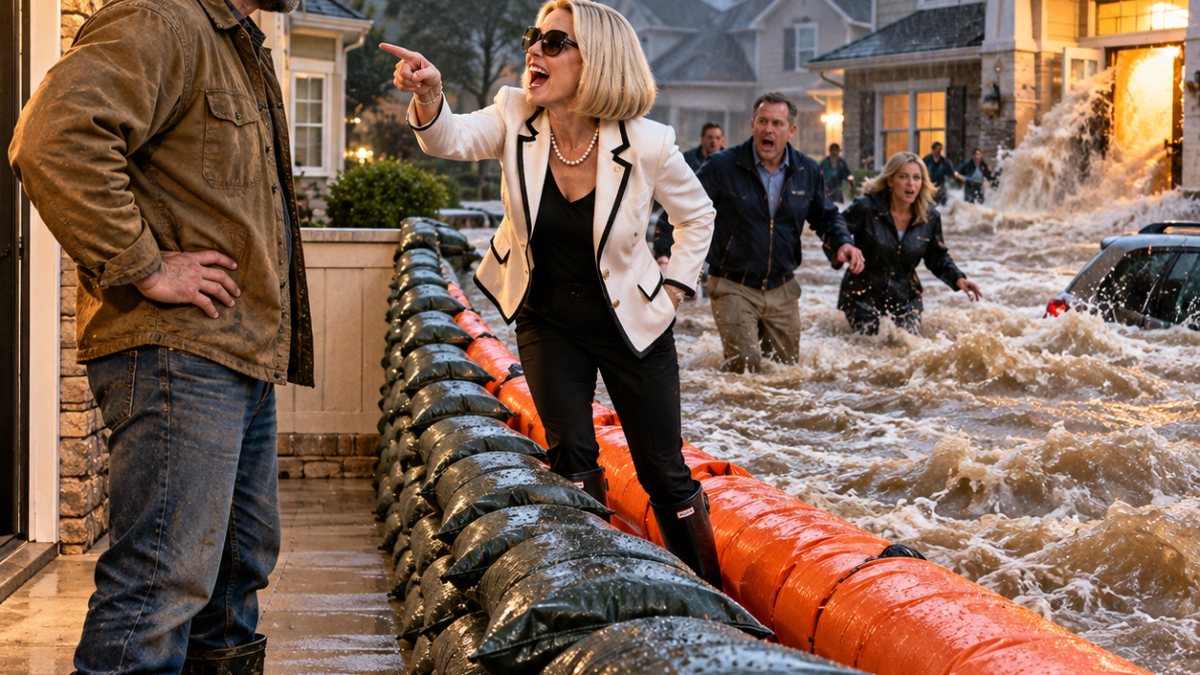
HOA Fined Me $500 and Called My Flood Wall a Joke—Then the Spillway Opened and Their Homes Filled With Water While Mine Stayed Dry.
The HOA president stood in my driveway under a blackening sky, handed me a $500 citation, and called the flood wall around my house an embarrassing eyesore that was destroying neighborhood property values.
Three hours later, the storm drains began shooting muddy water backward into the street, his custom front door burst inward, and the same board members who had mocked my sandbags were watching their living rooms disappear beneath four feet of sewage-filled floodwater.
By the next morning, my house was the only dry home on the cul-de-sac—and when those same neighbors began wading through chest-deep water toward my “joke” of a barrier begging for food, medicine, and shelter, I had to decide whether being right mattered more than helping the people who had tried to stop me from protecting my own family.
There is a sound a fiberglass front door makes when enough water pushes against it.
It isn’t dramatic at first.
No explosion.
No cinematic boom.
Just a wet crack.
A little plastic.
A little wood.
Weather stripping surrendering one inch at a time.
Then comes the rush.
That is the sound of a room becoming a container for a river.
I heard Richard Bellamy’s front door fail from across the street.
I was standing inside my dry living room holding black coffee.
Richard was inside his house.
Three hours earlier, he had stood on my driveway in a salmon-colored polo shirt, looked at the sandbag wall I had spent two days building, and called me a paranoid idiot.
Then he fined me five hundred dollars for it.
My name is Tom Mercer.
Before I moved into Oak Creek Estates, I spent twelve years working in civil engineering.
Not glamorous civil engineering.
Drainage.
Retention.
Roadway grading.
Stormwater infrastructure.
The sort of work nobody notices when it functions and everybody suddenly becomes an expert on when it fails.
Eventually I burned out.
Too many municipal meetings.
Too many contractors arguing over six inches of pipe diameter.
Too many developers promising that a spreadsheet had somehow overruled gravity.
I moved into software project management.
Better pay.
Cleaner clothes.
Fewer meetings about concrete.
But you don’t forget how water moves.
Especially after you’ve spent twelve years being paid to predict where it will go.
Oak Creek Estates looked safe.
That was its greatest trick.
PART2:
The subdivision sat six miles outside a prosperous southern city where farmland had been turning into housing developments for almost fifteen years.
Oak Creek had seventy-eight homes.
Modern Craftsman facades.
Stone veneer.
Three-car garages.
Decorative streetlights.
Landscaping so symmetrical it looked copied and pasted.
The developer had planted rows of young maples along the sidewalks.
The HOA required approved mailbox designs.
Approved fencing.
Approved mulch colors.
Approved basketball goals.
You could receive a warning for leaving a garage door open too long.
I wish that was exaggeration.
It wasn’t.
We moved there because my wife Sarah loved the house.
I did too.
Four bedrooms.
Basement.
Big kitchen.
Covered back porch.
A yard just large enough to feel private without owning enough grass to ruin every Saturday.
The school district was excellent.
The neighborhood was quiet.
And the cul-de-sac looked almost absurdly peaceful.
The only thing I hated was the topography.
The first time our realtor drove us down Oak Creek Drive, I noticed it immediately.
The neighborhood descended from the entrance.
Gradually.
So gradually most people wouldn’t see it.
Every street fed downward toward us.
PART3:
Our house sat at the elbow of the final cul-de-sac.
Lowest finished-floor elevation on the block.
The realtor said:
“The drainage here is state-of-the-art.”
That sentence bothered me.
“How large is the downstream culvert?”
She blinked.
“The what?”
I walked to the rear property line.
There was a shallow swale behind the houses.
Farther beyond it, trees hid Oak Creek.
The real creek.
Not the subdivision.
“How does runoff leave the basin?”
The realtor smiled uncertainly.
“I’m sure it’s all been engineered.”
Sarah appeared beside me.
“Tom.”
“I’m asking.”
“You’re interrogating.”
“I like the house.”
“Then stop frightening the realtor.”
The realtor laughed.
I didn’t.
I requested the development drainage documents before closing.
That should tell you what kind of man Sarah married.
I read them.
Detention ponds.
Underground storm lines.
A reinforced concrete culvert beneath County Road 14.
Design storm assumptions.
Freeboard calculations.
On paper, it worked.
Barely.
I told Sarah:
“We’re fine unless something unusual happens.”
She said:
“Everything unusual happens to you.”
For four years, nothing unusual did.
Heavy rain came.
Storm drains worked.
The creek rose.
Then fell.
My basement stayed dry.
Eventually even I stopped checking the drainage maps every time a storm approached.
Oak Creek became home.
Then came the August storm.
It began as a tropical depression in the Gulf.
At first it wasn’t even headed toward us.
The forecast track shifted.
Then shifted again.
By Monday, the remnants were predicted to move inland and stall against a slow cold front.
That interested me.
The rainfall projections climbed.
Three inches.
Then four.
A few models showed six.
I opened the county hydrology dashboard.
Soil moisture was already high from the previous week.
I checked the upstream reservoir.
Ninety-one percent.
Tuesday morning: ninety-four.
Tuesday night: ninety-six.
I opened the drainage plans from our closing documents.
The downstream culvert at County Road 14 had been designed around a storm frequency calculation from more than a decade earlier.
I checked satellite elevations.
Then recent development upstream.
More roofs.
More parking lots.
Less soil absorbing water.
I ran rough numbers.
Then ran them again.
Sarah found me at the dining table with my laptop, two notebooks, county contour maps, and the expression she called my disaster face.
“No.”
I looked up.
“What?”
“I know that face.”
“What face?”
“The one you had before the water heater exploded.”
“I told you the pressure valve sounded wrong.”
“And you were right.”
“Yes.”
“I hate when you’re right.”
I turned the laptop.
“Look.”
She sat.
I showed her rainfall projections.
Reservoir capacity.
Creek stage.
Runoff assumptions.
She followed enough.
Sarah is a nurse practitioner.
She understands numbers.
She just prefers the ones inside people.
“What are you saying?”
“If the western model verifies, the reservoir may need to release.”
“And?”
“Creek rises.”
“Our culvert?”
“Becomes a choke point.”
“How bad?”
I hesitated.
She narrowed her eyes.
“How bad?”
“Our street could flood.”
“Like ankle deep?”
“I don’t know.”
“Tom.”
“If the creek overtops while the storm line is full, water can back through the drainage system.”
Her face changed.
“Into the neighborhood?”
“Yes.”
“All the way here?”
“We’re the lowest point.”
Sarah stared.
“What do we do?”
That was why I loved her.
No:
Are you sure?
No:
The news didn’t say that.
No:
You’re overreacting.
Just:
What do we do?
I posted in the neighborhood Facebook group first.
That was my mistake.
I wrote:
Hey, everyone. I’ve been watching the weekend rainfall models. Because the ground is already saturated and the reservoir upstream is near capacity, there’s a real chance we could see significant flash flooding if the current forecast holds. Please consider clearing storm drains, moving basement valuables up, checking sump pumps, and keeping vehicles on higher ground Saturday.
Five minutes later, Helen Price commented.
Helen was the HOA secretary.
Sixty.
Retired school administrator.
She treated the covenants as if Moses had carried them down from the mountain.
Her reply:
Tom, please keep neighborhood posts related to verified announcements and community events. This kind of speculation can create unnecessary panic.
Then Richard.
Richard Bellamy.
HOA president.
Fifty-eight.
Commercial real-estate broker.
The kind of man who had never encountered a golf shirt he couldn’t tuck in.
Richard wrote:
Agreed. I spoke with the developer last year about drainage, and Oak Creek was designed to exceed all applicable standards. Let’s not alarm people unnecessarily.
Then:
P.S. Tom, trash containers were visible after 8:00 PM Monday. Please remember community rules.
I stared at the screen.
Sarah walked behind me.
Read it.
“Don’t.”
“I didn’t say anything.”
“You’re typing.”
“I’m clarifying.”
“You’re typing with your angry shoulders.”
I deleted my response.
Then Richard posted again.
For anyone concerned, forecast is calling for ordinary heavy rain. Our infrastructure is more than adequate.
Someone added a laughing emoji to my warning.
Then another.
Gary Whitmore, HOA treasurer, commented:
Guess Tom’s engineering degree needs something to do now that he works with computers 😂
That one irritated me.
Not because it was clever.
Because Gary lived directly across from us.
I had helped him jump-start his car twice.
Tuesday evening I knocked on his door.
He opened holding a glass of wine.
“Hey, Tom.”
“You have a basement?”
He laughed.
“I know why you’re here.”
“I’m serious.”
“So is Richard.”
“Richard sells office parks.”
“He spoke to the developer.”
“The developer isn’t responsible for emergency management.”
Gary leaned against the door.
“How high are you predicting?”
“I can’t give you an exact depth.”
“So you don’t know.”
“I know the risk is real.”
He smiled.
“Look, I appreciate it.”
“No, you don’t.”
His smile disappeared slightly.
“I’m trying to help.”
“And I’m listening.”
“No.”
I pointed toward his lower windows.
“You have finished basement rooms down there?”
“Home theater.”
“Move electronics upstairs.”
“Tom—”
“At least raise the equipment.”
“The sump pump handles water.”
“A sump pump cannot handle river backflow.”
Gary sighed.
“I’ll mention it to Nancy.”
That was the end.
Wednesday morning Sarah and I were at Home Depot when it opened.
Two carts.
Then four.
Sandbags.
Plastic sheeting.
Plywood.
Sealant.
Generator fuel cans.
Utility pumps.
Extension hoses.
Water barriers.
Battery lanterns.
Cases of drinking water.
Propane.
Extra first-aid supplies.
A cashier stared at the load.
“Building an ark?”
Sarah answered:
“Apparently.”
I rented a U-Haul box truck because the sand alone exceeded what my pickup should carry.
At the rental desk, the employee asked where I was moving.
“Nowhere.”
He looked confused.
“Sandbags.”
More confusion.
“I’m moving sand.”
“Oh.”
The first afternoon was brutal.
Filling sandbags sounds simple.
It is.
Simple is not the same as easy.
You shovel half a bag.
Not full.
Full bags become rigid and don’t stack correctly.
Half-filled bags flatten.
You fold the empty top.
Lay each one overlapping the seam beneath it.
Compact.
Next row.
Again.
And again.
And again.
Sarah worked beside me.
At first neighbors slowed to watch.
Then phones came out.
At 2:15, a teenager on a bicycle asked:
“Mr. Mercer, are you building a bunker?”
“Flood wall.”
“Cool.”
His mother called him away.
By sunset, my hands had blisters.
Sarah’s back hurt.
We had maybe one-third finished.
She sat on an upside-down bucket.
“We could be wrong.”
“Yes.”
“That would be embarrassing.”
“Yes.”
“Expensive.”
“Yes.”
She drank water.
“How expensive?”
“Don’t ask.”
“Tom.”
“I have receipts.”
“How much?”
“Enough that if it doesn’t flood, we’ll be eating beans.”
She laughed.
“I like beans.”
The next morning I checked the forecast.
The high-end rainfall projection had increased.
Reservoir:
ninety-eight percent.
That was the moment all doubt disappeared.
I called the county water office.
After three transfers I reached a man named Derek.
I gave him the reservoir level.
The projected rainfall.
Asked about emergency spillway procedure.
He became cautious.
“We don’t discuss operational decisions before issuance.”
“I’m not asking for a decision. I’m asking what threshold triggers release.”
“Depends on inflow.”
“If the forecast verifies?”
Pause.
“We’re monitoring.”
That was government language for yes, but please stop asking me to say yes.
I called the city public works office.
Asked whether the Oak Creek culvert had been inspected recently.
A woman checked.
“Last routine inspection fourteen months ago.”
“Any blockage?”
“None documented.”
“Capacity upgrades since subdivision construction?”
“No.”
“How much upstream impervious area has been added?”
She did not know.
I did.
A lot.
By Thursday afternoon, Sarah and I had finished the main wall.
Three feet of layered sandbags around the vulnerable sides.
Plywood over lower basement windows.
Thick plastic wrapping.
Marine sealant.
The driveway was the weak point.
You can’t build a permanent sandbag wall across your own driveway and still move vehicles.
So I rented commercial water-filled barriers.
Large orange tubes.
When empty, they looked ridiculous.
When filled, each weighed thousands of pounds.
We positioned them but left them flat until the rain began.
Two pumps sat ready.
One primary.
One backup.
Intake hoses staged.
Fuel.
Spare spark plugs.
Extension line.
I moved both vehicles to the upper side of the yard behind the barrier zone.
We carried everything valuable from the basement upstairs.
Family photos.
Tools.
Sarah’s grandmother’s cedar chest.
Computers.
Storage bins.
Our exercise equipment stayed.
If the Peloton wanted to become a submarine, I was willing to sacrifice it.
Friday morning the sky looked wrong.
Not merely cloudy.
Bruised.
Purple-gray.
The air held so much moisture it felt thick in the lungs.
I could feel pressure behind my eyes.
Gary was edging his lawn.
Of course he was.
Our properties faced each other.
He ran the edger along the concrete with almost surgical precision.
Then stopped.
Stared at my house.
Three-foot sandbag wall.
Plastic.
Pumps.
Orange barriers.
He laughed visibly.
Shook his head.
Went back to the lawn.
Sarah stood beside me holding a shovel.
“They think we’ve lost our minds.”
“Maybe we have.”
“You don’t believe that.”
“No.”
She wiped mud from her cheek.
“I’m taking a picture.”
“Why?”
“If nothing happens, I want evidence of what you made me do.”
“If it floods?”
“I want evidence I helped.”
She took the photograph.
Years later, it would become one of my favorite pictures of us.
Both exhausted.
Dirty.
Standing beside the ugliest yard in Oak Creek Estates.
Completely unaware how important those bags would become.
At 12:46 P.M., rain started.
Fat drops.
Slow.
Each one darkened the concrete.
I was positioning the primary pump hose when Sarah looked toward the street.
“Oh no.”
I followed her gaze.
Three figures were walking toward us.
Richard.
Helen.
Gary.
The HOA board’s holy trinity.
Richard wore his salmon polo.
Khaki shorts.
Boat shoes.
Silver clipboard.
Helen had a clear plastic folder.
Gary looked uncomfortable but loyal.
Richard stopped at the edge of the mud.
“Tom.”
I kept dragging the hose.
“Richard.”
“What is this?”
I looked around dramatically.
“House.”
“You know what I mean.”
“Flood protection.”
He laughed.
Not amused.
Disbelieving.
“You’ve got to be joking.”
“No.”
Helen opened her folder.
“Tom, we’ve received multiple complaints.”
“About?”
“This.”
She gestured toward the house.
“All of this.”
“Define this.”
“Sandbags.”
“Yes.”
“Plastic sheeting.”
“Yes.”
“Commercial barriers.”
“Yes.”
“Visible pumps.”
“Yes.”
Richard stepped forward.
“It looks like a landfill.”
Rain dotted his polo.
“That seems harsh.”
“You have destroyed the visual continuity of the block.”
I stared.
“The visual continuity.”
“Yes.”
“The storm starts today.”
“It is already raining.”
“Correct.”
He looked at the sky.
“This is weather.”
“Very observant.”
His jaw tightened.
“Don’t be smart.”
“I’m trying not to drown.”
Helen spoke.
“Section Four, Paragraph B prohibits unapproved hardscape and exterior modifications.”
“These aren’t permanent.”
“That is irrelevant.”
“No, it’s literally the legal difference between hardscape and temporary emergency preparation.”
Helen frowned.
“I am not debating semantics.”
“It isn’t semantics.”
Gary said:
“Tom, come on.”
“What?”
“This is excessive.”
“You have a finished basement.”
He looked away.
“I told you.”
“I remember.”
“Did you move anything?”
“Nancy moved some photo albums.”
“That’s it?”
“The sump pump works.”
I felt my temper rising.
“Gary.”
Richard interrupted.
“Do not use this meeting to spread panic.”
“Meeting?”
“Yes.”
“On my driveway?”
“You forced this by refusing compliance.”
Rain intensified.
Sarah came down the steps.
“Richard, the reservoir is almost full.”
Richard sighed dramatically.
“Not this again.”
“Did you check?”
“I spoke to the city planner.”
“Which planner?”
“Mark Donnelly.”
I knew the name.
Planning department.
Zoning.
Not stormwater.
“What did he say?”
“That there may be localized pooling.”
I almost laughed.
“Did you ask him about the reservoir release?”
Richard blinked.
“The what?”
There it was.
Sarah looked at me.
I looked at Richard.
“The upstream reservoir.”
“What about it?”
“It was at ninety-eight percent yesterday.”
“So?”
“If inflow exceeds safe capacity, they open spillways.”
Helen shook her head.
“This is conspiracy-level alarmism.”
I stared at her.
“A dam releasing water is not a conspiracy.”
Richard pointed the clipboard at me.
“You are not the Army Corps of Engineers.”
“No.”
“You haven’t worked in civil engineering in years.”
“I know how drainage works.”
“And the developer employed actual engineers.”
“I am an actual engineer.”
“Former engineer.”
I laughed.
“I changed jobs, Richard. Physics didn’t revoke my license.”
Sarah covered a smile.
Richard stepped closer.
“The neighborhood has never flooded.”
“It’s five years old.”
“That is irrelevant.”
“It was built partly on mapped floodplain.”
“The maps were updated after grading.”
“You can move soil.”
I pointed toward the trees.
“You cannot negotiate with the creek.”
Rain fell harder.
The curb began carrying a thin stream.
Richard looked at it.
Then at me.
“Take it down.”
I thought I had misheard.
“What?”
“The barrier.”
“No.”
“Remove it by five.”
“No.”
“Tom.”
“No.”
His face hardened.
“I am speaking to you as president of this association.”
“And I am answering as the owner of this house.”
“You agreed to covenants.”
“I did not agree to flood my basement for curb appeal.”
“It is a visual nuisance.”
“It might save the house.”
“It won’t.”
There it was.
Absolute certainty.
Richard looked at the sandbags.
“This is a joke.”
Sarah stopped smiling.
Richard continued.
“You have turned your home into a bunker because you read weather models on the internet.”
“I downloaded county infrastructure data.”
“Whatever.”
He held out one hand.
Helen passed him a carbon citation.
He wrote.
Signed.
Then extended it.
I didn’t take it.
Rain darkened the pink paper.
He dropped it.
It landed in the mud.
“Five hundred dollars.”
Sarah said:
“For what?”
“Unauthorized exterior alteration.”
Richard looked at me.
“Additional one hundred dollars per hour after five P.M. if it remains.”
I stared at him.
“You’re serious.”
“Completely.”
“And if I don’t remove it?”
“Contractor remediation at your expense.”
I stepped closer.
“You send a contractor onto my property to remove that barrier during a flood warning and I will have every one of you named personally in whatever follows.”
Gary shifted nervously.
Helen wrote something.
Richard smiled.
“Threat noted.”
“It was a prediction.”
“You are paranoid.”
He turned.
“We are a luxury community, Tom.”
I will remember that sentence for the rest of my life.
“We do not do sandbags.”
He looked at the barrier like it offended him morally.
“Clean up this joke.”
Then he walked away.
Helen followed.
Gary hesitated.
For half a second he looked at the sky.
Then followed too.
Sarah came beside me.
We watched them cross the street.
She looked at the pink citation dissolving in mud.
“Five hundred?”
“Plus one hundred an hour.”
“That’s ambitious.”
I looked at the sky.
Rain suddenly intensified.
Sarah said:
“Time?”
I checked.
1:14.
She handed me the hose.
“Fill the barriers.”
We worked for another hour.
The orange tubes slowly expanded.
Hose water filled them.
They became heavy.
Firm.
Pressed into the driveway.
I checked every seam.
Every bag.
Every window.
Pump intake.
Fuel.
Sarah sealed the side-door threshold.
At 2:20, we went inside.
Wet clothes came off in the mudroom.
Hot showers.
Dry sweatshirts.
Coffee.
The house felt absurdly peaceful.
Rain hammered the roof.
Not rain.
Hammered water.
Continuous.
Mechanical.
The kind of sound that makes conversation difficult.
I stood at the living room window.
Sarah joined me.
“You nervous?”
“Yes.”
“Good.”
I looked at her.
“Why good?”
“Because if you said no, I’d know you were lying.”
For thirty minutes, nothing frightening happened.
Water flowed along curbs.
Drains swallowed it.
Richard’s house looked normal.
His front lawn perfect.
Gary’s edges remained mathematically crisp.
At 2:48, a neighbor posted in the Facebook group:
See, Tom? Still here 😂
I turned my phone face down.
At 3:02, the county issued a flash flood watch upgrade.
At 3:09, the reservoir page stopped updating.
That scared me more than a number would have.
At 3:15, every phone in our house screamed.
Emergency alert.
FLASH FLOOD WARNING.
DAM RELEASE IN PROGRESS.
MOVE TO HIGHER GROUND IMMEDIATELY.
Sarah read it.
“Oh God.”
I moved to the window.
“Watch the drain.”
The storm grate sat near the lower end of our driveway.
At first, water still flowed into it.
Then stopped.
Not gradually.
Flow slowed.
Whirled.
Paused.
A bubble rose.
Then another.
The grate erupted.
Brown water shot three feet into the air.
Leaves.
Branches.
Trash.
Mud.
Sarah whispered:
“Tom.”
Another drain burst.
Then another.
The underground system had reversed.
Creek pressure was forcing water backward through the storm pipes.
Within two minutes, water covered the gutter.
Three minutes:
half the road.
Five:
curb gone.
It didn’t look like a wave.
That would almost be easier.
It looked like the ground was sinking beneath brown water.
The street disappeared from bottom up.
Gary’s lawn went first.
Perfect lines.
Edging.
Mulch beds.
Gone.
Mulch floated like coffee grounds.
A plastic lawn chair came around the corner sideways.
Our driveway disappeared until the water hit the orange barrier.
I held my breath.
Two inches.
Four.
Six.
The tube did not move.
Water split around it.
Left.
Right.
Along the sandbag wall.
The lower bags darkened.
First row saturated.
Second remained dry.
Sarah gripped my wrist.
“Is that normal?”
“Yes.”
“You sure?”
“Yes.”
I was not entirely sure.
Water rose.
Eight inches.
Ten.
Our yard behind the wall stayed green.
Dry.
It was one of the strangest things I have ever seen.
Brown water everywhere beyond the barrier.
Dry grass six inches away.
A physical line between preparation and consequence.
Then Richard opened his front door.
Same salmon polo.
No clipboard.
He stepped onto his porch.
Stared.
The water had crossed his sidewalk.
He stood holding the porch railing.
I could see his face even across the street.
Confusion first.
Not fear.
Confusion.
The world had violated his assumptions.
He looked toward our house.
Saw the barrier.
Saw the dry driveway.
Saw me through the window.
We made eye contact.
I didn’t smile.
I wish I could tell you I felt compassion instantly.
I didn’t.
For maybe thirty seconds, I felt vindicated.
Ugly.
Human.
He had mocked me.
Fined me.
Ordered me to tear down the exact thing now saving my home.
And he was watching the answer arrive across his lawn.
Then the water hit his first porch step.
Vindication disappeared.
Because floods stop being arguments quickly.
Richard pulled out his phone.
Called someone.
Waved his arm.
Pointed toward the street.
Probably the city.
Maybe emergency services.
Maybe the developer.
It didn’t matter.
The entire county was getting hammered.
You cannot escalate a river to management.
Water reached his second step.
Across the street, Helen’s garage door began moving.
Slowly.
Opening.
Sarah frowned.
“Why is she opening that?”
“She isn’t.”
Power fluctuation.
The motor had triggered.
The door rose eighteen inches.
Floodwater rushed beneath it.
Helen appeared inside.
Saw.
Ran toward the controls.
Too late.
Water hit her white SUV’s tires.
Then hubs.
Her garage filled.
She disappeared back into the house.
Gary emerged.
He stood in his doorway.
Nancy behind him.
He looked at us.
I could not read his expression.
Rain between us was too thick.
Richard’s porch disappeared.
Water reached the threshold.
Sarah whispered:
“It’s going inside.”
“Not yet.”
Weather stripping held.
Water pushed.
Another inch.
Richard and his wife moved furniture inside.
Through their large front windows, I saw them lift a chair.
Then a table lamp.
Then rugs.
They were still thinking possessions.
That phase lasts only minutes.
Water reached halfway up the door.
Pressure increased.
The seal flexed.
Then came the crack.
Wet.
Sharp.
The bottom of the door bowed inward.
Brown water shot beneath it.
Then around the sides.
Richard’s wife jumped backward.
The door gave.
Not fully off the hinges.
Enough.
Water poured through the foyer.
Within seconds it spread across the hardwood.
I watched the level rise against their floor-to-ceiling windows from inside.
A couch moved.
Actually moved.
Six inches.
Then more.
Sarah covered her mouth.
“My God.”
Richard disappeared upstairs.
The salmon polo vanished.
I realized I had been gripping my coffee so hard my hand hurt.
My phone buzzed.
HOA PORTAL NOTIFICATION.
ACCOUNT ASSESSED $100.
REASON: CONTINUED UNRESOLVED ARCHITECTURAL VIOLATION.
TIME: 3:56 PM.
I laughed.
Couldn’t help it.
Sarah looked over.
“What?”
I showed her.
She stared.
Then laughed too.
Not because the situation was funny.
Because some absurdities are too large for any other response.
The neighborhood was flooding and an automated system had fined me because my flood wall was still standing.
I deleted the email.
Then went to the basement.
That was where the real test waited.
The lower windows were below exterior water level now.
I shined a flashlight.
The plastic membrane bowed inward.
Tight.
Cold.
Water pressure on the other side.
Plywood backing held.
Sealant held.
Concrete walls were damp in spots but no active intrusion.
The primary pump cycled.
A shallow collection channel I had created inside the barrier caught minor seepage and sent it through the hose.
Sarah called down.
“Power flickered.”
“Expected.”
“How much fuel?”
“Three days if we rotate pumps.”
“Generator?”
“Ready.”
The lights died before I reached the stairs.
Darkness.
Then Sarah switched on the camping lantern.
Our kitchen turned bright white.
Refrigerator silent.
Air conditioner gone.
Rain roaring outside.
I started the portable generator on the covered side patio, high enough above water and ventilated.
Critical loads only.
Refrigerator.
Medical supplies.
Charging station.
Pump backup.
No whole-house fantasy.
We settled into emergency mode.
Sarah organized.
I monitored.
At 5:10, water was twenty-eight inches against the driveway barrier.
The top was thirty-six.
I recalculated freeboard.
Rain intensity had decreased slightly.
Creek crest projected within ninety minutes.
Maybe.
Forecasts become less comforting when water is touching your house.
At 6:00, the neighborhood was unrecognizable.
Cars half submerged.
Mailboxes missing.
Landscaping gone.
Trash cans floating.
A blue recycling bin wedged against our wall.
Somebody’s wooden playset drifted sideways between houses.
The smell began.
Sewage.
Fuel.
Fertilizer.
Mud.
The sweet rotten smell of flooded soil mixed with chemicals.
This was not clean water.
This was everything underground and inside homes joining one brown soup.
Richard and his wife were upstairs.
A flashlight moved behind the second-floor windows.
Helen’s SUV disappeared almost to the windows.
Gary’s house was dark.
One upstairs light flashed occasionally.
At 7:30, Sarah stood beside me.
“Are they safe?”
“For now.”
“For now?”
“Second floors are above projected crest.”
“What if the forecast is wrong?”
I didn’t answer.
She hated that.
“So what do we do?”
“We can’t cross while there’s current.”
“Can rescue boats get in?”
“Eventually.”
“When?”
“No idea.”
Emergency scanner traffic told us the county was overwhelmed.
Homes near the actual river had water to rooflines.
People trapped in vehicles.
A nursing facility evacuating.
First responders prioritizing life-threatening situations.
Oak Creek’s residents were trapped mostly above water.
That mattered.
Money did not move them to the front of the rescue list.
Nature had democratized the emergency.
Around eleven, I stepped onto the covered rear porch.
Rain had eased to steady.
The current remained strong.
My privacy fence was gone.
Flattened.
Behind us, Bill Sanderson’s yard looked like a debris field.
Bill was retired.
Loved cars.
His 1967 Corvette lived in a climate-controlled garage.
I could see half the garage wall missing.
A tree had come through it.
Then something bumped my barrier.
Thump.
Thump.
I aimed a flashlight.
A white mailbox post.
Beside it floated laminated paper.
I used the pool skimmer.
Caught it.
Pulled it over.
Mud.
Water.
Printed text.
OAK CREEK ESTATES COVENANTS AND RESTRICTIONS.
Page fourteen.
Section Four.
Architectural Standards.
I stared.
Then laughed quietly.
I considered saving it.
Instead I dropped it into a trash bag.
Some symbolism does not need framing.
The night stretched.
Thirty-minute checks.
Pump fuel.
Windows.
Doors.
Barrier movement.
Sarah took a two-hour sleep shift.
Then I did.
At 4:07 A.M., rain became mist.
Water stopped rising.
Thirty-one inches at our driveway.
Five inches below the barrier crest.
I sat on the couch.
Closed my eyes.
When dawn finally arrived, it did not illuminate Oak Creek Estates.
It revealed it.
Gray sky.
Gray mud.
Brown water.
Silence.
No current now.
Just a lake.
Every house on the cul-de-sac showed a dirty horizontal stain.
Four feet high on some.
Three on others.
Garage doors bowed.
Front doors damaged.
Cars drowned.
Landscaping buried.
A refrigerator floated near the center of the street like an appliance had forgotten its kitchen.
Our house sat in the middle of it.
Dry.
The contrast made me uncomfortable.
Green grass.
Dry driveway.
Orange barriers.
Mud on the outside of sandbags.
Nothing inside.
I opened the front door carefully.
Cold foul air hit me.
Sarah came behind.
“Oh my God.”
We stood.
Then glass shattered across the street.
Gary’s front window.
A lamp fell out first.
Then Gary.
No shirt.
Golf pants.
Mud to his chest.
He lowered himself into the water.
Held a plastic tote above his head.
“Gary!”
He turned.
The water reached his chest.
“Wait!”
I grabbed rope.
He shook his head.
Started toward us.
Every step slow.
He couldn’t see what was below the surface.
Fence pieces.
Glass.
Furniture.
Storm grates.
Debris.
Ten minutes to cross fifty yards.
When he reached the orange tube, he looked destroyed.
Not embarrassed.
Destroyed.
His face was gray.
Lips shivering.
“Tom.”
“What happened?”
“My wife.”
That erased every other thought.
“Nancy?”
He nodded.
“She’s diabetic.”
I knew.
“The insulin?”
“Fridge floated.”
My stomach dropped.
“How long?”
“Last dose last night.”
“Blood sugar?”
“High.”
“How high?”
“I don’t know. Meter’s wet.”
Sarah was already behind me.
She heard.
“Bring her here.”
Gary looked at the barrier.
“How?”
“We’ll get her.”
He lifted the plastic tote.
“I brought food.”
His voice broke.
“Cans.”
“Water.”
“I didn’t know if—”
I realized what he was doing.
He was bargaining.
Trying not to arrive empty-handed.
Trying to make himself worthy of help from the man he mocked.
“Gary.”
He looked at me.
“Stop.”
His eyes filled.
“We’re getting Nancy.”
He swallowed.
“I laughed at you.”
“I know.”
“I should’ve listened.”
“Later.”
“I—”
“Later.”
I went to the garage.
Aluminum step ladder.
Placed it over the water barrier like a bridge.
“Climb.”
Gary stared.
“Leave your shoes outside.”
They were coated in sewage.
He climbed.
When his bare feet hit dry concrete, his knees gave.
He put both muddy hands on the driveway.
Then started crying.
Quiet at first.
Then hard.
Sarah knelt beside him.
“Gary.”
“I’m sorry.”
“Where is Nancy?”
“Top of the stairs.”
“Conscious?”
“Yes.”
“Confused?”
“A little.”
Sarah stood.
“Tom, paddleboard.”
We had an inflatable paddleboard we had used exactly twice.
It was in the garage.
We inflated it fully.
High-visibility rope tied front and rear.
I put on waterproof work gloves.
Rubber boots would not matter in chest-deep water, but I wore them anyway.
Sarah packed towels and a medical bag.
“I’m coming.”
“No.”
“Tom.”
“You need to receive her here.”
Sarah knew I was right.
Hated it.
“Mask.”
“For?”
“Sewage.”
She handed me an N95.
Not perfect.
Better than nothing.
Gary and I went back into the water.
Cold.
Shockingly cold.
Summer air above.
Cold flood below.
The smell was worse outside.
We moved slowly.
I used a fiberglass pole to probe each step.
At Gary’s house, the front door hung open.
The foyer was underwater.
Picture frames floated.
A ceiling fan reflected in the black surface.
Nancy sat at the top of the stairs wrapped in a wet comforter.
“Nancy.”
She looked at me.
“Tom?”
“Yeah.”
“You were right.”
I almost laughed.
“Apparently.”
Her lips looked pale.
“Sarah’s waiting.”
“I don’t want to get in that water.”
“You won’t.”
We positioned the board against the stairs.
Gary helped.
Nancy crawled onto it.
Weak.
Shivering.
We wrapped her.
Then pulled.
Slow.
The return trip took forever.
Twice debris caught the board.
Once my shin hit something submerged so hard I nearly fell.
A chair surfaced beside me.
Then rolled away.
At our driveway, Sarah waited.
We got Nancy over the barrier.
Dry concrete.
Blankets.
Sarah immediately checked her.
Blood glucose from a spare meter.
High.
Not catastrophic yet.
Hydration.
Warmth.
Medication plan.
Emergency call logged.
Sarah still had access to a limited supply of short-acting insulin in her professional emergency kit, but she wasn’t going to improvise care without physician direction.
She reached an on-call service by satellite hotspot we had as backup.
Instructions.
Dose.
Monitoring.
Nancy began stabilizing.
Gary sat beside her.
Held her hand.
He looked at me once.
Didn’t speak.
He didn’t need to.
Then Richard’s balcony door opened.
He stepped out.
Same salmon shirt.
Now dirty.
Hair flattened.
He saw Gary on my driveway.
His expression transformed.
Even after a flood, Richard managed to find the HOA president inside himself.
“Gary!”
Gary slowly looked up.
“What are you doing?”
I genuinely thought I had misheard.
Richard pointed.
“You cannot just enter his property.”
Nobody responded.
“He’s in violation!”
Sarah stared at me.
I stared at Gary.
Richard shouted:
“Do not legitimize this structure!”
Gary’s face changed.
Not anger at first.
Something like disbelief.
Then he stood.
Nancy grabbed his arm.
“Gary.”
He gently freed himself.
Walked to the edge of the dry driveway.
Looked across fifty yards of brown floodwater.
Richard stood on his second-floor balcony surrounded by a destroyed home.
Gary raised one hand.
Extended his middle finger.
Sarah made a sound halfway between a cough and laugh.
Richard’s mouth opened.
Nothing came out.
Gary held the gesture for five full seconds.
Then lowered his hand.
Came back.
Sat beside Nancy.
“Sorry,” he whispered.
Nancy smiled weakly.
“Worth it.”
That was the end of Gary Whitmore’s loyalty to Richard Bellamy.
Other people saw our rescue.
That changed everything.
Human beings watch for evidence of safety during disasters.
Until then, my house had been simply the dry house.
Now it became a destination.
Bill appeared from behind us.
He climbed across the remains of our fallen fence carrying a tabby cat inside a pillowcase.
Blood ran from his forehead.
“What happened?”
“Tree.”
“Sit.”
Sarah cleaned him.
The cat escaped the pillowcase.
Hid beneath our dining table.
Then came the Kellers.
Parents.
Two teenage daughters.
One daughter barefoot.
They waded from three houses away carrying garbage bags above their heads.
“Can we stay?”
“Come on.”
Then a young couple from the corner lot.
Their baby held against the father’s chest inside a dry bag sling.
That one frightened me.
We got them over.
Then Helen.
I barely recognized her.
Yellow floral nightgown.
Black with mud below the waist.
Hair wet.
No glasses.
Dragging a rolling suitcase.
The suitcase was underwater.
Every step required hauling forty pounds of trapped water and possessions.
She reached the barrier.
Stopped.
Looked at me.
“Tom.”
Her voice was tiny.
“Yes.”
“I can’t lift this.”
A thousand responses came to mind.
Section Four, Paragraph B.
Unauthorized luggage.
Visual nuisance.
Property values.
All the clever things angry people imagine saying.
None came out.
I stepped into the water.
Grabbed the suitcase.
Lifted.
It felt like a dead body.
We pulled it over.
Brown water poured from the zipper.
I held out my hand.
Helen stared at it.
Then took it.
Ice cold.
She crossed the ladder.
When her feet touched dry grass, she began crying.
No drama.
Shoulders folding inward.
Hands over her face.
Sarah wrapped a towel around her.
“You’re safe.”
Helen looked at the sandbags.
Then at me.
“I’m sorry.”
I said:
“Sit down.”
“I should have listened.”
“Sit.”
“I wrote the fine.”
“Helen.”
She stopped.
“We can talk about the fine when the county isn’t underwater.”
That almost made her laugh.
By noon, nineteen people were at our house.
Four children.
One infant.
Two elderly residents.
Three injured adults.
One diabetic.
One furious cat.
Sarah turned the kitchen and living room into a basic triage shelter.
Camp stove.
Broth.
Bottled water.
Blankets.
Dry socks from our closets.
People wore my sweatshirts.
Sarah’s pajama pants.
Old T-shirts.
Nobody cared what matched.
The HOA had rules governing visible laundry.
By noon, underwear hung from chairs drying beside a propane heater.
Nobody filed a complaint.
I strung a rope handline to the nearest neighboring property to assist people crossing.
We used the paddleboard for those unable to wade.
I kept checking the wall.
Water slowly started receding.
Not enough.
Richard remained upstairs.
I watched him occasionally.
Alone on the balcony.
His wife was inside.
He no longer shouted.
Around 1:30, Sarah asked:
“Are we getting them?”
I knew who she meant.
“Yes.”
“You sure?”
“No.”
“They’re still people.”
“I know.”
We crossed to Richard’s house last because their second floor remained secure and there were others with medical needs.
He came down to the upper staircase when he heard us.
“You.”
That was his greeting.
“Do you want out?”
He stared.
His wife stood behind him.
She looked exhausted.
“Yes,” she said immediately.
Richard hesitated.
She snapped:
“Richard.”
He nodded.
We brought them out.
No speech.
No apology.
No humiliation.
His wife, Laura, thanked us repeatedly.
Richard said nothing.
When he climbed over the orange barrier, he stood on my driveway.
Looked down.
The dry concrete.
He touched it with one shoe as though testing whether it was real.
Then looked at me.
“I was told it wouldn’t flood.”
I answered:
“I know.”
“The developer’s report—”
“I know.”
“The city planner said—”
“I know.”
His face twisted.
“I did what I was supposed to do.”
“No.”
That stopped him.
“What?”
“You heard one answer you liked.”
He stared.
“I told you the reservoir was full.”
He looked away.
“Sarah told you.”
Nothing.
“You fined me while it was raining.”
His shoulders fell.
“I know.”
Then Laura said:
“Richard, stop.”
She looked at me.
“Thank you.”
That was enough for that day.
The water took three days to drain.
Not disappear.
Drain.
What remained was worse in some ways.
Mud.
Six inches in places.
Gray.
Oily.
Contaminated.
The smell intensified in the heat.
National Guard trucks arrived.
Rescue boats.
Utility crews.
FEMA teams.
Insurance adjusters.
Building inspectors.
People in clean hard hats walked through ruined homes carrying real clipboards.
The irony was not lost on anyone.
Orange search markings appeared.
No fatalities on our street.
That was the miracle.
Property damage?
Devastating.
Gary’s house:
four feet of water.
Electrical destroyed.
HVAC contaminated.
Walls opened.
Helen:
garage and first floor.
Mold risk.
Bill:
structural damage from the fallen oak.
Kellers:
foundation shift.
Richard’s house was worst.
The southeast corner had settled.
Floodwater had saturated the soil beneath the footing.
A crack ran from foundation to second-floor facade.
The structural engineer spent forty minutes measuring.
Richard stood nearby.
Silent.
Then the engineer placed a red tag on the front entrance.
UNSAFE.
NO OCCUPANCY.
Richard read it.
“What does that mean?”
The engineer answered gently.
“We need additional evaluation.”
“Can it be repaired?”
“Possibly.”
“Possibly?”
“Your insurer and engineer will need to determine feasibility.”
A week later, the answer became no.
Foundation replacement plus contamination remediation exceeded practical reconstruction cost.
Total structural loss.
Demolition recommended.
Our house received a green occupancy tag.
Minor exterior damage.
Fence gone.
Some landscaping.
No interior flooding.
The pumps and barriers had held.
The county engineer who inspected asked who designed the temporary defense.
“I did.”
“You in construction?”
“Former civil.”
He looked around.
“Good work.”
That sentence meant more to me than I expected.
Thursday morning, Sarah and I began dismantling.
Threat gone.
Drain tubes.
Cut zip ties.
Empty sand.
Roll plastic.
My back hurt.
Hands hurt.
But it was clean pain.
Work after survival.
I was cutting open a sandbag when footsteps approached.
Richard.
No salmon polo this time.
Actually, yes.
Same shirt.
Except now it was brown-gray with dried mud.
I had seen him wearing it for days.
Maybe it was one of the few clothes he recovered.
He looked twenty years older.
He stopped at my property line.
I straightened.
Neither spoke.
Then he reached into his pocket.
Pulled out paper.
Pink.
Water damaged.
The citation.
The exact one.
Five hundred dollars.
He had apparently retrieved it from somewhere after the water receded.
The ink had blurred.
His signature barely visible.
He stared at it.
“The adjuster says they’re tearing the house down.”
I put the box cutter down.
“I heard.”
“Thirty years.”
“What?”
“We saved for thirty years.”
His voice trembled.
“Every upgrade.”
“Kitchen.”
“Floors.”
“Laura picked every fixture.”
He looked toward the remains of his home.
“All gone.”
I wanted to stay angry.
Anger would have been easier.
Instead I saw a man who had made a stupid, arrogant decision and lost far more than any punishment I would have imagined.
“I’m sorry.”
Richard looked at me.
“You mean that?”
“Yes.”
“Why?”
“Because losing a home is terrible.”
He stared.
Then looked at the citation.
“I called this a joke.”
“Yes.”
“I fined you.”
“Yes.”
“I told people you were unstable.”
“I know.”
His hand shook.
“It wasn’t a joke.”
“No.”
He opened his fingers.
The citation fell into the mud.
He watched it land.
Then said:
“I should have listened.”
This time I did not say I know.
I said:
“Yes.”
He nodded.
Turned.
Walked away.
That would have been a neat ending.
It wasn’t.
Real life kept going.
The HOA held an emergency meeting two weeks later in a rented church hall because the clubhouse had flooded too.
For the first time since we moved to Oak Creek, nearly every homeowner attended.
Nobody wore polos.
Nobody discussed mailbox color.
People were angry.
Scared.
Homeless in some cases.
Richard did not preside.
He resigned forty-eight hours before the meeting.
Gary stood at the microphone.
“I’m acting president only until elections.”
Someone shouted:
“Dissolve the HOA!”
Applause.
Someone else:
“Sue the developer!”
More applause.
Helen sat in the front row.
No clipboard.
The board’s attorney explained that the HOA still legally existed.
Immediate dissolution wasn’t simple.
Insurance claims.
Shared property.
Debts.
Storm cleanup.
The room groaned.
Then Gary did something I did not expect.
He asked me to speak.
I refused.
He asked again.
“Tom.”
“No.”
“You were right.”
“I don’t need a ceremony.”
“This isn’t about you being right.”
That got my attention.
“What is it about?”
“About why.”
The room quieted.
Sarah nudged me.
“Go.”
I looked at her.
“You too?”
“Go.”
So I stood.
Walked to the front.
People watched.
Some embarrassed.
Some grateful.
Some defensive.
I had no speech.
I said:
“The flood wall did not save my house because I’m smarter than everybody here.”
Silence.
“It saved my house because I knew enough to be afraid early.”
That was the truth.
“I had training.”
“I knew where to look.”
“I had money available to buy materials.”
“I had a wife willing to spend two days filling bags.”
Sarah smiled.
“I had a basement configuration that was possible to protect.”
“Not everybody had those advantages.”
A man raised his hand.
“What about the HOA stopping people from preparing?”
The room changed.
Helen lowered her head.
I answered:
“That was wrong.”
“What about the fine?”
“Wrong.”
“Are you suing?”
“No.”
Murmurs.
“Why not?”
I looked at Gary.
Then Helen.
Then the empty chair where Richard would have sat.
“Because the flood already taught the lesson.”
Somebody said:
“That doesn’t fix our houses.”
“No.”
I nodded.
“It doesn’t.”
“The HOA should be accountable.”
“Yes.”
“But if you think the main problem was three arrogant board members, you’re missing something.”
The room quieted.
“The problem was that a system existed where aesthetics mattered more than emergency judgment.”
Nobody spoke.
“We had rules for garbage cans.”
“Rules for fence stain.”
“Rules for grass.”
“But no neighborhood emergency plan.”
That landed.
“No flood map distributed.”
“No evacuation routes.”
“No pump inventory.”
“No list of medically vulnerable residents.”
“Nothing.”
Sarah looked at Nancy.
Nancy squeezed Gary’s hand.
“We spent more time discussing mailbox uniformity than what happens if the power fails.”
A few people laughed sadly.
“That is not Richard’s fault alone.”
I looked around.
“We all liked the illusion.”
That upset some people.
Good.
“Oak Creek looked safe.”
“Expensive houses.”
“Fresh pavement.”
“Engineered drainage.”
“So we acted like risk belonged somewhere else.”
A woman in the third row started crying.
I continued.
“Next time somebody says something uncomfortable, don’t ask first whether it threatens property values.”
“Ask whether it might be true.”
Then I sat.
No applause at first.
I preferred that.
People were thinking.
Then one person clapped.
Then stopped when nobody joined.
Perfect.
The meeting became productive after that.
Emergency committee.
Drainage review.
Medical-needs registry.
Mutual aid plan.
Backup communications.
The HOA suspended aesthetic enforcement for six months during rebuilding.
Eventually many rules were rewritten permanently.
Temporary emergency barriers received explicit exemption.
Imagine that.
I made them name it the Mercer Rule.
They tried.
I refused.
“Absolutely not.”
Gary laughed.
“You earned it.”
“I do not want my name in HOA bylaws.”
Sarah said:
“That might be your strongest principle.”
The county investigation into the flood took months.
The developer had technically met the standards required when Oak Creek was approved.
That frustrated people.
But standards had been based on older rainfall assumptions.
Upstream development had increased runoff.
The reservoir release had combined with an extreme rainfall event.
The downstream culvert became overwhelmed.
The storm system backflowed exactly as I feared.
Nobody had illegally caused the flood.
But plenty of people had underestimated the risk.
The county upgraded the culvert the next year.
A second relief channel was added.
Backflow prevention installed on sections of storm infrastructure.
The neighborhood contributed through a special assessment.
That meeting was fun.
Gary stood at the podium.
“Proposed assessment: $2,800 per household.”
Half the room groaned.
I raised my hand.
Gary pointed.
“Tom?”
“Can we pay five hundred dollars and call the culvert an eyesore?”
The room exploded laughing.
Even Helen.
Especially Helen.
Richard was not there.
He and Laura moved after the insurance settlement.
Smaller house.
Higher ground.
Before leaving, he came to see me once more.
No paperwork.
He stood beside the rebuilt sidewalk.
“I owe you something.”
“You don’t.”
“Yes.”
He handed me an envelope.
Inside:
$500.
I looked at him.
“What is this?”
“Fine refund.”
“I never paid it.”
“I know.”
“Then I’m not taking this.”
“It’s symbolic.”
“You think I want symbolic money from you?”
He actually smiled.
“A year ago I would’ve thought yes.”
“Keep it.”
He did.
Then he said:
“Laura wants me to apologize properly.”
“You already did.”
“No.”
He looked at the house.
Our new landscaping was growing back.
“No excuses.”
“I was arrogant.”
“Yes.”
“I was condescending.”
“Yes.”
“I used the board to punish you because you embarrassed me.”
I had not known that part.
“When?”
“Facebook.”
I almost laughed.
“You warned everyone publicly.”
“And?”
“I had already told people privately the drainage was fine.”
“So you thought my post made you look wrong.”
“Yes.”
“That’s why you came after the barrier?”
“Partly.”
He looked ashamed.
“I wanted you to take it down before the storm so it wouldn’t look like you were preparing for something I told people wouldn’t happen.”
That stunned me.
He had not merely dismissed the risk.
He had been protecting his reputation.
“You risked my house over embarrassment?”
His face tightened.
“Yes.”
For the first time, anger came back fresh.
I walked away.
Richard said:
“Tom.”
I turned.
“I am sorry.”
I believed him.
That did not make the anger disappear.
“Goodbye, Richard.”
“Goodbye.”
He left.
I never saw him again.
Years later, Oak Creek looks normal again.
That is almost unsettling.
New drywall.
New floors.
New landscaping.
Gary rebuilt.
Helen rebuilt.
Bill rebuilt his garage but sold the Corvette instead of restoring it.
He said the flood cured him of owning anything he was afraid to use.
Nancy is healthy.
She keeps backup insulin in a waterproof medical container on the second floor now.
Gary keeps a generator.
Two pumps.
And enough sandbags to defend a small country.
Every time heavy rain enters the forecast, he texts me:
Are we panicking yet?
I answer:
Check the reservoir.
He does.
Helen changed more than anyone expected.
She joined the emergency committee.
The same woman who once quoted architectural bylaws while rain fell on my sandbags became the person who now sends weather alerts to elderly residents.
Her messages are annoyingly detailed.
I respect them.
Sarah says disasters do strange things to identity.
She’s right.
People are not always what they were on their worst day.
That includes Richard.
It includes me.
Because there is a part of this story people misunderstand when I tell it.
They imagine I stood behind my perfect flood wall enjoying everyone else’s destruction.
I didn’t.
For a few minutes, yes, there was satisfaction.
I’m not going to lie.
Watching the man who fined me see water cross his lawn felt like justice.
Then his door broke.
And justice stopped feeling entertaining.
Homes are not arguments.
Wedding photos float the same way whether the owner is kind or arrogant.
Children’s toys collect the same mud.
Medicine spoils.
Pets get terrified.
Old people shiver.
Walls absorb sewage.
People lose parts of their lives they can never replace.
By noon the next day, I wasn’t thinking about fines.
I was thinking about blankets.
Propane.
Insulin.
Clean water.
Who had injuries.
Which homes were safe to enter.
Whether our fuel would last.
Whether another storm was forming.
That may have been the real lesson.
Preparation matters.
Being right matters when being wrong can kill somebody.
But once disaster arrives, the moral arithmetic changes.
You help whoever is in front of you.
Gary laughed at me.
I helped his wife.
Helen wrote the citation.
Sarah gave her dry clothes.
Richard tried to dismantle the barrier.
We pulled his wife across it.
Not because they deserved special kindness.
Because emergencies are not courtrooms.
You can settle accountability after people are safe.
I still have photographs from the morning after.
One shows our house.
Dry green grass behind orange barriers.
Every surrounding yard underwater.
People online call it satisfying.
It isn’t, when I look closely.
In the background is Helen’s flooded garage.
Gary’s broken window.
Richard’s bowed front door.
The satisfaction evaporates.
Another photograph shows our porch at noon.
Nineteen people.
Blankets.
Paper cups.
Baby sleeping in a laundry basket lined with towels.
Bill’s cat staring through the window.
Gary sitting on the floor beside Nancy.
Helen wearing Sarah’s college sweatshirt.
That is the photograph I like.
Not because our house survived.
Because once it survived, it became useful.
Sarah framed that one.
It hangs near the mudroom.
Underneath it she put a small brass plaque.
I expected some inspirational line.
Instead it says:
WE DO SANDBAGS.
I laughed for five minutes.
Oak Creek also changed the developer disclosure package.
Every new buyer now receives a flood mitigation sheet.
Elevation information.
Evacuation route.
Drainage map.
There’s a sentence in bold:
TEMPORARY FLOOD PROTECTION MEASURES ARE PERMITTED DURING DECLARED OR REASONABLY ANTICIPATED WEATHER EMERGENCIES.
I’m tempted to highlight it whenever a new neighbor moves in.
I don’t.
Usually.
One August, five years after the flood, another tropical system approached.
Nothing close to the original storm.
Two inches predicted.
Maybe three.
I went outside.
Checked drains.
Tested pumps.
The orange barriers had been cleaned and stored in my garage since the flood.
I did not deploy them.
Not necessary.
At 6:30 that evening, someone knocked.
Gary.
“What?”
He stood holding a folded temporary water barrier.
“You putting yours out?”
“No.”
His face fell.
“Why not?”
“Because we’re not flooding.”
“You sure?”
“Pretty sure.”
“How sure?”
“Eighty-five percent.”
Gary stared.
“What do I do with fifteen percent?”
Sarah shouted from inside:
“Welcome to anxiety!”
Gary looked toward the door.
“She doesn’t help.”
“No.”
I checked his setup anyway.
Because fear after disaster deserves patience too.
His was good.
Overbuilt.
I told him that.
He smiled.
“Learned from a paranoid fool.”
“Who said that?”
He pointed toward Richard’s old house.
New owners lived there now.
The original was demolished.
Rebuilt on a raised foundation.
Drainage vents.
Flood-resistant lower materials.
Beautiful house.
Safer.
The new family had no idea what the salmon polo meant.
Good.
Not every story needs to be inherited.
The storm passed with ordinary rain.
No flood.
Gary left his barriers up another day.
Nobody fined him.
That mattered.
Sometimes the victory is not dramatic.
Sometimes it is simply a community becoming less stupid.
I eventually returned to consulting part-time in civil drainage.
Not because Oak Creek scared me back into engineering.
Because the flood reminded me why I had entered the field.
Water does not care about status.
It does not recognize property values.
It does not read marketing brochures.
It does not negotiate with an HOA.
It follows elevation.
Pressure.
Capacity.
Gravity.
There is something honest about that.
Brutal.
But honest.
People build systems around themselves and mistake rules for reality.
Then reality arrives.
I have spoken at three community preparedness meetings since then.
I always bring the pink citation.
Not the original.
That one dissolved.
I have a scanned copy.
Five hundred dollars.
Unauthorized property modification.
Issued while rainfall was already increasing.
People laugh.
Then I show them the photograph of Richard’s living room.
Silence.
I don’t do it to humiliate him.
I remove his name.
The point is not Richard.
The point is institutional blindness.
Somebody says:
“This looks ugly.”
Somebody else says:
“The code doesn’t allow it.”
Somebody with technical knowledge says:
“This could save the structure.”
And instead of asking whether the rule should bend to risk, organizations often punish the person making everyone uncomfortable.
That happens far beyond HOAs.
Hospitals.
Companies.
Government.
Families.
Humans love normalcy.
We will defend the appearance of normal long after evidence says normal is gone.
Oak Creek looked normal at one P.M.
Lawns trimmed.
Cars dry.
HOA clipboard.
At three-fifteen, drains reversed.
At four, houses filled.
Three hours.
That is all.
Three hours between ridicule and survival.
I think about that whenever someone tells me preparation is alarmist.
Sometimes it is.
Sometimes people overprepare.
I have.
There were storms afterward when I bought too much fuel.
Moved things unnecessarily.
Checked drains at midnight and felt silly the next morning.
Fine.
Prepared and embarrassed is survivable.
Unprepared and underwater is harder.
Sarah puts it differently.
She says:
“Better to look stupid before the emergency than helpless during it.”
She should put that on a shirt.
Not a salmon one.
Never salmon.
Last year, the HOA elected Helen president.
I laughed when she told me.
She did not.
“Don’t start.”
“You?”
“Yes.”
“Architectural guidelines?”
“Still exist.”
“Flood barriers?”
“Explicitly protected.”
“Trash cans?”
“Still by eight.”
“Power corrupts.”
“Move yours on time.”
Some things never change.
But Helen did.
At her first annual meeting as president, she added a permanent agenda item.
Emergency preparedness.
Drain inspections.
Medical registry updates.
Generator safety.
Storm shelter plans.
Volunteer checks.
Nobody complained.
Well, somebody always complains.
But fewer.
When the meeting ended, Helen walked over.
“Do you remember what I said?”
“When?”
“That day.”
“You said my flood preparation was architectural mutilation.”
She closed her eyes.
“You remember exact wording?”
“I was motivated.”
She nodded.
“I think about that a lot.”
“So do I.”
“I’m embarrassed.”
“Good.”
She looked offended.
Then I smiled.
“Embarrassment means you learned something.”
She laughed.
“Still annoying.”
“Yes.”
Outside, Gary was loading chairs.
He shouted:
“Ask him about the five-hundred-dollar fine!”
Helen yelled back:
“Shut up, Gary!”
Sarah nearly fell over laughing.
Those people became our friends.
Not because disaster erased the past.
Because rebuilding forced us to know one another beyond our positions.
HOA president.
Treasurer.
Secretary.
The engineer guy.
The paranoid guy.
The rule follower.
The lawn guy.
Floodwater stripped titles quickly.
Gary became a husband trying to keep Nancy warm.
Helen became a frightened woman dragging a suitcase.
Richard became a homeowner watching his life disappear.
I became a man with a dry driveway and extra soup.
Sarah became what she always is in emergencies:
the person everyone listens to once things get serious.
That is the version of Oak Creek I trust now.
Not the one in the brochure.
The one underneath.
There is one moment I have never forgotten.
Not Richard’s door breaking.
Not Gary’s gesture from the driveway.
Not the green inspection tag.
Late on the first night, after everyone settled around our house, I walked into the living room.
People were sleeping everywhere.
Couches.
Floor.
Recliners.
The infant’s parents had pushed two chairs together.
Bill slept sitting upright with gauze taped to his forehead.
Helen was curled beneath a blanket.
Gary sat awake beside Nancy.
Richard was near the window.
Separated from everyone.
I almost walked past.
Then he said:
“Tom.”
I stopped.
He looked outside.
Water reflected moonlight faintly.
“What?”
“If the barrier breaks?”
“It probably won’t.”
“Probably.”
“No guarantee.”
“What do we do?”
“Go upstairs.”
He nodded.
Then asked:
“Were you scared while building it?”
That surprised me.
“Yes.”
“You looked so sure.”
“I wasn’t.”
He turned.
“You weren’t?”
“No.”
“I knew the risk.”
“That’s different.”
He absorbed that.
Maybe for the first time, Richard understood why his certainty had been dangerous.
He thought preparedness came from confidence.
It often comes from fear taken seriously.
I said:
“Being scared isn’t the same as panicking.”
He nodded.
Then asked:
“Did you hate me this afternoon?”
I considered.
“Yes.”
Fair answer.
“And now?”
I looked around the room.
His wife asleep under one of our blankets.
“No.”
“Why?”
“Too tired.”
He almost smiled.
That was the last real conversation we had before he moved.
Maybe that is why I could mean it when I said I was sorry about his house.
Hatred requires energy.
Flood cleanup used all of mine.
The original water barrier stayed in my garage for years.
Orange rubber.
Scuffed.
Dirty despite cleaning.
One section still had a black line marking peak water.
Thirty-one inches.
I wrote the date beside it in permanent marker.
Sarah asked:
“Why?”
“So I remember.”
“As if you could forget.”
She was right.
But remembering isn’t only about memory.
It is about scale.
That black line reminds me what thirty-one inches means.
A statistic sounds small.
Thirty-one inches.
Less than a kitchen counter.
But spread across a house, it destroys drywall.
Insulation.
Outlets.
Furniture.
Appliances.
Flooring.
Cabinetry.
Vehicles.
Documents.
It can ruin a life financially.
It can kill somebody who cannot move quickly.
Numbers need context.
So does arrogance.
Richard’s mistake wasn’t that he didn’t understand hydrology.
Most people don’t.
His mistake was believing not understanding it entitled him to dismiss someone who did.
My mistake could have been believing technical knowledge made me morally superior.
The flood corrected both of us.
I knew the water.
Sarah knew people.
Gary knew logistics.
Helen knew every resident’s contact information.
Bill knew generators.
The Kellers had first-aid training.
Everyone became useful once nobody cared who controlled the architectural committee.
Maybe communities should remember that before the emergency.
A neighborhood is not valuable because every mailbox matches.
It is valuable because somebody checks on your wife when her insulin is gone.
Because someone lends a generator.
Because someone has rope.
Because somebody cooks soup.
Because a guy you insulted yesterday still reaches into contaminated water and offers you his hand today.
That is property value.
Good luck putting it into an appraisal.
The rebuilt Oak Creek Estates is different now.
Same streets.
Mostly same houses.
Same creek.
But storm drains get inspected.
People own flood radios.
The county installed markers showing historic flood depth.
The one near our cul-de-sac reaches my waist.
New children ask what it means.
Parents tell them.
That is important.
Communities forget danger quickly.
Comfort encourages amnesia.
One day some future board may decide emergency barriers look ugly again.
Maybe.
If they do, there are nineteen adults on our street who will bring photographs.
Gary will probably bring the middle finger too.
I hope he leaves that part out.
Probably not.
As for me, I still watch weather models.
Sarah still knows the face.
When she sees it, she asks:
“How bad?”
Sometimes I answer:
“Nothing.”
Sometimes:
“Maybe clear the gutters.”
And once in a while:
“Home Depot.”
She groans.
Then puts on her boots.
That is marriage.
People have asked whether I ever paid the fine.
No.
The HOA formally rescinded it during the first emergency meeting.
The board also removed every hourly penalty the automated portal had issued during the flood.
My account had reached $1,200 before the server went offline.
I printed the ledger.
Framed it beside the photograph of our sandbag wall.
Sarah thought that was petty.
It was.
I have made peace with that.
The final line reads:
STATUS: VOID — EMERGENCY EXEMPTION.
Sometimes bureaucracy produces poetry accidentally.
But the piece of paper that matters most is not the fine.
It is a note Richard sent six months after moving.
No return address.
Just my name.
Inside:
Tom,
I spent years believing good leadership meant appearing certain.
I know now that certainty without curiosity is just arrogance in a suit.
You were under no obligation to help us after what I did.
You did anyway.
Laura and I will always remember that.
I hope the next time somebody warns me about something I don’t understand, I listen before I defend my pride.
Richard
I kept it.
Not because it erased anything.
Because it proved losing everything had not been the only thing that happened to him.
He learned.
Pain is expensive tuition.
You hope people don’t waste the lesson.
The night after I received the letter, rain started.
Gentle.
Ordinary.
I went to the porch.
Watched water run down the curb and disappear into the upgraded drains.
Sarah came outside.
“You checking?”
“Maybe.”
“You trust the new system?”
“Yes.”
“How much?”
“Eighty-nine percent.”
She laughed.
“Progress.”
We stood listening.
No alarms.
No reverse geyser.
No brown water.
Just rain.
Across the street, Gary opened his garage.
He saw me.
Held up a flashlight like a salute.
I returned it.
Then he checked his drain.
Helen’s porch light came on.
Bill’s generator cover was secured.
The neighborhood was paying attention.
That felt safer than any promise a developer could ever make.
I do not believe preparation gives control.
That would be another kind of arrogance.
Sometimes the barrier fails.
Sometimes the forecast is wrong.
Sometimes you do everything correctly and still lose the house.
I have seen that too.
What preparation gives you is margin.
Time.
Options.
A better chance.
On that August afternoon, our margin was five inches.
Five inches between the top of my water barrier and the flood.
Five inches between a dry living room and the same destruction Richard watched inside his.
That is not a lot.
Enough.
When people tell this story now, they usually shorten it.
“HOA guy mocked engineer.”
“Engineer builds wall.”
“Flood comes.”
“HOA houses drown.”
It sounds like revenge fiction.
Reality was messier.
The water did not know who was on the board.
My wall did not punish anyone.
The flood would have reached Richard whether I built it or not.
Our defenses redirected some immediate flow locally, but the neighborhood-wide flooding came from system backflow and rising creek levels, not because my house was protected.
That distinction matters to me.
I didn’t save my home by sacrificing theirs.
I saved my home because ours was the only one prepared for a flood that was already coming. The source story likewise centers on Tom’s prior engineering knowledge, the overloaded drainage system, the upstream reservoir release, and the temporary barriers holding while surrounding homes were inundated.
And when the water stopped rising, the part I remain proudest of happened afterward.
We opened the barrier.
Not literally.
That would have flooded us.
We built a bridge over it.
Then helped people across.
Gary first.
Nancy.
Bill.
The Kellers.
Helen.
Richard and Laura.
The wall did exactly what walls are supposed to do.
It kept danger out.
But the ladder did something just as important.
It let people in.
I think about that more than anything.
Protection without compassion can become another kind of prison.
You prepare so you have something left to share.
Dry ground.
Heat.
Medicine.
Food.
A phone charge.
A blanket.
Space.
That is why the photograph on our wall does not show me standing beside the flood barrier like some victorious engineer.
It shows nineteen people on our porch.
Because that is what the wall was ultimately for.
Not proving Richard wrong.
Giving us enough safety to help once he was.
The day before the flood, he called my preparation a property-value-destroying joke.
The next morning, his house had a red condemnation tag.
Mine had a green one.
I could end there.
A clean reversal.
An arrogant man humbled by the exact disaster he mocked.
But the truth kept going.
A week later he stood in front of my house holding the ruined citation and admitted:
“It wasn’t a joke.”
Months later, he admitted why he had fought me.
Years later, the neighborhood rewrote its rules.
The county rebuilt drainage.
Gary learned how to use flood barriers.
Helen learned how to lead without mistaking control for safety.
I learned that being correct can become its own trap if you start enjoying other people’s suffering.
And Sarah?
Sarah claims she learned never to let me browse hydrology data unsupervised.
She’s lying.
She checks the reservoir now too.
The water eventually receded.
The mud got shoveled.
Drywall came out.
Cars were hauled away.
Insurance paid what it paid.
People fought over the rest.
Grass grew back.
New trees replaced the dead ones.
Children returned to bicycles.
Delivery trucks came.
Garbage cans once again became objects people argued about.
Normal life is persistent.
But every house on our cul-de-sac carries something invisible now.
A memory line.
Even where paint covers it.
Even where walls were replaced.
About four feet above the old floors, everyone who lived there that night knows exactly where the water reached.
Our house has no line.
Instead, we have a black mark on an orange barrier in the garage.
Thirty-one inches.
Five inches to spare.
Sometimes that is the distance between arrogance and preparation.
Sometimes between ruin and shelter.
Sometimes between mocking the person who is afraid and asking why they are afraid.
And sometimes the person everyone calls paranoid is simply the only one who bothered to look uphill, look downstream, do the math, and believe gravity before believing the brochure.
Richard thought our sandbags made Oak Creek look ugly.
Three hours later, the creek showed us what ugly really looked like.
Not orange barriers.
Not plywood.
Not plastic.
A child’s tricycle caught in a tree.
A refrigerator floating down a street.
A diabetic woman shivering at the top of a staircase.
A man standing barefoot in contaminated water begging his neighbor for help.
That was ugly.
Preparation was never the eyesore.
Pride was.
And when the water finally came through their doors, the most important thing my wall proved was not that I had been right.
It proved that while everyone else was arguing about appearances, my wife and I had been building somewhere dry enough for all of us to stand.





