HOA Dumped 300 Tons of Rock Across an “Ugly” Emergency Road—Then a Wildfire Hit and Fire Trucks Found Their Only Way Into 45 Homes Completely Blocked.
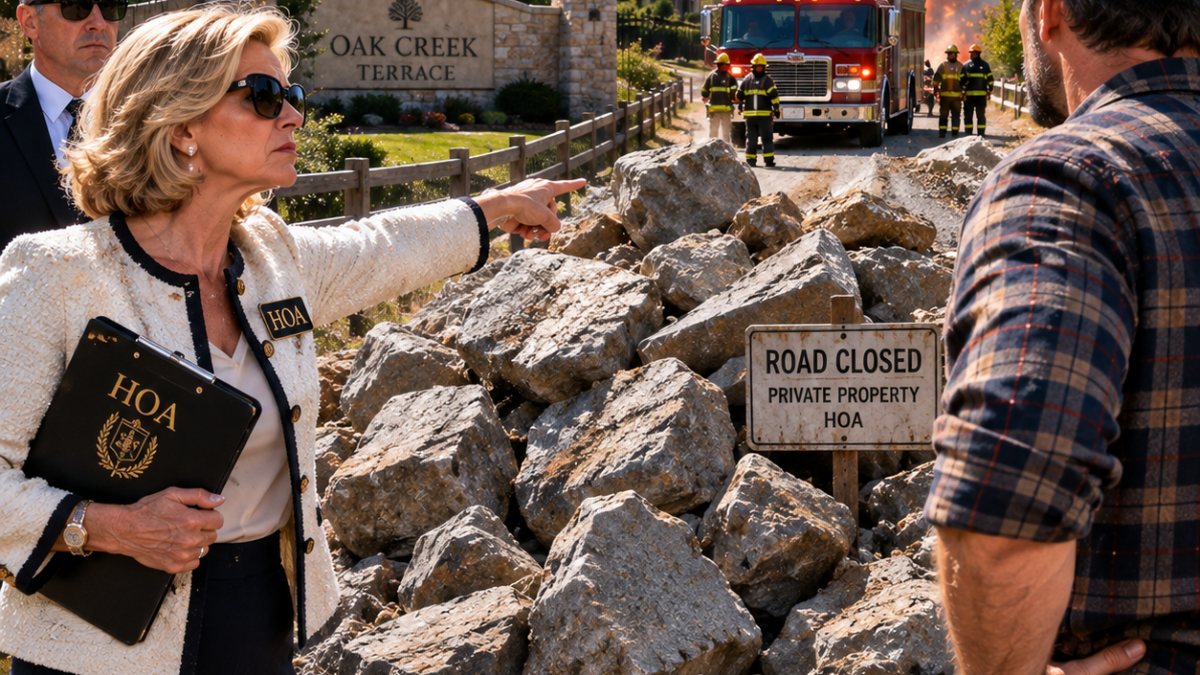
HOA Dumped 300 Tons of Rock Across an “Ugly” Emergency Road—Then a Wildfire Hit and Fire Trucks Found Their Only Way Into 45 Homes Completely Blocked.
Our HOA president hated the dusty emergency road behind our neighborhood so much that he dumped more than three hundred tons of granite across it, even after I stood up at a board meeting and warned him the county plat marked that road as a fire-access easement.
For three months, Gregory Carmichael strutted past his ten-foot wall of boulders like he had finally sealed every ugly thing out of his perfect million-dollar community—until a delivery truck destroyed our only other gate on the hottest, driest holiday weekend of the year.
Two hours later, the forest caught fire, the first engine found the front entrance impassable, the second route ended at Gregory’s mountain of rocks, and an eighty-two-year-old widow’s roof began burning while the firefighters who could save her stood trapped on the other side.
My name is Mason Hayes.
I am a structural engineer.
That sounds more useful than it usually is.
Most days, nobody wants to hear what a structural engineer thinks until something cracks, moves, sinks, bends, burns, or starts making a noise buildings are not supposed to make.
Before that, we’re usually the people ruining everybody’s fun.
You want the wall gone?
I tell you it carries load.
You want the balcony bigger?
I tell you the beam isn’t enough.
You want a spectacular glass staircase?
I ask what happens when somebody weighing three hundred pounds runs down it carrying a refrigerator.
My wife Harper says I have a professional gift for making attractive ideas less attractive.
She is a pediatric nurse.
That means she spends twelve-hour shifts comforting frightened children and exhausted parents.
I spend mine telling architects their cantilever is optimistic.
She is the better human being.
We had been married eleven years when we bought the house in Oak Creek Terrace.
We saved for almost all eleven.
Skipped expensive vacations.
Drove old cars.
Paid down debt.
Harper picked up holiday shifts.
I took side consulting jobs.
We had one daughter, Emma, who was nine when we moved.
The school district was excellent.
The valley was quiet.
Our house backed into dense pine forest.
PART2:
The listing photographs showed morning fog hanging between the trees.
Harper stood in the kitchen during the showing and said:
“I can see us getting old here.”
That was it.
We bought it.
Oak Creek Terrace was the kind of gated subdivision designed to look as if nature had been carefully instructed where to stand.
Stone entrance.
Black iron gates.
Water feature.
Hydrangeas.
Mature trees transplanted at absurd expense.
Every home different enough to appear custom and similar enough to reassure the architectural committee.
Our place sat near the end of Sycamore Drive.
Four bedrooms.
Screened porch.
Small pool.
Forest behind us.
PART3:
We thought we were buying peace.
Then we met Gregory Carmichael.
Gregory had been president of the Oak Creek Terrace Homeowners Association for seven years.
He was retired from corporate restructuring, which Harper described as “apparently firing people professionally.”
Gregory described it as “maximizing distressed asset value.”
That should tell you almost everything.
He was sixty-two.
Silver hair.
Expensive glasses.
Cashmere whenever weather allowed.
Clipboard in situations where no clipboard was necessary.
He had an extraordinary ability to make volunteer neighborhood governance sound like national security.
Our first violation letter came twelve days after moving in.
Moving van in driveway after 9:00 p.m.
Seventy-five dollars.
Harper looked at me.
“We were moving.”
“Apparently illegally.”
Second:
Door knocker finish not listed in approved architectural schedule.
It was brass.
Fine:
One hundred dollars.
Third:
Organic growth visible on rear patio masonry.
I walked outside.
Found one patch of algae approximately the size of a credit card.
Harper stared at the notice.
“We paid how much for this house?”
“Let’s not discuss that near my blood pressure.”
We appealed the door knocker.
Gregory denied it personally.
I asked why the HOA president reviewed door hardware.
He answered:
“Standards collapse through small exceptions.”
I should have understood then.
Gregory did not care about brass.
Gregory cared about the word no.
Our real conflict began with Old Mill Lane.
It ran behind Sycamore Drive through a narrow notch in the forest.
Calling it a road was generous.
Gravel.
Dirt.
Ruts.
Two shallow drainage ditches.
No streetlights.
No landscaping.
At the Oak Creek boundary sat a heavy chain between two posts.
County padlock.
Reflective FIRE ACCESS signs.
Beyond it, Old Mill Lane wound about three-quarters of a mile through county land and connected to Highway 14.
The neighborhood had been built inside a bowl-shaped valley.
Dense forest rose on three sides.
The main gated entrance sat at the southeast corner.
Old Mill Lane was the secondary emergency route.
It appeared clearly on the subdivision plat:
EMERGENCY ACCESS EASEMENT.
MAINTAIN UNOBSTRUCTED WIDTH FOR FIRE/EMS ACCESS.
I noticed that during closing because engineers read maps.
Normal people look at kitchen countertops.
We look for drainage arrows.
Most residents barely knew the lane existed.
Gregory knew.
He hated it.
At meetings he called it:
“The back trail.”
“The service scar.”
Once:
“The peasant path.”
That one nearly got Harper to attend an HOA meeting just to throw something.
Teenagers occasionally parked near the county end.
Delivery drivers sometimes followed GPS there and had to back out at the chain.
Dust blew into the nearest yards during dry weather.
None of that was ideal.
The solution seemed obvious.
Better signage.
Maybe stabilized gravel.
More reflective markings.
Gregory wanted disappearance.
For years he petitioned the county.
First to close it.
Denied.
Then to replace the chain with an HOA-controlled gate.
Denied unless emergency access remained immediately available to responders.
Then to landscape it.
County responded that nothing could reduce clear width or apparatus access.
He took every refusal personally.
The issue exploded one June evening.
Monthly meeting.
Oak Creek clubhouse.
Harper stayed home with Emma.
I attended because Gregory had recently proposed changes to retaining walls along Sycamore Drive and I wanted to see the plans.
Halfway through the agenda, he dimmed the lights.
A rendering appeared.
Title:
BEAUTIFICATION PROJECT ALPHA.
I almost laughed.
The image showed the rear end of Sycamore Drive transformed.
No dirt road.
No chain.
Instead:
Tiered granite boulders.
Decorative grasses.
Native shrubs.
Small ornamental trees.
A landscaped rock wall completely covering the opening.
Gregory stood beside the screen.
“For too long, our western boundary has suffered from a visual and security vulnerability.”
A few people nodded.
He continued:
“Old Mill Lane attracts unauthorized vehicles, trespassers, and unnecessary dust.”
I raised my hand.
He ignored it.
“We have repeatedly asked the county to address this issue.”
Hand still raised.
“They refuse.”
“Gregory.”
He sighed.
“Mr. Hayes.”
“What exactly are those rocks covering?”
“Association property.”
“No.”
I stood.
“Old Mill Lane.”
“It terminates at our boundary.”
“It is a recorded emergency easement.”
Murmurs.
Gregory smiled.
“I am aware.”
“Then why is there a wall across it?”
“It isn’t a wall.”
I looked at the rendering.
“What would you call ten feet of granite?”
“A natural landscape installation.”
People laughed softly.
Gregory did not.
I walked closer.
“How wide?”
“Approximately fifty feet.”
“The fire-access opening is fifty feet.”
“Coincidence.”
“Depth?”
“Variable.”
“Gregory.”
His smile tightened.
“Roughly fifteen to twenty feet.”
I stared.
“You are proposing hundreds of tons of rock directly across a fire lane.”
“No.”
“Yes.”
“We are landscaping association property adjacent to a county easement.”
“You are obstructing the easement.”
“Our counsel believes the county retains access rights but does not control every landscaping decision on HOA-owned land.”
“Can a fire engine pass?”
“If necessary, emergency crews can address the landscaping.”
I thought I had misheard.
“Address it how?”
“They have equipment.”
“Gregory, Engine 42 weighs close to thirty tons loaded.”
“I fail to see—”
“It doesn’t climb boulder gardens.”
A few residents shifted.
I pointed to the screen.
“If our main entrance gets blocked, this is the backup route.”
“The primary entrance has two lanes.”
“Mechanical gates.”
“Commercial grade.”
“Commercial equipment fails.”
“So do dirt roads.”
“Which is why the county made us keep both.”
Gregory’s expression hardened.
“The likelihood of both accesses being unavailable simultaneously is remote.”
“That’s what redundancy is for.”
He turned to the board.
“We’ve spent five years listening to theoretical objections.”
I said:
“Fire access isn’t theoretical.”
“We have hydrants.”
“Fire trucks need to reach the hydrants.”
A woman in the back laughed.
Gregory glared at her.
Then at me.
“We have legal counsel.”
“Did your counsel tell you a thirty-ton engine can drive over these rocks?”
Silence.
“Because if he did, I want his engineering license number.”
That got more laughter.
Gregory turned red.
“The motion is on the table.”
Four board members.
All raised hands.
One woman hesitated.
Gregory stared until her hand went up.
Five to zero.
Approved.
I left before the meeting ended.
Called county fire marshal next morning at 8:01.
Sent photos of rendering.
Plat.
Meeting minutes once available.
The deputy fire marshal sounded concerned.
“We’ll review.”
“When?”
“We have to confirm exact easement limits.”
“They’re installing it.”
“Permit issued?”
“I don’t know.”
“We’ll send somebody.”
I called county planning.
Then public works.
Then HOA management.
By 9:30 I thought I had at least slowed it down.
At 5:27 the next morning, dump trucks woke us.
I sat upright.
Harper did too.
“What is that?”
I already knew.
I ran to the window.
Diesel exhaust.
Backup alarms.
Down Sycamore.
“No.”
I pulled on jeans.
Harper followed.
“Mason?”
“They’re doing it now.”
I ran outside.
Five dump trucks were queued near Old Mill Lane.
An excavator sat beside the opening.
First truck backed up.
The driver raised the bed.
Granite crashed down.
Not landscaping stone.
Riprap.
Massive angular boulders used for erosion control.
Some several feet across.
The impact shook the pavement.
I ran.
“STOP!”
Contractor in orange vest turned.
“Troy!”
I didn’t know his name yet.
He pointed me away.
“Construction zone.”
“This is a fire easement.”
“Talk to HOA.”
Gregory stood twenty yards away with coffee.
Cashmere sweater.
At 5:30 in the morning.
He had come to watch.
“Gregory!”
“Good morning, Mason.”
“Stop the trucks.”
“Board-approved project.”
“I called county.”
He took a sip.
“They can review after installation.”
That sentence told me everything.
He knew exactly what he was doing.
“You’re racing enforcement.”
“We are exercising private property rights.”
Second truck unloaded.
Another twenty tons.
Dust rolled across the cul-de-sac.
Residents came outside.
Robes.
Pajamas.
Phones.
I called fire marshal again.
Voicemail.
Called sheriff.
Deputy arrived.
Looked at plats.
Looked at HOA contractor paperwork.
Called supervisor.
Then told me:
“This is tangled.”
“It’s a fire lane.”
“I understand.”
“Then stop them.”
“They’re claiming work is inside HOA property and not a structure requiring immediate stop.”
“It physically blocks the road.”
“I see that.”
“Then?”
“Fire marshal needs to issue the order.”
By the time county inspector arrived, nine trucks had unloaded.
Then ten.
Eleven.
The pile grew.
Eight feet.
Nine.
Ten.
Fifty feet wide.
Almost twenty feet deep in the center.
Three hundred tons, according to invoices later.
County inspector stared.
“What the hell?”
I pointed at Gregory.
“Ask him.”
Gregory handed over a letter from HOA counsel.
The inspector read.
“This doesn’t authorize obstruction.”
“It confirms landscaping rights.”
“Not over emergency access.”
“Our project is within our property boundary.”
“The easement crosses your property.”
Gregory smiled.
“Then issue us a formal ruling.”
That was his game.
Procedure.
Appeal.
Delay.
By the time government moved, rocks were already there.
Fire marshal issued written notice within days directing Oak Creek to restore emergency access.
HOA appealed.
Temporary hearing scheduled.
Lawyers argued whether the easement language allowed county removal without judicial order.
Gregory celebrated every day the rocks remained.
“They’re landscaping.”
He repeated it endlessly.
Then our fines started.
Grass too long.
Trash container visible.
Guest vehicle partially blocking sidewalk.
Harper opened one notice.
“Do you think this is because you spoke at the meeting?”
“Yes.”
“Can we prove it?”
“No.”
“Can I punch him?”
“No.”
“Can I imagine it?”
“Strongly encouraged.”
Penelope Fletcher lived closest to Old Mill Lane.
Eighty-two.
Widowed.
Her husband, Walter, had died two years earlier.
Penelope was five feet tall and still mowed part of her own lawn because, according to her, “landscapers scalp the grass.”
She had lived in Oak Creek since the first phase.
One afternoon in August I found her standing near the boulders.
“What are you doing?”
“Looking.”
“At?”
“My death trap.”
I sighed.
“Penelope.”
“Don’t Penelope me.”
She pointed into the forest.
“It’s dry.”
Very dry.
We had gone weeks without meaningful rain.
Pines browned at lower branches.
Brush crackled underfoot.
County fire danger signs climbed.
“You talk to Gregory?”
“Yes.”
“What’d he say?”
“That I’m catastrophizing.”
“That’s not a word he should use while standing beside this.”
She gripped my arm.
“If fire comes from that direction, how do trucks reach me?”
“The front.”
“And if they can’t?”
I looked at the rocks.
She knew the answer.
“That road was here before Gregory.”
“Yes.”
“My Walter said never block two ways out.”
“Walter was right.”
“Gregory thinks gates make us safe.”
“Gregory thinks appearance makes everything safe.”
Penelope sighed.
“Same disease.”
Labor Day weekend arrived brutally hot.
Nearly ninety degrees.
Dry wind.
Many residents were away.
At 5:10 Friday evening, a delivery box truck attempted to exit through the main entrance.
The driver turned too sharply.
Rear corner struck the left iron gate.
Heavy impact.
Hinge assembly tore loose.
Gate panel folded inward.
Because of the track geometry, it jammed against the opposite leaf.
The truck driver stopped.
Then panicked.
Witnesses later said he tried backing up.
Made damage worse.
Eventually he pulled into a shoulder area.
Security called management.
Management called Gregory.
Gate contractor quoted emergency holiday service.
Expensive.
Gregory refused.
Mass email at 5:47:
Residents,
Due to an unfortunate vehicle incident, the main vehicular gate is temporarily inoperable. Emergency repair has been scheduled for Tuesday to avoid excessive holiday service charges.
Residents are advised to park outside the entry and use pedestrian access until restoration.
Thank you for your patience.
—Gregory Carmichael, HOA President
I read it twice.
Then called him.
He answered.
“Mason.”
“Open Old Mill Lane.”
“No.”
“The front is blocked.”
“Temporary issue.”
“The backup exists for exactly this.”
“The rock installation remains subject to legal review.”
“Which means it’s still blocking us.”
“Residents can walk out.”
“Fire trucks cannot walk in.”
“You are being dramatic.”
“Spend the holiday fee.”
“The quote is exploitative.”
“How much?”
“That isn’t your concern.”
“How much?”
“Fourteen thousand.”
I almost laughed.
“You spent more than that on boulders.”
“That was capital landscaping.”
“Cut the damn gate.”
“No.”
“Gregory.”
“Tuesday.”
He hung up.
I called fire marshal.
Holiday duty officer took report.
A crew was scheduled to inspect the damaged front entrance.
They had other calls.
Harper came behind me.
“Bad?”
“We have no vehicle exit.”
“What about Old Mill?”
I looked at her.
She closed her eyes.
“Right.”
At 7:21, Emma said:
“Why does it smell like campfire?”
Harper and I both froze.
I walked to back window.
Smoke.
At first thin.
Then thicker.
Coming through trees near Penelope’s side.
I ran outside.
Orange glow behind ridge.
Harper grabbed phone.
“911.”
I sprinted toward Penelope’s.
Others emerged.
Someone shouted:
“FIRE!”
Wind pushed smoke sideways.
Flames moved through dry underbrush frighteningly fast.
Within minutes, trees were torching.
That deep rushing sound.
People think wildfire sounds like crackling.
Small fires crackle.
Large fire roars.
It sounded like traffic mixed with a furnace.
I ran to Penelope’s door.
She opened before I knocked.
“What do I do?”
“Grab your medication.”
“My photo albums—”
“Medication.”
“Walter’s ashes.”
“Fine. Medication and Walter.”
Harper arrived.
“I’ll take her.”
“No.”
Penelope pulled away.
“My cat.”
Harper said:
“What cat?”
“Mabel!”
Of course.
I entered.
Smoke not inside yet.
Found cat under bed after thirty seconds that felt like ten minutes.
Mabel objected violently to rescue.
I put her in laundry basket.
Penelope held Walter’s urn.
Harper took both toward center of neighborhood.
Fire approaching back fence.
I called 911 again.
Dispatcher:
“Units responding.”
“Front gate blocked.”
“We have that note.”
“Old Mill Lane is blocked too.”
Pause.
“What?”
“Three hundred tons of rock.”
Longer pause.
“Fire units have been advised.”
Then sirens.
Distant.
Relief hit too early.
Engine 42 reached main entrance.
Could not pass.
Security camera footage later showed Captain Mitchell Bradley stepping out and staring at the mangled gates.
Five-foot pedestrian opening.
No engine.
Heavy Rescue was dispatched with cutting equipment.
ETA uncertain.
Captain Bradley knew Old Mill Lane.
He ordered driver reverse.
They rerouted.
Several minutes lost.
Inside Oak Creek, embers crossed Penelope’s fence.
Her rear shrubs ignited.
Then deck.
I had a garden hose.
Useless against a crown fire.
Still used it.
Neighbors dragged hoses.
Wet roofs.
Closed windows.
Moved propane cylinders.
Harper organized families.
“Children to clubhouse.”
“Medications.”
“Pets on leashes.”
“Do not drive to front gate.”
She became a nurse in crisis mode.
Calm.
Loud.
Clear.
Gregory appeared carrying a hose.
White face.
“What happened?”
I stared.
“Forest fire.”
“I mean gates.”
“You know about gates.”
“We need evacuation.”
“Yes.”
“How?”
I pointed toward his rocks.
His expression changed.
Only slightly.
Then sirens grew louder behind forest.
Old Mill Lane.
Fire engine coming.
People cheered.
I didn’t.
Because I knew what they were about to find.
Captain Bradley’s engine rounded the final bend.
Then stopped.
Rock wall.
Ten feet high.
Twenty deep.
Three hundred tons.
Later he told investigators his first thought was that GPS had sent them to the wrong location.
Then he saw FIRE ACCESS sign.
Behind rocks.
Through gaps, he could see smoke.
He radioed:
“Dispatch, Engine 42. Rear emergency easement is physically obstructed by a large rock barricade. No apparatus access.”
Inside, Penelope’s deck became fully involved.
Fire reached eaves.
I sprayed water at siding.
Pressure started falling.
The municipal system was being hit hard.
Mutual aid responding.
Everyone opening hoses.
Then hydrants would start drawing once crews got in.
Except crews couldn’t get in.
Captain Bradley tried options.
Could smaller brush units cross?
No.
Could engine push rocks?
No.
Could winch move enough?
They attempted one accessible boulder.
Logging chain.
Winch.
Rock shifted inches.
Chain overloaded.
They stopped before someone got hurt.
Correct decision.
You do not turn firefighting into roulette.
He requested heavy equipment.
County public works had a dozer staged at a road project several miles away.
But it needed an operator.
Sheriff deputies began locating the on-call foreman.
Forestry had a dozer farther away.
Heavy Rescue worked front gate.
Minutes.
Always minutes.
Inside the subdivision, minutes became structures.
Penelope’s rear roof caught.
I went back inside once.
Bad decision.
Smoke had entered upper floor.
I made it ten steps before heat drove me out.
Nothing inside was worth dying for.
Penelope stood across street with Harper.
Holding Walter’s urn.
Watching her house burn.
She did not cry.
That was worse.
She said:
“I told him.”
Harper put an arm around her.
Penelope whispered:
“I told him.”
The fire spread to one side fence.
Radiant heat damaged neighboring siding.
Embers landed two houses farther.
People used pool water in buckets.
One teenager jumped into a swimming pool fully clothed to soak blankets.
Someone rescued a golden retriever from a fenced yard.
No hero speeches.
Just frightened people doing whatever looked useful.
Then water pressure dropped.
My hose became weak.
Neighbor’s hose sputtered.
Gregory stood in his driveway.
Staring at his “landscaping.”
I crossed the street.
“Gregory!”
He turned.
“They can’t get in!”
“I know.”
“You knew this could happen!”
“I did not know the front gate would fail.”
“That is why there are two routes!”
“The county should have—”
I stepped closer.
“Do not blame the county.”
His face shook.
“I was trying to protect property values.”
Behind him, Penelope’s roof collapsed inward.
The sound stopped both of us.
I pointed.
“That was her property.”
Gregory had no answer.
Then we heard something deeper than fire.
Diesel.
Heavy.
From the rear.
County public works had located an authorized operator for the staged bulldozer.
A sheriff unit escorted it toward Old Mill Lane.
Not stolen.
Not hotwired.
Not a stunt.
Emergency public-safety deployment.
A Caterpillar dozer heavy enough to move highway material.
Captain Bradley cleared firefighters back.
Operator assessed the pile.
Those rocks had been installed without engineered retaining geometry.
Useful now.
He lowered blade.
First push shifted the outer layer.
Second shoved several tons sideways.
Granite scraped steel.
Sparks.
Dust.
The machine climbed slightly.
Tracks bit.
Blade pushed.
Rocks rolled into shoulders.
Again.
Again.
No magical sixty-second miracle.
It took several brutal minutes.
Enough to feel endless.
Eventually a corridor opened.
Not pretty.
Not smooth.
Wide enough.
Engine 42 went first.
Slow through debris.
Then accelerated.
Mutual-aid engine behind.
Water tender.
Brush unit.
Sirens echoed through neighborhood.
I have never heard a better sound.
Professional firefighters arrived.
Everything changed.
Lines deployed.
Hydrant connected.
Deck gun hit Penelope’s house.
Other crews protected exposure homes.
Brush teams attacked advancing edge.
Mutual aid cut containment line.
County forestry crews arrived later.
Harper moved Penelope toward paramedics after smoke exposure.
The old woman fought them.
“I am fine.”
“You are eighty-two.”
“That’s not a disease.”
Harper smiled despite everything.
“Humor me.”
By midnight, forward structure threat was controlled.
Forest fire continued beyond subdivision, but homes were no longer undefended.
Penelope’s was gone.
Not damaged.
Gone.
Exterior walls in sections.
Roof collapsed.
Interior destroyed.
Three neighboring homes suffered significant heat, smoke, and exterior damage.
Several fences burned.
Landscaping vanished.
No one died.
That sentence matters more than every other sentence in this story.
No one died.
Penelope spent one night in hospital for smoke inhalation.
Mabel the cat remained furious but alive.
At dawn, Oak Creek Terrace looked nothing like Gregory’s perfect community.
Fire trucks parked across lawns.
Hoses everywhere.
Mud.
Soot.
Broken shrubs.
Boulder fragments scattered.
Dozer tracks through the rear entrance.
Front gate half dismantled by Heavy Rescue.
Residents stood in road exhausted.
Gregory stood outside his house.
His lawn had been churned by apparatus tires.
Nobody cared.
Mason—meaning me—walked toward him.
I had soot on my clothes.
Eyes burning.
Harper had ordered me checked twice.
I ignored her twice.
Gregory looked at Penelope’s house.
Black shell.
I said:
“She warned you.”
He swallowed.
“The board voted.”
“You pushed it.”
“The county should have enforced sooner.”
“You raced them.”
“We had legal advice.”
“You knew why the road existed.”
He looked at me.
“I thought the main gate was enough.”
“There it is.”
“What?”
“You thought.”
He flinched.
“You didn’t know.”
Silence.
“You weren’t willing to spend fourteen thousand dollars on holiday gate repair.”
He closed his eyes.
“You spent tens of thousands blocking a road the fire department needed tonight.”
A county SUV rolled through the new breach.
Fire Marshal’s office.
Captain Bradley came with him.
Soot-blackened gear.
Exhausted.
The fire marshal was named Ellen Mercer.
No screaming.
No dramatic accusations.
She walked to Gregory.
“Mr. Carmichael?”
“Yes.”
“You are HOA president?”
“Yes.”
“Who authorized obstruction of Old Mill Lane?”
He looked at us.
Then:
“The board approved a landscaping project.”
Mercer looked toward boulders.
“That’s your landscaping?”
“Yes.”
“Did you receive our June notice directing restoration of clear emergency access?”
Gregory hesitated.
“Yes.”
“Did you appeal?”
“Yes.”
“Was a stay issued allowing continued obstruction?”
His attorney wasn’t there to help.
“I don’t know.”
Mercer wrote something.
Captain Bradley stared at him.
Then said:
“My engine was seven minutes from the rear of this neighborhood.”
Gregory said nothing.
“It took substantially longer to gain apparatus access because of those rocks.”
More silence.
Bradley pointed toward Penelope’s ruins.
“Seven minutes matters.”
That was all.
More damaging than shouting.
Sheriff investigators arrived later.
Nobody handcuffed Gregory dramatically on his lawn that morning.
Real accountability began with reports.
Photos.
Measurements.
Board minutes.
Emails.
Invoices.
Fire dispatch logs.
Warning letters.
Appeal documents.
Emergency-response timelines.
Then lawyers.
Lots of lawyers.
Oak Creek’s board called an emergency meeting forty-eight hours later.
Not at clubhouse.
Smoke damage and emergency operations made it unavailable.
Middle school auditorium.
Almost every homeowner attended.
Penelope came wearing hospital wristband.
Standing ovation when she entered.
She hated it.
Gregory sat front table beside HOA attorney.
He looked twenty years older.
The lawyer spoke first.
“We are dealing with multiple overlapping investigations.”
A resident yelled:
“Did we block the fire road or not?”
Attorney paused.
“Yes.”
Noise exploded.
He continued:
“The board’s position was based on advice regarding property rights—”
I stood.
“Was the fire marshal warning disclosed to residents?”
Silence.
Someone shouted:
“What warning?”
Gregory looked at counsel.
Counsel looked at board.
Then pulled papers.
“The association received correspondence regarding the county’s position on the emergency easement.”
“When?”
“June.”
Three months before fire.
Room erupted again.
Penelope raised her hand.
No microphone needed.
Her voice carried.
“I asked you.”
Everybody quieted.
She looked at Gregory.
“I asked you how trucks would reach my house.”
Gregory’s face collapsed slightly.
“I remember.”
“You told me not to be hysterical.”
Someone whispered:
“Oh, God.”
Penelope said:
“My husband built half the furniture that burned.”
Silence.
“My photographs burned.”
Gregory looked down.
“His military medals burned.”
She gripped chair.
“I saved his ashes because Mason made me carry the urn instead of going back for anything else.”
Harper squeezed my hand.
Penelope continued:
“You worried that a dirt road was ugly.”
She looked toward everyone.
“My house is ugly now.”
No one moved.
Then she sat.
Gregory lost presidency that night.
Board voted to suspend him from all authority pending investigation.
Three directors resigned.
The remaining members appointed interim leadership.
I refused nomination.
Harper laughed when someone suggested me.
“No.”
I looked at her.
“What?”
“You would become unbearable.”
“I am an engineer.”
“Exactly.”
County investigation confirmed what we’d warned.
Old Mill Lane was a recorded emergency-access easement required as part of subdivision approval.
Maintaining it clear was not optional.
The rock installation physically prevented its intended use.
The HOA had received written warning.
The appeal process had not granted a right to keep the obstruction indefinitely.
Worse, discovery later showed Gregory had instructed contractor Troy Donovan to install the rocks before county enforcement could mobilize.
Text:
Need this completed tomorrow morning before they send someone.
Another:
Once it’s in place, removal becomes their problem.
That sentence mattered.
So did:
Call it landscaping, not a barricade.
Troy’s company had invoices.
Truck weights.
Rock tonnage.
Three hundred eighteen tons delivered.
Gregory was not some innocent president misled by contractor.
He designed the strategy.
Troy was not innocent either.
He knew what he was covering.
A text from his foreman:
Fire lane sign right where you want dump.
Troy replied:
Boss knows. Keep moving.
The county prosecutor reviewed potential criminal violations including reckless conduct, obstruction of emergency access, property-related offenses, and misuse of association funds.
No instant five-felony spectacle.
A slow case.
Evidence.
Intent.
Causation.
Meanwhile civil liability became enormous.
Penelope’s insurer paid her homeowners claim.
Then pursued responsible parties through subrogation.
Other damaged homeowners filed claims.
County billed emergency work associated with removal and response where permitted.
Public works documented dozer damage.
Fire district documented delay.
The HOA’s insurer reserved rights.
Intentional acts and known code violations complicated coverage.
Troy’s insurer blamed HOA.
HOA blamed Troy.
Gregory blamed legal counsel.
Legal counsel produced emails showing it had specifically warned:
Do not permanently obstruct emergency access without county approval.
That email ended that defense.
The homeowners were furious for another reason.
Money.
Associations are homeowners.
When an HOA makes an expensive mistake, the bill does not vanish into the word HOA.
It finds people.
Insurance premiums rose.
Legal fees climbed.
Emergency assessment became likely.
A proposed preliminary assessment was around twelve thousand dollars per property, payable in stages, depending on final recoveries and coverage.
Still devastating for families.
Especially residents who opposed Gregory.
Harper said:
“That’s the cruel part.”
“What?”
“Penelope loses her house and then gets billed for the organization that helped make the fire worse.”
She was right.
The new interim board negotiated hardship plans.
Delayed payments for displaced families.
Aggressively pursued Gregory and contractor contribution.
Used reserves.
Cancelled cosmetic projects.
Entrance fountain renovation?
Gone.
Imported tree replacement?
Gone.
Clubhouse audiovisual upgrade?
Gone.
Residents cheered when that budget disappeared.
One man said:
“Turns out we don’t need a second wine fridge while we’re paying fire lawyers.”
Growth.
Gregory’s personal legal situation worsened.
During deposition, he was asked:
“Why did you call Old Mill Lane the peasant path?”
He denied saying it.
Three meeting recordings existed.
Bad choice.
Asked:
“Did Mr. Hayes warn a fire engine could not cross the proposed rock installation?”
“Yes.”
“What did you say?”
“I don’t recall.”
Minutes recorded:
If a fire truck needs to get in, they can address the rocks.
Asked:
“Did Mrs. Fletcher raise wildfire concerns?”
“Yes.”
“Your response?”
“I reassured her.”
Her neighbor had recorded part on phone.
Stop being hysterical. We have the main gates.
Every arrogant sentence he had tossed casually into the world came back typed into evidence.
That is the thing about power.
People think only formal decisions count.
Sometimes the careless sentence proves how you understood the risk before making the decision.
Troy Donovan eventually cooperated.
Not because he found morality.
Because his insurer and attorney explained exposure.
He produced messages.
He admitted Gregory wanted installation completed before stop-work order could be served.
He admitted accepting payment from an HOA reserve account.
He admitted knowing the lane was signed as emergency access.
His company paid heavily in settlement and lost eligibility for certain county work.
Gregory accepted a criminal plea the following year rather than take everything to trial.
The final charges were less theatrical than neighborhood rumor but serious.
Reckless endangerment-related conduct.
Knowing obstruction of required emergency access.
Financial misconduct tied to unauthorized use of association funds was addressed separately in civil and governance proceedings.
He received a custodial sentence shorter than some residents wanted, followed by probation, restitution obligations, and restrictions under settlement and association agreements that effectively ended his role in community governance.
I attended sentencing.
Penelope did too.
She gave a victim statement.
No yelling.
She held a photograph.
Her old living room.
Walter in his recliner.
Christmas tree.
Mabel sleeping under it.
She said:
“This photograph survived because it was in my purse.”
Pause.
“Almost every other photograph of forty-seven years of marriage did not.”
Gregory looked down.
Penelope continued:
“I don’t want him destroyed.”
That surprised everyone.
“I want him to remember every time he sees a pretty wall that walls have two sides.”
The judge thanked her.
Gregory apologized.
Whether sincere, I don’t know.
I hope so.
For his sake more than ours.
Hatred is exhausting.
After fire, county took no chances.
Old Mill Lane was cleared fully within days.
Every remaining boulder removed from travel width.
Then engineers surveyed.
Road base improved.
Drainage corrected.
Vegetation cleared to required width.
The HOA wanted to pave it.
This time county agreed to a hardened emergency surface.
Not fancy boulevard.
Durable access.
Wildfire-resistant shoulders.
Turn radius adequate for apparatus.
At subdivision boundary, they installed a crash-rated emergency gate with standardized responder access.
County fire department had immediate capability.
No HOA president controlled the key.
Reflective sign:
EMERGENCY ACCESS — KEEP CLEAR AT ALL TIMES.
Under it, somebody taped:
YES, GREGORY, THIS MEANS ROCKS TOO.
County removed that.
Eventually.
I photographed it first.
The largest granite boulders were not all hauled away.
Penelope suggested something unexpected.
“Use them.”
“For?”
“Make them remember.”
So along the sides of Old Mill Lane—not in travel path—the county-approved landscape plan used some rocks as erosion control and a small memorial garden.
Spaced.
Stable.
Low.
No obstruction.
Native drought-tolerant plants.
At the center:
One boulder.
Bronze plaque.
It did not mention Gregory.
Penelope insisted.
“Don’t give him a monument.”
The plaque read:
OLD MILL EMERGENCY CORRIDOR
KEEP THE WAY OPEN.
FOR THOSE WHO NEED TO LEAVE.
FOR THOSE COMING TO HELP.
Simple.
Better than anything I would have written.
Penelope rebuilt.
Her insurer paid structure.
Settlement covered additional losses.
Neighbors created a fund for items insurance could not replace.
No amount replaced Walter’s photographs.
But people tried.
One neighbor had old holiday pictures containing him.
Church archives had photographs.
Their daughter scanned family albums.
Someone found a video of Walter telling a terrible joke at a block party.
Penelope watched it twenty times.
She moved into the new house fourteen months after fire.
Smaller.
More fire-resistant materials.
Metal roof.
Defensible landscaping.
No cedar fence against forest.
She invited entire neighborhood.
No permit.
Harper organized food.
Bounce house sat illegally near curb.
Someone parked barbecue smoker directly where Gregory would have issued three citations.
Kids drew chalk across sidewalk.
Music exceeded old decibel rule.
Trash cans remained visible all evening.
It was glorious.
By then Oak Creek’s bylaws had changed.
Not abolished.
I argued against that.
Communities still need stormwater maintenance.
Shared roads.
Insurance.
Emergency systems.
But petty enforcement was cut dramatically.
No fines over tiny grass-height deviations.
No door-hardware policing.
Clear appeal process.
Open meetings.
Conflict disclosures.
Emergency-access decisions required review by qualified professionals.
Fire marshal invited annually.
Wildfire evacuation drills.
Harper joined emergency-preparedness committee.
I joined infrastructure.
She said:
“You became HOA.”
“I hate you.”
“You’re on a committee.”
“Technical advisory.”
“HOA.”
“Take it back.”
“No.”
Our first major task was evacuation planning.
Oak Creek had spent years selling privacy.
Now we talked about escape.
Two routes.
Traffic management.
People with mobility limitations.
Medical residents.
Pets.
Power outage.
Gate failure.
Wildfire.
Communication.
Boring.
Useful.
Captain Bradley attended first drill.
When fire engine rolled cleanly through Old Mill gate, residents applauded.
He looked embarrassed.
Afterward he said:
“Please stop clapping when we drive on roads.”
Penelope said:
“Drive faster then.”
He laughed.
She became honorary mayor without holding office.
Property values did not collapse permanently.
Another irony.
Gregory had blocked Old Mill Lane to protect property values.
The fire and lawsuits did hurt them for a while.
Then neighborhood recovered.
Buyers returned.
Old Mill emergency access became a selling point.
Listings began saying:
DUAL EMERGENCY EGRESS.
Harper showed me one.
“You’re kidding.”
“Nope.”
“The ugly road is now premium safety infrastructure.”
“Apparently.”
“Humans are exhausting.”
“Yes.”
Five years later, another wildfire threatened the valley.
Lightning.
Dry wind.
Not as close initially.
County issued evacuation warning.
Oak Creek did not panic.
Front gate opened and locked in emergency-open position.
Old Mill gate opened.
Traffic split.
Residents evacuated through both routes.
Fire engines entered Old Mill while cars exited main.
No conflict.
No blocked apparatus.
No rocks.
Penelope rode with us.
Mabel’s successor in carrier.
She looked back at her rebuilt house.
“Different feeling.”
“What?”
“Knowing there’s somewhere to go.”
Exactly.
Fire turned before reaching neighborhood.
We came home next day.
Nothing lost.
That is what infrastructure is supposed to do.
Make disaster less dramatic.
Good safety systems are boring.
You only understand their value when somebody removes them.
I used to think Gregory’s story was about arrogance.
It was.
But more specifically, it was about confusing appearance with function.
Old Mill Lane was ugly.
That part was true.
Dusty.
Rutted.
Unimpressive.
It did not match Oak Creek’s entrance.
But it had one job.
Stay open.
It did that perfectly for fifteen years.
Nobody thanked it.
Nobody photographed it for sales brochure.
Nobody landscaped it.
It sat there.
Waiting for a bad day.
Gregory saw something unused and decided it was useless.
Those are not same thing.
Fire extinguishers spend almost their entire lives unused.
So do emergency exits.
Defibrillators.
Spare generators.
Flood channels.
Safety margins.
We build them for the one day ordinary systems fail.
That Friday, our ordinary system failed.
One delivery truck.
One gate.
That’s all.
And suddenly the ugly road was not redundant scenery.
It was the only route left.
Except Gregory had turned it into a sculpture.
Years after, engineering students from nearby university asked me to speak about Oak Creek during a resilience course.
I refused first.
Professor called Harper.
Traitor.
I eventually went.
Showed site plan.
Two access routes.
Front gate failure.
Fire location.
Response paths.
Rock barrier.
Then asked:
“What failed?”
Students answered.
“Gate.”
“HOA governance.”
“Access redundancy.”
“Emergency planning.”
“Wildfire mitigation.”
One student said:
“Human factors.”
I pointed.
“That.”
Everyone focuses on rock.
Rock behaved exactly like rock.
Gate behaved like damaged mechanical gate.
Fire behaved like wildfire.
The unpredictable system was people.
Gregory had information.
Warning.
Map.
Engineer objection.
Fire marshal notice.
Resident concerns.
He did not lack data.
He lacked willingness to let data change decision.
That’s a different failure mode.
Engineers see it constantly.
Decision first.
Analysis second.
Then analysis becomes decoration.
Professor asked:
“What should HOA have done when it disliked Old Mill Lane?”
I said:
“Ask what function cannot be lost.”
Then improve appearance around that requirement.
Could road have been upgraded?
Yes.
Could chain become proper emergency gate?
Yes.
Could dust be reduced?
Yes.
Could teenagers be discouraged?
Yes.
Could landscaping soften edges without narrowing access?
Probably.
Many solutions.
But Gregory framed problem wrong.
How do I make this road disappear?
When correct question was:
How do we make it safer and less ugly while preserving emergency function?
Bad question creates bad options.
After lecture, one student said:
“You must hate HOAs.”
“No.”
He looked surprised.
“I hate unreviewed authority.”
“Difference?”
“HOA can maintain drainage ponds very well.”
He laughed.
“That’s your endorsement?”
“Strongest available.”
Harper says I got softer.
Maybe.
Gregory eventually wrote Penelope a letter from custody.
She let me read it.
He admitted he had convinced himself county resistance was bureaucracy rather than expertise.
He admitted he enjoyed winning disputes.
He said:
I began seeing every objection as a challenge to my authority rather than information I might need.
That sentence impressed me.
Penelope folded letter.
“Think he means it?”
“I don’t know.”
“Doesn’t matter.”
“What?”
“Truth is truth even when somebody learns it late.”
She put it in drawer.
Never wrote back.
That was her choice.
When Gregory was released, he did not return to Oak Creek.
House sold.
His wife had moved before sentencing.
I heard he relocated near his son.
No board positions.
No interviews.
Good.
Some consequences should end quietly.
Troy’s excavation company survived under new management after settlements and regulatory trouble.
He left business.
Old Mill Lane became part of county emergency-access inspection schedule.
Twice annually.
No ambiguity.
No private landscaping across it.
No one has tried.
The front gates were redesigned too.
Breakaway/manual emergency opening.
Knox access.
Backup power.
Physical override.
No system treated as infallible.
Because nothing is.
Emma grew up.
She was nine during fire.
For years thunderstorms made her nervous because smoke and dark sky became linked in memory.
Harper noticed before I did.
Nurses.
We got her counseling.
She improved.
At seventeen she wrote college essay about Oak Creek fire.
Not about Gregory.
About Harper organizing children while houses burned.
She ended with:
Safety is not feeling protected. Safety is knowing what to do when protection fails.
I cried.
Denied it.
Harper told everyone.
Emma studied emergency management.
I blame both of us.
Penelope died peacefully at ninety-one.
In rebuilt house.
Mabel’s successor asleep beside her.
Her daughter asked if neighborhood would place memorial.
We added a small bench near Old Mill garden.
Plaque:
PENELOPE FLETCHER
SHE ASKED THE RIGHT QUESTION:
“HOW WILL HELP GET IN?”
That’s all.
Every firefighter who drives through sees it.
Captain Bradley retired.
At his retirement gathering, Oak Creek gave him framed photograph of Engine 42 entering through cleared Old Mill Lane years after fire.
He said:
“You people traumatized me.”
We believed him.
I asked about original night.
“What did you think when you saw rocks?”
He took a long breath.
“Honestly?”
“Yeah.”
“I thought somebody had moved the road.”
“What?”
“My brain couldn’t accept anyone would intentionally block a signed fire lane.”
He laughed without humor.
“Then I saw sign behind rocks.”
Pause.
“I got angry.”
“You looked angry.”
“I’ve been blocked by cars.”
“Yep.”
“Locked gates.”
“Sure.”
“Snow.”
“Okay.”
“Collapsed trees.”
“Right.”
“Never landscaping.”
We laughed.
Then he became serious.
“We had water.”
“Crew.”
“Equipment.”
“Training.”
He tapped table.
“None of that matters if you can’t reach people.”
That is the entire story in one sentence.
Help is only useful if it can reach you.
Oak Creek had spent years investing in symbols of safety.
Gates.
Cameras.
Walls.
Security patrol.
Private roads.
Then ignored the simplest requirement:
Access.
Gregory believed security meant preventing outsiders from entering.
Fire taught us security also means making sure the right outsiders can.
Firefighters.
Paramedics.
Police.
Utility crews.
Sometimes safety is not stronger wall.
Sometimes safety is an open road.
I still live in Oak Creek Terrace.
Harper too.
Emma visits.
We could have left.
Considered it.
After fire, subdivision felt contaminated by memory.
Then rebuilt.
Not just houses.
Culture.
People who barely knew each other began talking.
Shared tools.
Checked elderly neighbors.
Created emergency contact lists.
Stopped reporting every minor landscaping difference.
Annual block party remained delightfully ugly.
The neighborhood became less perfect.
Better.
A few houses now have xeriscaping.
One mailbox is dark green instead of approved bronze.
Nobody died.
Kids leave bicycles in driveways.
Trash cans occasionally stay out overnight.
Civilization continues.
Old Mill Lane is paved now.
Not fancy.
Gray emergency asphalt.
White edge markings.
Reflectors.
Wide turn radius.
At forest boundary, heavy gate.
NO PARKING.
EMERGENCY ACCESS.
KEEP CLEAR.
Beyond it, road continues to highway.
Every time I walk there, I remember boulder wall.
It is difficult to reconcile same space.
Then:
Ten feet granite.
Now:
Open.
That is what I like.
Open.
One evening, new resident stopped me.
“Are you Mason?”
“Depends.”
He laughed.
“Someone said you were here during fire.”
“Yes.”
He pointed toward memorial rocks.
“Are those from wall?”
“Some.”
“Gregory really dumped three hundred tons?”
“Three hundred eighteen according to invoices.”
“Why?”
“He thought road was ugly.”
The man looked down Old Mill Lane.
“It is ugly.”
I smiled.
“Correct.”
He seemed surprised.
“You agree?”
“Absolutely.”
“Then why keep it?”
I looked at him.
“Because not everything important needs to be beautiful.”
He nodded.
Then looked again.
“Kind of beautiful now.”
Maybe.
Or maybe function changes how we see things.
A scar becomes lifeline once you understand what it saved.
That is what happened to Old Mill Lane.
Gregory saw imperfection.
After fire, we saw survival.
I keep copy of original Beautification Project Alpha rendering.
Harper hates it.
“Why?”
“Evidence.”
“Case is over.”
“History.”
On rendering, designer had shown boulders beautifully arranged.
Ornamental grasses.
Small plaque.
Soft lighting.
No chain.
No dirt road.
No emergency sign.
A perfect picture.
That was Gregory’s problem.
He believed rendering more than map.
Renderings show what something looks like.
Plans should show what it does.
The county plat had ugly dashed line labeled emergency access.
No color.
No lighting.
No flowers.
But that boring line mattered more than entire rendering.
After Penelope died, I took both documents to local fire-safety presentation.
Held rendering in one hand.
Plat in other.
Asked room:
“Which one tells truth?”
An old fire captain answered:
“The ugly one.”
Exactly.
The fire itself eventually became a date residents remembered.
Before fire.
After fire.
Before fire, people said:
Gregory will never allow that.
After fire:
Show us authority.
Before:
It is just an HOA issue.
After:
Does it affect safety?
Before:
Main gate is enough.
After:
What’s backup?
Those changes matter.
Not dramatic.
Institutional.
Durable.
When Harper and I first bought house, we thought sanctuary meant exclusion.
Trees.
Gate.
Privacy.
Quiet.
Now I think sanctuary means trust.
Neighbor will knock if smoke starts.
Board will listen when engineer raises concern.
Fire truck can reach your street.
Emergency road stays open even if it looks terrible.
The people around you value your life more than landscape rendering.
That is a better kind of exclusivity.
Harder to sell in brochure.
Worth more.
Sometimes people ask whether I became HOA president after Gregory.
No.
Absolutely not.
I served infrastructure committee three years.
Then escaped.
Harper still laughs because my biggest accomplishment was getting culvert inspection schedule adopted.
No scandal.
No headlines.
Culverts just work.
Perfect.
At final meeting, new president thanked me.
I said:
“The greatest compliment you can give infrastructure is forgetting it exists.”
Someone responded:
“Until it fails.”
Exactly.
Old Mill Lane is different.
Nobody forgets it.
Not anymore.
Every June, fire department runs engine through during access check.
Children wave.
Penelope’s memorial bench sits near entrance.
Boulders line sides.
Not wall.
Boundary.
Decoration.
Reminder.
The same material can protect or endanger depending on where you put it.
That might be Gregory’s most accidental lesson.
Rocks weren’t evil.
Gate wasn’t evil.
HOA wasn’t evil.
Even desire for attractive neighborhood wasn’t evil.
The failure came from priority.
Beauty above safety.
Control above expertise.
Winning above listening.
Once those priorities shifted, same neighborhood became safer without becoming ugly.
Maybe less manicured.
Definitely more human.
On anniversary of fire, I sometimes wake before Harper.
Walk Old Mill.
Forest has regrown in burned areas.
Young pines.
Black scars still visible on older trunks.
Penelope’s rebuilt house belongs to young family now.
They know history.
Keep metal roof.
Maintain defensible space.
At rear of road, I stop near largest memorial boulder.
Run hand over bronze letters.
KEEP THE WAY OPEN.
That’s what Gregory failed to do physically.
Maybe emotionally too.
He closed every path that challenged him.
County says no?
Close path.
Mason warns?
Fine him.
Penelope worries?
Dismiss her.
Fire marshal writes?
Appeal.
Contractor sees sign?
Tell him keep dumping.
Every warning became another boulder.
Until wall was so high that when real emergency came, nothing could pass.
That’s how disasters grow.
Not usually one decision.
Stacked decisions.
One rock.
Another.
Another.
Three hundred tons later, everyone asks how wall got there.
We watched it happen.
Truck by truck.
That’s the part I never forget.
I stood there that morning.
Dust in my face.
Gregory drinking coffee.
I knew it was dangerous.
County knew.
Some board members probably knew.
Yet rocks kept falling because procedure had not caught up to machinery.
That’s why speaking up once is not always enough.
But also why people need systems that can stop bad decisions before consequences become irreversible.
Oak Creek has those systems now.
Maybe imperfect.
Better.
The last time Emma visited, she brought boyfriend.
He had never heard story.
We walked Old Mill.
He read plaque.
Asked:
“What happened here?”
Emma looked at me.
“Dad, want to tell it?”
I said:
“No.”
She smiled.
Then told him.
Shorter than mine.
“An HOA president blocked the fire road because he thought it was ugly. Then the front gate broke during a wildfire and firefighters couldn’t get in until county bulldozed through rocks.”
Boyfriend stared.
“That’s insane.”
Emma shrugged.
“That’s why my dad checks emergency exits everywhere.”
I protested.
“I do not.”
Harper said:
“You absolutely do.”
Traitors.
We continued walking.
At highway end, sunset turned sky orange.
Not fire orange.
Normal.
Beautiful.
I looked back.
Road open.
Nothing blocking it.
That’s still one of most reassuring sights I know.
Gregory Carmichael spent years trying to make Oak Creek Terrace look like no danger could ever enter.
Perfect gates.
Perfect lawns.
Perfect walls.
Perfect silence.
Then danger came from forest.
And the thing we needed most was the one ugly opening he had decided did not belong in his picture.
He thought the rocks kept outsiders out.
For one terrible night, they kept help out instead.
And after everything burned, after lawyers, court hearings, insurance claims, rebuilding, apologies, assessments, and years of recovery, the most valuable improvement Oak Creek ever made was not another gate, another camera, or another wall.
It was leaving one road open.




