HOA Bulldozed My 50-Year-Old Drain to Beautify Their $3 Million Pool—Then Heavy Rain Hit and the Entire Concrete Pool Rose Out of the Ground.
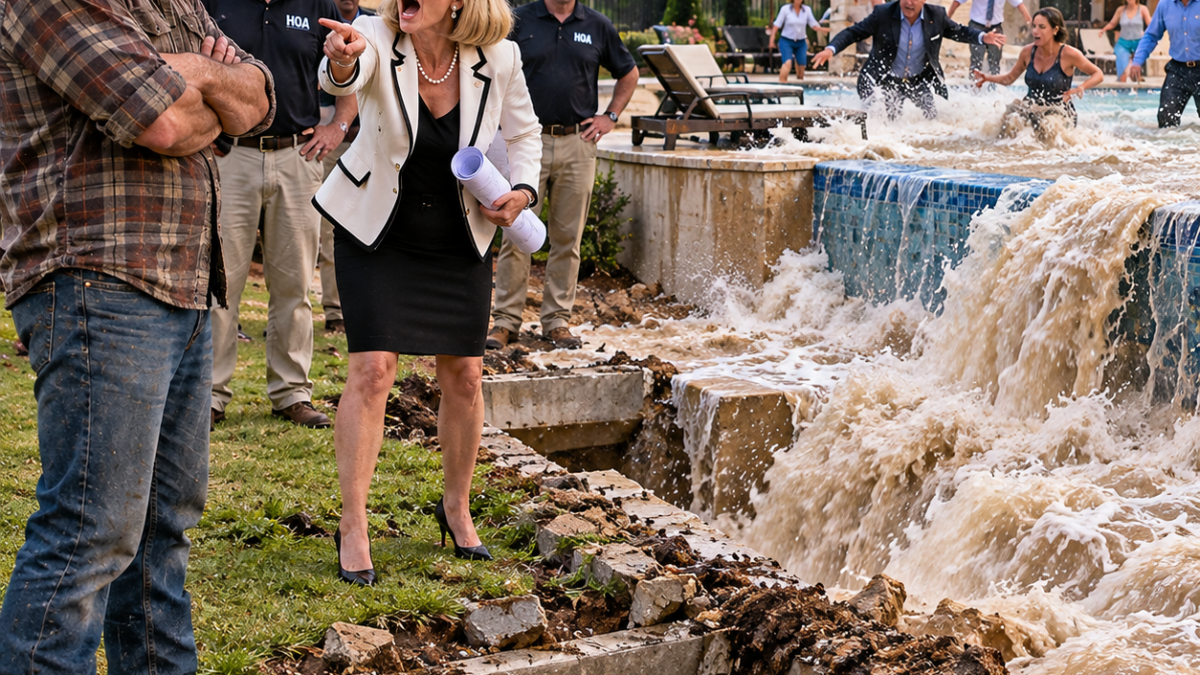
HOA Bulldozed My 50-Year-Old Drain to Beautify Their $3 Million Pool—Then Heavy Rain Hit and the Entire Concrete Pool Rose Out of the Ground.
The HOA waited until I flew out of state, drove an excavator across my property line, and destroyed the ugly fifty-year-old drainage trench my engineer uncle had warned me never to touch.
For four months, nothing happened, so their president celebrated his new $3 million resort pool and bragged in the neighborhood newsletter that sometimes “progress” meant removing the mistakes of the past.
Then six days of rain filled the ground beneath us, the concrete deck began bending upward before sunrise, and the entire deep end of their brand-new swimming pool rose out of the earth like a ship trying to escape a sinking harbor.
My name is Jasper Thorne, and the ugliest thing I ever inherited turned out to be the smartest thing my uncle ever built.
When Uncle Henry died, he left me a house, eleven acres, an unreasonable quantity of old engineering books, and one handwritten warning.
The house was outside Atlanta, though far enough beyond the city that people still gave directions using churches, gas stations, and the phrase “after the road bends.”
Henry built it in 1983.
He was a civil engineer for forty-two years.
Dams.
Flood-control systems.
Retention basins.
Storm-water channels.
A few hydroelectric projects I never completely understood.
He was brilliant.
He was also what polite relatives called particular.
Henry labeled his breaker panel in three colors.
He recorded rainfall in spiral notebooks.
He owned two barometers even though one worked perfectly.
His basement had shelves marked:
FASTENERS.
PLUMBING.
ELECTRICAL.
THINGS PEOPLE WILL THROW AWAY AND REGRET.
When I was thirteen, I asked why there were six buckets of copper fittings under his workbench.
He said:
“Because one day the store won’t have the one you need.”
I laughed.
Twenty-seven years later, during a supply shortage, I drove to his place for a half-inch copper elbow.
He was waiting on the porch.
Didn’t say I told you so.
That was worse.
Henry never married.
No children.
My father was his younger brother.
Dad died first.
Then my mother.
By the time Henry’s health started failing, I was the closest family he had.
I visited every Sunday.
Brought groceries.
Pretended not to notice when he began forgetting names.
Henry never forgot structures.
Even near the end, he could look at a retaining wall from a car window and tell you why it would crack in five years.
The house itself sat on a gentle hill above what had once been hundreds of acres of Georgia woods.
PART2:
Those woods disappeared gradually.
First roads.
Then sewer lines.
Then signs advertising luxury homes.
Eventually the development became Whispering Pines.
Three hundred and twelve houses.
Clubhouse.
Tennis courts.
Walking trails.
Landscaped entrance.
Golf-cart paths.
Decorative ponds.
The kind of neighborhood where people used phrases like architectural harmony without irony.
Henry’s property predated everything.
When the subdivision incorporated its homeowners association around the remaining parcels, his deed received extensive grandfather protections.
The HOA could regulate things affecting shared infrastructure and common access.
It could not tell Henry what color to paint his house.
Could not require their landscaping package.
Could not force him to replace the shed.
PART3:
And it absolutely could not alter an existing drainage structure on his property.
That drainage structure was impossible to miss.
A concrete trench ran along the eastern edge of the backyard.
Four feet deep in places.
Almost six feet across.
It sloped toward an iron grate the size of a prison door.
The concrete was stained dark gray.
Moss grew along one side.
Hairline cracks ran through the upper lip.
It was, objectively, hideous.
The first time Henry showed me the property after I became old enough to appreciate houses, I pointed at it.
“What is that thing?”
“Drain.”
“Obviously.”
“Then why’d you ask?”
“Why is it enormous?”
“Because water’s enormous when people underestimate it.”
That was Henry.
Ask for explanation.
Receive prophecy.
Years later, when I inherited the house, I found a sealed envelope clipped to the deed.
JASPER.
Inside was one sheet of paper.
Three sentences.
Do not remove the eastern trench.
The perched water system under this hill is higher than current subdivision plans acknowledge.
Let the earth breathe, Jasper, or it will choke you.
The second sentence had been underlined twice.
The third three times.
I kept the note.
Not because I understood it.
Because Henry understood things I didn’t.
For the first eight years after his death, the trench caused no problems.
Rain came.
Water occasionally flowed through it.
Sometimes nothing happened for months.
The land on the other side belonged to the HOA and remained wooded.
Nobody saw the trench except me and squirrels.
I even thought about landscaping around it.
Maybe river stone.
Ferns.
Something.
Then Greg Higgins became HOA president.
Greg had been a commercial real-estate developer.
He retired at fifty-eight after selling his stake in a regional firm.
By sixty-two he had decided retirement meant managing everybody else.
Greg was tall.
Fit.
Perfect teeth.
Perfect silver hair.
Perfect tan.
He wore pastel golf shirts and loafers without socks.
He could make the phrase good morning sound like an accusation.
His vice president was Cynthia Gallagher.
Dentist.
Sharp dresser.
Sharper personality.
Cynthia believed every property problem could be solved by either landscaping or fines.
Together, they decided Whispering Pines needed “destination-level amenities.”
That phrase appeared constantly.
Destination-level pool.
Destination-level clubhouse.
Destination-level pickleball courts.
I wanted to know what destination anybody imagined.
We lived twenty-eight minutes from Costco.
Their master project was an aquatic center.
Three million dollars, according to the budget eventually mailed to residents.
Large competition-length pool.
Children’s splash area.
Hot tub.
Stone deck.
Outdoor bar.
Covered pavilion.
Fire pits.
Cabanas.
Waterfall wall.
Everything except dolphins.
The location?
The common property directly east of my backyard.
The untouched woodland disappeared in three weeks.
That was when Greg noticed my trench.
The first letter was almost friendly.
Dear Mr. Thorne,
As part of the Whispering Pines Community Enhancement Initiative, the Board would like to partner with you in improving the visual interface between your parcel and the new Aquatic Recreation Center.
Visual interface.
My drainage trench.
They offered five thousand dollars toward “remediation.”
Attached was a rendering.
My actual backyard had been digitally transformed.
Concrete trench gone.
Bermuda grass.
Flower bed.
Three ornamental shrubs.
I emailed:
Thank you, but the drainage structure is original to the property and will remain.
Greg came to my door six days later.
“Jasper.”
“Greg.”
“Got a minute?”
“Depends.”
He smiled.
“I want to talk about the drainage channel.”
“Trench.”
“If you prefer.”
“I do.”
He looked past me toward the backyard.
“We offered you five thousand.”
“I saw.”
“That more than covers removal.”
“I don’t want it removed.”
Greg’s smile stayed, but the warmth disappeared.
“Why?”
“My uncle designed it.”
“Your uncle designed a lot of strange things.”
“You knew him?”
“Briefly.”
That surprised me.
“When?”
“Development approvals in the late nineties.”
“Did he object?”
Greg laughed.
“To everything.”
That sounded right.
“He wrote letters about drainage, grading, the water table, slope disturbance.”
“What happened?”
“Engineers addressed his concerns.”
“Did they?”
“Obviously.”
He spread one hand toward the neighborhood.
“Whispering Pines has been here twenty-five years.”
I looked toward the trench.
“Then leaving it shouldn’t bother you.”
Greg’s jaw tightened.
“The aquatic center is a major investment.”
“Congratulations.”
“Your drainage structure will be visible from the sun deck.”
“Don’t look.”
He stared.
I continued:
“It’s on my land.”
“We have architectural standards governing structures visible from common amenities.”
“My grandfather protections cover existing structures.”
“Grandfather provisions aren’t absolute.”
“Mine are specific.”
Greg leaned slightly closer.
“Jasper, I’m trying to do this cooperatively.”
“No. You’re trying to remove my drain.”
“It is an eyesore.”
“So is your waterfall rendering.”
He blinked.
I smiled.
“You asked.”
That was probably unnecessary.
Worth it.
A week later:
NOTICE OF VIOLATION.
Structural blight visible from planned community facility.
Two hundred dollars per day if uncured.
I forwarded it to my attorney.
His name was Richard Gable.
Property lawyer.
Fifty-one.
Thin.
Wire-frame glasses.
Permanent expression suggesting the world had disappointed him before breakfast.
Richard read my grandfather clause.
Read the violation.
Called me.
“Did these people read your deed?”
“Apparently not.”
“This is nonsense.”
“Good.”
“Don’t sound happy.”
“Why?”
“Nonsense still costs money.”
Lawyer wisdom.
Richard sent a cease-and-desist.
Four pages.
Citations.
Plat references.
Recorded grandfather clause.
No ambiguity.
The fines stopped.
Construction did not.
By May, machines were working forty yards from my eastern line.
Excavators.
Bulldozers.
Dump trucks.
They cleared trees.
Regraded land.
Installed drainage.
Dug the pool excavation.
Watching it bothered me.
Not because of the noise.
Something about the depth.
Twelve feet at the deep end.
Maybe more.
I remembered Henry’s note.
The water system under this hill is higher than current subdivision plans acknowledge.
I found one of Henry’s old plan sets.
Drainage calculations.
Soil profiles.
Handwritten groundwater measurements.
Most meant nothing to me.
I called Richard.
“Should I do something?”
“About?”
“The pool.”
“What about it?”
“I think Henry believed that land was wet.”
“Jasper, half of Georgia is wet.”
“Helpful.”
“Did the HOA get permits?”
“Yes.”
“Engineers?”
“Presumably.”
“Then let their engineers engineer.”
Fair.
For a while, I did.
Then Greg started visiting the fence.
Not crossing.
Just standing.
Looking at the trench.
One morning I was trimming shrubs.
He called:
“Still time to fix that thing.”
“Still time to build your pool somewhere else.”
He smiled.
“Foundation’s poured.”
“Then we’re both committed.”
Cynthia started appearing too.
She photographed the trench from common property.
The HOA newsletter mentioned “legacy infrastructure challenges.”
Then in June, I received an email.
The board had “identified evidence” suggesting twelve feet of my eastern property fell within an older drainage and utility maintenance corridor.
Attached was a scan.
A faded map dated 1977.
The supposed easement line crossed directly over Henry’s trench.
I stared.
Then opened my current title report.
No such easement.
I sent everything to Richard.
He called immediately.
“This scan is wrong.”
“How wrong?”
“The typography is wrong.”
“What?”
“The document uses a parcel designation created in 1998.”
“But it’s dated 1977.”
“Yes.”
I sat up.
“So fake?”
“Don’t use that word yet.”
“Altered?”
“Likely.”
“What do they want?”
Email answered that.
Because the trench allegedly occupied a utility corridor, the HOA asserted a right to maintain, repair, or modernize the structure.
Richard fired back.
No entry.
No alteration.
Produce certified county recording.
The HOA attorney responded with delays.
“We are retrieving archival documentation.”
Then my job sent me to Chicago.
I worked in corporate risk management for a manufacturing company.
Normally dull.
Occasionally I had to travel.
June retreat.
Five days.
I almost canceled.
Something bothered me.
Before leaving, I checked every exterior camera.
Added one facing the trench.
Put a temporary no-trespassing sign near the east boundary.
Texted Richard:
If they touch it, kill them.
He replied:
Legally?
I said:
Preferably.
Tuesday afternoon, I was in a hotel conference room learning about “cross-functional leadership alignment.”
My phone vibrated.
Motion detected.
BACKYARD EAST.
I opened the feed.
Greg Higgins stood on my property.
Yellow hard hat.
Safety vest.
Rolled drawing under one arm.
Behind him:
Excavator.
For several seconds I could not process it.
The machine was crossing the property line.
I hit microphone.
“HEY!”
Greg looked up.
The camera speaker distorted my voice.
“GET OFF MY PROPERTY.”
Greg smiled.
Actually smiled.
He waved.
I called him.
No answer.
Called Cynthia.
No answer.
Called the HOA office.
Voicemail.
Called Richard.
He answered.
“They’re in my yard.”
“What?”
“Excavator.”
“Call police.”
I did.
From Chicago.
The county dispatcher sounded confused.
“You are reporting trespassing in Georgia?”
“Yes.”
“And you’re currently in Illinois?”
“Yes.”
“Someone is operating heavy equipment on your property?”
“Yes.”
“Do you have live video?”
“Yes.”
Deputy dispatched.
Too late.
By the time he arrived, the excavator had already started.
Bucket teeth slammed through Henry’s concrete.
First strike cracked the upper edge.
Second tore out a slab.
Third caught the iron grate.
I watched on my phone.
Unable to stop anything.
Concrete shattered.
Rebar twisted.
Greg stood with one hand on his hip.
The operator worked methodically.
My hands shook so badly I could barely hold the phone.
Richard said:
“Record everything.”
“Camera is.”
“Download it.”
“I am.”
“Don’t talk to them anymore.”
“I want to strangle him.”
“Please do not put that in writing.”
Wednesday, dump trucks removed broken concrete.
Thursday, loads of clay and fill went in.
Compactor rolled repeatedly.
Friday, Bermuda sod.
By Saturday, when my flight landed, my backyard looked better than it ever had.
Perfectly flat.
Perfectly green.
No trench.
No grate.
No concrete.
Nothing.
I stood at the back door.
My suitcase still in the hallway.
The change was shocking.
Henry’s warning ran through my head.
Let the earth breathe.
I walked outside.
The fill was dense.
Fresh sod.
The property line stakes had been disturbed.
One camera mount bent.
I called Richard.
“I’m home.”
“Do not confront Greg.”
“I haven’t.”
“Police report is filed.”
“Good.”
“I’ve sent preservation notices to HOA, contractor, operator, board.”
“Good.”
“We’re getting the original map.”
“Good.”
“Why do you keep saying good like you’re planning murder?”
“Richard.”
“Yes?”
“I need a hydrologist.”
Silence.
“Why?”
“Because Henry wasn’t stupid.”
That Monday Dr. William Aerys came to my house.
Sixty-six.
Suspenders.
Work boots.
Canvas hat.
Unlit cigar.
He had worked for state environmental agencies and private geotechnical firms.
He knew Henry.
That alone made me trust him.
“You’re Henry Thorne’s nephew?”
“Yes.”
“He still alive?”
“No.”
Aerys removed his hat.
“Damn.”
“You knew him?”
“We argued for thirty years.”
“Friends?”
“Absolutely not.”
Then:
“I miss him.”
Very Henry.
I showed him the note.
Aerys read it.
Then read it again.
“Where’s the trench?”
I pointed.
He stared at the new grass.
“Oh, no.”
That was not what I wanted a hydrologist to say.
For three hours he worked.
Soil probe.
Ground-penetrating radar.
Old plans.
Current construction plans from public permits.
Topographic survey.
Bore logs.
He walked my entire east yard.
Then the HOA fence.
Then stood looking at their new pool shell.
Finally he sat on my patio.
“Coffee?”
“Yes.”
“Bad?”
“Probably.”
“Perfect.”
I poured.
Aerys spread Henry’s drawings on the table.
“Your uncle built a relief system.”
“For rain?”
“Not exactly.”
He pointed at a cross-section.
“This hill has a shallow perched groundwater zone above a dense clay layer.”
“Meaning?”
“Water infiltrates upper soils.”
He tapped the clay.
“Can’t move downward efficiently.”
“So?”
“So during long wet periods, pressure builds.”
“Under my yard?”
“Under the whole slope.”
“Why trench?”
“Henry cut through to the permeable layer and connected a relief path.”
He drew with a pencil.
“When groundwater rises, the trench intercepts it and directs it away.”
“To storm drainage?”
“Eventually.”
“Why so big?”
Aerys smiled.
“Because Henry didn’t trust developers.”
Of course.
I pointed downhill.
“Pool?”
Aerys stopped smiling.
“That’s where things become interesting.”
He explained hydrostatic uplift.
A pool shell is heavy.
When full, water weight helps counter groundwater pressure.
When partly drained, especially for winter maintenance, the shell becomes relatively buoyant.
If groundwater rises high enough beneath it, uplift pressure can exceed resisting weight.
“Pools actually come out of the ground?”
“Yes.”
“I thought that was internet nonsense.”
“No.”
“How far?”
“Usually crack, heave, tilt.”
“Can the whole thing rise?”
“Absolutely.”
I looked at their pool.
“It has hydrostatic relief valves?”
“Plans show them.”
“Then problem solved?”
Aerys shook his head.
“Maybe.”
That was worse.
“Why maybe?”
“Those valves relieve local pressure if functioning correctly.”
He tapped my yard.
“But your uncle’s trench managed pressure across a broader section of the slope.”
“So filling it changes groundwater movement.”
“Yes.”
“How?”
“Instead of intercepting rising groundwater here…”
He drew an arrow.
“…the hydraulic gradient pushes it laterally.”
Arrow moved downhill.
Toward the aquatic center.
I stared.
“They dug the pool into the hillside.”
“Correct.”
“Basically another hole.”
“A much deeper hole.”
“Which becomes the new low-resistance point.”
“Yes.”
I looked at the perfect Bermuda grass covering Henry’s trench.
“What happens during a wet winter?”
Aerys leaned back.
“That depends on rainfall, pool water level, drainage performance, relief valve operation, soil saturation, construction quality…”
“Give me your professional concern.”
He took the cigar from his mouth.
“Your HOA removed a pressure-management feature without understanding why it existed, then constructed a large below-grade concrete structure downhill.”
Pause.
“That is not a combination I would have recommended.”
“Should we warn them?”
“Yes.”
That surprised me.
The source version of revenge in my head wanted him to say let them learn.
Real engineers are less entertaining.
Aerys continued:
“In writing.”
I smiled.
He pointed the cigar at me.
“Don’t smile.”
“Sorry.”
“You want clean hands?”
“Yes.”
“Then warn them.”
That afternoon, Aerys prepared a preliminary hazard notice.
Not dramatic.
Not:
POOL WILL EXPLODE.
Professional language.
Removal of existing interceptor/pressure-relief drainage could alter local groundwater regime.
Recommend immediate geotechnical review.
Recommend restoring temporary relief path pending analysis.
Evaluate pool hydrostatic controls before seasonal lowering of water.
Richard sent it certified to:
HOA.
Greg.
Cynthia.
Pool contractor.
HOA engineer.
County building department.
Insurance carrier, eventually.
Greg replied.
The HOA has reviewed the matter with qualified professionals. Your consultant’s speculative conclusions appear designed to support threatened litigation.
Richard showed me.
“Good.”
“Good?”
“Very.”
“He ignored it.”
“Exactly.”
“You lawyers are diseased.”
“Yes.”
A second report followed after more testing.
Aerys found the compacted fill had very low permeability compared with the original drainage corridor.
That was important.
It wasn’t merely gone.
It had been replaced by a barrier.
Richard sent another warning.
No response.
County inspected.
Could not immediately order pool demolition.
The trench had been on private property and the drainage configuration was complicated.
But inspectors documented concern.
They also discovered the 1977 “utility map” supplied by the HOA had no matching county record.
The original archived map looked different.
Someone had altered a copy.
Who?
That would take time.
I filed suit.
Trespass.
Property destruction.
Declaratory relief.
Restoration costs.
Fraud allegations related to the altered map.
Richard wanted emergency restoration of the trench.
HOA fought.
They argued the system could be redesigned after the aquatic center opened.
Temporary court order prohibited further work on my property.
It did not immediately force excavation because experts disputed urgency.
July arrived.
Hot.
Dry.
The grass looked beautiful.
Nothing happened.
August.
Still dry.
Nothing.
Greg became bolder.
The aquatic center opened Labor Day weekend.
I watched from my deck.
They had built something absurdly beautiful.
Blue tile.
Stone.
Waterfall.
Pool bar.
Lounge chairs.
Landscaping.
Greg gave a speech.
I could hear parts through outdoor speakers.
“Vision.”
“Standards.”
“Property values.”
“Building for future generations.”
Then:
“Sometimes progress requires us to remove outdated obstacles.”
People applauded.
He looked uphill.
At me.
Raised his champagne glass.
I raised my coffee.
Aerys had told me:
“Do not drain that pool too low during wet weather.”
I had no control over it.
The HOA’s engineers did.
Surely they understood.
Surely.
That word has destroyed a lot of expensive things.
The pool operated through September.
October cooled.
HOA newsletter arrived.
Greg wrote the president’s column himself.
Title:
MOVING BEYOND THE PAST.
One paragraph read:
We should never allow outdated structures or resistance to responsible improvement to prevent Whispering Pines from achieving its full potential.
I sent a photo to Richard.
He replied:
Please tell me you framed this.
I did.
In late October, the pool closed for winter.
The water level was lowered.
Not emptied.
Lowered.
Equipment winterized.
Cover installed.
Then November brought rain.
First two days, ordinary.
Then a stalled weather system settled over the region.
Rain fell Tuesday.
Wednesday.
Thursday.
Friday.
Not spectacular lightning.
Just relentless water.
The kind that soaks rather than runs off.
Creeks rose.
Roadside ditches filled.
Local news warned about saturated soils.
Saturday morning, my backyard felt wrong.
I stepped onto the grass.
Soft.
Then softer.
Near the filled trench line, water pooled.
I called Aerys.
“Come.”
He arrived in rain gear.
Walked the yard.
Measured shallow groundwater through temporary monitoring points he’d installed during the lawsuit.
His expression darkened.
“It’s rising.”
“How bad?”
“Fast.”
“Call them.”
We did.
Emergency notice.
Groundwater elevation approaching critical level relative to pool shell.
Check hydrostatic relief.
Restore emergency drainage.
Greg answered through the HOA attorney:
Facility is winterized and secure. No emergency exists.
Richard looked at me.
“I want you to remember that sentence.”
I said:
“I already hate it.”
Sunday morning, 6:43.
I was making eggs.
Coffee brewing.
Rain against windows.
Then I heard a sound through the floor.
Not loud at first.
Deep.
Like someone dragging a metal dumpster underground.
I stopped.
Another sound.
Crack.
I ran outside.
Cold rain.
No jacket.
I reached the deck.
Looked downhill.
The pool deck had changed shape.
At first I thought it was perspective.
Then I saw one section of stone moving.
Up.
Slowly.
Tiles lifted along a seam.
A deck drain popped loose.
Then:
BANG.
PVC or conduit.
A jet of muddy water erupted near the pump enclosure.
Ten feet.
Maybe fifteen.
Not twenty.
Still enough.
The pool cover tore loose at one corner.
The deep-end deck cracked.
Concrete rose.
I couldn’t believe the scale.
The pool shell wasn’t flying from the ground.
It was heaving.
The deep end lifted several inches.
Then more.
One side shifted upward.
The opposite edge dropped.
Cracking propagated across the deck.
Water sloshed beneath the winter cover.
Another groan.
The structure tilted.
Within minutes, the deep end sat more than a foot above its original elevation.
Parts of the surrounding deck lifted higher.
Stone fractured.
Plumbing snapped.
Electrical conduits tore.
Brown groundwater boiled through cracks.
Then the motion stopped.
The result looked impossible.
A massive concrete pool cocked crookedly inside its own excavation.
Not five feet in the air.
Worse in some ways.
Clearly destroyed.
Clearly moved.
Clearly no longer structurally trustworthy.
Lights began coming on in neighboring houses.
People came outside.
Phones.
Raincoats.
Pajama pants.
The fire department arrived.
Utility power to the aquatic center was shut down.
Police blocked access.
Fire chief stared.
“What happened?”
Nobody answered.
Then Greg arrived.
Black Mercedes SUV.
Too fast.
He jumped out before the engine seemed fully stopped.
Rain jacket.
Pajama bottoms.
No perfect hair.
He ran toward the fence.
Saw the pool.
Stopped.
His whole body sagged.
Cynthia arrived minutes later.
She stood with both hands over her mouth.
Neighbors whispered.
Greg turned uphill.
Saw me at my property line beneath an umbrella.
His face changed.
He walked through mud toward me.
“You.”
Here we go.
“You did this.”
I said:
“Good morning, Greg.”
“You sabotaged it.”
“No.”
“You did something to the drainage.”
“Your excavator did.”
His mouth opened.
“You redirected water.”
“No.”
“You undermined us.”
I almost laughed.
“Greg, I was in Chicago when the drainage structure was removed.”
People nearby heard that.
Greg stepped closer.
“You planned this.”
“I hired a hydrologist.”
“Exactly.”
“After you destroyed my drain.”
Cynthia was on the phone.
Probably counsel.
Maybe police.
Greg pointed.
“You’re going to pay for every dollar.”
I looked at the pool.
Then him.
“Call your lawyer.”
Fire chief ordered everyone away.
The ground was unstable.
That part wasn’t revenge.
It was dangerous.
The entire area was closed.
Engineers came.
County.
Insurance.
Pool contractor.
Geotechnical teams.
Nobody cared about HOA politics anymore.
They cared about why a multimillion-dollar structure had moved.
By that afternoon, Richard was in my kitchen.
Laptop.
Folders.
Coffee.
Aerys beside him.
Doorbell.
Greg.
Cynthia.
Two police officers.
HOA attorney David Preston.
He looked expensive.
“Mr. Thorne.”
“Mr. Preston.”
“We are placing you on notice to preserve all records relating to groundwater alteration, drainage modifications, communications with consultants, and any activity affecting the aquatic center site.”
Richard stepped beside me.
“Wonderful.”
Preston looked.
“Richard.”
“David.”
Of course lawyers know each other.
Richard held out a folder.
“You’ll want this.”
“What is it?”
“Dr. Aerys’s first report.”
Another folder.
“Second report.”
Another.
“Certified delivery receipts to your client.”
USB drive.
“Security footage showing Mr. Higgins entering Jasper’s property with the excavator crew.”
Greg went pale.
Preston looked at him.
“You told me the contractor acted under a utility easement.”
Greg said:
“They did.”
Richard smiled.
“And here’s the county-certified 1977 map.”
He held up one sheet.
“And here’s the map your board supplied.”
Second sheet.
Even from where I stood, differences showed.
Preston’s face hardened.
“Where did that version come from?”
Greg looked at Cynthia.
Cynthia looked at Greg.
That was beautiful.
One police officer asked:
“Can I see the video?”
Richard handed him the drive.
Greg said:
“This is civil.”
The officer responded:
“Trespassing and property damage may not be.”
Cynthia stepped backward.
Preston lowered his voice.
“Greg, stop talking.”
Best advice he’d received in months.
The engineering investigation took six weeks.
The findings were devastating.
The pool had experienced hydrostatic uplift.
Groundwater rose beneath the shell after prolonged rainfall.
One relief system serving the pool site was partially obstructed by sediment.
Two hydrostatic relief valves did not function as designed.
But those failures alone might not have caused the scale of movement.
The altered groundwater pathway upslope was a major contributing factor.
Specifically:
Removal and compaction of the existing interceptor trench increased lateral groundwater pressure toward the aquatic center excavation.
Aerys hadn’t predicted an exact date.
He hadn’t predicted a dramatic five-foot pool launch.
He had predicted increased risk.
In writing.
Twice.
The HOA had received it.
Then ignored it.
Their own engineering consultant had emailed Greg after the second warning.
This was discovered in document production.
Greg,
Recommend we pause winter drawdown until we verify groundwater relief assumptions. Thorne consultant’s data may be conservative, but concern is technically plausible.
Greg replied:
We are not allowing a hostile homeowner to dictate facility operations. Proceed under normal schedule.
That email changed the lawsuit.
The contractor had also requested confirmation that the old trench removal was legally authorized.
Greg sent the altered map.
Where did the altered map come from?
Eventually, the answer emerged.
Not some sophisticated forgery conspiracy.
More embarrassing.
Cynthia had found an old planning map.
Greg asked an architectural consultant to “update” the utility overlay for a presentation.
Someone extended a dashed corridor based on an assumption.
Greg then treated the presentation graphic like a recorded easement map.
When lawyers asked for documentation, he supplied that version without clearly identifying what it was.
Maybe not criminal forgery.
Potential misrepresentation.
Gross negligence at minimum.
Richard summarized:
“They created their own homework and then cited it as the textbook.”
Perfect.
The insurance fight was brutal.
Whispering Pines carried property coverage.
General liability.
Directors and officers coverage.
Construction policies.
Everyone pointed at everyone.
The pool contractor blamed groundwater conditions.
The design team blamed unauthorized alteration upslope.
HOA blamed contractor.
Insurer investigated intentional acts.
Residents wanted one thing:
Who is paying?
Emergency town hall moved to the middle school auditorium because the clubhouse couldn’t hold the crowd.
More than three hundred residents attended.
I sat near the back.
Richard beside me.
Aerys refused to come.
“Too many angry suburbanites.”
Smart man.
Greg sat at a folding table.
Cynthia beside him.
David Preston at one end.
Insurance representative on the other.
Her name was Brenda Carmichael.
No relation to anybody in my other life.
Senior claims specialist.
She looked like she’d rather inspect a warehouse fire.
Greg opened.
“This unfortunate incident resulted from extraordinary rainfall—”
Brenda interrupted.
“Mr. Higgins.”
He looked annoyed.
“I need to correct that characterization.”
Room quieted.
Brenda opened a binder.
“The rainfall was significant.”
Greg nodded.
“However, preliminary coverage analysis has identified multiple contributing factors beyond weather.”
People shifted.
“Specifically, the removal of a pre-existing groundwater interception feature on private property.”
Murmurs.
Greg lifted the microphone.
“That feature was obsolete.”
Brenda looked at him.
“Our engineering consultants disagree.”
Silence.
She continued.
“The carrier also received documentation showing the HOA was warned prior to the loss about potential hydrostatic consequences.”
Now people turned toward Greg.
One man shouted:
“You knew?”
Greg raised his hand.
“No, that’s not—”
Brenda continued.
“The board president received at least two written warnings.”
Noise exploded.
She waited.
“The insurer has not denied all coverage.”
Important realism.
The room quieted slightly.
“Certain components may remain covered under construction and property provisions subject to reservations.”
Greg exhaled.
Too soon.
“However, costs attributable to intentional unauthorized property alteration, excluded conduct, fines, penalties, and some resulting damages may not be covered.”
A woman shouted:
“What does that mean in English?”
Brenda looked toward her.
“It means the association may be responsible for a significant portion of the loss.”
Pandemonium.
Greg grabbed microphone.
“Our attorneys are disputing that.”
Residents shouted over him.
“How much?”
“Who removed the drain?”
“Why weren’t we told?”
“Did he warn you?”
“Who signed this?”
Cynthia whispered something to Greg.
He snapped at her.
Microphone caught it.
“Not now.”
Bad.
A resident named Aaron Patel stood.
Accountant.
I knew him only because he once waved while jogging past my property.
“How much money do we have in reserves?”
Treasurer at the table answered.
“Approximately 1.4 million.”
“How much is unrestricted?”
Silence.
“Eight hundred thousand.”
“How much damage?”
Nobody wanted to answer.
Brenda eventually did.
“Current preliminary estimates, including demolition, geotechnical stabilization, site remediation, pool replacement if pursued, utility reconstruction, legal costs, and restoration obligations, could exceed four million.”
The room erupted again.
Then Richard leaned toward me.
“This is where revolutions start.”
“Should we leave?”
“Absolutely not.”
Greg tried to blame extraordinary weather.
Someone shouted:
“Rain didn’t drive the excavator!”
That became the line everyone repeated.
Then Kevin Marsh, a retired contractor, asked:
“What about Thorne’s property?”
David Preston answered:
“There is pending litigation.”
Richard stood.
Didn’t take microphone.
Preston saw him.
Richard said:
“The HOA has already stipulated that the drainage structure was removed without a valid recorded easement.”
Gasps.
Greg turned toward Preston.
“You stipulated what?”
Preston removed his glasses.
“Because it was true, Greg.”
That broke something.
Residents started demanding resignation.
Cynthia raised the microphone.
“I was not informed about all engineering communications.”
Greg stared at her.
Cynthia continued:
“I move effective immediately that the board suspend President Higgins’s executive authority pending independent investigation.”
The room went insane.
Greg stood.
“You can’t make a motion during—”
Three board members seconded from the audience.
Richard whispered:
“Et tu, dentist.”
I nearly spit out my water.
The board removed Greg from operational control that night.
Not permanently yet.
That required process.
But his reign was over.
The financial reckoning was ugly.
No absurd forty-two-thousand-dollar immediate assessment.
Reality was painful enough.
Insurance covered portions of demolition and some resulting physical damage after months of negotiation.
Other claims were excluded.
The pool designer’s professional-liability carrier contributed to settlement because hydrostatic safeguards had not been adequately verified after site changes.
The contractor contributed because relief components had installation deficiencies.
The HOA itself remained liable for removing Henry’s drainage structure and ignoring warnings.
Greg faced personal claims under the HOA’s fiduciary provisions.
D&O coverage disputed protection for knowingly unauthorized acts.
Eventually, Whispering Pines adopted:
A special assessment of $9,800 per property, payable over several years.
A substantial annual-dues increase.
Cancellation of several planned amenities.
And a settlement fund created through contributions from insurers, contractors, the HOA, and—after a separate agreement—Greg himself.
Homeowners were furious.
Understandably.
Some had nothing to do with what happened.
They had trusted the board.
That was the hard part of HOA disasters.
The association isn’t an abstract villain.
It’s the homeowners.
When the board makes expensive mistakes, innocent people receive invoices.
I stopped finding the whole situation funny.
Greg deserved consequences.
The family two streets over with three kids and a mortgage did not deserve a surprise $9,800 bill.
At the next meeting, I spoke.
I hadn’t planned to.
A woman stood near the microphone crying.
“My husband was laid off.”
She held the assessment notice.
“We can’t pay this.”
I looked at Richard.
He said:
“Don’t.”
“What?”
“Whatever you’re thinking.”
“I haven’t said anything.”
“I know your face.”
Apparently everyone knew faces.
I went to the microphone.
The room became uncomfortable when they saw me.
I was the man from uphill.
To some of them, the reason their pool was gone.
“My name is Jasper Thorne.”
Someone muttered:
“We know.”
Fair.
“I didn’t ask for this assessment.”
Silence.
“I didn’t ask for your pool to fail.”
Someone shouted:
“Your lawsuit did this!”
I looked toward the voice.
“No.”
Pause.
“An excavator did.”
A few laughs.
Mostly silence.
“I warned the board.”
I held up copies.
“Twice.”
“They ignored it.”
I looked around.
“But most of you didn’t.”
That mattered.
“You weren’t in my yard.”
“You didn’t destroy the trench.”
“You didn’t send the excavator.”
I looked toward the woman with the assessment notice.
“So my settlement proposal includes a structure that puts as much cost as legally possible on the responsible parties before it hits individual homeowners.”
Richard covered his eyes.
I continued.
“I am not waiving restoration.”
“No.”
“I am not waiving damage to my property.”
“No.”
“I am not waiving attorney fees.”
Richard lowered his hands slightly.
“But I don’t want one family losing their house because Greg Higgins wanted a prettier view from a tiki bar.”
That got applause.
Greg was not present.
Probably fortunate.
Negotiations changed.
My restoration claim remained.
But payment schedules and insurance allocations reduced the immediate burden.
The HOA created hardship plans.
Not generosity.
Basic decency.
Then criminal investigators finished reviewing the altered map.
No charges for sophisticated forgery.
Evidence showed Greg knowingly used an unofficial modified drawing to claim rights he did not possess.
The district attorney charged him with trespass-related property destruction and falsification/misrepresentation offenses appropriate under state law.
The exact counts changed during plea negotiations.
Greg accepted a deal.
Restitution.
Probation.
Community service.
No prison.
Some neighbors complained.
I didn’t.
Prison would not rebuild my backyard.
Money and accountability would.
Greg sold his house.
Not forced overnight.
No dramatic midnight escape.
His wife apparently wanted out.
Civil settlements were expensive.
Legal fees worse.
One Thursday morning a moving truck arrived.
I happened to be repairing a railing.
Greg stood at the edge of his driveway downhill.
Saw me.
For months, I’d imagined what I’d say.
Physics doesn’t care about your bylaws.
Enjoy Arizona.
Nice pool.
Something.
Instead, I lifted one hand.
Not friendly.
Not hostile.
Acknowledgment.
Greg stared.
Then walked toward my property.
He stopped at the line.
At least he’d learned one thing.
“Jasper.”
“Greg.”
He looked older.
The veneers remained perfect.
Everything else looked tired.
“You ruined my life.”
I waited.
Then said:
“No.”
His eyes hardened.
“You could have stopped this.”
“I tried.”
“You could’ve sued before the pool opened.”
“I did.”
“You could have made more noise.”
“I sent engineering warnings.”
“You wanted this.”
That angered me.
“No.”
I stepped closer to the line.
“I wanted you to leave my drain alone.”
Greg looked toward the empty construction site.
The pool had been demolished by then.
Huge muddy excavation.
“I built something for this community.”
“You did.”
“People loved it.”
“I know.”
“It was beautiful.”
“Yes.”
He looked at me, surprised by agreement.
Then I said:
“And you destroyed something you thought was ugly without understanding what it did.”
Silence.
“That was the whole mistake.”
Greg looked down.
“I thought Henry was crazy.”
I almost smiled.
“He was.”
Greg looked up.
“Then—”
“He was also right.”
For the first time in our entire relationship, Greg laughed honestly.
One quiet laugh.
“Yeah.”
He turned.
Then stopped.
“I read his reports.”
“Which?”
“The old ones from the nineties.”
I stared.
“After all this?”
“Yeah.”
“And?”
“He predicted groundwater migration if they cut too deeply into the slope.”
I felt something inside me twist.
“Did the developers know?”
“Some.”
“What happened?”
“Too expensive to redesign everything.”
“So they left his trench.”
“Yes.”
I looked toward the empty pool site.
“Then you removed it.”
Greg nodded.
“Yeah.”
He walked away.
That was the last time I saw him.
Restoration of my property took almost a year.
I had a choice.
Court could have required reconstruction substantially matching Henry’s original trench.
Ugly concrete.
Huge channel.
Iron grate.
Part of me wanted exactly that.
A monument.
Richard asked:
“What does the engineer recommend?”
Aerys proposed better.
Modern pressure-relief system.
Subsurface interceptor drains.
Monitoring wells.
Redundant relief path.
Stone-lined surface channel for overflow.
Native water-tolerant plants.
Something that functioned like Henry’s design but didn’t look like a Soviet flood-control bunker.
“Would Henry approve?”
Aerys chewed his cigar.
“No.”
I laughed.
“Why?”
“He’d say decorative stone creates maintenance complexity.”
“Sounds right.”
“Then he’d secretly like it.”
We built it.
The HOA paid its negotiated share.
Their insurer paid another.
My settlement covered the rest.
The final cost to restore and modernize my system was about $180,000.
Worth every dollar.
The new channel curved along the east boundary.
River stone.
Native sedges.
Iris.
Fern.
Hidden collector drains.
Inspection ports.
Groundwater gauges.
When heavy rain came, clear water appeared gradually between the stones.
No drama.
No pressure.
Just flow.
The first storm after completion, I stood outside.
Umbrella.
Watched water move exactly where it was supposed to.
Aerys stood beside me.
“Beautiful.”
“You’re talking about groundwater.”
“Obviously.”
The empty aquatic-center site remained fenced for another year.
The HOA considered rebuilding.
Residents voted no.
Strongly.
Instead they created a park.
Grass.
Walking loop.
Covered pavilion.
Small playground.
No excavated structures.
Good choice.
One corner contained a rain garden.
That made me laugh.
The new HOA president was Aaron Patel, the accountant.
His first official visit to my house was awkward.
He stood at my gate.
Called rather than entering.
Already improvement.
“Can I come up?”
“Yes.”
He brought a folder.
“No violation letters?”
“Absolutely not.”
“Then come in.”
We sat on the porch.
He presented a maintenance agreement.
The HOA wanted permission for its drainage engineer to inspect shared downstream conditions annually.
Not my system.
Their side.
“No entry without notice?”
“Correct.”
“No control over my landscaping?”
“Correct.”
“No architectural jurisdiction?”
“God, no.”
I signed.
Aaron looked at Henry’s new channel.
“You know something?”
“What?”
“If Greg had just offered to pay for this in the beginning…”
I nodded.
“Would’ve been cheaper.”
“How much cheaper?”
“Couple million.”
Aaron closed his eyes.
“Please don’t say that.”
“Sorry.”
Whispering Pines changed after Greg.
Some good.
Some ridiculous.
HOAs don’t become monasteries after one scandal.
People still fought over garbage cans.
Someone tried to ban basketball hoops.
Another board member wanted uniform mailbox numbers.
But there was caution now.
When somebody said:
The HOA has authority.
Someone else asked:
Where is that written?
Beautiful question.
Where is that written?
Residents requested documents.
Budgets.
Contracts.
Engineering studies.
Meeting minutes.
Greg’s real legacy was not the failed pool.
It was accidentally teaching three hundred homeowners to read.
Cynthia Gallagher resigned completely six months later.
She sent me a card.
No return address.
Inside:
I should have questioned him sooner.
I am sorry.
That was all.
I kept it.
Not because I forgave everything.
Because admitting failure deserves somewhere to land.
Uncle Henry’s note is framed now.
Not prominently.
Inside the workshop.
Do not touch the eastern trench.
The water table is higher than they think.
Let the earth breathe, Jasper, or it will choke you.
Visitors read it.
Then look at the stone channel.
One friend asked:
“Did Henry know the exact pool would happen?”
“No.”
“Then why the warning?”
“He understood the hill.”
That’s what engineering really is, Aerys once told me.
Not predicting every failure.
Understanding forces well enough to give them somewhere safe to go.
Water.
Wind.
Load.
Heat.
Pressure.
Ignore them and they do not become offended.
They become indifferent.
Indifference is worse.
A board can vote unanimously against groundwater.
Groundwater will abstain.
Then continue.
Three years later, the region experienced another major rain event.
Worse than the one that destroyed the pool.
News crews covered flash flooding.
Roads closed.
Creeks overflowed.
Whispering Pines held.
My backyard held.
Water appeared through the stone relief channel.
At peak flow it sounded like a creek.
Aaron called.
“Your system okay?”
“Beautiful.”
“Our park is wet.”
“That’s what parks do.”
“You’re enjoying this.”
“A little.”
No structures moved.
No decks cracked.
No pipes burst.
The system worked.
The following morning, a boy from the neighborhood stood at my fence.
Maybe twelve.
His mother waited behind him.
“Mr. Thorne?”
“Yeah?”
“Can I see the drain?”
I looked at the mother.
She shrugged.
“School engineering project.”
I opened the gate.
They came up.
The boy stared at the channel.
“This broke the pool?”
“No.”
He looked disappointed.
“The old one being removed contributed.”
“Oh.”
I explained groundwater.
Clay.
Pressure.
Relief.
He asked excellent questions.
Then:
“Why’d they remove it?”
I considered.
“Because it was ugly.”
He frowned.
“That was dumb.”
Children are efficient.
“Yes.”
He took photographs.
At school his project won some regional science fair category.
He mailed me a copy.
Title:
THE DRAIN THAT LOOKED USELESS.
I framed that too.
Years passed.
I retired.
The manufacturing company survived without me.
Shocking.
The house became quieter.
The pines behind it grew taller.
I replanted several trees near the line.
Not to hide Whispering Pines.
Just because I missed the woods Henry knew.
Aaron finished his board term.
The next president, Leila Morgan, was an environmental engineer.
I joked that they were overcorrecting.
She said:
“Trauma response.”
Fair.
Leila invited me to review a proposed rainwater project.
“I’m not joining the HOA.”
“Nobody asked.”
“Good.”
“We want your opinion.”
“Dangerous.”
“Henry taught you.”
“Mostly by yelling.”
“Traditional pedagogy.”
We became friends.
She told me something I hadn’t known.
During discovery in my lawsuit, they found a memo from Henry dated 1999.
It had gone to the original developer.
He wrote:
The eastern relief swale on Parcel Thorne must remain functional unless replaced by an equivalent engineered system. Development of the lower bench increases consequence of failure.
I read it.
Again.
Before the pool.
Before Greg.
Before me.
Henry had anticipated development would make the system more important, not less.
“What happened to this?”
Leila said:
“Filed.”
“That’s it?”
“Basically.”
I laughed.
Of course.
The world is full of disasters sitting beside documents nobody wants to read.
I added the memo beside his handwritten note.
Henry would have hated the display.
Too sentimental.
One evening, sitting on the deck, I thought about calling Greg.
I still had an old number from legal filings.
I didn’t.
What would I say?
Henry was right?
He knew.
I forgive you?
Not sure I did.
How are you?
Didn’t need to know.
Some stories don’t need a reunion.
Some people enter your life to teach one lesson and leave.
Greg taught me not to confuse confidence with competence.
He was smart.
Successful.
Experienced.
And dangerously certain that anything interfering with his vision must be useless.
That is not stupidity.
It is arrogance.
Arrogance is smarter than stupidity.
That makes it more expensive.
The pool itself was never rebuilt.
People still complain.
Teenagers especially.
“Other neighborhoods have pools.”
True.
Whispering Pines eventually negotiated seasonal access to a nearby recreation center.
Cheaper.
No hydrostatic problem.
Property values recovered.
Despite Greg’s predictions, the absence of a resort pool did not destroy civilization.
My stone drainage channel became weirdly popular.
People walking the park could see part of it through the fence.
Native flowers bloom in spring.
Frogs live near the overflow basin.
Once I found a neighborhood Facebook post:
Jasper’s drainage garden looks amazing this year.
I stared at the sentence.
Eight years earlier:
STRUCTURAL BLIGHT.
Now:
Drainage garden.
Humans are ridiculous.
I showed Richard.
He said:
“You should send them a $200 daily beauty fee.”
I laughed.
Richard eventually retired.
At his retirement dinner, he told the story.
He exaggerated everything.
According to him, the pool launched “like a concrete aircraft carrier.”
I objected.
He said:
“I was your lawyer. I own the narrative.”
Aerys corrected him from another table:
“It experienced differential uplift, you idiot.”
They argued twenty minutes.
Best retirement dinner I’ve attended.
Dr. Aerys died two years later.
Heart attack.
His family invited me to the service.
On a table near photographs was his unlit cigar.
I cried harder than expected.
I thought about experts.
Henry.
Aerys.
People who spend their lives learning how the invisible works.
Pressure underground.
Load paths.
Drainage.
Forces most of us notice only when they fail.
Then people call the failure sudden.
Usually it isn’t.
The warning existed.
Sometimes literally.
Sometimes in cracks.
Sounds.
Measurements.
A trench everybody hated.
After the funeral, Aerys’s daughter handed me an envelope.
“Dad left you this.”
Inside was a photocopy of my first groundwater report.
On the cover he had written:
HENRY WAS STILL AN ASSHOLE.
Below:
BUT HE WAS RIGHT.
I laughed in the cemetery parking lot for five minutes.
That note sits beside Henry’s.
My wall of engineering romance.
At sixty-four, I finally renovated the kitchen.
Henry would have objected to the expense.
I opened one wall.
Found another note.
Of course.
Penciled on a stud:
IF YOU’RE READING THIS, YOU TORE OUT A PERFECTLY GOOD WALL.
—H.T.
I sat on the floor laughing.
Contractor thought I had lost my mind.
Henry had been gone more than a decade and was still criticizing renovation choices.
I left the note.
Covered it again.
Some structures should remain.
The most important change happened in how I saw the original trench.
For years I hated it.
Then Greg hated it.
Then it became evidence.
Then symbol.
Now I understand Henry better.
He did not build it to be pretty.
He built it to work when nobody was thinking about it.
That’s what good infrastructure does.
It performs quietly.
Nobody applauds a drain on sunny days.
Nobody thanks a retaining wall that doesn’t collapse.
Nobody celebrates a pressure-relief valve that opens correctly.
We notice systems when they stop.
Or when somebody removes them.
Greg saw concrete.
Henry saw pressure.
Greg saw lost property value.
Henry saw groundwater.
Greg saw an obstacle.
Henry saw a path.
Both looked at the exact same structure.
Only one understood what it was for.
That’s a lesson bigger than drains.
People do it with rules.
Institutions.
Old procedures.
Sometimes the old thing is obsolete.
Sometimes it really should be removed.
But before removing anything that has existed for fifty years, there is one useful question.
Why is it here?
Not:
Is it ugly?
Not:
Does it interfere with my plan?
Not:
Can I legally make it disappear?
Why is it here?
Had Greg asked that once, none of the rest happens.
No lawsuit.
No pool failure.
No special assessment.
No resignation.
No moving truck.
No years of insurance litigation.
Just an ugly trench beside a beautiful pool.
Maybe Henry’s concrete channel would have embarrassed the sunbathers.
They’d have survived.
Instead they got a park.
Also fine.
Sometimes I walk through it in the evenings.
Nobody minds.
The old pool footprint is almost invisible now.
Grass.
Trees.
Benches.
Rain garden.
Children play where the deep end used to be.
There’s a slight rise in the land from the stabilization work.
If you know where to look, you can see the shape.
I know.
One bench faces my property.
A small plaque says:
WHISPERING PINES COMMUNITY GREEN
ESTABLISHED 2029
No mention of pool.
No mention of Greg.
No mention of me.
Good.
Land does not need gossip engraved into it.
One rainy afternoon, I sat on that bench.
Water flowed through my stone channel uphill.
Everything smelled like wet leaves and Georgia clay.
A man walking his dog sat beside me.
New resident.
Didn’t recognize me.
“Nice neighborhood.”
“Seems okay.”
“I heard there used to be a pool here.”
“So I’ve heard.”
He pointed uphill.
“Some drainage problem destroyed it?”
“Something like that.”
“Crazy.”
“Water.”
He nodded wisely, as if that explained everything.
It did.
He left.
I stayed.
The rain increased.
No deep groan.
No cracking deck.
No sirens.
Just water following the path built for it.
That sound is incredibly satisfying when you understand the alternative.
People still occasionally tell me I got revenge on the HOA.
I understand why.
Good headline.
HOA DEMOLISHES MAN’S DRAIN, DESTROYS OWN POOL.
There is justice in that symmetry.
But revenge requires action.
I barely did anything dramatic.
I said no.
They entered my land anyway.
I documented.
I hired experts.
I warned them.
They ignored the warning.
Then it rained.
I cannot take credit for rain.
I certainly cannot take credit for hydrostatic pressure.
Physics does not join sides.
That’s what made the outcome so complete.
Greg couldn’t argue with it.
Couldn’t fine it.
Couldn’t threaten it.
Couldn’t send a violation notice to the aquifer.
Couldn’t hold an emergency board meeting and vote that groundwater pressure was aesthetically unacceptable.
He had spent years learning how to dominate people with bylaws.
Then he picked a fight with something that could not read.
The earth never knew Greg Higgins existed.
It simply filled with water.
Pressure rose.
A relief path had been removed.
Another weak point existed downhill.
Force moved there.
Concrete moved.
That’s all.
No anger.
No justice.
Cause.
Effect.
Humans supplied the irony afterward.
I still drink coffee on the back patio every morning.
The house is older.
So am I.
Henry’s trees are enormous now.
Sometimes mist sits over the park.
When it rains, the stone channel comes alive.
Water slips between river rocks.
Native grasses bend.
The underground system relieves the rest silently.
I keep one section of the original concrete.
Aerys found it near the contractor’s dump pile before the case ended.
Three feet long.
Cracked.
Ugly.
I put it beside the workshop.
Leila once asked:
“Why keep that?”
“Sentimental.”
She stared.
“You?”
“Don’t spread it around.”
On the concrete, I mounted a small brass plate.
Not the HOA.
My own.
It says:
HENRY THORNE’S UGLY DRAIN
1983–2026
REMOVED WITHOUT ASKING
PROVED ITS POINT AFTERWARD
Below that, smaller:
LET THE EARTH BREATHE.
That’s enough.
Because Henry never needed a monument.
Neither did the drain.
They were built for the same purpose.
To hold quietly until the day somebody finally learned why they mattered.
And every November, when the rain starts beating against the roof and water begins moving through the stones at the edge of my yard, I raise my coffee toward the empty green field where Greg Higgins’s three-million-dollar swimming pool once sat.
Not because I beat him.
I didn’t.
I just listened to the engineer who understood the hill.
Greg listened to himself.
Then the rain decided which one of us had been paying attention.





