HOA Bulldozed My 50-Year-Old Artesian Well and Paved a Luxury Road Over It—Then a 30-Foot Geyser Blew Through the Asphalt and Swallowed Their New Entrance.
HOA Bulldozed My 50-Year-Old Artesian Well and Paved a Luxury Road Over It—Then a 30-Foot Geyser Blew Through the Asphalt and Swallowed Their New Entrance.
The Oak Creek HOA crossed my surveyed property line while I was out of town, demolished the stone wellhouse my grandfather built fifty years earlier, and pumped concrete into a naturally pressurized artesian well because its nonstop flow interfered with their new luxury entrance road.
For almost a month, nothing happened, so HOA President Patricia Whitmore held a champagne ribbon-cutting directly above the buried well and bragged that “progress” had finally defeated one stubborn landowner.
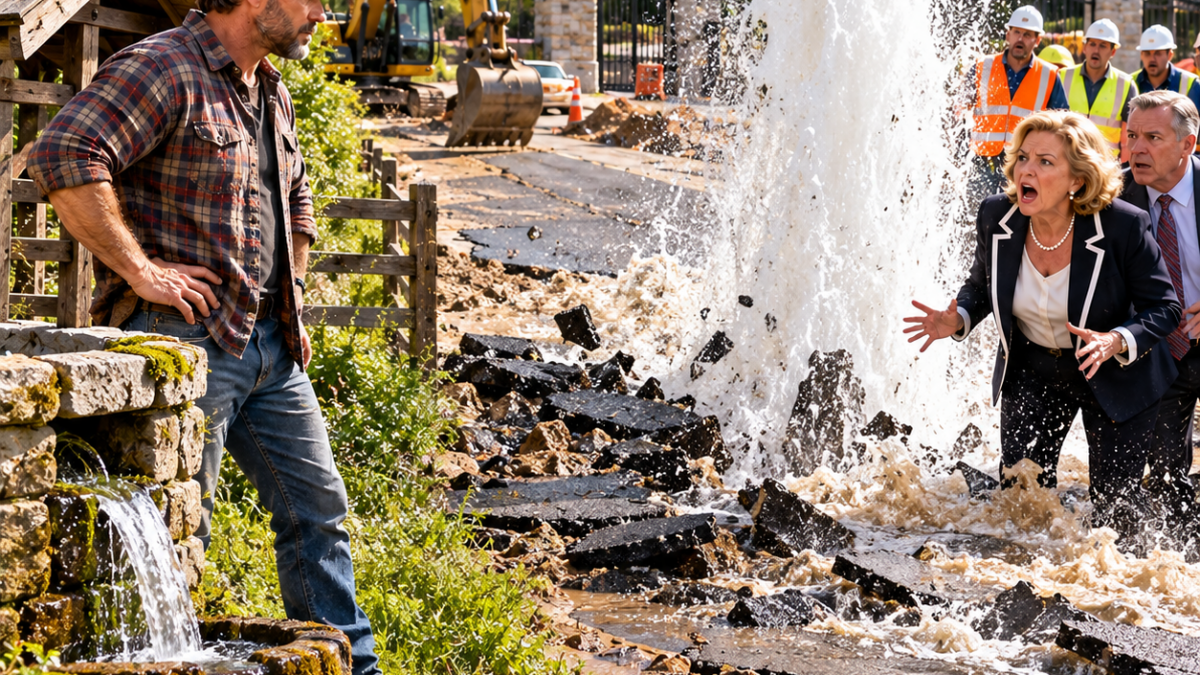
Then the pavement began breathing beneath her podium, muddy water punched through the brand-new boulevard, and every engineer standing nearby realized the HOA had not stopped the spring at all—they had only forced forty years of underground pressure to find another way out.
My grandfather used to tell me there were two kinds of people who got themselves into trouble with water.
People who did not understand it.
And people who believed understanding was optional.
Winston Caldwell had spent nearly forty years as a drilling contractor, irrigation specialist, and amateur geologist in the foothills east of the Cascades.
He wasn’t formally educated beyond community college.
He hated being called an expert.
He also kept field notebooks containing water-table measurements going back to 1971.
So when Winston told you a patch of ground was wet, you did not build there.
When he told you a slope would move, you did not argue because the slope looked solid.
And when he drilled a four-hundred-foot artesian well on the eastern edge of his ten-acre property and spent the next year building a stone enclosure around it, you did not call it a decorative fountain.
That well had been running before I was born.
By the time I inherited the property, the sound of it was as familiar as birds.
Cold water rose under natural pressure through a steel casing, spilled into a broad stone basin, then followed a shallow rock-lined channel through the trees.
No pump.
No electric motor.
No switch.
Just geology.
The flow changed a little with the seasons.
Never stopped.
Grandpa estimated an average around eighty gallons a minute in good years.
Sometimes less.
Sometimes more.
When I was nine, I asked him why we didn’t turn it off.
He stared at me over his glasses.
“Turn what off?”
“The water.”
He looked at the well.
Then back at me.
“Harrison, that isn’t a faucet.”
I shrugged.
“Put a cap on it.”
Grandpa laughed so hard he had to sit down.
Years later I understood why.
The well did not produce water because a pump sucked it upward.
The aquifer was confined beneath layers of less permeable rock and sediment.
Water entered that system at higher elevations.
Pressure did the rest.
The steel casing merely gave that pressure a controlled path to the surface.
Grandpa simplified it:
“Water wants out.”
PART2:
That sentence eventually cost Oak Creek Estates several million dollars.
At the time, nobody knew it.
My name is Harrison Caldwell.
I am not a farmer.
Not a hydrologist.
Not a survivalist.
I write software for industrial logistics systems.
I work from home when I can.
I own too many old tools because my grandfather believed throwing away usable metal was a moral failure.
I drink coffee on the back porch every morning.
I like quiet.
That is probably the most important thing about me.
I did not inherit Winston’s appetite for arguing with government agencies.
Or his habit of writing letters to newspapers.
Or his ability to identify rock by taste, which I still believe he invented to frighten children.
I inherited his land because my mother—his only daughter—had died before him.
He left me the house, the ten acres, the well, and one legal folder so thick I assumed it contained every piece of paper created in Washington state since admission to the Union.
Inside were:
The original deed.
Surveys.
Well-registration records.
Water-use paperwork.
Environmental assessments.
Boundary markers.
Old photographs.
And a note in Winston’s handwriting:
HARRISON — NEVER LET A DEVELOPER CONVINCE YOU THEIR NEW MAP IS OLDER THAN YOUR IRON PINS.
I laughed the first time I read it.
I stopped laughing five years later.
Oak Creek Estates appeared gradually.
PART3:
First came survey stakes in the farmland south and east of us.
Then earthmovers.
Then roads.
Then model homes.
Then hundreds of houses that looked expensive and nearly identical.
Gray siding.
White trim.
Stone veneer.
Perfect shrubs.
Wide driveways.
The developer cleared most of the old farmland and a significant amount of second-growth forest.
That bothered me.
But they owned it.
I owned mine.
Simple.
I had no desire to become one of those people who assumes a nice view creates ownership rights over everything in the view.
The development’s first phase stopped well below my property.
Second phase came closer.
Then Phase Three was announced.
That was when things changed.
Phase Three required a new northern access road.
Oak Creek Boulevard.
Gated entrance.
Stone columns.
Landscaped median.
Direct connection to the state highway.
The cleanest route happened to run beside my eastern boundary.
Beside Grandpa’s well.
I found that out one October morning when a white Mercedes SUV stopped near the old timber fence.
A woman stepped out.
Mid-fifties.
Blonde hair.
Cream coat.
Boots too clean for mud.
Behind her came a man with glasses carrying a leather portfolio.
They stood staring at Grandpa’s stone wellhouse.
I walked downhill.
“Can I help you?”
The woman turned.
“You’re Harrison Caldwell?”
“Yes.”
“Patricia Whitmore.”
She said the name like I should already know it.
“President of Oak Creek Estates Homeowners Association.”
The man nodded.
“Greg Tolson. Vice president.”
“Morning.”
Patricia pointed at the wellhouse.
“We need to discuss that structure.”
I looked behind me.
“What structure?”
She seemed irritated by the question.
“The stone building.”
“That’s a wellhouse.”
“We’ve received concerns.”
“From?”
She ignored that.
“It is directly adjacent to the planned Oak Creek Boulevard corridor.”
“Okay.”
“And it does not conform to Oak Creek’s architectural standards.”
I actually looked around to see if anyone else was hearing this.
“I’m not in Oak Creek.”
“We understand your parcel predates the development.”
“That is one way to say completely separate.”
Greg opened his portfolio.
Patricia continued:
“The constant water runoff is also a nuisance issue.”
I looked at the spring channel.
“You’re bothered by water?”
“We will have premium Phase Three lots nearby.”
“Then they may enjoy the sound.”
Her eyes hardened.
“This is not a joke, Mr. Caldwell.”
“No.”
I leaned against the fence.
“That’s what worries me.”
Greg unrolled a survey.
“Our updated boundary work shows a discrepancy.”
There it was.
Grandpa’s note entered my head.
Their new map.
Iron pins.
Greg pointed.
“The historic boundary appears to lie approximately ten feet west of the fence.”
“No.”
He blinked.
“No?”
“No.”
“Our surveyor—”
“My survey pins are original.”
“Markers can move.”
“Not two-inch iron pipe set four feet into packed ground.”
Patricia sighed.
“You are not a surveyor.”
“No.”
“Then perhaps let professionals—”
“I hired one when I inherited the property.”
That slowed her.
“Survey says fence is fully inside my line.”
Greg tapped his map.
“Ours differs.”
“Then yours is wrong.”
Patricia’s mouth tightened.
She walked toward the wellhouse.
Stopped at the fence.
“This sits within the corridor we require.”
“No, it doesn’t.”
“We have a prescriptive access claim.”
“You haven’t used my land.”
“We have maintained drainage infrastructure adjacent to it.”
“Not the same thing.”
Greg began to speak.
I looked at him.
“Do not say prescriptive easement unless you can explain all the elements.”
He stopped.
Patricia stepped in.
“We are constructing a multi-million-dollar entrance.”
“Congratulations.”
“This structure interferes.”
“Move the road.”
Her face reddened.
“You expect an entire planned boulevard to move for that?”
She pointed toward Grandpa’s well.
“A pile of moldy stone around a leaking pipe?”
That was the moment I stopped treating her like a confused neighbor.
“It isn’t leaking.”
“Water is pouring out.”
“Because it’s an artesian well.”
She frowned.
“An artisan what?”
Greg corrected quietly:
“Artesian.”
I almost smiled.
Patricia ignored him.
“Whatever you call it, cap it.”
“No.”
“We can reimburse removal.”
“No.”
“Five thousand?”
“No.”
“Ten?”
“No.”
“Mr. Caldwell—”
“You cannot casually seal that well.”
“Why?”
“Because it’s naturally pressurized.”
She rolled her eyes.
“So relieve the pressure.”
“The well is the relief path.”
Silence.
I explained more than I should have needed to.
Deep aquifer.
Confined formation.
Natural head pressure.
Continuous flow.
Specialized abandonment requirements if anyone ever wanted to permanently close it.
Permits.
Environmental review.
A hydrogeologist.
Not a concrete truck.
Patricia listened with the expression of somebody waiting for a waiter to stop explaining the menu.
When I finished, she said:
“We’ll have our engineers address it.”
“No.”
“What?”
“You aren’t touching it.”
She smiled.
Not pleasantly.
“We’ll see.”
There it was.
The sentence people use when they believe rules will eventually become whatever they need them to be.
I called a licensed surveyor that afternoon.
Evan Pierce.
He found Grandpa’s pins.
Shot the line.
Compared deed descriptions.
Two days later:
“Your fence is actually eighteen inches inside your property.”
“How far is the wellhouse?”
“Almost seven feet inside.”
“And their map?”
“Wrong.”
“Accidentally?”
Evan shrugged.
“I don’t accuse surveyors without seeing their field notes.”
“Can I accuse the HOA?”
“That’s recreational. Do what you want.”
I sent the certified survey to Oak Creek’s management company.
Their lawyer acknowledged receipt.
I thought the issue was finished.
Then came the letter.
NOTICE OF REQUIRED REMEDIATION.
Oak Creek claimed the wellhouse constituted an encroachment into a planned access easement.
The attached legal description was vague.
My attorney, Oliver Stanton, read it.
Oliver had handled Grandpa’s estate.
He remembered Winston.
Mostly because Winston once sent him a nine-page handwritten correction to a two-page lease.
Oliver called me.
“They have nothing.”
“Good.”
“They may still behave like they do.”
“Less good.”
“I’ll respond.”
His letter was merciless.
Property entirely outside Oak Creek HOA.
No covenant jurisdiction.
No recorded easement.
Current certified survey attached.
Well registered.
Any entry would constitute trespass.
Any alteration required applicable regulatory approval.
Do not enter.
Do not disturb.
Do not touch.
We sent it certified.
For several days, quiet.
Then I had to travel.
Mandatory conference in Denver.
Three days.
I hated conferences.
I hated airports.
I especially hated leaving with the property dispute unresolved.
So I did three things.
Installed fresh camera batteries.
Strung bright survey ribbon along the eastern line.
Placed temporary signs:
PRIVATE PROPERTY.
ACTIVE REGISTERED WATER WELL.
NO ENTRY WITHOUT OWNER CONSENT.
Then I left.
Friday afternoon I sat through a presentation about cloud architecture.
Saturday I pretended to care about collaborative innovation.
Sunday afternoon I flew home.
My truck reached the property just after dark.
Something felt wrong before I knew what.
The woods sounded different.
That sounds mystical.
It wasn’t.
I had lived with the artesian well long enough that the rushing water was always there.
Even inside the house at night, if windows were open, you could hear it.
Now:
Nothing.
No water.
Then I smelled asphalt.
Fresh.
Heavy.
I left the truck running.
Grabbed a flashlight.
Ran.
The timber fence had been removed over a broad section.
Survey ribbon gone.
Three cedars cut.
Ground scraped flat.
And the stone wellhouse—
Gone.
Not damaged.
Gone.
Grandpa and I had rebuilt part of that stone roof together when I was seventeen.
Gone.
In its place sat compacted road base.
Gravel.
Drainage fabric.
Construction stakes.
Heavy equipment.
The new boulevard corridor extended directly across the edge of my parcel.
I ran to where the casing should have been.
Found a short section of steel protruding near the graded shoulder.
Bent.
Sheared.
And silent.
My stomach dropped.
I put the flashlight over it.
Gray material filled the inside.
Concrete.
I heard someone shout:
“Hey!”
A man in a reflective vest walked from the equipment staging area.
Hard hat.
Heavy jacket.
“Site’s closed.”
“This is my property.”
He slowed.
“You Caldwell?”
“Yes.”
He sighed.
That was not encouraging.
“Dave Rankin.”
He pointed to his jacket.
RANKIN CONSTRUCTION.
“What did you do?”
“You need to talk to Oak Creek.”
“What did you do to my well?”
Dave looked down.
“Look, the plans showed the right-of-way.”
“They lied.”
“I’m not getting into that.”
“You cut the casing.”
“Dozer operator caught it.”
“And?”
“Water started coming up.”
“How much?”
“A lot.”
“How much?”
“Enough we couldn’t work.”
My mouth went dry.
“Then what?”
Dave rubbed his neck.
“We tried clamping.”
“You tried what?”
“Didn’t hold.”
“Then?”
He hesitated.
“HOA president came down.”
“Patricia?”
“Yes.”
“What did she tell you?”
“To stop the flow.”
“How?”
“We used a fast-set plugging material.”
I stared.
“Where?”
“Casing.”
“How much?”
“Enough.”
“Define enough.”
“Harrison—”
“HOW MUCH?”
He flinched.
“Several yards.”
I stopped.
A few seconds passed.
Dave said:
“It held.”
I looked at him.
He mistook my silence for relief.
“We got it stabilized.”
“No.”
“What?”
“You stopped the visible discharge.”
“Exactly.”
“No.”
I pointed into the casing.
“The aquifer didn’t stop producing pressure.”
He looked uncomfortable.
“Material is rated for wet conditions.”
“That has nothing to do with where the pressure goes.”
“It sealed.”
“Yes.”
“That was the goal.”
“No, Dave.”
My voice went quiet.
“You didn’t solve a leak.”
I pointed below us.
“You removed the designed outlet from a confined system.”
He frowned.
“Patricia said this was basically an abandoned spring line.”
“It has been flowing every day for fifty years.”
He stopped.
“Fifty?”
“Yes.”
“Registered?”
“Yes.”
His face changed.
“Did you tell the HOA?”
“In writing.”
Dave swore.
Then:
“We were given documentation.”
“Fake documentation.”
“I need to call my boss.”
“Good.”
“I also need you off the active roadbed.”
“This roadbed is on my property.”
“I understand.”
“No, you clearly don’t.”
I photographed everything.
Then called Oliver.
It was 9:42 Sunday night.
He answered:
“If this is about your HOA, I hate you.”
“They destroyed the well.”
Silence.
“What?”
I explained.
The wellhouse.
Casing.
Concrete.
Road.
Oliver became very quiet.
“Do not touch anything.”
“I wasn’t planning to.”
“Don’t try to reopen it.”
“I know.”
“Don’t excavate.”
“I know.”
“Don’t confront Whitmore.”
“I want—”
“No.”
“Oliver.”
“No.”
“They destroyed Grandpa’s—”
“I know.”
He had known Grandpa too.
His voice softened.
“That’s why you’re going to do this correctly.”
Monday morning began with phone calls.
Sheriff.
County planning.
Water resources office.
Department of Natural Resources.
Environmental health.
The sheriff’s deputy took a report.
Boundary dispute made him cautious.
“Civil matter may be involved.”
Oliver nearly exploded.
“They entered after certified notice.”
The deputy said:
“We’ll document.”
Fair.
DNR reacted differently.
“Someone placed cement into a registered artesian well?”
“Yes.”
“Who?”
“HOA contractor.”
“Was a licensed well driller present?”
“I don’t know.”
“Closure permit?”
“No.”
“Abandonment filing?”
“No.”
Silence.
“We’ll send an inspector.”
“When?”
“As soon as available.”
Government translation:
Not today.
The mail delivered Patricia’s invoice that afternoon.
$4,500.
EMERGENCY WATER HAZARD MITIGATION.
REMOVAL OF UNAUTHORIZED STRUCTURE.
I sat at the kitchen table.
Read it three times.
Then laughed.
Not because it was funny.
Because sometimes anger runs out of conventional exits.
I drove to Oliver’s office.
Laid everything down.
Grandpa’s deed.
Certified survey.
Photos.
Video.
DNR registration.
Invoice.
Oliver read.
Then leaned back.
“Harrison.”
“What?”
“Do you remember your grandfather’s well filing?”
“Yes.”
“Natural flow?”
“Yes.”
“Continuous?”
“Yes.”
“High artesian pressure?”
“Yes.”
He looked at me.
“Has anybody evaluated what happens if the primary discharge path is blocked?”
“I can guess.”
“Don’t guess.”
He picked up the phone.
“Let’s hire somebody who gets paid to know.”
Dr. Elena Marquez arrived the next day.
Hydrogeologist.
Forty-seven.
Practical.
No appetite for neighborhood drama.
She reviewed Winston’s records first.
Then state well logs.
Then construction plans.
Then new road grades.
Then she said:
“I need access to the site.”
Oak Creek refused.
Oliver obtained limited inspection access through counsel.
Rankin Construction allowed her onto the active corridor.
Patricia attended.
Of course.
We stood near the buried well.
Marquez asked:
“Who authorized the plug?”
Patricia said:
“The contractor addressed an active hazard.”
Dave Rankin said nothing.
Marquez looked at him.
“Were you instructed by a licensed well professional?”
Dave shook his head.
“Who designed the closure?”
“No formal design.”
Marquez wrote something.
Patricia crossed her arms.
“The water stopped.”
Dr. Marquez looked at her.
“No.”
Patricia frowned.
“You can see it isn’t flowing.”
“The surface discharge stopped.”
“That is what I said.”
“It is not the same.”
Marquez explained.
The aquifer remained pressurized.
The original casing had provided a low-resistance vertical pathway.
If plugged improperly, pressure could transfer into fractures, annular spaces, disturbed soils, construction trenches, or other weaknesses.
“Meaning?” Patricia asked.
“Meaning water may emerge somewhere else.”
“Where?”
Marquez looked along Oak Creek Boulevard.
“That is what we need to determine.”
Patricia laughed.
“You’re being paid by Mr. Caldwell.”
Oliver said:
“Patricia.”
She ignored him.
“Our engineers reviewed this.”
“Which engineers?”
No answer.
Marquez asked for geotechnical boring logs from the road project.
Patricia said counsel would respond.
That night Marquez called me.
“They should stop loading the roadway until this is resolved.”
“Can we force them?”
“Regulators might.”
“How urgent?”
“I cannot predict failure.”
“Could nothing happen?”
“Yes.”
“Could something?”
“Yes.”
“That is a terrible answer.”
“It is the honest one.”
She paused.
“Water is difficult because the damage path is often invisible until it isn’t.”
I filed for an injunction.
Unlike the original version of revenge I might have fantasized about, Oliver did not advise us to wait silently for catastrophe.
He wanted every warning documented.
Our emergency filing requested:
Stop further paving in the affected corridor.
Preserve access to the well location.
Independent groundwater evaluation.
No additional fill until regulators reviewed the closure.
Oak Creek fought.
They had buyers scheduled.
Phase Three launch approaching.
Patricia submitted a declaration stating:
The well had been an uncontrolled nuisance discharge.
The construction contractor had safely mitigated it.
No evidence existed of danger.
Their engineer wrote that no immediate surface instability had been observed.
That was technically true.
For the first week.
Nothing happened.
Judge ordered expedited inspection but did not halt the entire Phase Three project.
DNR placed an administrative hold on any further well alteration.
Oak Creek could continue unrelated work at its own risk.
They chose risk.
They finished the road.
Six inches of asphalt.
Landscaping.
Imported stone.
Two enormous limestone entry pillars.
Custom gate.
I watched.
Not gleefully.
Every paving truck made me nervous.
Marquez installed monitoring points on my side of the line with my permission.
Groundwater readings shifted.
Not dramatically.
Enough.
She documented increased head in shallow formations around the former well corridor.
Sent another warning.
Oak Creek’s counsel acknowledged receipt.
Patricia pushed ahead.
Grand opening scheduled for the Saturday before Thanksgiving.
Invitations went everywhere.
County commissioner.
Realtors.
Prospective Phase Three buyers.
Local business association.
Press.
Jazz quartet.
Catering.
I received an invitation.
I assumed sarcasm.
Front:
A NEW ERA FOR OAK CREEK.
I pinned it beside Patricia’s $4,500 invoice.
By then the road showed signs.
First:
Persistent dampness near one seam.
Then:
Discoloration.
Then:
Fine cracks.
Rankin Construction inspected.
Dave called me privately.
“I think something is moving.”
“What?”
“Subgrade.”
“Tell Patricia.”
“I did.”
“And?”
“She says settlement.”
“Normal?”
“Could be.”
“Do you believe that?”
Long silence.
“No.”
“Tell DNR.”
“I will.”
He did.
DNR scheduled another inspection for the week of the ribbon-cutting.
The night before the event, rain fell.
Not a storm.
Just steady mountain rain.
Marquez called at 7:30 a.m. Saturday.
“Harrison.”
“What?”
“Do not stand near that road.”
“I wasn’t planning to.”
“Head readings jumped overnight.”
“How bad?”
“Bad enough that I’m calling the county.”
“Should the event be cancelled?”
“Yes.”
She called.
Oliver called Oak Creek counsel.
DNR called the HOA manager.
Rankin called Patricia.
The county public works duty officer recommended closing the affected lane pending inspection.
Patricia refused to cancel.
She changed the setup.
Moved most guests toward the landscaped shoulder and declared the center lane off-limits to vehicles.
That was not enough for me.
Oliver drove up.
“You’re not going down there.”
“I can stand on my land.”
“Behind the line.”
“Yes.”
“Far behind.”
“Yes, Mom.”
“I billed you for that.”
I set a folding chair near the eastern property pin.
Twenty yards uphill from the road.
Coffee thermos.
Oliver stood beside me in a wool coat.
“This is profoundly stupid.”
“What?”
“Attending.”
“We are not attending.”
“We are watching.”
“Legally distinct.”
Across the line, music played.
People gathered.
Patricia wore white.
Of course.
Greg Tolson held giant novelty scissors.
There were maybe sixty people.
Not hundreds.
Enough.
Dave Rankin stood near the construction trailer.
He wasn’t smiling.
I noticed he kept looking at the pavement.
Patricia began her speech.
“Today marks another milestone…”
I couldn’t hear every word.
Then:
“Progress requires determination.”
Pause.
“Sometimes determination means refusing to let old obstacles stand in the path of responsible growth.”
She looked uphill.
Directly at me.
I raised my coffee.
Oliver whispered:
“You are twelve.”
“Eleven.”
The jazz band played.
Caterers rolled service carts.
Then I saw Dave move.
Fast.
Toward the road.
He shouted something.
Music covered it.
A dark line of water appeared along the center seam.
Not spraying.
Seeping.
Then bubbling.
People noticed.
Patricia turned.
The pavement lifted slightly.
Just enough to look wrong.
Like a blister forming under skin.
Dave screamed:
“GET OFF THE ROAD!”
That cut through everything.
The band stopped.
Oliver stood.
I was already up.
People moved toward the shoulders.
That probably saved someone.
The road surface heaved.
Then cracked.
A sharp report.
Water burst through.
Not a cinematic bomb.
A violent high-pressure rupture.
Mud.
Gravel.
Cold water.
Asphalt fragments.
People screamed and ran.
The central pavement split over several yards.
A catering cart toppled.
No one was beneath it.
The fissure widened.
Water surged.
The subgrade began washing out rapidly.
A section of asphalt sagged.
Then dropped.
A sinkhole opened.
Maybe fifteen feet across initially.
Then larger.
The white catering tent collapsed at one edge as anchors lost support.
Guests were already clear.
One limestone pillar began leaning.
Slowly.
Impossible-looking.
The gate twisted.
Metal shrieked.
Then the pillar collapsed into the washed-out section with a massive splash.
The other side remained standing.
Half a grand entrance.
Water continued pouring from the ground.
Not the neat stream Grandpa’s well had produced.
Brown now.
Carrying sediment.
Following the disturbed roadbed.
Patricia stood on the grass.
White suit soaked gray-brown below the knees.
Hair flattened by spray.
She stared at the broken boulevard.
Then at me.
“You.”
Oliver sighed.
“Of course.”
Patricia marched as far toward my line as the emergency crew allowed.
“You did this!”
I stayed behind my boundary.
“No.”
“You sabotaged the road!”
“No.”
“You reopened that well!”
“No.”
Oliver called:
“Patricia, stop talking.”
She ignored him.
“You wanted this!”
I felt the anger return.
“No.”
I pointed at the crater.
“I wanted my grandfather’s well left alone.”
Sirens arrived.
Fire department.
Sheriff.
County public works.
Then, twenty minutes later, a state DNR truck.
Inspector Nathan Cho stepped out.
Looked at the road.
Looked at the water.
Then said something I will remember forever.
“Who plugged the well?”
Nobody answered.
Dave Rankin raised one hand.
“Our crew performed the work.”
Patricia spun.
“Dave!”
He continued:
“At HOA direction.”
Cho looked at him.
“Licensed closure?”
“No.”
“Permit?”
“No.”
“Engineer?”
“No.”
Patricia said:
“It was an emergency leak.”
Cho looked toward the crater.
“I can see how well that emergency solution worked.”
Oliver handed him the documentation.
Registration.
Survey.
Certified notices.
Marquez reports.
Photographs.
DNR complaint.
Security footage.
Cho looked at me.
“You have not altered the site since the plug?”
“No.”
“Excavated?”
“No.”
“Attempted to remove cement?”
“No.”
“Good.”
He looked at Patricia.
“We’re closing this corridor.”
Her face went pale.
“Phase Three needs this access.”
“Then Phase Three has an access problem.”
The official investigation began immediately.
Nobody could simply blame “nature.”
Nature was involved.
Human choices were too.
State engineers found the well had been improperly sealed.
The cement blocked the casing but had not converted the artesian system into a compliant abandonment.
Pressure migrated through fractured material around and near the original bore.
Construction disturbance provided preferential pathways.
Road excavation and compacted subgrade altered drainage.
Water eventually carried fine material away beneath the new road.
Voids developed.
Then the surface failed.
Marquez described it more simply:
“They gave the water a new route and then built a road on top of that route.”
The good news:
Nobody was seriously injured.
Two people were treated for minor falls.
One caterer needed stitches after slipping near a table.
No cars entered the collapse.
Dave’s warning emptied the pavement before it failed badly.
That mattered to me.
Because revenge stops being satisfying the moment an innocent person gets hurt.
Oak Creek’s board tried blaming Rankin Construction.
Rankin produced the work order.
Signed:
Patricia Whitmore.
EMERGENCY FLOW ABATEMENT AUTHORIZATION.
Use rapid hydraulic sealing material as required to permit roadway construction.
Dave also produced emails.
One:
We cannot compact the road base while the Caldwell water source continues discharging.
Patricia replied:
Then eliminate the discharge.
Another:
Recommend bringing in licensed well contractor.
Patricia:
Schedule cannot absorb another specialty subcontractor. Use practical field solution.
That email circulated through Oak Creek faster than any HOA newsletter.
Residents were furious.
Then the legal documents became public.
They learned I had sent a certified survey before construction.
That Oliver warned the board.
That Marquez warned them after the plugging.
That DNR had opened a file.
That Patricia still held the ribbon-cutting.
The HOA emergency meeting lasted four hours.
I attended the first ninety minutes.
That was enough.
Patricia sat at the front.
Greg beside her.
Five other board members.
HOA counsel.
Insurance representative.
Utility consultant.
Three hundred angry homeowners.
The first resident at the microphone asked:
“Did you know the well was on Caldwell’s property?”
Patricia answered:
“We had conflicting surveys.”
The resident held up mine.
“This was certified before construction.”
“We were advised—”
“By who?”
Patricia looked toward counsel.
Counsel looked down.
Second resident:
“Why didn’t you use a licensed well company?”
“The contractor—”
Dave Rankin stood in the back.
“No.”
Everyone turned.
He walked to the microphone.
“We recommended one.”
Patricia stared.
Dave continued.
“My crew bears responsibility for accepting the work order.”
Good answer.
“But we did not tell the HOA this was a proper permanent abandonment.”
He held up the signed authorization.
“We were told to stop the water so grading could continue.”
Noise exploded.
The insurance representative raised a hand.
Nobody cared.
Finally she spoke into her microphone.
“The carrier is conducting a coverage investigation.”
A man shouted:
“Translation?”
She answered:
“Certain losses caused by accidental ground failure may be covered.”
People quieted.
“However, deliberate unauthorized alteration of a registered water source, known-property trespass, regulatory penalties, and damages arising from excluded intentional acts may not be.”
Someone shouted:
“So we’re screwed?”
The representative said:
“I did not say that.”
“Sounds like it.”
She continued:
“Multiple insurers and responsible parties are involved.”
Translation:
Years of lawyers.
Greg Tolson looked physically ill.
Then a board member named Ellen Cho—not related to the DNR inspector—spoke.
“I move that Patricia Whitmore be immediately suspended from all executive authority pending independent legal investigation.”
Greg whispered:
“You can’t—”
Another board member:
“Second.”
Vote.
Five to one.
Greg abstained.
Patricia stared.
“You’re removing me?”
Ellen said:
“We are protecting the association.”
Patricia laughed bitterly.
“I built this community.”
A homeowner shouted:
“No, the developer built it!”
Another:
“And Harrison’s grandfather apparently kept the water where it belonged!”
That got a strange wave of laughter.
I left.
Oliver followed.
“You don’t want to see the rest?”
“No.”
“Why?”
“Because these people still have to live together tomorrow.”
That surprised him.
“You’re becoming wise.”
“Take that back.”
The lawsuit took eighteen months.
Not three dramatic weeks.
Real litigation is mostly emails, depositions, expert reports, invoices, scheduling conflicts, and people discovering that revenge gets very expensive when billed in six-minute increments.
Our property claim was strong.
No valid easement.
Certified survey.
Prior written warning.
Video evidence.
Destroyed wellhouse.
Destroyed fence.
Cut trees.
Damaged well.
Unauthorized entry.
Oak Creek eventually stipulated trespass.
The fight became damages.
Environmental restoration.
Well remediation.
Loss of historic structure.
Legal fees.
Buffer rights.
Future road location.
Patricia’s personal liability.
The HOA’s insurance.
Rankin’s liability.
The developer’s role.
Everybody had lawyers.
I had Oliver.
Oliver enjoyed himself far too much.
DNR imposed substantial penalties tied to unauthorized well alteration and environmental damage.
Not fantasy-level daily numbers.
Enough.
The county closed the Phase Three road indefinitely.
Oak Creek had to use its original entrance while a replacement alignment was designed.
The new route moved roughly half a mile south.
More expensive.
Longer.
Not my problem.
Hydrogeologists designed a proper solution for Grandpa’s well.
Removing the cement was not as simple as drilling a hole through it.
The casing was damaged.
Surrounding formation had been disturbed.
The old bore had to be assessed carefully.
Parts of the damaged casing were removed.
Pressure was brought under controlled management.
A replacement wellhead and discharge system were constructed under permit.
No DIY heroics.
No dramatic geyser intentionally created.
Professionals.
Meters.
Valves.
Monitoring.
Environmental safeguards.
The rebuilt wellhouse was beautiful.
That surprised me.
Cedar beams.
River stone.
Metal roof.
Open sides around the discharge basin.
A small covered porch.
Oliver called it “aggressively sentimental.”
Correct.
We embedded some of Grandpa’s original stones into the new walls.
The contractor found his old chisel marks on two.
I kept those near the entrance.
A brass plaque reads:
WINSTON CALDWELL WELL
EST. 1972
RESTORED 2028
Under it:
WATER WANTS OUT.
That was my addition.
Oak Creek paid most of the restoration through settlement and insurance contributions.
Rankin Construction paid a share.
Dave did not lose his company.
I didn’t want him to.
He had made a bad decision.
Then cooperated.
He testified honestly.
His firm implemented a policy requiring written specialty review before altering wells, springs, drainage structures, or underground utilities outside approved civil plans.
Dave visited after restoration.
Stood at the new wellhouse.
“Looks better.”
“Grandpa would’ve hated it.”
“Why?”
“Too nice.”
Dave laughed.
Then grew serious.
“I should’ve walked off.”
“Yes.”
“I knew it felt wrong.”
“Yes.”
“Patricia was screaming about the schedule.”
“That happens.”
“I let the schedule become permission.”
That sentence stayed with me.
The schedule became permission.
A lot of disasters begin there.
Not evil.
Pressure.
Deadline.
Money.
Someone says:
Just make it work.
Then qualified people do something they know deserves more thought.
Dave said:
“I’m sorry.”
I believed him.
“Thank you.”
He looked relieved.
I did not tell him it was okay.
It wasn’t.
Forgiveness and absolution are not the same thing.
Patricia fought personal liability to the end.
She claimed she relied on professionals.
Emails disagreed.
She claimed she believed the land belonged to Oak Creek.
Certified survey disagreed.
She claimed the closure was emergency mitigation.
Scheduling emails disagreed.
She eventually settled.
Sold the Mercedes.
That part was true.
Not because a judge ordered her to liquidate luxury vehicles dramatically.
Legal bills and personal settlement obligations were expensive.
Her husband sold their Oak Creek house the following spring.
They moved.
I never saw her again.
Greg resigned three months after her suspension.
His farewell email described “an increasingly hostile governance environment.”
Mrs. Avery from Phase One printed it and mailed me a copy with a sticky note:
WE FINALLY AGREE ON SOMETHING.
The ruined boulevard was removed.
Not merely patched.
The voids beneath it were too extensive.
Ground needed stabilization.
Drainage redesigned.
The abandoned section near my property was never rebuilt as a road.
That became part of the settlement.
Oak Creek transferred a narrow buffer parcel adjacent to my eastern line to a conservation easement jointly managed by a local land trust.
No future road.
No Phase Three houses pressed against the well.
Trees replanted.
The state required monitoring for several years.
Fine by me.
The first winter after restoration, snow came early.
I walked to the wellhouse at dawn.
Steam hung faintly above the water because the spring temperature was warmer than the air.
Same sound.
Rushing.
Steady.
Grandpa’s sound.
I sat on the little cedar porch with coffee.
For the first time since Patricia entered my life, I felt like the property belonged to me again.
Not legally.
It always had.
Emotionally.
That’s different.
Litigation makes you feel like your own land has become evidence.
Every tree:
Exhibit.
Every stone:
Photograph.
Every memory:
Damage calculation.
I hated that.
The restoration returned it to being home.
Oak Creek changed too.
Residents replaced most of the old board.
New president was Ellen Cho.
She came to my gate before her first formal meeting.
Called first.
That alone made her revolutionary.
“Harrison?”
“Yep.”
“I’d like to apologize on behalf of the association.”
“You don’t have to.”
“I know.”
She waited.
“I still want to.”
So I listened.
“We failed to question authority.”
Not:
Patricia failed.
We.
That mattered.
“We assumed because something was attached to a development plan, somebody had verified ownership.”
She looked toward the wellhouse.
“We also treated you like an obstacle instead of a neighbor.”
“I’m not technically in your neighborhood.”
She smiled.
“Adjacent human.”
“Better.”
Oak Creek adopted new rules.
Any work touching land outside HOA-owned parcels required independent title verification.
No board member could authorize emergency construction beyond a defined cost without counsel review.
Environmental features required professional signoff.
Construction records posted to homeowners.
Surveys had to come from recorded or certified sources, not planning graphics.
One resident joked at a meeting:
THE CALDWELL RULE.
I hated that.
It stuck.
Three years later, Oak Creek’s redesigned Phase Three opened.
Smaller.
No grand northern boulevard.
Residents used the southern entrance.
Property values did not collapse.
Civilization survived.
Patricia’s promised catastrophe never happened.
People bought houses.
Had children.
Complained about mailbox colors.
HOAs remain HOAs.
One afternoon a couple walking near the conservation buffer stopped at the fence.
“Are you Mr. Caldwell?”
“Depends.”
The man laughed.
“We just moved into Phase Three.”
“Condolences.”
His wife smiled.
“Is that the well?”
“Yes.”
“The road story?”
“Yes.”
They looked at the water.
The husband asked:
“Did it really explode?”
“Road failed.”
“Thirty-foot geyser?”
“People exaggerate.”
“How high?”
“High enough.”
His wife asked:
“Did you know it would happen?”
“No.”
That was important.
“I knew blocking the well improperly could create problems.”
“But exact sinkhole?”
“No.”
“You weren’t waiting for the ribbon-cutting?”
“I was waiting for regulators.”
The husband looked disappointed.
“Story online says you brought a lawn chair to watch.”
“That part is unfortunately true.”
His wife laughed.
“Why?”
“Because I was petty.”
Fair.
“But we had warned them to close the road.”
“Yes.”
“And people got off it.”
“Thankfully.”
I pointed toward the stone basin.
“The lesson isn’t that I outsmarted the HOA.”
“What is?”
“Don’t improvise underground engineering because you’re late for asphalt.”
That is less viral.
More useful.
Grandpa would approve.
Maybe.
He would probably rewrite it.
As I got older, I found more of Winston’s notes.
He had written about the aquifer constantly.
One notebook contained the original drilling entry.
May 17, 1972.
Flow strong.
Formation tighter than expected.
Natural rise immediate.
Don’t let anybody get clever with this one.
I framed that page.
Apparently Grandpa had predicted Patricia fifty years early.
There was another entry from 1996, when the first developers approached nearby farms.
Subdivision people asking about eastern boundary.
Told them spring stays.
They nodded too quickly.
I laughed.
Grandpa understood developers.
Not because developers were bad.
Because development rewards momentum.
Roads need schedules.
Homes need closings.
Loans have clocks.
Every inconvenient object becomes something to move.
Tree.
Drain.
Stone.
Well.
Person.
Sometimes that works.
Sometimes the inconvenient thing is inconvenient because physics put it there first.
Years later, I sold an environmental easement over three acres surrounding the well and creek corridor.
Not to Oak Creek.
A regional conservation trust.
That made future development difficult.
Exactly what I wanted.
The trust’s lawyer asked:
“Are you concerned this limits resale value?”
“No.”
“You understand a buyer may pay less?”
“Yes.”
“You are comfortable permanently restricting construction here?”
I looked at the well.
“Yes.”
She smiled.
“You’ve thought about this.”
“For approximately one HOA president.”
She didn’t understand.
That was fine.
Ellen retired from the board after four years.
At her final neighborhood picnic she invited me.
I went.
Oak Creek residents had stopped treating me like the angry hill hermit by then.
Children knew my property as “the spring place.”
One kid asked if there were fish in the well.
“No.”
“Why?”
“Because it’s four hundred feet deep.”
“Could fish live down there?”
“No.”
“How do you know?”
I stared.
“Go ask your parents.”
Ellen handed me a beer.
“You like us now?”
“Let’s not get emotional.”
She laughed.
Then:
“Do you know what Patricia’s biggest mistake was?”
“Where do I start?”
“Seriously.”
I thought.
“The survey?”
“No.”
“The well?”
“No.”
“The road?”
She shook her head.
“What?”
“She never came back after you said no.”
I looked at her.
Ellen continued:
“If she’d returned with an engineer and asked, ‘What does this well do?’…”
“Nothing happens.”
“Exactly.”
That was true.
Patricia’s biggest mistake was not ignorance.
Ignorance can be fixed.
It was treating a question like an insult.
She did not know how the well worked.
Fine.
Neither had I when Grandpa first explained it.
The dangerous part was believing she didn’t need to know because she was in charge.
Authority feels like knowledge if nobody challenges it.
Those are not the same thing.
A board vote cannot lower artesian pressure.
A construction deadline cannot change geology.
A glossy master plan cannot move a property pin.
And concrete cannot make underground water disappear just because the surface looks dry afterward.
It only changes where the water goes.
The new wellhouse became my favorite place on the property.
I added a bench.
Then a small table.
Nothing fancy.
Most mornings I still drink coffee at the house.
Some mornings I walk down.
The flow enters the basin.
Crosses the stone lip.
Runs beneath a little cedar footbridge.
Then follows the creek.
Same water.
Different structure.
Grandpa would complain about the bridge.
“Unnecessary.”
He would use it every day.
I am certain.
My favorite part is the sound.
When the HOA buried the well, that sound vanished.
I hadn’t realized how much of home lived inside it until silence replaced it.
The night I returned from Denver and heard nothing, I thought first about property damage.
Then law.
Then money.
Only later did I understand what really hurt.
Patricia erased one of the last living things Grandpa had built.
Not a photograph.
Not a chair.
A working system.
Something he designed.
Touched.
Maintained.
Listened to for fifty years.
Restoring the well did not bring him back.
But the first day the new discharge opened under controlled pressure and water moved into the stone basin, I cried.
Oliver pretended not to notice.
Then charged me for the hour.
Years afterward he insisted he gave me an emotional discount.
Lawyers lie.
Oliver eventually retired.
At his dinner, somebody asked his favorite case.
He pointed at me.
“Artesian insanity.”
I said:
“You loved that case.”
“I loved your invoices.”
“Monster.”
He raised his glass.
“To Winston Caldwell.”
I raised mine.
“Who warned everybody fifty years early.”
Oliver smiled.
“And to property records.”
Less romantic.
Still true.
Because for all the talk about water winning, the law mattered.
The certified survey.
The registered well.
The deed.
The warnings.
The emails.
The regulatory file.
Without those, Oak Creek could have turned a clear trespass into years of uncertainty.
Grandpa did not merely build things correctly.
He documented them.
That was another lesson.
Memory is not evidence.
Maps are.
Permits are.
Recorded boundaries are.
Photos.
Letters.
Receipts.
Boring paperwork saves beautiful things.
I used to tease him for filing everything.
Now I own three fireproof cabinets.
Apparently personality is inherited slowly.
One rainy November morning, decades after the road failure, I heard a truck near the east line.
Old reflex.
I walked down.
Oak Creek maintenance.
Young man.
Reflective vest.
He stood outside the conservation boundary.
Didn’t cross.
“Mr. Caldwell?”
“Yeah?”
“Stormwater inspection.”
“On your side?”
“Yes, sir.”
“Then inspect.”
He smiled.
“My supervisor said under no circumstances do we step across this line without calling you.”
“Smart supervisor.”
“Apparently there’s history.”
“So I’ve heard.”
He looked at the wellhouse.
“Is that the well?”
“Yes.”
“Crazy story.”
“Less crazy than people say.”
“Road really sink?”
“Yes.”
He nodded with satisfaction.
“Good enough.”
Then walked away.
I stood there listening to the spring.
Somewhere below us, Oak Creek Boulevard—the replacement one—carried SUVs into Phase Three.
Children went to school.
People drove to work.
Everything normal.
The original failed road location is forest again.
Mostly.
If you know where to look, there are still fragments of old asphalt deep in the brush.
I found one a few years ago.
Heavy black chunk.
Broken edge.
I put it beside Grandpa’s original wellhouse stones.
Two pieces of the same argument.
One built to respect pressure.
One built by pretending pressure could be ignored.
Visitors ask why I keep the asphalt.
I tell them:
“Reminder.”
“Of Patricia?”
“No.”
“Of the HOA?”
“No.”
“Then what?”
“That silence after a bad decision doesn’t mean the decision worked.”
That is probably the most important thing Oak Creek taught me.
They sealed the well.
The water stopped.
For days, everything looked perfect.
Construction continued.
Road went down.
Landscaping went in.
Gate rose.
No disaster.
That silence made them confident.
Nothing happened.
So they assumed nothing would.
Humans do that constantly.
A retaining wall doesn’t move today, so it is fine.
A leak stops dripping, so the problem is solved.
A warning doesn’t become catastrophe immediately, so the warning must have been exaggerated.
Then one morning the asphalt bends.
Silence is not always safety.
Sometimes it is pressure accumulating where you cannot see it.
I think about that more than I probably should.
Maybe because age makes people philosophical.
Maybe because Grandpa finally infected me.
I still have Patricia’s invoice.
$4,500 for “emergency hazardous leak mitigation.”
Framed.
Next to the road fragment.
I considered sending it back after settlement with PAID IN FULL written across it.
Oliver wouldn’t let me.
“Why?”
“Because judges appreciate maturity.”
“I don’t.”
“We know.”
So I kept it.
The white Mercedes is gone.
Patricia is gone.
The old road is gone.
The well remains.
That tells you most of what you need to know.
Not that nature always punishes arrogance on schedule.
It doesn’t.
Plenty of arrogant people live very comfortable lives.
Not that every HOA is evil.
They’re not.
Not even that old things should never be changed.
They should, when somebody understands what they do first.
The lesson is smaller.
When you inherit a system you don’t understand, ask before removing it.
When a landowner says your survey is wrong, verify before crossing the fence.
When a contractor says you need a specialist, hire the specialist.
When water has been escaping through the same controlled path for fifty years, don’t assume you can erase the path and erase the pressure.
And if a seventy-year-old drilling contractor leaves a note saying:
Don’t let anybody get clever with this one—
Maybe listen.
Grandpa knew.
Patricia didn’t.
I only understood afterward.
But by then Oak Creek’s beautiful new boulevard had already learned the lesson in the only language geology speaks.
Pressure.
Resistance.
Failure.
Release.
The HOA believed sealing my old well had solved their problem because the surface went quiet.
They mistook quiet for victory.
Then water erupted through the road they had built over it.
And in the end, the most expensive mistake Patricia Whitmore ever made was not crossing my property line.
It was believing that because she could silence the well, she had somehow silenced the mountain beneath it.




