HOA Built a $12 Million Fire Station 42 Feet Inside My Ranch—Then a Certified Survey Proved the Building, Helipad, and Driveway Were All Mine
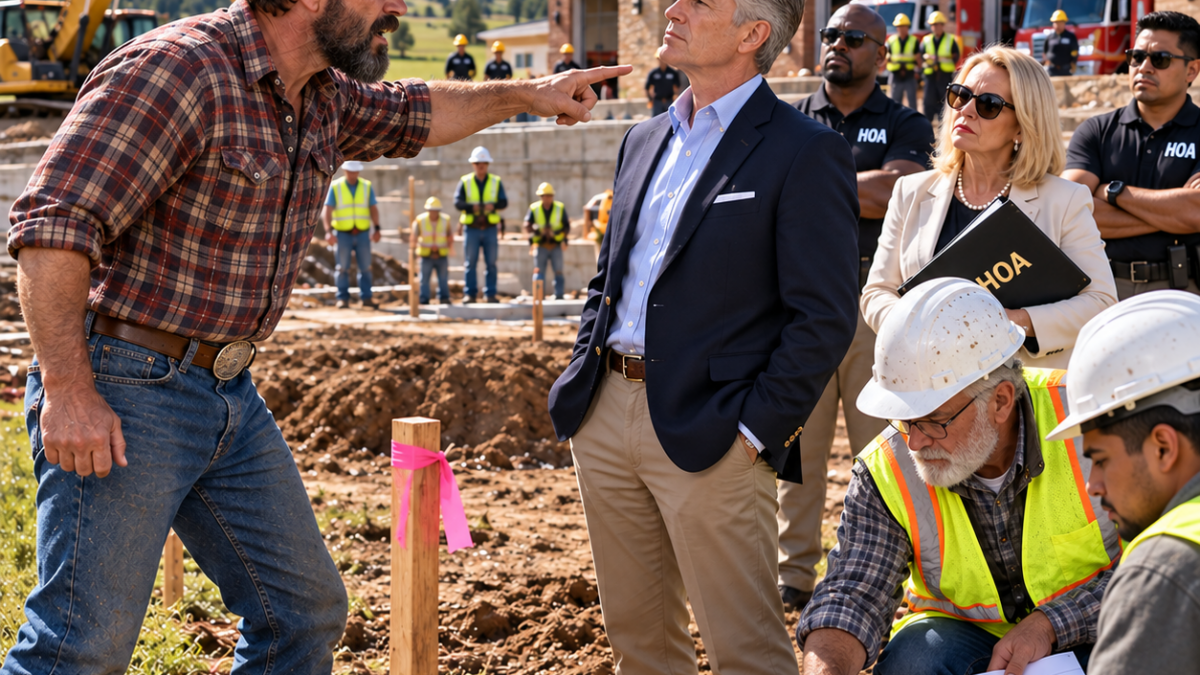
HOA Built a $12 Million Fire Station 42 Feet Inside My Ranch—Then a Certified Survey Proved the Building, Helipad, and Driveway Were All Mine.
The HOA president tore down my grandfather’s fence, shoved bulldozers onto my ranch, and spent $12 million building a private fire station while threatening to bankrupt me if I challenged his “official” property map.
For eight months I let him pour concrete, install Italian brick, pave a helicopter pad, and brag to hundreds of homeowners that progress had finally defeated the stubborn rancher standing in his way.
Then, at his ribbon-cutting ceremony, I unfolded a certified survey proving the entire station sat forty-two feet inside my land—and the building he was about to celebrate had legally become the most expensive gift anyone had ever built on Iron Ridge Ranch.
The first thing Steven Hayes destroyed was not my fence.
It was the idea that men like him could be reasoned with.
That took me longer to understand than I am proud to admit.
My name is Louis Pendleton.
Everybody calls me Louie.
My grandfather called me Lewis whenever he was angry, which meant I grew up answering to both.
The Pendleton family has run cattle on Iron Ridge Ranch since 1942.
Four hundred acres in the Colorado foothills.
Not flat postcard country.
Our land climbs.
Drops.
Breaks into sagebrush.
Exposes red stone after heavy rain.
The western pasture runs toward the mountains.
The eastern ridge overlooks what used to be open valley.
When my grandfather bought it, there were two neighboring ranches, a dirt county road, and enough distance between houses that smoke from another chimney counted as company.
By the time I inherited Iron Ridge, the valley had changed.
People wanted views.
Developers wanted money.
And land that cattle had walked across for seventy years suddenly became “underutilized acreage.”
I learned that phrase from a brochure.
The developer called the new community Whispering Pines.
There had indeed once been pines.
They bulldozed most of them.
In their place came three-story houses with black-framed windows, fake barn doors, imported stone, and rooftop patios nobody used because the wind on that ridge could remove a paper plate from your hand and send it to Wyoming.
Homes started around $1.8 million.
Some crossed three.
Whispering Pines was gated.
Private roads.
Landscaping crews.
A clubhouse.
A gym.
A pool with fire bowls beside it.
A concierge desk.
I am not making that up.
The HOA had a concierge.
Iron Ridge had me, two ranch hands, a cattle dog named Boone, and a propane tank that leaned slightly to the north.
At first the contrast amused me.
Then Steven Hayes became HOA president.
Steven came from California.
He made sure everyone knew he had been a corporate litigator.
Thirty years.
Major clients.
Major cases.
Major settlements.
He said those words often enough that I suspect retirement had not given him enough people to intimidate.
Whispering Pines gave him seventy-eight houses and a board.
That was all he needed.
PART2:
Within a year he had transformed the association from irritating into aggressive.
Parking rules.
Exterior paint.
Window treatments.
Approved fence styles.
Approved patio furniture.
Approved seasonal decorations.
If your landscaping crew arrived too early, letter.
If your garbage bin remained visible after pickup, letter.
If you planted something not on the approved list, letter.
I wasn’t in the HOA.
That should have insulated me.
It didn’t.
Steven sent me fourteen letters during his first eighteen months as president.
I kept them.
My favorite began:
Dear Mr. Pendleton,
Whispering Pines has received numerous complaints regarding livestock-related odors affecting outdoor recreational enjoyment.
Livestock-related odors.
Cow manure.
He wanted my cattle moved farther from the property line.
I replied once.
Dear Mr. Hayes,
The cows decline.
Louie
He did not appreciate it.
PART3:
Another letter demanded I install privacy screening because residents could see agricultural equipment.
That meant tractors.
Another objected to dust.
One complained about predawn ranch noise.
Cattle are not known for respecting luxury quiet hours.
I ignored nearly all of them.
Most residents left me alone.
Some were friendly.
One retired surgeon bought half a beef from me every year.
A couple on Juniper Crest brought their grandchildren to see calves.
A young family named the bull in our eastern pasture Walter even after I told them his name was Number 37.
It was Steven who treated the ranch like an unresolved defect in the development.
He used to stand near the boundary during neighborhood tours.
Hands on hips.
Patagonia vest.
Polished boots.
Looking at my pasture the way people look at a stain they intend to remove later.
I knew what he wanted.
More land.
Whispering Pines had reached the valley edge.
Iron Ridge blocked the next expansion.
Three developers offered to buy.
First:
$5.8 million.
Second:
$7.2 million.
Third:
$9 million plus a relocation allowance.
Sounds like life-changing money.
It was.
I still said no.
People hear that and assume sentimentality.
Partly.
My grandfather was buried on the hill beside my grandmother.
My father’s ashes were scattered near the north pasture.
Every fence line contained somebody’s work.
But there were practical reasons too.
Ranching was my livelihood.
My home was paid for.
Land was appreciating.
And I had no desire to cash out at fifty-six just so some developer could put twelve houses where my cattle drank.
Steven could not understand that.
People who measure everything in price often interpret refusal as negotiation.
So his offers became pressure.
Complaints.
Letters.
County calls.
Environmental inquiries.
He once claimed our stock pond was contaminating Whispering Pines groundwater.
The county tested it.
Nothing.
Steven then complained the test was “insufficiently comprehensive.”
Sheriff Miller joked that Steven had personally increased county paper consumption by fourteen percent.
Miller and I had known each other since high school.
His name was James Miller, but everybody called him Sheriff Miller even before he became sheriff because his father held the job first.
He came by one afternoon after yet another trespass complaint.
Steven had alleged my cattle crossed onto HOA common space.
Miller stood at my fence.
Looked at the cows.
Looked at me.
“Any confessions?”
“Walter looks suspicious.”
“You named one?”
“Neighbors did.”
Miller sighed.
“Steven says they damaged ornamental grasses.”
“No cattle left my land.”
“You sure?”
“Yes.”
“How?”
“Fence.”
He stared at the fence.
Old barbed wire.
Cedar posts.
Some replaced over the years.
“Compelling technology.”
“Very advanced.”
Miller grinned.
Then got serious.
“He’s looking for leverage.”
“I know.”
“Don’t give it.”
“I won’t.”
The fence he was looking at would become the most expensive line in the county.
My grandfather built it in the 1970s.
At least, that was what I had always believed.
Everybody called it the property fence.
It ran along the eastern ridge.
Barbed wire.
Cedar.
Some steel T-posts added later.
I had repaired it since I was twelve.
If a post leaned, you straightened it.
If cattle rubbed wire loose, you tightened it.
I never questioned whether it sat exactly on the deed line.
Ranch fences rarely do.
Terrain decides things.
Creeks.
Rocks.
Trees.
Ease of access.
That mattered later.
But in May 2024, when the bulldozers came, all I knew was that somebody had ripped it out.
I was fixing an irrigation line about half a mile north when I heard the machines.
Deep diesel.
Not ranch equipment.
Bigger.
I rode the ATV over the rise.
Three bulldozers.
Two dump trucks.
Excavator.
Crew.
They were scraping sagebrush from a broad pad on the eastern slope.
The fence was gone.
Not cut neatly.
Ripped.
Cedar posts lay piled like bones.
Wire twisted into a steel nest.
Fifty feet inside what I believed was my pasture.
I stood there maybe two seconds.
Then drove downhill as fast as the ATV would take me.
A dump truck reversed.
I cut across its path.
The driver slammed the brakes.
Horn.
I jumped off.
“SHUT IT DOWN!”
Nobody did.
I waved both arms.
“SHUT IT DOWN!”
A foreman in a white hard hat came toward me.
Heavyset.
Red beard.
“Sir, you can’t be in the active work zone.”
“This is my ranch.”
“No.”
“Yes.”
He pointed behind me.
“Whispering Pines property.”
I almost laughed.
“You removed my fence.”
“The fence was improperly placed.”
“Who told you that?”
He pulled rolled plans from his truck.
“Developer site control.”
“Survey?”
“Plat.”
“Show me.”
He hesitated.
Then opened the sheet.
Digital map.
Colored lines.
New building pad.
Fire access lane.
A boundary line following the creek.
I stared.
“That’s wrong.”
He shrugged.
“Not my department.”
“The deed boundary is not that creek.”
“That’s what we were given.”
“The creek moved in 1983.”
Now he looked interested.
“What?”
“Flood.”
“The channel shifted west.”
“I don’t know anything about that.”
“Exactly.”
He radioed somebody.
Before I could say more, a black Range Rover climbed the construction road.
Steven stepped out.
Of course.
Puffer vest.
Gray slacks.
Sunglasses.
No hard hat.
Safety apparently applied to people without HOA authority.
“Louie.”
He said it like we were meeting for lunch.
“Steven.”
“I assumed you’d come up.”
“You ripped out my fence.”
He smiled.
“We corrected an old mistake.”
“That fence was on my land.”
“No.”
He took his phone out.
Pulled up a map.
“Digital boundary survey completed during Whispering Pines expansion.”
He turned the screen.
Same line.
Creek.
I looked at him.
“That isn’t the legal boundary.”
“It is according to our records.”
“The original deed follows monument pins.”
“The natural boundary is the creek.”
“The creek moved.”
Steven sighed.
“Louie.”
There are few things I hate more than somebody using your first name to signal patience while being wrong.
“Do not.”
“What?”
“Use that voice.”
He removed his sunglasses.
“What voice?”
“The one where you explain my ranch to me.”
His smile disappeared.
“You ranchers are remarkably sentimental about outdated records.”
“My deed is outdated now?”
“Your interpretation is.”
I pointed toward the twisted fence.
“You stop those machines until a licensed surveyor verifies this.”
“No.”
The foreman looked at Steven.
Then me.
Steven continued:
“We have county approvals.”
“Development approvals.”
“Fire district coordination.”
“Engineering.”
“Financing.”
“You have no basis to stop construction.”
“You’re on my land.”
“And you are currently trespassing on a permitted construction site.”
I laughed.
Couldn’t help it.
“On my ranch.”
Steven stepped closer.
“Here’s what’s going to happen.”
He lowered his voice.
“You are going to go home.”
“I am going to continue building a facility that protects more than seventy multimillion-dollar homes.”
“And if you interfere, we will seek immediate injunctive relief.”
“We will seek damages.”
“And if necessary, the association will pursue every legal remedy available.”
“Meaning?”
“Meaning litigation is expensive.”
There it was.
Not a threat.
A financial forecast.
He knew exactly what he meant.
I owned land.
He had lawyers.
He expected the cost of proving ownership to become higher than surrender.
I said:
“Get a physical survey.”
“We already did.”
“No.”
“You have a map.”
His jaw tightened.
“You’re not qualified to evaluate our survey work.”
“I’m qualified to know where my grandfather’s deed line is.”
“Your grandfather also put the fence in the wrong place.”
“You don’t know that.”
“Actually, I do.”
He put his sunglasses back on.
Then turned to the foreman.
“Keep going.”
I stepped toward Steven.
Miller’s voice appeared in my memory.
Don’t give him leverage.
I stopped.
Hands unclenched.
Steven noticed.
Smiled.
That smile decided everything.
I climbed onto the ATV.
He called after me:
“Progress doesn’t stop because one rancher doesn’t like change.”
I looked back.
“No.”
“It usually stops because somebody skipped something important.”
He laughed.
I drove home.
My ranch hands expected war.
Miguel Ortega had worked Iron Ridge for nineteen years.
He was beside the equipment shed when I arrived.
“You letting them do that?”
“For today.”
“They tore out the fence.”
“I saw.”
“Cattle can get through.”
“We build temporary line fifty yards west.”
His face changed.
“West?”
“Inside.”
“You’re giving them more?”
“Temporarily.”
Miguel stared.
Then understood I had something else in mind.
“What are you doing?”
“I don’t know yet.”
That was honest.
First, I called Samuel Croft.
Not a lawyer.
A surveyor.
Samuel was sixty-eight.
Had worked land boundaries across western Colorado for forty-three years.
State projects.
Ranches.
Mining claims.
Utility corridors.
Old homesteads.
My father trusted him.
My grandfather had apparently once called him “that boy who knows where dirt belongs.”
Samuel remembered the insult fondly.
He answered:
“Croft.”
“Samuel, Louie Pendleton.”
“Your father still owes me twenty dollars.”
“He’s been dead seven years.”
“Excuses.”
“I have a boundary problem.”
“Everybody does eventually.”
I explained.
Creek.
Old fence.
Whispering Pines.
Fire station.
Bulldozers.
Samuel became silent.
“What map are they using?”
“I’ll send it.”
I did.
Ten minutes later he called.
His voice had changed.
“Do not sign anything.”
“I won’t.”
“Do not acknowledge the creek as boundary.”
“I haven’t.”
“Do you have the original deed packet?”
“Copies.”
“Find everything from 1942.”
“My grandfather’s purchase?”
“Yes.”
“And earlier.”
“How much earlier?”
“Homestead patent if we can.”
“Why?”
“Because that creek moved.”
“So?”
“So water moves.”
“Monuments usually don’t.”
He came the next morning.
Not with GPS first.
With boxes.
Maps.
Copies from county archives.
Federal land patents.
Survey field books.
He spread them across my kitchen table.
The original land description dated back to 1910.
Calls to iron monuments.
Bearings.
Distances.
Reference points.
Not “follow creek.”
The creek appeared as a natural feature.
Not controlling boundary.
Samuel tapped one handwritten note.
“Here.”
I leaned over.
“Original surveyor references creek east of line.”
“Meaning?”
“The line was west of creek in 1910.”
“Today the creek is west.”
“Exactly.”
The 1983 flood had shifted the channel.
I remembered that flood.
I was fifteen.
My father and grandfather spent two days moving cattle.
A section of road disappeared.
The creek cut a new bend.
Everyone knew.
But the digital parcel layer built decades later apparently treated the modern channel as if it were the historic dividing line.
Samuel looked almost offended professionally.
“How far off?”
“Need field work.”
“When?”
“Tomorrow.”
I said:
“Stop them now?”
He looked toward the ridge.
Machines visible in the distance.
“What are they building?”
“Private fire station.”
“How much?”
“Twelve million.”
Samuel stared.
“On disputed ground?”
“Steven says it isn’t disputed.”
Samuel smiled.
“Yet.”
I should say this clearly.
The source premise had Louie deliberately allow construction to continue for eight months until the project was nearly complete, while a master surveyor quietly reconstructed the historical boundary from archived deeds and original iron monuments.
That is dramatic.
It is also reckless if you imagine it as legal advice.
In this fictional version, I did not sit completely idle.
I documented everything.
I sent written notice disputing title.
My attorney later sent preservation letters.
I photographed construction.
Saved emails.
Recorded dates.
I made sure nobody could later claim I had silently consented.
What I did not do was file an emergency lawsuit.
Not yet.
Why?
Because Samuel told me something after his first field day.
“We have a strong problem.”
“What does that mean?”
“It means I think they’re very wrong.”
“How wrong?”
“Need verification.”
“Enough to stop construction?”
“Yes.”
“Should I?”
He looked toward the half-cleared pad.
“What do you want?”
“My land.”
“Then don’t confuse speed with leverage.”
I thought about Steven.
Money.
Lawyers.
Threats.
“If I stop them now, they fight over dirt.”
“Yes.”
“And if they build?”
“They fight over improvements fixed to dirt.”
That distinction was enormous.
I met an attorney two days later.
David Callahan.
Real-estate litigator.
Not cheap.
Not intimidated.
He listened.
Reviewed Samuel’s preliminary data.
Then asked:
“Do you want the station?”
I laughed.
“No.”
“Do you want them off the land?”
“Yes.”
“Do you want money?”
“For damage.”
“Do you want revenge?”
I hesitated.
David noticed.
“Wrong answer.”
“What?”
“Revenge creates bad instructions.”
“I want accountability.”
“Better.”
“Can we let them keep building?”
“We can notify them title is disputed.”
“Then?”
“If they continue after notice, they increase their risk.”
“Can they later claim I consented?”
“Not if notice is explicit.”
David sent it.
Certified.
Whispering Pines HOA.
Langden Development affiliate that had sold some adjacent land.
General contractor.
Insurance carrier.
County planning.
NOTICE OF BOUNDARY DISPUTE.
Steven responded through counsel.
They rejected the claim.
Attached digital maps.
Threatened fees and costs if I interfered with “critical public-safety infrastructure.”
I read that phrase twice.
Private HOA fire station.
Critical public-safety infrastructure.
David laughed.
“They’re trying to give it moral armor.”
“Will it work?”
“In court?”
“Maybe emotionally.”
“Legally, ownership is ownership.”
Construction continued.
Foundation.
Retaining walls.
Three bays.
Crew quarters.
Kitchen.
Gym.
Luxury lounge.
Emergency generator.
Fuel system.
Office.
Equipment room.
The source described Italian brick and a helipad, and Steven really committed to spectacle.
Every week, I watched money become immovable.
Concrete is arrogant that way.
Once poured, people begin believing permanence creates legitimacy.
It does not.
By July, walls.
August, roof.
September, glass bay doors.
October, paving.
November, landscaping.
December, interior finish.
Whispering Pines assessed residents heavily to fund it.
$75,000 per household, according to Susan Mitchell, who would matter later.
Some paid cash.
Some financed.
Some were furious.
Steven sold it as independence.
County fire response to Whispering Pines was roughly eighteen minutes because the development sat outside municipal limits.
That was a real concern.
A closer station made sense.
The HOA’s solution was to privately finance one for themselves.
Full-time crew.
Two custom engines.
Helipad.
Emergency medical suite.
There were easier ways.
Partnership with county.
Land donation.
Joint district.
But Steven wanted control.
Private gate.
Private equipment.
Private service.
He stood at HOA meetings saying:
“We pay premium taxes and deserve premium protection.”
That quote made it into a local lifestyle magazine.
I clipped it.
By January, Samuel had enough evidence to finalize.
He came to my kitchen one cold morning.
Snow on his boots.
Large tube under one arm.
Coffee in the other hand.
“Sit.”
I sat.
He unrolled the map.
The legal boundary ran east of my grandfather’s fence.
Not by two feet.
Not five.
About forty feet in some places.
My grandfather had deliberately built the fence inside the deed line.
Why?
Cattle trail.
Brush clearance.
Easier maintenance.
Samuel found old notes from my grandfather in county agricultural records after a road grant discussion in the seventies.
KEEP STOCK FENCE WEST OF MONUMENT LINE FOR ACCESS.
There it was.
The fence everyone assumed marked ownership never had.
The original monuments did.
Samuel had located three surviving iron pins and reconstructed a fourth from bearing references.
The red line crossed the station footprint.
Actually, no.
It didn’t cross it.
The station sat entirely west of the true line.
On Iron Ridge.
Driveway.
Building.
Helipad.
Retaining walls.
Most landscaped buffer.
All mine underneath.
I stared.
“How far?”
“Nearest building corner is roughly forty-two feet inside.”
I leaned back.
“Twelve million dollars.”
Samuel smiled.
“Concrete doesn’t move boundaries.”
“What happens now?”
“You file the survey.”
“David files suit?”
“If needed.”
“Do I own the station?”
Samuel lifted both hands.
“Ask the lawyer.”
David’s answer was more careful than the source story’s simplified claim that anything permanently attached automatically became mine.
Property law is not magic.
Improvements made under mistaken belief can create equitable claims.
Good-faith improver doctrines.
Restitution.
Removal rights.
Negotiated transfer.
Facts matter.
But one thing was clear:
Whispering Pines had built a twelve-million-dollar structure on land it did not own.
After repeated written notice.
That made their position very bad.
David grinned.
“You still invited to the ribbon cutting?”
I held up the gold envelope.
Steven had mailed one.
Heavy card stock.
Embossed crest.
WHISPERING PINES COMMUNITY FIRE & RESCUE CENTER GRAND OPENING.
Tuesday.
10 A.M.
“I think he’s making a point.”
David said:
“Go.”
“Really?”
“Yes.”
“Why?”
“Because county recording will be complete that morning.”
“Sheriff?”
“I’ve already spoken to Miller.”
“What exactly are we doing?”
“Serving formal notice.”
“Not seizing?”
“Not yet.”
“No chains?”
“No.”
I looked disappointed.
David laughed.
“Try being boring for one hour.”
The morning of the ribbon cutting was beautiful.
Cold.
Bright.
Mountain air sharp enough to feel polished.
Whispering Pines had turned the station into a festival.
White tents.
Catered breakfast.
Coffee bar.
String quartet.
Yes.
String quartet.
At a firehouse.
Residents in winter coats.
Local media.
HOA board.
Two gleaming custom engines.
One red.
One black.
WHISPERING PINES FIRE & RESCUE painted in gold.
I parked the ranch truck on my side.
Walked over with David and Sheriff Miller.
Miller wore uniform.
Not because he was taking sides.
Because any boundary confrontation involving several hundred angry people and twelve million dollars of disputed property benefits from a calm man with a badge.
People saw us.
Whispers.
Steven stood at the podium.
Tailored navy suit.
Hair perfect.
He smiled when he saw me.
That smile said:
You came to watch me win.
Good.
We stood at the back during his speech.
He thanked the board.
The architect.
The contractor.
The donors.
The “visionary homeowners.”
Then:
“For too long, communities like ours have been told to wait.”
Applause.
“To accept slower services because of geography.”
More applause.
“But progress does not ask permission from the past.”
I almost admired the line.
He probably paid someone for it.
“We built the future.”
Applause.
The string quartet looked bored.
Steven lifted giant ceremonial scissors.
Red ribbon stretched across the bay.
David touched my arm.
“Now.”
We walked forward.
People moved aside.
Steven saw Miller first.
His expression flickered.
Then recovered.
“Sheriff.”
He spoke into the microphone.
“To what do we owe—”
I raised the envelope.
“Steven.”
The crowd quieted.
He smiled.
“Louie.”
“Before you cut that ribbon, you need this.”
“I don’t think we do.”
David stepped forward.
“You do.”
Steven recognized him.
Probably from correspondence.
His attorney was not present.
That mattered.
David said:
“Formal notice of recorded boundary survey and trespass claim.”
Silence.
Steven laughed.
Too quickly.
“We’ve addressed this.”
“No.”
David’s voice carried.
“You rejected it.”
“Different thing.”
I opened the survey.
Unfolded it across the podium.
Right over Steven’s speech.
He looked down.
Red line.
Coordinates.
Seals.
Monument references.
County recording number.
His smile died.
“What is this?”
“The line.”
“The actual one.”
“You’re standing on Iron Ridge Ranch.”
A murmur went through the crowd.
Steven looked at me.
Then map.
Then me.
“No.”
“Yes.”
“The creek—”
“Moved in 1983.”
“We have developer surveys.”
“You have GIS-based boundary assumptions.”
David pointed.
“This survey is tied to the original 1910 monuments, federal records, and recorded chain of title.”
Steven’s hand shook.
Barely.
“The county issued permits.”
David answered:
“Based on the site information submitted by your project team.”
“That means the county accepted our boundary.”
“No.”
“It means the county accepted your application.”
Those are different things.
Sheriff Miller said nothing.
That made him more intimidating.
Steven leaned toward the map.
“This is fabricated.”
Samuel’s seal sat near his hand.
I said:
“Samuel Croft.”
Steven knew the name.
Everybody in land development did.
His face paled.
“Croft?”
“Yes.”
“He’s eighty.”
“Sixty-eight.”
“Whatever.”
“He’s wrong.”
“Then challenge it.”
Steven looked around.
Homeowners watching.
Media camera.
Contractors.
Fire crew.
The giant scissors slipped from his hand.
Hit asphalt.
Metal clatter.
Nobody moved.
I pointed toward the building.
“Nearest corner is forty-two feet inside my title.”
His mouth opened.
“The entire station pad is on my land.”
“That’s impossible.”
“So was my fence being yours.”
A woman near the front said:
“What does this mean?”
Another:
“Steven?”
Another louder:
“We paid seventy-five thousand dollars each!”
The crowd turned.
Not on me.
On him.
Steven grabbed the microphone.
“Everyone remain calm.”
Wrong instruction.
Nothing makes frightened rich people less calm than being told to remain calm.
He continued:
“This is a frivolous property claim.”
David said:
“It is recorded.”
“We will litigate.”
“Probably.”
“We have permits.”
“Still true.”
“This is a public-safety facility.”
“Private HOA facility.”
Steven pointed at me.
“You waited.”
There it was.
He understood.
“You knew.”
“I disputed the line in writing eight months ago.”
“You knew this was happening.”
“I told you to survey.”
“You deliberately let us finish.”
“You deliberately kept building after notice.”
The crowd noise rose.
Susan Mitchell shouted from somewhere:
“Is that true?”
Steven ignored her.
I said:
“You threatened to bankrupt me if I interfered.”
His face went hard.
“That is defamatory.”
“I saved the letter.”
David smiled.
“We all did.”
Then Miller finally spoke.
“Folks.”
Everyone quieted more than they did for Steven.
“I am not here to decide ownership.”
“That’s a civil matter.”
“But I have reviewed the county filing.”
“The survey exists.”
“The dispute is real.”
He looked at Steven.
“And until counsel sorts access and possession, nobody should remove property, damage fencing, or enter restricted ranch areas without legal authority.”
Steven looked at me.
“This station belongs to the HOA.”
I said:
“The building is on my ranch.”
“Ownership of the improvement can be argued by lawyers.”
“But the dirt isn’t.”
Then I added:
“And you built the whole thing after I told you the line was wrong.”
Some residents began shouting.
“How did this happen?”
“Where was the board?”
“Where was the survey?”
“Who approved this?”
Steven stepped away from the podium.
The ribbon remained uncut.
Best detail of the morning.
Not the survey.
Not the shock.
The ribbon.
Still stretched across the bay.
Ceremonial red fabric guarding twelve million dollars nobody could confidently say they controlled.
There was no champagne toast.
No fire-engine demonstration.
The quartet packed up.
Food stayed mostly untouched.
Residents surrounded Steven.
I left with David and Miller.
At my truck, Miller said:
“You enjoyed that.”
“I behaved.”
“You smiled.”
“Not illegal.”
David said:
“Now the expensive part.”
He was right.
Whispering Pines filed for emergency injunctive relief the next morning.
They asked the court to preserve access.
Prevent me from interfering.
Recognize operational necessity.
Their lawyers raised equitable improvement doctrines.
Good-faith construction.
Public necessity.
Implied easement.
Boundary acquiescence.
Prescriptive theories.
Every phrase money could buy.
We counterclaimed.
Trespass.
Destruction of ranch fencing.
Unauthorized grading.
Loss of grazing use.
Erosion damage.
Removal of vegetation.
Legal and survey costs.
And because they had continued after written notice, David argued their good-faith narrative had serious problems.
Three weeks later, Judge Evelyn Harrison held the first major hearing.
Steven sat with four attorneys.
I sat with David.
Susan Mitchell and several homeowners sat behind them.
The courtroom was full.
Their lead counsel, Martin Keller, argued:
“Your Honor, regardless of technical boundary uncertainty, the structure serves an essential fire and emergency response function.”
Judge Harrison looked over her glasses.
“Who owns the fire department?”
“Whispering Pines HOA.”
“Private nonprofit?”
“Yes.”
“Government entity?”
“No.”
“Tax-supported fire district?”
“No.”
“Then be careful with the word essential as if it changes title.”
Keller shifted.
“We believe equitable relief is appropriate.”
“Perhaps.”
“We also reserve eminent-domain arguments should county authorities become involved.”
Judge Harrison frowned.
“Your client does not possess eminent-domain authority.”
“We understand.”
“Then don’t imply it.”
That exchange spread through the county by lunch.
The judge did not hand me the station.
Not that simply.
She did three important things.
First:
Recognized the recorded survey as sufficient to establish a serious title claim pending full adjudication.
Second:
Denied the HOA’s request for unrestricted control over the property.
Third:
Ordered a standstill.
No demolition.
No expansion.
No removal of permanent improvements.
No operational use without temporary agreement or further order.
The fire engines?
They had been delivered under purchase contracts to the HOA and were movable property.
They were removed from the bays after supervised access was arranged.
The source story simplified this by having them locked inside; my expanded version keeps the legal posture more believable while preserving the same power reversal.
The station remained empty.
That hurt Whispering Pines every day.
Debt service.
Insurance.
Private crew contracts.
Legal fees.
Temporary fire coverage arrangements.
Residents were furious.
And not all of them were wrong to be furious at me.
I understood.
They paid.
Many knew nothing about the boundary fight.
Some had trusted Steven.
One resident, Mary Kowalski, came to my ranch gate.
She was seventy-three.
Widowed.
Small woman.
Expensive coat.
Angry.
“You could have stopped this.”
“Yes.”
“Earlier.”
“Yes.”
“My assessment was seventy-five thousand dollars.”
“I know.”
“I took money from retirement.”
That hit.
“I’m sorry.”
“You don’t look sorry.”
“I warned the HOA.”
“That isn’t what I asked.”
She stared.
“Did you know for sure before they finished?”
“Not for sure until Samuel completed his work.”
“When?”
“Late January.”
“Station was almost done.”
“Yes.”
She shook her head.
“You wanted them hurt.”
I almost denied it.
Then didn’t.
“Part of me did.”
Her eyes filled.
“And we got hurt too.”
That conversation changed my thinking more than any lawyer.
I had focused on Steven.
The HOA.
The arrogance.
But residents had paid.
Some wealthy enough to absorb it.
Some not.
They did not all deserve the lesson I wanted Steven to learn.
I told David.
He listened.
Then said:
“Good.”
“What’s good?”
“You’re becoming useful.”
“That sounds insulting.”
“It is.”
“What do we do?”
“Decide what outcome you actually want.”
I returned to the original question.
My land.
Protection.
Accountability.
Public safety.
The irony was that the station itself was excellent.
Location too.
It could serve the entire valley.
Iron Ridge.
Nearby ranches.
County road.
Whispering Pines.
Response time would improve for everybody.
Destroying it would be waste.
Letting the HOA keep it privately would reward what they did.
Selling the land outright?
I did not want to sell.
Then the answer started to form.
Meanwhile, Whispering Pines imploded politically.
Emergency meeting after emergency meeting.
Financial reports.
Lawyer bills.
Special assessments.
Steven blamed me.
Residents blamed Steven.
Susan Mitchell, retired CPA, began requesting project records.
She found things.
Not theft.
Worse for Steven politically.
Negligence.
The HOA board had approved twelve million dollars based largely on developer-submitted site documents.
No independent boundary survey.
No outside title verification tailored to the station pad.
No conflict review.
Steven had pushed speed.
Emails showed it.
One:
Physical resurvey unnecessary. Developer GIS confirmed.
Another:
Pendleton objection has no merit. Proceed.
Another:
Delay will increase cost. We should not reward obstructionism.
Susan printed them.
At the recall meeting, three hundred people packed the clubhouse and spillover lawn.
Steven defended himself for forty minutes.
He said:
“Every decision was made in the community’s best interest.”
Susan stood.
“Did you receive written notice of the boundary dispute before foundation work?”
Steven hesitated.
“Yes.”
“Before retaining walls?”
“Yes.”
“Before brick?”
“Yes.”
“Before final paving?”
“Yes.”
“Did you commission an independent monument survey?”
“No.”
The room turned.
Susan asked:
“Why?”
Steven answered:
“Because our professionals advised the existing documents were adequate.”
A board member interrupted:
“I never saw independent advice.”
Another:
“Neither did I.”
Steven’s coalition collapsed in minutes.
Recall vote.
Overwhelming.
Entire board removed.
Susan elected interim president.
Steven left before adjournment.
Two months later his house went up for sale.
He didn’t flee in darkness like a cartoon villain.
He moved.
Quietly.
I saw the Range Rover loaded one morning.
He stopped near my gate.
Rolled down the window.
I walked over.
“You happy?”
he asked.
“No.”
He laughed bitterly.
“You won.”
“That’s not the same thing.”
“You destroyed me.”
“No.”
“You made sure the whole valley thinks I’m incompetent.”
“You kept building after notice.”
“You sat there and watched.”
“Yes.”
His eyes hardened.
“Why?”
I thought about Mary Kowalski.
The residents.
The cost.
Then told him the truth.
“At first?”
“Yes.”
“I wanted you to feel what it was like to have somebody use money and certainty to push you off ground that wasn’t theirs.”
Steven looked toward the station.
“And now?”
“I think I let anger make the lesson too expensive for people who weren’t you.”
He did not expect that.
Neither did I until I said it.
He stared.
“Then give it back.”
“What?”
“The land.”
“No.”
His mouth tightened.
“There it is.”
“I said I regret hurting innocent homeowners.”
“That doesn’t mean you get my ranch.”
He smiled.
“You’re still a cowboy.”
“You’re still a lawyer.”
“Retired.”
“That explains the boundary problem.”
He almost laughed.
Then drove away.
Six months after ribbon day, the settlement conference happened.
County municipal building.
Neutral room.
Bad coffee.
Susan Mitchell represented the new HOA.
She looked exhausted.
County Fire Chief Tom Bradley sat beside her.
David beside me.
Two HOA attorneys.
County counsel.
Survey documents stacked.
Susan started.
“Mr. Pendleton.”
“Louie.”
“Louie.”
She breathed.
“The association cannot sustain this.”
“I know.”
“We have debt.”
“I know.”
“Residents are facing additional assessments.”
“I know.”
“The station cannot remain unused.”
“I agree.”
She looked surprised.
“We would like to purchase the land beneath it.”
“No.”
Her face fell.
“Louie.”
“Not for sale.”
“Then what?”
I slid the proposal across.
David had spent weeks building it.
Susan opened it.
First:
Iron Ridge Ranch retains ownership of all disputed land confirmed by survey.
Second:
Whispering Pines HOA conveys all claims and interests in the station improvements to Pendleton under negotiated settlement, subject to defined compensation offsets and dismissal of claims.
Third:
Pendleton grants a ninety-nine-year lease to the county fire protection authority.
Rent:
One dollar annually.
Chief Bradley looked up.
“What?”
Susan reread.
“You’re giving the station to the county?”
“Leasing.”
“For a dollar?”
“Yes.”
“Why?”
“Because I don’t need a firehouse.”
Bradley smiled despite himself.
I continued.
“It serves the entire valley.”
“County takes operations.”
“Public station.”
“No gates.”
“No private priority.”
“Ranches.”
“County roads.”
“Whispering Pines.”
“Everybody.”
Susan stared.
“That’s your demand?”
“Part.”
She turned the page.
Settlement payment:
$2.5 million.
Trespass.
Fence destruction.
Land disturbance.
Survey and legal fees.
Loss of use.
Settlement of improvement claims.
Susan closed her eyes.
“That will hurt.”
“I know.”
“Could you reduce it?”
“No.”
“Why?”
“Because accountability needs to remain expensive enough that nobody repeats this.”
Chief Bradley said nothing.
Susan reopened.
Boundary wall.
Perpetual acknowledgement of surveyed property line.
New fence or wall entirely on HOA side.
No livestock-odor complaints absent actual legal violation.
No attempt to regulate ranch operations.
Formal buffer.
Drainage protections.
No access beyond county fire lease corridor.
Susan read slowly.
Then:
“What about the trucks?”
“The HOA sells or donates them to county.”
“County can’t accept without process.”
Bradley spoke.
“We can.”
Everyone looked.
“We have authority to accept equipment subject to board approval.”
He looked at Susan.
“Given the station exists and the engines were specifically ordered for it, I can recommend acceptance.”
Susan leaned back.
“This community paid for a private fire service.”
I said:
“And ended up funding a public one.”
She looked angry.
“That’s easy for you to say.”
“I know.”
I paused.
“But imagine the other option.”
“Demolition?”
“Yes.”
“More litigation.”
“Yes.”
“Another ten million wasted.”
“Yes.”
Silence.
Susan stared at the proposal.
Then said:
“I need a board vote.”
“Of course.”
The source premise resolves with essentially the same moral reversal: the HOA loses exclusive control, pays substantial damages, formally recognizes the true 1910 boundary, and the firehouse ultimately serves the broader county instead of only the gated community.
They voted three days later.
Seventy-eight percent yes.
Not because residents loved me.
Some never did.
Because the alternative was worse.
Settlement executed.
Payment structured through insurance, reserves, asset liquidation, and HOA financing.
It hurt.
But did not destroy the neighborhood.
That mattered to me more by then.
The county took over.
Chief Bradley moved crews in five weeks later.
The signage changed.
WHISPERING PINES FIRE & RESCUE disappeared.
IRON RIDGE VALLEY FIRE STATION 4.
I objected to Iron Ridge.
They did it anyway.
First day operational, Bradley called.
“You coming?”
“No.”
“Coffee’s free.”
“It’s my building.”
“County-leased building.”
“Still.”
“Coffee.”
I went.
The luxury lounge Steven built for wealthy private firefighters became a county break room.
Somebody removed half the fancy furniture.
Installed durable couches.
A bulletin board.
Kids’ drawings.
Training schedules.
The polished concrete stayed.
Italian brick stayed.
Helipad stayed.
The first helicopter landed three weeks later for a ranch accident nine miles south.
That changed everything for me.
A teenager had been thrown from a horse.
Serious head injury.
Station 4 responded.
Helicopter used the pad.
Faster transfer.
He survived.
Bradley called me that night.
“You still think twelve million was ridiculous?”
“Yes.”
“Fair.”
Then:
“Kid’s alive.”
I sat on my porch.
Looked toward station lights on the ridge.
“Good.”
That was the moment the building stopped feeling like Steven’s monument.
It became useful.
Months later, wildfire broke out west of the county road.
Dry lightning.
Wind.
Grassfire racing.
Station 4 was first unit out.
They protected three ranch houses before state crews arrived.
Iron Ridge’s south pasture burned thirty acres.
Could have been three hundred.
A county firefighter named Maria Lopez drove one of the former Whispering Pines engines directly across my ranch access lane.
I stood by the barn watching flames.
She shouted:
“Louie!”
“What?”
“Your HOA bought a good truck!”
I laughed in smoke.
“Don’t tell them!”
Whispering Pines changed too.
The new HOA became boring.
Best compliment I can give.
Susan published budgets.
Conflict policies.
Independent project review.
Any capital project over $250,000 required third-party due diligence.
Including survey.
Especially survey.
Residents started joking about “the Pendleton clause.”
I hated that.
Susan loved it.
The wall went up along the legal boundary.
Eight feet.
Masonry.
HOA side.
Clean.
No part on mine.
My cattle could stand ten feet away and offend no one visually.
One morning I found Walter—Number 37’s successor, also inexplicably called Walter—staring at the wall.
“Progress,” I told him.
He chewed.
Cattle are hard to impress.
The $2.5 million changed Iron Ridge.
I paid off remaining ranch debt.
Rebuilt two barns.
Upgraded irrigation.
Bought one new tractor and one used.
Miguel objected to the new tractor.
“Too many computers.”
“You complained the old one had no air conditioning.”
“It had character.”
“It had a broken seat.”
“Character.”
I established a trust for my nephew Caleb.
He had worked summers since fourteen.
Loved cattle.
Wanted the ranch someday.
I made him sign papers acknowledging that wanting the ranch meant inheriting work, not just land.
He said:
“I know.”
I said:
“You think you know.”
He rolled his eyes.
Family tradition.
Samuel Croft refused a bonus.
I tried.
He said:
“You paid my invoice.”
“I made millions because of your work.”
“No.”
“You kept land because you had a deed.”
“I found the pins.”
“That was my job.”
I sent him a case of expensive whiskey.
He returned half.
Said the rest was excessive.
Surveyors are strange.
David Callahan took his fee happily.
Lawyers are less strange.
One year after the ribbon-cutting disaster, Station 4 held an open house.
County families.
Kids.
Fire engines.
Helicopter demonstration.
Whispering Pines residents attended.
Ranch families attended.
People who had never entered the gated development stood beside people who once believed their private assessment bought them exclusive safety.
I walked around anonymously as much as possible.
A little boy climbed into an engine.
His mother took pictures.
An older rancher named Ellis slapped my shoulder.
“Nice barn.”
I laughed.
“Don’t start.”
He said:
“You got a pole barn with paramedics.”
Chief Bradley heard.
“Get off my station.”
“His station.”
“County station.”
“My dirt.”
Bradley pointed toward the grill.
“Eat a hot dog and stop litigating.”
I did.
Susan Mitchell found me later.
“You know people still hate you.”
“I know.”
“Some think you extorted us.”
“I know.”
“Some think Steven deserved worse.”
“I know.”
“Some think you saved the whole project.”
“I did not.”
She looked toward the station.
“What do you think?”
I thought.
“I think everybody paid tuition.”
“For what?”
“Certainty.”
She nodded.
“Steven was certain.”
“So was I.”
That surprised her.
“How?”
“I became certain letting them finish was justice.”
“Wasn’t it?”
“Partly.”
I looked at the families.
“But Mary Kowalski didn’t threaten me.”
Susan knew Mary.
“She moved.”
“I heard.”
“Couldn’t afford another assessment.”
That still bothered me.
Susan said:
“You warned us.”
“I warned Steven.”
“The board received notice.”
“Residents didn’t.”
“You couldn’t personally knock on seventy-eight doors.”
“No.”
“But I could have tried harder to separate Steven from everyone else.”
Susan looked at me.
“You know what’s annoying?”
“What?”
“You have won enough.”
“Meaning?”
“You don’t also get to be morally perfect afterward.”
I laughed.
“Fair.”
She smiled.
“We all made choices.”
Then:
“Some worse than others.”
Also fair.
Years passed.
Station 4 became ordinary.
That is how public infrastructure should feel.
Sirens.
Shift changes.
Training drills.
School tours.
Coffee.
Grass mowed.
Snow cleared.
Nobody thinks about the boundary unless they know the story.
Occasionally a new firefighter asks:
“Is it true the rancher owns this?”
Chief Bradley answers:
“Rent’s current.”
One dollar.
Every January, the county sends a check.
I framed the first.
Not the others.
The first reads:
LEASE PAYMENT — FIRE STATION 4 — $1.00.
I keep it beside Steven’s original cattle-odor letter.
Balance.
One tried to regulate manure.
One pays to save houses.
Life has humor if you store documents long enough.
I saw Steven once more.
Four years later.
Denver airport.
He looked older.
So did I.
We recognized each other near baggage claim.
Neither could pretend otherwise.
He approached.
“Louie.”
“Steven.”
“You still have the station?”
“County does.”
“My residents paid for it.”
“Former residents.”
He smiled thinly.
“You haven’t changed.”
“Some.”
Silence.
Then he asked:
“Did it work?”
“What?”
“The county operation.”
“Yes.”
“Response times?”
“Better.”
He nodded.
“I always said the valley needed a closer station.”
That irritated me.
“You also said my ranch line was a creek that moved forty years ago.”
He sighed.
“There he is.”
“Did you ever admit you should have surveyed?”
He looked at the baggage carousel.
“Yes.”
“To yourself?”
“To lawyers.”
“That’s expensive therapy.”
He laughed.
Then became serious.
“I lost friends.”
“I know.”
“Home.”
“I know.”
“Reputation.”
I didn’t answer.
He looked at me.
“You think I deserved it?”
I remembered standing beside the construction site.
His threat to bury me in legal fees.
Then Mary.
The assessments.
The teenage rider saved by the helicopter.
“I think you deserved consequences.”
“That’s diplomatic.”
“I’ve aged.”
He nodded.
Then:
“I thought you were backward.”
“Rancher.”
“Fence.”
“Old deeds.”
“Paper maps.”
“I thought modern data was better.”
“Sometimes.”
“Not that time.”
“No.”
He picked up his suitcase.
Before leaving, Steven said:
“You know what bothers me most?”
“What?”
“You told me to survey.”
“Yes.”
“I could have spent five thousand dollars.”
“Probably.”
“And saved twelve million.”
“More, counting lawyers.”
He grimaced.
“Thank you.”
“Anytime.”
He walked away.
That conversation did more for me than the ribbon cutting.
Not because he apologized.
He didn’t.
Because he finally understood scale.
Five thousand dollars.
Twelve million dollars.
The mistake was not complex.
The defense of it was.
That is often the way.
Small error.
Large ego.
Catastrophic bill.
People love to retell my story as if it is about patience.
“Rancher lets HOA build expensive station on his property.”
“Then takes it.”
That is entertaining.
But incomplete.
The real story is about what happens when institutions stop checking themselves.
Steven did not wake up intending to spend twelve million dollars on my ranch.
He started with a map.
A convenient one.
The map matched what he wanted.
So he trusted it.
When I challenged it, instead of verifying, he attacked the challenge.
That was the fatal decision.
Everything afterward was sunk-cost psychology.
Foundation poured?
Harder to stop.
Walls framed?
Harder.
Brick installed?
Harder.
Engines ordered?
Harder.
Residents assessed?
Much harder.
Each dollar spent made Steven more emotionally committed to proving the first assumption correct.
By the time Samuel found the monuments, Steven had turned being right into a necessity.
That is dangerous.
Especially for leaders.
Sometimes the strongest sentence a leader can say is:
“Check again.”
Steven couldn’t.
Susan could.
That is why Whispering Pines survived her presidency.
Ranching teaches that too.
Cattle get out.
Equipment breaks.
Weather changes.
You make decisions with incomplete information.
The only guaranteed way to make a mistake worse is to defend it because admitting it hurts.
My grandfather was good at changing his mind.
Not quickly.
But eventually.
Once, when I was fourteen, he spent two days repairing a north fence.
Then realized he had set six posts wrong.
I said:
“Leave them.”
He looked at me like I had suggested robbing a bank.
“They’re wrong.”
“Nobody will know.”
“I will.”
He pulled every post.
Reset them.
At the time I thought he was stubborn.
Maybe he was.
But there are two kinds of stubborn.
Stubborn about being right.
Stubborn about doing right.
They look similar from far away.
Steven had the first kind.
My grandfather had the second.
I try to remember which one I inherited.
The original iron boundary pins still exist.
Samuel marked them properly after the settlement.
Protected monuments.
Recorded coordinates.
No confusion.
Every few months I ride the ATV along the wall.
Check erosion.
Drainage.
Fence.
Station.
The firehouse driveway crosses Iron Ridge under the county lease.
Legal.
Mapped.
Recorded.
Boring.
Exactly how land use should be.
One afternoon, Caleb rode with me.
He was twenty-two by then.
He will likely run Iron Ridge after me.
We stopped near the old fence location.
Nothing left.
Grass reclaimed most of it.
He asked:
“Where was Grandpa’s fence?”
I pointed.
“About there.”
“And property line?”
“Wall.”
He looked at the distance.
“Forty feet?”
“Roughly.”
“So we always had more land?”
“Yes.”
“Why didn’t anybody know?”
“We knew generally.”
“Not precisely.”
“Why?”
I thought about it.
“Because it didn’t matter until somebody made it matter.”
He nodded.
Then looked at the station.
“Would you do the same thing?”
I knew what he meant.
Let them build.
Wait.
Spring the survey.
I did not answer immediately.
“No.”
He looked surprised.
“You wouldn’t?”
“I would survey sooner.”
“Why?”
“Too many innocent people paid.”
“But then we wouldn’t have the fire station.”
“Maybe we still would.”
“No two mistakes create the same future.”
He stared.
“You sound old.”
“Get off my ATV.”
He laughed.
That answer had taken me years.
At the time, I believed patience was power.
It was.
But patience used for punishment can become cruelty.
The better move would have been to verify immediately, file immediately, force a negotiation before twelve million dollars went into concrete.
Would Steven have listened?
Maybe not.
Would court have stopped construction?
Probably.
Would the valley have gotten Station 4?
Unknown.
Life is full of outcomes that become good after beginning badly.
That does not retroactively make the bad beginning wise.
The station became valuable.
That does not mean Steven was right to build it where he did.
The county lease became a public benefit.
That does not mean I was perfectly noble in waiting.
Both truths can exist.
People dislike that.
They prefer heroes.
Villains.
Clean reversals.
Reality has cattle mud on it.
Still, when I hear the Station 4 siren at night, I smile.
Not because Steven lost.
Because somebody is getting help.
That is what the building should always have been for.
Not property values.
Not exclusivity.
Not proof that rich homeowners could buy faster protection than surrounding ranch families.
Help.
Fire does not check HOA membership.
A heart attack does not care whether your gatehouse has stone columns.
A child thrown from a horse does not become less urgent because her family owns acreage instead of a three-million-dollar home.
Turning the station public was the only ending that made sense.
Susan understood that eventually.
Chief Bradley understood immediately.
Steven never did while he was president.
Maybe he did later.
I hope so.
People ask about the $2.5 million.
Yes.
It was real.
Yes.
It changed the ranch.
No.
It did not make me feel like I won twelve million dollars.
I did not.
The HOA had poured twelve million into an improvement tied up in a property dispute.
Settlement accounting was complicated.
Insurance.
Claims.
Transfer of improvements.
Legal waivers.
Equipment disposition.
Land-use rights.
What I received was damages and settlement money.
What the county got was long-term use.
What residents lost was exclusivity.
What they gained was closure.
What I gained most was certainty about my line.
Forty-two feet.
It sounds small.
On four hundred acres, it is.
But those forty-two feet contained a twelve-million-dollar lesson.
One winter morning, Chief Bradley called at 5:12.
“Louie.”
“What burned?”
“Nothing.”
“Then why are you calling at five?”
“Come outside.”
I put on boots.
Drove ATV to the ridge.
Snow.
Fresh.
Station lit against dark mountains.
Firefighters stood outside.
Bradley handed me coffee.
“What?”
He pointed.
Beyond the station, sunrise beginning.
Pink over snow.
Beautiful.
“I retire today.”
“You called me for scenery?”
“And coffee.”
“Selfish.”
He laughed.
Then looked at the building.
“You know, when I first heard the story, I thought you were crazy.”
“Common.”
“Then I thought Steven was crazy.”
“Also common.”
“Now I think everybody was.”
“Progress.”
Bradley sipped.
“This station made 1,147 calls last year.”
I looked at him.
“Really?”
“Structure fires.”
“Medical.”
“Crashes.”
“Wildland.”
“Rescues.”
“Eleven mutual-aid calls into Whispering Pines.”
“Thirty-two ranch responses.”
“Three helicopter transfers.”
He looked toward me.
“One baby delivered.”
I laughed.
“In the station?”
“Ambulance bay.”
“Steven paid for a maternity ward.”
“Basically.”
We stood.
Sirens quiet.
Snow absorbing sound.
Bradley said:
“Whatever stupid thing built this place…”
He paused.
“…it’s doing good work.”
I nodded.
“Yes.”
That may be the sentence I would put on the plaque if anybody let me.
Not:
JUSTICE SERVED.
Not:
PROPERTY RIGHTS WIN.
Not:
HOA LOSES $12 MILLION.
Just:
IT’S DOING GOOD WORK.
Because that is what mattered after everybody stopped fighting.
The building was never inherently arrogant.
Brick does not have motives.
Concrete does not know who poured it.
A helipad does not care whether it was intended for millionaires.
People decide what structures mean by how they use them.
Steven built a monument to control.
The county turned it into a fire station.
Iron Ridge provided the land.
Whispering Pines paid the painful tuition.
That is the whole strange history.
Today the boundary wall still stands.
Eight feet high.
Exactly on the correct side.
Cattle graze near it.
No complaints.
Sometimes a new Whispering Pines resident sees me at the station coffee room.
Asks:
“You’re the rancher?”
“Depends.”
They laugh because somebody has told them I say that.
One man asked:
“Is it true this building is technically yours?”
I said:
“It’s technically everyone’s problem.”
Bradley, before retiring, preferred:
“County pays a dollar.”
The new chief displays the lease check in a frame.
Yearly.
Ridiculous.
On the anniversary of the failed ribbon cutting, firefighters once stretched a red ribbon across the bay as a prank.
I arrived.
Saw it.
Stopped.
They handed me giant scissors.
“Absolutely not.”
They laughed.
I cut it anyway.
This time the station was open.
Public.
Legal.
Useful.
No sheriff.
No survey map on the podium.
No terrified HOA president.
Just firefighters applauding because they enjoy giving an old rancher grief.
That ribbon cutting felt better.
Not because it erased the first.
Because it corrected it.
Afterward, I drove the ATV home.
Passed the wall.
Cattle.
Snowmelt in the creek.
The creek still moves a little every season.
Water always does.
That was the original mistake.
People looked at something moving and treated it like a permanent line.
Meanwhile, the iron pins sat underground.
Quiet.
Unimpressive.
Correct.
That is what I remember when people ask how I beat Steven Hayes.
I didn’t.
Samuel Croft found the pins.
David understood the law.
Residents removed their board.
Susan negotiated.
The county made the station useful.
Miller kept everybody calm.
I mostly refused to leave.
Sometimes that is enough.
Not heroic.
Not clever.
Stand where your deed says you can stand.
Document.
Check.
Wait.
Do not let somebody else’s confidence become your evidence.
Steven’s greatest weapon was certainty.
Mine became verification.
He had development maps.
I had century-old monuments.
He had lawyers.
I had a surveyor who disliked shortcuts.
He had a twelve-million-dollar building.
I had the dirt under it.
And dirt is boring right until someone pours concrete on the wrong side of the line.
If Steven had ordered a proper survey in the beginning, he might still be president of Whispering Pines.
The HOA might still own a private fire station.
I might still be receiving letters about cattle odor.
Instead, one overlooked boundary turned the entire story inside out.
The station did not make Whispering Pines safer because Steven was powerful enough to build it wherever he wanted.
It became valuable only after everybody admitted he never had that right.
That distinction matters.
Power can build quickly.
Rights last longer.
And sometimes the truth sits ten inches underground for a hundred years, waiting for somebody with a metal detector to ask the only question that should have been asked before the first bulldozer arrived:
Where, exactly, is the line?




