He Had His Wife Searched for $3.2 Million in Missing Diamonds—So She Removed Her Wedding Ring and Walked Out
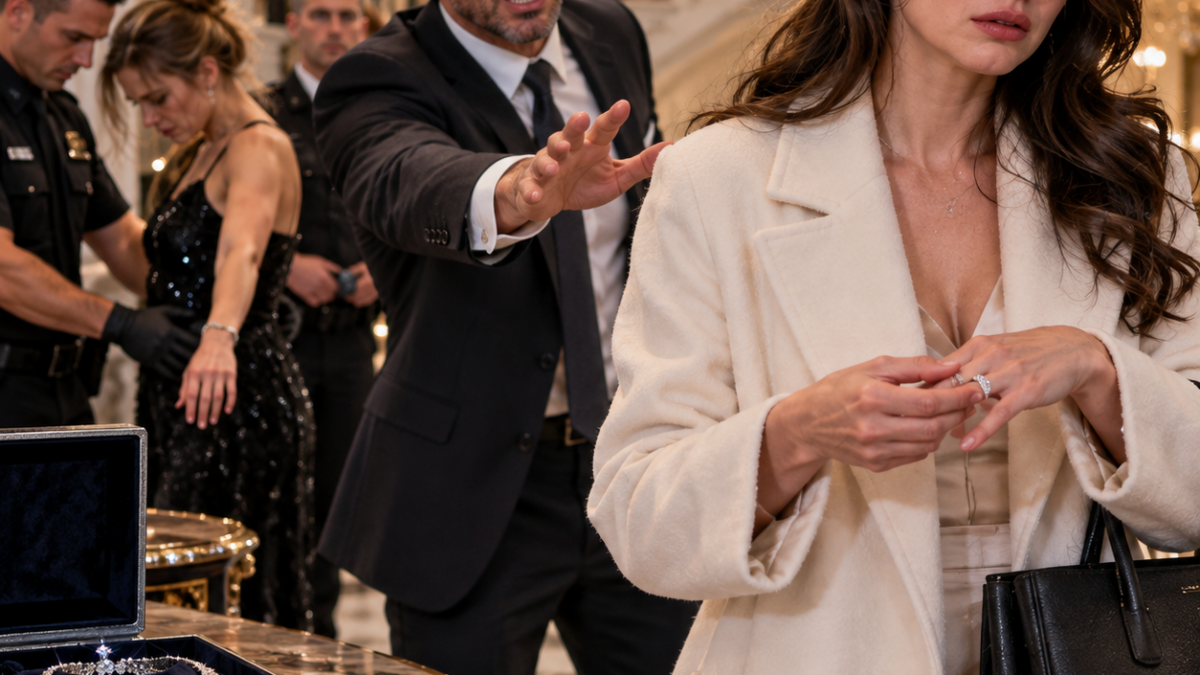
He Had His Wife Searched for $3.2 Million in Missing Diamonds—So She Removed Her Wedding Ring and Walked Out.
My husband stood in the marble foyer of the house we had shared for exactly one year and ordered two of his security men to search my handbag because $3.2 million in family diamonds had vanished from the vault—and the access log showed only my name.
I let them open every pocket, watched them find the anniversary gift I had secretly repaired for him, and then removed every piece of jewelry Dante Caruso had ever given me, including my wedding ring, and placed it on the table between us.
He thought the missing diamonds were the crisis; I knew the real disaster had happened the instant the man who slept beside me decided a photograph and a computer log deserved forty-eight hours of trust that his wife did not.
My name is Julia Hayes.
For one year, legally, I was Julia Caruso.
I never stopped using Hayes professionally.
That had been one of my conditions.
At the time, I thought keeping my own name was the clearest proof that I understood exactly what kind of marriage I had entered.
I was wrong.
The clearest proof came the night I walked out.
But I am getting ahead of myself.
Before Dante, I was a forensic accountant.
Not the exciting kind television invents.
I did not kick down doors.
I did not chase people through airports carrying briefcases full of bearer bonds.
I read.
That was most of the work.
Bank statements.
Corporate filings.
Trust documents.
Grant distributions.
Vendor agreements.
Expense reports.
Tax schedules.
Meeting minutes.
Invoices that looked ordinary until you compared them with another invoice from three years earlier.
Fraud is usually boring until it becomes expensive.
People imagine thieves as men in ski masks.
PART2:
In my experience, the dangerous ones wore expensive shoes, remembered your birthday, and understood exactly which spreadsheet cell nobody would examine because everyone trusted the person who prepared it.
That was how I met Dante Caruso.
His family foundation had hired the firm where I worked to perform an independent review after a disagreement over grant distributions.
The Caruso Family Foundation was enormous.
Old shipping money.
Warehouse property.
Commercial real estate.
Investments.
A private charitable trust established by Dante’s grandfather, Vincent Caruso Sr., who had apparently believed family members were less likely to steal from one another if he made the paperwork sufficiently complicated.
He had been wrong.
Most wealthy families become small governments eventually.
The Carusos had committees.
Voting blocs.
Old grudges.
Uncles who had not spoken in fifteen years but would appear instantly if a trust amendment threatened their percentage.
There was also one peculiar rule.
PART3:
The acting head of the trust had to be married.
Not happily.
Not wisely.
Simply legally married.
Vincent Sr. had written the rule decades earlier because he believed marriage demonstrated “stability.”
I have audited enough marriages to know how funny that sentence is.
When I met Dante, he was forty-one.
Broad-shouldered.
Dark hair beginning to silver near the temples.
The kind of man who entered a room without needing to announce that he controlled it.
He ran the Caruso shipping and logistics businesses.
He also chaired the family trust.
His reputation was difficult to separate from his family’s mythology.
Some people spoke about him as if he owned half of New York Harbor.
Others as if he personally broke the fingers of anyone who paid an invoice late.
The truth was less theatrical.
Mostly.
Dante was disciplined.
Extremely private.
Loyal to people he considered his.
Dangerously unforgiving toward people he did not.
The first time we met, he looked at my audit notes and said:
“You circled six companies.”
“Yes.”
“Why?”
“Because they’re connected.”
“They have different owners.”
“On paper.”
He leaned back.
“What do you think?”
“I think money is moving sideways before it moves out.”
“How much?”
“I don’t know yet.”
“That isn’t useful.”
“It’s more useful than pretending I know.”
His eyes narrowed.
Most powerful men dislike hearing “I don’t know.”
Dante surprised me.
He smiled.
Small.
Almost invisible.
“Good answer.”
The company that bothered me most was Harbor Line Holdings.
Delaware registration.
Generic management services.
Invoices scattered through foundation records.
None enormous enough to trigger an alarm.
Legal consulting.
Property assessment.
Transportation coordination.
Security planning.
A hundred thousand here.
Eighty thousand there.
Amounts designed to look irritating instead of catastrophic.
But they repeated.
Nine years.
Different descriptions.
Same destination.
I marked it in my preliminary report.
Page three.
HARBOR LINE — VERIFY BENEFICIAL CONTROL / RELATED-PARTY RISK.
Then something strange happened.
The registered agent changed.
Paper trail blurred.
Internal records stopped matching public filings.
And access to older foundation archives became suddenly “delayed.”
That was when Dante asked me to dinner.
I assumed he wanted to discuss the audit.
He did.
For twenty minutes.
Then he asked:
“Are you seeing anyone?”
I stared at him.
“That is not an accounting question.”
“No.”
“Then why are you asking?”
“Because I’m interested.”
“In hiring my firm again?”
“In you.”
I laughed.
He did not.
That was the beginning.
Slowly.
Very slowly.
Dante had money.
That never impressed me.
Money makes life easier.
It does not automatically make the person holding it interesting.
What interested me was that he listened.
Actually listened.
If I contradicted him, he did not need to win immediately.
He would go silent.
Consider.
Sometimes come back the next day and say:
“You were right.”
Do you know how rare that is?
Especially in men with buildings named after their grandfathers.
He showed me the parts of himself the public never saw.
He hated opera.
Loved old boxing broadcasts.
Could cook exactly three things.
One of them was terrible.
He read history at night.
He visited his father’s grave every month but never told anyone.
He kept an old wristwatch in his desk drawer that no longer worked.
It had belonged to his father, Vincent Jr.
The first time I asked about it, he shut the drawer.
“Broken.”
“Obviously.”
“Leave it.”
Months later, he told me.
He had been eleven when his mother left.
Not died.
Left.
One night.
Suitcases.
Cash.
Jewelry.
Everything portable from the family safe.
Dante’s father had sat in his study afterward holding that watch.
At 2:17 in the morning, he stopped it.
The hands stayed frozen there for decades.
Dante remembered his father telling him:
“People always take something when they leave.”
Then:
“Go count the safe.”
Eleven years old.
Mother gone.
First lesson:
Loss is theft.
I understood more about Dante after that.
Not everything.
Enough.
We had been seeing each other almost a year when the trust problem became urgent.
His aunt Marisa had begun building a voting bloc.
Marisa Caruso was his father’s older sister.
Elegant.
Sharp.
Sixty-three.
She had been the unofficial administrator of the family foundation for three decades.
She knew every cousin.
Every banker.
Every lawyer.
Every family secret.
She also knew the marriage clause.
Dante’s marriage requirement had not mattered while his previous divorce was still technically within a trust grace period.
Now the grace period was ending.
If he was unmarried, the trustees could remove him.
Marisa had the votes.
One night, Dante came to my apartment.
No flowers.
No ring.
A folder.
He placed it on my table.
“What is that?”
“Proposal.”
I opened it.
Prenuptial agreement.
I stared at him.
“You are the least romantic man alive.”
“Probably.”
“What exactly are you proposing?”
“Marriage.”
“For the trust.”
“Partly.”
I closed the folder.
“Good night, Dante.”
He did not move.
“Julia.”
“I am not marrying you so you can keep a chair at a family table.”
“Then marry me because you love me.”
I looked at him.
That was the first time he had said the word.
Not whispered.
Not dressed up.
Plain.
“I do.”
He continued.
“The trust issue forced the timing.”
“It did not create the feeling.”
“That is not better enough.”
“I know.”
He opened the agreement.
“Your money stays yours.”
“Your work stays yours.”
“Your apartment stays yours.”
“No authority over your accounts.”
“No control over your career.”
“No obligation to participate in family business except what you choose.”
Then he pointed.
“Clause Nine.”
I read.
If either spouse determines the other has ceased to treat them with fundamental respect, that spouse may immediately leave the marital residence and relationship without explanation, financial penalty, or interference.
I looked up.
“You wrote that?”
“My attorney hated it.”
“Smart attorney.”
“I insisted.”
“Why?”
He was quiet.
“Because I know what my family does when it thinks something belongs to us.”
“People aren’t property.”
“I know.”
“Do you?”
“I’m trying to.”
That answer mattered.
I added another condition.
A second vault-camera system.
Independent vendor.
Off-site storage.
No family control.
Dante frowned.
“Why?”
“Because Harbor Line still bothers me.”
“You think the trust is being robbed?”
“I think your foundation’s records have blind spots.”
“My aunt controls administration.”
“I know.”
“You suspect Marisa?”
“I suspect anything nobody wants independently checked.”
He stared.
Then nodded.
“Done.”
Sal Greco, Dante’s security chief, arranged the installation.
Or so I thought.
That detail would matter later.
We married quietly.
No magazine spread.
No hundred-person reception.
White roses.
City hall ceremony.
Dinner afterward.
Dante gave me a simple diamond band.
I gave him nothing expensive.
I told him:
“You already have too many things.”
He said:
“I have one thing I wanted.”
I rolled my eyes.
But I kissed him.
Our first year was not perfect.
No marriage is.
Especially not one with a family trust, security staff, old trauma, and an aunt who looked at me like I had wandered into her house carrying a calculator and bad intentions.
But we were good.
Mostly.
I continued the audit.
Dante did not interfere.
He hated some of my questions.
Still answered.
I learned the rhythm of his house on Staten Island.
Security at front gate.
Tony in the mornings.
Sal at night.
Dante’s study.
The old watch in the drawer.
Sunday dinners I attended twice a month and survived by sitting near the wine.
Marisa tested me constantly.
“Still working, Julia?”
“Yes.”
“Dante can afford to take care of you.”
“I can afford to take care of me.”
Smile.
Another cut later.
“Have you thought about children?”
“Have you thought about boundaries?”
Dante nearly choked on his drink.
I liked him best when he laughed.
Our first anniversary fell on a Sunday.
I had one surprise planned.
The watch.
Months earlier, I had quietly taken it from Dante’s desk after photographing exactly how everything had been arranged.
I brought it to a restoration specialist on Forty-Seventh Street.
The watchmaker warned me.
“It may run.”
“That is the goal.”
“Some people prefer an heirloom frozen.”
“Not him.”
“How do you know?”
“I don’t.”
That was the point.
The repair ticket was in my handbag the Thursday everything collapsed.
So was the card I planned to give him.
YEAR ONE.
LET IT RUN.
I went into the family vault that afternoon at 1:40.
My access code.
My face on the primary camera.
Exactly as the system later showed.
I had filed the vault request Monday.
I needed the 2019 appraisal file for my quarterly audit presentation.
Nothing secret.
Nothing improvised.
The Caruso family vault was absurd.
Jewelry.
Trust documents.
Art certificates.
Private ledgers.
Old bonds.
Family archives.
Among the jewelry was Dante’s grandmother’s diamond set.
Necklace.
Bracelet.
Earrings.
Three-point-two million dollars at the most recent valuation.
The set was inside a monitored case.
When I entered, it was closed.
I did not touch it.
I retrieved the file.
Signed the access sheet.
Left.
At four that afternoon, an appraiser arrived.
The case was empty.
At six, Dante received the alert.
At seven, I walked through our front door.
Dante was waiting.
So were Sal.
Tony.
Marisa.
The silence told me before anyone spoke.
I removed my coat.
“What happened?”
Dante said:
“Put your bag on the table.”
I looked at him.
“Why?”
“My grandmother’s diamonds are gone.”
For one second, the sentence did not connect to me.
Then it did.
The room shifted.
“Okay.”
“Three-point-two million.”
“I know what they’re worth.”
“The case was opened before the appraiser arrived.”
“And?”
“One name on today’s vault log.”
Mine.
I understood immediately.
I also understood something else.
He did not say:
Help me understand.
He said:
Put your bag on the table.
I placed it down.
“Dante.”
“The camera has you going in at one-forty.”
“Yes.”
“I told you at breakfast.”
“I went for the 2019 appraisal file.”
“I filed the request Monday.”
Marisa stood near fireplace.
Her expression was almost sorrowful.
That should have warned me.
Dante asked:
“Was anyone else scheduled?”
“The security technician usually checks the case sensors on appraisal day.”
“Kenny Platt?”
“Yes.”
Sal shook his head.
“Kenny came Tuesday.”
“No.”
I looked at him.
“He was supposed to come today.”
Marisa said softly:
“Julia…”
I turned.
She held out her phone.
A photograph.
Me outside the watch shop on Forty-Seventh Street.
Car door.
Envelope in my hand.
Time stamp from that afternoon.
Whoever had taken it stood across street.
Marisa said:
“This came at six.”
I stared.
“What exactly do you think that proves?”
Dante looked at the photo.
Then at me.
That look.
I will never forget it.
Not anger.
Not certainty.
Suspicion.
That was worse.
“Are you asking me if I stole them?”
His jaw tightened.
“That’s my answer.”
I picked up my bag.
Dante said:
“Julia.”
I turned toward front door.
Marisa said:
“Search it.”
I stopped.
Dante did not immediately object.
That second became the line between before and after.
“Excuse me?”
Marisa looked toward Sal.
“Search the bag.”
Sal looked at Dante.
Not her.
Dante stayed silent.
I smiled.
Not because anything was funny.
Because sometimes humiliation arrives so cleanly your body reaches for the wrong emotion.
“Go ahead, Sal.”
He did not move.
“Julia—”
“It’s not on you.”
I placed the bag back on the table.
Opened it myself.
Wallet.
Keys.
Notebook.
Lip balm.
Audit papers.
Phone charger.
Envelope from watch shop.
Then Sal found the watch.
Wrapped carefully.
Dante stared.
“What is that?”
I took it from Sal.
Set it down.
“Your father’s watch.”
Dante’s face changed.
“That watch has been in my desk for thirty years.”
“Not today.”
I slid the repair ticket across table.
Forty-Seventh Street.
Dated that afternoon.
Then my anniversary card.
YEAR ONE.
LET IT RUN.
Signed J.
For the first time that night, Dante looked ashamed.
Only for a moment.
Then fear won again.
“That explains the photograph.”
“It doesn’t explain the vault.”
No.
It did not.
I could see him thinking.
His mother’s empty safe.
A woman leaving.
Jewelry gone.
Eleven years old.
Go count the safe.
I knew exactly which ghost had walked into our marriage.
And I knew he was choosing the ghost.
I said:
“You installed the backup cameras.”
Dante looked at Sal.
Sal said:
“Off-site archive.”
“Give me forty-eight hours.”
Dante turned.
“What?”
“Backup retrieval can take time if the primary system was altered.”
I stared at my husband.
“Forty-eight hours.”
“You can wait forty-eight hours.”
His voice lowered.
“If those stones are already moving—”
I understood.
He thought delay meant risk.
But what I heard was simpler.
You do not get forty-eight hours of belief.
Marisa said:
“Maybe the jewelry is upstairs.”
That was when I laughed.
“You want them to search my closet too?”
“Julia.”
Dante sounded pained now.
I removed my earrings.
Placed them on the entry table.
He stared.
“Our first Christmas.”
Then the bracelet.
“Your birthday.”
Another necklace.
“The night you finally kissed me.”
“Julia, stop.”
Then my wedding ring.
Everything inside me trembled.
My hand did not.
“This one you put on me yourself.”
I placed it beside the others.
“Everything you might think I took.”
“You can have it back.”
Dante stepped forward.
“You don’t have to do this.”
I looked at him.
“You had two men search your wife in her own front hall.”
His face went white.
“I was protecting the family.”
“No.”
I picked up my bag.
“I guess I’m the only one protecting it from you.”
“Julia.”
I walked toward door.
“You’re not leaving tonight.”
I stopped.
Turned.
“Are you going to stop me?”
Clause Nine.
He knew it.
I knew it.
The entire room knew it.
For the first time, Dante looked afraid.
Not angry.
Afraid.
“No.”
“Good.”
“My lawyer will send separation papers.”
“Julia, please.”
I looked at the jewelry on the table.
“I never wanted your diamonds.”
My voice shook then.
Finally.
“I wanted a husband who would believe me before the proof came in.”
“Even for forty-eight hours.”
I walked out.
The car had been our wedding gift.
Technically Dante’s purchase.
I left the keys.
That meant I made it eleven blocks on foot before I remembered I had no transportation.
New York has a way of humiliating you at useful moments.
I stood at a bus stop in expensive shoes carrying a handbag that had just been searched for stolen diamonds.
Rain had started.
A black sedan pulled near curb.
Marisa’s car.
Window lowered.
“Julia.”
I kept walking.
The car rolled.
“Miss Hayes.”
I stopped.
Not because she used my name.
Because that was when I realized she already knew where I was going.
She stepped out.
Elegant as always.
“I need ten minutes.”
“You’re parked in a bus stop.”
“Julia.”
“If you need ten minutes, call my office and make an appointment.”
Her expression changed.
“You know who I am.”
“I do.”
“That is why I’m surprised nobody taught you how calendars work.”
I walked away.
She followed on foot for half a block.
“Somebody is moving money out of the foundation.”
I stopped.
That was the first interesting thing she said.
I turned.
“Through shell companies.”
“One is Harbor Line.”
Every muscle in me tightened.
Marisa continued.
“Whoever is doing it will make sure blame lands on whoever found it.”
I looked at her.
“And who found it?”
“You.”
The answer came too quickly.
Too neatly.
That was my first clue.
Not proof.
Clue.
Marisa knew Harbor Line mattered.
I had never told her how much.
I said:
“You should go home.”
“Dante needs a wife.”
There it was.
The trust.
“My grandfather’s rule.”
“If he loses you, my people have the votes.”
I stared.
“You think I married him for the trust?”
“No.”
She smiled.
“I think he married you for it.”
I left.
That night I rented a tiny apartment above a bookstore using the only card in my wallet that had always remained solely in my name.
Julia Hayes.
The apartment was empty.
Ugly.
Perfect.
One room.
Kitchenette.
Radiator that sounded like someone trapped inside it.
I signed for six months.
Then opened my laptop.
Because I am many things.
Vindictive is occasionally one of them.
But unfinished work irritates me more.
I had an audit to complete.
If someone had framed me because I found Harbor Line, leaving the Caruso house did not make the numbers disappear.
I stayed up until four.
The missing link was in 2019.
Old foundation file.
The same one I had retrieved from the vault.
Harbor Line’s new registered agent was not new.
The name appeared in a vendor onboarding attachment.
Authorized by—
Marisa Caruso.
I sent my final report to the trust.
Then shut my laptop.
I blocked Dante’s number.
For one night.
At sunrise, I unblocked it.
He did not call.
That hurt more than it should have.
Later I learned why.
At 2:09 p.m. the backup vault footage arrived.
Kenny Platt entered carrying a technician’s toolbox.
2:16.
He left.
Seven minutes.
His access did not exist on primary logs.
Someone had deleted it.
The backup system had not.
Exactly the system I had insisted they install.
Sal showed Dante the footage.
Then the payment trail.
Kenny had a gambling marker.
Sixty thousand dollars.
Paid seven days earlier.
One wire.
Harbor Line Holdings.
Kenny’s apartment was empty.
Phone off.
Mother said he left Thursday night.
Dante finally understood.
The thief had not requested extra cameras.
The person being framed had.
Me.
He called.
I let voicemail take it.
“Julia.”
His voice sounded different.
“I was wrong.”
Pause.
“And I’m going to make sure everyone knows it.”
“You don’t have to call me back.”
I listened twice.
Did not respond.
Because “I was wrong” is important.
It is not restoration.
The next move mattered more.
Dante could have handled Harbor Line privately.
That was what the Caruso family did.
Problems stayed in the family.
Lawyers.
Payments.
Resignations.
Silence.
Instead, he sent the footage, my report, and the financial trail to the district attorney.
No request for discretion.
No family protection.
No special treatment.
At the next trust meeting, Marisa tried to take control.
“This family has had a difficult month.”
She stood at the head of the table.
“Until Dante’s domestic situation is settled, I propose—”
Dante interrupted.
“No.”
Every trustee looked at him.
He stood.
“I have something to say before any vote.”
Marisa smiled tightly.
“This is not the time.”
“It became the time when I made my marriage public in front of employees.”
Then he said the words that later traveled through the family faster than any scandal.
“I accused my wife of stealing.”
No euphemism.
No “misunderstanding.”
No “concern.”
“I had her searched in our front hall.”
“I let a photograph speak louder than the woman standing in front of me.”
“Julia stole nothing.”
“I was wrong.”
Marisa objected.
“Dante, that is between you and Julia.”
“No.”
He looked around the table.
“It stopped being private when I humiliated her in front of people who work for this family.”
Then he put the evidence on the screen.
2:09.
Kenny.
Harbor Line wire.
My audit.
Page three from fourteen months earlier.
HARBOR LINE.
Circled.
Marisa’s authorization.
The DA warrant followed.
A Red Hook storage unit.
Inside:
Dante’s grandmother’s diamonds.
Every piece.
And a second set of books.
Eleven million dollars diverted over nine years.
Money intended for a women’s shelter.
A pediatric ward.
Education grants.
Harbor Line had been draining the foundation slowly.
Marisa had orchestrated it.
She had also paid for a private investigator.
His reports contained photographs of me.
My schedule.
The watch repair.
My Monday vault request.
She knew the appraiser would be there Thursday.
She knew Kenny could access sensors.
She knew my name would be the only visible entry.
It was not brilliant.
It did not need to be.
It only needed Dante to be afraid enough to believe the wrong story.
He was.
That was the ugliest part.
Marisa understood his wound better than I did.
She knew exactly which memory to touch.
Woman.
Jewelry.
Leaving.
His mother.
The empty safe.
At the trust meeting, Marisa looked at him and said:
“She was never one of us.”
Dante answered:
“You’re right.”
Then:
“She was the only one of us watching the books.”
He removed Marisa from the trust.
Refused to shield her from prosecution.
One trustee asked:
“You would hand your own blood to the DA?”
Dante said:
“I handed my wife to two bodyguards.”
“This is the least I owe her.”
Then he did something I never expected.
He gave up the trust chair.
The position he had married partly to keep.
He proposed an outside fiduciary.
Independent.
No Caruso surname.
No blood requirement controlling charitable money.
Marisa had been right about one thing.
Our marriage had started, partly, as an arrangement.
Dante destroyed the arrangement himself.
Tony came to see me three days later.
He had worked for Dante’s father for twenty-two years.
Large man.
Broken nose.
A wrist injury I had once insisted he get treated after I noticed him compensating while carrying boxes.
He stood in the bookstore downstairs holding an envelope.
“Mrs. Caruso.”
“Julia.”
He nodded.
“Julia.”
“I didn’t want a lawyer bringing this.”
I took the envelope.
Inside was a letter from Dante.
Not flowers.
Not jewelry.
A letter.
I was more afraid of trusting you than of losing you.
I got the price wrong.
That line hurt.
Tony said:
“Yesterday he stood in front of the whole family and said he was wrong.”
“Good.”
“I never heard a Caruso say that before.”
“That is a low bar.”
Tony almost smiled.
“He gave up the chair.”
“I know.”
“He married you for that chair.”
“Partly.”
“I know.”
I folded the letter.
“Anything you want me to tell him?”
“Tell him I read it.”
Tony nodded.
Then I noticed his wrist.
“How is it?”
“Fine.”
“You’re not wearing the brace.”
He looked guilty.
“Wear it.”
He smiled.
“I’ll tell him you said hello.”
“I did not.”
“No, ma’am.”
Three weeks later, Marisa came to the bookstore.
Not upstairs.
She waited until closing.
The owner called me down.
Marisa stood near register.
No security.
No pearls.
No immaculate confidence.
Just a woman whose accounts had been frozen.
“The DA wants me.”
“Yes.”
“You can stop this.”
“No.”
“Dante listens to you.”
“He used to.”
“Tell him to keep it inside the family.”
I stared.
“You told my husband I was a thief.”
“I protected my interests.”
“You broke my marriage.”
Her mouth tightened.
“It already had cracks.”
That landed because it was true.
“It did.”
I stepped closer.
“And you stuck your fingers in and pulled.”
She looked past me toward stairs.
“If you refuse to help me, you’ll never step inside that house again.”
I laughed.
Softly.
“When I walked out of that house, I did not take a thing.”
“Not jewelry.”
“Not the car.”
“Not money.”
“All I ever wanted inside it was respect.”
I opened the bookstore door.
“You think a locked door scares me?”
She stared.
“Good night, Marisa.”
For three months, I stayed gone.
Dante sent nothing expensive.
That surprised me.
No jewelry.
No car.
No apartment.
No check.
The settlement his lawyers proposed was generous.
I returned most of it.
I kept exactly one-third of the amount allocated for professional compensation.
With a note:
For one year auditing your trust.
That third I earned.
Dante did not argue.
He did not send another offer.
That mattered.
Marisa was indicted.
The diamonds were recovered.
Several foundation accounts were frozen and reconstructed.
Independent trustees came in.
Kenny Platt disappeared.
For a while.
Then Sal found him in Philadelphia.
Kenny wanted to cooperate with prosecutors.
He was terrified.
Not of the DA.
Of the people who had helped move Marisa’s money.
He had one condition.
Dante’s personal word that nobody would touch him before he was delivered safely to authorities.
Sal offered to handle it.
Dante said:
“He asked for my word.”
So Dante went to Red Hook.
In person.
That was stupid.
Brave.
Possibly both.
Marisa’s remaining people intercepted the car near the pier.
Not a cinematic gun battle.
A violent collision.
Two men.
One had a weapon.
Dante put himself between Kenny and them long enough for the DA team nearby to intervene.
Tony took cuts and bruises.
Dante’s shoulder was badly injured.
Kenny was untouched.
The prosecution got him.
I received the call from Sal.
“Mrs. Caruso.”
I nearly hung up at the name.
Then heard his voice.
“He’s been hurt.”
“How badly?”
“Shoulder.”
“He’s awake.”
“St. Agnes.”
I hated how quickly my body reacted.
My coat was on before my mind made a decision.
At the hospital, Dante looked terrible.
Bandage large enough to make subtlety impossible.
He smiled when I walked in.
“That is not nothing.”
He glanced at the bandage.
“I’ve had worse.”
“That is not comforting.”
“Okay.”
I stared.
“Since when do you say okay that quickly?”
“Since I figured out that when I argue with you, I’m usually the one who is wrong.”
I almost smiled.
Almost.
Then I remembered why we were there.
“I did not come because I forgive you.”
His expression settled.
“I know.”
“I came because Sal said you were hurt.”
“I know.”
“I miss you,” he said.
I closed my eyes.
“Missing me does not change what happened.”
“No.”
“You made me a stranger in my own front hall.”
“Yes.”
“You looked at me like I might rob you.”
“Yes.”
“You believed a photograph before you believed your wife.”
“Yes.”
Every yes hurt.
But he did not defend himself.
That mattered too.
“I don’t know whether I can trust you again.”
He looked at me.
“Then don’t promise me you will.”
I said nothing.
“Let me spend however long it takes proving your trust matters more than my pride.”
“That doesn’t guarantee I come back.”
“I know.”
“Will I see you again?” he asked.
I stood.
“I don’t know.”
His eyes dropped.
Then he nodded.
“Thank you for not lying to me.”
That sentence stayed.
Six months after I walked out, Dante drove across the bridge to my neighborhood carrying coffee.
No security car.
No flowers.
He stood outside bookstore.
I was shelving new releases.
The owner called upstairs.
“Your husband is here.”
“Technically.”
“Whatever he is, he brought coffee.”
I came down.
Dante looked tired.
Healthier.
His shoulder still stiff.
“You drove here for coffee?”
“To bring coffee.”
“Expensive delivery.”
“I hoped you’d let me sit for five minutes.”
“It’s been six months.”
“Six months and four days.”
Of course he knew.
We sat.
He gave me a folder.
I immediately frowned.
“This is how you proposed the first time.”
“I know.”
“Bad start.”
“It isn’t a prenup.”
I opened it.
Every marital financial right Clause Nine or any other provision gave Dante over my money, work, residence, or property had been formally waived.
Signed.
Not contingent on reconciliation.
Not contingent on divorce.
Permanent.
I looked at him.
“What is this?”
“Choice.”
“If you ever come back, it has nothing to do with the trust.”
“The trust isn’t mine anymore.”
“I know.”
“It has nothing to do with money.”
“Or this house.”
“You can leave whenever you want.”
“I should always have understood that.”
My throat tightened.
“And if I never come back?”
Dante looked at his coffee.
“Then I hope you build a life that makes you happy.”
That was the first moment I believed he might actually have changed.
Not because he wanted me.
He always wanted me.
Because he had finally stopped treating wanting me like a claim.
I said:
“I miss you too.”
His eyes lifted.
“That does not mean I’m ready.”
“I know.”
“Thursday.”
“What?”
“Dinner.”
He smiled.
“One dinner.”
“No men at the next table.”
“Deal.”
We started again.
Slowly.
Dinners.
Coffee.
Walks.
Therapy.
Yes.
Therapy.
Dante hated it.
I made that a condition.
Not couples therapy first.
His own.
He needed to sit in a room and understand why an eleven-year-old boy was still counting safes inside a forty-two-year-old man.
He went.
Every week.
No complaints.
At least not to me.
I went too.
Because I had my own habits.
I had learned how to leave before asking for repair.
How to become self-sufficient enough that needing someone felt dangerous.
How to call detachment strength.
We were not opposites.
We were two people with different escape routes.
Dante controlled.
I withdrew.
Both can destroy a marriage if left unexamined.
Winter arrived.
First snow.
Dante came to the bookstore with white roses.
Same flowers from our wedding.
No diamonds.
No bracelet.
Nothing that could be appraised.
I laughed.
“Learning.”
He nodded.
“Slowly.”
One night over dinner, I said:
“The night I left, I was eleven blocks away before I remembered I had given you the car keys.”
Dante stared at his plate.
“I sat in my study with your ring until sunrise.”
“You almost lost me.”
“I know.”
“I love you.”
His eyes closed briefly.
“But I will never be a woman who stays because she is afraid to leave.”
“I don’t want you to be.”
“If we do this again, it cannot be the old marriage.”
“It won’t.”
“That is a promise.”
“Yes.”
“I don’t trust promises.”
He looked at me.
“Then don’t.”
“What?”
“Don’t trust the promise.”
“Trust what I do after.”
That was a better answer.
One year after I walked out, Dante asked me to meet him at the house.
Not move back.
Just come.
The foyer looked exactly as it had the night everything ended.
Same marble.
Same table.
I hated the table.
He knew.
He stood beside it.
In his hand was my wedding ring.
“I kept it.”
I said nothing.
“Every night for months, I looked at it and asked myself how I could be certain about everything else and still doubt the one person who mattered most.”
I crossed my arms.
“I don’t deserve another chance because I want one.”
“No.”
He smiled sadly.
“You don’t.”
That surprised him.
Then I continued.
“But you worked for it.”
He breathed out.
I did not put the ring on.
Not yet.
He asked:
“Marry me again.”
I almost laughed.
“We never divorced.”
“I know.”
“I want vows anyway.”
“Not for the trust?”
“I don’t run it.”
“Not for the family?”
“I don’t care what they vote.”
“Not for the house?”
“It is just a house.”
I looked at him.
“One condition.”
“Clause Nine stays.”
“Of course.”
“And we add another.”
He waited.
“You stop looking for reasons not to believe me.”
His face tightened.
“Never again.”
“No.”
I shook my head.
“Don’t say never.”
“That’s fear talking.”
“Say what you will do when you are afraid.”
He understood.
Slowly.
“When I am afraid, I tell you.”
“When I’m angry, I listen before I act.”
“When evidence and you seem to disagree, I ask questions before I decide which one I understand.”
I nodded.
“Better.”
“And you?”
“When I want to leave, I tell you why before I disappear.”
He smiled faintly.
“Clause Nine says no explanation required.”
“Clause Nine protects the right.”
“It doesn’t require me to use it badly.”
We married again.
Same legal marriage.
New vows.
Small.
White roses.
Tony wore his wrist brace because I threatened him.
Sal pretended not to cry.
He failed.
Dante wore his father’s watch.
Running.
That mattered.
At our second ceremony, he said:
“I spent most of my life thinking love meant protecting what was mine.”
Then looked directly at me.
“You taught me love means protecting another person’s right to remain themselves, even when that means they can walk away from you.”
I did not cry.
Much.
Later that night, back in the house, I stood in the foyer.
Dante joined me.
“What are you thinking about?”
“The worst night of my life.”
He looked toward the table.
“I used to think this house was everything I built.”
“It’s a nice house.”
He laughed.
“That wasn’t the point.”
“No.”
He took my hand.
“I know now it’s just a house.”
I asked:
“Then what makes it home?”
He did not hesitate.
“The woman who walked out that door the night I forgot how to love her.”
My throat tightened.
Then he added:
“And chose to walk back in.”
I looked at him.
“No.”
His face changed.
“No?”
“That’s not the whole answer.”
I squeezed his hand.
“What makes it home is that if I ever walk out again, you know I am still a person when I cross the threshold.”
He nodded.
“That too.”
That was the difference.
I did not return because Dante solved a crime.
I did not return because he recovered the diamonds.
Or because Marisa was indicted.
Or because he surrendered the trust chair.
Or because he was hurt protecting Kenny.
Those things mattered.
But none bought forgiveness.
Dante learned the lesson I wish more people understood.
You cannot repair humiliation by offering enough money.
You cannot buy trust after treating someone like a suspect.
You cannot call control protection just because your fear feels justified.
And apologies become meaningful only when the person who was hurt can say no without being punished for it.
The diamonds were worth $3.2 million.
The auditors recovered another $11 million in stolen charitable funds.
Those were the numbers newspapers cared about.
The number I remember is forty-eight.
Forty-eight hours.
That was all Sal asked for.
Forty-eight hours to retrieve the backup footage.
Forty-eight hours for proof.
Dante had spent a year telling me he trusted me.
Then fear entered the room, and forty-eight hours became too expensive.
That is how fragile words can be.
It took him more than a year of actions to earn back what he had thrown away in minutes.
I am glad it did.
Some things should be expensive to repair.
The old Caruso trust still exists.
But nobody named Caruso controls it alone anymore.
Independent trustees.
External audits.
Dual authorization.
Actual governance.
Marisa eventually stood trial.
Kenny testified.
Harbor Line collapsed under its own records.
The diamonds returned to the family vault.
Dante refused to wear or display any piece from the set.
Once, years later, someone asked why.
He said:
“Too expensive.”
The man laughed.
Dante did not.
He wasn’t talking about money.
His father’s watch still runs.
Every anniversary, I tease him about how many times he checks it.
He says:
“Making up for thirty years.”
Sometimes I catch him staring at it.
I know what he remembers.
His mother.
His father.
An empty safe.
A frozen second hand.
But memories can change jobs.
They do not have to disappear.
Sometimes they stop being instructions.
Dante’s childhood taught him:
People always take something when they leave.
Our marriage taught him something else.
Sometimes the person leaving is the one who leaves everything behind.
The ring.
The jewelry.
The car.
The house.
The money.
Not because she wants nothing.
Because the thing she wanted cannot be carried out in a bag.
Respect.
Belief.
Trust.
And sometimes, if you are very lucky, the person you wronged gives you the chance to earn those things again.
Not because you deserve it.
Because they choose it.
That is the word Dante finally learned.
Choose.
Not own.
Not keep.
Not protect.
Choose.
And be chosen.
Every day.




