For Five Years, an Old Shelter Cat Gave His Only Blue Toy Mouse to Every Frightened Kitten—Then One Tiny Kitten Arrived, and Moka Did Something He Had Never Done Before.
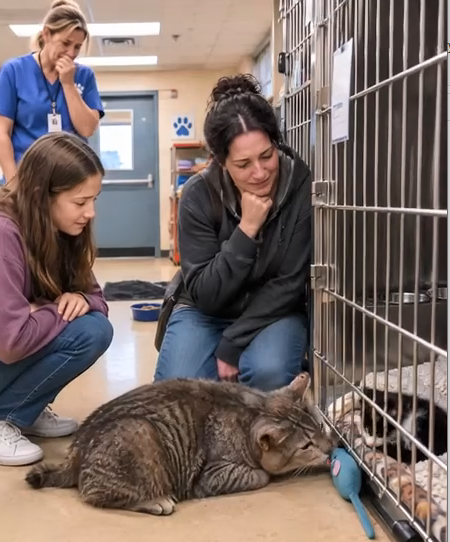
PART3:
Always.
Yet there it was.
Directly in front of Cage 9.
Not dropped in the aisle.
Not near the cleaning cart.
Placed with its nose touching the metal door.
Cage 9 held a tiny orange kitten brought in the night before.
She had been found beneath a parked car outside a grocery store.
Motor oil stained her paws.
She shook so badly the animal control carrier trembled in the officer’s hands.
She hissed whenever anyone looked directly at her.
Wouldn’t eat.
Wouldn’t drink.
Wouldn’t accept a warm towel.
She had pushed herself into the back corner and made her body almost flat.
The message was clear.
Do not see me.
Seeing me is dangerous.
Now Moka’s blue mouse waited outside her door.
I looked across the room.
Cage 14.
Moka sat exactly as he always sat.
Old brown tabby.
Gray across his muzzle.
One torn ear.
Cloudy green eyes.
Hips stiff with arthritis even then.
His front paws were tucked beneath his chest.
His fleece blanket was bunched behind him.
Breakfast untouched.
He looked at me.
I looked at him.
Then the mouse.
“Moka.”
Slow blink.
“What did you do?”
Another slow blink.
That was all.
I asked Marla.
She had not moved it.
Night staff hadn’t either.
Nobody even knew it was missing.
At noon, the orange kitten pulled the mouse through the bars.
She dragged it into the corner.
Tucked it beneath her chin.
By evening, she ate two bites of wet food.
The next morning, the blue mouse was back under Moka’s paws.
I never saw him retrieve it.
The old security camera had one blind spot near senior cages.
Moka somehow understood it better than we did.
A few weeks later, it happened again.
A gray kitten came in from a storm drain.
He didn’t hiss.
He didn’t cry.
He sat with eyes too wide and watched every person as if waiting for the next bad thing.
Morning came.
Blue mouse outside his cage.
By then I started paying attention.
Moka had a system.
He never chose the kittens who screamed for attention.
He passed the ones bouncing at doors.
Passed kittens reaching paws through bars.
Passed young cats meowing at visitors.
He stopped for the silent ones.
The ones pressed into corners.
The ones who stopped eating.
The ones who looked as though they had already learned the most dangerous lesson an abandoned animal can learn:
Don’t expect anyone to come.
He waited until the room was quiet.
Usually late afternoon.
After food bowls had been washed.
After floor mopping.
When dryers hummed in back.
When volunteers were distracted with paperwork.
Then Moka would stand.
Slowly.
His back legs were stiff.
He never cried from pain.
Never complained.
He gathered himself one paw at a time.
Picked the blue mouse up in his mouth.
Walked down the row.
Set it outside the frightened kitten’s cage.
Then turned around.
Back to Cage 14.
No audience.
No reward.
No proud meow.
He never sat around watching to see if the kitten liked it.
He gave comfort and left.
Like he understood that frightened things sometimes need kindness without witnesses.
Maybe I am giving an old cat too much philosophy.
I know that.
I work around animals.
I know the danger of turning instinct into poetry because humans need meaning.
But I also know what I saw.
Again.
And again.
And again.
Five years.
Moka came to Willow Creek before I did.
His intake paperwork was painfully small for a whole life.
OWNER ENTERED ASSISTED LIVING.
SENIOR CAT.
BROWN TABBY.
NAME: MOKA.
He arrived with two things.
A faded fleece blanket.
And the blue mouse.
The woman surrendering him had cried.
That was all anyone remembered.
Moka did not cry.
He didn’t fight.
Didn’t swat.
Didn’t stop eating completely.
He simply folded himself into Cage 14.
And waited.
Visitors passed him for years.
They wanted kittens.
Or young cats.
Or playful cats.
Or cats whose eyes were clear.
Cats who reached through bars.
Cats who performed.
Moka never sold himself.
That was the phrase Marla used once.
“Some cats are salesmen.”
Moka wasn’t.
He watched people.
If someone sat beside him quietly, he might move closer.
If someone pushed fingers through bars too quickly, he turned away.
He hated being picked up.
Loved warm food.
Loved low voices.
Liked a hand resting near him more than a hand touching him.
And every night he slept with the blue mouse beneath one paw.
The last proof of another life.
We repaired it carefully.
No hard plastic.
No loose threads.
No stuffing accessible.
We tried replacing it once with a new blue mouse.
Moka sniffed it.
Walked away.
It had to be that one.
The first thing he gave away.
The only thing he always brought back.
Then Popper arrived.
He was black and white.
Tiny enough to look unfinished.
His head seemed too large.
Ribs sharp under fur.
He had been left in a cardboard box behind a closed diner.
No note.
No blanket.
No mother.
Nothing.
I had seen scared kittens.
Angry kittens.
Feral kittens.
Sick kittens who attacked anything reaching toward them.
Popper frightened me more.
Because Popper did nothing.
No hiss.
No swat.
No crying.
He curled beside the litter box and stared at nothing.
When I opened his cage, he didn’t move.
Warmed food?
Nothing.
Chicken broth?
Nothing.
A soft toothbrush rubbed gently against his cheek to mimic grooming?
Nothing.
His breathing was so shallow I watched his ribs to make sure they still moved.
Marla stood beside me that afternoon.
“He’s shut down.”
“I know.”
“Dr. Sato?”
“Wants fluids if he won’t take anything orally by tonight.”
I looked across the room.
Cage 14.
Moka was awake.
Blue mouse beneath one paw.
His eyes were fixed on Popper.
“I know,” I whispered.
“He needs it.”
Moka kept watching.
That night I checked him before leaving.
“Goodnight, old man.”
He stared past me toward Popper.
The next morning Cage 14 was empty.
For one terrible second, I forgot how to breathe.
The door was closed.
Blanket inside.
Food untouched.
Mouse gone.
My rescue brain went immediately to the worst possibility.
Old cat.
Weak hips.
Empty cage.
Night shift.
Something final.
“Moka?”
Then I saw him.
On the floor beside Popper’s cage.
Lying there.
Not dropping off the mouse.
Not walking back.
His old body was pressed against the bars.
His nose was inches from Popper’s.
The blue mouse sat between them.
Inside the cage, Popper was sleeping.
Actually sleeping.
Not curled beside the litter box with his muscles tight.
Not hiding.
His body was loose.
His face rested near the bars.
Moka lay on the other side.
I stood in the aisle and cried.
For five years, Moka always brought the mouse back.
For five years, comfort had been something he loaned.
This time he stayed.
That was different.
Marla found me.
Saw tears.
Her face went white.
“Oh God. Moka?”
I pointed.
She looked.
“Oh.”
Then she started crying too.
She claimed dust.
There was no dust.
“How did he get out?”
“No idea.”
Moka looked at us.
Not guilty.
Not proud.
Simply present.
Popper woke.
Lifted his head.
Moka did not move.
The kitten slowly pressed his nose between the bars.
Moka touched his nose back.
That was the first thing Popper responded to.
Technically, Moka should have been returned to his cage immediately.
Sanitation.
Safety.
Supervision.
Rescue regulations exist because good intentions can still hurt animals.
But Marla crouched beside me.
“If anyone asks…”
“He is supervised.”
“By whom?”
I pointed at Moka.
“Senior staff.”
She laughed.
We left him there another fifteen minutes.
Then we moved them into the small playroom together under supervision.
Popper crawled directly under Moka’s chest.
Moka tolerated it.
He did not groom him immediately.
Didn’t become some magical foster mother.
He just stayed.
Popper needed someone to stay.
That was enough.
Healing took time.
I hate animal stories where love cures trauma overnight.
That makes suffering too small.
Popper did not suddenly become playful.
First he ate one bite.
Then three.
Then half a teaspoon off my finger.
He stopped sleeping beside the litter box.
He began sleeping near the front of the cage where he could see Moka.
During playroom time, he walked straight to Moka.
If Moka changed position, Popper moved too.
If a door slammed, Popper ran beneath Moka’s chin.
If Moka ate, Popper watched.
Then ate.
Moka changed too.
That surprised me more.
He started finishing meals.
He lifted his head when volunteers entered.
His purr became loud.
For years he had looked like a cat trying not to disappear too loudly.
Now he had purpose.
Popper needed him.
And Moka, after five years of being passed over, needed to be needed.
The blue mouse stayed between them.
Always.
Then, one Saturday, a couple came in.
Diane and Cal.
Both in their sixties.
Maybe early seventies.
Diane had short silver-brown hair and kind eyes.
Cal wore flannel and spoke like a man who thought listening was more useful than filling silence.
Diane asked:
“Do you have a cat who’s been here the longest?”
I almost dropped the clipboard.
“Yes.”
No hesitation.
“His name is Moka.”
I led them to Cage 14.
Moka was resting.
Popper had somehow draped himself across Moka’s back.
The blue mouse sat between their paws.
I began my speech.
“Moka is a senior.”
“He has arthritis.”
“He may need dental work.”
“He doesn’t like being picked up.”
“Popper is extremely shy.”
“They’ve become bonded, but—”
Diane lifted one hand.
“They shouldn’t be separated.”
I stopped.
Cal crouched.
Popper opened one eye and pushed closer into Moka.
Cal said:
“Well.”
“Looks like there are two cats who’ve been here the longest.”
I had to turn away.
The adoption process took time.
Senior cat.
Shy kitten.
Home inspection.
Medical disclosures.
Bonded placement.
Trial.
Diane and Cal complained about none of it.
They never asked:
“How many years does Moka have?”
Instead Diane asked:
“What makes him comfortable?”
Cal asked:
“Where does Popper hide when he’s afraid?”
Those were the right questions.
The day they left, everyone at the rescue found an excuse to be near the front desk.
Moka rode in a soft carrier lined with his old fleece blanket.
Popper’s carrier sat pressed beside it.
The blue mouse had to remain visible between the bars or Moka refused to settle.
I crouched.
“You did good, old man.”
Slow blink.
Popper watched from darkness.
Diane promised pictures.
Cal lifted both carriers like sleeping children.
The front bell rang.
Then Cage 14 was empty.
I stood there longer than I should have.
The cat room sounded wrong.
Not quiet.
Not loud.
Missing.
Two weeks later, a printed photograph arrived.
Not text.
Not email.
Paper.
Diane said something about Moka deserved paper.
He was asleep in a sunbeam on an old armchair.
Popper curled into his side.
One black-and-white paw draped over him.
Blue mouse between them.
On the back Diane wrote:
For five years, Moka taught scared kittens they were safe.
Now we just want him to know he is, too.
I taped it above Cage 14.
That should have been the end.
It wasn’t.
Two weeks later, a woman walked into Willow Creek and told us Moka should never have been adopted.
Her name was Judith Harper.
Late fifties.
Pressed blouse.
Neat hair.
Brown purse.
Beside her stood her son, Aaron.
He looked like he wished to disappear into the floor.
Judith pointed toward the photograph.
“That cat.”
My stomach tightened.
“Moka?”
“No.”
She said it firmly.
“His name is Benjamin.”
The rescue seemed to stop.
She opened her purse.
Pulled out photographs.
Older Moka.
Young.
On a floral couch.
Beside a Christmas tree.
Curled in the lap of a white-haired elderly woman.
And in almost every picture—
The blue mouse.
Judith touched one photograph.
“That was my mother’s cat.”
“She called him Benjamin.”
“Benny Boy when nobody else was around.”
My throat tightened.
Marla came beside me.
“Our records say his owner entered assisted living.”
“She did.”
“And then she died two months later.”
Judith’s voice stayed controlled.
Some grief gets quieter the deeper it goes.
She continued:
“I was told the rescue would call family before placing him.”
Marla checked file.
No note.
Judith produced a handwritten paper.
Shaky writing.
My cat Benjamin is to stay safe. If he cannot stay with me, please let my family decide.
Safe.
That word again.
Judith’s mother, Evelyn Harper—Evie—had broken a hip.
Assisted living became permanent.
Family overwhelmed.
Insurance.
House.
Medical decisions.
Funeral planning that came sooner than expected.
Judith thought Benjamin was temporary.
Somewhere in that mess, communication failed.
Five years.
Nobody called her.
She never called us.
Maybe she thought somebody else had.
Maybe she couldn’t bear another responsibility.
Maybe grief swallowed time.
None of those explanations made what happened simple.
“I want him back,” she said.
Marla stayed calm.
“He’s legally adopted.”
“Undo it.”
Aaron looked at his mother.
“Mom.”
“He belonged to Grandma.”
“I know.”
“He belongs with family.”
There it was.
The sentence that split everybody.
He belongs with family.
Part of me understood.
History matters.
Names matter.
A dying woman’s wish matters.
But I had watched Moka spend five years behind bars.
I watched him give away the only thing he had.
I watched him finally sleep in sunlight.
Now someone wanted to move him because of a promise nobody found in time.
Marla said:
“We cannot remove a legally adopted animal without cause.”
“There is cause.”
“We will review.”
“I don’t want review.”
“I want my mother’s cat.”
Aaron finally asked:
“Can we find out how he is?”
Judith looked at him.
“He’d be better with us.”
But I heard something in her voice.
Fear.
Not cruelty.
Not entitlement.
Fear that said:
My mother is dead.
This cat is something she touched.
Something she loved.
Maybe if I get him back, I have not lost everything.
That’s when I understood there was no villain.
I almost wished there was.
Villains make choices easier.
Marla called Diane and Cal.
Diane cried.
Cal asked legal questions.
Nobody blamed them.
They had done everything right.
That evening volunteers argued.
Family should get him.
Family had five years.
Moka is old.
Moving him is cruel.
Promises matter.
Popper might collapse without him.
Moka would adjust.
Maybe Popper would too.
Legal is legal.
Legal isn’t always right.
The real question became:
What happens when kindness toward one heart might break another?
I didn’t sleep.
I kept seeing Moka outside Popper’s cage.
Five years he always brought the mouse back.
Until one kitten needed more than a toy.
Then he stayed.
A few days later, Diane came to the rescue alone.
Her eyes were swollen.
She carried the blue mouse in a clear bag.
I thought Moka had died.
She saw my face.
“No.”
“He’s okay.”
“Both of them.”
I breathed.
She handed us the bag.
A note attached:
Moka carried this to Popper again last night.
Diane cried.
“They eat together.”
“Sleep together.”
“Popper won’t come out unless Moka does first.”
“And now I’m supposed to decide whether somebody else’s grief matters more than their bond.”
Nobody answered.
There was no answer.
She looked at me.
“You knew him longest.”
I shook my head.
“I knew him in a cage.”
She stared.
Then nodded.
“That’s what Cal said.”
“What?”
“He said maybe we don’t own the happy ending just because we got to be there when it happened.”
I hated how good they were.
It would have been easier if Diane and Cal were selfish.
It would have been easier if Judith was cruel.
Life didn’t offer us that kindness.
Marla arranged a meeting.
Neutral visiting room at the rescue.
Moka and Popper came with Diane and Cal.
Judith came with Aaron.
No promises.
No pressure.
We put Moka’s fleece blanket on rug.
Low table.
Water.
Quiet.
Moka stepped from carrier slowly.
Old.
Stiff.
Cal opened Popper’s carrier.
Popper shot straight under Moka.
Everyone saw.
Nobody could unsee it.
Moka lowered his head and touched Popper’s forehead.
One tiny gesture.
Choice.
Judith sat very still.
Then whispered:
“That’s not Benjamin.”
At first I thought she meant name.
Then:
“My mother’s Benjamin hid from everyone.”
“He only came out for Mom.”
“He never took care of anyone.”
Moka lay down.
Popper pressed into him.
Mouse between them.
Judith looked at the toy and finally broke.
“I didn’t visit her enough.”
Her hand covered her mouth.
“I kept saying I was busy.”
“She had nurses.”
“She had activities.”
“She had people.”
Her voice collapsed.
“But she had him.”
“And then she didn’t.”
That was the real thing.
Not only the cat.
Guilt.
Guilt wears costumes.
Anger.
Control.
Family rights.
Promises.
But underneath it often says:
Please let me change something about the past.
Diane moved beside Judith.
I expected her to defend herself.
She didn’t.
She said:
“Tell me about your mother.”
Judith stared.
Diane nodded toward Moka.
“What did she call him when nobody else was around?”
“Benny Boy.”
Diane smiled through tears.
“Benny Boy.”
Moka’s torn ear twitched.
Everyone froze.
Again.
“Benny Boy.”
He lifted his head.
Just a little.
Judith made a sound I still remember.
She sat on the floor.
Did not reach.
“Hi, Benny.”
Moka watched.
Her hand rested open.
He didn’t come.
Didn’t run.
That mattered.
They stayed like that.
Then Popper did something nobody expected.
The kitten stood.
Pushed the blue mouse forward with one paw.
Barely an inch.
Judith laughed through tears.
“Is he giving it to me?”
I looked at Moka.
The old cat put his chin down.
“No.”
“I think he’s sharing.”
That changed everything.
Not solved.
Changed.
Marla proposed the only plan that felt like it belonged to Moka rather than adults.
Moka and Popper would remain with Diane and Cal.
Judith would get updates.
Visits, only if Moka tolerated them.
No moving him.
No pressure.
Judith asked:
“Can I send something of Mom’s?”
Diane answered immediately.
“Yes.”
A week later, Diane received a piece of floral fabric from the couch in old photos.
Judith included a note.
His name was Benjamin when he was hers.
Thank you for letting him be Moka when he became yours.
Diane sent me a picture.
Moka asleep.
Floral fabric under one paw.
Popper against him.
Blue mouse resting on top.
I printed it.
Taped it beneath the first photo.
Over time, Moka changed the rescue even after leaving.
People stopped longer near senior cages.
One couple came for a kitten and left with a twelve-year-old calico.
A widower adopted a gray cat with bad teeth and a crooked tail.
A mother and teenage son came three Saturdays in a row to sit near an old black cat who didn’t trust hands yet.
Cage 14 stayed empty longer than necessary.
Marla said supplies.
Nobody believed her.
We all looked toward it when frightened kittens arrived.
Out of habit.
Moka was home.
Popper grew.
Never large.
But healthy.
Glossy fur.
Bright eyes.
Where Moka went, Popper followed.
Armchair.
Water dish.
Porch.
Cal called him Moka’s bodyguard.
“Not a useful one,” he added.
Moka slowed.
Some days his rear legs wobbled.
Some days he ate only if Cal held plate.
Some days he slept so deeply Popper tapped his face until he blinked.
But he was comfortable.
Loved.
Known.
There is a difference between keeping something alive and allowing it to live.
Moka was living.
In sunlight.
Warm blankets.
The sound of Popper’s paws following him room to room.
Judith visited twice that winter.
First time, Moka stayed on Diane’s lap.
Judith sat on floor and talked about Evie.
“Mom hummed when she folded towels.”
“Do you remember?”
“She called you the only man in the house who listened.”
Moka half closed his eyes.
Popper sat between women.
Second visit, Moka allowed Judith to place floral fabric near him.
She didn’t pick him up.
Didn’t ask to take him.
Only said:
“She loved you.”
After she left, Diane said Moka carried the blue mouse to Popper and slept on floral cloth all afternoon.
I don’t know what it meant.
Maybe nothing.
Maybe everything.
In February, Marla called on Sunday.
“Moka’s not doing well.”
I sat on edge of bed.
“How bad?”
“He stopped eating.”
“The vet says it’s time to talk about comfort.”
For five years I prepared for Moka leaving.
Then he got a home.
Some stupid part of me believed love had negotiated extra years.
It had.
Just not forever.
Diane asked me to come.
I nearly said no.
I was afraid the final image would replace all good ones.
Then I thought of every morning Moka got up despite arthritis.
Every time he carried comfort down that aisle.
So I went.
Diane and Cal’s house was small.
Warm.
Blankets on chairs.
Books.
Cat dishes.
A sunbeam across the floor.
Moka lay in the armchair.
Blue mouse beside him.
Floral cloth beneath paws.
Popper pressed so close you could barely tell where one ended.
Moka lifted his head when I entered.
Just enough.
“Hi, old man.”
I sat on floor.
Put hand near him.
Not on him.
The way he liked.
“You did good.”
My voice broke.
Popper stared.
Then pressed harder into Moka, as if love could keep a door shut.
Judith came later.
Aaron drove.
No papers.
No demands.
She brought framed photograph of Evie holding Benjamin.
She sat with us.
Moka slept.
Popper watched.
Finally Judith whispered:
“I’m sorry I tried to take you away.”
She was speaking to Moka.
“I thought bringing you back would bring her back too.”
Aaron held his mother’s hand.
“But you’d already found what she wanted for you.”
Diane reached across.
Judith took her hand.
Two women who could have hated each other chose not to.
Not because it was easy.
Because Moka deserved a room without anger.
The veterinarian came that evening.
Quiet.
Gentle.
Moka was not afraid.
Diane held him.
Cal kept a hand on Popper.
Judith held floral fabric.
I held blue mouse until the last moment.
Then placed it against Moka’s paw.
Popper stayed touching him.
Right to the end.
Afterward, Popper would not move.
He kept his nose buried in Moka’s fur.
Diane sobbed.
Cal too.
Judith cried with them.
I thought about Cage 14.
About a cat nobody chose.
Five years of quiet kindness.
The unfairness that he got so little time in a real home.
Then I looked around.
Armchair.
Sunlight.
People joined together because one old cat loved without noise.
Moka’s happy ending wasn’t measured in years.
It was measured in finally being seen.
The next week Diane came to the rescue with Popper.
She immediately said:
“I’m not returning him.”
We all laughed because we had panicked.
Popper was eating.
Searching sometimes.
Crying at night.
He did better when mouse was close.
Diane brought a shadow box.
Inside was a tiny piece of blue fabric saved from an old repair.
The real mouse stayed with Popper.
Beside the fabric was Moka’s picture.
Under it:
HE GAVE AWAY COMFORT UNTIL COMFORT FOUND HIM.
Marla hung it above Cage 14.
Then she put new blanket inside.
Not for a permanent resident.
For frightened cats during intake.
A basket of safe stuffed toys.
Blue.
Gray.
Orange.
The first kitten to use it was a tortoiseshell called Button.
She shook when door opened.
Marla placed tiny blue mouse near carrier.
Button stared nearly an hour.
Then extended one paw.
Pulled it inside.
I cried.
Again.
A few days later, Button was adopted by a retired school bus driver.
He chose her because she was afraid.
“I know what that’s like.”
That was when I understood what Moka had left.
Not legend.
A practice.
A way of noticing the ones who hide.
Popper visited in spring.
Diane carried him because he still hated carriers.
Judith came.
Aaron.
Cal.
Something had formed between them.
Not simple family.
Not strangers.
Chosen people connected by one old cat.
Popper walked into the cat room.
Sniffed.
Stopped at Cage 14.
Toy basket inside.
He stared.
Then walked in.
Chose a small blue mouse.
Carried it out.
Placed it in front of a terrified gray kitten’s cage.
I covered my mouth.
Marla turned away too quickly.
Judith cried openly.
Popper didn’t look at us.
He returned to Diane and buried his face beneath her chin.
By morning, the gray kitten had pulled the mouse inside.
After that, staff called Cage 14 “Moka’s Room.”
Officially it was Intake Resting Space B.
Nobody used that name.
People donated stuffed mice.
We inspected every one.
No loose eyes.
No ribbons.
No hard pieces.
Every frightened kitten got one.
Every senior cat got more time.
And every adopter who said:
“I want a kitten because older cats are too sad.”
Got Moka’s story.
Not guilt.
Guilt does not make good adopters.
Truth.
Older animals are not leftovers.
They are whole lives.
They have memories.
Rules.
Grief.
Preferences.
History.
They may not give you twenty years.
Sometimes they give you something deeper than time.
Some people understood.
Some didn’t.
That was okay.
Not every home fits every heart.
But sometimes a family would stand longer in front of an older cat.
Instead of:
“How old?”
They started asking:
“What does he like?”
That question changed everything.
What does he like?
Not:
What is wrong with him?
Not:
How long do we have?
What does he like?
Moka liked warm food.
Low voices.
Hands nearby.
Not too much touching.
An old fleece blanket.
A worn blue mouse.
And eventually, a frightened kitten who needed him.
One summer, a woman came in with teenage daughter.
They had lost a cat one month earlier.
Daughter wanted a kitten.
Mother wanted to wait.
They argued quietly.
Then daughter saw Moka’s shadow box.
She read every word.
“Did he really give his toy away?”
“Yes.”
“For five years?”
“Yes.”
She looked toward senior room.
“Can we see the cats nobody asks about?”
Her mother started crying.
They adopted thirteen-year-old orange cat named Pickle.
Pickle drooled when happy.
Hated everybody except them.
Three months later, photo arrived.
Pickle sprawled over homework.
The daughter smiling like grief had returned her heart in different shape.
I taped it near Moka.
Then more photos.
One-eyed black cat.
Senior pair.
Shy tabby.
White cat who only drank from coffee mugs.
Gray cat who hid under beds for two months then decided his adopter’s chest was only acceptable sleeping surface.
Passed over does not mean unworthy.
Quiet does not mean empty.
Old does not mean finished.
One afternoon, a little boy looked at wall.
“Why didn’t people want them?”
His father knelt.
I expected usual answer.
Because kittens.
Because money.
Because people are busy.
Instead:
“Sometimes people look too fast.”
I never heard it said better.
Sometimes people look too fast.
At animals.
At neighbors.
At old people in grocery lines.
At tired mothers.
At quiet people sitting alone.
Anyone who does not shine loudly enough.
We label them.
Sad.
Difficult.
Used up.
Too much work.
Maybe we’re wrong.
Maybe we never stopped long enough to see the blue mouse beneath their paws.
A year after Moka died, Diane invited us to Popper’s adoption anniversary.
She called it Moka Day.
Small group.
Diane.
Cal.
Judith.
Aaron.
Marla.
Me.
Popper wore no costume.
Diane said dignity.
Cal said attitude.
Both true.
On coffee table sat the real blue mouse.
Worn.
Patched.
Clean.
Popper walked to it.
Sniffed.
Sat beside it.
Like a guard.
Diane lifted coffee.
“To Moka.”
We raised coffee.
Tea.
Water.
Half-empty soda.
“To Moka.”
Judith spoke.
“I used to think the rescue took something from my mother.”
Room quiet.
She looked at Diane.
“I don’t anymore.”
Diane cried.
Judith continued:
“I think he carried her love as far as he could.”
“Then he handed it to all of you.”
Nobody added anything.
Popper eventually knocked a treat off table.
That helped.
Cats are good at reminding humans not to worship their emotions too long.
Before I left, Diane handed me photograph.
Popper sleeping in same sunbeam where Moka used to.
Blue mouse beside him.
On back:
He still shares it.
But now he always brings it home.
I taped it beneath all others.
Then stood there before morning chaos.
Food.
Litter.
Phone calls.
New arrivals.
Goodbyes.
Second chances.
I looked at first photograph.
Moka.
Old.
Tired.
Finally peaceful.
Then Popper.
Small.
Brave.
Still learning.
And I thought about how close we came to ruining best part because everyone was trying to protect their own version of love.
Judith wanted past.
Diane and Cal protected present.
Rescue wanted to do right thing.
I wanted nobody to hurt Moka again.
And Moka?
He had shown answer years before.
You can share what matters without losing it.
You can honor past without stealing present.
You can love someone enough to ask what they need, not only what you miss.
That is harder than it sounds.
People still disagree when they hear story.
Some think Judith should have gotten Benjamin back.
Some think Diane and Cal were his real family.
Some think Evie’s written wish should have decided everything.
Some believe an old cat’s peace mattered more.
I understand all of them.
But I was there.
I saw Popper push mouse forward.
I saw Moka lift his head at “Benny Boy.”
I saw two women choose mercy instead of winning.
And I believe Moka belonged where he could rest.
Not where guilt pulled.
Not where paperwork pointed.
Where he was safe.
Where Popper could breathe.
Where the blue mouse was no longer goodbye.
The last time I saw Popper, he was no longer that half-starved kitten.
Still shy with strangers.
Still serious.
Still small.
But when Diane set him down in Moka’s Room, he went to toy basket.
Picked blue mouse.
Carried it to a frightened kitten.
Set it down.
Then looked back at me.
For one second, I saw Moka.
Not because they looked alike.
They didn’t.
Because kindness had moved from one small body into another.
Quietly.
No applause.
No need to be understood.
Maybe that’s how love survives.
Not by staying exactly where it started.
By being carried forward.
Paw by paw.
Room by room.
Heart by heart.
Every time I pass Cage 14 now, I slow down.
Blanket usually covered in fur.
Toy basket never full for long.
There is almost always some frightened little thing inside learning the world may not be finished with them yet.
Above it:
Moka in sun.
Popper beside him.
Judith’s note.
Shadow box.
Photos of cats people almost missed.
Visitors stop.
Some move on quickly.
Some stay.
Some cry.
Some ask questions.
And sometimes someone points toward oldest cat in the room and says the words every rescue volunteer hopes to hear:
“Tell me about that one.”
When they do, I start same way.
I tell them about an old brown tabby with cloudy green eyes.
A torn ear.
Five years in Cage 14.
A faded blue toy mouse that had come from home.
I tell them how he gave it to kittens who were too frightened to ask for comfort.
Then I tell them about one kitten who needed more.
The kitten who made Moka leave his cage and stay beside him.
And if they are still listening, I tell them the part that matters most.
Moka wasn’t rescued only on the day Diane and Cal carried him through the front door.
He was rescued every time someone finally saw him.
Every time someone slowed down.
Every time someone chose patience.
Every time someone understood love isn’t always young.
Or loud.
Or easy.
Sometimes love is old.
Tired.
Gray around the face.
Passed over for years.
Holding one worn blue mouse beneath a paw.
Still willing to give it away.
And somewhere underneath all that giving, still hoping someone might one day look back and say:
You’re safe now, too.




