“Can Anyone Make That Shot?” the General Asked 26 Sniper Candidates—Only the 78-Year-Old Groundskeeper Raised His Hand
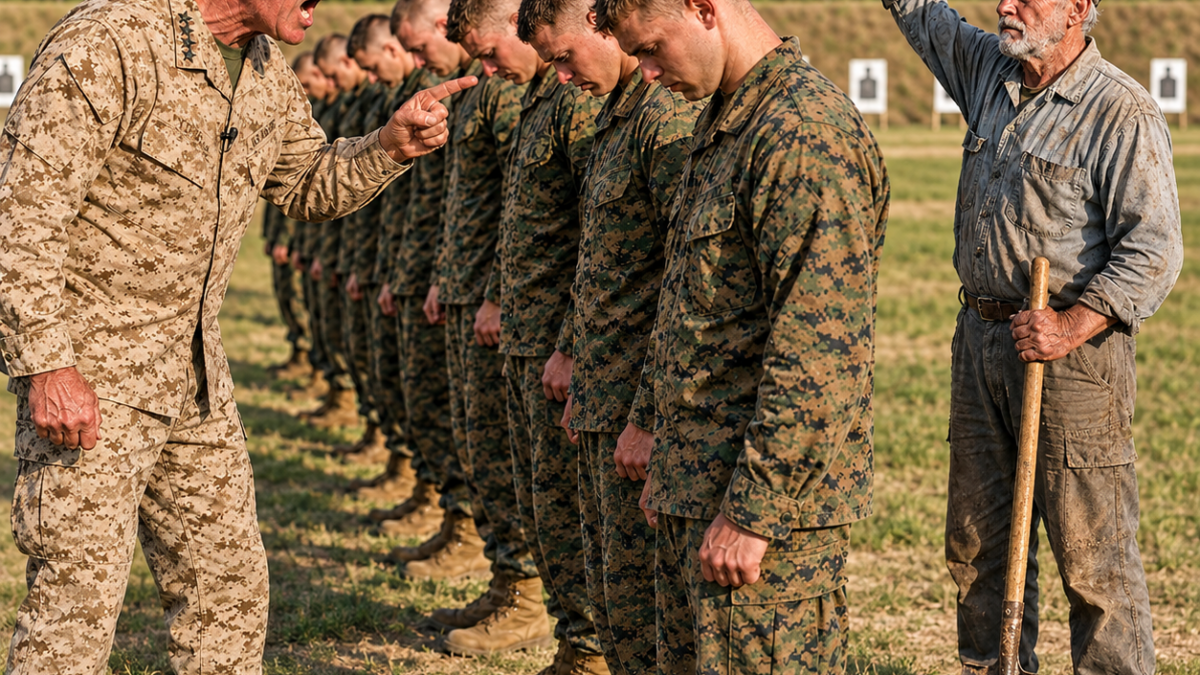
“Can Anyone Make That Shot?” the General Asked 26 Sniper Candidates—Only the 78-Year-Old Groundskeeper Raised His Hand.
Twenty-six elite sniper candidates stared at a 1,400-yard steel plate through brutal crosswinds and refused the general’s challenge—then the seventy-eight-year-old groundskeeper who emptied their trash quietly raised one weathered hand.
They laughed when the old man stepped toward the rifle, until a retired sergeant major saw the way he settled behind the stock and whispered a name that hadn’t been spoken at that school in more than fifty years.
Minutes later, the general was standing at attention with his cover pressed against his chest, because the man everyone knew as Mr. Webb had once carried a dying spotter four miles off Hill 55—and had spent half a century pretending the world had forgotten him.
At 4:40 every morning, Harland Webb parked beneath the same loblolly pine.
Same space.
Same tan Ford pickup.
Same rough idle that coughed twice before settling into a tired mechanical rumble.
He always arrived before sunrise.
That was deliberate.
Harland liked buildings before people entered them.
Before voices.
Before orders.
Before boots struck floors.
Before young men filled every corridor with confidence.
At that hour, the Marine marksmanship school felt almost peaceful.
He would sit behind the steering wheel for thirty seconds after turning off the engine.
Not praying exactly.
Not remembering intentionally.
Just sitting.
Sometimes the cold made his left hip ache before he even opened the door.
Sometimes it was rain.
Sometimes nothing at all.
The injury had been with him so long that he no longer thought of it as pain.
It was more like weather.
A condition of being alive.
He would climb out wearing the same faded gray work shirt, dark utility pants, old boots, and a canvas jacket that had been patched so many times the patches had begun receiving patches of their own.
Then he would unlock the maintenance shed.
Roll out the cart.
Trash bags.
Broom.
Paint.
Tools.
Coffee thermos.
By five, he was working.
Nineteen years.
That was how long Harland Webb had been maintaining the grounds and ranges.
He cut grass.
Raked brass.
Painted steel targets.
Replaced broken target frames.
Swept halls.
Emptied trash.
Cleaned mud from stairwells after field exercises.
Unclogged drains.
Changed fluorescent tubes.
PART2:
Fixed things nobody noticed until they stopped working.
The instructors called him Mr. Webb when they remembered.
Candidates usually called him sir if they were polite.
Some called him Pops.
A few called him Old Man Webb when they thought he couldn’t hear.
He heard.
Harland heard almost everything.
He had simply learned, decades earlier, that hearing something did not require answering it.
The young men moved around him every day without seeing him.
Not maliciously.
Mostly.
They were busy.
They were exhausted.
They were ambitious.
They were surrounded by men whose résumés mattered and instructors whose opinions could alter careers.
A seventy-eight-year-old civilian with a broom did not register as important.
Harland understood that.
He had once been young enough to believe uniforms revealed more than they concealed.
He knew better now.
There were small things about him that some people noticed.
Candidate Alvarez had noticed one.
Alvarez was twenty-six, lean, serious, and halfway convinced the course would break him.
Three weeks into the program he had missed too many wind calls.
His confidence had begun shrinking with every error.
One afternoon, after everyone else returned to the barracks, Alvarez sat alone at the old picnic table behind the equipment shed.
Harland was eating lunch there.
Turkey sandwich.
Apple.
Black coffee.
Always the same.
Alvarez sat without asking.
Harland did not object.
For ten minutes they said nothing.
Across the trees, rifles cracked from Range Seven.
Harland listened.
Alvarez stared at his boots.
Finally he said:
“I think they’re dropping me.”
Harland took another bite.
“Maybe.”
Alvarez looked up.
That was not what he wanted to hear.
“You’re supposed to say I’ll be fine.”
“Don’t know if you will.”
Alvarez almost smiled.
Harland looked toward the range.
Another shot.
Pause.
Two more.
Then:
“It ain’t the wind beating you.”
Alvarez frowned.
“Feels like it.”
“No.”
Harland folded the wax paper around the remaining half of his sandwich.
“It’s the waiting.”
“What?”
“You get behind the rifle.”
“You know everybody’s watching.”
“You know one bad call matters.”
“So you start trying to make the shot happen.”
Alvarez listened.
Harland tapped one finger against the table.
“Can’t make it happen.”
“You let it happen when everything is ready.”
“The position.”
“Breathing.”
“Wind.”
“Head.”
“You get still inside the waiting.”
“Rest follows.”
Alvarez studied him.
“You shoot?”
Harland took a drink of coffee.
“Used to hunt.”
Then he stood and pushed his hip straight with one hand.
“Finish your lunch.”
He walked away.
Alvarez stared after him.
Three weeks later, he graduated the phase.
He never told anyone about the conversation.
Harland never asked.
That was how he preferred things.
He lived alone in a small clapboard house twelve miles from the base.
His wife Elena had died eleven years earlier.
Forty-two years of marriage.
Cancer.
Quick at the end.
Slow before that.
Their daughter lived in Arizona.
Two grandsons.
Christmas calls.
Birthday packages.
Harland loved them fiercely and from a distance.
There was one room in the house nobody used.
Small.
Back bedroom.
Inside:
A wooden trunk.
A folded uniform.
A flag.
A pair of jungle boots cracked with age.
Three photographs.
A citation envelope never opened.
And a cartridge case.
One brass cartridge stayed with him.
Always.
Buttoned inside the left chest pocket of his work shirt.
Dented at the base.
Darkened with age.
He had carried it for fifty-one years.
Elena once asked why.
He answered:
“Danny.”
That was enough.
She never asked again.
She was one of only three people after the war who knew what Danny meant.
The second was Otis Pruitt.
The third was God, if Harland’s mother had been right.
Harland was less certain about the third.
The morning General Nathaniel Graves visited the school, every surface had been cleaned until it looked embarrassed.
Four-star general.
Former sniper.
Combat veteran.
One of the highest-ranking Marines still serving who had once come through the reconnaissance and sniper pipeline himself.
The instructors were terrified.
The candidates pretended not to be.
Floors were polished.
Brass plaques wiped twice.
Windows cleaned.
Range signs repainted.
Harland trimmed grass that did not need trimming because someone decided the general might notice.
The evening before, Staff Sergeant Cody Renner stopped him near the schoolhouse.
“Mr. Webb.”
Harland turned.
Renner was twenty-nine.
Strong.
Decorated.
Excellent shooter.
Two service rifle championships.
Lead instructor.
He possessed the particular confidence of a man who had been right often enough to begin believing error was mostly something that happened to others.
“Tomorrow morning,” Renner said, “keep the maintenance cart out of the main corridor during the visit.”
“All right.”
“And if the general goes outside, give the entourage room.”
Harland nodded.
“We need everything clean.”
“It is.”
Renner looked at the floor.
It was spotless.
“Right.”
Then:
“Just stay out of photographs if you can.”
Harland looked at him.
Not angry.
Not offended.
Just looked.
Renner became uncomfortable for reasons he couldn’t explain.
“Protocol.”
Harland nodded.
“Sure.”
He pushed the cart away.
The next morning, General Graves arrived at 0800.
Harland was already three hours into his day.
He watched from the back of the briefing room while twenty-six advanced instructor candidates sat in rows.
Pressed uniforms.
Straight backs.
Pens ready.
Renner stood along the wall with other instructors.
Beside the general sat retired Sergeant Major Otis Pruitt.
Harland saw him immediately.
His hand stopped on the trash bag.
Otis.
Older.
Much older.
White hair.
Heavy around the middle.
Cane beside the chair.
But still Otis.
Harland lowered his eyes.
Fifty-one years collapsed and then returned.
Otis did not see him.
Why would he?
Harland continued working.
General Graves spoke about tradition.
Standards.
Patience.
Judgment.
Responsibility.
Then history.
Names.
Campaigns.
Long-range engagements.
Vietnam.
The First Marine Division.
And finally:
Hill 55.
Harland froze.
Not visibly to anyone except perhaps himself.
The room disappeared.
For one second he smelled wet elephant grass.
Hot metal.
Cordite.
Blood.
Danny whispering:
“Wind’s moving left.”
Harland tightened his grip on the trash bag.
The brass cartridge in his pocket felt suddenly heavy.
General Graves continued.
He told a story about a sniper pair operating from Hill 55 in 1969.
Long observation.
Impossible movement.
Distances that had become school legend.
Records incomplete.
Names lost in bureaucracy.
Harland stared at the floor.
He had heard versions before.
Usually wrong.
Sometimes exaggerated.
Sometimes sanitized.
Nobody ever told the part that mattered.
Danny.
They always forgot Danny.
That was why Harland never corrected anyone.
If they wanted legends, let them have legends.
He had lived with the real thing.
The briefing ended.
General Graves smiled.
“History is useful.”
“But history can also become a hiding place.”
He looked at the candidates.
“Let’s see what you can do today.”
Range Eleven.
Late morning.
Wind ugly.
Hard gusts across the Potomac lowlands.
Not steady.
That was the problem.
Steady wind can be solved.
Variable wind lies.
The rangemaster had placed a twelve-inch steel plate 1,400 yards downrange.
White.
Barely visible.
The rifle on the mat was old-fashioned.
Bolt action.
Iron sights.
No optic.
No ballistic computer.
No spotter.
One round.
General Graves stood before twenty-six candidates.
“Can anyone in this room make that shot?”
Silence.
He pointed toward the plate.
“One round.”
“Iron sights.”
“No spotter.”
“Right now.”
Nobody moved.
Harland was at the rear of the range collecting debris near a maintenance cart.
He heard every word.
The candidates understood the problem immediately.
1,400 yards.
Iron sights.
Crosswind.
Cold bore.
One round.
No correction.
The odds were terrible.
Worse than terrible.
This was not a competition where a miss disappeared into statistics.
This was in front of a four-star general.
Careers lived partly on reputations.
Nobody wanted to become the man who confidently volunteered and missed by thirty feet.
General Graves waited.
Five seconds.
Ten.
His expression changed.
Not anger.
Disappointment.
Harland recognized it.
The general had not expected a hit.
He had expected courage.
One person willing to fail publicly.
Nobody raised a hand.
Harland looked at the flags.
Near flag.
Far flag.
Grass.
Heat movement.
He could almost hear Danny.
Quarter from four.
Half at seven.
Wait.
Harland’s hand moved before he decided.
He raised it.
“I’ll take it.”
Twenty-seven heads turned.
Then came the laughter.
First Renner.
Quick.
Disbelieving.
Then several candidates, mostly from relief.
The challenge had suddenly become ridiculous instead of threatening.
Renner grinned.
“Mr. Webb.”
Harland said nothing.
Renner looked toward General Graves.
“Sir, respectfully, Mr. Webb maintains the grounds.”
Another small laugh.
Harland stared at the distant plate.
Renner continued.
“I’m not sure he’s qualified on the weapon.”
“He could hurt himself.”
One candidate muttered:
“Someone get Grandpa a scope.”
More laughter.
Alvarez did not laugh.
He watched Harland.
The picnic table.
The words.
Still inside the waiting.
Something tightened in his chest.
General Graves looked at Harland.
Not the shirt.
Not the age.
The eyes.
The old man was not smiling.
Not boasting.
Not trying to prove something.
He looked like someone answering a practical question.
The general raised a hand.
Silence.
“Staff Sergeant Renner.”
“Sir.”
“Stand down.”
Renner’s grin disappeared.
General Graves looked at Harland.
“You serious?”
“Yes, sir.”
“You understand the challenge?”
“Yes.”
“You’ve fired this platform?”
Harland looked at the rifle.
“Something close.”
Renner started:
“General—”
Graves did not turn.
“That’ll be enough.”
Then to Harland:
“Come forward.”
Harland left the cart.
Walked.
Slowly.
His left hip caught once.
He ignored it.
Otis Pruitt watched from beside the general.
At first, nothing.
An old man approaching a rifle.
Then Harland stopped behind the firing point.
Did not touch the weapon.
Looked downrange.
Near flags.
Middle grass.
Far shimmer.
Otis’s expression changed.
Harland bent.
Lowered himself.
Left knee first.
Then right.
Settled.
He did not grip the rifle.
He built around it.
Elbow.
Shoulder.
Hip.
Spine.
Bone on bone.
Minimum muscle.
Natural point.
Otis stepped forward.
His cane fell into the grass.
Nobody noticed.
He whispered:
“No.”
General Graves looked sideways.
Otis stared at Harland’s hands.
“No.”
“What?”
Otis’s face had drained.
The old groundskeeper adjusted his cheek against the stock.
Tiny movement.
Exactly the same movement.
Otis had seen it on film hundreds of times.
Training film.
Black and white.
No name.
A shooter in Vietnam.
An unnamed standard.
Harland reached into his shirt pocket.
Removed the brass cartridge.
Held it between thumb and forefinger.
For one second, touched it to his lips.
Otis grabbed Graves’s sleeve.
“Sir.”
“What?”
“What’s his name?”
Graves looked confused.
“The groundskeeper?”
“Yes.”
Rangemaster checked paperwork.
“Harland Webb.”
Otis closed his eyes.
“Oh, God.”
Graves turned.
“You know him?”
Otis stared.
“That’s Webb.”
Nobody understood.
Downrange, Harland heard none of it.
Wind.
That was all.
The old body remembered before the old mind needed to.
He waited.
A gust hit.
Flags snapped.
He did nothing.
Wind dropped.
Changed.
Grass flattened unevenly.
Far mirage shifted.
Wait.
Danny’s voice inside memory:
Not yet.
Harland breathed.
Slow.
Half out.
Pause.
Front sight.
Plate.
The target did not become larger.
The rifle did not become younger.
His eye did not become twenty-seven again.
He simply accepted what he had.
Pressure on trigger.
Nothing forced.
The rifle cracked.
Recoil moved him.
He stayed in position.
Everyone stared downrange.
A second.
Longer.
Then—
PING.
Clear steel.
The plate jumped.
Swung.
Range Eleven erupted.
Men shouted.
Someone swore.
The rangemaster stared through the spotting scope.
“Hit!”
“Center mass!”
“God Almighty.”
Harland worked the bolt.
Caught the brass in his palm.
Looked at it.
Then placed it into his shirt pocket beside the old cartridge.
He rose slowly.
Hip protesting.
Renner stood frozen.
Every word he had said five minutes earlier had become heavier.
General Graves looked at Harland.
Then Otis.
Otis was crying.
Not discreetly.
Tears ran down the face of a retired sergeant major who had spent thirty years teaching hard men how not to show anything.
He walked toward Harland.
Stopped three feet away.
Straightened.
His heels struck together.
He saluted.
Perfect.
The range became silent again.
Harland stared.
Then something softened.
“Otis.”
Pruitt’s salute trembled.
Harland looked at his stomach.
“You got fat.”
A laugh broke out of Otis and collapsed into a sob.
He dropped the salute.
Grabbed Harland by both shoulders.
“You son of a—”
He stopped himself.
Pressed his forehead briefly against Harland’s.
Then turned toward everyone.
“Do you know who this man is?”
Nobody answered.
Otis pointed toward Renner.
“You laughed at him.”
Renner looked sick.
Otis looked at the candidates.
“Every one of you walked past this man for months.”
“Years, some of you.”
“You handed him trash.”
“You told him to move his cart.”
“You spoke around him like furniture.”
His voice cracked.
“This is Gunnery Sergeant Harland Webb.”
“United States Marine Corps.”
“Scout sniper.”
“First Marine Division.”
“Vietnam.”
“1968.”
“1969.”
“Hill 55.”
A murmur moved through the formation.
General Graves went still.
Otis continued.
“When I was a young sniper, this school used a film.”
“Position.”
“Trigger control.”
“Natural point.”
“A shooter you never saw from the front.”
“They called him the Standard.”
Harland looked away.
Otis pointed at him.
“That was him.”
Renner whispered:
“No.”
Otis heard.
“Yes.”
He stepped closer to the candidates.
“I watched that film two hundred times.”
“I taught from it.”
“Every instructor before me taught from it.”
“Half the techniques you boys think belong to this school came through men who studied him.”
Alvarez stared at Harland.
Picnic table.
Waiting.
Suddenly everything made sense.
The general asked:
“Gunnery Sergeant Webb.”
Harland looked at him.
“Sir.”
“Is this true?”
Harland shrugged slightly.
“Some of it.”
Otis laughed through tears.
“Same stubborn bastard.”
General Graves stepped forward.
“Tell me what isn’t.”
Harland looked downrange.
Then toward the twenty-six candidates.
His voice remained quiet.
“I wasn’t alone.”
Silence.
“I had a spotter.”
He reached into his shirt.
Pulled the old dented brass.
Held it.
“Corporal Daniel Reyes.”
Harland’s fingers tightened around the cartridge.
“Best eyes I ever knew.”
“He could see a change in wind before the grass admitted it.”
A few men smiled faintly.
Harland did not.
“We went out together.”
“We came back one man.”
His voice changed almost imperceptibly.
No longer the groundskeeper.
No longer the shooter.
Just an old man opening a door he had kept shut for fifty-one years.
“October 1969.”
“South of Hill 55.”
“We were moving back after an observation mission.”
“Trail looked clean.”
“It wasn’t.”
Harland looked at his hands.
“I stepped.”
“Danny stepped right behind me.”
“Explosion took him.”
The wind moved through the grass.
Nobody shifted.
“My left hip got opened up.”
“Couldn’t hear much.”
“Couldn’t see straight.”
“But Danny was still breathing.”
Harland swallowed.
“I remember telling him not to sleep.”
“He told me I talked too much.”
A few men looked down.
“He always lied.”
“Man could talk through artillery.”
Harland smiled once.
Gone immediately.
“We had no clean extraction.”
“Radio was dead.”
“Movement nearby.”
“So I carried him.”
The general’s face changed.
“How far?”
Otis knew.
Harland answered:
“Four miles.”
Renner closed his eyes.
Harland continued.
“Maybe a little more.”
“Don’t remember.”
“He died before the second mile.”
Nobody breathed.
“But I kept talking to him.”
“I told him Elena was going to kill me for getting shot.”
“I told him he still owed me five dollars.”
“I told him the Yankees would never win another pennant.”
“He hated the Yankees.”
Harland looked at the cartridge.
“When I reached the wire, they tried to take him.”
“I wouldn’t let go.”
The general removed his cover.
Harland’s voice became rougher.
“Three men had to pry my hands loose.”
“I didn’t talk for three days.”
“After that, I never wanted anybody calling me a legend.”
He looked at Otis.
“You boys made stories.”
Otis said:
“We needed them.”
Harland shook his head.
“You needed Danny.”
Otis’s face broke.
Harland held up the brass.
“This was the last round I fired over there.”
“I kept it for him.”
“Every time I touched a rifle after, I thought of him.”
“That’s all.”
General Graves stood at attention.
Slowly.
Deliberately.
His cover against his chest.
Then one by one, the instructors straightened.
Candidates followed.
Nobody ordered them.
Renner stood last.
Head bowed.
Harland looked uncomfortable.
“I’m still on the clock.”
No one laughed.
Then Alvarez stepped forward.
“Mr. Webb.”
Harland looked at him.
Alvarez’s eyes were wet.
“The waiting.”
Harland recognized him.
“Yeah.”
“You knew.”
“Knew what?”
“What I was doing wrong.”
Harland shrugged.
“You were trying too hard.”
Alvarez laughed through tears.
“Yes, sir.”
Harland said:
“Don’t call me sir.”
“Okay.”
Pause.
“Gunnery Sergeant?”
Harland sighed.
“Worse.”
That finally broke the tension.
Small laughter.
Respectful.
Human.
Renner did not laugh.
He walked forward.
Stopped.
“Mr. Webb.”
Harland turned.
Renner struggled.
“I owe you an apology.”
“Probably.”
A few candidates glanced up.
Renner swallowed.
“I treated you like you were stupid.”
Harland said nothing.
“I laughed.”
“Yes.”
“I was disrespectful.”
“Yes.”
Renner’s face flushed.
“I’m sorry.”
Harland studied him.
“Why?”
Renner looked confused.
“Because I was wrong.”
“That ain’t enough.”
Silence.
Harland pointed toward the candidates.
“You apologize because you thought a man’s job told you how much respect he deserved.”
Renner went still.
Harland continued.
“You’d been right about me being unable to shoot, you still would’ve been wrong.”
That landed harder than the shot.
Renner nodded.
“Yes.”
Harland put a hand on his shoulder.
“You’re a good shooter.”
Renner looked up.
“You watched me?”
“Every day.”
“But—”
“I paint your targets.”
A few men smiled.
Harland continued.
“You got good hands.”
“Good eye.”
“You rush when you’re embarrassed.”
Renner’s mouth opened.
Harland tapped his shoulder.
“Fix that.”
Then he walked back toward his cart.
General Graves called:
“Gunnery Sergeant.”
Harland stopped.
“Sir?”
“Where are you going?”
“Trash.”
The general almost smiled.
“Not today.”
Harland looked at the cart.
“Still needs emptying.”
Twenty-six candidates moved at once.
Harland raised both hands.
“Oh, hell.”
Within seconds, half the class was arguing over who got to push the cart.
That became the first story people told.
The truth spread quickly.
Too quickly for Harland’s taste.
Video existed.
Range cameras.
Phones.
Someone captured the shot.
Someone captured Otis’s salute.
Someone captured Harland talking about Daniel Reyes.
Within days, people across the service had seen clips.
The old groundskeeper.
The impossible shot.
The hidden sniper.
The salute.
Harland hated every second.
His daughter called.
“Dad.”
“Hey, sweetheart.”
“Why am I learning from the internet that you’re apparently some legendary sniper?”
Harland closed his eyes.
“Exaggeration.”
“You hit something at fourteen hundred yards.”
“Plate.”
“With iron sights.”
“Lucky.”
“Dad.”
“Yes.”
“Who was Daniel?”
Harland went quiet.
His daughter had heard the name only once.
At her mother’s funeral.
Harland had whispered it near the flag.
He said:
“Friend.”
“More than that.”
“Yes.”
She waited.
Harland did not continue.
She said softly:
“You can tell me when you’re ready.”
Harland looked at Elena’s chair.
“Maybe.”
That night, he did something he had not done in decades.
Opened the wooden trunk.
Pulled out the old photograph.
Two young Marines.
Harland.
Daniel.
Hill grass behind them.
Danny holding binoculars.
Grinning.
Harland looking away from camera.
Twenty-seven.
Immortal.
He sat at the kitchen table until sunrise.
The Marine Corps looked into records.
Not because viral clips are always reliable.
Because General Graves personally requested archival review.
Names emerged.
Reports.
After-action logs.
Old recommendations.
Some claims had grown in retelling.
Others were worse than legend.
The important discovery was a recognition packet from 1969.
Never completed.
Captain killed months later.
Unit transferred.
Paper buried.
Recommendation concerned Harland’s actions after the explosion.
Not the shooting.
The carry.
The refusal of morphine until he returned within friendly lines because he feared losing clarity.
Navigation while wounded.
Recovery of Daniel’s body.
Continued observation of enemy movement despite injury.
Harland was furious when Graves told him.
“I don’t want it.”
They sat in Harland’s kitchen.
General in uniform.
Otis beside him.
Bad coffee.
Harland in a flannel shirt.
“No.”
Graves said:
“It was recommended.”
“Fifty-one years ago.”
“The record survived.”
“Let it die.”
Otis hit the table with his palm.
Harland looked at him.
Otis said:
“You don’t get to decide that alone.”
Harland’s jaw tightened.
“Yes, I do.”
“No.”
“You’re retired.”
“So are you.”
“Then stop giving orders.”
“I ain’t ordering.”
“Sounds like it.”
Otis leaned forward.
“You think this is for you?”
Harland stared.
“It is not.”
He pointed toward the school.
“Those boys.”
“The ones who laughed.”
“The ones who didn’t.”
“The ones coming after.”
“They need to see what honor looks like when the man receiving it doesn’t think he deserves it.”
Harland looked away.
Otis continued.
“And Danny.”
That brought his eyes back.
“Don’t you dare use Danny.”
“I’m not.”
Otis’s voice softened.
“You are.”
Harland went still.
“You’ve spent fifty-one years making sure every good thing you did belonged to him.”
“Maybe some did.”
“Maybe not all.”
Harland stood.
Pain flared in the hip.
He walked to the window.
General Graves said quietly:
“Your spotter will be named.”
Harland turned.
“What?”
“If you accept the ceremony.”
“Daniel Reyes will be named in full.”
“We will put his record beside yours.”
“His family?”
“We found his niece.”
Harland’s face changed.
“She alive?”
“Yes.”
“She wants to come.”
Harland sat.
The argument ended.
Six months later, spring came to Quantico.
Rain the night before cleaned the air.
Parade deck bright.
Harland wore dress blues borrowed and tailored.
He hated them.
“Too tight.”
Otis adjusted his collar.
“You got wider.”
“You got fatter.”
“Still?”
“Still.”
All twenty-six candidates returned.
Graduated now.
Different units.
Some traveled across the country.
Renner stood with them.
Nervous.
General Graves read the citation.
Harland barely heard it.
He was looking at a woman in the front row.
Maria Reyes.
Daniel’s niece.
She held Danny’s photograph.
After the medal was pinned, Harland did not salute the general first.
He walked to Maria.
She stood.
He removed the old cartridge from his pocket.
For a moment, nobody understood.
Harland placed it in her hand.
Maria stared.
“What is this?”
“Your uncle.”
Her breath caught.
Harland continued.
“I carried it because I didn’t know what else to carry.”
“You should have it now.”
Maria closed her fingers.
“No.”
Harland frowned.
She pressed it back.
“He gave his life with you.”
“You carried him home.”
“You carried this long enough.”
She touched his shirt pocket.
“You keep carrying him.”
Harland’s eyes filled.
He put it back.
Then Maria hugged him.
The seventy-eight-year-old former sniper stood rigid for two seconds.
Then his arms came around her.
Nobody on the parade deck looked away.
Afterward, Renner approached.
Cover in hand.
He had rehearsed.
Harland could tell.
Renner began:
“Gunnery Sergeant Webb, six months ago I—”
Harland raised one hand.
“Cody.”
Renner stopped.
First time Harland used his first name.
“You already apologized.”
“Not enough.”
“Then do better.”
Renner swallowed.
“How?”
Harland looked toward the young Marines standing nearby.
“Next time you think you know somebody because of what they’re wearing…”
He waited.
“…don’t.”
Renner nodded.
Harland continued.
“You’re a better shot than I was at twenty-nine.”
Renner stared.
“No, I’m not.”
“Yes.”
“That shot—”
“One shot ain’t a life.”
“You have things I never had.”
“Use them.”
Renner looked down.
Harland touched his shoulder.
“But you remember one thing.”
“What?”
“You never know who’s emptying your trash.”
Renner’s eyes filled.
“Yes, Gunnery Sergeant.”
The school changed after that.
Not dramatically.
No statue.
Harland refused.
No building renamed.
He refused that too.
They did replace the old anonymous training film.
The black-and-white position footage Otis had taught from.
This time they recorded Harland.
Three hours.
One camera.
No script.
He talked about body position.
Wind.
Patience.
Fear.
Ego.
Spotters.
Mostly spotters.
“The shooter gets remembered because he pulls the trigger.”
“That’s a mistake.”
“The shot starts before trigger.”
“Spotter sees.”
“Reads.”
“Confirms.”
“Calls.”
“Keeps you honest.”
“And when you miss, he knows why.”
Harland paused.
Then:
“A shooter alone starts believing himself.”
“That’s dangerous.”
The interviewer asked:
“Is that what Daniel did for you?”
Harland looked away from camera.
Long silence.
“Yes.”
They left the silence in the film.
The interviewer asked:
“What made him good?”
Harland smiled.
“He told me when I was full of it.”
Another long pause.
“Best skill a partner can have.”
The new film became required viewing.
Candidates expected marksmanship.
What they remembered was Harland saying:
“The shot is never just yours.”
Someone suggested using that line on a plaque.
Harland rejected it.
Then offered something else.
At the schoolhouse entrance, they hung a photograph.
Harland and Danny.
Both young.
Danny with binoculars.
Harland behind the rifle.
Two names beneath.
Equal size.
Gunnery Sergeant Harland Webb.
Corporal Daniel Reyes.
Then:
THE SHOT IS NEVER JUST YOURS.
SOMEBODY IS ALWAYS SPOTTING FOR YOU.
THANK THEM WHILE THEY CAN STILL HEAR YOU.
Harland stayed groundskeeper three more years.
People expected him to stop doing maintenance after the story came out.
He refused.
“Job needs doing.”
Candidates began fighting over his cart.
He hated that.
“You’re supposed to be training.”
“Carrying this is training.”
“Who told you that?”
“Sergeant Major Pruitt.”
“Otis is an idiot.”
One candidate said:
“You told him that?”
“For fifty years.”
The young Marine laughed.
Harland let him carry the cart.
His status changed, whether he liked it or not.
People said good morning.
People learned his name.
Candidates sat with him at lunch.
Some asked questions.
He answered a few.
Never war stories for entertainment.
If someone asked:
“How many confirmed kills?”
Harland usually replied:
“Enough.”
If they asked:
“What’s the longest shot?”
“Doesn’t matter.”
“Best rifle?”
“The one you know.”
“How do you control fear?”
“You don’t.”
“You work while afraid.”
“What’s the secret to patience?”
“No secret.”
“Wait.”
Alvarez returned two years later as an instructor.
First day, he found Harland at the picnic table.
Same sandwich.
Same coffee.
“Seat taken?”
Harland looked up.
“You still rush?”
“Less.”
“Sit.”
Alvarez did.
They ate in silence.
Perfect conversation.
Otis visited whenever health allowed.
The two old men argued constantly.
Wind calls.
Baseball.
Coffee.
Memory.
Once Otis said:
“You know you missed one thing in the video.”
“What?”
“You never explained how you made the fourteen-hundred-yard shot.”
Harland stared.
“Luck.”
“Bull.”
“Wind dropped.”
“You held three-quarter left.”
“Maybe.”
“I saw.”
“You’re old.”
“So are you.”
Harland sipped coffee.
“Danny would’ve called it.”
Otis smiled.
“There it is.”
“What?”
“You still give him every shot.”
Harland looked toward Range Eleven.
“Wasn’t mine alone.”
Otis did not argue.
Harland retired at eighty-one.
Not ceremony.
He tried to avoid one.
Failed.
Candidates lined the road from maintenance shed to his truck.
Two rows.
Quiet.
Harland stopped.
“You people have work.”
Nobody moved.
Renner had returned for the day.
Now Gunnery Sergeant Renner.
More mature.
Same eyes.
He stepped forward.
“Mr. Webb.”
Harland groaned.
“Don’t.”
Renner smiled.
“Your cart.”
They had restored the old maintenance cart.
Painted it gray.
Small brass plate:
HARLAND WEBB
KEPT THIS PLACE STRAIGHT FOR 22 YEARS.
Harland stared.
“That’s ridiculous.”
“Probably.”
“You spent money on this?”
“Private donations.”
“Idiots.”
Renner laughed.
Harland touched the handle.
Then:
“Thank you.”
That was enough.
He drove away in the same tan Ford.
Still rough idle.
Still under the loblolly pine until the final morning.
Retirement was harder than he expected.
Too quiet.
He missed rifle fire.
Not because of violence.
Rhythm.
Routine.
People.
His daughter convinced him to visit Arizona.
He stayed three weeks.
Grandsons asked questions about Vietnam.
Harland answered carefully.
One asked:
“Were you scared?”
“Yes.”
“All the time?”
“Enough.”
“Did Grandpa Danny save you?”
Harland smiled at the accidental title.
“Yes.”
“How?”
“Lots of ways.”
They left it there.
Harland died two winters later.
Sleep.
No drama.
Eighty-three.
His daughter found him in the chair by the window.
Daniel’s photograph nearby.
The dented cartridge still inside the pocket of a gray work shirt hanging over the chair.
Funeral cold.
Clear.
Full military honors.
The twenty-six candidates from that day had scattered across the world.
Not all could come.
Most did.
Some older.
Some promoted.
Some retired.
A few walking with injuries.
Renner stood near the front.
Alvarez beside him.
Otis came with a cane.
Frail.
Ninety.
He refused a wheelchair.
When the flag was folded, Harland’s daughter received it.
Then Maria Reyes stepped forward.
She carried Daniel’s photograph.
Harland’s daughter gave her the cartridge.
This time Maria accepted it.
Otis stood.
Slowly.
Painfully.
Raised one final salute.
His hand shook.
The other men followed.
Twenty-six.
Then instructors.
Then General Graves, retired now.
No one spoke.
Wind moved through the cemetery grass.
Somewhere in the distance, a rifle salute began.
Harland Webb had spent nineteen years being invisible at the school before anyone discovered who he had been.
That was the story people remembered.
But Renner understood something more difficult.
The day on Range Eleven had not taught him to respect hidden heroes because they might secretly be famous.
That would have been an easy lesson.
A shallow one.
Harland had corrected him immediately.
Even if he had never fired a rifle.
Even if he had never served.
Even if his whole life truly had been cutting grass and emptying trash.
Renner still would have been wrong to laugh at him.
That became the lesson he taught every class afterward.
On the first morning of each new sniper instructor course, Renner brought candidates into the schoolhouse.
He stopped beneath the photograph.
Harland.
Daniel.
He told the story.
But he never began with the shot.
He began with the trash cart.
“He worked here nineteen years.”
“Most people didn’t know his first name.”
“Think about that before we talk about marksmanship.”
Then he told them about Hill 55.
Danny.
The waiting.
The bridge between memory and skill.
The impossible shot.
The salute.
And finally:
“You do not know who people are from the job you see them doing.”
“You do not know what somebody has carried before meeting you.”
“You do not know who taught the person who taught you.”
“And you do not become elite by shooting well enough that you stop respecting people.”
“You become elite when skill makes you more disciplined about humility.”
That was the part Harland would have hated hearing.
Too polished.
Too many words.
He would probably have said:
“Just don’t be an ass.”
Renner sometimes finished with that instead.
Candidates remembered it.
The school continued.
Classes came.
Graduated.
Wars changed.
Rifles changed.
Optics changed.
Ballistic software improved.
Ranges modernized.
The old bolt-action rifle from that morning eventually went into a display case.
Beside it was no claim about impossibility.
No dramatic distance record.
Just a card describing the demonstration.
One round.
Iron sights.
Range Eleven.
Harland Webb.
The school deliberately avoided turning the shot itself into mythology.
Because Harland had spent his life warning them against exactly that.
The shot was not the man.
Survival was not the man.
The medal was not the man.
Neither was the broom.
A life was everything together.
That was harder to teach.
Much more valuable.
Years later, Alvarez became school director.
On his first day, he moved his office chair to the window facing the equipment shed.
Same picnic table still there.
Weathered.
Repaired twice.
He ordered nobody to replace it.
One afternoon, a struggling candidate sat there alone.
Alvarez watched.
For a moment he thought about going outside.
Giving advice.
Then he stopped.
Harland’s voice came back.
Still inside the waiting.
Alvarez let the young man sit.
Ten minutes later, the new groundskeeper walked by.
Older woman named Denise.
She stopped.
Spoke to him.
Alvarez couldn’t hear what she said.
The candidate nodded.
Denise continued on.
Alvarez smiled.
Then walked downstairs.
Not toward the candidate.
Toward Denise.
“Ma’am.”
She turned.
“Yes?”
“I’m Colonel Alvarez.”
“I know.”
He held out his hand.
“I don’t think we’ve properly met.”
She smiled.
“Denise Carter.”
“Good to meet you, Denise.”
Harland would have approved.
Probably.
He might have told Alvarez he was being sentimental.
Then asked whether Range Seven had been repainted.
That was how people missed men like Harland.
They expected greatness to announce itself.
Uniform.
Medals.
Voice.
Rank.
Photographs.
Stories.
But some of the hardest lives disappear deliberately into ordinary work.
A man survives something enormous.
Then spends fifty years repairing doors.
Cutting grass.
Packing lunches.
Changing light bulbs.
Carrying a dead friend inside one shirt pocket.
The world assumes silence means there is nothing to tell.
Sometimes silence means the story is too heavy to keep putting down in front of strangers.
The twenty-six men on Range Eleven never forgot the sound of steel that morning.
But later, when they spoke among themselves, most admitted that was not the sound that stayed with them.
It was Harland’s voice after Otis revealed his name.
I had a spotter.
That sentence.
Not:
I was the best.
Not:
I made impossible shots.
Not:
You should have known who I was.
I had a spotter.
Danny.
Harland’s entire life had somehow condensed itself into refusing to accept credit alone.
That was why the brass cartridge mattered.
Why he stayed near the school.
Why he listened to young shooters.
Why he never corrected the legends until somebody else dragged them into daylight.
He had spent half a century believing survival placed him in debt.
What the school eventually taught him—slowly, painfully—was that remembering Daniel did not require erasing Harland.
There had been two men on Hill 55.
One died.
One lived.
Both mattered.
That may have been the hardest shot Harland Webb ever made.
Not 1,400 yards.
Not iron sights.
Not wind.
Accepting, at seventy-eight, that coming home did not make him guilty of taking another man’s future.
That Daniel’s sacrifice could be honored without turning Harland’s remaining years into punishment.
Elena had tried to teach him.
Otis had tried.
His daughter tried.
The general, the school, Renner, Alvarez—without knowing it, all helped finish the lesson.
Harland never said he accepted it completely.
Men like him rarely do.
But after the ceremony, his daughter noticed something.
The folded flag moved.
For eleven years after Elena died, it had sat beside Daniel’s photograph.
After Quantico, Harland placed Elena’s photograph between them.
Danny.
Elena.
Harland’s family.
Not competing griefs.
One life.
When Harland died, that was how his daughter found the windowsill.
Three photographs.
Daniel and Harland young.
Elena on their wedding day.
A newer picture taken after the medal ceremony.
Harland surrounded by twenty-six Marines, all grinning.
Harland not grinning.
Almost.
His daughter kept that one.
The other two were buried with him.
The brass went to Maria Reyes.
She later donated it to the school under one condition.
It would not sit beneath Harland’s name alone.
Today, in the story as those Marines tell it, a small display case stands under the photograph of Harland and Daniel.
Inside:
One dented brass cartridge.
Two names.
No rank.
No medal list.
No confirmed engagements.
Just:
HARLAND WEBB
DANIEL REYES
THE SHOT WAS NEVER JUST ONE MAN’S.
And every class walks past it.
Most slow down.
Some read.
A few glance and keep moving.
That is human nature.
But once in a while, a candidate stops.
Looks toward whoever is sweeping the hallway.
And asks:
“What’s your name?”
That is the part Harland would have understood.
Not worship.
Not legend.
Attention.
Simple human attention.
Because the greatest mistake made on Range Eleven was never believing an old man could make the shot.
It was believing they already knew who he was before he ever touched the rifle.
And the greatest thing Harland Webb taught them had nothing to do with distance, wind, breathing, or marksmanship.
It was that every person standing quietly at the edge of your life has already lived chapters you cannot see.
Some carried rifles.
Some carried children.
Some carried families.
Some carried grief.
Some carried men four miles through darkness and then never spoke about it again.
The uniform changes.
The work changes.
The body gets old.
The hands shake.
The hair disappears.
Names fade from records.
But dignity does not retire simply because nobody remembers where it came from.
So when General Graves asked twenty-six elite young shooters whether any of them could make that impossible shot, they all looked at the target and measured the risk.
Harland Webb looked at the wind.
Then raised his hand.
Not because he needed to prove he was still the man from Hill 55.
He already knew he wasn’t.
That young man had stayed behind with Daniel.
The person who stepped onto Range Eleven was something else.
An old groundskeeper.
A widower.
A father.
A grandfather.
A retired Marine.
A man with one bad hip.
A sandwich in wax paper.
A cart full of trash.
And fifty-one years of practice carrying something no one else could see.
He made the shot.
The steel rang.
The room finally saw him.
But by then, Harland Webb had already spent a lifetime learning the thing they were only beginning to understand:
Being unseen does not make a man small.
And being noticed does not make him great.
What makes him great is what he does when no one is looking.




