A Wounded Navy SEAL Asked for One Quiet Hour With His K9—Then the Dog Dragged Him to a Nurse Who Knew the Truth About His Fallen Teammate.
PART2:
“He specifically left instructions.”
Grant stared at her.
The nurse sighed.
“I’m going to regret this.”
“No, you’re not.”
“I already do.”
Her name was Angela Mendoza.
She had been Grant’s primary nurse for two days and was apparently immune to intimidation.
“Fine. One hour.”
“Thank you.”
“With Atlas.”
“That was the point.”
“Inside the rehabilitation lounge only.”
Grant nodded.
“And if your pain spikes, you call.”
“Yes.”
“And you do not try to walk without assistance.”
Grant looked offended.
“I can walk.”
“You can limp with confidence.”
“That still counts.”
“No, it doesn’t.”
She handed him the form.
“Six-thirty to seven-thirty.”
Grant checked the clock.
“Twelve minutes from now.”
“You’ll survive.”
He wasn’t certain.
But he didn’t argue.
Atlas arrived four minutes later.
The German Shepherd had been transported from the military veterinary wing across the medical campus.
Eight years old.
Eighty-six pounds.
Dark saddle marking.
Gray beginning to dust his muzzle.
A small crescent notch in the outer edge of his left ear.
He wore a lightweight recovery harness instead of his operational rig.
His right shoulder had been shaved.
A neat line of sutures disappeared beneath a protective wrap.
The veterinary technician holding his lead said:
“No running.”
Grant looked at Atlas.
Atlas looked back.
“I assume you heard that.”
The dog’s tail moved once.
“Good.”
The technician handed over the leash.
“Twenty minutes at a time standing. No stairs if you can avoid them. He’s still favoring the shoulder when he gets tired.”
“So am I.”
“You’re both terrible patients.”
“Occupational tradition.”
The technician left.
Grant lowered himself slowly into the chair beside the rehabilitation wing’s tall windows.
Sunset spread orange light across the courtyard.
Atlas came to him.
For six years, they had worked together.
Not every day.
Military dog assignments were more complicated than the stories people told.
Atlas had trainers before Grant.
Temporary handlers.
Veterinary staff.
Transport teams.
But Grant had been his operational partner longer than anyone else.
They had deployed together.
Slept in the same dirt.
Ridden in helicopters together.
Crossed villages together.
Waited in darkness together.
Atlas had found explosives.
Tracked people.
Detected things Grant could not see, hear, or smell.
He had saved Grant’s life twice in ways that could be counted.
Probably more in ways nobody could.
Grant rubbed the dog’s neck.
“Just us.”
Atlas settled at his feet.
Grant looked through the glass.
“No officers.”
The dog breathed heavily.
“No reports.”
Atlas lowered his chin.
“No one asking me what happened.”
Grant’s hand stopped.
The final sentence came out quieter.
“No Ethan.”
Atlas’s ears moved.
Grant looked away.
For nearly five minutes, neither moved.
It was exactly what Grant had asked for.
Silence.
No questions.
No condolences.
No one telling him he had followed procedure.
No one saying Ethan had known the risks.
No one telling him there was nothing he could have done.
Grant hated that sentence.
Nothing you could have done.
People said it as though helplessness was comforting.
It wasn’t.
Then Atlas lifted his head.
Grant noticed immediately.
“Stay.”
The dog’s ears angled toward the corridor.
His nose lifted.
One breath.
Another.
He stood.
“No.”
Atlas looked at him.
Grant tightened his fingers around the leash.
“We negotiated.”
The dog continued staring toward the hallway.
“One hour.”
Atlas took one step.
“Atlas.”
The dog stopped.
Grant relaxed.
“Good.”
Atlas pulled.
The chair scraped six inches across the floor.
Pain tore through Grant’s ribs.
“Jesus.”
He braced one hand against the armrest.
“Easy.”
Atlas pulled again.
Not wildly.
Not panicked.
Purposefully.
Grant knew the difference.
He had watched Atlas pursue odor through dust storms, sewage, explosives residue, smoke, and crowded streets.
The dog was on something.
But they were inside a hospital.
“Atlas, heel.”
Atlas hesitated.
Looked back at Grant.
Then looked toward the corridor again.
“Don’t do this.”
The dog leaned into the harness.
Grant swore.
He pushed himself upright.
Pain immediately punished the decision.
His ribs burned.
The shoulder protested.
Atlas slowed enough that Grant could follow.
“You are supposed to be injured.”
Atlas moved.
“So am I.”
A physical therapist pushing a walker cart stepped aside.
“Everything okay?”
“No.”
Grant limped after the dog.
“Apparently my K9 has developed independent healthcare objectives.”
The therapist laughed.
Grant did not.
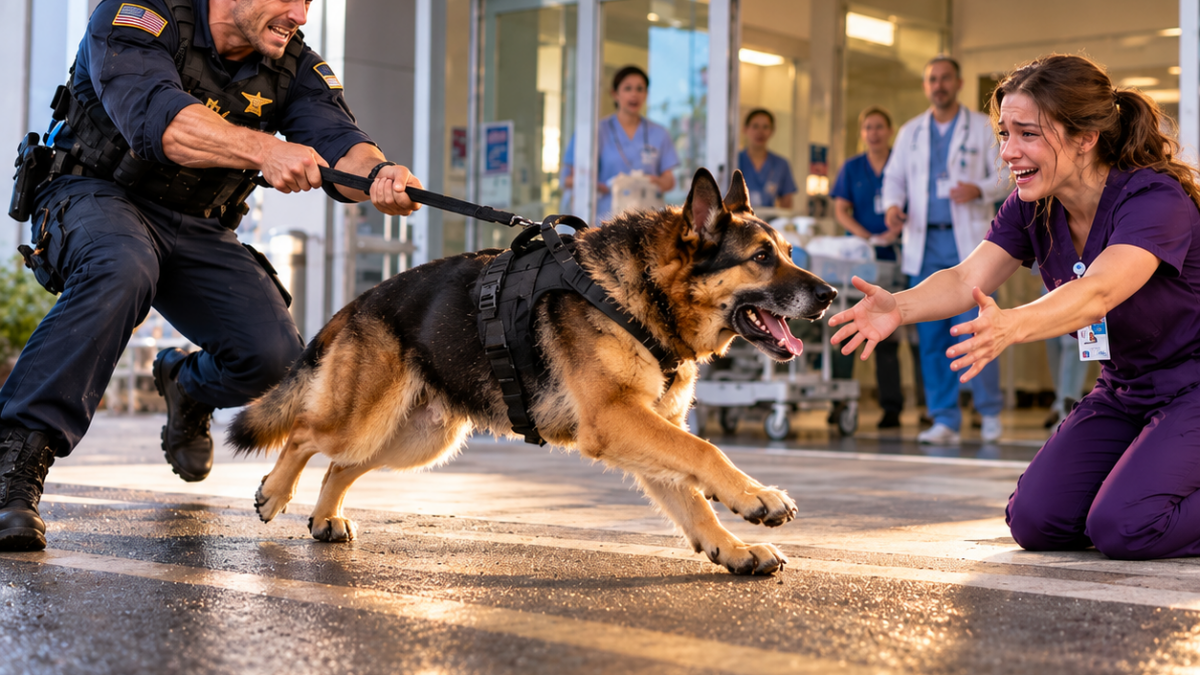
Atlas guided him past the nurses’ station.
Angela looked up.
“Where are you going?”
“I don’t know.”
“You signed a form!”
“Tell him.”
Atlas kept moving.
Angela stared.
“Should I call somebody?”
“No.”
“That answer has never made me feel better when you say it.”
Grant followed.
Atlas passed two patient rooms.
Ignored a medication cart.
Ignored a tray of food.
Ignored another dog from the rehabilitation program.
Then turned left.
Grant’s confusion deepened.
He had never brought Atlas into this hallway.
“Buddy.”
The dog’s pace quickened slightly.
“Atlas.”
No response.
At the far end of the corridor, a nurse was helping an elderly veteran adjust his blanket.
Pale blue scrubs.
White hospital badge.
Chestnut-brown hair pulled into a practical ponytail.
She looked tired in the unremarkable way good nurses often looked near the end of a shift.
Atlas stopped.
Completely.
The nurse looked up.
Her eyes moved first to Grant.
Then down.
She froze.
The blanket slipped from her hands.
“Atlas?”
Grant stopped too.
The dog’s tail moved.
Once.
Then twice.
The nurse stepped slowly away from the patient’s bed.
“No way.”
She crouched.
“Atlas?”
The German Shepherd moved toward her.
Grant loosened the leash instinctively.
The nurse extended one hand.
Atlas sniffed.
Her fingers.
Wrist.
Sleeve.
Then he pressed his head against her shoulder.
The nurse closed her eyes.
“Oh.”
Her voice broke.
“Oh, buddy.”
Atlas leaned into her.
Not like he greeted a stranger.
Not even like he greeted most familiar military staff.
There was history there.
Grant’s entire body went alert.
“How do you know my dog?”
The nurse opened her eyes.
Tears had appeared.
She looked at Grant carefully.
“My name is Natalie Ward.”
“That doesn’t answer me.”
“No.”
She kept one hand on Atlas’s neck.
“I worked with him in Germany.”
Grant stared.
“When?”
“Four years ago.”
“Doing what?”
“I was assigned to a rehabilitation facility near Landstuhl.”
Grant looked at Atlas.
Then Natalie.
“He was there before he came to my unit.”
“Yes.”
“I read his file.”
“I imagine you did.”
“There was nothing about you.”
“I wasn’t his handler.”
“What were you?”
“Combat medic attached to rehabilitation support.”
Grant narrowed his eyes.
“You were medical?”
“Yes.”
“For dogs?”
“Sometimes.”
She smiled faintly.
“Mostly humans. But the facility integrated recovery services for military working dogs.”
Atlas nudged her hand.
Natalie scratched beneath his ear.
“The injury was here.”
She touched the old scar tissue near his left shoulder.
Grant noticed how precise the movement was.
“He had a different shoulder injury back then.”
“Yes.”
“He was separated from his team for almost two months.”
Grant knew that.
Atlas’s previous deployment history was part of the record.
He had suffered a partial tendon tear.
Recovered.
Recertified.
Transferred.
Natalie continued.
“He hated recovery.”
Grant looked at Atlas’s current bandage.
“Sounds familiar.”
“He wouldn’t settle.”
“That also sounds familiar.”
“He’d sit beside the treatment room door every afternoon.”
“Why?”
Natalie looked down at the dog.
“I think he was waiting.”
“For his handler?”
“Maybe.”
“Who?”
“Anyone familiar.”
Grant noticed the uncertainty.
“You don’t know?”
“We weren’t always given operational details.”
Atlas shifted until he was practically sitting against Natalie’s legs.
Grant asked:
“And you sat with him.”
“Most days.”
“Why?”
She thought.
Then answered:
“Because everyone kept asking him to do something.”
Grant frowned.
“What does that mean?”
“Walk farther.”
“Bear weight.”
“Accept range-of-motion work.”
“Eat.”
“Settle.”
“Recover.”
She looked at Grant.
“Sometimes I thought he needed somebody who wasn’t asking him for anything.”
Grant looked away first.
That sentence landed too close.
Natalie stood.
“You need to sit.”
“I’m fine.”
“You’re pale.”
“That’s my natural personality.”
“That doesn’t even make sense.”
“It doesn’t have to.”
She pointed toward a chair.
“Sit.”
Grant almost refused.
Then his ribs made the decision.
He sat.
Atlas immediately placed himself between Grant and Natalie.
Not protective.
Connected.
One person on either side.
For the first time in three days, Grant’s shoulders relaxed.
He hated that Natalie noticed.
“You should probably return him to the rehab lounge.”
“In a minute.”
Grant looked at her badge.
Natalie Ward, RN.
Then at the small photograph clipped behind it.
He would have missed it if the fading sunlight had not reflected off the plastic.
A younger Natalie.
Military uniform.
Beside her stood a man about her age.
Dark hair.
Similar eyes.
Her brother, Grant guessed.
And beside that man—
Grant’s breathing stopped.
Ethan Cole.
Younger.
Maybe six years younger.
One arm over the man’s shoulder.
Wide grin.
Alive.
Grant leaned forward.
Pain stabbed through his ribs.
“Who is that?”
Natalie followed his gaze.
Her hand froze near the photograph.
“My brother.”
“No.”
Grant pointed.
“Him.”
Her face changed.
“Ethan.”
Grant went cold.
“You knew Ethan?”
Natalie studied him.
“You were on his team.”
Not a question.
Grant nodded slowly.
“You’re Ellis.”
Something in the way she said his name bothered him.
“How do you know me?”
“Ethan talked about you.”
Grant almost laughed.
“He barely talked about anybody.”
“He talked about you.”
“What did he say?”
Natalie looked toward the elderly veteran in the treatment room.
“I need to finish here.”
“Natalie.”
She met his eyes.
“Give me five minutes.”
Grant did not want to.
But Atlas lay down beside her chair as if he had already decided the matter.
Five minutes became seven.
Grant watched Natalie work.
She adjusted the veteran’s pillow.
Checked an IV.
Explained a medication.
Made a joke that made the old man smile.
No rush.
No performance.
When she returned, Grant was holding the photograph.
She had allowed him to remove it from the lanyard.
“His name was Samuel?”
“Yes.”
“Your brother?”
“Yes.”
“He served?”
“Army medic.”
Grant looked at Ethan.
“How did they know each other?”
Natalie sat.
“Medical evacuation.”
“When?”
“Six years ago.”
Grant searched his memory.
Ethan had been involved in dozens.
“What happened?”
“Samuel’s team got caught after an attack on a convoy.”
Grant said nothing.
“Three wounded.”
“One critical.”
“Ethan’s element helped secure the evacuation corridor.”
“Samuel survived?”
“That time.”
Grant looked at her.
“That time.”
Natalie lowered her eyes.
“He died two years later.”
“How?”
“Training helicopter crash.”
Grant breathed out.
“I’m sorry.”
“So was Ethan.”
Grant looked again at the photograph.
“They stayed in touch?”
“Yes.”
“Why?”
“Because Ethan did that.”
Grant’s mouth tightened.
“He collected people.”
Natalie smiled sadly.
“That’s one way to say it.”
Ethan remembered birthdays.
Called people after funerals.
Sent ridiculous care packages.
Showed up without announcing he was showing up.
He was the guy who remembered the name of your first dog, the beer you hated, the story you told once at two in the morning.
Grant hated him for it occasionally.
Loved him for it always.
Natalie said:
“After Samuel died, Ethan called me.”
Grant looked up.
“How did he get your number?”
“My brother had it.”
“What did he say?”
“Not much.”
“Ethan never used ten words where seven would work.”
Natalie smiled.
“He asked if I’d eaten.”
“That sounds like him.”
“I told him yes.”
“Had you?”
“No.”
“Also sounds familiar.”
“He called again the next week.”
“And?”
“Then once a month for almost a year.”
Grant stared.
“He never told me.”
“Why would he?”
“He told me everything.”
Natalie looked at him gently.
“No.”
Grant bristled.
“What’s that supposed to mean?”
“Nothing insulting.”
“It sounded insulting.”
“People have parts of themselves in different places.”
“I knew him twelve years.”
“I’m sure you knew him deeply.”
“Then why didn’t I know you?”
“Because I wasn’t part of your relationship.”
Grant didn’t like how reasonable that was.
“He helped me after Samuel,” Natalie continued.
“How?”
“He listened.”
“To what?”
“My anger.”
Grant’s voice softened.
“What were you angry about?”
“Everything.”
She looked out the window.
“Samuel shouldn’t have been on that helicopter.”
“Why not?”
“He volunteered to fill another medic’s slot.”
Grant understood instantly.
“He wasn’t scheduled.”
“No.”
“And you blamed him.”
“Yes.”
“You blamed yourself too.”
Natalie looked at him.
“How do you know?”
“Because you’re talking to me like somebody who’s done it.”
She didn’t answer.
Grant looked down at Atlas.
“Ethan died three days ago.”
Natalie closed her eyes.
“I heard there had been casualties.”
“You didn’t know his name?”
“No.”
Grant’s voice broke.
“He was the one.”
Natalie stayed silent.
Grant hated silence when it invited honesty.
“He stayed behind.”
Her eyes opened.
“What happened?”
Grant should not have told her.
Parts of the mission were still under review.
He knew what he could say.
What he shouldn’t.
But something about Atlas sitting between them, something about Ethan’s face hanging from her badge, loosened the wall.
“We were clearing civilians from a damaged building.”
Natalie listened.
“Secondary structural damage.”
“Fire.”
“Debris.”
“Ethan found somebody trapped.”
“Civilian?”
“Yes.”
“He stayed.”
“Grant…”
“I ordered movement.”
His jaw tightened.
“We had to clear the corridor.”
“The building was failing.”
“A beam came down.”
“I got Atlas toward the exit.”
“Then another collapse.”
Grant stared at the floor.
“Ethan was still inside.”
“Were you injured before that?”
“After the first collapse.”
“Concussion?”
“Apparently.”
“Apparently?”
“I don’t remember half of it clearly.”
Natalie’s expression sharpened with medical concern.
“Grant.”
“I was functional.”
“That is not a medical term.”
“I walked.”
“So do concussed people.”
“I followed the withdrawal order.”
He said it like a confession.
Natalie did not interrupt.
“I went out.”
The words became quieter.
“Ethan didn’t.”
His breathing changed.
Atlas lifted his head.
Grant stared at his hands.
“I should’ve gone back.”
Natalie waited.
“Say it.”
“What?”
“That I was ordered out.”
“You were.”
“That going back could have gotten more people killed.”
“It could have.”
“That Ethan made his choice.”
“He did.”
Grant looked at her angrily.
“None of that helps.”
“I didn’t expect it to.”
“Everybody says the same thing.”
“I’m not everybody.”
“You’re doing a good impression.”
Natalie accepted the blow.
Then asked:
“Did you know the building would collapse again?”
“No.”
“Could you see Ethan’s position?”
“No.”
“Were you physically capable of reaching him?”
“I don’t know.”
“Then you don’t know that going back would have saved him.”
Grant’s jaw clenched.
“You make guilt sound logical.”
“No.”
Her voice softened.
“I think guilt is usually very logical to the person carrying it.”
He looked away.
Natalie continued.
“What I’m asking is whether you’re treating uncertainty like evidence.”
That got through.
Grant stared.
She said:
“You don’t know that staying would have saved Ethan.”
“I know leaving didn’t.”
“You also don’t know that.”
Before Grant could respond, Atlas stood.
He pressed his head against Grant’s sternum.
Pain shot through Grant’s ribs.
“Easy.”
But Grant wrapped one arm around him anyway.
Atlas remained.
Grant’s face twisted.
The first sob embarrassed him.
The second made embarrassment irrelevant.
“I left him there.”
Natalie moved her chair closer.
“I couldn’t bring him home.”
She said nothing.
No slogans.
No everything happens for a reason.
No hero speech.
She sat.
Atlas leaned against Grant.
Eventually his breathing settled.
Then Natalie asked:
“There’s something I need to know.”
Grant wiped his face.
“What?”
“Did Atlas locate Ethan before you left?”
Grant frowned.
“No.”
“You’re sure?”
“He was working the exit route.”
“What happened after the second collapse?”
“I told you. I don’t remember everything.”
“Was Atlas evacuated with you?”
Grant stopped.
“I thought so.”
“You thought?”
“I remember somebody taking his lead.”
“Who?”
Grant searched.
Smoke.
Dust.
A voice.
Pain.
Hands pulling at his vest.
Atlas barking.
No.
Not barking.
Pulling.
Toward something.
Grant squeezed his eyes shut.
“I don’t know.”
Natalie’s expression changed.
“What?”
“There was something in the casualty documentation.”
Grant looked at her.
“What documentation?”
“Preliminary medical summary.”
“How did you see it?”
“I’m covering rehabilitation coordination.”
“What did it say?”
“I only saw one section.”
“Natalie.”
She hesitated.
“A working dog alerted rescue personnel after the second collapse.”
Grant went still.
“What?”
“It didn’t list the dog’s name.”
“How many working dogs were there?”
“I don’t know.”
Grant did.
Two teams had entered the wider operational area.
Only Atlas had been inside that structure.
“Where?”
“Western corridor.”
That was where Ethan had been.
Grant stood too quickly.
Pain exploded.
He nearly fell.
Natalie caught his left arm.
“Sit down.”
“Where is that report?”
“Grant.”
“Where?”
“I can call the liaison.”
“Do it.”
“Sit first.”
“Natalie—”
“I will not help you tear something internal because you’re emotionally incapable of moving at human speed.”
Grant stared.
Atlas stared.
Grant sat.
Natalie called.
Lieutenant Commander Peter Lawson arrived at 5:52 P.M.
Grant hated him immediately for walking too slowly.
Peter had worked medical liaison with Grant’s command long enough to recognize the look.
“What happened?”
Grant pointed at Natalie.
“She found a rescue note.”
Peter frowned.
“What rescue note?”
Natalie explained.
Peter’s expression changed.
“I haven’t seen that.”
“Can you get it?” Grant asked.
“I can try.”
“Now.”
Peter looked at the clock.
“Grant.”
“Now.”
Peter stopped arguing.
Twenty-three minutes later, he returned with a tablet and several printed pages.
Grant’s heart pounded so hard his ribs hurt worse.
Peter sat.
“This is not the completed after-action report.”
“I know.”
“It’s the medical extraction summary plus veterinary transfer logs.”
“Read it.”
Peter hesitated.
Grant snapped:
“Read it.”
Peter did.
“Following secondary structural collapse, rescue element Alpha reported repeated canine alert behavior at the western interior corridor.”
Grant’s fingers tightened.
“Continue.”
“Handler not present.”
Peter looked at Grant.
“Animal returned toward compromised area and repeatedly indicated near inaccessible flooring section.”
Grant stared at Atlas.
The dog lay beneath Natalie’s chair.
Calm.
“Then what?”
“Rescue personnel initially attempted to remove the dog due to structural instability.”
“And?”
Peter swallowed.
“The dog repeatedly returned.”
Grant’s throat closed.
“Read.”
“After approximately six minutes, structural engineers identified a possible survivable void beneath collapsed flooring.”
Natalie lowered her head.
Peter continued.
“Rescue team entered.”
“Victim located.”
Grant stopped breathing.
“Name?”
Peter looked at the page.
“Petty Officer First Class Ethan Cole.”
The corridor disappeared.
Grant heard only his own heartbeat.
“Was he dead?”
Peter did not answer quickly enough.
“Was he dead when they found him?”
“No.”
Grant shut his eyes.
Peter continued carefully.
“He was unconscious.”
“But alive.”
“Yes.”
“How long?”
“The report doesn’t specify.”
“What happened?”
“Medical intervention began immediately.”
“Was he conscious?”
“No documentation of consciousness.”
“Did he die there?”
“No.”
Grant opened his eyes.
“What?”
“He was evacuated.”
Grant stared.
“To where?”
“A forward surgical unit.”
“You’re telling me Ethan got out?”
“Yes.”
“Why did nobody tell me?”
Peter’s expression hardened.
“You were being treated for a head injury, three fractured ribs, possible internal bleeding, and shoulder trauma.”
“I asked about him.”
“I know.”
“I asked.”
“You were told he was being treated.”
“I was told he didn’t make it.”
“Later.”
“How much later?”
Peter checked records.
“Several hours.”
Grant looked down at Atlas.
“The dog found him.”
Peter turned the tablet.
“Veterinary transport identification confirms Atlas’s ID.”
Grant read the number.
He knew it by memory.
The numbers blurred.
Atlas had gone back.
While Grant was being dragged from the building.
While Grant was barely conscious.
Atlas had returned.
Again.
Again.
Again.
“He was injured.”
“Yes.”
“His shoulder?”
“The veterinary note attributes the injury to debris impact during the post-collapse period.”
Grant stared.
“Meaning after I left.”
“Yes.”
“Did Ethan know Atlas was there?”
“We don’t know.”
Grant’s voice became desperate.
“Was Atlas with him?”
Peter read.
“The rescue team reports the dog remained near the breach location until another handler secured him after casualty extraction.”
“That’s not what I asked.”
“I know.”
“Was he with Ethan?”
“No detailed documentation.”
Grant looked at Atlas.
“You went back.”
The dog lifted his head.
“You son of a bitch.”
Natalie looked startled.
Grant laughed once through tears.
“You went back.”
Atlas stood.
Walked to him.
Grant lowered himself carefully despite the pain.
He held the dog’s face between his hands.
“You found him.”
Atlas licked his wrist.
Grant’s forehead touched the dog’s.
For three days, Grant’s memory had ended with Ethan disappearing inside dust and concrete.
Alone.
Abandoned.
Now that ending changed.
Not the outcome.
Ethan was still dead.
But not alone.
Rescuers had reached him.
Atlas had led them there.
Grant whispered:
“Was he with you?”
Atlas gave no answer.
Of course he didn’t.
Grant looked at Natalie.
“Why would Atlas go back?”
“He was trained to search.”
“That’s not enough.”
“It may be.”
“He was hurt.”
“Yes.”
“He had been ordered out.”
“You were separated.”
“He kept going back.”
Natalie looked at the dog.
Then said:
“Maybe because he hadn’t finished.”
Grant closed his eyes.
Ethan used to say that.
Not done yet.
Any time someone tried ending a task early.
Not done yet.
Grant almost laughed.
Peter handed him the page.
“There will be a full investigation.”
“I don’t want the investigation changed.”
“Good.”
“I want the story right.”
Peter nodded.
“That I understand.”
After Peter left, Natalie said:
“I want to show you something.”
Grant was exhausted.
But he followed.
Atlas too.
They entered a small rehabilitation records office.
Natalie opened a filing cabinet.
She removed a thin folder.
Old.
Four years old.
ATLAS.
Military identification number.
Inside were clinical notes.
Range-of-motion measurements.
Medication logs.
Behavioral observations.
Then a photograph.
Atlas younger.
Lying beside a chair.
His head resting against Natalie’s knee.
Grant smiled.
“He looks like a puppy.”
“He was four.”
“Basically a puppy.”
“He disagreed.”
Grant turned the photograph over.
A handwritten note.
Patient settles more quickly with familiar personnel present. Recommend consistent low-demand companionship during rehabilitation and gradual return to task expectations.
Grant recognized Natalie’s handwriting from a note she had written earlier.
“You wrote this.”
“Yes.”
“Why?”
“Because the rehab team was focused on function.”
“That’s their job.”
“Part of it.”
She leaned against the desk.
“Atlas was improving physically faster than emotionally.”
Grant looked at the note.
“He was scared?”
“Frustrated.”
“Same thing?”
“Not always.”
“What happened?”
“He would walk well one day and refuse the treatment room the next.”
“What did they do?”
“At first?”
“Yes.”
“Push.”
Grant looked at her.
“And?”
“He pushed back.”
“Of course.”
“So I asked them to stop measuring every setback like a failure.”
Grant stared at the photograph.
It was uncomfortably relevant.
Natalie continued.
“Recovery is messy.”
“I know.”
“Do you?”
He looked up.
She was not accusing him.
That made it harder.
“You’re treating every painful memory like evidence that you’re recovering incorrectly.”
Grant said nothing.
“You think because you still replay Ethan’s death, something’s wrong.”
“There is something wrong.”
“Ethan died.”
“Yes.”
“That hurts.”
“Yes.”
“It’s supposed to.”
Grant looked at her.
Natalie’s voice softened.
“I used to think recovering from Samuel meant reaching a morning when I wouldn’t think of him first.”
“Did you?”
“No.”
“What happened?”
“I stopped treating the thought like a wound reopening.”
Grant looked back at the young Atlas.
“What did recovery mean for him?”
“Not returning to exactly who he was.”
“He returned to duty.”
“Yes.”
“But?”
“He became more careful.”
Grant laughed.
“Atlas?”
“He was.”
“Not with me.”
“Maybe you ruined him.”
“Likely.”
She smiled.
“Some days he trusted the shoulder.”
“Some days he didn’t.”
“We adjusted.”
Grant studied the current dog.
Older.
Bandaged again.
“And now?”
“We may have to adjust again.”
The veterinary assessment came the next morning.
Grant already knew.
The senior veterinarian sat across from him.
Atlas lay nearby.
“His shoulder will heal enough for normal quality of life.”
Grant nodded.
“But?”
“Operational work presents unnecessary reinjury risk.”
There it was.
“Retirement.”
“Medical retirement is our recommendation.”
Grant had faced armed men more easily than that sentence.
“How certain?”
“High confidence.”
“Could he pass fitness standards?”
“Maybe.”
“Then—”
The veterinarian interrupted.
“Passing is not the same as being safe.”
Grant clenched his jaw.
“He still wants to work.”
“Maybe.”
“He pulled me across a hospital yesterday.”
“That is not an operational assessment.”
Grant almost smiled.
The veterinarian continued.
“He’s eight.”
“Healthy otherwise?”
“Yes.”
“He could have years.”
“Good years.”
“If retired.”
“That’s what we recommend.”
Grant looked at Atlas.
The dog watched somebody through the courtyard window.
Tail moving faintly.
Completely unaware that people were deciding the formal end of his career.
Grant had always imagined Atlas would retire someday.
Later.
Always later.
After Grant did.
Maybe they’d both walk away together.
But now the decision had arrived without ceremony.
Peter Lawson sat nearby.
“You don’t have to sign today.”
Grant picked up the form.
“Yes, I do.”
“Why?”
“Because waiting won’t make his shoulder younger.”
He signed.
The pen shook slightly.
Atlas looked up.
Grant leaned back.
“Well.”
He rubbed the dog’s ears.
“Looks like you’re unemployed.”
Atlas yawned.
“Taking it better than I am.”
Peter left them alone.
Later, Grant found Natalie in the courtyard.
She was sitting beneath a tree eating half a sandwich.
Atlas immediately pulled toward her.
This time Grant let him.
“Traitor.”
Natalie smiled.
“He remembers quality.”
“I feed him.”
“Transactional.”
“He works for food.”
“Apparently not exclusively.”
Grant sat beside her.
He carried Ethan’s report.
Natalie saw it.
“You reading it again?”
“Yes.”
“Helping?”
“No.”
She nodded.
“Honest.”
Grant looked at the lines.
“Ethan was alive when Atlas found him.”
“Yes.”
“I keep wondering what he knew.”
Natalie waited.
“Was he scared?”
“Probably.”
“Did he know we were coming?”
“I don’t know.”
“Did he think I left?”
“I don’t know.”
Grant closed his eyes.
“I wish I had been there.”
Natalie said:
“Of course.”
“But I wasn’t.”
“No.”
“And I can’t change that.”
“No.”
Grant folded the report.
“I think I finally understand something.”
“What?”
“Not being able to save him isn’t the same as abandoning him.”
Natalie looked at him.
“No.”
The word was gentle.
Certain.
Grant breathed out.
Then Natalie became quiet.
Too quiet.
He noticed.
“What?”
“There’s something else.”
Grant’s body tightened instantly.
“What?”
Natalie reached into her scrub pocket.
Pulled out a small envelope.
Old.
Edges softened.
His name was written across the front.
GRANT.
He knew the handwriting.
Ethan.
Grant went completely still.
“What is that?”
Natalie held it carefully.
“Ethan gave it to me after Samuel died.”
Grant stared.
“Why would Ethan give you a letter for me?”
“He didn’t exactly.”
“What does that mean?”
“He gave me three sealed envelopes.”
“Three?”
“One for Maggie.”
Ethan’s daughter.
Grant’s throat tightened.
“One for his wife?”
“No.”
Grant frowned.
“His wife already had one elsewhere, I think.”
“And this?”
Natalie looked at his name.
“He said there might be a day when the right person needed this.”
“Why you?”
“He knew I kept things.”
“That is the stupidest answer I’ve ever heard.”
“I told him that.”
Grant almost smiled.
“When?”
“Two years ago.”
“After Samuel?”
“Yes.”
“Why didn’t you mail it?”
“He told me not to.”
“What exactly did he say?”
Natalie remembered.
“‘If Ellis ever starts believing he failed somebody because he isn’t God, give him this.’”
Grant stopped breathing.
“That sounds like him.”
“Yes.”
“You knew I was here?”
“I saw your name on the admission list.”
“And you still waited.”
“I didn’t know whether you were that Grant Ellis.”
“Then Atlas found you.”
“Yes.”
Grant looked at the dog.
Atlas wagged once.
“You manipulative bastard.”
Natalie held out the envelope.
Grant did not take it immediately.
His fingers had begun trembling.
“What if I don’t want it?”
“Then I keep it.”
“What if it says something I can’t handle?”
“I stay.”
Grant looked at her.
Then took the envelope.
The seal cracked loudly.
Inside was one sheet.
Ethan’s handwriting.
Grant,
If you’re reading this, something probably didn’t go the way we planned.
Grant laughed once.
It hurt.
You know I never liked leaving things unfinished, so here’s me trying to cheat.
If Atlas is still with you, take care of him. He’s given enough.
Grant stopped.
Atlas lay across his boots.
He continued.
And if you’re wondering whether you did enough for me, knock it off.
Grant’s eyes blurred.
I trusted you with my life long before whatever happened that made Natalie hand you this letter.
I didn’t trust you because I thought you would always make the perfect call.
I trusted you because I knew when the call came, you’d make the best one you could with what you had.
Those are not the same thing.
Grant wiped his face angrily.
Don’t turn my trust into another thing you have to prove.
You’ve spent half your life believing love means responsibility for every outcome.
It doesn’t.
Sometimes people you love get hurt while you are doing everything right.
Sometimes the mission goes bad.
Sometimes we lose.
That doesn’t mean the loyalty before the loss wasn’t real.
If I’m gone, don’t make me the worst day of your life.
Remember the dumb stuff too.
Remember Mexico.
Remember the goat.
Tell Maggie I cheated at cards.
Tell her I loved her.
And Ellis—
Take care of yourself, brother.
I mean it.
Ethan.
Grant read the last line three times.
Then again.
The paper disappeared behind tears.
Natalie said nothing.
Atlas stood.
Grant lowered himself despite his ribs.
He wrapped both arms around the dog’s neck.
His face pressed into the fur.
And finally, for the first time since the mission, Grant stopped trying to cry quietly.
His shoulders shook.
Atlas remained perfectly still.
Natalie sat beside them.
No hand on Grant’s shoulder.
No interruption.
Just presence.
When Grant finally lifted his head, he looked at Atlas.
“You found her.”
The dog’s tail thumped once.
Grant laughed through tears.
“You stubborn old fool.”
The words contained no anger now.
Twelve days later, Grant left Northbridge.
Three fractured ribs healing.
Shoulder improving.
Concussion symptoms mostly resolved.
Psychological follow-up mandatory.
Grant objected.
His command ignored him.
Atlas officially retired.
The military approved permanent placement with Grant.
The paperwork called it adoption.
Grant hated the word.
“You were already mine.”
Natalie corrected him.
“He was never yours.”
Grant looked at her.
“He chose to stay.”
“That’s different.”
He thought about it.
“Fair.”
Grant rented a small house outside Virginia Beach.
Fenced yard.
Quiet street.
Shaded porch.
Atlas inspected everything.
Living room.
Kitchen.
Two bedrooms.
Back door.
Fence line.
Then returned to Grant.
“You approve?”
Atlas walked away.
“Strong endorsement.”
The silence was hardest.
For years, Grant’s life had schedules.
Briefings.
Training.
Deployment.
Equipment checks.
Calls.
Radios.
Aircraft.
People.
Now there was a refrigerator humming.
A neighbor mowing grass.
Atlas’s nails clicking over hardwood.
Grant woke at 4:50 the first morning.
Sat upright.
Reached for a phone expecting instructions.
Nothing.
Atlas was asleep beside the bed.
Grant stared.
“What do civilians do at five in the morning?”
Atlas did not answer.
“Useless.”
Grant made coffee.
By six, he had cleaned the kitchen.
By seven, he had reorganized the garage.
At seven-fifteen, his ribs reminded him why his doctors prohibited both.
At eight, Atlas stood by the door.
“You have nowhere to be.”
Atlas looked at the leash.
Grant understood.
“Walk.”
Tail.
“All right.”
They went slowly.
That was new.
Operational walks had purpose.
Exercise.
Conditioning.
Task.
Now Atlas stopped at trees.
Mailboxes.
A fire hydrant.
A patch of grass apparently containing intelligence vital to national security.
Grant waited.
No stopwatch.
No command.
A woman watering flowers waved.
“Beautiful shepherd!”
Grant nodded.
Atlas stared at a squirrel.
“Retired military,” Grant said before knowing why.
The woman’s face changed.
“Oh.”
He immediately regretted mentioning it.
People did that.
Their voices softened.
“Thank you for your service.”
Grant never knew whether she meant him or Atlas.
Maybe both.
Atlas continued smelling a bush.
Grant smiled.
“He’s mostly interested in local shrubbery now.”
The woman laughed.
Good.
Normal.
That afternoon Grant sat on the porch.
Ethan’s letter beside his coffee.
He did not read it.
He could recite parts already.
Don’t turn my trust into another thing you have to prove.
Grant had spent years turning everything into something to prove.
Leadership.
Friendship.
Fatherhood, maybe, if he had ever let himself have a family.
He had dated.
Nothing lasted.
There was always another deployment.
Another training cycle.
Another excuse.
Ethan used to say:
“One day you’re gonna retire and realize nobody knows where you keep your good mugs.”
Grant told him he didn’t own good mugs.
Ethan said that proved the point.
Now Grant owned four mugs.
Three had come with the rental.
One said WORLD’S OKAYEST UNCLE.
Ethan gave it to him after Maggie was born.
Grant drank from it every morning.
Three weeks after discharge, Natalie called.
Grant saw the number and stared longer than necessary.
Then answered.
“Ward.”
“Ellis.”
“That’s not how normal people answer phones.”
“Occupational damage.”
“How are you?”
“Alive.”
“That wasn’t what I asked.”
“You people love that line.”
“What people?”
“Medical professionals.”
“I’ll try again. How are the ribs?”
“Better.”
“Shoulder?”
“Annoying.”
“Headaches?”
“Less.”
“Sleep?”
Grant hesitated.
Natalie waited.
“Bad.”
“Nightmares?”
“Sometimes.”
“Therapy?”
“I attend.”
“That answer sounded legally compliant.”
“It is.”
She laughed.
“And Atlas?”
Grant looked toward the yard.
The dog was lying in sunlight.
“He runs my schedule.”
“Of course.”
“Walk at six.”
“Breakfast at six-thirty.”
“Nap at eight.”
“Judges me until lunch.”
“He always had structure.”
“He retired, not joined management.”
Natalie laughed again.
Then her voice softened.
“I wanted to check on you both.”
“Why?”
There was a pause.
“Because I wanted to.”
Grant looked away.
He was not good with answers that simple.
“Natalie.”
“Yeah?”
“Thank you.”
“For?”
“The letter.”
Silence.
“I’m glad he left it.”
“I wish he’d told me.”
“He tried.”
Grant understood what she meant.
The letter had been Ethan telling him.
Just in advance.
“I keep thinking about you and Samuel.”
Natalie was quiet.
“Why?”
“You said Ethan called after he died.”
“Yes.”
“What did Ethan tell you?”
“Mostly stupid things.”
“Like?”
“To eat.”
“Go outside.”
“Stop rereading accident reports.”
Grant smiled faintly.
“That’s very Ethan.”
“He told me one useful thing.”
“What?”
Natalie said:
“Samuel’s death was not an assignment.”
Grant frowned.
“What does that mean?”
“I kept treating grief like a problem I had been given to solve correctly.”
Grant leaned back.
“Sounds familiar.”
“He said I was allowed to miss my brother without making missing him my job.”
Grant looked at Ethan’s letter.
“He was annoyingly good at other people’s lives.”
“Yes.”
“Terrible at his own.”
“Also yes.”
They talked fourteen minutes.
Then thirty.
Grant did not notice.
A month later, he returned to Northbridge for Atlas’s follow-up evaluation.
The dog recognized the parking lot.
Then the corridor.
Then Natalie.
He pulled.
“Absolutely not.”
Atlas pulled harder.
Natalie laughed from twenty feet away.
“Still good with commands, I see.”
“Retirement has destroyed discipline.”
“He looks happy.”
Atlas pressed his head beneath her hand.
“You look better too,” Natalie said.
Grant shrugged.
“That sounded dangerously like a compliment.”
“It was clinical.”
“Good.”
They sat in the rehabilitation courtyard.
Atlas’s shoulder had improved.
No return to working duty.
But normal walks.
Moderate exercise.
No strenuous jumping.
Grant had memorized every instruction.
After a while he asked:
“Why do you think he brought me to you?”
Natalie looked at Atlas.
“Recognition.”
“I know that.”
“Then why ask?”
“He could’ve recognized you and kept walking.”
“Maybe.”
“He dragged me eighty yards.”
“You exaggerate.”
“Sixty.”
“Still.”
Grant waited.
Natalie said:
“I think he remembered you.”
“Meaning?”
“Safety.”
Grant looked at her.
She continued.
“Four years ago, he was injured and displaced.”
“He didn’t know why he was there.”
“Didn’t know when he would work again.”
“Didn’t have his normal team.”
“And I sat with him.”
Grant nodded slowly.
“So?”
“So maybe he smelled me.”
“Remembered me.”
“And wanted to investigate.”
Grant stared at the dog.
“That’s the rational explanation.”
“You sound disappointed.”
“No.”
He smiled.
“I was thinking maybe he knew I needed you.”
Natalie considered.
“I don’t know if dogs think in those terms.”
“Neither do I.”
“Then why say it?”
“Because it feels true.”
Natalie looked at him.
For once she didn’t correct him.
“Maybe partnership works both ways.”
Grant rubbed Atlas’s neck.
“For years I thought he depended on me.”
“He did.”
“And?”
“You depended on him.”
“That was operational.”
Natalie shook her head.
“See?”
“What?”
“You still divide things that don’t need dividing.”
Grant frowned.
“You trusted him with your life.”
“Yes.”
“He trusted you.”
“Yes.”
“You slept next to each other in terrible places.”
“Yes.”
“You’re currently restructuring your life around his bad shoulder.”
Grant looked at Atlas.
“Yes.”
“That’s a relationship.”
Grant smiled.
“Careful.”
“What?”
“You’re making me emotional in public.”
“Medical emergency.”
Spring came.
Grant’s ribs healed.
His shoulder mostly recovered.
Atlas developed a mild limp on cold mornings.
Grant learned to recognize it.
They walked anyway.
Slower.
Grant’s mandatory therapy turned voluntary.
He hated admitting that.
His therapist, Dr. Karen Liu, never celebrated too visibly.
She knew better.
One session Grant said:
“I had the dream again.”
“The building?”
“Yes.”
“What changed?”
“Atlas was gone.”
“Gone where?”
“I don’t know.”
“And Ethan?”
“Still inside.”
“What did you do?”
“Went back.”
“What happened?”
“I couldn’t reach him.”
Dr. Liu waited.
Grant looked at the floor.
“Before, I thought the dream meant I should have gone back.”
“And now?”
“I think it means I wish I could.”
“That’s different.”
“Yes.”
“Does the difference help?”
“No.”
Then Grant thought.
“Actually.”
She waited.
“A little.”
That was recovery.
Embarrassingly small.
A little.
Not cured.
Not fixed.
A little.
Natalie accepted a new role at Northbridge.
Rehabilitation coordinator for injured service members and military working dogs.
The program was still being built.
She called Grant for his perspective.
“What perspective?”
“Handler.”
“Former handler.”
“You didn’t lose knowledge when Atlas retired.”
“Apparently I lost authority.”
“You never had that here.”
They met for coffee.
At first it was about the program.
Then not.
Natalie talked about Samuel.
More than before.
He had been younger.
By eighteen months.
Funny.
Messy.
Loved old pickup trucks.
Could not cook.
Once accidentally dyed an entire load of military undershirts pink because he washed them with a red towel.
“He wore them?”
“For months.”
Grant laughed.
“He sounds like Ethan.”
“They liked each other.”
“Why didn’t Ethan ever bring him around?”
“They only met a few times after the evacuation.”
Natalie looked at her coffee.
“But they kept in touch.”
She smiled.
“Men can maintain a five-year friendship using fourteen words and three memes.”
“Efficient.”
“You’re all emotionally ridiculous.”
“Also efficient.”
Grant told her about Ethan.
The goat.
Natalie knew the goat story.
“What version did he tell you?”
“That you were drunk.”
“We were not drunk.”
“Grant.”
“We were professionally dehydrated.”
“Same thing?”
“No.”
She laughed so hard she nearly spilled coffee.
That sound did something uncomfortable to Grant’s chest.
Not pain.
Something else.
He ignored it.
For a while.
Ethan’s family remained part of Grant’s life.
His widow, Caroline, had known Grant nearly as long as Ethan had.
The first time Grant visited after the funeral, Maggie opened the door.
Seven years old.
Two missing front teeth.
She hugged his waist.
Grant nearly collapsed.
“Uncle Grant.”
“Hey, Bug.”
“Daddy died.”
There was no gentle way children delivered truth.
“I know.”
“Did you see?”
Grant froze.
Caroline appeared behind her.
“Maggie.”
“No, it’s okay.”
Grant crouched.
His ribs were healed enough.
“Yes.”
“You were there?”
“Yes.”
“Was he scared?”
Grant’s throat closed.
“I don’t know.”
Maggie considered.
“He was scared of spiders.”
Grant almost laughed.
“Terrified.”
“He said he wasn’t.”
“Your dad lied about spiders.”
Maggie smiled.
Then cried.
Grant held her.
Later, Caroline asked:
“What happened?”
Grant gave the version she was cleared to hear.
Then the part that mattered.
“Atlas found him.”
Caroline stared.
“What?”
Grant told her.
Everything the medical report allowed.
The repeated alerts.
The rescue.
Ethan being alive when located.
Evacuation.
Caroline covered her mouth.
“So he wasn’t alone.”
Grant’s eyes filled.
“No.”
Caroline cried for almost ten minutes.
Then she said:
“I kept imagining him alone.”
“So did I.”
“Did he know?”
“I don’t know.”
She looked at Atlas lying beside Maggie.
“Maybe it’s enough somebody was trying.”
Grant nodded.
“That’s what I keep telling myself.”
Grant gave Maggie Ethan’s message from the letter.
Tell Maggie I cheated at cards.
Maggie looked offended.
“He did.”
“I know.”
“He told me he never cheated.”
“He lied.”
“He cheated with a seven-year-old?”
“Your father lacked honor.”
Caroline laughed for the first time since Grant arrived.
It felt like betrayal for half a second.
Then relief.
Maybe that was what Ethan meant.
Don’t make me the worst day of your life.
Summer arrived.
Grant still had not decided whether to remain active duty in a nonoperational capacity or separate.
People wanted answers.
His command.
His family.
The military.
Grant did not.
For the first time, he allowed uncertainty.
Atlas helped.
The dog had no existential crisis about retirement.
At least none Grant could identify.
He discovered sprinklers.
Bacon.
A golden retriever named Rosie three houses down.
Sleeping past sunrise occasionally.
Grant watched him transform.
Not into a different dog.
Into the same dog without a job.
That distinction mattered.
One morning Natalie visited.
Atlas heard her car.
Went to the window.
“You have got to stop liking her more than me.”
Natalie entered carrying coffee.
“He has taste.”
“This is my house.”
“And yet he greeted me first.”
Grant took the coffee.
“You’re reinforcing betrayal.”
“Good morning to you too.”
They walked Atlas.
The dog moved between them.
Grant said:
“He seems happy.”
“He is.”
“You know that?”
“I know what relaxed body language looks like.”
“What if he misses working?”
“He probably does.”
Grant looked surprised.
“Both can be true.”
Natalie smiled.
“You taught me that phrase.”
“I did?”
“Not intentionally.”
They walked farther.
Grant said:
“I miss it.”
“Deployment?”
“Parts.”
“Which?”
“Clarity.”
“What do you mean?”
“There was always a next thing.”
“Objective.”
“Route.”
“Task.”
“Here…”
He looked around the quiet neighborhood.
“I decide.”
“That scares you?”
“Yes.”
Natalie nodded.
“Samuel said civilian life scared him.”
“He never got one.”
“No.”
Grant immediately regretted the words.
“I’m sorry.”
“Don’t.”
Natalie looked ahead.
“He didn’t.”
She breathed.
“But that doesn’t mean I’m supposed to refuse mine.”
Grant looked at her.
She continued.
“For a long time, I thought enjoying anything after Samuel meant he mattered less.”
“Do you still?”
“No.”
“What changed?”
“Time.”
“Therapy.”
“Ethan.”
She smiled.
“Atlas.”
Grant laughed.
“Atlas gets credit for everything.”
“He found me.”
“He did.”
A year after the operation, Northbridge held a rehabilitation recognition event.
Grant nearly skipped.
Natalie threatened him.
“You promised.”
“I said maybe.”
“You said, and I quote, ‘Fine.’”
“That is not legally binding.”
“I have witnesses.”
Atlas attended wearing a retirement harness.
No military patches.
Just his name.
ATLAS.
His muzzle had grown grayer.
His shoulder still stiffened after long walks.
He remained magnificent.
The rehabilitation display included photographs.
Service members relearning to walk.
Working dogs in hydrotherapy.
Occupational therapy.
Families.
One photograph stopped Grant.
Young Atlas.
Germany.
Head on Natalie’s knee.
The same one from the file.
Natalie approached.
“That was the first day he slept through treatment.”
Grant studied it.
“He trusted you.”
“Eventually.”
“You loved him.”
Natalie looked at Atlas.
“I cared.”
“That’s not what I said.”
She smiled.
“Maybe.”
Grant looked at the younger version of the dog.
“You know what scares me?”
“What?”
“That I’m starting to remember more of Ethan before the mission.”
Natalie frowned.
“Why does that scare you?”
“Because part of me thinks forgetting the worst part means forgetting him.”
She looked at Grant carefully.
“Are you forgetting it?”
“No.”
“Then?”
Grant exhaled.
“Yesterday I remembered him falling into a pool in Coronado.”
Natalie laughed.
“Fully clothed?”
“Boots.”
“Why?”
“He was trying to impress someone.”
“Did it work?”
“She married someone else.”
“Good.”
Grant smiled.
“I hadn’t thought about that in years.”
“And it felt bad?”
“No.”
“That’s the point.”
Grant looked again at the photograph.
Natalie said:
“I used to think Samuel’s death was the most important thing that happened to him.”
Grant turned.
“It wasn’t?”
“It was the last.”
She looked down.
“Those aren’t the same thing.”
Grant absorbed that.
Around them, people talked.
Laughed.
Awards were announced.
Nobody in that room had been untouched by injury or loss.
Yet the room was not sad.
Not entirely.
Maybe grief had never required silence as proof.
Later, Grant and Atlas prepared to leave.
Natalie followed them into the courtyard.
Warm afternoon.
Trees moving lightly.
Atlas stopped at the gate.
Looked back.
Natalie raised a hand.
“Bye, Atlas.”
His tail moved.
Grant said:
“He’s going to demand monthly visits.”
“Then keep his appointments.”
“That sounds like a threat.”
“It is.”
Grant held out his hand.
Natalie looked at it.
“Seriously?”
“What?”
“You’re shaking my hand?”
Grant became self-conscious.
“What am I supposed to do?”
“I don’t know.”
She took it.
“Take care, Grant.”
“You too.”
He turned.
After three steps Atlas slowed.
Not because his shoulder hurt.
To walk beside him.
Grant noticed.
For years Atlas had worked ahead.
Searching.
Scanning.
Pulling toward odor.
Looking for danger.
Now he walked beside Grant.
No destination except the car.
Grant thought about that first hospital evening.
He had asked for one quiet hour alone.
Atlas had refused.
At the time, Grant thought the dog was being stubborn.
Now he understood something.
Atlas had never been interested in giving Grant what he asked for.
His entire career had been about detecting what Grant could not.
Explosives hidden beneath roads.
People concealed behind walls.
Danger in places that looked safe.
And that evening, maybe Atlas had detected something else.
Familiarity.
Safety.
A person from his own past.
A door Grant did not know existed.
Atlas had brought him to Natalie.
Natalie led him to the report.
The report changed Ethan’s final hours.
Then Ethan’s letter changed Grant’s understanding of everything before them.
Not because it erased guilt.
Guilt did not disappear that neatly.
Not because the investigation absolved him.
Grant had followed orders.
The official finding had already said that.
What changed was smaller.
More human.
He stopped treating Ethan’s death like an equation he could solve backward.
If I had stayed.
If I had turned left.
If I had ignored the order.
If.
If.
If.
There was no version where Grant got enough information to control an event that had already happened.
There was only the truth.
Ethan stayed to help somebody.
Grant moved Atlas toward safety.
The structure collapsed.
Grant was injured.
Atlas returned.
Rescuers followed him.
Ethan was found alive.
Medical personnel fought for him.
He died later.
Everybody did what they could.
The outcome was still terrible.
That was the part Grant had resisted most.
Sometimes everybody can do their best and the ending is still terrible.
Accepting that was harder than blaming himself.
Blame creates the illusion of control.
If it was my fault, then maybe I could have prevented it.
If I could have prevented it, then the world still makes sense.
But sometimes it doesn’t.
Sometimes people die despite training.
Despite courage.
Despite loyalty.
Despite a dog refusing to leave.
Grant reached the car.
Opened the rear door.
Atlas climbed carefully onto his blanket.
Grant paused.
“You ready, partner?”
Atlas looked at him.
Grant smiled.
“Yeah.”
“Me too.”
He closed the door.
Then stood beside the vehicle.
Natalie was still at the courtyard entrance.
Watching.
Grant raised a hand.
She raised hers.
For a moment, he considered walking back.
Saying something.
Asking whether she wanted dinner.
Coffee.
Something not medical.
Not grief-related.
Not Ethan.
He didn’t.
Not that day.
Recovery was not a race.
Natalie had taught Atlas that years ago.
Grant was beginning to learn.
He got into the car.
Started the engine.
The road home stretched ahead.
Atlas lay behind him.
The retired harness rested on the seat.
Ethan’s letter remained folded in Grant’s wallet.
He still carried it everywhere.
Not because he needed to read it constantly.
Because some things mattered simply because you could hold them.
Two miles from the hospital, Grant looked in the mirror.
Atlas was asleep.
Completely.
No alert posture.
No working focus.
Just a dog sleeping in a car.
Grant smiled.
“Lazy.”
Atlas did not move.
For the first time since the operation, Grant drove home without replaying the collapse.
He thought about Mexico.
The goat.
Ethan falling into a swimming pool.
Maggie accusing her father of cheating at cards.
Natalie laughing.
Atlas pulling him through the corridor.
Life before the worst day.
Life after it.
Both still existed.
Six months later, Grant left active operational service.
He accepted a training position for a while.
Then moved into veteran K9 transition work.
He never planned that.
Natalie blamed Atlas.
Grant did too.
They began seeing each other outside Northbridge.
Slowly.
Awkwardly.
The first dinner was terrible.
Grant talked too much about work.
Natalie told him.
The second was better.
The third included no discussion of medical files.
By the fourth, Atlas had decided Natalie’s house was also his house.
Grant objected.
Nobody listened.
There was no dramatic romance built out of grief.
Natalie never replaced Ethan.
Grant never replaced Samuel.
Neither tried.
That was why it worked.
They met each other as people who had lost others, not as cures for those losses.
Some nights Grant woke from the collapse dream.
Natalie did not ask whether he was okay.
She knew he wasn’t.
She just stayed until the room became the room again.
Some anniversaries Natalie disappeared into herself.
Grant did not force conversation.
He made coffee.
Walked Atlas.
Stayed close.
Atlas grew old.
Ten.
Eleven.
His hips weakened.
The military dog who once worked six-hour search patterns began taking ten minutes to reach the mailbox.
Grant never hurried him.
That became one of the most important things he learned.
Operational life had measured value in performance.
Speed.
Accuracy.
Mission completion.
Retirement taught Grant another metric.
Presence.
Atlas did not need to find explosives anymore to matter.
He did not need to track anyone.
He did not need to prove usefulness.
He could sleep in sunlight.
Sniff one tree for five minutes.
Refuse to come inside during rain.
Steal chicken.
That was enough.
Grant eventually understood the same might be true of him.
One fall evening, years after Ethan died, Grant sat on the porch.
Atlas lay beside him.
Natalie came outside with two coffees.
She sat.
The sky was orange.
Almost identical to the hospital sunset.
Grant said:
“You remember the first day?”
“With you?”
“With him.”
Natalie looked at Atlas.
“Germany.”
“He dragged me to you.”
“Yes.”
“I still wonder why.”
Natalie smiled.
“You’ve been asking that for years.”
“I know.”
“What answer do you want?”
Grant thought.
“I used to want something dramatic.”
“Like?”
“That he knew.”
“Knew what?”
“That Ethan had left the letter.”
“That you knew Samuel.”
“That you could help.”
Natalie scratched Atlas’s head.
“And now?”
Grant looked at the old dog.
“Now I think he smelled somebody safe.”
Natalie nodded.
“And followed it.”
“Probably.”
Grant smiled.
“That’s enough.”
Atlas opened one eye.
Grant leaned down.
“You hear that?”
The dog closed the eye again.
“Still rude.”
Natalie laughed.
Grant looked toward the yard.
“I used to think my job was protecting him.”
“It was.”
“And Ethan.”
“Yes.”
“My team.”
“Yes.”
Grant nodded slowly.
“And when something happened anyway, I thought it meant I failed.”
Natalie waited.
“What do you think now?”
“That responsibility has edges.”
She looked at him.
“That sounds healthy.”
“Don’t tell anyone.”
“Ruins your reputation?”
“Completely.”
He looked at Atlas.
“We carry each other as far as we can.”
Natalie’s eyes softened.
“Then?”
“Sometimes somebody else has to pick up the lead.”
That was what happened to Ethan.
Grant had not been there for the last part.
Atlas had been.
Then rescuers.
Then medics.
Then doctors.
The chain did not break because Grant left the building.
That truth took years to accept.
Atlas died the following spring.
Quietly.
At home.
Not dramatic.
Not heroic.
Old.
Tired.
Loved.
The veterinarian came to the house.
Natalie sat on one side.
Grant on the other.
Atlas’s head rested in Grant’s lap.
His breathing slowed.
Grant whispered:
“You gave enough.”
Ethan’s words.
Atlas had given enough.
Grant rubbed the notch in his left ear.
The one Natalie had recognized instantly years before.
“Good boy.”
His voice broke.
“The best.”
Natalie placed one hand over Grant’s.
Atlas breathed once more.
Then stopped.
Grant cried harder than he had at Ethan’s funeral.
That surprised him.
Later he understood why.
Atlas had carried the bridge between before and after.
Ethan’s life.
Ethan’s death.
Grant’s guilt.
Natalie.
Retirement.
Home.
When Atlas left, the bridge did not disappear.
But Grant finally had to admit he could walk without the dog beside him.
That was Atlas’s last lesson.
Months afterward, Northbridge asked Grant to speak at a small ceremony honoring retired military working dogs.
He nearly refused.
Natalie said:
“Go.”
“I hate speeches.”
“You trained SEAL candidates.”
“That involved yelling.”
“You could yell.”
“At grieving families?”
“Maybe don’t.”
Grant attended.
He carried no prepared remarks.
Behind him were photographs of dogs.
Working.
Recovering.
Retired.
Atlas’s photograph sat near the center.
Not in tactical gear.
On Grant’s porch.
Gray muzzle.
Sunlight.
Relaxed.
Grant stood at the microphone.
For a long moment, he said nothing.
Then:
“Atlas was trained to find what people missed.”
The room became quiet.
“He found explosives.”
“People.”
“Routes.”
“Danger.”
Grant looked toward Natalie.
“And once, in a hospital, he found a nurse.”
A few people smiled.
“I thought I needed one hour alone.”
“He disagreed.”
More smiles.
“He dragged me down a hallway to somebody he remembered from four years earlier.”
Grant paused.
“That person helped me discover something I had been missing.”
He looked at Atlas’s picture.
“My closest friend had died three days earlier.”
“I had reduced twelve years of friendship to the final minutes of one operation.”
His voice tightened.
“I thought that was loyalty.”
“It wasn’t.”
“It was grief.”
He took a breath.
“Atlas helped rescuers find my friend after I was taken out.”
“He finished something I could not.”
“And the nurse he found carried a letter my friend had written years earlier.”
Grant smiled faintly.
“I used to call that coincidence because I didn’t know what else to call it.”
He looked at Natalie.
“Maybe it was.”
“That doesn’t make it small.”
The room remained completely still.
“People like me spend a lot of time talking about dogs’ loyalty.”
“I think sometimes we misunderstand loyalty.”
“We imagine it as following.”
“Staying beside us.”
“Obeying.”
“Coming when called.”
Grant looked toward the photograph.
“Atlas taught me loyalty can also mean pulling in the other direction when the person holding the leash is wrong.”
A quiet laugh moved through the room.
“He did that professionally and personally.”
Grant smiled.
“Mostly personally.”
Then his face softened.
“He spent his working life finding things.”
“The last thing he found for me was not Ethan.”
“Ethan was gone.”
“He didn’t find the past.”
“He found a way out of the version of the past I had trapped myself inside.”
Grant paused.
“He found somebody who knew another piece of the story.”
“That was enough.”
Afterward, families approached.
Handlers.
Veterans.
One young man with a retired Malinois said:
“I feel guilty when he doesn’t want to work anymore.”
Grant looked down at the dog.
“How old?”
“Ten.”
“Maybe he’s done.”
The handler’s eyes filled.
“I don’t know who I am if we’re done.”
Grant understood.
“Then figure it out together.”
The young man nodded.
Grant touched the dog’s harness.
“He already gave you the hard years.”
“Let him have the easy ones.”
Natalie heard.
Later she said:
“That sounded wise.”
Grant frowned.
“Don’t spread it around.”
They walked toward the parking lot.
No dog between them now.
That absence still hurt.
But it did not feel like a command to stop moving.
At the gate, Grant instinctively slowed.
For years, Atlas had done that.
Matched his stride.
Grant smiled at the memory.
“What?”
Natalie asked.
“Nothing.”
Then corrected himself.
“Atlas.”
She understood.
They stood in the sunlight.
Grant thought about the hospital corridor all those years earlier.
His hand tight on the leash.
Atlas pulling.
Grant ordering heel.
The dog refusing.
At the time he believed he was the handler and Atlas was disobeying.
Now he understood partnership had never been that simple.
Sometimes Grant led.
Sometimes Atlas did.
Sometimes Ethan.
Sometimes Natalie.
Sometimes you survive because somebody you trust knows the route when you don’t.
Grant had asked for one quiet hour alone with his K9.
Atlas refused.
Instead, he led Grant straight to the woman who remembered him from an old rehabilitation room.
She carried a photograph of Ethan.
A report revealed Atlas had returned to the wreckage.
A letter revealed Ethan had trusted Grant without requiring perfection.
None of it brought Ethan back.
None of it erased Samuel.
None of it stopped Atlas from growing old.
That was never what healing promised.
Healing did not reverse loss.
It gave loss a place to live without giving it the whole house.
Grant learned that slowly.
Natalie had learned it before him.
Atlas seemed to have understood it all along.
Years after the mission, Grant could still hear Ethan sometimes.
Not literally.
In memory.
Making fun of his coffee.
Complaining about his music.
Calling him brother.
The memories no longer always ended in dust.
That was the victory.
Small.
Hard earned.
Real.
And whenever Grant found himself slipping back toward that final corridor, that ruined building, that impossible question—
What if I had gone back?
—he remembered the dog.
Injured.
Separated from his handler.
Returning toward danger.
Alerting.
Waiting.
Refusing to leave until other people understood.
Atlas had once been trained to find what was missing.
In the hospital, he found Natalie.
In the wreckage, he found Ethan.
And over the years that followed, without ever understanding the words Grant used for guilt or grief or recovery, he helped Grant find one final thing.
A life that continued.
Not because the dead mattered less.
Because love did not end where loss began.
Sometimes loyalty means staying.
Sometimes it means searching.
Sometimes it means refusing a command.
And sometimes, when a broken man asks the world to leave him alone, the creature who knows him best takes the leash, pulls him to his feet, and leads him exactly where he needs to go.





