A Retired Military K9 Refused Food for 12 Days After His Handler Died—Then a New Nurse Whispered, “You’re Home, Old Soldier,”
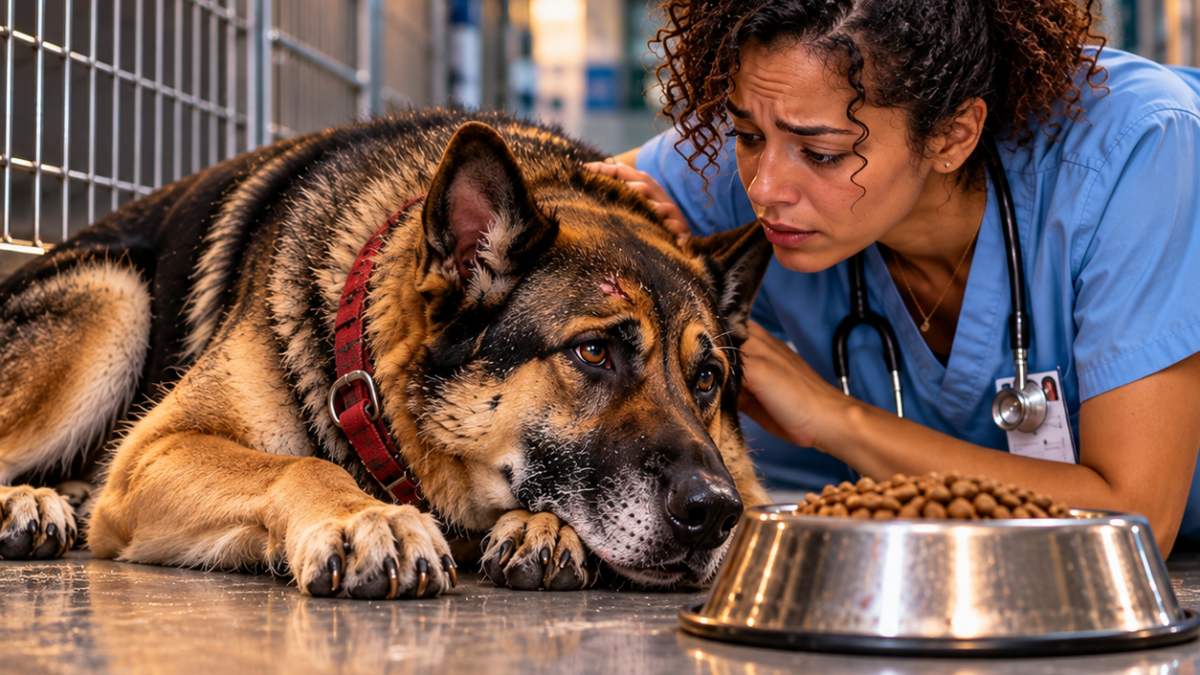
PART2:
Corporal Jamie Voss stood beside her.
“Three bites of boiled chicken at 2 p.m.”
“Water?”
“Some.”
“Urination?”
“Reduced.”
“Stool?”
“Minimal. Nothing overnight.”
“Vomiting?”
“No.”
“Abdominal pain?”
“Nothing obvious.”
Dr. Cole exhaled through her nose.
“Weight?”
Jamie checked.
“Down another pound and a half.”
She closed her eyes briefly.
Not good.
Grief could reduce appetite.
Grief could make dogs withdraw.
Grief could disrupt sleep, movement, social behavior.
But twelve days of inadequate nutrition in an older dog was no longer a sentimental story about loyalty.
It was a medical problem.
Potentially fatal.
“We repeat chemistry this morning.”
Jamie nodded.
“Ultrasound?”
“If his abdominal exam changes or labs point us there.”
She looked through the glass.
“And call nutrition.”
Jamie hesitated.
“For assisted feeding?”
“We need a plan ready.”
He looked at Ranger.
“You think we’re there?”
“I think we’re approaching there.”
Jamie swallowed.
Ranger had been at Millbrook Military Veterinary Rehabilitation Center for nine days.
Everyone had gotten attached.
That happened fast with old working dogs.
People saw the scars.
The service records.
The photographs.
They forgot that the animal in front of them did not know he was decorated.
Did not understand retirement certificates.
Did not care that a commander once shook Ethan’s hand and called them one of the best teams in the unit.
Ranger knew routines.
Smells.
Footsteps.
Commands.
The pressure of Ethan’s hand behind his ears.
The sound of a truck in the driveway.
The click of one particular leash.
The voice that said:
I’m back.
Six weeks earlier, that voice had stopped forever.
Ethan Calloway died at forty-one.
Not in combat.
Not dramatically.
Not in uniform.
He collapsed in his kitchen on a Tuesday afternoon.
An undiagnosed cardiac condition.
By the time paramedics arrived, Ranger was lying beside him.
Mara Calloway—Ethan’s older sister—found both of them.
Ethan on the floor.
Ranger pressed against his chest.
After the ambulance left, Ranger remained at the front door until morning.
He ate that night.
A little.
He ate the next morning too.
Then less.
Then only from Mara’s hand.
Then not from her hand.
Then not at all.
She took him to Ethan’s civilian veterinarian.
Bloodwork.
X-rays.
Medication review.
Nothing obvious.
After eight days of decline, the veterinarian recommended Millbrook.
The center specialized in retired working dogs.
Joint disease.
Behavioral transitions.
Neurological conditions.
Chronic injuries.
Trauma.
Handlers joked that Millbrook was where old warriors went when their bodies finally got permission to admit they’d been hurt.
Mara had arrived in tears.
“Please don’t let him die because Ethan did.”
Dr. Cole never promised outcomes.
She said:
“We’ll do everything appropriate to understand why he isn’t eating.”
Mara had stared at her.
“That’s not what I asked.”
“I know.”
That was the beginning.
Now, on the twelfth day, Ranger had stopped looking at food.
At 7:18 a.m., a woman carrying a clipboard walked into the kennel wing.
Dark green scrubs.
Silver chain tucked beneath her collar.
Short black curls.
Thirty-four years old.
Her name was Nadia Ellis.
Her first week.
New enough that she still checked door labels twice.
Experienced enough that she didn’t pretend being new meant knowing nothing.
Seven years in veterinary nursing.
Emergency medicine.
Orthopedic recovery.
Retired police dogs.
Search-and-rescue dogs.
Two years at a nonprofit serving service animals with chronic pain.
Millbrook was her first military facility.
Jamie handed her Ranger’s chart.
“This is the one.”
She glanced toward kennel six.
“The shepherd?”
“Ranger.”
She looked at the dog.
“He’s asleep?”
“No.”
Nadia noticed.
Eyes open.
Fixed on the corridor.
“Hasn’t eaten breakfast?”
“Not a bite.”
“Anything overnight?”
“No.”
She read the chart.
Then:
“Any vomiting?”
“No.”
“Diarrhea?”
“No.”
“Pain response?”
“Arthritis, but nothing acute.”
“Dental?”
“Checked.”
“Medication side effects?”
“Being reviewed.”
“Pancreas?”
“Nothing definitive.”
“Kidneys?”
“Changes consistent with dehydration, not enough to explain everything.”
Nadia nodded.
“So we don’t call this grief and stop looking.”
Jamie glanced at her.
“No.”
“Good.”
She wasn’t being cold.
She had seen grief become an excuse before.
In humans and animals.
Once somebody decided a symptom had an emotional explanation, every physical possibility started looking inconvenient.
Nadia hated convenient diagnoses.
She crouched near the kennel glass.
Ranger’s eyes did not move toward her.
Instead, a cart rattled somewhere near reception.
His ears lifted.
Head rose.
His entire body sharpened.
For three seconds the sick old dog disappeared.
In his place was a military working German Shepherd.
Alert.
Listening.
Waiting.
A vehicle passed outside.
Ranger stood.
Stiffly.
His nose pointed toward the main corridor.
The engine faded.
Ranger stayed standing another moment.
Then lowered himself.
The change hurt to watch.
Nadia asked:
“How often does he do that?”
Jamie looked.
“That?”
“When a vehicle passes.”
“All the time.”
“And the main entrance?”
“Same.”
“He’s waiting.”
Jamie nodded.
“For Ethan.”
Nadia looked at him.
“How long has Ethan been dead?”
“Six weeks.”
“How long did Ranger live with him after retirement?”
“Eighteen months.”
“Only him?”
“Mostly.”
Nadia opened the chart.
“Family?”
“Sister. Mara.”
“Any other handler?”
“Not after retirement.”
Nadia continued reading.
There were photographs.
Service documents.
Retirement notes.
One image stopped her.
Ranger younger.
Black tactical harness.
Ears high.
Mouth open.
Ethan Calloway beside him.
Broad smile.
One hand on Ranger’s shoulder.
On the back, somebody had written:
He doesn’t need me to be fearless. He needs to know I’ll come back.
Nadia read it twice.
Jamie saw.
“Ethan wrote that.”
“Interesting.”
“He was like that.”
“Like what?”
“With Ranger.”
Jamie shrugged.
“Talked to him like a person.”
Nadia looked at Ranger.
“A lot of handlers do.”
“Yeah, but Ethan meant it.”
She turned toward the final transition notes.
Known settling routine.
Handler approaches from left.
Crouches.
Avoids direct restraint.
Brief forehead contact.
Familiar homecoming phrase.
Nadia looked up.
“What phrase?”
Jamie shook his head.
“Not recorded.”
“Who wrote this?”
“Retirement transition specialist.”
“Can we contact them?”
“Already sent a message.”
“Former unit?”
“Records office is moving some archived files.”
“How long?”
“Day or two.”
Nadia looked back at Ranger.
“Has Mara heard the phrase?”
“Nobody asked.”
Nadia stood.
“Let’s ask.”
Before calling Mara, she entered the kennel.
Slowly.
Sideways.
No reaching.
Ranger glanced once.
Nothing more.
Nadia placed a small bowl of warmed food several feet away.
Chicken.
Rice.
A little broth.
She sat against the opposite wall.
No command.
No coaxing.
No “good boy.”
No emotional pleading.
Animals didn’t eat because humans needed hope.
Five minutes.
Ranger lifted his nose.
Sniffed.
Nadia did not move.
He stood.
Walked toward the food.
Jamie appeared in the observation window.
Nadia ignored him.
Ranger reached the bowl.
Sniffed once.
Twice.
Nadia’s chest tightened.
One bite.
Please.
The dog turned away.
Walked to the kennel door.
Pressed his nose beneath the gap.
Sniff.
Sniff.
Scratch.
Nadia leaned forward.
Ranger scratched again.
“What is it?”
No response.
Jamie opened the outer door.
“He does that.”
“Since when?”
“Since he arrived.”
“Always same place?”
“Mostly.”
“Anyone check underneath?”
Jamie frowned.
“Underneath the door?”
“Yes.”
“It’s a hallway.”
“I can see that.”
“Cleaning chemicals. Shoe dirt. Other dogs.”
“Maybe.”
She stood.
There was a thin dark streak near the threshold.
Could be dirt.
Rubber residue.
Wheel mark.
Nothing.
Nadia photographed it.
Jamie smiled.
“You think you’ve found something?”
“No.”
That answer surprised him.
“I think I’ve found a dirty line on the floor.”
“So why photograph it?”
“Because Ranger cares.”
Jamie nodded.
Fair.
Nadia crouched again.
Ranger had returned to the doorway.
Not food.
Door.
Waiting.
At 1:12 p.m., Nadia called Mara.
Mara answered on the second ring.
“How is he?”
No hello.
Nadia understood.
“My name is Nadia Ellis. I’m one of the veterinary nurses working with Ranger.”
“Did he eat?”
“Not yet.”
Silence.
Mara inhaled slowly.
“Okay.”
“We’re continuing his medical workup.”
“I know.”
“I also want to understand his routine with Ethan.”
Mara said nothing.
Nadia continued carefully.
“There is a note in Ranger’s retirement file about a homecoming routine.”
Mara’s breathing changed.
“What note?”
“Ethan approached from the left, crouched, forehead contact, familiar phrase.”
“Oh.”
“You know it?”
“I think so.”
“What was it?”
Mara hesitated.
“I’m not sure.”
Nadia waited.
“It was something Ethan said after deployments.”
“Can you remember?”
“I don’t want to give you the wrong thing.”
“That’s okay.”
“No.”
Mara sounded suddenly emotional.
“If Ranger recognizes it, I don’t want to get it wrong.”
Nadia respected that.
“Then don’t guess.”
Silence.
“I’ll think.”
“Good.”
Nadia asked:
“Before Ethan died, did Ranger behave differently?”
Mara took several seconds.
“He followed him more.”
“How much?”
“Everywhere.”
“Unusual?”
“Ranger always followed Ethan.”
“More than normal?”
“Yes.”
“When did it start?”
“Maybe a week before.”
“Any illness?”
“Ethan?”
“Ranger.”
“No.”
“Exposure to anything?”
“No.”
“Medication?”
“Same arthritis meds.”
“Chemicals?”
“Not that I know.”
“Any vomiting?”
“No.”
“Changes in appetite before Ethan died?”
Mara thought.
“No.”
Then:
“Actually, maybe.”
Nadia leaned forward.
“What?”
“He didn’t finish breakfast the morning Ethan died.”
“Was that unusual?”
“Very.”
“Anything else?”
Mara became quiet.
“There is one thing.”
“Tell me.”
“It sounds stupid.”
“Good. Those are often useful.”
Mara almost laughed.
“The night before Ethan died, Ranger kept going to the back door.”
“Why?”
“I don’t know.”
“Needed outside?”
“No.”
“How do you know?”
“Ethan opened it once. Ranger didn’t go out.”
Nadia wrote.
“What did he do?”
“Sniffed.”
“Where?”
“The bottom of the door.”
Nadia stopped writing.
Same behavior.
“Then?”
“He went back to Ethan.”
“How many times?”
“Maybe six.”
“What did Ethan say?”
Mara gave a sad laugh.
“He said Ranger was hearing ghosts.”
Nadia looked through the window at kennel six.
Ranger’s nose was again near the gap beneath the door.
“Anything outside?”
“I don’t know.”
“Trash?”
“No.”
“Garage?”
“Detached.”
“Cleaning products?”
“Kitchen nearby, but nothing different.”
“Back door ever left open?”
“No.”
Nadia wrote:
back door—repeated sniffing—night before death.
“Did Ethan mention veterinary appointment?”
“No.”
“Any note?”
“Not that I saw.”
“Would you look?”
Mara became quiet.
“Yes.”
“Don’t throw anything away.”
A pause.
“What do you think this means?”
Nadia answered honestly.
“I don’t know.”
Mara sounded disappointed.
Nadia continued:
“And I don’t want to invent an answer because we’re scared.”
That mattered.
“Okay.”
“We’ll keep looking.”
At 6:30 that evening, Millbrook reception received a call.
Male voice.
Asked about Ranger.
Receptionist transferred him to Dr. Cole.
“Who is this?”
“Daniel Mercer.”
“Your relationship to Ranger?”
“Served with Ethan.”
Dr. Cole sat straighter.
“What can I help you with?”
“I heard he’s not eating.”
“How?”
“Mara told somebody from the old unit.”
Dr. Cole waited.
Daniel asked:
“Has he been reacting to smells?”
That was strange.
“Why?”
Silence.
“Mr. Mercer?”
“There was something during Ranger’s last deployment.”
“What?”
“Storage facility.”
“Explain.”
Daniel breathed.
“Ranger wouldn’t enter one corridor.”
“Because?”
“We didn’t know at first.”
“And then?”
“Solvent leak.”
Dr. Cole looked toward Nadia, who had entered the office.
Nadia heard only half.
Dr. Cole put the call on speaker.
“Go on.”
Daniel hesitated.
“Ethan never thought the final report explained everything.”
“Why are you calling now?”
Another silence.
“Because before Ethan died, he sent me a message.”
Nadia looked at Dr. Cole.
“What message?”
Daniel said:
“Ranger’s doing it again.”
Then the call dropped.
Dr. Cole stared at the phone.
Nadia said:
“Call him back.”
Number blocked.
No answer.
“What the hell was that?”
Dr. Cole looked irritated.
“Possibly nothing.”
“Possibly not.”
Nadia said:
“I need the deployment record.”
“Request it.”
“Already starting.”
“Good.”
Then Dr. Cole looked at her.
“Remember.”
“I know.”
“What?”
“Association is not causation.”
“I know.”
“A weird smell eighteen months ago does not explain twelve days of anorexia.”
“I know.”
“Ethan’s death matters.”
“I know.”
“Age matters.”
“I know.”
“Pain matters.”
“I know.”
Dr. Cole finally smiled.
“You’re annoying.”
“First week.”
“Promising.”
That night Nadia stayed twenty minutes after shift.
Ranger had not eaten dinner.
She sat outside the kennel.
“You don’t know me.”
His ears moved.
“I don’t know Ethan.”
Nothing.
“I don’t know what you’re waiting for.”
Ranger lifted his head.
Nadia continued.
“But I promise you something.”
His eyes met hers.
“I won’t call it grief just because grief is obvious.”
Ranger stood.
Walked toward the door.
Sniffed beneath.
Then made a sound.
Small.
Strained.
The first vocalization anyone had heard from him since arrival.
Jamie, walking past, stopped.
“Was that him?”
Nadia nodded.
Ranger whined again.
Nose against the threshold.
Jamie whispered:
“Jesus.”
Nadia didn’t believe dogs gave testimony.
Not the way humans did.
But behavior was data.
Ranger kept repeating something.
They just didn’t know what question he was answering.
The next morning, Nadia and Jamie reviewed overnight footage.
Most was boring.
Ranger sleeping.
Standing.
Drinking once.
Changing position.
At 9:42 p.m., a facility employee pushed a sealed gray equipment container down the corridor.
Ranger shot up.
Not slowly.
Up.
Nose working.
He followed the movement from inside his kennel.
Scratched beneath the door.
Whined.
Nadia paused.
“What is that container?”
Jamie checked the transport log.
“Storage.”
“What’s inside?”
“Old gear.”
“What kind?”
“Harnesses. Training equipment. Retired stuff.”
“From?”
“Multiple units.”
“Could Ranger’s old equipment be in it?”
“Maybe.”
Nadia looked again.
The container was gone.
She called facilities.
“Don’t open it near animals.”
The safety officer sounded annoyed.
“Why?”
“Because a dog with prior environmental scent-response history is reacting to it.”
“You think it’s hazardous?”
“I think we don’t know.”
“That’s not the same.”
“Exactly.”
That answer worked.
Container isolated.
Exterior sampled.
Contents inventoried.
No active hazardous chemical found.
Standard cleaning residue on exterior.
Old harnesses.
Muzzles.
Training leads.
Protective sleeves.
One harness carried an identification number connected to Ranger’s former unit.
Nadia stared at it.
Jamie said:
“So he recognized his old gear.”
“Maybe.”
“That’s it?”
“No.”
“What?”
“He reacted before the container came level with the kennel.”
“Dogs smell things.”
“Yes.”
“What are you thinking?”
“I don’t know.”
“You say that a lot.”
“Good clinicians do.”
The archive report arrived at noon.
Training facility.
Temporary storage building.
Eighteen months before Ranger’s retirement.
Several dogs agitated.
Ranger refused corridor.
Ethan reported concern.
Area evacuated.
Maintenance inspection.
Damaged industrial solvent container.
Ventilation.
No acute injury.
No documented lasting exposure.
One handwritten note:
Ranger alerted prior to container opening. Check ventilation pathway.
Another note:
No further action required after site clearance.
Nadia read the final sentence.
No further action required.
She disliked sentences like that.
Not because they were always wrong.
Because they made people stop looking.
Dr. Cole read everything.
“Interesting.”
“You think relevant?”
“Historically.”
“To now?”
“Unknown.”
Nadia nodded.
“Exactly.”
The container at Millbrook was cleared.
No hazard.
That should have ended the thread.
Then Daniel Mercer called again.
This time from an identifiable number.
Nadia answered with authorization from Dr. Cole.
“Mr. Mercer?”
“Yes.”
“You called yesterday.”
“I’m sorry.”
“Why’d you hang up?”
“I got nervous.”
“About what?”
“I don’t want people thinking Ethan was paranoid.”
Nadia leaned back.
“Tell me what you have.”
Daniel sighed.
“We served together during Ranger’s final deployment.”
“Okay.”
“After that solvent thing, Ethan got weird about smells.”
“Weird how?”
“Protective.”
“Of Ranger?”
“Yes.”
“Why?”
“He thought Ranger had been exposed longer than they admitted.”
“Evidence?”
“No.”
“Symptoms?”
“Not really.”
“Then?”
“Ranger reacted to similar smells later.”
“What similar smells?”
“Cleaning solvents. Some fuel additives. One maintenance building.”
“Any illness?”
“No.”
“Veterinary evaluation?”
“Normal.”
Nadia wrote.
Daniel continued:
“Everybody told Ethan he was overthinking it.”
“Were they?”
“Maybe.”
His honesty helped.
“Then three days before he died, Ethan sent me a picture of a notebook page.”
“Do you still have it?”
“Yes.”
“Send it through secure intake.”
“What does it say?”
Daniel read:
Ranger keeps checking back door. Same reaction as storage incident. Probably unrelated, but asking vet to check him. Don’t want to ignore a pattern just because everyone thinks I’m overreacting.
Nadia stared.
Three days before Ethan died.
“Did Ethan say he smelled anything himself?”
“No.”
“Did he feel sick?”
“He said tired.”
“More than normal?”
“I don’t know.”
“Any headaches?”
“He complained once.”
“When?”
“That week.”
Nadia’s pulse changed.
Careful.
“Mr. Mercer, I’m going to ask you something important.”
“Okay.”
“Do you have any reason to believe Ethan’s death was caused by chemical exposure?”
Daniel went silent.
Then:
“No.”
“Any evidence?”
“No.”
“Any doctor told you that?”
“No.”
“Then do not start telling people that.”
He sounded offended.
“I wasn’t—”
“I’m serious.”
“I loved Ethan.”
“Then protect the truth.”
Silence.
Finally:
“Okay.”
Nadia continued:
“We can investigate Ranger’s behavior without turning it into a theory about Ethan’s death.”
“His heart.”
“What?”
“They said his heart.”
“I know.”
“Genetic thing.”
“Yes.”
Daniel exhaled.
“Ethan’s dad died young too.”
That mattered.
Known familial cardiac issue.
Not solvent.
Not conspiracy.
Not cover-up.
Just tragedy.
Nadia thanked him.
An hour later his note arrived.
Authentic enough to review.
Mara searched Ethan’s house.
At 5:17 p.m. she called Nadia.
“I found something.”
“What?”
“Appointment card.”
“For Ranger?”
“Yes.”
“When?”
“Day after Ethan died.”
Nadia closed her eyes.
Reason for visit?
“There’s handwriting.”
“What does it say?”
“Ask about back door smell.”
Silence.
Mara began crying.
“He was going to take him.”
“Yes.”
“He noticed.”
“Yes.”
“I didn’t.”
“Mara.”
“I was there.”
“You didn’t live there.”
“I was there that night.”
“You were visiting.”
“I should have—”
“No.”
Nadia stopped her.
“Do not turn a detail you didn’t understand into a crime you committed.”
Mara went quiet.
Nadia softened.
“We have the note now.”
“What does it mean?”
“We still don’t know.”
“I hate that.”
“I know.”
“Is Ranger sick from something?”
“We haven’t found evidence of ongoing toxic exposure.”
“Then why isn’t he eating?”
“Could be several things.”
“Grief?”
“Possibly major factor.”
“Pain?”
“Possible.”
“His kidneys?”
“Being monitored.”
“The smell?”
“Could be memory association.”
Mara sounded frustrated.
“I just want one answer.”
Nadia looked at Ranger.
“So does everyone.”
Then:
“Sometimes bodies don’t give us one.”
The four-word phrase remained unknown.
Until 8:03 that night.
Mara called back.
“I remember.”
Nadia stood.
“The phrase?”
“Yes.”
“You’re sure?”
“Yes.”
“What is it?”
Mara began crying before saying it.
“Ethan used to crouch beside him.”
Nadia waited.
“Always on the left.”
“Okay.”
“He would touch his forehead to Ranger’s.”
“Okay.”
“Then he said…”
Her voice broke.
“You’re home, old soldier.”
Nadia closed her eyes.
Four words.
You’re home, old soldier.
“Only after deployments?”
“Mostly.”
“Any other time?”
“After hard training.”
“After the storage incident?”
“Yes.”
“How often?”
“Whenever Ranger got restless.”
“Did Ethan use food after?”
“Sometimes.”
“Was it a command?”
“No.”
“Reward cue?”
“I don’t think so.”
“More like reassurance?”
“Yes.”
Mara sniffed.
“He’d say it, then sit with him until Ranger relaxed.”
Nadia looked toward kennel six.
“Thank you.”
“Are you going to say it?”
“Maybe.”
Mara sounded startled.
“Maybe?”
“I want to use the whole routine carefully.”
“Why?”
“Because the words aren’t magic.”
Mara went quiet.
Nadia continued:
“If Ranger responds, I don’t want anyone to decide we’ve cured him.”
“I understand.”
“Medical monitoring continues.”
“Yes.”
“If he doesn’t respond, it doesn’t mean Ethan meant less.”
Mara began crying again.
“Okay.”
At 8:15 p.m., Ranger’s food was warmed.
Small amount.
Not a full bowl.
Dr. Cole stood behind observation glass.
Jamie nearby.
No crowd.
No camera.
No emotional spectacle.
Nadia opened the kennel.
Entered.
Approached from Ranger’s left.
Stopped several feet away.
Waited.
Ranger looked at her.
Nadia crouched.
No reaching.
No collar.
No command.
The dog stared.
She lowered her head slightly.
Not touching yet.
Ranger moved forward half a step.
Nadia whispered:
“You’re home, old soldier.”
Ranger froze.
His ears rose.
Not dramatically.
Just enough.
His eyes changed.
Jamie covered his mouth.
Nadia stayed still.
Five seconds.
Ten.
Ranger’s shoulders loosened.
He stepped forward.
Sniffed Nadia’s fingers.
Then his forehead touched hers.
Nadia nearly cried.
She did not move.
Ranger pulled away.
Looked toward the bowl.
Walked to it.
Sniffed.
One bite.
Jamie inhaled sharply.
Dr. Cole lifted a hand.
Stay quiet.
Ranger chewed.
Second bite.
Third.
Fourth.
He stopped after maybe a quarter cup.
Turned.
Returned to his bedding.
Lay beside Ethan’s old red collar.
Nadia sat on the concrete.
Tears finally came.
Jamie whispered through the intercom:
“Holy hell.”
Dr. Cole immediately said:
“No.”
Jamie looked at her.
“No miracle language.”
“I wasn’t—”
“No.”
She entered the room.
“Document quantity.”
“Okay.”
“Time.”
“Okay.”
“Behavior.”
“Yes.”
“Continue hydration.”
“Yes.”
“Tomorrow we reassess.”
Jamie nodded.
Then smiled.
“But he ate.”
Dr. Cole looked through the glass at Ranger.
“Yes.”
Her own eyes were wet.
“He ate.”
Mara arrived the next morning before visiting hours.
She was carrying Ethan’s red flannel shirt.
Nadia met her at reception.
“He ate again.”
Mara stopped walking.
“How much?”
“Small portion.”
“Oh my God.”
“Don’t run ahead.”
“I know.”
Mara covered her face.
“I know.”
Nadia waited.
Mara whispered:
“Did you say it?”
“Yes.”
“And?”
“He responded.”
Mara cried harder.
“Thank you.”
Nadia shook her head.
“No.”
“What?”
“Don’t thank me like I brought Ethan back.”
Mara looked at her.
“I didn’t mean—”
“I know.”
Nadia softened.
“I just used something familiar.”
Mara nodded.
“Still.”
They entered Ranger’s wing.
The dog saw Mara.
Stood.
Slowly.
She didn’t rush him.
That had been difficult to learn.
Grief makes humans want to grab.
Ranger approached.
Sniffed her pants.
Then the flannel shirt.
His entire body became still.
Mara crouched.
“Hey, buddy.”
Ranger pushed his nose into the shirt.
Inhaled.
Again.
Then sat.
Mara began sobbing.
Ranger rested his head against her chest.
Nadia turned away.
Some moments didn’t improve with witnesses.
Over the next week, progress came unevenly.
Breakfast.
Half.
Dinner.
Nothing.
Next morning.
Three bites.
Afternoon.
Chicken.
Full portion.
Then another refusal.
Dr. Cole kept testing.
Kidney values improved with hydration.
No significant gastrointestinal disease found.
Arthritis management adjusted.
Dental pain remained unlikely.
Ultrasound showed age-related changes but no obstructive mass.
No evidence of current poisoning.
No magical diagnosis.
Grief.
Disruption.
Pain.
Age.
Routine collapse.
Possibly sensory memories linked to odors.
All interacting.
Ranger was a body, not a metaphor.
That mattered.
Nadia built a schedule.
Same feeding times.
Same bowl location.
Same staff whenever possible.
Mara visited Tuesdays, Thursdays, Saturdays.
Short walks.
No crowding.
No constant phrase.
“You’re home, old soldier” was used only when Ranger became visibly restless.
Jamie disagreed.
“Why not say it every meal?”
“Because then it becomes noise.”
“He eats after.”
“Sometimes.”
“Isn’t that the point?”
“No.”
“What is?”
“That he learns safety doesn’t depend on somebody recreating Ethan perfectly.”
Jamie thought.
“We’re trying to move him forward.”
“Yes.”
“Feels cruel.”
“Sometimes progress does.”
Ranger began barking again.
First at a delivery truck.
One short bark.
Jamie looked at Nadia.
“That.”
“What?”
“He used to do that.”
Nadia smiled.
“Complain?”
“Constantly.”
Ranger barked again.
Jamie laughed.
“He’s back.”
Nadia shook her head.
“No.”
Jamie looked.
“He’s not going back.”
The distinction mattered.
“He’s becoming whatever comes next.”
Two weeks after the historical records review began, Dr. Cole received the final safety summary.
No current chemical hazard at Millbrook.
Old container harmless.
Historical solvent incident documented.
No evidence of permanent toxic injury.
No evidence connecting the old incident to Ethan’s death.
Ranger’s reaction likely represented learned odor association or heightened scent sensitivity.
The “mystery” had no villain.
Nadia felt relief.
And something else.
Disappointment embarrassed her.
Part of the human brain wants dramatic explanations.
Hidden danger.
Negligence.
Secret.
Something that makes loss solvable.
Instead, Ethan had died because his heart failed.
Ranger had lost the person around whom his life had been organized.
The old dog had remembered strange smells because dogs remember.
That was all.
Or enough.
Mara came in carrying a cardboard box the afternoon the report closed.
“I found more of Ethan’s things.”
Nadia groaned jokingly.
“No more mysteries.”
“I don’t think this is one.”
Inside:
Photographs.
Old Ranger collar.
A training patch.
Three notebooks.
And an envelope.
No stamp.
Front:
RANGER.
Nadia stared.
“What is this?”
“I don’t know.”
“You opened it?”
“No.”
“Why bring it here?”
Mara’s hands trembled.
“Because I can’t read it alone.”
Nadia hesitated.
“This isn’t mine.”
“I know.”
“It’s yours.”
“Please.”
They sat in the family consultation room.
Ranger slept in the exercise yard beyond the window.
Mara opened the envelope.
One page.
Ethan’s handwriting.
Ranger,
If you’re reading this, someone has probably found the box of old photographs I keep pretending I don’t care about.
Mara laughed through tears.
“That sounds like him.”
She continued.
You’ve been with me through more than I know how to explain.
You knew when I was tired.
When I was afraid.
When I was pretending not to be either.
You never asked me to be fearless.
You never asked me to be perfect.
You waited for me to come back.
Nadia looked through the glass.
Ranger slept in sunlight.
Mara kept reading.
I don’t know how many years we’ll get after service.
I hope plenty.
But you’re older now, and apparently so am I, according to people who enjoy ruining my day.
Mara laughed.
Then covered her mouth.
If there ever comes a day when one of us has to live without the other, I hope someone gives you the patience you gave me.
You don’t owe me bravery forever.
You don’t have to keep watch at the door.
You are allowed to rest.
You’re home, old soldier.
Mara could not continue.
There was nothing else.
Nadia took the page only when Mara offered it.
She read the last line again.
You don’t have to keep watch at the door.
Nadia’s throat tightened.
That was what Ranger had done for six weeks.
At home.
At Millbrook.
Every engine.
Every footstep.
Every corridor sound.
Door.
Door.
Door.
Waiting.
Mara whispered:
“Do you think he knew?”
“Knew what?”
“That Ethan would die.”
“No.”
Immediate.
Mara stared.
“You’re sure?”
“No one can know what Ranger perceived.”
“But the back door.”
“He could have smelled something unrelated.”
“The appetite.”
“One breakfast.”
“The following.”
“Dogs notice behavior.”
Mara looked desperate.
“Maybe Ethan knew.”
Nadia shook her head.
“The letter doesn’t prove that.”
“What if he knew his heart was bad?”
“Did he?”
“No.”
“Then don’t create a goodbye Ethan didn’t know he was writing.”
Mara cried.
“Why not?”
“Because you already have a real goodbye.”
Nadia touched the letter.
“He wrote this someday.”
Not tomorrow.
Not next week.
Someday.
A handler thinking about an aging dog.
A man imagining the ordinary cruelty of time.
He didn’t know time was closer than expected.
That made the letter sad enough.
It didn’t need prophecy.
Mara wiped her face.
“He told Ranger he could stop waiting.”
“Yes.”
“What if that’s what the phrase meant?”
Nadia looked at the dog.
“Maybe Ethan wanted home to mean more than his presence.”
Mara cried again.
That afternoon, Nadia entered Ranger’s yard carrying the letter.
Not because he could read it.
Because humans need rituals.
She sat beside him.
Ranger lifted his head.
“You had a smart man.”
His tail moved once.
Nadia smiled.
“Don’t get proud.”
Ranger rested again.
She read the letter aloud.
All of it.
When she reached:
You don’t have to keep watch at the door.
Ranger’s ear moved.
Probably voice tone.
Probably coincidence.
Nadia let it be what it was.
She finished.
“You’re home, old soldier.”
Ranger sighed.
Long.
Then slept.
Three weeks later, the team planned a home trial.
Mara had been asking.
Dr. Cole agreed Ranger was medically stable enough with monitoring.
Not cured.
Stable.
There is a difference families often don’t want to hear.
Mara prepared Ethan’s house.
Removed slippery rugs.
Then added better nonslip rugs.
Moved Ranger’s water bowl higher.
Installed a ramp by the porch.
Cleared medications.
Set feeding schedule.
Kept Ethan’s chair where it was.
Nadia asked:
“Why?”
Mara looked at it.
“Because moving everything feels like pretending he never lived here.”
Fair.
First home visit lasted two hours.
Ranger entered.
Stopped.
The house smelled like Ethan.
Less than before.
Still enough.
Ranger walked to the living room.
Empty chair.
Sniff.
Kitchen.
Back door.
Sniff.
Bedroom hallway.
Returned.
Chair.
Lay down.
Mara stood frozen.
Nadia whispered:
“Let him.”
“He looks sad.”
“He is.”
“I want to help.”
“You are helping by not making him perform being okay.”
That landed.
At feeding time Ranger stood.
Looked at bowl.
Then front door.
Mara’s face fell.
“Oh no.”
Nadia sat on Ranger’s left.
Waited.
He looked.
She whispered:
“You’re home, old soldier.”
His ears lifted.
Not as dramatically anymore.
Good.
He sniffed Nadia’s hand.
Then the bowl.
Ate.
Slowly.
Mara cried.
Quietly.
Afterward Ranger returned to Ethan’s chair.
Sunlight had moved across the floor.
He laid his muzzle on Ethan’s old slippers.
Stayed.
No transformation.
No playful zoom around the house.
No cinematic recovery.
Just an old dog eating lunch and resting near the memory of his person.
It was enough.
The second visit lasted four hours.
Third—overnight.
Mara slept on the couch.
At 2:16 a.m., Ranger stood at the bedroom hallway.
Mara followed.
He went to Ethan’s room.
Stood near the bed.
Then returned to his own.
She almost called Nadia.
Didn’t.
Instead she sat nearby.
“It’s okay.”
Ranger lay down.
She did not use the four words.
That mattered.
In the morning he ate half breakfast without prompting.
Mara sent Nadia a photo.
EMPTY HALF BOWL.
Caption:
No phrase.
Nadia smiled.
Progress.
Then came the setback.
Two days later Ranger stopped eating again.
Mara panicked.
Called at 6:11 a.m.
“He’s doing it again.”
“How many meals?”
“One.”
“He didn’t eat dinner.”
“Water?”
“Yes.”
“Vomiting?”
“No.”
“Stool?”
“Normal.”
“Energy?”
“Slow.”
“Was yesterday unusual?”
Silence.
“Mara?”
“We went through Ethan’s clothes.”
Nadia understood.
“Did Ranger see?”
“Yes.”
“What did you do with them?”
“Bags.”
“Where?”
“Front hallway.”
Ranger had watched Ethan’s smell get put into bags beside the door.
From the dog’s perspective, maybe departure.
Maybe change.
Maybe nothing.
But the timing mattered.
Nadia drove over with Dr. Cole’s approval.
Ranger stood near the bags.
Not bowl.
Nadia said:
“Move them.”
Mara did.
Not hide.
Bedroom closet.
Ranger followed.
Sniffed.
Nadia did not use Ethan’s phrase.
She waited.
Twenty minutes.
Mara sat on the floor.
Finally Ranger drank.
Later ate several bites.
The next morning more.
Lesson:
Grief did not move in a straight line.
Neither did recovery.
Mara stopped measuring Ranger against yesterday.
She learned to watch patterns.
Two bad meals?
Call.
No water?
Call.
Vomiting?
Call.
Collapse?
Emergency.
But one quiet morning after a difficult reminder?
Give space.
Keep routine.
Observe.
That helped Mara too.
She was grieving Ethan while managing Ranger’s grief.
Sometimes she couldn’t tell which one she was reacting to.
One afternoon she snapped at Ranger for refusing the porch.
“Come on!”
The dog backed away.
Mara immediately cried.
“I’m sorry.”
Nadia, visiting for follow-up, said:
“Don’t apologize twelve times.”
Mara stared.
“What?”
“You startled him.”
“I feel terrible.”
“Then correct it.”
“How?”
“Lower your voice. Give him space. Try later.”
“That’s all?”
“That’s enough.”
Mara sat.
“I keep thinking if I do one thing wrong he’ll get sick again.”
“That’s anxiety.”
“I know.”
“It makes people controlling.”
Mara winced.
Nadia continued gently.
“Ranger survived war.”
“Yeah.”
“He survived retirement.”
“Yeah.”
“He survived losing Ethan.”
Mara’s eyes filled.
“He can survive you having a bad moment.”
She laughed through tears.
“That’s oddly comforting.”
“Good.”
At Millbrook, Jamie began telling the story incorrectly.
Not intentionally.
Visitors asked:
“Is that the dog who started eating because Nurse Nadia said some magic words?”
Nadia heard him once.
“Jamie.”
He froze.
“Uh-oh.”
“Come here.”
“I’m working.”
“Now.”
He approached.
She pointed at him.
“No magic words.”
“I know.”
“You just said magic words.”
“I said familiar phrase.”
“You implied miracle.”
“The visitors liked it.”
“I don’t care.”
Jamie grinned.
“I know.”
Nadia became serious.
“Ranger nearly required assisted nutritional support.”
“I know.”
“He was medically monitored.”
“Yes.”
“Pain management adjusted.”
“Yes.”
“Hydration supported.”
“Yes.”
“Environment stabilized.”
“Yes.”
“His family participated.”
“Yes.”
“The phrase was one piece.”
Jamie nodded.
“Okay.”
“Why does that matter?”
“So people don’t think grief is cured by saying the right sentence.”
“Good.”
Then Jamie smiled.
“But it is a hell of a sentence.”
Nadia sighed.
“Yes.”
It was.
You’re home, old soldier.
Four words carrying eight years of service.
Deployments.
Homecomings.
Fear.
Routine.
Ethan’s voice.
Hands on fur.
Door opening.
Return.
No wonder the words mattered.
But Ranger had to learn something Ethan could not teach him directly.
Home could remain even when Ethan didn’t.
That took months.
By spring, Ranger was living with Mara permanently.
He had gained six pounds.
Not all lost weight.
Enough.
Blood values improved.
Arthritis still limited him.
He no longer jumped into vehicles.
Used a ramp.
Hated it.
Needed it.
His favorite place remained Ethan’s chair.
Technically beside it.
Ranger never climbed onto furniture.
Ethan had trained him too well.
Mara put a bed there.
Ranger ignored the bed and lay on the floor.
Eventually she moved the bed.
He followed the empty floor space.
“Fine.”
She gave up.
One April morning Ranger brought Mara his leash.
She stared.
He dropped it.
Looked at her.
Mara called Nadia.
“He brought the leash.”
Nadia laughed.
“Take him out.”
“What if—”
“Mara.”
“Right.”
They walked two blocks.
Ranger sniffed every mailbox.
Barked at a squirrel.
Returned exhausted.
Finished breakfast.
No phrase.
Mara sent the photo.
Nadia saved it.
Weeks later Daniel Mercer came to visit.
Ranger recognized him.
Not dramatically.
Sniff.
Tail wag.
Lean.
Daniel cried anyway.
“He remembers.”
Mara said:
“Apparently old soldiers do.”
They sat on the porch.
Daniel told stories.
Ethan once slept through a mortar alarm because he was wearing ear protection.
Ranger woke him by standing on his chest.
Ethan once lost a glove and blamed another soldier for taking it.
Ranger had buried it.
Ethan hated powdered eggs.
Loved gas-station coffee.
Sang country music badly.
Pretended not to talk baby voice to Ranger.
Absolutely did.
Mara laughed harder than she had since Ethan died.
Then Daniel became serious.
“I feel guilty.”
“Why?”
“He sent me the back-door note.”
“I know.”
“I told him he was overthinking.”
Mara looked at him.
“He probably was.”
Daniel laughed once.
“Maybe.”
“Did it kill him?”
“No.”
“Did it hurt Ranger?”
“We don’t know.”
“Then what are you guilty of?”
Daniel stared.
“Not taking him seriously.”
Mara understood.
She had her own version.
Nadia’s voice lived in her head now.
Don’t turn a detail you didn’t understand into a crime you committed.
She told Daniel.
He nodded.
“Sounds like her.”
Months passed.
The internet never learned Ranger’s story.
Not then.
There was no viral video.
No television crew.
Nadia preferred it.
But Millbrook staff began using Ranger’s case in internal training.
Not as “magic phrase.”
As a case about layered causes.
Behavioral grief.
Medical vulnerability.
Environmental cues.
Historical associations.
Importance of full records.
Family routines.
Avoiding premature assumptions.
One young technician asked:
“So what was the diagnosis?”
Dr. Cole answered:
“That’s the wrong question.”
The technician looked confused.
“Why?”
“Because sometimes there isn’t one box.”
She wrote on the board:
GRIEF
PAIN
AGE
DEHYDRATION
ROUTINE LOSS
SCENT ASSOCIATION
STRESS
“Medicine becomes dangerous when clinicians need reality to be simpler than it is.”
Nadia smiled.
She liked Dr. Cole more every week.
Ranger returned for monthly checks.
Then every six weeks.
He always walked first toward kennel six.
Sniffed the door.
Then Nadia.
Sometimes leaned against her.
Sometimes ignored her.
That was better.
Attachment had become less desperate.
At one visit, Nadia crouched.
“You don’t need me today?”
Ranger walked past.
Jamie laughed.
“Rejected.”
“Healthy boundaries.”
Ranger found Dr. Cole’s pocket and stole a liver treat.
Everyone cheered.
The dog who once ignored liver now committed theft for it.
Improvement.
On the first anniversary of Ethan’s death, Mara prepared badly.
She thought she was ready.
She wasn’t.
She woke at 4 a.m.
Couldn’t breathe.
Sat on kitchen floor.
Ranger found her.
The irony.
She had spent a year watching his grief.
Now the old dog stood beside hers.
Mara pressed her forehead to his.
Exactly how Ethan had.
Without planning, she whispered:
“You’re home, old soldier.”
Then cried because the words were not only for Ranger anymore.
Home.
Old soldier.
Come back.
Rest.
Stay.
Let go.
Everything at once.
Ranger licked her face.
She laughed.
“Gross.”
He did it again.
She took him outside at sunrise.
They walked Ethan’s favorite route.
At the hill overlooking Millbrook, Mara sat.
Ranger lay beside her.
She read Ethan’s letter aloud.
When she reached:
You don’t owe me bravery forever.
Mara stopped.
She realized she had been doing the same thing Ranger had.
Standing at a door.
Waiting.
Not literally.
But emotionally.
Waiting for grief to return Ethan.
Waiting for enough suffering to prove she loved him.
Waiting to feel permission to have a good day.
Ethan’s words had not been written to her.
They reached her anyway.
“You don’t owe me bravery forever.”
Mara cried.
Then she went home and packed Ethan’s clothes.
Not all.
A few shirts stayed.
His jacket.
One pair of boots.
Photographs.
The rest donated.
Ranger watched.
This time the bags went through the garage.
Not front door.
Mara laughed at herself.
“Compromise.”
Ranger slept through it.
Two years after Ethan died, Ranger slowed considerably.
Twelve.
Nearly thirteen.
Kidney disease progressed.
Arthritis harder.
Hearing faded.
Mara called Nadia.
Not panicked anymore.
“It’s time to talk.”
Nadia knew.
Quality of life.
Mobility.
Appetite.
Pain.
Interest.
Good days versus bad.
No single test.
Hard decisions.
Ranger still ate.
Still wanted short walks.
Still barked at trucks.
Still leaned into Mara.
Not time yet.
Three months later.
Harder.
He stopped bringing leash.
Still ate breakfast.
Four months.
Needed help standing some mornings.
Five.
Ate less.
Dr. Cole adjusted medications.
Six.
One morning Ranger walked to the front door.
Sat.
Mara thought he needed outside.
She opened it.
He stayed.
Looked down the driveway.
Same waiting posture from years earlier.
Mara’s heart broke.
Then Ranger turned.
Walked to Ethan’s chair.
Lay down.
Did not get up for breakfast.
Mara called Nadia.
“This feels different.”
Nadia came after shift.
Ranger looked at her.
Tail moved once.
His breathing was calm.
But his eyes looked tired.
Dr. Cole evaluated him the next morning.
Pain increasing.
Kidney function declining.
Appetite failing.
Could support.
Could hospitalize.
Could buy days.
Maybe weeks.
Mara asked:
“Would he enjoy them?”
Dr. Cole did not answer immediately.
That was answer enough.
Mara took Ranger home.
One final day.
Daniel Mercer came.
Jamie.
Nadia.
Dr. Cole.
No crowd.
No uniform ceremony.
Mara placed Ethan’s red collar beside Ranger.
He had worn it less lately because his neck skin had become sensitive.
She brought Ethan’s letter.
Ranger lay on a blanket in the sunlight near the back door.
The door he had once sniffed.
The door people thought might conceal a mystery.
It concealed nothing.
Just a yard.
Grass.
Wind.
Birds.
The ordinary world.
Mara sat on one side.
Nadia on the other.
Daniel said:
“Remember the fuel depot?”
Mara didn’t.
Ranger probably didn’t care.
Daniel told the story anyway.
Ethan had hidden behind Ranger during a rainstorm because Ranger had a better poncho.
Nadia laughed.
Mara said:
“He used a dog as an umbrella?”
“Essentially.”
“Coward.”
“Absolutely.”
They told stories until no one could talk.
Then Mara read the letter.
The whole thing.
Ranger’s breathing slowed.
At the end she placed her forehead against his.
“You don’t have to keep watch.”
Her voice broke.
“You don’t have to wait.”
Ranger closed his eyes.
Mara looked at Nadia.
“I can’t say the last line.”
Nadia understood.
She moved closer.
Not taking over.
Joining.
Mara kept one hand on Ranger’s chest.
Nadia touched his shoulder.
Together, quietly:
“You’re home, old soldier.”
Dr. Cole administered sedation first.
Ranger relaxed.
Deeper than he’d relaxed in months.
The final medication followed when Mara nodded.
Ranger’s breathing stopped beneath her hand.
No dramatic movement.
No final bark.
No sign from beyond.
Just stillness.
Mara sobbed into his fur.
Nadia stayed.
Not because she could fix it.
Because leaving immediately would have turned care into procedure.
Ten minutes.
Twenty.
No one rushed.
Finally Mara lifted her head.
“He found Ethan?”
Nadia’s eyes filled.
“I don’t know.”
Mara gave a small laugh.
“You still say that.”
“Yes.”
“Good.”
Nadia looked at Ranger.
“But if there’s anywhere old handlers and stubborn dogs get another door…”
Mara smiled through tears.
“I hope Ethan remembered the phrase.”
They cremated Ranger.
Half his ashes went with Mara.
Half were buried beside Ethan.
The marker was simple.
RANGER
MILITARY WORKING DOG
PARTNER OF STAFF SERGEANT ETHAN CALLOWAY
BENEATH:
YOU’RE HOME, OLD SOLDIER.
Mara worried the words might look strange to strangers.
Nadia said:
“They aren’t for strangers.”
That settled it.
Years later, Nadia became senior nursing coordinator at Millbrook.
Jamie became supervisor of kennel operations.
Dr. Cole retired and continued appearing twice a week because apparently retirement had failed.
Ranger’s case was still taught.
The story changed depending on who told it.
Some liked the four words.
Some liked the door.
Some liked the unanswered solvent thread.
Some liked the letter.
Nadia always corrected one thing.
“He did not start eating because language cured grief.”
Students nodded.
“He responded to a familiar safety routine.”
She pointed to the case summary.
“Meanwhile, medical care continued.”
Hydration.
Pain control.
Monitoring.
Nutrition.
Diagnostics.
Environment.
Family.
Time.
One student asked:
“Then why does everybody remember the phrase?”
Nadia smiled.
“Because humans like sentences.”
“What do dogs like?”
“Patterns.”
She paused.
“Presence.”
Another student asked:
“Did Ranger understand what the words meant?”
Nadia thought.
“Maybe not the dictionary meaning.”
“Then what?”
“He understood who used to say them.”
Pause.
“He understood what happened around them.”
Safety.
Return.
Rest.
Home.
That was enough.
Mara eventually started volunteering with families adopting retired service dogs.
She gave practical advice.
Buy rugs.
Protect joints.
Don’t change ten routines at once.
Watch appetite.
Don’t assume behavior is “just emotional.”
Don’t turn every odd behavior into a conspiracy either.
Get medical help.
Be patient.
Let old working dogs become dogs.
One couple asked her:
“How do you make them stop waiting for their handler?”
Mara became quiet.
“You don’t.”
They looked disappointed.
She continued:
“You give them something else to wait for.”
Breakfast.
A walk.
Your car.
The mailman.
A favorite blanket.
Tomorrow.
“Eventually, sometimes, they turn toward what’s still here.”
The woman asked:
“How long?”
Mara smiled sadly.
“However long.”
On Ethan’s fifth death anniversary, Mara visited his grave.
Ranger’s marker beside it.
She brought no flowers.
Ethan hated cemetery flowers.
She brought two gas-station coffees.
Set one down.
“Still terrible.”
Wind moved through the grass.
Mara sat.
She told Ethan about work.
About Nadia.
About the old house.
About selling his truck.
About keeping Ranger’s leash.
Then:
“I was mad at you.”
Silence.
“You died and left me with that dog acting like I could explain anything.”
She laughed.
“Typical.”
Tears came.
“You would’ve loved Nadia.”
Pause.
“No. Actually you would’ve argued constantly.”
She smiled.
“She never guesses when she can investigate.”
Another pause.
“She helped him.”
Mara touched Ranger’s stone.
“No.”
She corrected herself.
“She helped us.”
That felt more accurate.
Across town, Nadia was sitting with another retired working dog.
A Belgian Malinois named Rex.
Handler alive.
Different problem.
Hip surgery.
Anxiety.
No appetite after anesthesia.
A young technician said:
“Should we try Ranger’s phrase?”
Nadia looked at him.
“No.”
“Why not?”
“Because Rex isn’t Ranger.”
That was the whole point.
Care was not copying the dramatic thing that worked once.
Care was paying attention to the life in front of you.
“What does Rex know?”
The technician checked the chart.
“Handler says he settles when somebody taps the floor twice.”
“Then start there.”
Tap.
Tap.
Rex lifted his head.
Different dog.
Different language.
Same principle.
Years later, Millbrook built a small memorial garden behind the rehabilitation wing.
Names of working dogs.
Handlers.
Veterinary staff.
People lost.
Animals lost.
Ranger’s name was there.
Ethan’s too.
Not because their story was more important.
Because stories became easier to carry when they had somewhere to rest.
At the entrance, a bronze plaque carried a line taken from Ethan’s letter:
YOU DON’T OWE ME BRAVERY FOREVER.
Below it:
REST IS PART OF COMING HOME.
Nadia objected to the first design.
It included her name.
She made them remove it.
Jamie complained.
“You’re impossible.”
“Correct.”
“You’re part of the story.”
“I’m alive. I don’t need a plaque.”
“That’s not how plaques work.”
“Today it is.”
Her name stayed off.
But somebody hid four small words along the underside of a bench.
Nadia found them months later.
YOU’RE HOME, OLD SOLDIER.
She knew exactly who had done it.
Jamie denied everything.
Badly.
Nadia left it.
Some traditions deserved to remain.
When Mara turned sixty, she adopted another dog.
Not military.
Not decorated.
A mutt from the county shelter.
One ear up.
One ear down.
Terrible manners.
Name: Pickles.
Nadia laughed for five minutes.
“You went from Ranger to Pickles?”
“I needed less pressure.”
Pickles ate everything.
Shoes.
Paper.
Half a dish towel.
Once a piece of drywall.
Mara called Nadia.
“He won’t stop eating.”
Nadia said:
“Enjoy the symmetry.”
Mara hated her.
Pickles slept beside Ranger’s old leash.
Not because he understood.
Because it smelled like home.
Mara learned she could love a new dog without betraying the old one.
That lesson took longer than expected.
Everything important did.
Once, years after Ranger’s death, a local veteran organization asked Mara to tell the story at a fundraiser.
She said yes.
Then regretted it.
Standing at the microphone, she looked at hundreds of people.
“Everybody loves the part where he finally eats.”
People smiled.
“I love it too.”
Then she became serious.
“But that’s not the part I think about most.”
Silence.
“I think about the first eleven days.”
She looked down.
“Everybody kept putting food in front of him.”
Pause.
“We were trying.”
Another pause.
“But Ranger wasn’t asking for food first.”
“He was asking whether the world still worked the way it used to.”
Mara’s eyes filled.
“He was asking whether the door would open and Ethan would walk through.”
She touched the folded letter in her pocket.
“We couldn’t give him that.”
Silence.
“So we had to help him learn something harder.”
Her voice shook.
“That home could still be home even after somebody was missing.”
A woman in the audience began crying.
Mara continued:
“I think people do that too.”
She did not need to explain.
Everyone in the room knew.
We stand at doors.
Jobs.
Marriages.
Childhoods.
Old versions of ourselves.
Waiting for something finished to become unfinished again.
Sometimes love is not the thing that keeps us waiting.
Sometimes love is what finally gives us permission to turn around.
Years later, Nadia still remembered the exact second Ranger took the first bite.
Not because it looked miraculous.
It didn’t.
The bite was tiny.
Messy.
He dropped half of it.
Chewed slowly.
Nobody celebrated until afterward.
What Nadia remembered was the moment before.
The shoulders loosening.
The breath.
The nose against her hand.
The decision.
One small movement toward life.
That was medicine sometimes.
Not cure.
Movement.
One swallow.
One step.
One night of sleep.
One appointment.
One phone call.
One person willing to say:
I don’t know yet.
Then keep looking.
When Nadia finally retired from Millbrook at sixty-five, Jamie—now gray-haired himself—gave a speech.
“You all know Nadia hates sentimental stories.”
Nadia shouted:
“Correct.”
Laughter.
“She especially hates the phrase ‘miracle worker.’”
“Also correct.”
“So I won’t call her that.”
“Good.”
Jamie held up an old photocopy.
Ranger’s feeding chart.
Day twelve.
8:17 p.m.
Voluntary intake: several mouthfuls.
Familiar settling routine used.
Medical monitoring continued.
Nadia stared.
“You kept that?”
“Training archive.”
“You stole it.”
“Allegedly.”
He continued:
“Nadia taught us that compassion without curiosity can miss disease.”
Silence.
“And curiosity without humility can invent disease that isn’t there.”
Dr. Cole, ninety years old and sitting in the front row, nodded vigorously.
Jamie went on.
“She taught us not to call every behavior grief.”
“Not to call every strange detail a conspiracy.”
“Not to confuse one meaningful response with a cure.”
“And not to give up on a patient because the first eleven things didn’t work.”
Nadia looked down.
Jamie finished:
“Mostly she taught us that old soldiers—human or otherwise—sometimes need permission to stop standing guard.”
He handed her a small wooden box.
Inside was Ranger’s old red collar.
Mara had donated it years earlier to Millbrook’s archive.
Nadia shook her head.
“No.”
“Mara approved.”
“You can’t give me this.”
“Read the tag.”
A new brass tag hung beside the old one.
Four words.
YOU’RE HOME, OLD SOLDIER.
Nadia cried.
Everyone pretended not to notice for almost seven seconds.
Then Dr. Cole yelled:
“About time.”
The room laughed.
Nadia held the collar against her chest.
Ranger had been gone decades.
Ethan longer.
Mara was still alive.
Pickles somehow still eating things he shouldn’t.
Life had kept moving.
That’s what it does.
No matter how sacred the person who died.
No matter how loyal the dog.
No matter how long you watch the door.
Life keeps moving.
The question is whether you move with it.
Not away from what you loved.
With it.
Carrying what remains.
The routine.
The photograph.
The stupid gas-station coffee.
The leash.
The scar.
The phrase.
The memory of one man coming through a door after deployment, crouching to the left of a waiting German Shepherd, touching forehead to forehead, and saying the words that meant the dangerous part was finished.
You’re home, old soldier.
For Ethan, those words meant:
I came back.
For Ranger after Ethan died, they had to become something else.
You are safe even though I didn’t.
You can eat.
You can sleep.
You can stop listening for my truck.
You can love the person still standing here.
You can let tomorrow arrive.
Four words did not bring Ethan home.
They did not cure kidney disease.
They did not erase arthritis.
They did not explain every smell Ranger noticed.
They did not solve grief.
They did something smaller.
And maybe more important.
For one moment, they connected an old dog to a memory in which the world had once felt safe.
That moment gave Ranger enough room to take one bite.
Then another.
And months later, on a morning when nobody whispered anything at all, Ranger finished breakfast.
Afterward he picked up his leash.
Carried it to Mara.
Dropped it at her feet.
And looked toward the door.
Not because he believed Ethan was finally coming back.
Because, at last, Ranger was ready to go outside without him.





