A RETIRED COP TEASED A TERRIFIED PUPPY—BUT WHEN HE TRIED TO LEAVE, SHE EXPOSED THE SECRET SOMEONE HAD BURIED
PART3:
“You’re impossible.”
“So I’m told.”
His phone rang again.
Judith Harland.
Alden frowned.
Judith managed the Tiona Community Kitchen.
Sixty-three years old.
Widowed.
Efficient.
Almost aggressively practical.
She was not the sort of person who called Alden because a light bulb needed replacing.
He answered.
“What happened?”
No greeting.
Judith was used to that.
“I found a dog.”
Alden paused.
“You called the wrong retired cop.”
“She’s a puppy.”
“Still wrong.”
“She’s hiding inside the old Mercer nursery greenhouse.”
That changed his expression.
The nursery had been abandoned for nearly eight years.
Half the windows were broken.
The storage buildings were condemned.
Kids sometimes went there to drink beer in summer, but in winter nobody had any reason to be on the property.
“How young?”
“Three months maybe.”
“Hurt?”
“I can’t tell.”
“Animal control?”
“Called. Roads are icy north of Warren. They said at least two hours.”
Alden looked toward the sky.
Snow had begun falling again.
Thin.
Dry.
“Where are you?”
“Outside the greenhouse.”
“Don’t corner her.”
“I know.”
“Don’t reach.”
“I know.”
“Don’t—”
“Alden.”
“What?”
“I’ve handled dogs before.”
“Then why call me?”
Judith went quiet.
“Because something about this one feels wrong.”
Alden stared at his truck.
That sentence bothered him.
“How?”
“She isn’t acting lost.”
“What does that mean?”
“I don’t know.”
“Helpful.”
“She’s hiding like somebody taught her people are dangerous.”
Alden grabbed his gloves.
“I’m coming.”
Twenty minutes later, his SUV rolled through the sagging gate of the old nursery.
The greenhouse appeared through bare trees like the skeleton of something that had once been alive.
Cloudy glass.
Rusting aluminum frame.
Snow piled against one side.
Several panes missing entirely.
Judith stood near the entrance wearing a long brown coat and knitted hat.
She pointed inside as Alden approached.
“She’s behind the third planting table.”
“You went in?”
“Only enough to put food down.”
“Did she eat?”
“No.”
“Growl?”
“No.”
“Bark?”
“No.”
“Try to run?”
“She moves away every time I move toward her.”
Alden stepped inside.
The greenhouse smelled of frozen dirt, mildew, rotting wood, and old fertilizer.
Broken planters lay beneath benches.
Weeds had grown through cracks in the concrete and died with winter.
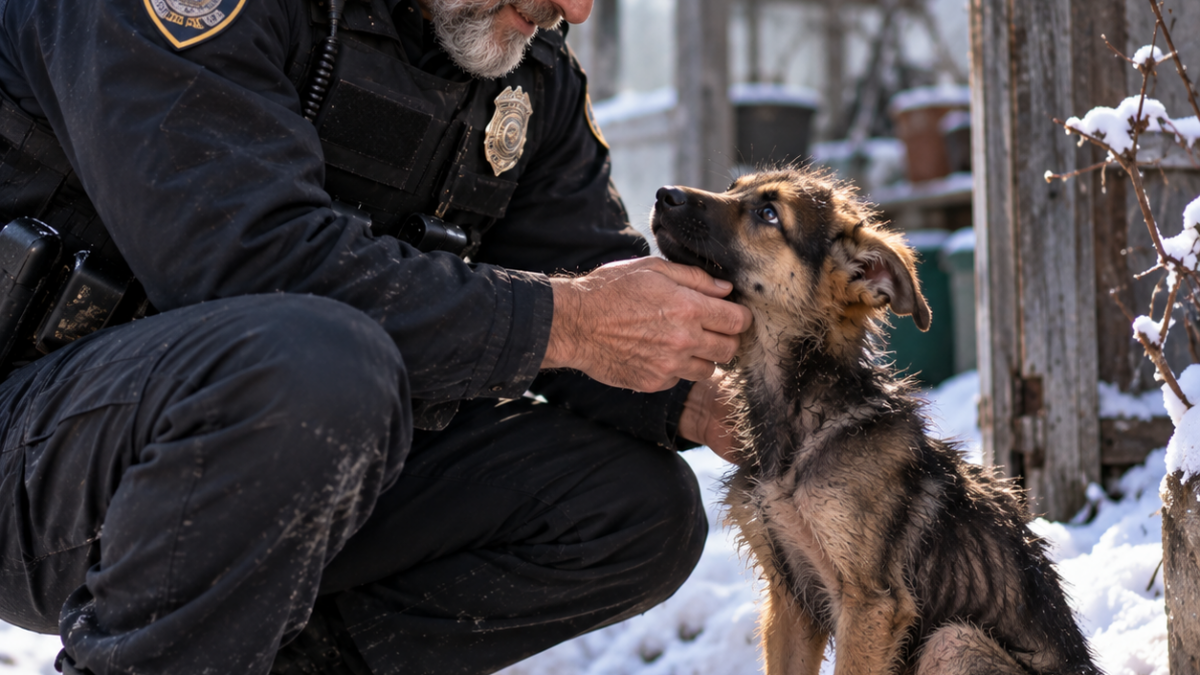
He saw the puppy immediately.
Black and tan.
Maybe eleven weeks.
Thin.
Too thin.
One ear nearly upright.
The other folding at the tip.
She stood behind an overturned planting table, staring at him.
Alden did not kneel.
People always thought kneeling automatically made them less threatening to dogs.
Sometimes it did.
Sometimes it meant a stranger had made himself smaller so he could reach faster.
Alden simply stood.
“Hey.”
The puppy moved backward.
One step.
Alden moved forward.
She moved back again.
He stopped.
Her body remained low.
No aggression.
No warning.
Just distance.
Alden studied her.
Then lifted an eyebrow.
“Fine.”
Judith called from behind him.
“Fine what?”
“You win.”
He turned around.
Judith stared.
“That’s it?”
Alden started toward the exit.
“What are you doing?”
“Leaving.”
“You drove twenty minutes.”
“I know.”
“The dog is still there.”
“I can see that.”
Then Alden heard it.
Click.
He stopped.
Click.
Click.
Tiny nails on concrete.
He did not turn around.
Judith’s eyes widened.
The puppy was following.
Alden took another step.
Click-click.
He almost smiled.
Thirty-two years in law enforcement had taught him that chasing somebody who desperately wanted distance usually produced one result.
More distance.
Sometimes if you stopped chasing, they showed you what they actually wanted.
Alden reached an old wooden cabinet near the greenhouse entrance.
Instead of going outside, he stepped around it and disappeared from the puppy’s view.
The footsteps continued.
Then stopped.
Silence.
Alden waited.
Five seconds.
Ten.
A small black nose appeared around the cabinet.
Then one brown eye.
Then the crooked ear.
The puppy looked toward the doorway.
Looked back inside.
Then slowly peeked around the cabinet again.
Alden leaned his head out from the opposite side.
“Looking for somebody?”
The puppy jumped backward.
Alden froze.
Judith slapped one hand over her mouth to hide a laugh.
The puppy stared at him.
Then, unexpectedly, her tail moved once.
Not a wag exactly.
A single uncertain sweep.
Alden smiled.
“So you do have a sense of humor.”
Judith shook her head.
“Did you just hide from a traumatized puppy?”
“No.”
“What do you call that?”
Alden looked at the dog.
“Poor surveillance.”
Judith laughed.
This time the puppy did not retreat.
Her head tilted.
Alden started walking again.
She followed.
He turned toward her.
She stepped back.
He turned away.
She came closer.
There it was.
The rule.
Do not come after me.
But do not disappear.
Alden understood rules.
Outside, he opened the rear door of his SUV.
Then stepped away.
The puppy stood at the greenhouse entrance.
Judith folded her arms.
“You think she’ll get in?”
“Her choice.”
The puppy stared at the vehicle.
Then Alden.
Then back at the greenhouse.
For several seconds, Alden thought she might retreat.
Instead, she stepped outside.
Sniffed the snow.
Moved closer.
Stopped.
Alden remained still.
Eventually she reached the SUV and put both front paws on the running board.
Her hind legs stayed on the ground.
She looked at Alden.
He approached carefully.
“Just a little help.”
His hands moved under her chest and belly.
The puppy stiffened.
But did not fight.
Alden lifted her the final few inches.
She curled immediately against the far side of the seat.
Judith came closer.
“What are you going to do with her?”
“Warm house tonight.”
Alden shut the door.
“Vet tomorrow.”
“And then?”
“Rescue.”
Judith nodded slowly.
“Of course.”
Alden looked at her.
“What does that mean?”
“Nothing.”
“That sounded like something.”
“Drive safely.”
Alden pointed at her.
“I know that look.”
“What look?”
“The one where you’ve already decided I’m doing something I haven’t decided.”
Judith smiled.
“Goodnight, Alden.”
He climbed into the SUV.
The puppy watched through the gap between the front seats.
Alden started the engine.
“One night.”
Her ears moved.
“Don’t get comfortable.”
The puppy lowered her head.
On the drive home, Alden passed a field where dried tansy stalks stood above the snow.
Most vegetation had collapsed beneath winter.
The tansy had not.
Brittle.
Brown.
Still upright.
Alden glanced at the rearview mirror.
“Tanzy.”
The puppy lifted her head.
He said it again.
“Tanzy.”
One ear twitched.
Alden nodded.
“That’ll do.”
His house had been too quiet for three years.
He would never have admitted that.
Silence had been something he wanted when he retired.
No radio.
No dispatcher.
No ringing department phone.
No intoxicated men yelling.
No supervisors asking for overtime.
No knock at three in the morning.
At first, retirement felt like freedom.
Then the quiet became enormous.
His wife, Marianne, had died six years before retirement.
Cancer.
Fourteen months from diagnosis to funeral.
Alden had responded by working.
More shifts.
More cases.
More hours.
He told people the department needed him.
Sometimes it did.
Mostly Alden needed the department.
Police work gave grief instructions.
Secure the scene.
Interview witnesses.
Protect evidence.
Call family.
Write report.
There were no instructions for waking at two in the morning and reaching toward a side of the bed that had been empty for years.
So he worked.
When retirement arrived, Alden discovered grief had been waiting patiently for him.
That was when he started helping everybody in town.
Batteries.
Shelves.
Pipes.
Groceries.
Anything with a solution.
Anything that let him be useful.
Tanzy entered that quiet house at 6:42 on a Thursday evening.
Alden opened the SUV door.
Waited.
She hesitated.
Then moved toward him.
He supported her down.
Inside, he placed a blanket near the heater.
Water.
Warm softened food.
He stayed across the room.
Tanzy drank.
Stopped.
Checked him.
Drank again.
She ate only after he sat in his chair and opened a newspaper.
Ten minutes later, she circled the blanket.
Lay down.
Kept one eye on him.
Alden pretended to read.
After another ten minutes, her eyes finally closed.
“One night,” he said.
Tanzy slept.
At 1:16 a.m., Alden woke.
He did not know why.
Thirty years as a cop had made sleep thin.
A door settling.
A car outside.
A floorboard.
Anything unusual could pull him awake.
He listened.
Something was missing.
The tiny sound of movement near the heater.
Alden got up.
The blanket was empty.
“Tanzy?”
No response.
He found her at the front door.
Flat on the floor.
Chin across her paws.
One of the coldest places in the house.
Alden frowned.
“You need outside?”
He unlocked the door.
Pulled it open.
Winter air entered immediately.
Tanzy raised her head.
The porch was directly in front of her.
Open.
Free.
Alden stepped backward.
She could leave.
Tanzy stared into the darkness.
Then looked at Alden.
Then lowered her head again.
He waited.
Nothing.
“You wanted the door.”
Tanzy blinked.
“But not outside.”
Nothing.
Alden closed it.
“Fine.”
He went back to bed.
Tanzy remained there.
Only much later would Alden understand why.
She was not guarding the exit.
She was guarding his return.
The veterinarian’s name was Diane Weller.
Forty-five.
Calm.
Direct.
She had been treating animals around Tiona long enough to know most dogs in town and approximately half the owners who should not have been allowed near them.
She examined Tanzy slowly.
Mild dehydration.
Low body weight.
No fractures.
No parasites beyond fleas.
No obvious internal injury.
Then Diane reached toward Tanzy’s neck.
Too fast.
The puppy recoiled.
Instantly.
Alden noticed.
“She always does that.”
Diane stopped.
“What?”
“Gets away when somebody reaches.”
“She’s afraid of hands?”
“Maybe.”
Diane waited until Tanzy settled.
Then moved slower.
“Could be undersocialization.”
“Could be abuse.”
“Yes.”
Alden’s jaw tightened.
Diane looked at him.
“Don’t decide the story before you have evidence.”
He gave her a look.
“Still lecturing cops?”
“Retired cops are worse.”
She scanned Tanzy.
“No chip.”
“Expected that.”
“No tattoo.”
“Anything else?”
“Physically she’ll recover.”
Diane scratched notes.
“Emotionally…”
“What?”
“Stop trying to make her trust you.”
Alden frowned.
“That seems counterproductive.”
“Let her choose.”
He looked at Tanzy.
Diane continued.
“You keep moving toward her because you want to prove you’re safe.”
“I am safe.”
“She doesn’t know that.”
“So?”
“So every time you decide when contact happens, you confirm she has no control.”
Alden went quiet.
“Let her choose you.”
Four words.
Alden carried them home.
For the next week, progress came in inches.
Tanzy ate closer to him.
Slept farther from the door.
Followed him halfway into the kitchen before realizing she had done it.
Then one afternoon, a truck door slammed outside.
Tanzy vanished behind a cabinet.
Alden stood immediately.
“Tanzy.”
She pressed deeper into the corner.
He took one step.
Stopped.
Greenhouse.
He turned away.
Placed a piece of food several feet from the hiding place.
Returned to his chair.
Waited.
Ten minutes.
A nose appeared.
Five more.
One paw.
Then Tanzy emerged.
Ate.
Looked at Alden.
He did nothing.
She lay on the rug.
Alden smiled.
Some things did not improve because you took control.
That was not a lesson Alden enjoyed.
It was still a lesson.
Two days later, thunder rolled across the valley.
Tanzy went beneath the dining table.
Alden instinctively used the old command voice.
“Tanzy. Stay.”
The puppy flattened.
Moved backward.
Fear surged through her.
Alden heard his own tone.
Police.
Control.
Obey.
He had taken fear and treated it like disobedience.
“All right.”
He backed away.
Sat on the floor.
Not close enough to trap her.
“I’m here.”
Thunder cracked.
Tanzy stayed hidden.
Alden’s left knee began aching.
He did not move.
Ten minutes later, one paw appeared.
Then another inch.
Finally, the paw settled on the toe of Alden’s shoe.
Nothing else.
Alden did not touch her.
“Okay.”
The paw remained until the storm moved east.
The next morning, Judith called.
Loose handrail.
Alden grabbed his toolbox.
Tanzy followed him to the door.
He looked down.
“You coming?”
She tilted her head.
Alden opened the door.
That became the first day Tanzy entered the community kitchen.
The place occupied an old brick building near Main Street.
It served breakfast four mornings a week and hot dinners three nights.
Some people came because they had nowhere else.
Some were seniors.
Some were parents between paychecks.
Judith refused to let anyone call it a soup kitchen.
“We have lasagna,” she said once. “Soup is Thursday.”
Near the front window sat Clifford Ames.
Sixty-eight.
Retired postal worker.
Professional commentator on every subject regardless of whether anyone requested his expertise.
Coffee on his right.
Newspaper on his left.
He saw Tanzy.
“That the temporary dog?”
Alden opened his toolbox.
“Yes.”
Clifford nodded.
“I bought a temporary recliner in 2009.”
“And?”
“Still have it.”
“Furniture doesn’t grow.”
“Neither does my willingness to listen to you.”
Tanzy watched Clifford from behind Alden.
Clifford did not approach.
He simply sat.
Ten minutes later, Tanzy moved closer.
Clifford unfolded a napkin.
A biscuit appeared.
Alden looked up.
“Don’t.”
Clifford ignored him.
Tanzy took another step.
“Clifford.”
“What?”
“Stop feeding my dog.”
Silence.
Judith looked over.
Clifford slowly smiled.
“Your dog?”
Alden froze.
He had said it.
Without thought.
Tanzy accepted the biscuit.
Clifford leaned back.
“I thought she was temporary.”
Alden tightened a screw harder than necessary.
“She is.”
“Of course.”
That afternoon, Judith told him a rescue had a foster opening.
Reputable.
Experienced.
Ready tomorrow.
Alden said exactly what he was supposed to.
“That was the plan.”
Judith nodded.
“You want me to confirm?”
“Give me until morning.”
That evening, Alden sat in his chair.
Tanzy slept beside his shoe.
The house had changed.
Bowl near the kitchen.
Blanket by the heater.
Rope toy under the coffee table.
Tiny claw marks near the back door.
He imagined someone arriving tomorrow.
Tanzy leaving.
He imagined folding the blanket.
Removing the bowl.
Finding the rope toy weeks later beneath furniture.
The house returning to normal.
Quiet.
Easy.
Alden looked down.
Tanzy’s paw touched his boot.
At the greenhouse, she had chosen him only when he stopped chasing.
Dr. Weller had said let her choose you.
He had.
He had forgotten that choice worked both ways.
At eight the next morning, he called Judith.
“She’s staying.”
Judith was silent for half a second.
“Are you sure?”
Alden looked at Tanzy.
“Yeah.”
“I’ll tell the rescue.”
He hung up.
Tanzy approached.
Alden lowered one hand.
Then remembered.
He stopped before touching her.
Tanzy looked at him.
Alden waited.
She stepped forward.
Pressed the side of her face beneath his palm.
His throat tightened unexpectedly.
“All right.”
He scratched behind the crooked ear.
“You win again.”
But Tanzy’s behavior around doors did not stop.
Whenever Alden left, she lay beside the threshold.
Whenever he returned, she was waiting.
At first, he found it amusing.
Then comforting.
Then strange.
One afternoon, Alden was gone four hours helping repair the community kitchen freezer.
When he returned after dark, Tanzy was in the same place.
His key entered the lock.
Her head lifted.
By the time the door opened, her tail was moving hard enough to strike the wall.
Alden stood there.
People had always been glad when he arrived because his presence usually meant something would be repaired.
A car would start.
A fight would stop.
A missing kid would be found.
A problem would become manageable.
Tanzy had nothing broken.
She was just happy he came back.
That bothered him more than he expected.
Not negatively.
Deeply.
Then Clifford said something Alden could not shake.
It happened after Clifford began clearing belongings from his house.
First an old radio appeared on the donation table.
Then six books.
Then kitchenware.
Alden noticed.
“You moving?”
Clifford shrugged.
“My sister wants me near Pittsburgh.”
“You thinking about it?”
“Maybe.”
“Need help packing?”
Clifford’s face changed.
Alden noticed too late.
“What?”
Clifford set down his coffee.
“You always know how to help people leave.”
Alden frowned.
“What’s that supposed to mean?”
“Exactly what I said.”
“Clifford—”
“You carry boxes.”
His voice was not angry.
Worse.
Sad.
“You check tires. Map routes. Fix locks before somebody sells a house.”
Alden stayed quiet.
“You just never know how to ask anybody to stay.”
For once, he had no answer.
Clifford left.
Tanzy watched the door.
Alden looked at Clifford’s empty chair.
Something about it felt wrong.
The following morning, it was empty again.
Eight o’clock.
No Clifford.
8:05.
8:10.
Alden checked the door repeatedly.
Clifford had delivered mail for thirty-eight years.
The man treated punctuality like religion.
Judith emerged from the pantry.
“He’s not here?”
“No.”
Alden called.
Ring.
No answer.
Again.
Nothing.
Tanzy sniffed the chair.
Then the floor.
Alden tried to tell himself Clifford had overslept.
His eyes went to the donation table.
Radio.
Books.
Maybe Clifford had left.
Maybe after their conversation, he packed and went south without telling anyone.
Alden felt something unpleasant twist beneath his ribs.
The last thing he had offered was help leaving.
“I’m going to his house.”
Judith started to answer.
Then looked toward the hallway.
“Alden?”
She lifted a coat from a hook.
Clifford’s.
A phone sat on a nearby table.
Clifford’s.
Alden moved instantly.
“Clifford!”
No response.
Judith checked the restroom.
Alden checked the pantry.
Office.
Kitchen.
Nothing.
Tanzy remained near the chair.
Nose moving.
Then she followed the baseboard.
Into the hallway.
Alden watched.
“Tanzy?”
She continued.
Stopped at the old storage room.
Sniffed the door.
Scratched once.
Then barked.
One sharp sound.
Alden reached the door.
“Clifford?”
Nothing.
Then—
Knock.
Alden pressed closer.
“Clifford!”
Another knock.
Weak voice.
“Alden.”
Relief hit first.
Then anger.
Then action.
The latch had jammed.
Clifford had entered early to retrieve a portable heater.
Door closed behind him.
Phone outside.
Coat outside.
He had been trapped nearly two hours.
When they opened the room, he was cold and shaky but otherwise fine.
Paramedics checked him.
Tanzy sat beside his knee.
Clifford looked down.
“She find me?”
Alden folded his arms.
“She was looking for a biscuit.”
Clifford laughed weakly.
“Ungrateful detective.”
Then he looked toward his chair.
Empty.
His smile softened.
“You sit in the same place long enough…”
Alden followed his gaze.
“Somebody notices when you’re gone.”
Those words followed Alden home.
So did something else.
Tanzy had not solved a crime.
She had not performed trained scent work.
She simply knew where Clifford belonged.
And recognized his absence.
That was enough.
A week later, Clifford returned.
Two coffees.
Same chair.
Same newspaper.
Tanzy reached him first.
Rested her head against his knee.
Clifford scratched her neck.
“Nobody tells anyone about this.”
Judith called from the counter.
“About what?”
“That I like the dog.”
Alden sat opposite him.
“Too late.”
Clifford looked toward the window.
“My sister called.”
Alden waited.
“She still wants me to move.”
“You going?”
“Maybe summer.”
Alden almost said sensible.
Almost asked whether Clifford needed help.
Instead:
“Stay.”
Clifford turned.
Alden cleared his throat.
“At least a while.”
Clifford looked at him for several seconds.
Then nodded.
“Good.”
That was all.
It was also more than Alden had said in years.
Tanzy changed his life quietly.
That was how he thought of it later.
No dramatic rescue.
No spectacular act.
Not yet.
Just ordinary shifts in behavior.
Alden accepted soup when Judith brought it instead of saying somebody else needed it more.
He allowed a neighbor to help him repair the porch.
He sat for coffee even when nothing was broken.
He started spending evenings home instead of inventing errands.
Tanzy grew.
Her ribs disappeared beneath healthy weight.
Her coat became glossy.
The crooked ear mostly stood upright but bent at the tip whenever she was tired.
People around town learned to approach only when she approached them.
Children at the kitchen loved sitting nearby and waiting until curiosity overcame caution.
Alden bought a leather collar.
One evening, he placed it on the floor.
Tanzy sniffed it.
Looked at him.
Moved forward.
Only then did he fasten it.
Her tag said:
TANZY RUSK
Alden stared at that longer than necessary.
The next morning, he clipped the leash on.
They walked to the community kitchen.
Clifford was in his chair.
Two coffees.
Judith working.
Nothing needed fixing.
Alden sat.
For once, uselessness felt almost peaceful.
Then Tanzy began behaving strangely.
It started near the old highway east of town.
Alden had taken a different route home after helping Judith collect food donations.
Tanzy sat in the passenger seat.
As they passed a gravel road near the county line, she stood.
Alden glanced over.
“Sit.”
Tanzy did not.
Her nose pressed toward the cracked window.
A whine.
Alden slowed.
She became more agitated.
Pacing.
Looking back.
“Tanzy.”
He pulled over.
The gravel road led toward several old farm properties and an industrial storage yard.
No houses visible.
Tanzy stared down it.
Then at Alden.
Then back.
“What?”
She whined.
Alden looked around.
Nothing.
He drove on.
Tanzy remained unsettled for nearly ten minutes.
Two days later, same road.
Same reaction.
This time she scratched at the passenger door.
Alden stopped.
“Okay.”
He parked.
Got out.
Tanzy jumped down.
Nose low.
Not trained tracking.
Just searching.
She moved twenty yards down the gravel.
Stopped.
Looked at him.
Alden’s chest tightened.
Greenhouse.
The first day.
The same look.
Are you following?
He did.
The road curved through trees.
Alden heard barking.
Lots of barking.
Not playful.
Kennel barking.
Tanzy stopped.
Her entire body lowered.
Tail beneath her.
She stared ahead.
Alden crouched but did not touch.
“What is it?”
A truck engine started somewhere beyond the trees.
Tanzy jerked backward.
Alden immediately stood.
They returned to the SUV.
He did not force her farther.
That night, he searched county records.
The property belonged to Brant Holloway.
Alden knew the name.
Most people did.
Holloway owned a regional construction company.
Donated to local charities.
Sponsored youth baseball.
Sat on the county development advisory board.
He also operated a licensed German Shepherd breeding kennel.
Iron Ridge Shepherds.
Alden stared at the website.
Champion bloodlines.
Family-raised puppies.
Health guaranteed.
Photographs of beautiful dogs on green lawns.
Nothing unusual.
Then he found an old article.
Iron Ridge Donates K9 Candidate to Sheriff’s Department.
Another.
Local Businessman Supports Police Working Dog Program.
Alden frowned.
Why would Tanzy fear that property?
He called Diane.
“Could she remember a place from eleven weeks old?”
“If she had a strong enough experience.”
“Good or bad?”
“Either.”
“What about smell?”
“Absolutely.”
“Vehicle sounds?”
“Yes.”
Diane went quiet.
“What happened?”
“Nothing.”
“Alden.”
“She reacted to a kennel.”
“Which kennel?”
“I’m not accusing anyone.”
“Then why call me?”
He sighed.
“Iron Ridge.”
Silence.
That interested him.
“What?”
Diane took several seconds.
“I treated two dogs from there.”
“When?”
“Last year.”
“For?”
“I can’t discuss clients.”
“Were they neglected?”
“I said I can’t discuss clients.”
Alden knew Diane well enough to hear what she was not saying.
“Did you report something?”
Another pause.
“Alden.”
“Did you?”
“I made a report based on the condition of an animal brought through a third party.”
“What happened?”
“I was told inspection found no actionable violations.”
“Who inspected?”
“County animal control.”
“Which officer?”
“I don’t remember.”
Alden did.
The county had one lead cruelty investigator.
Miles Denton.
Alden had worked with him years earlier.
Competent then.
Friendly with Holloway now, apparently.
Pictures online showed them together at charity events.
Alden did not like coincidences.
But he also knew something retirement had not changed.
Suspicion was not evidence.
The following Saturday, Tanzy disappeared.
Not far.
Alden was working in the garage.
He realized the side gate was open.
His stomach dropped.
“Tanzy!”
No response.
He ran.
Tracks in soft mud led toward the road.
Alden grabbed keys.
Then heard Clifford shouting from the sidewalk.
“Alden!”
Tanzy stood across the street.
Perfectly still.
Beside a parked white cargo van.
The driver was inside the corner store.
Tanzy stared at the vehicle.
Alden approached slowly.
The van carried no business logo.
Rear doors scratched.
One small ventilation panel.
Tanzy began trembling.
Alden stopped.
Her eyes were fixed on the doors.
He looked at the license plate.
Memorized it automatically.
The driver came outside.
Forties.
Heavy jacket.
Baseball cap.
He saw Alden.
Then Tanzy.
His face changed.
Tiny.
Enough.
“You lose your dog?”
Alden looked at him.
“She’s mine.”
The man stared at Tanzy.
“What breed?”
“You know.”
The man smiled.
“Looks like a shepherd.”
Tanzy backed behind Alden.
He noticed.
“You know this dog?”
“No.”
“You looked like you did.”
“Man, I just came for cigarettes.”
The driver opened his door.
Alden looked at the plate again.
The man noticed.
“What’s your problem?”
“Nothing.”
“Then move.”
Alden stepped aside.
The van left.
Tanzy stared until it disappeared.
Clifford approached.
“What the hell was that?”
Alden took out his phone.
Wrote the plate.
Then looked at Tanzy.
“I don’t know.”
The registration came back indirectly through an old friend still at the department who owed Alden a favor.
Company vehicle.
Holloway Construction.
That was not proof either.
But it was enough for Alden to become careful.
He started documenting.
Dates.
Reactions.
Vehicles.
Public records.
Kennel permits.
Inspection history.
Everything looked clean.
Too clean.
Six inspections in three years.
No violations.
Yet online reviews contained strange complaints.
People saying puppies became sick days after purchase.
Deposits refused.
Veterinary paperwork inconsistent.
Reviews disappeared quickly.
Alden printed screenshots.
Then Judith told him something.
“You remember the old nursery?”
“Where Tanzy was found?”
“Yes.”
“Of course.”
“The owner finally sold the property.”
“To who?”
“Holloway Development.”
Alden went silent.
“When?”
“About a month before I found Tanzy.”
He felt cold.
“Why didn’t you mention that?”
“I didn’t know it mattered.”
Maybe it didn’t.
But Alden drove to the courthouse.
Deed records.
Purchase agreement.
Planning filings.
Holloway intended to convert the nursery into equipment storage.
Alden asked a clerk whether anyone had been using it before the sale.
She shrugged.
Then remembered contractors had stored materials there temporarily.
Which contractor?
Holloway.
Tanzy might not have randomly found the greenhouse.
She may have already been there.
Or been transported through there.
Alden contacted county animal control.
Officially.
He did not lead with accusations.
He reported behavior and concerns.
Miles Denton called him personally.
“Come on, Alden.”
“What?”
“You’re building a criminal case because a puppy barked at a road?”
“I didn’t say criminal.”
“You’re implying abuse.”
“I’m asking whether you’ve received complaints.”
“Complaints are public record requests.”
“Then I’ll file one.”
Denton sighed.
“You’re retired.”
“I know.”
“Act like it.”
Alden’s expression changed.
“What does that mean?”
“It means stop trying to be a cop.”
Alden sat very still.
“I’m not.”
“Sure sounds like it.”
“Then answer as an animal control investigator.”
Denton’s tone hardened.
“Iron Ridge passes inspections.”
“When was the last unannounced one?”
Silence.
Alden repeated.
“When?”
“We follow protocol.”
“That’s not an answer.”
“You know what, Alden? Enjoy retirement.”
Call ended.
Alden stared at the phone.
Thirty-two years taught him many things.
One was that people who had clean answers usually gave them.
That evening, somebody threw raw meat into Alden’s yard.
Tanzy found it first.
Alden saw her sniffing.
“Leave it.”
She backed away.
He approached.
Meatball.
Dark granules inside.
Alden bagged it.
Diane tested it.
Rat poison.
Alden became furious.
Not loud.
That was worse.
Police took a report.
No camera captured the throw.
A neighbor remembered a white van.
Alden installed security cameras the next morning.
Judith wanted him to send Tanzy somewhere safe.
“No.”
“Alden—”
“No.”
“You may be dealing with somebody dangerous.”
“So she should lose her home?”
“Temporarily.”
Tanzy lay beside Alden’s chair.
He looked at her.
The word temporary felt wrong now.
“No.”
Then Clifford disappeared.
Not literally this time.
He missed coffee.
Again.
Alden called.
No answer.
Instant panic returned.
He drove to Clifford’s house.
Found him sitting on his porch.
Alive.
Fine.
Angry.
“What?”
Alden climbed out.
“You didn’t answer.”
“My phone’s inside.”
“You didn’t come to the kitchen.”
“I have a dentist appointment.”
Alden stopped.
Clifford stared.
Then smiled.
“You were worried.”
“No.”
“You drove here.”
“I was nearby.”
“You live six miles away.”
Alden exhaled.
“Fine.”
Clifford laughed.
Then became serious.
“What’s happening with the dog thing?”
Alden told him.
Not everything.
Enough.
Clifford listened.
Then said, “You know who used to get mail out at Holloway’s kennel?”
Alden stared.
“Who?”
“His kennel manager.”
“Name?”
Clifford thought.
“Woman.”
Very helpful.
“Red hair.”
“Clifford.”
“Give me a second.”
He closed his eyes.
“Marcy. Marcy Bell.”
“Still there?”
“No.”
“How do you know?”
“Forwarding order maybe three years ago.”
“To where?”
“Can’t remember.”
“You delivered her mail?”
“Sometimes.”
“Any reason she left?”
Clifford looked at him.
“I delivered envelopes, Alden. I didn’t interrogate residents.”
“Uncharacteristically restrained.”
“I had standards.”
Alden searched public directories.
Found Marcy Bell in Erie.
He called.
The moment he said Iron Ridge, she hung up.
Alden did not call again.
Instead, he mailed a letter.
One paragraph.
My name is Alden Rusk. I am retired law enforcement in Tiona. I recently adopted a young German Shepherd found at the old Mercer nursery. I believe she may have come from Iron Ridge. I am not asking you to speak to me. If there is anything I should know for this dog’s safety, you can contact me or any law enforcement agency you trust.
Three days later, Marcy called.
“You have the crooked-ear female?”
Alden’s heart accelerated.
“You know her?”
Silence.
“Ms. Bell?”
“They told me she died.”
Alden stood.
“Who?”
“Brant.”
“What do you mean died?”
“She was from Lena’s litter.”
“Lena?”
“One of the breeding females.”
Alden grabbed a pen.
“How many puppies?”
“Seven.”
“What happened?”
“Two got sick.”
“Tanzy?”
“No.”
Marcy’s voice shook.
“Tanzy was healthy.”
Alden stopped writing.
“How do you know?”
“She had the folded ear.”
“What happened to her?”
“Brant said she was unsellable.”
Alden’s jaw tightened.
“What does that mean?”
“I don’t know what happened after I left.”
“When did you leave?”
“January.”
Tanzy was found late February.
“Why did you leave?”
Silence.
Alden waited.
Marcy whispered, “Because I found the freezer.”
Alden went completely still.
“What freezer?”
No response.
“Marcy.”
“There was an outbuilding behind the main kennel.”
Her breathing changed.
“Old chest freezer.”
Alden’s hand tightened around the phone.
“Dogs?”
“I don’t know how many.”
He closed his eyes.
“Dead?”
“Yes.”
Alden took a breath.
“Did you report it?”
“I called Denton.”
There it was.
“What happened?”
“He came out.”
“And?”
“Brant said they were stillborn puppies and two dogs euthanized by a vet.”
“Were they?”
“I don’t know.”
“What did Denton do?”
“Nothing.”
“Did he document?”
“I never saw anything.”
“Why not state police?”
“I was afraid.”
“Of Brant?”
“Yes.”
“What did he do?”
“He told me if I accused him of cruelty, he’d say I stole medication.”
“Did you?”
“No.”
“He owned the house I lived in.”
Alden listened.
“He owned my car through the company.”
Her voice cracked.
“I had nowhere to go.”
Alden said quietly, “You got out.”
“Other dogs didn’t.”
“Marcy.”
“I should’ve done more.”
Alden knew that sentence.
Every cop did.
Every survivor.
Every witness.
Everybody who escaped something while somebody else remained.
“Can you tell investigators now?”
“I don’t know.”
“You called me.”
Silence.
“Yes.”
“That’s a start.”
Alden contacted state police.
Not county.
He handed them everything.
Behavioral observations were not evidence of crimes.
But Marcy’s statement was.
Poisoned meat was.
Possible inspection conflicts were.
State investigators opened preliminary inquiries.
They moved quietly.
Alden hated waiting.
Then somebody broke into his garage.
Nothing valuable taken.
Tools untouched.
Drawers opened.
Files scattered.
A folder marked IRON RIDGE missing.
Alden had copied everything digitally.
The intruder did not know.
Police photographed the scene.
Tanzy stood in the doorway trembling.
Alden looked down.
“This is my fault.”
Judith stood behind him.
“No.”
“I kept digging.”
“And?”
“Now she’s scared again.”
Judith looked at Tanzy.
“She was scared before you ever met her.”
Alden said nothing.
“You didn’t cause what happened.”
“I’m bringing it here.”
Judith’s voice softened.
“Then stop doing everything alone.”
That sentence irritated him.
Mostly because it was right.
Alden gave investigators full control.
He stopped visiting the kennel road.
Stopped calling people.
Stopped trying to solve it himself.
He became a witness.
It nearly drove him insane.
Three weeks passed.
Then Tanzy did something that cracked the case open.
Alden took her to the community kitchen on a Thursday morning.
A delivery truck arrived.
New food donations.
Tanzy froze.
Not at the driver.
At the sound.
A metal gate rattling inside the truck.
The exact sound made her flatten.
Then pull toward the rear alley.
Alden almost stopped her.
Instead, he followed.
Tanzy moved to a drainage ditch along the back property line.
Sniffed.
Scratched at snowmelt mud.
Alden saw something yellow.
Plastic.
He pulled on gloves.
An identification collar.
Small.
Faded.
Printed:
IRON RIDGE – LENA 14
Alden stared.
Why was it behind the community kitchen?
Then Judith came outside.
“What?”
He showed her.
Her face changed.
“That’s strange.”
“Why?”
“The kitchen gets discarded produce from Holloway Farms.”
Alden looked at her.
“What?”
“Twice a month.”
“Since when?”
“Years.”
“Who brings it?”
“Usually one of their utility trucks.”
Alden stared at the collar.
Maybe coincidence.
Maybe it fell from a vehicle.
Then Tanzy began digging again.
Another object.
Veterinary syringe.
Cap still attached.
Then another collar.
No name.
Alden stopped.
“Everybody inside.”
Judith froze.
“What?”
“Inside now.”
He called state police.
Investigators searched the drainage area with a warrant obtained from what they recovered.
They found discarded veterinary supplies.
Kennel tags.
Medication packaging.
And, farther down the drainage channel, a black contractor bag containing records.
Not bodies.
Paper.
Shredded partially.
Water damaged.
But readable.
Vaccination certificates.
Microchip labels.
Breeding logs.
Some did not match records submitted during county inspections.
Alden understood.
Somebody from Iron Ridge had been using community kitchen deliveries to dispose of material off-site.
Why?
Because Holloway’s property might be inspected.
Because nobody searched charity dumpsters.
The state obtained warrants.
Iron Ridge Shepherds was raided at dawn four days later.
Alden did not go.
He sat at home.
Tanzy beside the door.
His phone rang at 7:42.
Diane.
“They found forty-three dogs.”
Alden closed his eyes.
“How bad?”
“Some okay.”
“Some?”
Silence.
“Some not.”
“Lena?”
“I don’t know.”
By noon, local news trucks were outside Holloway’s property.
Investigators removed dogs.
Records.
Computers.
Medications.
An underground burial area behind the kennel contained animal remains.
The freezer existed.
Marcy Bell’s statement was corroborated.
Several dogs had died from untreated infections.
Others had been euthanized improperly.
Puppies considered low-value had been transported to abandoned buildings or dumped.
Tanzy had likely been placed in a utility van with three other puppies and left at the Mercer nursery during a cold night.
Two puppies were recovered months earlier by another rescue several counties away.
The fourth was never found.
Tanzy survived.
Then Judith found her.
But the scandal became worse.
Inspection records showed Miles Denton had certified the kennel repeatedly.
Bank records later revealed payments from Holloway Construction to a consulting business owned by Denton’s brother.
Holloway called them legitimate maintenance payments.
Investigators disagreed.
Denton was suspended.
Then charged with falsifying public records and accepting unlawful benefits.
Brant Holloway appeared on television outside his attorney’s office.
He looked angry rather than ashamed.
He called the investigation a politically motivated attack.
He described Alden as “a bored retired police officer looking for relevance.”
A reporter asked whether he had ordered unsellable puppies abandoned.
Holloway said:
“Animals in commercial breeding programs are property, and difficult decisions are made all the time.”
That sentence destroyed whatever public sympathy he might have had.
Alden watched from Clifford’s chair at the community kitchen.
Clifford looked at the television.
“Property.”
Judith’s mouth tightened.
Tanzy slept at Alden’s feet.
Holloway continued.
“Mr. Rusk has no direct knowledge of my operation.”
That was true.
Alden said so when reporters came.
He refused to exaggerate.
“I didn’t witness what happened at the kennel.”
“Do you believe Mr. Holloway abused animals?”
“That’s for evidence and a court.”
“But your dog came from there.”
“Investigators believe so.”
“How do you feel?”
Alden looked toward Tanzy.
“Angry.”
“Do you think she remembers?”
“Yes.”
“How can you know?”
Alden paused.
“I don’t know what she remembers.”
He chose the next words carefully.
“But I know what she fears.”
That clip spread.
Not because Alden was dramatic.
Because he wasn’t.
The trial came eleven months later.
Holloway faced multiple animal cruelty charges, fraud allegations related to veterinary certifications, falsified sales records, and conspiracy counts.
Denton faced separate charges.
Marcy testified.
She shook so hard on the stand that the judge allowed a break.
When she returned, she described the freezer.
The sick dogs.
The threats.
The abandoned puppies.
Defense attorneys attacked her credibility.
Said she was disgruntled.
Said she stole company property.
Said she hated Holloway.
Marcy answered:
“I was afraid of him.”
The lawyer asked, “Isn’t fear a powerful reason to distort memory?”
Marcy looked toward the jury.
“It was a powerful reason I stayed quiet.”
No one spoke.
Diane testified about veterinary inconsistencies.
State investigators explained records.
Animal welfare experts described conditions.
Then Alden took the stand.
Holloway’s attorney smiled.
“Officer Rusk.”
“Retired.”
“Yes.”
The attorney paced.
“You spent more than thirty years as a police officer?”
“Thirty-two.”
“You missed it?”
Alden stared.
“Sometimes.”
“You missed investigating?”
“Sometimes.”
“You missed being important?”
Objection.
Sustained.
The attorney rephrased.
“After retirement, you remained heavily involved in community matters?”
“I help people.”
“Whether they ask?”
A few jurors looked at Alden.
He almost smiled.
“Occasionally.”
The lawyer continued.
“You found this puppy?”
“Judith Harland found her.”
“You took her.”
“She followed me.”
“You named her.”
“Yes.”
“You became emotionally attached.”
“Yes.”
“So when the dog displayed fear near my client’s property, you decided Mr. Holloway caused it.”
“No.”
The attorney paused.
“You began investigating him.”
“I collected information.”
“You contacted former employees.”
“One.”
“You searched records.”
“Public records.”
“You contacted law enforcement.”
“Yes.”
“Because of how a dog behaved?”
Alden shook his head.
“Because evidence accumulated.”
“But it began with your interpretation of animal behavior.”
Alden considered.
“It began because Tanzy was afraid.”
The attorney smiled.
“Dogs are afraid of many things.”
“Yes.”
“They cannot testify.”
“No.”
“They cannot identify perpetrators.”
“No.”
“They cannot explain memories.”
“No.”
“So the dog told you nothing.”
Alden looked toward the jury.
“No.”
The attorney seemed pleased.
Alden continued.
“She showed me where to start looking.”
The attorney’s smile faded.
The prosecution later asked Alden about the poisoned meat.
The break-in.
The collar.
The drainage ditch.
Then one final question.
“Mr. Rusk, why didn’t you stop?”
Alden looked at Tanzy’s photograph displayed as evidence.
A tiny frightened dog inside the greenhouse.
“Because she had already been abandoned once.”
The courtroom was silent.
“And?”
Alden swallowed.
“I wasn’t going to look away the second time.”
Brant Holloway was convicted on most major counts.
Not every charge.
Justice rarely arrives as neatly as stories make it.
But enough.
His kennel license was permanently revoked.
He received prison time.
Substantial fines.
Asset forfeiture.
Restitution.
Miles Denton later pleaded guilty to corruption-related charges.
The surviving dogs were placed with rescues.
Some needed months of medical care.
Several could never be adopted into ordinary homes because fear had damaged them too deeply.
Others recovered.
Lena was found alive.
Tanzy’s mother.
She was underweight.
Eight years old.
Overbred.
Terrified of enclosed spaces.
When Alden saw her photograph, he cried.
He tried to hide it.
Judith did not let him.
“You’re crying.”
“No.”
“You are.”
“Allergies.”
“In February?”
“Seasonal.”
“You’re impossible.”
Lena eventually went to a quiet foster home with Diane’s sister.
Tanzy met her once.
Nobody knew whether dogs understood biological relationships the way people wanted them to.
Tanzy sniffed Lena.
Lena sniffed back.
They walked the yard.
Then Tanzy lay near her.
That was enough.
Alden did not invent meaning beyond what he could see.
He had learned not to force stories onto frightened creatures.
Spring returned.
Then summer.
The courthouse attention faded.
News trucks left.
People moved on.
The community kitchen still needed hinges fixed.
Clifford still complained about coffee.
Judith still refused help carrying boxes until the boxes were objectively too heavy.
Tanzy grew into a beautiful German Shepherd.
Not police-dog beautiful.
Not breeder-show beautiful.
Alden hated those measurements now.
Just Tanzy.
One ear upright.
One slightly bent at the tip.
Deep brown eyes.
Cautious with strangers.
Ridiculously loyal.
And still obsessed with the front door.
Every time Alden left, she waited.
Sometimes he returned ten minutes later.
Sometimes two hours.
There she was.
One evening, Clifford sat on Alden’s porch with coffee.
Tanzy lay near the door.
Clifford nodded toward her.
“She still do that?”
“Every time.”
“You know why?”
Alden shrugged.
“Habit.”
“Maybe.”
Clifford drank.
“Maybe she wants to make sure you come back.”
Alden looked at Tanzy.
“You planning to get sentimental?”
“I’m old. I’m allowed.”
“You were sentimental before you were old.”
“Prove it.”
They sat quietly.
Then Clifford said, “You know what’s funny?”
“What?”
“She was afraid you’d leave.”
Alden looked at him.
“So were you.”
Alden stared.
Clifford smiled.
“That’s why you spent thirty years making sure everybody needed you.”
Alden’s expression hardened.
“Armchair psychology from a mailman?”
“Retired mailman.”
“Important distinction.”
“I delivered bills and Christmas cards. I know people.”
Alden looked toward the yard.
Clifford continued.
“You lost Marianne.”
Alden’s jaw tightened.
“You lost the job.”
“I retired.”
“Same difference emotionally.”
“No.”
“Then you filled every hour fixing things so nobody could leave without needing you first.”
Alden said nothing.
Clifford raised his cup.
“Tanzy doesn’t need you to fix something every day.”
“She needs food.”
“You know what I mean.”
Alden did.
“She just wants you home.”
That sentence stayed with him.
Months later, it mattered.
Clifford finally decided to move.
His sister’s health had worsened.
Family needed him.
This time when he told Alden, there was no resentment.
“I think it’s time.”
Alden felt the old instinct rise.
Boxes.
Truck.
Route.
Repairs.
Practicality.
Instead, he said:
“I’m going to miss you.”
Clifford stopped.
Then laughed once.
“Took you long enough.”
Alden frowned.
“Don’t ruin it.”
“I’m sorry.”
Alden nodded toward him.
“I mean it.”
Clifford’s eyes filled.
“Yeah.”
He looked away.
“I’ll miss you too.”
Tanzy rested her head against Clifford’s knee.
Clifford scratched behind her ear.
“You better notice my chair’s empty.”
Tanzy sighed.
Alden smiled.
“She will.”
The morning Clifford left, Alden helped load boxes.
Of course he did.
Checked tire pressure.
Of course.
Adjusted a loose trailer strap.
But when Clifford climbed into the driver’s seat, Alden stood by the door.
“Call when you get there.”
“I will.”
“And don’t drive if you’re tired.”
“Yes, Dad.”
“Clifford.”
“I’ll call.”
The truck pulled away.
Alden watched until it disappeared.
Tanzy stood beside him.
He did not pretend leaving was easy.
He did not immediately look for something broken.
He simply let himself miss his friend.
That evening, Tanzy waited by the door.
Alden sat beside her.
They stayed there together.
Years passed.
Alden turned sixty-five.
Then sixty-seven.
His knees worsened.
His hair went completely gray.
Tanzy’s muzzle began doing the same.
The community kitchen expanded.
Judith finally retired, although she continued showing up four days a week and insisting that did not count as work.
Clifford visited twice a year.
Every time, Tanzy recognized his truck before it reached the driveway.
Alden never stopped helping people.
That part of him was real.
Good.
He had simply learned that usefulness was not the price of belonging.
People could want you in a room even when nothing was broken.
That remained difficult to believe sometimes.
Tanzy reminded him.
One cold evening, Alden opened the kitchen drawer.
His old police badge was still there.
He picked it up.
Studied the scratches.
Thirty-two years.
Thousands of calls.
He walked to the row of hooks near the front door.
Tanzy’s leash hung there.
Alden placed the badge beside it.
Past and present.
The life where people called because they needed Officer Rusk.
The life where one dog waited because she simply wanted Alden.
Tanzy approached.
He sat on the floor.
At her age, she no longer bounded toward him.
She leaned.
Heavy shoulder against his chest.
Alden wrapped one arm around her.
“You know, you caused a lot of trouble.”
Tanzy looked at him.
“Greenhouse.”
Her ear moved.
“Corruption investigation.”
Nothing.
“Trial.”
She yawned.
“National news.”
Tanzy put her head on his leg.
Alden smiled.
“Very disrespectful.”
He scratched her neck.
Then his smile faded.
“You wouldn’t let me leave.”
That was how he thought about the first day now.
He had turned away because he believed that was how to earn her trust.
Tanzy had followed because something in her could not bear to watch another person disappear.
They had each misunderstood the other.
Alden thought he was teasing a scared puppy.
Tanzy thought she was choosing whether one more human would leave her behind.
Years later, on the anniversary of the day they met, Alden drove her to the old Mercer nursery.
The greenhouse was gone.
Holloway’s development plans died with the criminal case.
The property had been purchased by the county and converted into a small public garden and community greenhouse.
A plaque near the entrance honored rescued animals from the Iron Ridge case.
Alden hated the plaque.
Too dramatic.
Judith loved it.
Tanzy stepped from the SUV.
She was ten now.
Older.
Slow.
The bent ear still there.
Alden did not pull her toward the greenhouse.
He waited.
Tanzy looked at the building.
Then at him.
For several seconds, neither moved.
Alden smiled.
“Your choice.”
Tanzy stepped forward.
He followed.
Inside, children were planting seedlings.
Sunlight passed through new glass.
Warm soil replaced frozen concrete.
No broken tables.
No dark hiding places.
A little girl noticed Tanzy.
“Can I pet her?”
Alden almost answered automatically.
Then looked at Tanzy.
“Let her choose.”
The girl sat several feet away.
Hand on her knee.
Tanzy watched.
Slowly, she approached.
Sniffed.
The child smiled.
Tanzy allowed one gentle touch.
Alden’s throat tightened.
Diane had told him all those years ago:
Let her choose you.
Alden finally understood how large that lesson had become.
Choice was not just about frightened dogs.
It was about friendship.
Grief.
Retirement.
Love.
Asking someone to stay.
Allowing someone to help.
Knowing when to follow instead of lead.
Tanzy finished greeting the girl.
Then returned to Alden.
She stood in front of him.
Waited.
He turned toward the exit.
Tanzy followed.
Halfway out, Alden stopped behind a wooden cabinet used for gardening tools.
He looked at it.
Almost identical in size to the old cabinet from the abandoned greenhouse.
Alden smiled.
He stepped behind it.
Tanzy stopped.
One ear appeared around the edge.
Then one brown eye.
Alden leaned out from the other side.
“Looking for somebody?”
For one second, Tanzy stared.
Then her tail began moving.
Not uncertain now.
Not one small sweep.
A full wag.
Alden laughed.
A nearby volunteer looked confused.
Tanzy walked around the cabinet.
Pressed against his leg.
Alden rested a hand on her back.
“All right.”
He looked down at the dog who had once been terrified of disappearing people.
“I’m here.”
And that, more than any rescue, any investigation, any verdict, or any badge Alden had ever carried, became the promise that mattered most.
He was there.
Not because someone’s battery was dead.
Not because a shelf needed repairing.
Not because a frightened town needed an officer.
Not because Tanzy had a problem he could solve.
He was there because some lives become connected quietly.
A puppy follows you when you turn away.
A friend leaves an empty chair.
A woman saves you a cup of coffee.
Someone notices whether you came home.
Someone waits.
Someone stays.
Alden had spent most of his life believing his value came from what he could fix.
Tanzy taught him that sometimes the deepest proof that you matter is much simpler.
A door opens.
A familiar person walks through it.
And somewhere on the other side, someone who loves them gets up because they came back.
The day Alden found Tanzy, he thought he was rescuing a frightened eleven-week-old puppy from an abandoned greenhouse.
He was wrong.
He gave her warmth.
Food.
A home.
Safety.
But Tanzy gave him something he had lost long before retirement.
A reason to stop measuring his life by emergencies.
A reason to sit when nothing needed fixing.
A reason to say stay when someone mattered.
A reason to understand that being wanted could mean more than being needed.
And maybe that was why, from the very first afternoon, she refused to let him disappear.
Because Tanzy already knew something Alden would take years to learn.
The people who matter most are not always the ones who rescue us.
Sometimes they are simply the ones we look for when they leave.
And the ones we trust will come home.