A Police Officer Froze When an Aging German Shepherd in a Kennel Responded to a Secret Signal Only His Lost K9 Had Ever Known—Then the Dog Did Something Even More Impossible
PART3:
Nobody answered directly.
That told him enough.
For two days, teams searched.
On the third, weather worsened.
By then Wesley was in a hospital bed in Lander, trying to convince doctors to discharge him.
His daughter Maren sat beside him.
Fourteen years old.
Too quiet.
Too pale.
She had grown up with Alder.
To the sheriff’s office, he was K9 Alder.
To Maren, he was the dog who slept outside her bedroom when she was sick.
The dog who stole peanut butter from her sandwiches.
The dog who stood beside the bathtub when she was seven because he apparently believed Wesley was trying to drown her.
The dog who waited at the front window every afternoon fifteen minutes before her school bus arrived.
Maren believed Alder was alive.
“Dad, he gets out of everything.”
Wesley stared toward the hospital window.
“Maren.”
“He does.”
“Maren.”
“They haven’t found him.”
His throat tightened.
“That doesn’t mean—”
“It means they haven’t found him.”
Wesley wanted to believe her.
That was the problem.
He wanted it so badly that hope felt dangerous.
He had spent his entire career watching families refuse facts because the truth hurt too much.
Missing persons.
Overdoses.
Accidents.
People standing in parking lots insisting that absence was temporary because accepting anything else felt like betrayal.
Wesley could not do that to Maren.
Could not do it to himself.
The next afternoon, Lieutenant Ray Danner came into the hospital room carrying a wooden box.
Wesley knew before the man spoke.
Maren stood.
“No.”
Danner removed his hat.
“Wes.”
“No.”
Maren backed away from the box.
“They found remains near the lower wash.”
Wesley closed his eyes.
Danner continued carefully.
“Recovery contractors located what they believe was Alder.”
Maren shook her head.
“No.”
“His collar and tag were recovered.”
“Did you see him?”
Danner looked toward Wesley.
Maren repeated, louder.
“Did you see him?”
“No.”
“Then you don’t know.”
“Maren.”
Wesley’s voice sounded harsher than he intended.
She looked at him.
Tears in her eyes.
He hated himself even before he finished speaking.
“They found his collar.”
“So?”
“And remains.”
“So?”
“Maren—”
“You said dogs lose collars all the time.”
“That isn’t what happened.”
“You don’t know!”
Her voice broke.
Wesley looked away.
The grief on her face was unbearable.
But uncertainty felt worse.
He needed an ending.
Needed ground under his feet again.
So when the recovery company delivered cremated remains, a scorched K9 collar, and a brass identification tag, Wesley accepted them.
No DNA test.
No microchip confirmation.
No independent veterinary identification.
He would hate himself for that later.
At the time, he was injured, medicated, sleep-deprived, and desperate to believe somebody else had already done the difficult part correctly.
The private contractor had handled animal recovery because county resources were overwhelmed.
Paperwork was stamped.
A case number existed.
Names appeared in boxes.
It looked official.
That was enough.
Three weeks later, Wesley and Maren buried the wooden box beneath an old cottonwood behind their house.
Snow still covered parts of the yard.
Wesley’s shoulder remained in a brace.
Maren stood with a shovel almost as tall as she was.
She cried silently.
Wesley did not cry.
Not then.
He had spent the previous weeks arranging logistics.
Insurance.
Medical appointments.
Department paperwork.
Funeral arrangements for another deputy killed in the landslide.
Alder’s memorial citation.
There was always something requiring a signature.
When the hole was filled, Maren remained beside it.
Wesley put one hand on her shoulder.
“He’s gone, sweetheart.”
She looked at him.
Something in her face hardened.
“We have to let him go.”
She pulled away.
Wesley would remember that movement for years.
Not dramatic.
Just one small step.
But something between them moved too.
Three years passed.
Wesley returned to duty.
He refused another K9.
Twice the department offered.
Twice he declined.
Everyone assumed grief.
They were right.
Mostly.
But Wesley’s reason was more complicated.
Alder had not simply been a working dog.
They had spent thousands of hours together.
Patrol shifts.
Training.
Long nights in a vehicle.
Searches where Alder trusted Wesley with his life before Wesley even understood the danger.
Wesley could not imagine putting another dog into Alder’s place.
So he worked alone.
Maren grew from fourteen to seventeen.
She became independent.
Good grades.
Part-time job at a bookstore.
College brochures appearing on the dining table.
She and Wesley rarely fought.
That was almost worse.
They had become polite.
She told him where she was going.
He told her when he would be late.
They ate dinner when schedules allowed.
They functioned.
Wesley told himself this meant they were healing.
He did not notice how little they spoke about anything that mattered.
Then, one December afternoon, everything changed.
The assignment seemed routine.
County licensing had requested law enforcement presence during an inspection at Blackridge Working Dog Center outside Lander.
The facility trained protection dogs, security dogs, and working breeds for private owners.
Its director, Silas Pruitt, had operated in Wyoming for more than twenty years.
Fifty-six.
Well-spoken.
Professional.
He donated to law enforcement charities.
Provided dogs to private security companies.
Hosted training seminars.
Nothing about the inspection suggested urgency.
Wesley arrived at 2:14 p.m.
Cold wind came off the mountains.
Snow threatened in the west.
Silas met him near the office.
“Officer Carrick.”
“Mr. Pruitt.”
“Silas is fine.”
Wesley nodded.
Silas was lean, gray-haired, with the calm confidence of someone who had spent his life around animals that could injure him if he became careless.
He gave the inspectors access without complaint.
Vaccination records.
Feed storage.
Exercise yards.
Training areas.
Kennels.
Everything appeared ordinary.
Then Wesley reached the final row.
Most dogs barked as strangers passed.
Belgian Malinois.
Dutch Shepherds.
German Shepherds.
One Rottweiler.
Then, at the far end, silence.
An older German Shepherd stood behind a metal gate.
The kennel card read:
MACK
MALE
APPROX. 8 YEARS
RESTRICTED HANDLING
Wesley stopped.
The dog stared at him.
Gray around the muzzle.
Lean.
Right ear.
A tiny notch near the outer edge.
Wesley’s chest tightened.
He told himself no.
Immediately.
No.
Working shepherds accumulated scars.
Notched ears happened.
Similar coloring meant nothing.
Grief made patterns.
Memory filled gaps.
People saw dead loved ones in grocery stores.
He had watched enough families chase false recognition to know that wanting something could distort perception.
Silas continued talking behind him.
“Older surrender.”
Wesley did not move.
“He’s been difficult to place.”
“How long?”
Silas paused.
“About two years.”
Wesley’s eyes stayed on the dog.
“Where’d he come from?”
“Private transfer.”
“From?”
“I’d have to check.”
That answer bothered him.
Trainers usually knew dogs.
Especially difficult ones.
Wesley stepped closer.
The shepherd remained silent.
Did not retreat.
Did not advance.
Just watched.
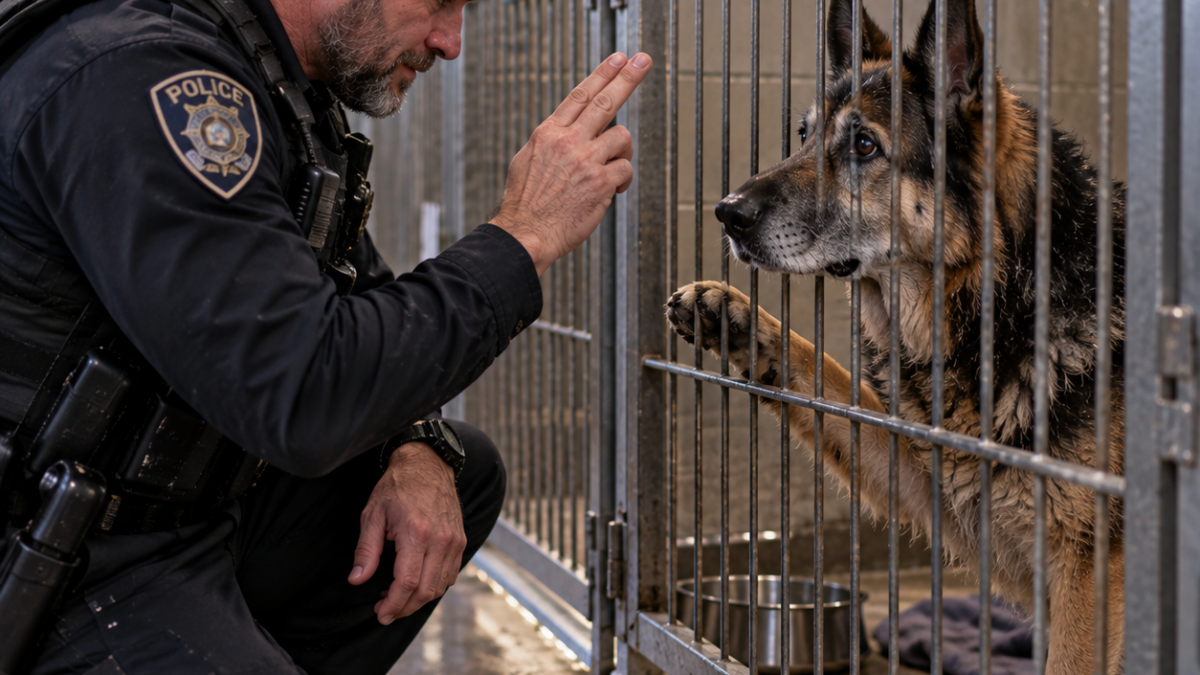
Wesley slowly lifted his right hand.
Silas stopped talking.
The gesture was small.
Two fingers angled downward near Wesley’s thigh.
Invisible to most observers.
It meant:
Left side.
Close.
Wait.
Alder had learned it because Wesley often worked scenes where voice commands risked alerting a suspect.
No official K9 command chart contained it.
The old shepherd’s ears shifted.
Then he moved.
One step.
Another.
Turn.
Sit.
Exactly against Wesley’s left leg.
Wesley forgot how to breathe.
Silas said something.
Wesley did not hear.
He lifted his hand again.
Smaller signal.
Thumb drawn lightly across the inside of his wrist.
This one was not training at all.
Years earlier, Alder had become restless during a three-hour stakeout.
Wesley repeatedly tapped his wrist when telling him to settle.
Somehow, through repetition, it became theirs.
Touch my wrist.
Alder would reach forward and press his nose against it.
The old dog lowered his head.
Touched Wesley’s wrist.
Wesley’s hand began trembling.
Silas stepped closer.
“Officer?”
Wesley looked at the dog.
Gray muzzle.
Ear notch.
Scar near the left eyebrow.
The eyes.
God, the eyes.
He whispered:
“Alder?”
The dog froze.
One second.
Two.
Three.
Then he stepped forward.
Stopped.
His body tightened.
He wanted to come closer.
Something held him back.
Wesley slowly knelt.
“Alder?”
Another step.
Then the dog pressed his head against Wesley’s chest.
Wesley’s eyes closed.
His hands settled behind the dog’s ears.
The same place.
The same shape.
Older.
Thinner.
But real.
Warm.
Alive.
For three years, Wesley had touched a grave.
Talked to ashes.
Apologized to a dead partner.
Now the dog he buried was breathing against him.
Silas’s voice came from behind.
“Officer Carrick.”
Wesley opened his eyes.
“That dog is Mac.”
Wesley looked over his shoulder.
Silas’s face remained composed.
Too composed.
“Where did you get him?”
“Transfer.”
“From where?”
“I told you, I’d need records.”
“Microchip?”
Silas hesitated.
Then said something that changed the entire room.
“He doesn’t have one.”
Wesley stared.
Alder had one.
All department K9s did.
Registered.
Documented.
Scanned during annual veterinary examinations.
Wesley stood.
“He had a chip.”
Silas frowned.
“If this is the animal you’re thinking of.”
Wesley’s hand remained against the dog.
“Scan him.”
The veterinarian returned the next morning.
Wesley barely slept.
Maren had been at the kitchen table when he came home.
She looked up.
“You’re late.”
“I found a dog.”
She almost smiled.
“Congratulations.”
“Maren.”
Something in his voice changed her expression.
“What?”
He sat.
“I think I found Alder.”
The color left her face.
For several seconds, nothing moved.
Then she stood.
“No.”
“I’m not saying I know.”
“You just said—”
“I think.”
“No.”
“Maren.”
“Don’t.”
Her breathing changed.
Wesley had expected shock.
Hope.
Tears.
Anything except anger.
“You made me bury him.”
“I know.”
“You told me I was being childish.”
“I know.”
“You said he was dead.”
“Maren—”
“You made me stop waiting.”
“I was trying to protect you.”
“From what?”
“From spending your life waiting for something that might never happen.”
She laughed once.
Bitterly.
“And now what?”
Wesley had no answer.
She stared at him.
“Don’t do this unless you’re sure.”
Then she went upstairs.
The veterinary examination began at eight the next morning.
Scanner over shoulders.
Nothing.
Again.
Nothing.
The vet parted the fur.
A faint line of scar tissue.
Wesley noticed immediately.
“What’s that?”
“Old scar.”
“From?”
“Could be injury.”
“Could a chip have been removed?”
“It’s possible.”
“Is that what happened?”
“I can’t say that.”
Wesley appreciated her restraint.
He did not need somebody turning suspicion into certainty.
He needed facts.
They compared old veterinary records.
Alder had fractured a canine tooth during training at age three.
Repair.
Same tooth.
Same location.
Alder had undergone orthopedic surgery on the right front leg after a tracking accident.
Two fixation screws placed at an unusual angle.
X-ray.
Same screws.
Same angle.
The vet studied both images.
Wesley stared.
Then the ear.
Scar placement.
Age.
Dental pattern.
Behavioral response.
No DNA was needed for Wesley emotionally.
Legally, more would come.
But he knew.
The dog was Alder.
A center employee arrived with a leash.
The moment she turned Alder toward the kennel corridor, he stopped.
Legs rigid.
Breathing rapid.
She pulled gently.
He backed away.
No aggression.
Pure refusal.
Wesley moved beside him.
Alder looked at him.
His breathing slowed.
Silas watched from the doorway.
Temporary placement became an immediate point of dispute.
The county veterinarian documented stress.
The ownership records were under question.
Wesley requested emergency custodial placement.
Silas objected.
“This is my property.”
Wesley looked at him.
“If he’s Alder, he isn’t.”
“You haven’t proven that.”
“The county can hold him.”
Silas’s jaw tightened.
Wesley saw the first crack in his composure.
Within hours, Alder was released temporarily to Wesley while identity and ownership were investigated.
Wesley opened the rear door of his patrol SUV.
Alder stopped.
Three years earlier, he would have jumped inside before Wesley finished opening it.
Now he backed away.
Wesley almost said:
Up.
The word left his mouth before he could stop it.
Alder lowered his head.
Body tense.
Wesley immediately stepped away.
“No.”
Silence.
“No commands.”
He waited.
Five minutes.
Alder approached.
Sniffed the threshold.
Climbed in.
Slowly.
The drive home took eighteen minutes.
Wesley watched him in the mirror.
Alder did not lie down.
He remained alert.
Every turn.
Every slowing vehicle.
Every sound.
When Wesley pulled into the driveway, Maren was on the porch.
She did not move.
Alder stepped out.
Looked at her.
Maren’s face crumpled for half a second.
Then she controlled it.
Wesley said nothing.
Alder approached the house.
Stopped at the threshold.
Three years ago, he had crossed that doorway thousands of times.
Now he would not enter.
Wesley stepped inside.
Waited.
Nothing.
Came back out.
Maren whispered:
“Maybe it isn’t him.”
Wesley looked at the dog.
“Maybe.”
Neither believed it.
After several minutes, Alder crossed.
Slowly.
Sniffed the hallway.
Wall.
Floor.
Furniture.
No tail wagging.
No dramatic recognition.
He moved like a dog inspecting unfamiliar territory.
That hurt Wesley.
He had imagined reunion as restoration.
The dog would come home.
Everything would click back into place.
Maren would laugh again.
Alder would sleep in his old spot.
Wesley would finally breathe.
Instead, Alder acted like a survivor entering a building where he needed to identify every exit.
That afternoon, Wesley made another mistake.
He went into the garage.
Opened the old K9 storage cabinet.
Harness.
Lead.
Training toys.
Alder appeared behind him.
The second Wesley lifted the harness, the dog recoiled.
Fast.
Back against the wall.
Ears flattened.
Wesley froze.
“Alder.”
The dog’s breathing increased.
Wesley dropped the harness.
“No.”
He pushed it into the cabinet.
Closed the door.
Then sat on the concrete floor.
Several feet away.
“You don’t have to work.”
Alder watched him.
Wesley’s voice softened.
“Never again if you don’t want.”
That evening, he bought an orthopedic bed.
Alder ignored it.
Instead, he climbed onto Wesley’s old sheriff’s jacket draped over a chair.
Maren saw.
“He always did that.”
Wesley looked at her.
It was the first time she had directly connected this dog to Alder.
Wesley smiled.
“Alder always—”
“Don’t.”
Her face closed.
Wesley stopped.
Maren wanted to believe.
That was exactly why she was afraid.
After midnight, Wesley came downstairs.
The expensive bed was empty.
Jacket empty.
Alder lay beside the front door.
Facing outward.
Eyes open.
Not sleeping.
Waiting.
Prepared.
Wesley sat several feet away.
Ten minutes.
Nothing.
Then Alder shifted closer.
Only inches.
Wesley did not touch him.
Those inches mattered.
The next morning, physical comparisons came back stronger.
Dental match.
Orthopedic match.
Approximate age.
Archived photographs confirmed scars.
Investigators ordered DNA comparison against stored biological samples from Alder’s earlier veterinary care.
Wesley should have felt relief.
Instead, he stared through the kitchen window.
Cottonwood tree.
Beneath it:
A grave.
If Alder was here…
What was down there?
Maren joined him outside.
The ground was partly frozen.
Wesley brought two shovels.
She looked at them.
“You really want to do this?”
“No.”
“Then why?”
“Because we have to know.”
They dug.
The first strike of metal into soil brought back the funeral.
Maren at fourteen.
Wesley injured.
Snow.
Silence.
The lie he had believed.
Maren worked beside him.
Then stopped.
“I used to listen for him.”
Wesley looked up.
“What?”
“After the landslide.”
She stared into the hole.
“At night.”
Her voice remained calm.
“That first month, every sound outside…”
She swallowed.
“I thought Alder was coming home.”
Wesley leaned on the shovel.
“Maren…”
“You told me to stop.”
His throat tightened.
“I thought I was helping.”
“I know.”
She pushed the shovel into the ground.
Then stopped again.
“I didn’t only lose him.”
Wesley went still.
Maren looked at him.
“You disappeared too.”
He opened his mouth.
Nothing.
“You made dinner.”
She continued.
“You drove me places. Paid bills. Asked about grades.”
Her eyes filled.
“But you weren’t there.”
Wesley looked away.
The truth hurt because there was nothing to defend.
After Marianne died, Alder had become part of what held the house together.
Then Alder disappeared.
Wesley survived physically.
Emotionally, he retreated.
“I didn’t know how to come back.”
Maren nodded.
“I know.”
Metal struck wood.
They stopped.
The box came out slowly.
Darkened.
Moisture-stained.
Wesley opened it.
Ash container.
Brass tag.
Scorched collar.
He picked up the collar.
Turned it.
Something felt wrong.
Years earlier, Alder caught the buckle on chain-link fencing during training.
Deep diagonal scratch.
Wesley remembered cursing while checking his neck.
The buckle in his hands was smooth.
No scratch.
He looked closer.
Manufacturing code.
Later, they searched it.
The collar had been manufactured four months after the landslide.
Maren stared at the screen.
“That’s impossible.”
“No.”
Wesley felt anger move through him.
“It means this was never his.”
They called the cremation service listed in the recovery paperwork.
No record of Alder.
No matching intake.
No canine from that recovery date.
The ashes could have belonged to another animal.
Nobody could immediately say.
Maren whispered:
“So we buried a lie.”
Wesley looked toward Alder sleeping in the living room.
“Yes.”
That afternoon, he sat beneath the cottonwood.
The wooden box beside him.
Alder wandered slowly across the yard.
Wesley stared at the dirt.
“I’m sorry.”
Alder stopped.
Wesley’s voice broke.
“Did you think I left you?”
The dog crossed toward him.
Stopped beside his boot.
Then lifted one paw.
Placed it over Wesley’s toe.
Wesley froze.
That gesture.
He had forgotten.
During long searches, when Wesley became impatient, Alder would sometimes rest a paw against his boot.
Not trained.
Just habit.
Wesley placed his hand against Alder’s neck.
“I didn’t.”
His eyes filled.
“I swear I didn’t.”
Then the investigation changed.
Wesley reopened archived landslide records.
He reviewed contracted recovery units.
One private company handled transport of recovered animals.
Frontier Tactical Animal Transport.
Ownership records.
Company dissolved two years later.
Assets purchased by Blackridge Working Dog Center.
Silas Pruitt.
Wesley stared at the screen.
Alder did not wander into Silas’s facility by accident.
The next morning, Wesley found a video.
News footage.
Temporary recovery area after the landslide.
Low quality.
Wind.
Vehicles.
Rescue crews.
Then two men carried an injured German Shepherd toward a transport truck.
Wesley stopped playback.
Enlarged.
Ear notch.
Wrapped right front leg.
Police harness still attached.
Alder.
Alive.
The morning after the landslide.
Wesley sat completely still.
Then replayed it.
Again.
Again.
His breathing became uneven.
While Wesley lay in a hospital bed believing search teams were looking…
Alder had already been recovered.
Transported.
Alive.
Somebody knew.
He called Lieutenant Danner.
Now captain.
“Ray.”
“What?”
“I found video.”
Silence.
“What video?”
“Alder alive.”
Danner thought Wesley meant current footage.
“No. After the landslide.”
Another silence.
“You sure?”
“Come here.”
Danner arrived forty minutes later.
Watched.
Sat down.
“Jesus.”
Wesley looked at him.
“Who signed transport?”
They pulled records.
Three names.
One contractor.
Aaron Voss.
One technician.
Unclear signature.
Oversight authorization.
Evan Malloy.
Malloy had retired from emergency management the following year and moved to Idaho.
Danner contacted state investigators.
Federal agencies became involved because a law enforcement animal had potentially been unlawfully transferred across jurisdictions and records falsified.
Wesley wanted every detail immediately.
Investigators told him not to interfere.
That nearly killed him.
Then Maren stopped him.
He had taken Alder’s old rubber training toy from storage.
Rolled it.
“Alder?”
The dog looked.
Did not move.
Wesley tried a command.
“Come.”
Alder turned away.
Frustration rose.
Maren saw it.
“Dad.”
“What?”
“You’re doing it again.”
“Doing what?”
“Making him prove himself.”
Wesley frowned.
“I’m helping him remember.”
“He remembers you.”
“That’s not—”
“It is.”
Maren stepped closer.
“You keep giving him tests.”
“I’m not testing.”
“Yes, you are.”
She pointed at the old equipment.
“You want the old Alder.”
Wesley looked at her.
“I want him back.”
“He is back.”
The words landed hard.
Maren’s voice softened.
“He doesn’t need you three years ago.”
Wesley’s eyes moved to Alder.
Gray muzzle.
Stiff leg.
Cautious posture.
“He needs you now.”
Wesley sat.
Shame washed through him.
For three years, he had wished for one more day.
Now that Alder was home, Wesley was measuring him against memories.
Commands.
Responses.
Speed.
Habits.
As if trauma were a temporary inconvenience.
As if three years had happened only to Wesley.
That afternoon, he put the equipment away.
No more tests.
No unnecessary commands.
He watched.
Learned.
The current Alder disliked closed hallways.
Feared vans.
Panicked around heavy training harnesses.
Slept near exits.
Avoided men wearing certain black work gloves.
But he still searched for Wesley’s old jacket.
Still paused near Maren’s bedroom.
Still loved scrambled eggs.
Still tilted his head when Maren sang badly.
One evening, Maren sat on the floor.
Alder rested across the room.
She touched two fingers beneath her chin.
Opened her palm.
Wesley recognized it.
Maren invented the gesture when she was eight.
It meant:
Put your face here.
Alder stared.
Nothing.
Maren’s eyes lowered.
“That’s okay.”
Then Alder stood.
Slowly crossed.
Paused.
Lowered his muzzle into her open hand.
Maren broke.
Silent tears.
She did not grab him.
Did not pull him closer.
“You remember me.”
Wesley turned away because his own eyes were full.
That night, Alder slept beside the sofa.
Not the front door.
The investigation uncovered the rest gradually.
Frontier Tactical had received Alder at the recovery staging site.
An employee named Aaron Voss recognized him as a trained police dog worth tens of thousands of dollars.
Instead of transferring him to county veterinary custody, Voss falsified the transport destination.
At first, investigators believed greed alone explained it.
Then they found Silas.
Bank records.
Emails.
Working-dog sales.
Dogs with altered identities.
Animals imported and resold without proper records.
Dogs whose ownership histories disappeared when paperwork became inconvenient.
Alder had been injured, disoriented, and temporarily unable to work.
His microchip complicated resale.
Veterinary records suggested it was surgically removed within months of the landslide.
Wesley had to stop reading when he reached that line.
Maren found him at the kitchen table.
“What?”
He handed her the report.
She read.
Her face hardened.
“They cut it out?”
“Yes.”
“Why?”
“To erase him.”
Maren put the pages down.
Wesley whispered:
“They erased his name.”
The investigation found Alder had been moved three times.
First registered as Rex.
Then Brant.
Finally Mack.
One dog.
Three replacement identities.
Training records showed he had been used for protection work after recovery.
At one facility, handlers described him as “resistant.”
At another, “unreliable under pressure.”
One note said:
DOG DISPLAYS HANDLER ATTACHMENT ISSUES. REQUIRES CORRECTION.
Wesley stared at that sentence until the letters blurred.
Handler attachment issues.
Alder had spent years waiting for Wesley.
And people punished him for it.
That was the moment Wesley nearly lost control.
He went to the garage.
Hit a workbench.
Hard enough to split skin over his knuckles.
Maren appeared.
“Dad.”
He turned.
“They punished him because he remembered me.”
“Dad.”
“He was trying to come home.”
“I know.”
“And I buried—”
“Stop.”
Maren’s voice cut through him.
“You didn’t know.”
“I should have.”
“How?”
“I should have checked.”
“You were in the hospital.”
“I accepted ashes.”
“You were hurt.”
“I told you he was dead.”
Maren went silent.
That was the wound between them.
Wesley looked at her.
“I was wrong.”
She swallowed.
“I know.”
“I didn’t listen to you.”
“No.”
“I made you stop hoping because I couldn’t handle hoping myself.”
Her eyes filled.
Wesley continued.
“I’m sorry.”
Maren stared at him.
“You really believed he was dead.”
“Yes.”
“I know.”
She looked toward the living room where Alder slept.
“I’ve been angry for three years.”
“You had every right.”
“I know that too.”
A laugh escaped through tears.
Wesley smiled weakly.
Then Maren crossed the room.
Hugged him.
It was the first time in years she had initiated it.
Wesley held his daughter.
And realized the conspiracy had stolen more than a dog.
It had stolen trust.
Time.
The version of their family they might have had.
Justice could not return those years.
But it could stop more from being taken.
Silas came to the house four days later.
Late afternoon.
Black SUV.
Folder under one arm.
Alder was near the window.
The moment the engine stopped, he stood.
Breathing changed.
Wesley saw.
He stepped outside.
Closed the door.
Silas approached.
“What do you want?”
“Mac.”
Wesley’s face went hard.
“His name is Alder.”
“That is disputed.”
“No, it isn’t.”
Silas held up papers.
“My facility has documented ownership.”
“Your documents are evidence.”
“They remain legally valid unless a court says otherwise.”
“You’re not taking him.”
“You’re emotionally involved.”
Wesley stared.
Silas continued.
“You lost an animal three years ago.”
“He was stolen.”
“Allegedly.”
“He has his surgical screws.”
“Coincidence.”
“His dental repair.”
“Not unique.”
“His signals.”
Silas’s mouth tightened.
“Dogs learn behaviors.”
Wesley stepped down from the porch.
“You removed his chip?”
Silas’s expression barely moved.
“You need to be careful making accusations.”
“You knew who he was.”
“No.”
“You renamed him.”
Silas lowered his voice.
“Officer, grief distorts judgment.”
Wesley’s fists tightened.
There it was.
The strategy.
Make him angry.
Make him threatening.
Turn the grieving K9 handler into an unstable old cop.
Silas took another step.
“Perhaps you should consider whether your daughter’s attachment is influencing—”
The front door opened.
Alder came outside.
Slowly.
He looked at Silas.
Then Wesley.
Wesley felt a paw touch his boot.
He looked down.
Alder’s front paw rested there.
Same gesture.
Stop.
Breathe.
Wesley’s hands relaxed.
He stepped back.
Looked at Silas.
“If you believe you own him, bring it through the court.”
Silas said nothing.
“Not my porch.”
Wesley pointed toward the road.
“Leave.”
Silas stayed another second.
Then turned.
Drove away.
Maren stood inside the doorway.
“You okay?”
Wesley looked at Alder.
“Yeah.”
This time he was.
Three days later, investigators executed warrants at Blackridge.
They seized records.
Computers.
Medical supplies.
Chip scanners.
Sedatives.
Contract documents.
And fourteen dogs whose ownership histories did not match official records.
Three had microchip scars.
One was linked to a security company that reported him missing two years earlier.
Another had belonged to a military contractor.
The case exploded.
News media arrived.
Silas denied wrongdoing.
Called the allegations administrative misunderstandings.
Then prosecutors produced emails.
One from Aaron Voss to Silas, sent two days after the landslide:
FOUND LIVE SHEPHERD. POLICE DOG. LEG INJURY. HANDLER HOSPITALIZED. NO RELEASE YET.
Silas replied:
CHIP?
Voss:
YES.
Silas:
THEN FIX IT BEFORE PAPERWORK.
Wesley read the email once.
Then again.
His vision narrowed.
Maren sat beside him.
“That’s it.”
Wesley nodded.
They knew.
Silas had known Alder belonged to police.
Known Wesley was alive.
Known the dog had a chip.
And still ordered the identity erased.
The next email hurt worse.
Voss:
HANDLER KEEPS ASKING SEARCH TEAM.
Silas:
RECOVERY PACKAGE WILL CLOSE IT.
Recovery package.
Ashes.
Collar.
Tag.
Wesley stopped reading.
He stood.
Walked outside.
Alder followed.
Wesley sat beneath the cottonwood.
For years, he had believed tragedy took Alder.
Nature.
Chaos.
Bad luck.
Now he knew a human being made a deliberate decision after the disaster.
Someone saw grief.
Saw confusion.
Saw opportunity.
And manufactured death.
Wesley touched Alder’s neck.
“I’m sorry.”
Alder leaned against him.
“No.”
Wesley shook his head.
“I’m done apologizing.”
He breathed.
“You’re here.”
That had to matter more.
The criminal proceedings lasted almost a year.
Silas was charged with conspiracy, fraud, evidence tampering, theft involving working dogs, animal cruelty-related offenses tied to unauthorized procedures, and falsification of ownership documents.
Aaron Voss took a plea agreement.
His testimony explained how the false death package was created.
The ashes came from an unidentified deceased dog already scheduled for cremation.
The collar was purchased later and intentionally damaged with heat.
Alder’s real tag had been removed from his original equipment at the recovery site.
The fake paperwork exploited emergency conditions after the landslide.
Nobody double-checked because Wesley was hospitalized.
The county relied on private recovery personnel.
The contractor relied on forged signatures.
Everyone assumed somebody else had confirmed identity.
The lie survived because it looked official enough.
During trial, Silas’s attorney attacked Wesley.
Predictably.
“Officer Carrick, you loved this animal?”
“Yes.”
“You were traumatized by his disappearance?”
“Yes.”
“You buried what you believed were his remains?”
“Yes.”
“So finding an older German Shepherd three years later would have been deeply emotional.”
“Yes.”
“You wanted him to be Alder.”
Wesley thought.
“At first, I was terrified he was.”
The attorney paused.
“Terrified?”
“Because if he was Alder, somebody lied about his death.”
The jury watched.
The attorney continued.
“Your identification began with hand signals?”
“Yes.”
“Dogs can learn similar signals.”
“Yes.”
“So those signals proved nothing.”
“By themselves? No.”
“Yet you immediately treated him like Alder.”
“I investigated.”
“You embraced him.”
“Yes.”
“Emotional reaction.”
“Yes.”
“Not evidence.”
“No.”
Wesley remained calm.
The attorney tried again.
“You were angry with Mr. Pruitt.”
“Yes.”
“You wanted justice.”
“Yes.”
“For your dog.”
Wesley looked toward Silas.
“For what was done.”
The attorney smiled.
“So this case is personal.”
Wesley answered:
“The evidence is not.”
Silence.
Prosecutors followed with X-rays.
Dental records.
DNA.
Emails.
Transport logs.
Financial records.
Veterinary surgical evidence.
The false collar’s manufacturing date.
The nonexistent cremation record.
The video of Alder alive.
The hand signals were almost irrelevant by then.
But to Wesley, they remained where the truth began.
Maren testified too.
She was eighteen by then.
The prosecutor asked about the burial.
About Alder.
About the reunion.
Then Silas’s attorney made a mistake.
“You were fourteen when the dog disappeared?”
“Yes.”
“Children sometimes resist accepting death.”
Maren stared at him.
“I was right.”
The courtroom went silent.
The attorney shifted.
“You hoped he was alive.”
“I was right.”
“Hope does not equal evidence.”
“No.”
Maren’s voice remained steady.
“But adults telling you to stop asking questions doesn’t equal truth either.”
Wesley lowered his eyes.
Pride and pain arrived together.
The attorney moved on quickly.
Silas was convicted on most counts.
Not all.
But enough.
Prison.
Financial penalties.
Permanent prohibition from operating animal-training or breeding businesses.
Blackridge closed.
Other recovered dogs entered legal ownership proceedings and rehabilitation programs.
Alder’s case led to policy changes.
Disaster recovery procedures were rewritten.
Working animals required independent identity confirmation.
Microchip verification.
Photographic documentation.
Two-person signoff.
No private contractor could certify remains alone.
Some people called those changes Alder’s Law informally.
Wesley hated that.
Alder had already spent too much of his life being treated as something useful.
He did not need to become a symbol.
He needed retirement.
The official identity confirmation arrived one week before Christmas.
Wesley opened the letter at the kitchen table.
Maren stood beside him.
Alder slept nearby.
The wording was bureaucratic.
Ownership restored.
Identity verified.
Law enforcement K9 status retired.
Then:
CANINE ALDER CARRICK
RECOVERED ALIVE
RETIRED
Wesley read the line twice.
For three years, Alder existed officially only in past tense.
Deceased.
Lost.
Remains recovered.
Now:
Alive.
Maren leaned over.
“That’s it?”
Wesley nodded.
“That’s it.”
She smiled.
Alder lifted his head.
Wesley crossed toward him.
“You’re unemployed.”
Alder blinked.
“No more work.”
Maren laughed.
“He’s been acting retired for weeks.”
Wesley looked at the orthopedic bed Alder continued ignoring.
“He’s very committed.”
That afternoon, they took the old wooden box outside.
The false collar.
Ashes.
Fake paperwork.
The brass tag.
One thing inside had been real.
Alder’s original identification tag.
Wesley held it.
Scratched.
Worn.
K9 ALDER
FREMONT COUNTY
Maren touched the edge.
“That’s his.”
“Yes.”
Wesley had purchased a new collar.
Simple leather.
No police markings.
Nothing tactical.
Nothing that looked like equipment.
He called softly.
“Alder.”
The dog came.
No hesitation.
Wesley removed the temporary collar.
Fastened the new one.
Attached the old tag.
Metal clicked against the buckle.
Alder looked down.
Then up.
Wesley smiled.
“Better.”
Maren looked at the wooden box.
“What do we do with that?”
Wesley considered.
“Nothing.”
“Leave it?”
“It was never him.”
They did not rebury it.
No ceremony.
No goodbye.
They carried it to the garage where investigators later collected it as retained evidence before final disposal.
Then Wesley, Maren, and Alder walked back toward the house.
Wesley opened the back door.
Alder entered.
Immediately.
No pause.
The first week, he had stopped at thresholds.
Now he crossed as if doors were simply doors.
He moved through the kitchen.
Past the hallway.
Past the front entrance where he had once slept facing outward.
Past Wesley’s old jacket.
Toward the fireplace.
Stopped.
Sniffed.
Turned slowly.
His stiff leg made the circle uneven.
Then he lay down.
Maren’s eyes filled.
“He remembers.”
Wesley looked.
“Maybe.”
She smiled.
For once, neither needed certainty.
The place felt right.
That was enough.
Maren sat on the rug.
Alder rested near her.
Outside, the Wyoming afternoon faded.
Sunlight moved across the snow.
Wesley remembered the morning of the landslide.
His hand on Alder’s collar.
Home before dark, buddy.
The promise had haunted him for three years.
He came home.
Alder did not.
Now the old shepherd opened one eye.
Wesley walked closer.
“Took you long enough.”
Maren laughed.
Alder stretched one paw.
Placed it across Wesley’s boot.
Wesley smiled.
Then sat.
They did not become the family they had been.
That mattered.
Maren was not fourteen.
Alder was not five.
Wesley was not the same father.
Too much had happened.
For a long time, Wesley thought healing meant reversing damage.
Returning.
Restoring.
Becoming what existed before.
Alder taught him otherwise.
Healing was not backward.
It was forward.
Slowly.
A dog moving six inches away from a door.
A daughter saying what hurt.
A father listening instead of defending himself.
An old K9 choosing to sleep deeply.
Those were the victories.
Maren eventually left for college in Colorado.
Wesley hated the day.
Pretended not to.
Alder stood beside the driveway as she loaded boxes.
Maren knelt.
“You better stay here.”
Alder licked her chin.
Wesley said, “He has no college plans.”
“Talking to him.”
“I know.”
She hugged Alder.
Then Wesley.
Longer.
“You’ll call?”
Wesley smiled.
“You asking me?”
“Yes.”
“You used to complain.”
“I was seventeen.”
“That was eight months ago.”
“Exactly.”
He laughed.
After she drove away, Wesley stood in the driveway.
Alder beside him.
The house felt emptier.
But not abandoned.
That distinction mattered now.
Years earlier, Wesley responded to loss by disappearing inside himself.
This time he called Maren that evening.
“Did you make it?”
“Yes, Dad.”
“Room okay?”
“Yes.”
“Roommate?”
“Seems normal.”
“Define normal.”
“Goodnight.”
He smiled.
“Goodnight.”
Alder lived another four years.
They were quiet years.
No police work.
No protection training.
No kennels.
No vans unless he chose to enter.
Wesley walked him beside the river.
Took him camping once, then decided Alder preferred couches.
Maren came home on breaks.
Every time, Alder recognized her car before Wesley did.
He grew slower.
Gray spread across his face.
The repaired leg stiffened.
Wesley built a ramp.
Alder refused it for three days.
Then used it when he thought Wesley wasn’t watching.
One autumn evening, Wesley found Maren sitting beside him on the porch.
Alder slept between them.
She was twenty-one.
“Do you ever think about what would’ve happened if you hadn’t gone to Blackridge?”
Wesley looked toward the mountains.
“Yes.”
“All the time?”
“Less now.”
Maren scratched Alder’s ear.
“I used to.”
She stared at the old dog.
“I used to think about how close we came to never knowing.”
Wesley nodded.
“That’ll make you crazy.”
“So what do you do?”
“Be glad we did.”
Maren smiled.
“That simple?”
“No.”
“Thought so.”
They sat quietly.
Then Maren said:
“I forgive you.”
Wesley looked at her.
“For what?”
“You know.”
He did.
The burial.
The certainty.
The years afterward.
Wesley swallowed.
“I’m still sorry.”
“I know.”
She leaned against him.
“I know.”
That mattered more than forgiveness.
Alder died the following spring.
At home.
No emergency.
No mystery.
No one took him.
No one changed his name.
No one carried him into a vehicle Wesley could not follow.
He was thirteen.
His kidneys began failing.
The veterinarian explained the options.
Wesley asked every question.
Maren drove home from college.
They spent two days with him.
Fed him scrambled eggs.
Let him sleep anywhere.
Took him beneath the cottonwood.
Wesley sat in the grass.
Alder rested his head against his leg.
“Home before dark, buddy.”
Maren began crying.
Wesley did too.
Alder moved one paw.
Weakly.
Rested it on Wesley’s boot.
Same gesture.
Still there.
The veterinarian came to the house.
Alder died with Wesley’s hand on his neck and Maren’s hand beneath his muzzle.
This time, there was no uncertainty.
No contractor.
No sealed box delivered by strangers.
No paperwork standing in for truth.
Wesley knew exactly where Alder was.
Exactly who had been with him.
Exactly what happened.
Grief still hurt.
But certainty did not feel cruel this time.
It felt like mercy.
They buried Alder beneath the cottonwood.
Really buried him.
His new collar stayed with him.
The brass tag did too.
Maren placed the old rubber training toy beside him.
Wesley almost objected.
Then smiled.
“He never wanted that thing after he came back.”
“I know.”
“Why put it in?”
“So he can ignore it forever.”
Wesley laughed through tears.
They filled the grave.
When finished, Maren stood beside her father.
Neither said goodbye immediately.
Then Wesley touched the soil.
“You’re home.”
Years later, Wesley still volunteered with working-dog programs.
Not as a handler.
Mostly rehabilitation.
Retired K9s.
Dogs with fear.
Dogs whose careers ended badly.
Handlers who had trouble accepting that a dog could no longer be what he had been.
Whenever someone tried too hard to make an animal return to an old command pattern, Wesley gave the same advice Maren once gave him.
“He doesn’t need you from back then.”
People usually looked confused.
Wesley would point toward the dog.
“He needs you now.”
Sometimes trainers asked how he learned that.
Wesley would smile.
“Hard way.”
The cottonwood grew.
Maren eventually married.
At her wedding, she reserved a chair beside Wesley’s.
On it sat a framed photograph.
Alder.
Young.
Police harness.
Standing between Wesley and fourteen-year-old Maren.
Wesley stared at the picture before the ceremony.
His daughter came beside him in her dress.
“You okay?”
“Yeah.”
“You look like you’re going to cry.”
“Wind.”
“We’re indoors.”
“HVAC.”
Maren laughed.
Then looked at the photograph.
“He made it.”
Wesley nodded.
“Yes.”
Because that was the strange truth about lives and loss.
Alder had missed three years.
But he still made it into everything that came after.
Maren’s graduation.
College.
Holidays.
Ordinary dinners.
The rebuilding of a father and daughter.
The closure of a corrupt training operation.
Changes in disaster recovery procedures.
Dogs saved because somebody finally asked where they came from.
And most importantly, he got to spend his last years not as K9 property.
Not as Mack.
Not as Rex.
Not as Brant.
Not as inventory.
Alder.
Just Alder.
Sometimes people asked Wesley whether he believed Alder recognized the secret signal instantly that day at Blackridge.
Wesley always said yes.
Then someone would ask why the dog hesitated when Wesley called his name.
That answer was harder.
Maybe trauma.
Maybe fear.
Maybe after three years of being renamed, corrected, moved, and handled by strangers, hearing the old name hurt.
Maybe Alder remembered Wesley immediately but no longer trusted that recognition meant safety.
Wesley would never know.
He eventually stopped trying to.
What mattered was what Alder did next.
He came forward.
Slowly.
One step.
Then another.
He chose Wesley again.
That was the part Wesley carried.
Not the conspiracy.
Not Silas.
Not the trial.
Not the false ashes.
The choice.
For years, Wesley had believed loyalty meant a dog never leaving his handler.
Alder taught him something different.
Loyalty could survive separation.
Identity could survive being erased on paper.
Love could survive anger, fear, and time.
But healing required something more difficult than loyalty.
It required choice.
Wesley had to choose not to force the old Alder back.
Maren had to choose to trust her father again.
Alder had to choose whether the home he remembered was safe enough to enter now.
None of those choices happened once.
They happened every day.
A few inches closer to the sofa.
A muzzle in Maren’s hand.
A paw on Wesley’s boot.
Sleeping away from the door.
Crossing a threshold without stopping.
Those were the real reunions.
Not the dramatic moment inside the kennel.
That moment only opened the door.
Coming home took longer.
And maybe that was why Wesley never again spoke lightly about what it meant to return.
Because sometimes coming home is not arriving at the place you left.
Sometimes too much has changed.
Sometimes the people waiting there have changed too.
Sometimes you carry scars they cannot see.
Sometimes they carry guilt you cannot understand.
Home, Wesley learned, was not pretending none of those years happened.
Home was the place where nobody demanded you become who you used to be before they loved you again.
On winter evenings, long after Alder was gone, Wesley would sometimes sit beside the fireplace.
The house was quieter.
Maren had her own life.
The old police gear was packed away.
Alder’s photographs remained.
One in uniform.
One asleep on Wesley’s jacket.
One with Maren.
One taken during Alder’s final winter, gray-faced and lying beside the fireplace.
That was Wesley’s favorite.
Not the heroic K9.
Not the young tracking dog.
The old one.
Because the old Alder had already proven enough.
He did not need to find anyone.
Protect anyone.
Obey anyone.
He only needed to rest.
And Wesley finally understood why that image mattered more than all the others.
For most of Alder’s life, people valued him because of what he could do.
Track.
Search.
Protect.
Work.
After everything that happened, Wesley loved him most when he did nothing at all.
Sleeping by the fire.
Safe.
Named.
Home.
The last promise Wesley had made before the landslide had taken three years to complete.
“Home before dark, buddy.”
Wesley used to think he failed it.
In the end, he realized promises sometimes survive longer than the people making them expect.
The road home had taken Alder through mud, injury, theft, false names, kennels, fear, and years neither he nor Wesley could recover.
But he made it.
Not before that first darkness.
Not before hundreds that followed.
But in enough time for a father to apologize.
Enough time for a daughter to forgive.
Enough time for an old dog to sleep without watching the door.
Enough time for the three of them to choose one another again.
And in the end, that was what mattered.
Alder came home.
And this time, nobody could take his name away again.