A Marine Veteran Found a Starving German Shepherd Behind a Desert Store—But One Strange Detail on the Dog Made Him Realize He Had Just Found Something the Military Wanted Buried
PART3:
A stray dog in that condition should have cowered, growled, snapped, or tried to crawl away.
This one did none of those things.
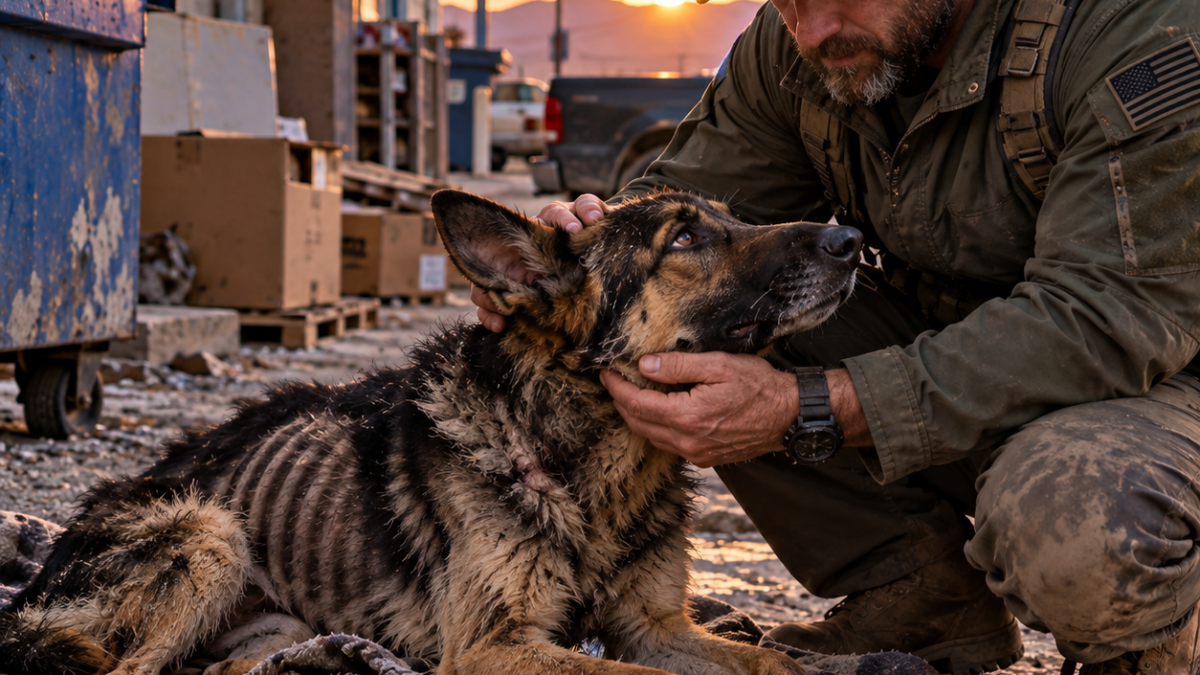
He lay in a perfect tactical sternal position, chest off the ground, legs tucked under him, body weak but ready to move if necessary. Even half-dead, he had arranged himself in the posture of a working dog conserving breath while staying prepared to spring.
Garrett felt the skin along his arms tighten.
“Hey there, buddy,” he whispered.
He lowered himself slowly, breaking eye contact to show he was not a threat. Then he tore a piece from the beef jerky and set it on the concrete several feet away.
The dog did not lunge.
Did not snap.
Did not scramble for it.
He waited.
Only after Garrett withdrew his hand did the shepherd sniff once and eat the meat with disciplined restraint.
That sent a chill down Garrett’s spine.
Hungry animals did not usually wait like soldiers.
Garrett offered another piece.
This time, the dog lifted his head a little higher.
His mouth opened.
A glint of metal caught the fading sunlight.
Garrett went still.
Four titanium crowns capped the dog’s canine teeth.
Not decorative.
Not accidental.
Titanium canines were expensive, uncommon, and unmistakable to anyone who had spent enough time around elite military K9 teams. They were usually fitted after working dogs broke natural teeth on body armor, weapons, doors, or explosive rigs.
Garrett’s voice dropped.
“Who do you belong to, soldier?”
The dog watched him.
Garrett inched closer. The shepherd allowed him to lay one hand gently on the side of his neck. His fur was coarse, filled with burrs, and beneath it Garrett felt scar tissue. Thick ridges. Old damage.
Then he folded back the dog’s left ear.
The world seemed to stop moving.
Tattooed into the pale skin inside the ear, faded but legible, was a military identification sequence.
XR9B77.
Garrett stared at it.
The U.S. military did not just lose dogs like this.
Not Tier One dogs.
Not dogs with titanium teeth and identification tattoos.
They were tracked, documented, recovered, honored. If one was killed, there were reports, handlers, ceremonies, paperwork that moved through channels most civilians never saw.
If a dog like this was wandering the New Mexico desert starving to death, something had gone catastrophically wrong.
Garrett looked back toward the store.
The cashier was still inside, head down, unaware of anything beyond the glow of his phone.
The desert wind moved dust across the alley.
The shepherd’s amber eyes stayed on Garrett.
Garrett made the decision before he fully understood its weight.
“All right,” he said quietly. “Let’s get you out of here.”
FULL STORY CONTINUATION 👇👇
Getting the dog into the truck should have been difficult.
It was not.
Garrett opened the passenger door and stepped back, expecting hesitation, fear, maybe collapse.
Instead, the shepherd slowly pushed himself upright.
His legs trembled under his own meager weight. One paw nearly folded beneath him. For a second, Garrett thought he would fall.
But the dog corrected himself.
Then, with painful precision, he executed a clean leap into the cab.
Not graceful.
Not strong.
But trained.
Garrett stood outside the open door, staring at him.
“You really are military.”
The dog lowered himself carefully onto the seat and faced forward.
Garrett closed the door.
For the entire drive back to the cabin, the shepherd remained awake. He did not whine. Did not pace. Did not put his head out the window or sniff the dashboard like a normal dog. He watched the road, the mirrors, the horizon, and once, when Garrett turned onto the dirt access road leading into the hills, the dog shifted slightly so his body faced the rear window.
Watching their six.
Garrett almost laughed.
It came out as something rougher.
“Hell of a passenger.”
The cabin appeared after thirty miles of dirt, brush, and silence. It sat low against the slope, weather-beaten and nearly invisible from the road. Solar panels angled from the roof. A water tank stood behind it. The nearest neighbor was far enough away that a person could scream himself hoarse and never be heard.
Garrett liked that too.
Until that evening.
For the first time in years, the isolation felt less like protection and more like a liability.
He brought the dog inside through the back entrance. The shepherd moved stiffly but without complaint. In the mudroom, Garrett found an old towel and filled a bowl with water.
The dog looked at the bowl.
Then at Garrett.
“Go ahead.”
Only then did he drink.
Slowly.
Carefully.
Not too much at once.
Garrett had seen dehydrated men drink with less discipline.
For the next three hours, Garrett worked quietly.
He washed the dirt and dried blood from the dog’s coat. The shepherd stood perfectly still in the tub, enduring warm water with a stoic silence that was more disturbing than fear would have been. He did not resist when Garrett cleaned his paws. Did not flinch when Garrett cut burrs from his fur.
But as the grime washed away, the true extent of the injuries became clear.
Shrapnel scars along the left flank.
A jagged burn near the shoulder.
Old puncture marks around the foreleg.
And, most disturbing of all, a strange lumpy scar running down the center of the abdomen.
Garrett leaned closer.
The stitching pattern was irregular.
Not clean veterinary work.
Not the neat closure of a controlled surgical room.
This looked like field medicine.
Fast.
Desperate.
Done by someone trying to keep a dying animal alive under impossible conditions.
Garrett ran two fingers near the scar, not touching it too hard.
“What happened to you?”
The shepherd turned his head and looked at him.
Garrett dried him, fed him a small measured portion of boiled chicken and rice, and watched the dog eat with slow control despite obvious hunger.
Then the shepherd lowered himself beside Garrett’s chair.
His head settled on Garrett’s boot.
Only then did he sleep.
Garrett sat at the kitchen table under the flickering overhead light.
He knew what he had to do.
He also knew he should not do it.
The phone he took from the lockbox beneath the sink was not connected to any normal network. It was encrypted, old, ugly, and only used for emergencies. The number he dialed had not been touched in four years.
Frank Reynolds answered on the fifth ring.
“Whoever this is, you better be dying.”
“Frank.”
Silence.
Then, sharply, “Garrett?”
“Yeah.”
“Good God, man. I thought you fell off the edge of the earth.”
“Not yet.”
“You sound like hell.”
“That part’s accurate.”
“What’s going on?”
Garrett looked down at the dog sleeping against his boot.
“I need you to run a K9 serial number. Off the books.”
Another silence.
This one colder.
“Garrett.”
“No central server ping. Legacy archives only.”
“You know what you’re asking?”
“Yes.”
“No, I don’t think you do. I’m sitting behind a high-clearance desk now, not kicking doors in Kandahar. If this query trips the wrong wire, I’m finished.”
“Then don’t trip it.”
Frank swore under his breath.
Garrett waited.
Finally, Frank said, “Give me the sequence.”
“X-ray. Romeo. Niner. Bravo. Seven Seven.”
The keyboard on Frank’s end clicked.
Then stopped.
Garrett listened to the old refrigerator hum.
The dog breathed steadily at his feet.
“Frank?”
No answer.
“Frank.”
When Frank came back, his voice had changed.
“Where are you right now?”
“My cabin.”
“You alone?”
Garrett looked down.
“Not exactly.”
“Tell me you didn’t find that dog alive.”
Garrett’s blood cooled.
“You know the serial.”
“Garrett, listen to me very carefully.”
“I’m listening.”
“That number belongs to a Belgian-German cross named Odin. Attached to the 75th Ranger Regiment. Special Activities Division.”
“So he’s a Ranger dog.”
“He was.”
Garrett said nothing.
Frank’s breathing sharpened.
“Odin was killed in action three years ago in Helmand Province. Entire unit wiped in an ambush, including his handler, Staff Sergeant Wyatt Miller. File sealed. Official report says Odin’s remains were destroyed in a classified strike to prevent capture of gear and biological material.”
Garrett looked down at the sleeping dog.
One amber eye had opened.
“He’s alive, Frank.”
“Then the report is a lie.”
Odin slowly lifted his head.
“And if that report is a lie,” Frank continued, voice lowering to a frantic whisper, “the people who buried it will do anything to keep it buried.”
Garrett stood.
Odin’s ears shifted toward the window.
“What aren’t you telling me?”
“I have to wipe this search.”
“Frank.”
“Don’t call me again.”
“Frank.”
“I mean it, Garrett. You are in massive danger.”
The line went dead.
Garrett lowered the phone slowly.
A dead dog.
A wiped-out Ranger unit.
A sealed Pentagon file.
A classified report that was false.
The pieces moved around him, too fast and too dark to settle.
Odin rose.
Not quickly.
Not fully.
But with purpose.
His ears angled toward the front window.
A low hum built deep in his chest.
Not a growl.
An alert.
Garrett killed the cabin lights.
Darkness flooded in, broken only by moonlight through the blinds.
He moved silently to the front window and looked through the slats.
A matte black SUV sat at the end of his dirt driveway.
No headlights.
No license plates.
Heavily tinted windows.
Positioned to block the only road out.
Garrett’s hand moved to his pistol.
“They tracked you.”
Odin moved to Garrett’s side and pressed his shoulder against Garrett’s leg. The dog’s body faced the door.
Defensive posture.
Automatic.
Garrett felt a strange, cold anger settle over the fear.
Whoever had done this had not only left men dead in Afghanistan.
They had left this dog to disappear too.
Garrett looked down at Odin.
“Good boy.”
He needed answers.
He needed them fast.
And he knew exactly where the answer might be.
The scar.
The lumpy abdominal scar.
If Odin had survived an ambush that officially killed him, if his handler had known the report would be falsified, if someone had cut the dog open in the field, then Odin had not merely escaped.
He had been carrying something.
Not drugs.
Not money.
A working dog like Odin was not a mule.
He was a courier.
Garrett moved to the kitchen and lifted the rug near the pantry. Beneath it was a hidden trapdoor, a relic from the previous owner, a doomsday prepper who believed civilization was always six weeks away from collapse. Garrett had kept the underground escape tunnel mostly as a joke.
Tonight, it stopped being funny.
“Move.”
He clipped a heavy leash to the makeshift collar he had put on Odin and opened the trapdoor.
The tunnel smelled of dust, earth, and old metal. Garrett entered first, then Odin followed without hesitation. Behind them, the cabin remained dark.
Halfway through the tunnel, Garrett heard the faint thud of doors opening above.
The men from the SUV were inside.
They moved quickly.
Professionally.
Too quickly.
Garrett and Odin emerged into a dry ravine behind the property, far beyond the cabin’s sightline. Moonlight silvered the desert. Garrett looked back once and saw small flashlight beams shifting inside his home.
They had breached silently.
They had known where to look.
Garrett’s isolation no longer felt private.
It felt compromised.
He and Odin moved through the desert for two hours, keeping low, avoiding open ridgelines, crossing cactus-strewn ground and dry washes until they reached a forgotten county road where Garrett kept an old Jeep hidden under a camouflage tarp.
He had prepared for many things in his life.
He had never imagined preparing for a dead military dog and an unmarked SUV full of ghosts.
The Jeep coughed twice before starting.
Garrett drove without lights until the eastern sky began to fade from black to bruised blue.
Just before dawn, he reached the outskirts of Albuquerque and pulled into the cluttered driveway of a veterinary clinic that had no business still operating.
The sign in the window buzzed weakly.
Half the letters were out.
The back door opened before Garrett finished knocking.
Dr. Harrison Cole stood there in a stained apron, cigarette hanging from his mouth, gray hair wild, eyes too sharp for a man who looked like he had not slept in two days.
“Hayes,” Harrison grunted. “You’re supposed to be playing hermit down south.”
“I was.”
Harrison looked past him.
Odin sat beside the Jeep, ribs showing, eyes scanning the clinic entrance.
The doctor’s expression changed.
“Who’s your friend?”
Garrett said, “He’s a ghost. And I need you to look inside him.”
Harrison stared at him for one beat.
Then stepped aside.
The clinic smelled like bleach, old smoke, and animals that had not trusted anyone until they had no choice.
Harrison led them into a makeshift treatment room. He took one look at Odin’s titanium teeth, the tactical way the dog cleared the corners before sitting, and let out a low whistle.
“Tier One.”
“Yeah.”
“You brought heat to my door.”
“Probably.”
“How bad?”
“Unmarked SUV bad.”
Harrison sighed and crushed out his cigarette.
“Of course you did.”
Garrett pointed to Odin’s abdomen.
“Field scar. Something inside. I need to know what.”
Harrison’s sarcasm faded.
He examined the scar, then looked at Garrett.
“This is ugly work.”
“Can you image it?”
“I can.”
“Do it.”
Harrison sedated Odin carefully, enough to keep him still but not too deep. The dog fought the medicine longer than he should have, trying to keep his eyes open and fixed on Garrett.
Garrett rested one hand near his head.
“Easy, soldier.”
Odin’s eyelids finally lowered.
The X-ray image appeared on the screen a few minutes later.
For once, Harrison said nothing.
Garrett stepped beside him.
Deep inside Odin’s abdomen, near the stomach lining, was a dense rectangular shadow.
Too clean.
Too deliberate.
Garrett looked at Harrison.
“Tracker?”
“No.”
“You sure?”
“Trackers are small. Usually injected between the shoulders. This is surgically placed, encased, and too large.”
Harrison tapped the screen.
“Titanium shell. Protected from stomach acid. See those density variations? Circuit board. Storage architecture.”
Garrett’s jaw tightened.
“A drive.”
“Military grade. Encrypted. Someone cut this dog open and hid a micro data drive inside him.”
Garrett stared at the image.
Wyatt Miller.
Odin’s handler.
A unit wiped out.
A false death certificate.
A dog declared dead.
The pieces snapped into place with a clarity that made the room feel colder.
“Wyatt knew they were going to die,” Garrett said.
Harrison looked at him.
“He needed a courier.”
Garrett nodded slowly.
“And he trusted his dog.”
Odin lay still on the table, breathing shallowly.
The loyalty of it hit Garrett in the chest.
This dog had survived a massacre, a field surgery, abandonment, starvation, and a hunt that had crossed oceans and states.
All to protect the last secret of a dead handler.
“Can you remove it safely?” Garrett asked.
Harrison looked at the screen, then at Odin.
“Yes.”
A crash tore through the front of the clinic.
The building shook.
Harrison’s head snapped toward the hallway.
Garrett already had his pistol in hand.
“They found us.”
The next minutes blurred into smoke, shouting, and the violent compression of time that Garrett had known too well in war.
The men entering the clinic were not amateurs.
They moved with discipline. Controlled voices. Coordinated angles. Expensive gear. No hesitation. They were the kind of men governments hired when governments needed to pretend they had hired no one.
Garrett shoved an examination table against the surgical-room entrance.
Harrison, to his credit, did not panic.
He pulled on gloves.
“You hold that door,” the doctor said. “I’m opening him now. If I stop halfway, he dies.”
Garrett looked back.
Odin lay beneath the surgical light, ribs too visible, abdomen shaved and cleaned, his life hanging between a disgraced corpsman’s hands and a retired Marine’s aim.
“Do it.”
The clinic became a battlefield.
Garrett did not think of it that way in the moment.
He thought in distances.
Doorways.
Cover.
Sound.
Angles.
Time.
Harrison needed minutes.
Garrett bought them one breath at a time.
Rounds tore through old walls. Glass shattered. Smoke rolled along the ceiling. Someone shouted commands from the hallway. Garrett fired only when he had to, conserving ammunition and forcing the attackers to slow down.
Behind him, Harrison worked with frightening focus.
“Status!” Garrett shouted.
“I’m in the abdomen,” Harrison snapped. “Scar tissue everywhere. Whoever put this in did it fast and ugly.”
Odin’s monitor beeped rapidly.
Garrett heard it through the gunfire.
Too fast.
Too weak.
“Keep him alive.”
“Trying, Hayes!”
The surgical light flickered once.
Harrison swore.
The attackers pushed closer.
A device clattered across the floor and rolled near Garrett’s boots.
He reacted on instinct, kicking it back before turning his face away.
The blast hit like a hammer.
White light.
Pressure.
Sound vanishing into a high ring.
Garrett blinked hard, vision blurred, ears screaming.
Then Harrison’s voice cut through.
“Got it!”
Garrett turned.
Harrison stood over the table holding a blood-slicked titanium capsule in surgical clamps.
“Vitals?”
“Bad, but not gone.”
“Close him.”
“I’m not making it pretty.”
“Make it fast.”
Harrison sealed the incision with brutal efficiency while Garrett filled the hallway with smoke from a canister in his go-bag. They had seconds, not minutes.
Garrett grabbed the drive.
Harrison wrapped Odin in a blanket and lifted him with a strained grunt.
They escaped through the basement utility access, crawling through a rusted storm-drain opening behind the old clinic while the men above breached the empty surgical room.
Outside, dawn spilled orange across the Albuquerque skyline.
Garrett’s hands were covered in dust and blood.
Harrison laid Odin carefully in the back of the Jeep and hung a portable IV bag from a cracked interior hook.
The titanium capsule sat in the cup holder.
Garrett looked at it.
“Whatever Wyatt died to protect,” he said, “we’re about to find out.”
It took three hours of evasive driving to reach the safe location.
Not a glamorous bunker.
Not a military site.
A decommissioned radio relay station in the high desert of Arizona, owned by a former intelligence analyst who owed Garrett his life from a botched extraction years earlier.
The building was concrete, windowless, and ugly.
Perfect.
Inside, surrounded by humming servers, outdated radio equipment, dust, and stale air, Garrett cracked open the titanium casing.
The micro data drive inside looked small.
Too small for the blood around it.
Too small for all the dead men attached to it.
He plugged it into an air-gapped terminal.
The screen demanded a cryptographic key.
Harrison leaned against the desk, lighting another cigarette with hands that were not as steady as he pretended.
“Military encryption. You’re not brute forcing that before we die of old age.”
Garrett stared at the blinking cursor.
“Wyatt didn’t leave this for a supercomputer. He left it for someone to find.”
“Then what’s the key?”
Garrett looked toward Odin.
The dog lay on a padded cot nearby, heavily sedated, chest rising and falling beneath the blanket. Even unconscious, he looked like he was still on watch.
“What would a handler never forget?”
“The tattoo?”
Garrett typed the ear sequence.
XR9B77.
Access denied.
He closed his eyes.
Think.
Wyatt was dying.
His unit gone.
Ambush closing in.
Odin wounded.
Drive loaded.
Encryption needed.
What would Wyatt have used?
Something no contractor would know.
Something no enemy would guess.
Something tied to the dog more deeply than a visible tattoo.
Garrett remembered Frank’s voice.
The fake death certificate.
The sealed file.
The registry.
His fingers moved.
He entered Odin’s official Department of Defense microchip registry number, the one Frank had confirmed without realizing he was giving Garrett the final key.
The screen flashed.
Decryption complete.
A directory opened.
Thousands of documents.
Satellite imagery.
Redacted Pentagon communications.
Offshore banking ledgers.
Contractor invoices.
Personnel lists.
Mission reports.
Harrison moved closer.
For two hours, they read.
The deeper they went, the colder the room seemed to become.
Wyatt Miller’s unit had not stumbled into a normal ambush.
They had discovered proof of a theft so large it looked impossible at first glance.
During the chaos of the withdrawal from Afghanistan, corrupt officials inside a defense logistics pipeline had worked with executives from a powerful private military contractor to move seized gold, bearer bonds, and untraceable funds into hidden channels. They had not merely skimmed from a war.
They had built a private empire from its ashes.
Wyatt’s Ranger unit found the evidence.
So the contractors erased them.
The official ambush report was manufactured.
The drone strike story was a burial shroud.
The men in that unit had died because they saw a theft too large to survive witnessing.
But Wyatt had not died empty-handed.
Before the end, he downloaded the ledgers, coordinates, ownership transfers, communications, and access credentials.
Then he hid them in the only courier he believed could still get out.
Odin.
Garrett opened a folder labeled TRUST.
Inside were legal transfer records and encrypted access deeds to a hidden storage site beneath an abandoned Cold War missile silo in the Nevada desert. The stolen wealth had been moved there, converted into assets, and shielded behind shell entities.
Wyatt had not only gathered evidence.
He had locked the thieves out of part of their own empire.
Harrison crushed his cigarette under his boot.
“If they know we have this, they will never stop.”
Garrett was already typing.
“They already didn’t stop.”
He compiled everything.
The ledgers.
The satellite images.
The communications.
The hidden bunker coordinates.
The real account of the ambush.
The false death records.
The contractors’ involvement.
Wyatt Miller’s last act.
Odin’s survival.
Garrett built a dead-man release package and sent it through secure channels to every authority with the power to act and every investigative desk powerful enough to make silence impossible.
Inspector General.
Federal anti-corruption task force.
Congressional oversight.
Military criminal investigators.
Major news organizations.
Then he sent a final copy to Frank Reynolds.
Not asking for help.
Not asking for forgiveness.
Just so someone inside the machine would know the truth before the machine tried to deny it.
When the final transmission completed, Garrett leaned back.
“It’s done.”
Harrison stared at the screen.
“You may have just started a war.”
Garrett looked at Odin.
“No,” he said. “Wyatt started it. Odin carried it. I just delivered the mail.”
From the corner of the room came a low whine.
Garrett stood immediately.
Odin’s amber eyes were open.
Heavy.
Clouded by pain.
But alive.
Garrett crossed to the cot and knelt beside him. Odin lifted his head with enormous effort and pushed his wet nose into Garrett’s hand.
For a moment, Garrett could not speak.
He had spent years believing loyalty was something war used until nothing remained.
But here it was.
Breathing.
Scarred.
Starved.
Cut open.
Still faithful.
Garrett gently stroked the coarse fur behind Odin’s ears, careful to avoid the fresh staples along his abdomen.
“You did good, soldier.”
Odin blinked slowly.
“Mission accomplished.”
The news broke before dawn.
At first, only a few headlines.
Then more.
A defense contractor under federal investigation.
A hidden Nevada site raided by military police and federal agents.
Senior officials suspended.
Financial records leaked.
Questions surrounding a classified ambush in Helmand Province.
The name Staff Sergeant Wyatt Miller returned to the public record.
Not as a casualty of a sealed tragedy.
As a man who had uncovered treason and died trying to expose it.
The names of his team followed.
Men who had been buried beneath lies finally came back into the light.
Frank called twelve hours later.
Garrett almost did not answer.
When he did, Frank said nothing for a long time.
Then he whispered, “You stupid son of a gun.”
Garrett looked over at Odin sleeping on the cot.
“Good to hear from you too.”
“They’re tearing the building apart here. Everyone’s panicking.”
“Good.”
“You sent me the file.”
“You needed to know.”
Frank’s voice cracked slightly.
“I knew Wyatt.”
Garrett closed his eyes.
“I’m sorry.”
“No,” Frank said. “You don’t understand. I knew him. He came through my desk before deployment. Young guy. Quiet. Kept asking whether Odin’s records had been updated properly. Said if anything happened to him, the dog’s paperwork better be cleaner than his own.”
Garrett looked at Odin.
“That sounds like a handler.”
“Garrett.”
“Yeah.”
“Protect that dog.”
Garrett’s hand tightened around the phone.
“I plan to.”
The aftermath did not come cleanly.
It never does.
There were hearings.
Arrests.
Denials.
Carefully worded statements.
Officials claiming ignorance.
Contractors claiming rogue employees.
Rogue employees claiming orders.
Orders disappearing behind classification claims until enough evidence forced enough doors open.
The hidden Nevada site was real.
The accounts were real.
The transfer records were real.
The ambush file was reopened.
Wyatt Miller’s family learned that his final act had not been failure, confusion, or disappearance into classified silence.
It had been courage.
Odin remained with Garrett through all of it.
At first, because moving him was unsafe.
Later, because no one knew where else he belonged.
Representatives from military working dog programs eventually came asking. Respectfully. Carefully. With paperwork and authority and solemn voices.
Garrett listened.
Odin lay beside his chair, head on his paws, amber eyes open.
One official said, “He is government property.”
Garrett looked at the dog.
Then back at the man.
“He’s a veteran.”
The room went quiet.
The paperwork took months.
Frank helped.
So did people Garrett had never expected to hear from again.
A senator’s office called once.
A military lawyer called twice.
A woman from Wyatt Miller’s family wrote a letter that Garrett read only once because he could not get through it a second time.
In the end, Odin was retired officially.
Not dead.
Not missing.
Not equipment.
Retired.
His record corrected.
His handler honored.
His service acknowledged in language that still left out half the truth but carried enough of it to matter.
Garrett kept the collar tag they issued.
ODIN
MWD RETIRED
DO NOT SEPARATE FROM HANDLER
Handler.
That word nearly undid him.
He had not wanted to be responsible for anyone again.
Not after the men he had lost.
Not after the missions that followed him home.
Not after years of building a life small enough that nothing could be taken from him without permission.
But Odin did not ask permission.
He simply stayed.
At first, the dog slept lightly. Every sound woke him. A truck on the road. Wind against the cabin. A coyote calling miles away. Garrett would open his eyes in the dark and see Odin already awake, watching the door.
Gradually, the dog learned the cabin.
The safe corners.
The window where morning sun fell.
The rug beside the stove.
The sound of Garrett making coffee.
The difference between a threat and a memory.
Garrett learned Odin too.
How he avoided tight spaces unless given time.
How he checked exits in every room.
How he disliked metal clanging but did not fear gunfire.
How he responded to certain words in languages Garrett did not speak.
How he sometimes woke from dreams with his paws moving like he was running beside someone Garrett would never meet.
On those nights, Garrett sat on the floor beside him.
He never grabbed him awake.
Never crowded him.
He only said, “You’re here.”
Sometimes Odin calmed at the sound.
Sometimes he needed longer.
Garrett understood that.
Some wars ended on paper long before they ended in the body.
Months passed.
The cabin changed.
Not much at first.
A dog bed appeared near the stove. Then another near Garrett’s desk because Odin preferred to rest where he could see him. Food bags took over a corner of the pantry. Medical supplies filled a shelf. A ramp was built near the truck because Odin’s healing abdomen and old injuries made jumping harder.
Garrett started driving into town more often.
For veterinary appointments.
For supplies.
For physical therapy sessions with a specialist who looked at Odin with tears in her eyes but treated him like a soldier instead of a tragedy.
People began to know the dog before they knew the man.
“Is that Odin?” a cashier once asked quietly.
Garrett stiffened.
The woman held up both hands.
“My brother was Army. He sent me the article.”
Garrett said nothing.
She looked at the shepherd standing calmly at Garrett’s side.
“Tell him thank you.”
Garrett expected to hate that.
He did not.
He looked down.
“You hear that?”
Odin’s ears shifted.
Garrett nodded.
“He heard.”
The first time Wyatt Miller’s mother visited, Garrett almost refused.
He had faced armed men more easily than he faced that phone call.
Her name was Elaine Miller.
She arrived in a plain blue sedan, wearing dark sunglasses and carrying a folded photograph in one hand. She was smaller than Garrett expected. Stronger too. Grief had not made her fragile. It had made her precise.
Odin was on the porch when she stepped out.
He stood immediately.
For a moment, no one moved.
Elaine removed her sunglasses.
“Odin?”
The dog’s head tilted.
Garrett held his breath.
Elaine took one step forward and opened her hand.
In her palm was a worn fabric patch.
Wyatt’s.
Odin crossed the porch slowly.
He lowered his nose to the patch.
Breathed in.
Once.
Twice.
Then he made a sound Garrett had never heard from him before.
Not a bark.
Not a whine.
Something broken and low.
He pressed his head into Elaine Miller’s hands.
She sank to her knees on the porch and wrapped both arms around the scarred dog.
Garrett looked away.
Some moments did not belong to witnesses.
Later, Elaine sat at Garrett’s kitchen table. Odin lay between them, his body touching her shoe and Garrett’s boot at the same time.
“He wrote about him,” Elaine said.
“Wyatt?”
She nodded.
“Every letter. Odin did this. Odin ate my glove. Odin scared a lieutenant half to death. Odin sleeps like he pays rent.”
She smiled through tears.
“After the report came, they told me there was nothing left. No body. No personal effects. Nothing they could release. They said it was classified. I buried an empty box.”
Garrett’s throat tightened.
Elaine looked down at Odin.
“And all this time, part of my son’s last act was still alive.”
Garrett did not know what to say.
So he told the truth.
“He got the mission done.”
Elaine nodded slowly.
“Yes. He did.”
Before leaving, she placed Wyatt’s photograph on Garrett’s table.
In it, Wyatt Miller stood in desert gear with one hand resting on Odin’s neck. He was young, sunburned, tired, grinning like a man who trusted the dog beside him more than the ground beneath his boots.
Odin looked stronger in the photograph.
Younger.
Unscarred.
But the eyes were the same.
Garrett framed the picture and placed it near the door.
Not as decoration.
As accountability.
Every morning, when he passed it, he remembered the mission did not end with the data release.
Some things had to be protected after the truth came out.
Peace was one of them.
It took Odin almost a year to bark without sounding like he expected danger to answer.
It happened one cold morning when Garrett dropped a slice of toast.
Odin, who had once ignored food until given permission even while starving, lunged forward with surprising speed and stole it from the floor.
Garrett stared.
The dog froze with half the toast sticking out of his mouth.
“You serious?”
Odin chewed.
Garrett pointed at him.
“That was theft.”
Odin swallowed.
Then wagged his tail once.
Just once.
Garrett laughed so hard he had to sit down.
It startled both of them.
The laugh echoed through the cabin, strange and rusty and alive.
Odin approached cautiously, as if checking whether the sound had injured him.
Garrett rested a hand on the dog’s head.
“I’m fine.”
And for the first time in years, he meant it more than he expected.
The world outside kept moving.
Trials began.
Deals were made.
Men who had worn expensive suits and spoken in clean conference rooms suddenly discovered that classified crimes could still leave fingerprints.
The stolen assets were seized.
Families of the dead were briefed, not fully, never fully, but enough that graves felt less like unanswered questions.
Wyatt Miller’s unit received posthumous honors.
There was a ceremony.
Garrett almost did not go.
Elaine Miller asked him to.
So he went.
Odin wore a service vest made specially to avoid rubbing his scars. Garrett wore his old dress blues for the first time in years, though they fit tighter in the shoulders and looser in places grief had carved down.
When Wyatt’s name was read, Odin stood.
No command.
No signal.
He simply stood.
The crowd went silent.
Garrett placed one hand lightly near the dog’s shoulder.
Odin did not move until the final name was spoken.
Afterward, an officer Garrett did not know approached and said, “That dog deserves a medal.”
Garrett looked at Odin.
“He deserves a yard, a soft bed, and nobody shooting at him ever again.”
Elaine Miller, standing nearby, said, “And toast.”
Garrett looked at her.
She smiled.
“I heard the story.”
Odin’s ears lifted at the word toast.
Garrett sighed.
“He’s developing bad habits.”
Elaine touched the dog’s head.
“Good. He’s earned some.”
Years later, people would tell the story in ways that made it sound impossible.
A starving dog behind a gas station.
A dead serial number.
A hidden drive.
A murdered Ranger unit.
A stolen war chest.
A retired Marine who vanished into the desert and came back carrying the truth.
Garrett never liked those versions.
They made it sound like he had been the hero.
He knew better.
Wyatt Miller had been the hero.
The men who died with him had been heroes.
Odin had carried the truth across a battlefield, across betrayal, across starvation, across silence.
Garrett had only been the man who stopped when he heard scraping in an alley.
That mattered, maybe.
But it was not the whole story.
The whole story was loyalty.
Not the clean kind people put on posters.
The brutal kind.
The kind that gets stitched into flesh.
The kind that survives official lies.
The kind that waits behind dumpsters, half-dead, still refusing to become ordinary.
Odin grew older at the cabin.
His muzzle silvered.
His scars softened but never disappeared.
He learned to sleep deeply when Garrett was near.
He learned that thunder was not artillery.
That a dropped pan was not a breach.
That Garrett leaving for town meant Garrett coming back.
Garrett learned things too.
That silence was not the same as peace.
That isolation was not the same as safety.
That sometimes the mission after war was not to forget the dead but to live in a way that honored what they tried to save.
On the anniversary of the day he found Odin, Garrett drove back to the old convenience store off Highway 54.
The sign was gone.
The pumps were dead.
The building had been boarded up.
The alley still smelled faintly of dust and old trash.
Odin stepped slowly from the truck, older now, moving carefully. Garrett did not lead him. He let the dog choose.
Odin walked to the place behind the pallets where Garrett had first seen him.
He sniffed the concrete.
Then he looked back.
Garrett crouched and rested one hand on the dog’s neck.
“This where I found you.”
Odin leaned into him.
Garrett looked across the empty desert.
“No,” he said quietly. “That’s not right.”
Odin turned his amber eyes toward him.
Garrett swallowed.
“This is where Wyatt’s mission found me.”
The wind moved dust across the cracked asphalt.
Somewhere far off, a truck passed on the highway.
Garrett stood, and Odin stood with him.
Together, they walked back to the pickup.
Not running.
Not hunted.
Not carrying a secret inside a wounded body.
Just an old Marine and an old war dog going home.
And this time, no one was left behind.