A Blind Cat Stopped Eating After Her Owner Died—Then a Boy Rolled One Tiny Stone Across the Shelter Floor, and She Finally Lifted Her Head.
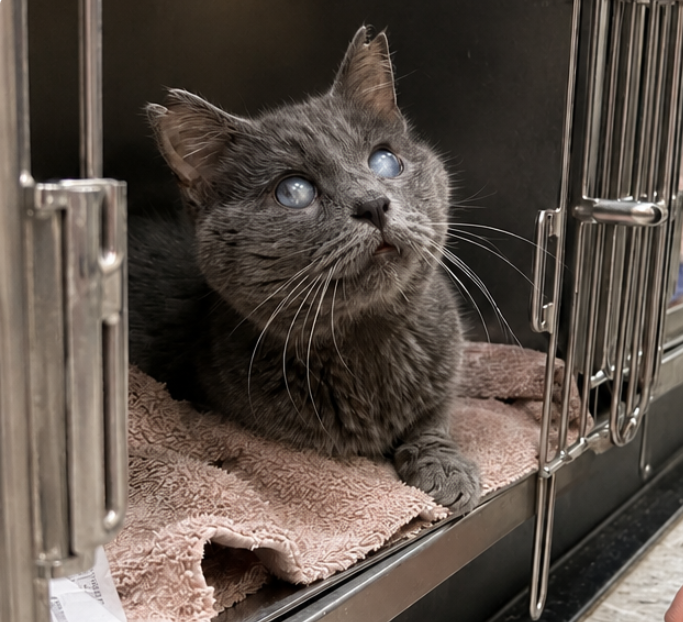
PART3:
Her hands looked like warm pieces of light.
Then the glaucoma worsened.
Brightness became fog.
Fog became nothing.
Evelyn never rearranged the furniture after that.
Not once.
When something had to move, she guided me toward it.
Let me smell it.
Let my whiskers touch the new edge.
Then she walked the path with me until I knew.
That was how she loved.
Quietly.
Repeatedly.
Without announcing what it cost.
She had been a librarian for thirty-five years.
Even after retirement, our apartment smelled like books.
Paper.
Dust.
Glue.
Old cardboard.
Stacks leaned against walls.
Books hid beneath tables.
Books occupied chairs no guest was apparently important enough to use.
Evelyn knew where every one belonged.
Sometimes she would reach into a pile and pull out exactly the volume she wanted.
“This one saved me,” she once told me.
I did not know what saving looked like to humans.
For cats, it was simpler.
Food.
Warmth.
Hands that did not hurt.
Someone coming back.
Evelyn had been widowed long before I arrived.
Her husband, Thomas, repaired watches.
One of his watches remained inside a bedroom drawer.
It no longer worked.
Every Sunday Evelyn opened that drawer.
She never wound the watch.
Never removed it.
Only touched it.
Then closed the drawer.
Humans keep strange things alive through repetition.
I understood that later.
I came to Evelyn after a storm.
Someone found me behind a grocery store.
I was tiny.
Wet.
Infected eyes.
Torn ear.
Bent tail.
The veterinary clinic thought I might not survive.
Evelyn had entered to collect medication for a stray dog she fed behind her building.
She heard me crying from a cardboard box.
That was enough.
The veterinary assistant warned her.
“This kitten may never see normally.”
Evelyn asked:
“Will she hurt?”
“For a while.”
“Can we help?”
“Yes, but it could be expensive.”
“And difficult?”
The assistant hesitated.
“Yes.”
Evelyn became annoyed.
I would later learn the small inhale she made when someone said something she considered foolish.
“Difficult isn’t the same as worthless.”
Then she took me home.
For weeks she carried me from room to room.
Kitchen.
Couch.
Bed.
Bathroom.
She tapped the food bowl.
Used a small brass bell near doors.
Spoke before touching me.
When the last of my vision disappeared, she did not mourn it in front of me.
She simply learned the apartment again.
With me.
That was our life.
Until the morning the tapping stopped.
I woke before Evelyn.
That never happened.
At first I remained curled on the blanket near the radiator.
Waiting.
The refrigerator hummed.
Pipes vibrated.
A truck stopped somewhere below.
No slippers.
No coffee.
No drawer.
No spoon.
I lifted my head.
The apartment felt wrong.
Silence has weight.
Anybody who has lived long enough with someone knows this.
There is ordinary quiet.
Sleeping quiet.
Reading quiet.
Sad quiet.
Then there is absence.
I moved toward Evelyn’s bedroom.
Counted.
One.
Two.
Three.
End of rug.
Four.
Five.
Floorboard squeak.
Six.
The bedroom door was open.
I heard breathing.
Thin.
Uneven.
I climbed onto the bed.
My claws caught the blanket.
I followed the sound.
Evelyn’s hand lay beside her.
I pressed my nose against her fingers.
Cold.
“Meow.”
Nothing.
I pushed my forehead beneath her palm.
Usually even sleeping, she would move.
Scratch between my ears.
Say my name.
Nothing.
I cried louder.
Her breath caught once.
Then continued in that terrible shallow rhythm.
I stayed.
I did not know how long.
Eventually someone entered the apartment.
Fast shoes.
Perfume.
Artificial flowers.
Hairspray.
Fear.
“Mom?”
Marianne.
Evelyn’s daughter.
I knew her.
She visited every few weeks.
Sometimes less.
She never sat on the floor with me.
Never tapped my bowl.
Touched me with one finger when politeness required.
She always asked some version of:
“You still have this cat?”
Evelyn always corrected her.
“Pixie lives here.”
Marianne never understood the distinction.
That morning she called an ambulance.
People filled the apartment.
Heavy bags.
Radios.
Rubber soles.
Metal equipment.
Someone lifted Evelyn from the bed.
I followed.
A paramedic blocked me gently with one leg.
“Stay back, sweetheart.”
I hated that word.
Sweetheart often meant:
I am about to move you somewhere you do not want to go.
I heard Evelyn being wheeled into the hallway.
I tried to follow.
Marianne caught me.
Her hands were hard.
Not intentionally cruel.
Impatient.
I twisted.
She swore.
“Stop.”
She shoved me into a plastic carrier.
The smell inside belonged to another animal.
Dust.
Fear.
Old urine.
I cried.
Someone near the door asked:
“Are you taking the cat?”
“No.”
One word.
I stopped moving.
The person asked:
“Doesn’t she belong to your mother?”
“My mother is going to the hospital.”
“Could someone keep her temporarily?”
“I have a job.”
Pause.
“Two children.”
Another pause.
“And I am not taking an elderly blind cat.”
The ambulance doors closed downstairs.
I heard them.
Then the engine.
Evelyn moved away.
I screamed.
There is no elegant word for it.
I screamed until my throat hurt.
Marianne carried the carrier to her car.
She said:
“I’m sorry, Pixie.”
She did not sound sorry.
She sounded inconvenienced.
Harbor County Animal Care was the loudest place I had ever known.
Dogs barked behind doors.
Cats cried.
Phones rang.
Bowls scraped.
Water sprayed.
Humans called names over one another.
My carrier landed on a counter.
A woman approached.
Coffee.
Soap.
Cats.
Her name was Tessa.
She opened the carrier.
Did not grab me.
“Hi, sweetheart.”
Again that word.
I pushed myself into the back.
Tessa waited.
“That’s okay.”
Her voice was soft.
“You don’t have to come out yet.”
That mattered.
Marianne stood nearby explaining me.
“She’s blind.”
“I can see that.”
“Old.”
“How old?”
“Fourteen?”
“Maybe fifteen.”
“Medical records?”
“I don’t have them.”
“Medication?”
“No idea.”
“Behavior?”
Marianne sighed.
“Difficult.”
Tessa became quiet.
“How?”
“She cries.”
I curled tighter.
“She gets underfoot.”
I had never gotten under Evelyn’s feet.
“She doesn’t like strangers.”
Correct.
“She may have accidents.”
Lie.
Tessa asked:
“Does your mother intend to reclaim her after rehabilitation?”
Marianne laughed.
“My mother won’t even remember she had a cat.”
That was the first lie I understood clearly.
There would be more.
Marianne signed the surrender paperwork.
Then left.
No touch.
No goodbye.
Only perfume lingering near the front desk.
Tessa carried me away from the dogs.
Quiet room.
Blanket.
Shallow water.
Food.
She placed the dish outside the carrier.
Then, without knowing what it meant, she tapped the bowl.
Tap.
Tap.
My body reacted before my mind did.
One paw forward.
Then another.
Evelyn?
I froze.
Wrong scent.
Wrong footsteps.
Wrong room.
But the sound.
Tap.
Tap.
Tessa said nothing.
Smart woman.
I ate a little.
The next morning she did it again.
Tap.
Tap.
I ate less.
The veterinarian examined me.
Dr. Alvarez.
Warm hands.
Metal stethoscope.
She touched my eyes.
The left one hurt.
I pulled away.
“Advanced glaucoma.”
Tessa asked:
“Treatment?”
“Medication for now.”
“And later?”
“Probably enucleation.”
Tessa exhaled.
Remove the eye.
Humans always become sad when discussing removing an eye that already sees nothing.
Cats care more about pain.
Dr. Alvarez continued.
“She’ll need bloodwork first.”
“How much?”
Silence.
Then:
“More than most adopters expect to spend on an elderly blind cat.”
Nobody meant it cruelly.
Sometimes facts hurt without anyone trying.
People came through the shelter.
Kittens left.
Young dogs left.
A fluffy white cat left.
A three-legged dog left.
People stopped near my cage.
Read the paper Tessa had attached.
BLIND.
SENIOR.
HANDLE GENTLY.
“Poor thing.”
“She’ll be hard to place.”
“Can she see anything?”
“No.”
“That’s sad.”
Nobody asked what I liked.
Nobody asked whether I knew my name.
Nobody asked whether I could still love somebody.
On the second day, I stopped eating.
On the third, I stopped drinking.
Tessa tapped the bowl.
Tap.
Tap.
I did not move.
The problem was not food.
The problem was that Evelyn was gone.
People think animals live entirely in the present.
Maybe some do.
I did not.
My world was memory.
Peppermint.
Lavender soap.
Left foot heavier than right.
There you are, Pixie girl.
Without those things, I had no map.
I curled against the cage wall.
Then a boy came.
Twelve years old.
I knew none of that at first.
I knew only smell.
Grass.
Pencil shavings.
Peanut butter crackers.
Laundry detergent.
His father smelled like engine oil and tiredness.
They had come to donate blankets.
The father said:
“We’re just dropping these off, Noah.”
“I know.”
They passed dogs.
Noah kept walking.
Then stopped at my cage.
He read the sign aloud.
“Blind. Senior. Handle gently.”
His father said:
“You don’t need to stop at every cage.”
“I’m not.”
Silence.
Then Noah sat on the concrete.
He did not put his hand through the bars.
Good.
He did not call me poor thing.
Better.
He did not make kissing noises.
Excellent.
For several minutes, nothing happened.
Then I heard something.
Tick.
Tick.
Tick.
A tiny object rolled across concrete.
Stopped near my cage.
I lifted my head.
Tick.
Tick.
Again.
Closer.
I stood.
His father said:
“She can’t see, Noah.”
“I know.”
“Then why are you rolling that?”
“I want her to know where I am.”
That was the first moment Noah understood me.
Before he touched me.
Before he knew my story.
Before he spent a dollar.
He understood that darkness was easier when sound had a location.
The stone rolled again.
Tick.
Tick.
Stopped beside the bars.
I stretched one paw through.
Touched it.
Noah inhaled.
“She found it.”
His father said:
“She heard it.”
“Same thing for her.”
Maybe.
Noah picked up the stone.
Rolled it again.
I followed.
He whispered:
“My name’s Noah.”
I moved closer.
“You don’t have to come out.”
Good.
He stayed twenty minutes.
No grabbing.
No pushing.
When his father said it was time to leave, Noah placed the stone beside my cage.
“I’ll come back tomorrow.”
I did not believe him.
People say things while leaving.
Leaving makes promises cheap.
But the next afternoon:
Same shoes.
Same peanut butter.
Tick.
Tick.
I was standing before he reached me.
Noah whispered:
“She remembers.”
His father said nothing.
Noah brought a book.
He read badly.
Skipped lines.
Mispronounced longer words.
I loved every mistake.
His voice remained.
That mattered more than the story.
Third day.
Noah tapped my bowl.
Tap.
Tap.
I walked toward it.
Ate.
For the first time in days, really ate.
Tessa almost cried.
Noah’s father talked with her near the doorway.
“Any adoption interest?”
“No.”
“Medical situation?”
“Still evaluating.”
“Cost?”
Tessa gave him a number.
Long silence.
Noah stood.
“I want her.”
His father sighed.
“Noah.”
“I do.”
“We talked about this.”
“You talked.”
“I listened.”
A small human after my own heart.
His father crouched.
“We rent.”
“I know.”
“Pet deposit.”
“I know.”
“She may need surgery.”
“I know.”
“She’s elderly.”
“I know.”
“Blind.”
“I know.”
“Sick.”
Noah’s voice sharpened.
“She’s not sick enough to stop loving.”
Silence.
His father took a breath.
“That isn’t what I said.”
“It sounds like what everyone means.”
Noah turned toward my cage.
“I can pay the adoption fee.”
“With what?”
“My savings.”
“How much?”
Pause.
“Eighty-seven dollars and forty-two cents.”
His father made a sound.
It might have been a laugh.
Might have been pain.
“That won’t cover medical care.”
“I can mow lawns.”
“You’re twelve.”
“I know how.”
“You already mow Mr. Keller’s.”
“I can wash cars.”
“You already wash his truck.”
“Then I’ll do somebody else’s.”
His father rubbed his forehead.
“Noah.”
The boy’s voice changed.
Something inside him opened.
“I know what it feels like when people decide somebody is too much work.”
His father stopped moving.
Noah continued.
“My mom was sick.”
I listened.
“Everybody kept talking about appointments.”
“Medicine.”
“Driving.”
“Work.”
“Money.”
“Too much.”
His voice shook.
“Then she died and nobody said too much anymore.”
The father crouched beside him.
“I never thought your mother was too much.”
“I know.”
“I don’t think Pixie is too much either.”
“Then help me.”
The father cried then.
Quiet tears.
I smelled salt.
“What happens if she needs surgery?”
Noah said:
“We figure it out.”
“That’s not a plan.”
“It’s the only plan people ever have when they love somebody.”
Humans occasionally say something so true even a cat should not interrupt.
Tessa offered foster-to-adopt.
Medical evaluation first.
Trial at home.
If it worked, permanent adoption.
Noah stood so quickly the stone rolled from his hand.
Tick.
Tick.
“Really?”
His father pointed at him.
“Every care instruction.”
“Yes.”
“You keep the apartment safe.”
“Yes.”
“You help with medicine.”
“Yes.”
“And if this becomes too much—”
“We figure it out.”
His father sighed.
“That phrase still isn’t a budget.”
Tessa opened my cage.
I backed away.
Noah sat.
Rolled the stone.
Tick.
Tick.
I stepped out.
One paw.
Another.
Cold floor.
Bleach.
Soap.
Noah.
I followed the sound until my whiskers touched his shoe.
He lowered his fingers.
Waited.
I smelled peanut butter and soap.
I pressed my nose against his hand.
Then Noah touched my head.
Two fingers.
Careful.
“There you are.”
My entire body became still.
Evelyn.
Not the same hand.
Not the same voice.
But the same kindness.
I leaned forward.
Hope does not return like lightning.
It comes through small openings.
That was mine.
The first night in Noah’s apartment, I walked into a wall.
Noah gasped like he had personally built it to hurt me.
I turned.
Found the rug.
He immediately began moving things.
Shoes against wall.
Backpack hung up.
Pencils picked up.
Clothes moved.
His father watched.
“Your room hasn’t been this clean since kindergarten.”
“I’m making it safe.”
“For Pixie?”
“For both of us.”
His father smiled.
His name was Daniel.
City bus mechanic.
Heavy steps.
Keys that announced him ten feet before he entered.
At first Daniel treated me like glass.
Then he learned.
He began saying:
“Pixie, coming through.”
“Pixie, chair moving.”
“Pixie, I’m home.”
Noah taped textures along safe routes.
Bell on the door.
Mat near the two entry steps.
Food in the same place.
Tap.
Tap.
Every meal.
By the third morning I waited for it.
The apartment had an empty bedroom.
I learned that quickly.
Different air.
Old medicine.
A woman’s clothes still inside the closet.
Daniel entered every night.
Sat on the bed.
Said nothing.
One evening I followed.
Climbed up.
He froze.
“You’re not supposed to be in here.”
I walked toward the sound of his breathing.
Put one paw against his leg.
Daniel exhaled.
Then touched my head.
Two fingers.
Careful.
“Your old woman teach you that?”
Maybe.
“Maybe you can teach me something.”
That night I slept beside him.
Noah found us.
“You let Pixie sleep in Mom’s room?”
Daniel looked embarrassed.
“She climbed up.”
“You could’ve moved her.”
“I could have.”
Noah smiled.
“Then don’t.”
He didn’t.
Dr. Alvarez eventually told them my left eye should be removed.
Not immediately.
But soon.
Noah asked:
“Will she see afterward?”
“No.”
His hand closed around the stone in his pocket.
“But she won’t hurt?”
“Not the same way.”
“How much?”
Dr. Alvarez gave the estimate.
Daniel went quiet.
Noah did too.
At home he emptied his savings onto the table.
Coins.
Bills.
Eighty-seven dollars and forty-two cents.
He counted twice.
“I can earn more.”
Daniel leaned against the counter.
“I know.”
“I’ll work.”
“You already do more than most twelve-year-olds should.”
“I can wake earlier.”
“You already wake at four.”
Silence.
Then Daniel said:
“Because of the nightmares.”
Noah stopped touching the coins.
I sat beneath the table.
“What do you dream?” Daniel asked.
“Mom.”
“What happens?”
“She calls me.”
Noah’s voice became small.
“I can’t find her.”
I moved toward him.
“I run.”
“But I keep hitting things.”
I rubbed my head against his ankle.
His hand fell onto my back.
“Pixie.”
Daniel sat beside him.
“Maybe you don’t have to find your mother.”
Noah looked up.
“Maybe you have to let yourself wake up.”
Noah cried.
“What if Pixie dreams about Evelyn?”
Daniel looked toward me.
“Then she wakes up here.”
Here.
That word became another sound of safety.
Here was Noah.
Daniel.
Food.
Blankets.
The little stone.
The painful eye still hurt.
But the world had started making sense again.
Then Tessa called.
Two weeks after I entered Noah’s home.
Daniel answered.
His voice changed.
“Are you sure?”
Noah looked up.
“What?”
Daniel covered the phone.
“Shelter.”
“Pixie?”
“Her owner.”
My heart began beating before he finished.
“She’s alive.”
Evelyn.
Alive.
Noah whispered:
“What?”
“She had a stroke.”
“She’s in rehabilitation.”
“And she’s asking for Pixie.”
Then came the second truth.
Marianne had told Evelyn I was dead.
Pleasant Grove Rehabilitation Center smelled like medicine, cooked vegetables, polished floors, and loneliness.
Noah carried me in the old shelter carrier.
I hated it.
He placed his fingers through the opening.
“I’m here.”
Elevator.
Hallway.
Wheelchairs.
Televisions.
Then:
Peppermint.
Lavender.
I stood.
The smell was thin beneath medicine.
But there.
Evelyn.
A voice came from inside the room.
Weak.
“Is that her?”
My carrier opened.
I stepped out.
One.
Two.
Three.
I knew where she was.
Her hand searched the blanket.
I jumped onto the bed.
Pressed my nose against her fingers.
“Pixie.”
She made a sound unlike any I had heard from her.
“Pixie.”
Her hand covered my face.
“There you are.”
I pushed into her palm.
She cried.
I cried too in the only way cats do.
Small sounds.
Head pressed harder.
Body refusing distance.
“You’re here.”
Yes.
She touched my torn ear.
“My girl.”
Noah stood near the bed.
Evelyn heard him.
“Who’s there?”
Daniel answered.
“This is Noah.”
“He’s been caring for Pixie.”
Evelyn reached out.
Noah took her hand.
“Thank you.”
Noah said:
“She needed somewhere safe.”
Then after a pause:
“So did I.”
Evelyn squeezed his hand.
Marianne had told her I died.
She had believed it.
For two weeks she had grieved me while I was alive.
That is a particular kind of cruelty.
Making someone mourn something you deliberately removed.
Daniel asked what happened that morning.
Evelyn explained.
Chest pressure.
Weak arm.
Could not properly call for help.
I cried beside her.
Marianne arrived.
Called the ambulance.
Promised she would take me to Evelyn’s cousin.
Instead:
Shelter.
No explanation.
No permission.
Then Evelyn told them more.
Marianne had been pushing assisted living.
Complaining about me.
Complaining about the apartment.
Asking about savings.
The deed.
Thomas’s will.
A limited power of attorney Evelyn had signed years earlier so bills could be paid during emergencies.
Money had begun disappearing.
Mail opened.
Accounts changed.
Evelyn had noticed.
But Marianne was her daughter.
Humans forgive family longer than logic recommends.
The next morning Marianne came into the rehabilitation room.
Her perfume reached me first.
I stiffened.
“So you found her.”
No apology.
Tessa stood near the bed.
Marianne said:
“My mother is not competent.”
Evelyn replied:
“I can hear you.”
Marianne ignored her.
She looked toward Daniel.
“You need to return the cat.”
Daniel did not move.
“You surrendered her.”
“My mother was ill.”
“You signed the paperwork.”
“I was overwhelmed.”
Tessa said:
“You also stated there was no family member willing to take responsibility.”
Marianne’s breathing changed.
Noah stayed near me.
Marianne turned toward him.
“You’re the boy?”
Silence.
“How old are you?”
“Twelve.”
“You spent your savings on a blind cat?”
Daniel stood.
“Enough.”
Marianne laughed.
“What happens when she needs real care?”
Noah’s body tightened.
“What happens when she gets sick?”
I walked closer to him.
“Will you dump her back at the shelter and call that kindness?”
Daniel stepped between them.
Evelyn’s voice came from the bed.
“You told me she was dead.”
Everything stopped.
Marianne said:
“Mom, you were confused.”
“I had a stroke.”
“You were confused.”
“I knew Pixie’s name.”
Marianne approached the bed.
“You don’t understand how much I’ve had to handle.”
“I asked for help.”
“I gave it.”
“You took my money.”
Silence.
Real silence.
Marianne stepped back.
Tessa reached for her phone.
Marianne raised her voice.
“My mother is mentally incompetent.”
Evelyn laughed softly.
“I worked in a library thirty-five years.”
“What does that have to do with anything?”
“I learned to keep records.”
A social worker named Carla Jennings appeared in the doorway.
She had heard enough.
“Mrs. Mercer, we need to discuss your finances and power of attorney.”
Marianne said:
“This is a family matter.”
Carla answered:
“Not anymore.”
Investigation began quietly.
Bank statements.
Power-of-attorney limits.
Shelter documents.
Apartment records.
Pension deposits.
Credit cards.
Furniture.
Jewelry.
Marianne became louder every time somebody asked a precise question.
She said she had sacrificed everything.
Said Evelyn was confused.
Said people were manipulating her.
Said I was a liability.
The shelter found its intake recording.
Marianne’s voice.
“If nobody takes her, you may as well put her down.”
Noah heard it.
He sat on Daniel’s kitchen floor holding me.
“I hate her.”
Daniel said:
“Hate what she did.”
“Same thing.”
“No.”
Noah cried.
“She talked like Pixie was a broken chair.”
Daniel sat beside him.
“People who are afraid of responsibility often call love a burden.”
“Why did she do it?”
“Maybe money.”
“Maybe anger.”
“Maybe because your grandmother loved Pixie and Marianne wanted control over anything she couldn’t control.”
Noah rubbed the stone.
“Can we stop her?”
“We tell the truth.”
“What if truth isn’t enough?”
Daniel looked at me.
“Then we tell it again.”
Marianne hired an attorney.
She demanded I be returned.
Claimed Evelyn lacked capacity.
Claimed the shelter adoption was invalid.
For three nights Noah barely slept.
Every car outside made him sit up.
He moved my bed beside his.
One night he whispered:
“If they take you, I don’t know what I’ll do.”
I climbed onto his chest.
His heart was racing.
“I don’t want to lose another mother.”
I did not know whether he meant me.
His own mother.
Evelyn.
All of us.
Maybe grief eventually stops separating names.
I stayed until sunrise.
Then Evelyn gave Noah a key.
Small.
Cold.
To her old apartment.
“There is something Marianne has not found.”
“What?”
“My red notebook.”
Evelyn had documented everything.
Dates.
Money.
Conversations.
Threats.
She had hidden it inside a hollowed-out book.
The Complete History of Municipal Law.
Marianne never opened boring books.
There was also a recorder.
Medication notes.
Memory exercises.
Conversations.
Evelyn had begun recording because she worried she might one day be told that what she remembered had never happened.
Carla went with Daniel, Tessa, and Noah to the apartment.
I came too.
Carrier again.
But this time Noah’s hand remained with me.
The apartment smelled wrong.
Coffee maker gone.
Rug rolled.
Books missing.
Furniture moved.
Evelyn’s scent fading.
My old map had been vandalized.
I stepped into the library.
Empty spaces where books once stood.
Daniel found the municipal-law volume.
Inside:
Red notebook.
First page.
Dates.
January 4.
Four hundred dollars missing.
January 18.
Marianne said Pixie should be euthanized because no one would want her.
February 3.
Bank password changed.
February 19.
Marianne threatened to stop visiting if Evelyn refused to sell.
March 1.
Pixie slept beside me while I cried.
Last entry.
Two days before the stroke.
Marianne told Evelyn she would be moving.
The apartment would be sold.
I would not be coming.
Evelyn wrote:
I told her I would rather die here with Pixie than live somewhere she could not go.
Then Marianne answered:
You don’t get to make everyone miserable just because you’re old.
Below it:
If I cannot speak, let Pixie’s silence remind someone that I tried.
Noah cried over the notebook.
They found the recorder.
Evelyn’s voice.
Dates.
Medicine.
Then Marianne.
“You need to stop writing everything down.”
“I’m practicing memory.”
“You’re making yourself suspicious.”
“I am suspicious of what I see.”
“You don’t see very much anymore.”
Another recording.
“Your pension came in.”
“I transferred it.”
“You didn’t ask.”
“I don’t need permission to pay bills.”
“It wasn’t a bill.”
“You don’t know what you’re talking about.”
“I know what my balance was.”
Then the last one.
Marianne’s voice near the recorder.
“I’m putting you in a facility whether you like it or not.”
“And when I do, that cat is going.”
“I will not let a blind animal ruin the sale of this apartment.”
Evelyn:
“Pixie is not ruining anything.”
Marianne:
“She is old, sick, and worthless.”
Pause.
“Do not call her that.”
Then laughter.
“Why?”
“She can’t even see who abandoned her.”
No one spoke when the recording ended.
I understood silence.
The shelter cage.
The empty bowl.
Evelyn’s bedroom.
Some silences are absence.
Others are people finally hearing something they cannot excuse.
Carla took the recorder.
“This changes everything.”
The hearing came three weeks later.
I stayed with Tessa because courthouses did not accept cats who happened to be central witnesses emotionally but legally remained cats.
Noah hated leaving me.
Daniel said:
“She knows you’ll come back.”
That was true now.
Noah had taught me.
The court reviewed Evelyn’s care and finances.
Marianne claimed Evelyn had chosen an animal over her health.
Claimed Noah’s family manipulated her.
Claimed the notebook proved confusion.
Then the limited power of attorney appeared.
Household bills only.
No authority to transfer money into Marianne’s personal accounts.
No authority to sell property for herself.
No authority to empty an apartment.
Bank records followed.
Pension money.
Credit-card payments.
Sold furniture.
Missing jewelry.
The attempted apartment sale.
The shelter surrender form.
Then the recordings.
Old.
Sick.
Worthless.
Blind animal.
Ruin the sale.
When Evelyn testified, her voice shook.
But she spoke.
“I wanted my cat.”
The judge listened.
“I wanted my home.”
“My books.”
“The right to decide what happened to the life I built.”
She turned toward Marianne.
“My daughter told me I was too old to make choices.”
“Then she used my illness to make them for me.”
Marianne began crying.
“I did everything for you.”
Evelyn answered:
“You did everything to me.”
Silence.
Marianne said she had given up her life caring for her mother.
Evelyn replied:
“You gave up my dignity for money.”
The judge removed Marianne’s authority over Evelyn’s finances.
An independent guardian was appointed.
Apartment sale stopped.
Financial records referred for further investigation.
My adoption remained valid.
When Noah came home, I heard his key.
I stood before the door opened.
He dropped to his knees.
“Pixie.”
I walked into him.
He held me.
“She called you worthless.”
I purred.
“She was wrong.”
Purr.
“She was wrong.”
Daniel locked the door.
“We won.”
Noah looked up.
“Did we?”
Good question.
Justice did not return Evelyn’s stolen time.
Did not erase the shelter.
Did not make Marianne sorry.
Did not bring Noah’s mother back.
But sometimes justice is not joy.
Evelyn later said:
“It is room to breathe.”
I understood that.
My eye surgery happened the following week.
Noah tapped my bowl before we left.
Tap.
Tap.
I ate.
At the clinic he kept one hand through the carrier.
“There you are.”
Dr. Alvarez removed the painful left eye.
When I woke, my head hurt.
But the deep pressure that had lived behind that useless eye was gone.
Noah had fallen asleep in a chair.
Daniel stood near the window.
“She did well,” Dr. Alvarez said.
Noah woke immediately.
“Can she come home?”
“Tomorrow.”
“I’ll stay.”
“You have school.”
“I’ll stay.”
She smiled.
“No.”
Noah leaned toward my carrier.
“I’ll come back.”
He did.
Always.
That became his greatest gift.
Not money.
Not the stone.
Returning.
Evelyn eventually moved into a small ground-floor supported apartment.
She could not keep me full-time.
But every Saturday Noah brought me.
The first sound when we entered:
Tap.
Tap.
Her fingers against the chair.
I crossed the room.
“There you are.”
Some Saturdays she cried.
Some she read.
Some she simply kept one hand against my back and listened to me breathe.
Noah once brought the red notebook.
“You should keep it.”
Evelyn said:
“I don’t need it anymore.”
“Why?”
“People know.”
“You kept records.”
“Yes.”
“Didn’t that protect you?”
“It started to.”
“What finished it?”
“Letting people stand beside me.”
Noah understood.
He was learning the same thing.
The criminal case against Marianne moved slowly.
Paper.
Hearings.
Bank transfers.
Witnesses.
The apartment manager described boxes being removed.
The shelter testified.
Carla testified.
Evelyn testified.
The recordings testified better than anybody.
Marianne eventually pleaded guilty to financial-exploitation and document-related offenses.
No dramatic handcuffs in front of television cameras.
No screaming confession.
Repayment.
Court supervision.
Community service.
Restrictions.
A criminal record.
Some money recovered.
Some gone.
Evelyn did not celebrate.
“I wanted justice.”
Noah sat beside her.
“It doesn’t feel good.”
“No.”
“What does it feel like?”
Evelyn thought.
“Like somebody opened a window.”
Daniel improved our apartment for me.
Ramp at the entry.
Textured mats.
Furniture kept stable.
Peppermint near food.
Lavender near couch.
Cedar near Noah’s room.
He announced changes.
“Box by wall.”
“Chair moved six inches.”
“New blanket.”
Sometimes they forgot.
I bumped into things.
Noah apologized to me as though personally responsible for the existence of furniture.
I forgave him.
Our apartment was not magically happy.
Noah still dreamed about his mother.
Daniel still sat in her empty room sometimes.
I still waited at doors for Evelyn’s old steps.
Healing did not erase the old map.
It added new rooms.
One day Noah read me a school assignment.
“My person is a cat named Pixie.”
I listened.
“She cannot see, but she taught me that being lost and being alone are not the same thing.”
His voice shook.
“She taught me people can leave and you can still find home.”
“She taught me somebody doesn’t have to fix you to love you.”
“Sometimes they just have to tap the bowl twice and wait.”
He stopped.
“Is that stupid?”
I licked his wrist.
“I’ll take that as no.”
Correct.
Evelyn grew stronger for a while.
Walking cane.
Reading group.
Crossword arguments.
Peppermint candies.
Every Saturday:
Tap.
Tap.
Then she changed her will.
Noah became nervous.
“You don’t need to give us anything.”
“I’m not giving you money.”
“Oh.”
Evelyn laughed.
“My apartment will go to Harbor County Animal Care.”
“Why?”
“The proceeds will fund medical care for senior and disabled animals.”
Noah touched my back.
“Because of Pixie?”
“Because Pixie reminded me.”
“Of what?”
“That the world stops seeing creatures when caring for them becomes inconvenient.”
The program became the Pixie Fund.
I did not understand money.
I understood outcomes.
An old terrier received dental work.
A three-legged rabbit went to a foster family.
A deaf dog found an elderly couple.
A sixteen-year-old black cat named June had been abandoned in a laundry room.
Noah met her.
Sat on the shelter floor.
Rolled the stone.
Tick.
Tick.
June did nothing.
Noah waited.
Rolled again.
Tick.
Tick.
Eventually June stepped forward.
Tessa said:
“You’re becoming an expert.”
Noah shook his head.
“I’m just waiting.”
Tessa smiled.
“That’s the expert part.”
Evelyn received a letter after June was adopted.
The old couple said June slept beside them and had begun purring again.
Evelyn cried.
I climbed onto her lap.
She tapped my back twice.
Tap.
Tap.
“There you are.”
Marianne wrote Evelyn one letter.
She did not open it.
Her lawyer read it.
Marianne said she was sorry things had become difficult.
Evelyn asked:
“Did she say she’s sorry for what she did?”
“No.”
“Then she’s sorry for consequences.”
“Yes.”
“I am not ready.”
That was enough.
Forgiveness is not another obligation elderly women owe their children.
Months became years.
Noah grew.
His voice changed.
Shoes grew larger.
Footsteps deeper.
The stone remained.
Daniel stopped treating my blindness like fragility.
I stopped waiting every evening for Evelyn’s footsteps.
Not because I forgot her.
Because I knew where she was.
Home became larger.
Evelyn.
Noah.
Daniel.
Shelter.
Peppermint.
Stone.
Tap.
Tap.
Then one winter afternoon Noah came through the door shouting my name.
Fear.
Immediate.
I stood.
He lifted me.
“Evelyn fell.”
Daniel arrived behind him.
“She didn’t break anything.”
“Hospital wants observation.”
“We can visit.”
At the hospital Evelyn sounded annoyed.
“Everyone is making too much of this.”
Noah said:
“You fell.”
“I sat down unexpectedly.”
“You fell.”
“I am an old woman.”
“That doesn’t give you permission to scare me.”
She laughed.
Then touched his cheek.
I lay beside her.
She was weaker.
That was the first day Evelyn spoke openly about leaving.
Noah refused.
“I don’t want to talk about it.”
“We should.”
“No.”
“Leaving isn’t always abandonment.”
He looked away.
“Sometimes the body ends.”
Her voice was soft.
“That doesn’t mean love decided to go.”
Noah cried.
“I’m not ready.”
“Neither am I.”
She held him.
“And sometimes people remain through things they taught you.”
“A story.”
“A habit.”
“The way someone taps a bowl.”
Tap.
Tap.
After two days Evelyn returned home.
Slower.
She insisted on walking inside.
Daniel on one arm.
Noah on the other.
I waited.
Door opened.
Steps.
Slow.
Left foot still slightly heavier than right.
“Pixie girl.”
I crossed the room.
Climbed onto her lap.
Her heartbeat beneath me.
Her fingers against my head.
“There you are.”
Years passed.
Evelyn became smaller.
The Pixie Fund became larger.
That seemed fair.
More old animals survived because she had once heard a kitten cry inside a cardboard box.
Noah finished school.
Studied social work.
He said he wanted to help people who were afraid to ask.
He kept the stone in his desk.
Every Sunday, he visited Evelyn.
I came when I could.
By then I was very old too.
My joints ached.
I slept most afternoons.
Could no longer jump onto every chair.
Noah lifted me when necessary.
Always told me first.
“Up.”
Then hands.
Respect matters most when you become dependent.
Evelyn understood.
Noah learned.
One spring morning Noah tapped my bowl.
Tap.
Tap.
“Evelyn wants you today.”
I stood.
He laughed.
“You knew.”
Of course.
At Evelyn’s apartment, the air had changed.
More medicine.
More blankets.
Quieter voices.
Peppermint still there.
Noah carried me to her chair.
Her fingers found my fur.
“Hello, my girl.”
I pressed my head beneath her chin.
“There you are.”
Barely a whisper.
Noah sat beside her.
Evelyn asked:
“Do you remember the shelter?”
“Yes.”
“The stone?”
“Yes.”
“What did you say when you found Pixie?”
Noah smiled through tears.
“That she wasn’t broken.”
“You were right.”
“She saved me too.”
“I know.”
“How?”
“You told me.”
“I don’t remember.”
Evelyn touched his hand.
“You were grieving.”
“She was grieving.”
“You did not try to force either one of you to stop.”
“You waited together.”
Noah bowed his head.
Evelyn looked toward the sound of his breathing.
“When I first brought Pixie home, I thought I rescued her.”
Her hand trembled on my back.
“She taught me blindness and ignorance are not the same thing.”
“She knew people by what they did.”
Noah whispered:
“She knew Marianne.”
“Yes.”
“She knew me too.”
Pause.
“I wasn’t a perfect mother.”
“Neither was mine.”
“No parent is.”
Evelyn breathed carefully.
“Imperfection isn’t failure.”
Then:
“You once tried to spend all your savings on Pixie because you thought love had to prove itself through sacrifice.”
Noah smiled.
“Eighty-seven dollars and forty-two cents.”
“I remember.”
“Was I wrong?”
“Not entirely.”
She touched his fingers.
“But love isn’t measured by what you lose.”
“What is it measured by?”
“Whether the other person feels less alone.”
Silence.
Then Noah:
“I’m glad you found me.”
Evelyn answered:
“I’m glad you listened.”
Her breathing slowed.
I felt it beneath me.
Noah noticed.
“Should I call someone?”
“Not yet.”
Daniel stood quietly near the door.
Evelyn wanted us there.
Noah.
Daniel.
Me.
Her fingers moved over my head one final time.




