A Biker Started Blocking Traffic Every Morning So My 9-Year-Old Daughter Could Cross the Street—Then One Morning, He Didn’t Show Up.
PART3:
Lily covered her ears and sobbed in the middle of the crosswalk.
By the time we reached the other side, she was shaking so hard I had to crouch on the sidewalk and hold her until the school bell rang.
The worst day came in October.
A man in a red pickup shouted out his window, “Hurry up!”
Lily turned toward the sound.
“Keep walking, baby,” I said.
The man shouted again.
“Move!”
She cried for twenty minutes behind a hedge outside the school entrance.
After that, she refused to cross.
Every morning became a battle.
We would walk the first three blocks fine. Lily would talk about butterflies, songs, her teacher, whether clouds had birthdays, whether dogs understood Spanish. Then we reached Mason Road, and her body locked.
“Come on, baby,” I would say.
“No.”
“We have to get to school.”
“Cars scary, Mama.”
“I know, but I’m right here.”
“No.”
She would plant her feet on the sidewalk and grip my hand with both of hers. Some mornings she cried. Some mornings she simply shut down, eyes on the asphalt, mouth tight, whole body saying she could not make herself move no matter how badly she wanted to be brave.
I called the city in November.
Then again in December.
Then in January.
I asked for a crossing guard. A flashing light. A stop sign. Anything.
A woman in traffic services told me they had received complaints about that intersection before.
“Then you know it’s dangerous,” I said.
“We have to conduct a review.”
“When?”
“I can put in the request.”
“How long does that take?”
“I can’t give you an exact timeline.”
That became the answer to everything.
No exact timeline.
No available funding.
No current staffing.
No guarantee.
Meanwhile, my daughter stood at a crosswalk every morning trying to convince her nervous system that a painted white line could protect her from two lanes of impatient adults.
Then came the Tuesday in March.
The morning was colder than it should have been. Texas does that sometimes, gives you spring flowers and then sends winter back for one last insult. Lily wore her pink jacket, the one with a butterfly patch on the pocket. She had two purple hair clips and mismatched socks because she insisted butterflies didn’t match either.
She was happy until Mason Road.
Then she stopped.
Traffic was worse than usual. Trucks kept rolling through the crosswalk like the sign did not exist. A black sedan slowed, then sped up when the driver behind him honked. A delivery van passed close enough that wind lifted the edge of Lily’s jacket.
Her hand tightened around mine.
“Cars scary, Mama.”
“I know.”
“I can’t.”
I looked at the road.
Then at my daughter.
Then at my watch.
The school bell would ring in twelve minutes.
A mother can measure helplessness in terrible little units like that.
Minutes until late.
Cars until panic.
Calls to city hall.
Forms submitted.
Nothing changed.
I was trying to decide whether to turn around and drive her to school, which would mean reinforcing the fear again, when I heard the motorcycle.
Not a distant hum.
A roar.
Deep, heavy, unmistakable.
The kind of sound that vibrates in your chest before the bike comes into view.
Lily heard it too. She flinched at first, but then she turned.
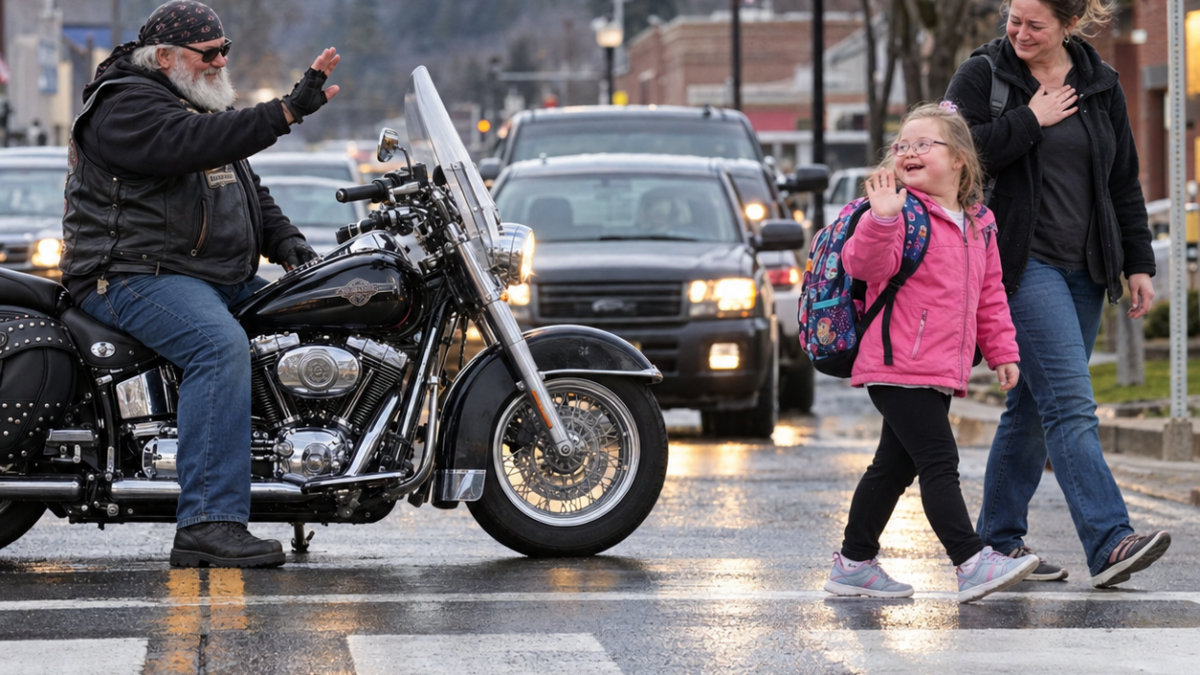
A black Harley rolled down Mason Road from the south, chrome flashing under the pale morning sun. The rider was a big man in a leather vest, gray beard, dark sunglasses, broad shoulders, heavy boots. He looked like someone most parents would instinctively pull their children away from.
He slowed near the crosswalk.
Looked at Lily.
Looked at me.
Looked at the cars that were not stopping.
Then he did something I still see in my mind like a scene from a movie.
He rode his motorcycle straight into the middle of the street and parked it sideways across both lanes.
Traffic stopped.
All of it.
Dead still.
A horn beeped once, weakly, then went silent.
The biker put both boots down, one hand resting on the throttle, and turned his head toward us.
“Go ahead,” he said.
His voice was gravelly but calm.
Lily stared at him.
Then at the empty road.
Then back at him.
“It’s okay,” I whispered.
She took one step.
Then another.
I walked beside her, holding my breath.
For the first time in months, no engine revved. No one shouted. No bumper rolled forward. No driver decided his coffee was more important than my daughter’s courage.
Halfway across, Lily stopped.
My stomach dropped.
But she did not freeze from fear.
She turned toward the biker and lifted her hand.
She waved.
The big man on the Harley lifted his hand and waved back.
Lily smiled.
Not a small smile.
Not a cautious one.
A real Lily smile, bright and whole and brave.
We made it to the other side.
The biker waited until both of Lily’s feet were on the sidewalk. Then he gave one nod, turned his bike, and rode away without another word.
I thought that was the end of it.
I was wrong.
The next morning, he was there.
Same corner.
Same black Harley.
Same leather vest.
Waiting.
Lily saw him before I did.
“Motorcycle man, Mama!”
She let go of my hand and walked straight toward him.
My daughter, who was afraid of loud cars, walked right up to a stranger on a Harley.
He shut the engine off when she approached.
That mattered.
He took off his sunglasses and tucked them into his vest.
His eyes were blue and tired and kind.
“Hey there,” he said. “You remember me?”
Lily nodded.
“You stopped the cars.”
“That’s right.”
“Why?”
He glanced at me, then back at her.
“Because cars are supposed to stop for people in a crosswalk. They forgot. I helped them remember.”
Lily considered this.
“Cars are rude.”
He almost smiled.
“Some are.”
“Are you stopping them today?”
“Yes, ma’am. Today and tomorrow and every day after that.”
Her eyes widened.
“Every day?”
“Every school morning I’m able.”
“Nobody honk?”
“Not while I’m here.”
She studied him with the seriousness of a judge.
“Promise?”
He held out his hand.
“Promise.”
Lily shook her head and extended her pinky.
“Pinky promise is stronger.”
The biker’s face changed.
Just for a second.
Something moved through him that I didn’t understand yet.
Then this enormous man in leather bent down and hooked his pinky around my daughter’s tiny finger.
“Pinky promise,” he said.
That was how Ray Dalton entered our lives.
Not with speeches.
Not with permission.
Not with some official title, badge, or city-issued vest.
Just a motorcycle parked sideways in the street and a promise made to a little girl at a crosswalk.
Every morning after that, Ray was there.
I learned his name on the third day because Lily asked.
“What your name?”
“Ray.”
“Mister Ray?”
“If you want.”
“I’m Lily.”
“I know.”
She tilted her head.
“How?”
He pointed to the butterfly patch on her backpack.
“Your mama says it every morning. ‘Come on, Lily.’ ‘Hold my hand, Lily.’ ‘Good job, Lily.’ I pay attention.”
That answer satisfied her.
From then on, she called him Mr. Ray.
He called her Miss Lily.
Their routine became sacred.
Lily would spot him from half a block away and speed up as much as Lily ever sped up.
“Mr. Ray day!”
Every school morning became Mr. Ray day.
He would park on the corner, one boot on the curb, one hand wrapped around a paper cup of coffee from the gas station. Black, no sugar. He said sugar ruined coffee. Lily said coffee ruined coffee.
They did their pinky promise.
Then Ray would start the Harley, ride into the road, and block both lanes while Lily crossed.
At first, she crossed holding my hand.
Then holding two fingers.
Then barely touching me.
By the second week, she crossed like she owned the road.
Head up.
Pink jacket bright.
Butterfly backpack bouncing.
Halfway across, she always turned and waved.
Ray always waved back.
At the far curb, Lily blew him a kiss.
Ray caught it in one big hand and tucked it into the front pocket of his leather vest.
Every morning.
No matter who was watching.
No matter how tough he looked.
My daughter blew him a kiss, and he caught it like it was something worth saving.
The change in Lily was not small.
Within a week, she stopped crying at night about cars.
Within two weeks, she started asking if it was morning yet because she wanted to see Mr. Ray.
Within a month, her teacher emailed me to say Lily had raised her hand three times in class.
“She seems more confident lately,” Mrs. Alvarez wrote. “Did something change at home?”
I typed back: She has a friend at the crosswalk.
That sounded too simple.
It was not.
Confidence is not built only in therapy rooms and classrooms. Sometimes it is built in the middle of a road, one safe crossing at a time, by someone who says with his actions, You deserve space here.
Ray gave Lily space.
And because he did, she started taking it elsewhere.
At the grocery store, she said hello to the cashier again.
At music therapy, she sang louder.
At school, she walked into the building without clinging to my coat.
At home, she taped a drawing to the fridge of a giant motorcycle with a tiny pink butterfly on the gas tank. Next to it stood two stick figures holding hands. One had a gray beard. One had pigtails.
“Is that Mr. Ray?” I asked.
“Yes. He is big.”
“And that’s you?”
“Yes. I am Lily.”
Simple as that.
One morning, she gave Ray a butterfly sticker.
It was pink with glitter on the wings, one of her favorites.
“For your motorcycle,” she said.
I expected him to put it in his pocket and maybe stick it somewhere private later.
He didn’t.
He crouched beside the Harley, cleaned a spot on the black gas tank with the edge of his sleeve, and placed that glittery pink butterfly right where everyone could see it.
Lily clapped.
“Pretty!”
Ray stood and looked at his bike.
“Needed something.”
I laughed.
“You sure about that?”
He glanced at me.
“Miss Lily gave it to me.”
As if that settled everything.
And it did.
Not everyone appreciated Ray.
Most people learned quickly. Once a big Harley blocked the road every morning, drivers suddenly discovered the meaning of a yield sign. Some even started stopping before Ray moved.
But there were always a few.
One morning in April, a man in a lifted pickup laid on his horn the entire time Lily crossed.
The sound hit her hard.
She flinched, but she kept walking.
Ray did not move until she reached the other curb.
Then he walked slowly toward the pickup.
The driver rolled down his window.
“You can’t just block a public road, you idiot!”
Ray stopped beside the truck.
He was calm.
Almost friendly.
That made him scarier.
“That little girl needs sixty seconds to cross,” he said. “You can give her sixty seconds.”
“I got work.”
“So does her mama.”
“I’ll call the cops.”
“Go ahead. I’ll be here tomorrow too.”
The driver looked Ray up and down, apparently realized the argument was not improving his morning, and rolled up his window.
Officer Martinez showed up the next day.
I saw the patrol car parked half a block away and immediately felt panic rise in my throat.
Ray saw it too.
He sipped his coffee.
“Morning, Officer.”
Officer Martinez was in his forties, neat mustache, tired eyes, the kind of police officer who looked like he had spent years trying to solve problems the city kept creating.
He watched Lily cross. Watched Ray block both lanes. Watched the cars stop. Watched Lily wave.
Then he got out.
“Mr. Dalton.”
“Officer.”
“Technically, what you’re doing is obstructing a roadway.”
Ray nodded.
“Technically, that sign says yield to pedestrians.”
Officer Martinez looked at the sign.
“Nobody yields,” Ray said. “So I help them yield.”
A corner of the officer’s mouth twitched.
“I’ve been asking the city for a traffic light here for two years. Budget keeps getting cut.”
“Funny how cheap paint is until somebody gets hit.”
Officer Martinez looked at Lily, who was now on the school side of the street, blowing Ray a kiss.
Ray caught it and tucked it into his vest pocket.
The officer’s face softened.
“Have a good morning, Mr. Dalton.”
“You too, Officer.”
He never came back to stop him.
Sometimes he came back to help.
It was the fifth week before Ray told me about Grace.
By then, he and I had developed our own morning ritual. After Lily crossed, I stayed on the corner for a minute while she continued to the school entrance with a group of other kids and the teaching aide who met them at the door. Ray and I drank coffee, complained about potholes, discussed weather, and pretended neither of us had become emotionally attached to these five minutes.
That morning, Lily had given him a drawing of a butterfly wearing sunglasses.
Ray studied it very seriously.
“She says that butterfly is you,” I said.
“Does it have a beard?”
“No.”
“Then it’s only partly accurate.”
He tucked the drawing carefully inside his vest.
I noticed his hand linger there.
“You’re good with her,” I said.
He looked toward the school.
“I had a daughter.”
Had.
The word landed quietly but heavily.
I turned toward him.
“Her name was Grace,” he said. “She had Down syndrome too.”
My chest tightened.
Ray kept looking across the street, not at me.
“Happiest kid in the world. Waved at strangers just like Lily does. Loved purple popsicles, old country music, and knocking over block towers. Hated peas like they owed her money.”
I smiled because he did.
“She was ten.”
The smile left his face.
“Grace had a heart condition. Comes with Down syndrome sometimes. We knew. Doctors watched it. Medications. Appointments. All of that. We thought we had time.”
He set his coffee on the bike seat.
“One Saturday, we were at the park. She was on the swings. My wife was reading on a bench. Grace called out, ‘Daddy, watch this.’”
His voice changed.
Not breaking.
Not yet.
“She pumped her legs as high as she could. Laughing like she’d figured out flying. Then she just… stopped.”
I pressed one hand over my mouth.
“Her heart gave out. By the time the ambulance came, she was gone.”
“Ray,” I whispered.
“That was twelve years ago.”
The road noise seemed very far away.
“My wife, Joanne, lasted three more years. Heart attack in her sleep. Doctor said it was quick. People say that like quick means kind.”
He picked up his coffee again, but did not drink it.
“I stopped riding after Grace died. Sold one bike. Covered this one in the garage. Sat in my house for two years waiting to die too.”
“What changed?”
He looked at the butterfly sticker on his gas tank.
“One morning I heard Grace’s voice.”
I stayed quiet.
“Maybe it was a dream. Maybe grief. Maybe my old brain misfiring. But I heard her clear as anything. ‘Daddy, go ride.’”
His hand rested on the motorcycle seat.
“So I did. Got on the Harley. Somewhere out on Highway 83, wind in my face, I swear I felt her arms around my middle like she was riding behind me again.”
He cleared his throat.
“After that, I rode every morning. No place particular. Just rode. Then that Tuesday in March, I came down Mason and saw Lily standing at the crosswalk, scared. Same eyes as Grace when something was too loud.”
He looked at me then.
“I figured that was Grace telling me where to be.”
I cried.
Right there on the sidewalk.
Coffee in one hand. Backpack strap over my shoulder. Mascara probably doing something tragic.
Ray looked mildly alarmed.
“You don’t have to cry every time I tell you something.”
“Yes, I do.”
He almost laughed.
Almost.
After that morning, I understood something about Ray that I hadn’t before.
He was not saving Lily because she reminded him of Grace in some simple sentimental way.
He was loving through the wound.
There is a difference.
Some people see reminders of what they lost and turn away because the pain is too sharp. Ray saw Lily at that crosswalk and moved toward her. Not because it didn’t hurt. Because it did. Because pain had once made his world smaller, and he was done letting it.
He never asked Lily to be Grace.
He never treated her like a replacement.
He learned her favorite songs. Her favorite snacks. Her dislike of green beans. Her habit of saying “actually” before correcting adults. Her deep belief that butterflies were “sky flowers.” He listened when she talked, even when it took her longer to get the words out. Especially then.
Ray did not rush her.
That may have been the greatest gift of all.
The crosswalk began changing too.
At first, people stopped because Ray forced them to.
Then some started stopping on their own.
A woman in a blue sedan rolled down her window one morning and called, “Good morning, sweetheart!” as Lily crossed.
Lily waved so hard her backpack slipped.
A delivery truck driver began arriving early and parking nearby so he could stop his truck before Ray even moved. His name was Calvin, and he brought Lily a butterfly keychain one Friday with my permission.
A school bus driver named Mrs. Pruitt started slowing every morning whether she had students aboard or not. Once, she opened the bus doors and shouted, “Looking good, Lily!”
Lily talked about that for two days.
Then came the morning Mrs. Pruitt got out of the bus and stood in the road beside Ray while Lily crossed.
No speech.
No announcement.
Just stood there in her reflective vest, arms crossed, blocking one lane while Ray blocked the other.
Solidarity looks beautiful when it finally becomes visible.
Soon there were parents who waited an extra minute to walk with us. Retirees who took morning walks past the crosswalk on purpose. A high school senior named Jaden who started carrying a homemade sign that said SLOW DOWN, GENIUS.
Ray liked him immediately.
The city ignored us until someone filmed the pickup driver yelling and Ray calmly telling him to give Lily sixty seconds.
The video spread.
Not viral in the national sense.
Small-town viral.
Which is worse in some ways because everyone recognizes the gas station, the truck, the intersection, the mayor’s niece in the background, the city’s neglected yield sign.
Comments flooded the town page.
Why is there no light there?
That crosswalk has been dangerous for years.
I’ve almost been hit there too.
Who is the biker?
Protect Lily at all costs.
The biker’s name is Ray and he is a legend.
Ray hated that.
“I’m not a legend,” he muttered when Calvin showed him the post.
Jaden grinned.
“Dude, you’re kind of a legend.”
“I’m a guy with a motorcycle and a free morning.”
“Legend behavior,” Jaden said.
Ray told him to go to school.
Then one Monday morning in May, Ray was not there.
At first, I thought we were early.
We weren’t.
Lily looked down the street.
“Mr. Ray coming?”
“I’m sure he is.”
Five minutes passed.
Cars moved through the crosswalk too fast.
Calvin pulled up in his delivery truck and stopped.
“I got it,” he called.
He blocked one lane with his truck and waved us across.
Lily didn’t move.
“Where Mr. Ray?”
“He might be sick today,” I said carefully.
“He promised.”
Her chin trembled.
“I know, baby.”
“He promised every day.”
Calvin’s face folded with worry.
I coaxed Lily across while Calvin held traffic, but she cried the whole way.
Ray was not there the next morning either.
Or the next.
I didn’t have his number. I realized that with shame. This man had shown up every morning for my daughter, had become part of our lives, had told me about his dead child, and I had no way to call him because our relationship existed in the sacred, fragile space between 7:35 and 7:45 on a street corner.
On the third day, Officer Martinez pulled up.
“Still no Ray?”
I shook my head.
“Do you know where he lives?”
“South end, somewhere. That’s all I know.”
He nodded.
“I’ll make some calls.”
That afternoon, my phone rang from an unknown number.
It was Martinez.
“I found him.”
My stomach dropped.
“He’s alive,” he said quickly.
I sat down.
“Where is he?”
“County hospital. Cardiac unit. Looks like he had an episode Sunday night. Neighbor found him Monday morning.”
“Heart?”
“Yeah.”
The same thing that took Grace.
I went to the hospital Thursday.
Room 412.
Lily insisted on coming, so I checked with the nurse first. Ray had approved visitors, though when we walked in, he looked annoyed in the way men do when they are embarrassed to be seen weak.
He looked smaller without his leather vest and Harley.
That frightened me more than the hospital equipment.
His beard was the same. His eyes were the same. But his body under the blanket looked too human. Too fragile. There were wires on his chest, an IV in his arm, monitors beeping softly beside him.
“You weren’t supposed to find out,” he said.
Lily marched to the bed.
“You gone.”
Ray’s face softened.
“I know, Miss Lily.”
“You promised.”
“I did.”
Her lower lip trembled.
“My heart got a little rude,” he said.
She climbed onto the chair beside the bed, then looked at me.
“Can I sit?”
Ray patted the blanket carefully.
“If your mama says okay.”
The nurse helped lift her onto the bed, avoiding wires.
Lily leaned forward and put her head on his chest.
The monitor beeped steadily.
“Your heart is beeping,” she said.
“That means it’s working.”
She listened with deep concentration.
“Good job, heart.”
Ray closed his eyes.
I turned toward the window because some moments are too much to watch straight on.
Lily sat up suddenly and reached into her backpack.
“I made this.”
She pulled out a drawing.
A motorcycle.
A big figure.
A small figure.
A pink butterfly on the gas tank.
Above them, in careful uneven letters, she had written:
MR RAY COME BACK SOON.
Ray took the paper.
He looked at it for a long time.
“It’s for your heart,” Lily said. “So it gets better.”
His voice was rough.
“It’s already working.”
He taped it to the wall beside his bed and told every nurse who entered not to move it.
The first morning without Ray, I parked my car sideways across one lane.
I was terrified.
My hands shook on the steering wheel. A man in a sedan rolled down his window and asked what I thought I was doing.
“My daughter needs to cross,” I said.
He looked ready to argue until he saw Lily standing on the curb in her pink jacket, hands over her ears.
He stopped.
The second morning, Calvin was there with his delivery truck.
“Figured you could use backup,” he said.
The third morning, Officer Martinez arrived in full uniform and parked his cruiser with the lights flashing.
The fourth morning, Mrs. Pruitt stood with us, along with three parents and Jaden holding a new sign.
LILY’S CROSSING.
By Friday, there were twelve people.
By the next Monday, there were twenty.
Someone had posted about Ray being in the hospital. Not private details, just enough: The biker who protected Lily needs us to protect her while he heals.
People came.
Parents. Retirees. Teachers. High school kids. A barber from the next block. The woman from the blue sedan. A man who owned the hardware store and brought orange safety cones. Brenda from the bakery with a box of donuts. Even the pickup driver who had yelled at Ray appeared one morning and stood awkwardly near the back. He didn’t say much, but he held a sign that said SLOW FOR KIDS.
Lily noticed him.
“You honked.”
His face went red.
“Yes, ma’am. I’m sorry.”
She considered that.
“Don’t do it again.”
“No, ma’am.”
Ray would have loved that.
Every morning, Lily crossed.
Every morning, she blew a kiss.
Whoever stood in Ray’s spot caught it and put it in their pocket.
Calvin did it.
Officer Martinez did it.
Mrs. Pruitt did it.
Jaden did it with dramatic flair that made Lily giggle.
But it wasn’t the same.
Then Ray got out of the hospital on a Wednesday.
On Thursday morning, we heard the Harley before we saw it.
Lily stopped mid-sentence.
Her whole body went still.
The black motorcycle rolled slowly down Mason Road and pulled onto the shoulder.
Ray was thinner. Paler. Moving carefully. But he wore his leather vest, sunglasses, boots, and the same stubborn expression he probably had worn through every doctor’s warning.
Lily screamed.
“MR. RAY!”
She ran.
Lily did not run often.
That morning she flew.
Ray crouched just in time to catch her. She threw her arms around his neck and held on.
“You came back!”
“I promised.”
She leaned back and put both small hands on his cheeks.
“Your heart okay now?”
Ray looked at her.
Then at all of us.
Calvin. Martinez. Mrs. Pruitt. Jaden. Parents. Retirees. Strangers who were no longer strangers because one child needed sixty seconds.
“My heart is perfect now,” he said.
Lily held out her pinky.
Ray hooked his around it.
“Pinky promise?” she asked.
“Pinky promise.”
Then she noticed the crowd.
“Who are they?”
Ray looked over his shoulder.
“They’re the people who helped while Mr. Ray was gone.”
Calvin walked up and shook Ray’s hand.
“Glad you’re okay, brother.”
Mrs. Pruitt wiped her eyes and pretended she wasn’t.
Jaden said, “Dude, you’re officially a legend now.”
Ray actually laughed.
A real laugh.
“I’m not a legend.”
Jaden pointed at the pink butterfly sticker on the Harley.
“Legend with a butterfly bike.”
Ray looked at the sticker.
Then at Lily.
“Best kind.”
The city installed a traffic light six weeks later.
Not because they suddenly found compassion in the budget.
Because the petition got four hundred signatures. Because the video kept circulating. Because Officer Martinez wrote a report with words like “documented hazard” and “ongoing pedestrian risk.” Because parents showed up at a council meeting wearing butterfly stickers. Because Lily stood at the microphone, held the mayor’s hand, and said, “Cars need red light so kids don’t be scared.”
The mayor looked like he wanted the floor to swallow him.
Good.
At the ribbon-cutting, they tried to put Ray in the back with the other residents.
Lily would not allow it.
She marched over, grabbed his hand, and dragged him to the front.
“This is Mr. Ray,” she announced. “He stopped the cars.”
Everyone clapped.
Ray looked like he would rather fight three men in a bar than be applauded by a town council.
But he stayed because Lily held his hand.
The mayor gave a speech about community partnerships and infrastructure priorities. Ray muttered something under his breath that made Officer Martinez cough into his fist.
Then Lily got to press the button.
The new pedestrian signal flashed.
The light turned red.
Cars stopped.
All by themselves.
Lily clapped so hard her butterfly hair clip fell out.
After the ceremony, I found Ray by his bike.
He was looking at the new light.
“You don’t need me anymore,” he said. “Got a real light now.”
I stood beside him.
“Lily will always need you.”
He shook his head.
“She’s got a whole town now.”
“Yes. Because you showed us where to stand.”
He looked away.
That was Ray’s way of not crying.
He still comes every morning.
He parks on the shoulder now instead of blocking the road. Lily walks up, does the pinky promise, waits for the light, crosses safely, and blows him a kiss from the other side.
He catches it.
Puts it in his vest pocket.
Every single morning.
Sometimes Calvin stops too. Sometimes Jaden, though he graduated and now works at the hardware store while taking classes at community college. Sometimes Officer Martinez rolls by and taps his horn lightly, which Lily permits because “police honks are gentle.” Sometimes the woman in the blue sedan waves.
Most strangers wave back now.
Not all.
But more.
On Sundays, Ray comes to dinner.
The first time, he arrived with flowers for me and a pack of butterfly stickers for Lily.
“You didn’t have to bring anything,” I said.
“I was raised right.”
Lily made him wear a paper crown decorated with pink and purple butterflies.
Ray looked at me as if asking for rescue.
I offered none.
He wore the crown through the entire meal.
He ate spaghetti with a butterfly crown on his head while Lily explained that he was “King Motorcycle.”
After dinner, Lily dragged him to the living room for a dance party. Ray said he didn’t dance. Lily said everyone danced. She put on an old country song from my phone, grabbed his hands, and made him sway while she spun in circles.
For one second, watching him, I saw it.
Not with my eyes exactly.
But I saw a little girl named Grace laughing on swings, calling Daddy, watch this.
And I saw Ray choosing not to turn away from the pain of remembering her.
He let memory hurt.
Then he let it move his feet.
Last week, Lily asked me at bedtime, “Mama, is Mr. Ray my family?”
I was sitting on the edge of her bed, untangling one butterfly clip from her hair. The question made me pause.
Family used to feel like a word that had failed us. Divorce does that. It rearranges people. It leaves empty chairs. It teaches children that some promises are not as permanent as adults claim.
But then I thought about Ray.
This man who showed up one morning and never really left.
This man who saw his dead daughter in mine and chose love instead of hiding.
This man who parked his motorcycle sideways in the road because my child deserved a safe minute.
This man who caught imaginary kisses and kept them in his vest pocket like treasure.
This man who let a little girl make him a king with a paper crown.
“Yeah, baby,” I said softly. “He’s family.”
Lily smiled.
Then her eyes grew serious.
“Grace too?”
My throat tightened.
Ray had told her about Grace slowly, carefully, with my permission. Lily knew Grace had loved swings and music and purple popsicles. She knew Grace had gone to heaven. Lily thought heaven was “where butterflies go when people miss them.”
“Yes,” I said. “Grace too.”
Lily looked at the paper butterflies taped above her bed.
“Maybe Grace told Mr. Ray to find me.”
I brushed hair from her forehead.
“Maybe she did.”
Lily closed her eyes.
“Good job, Grace.”
I sat there a long time after she fell asleep.
The next morning, we walked the four blocks to school.
The first three were still easy.
The fourth was different now.
There was a traffic light.
Fresh paint.
A button Lily loved pressing.
A sign below it the city had installed after the ceremony:
LILY’S CROSSING
PLEASE WAIT WITH KINDNESS
Ray was already there, leaning against his Harley, butterfly sticker still bright on the gas tank.
Lily ran to him.
“Mr. Ray day!”
“Best day of the week,” he said.
“It’s Tuesday.”
“Exactly.”
She held out her pinky.
He hooked his around it.
The light changed.
Cars stopped.
Lily stepped into the crosswalk, head high, butterfly backpack bouncing, moving at her own pace.
Not too slow.
Not too fast.
Just Lily’s pace.
And this time, the whole road waited.




