A 9-Year-Old Gray Cat Was Hours From Being Put Down After Everyone Called Him “Unadoptable”—Then a Woman Who Only Came to Donate Towels Stopped at His Cage.
PART3:
“Scared, yes. Not this bad.”
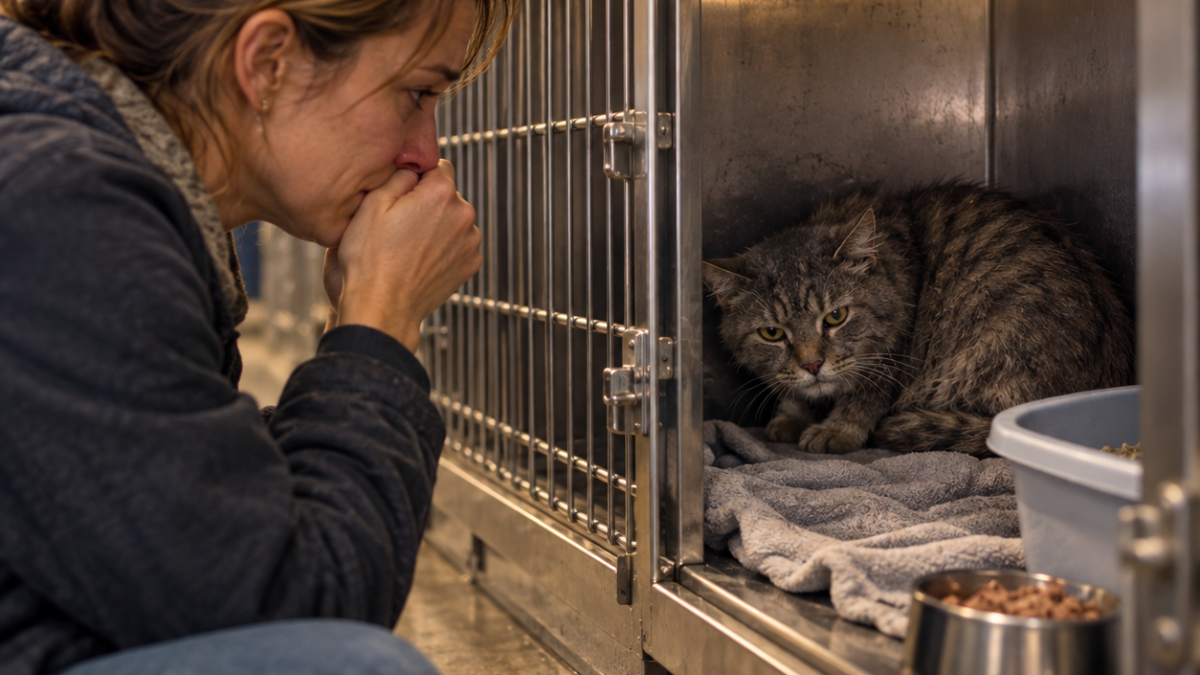
I crouched in front of the cage.
My knees complained immediately. At sixty-four, crouching had become less a casual movement than a legal negotiation with gravity.
“Smokey,” I said softly.
He did not blink.
“Hey, old man.”
Nothing.
Marlene shifted beside me. “His family surrendered him after his owner went into care. That’s what the paperwork says.”
“Into care?”
“Memory facility. Something like that. The daughter brought him in.”
The word daughter found a soft place in me and pressed.
I imagined a woman with boxes to pack, doctors to call, siblings arguing over paperwork, a mother asking the same question five times, and an old cat hiding under a bed while strangers carried furniture past him.
I did not want to imagine it kindly.
Kindness complicates anger.
But the picture came anyway.
“Did they say anything else?”
“That he was shy. That he hid from strangers. That he had some dental issues.” Marlene’s face tightened. “They said he was loved.”
I almost laughed, but there was no humor in it.
The old gray cat sat behind his litter pan like love had ended in a metal cage.
“Sometimes love fails badly,” Marlene said, as if she knew what I was thinking.
I looked up at her.
She gave a small shrug. “Doesn’t always mean it wasn’t there.”
That was the first thing she said that made me dislike her a little.
Not because it was cruel.
Because it might be true.
“And if nobody takes him?”
She looked down the row of cages.
The shelter was full. Anyone could see it. Cats in every kennel. More carriers stacked near the intake door. A handwritten board behind the desk listing urgent fosters needed. Space was not an abstract issue there. Space had breath, fur, names.
“We’ll do what we can,” she said.
“That isn’t an answer.”
“No,” she replied. “It isn’t.”
I looked back at Smokey.
There was a younger cat two cages down, black-and-white, charming everyone who passed by. He reached both paws through the bars and chirped whenever someone looked at him. A little girl in a glitter sweater was already begging her mother to ask about him. That cat would be fine. Maybe not immediately, but soon. He still believed hands brought good things.
Smokey did not.
That was what got me.
Not his age.
Not his dull fur.
Not the word unadoptable, though I hated it the moment Marlene used it.
It was the fact that he did not ask.
He did not plead for rescue. Did not perform sweetness. Did not make himself appealing. He seemed to have decided that wanting things only gave the world another way to disappoint him.
I knew that posture.
I had worn my own version of it after my husband died.
I had not curled behind a litter pan, of course. Human beings are expected to make despair look more presentable. I had folded laundry, paid bills, gone to work, smiled at the grocery cashier. I had answered the phone when Eli called and said, “I’m fine, sweetheart. Just tired.” I had cooked half-meals and eaten standing at the sink. I had kept the curtains open just enough that neighbors would not worry.
But inside, I had gone to the back of the cage.
Marlene waited.
I stood up too fast and nearly lost my balance.
“I can’t adopt a cat tonight,” I said.
It sounded firm.
It sounded sensible.
It sounded like something a woman says when she still believes she is in control of her life.
Marlene nodded. “I understand.”
I picked up my purse.
Smokey did not move.
I walked toward the front desk.
The black-and-white cat chirped. The little girl squealed. A dog barked somewhere behind the wall.
I made it almost to the lobby before I stopped.
There are moments that feel small when they happen. A pause. A glance back. A breath taken differently. Later, you understand your entire life turned on that one ordinary hesitation.
I turned around.
Marlene was still standing by Smokey’s cage.
She did not look surprised.
That annoyed me too.
“How much paperwork?” I asked.
Her face changed.
Not joy exactly.
Relief, maybe.
“Not much.”
“That is a lie people say before paperwork.”
“It’s not too bad.”
“It’s always too bad.”
She smiled for the first time.
I signed the papers before I could talk myself out of it.
I paid an adoption fee that felt both too small for a life and too large for a woman who had planned only to donate towels. I listened to instructions. I took a folder with medical notes, food recommendations, and a warning that transition could be difficult. Marlene brought a carrier from the back and lined it with one of Mrs. Donnelly’s donated towels, which seemed unfairly poetic for such a miserable situation.
Getting Smokey into the carrier was not dramatic.
That made it worse.
He did not fight.
He did not hiss.
When Marlene reached in slowly with a towel, his body went limp with terror. He became heavy in that terrible way frightened animals do, surrendering not because they trust, but because resistance has left them.
Marlene placed him in the carrier.
He pressed himself into the farthest corner.
“Give him time,” she said.
“How much?”
Her eyes softened. “As much as he needs.”
“That sounds like forever.”
“Sometimes forever gets smaller once they feel safe.”
I carried Smokey to my car through a cold October drizzle.
The carrier rattled softly on the passenger seat all the way home. I kept glancing over, hoping to see his head lift, his eyes turn, some sign that he understood we were leaving that place behind.
He stayed buried in the back corner.
My duplex looked smaller when I carried him inside.
That sounds foolish, but it did. As if bringing another life across the threshold made the rooms reveal their limitations. The narrow hallway with the scuffed baseboards. The living room with the sagging couch and afghan folded over one arm. The framed school photos of Eli on the mantel. The kitchen table with only one chair pulled out because I rarely used the second.
I had prepared nothing.
Because I had not planned to become responsible for a terrified senior cat with dental disease and a broken spirit before dinner.
I set him up in the spare bathroom. Fresh water. A shallow bowl of soft food. A clean litter box. A folded blanket. Low light. I placed the carrier on the floor and opened the door.
Then I backed away.
Smokey did not come out for two hours.
I sat in the hallway with my back against the wall, listening to nothing.
At first, I tried to be productive. I read the adoption folder. I searched online for advice about shy cats. I made notes. Keep confined. Use quiet voice. Do not force contact. Offer hiding places. Establish routine. Consult veterinarian.
After twenty minutes, every article began to sound like it had been written by someone whose shy cat had eventually become a charming Instagram creature named Biscuit who now wore bow ties.
Smokey was not Biscuit.
He was a gray rock in a plastic carrier.
Around nine, I heard movement.
Not much.
Just a faint shift.
I leaned toward the bathroom.
Smokey emerged low to the ground, belly nearly touching tile. He looked around once, saw the open space between the carrier and the toilet, and bolted behind the toilet so fast I barely saw him move.
Then he stayed there.
I slept badly that night.
Every few hours, I got up and stood outside the bathroom door like a nervous burglar in my own home. Once, I heard him drinking. Once, a small scraping sound told me he had used the litter box. By morning, a little food was gone.
That was how I knew he was still trying.
For the first week, I barely saw him.
I learned to measure his existence by evidence.
A paw print in spilled litter.
A depression in the blanket.
Food missing.
Water lower.
One gray hair stuck to the edge of the sink.
If I stepped into the room, he froze. If I spoke, he flattened himself lower. Once, I reached too quickly for the water bowl and he flinched so violently that his side hit the wall.
I felt sick about it all day.
“I’m sorry,” I whispered, though apologies are useless to creatures whose bodies remember pain better than words.
After five days, I sat on the closed toilet lid and cried.
Not loudly.
I did not want to scare him more than my existence already did.
“I don’t know what I’m doing,” I told the space behind the toilet.
Smokey did not respond.
“You probably noticed.”
Nothing.
“I thought saving you meant bringing you home. That was arrogant, wasn’t it?”
The bathroom fan hummed.
“I may have saved you from one ending just to give you another kind of misery.”
That was the fear that had begun to grow in me.
Maybe some hurt went too deep.
Maybe some creatures did not come back.
Maybe comfort offered too late only illuminated the size of what had been lost.
A few days later, I got him to a veterinarian.
It took forty minutes, two towels, a bleeding scratch on my forearm, and every ounce of patience I owned to guide him into the carrier. He did not attack so much as panic in all directions. By the time I buckled the carrier into the car, we were both trembling.
The vet’s name was Dr. Priya Singh.
She was younger than I expected, maybe mid-thirties, with calm hands and the kind of voice that made even hard facts land softly. She did not rush Smokey. She let him stay in the bottom half of the carrier while she examined him piece by piece. She spoke to him before touching. She stopped when he froze too hard. She dimmed the lights.
When she finished, she looked at me over her glasses.
“He’s terrified,” she said.
“I know.”
“But he’s also in pain.”
That sentence hit harder than I expected.
Pain.
Of course.
How had I missed it?
Bad teeth. Inflamed gums. Two likely resorptive lesions. Arthritis in his hips and lower spine. Evidence of an old ear infection that had probably gone untreated too long. Mild dehydration. Poor muscle tone. Nothing dramatic from across a room. Nothing that announced itself like a wound. Just steady, daily pain, the kind that grinds a life down quietly.
“He probably associates handling with discomfort,” Dr. Singh said. “Maybe not abuse. Maybe just pain. If touching has hurt him for months, or years, he may expect all contact to become pain.”
I sat very still.
How easy it had been to call him fearful.
Difficult.
Unadoptable.
How easy to name the behavior and miss the wound beneath it.
“What do we do?”
“We treat what we can. Dental work when he’s stable enough. Pain management. Anti-inflammatory support if bloodwork allows. A quiet environment. Predictable routine.” She paused. “And time.”
Everyone kept saying time like it was something I could purchase in bulk.
On the drive home, I cried harder than I had in months.
Not only for Smokey.
For every child called difficult when they were scared.
Every old person called bitter when they were lonely.
Every exhausted worker called rude when they were drowning.
Every animal labeled unadoptable because nobody had looked long enough to find the pain.
For how easy it is to mistake hurt for personality.
After that, I stopped waiting for Smokey to become sweet.
I stopped imagining some movie moment where he would suddenly leap into my lap and purr as if gratitude had repaired him. I stopped measuring progress by affection.
Instead, I gave him what Dr. Singh said he needed.
Relief.
Quiet.
Room.
I moved him from the bathroom to my bedroom because the bathroom had too many echoes and the toilet made an awful sound when flushed. In the bedroom closet, I made a hiding place with a soft blanket, a shallow bed, food, water, and a small night-light. I left the closet door open exactly twelve inches. Wider made him nervous. Narrower made me nervous.
Every evening, I sat on the bedroom floor a few feet away and read aloud.
At first, I read books.
Then I ran out of energy for books and read whatever was nearby. Grocery lists. Junk mail. Prescription warnings. The back of a soup can.
“Contains less than two percent of modified food starch,” I read one night, “which honestly sounds suspicious, Smokey, but I’m not a scientist.”
His eyes glowed from the closet.
No blink.
No trust.
But he listened.
Or at least he did not flee farther into the wall.
Days passed.
Then weeks.
His dental surgery cost more than I wanted to admit to anyone, especially Eli, who already worried about me living alone. I put part of it on a credit card and told myself I would figure it out, which is how most people in this country handle both love and emergencies.
After the bad teeth were removed and the infection treated, something shifted.
Not dramatically.
Smokey did not emerge reborn, leaping through the house like a creature in a medication commercial.
But he ate more.
His shoulders lowered.
His eyes stopped looking quite so far away.
He still hid when I entered the room, but sometimes he hid more slowly, as if fear had to remind him of the rule.
The first time he ate while I was sitting nearby, I froze with a water bill in my hand and did not move for twelve minutes. My foot fell asleep. My back cramped. Smokey took six bites of food, stopped, looked at me, then took another.
It felt like being trusted with a secret.
One night, after a long day that had gone wrong in all the small ways life can go wrong, I sat on the bedroom floor and cried.
The washing machine had leaked. My manager had scheduled me for an extra shift without asking. Eli had called but had to hang up after six minutes because his daughter spilled orange juice on the dog. I had gone to the pharmacy and forgotten the one thing I went there to buy. None of it was tragic. That was what made it unbearable.
Small burdens are like pebbles in a pocket.
One is nothing.
A hundred will drag you under.
I sat with my back against the bed and cried into my hands.
Not loud.
Just tired crying.
The kind that comes from carrying too much for too long while still being technically fine.
“I’m not going to force you,” I told the dark closet. “You don’t have to trust me tonight. Just… don’t give up in this house.”
For a while, nothing happened.
Then I heard a soft sound.
One careful step.
Then another.
I lifted my head.
Smokey stood at the closet entrance.
His body was low, but not flattened. His ears were tilted back, but not pinned. He looked at me for a long time.
Then he walked toward me.
Slowly.
Stiffly.
As if crossing those six feet required him to betray everything experience had taught him.
He did not climb into my lap.
He did not rub against me.
He did not purr.
He simply came close enough that his side touched my knee.
Then he leaned.
Just a little.
And stayed there.
That was all.
Some people would have missed it.
Some people would have waited for something prettier.
But I had spent weeks learning his language.
That small weight against my knee was not small.
It was a door opening one inch after years of being nailed shut.
I cried harder then, but silently, because I did not want him to think his courage had frightened me.
“Okay,” I whispered. “Okay, old man.”
His side remained warm against my knee for almost three minutes.
Then he retreated to the closet.
But he did not run.
And somehow, that was everything.
Three months later, I made the mistake of telling one person his story.
Her name was Barbara Kingsley, and she ran the register at the pharmacy where everyone in town eventually learned everyone else’s business, whether they wanted to or not. She asked about the scratches on my arm. I told her they were from my cat. She asked what kind. I said old, gray, complicated. She laughed and asked for the story.
I should have known better.
By Friday, half of Maple Ridge had an opinion.
Some people thought it was heartwarming.
Some thought it was foolish.
One woman outside the post office looked me directly in the eye and said, “I’m sorry, but people like you make it harder for shelters to do what needs to be done.”
She said “people like you” in the tone usually reserved for tax fraud and public coughing.
I stood there with my mail in one hand.
“What needs to be done?”
“You know.” She glanced away. “Hard choices.”
There it was.
Hard choices.
People loved that phrase.
It sounded mature. Practical. Clean.
Sometimes it was those things.
Sometimes it was only cruelty wearing a blazer.
“I made a choice,” I said.
She smiled tightly. “One cat.”
“Yes.”
“You can’t save them all.”
“I wasn’t trying to save them all.”
She blinked.
“I was trying to save him.”
That ended the conversation, but not the argument.
The shelter called in early October.
A younger volunteer named Avery explained they were holding a fall adoption weekend and asked if they could share Smokey’s before-and-after photo. “People need hope,” she said.
I looked over at Smokey.
He was sitting under the dining table watching dust move through sunlight with the gravity of a philosopher.
His coat had grown softer. His eyes were clearer. He still startled when I sneezed. He still vanished if someone knocked. But he slept at the foot of my bed most nights now, a heavy gray shape just close enough to count.
“Yes,” I said.
Then, before I could stop myself, “I can bring photos in person if that helps.”
Avery sounded relieved.
Shelters ask people to care so often that I think they stop expecting yes.
The morning of the event, I printed two photos at the pharmacy.
One was Smokey’s intake picture.
The shelter had emailed it to me. I hated looking at it. In the photo, he was hunched behind the litter pan, eyes huge, fur dull. Smaller than I remembered. Already halfway gone.
The second photo I took myself.
Smokey on my bedroom windowsill, looking out at the bird feeder, October light warming the fur along his back. He still looked old. Still serious. Still Smokey. But his body was loose. One paw tucked beneath him. Eyes present.
He looked like someone who had been hurt and had decided, carefully, to remain in the world.
When I walked back into Maple Lane Animal Haven, I thought I was prepared.
I was not.
The smell hit first.
Bleach. Detergent. Wet fur. Newspaper. The sour edge of fear beneath it.
Then the sounds.
Dogs barking from the other side. Metal doors opening and shutting. A kitten crying somewhere in the back. Voices trying to be cheerful in a building that held too much waiting.
The lobby was decorated with orange paper pumpkins and more construction-paper leaves. Adopted. Fostered. Found Home.
Avery met me near the desk. She was college-aged, with short curls and a nametag covered in tiny paw-print stickers. When she saw the photos, she made the little gasp people make when they want you to know they see the difference.
“Oh wow,” she said. “He looks incredible.”
I almost corrected her.
Not incredible.
Safe.
But maybe safety was incredible.
She pinned the photos to a corkboard near the front desk and wrote a card beneath them.
SMOKEY
Age 9. Labeled unadoptable.
Now sleeping at the foot of a bed every night.
I stared at those words.
Labeled unadoptable.
Not because it was untrue.
Because it was true too often.
Avery noticed my face. “We hate that word too.”
“Then why use it?”
“Because sometimes if we soften it, people don’t understand how close they came.”
That answer stayed with me.
I walked through the cat room after that.
I told myself I was only looking.
This was a lie so thin it barely deserved the effort.
The kittens had a crowd, of course. Tiny paws. Big eyes. One orange little thing kept tumbling backward off a blanket and being rescued by a laughing boy in a baseball cap. A calico kitten climbed her cage door like a circus performer while three teenagers filmed her.
Further back were the older ones.
The quiet ones.
The ones people read too quickly.
A black cat with a torn ear sleeping so hard he didn’t wake when a child tapped the sign.
A white-faced tortoiseshell named June, whose card said prefers women.
A large tabby named Leonard whose paper read: 12 years old. Owner passed away. Bad hips. Thyroid medication.
Leonard did not come forward.
He sat in the bottom cage near the end, watching the room with exhausted dignity, as if he had already accepted that attention belonged to younger bodies.
I crouched.
“Hello, Leonard.”
He blinked once.
Not a slow blink of affection. More of a weary acknowledgment that I had addressed him correctly.
Avery appeared behind me. “He’s sweet.”
“I believe you.”
“Most people don’t.”
I nodded.
There is something especially cruel about how our culture treats age.
You see it in jobs.
In mirrors.
In the way people say “still” about a life, as if it is surprising that something old could remain worthy of tenderness.
Still sharp.
Still active.
Still beautiful.
Still here.
And you see it in shelters.
Everyone says they want to rescue.
Fewer want a rescue that comes with medication, grief, fear, slowness, or a countdown.
It is easy to feel noble around a cute beginning.
It is harder to commit yourself to a difficult middle.
By noon, the lobby was crowded. Families came in with coffee cups and hopeful voices. Teenagers took selfies with kittens. A little girl in a glitter sweater cried because her mother said no to a rabbit. I stayed longer than I planned to, answering questions about Smokey from strangers who had seen the photos.
Then a man in a camouflage jacket glanced at Smokey’s board and said, not to me exactly but loud enough, “That’s nice and all, but most people don’t have money to throw at a broken old cat.”
A woman beside him laughed. “Exactly. People romanticize this stuff online. Meanwhile shelters stay full because nobody wants to talk about hard choices.”
They walked away.
I did not.
I stood there with those words burning through me.
Broken old cat.
Hard choices.
I drove home angry.
Not hot angry.
Deep angry.
The kind that feels old the moment it arrives.
Smokey was under the bed when I got home, because I smelled like shelter and strangers. I changed clothes, washed my hands, and sat on the bedroom floor.
After a while, his nose appeared.
Then his eyes.
Then his whole face, cautious as moonrise.
“I know,” I said. “People are exhausting.”
He blinked.
A long one.
Then he came forward and sat three inches from my fingers.
That was one of his versions of affection.
Being near the hand.
Not under it.
Letting it exist without punishment.
That evening, Eli called.
My son always called on Sundays if life had not swallowed him whole. He lived in Ohio with his wife, Meredith, and their daughter, Rosie, who believed I was the most interesting woman in America because I once mailed her a box of rocks with googly eyes glued onto them.
I told him about the shelter event.
About Leonard.
About the man in the hunting jacket and the woman who believed mercy became foolish when it cost money.
Eli was quiet for a moment.
Then he said, carefully, “Mom, can I say something without you taking it wrong?”
“No.”
He laughed. “That’s honest.”
“Say it anyway.”
“I think what gets people worked up is that an old animal makes them feel trapped. They hear medicine, special food, anxiety, vet bills, limited time… and all they see is obligation.”
I leaned against the kitchen counter.
“That isn’t wrong,” I said. “That’s true.”
Another pause.
Then Eli said, “But I don’t think most people are only afraid of the work.”
“No?”
“I think they’re afraid of getting attached to something they might lose soon.”
That hit closer.
Because yes.
That too.
Maybe especially that.
We do not live in a culture that handles loss well. We treat grief like a scheduling problem. We give people three days off when someone dies and expect them to return normal by Monday. We say protect your peace, guard your energy, move forward, choose what serves you.
Some of that is wisdom.
Some of it becomes an excuse to never be inconvenienced by love.
There is a difference.
A week after the shelter event, Avery posted Smokey’s photos on Maple Lane’s rescue page.
My phone lit up like a small emergency.
First came the kindness.
Hundreds of comments.
People posted pictures of old dogs with cloudy eyes, cats missing teeth, rabbits with one ear, three-legged mutts sleeping under Christmas trees. A widower from Kentucky wrote that his twelve-year-old beagle had saved his life after his wife died. A woman in Arizona said the cat nobody wanted had slept on her chest through chemo. A truck driver shared a photo of a one-eyed barn cat riding in the passenger seat of his rig with the caption: Best company I ever had.
I cried over strangers on the internet for two days.
Then the other comments started.
Easy to say when it’s not your money.
This kind of guilt posting is why shelters lie about behavior.
Some animals are unsafe and some are too far gone.
You spent all that on one old cat while healthy kittens die every day.
Emotional manipulation.
It’s a cat, not a child.
You can’t save them all.
That last one appeared again and again.
You can’t save them all.
As if anyone had said otherwise.
As if the only way to defend helping one life is to prove you have solved suffering itself.
Of course I could not save them all.
I could not save all the animals at Maple Lane.
I could not save Leonard’s owner from dying.
I could not save Mrs. Donnelly from leaving her home.
I could not save my husband from the heart attack that took him in our garage while I was inside folding towels.
I could not save every piece of myself that had gone quiet afterward.
But what a cold excuse that phrase becomes when people use it to justify doing nothing for the life directly in front of them.
The comment section turned into a courtroom where nobody had been sworn in but everyone testified.
People argued about shelters. Money. Mercy. Priorities. Euthanasia. Responsibility. Lonely women. That phrase appeared more than once.
Lonely women and their animals.
Lonely women treating pets like children.
Lonely women using rescue to fill a hole.
I read those words while Smokey slept under my dining table, and my face burned.
Maybe a hole existed.
A husband gone.
A son far away.
A house too quiet.
A body aging.
A heart with nowhere to put the love that still arrived every morning whether anyone asked for it or not.
But why did that make the act smaller?
Why are people so eager to mock the place where tenderness comes from?
Three nights into the comment storm, I turned my phone facedown and left it in the kitchen.
I could feel the ugliness in my body.
Too much opinion.
Too much performance.
Too many people trying to prove that practicality was morally superior to mercy.
Smokey found me sitting on the bedroom floor.
I was not crying that time.
Just tired.
He stood in the doorway, watching me with those solemn yellow-green eyes.
Then he walked over and did something he had never done before.
He climbed into my lap.
Awkwardly.
Stiffly.
With great suspicion.
One front paw first. Pause. Then the other. Then his whole heavy gray body settling against my stomach like an old sack of warm flour.
I froze.
He froze too.
Neither of us wanted to ruin it by acknowledging what had happened.
So I sat there, barely breathing.
He stayed for twenty full minutes.
His body was heavier than I expected and lighter than it should have been. I rested one hand on his back and felt the rise and fall of his breathing.
There were people online arguing that some lives asked too much.
Meanwhile, this old cat had spent months teaching himself that my lap was not a trap.
Tell me again which one of us had the harder job.
The next morning, I received a private message.
The sender’s name was Hannah Walker.
I think that used to be my mother’s cat. If this is the same Smokey, I don’t know if I should even be writing. But I’ve been crying since I saw that photo.
I stared at the message for a long time.
Anger came first.
Sharp.
Ugly.
Protective.
Your mother’s cat?
The cat curled behind a litter pan waiting to die?
The cat with infected teeth and painful joints and fear carved into his bones?
That cat?
I almost deleted the message.
Instead, I wrote:
What do you want to say?
She answered twenty minutes later.
Then again.
And again.
By late afternoon, I had the story.
Her mother, Ruth, had owned Smokey since he was a kitten. Ruth’s husband died four years earlier. Smokey had become her shadow afterward. Then Ruth began forgetting things. Small things at first. Appointments. Stove burners. Medication. Then bigger things. She fell twice. Got lost driving to church. Called Hannah one night from the grocery store parking lot because she could not remember which car was hers.
Eventually, Hannah and her brother moved Ruth into memory care.
No pets allowed.
They had six days to clear out the house.
Her brother was allergic. Hannah rented and had two dogs. They called neighbors, friends, a local vet, three rescue groups. Nobody would take a nine-year-old gray cat who hid from strangers, needed dental work, and had begun peeing outside the litter box because nobody knew he had pain.
So they took him to Maple Lane.
“He was never mean,” Hannah wrote. “Just shy. My mom loved him. I know that probably doesn’t matter to you after how he arrived there, but it’s true.”
I read that sentence six times.
Because that is the hard thing, isn’t it?
Sometimes love is true and still not enough.
Sometimes people fail a life they care about because they are overwhelmed, under-resourced, scared, grieving, selfish, exhausted, or all of it at once.
I did not want a complicated answer.
Complicated answers are harder to be righteous about.
I called Hannah that evening.
I don’t know why.
Maybe I wanted to hear whether remorse sounded different in a human voice.
It does.
She cried before I did.
She told me her mother had asked about Smokey for weeks after moving.
Then less often.
Then not at all.
She said the shelter staff had called once to say he wasn’t adjusting, but she had been in the middle of selling her mother’s house and fighting with Medicaid forms and trying to keep her own job. She thought someone would take him. She told herself shelters knew what to do. She told herself he would be safer there than in a house where nobody could keep him.
“I should have tried harder,” she said.
“Yes,” I replied.
Silence.
Then she whispered, “I know.”
I could have punished her.
Part of me wanted to.
Not because it would help Smokey.
Because anger loves an easy target.
But when she spoke about her mother, I heard the ragged guilt people carry after making one difficult choice after another and only later realizing which one will haunt them.
That does not erase harm.
It does not erase Smokey’s pain.
It does not erase the cage.
But it does make the world less simple than the internet prefers.
Before we hung up, Hannah asked if I would send a photo.
“Only if it doesn’t upset things,” she said. “I just want to know he’s okay.”
I looked over at Smokey.
He was asleep in the basket near the heater vent, one paw hanging out.
I took a picture.
Not posed.
Not pretty.
Just Smokey, old and breathing and safe.
I sent it.
Hannah replied with one line.
Thank you for doing what we didn’t.
That stayed with me for days.
Not because it made me feel noble.
It did not.
It made me sad.
For Hannah.
For Ruth.
For Smokey.
For all the ways this country is built around private struggle and public silence until something living falls through the cracks.
People love to say don’t judge when they do not want to answer for the outcome of their choices.
People also love to judge from a distance when compassion costs them nothing.
The truth sits in the middle, where nobody likes to stand.
Sometimes people surrender animals because they are careless.
Sometimes because they are cruel.
Sometimes because life narrows so fast that they make a terrible choice while trying to survive something else.
And the animal pays either way.
That is the part I cannot get past.
Smokey did not care about explanations in some grand moral sense.
What happened to his body happened.
The pain happened.
The fear happened.
The waiting happened.
A good explanation is not the same thing as repair.
In November, Smokey got sick again.
It started small.
He left half his breakfast.
Then all of it.
By evening, he was crouched under the dresser, eyes dull, not responding when I opened the treat bag.
Every cat owner knows that particular terror.
The way your mind sprints ahead of facts.
I wrapped him in a towel and drove to the emergency clinic across town with one hand on the carrier the whole way, as if I could hold him to earth by touch alone.
The waiting room was fluorescent and too warm.
A teenage boy sat with a limping hound under a blanket. A couple in scrubs held a cardboard box with breathing holes poked into the top. An older woman stared at a silent carrier in her lap while her lips moved in prayer or bargaining. No one looked at anyone for long.
That place had the quiet of people privately begging God.
The emergency vet said pancreatitis, maybe triggered by age, maybe stress, maybe one of those invisible internal shifts that come more often after a body has been hurt too long.
He needed fluids.
Monitoring.
Maybe overnight.
I signed whatever they put in front of me.
At two in the morning, I sat alone in my kitchen with the receipt and cried over the number at the bottom.
Not because I regretted it.
Because I did not know how many times I could keep saying yes and still pretend math did not matter.
That is the conversation people treat as shameful.
It isn’t.
Money matters.
Vet care is expensive.
Medication is expensive.
Growing old in America is expensive whether you walk on two legs or four.
Love does not cancel the bill.
It only makes you pay it if you can.
Smokey came home the next afternoon, tired but stable.
For two days, he wanted nothing but the heating pad, spoonfuls of watered-down food, and my hand resting against his side while he slept.
On the third night, he got up on his own, walked into the kitchen, and yelled at me for dinner with more feeling than I had ever heard from him in his life.
I laughed so hard I had to sit down.
That was when I understood something the internet misses completely.
People talk about rescue as if it is one dramatic act.
It is not.
It is repetition.
Medicine again.
Laundry again.
Patience again.
The same reassurance given one hundred times in one hundred boring forms.
It is not glamorous.
It does not photograph well.
It will not always make sense to outsiders.
But that is what devotion looks like when you remove the performance.
In December, Maple Lane asked if I would come read in the senior cat room once a week.
Apparently Avery had told them how I used to sit on the floor and read soup labels to Smokey until he learned my voice.
I said yes before I could overthink it.
Every Thursday afternoon, I brought a paperback and a grocery tote full of old blankets to the shelter. I sat in a folding chair between Leonard and June, the white-faced tortoiseshell, and read aloud.
Sometimes history.
Sometimes crime novels.
Once, accidentally, a very embarrassing romance because I grabbed the wrong book from my nightstand.
I read steadily.
No reaching.
No asking.
Just a voice in the room saying: Nothing bad is happening right now.
The first few weeks, nothing much changed.
Leonard watched.
June slept.
A black cat named Minnie hissed every time I cleared my throat.
Then small things began.
June ate while I was there.
Minnie stopped hissing.
Leonard came to the front of his cage and leaned one cheek against the bars while I read about a shipwreck in 1847.
A man came in one Thursday looking specifically for a kitten.
He left with Leonard.
I stood in the stock room afterward and cried into a bag of donated towels.
Avery found me there.
“Good crying?” she asked.
“The worst kind,” I said.
She nodded like she understood exactly.
By January, people in town had started recognizing me as “the Smokey lady,” which is not the worst thing I have ever been called.
At the grocery store, a cashier asked how the old gray cat was doing.
At the pharmacy, a man told me his wife had made him adopt a senior dog because of my post and now the dog followed him to the bathroom like a tiny prison guard.
On Facebook, the argument never fully died.
Every few weeks, someone new found the post and reignited it.
Still, not everyone agreed.
Still, people wrote that resources were limited, sentimentality clouded judgment, not every life should be prolonged simply because humans could not bear to let go.
And buried underneath all that, always, was the real question.
What counts as a life worth extra trouble?
Not only animal lives, either.
You can tell a lot about a culture by who it calls a burden.
The old.
The sick.
The scared.
The inconvenient.
The ones who need more time than strangers think reasonable.
The ones who are not easy to show off.
The ones who cannot make the world money, move fast enough, or perform gratitude in a way satisfying to watch.
I started answering comments sometimes.
Not all of them.
You would lose your soul that way.
But the ones written with real uncertainty instead of cruelty, I answered.
Smokey did not need me to save all cats. He needed me to save him.
Mercy is not efficient. That does not make it wrong.
And once, when a woman wrote, I’m not judging, I just don’t think every broken thing needs to be fixed, I sat with that for an hour before replying:
Maybe. But I think every living thing deserves one place where it is not treated like trash.
That comment spread farther than anything else.
Virality is a strange machine.
It takes your quietest wound and turns it into public property.
But if I am honest, the message mattered because people knew it was not only about a cat.
Everybody has known a Smokey.
Maybe a parent.
Maybe a veteran.
Maybe a spouse after grief hollowed them out.
Maybe a child called difficult when they were actually drowning in hurt.
Maybe themselves.
Too many people know what it feels like to shut down in plain sight while the world decides they are no longer worth the effort.
Late one night in February, I was folding laundry on my bed when Smokey climbed up beside the warm pile of towels and settled directly on top of them like he had paid the mortgage.
He looked at me with those steady eyes.
Then he did something he had never done before.
He head-butted my hand.
Once.
Firm.
Certain.
Not a question.
Not an accident.
A claim.
I laughed, and then, because I had become the kind of person who cried at cat manners, I immediately cried.
“All right,” I told him. “I know. You live here.”
He closed his eyes.
Purring.
I thought about the cage.
The litter pan.
The deadline I had not planned to interrupt.
The shelter worker saying he would not be alive by morning.
So much of life turns on small obediences we almost ignore.
A pause.
A glance.
A signature.
A decision made before we have fully built a case for it.
People still asked if I regretted it.
No.
I did not regret the bills.
The slow months.
The medicine.
The emergency clinic.
The way my world rearranged itself around the care of a creature who might never become easy.
Maybe that was the part some people could not stand.
Because if Smokey was worth it, then maybe we had all been lying to ourselves a little about what deserves our time.
Maybe convenience is not the highest form of wisdom.
Maybe efficiency is not the same thing as morality.
Maybe the old, the hurting, the anxious, the half-shut-down beings among us are not detours from real life.
Maybe caring for them is the test.
Spring came.
Smokey learned sunbeams.
Not discovered.
Learned.
There is a difference.
At first, he sat just outside them, as if warmth on the floor might be a trap. Then one morning I found him with both front paws stretched into the light, his body still in shadow. A week later, he lay halfway across the sunny patch near the bedroom window. By April, he was fully committed, rolled slightly to one side, belly fur warmed, eyes half closed.
I stood in the doorway the first time I saw him sleep with both eyes shut.
For a long moment, I did not move.
When you have seen a creature sleep like survival requires constant surveillance, rest becomes holy.
That summer, Eli and his family visited.
I warned them about Smokey in advance.
“He is not social,” I said. “He will hide. Do not take it personally. Do not reach for him. Do not let Rosie chase him. Do not make sudden noises. Do not—”
“Mom,” Eli said, laughing. “We get it. Smokey is the landlord.”
“That’s accurate.”
Rosie arrived carrying a drawing she had made of Smokey based on the photo I mailed her. In the drawing, he was enormous, purple, and smiling.
“He’s not purple,” I told her.
“He is in his heart,” she said.
At six years old, Rosie had the confidence of a dictator and the emotional range of a poet.
Smokey hid under the bed for the first day.
The second day, he emerged after Rosie went to sleep and sat in the hallway staring suspiciously at Eli.
“He remembers men,” Eli whispered.
“Or he remembers shoes.”
“What do I do?”
“Nothing.”
“Nothing?”
“Exactly.”
So Eli did nothing.
He sat at the kitchen table drinking coffee while Smokey watched him from ten feet away. He did not call. Did not coax. Did not make kissy noises, which should be illegal anyway. After twenty minutes, Smokey walked across the kitchen, sniffed Eli’s suitcase, and left.
“Was that approval?” Eli asked.
“That was a background check.”
On the last morning of their visit, Rosie sat cross-legged on the living room floor reading a picture book aloud to herself. Smokey appeared in the hallway.
I froze.
Eli saw my face and froze too.
Rosie did not. Children miss miracles constantly because they are busy creating them.
She kept reading.
Smokey walked slowly to the edge of the rug, lowered himself near the armchair, and listened.
Rosie glanced up once.
“Hi, Smokey,” she said softly.
Then she went back to the book.
He stayed until she finished.
When she closed the book, she whispered, “He likes stories.”
“Yes,” I said, my throat tight. “He does.”
Before they left, Eli hugged me in the driveway longer than usual.
“I understand now,” he said.
“What?”
“Why you needed him.”
I looked back toward the window.
Smokey was not visible, but I knew he was watching from somewhere.
“I think we needed each other.”
Eli nodded.
Then he said something that stayed with me.
“I’m glad you didn’t wait until you felt ready.”
That is not advice I would give carelessly.
Readiness matters.
Capacity matters.
Money, time, safety, emotional honesty—all of it matters.
But sometimes the doorway opens for a moment, and the life on the other side cannot wait for you to become the perfect version of yourself.
You can only ask: Can I make one place safe?
If yes, maybe that is enough to begin.
The years that followed were not all soft.
Smokey’s arthritis worsened. He needed medication twice a day, then three times. His thyroid numbers shifted. His kidneys began to whisper warnings. He had good months and expensive months and one terrifying weekend when he stopped drinking and I thought I was losing him.
Each time, Dr. Singh helped me understand what was kind.
Not what was possible.
Possible is a large word in medicine.
Kind is smaller and harder.
“Quality of life,” she would say gently, and I would nod because I knew she was right and still hate the phrase.
Smokey kept choosing life in his quiet way.
He yelled for breakfast. Not loudly, but with conviction.
He slept on the warm laundry.
He allowed Rosie to sit near him during visits.
He began meeting me at the bedroom door when I came home, not every time, but sometimes.
That sometimes became a gift I never took for granted.
Then came the winter he turned twelve.
By then, Smokey had lived with me almost three years.
Three years is not long if you are measuring a life from birth.
It is enormous if you are measuring from the night someone said morning might not come.
That winter was cruel.
Ice storms. Power outages. A flu season that seemed to take half the town down. Maple Lane overflowed again, as shelters do because human crisis never stops producing animal crisis. I kept reading on Thursdays. Older cats still watched from cages. Some went home. Some did not. I learned to hold both outcomes without letting either turn me numb.
In late January, Hannah messaged me.
Her mother, Ruth, was declining.
“Would it be wrong to show her Smokey’s picture?” she asked.
The question sat on my screen.
I imagined Ruth in a memory care room, perhaps no longer remembering the cat who had once slept near her, perhaps remembering him only as a feeling. I imagined Smokey in the shelter cage. Smokey on my windowsill. Smokey asleep on my feet.
“Not wrong,” I wrote. “But be gentle.”
Two days later, Hannah sent a video.
I watched it alone at my kitchen table.
Ruth sat in a recliner, thinner than I expected, white hair brushed neatly, a blanket over her knees. Hannah’s voice came from behind the camera.
“Mom, look. Do you remember Smokey?”
For a moment, Ruth stared blankly at the phone.
Then something changed.
Not recognition exactly.
Something deeper and more fragile.
Her hand lifted, trembling.
“Gray boy,” she whispered.
I pressed my hand over my mouth.
“Gray boy,” Ruth said again.
Then she smiled.
Only for a second.
But it was real.
Hannah cried behind the camera.
The video ended.
I sat there for a long time afterward while Smokey ate loudly in the next room, completely unaware that somewhere across town, a woman lost inside her own mind had found the shape of him for one brief moment.
I did not send the video to anyone.
Some things are too sacred for sharing.
Ruth died in March.
Hannah told me in a message.
She thanked me again for Smokey. She wrote that near the end, her mother no longer knew names, but sometimes stroked the blanket and whispered “gray boy” in her sleep.
I read the message to Smokey.
He was on the bed, washing one paw.
When I finished, he looked at me, blinked once, and resumed grooming.
Cats do not perform grief for our benefit.
That is one of their better qualities.
But that night, he slept pressed against my side.
Maybe because I needed it.
Maybe because he did.
Maybe those things are not separate.
In April, Smokey stopped jumping onto the bed.
The first night he slept on the floor beside it, I told myself he had chosen the rug.
The second night, I bought pet stairs.
He ignored them.
The third night, I lifted him gently, and he allowed it with the weary dignity of an elderly gentleman tolerating assistance from staff.
By summer, his world had shrunk.
Not unhappily, at first.
The bedroom. The hallway. The kitchen. The sunbeam. The basket by the heater, though the heater was not on. My lap sometimes, when he was feeling generous or tired enough to forget suspicion.
His appetite became unpredictable. His body grew lighter. His fur lost some of its shine. His eyes remained clear, though older now. More inward.
Dr. Singh adjusted medications.
We monitored.
We made plans.
I hated plans.
Plans meant the future had begun to gather evidence.
One September afternoon, I came home from reading at Maple Lane and found Smokey in the closet.
Not his usual comfortable closet spot.
The old spot.
Back corner.
Body folded tight.
Behind a storage bin.
For one second, I was back at the shelter.
Metal cage.
Plastic litter pan.
The cat trying to disappear.
“Smokey?”
He lifted his head.
His eyes found mine.
I knew.
Maybe not that day.
Maybe not that hour.
But soon.
The old fear had not returned.
The old pain had.
We went to Dr. Singh the next morning.
She examined him slowly, gently, the same way she had the first time. Bloodwork. Palpation. Listening. Looking at him, then at me, then back at him.
Kidney disease had progressed.
Arthritis severe.
Weight loss significant.
We could adjust. We could support. We could buy time.
But there was that word again.
Time.
Offered like a gift.
Also like a question.
“How much good time?” I asked.
Dr. Singh’s eyes softened.
“I don’t know. Maybe weeks. Maybe a few months. But we need to watch closely. If he stops eating, hides consistently, or seems unable to rest comfortably, we talk again.”
I nodded.
My throat hurt.
On the drive home, Smokey did something he had never done in the car.
He meowed.
Once.
Not loudly.
A low, rusty complaint.
“I know,” I said. “I don’t like it either.”
The next weeks became tender and terrible.
I gave him anything he would eat. Rotisserie chicken. Warmed wet food. Tuna water. A spoonful of baby food approved by Dr. Singh. He accepted offerings with declining enthusiasm and occasional offense.
He slept more.
He let me brush him.
He sat in the sun when it appeared.
At night, I lifted him onto the bed, and he slept against my knees. Sometimes I woke to find one paw resting on my ankle.
Eli offered to come.
I said not yet.
Then, after a bad morning when Smokey walked to his food bowl, sniffed it, and lay down beside it as if the effort had defeated him, I called back and said, “Now.”
Eli arrived two days later with Rosie.
She was nine by then. Tall, serious, hair in two braids, carrying a small gray stuffed cat she had named Smoke Jr. when she was six. Meredith stayed home because of work, but sent soup, muffins, and a note that said: We love the gray boy too.
Rosie came into the bedroom quietly.
Smokey was on the blanket near the window.
“He’s smaller,” she whispered.
“Yes.”
“Is he dying?”
Children deserve honest answers when they ask honest questions.
“Yes,” I said. “Not this minute. But soon.”
Her face crumpled.
She sat on the floor several feet away, exactly as she had been taught. No reaching. No sudden movement. She took out a book from her backpack and began reading aloud.
Not loudly.
Not theatrically.
Just enough.
Smokey opened his eyes.
He listened.
The book was about a dragon who was afraid of the dark.
Of course it was.
Toward the end, Smokey stood shakily, walked three steps, and lowered himself near Rosie’s knee.
Not touching.
Close.
Rosie’s voice wobbled, but she kept reading.
When she finished, Smokey closed his eyes.
Rosie looked at me with tears streaming down her face.
“He came out.”
“Yes.”
“Because of the story?”
“Maybe.”
“Because he knows I love him?”
I swallowed.
“Yes,” I said. “I think so.”
That night, Eli and I sat in the kitchen after Rosie fell asleep on the couch.
The house was quiet, but not lonely.
That distinction still mattered.
Eli looked older than I expected. Gray at his temples. Tired around the eyes. My son, carrying his own life, his own worries, his own invisible cages.
“I’m sorry I live so far away,” he said suddenly.
I stirred tea I did not want.
“You have a life.”
“That’s not what I said.”
I looked at him.
He rubbed his face. “I tell myself you like being alone.”
“I do like being alone sometimes.”
“I know.” He looked toward the bedroom. “But not all the time.”
No.
Not all the time.
“I should have visited more,” he said.
“I should have asked more.”
He gave a sad laugh. “We’re good at that, huh?”
“What?”
“Taking turns protecting each other from the truth.”
I reached across the table and took his hand.
“Maybe we can stop.”
He squeezed back.
“That’s a plan.”
The next morning was bright.
Too bright for what it held.
Smokey did not eat.
Not chicken.
Not tuna.
Not even the expensive little mousse he had enjoyed two days earlier.
He drank a little water, walked to the bedroom window, and lay down in the sunbeam.
Both eyes closed.
His breathing was steady but shallow.
I sat beside him on the floor.
Eli stood in the doorway.
Rosie cried silently into her stuffed cat.
“I need to call Dr. Singh,” I said.
Nobody argued.
Dr. Singh came to the house that afternoon.
That was her final kindness to us.
She arrived carrying a small bag and wearing a soft blue sweater instead of a white coat. Smokey was still in the sunbeam, his gray fur warmed by light. I had placed his favorite blanket beneath him, the one from the shelter carrier, washed soft by years.
Dr. Singh examined him gently.
She listened to his heart.
Touched his spine.
Watched him breathe.
Then she looked at me.
I nodded before she spoke.
“I think it’s time,” she said anyway, because truth deserves to be said clearly.
Rosie left the room with Eli.
She had said goodbye earlier, pressing two fingers to the blanket near Smokey’s paw.
“Thank you for being safe,” she whispered.
That nearly broke all of us.
Now I sat with Smokey alone for a few minutes.
The house held its breath.
I thought about the first night.
The cage.
The warning.
The drive home.
The toilet.
The closet.
The first lean against my knee.
The first purr.
The first time he climbed into my lap.
The way he had taught me that healing does not always look like joy.
Sometimes healing looks like eating while someone sits nearby.
Sleeping with both eyes closed.
Letting a hand exist without punishment.
I placed my palm gently on his side.
He did not flinch.
That, after everything, felt like the miracle.
“You did it,” I whispered.
His ear twitched.
“You made it all the way home.”
His eyes opened halfway.
Yellow-green.
Soft.
Tired.
I bent close.
“You were never hopeless,” I said. “Do you hear me? Never. You were hurting. We were just late.”
His paw flexed once against the blanket.
Dr. Singh returned.
She explained every step.
Sedation first. Peace. No pain.
I had heard these explanations before, but never for him.
The first medicine made Smokey sleepy. His head lowered onto the blanket. His breathing eased. For the first time all week, his body looked comfortable.
That comfort hurt more than anything.
I kept my hand on his side.
“I’m here,” I said.
It felt important to say.
The same message I had been trying to give him from the beginning.
I’m here.
Nothing bad is happening.
You are safe.
When the final medicine came, Smokey did not fight.
He did not tense.
He did not hide.
He left from the sunbeam.
On his blanket.
In his house.
Under my hand.
The stillness afterward was enormous.
I thought I had prepared.
I had not.
You cannot rehearse absence.
Eli came in first. Then Rosie. She climbed into my lap even though she was too big for it now, and I held her while she sobbed. Eli sat on the floor beside us, one arm around my shoulders, crying without trying to hide it.
Dr. Singh stayed until we could breathe.
Before she left, she touched Smokey’s blanket and whispered, “Good boy.”
That undid me all over again.
We buried Smokey beneath the maple tree in my small backyard.
The same tree that dropped red leaves on the grass every October. The same tree he had watched from the bedroom window. Eli dug because my hands shook too much. Rosie placed her drawing beside the box, the old one where Smokey was purple in his heart. I tucked in the shelter towel, a toy mouse he had ignored for three years, and a printed copy of the photo of him in the sunbeam.
Avery came from Maple Lane with a small wooden marker.
She had burned the words herself.
SMOKEY
HE WAS SAFE HERE.
Below that, in smaller letters:
AND THAT WAS ENOUGH.
Hannah came too.
I had not expected her.
She stood near the back fence, pale and nervous, holding a small bouquet of gray-blue flowers. For a moment, anger flickered in me again.
Then I saw her face.
Guilt ages people in a particular way.
She approached after the burial.
“I don’t know if I should be here,” she said.
“I don’t know either.”
She nodded, accepting that.
Then she held out the flowers.
“My mother used to call him Gray Boy,” she said. “Near the end. She remembered that much.”
I took the flowers.
We stood beneath the maple tree.
“I’m sorry,” she said.
“I know.”
“I don’t expect you to say it’s okay.”
“Good,” I replied softly. “Because it wasn’t.”
Her eyes filled.
“But he was okay here,” I said.
She covered her mouth.
“And that matters.”
She nodded, crying.
Sometimes forgiveness is too large a word.
Sometimes there is only truth, and the choice not to make the wound worse.
After Smokey died, the house became quiet again.
But not the same quiet as before.
This quiet had shape.
It held him.
The empty basket by the heater. The indentation at the foot of my bed. The gray hairs woven permanently into every blanket I owned. The pet stairs he never learned to use correctly. The medicine chart on the fridge, still marked with times I no longer needed to remember.
For weeks, grief arrived through habit.
Opening a can and turning toward a cat who was not there.
Stepping carefully around the bed in the dark so I would not disturb him.
Waking at 6:12 because that was when he used to complain for breakfast.
Sometimes I cried.
Sometimes I laughed.
Sometimes both, which I recommend only if you enjoy confusing your own body.
I kept reading at Maple Lane.
At first, it hurt too much.
Every gray cat broke me. Every cage corner looked like a memory. Leonard was gone to his new home. June had been adopted by a retired librarian. Minnie still hissed, but now with less conviction.
One Thursday, Avery handed me a carrier.
“No pressure,” she said, which is what shelter people say when there is absolutely pressure but they are polite enough to disguise it.
Inside was a small brown senior cat named Agnes.
She was fourteen, mostly deaf, and furious.
“No,” I said.
Avery nodded. “Of course.”
“I mean it.”
“Absolutely.”
“I am not adopting another cat.”
“I didn’t say adopting.”
“What did you say?”
“Fostering.”
“No.”
Agnes yelled from the carrier with the rasp of a creature who had smoked two packs a day since 1973.
I closed my eyes.
Avery said, “She just needs somewhere quiet for two weeks.”
I looked at her.
She looked back.
We both knew two weeks was a dangerous unit of time.
I brought Agnes home.
Not because she was Smokey.
She was not.
Nothing would ever be Smokey.
Agnes hated my curtains, judged my furniture, and bit me the second day because I had the audacity to offer her medication without written permission. She slept in the laundry basket and yelled at walls. Rosie adored her immediately. Eli said I had a type.
Maybe I did.
Old.
Difficult.
Honest.
Agnes stayed four months, then went home with a widower named Carl who said he wanted a cat that “didn’t need too much nonsense.” Agnes bit him during the meet-and-greet. He laughed.
Perfect match.
After that came others.
Not always.
Not too many.
I learned my limits.
But my house became, little by little, a place where old frightened cats could rest between endings and beginnings. Some stayed weeks. Some stayed months. One stayed permanently, a one-eyed black cat named Marvin who arrived with kidney disease and the personality of a retired mob boss.
Every time I set up the closet with a blanket, food, water, and a night-light, I thought of Smokey.
Every time a scared cat ate while I sat nearby reading junk mail, I thought of Smokey.
Every time someone said, “I could never do that, I’d get too attached,” I thought: yes, that is the point.
Love that refuses attachment refuses the cost of being alive.
Years later, when my granddaughter Rosie was twelve, she wrote an essay for school titled “The Cat Who Slept With Both Eyes Closed.”
She asked if she could read it to me before turning it in.
We sat at my kitchen table. Marvin snored in the laundry basket. Rain tapped against the window. Rosie unfolded three pages covered in her careful handwriting.
She wrote about Smokey, though she had known him only near the end. She wrote about how he was scared because people had moved him from one place to another without explaining. She wrote that adults often think animals don’t understand, but maybe they understand the parts that matter: pain, safety, leaving, staying.
Then she wrote:
My grandma says Smokey was not hopeless. He was hurting. I think people are like that too. Sometimes the person everyone calls difficult is really the person who has been scared the longest. Sometimes love is not making someone happy fast. Sometimes love is being the place where nothing bad happens anymore.
I had to stop her there because I was crying too hard to hear the rest.
She looked up, alarmed.
“Was it bad?”
“No,” I said. “It was very bad for my mascara, but not bad.”
“I’m not wearing mascara.”
“I am speaking spiritually.”
She smiled.
Then she finished the essay.
At the end, she wrote:
Smokey died in a sunbeam. My grandma says that sounds sad, and it is, but it is also the happiest ending a scared cat could have, because it means he was not hiding anymore.
That child received an A.
She also received a long hug and five dollars, because I am not above bribery when literature deserves reward.
I am older now.
Older than I feel in my mind, which is one of aging’s rude little jokes. My knees are unreliable. My hands ache when rain comes. Eli calls more. Sometimes he visits without waiting for a holiday. Rosie is taller than I am now and still sends me pictures of rocks with googly eyes when she finds them online.
Maple Lane has a senior-cat room named after Smokey.
Not officially at first.
People just started calling it Smokey’s Room.
Eventually, the shelter gave up and put a sign on the door.
SMOKEY’S ROOM
For the old, the scared, the healing, and the still worthy.
Beneath it hangs his photo.
Not the intake picture.
Not the dramatic before-and-after.
The one from my bedroom windowsill.
Gray fur warmed by October light.
One paw tucked under.
Eyes serious.
A cat who had been hurt and decided, carefully, to remain.
Sometimes visitors stop there.
Some cry.
Some smile.
Some walk quickly past because the room asks too much of them.
That’s all right.
Not every lesson arrives the first time.
Every Thursday, I still read there when I can.
My voice is thinner now, but cats do not seem to mind. I read novels, labels, letters, whatever I have. The cats listen or don’t. Healing does not require constant attention. Only a trustworthy presence.
And every year, on the anniversary of the night I brought Smokey home, I sit beneath the maple tree with a cup of tea.
I tell him what happened.
Which cats were adopted.
Which ones are still waiting.
What foolish thing Eli said.
What brilliant thing Rosie wrote.
How Marvin bit the mailman’s shoe but not the mailman, which I consider moral restraint.
I tell Smokey that people still argue online about whether he was worth it.
Then I laugh.
Because the argument ended the moment he slept with both eyes closed.
That was the verdict.
That was the proof.
No comment section could touch it.
If you ask me now what saved Smokey, I will not say love.
Not by itself.
Love is too vague a word for people who want credit without inconvenience.
What saved him was safety he could count on.
Food that kept coming.
Pain that finally got treated.
Hands that stopped when he flinched.
A house where nothing bad happened anymore.
That is what brought him back.
And if that sounds small to someone, I think they have never been truly afraid.
Because when you have been hurt long enough, safety is not small.
It is the whole world.
Smokey was not the cat everyone wanted.
He was old.
He was scared.
He was expensive.
He came with pain, history, and no promise of becoming easy.
But he taught me that peace can be quieter than joy and still be a miracle.
He taught Eli to ask better questions.
He taught Rosie that difficult does not mean unworthy.
He taught Hannah that sorrow and responsibility can sit in the same room.
He taught a shelter full of tired people that unadoptable is sometimes just another word for not yet understood.
And he taught me, in the final years of my own life, that I was not finished giving tenderness simply because the world had taken so much from me.
On the night I met him, Smokey was pressed into the back of a cage, trying to disappear before morning came.
He did not know that somewhere beyond that metal door, a lonely woman with donated towels and no plan was about to make one foolish, expensive, inconvenient decision.
He did not know that he would one day sleep in sunbeams.
That a child would read to him.
That strangers would argue over his worth.
That a room would carry his name.
That he would die safe.
Maybe none of us knows, in our worst moment, how much story is still waiting.
Maybe that is why mercy matters most before proof.
Before transformation.
Before gratitude.
Before the world agrees we made a reasonable choice.
The old gray cat they called hopeless was never hopeless.
He was hurting.
And when the hurt was finally met with patience instead of pressure, medicine instead of judgment, and quiet instead of demand, he came back exactly as far as he could.
Not into a perfect cat.
Not into an easy cat.
Into himself.
That was enough.
More than enough.
And if I leave any message behind when my own house finally goes quiet, let it be this:
Do not wait until a life becomes beautiful before you decide it is worth saving.
Do not wait until fear performs sweetness.
Do not wait until pain becomes inspiring.
Sometimes the miracle is not a grand recovery, a viral ending, or a perfect transformation.
Sometimes the miracle is an old gray cat in a sunbeam, breathing softly, sleeping with both eyes closed because at last, after everything, he believes morning will come and he will still be safe when it gets there.