A 7-Year-Old Girl Pointed at the Nurse’s Old Military K9 Photo and Said, “That Dog Is Still Alive”—Then She Said His Name.
PART2:
Children say strange things sometimes. They notice details adults miss. They confuse pictures with memories, stories with reality, dreams with something that happened yesterday.
But Clara did not sound confused.
She sounded certain.
I looked at her.
“What did you say?”
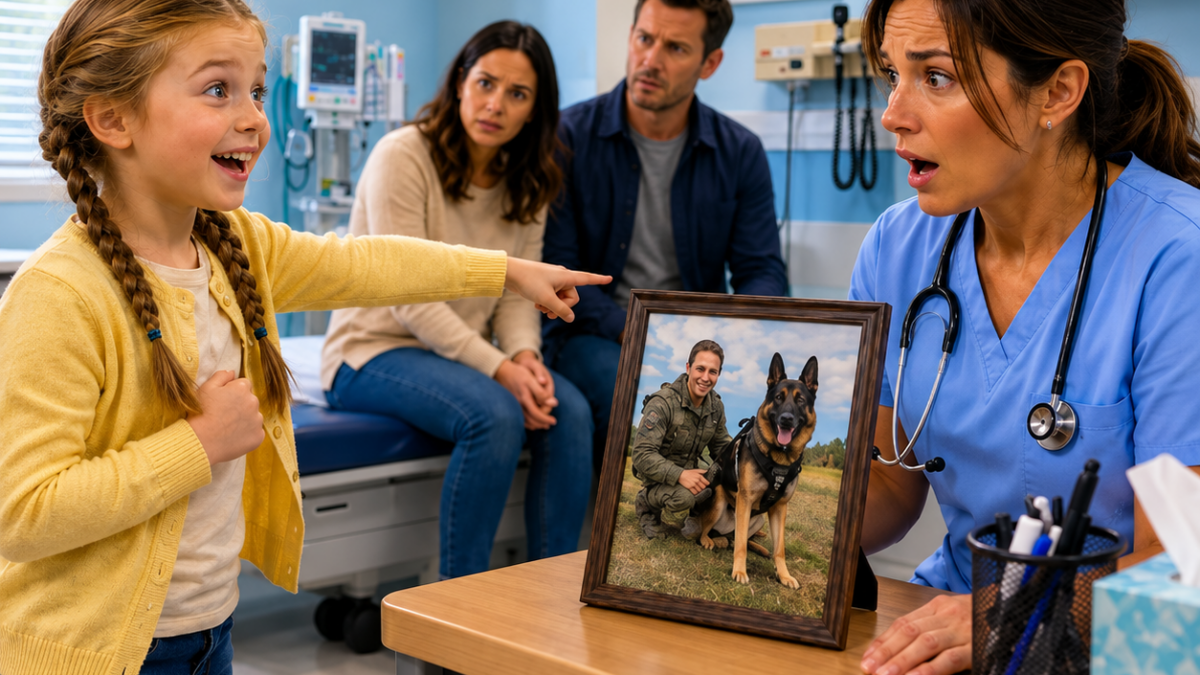
She pointed again.
“That dog.”
Her father glanced up from the paperwork.
Rachel smiled nervously. “Clara, sweetheart, that’s just a picture.”
“No,” Clara said.
She shook her head once.
“He’s alive.”
Something cold moved through me.
Not fear exactly.
Not hope yet.
Hope was too dangerous.
Hope was the kind of thing that could reopen wounds you had spent years learning not to touch.
I set the chart down.
“What makes you think that?”
Clara looked directly at me.
“Because I know him.”
The room went quiet.
Rachel gave another nervous laugh, softer this time.
“She loves animals,” she said, as if that explained it.
But Clara was not smiling.
She looked almost confused by our reaction, as if adults had once again made something simple more complicated than it needed to be.
Then she said the words that made my heart forget how to beat.
“He lives with us.”
My pen slipped from my hand and hit the floor.
No one moved for a second.
Rachel’s smile faded.
Daniel lowered the paperwork.
I looked at Clara, then at the photograph, then back at the little girl sitting on my exam table with absolute calm in her face.
“What’s his name?” I asked.
My voice sounded wrong.
Thin.
Careful.
As if one louder sound might break whatever fragile impossible thing had entered the room.
Clara answered immediately.
“Archer.”
The room tilted.
Not visibly.
Not to anyone else.
But inside me, something gave way.
For almost four years, I had trained myself not to react when I heard the name.
Archer.
People had dogs named Archer.
Books had characters named Archer.
Children used the word when they played pretend.
It was not always him.
It could not always be him.
But this little girl had pointed at his photograph and said his name without hesitation.
Rachel noticed my face.
“Doctor?” she said.
I swallowed.
“I’m sorry.”
I looked at the photograph again.
My hand was shaking when I picked it up.
“Clara,” I said gently, “can you tell me where your family got this dog?”
Rachel answered for her.
“A retirement rescue. About eight months ago.”
“What rescue?”
“Pine Hollow Working Dog Rescue.”
I sat down before my knees could decide for me.
I knew that name.
Not because it had ever been connected to Archer officially.
Because years earlier, when he vanished, I had searched every rescue and shelter record I could reach. Pine Hollow had been one of them. I had called. I had emailed. I had sent photographs. I had checked old intake lists until my eyes burned.
Nothing.
Archer had been my military working dog.
He had disappeared during a transfer after a storm disrupted the route.
For months, the search consumed me.
For years, the not knowing hollowed me out in quiet ways.
Eventually, the case went cold.
Eventually, people stopped asking.
Eventually, I left active K9 work.
But I kept the photograph.
Because some part of me had never accepted that a dog like Archer could simply vanish from the world.
I looked at Clara.
“Does Archer have a scar here?”
I touched the photograph above his right eyebrow.
Clara nodded. “Yes.”
“What about his left ear?” I asked. “Does it bend a little?”
“Yes.”
My breathing changed.
“Does he make a small sound when he gets excited?”
Clara smiled for the first time.
“He does.”
“Does he sleep near the door?”
“Yes.”
“Does he carry an old blue ball around?”
Clara’s eyes widened.
“Yes.”
I closed my eyes.
There was no longer any doubt.
No reasonable doubt.
No place left for coincidence to hide.
The dog living in that little girl’s house was Archer.
My Archer.
The same dog I had trained.
The same dog I had searched for.
The same dog I had eventually been forced to believe I might never see again.
Clara looked at me with that simple honesty only children can have.
“I told you.”
I tried to smile.
It almost broke me.
I continued the examination because that was my job.
Heart rate.
Lungs.
Ears.
Reflexes.
Everything normal.
But I barely trusted myself to hold the stethoscope steady.
The entire time, one thought repeated in my mind.
Archer is alive.
Archer is alive.
Archer is alive.
At the end of the checkup, Clara climbed down from the examination table and walked toward my desk.
She pointed to the photograph again.
“Can you tell him I saw you?”
I blinked.
“What?”
“Tell Archer I found his old picture.”
My eyes filled before I could stop them.
“I will.”
Clara studied me carefully.
Then she asked, “Do you want to see him?”
I could not answer immediately.
For almost four years, that question had lived inside me without form.
Did I want to see him?
I had dreamed of seeing him.
Prayed for it.
Feared it.
Imagined him running toward me across a field.
Imagined finding only a collar.
Imagined someone telling me he had died long ago.
Imagined nothing at all because imagining hurt too much.
“Yes,” I whispered.
Clara smiled.
“Then come home with us.”
Rachel sat up quickly. “Clara.”
“What?”
“You can’t just invite the nurse home.”
“Why?”
Daniel looked at me.
Rachel looked apologetic.
I wiped under one eye and tried to collect myself.
“It’s okay,” I said.
Then I looked at both parents.
“Would you be comfortable with me meeting him?”
Rachel and Daniel exchanged a long look.
There was caution there.
Confusion.
Concern.
But not cruelty.
Finally, Daniel nodded.
“We’d like to understand what happened too.”
That evening, I stayed late.
The hospital went quiet around me, but I barely noticed.
I searched old records.
Military K9 transfer forms.
Retirement files.
Missing dog reports.
Old emails.
Shelter databases.
Archer’s service number.
Nothing current.
Then I found a shelter intake photo.
Four years old.
A black-and-tan German Shepherd.
Slightly thinner than I remembered.
A faded harness.
Small scar above the right eyebrow.
The intake name was simply:
Archer.
Identification pending.
I stared at the screen until the words blurred.
According to the file, he had been found wandering near a rural highway after a severe storm.
No active microchip detected.
Military identification tag missing.
Frightened of vehicles.
Avoidant with unfamiliar handlers.
Eventually transferred into rehabilitation.
Eventually adopted by the Bennetts.
I leaned back and covered my mouth with one hand.
Then I saw the intake date.
My stomach tightened.
Same week.
Same region.
Same storm system.
The exact week Archer disappeared.
It was not coincidence.
Someone had found him.
But how had the system failed so badly?
Where had he been before Pine Hollow received him?
Why had no one connected him to the missing report?
And why, after all those searches, had I never been told?
The next morning, I drove to the Bennett home with my hands locked too tightly around the steering wheel.
It was a warm house on a quiet street.
Children’s drawings in the front window.
A scooter tipped on the porch.
A hanging basket of flowers beside the door.
Rachel opened before I could knock twice.
“Come in.”
I stepped inside.
The house smelled like toast, laundry soap, and crayons.
Family photographs lined the hallway.
A dog bed sat near the living room window.
Then I heard it.
Pause.
Heavy paws.
Slow.
Familiar.
I stopped breathing.
A German Shepherd appeared at the end of the hallway.
Gray muzzle now.
Bent left ear.
Small scar above the right eyebrow.
Blue ball hanging from his mouth.
My lips parted.
No sound came out at first.
Then I whispered, “Archer.”
The dog froze.
Clara stood beside him in pajamas, smiling like she had delivered proof of something obvious.
“See?”
Archer stared at me.
For a few seconds, he did not move.
I stayed still.
I did not want to rush him.
Did not want to frighten him.
Did not want my grief to become pressure.
Then his ears lifted.
The blue ball fell from his mouth.
He took one step.
Then another.
I lowered myself as much as my knees allowed.
“Hey, buddy.”
He stopped.
His nose moved.
Once.
Twice.
His eyes changed.
That was the only way I can describe it.
Something behind them shifted from caution to recognition.
His tail moved once.
Then faster.
And after almost four years, the military K9 who had disappeared from my life walked toward me.
I reached out.
Archer pressed his head into my hands.
I closed my eyes.
He remembered.
My hands found the shape of his skull.
The strong line of his neck.
The old way he leaned his weight into me without knocking me over.
The sound that left me did not feel human.
I had spent years preparing myself for loss.
I had not prepared for reunion.
Clara whispered, “I told you.”
I could not answer.
Because there was something even more painful than finding Archer alive.
He was wearing a worn leather strap around his neck.
And attached to it was a small metal tag I had never seen in any recovery report.
I touched it.
My fingers trembled.
“Where did this come from?”
Rachel looked confused.
“It came with him from the shelter.”
I turned the tag over.
Engraved across the back were three words.
RETURN TO E. HART.
My breath caught.
E. Hart.
Me.
But I had never made that tag.
Never seen it.
Never attached it to Archer.
Someone had known who he belonged to.
Someone had tried, in some way, to send him back.
And yet he had never returned.
Suddenly, the mystery was no longer simply how Archer had survived.
It was who had found him.
And why the message had never reached me.
Rachel noticed my expression.
“What does it mean?”
“I don’t know.”
Daniel stepped closer. “Are you sure?”
I nodded slowly. “I’ve never seen this tag before.”
Clara was stroking Archer’s neck.
“He likes it.”
Rachel said, “We kept it on him because it seemed important.”
“It was,” I whispered.
I sat at the kitchen table with Archer lying at my feet.
The position nearly broke me.
He settled slightly to my left.
The same place he had always taken beside me.
A trained position.
A remembered place.
I looked down.
“You still do that.”
Archer lifted his head.
“You remember?”
His tail thumped once against the floor.
Clara sat across from me, chin in her hands.
“He follows you.”
I smiled through the ache in my chest.
“He used to.”
“Now he does.”
Rachel brought out the adoption folder.
I opened it carefully.
The shelter records were incomplete.
Male German Shepherd.
Military background suspected.
Found near Route 18 after severe weather.
No current identification chip detected.
Then another line caught my eye.
Dog arrived with leather collar and metal tag.
I pointed to the form.
“Who signed this?”
“The shelter director,” Rachel said.
I turned the page.
There was a handwritten note.
Animal unusually responsive to female voices. Appears to search for one particular person.
I stopped breathing again.
Rachel leaned over. “What?”
I looked at Archer.
“Did he ever do that with you?”
Rachel nodded.
“He used to sit near the front door whenever women came into the house. Like he was waiting for someone.”
Clara smiled.
“He was waiting for you.”
I looked down at him.
There are some sentences children say without knowing they are holding a knife.
That was one of them.
The next morning, I contacted Major Samuel Reed, a former K9 records officer I had worked with during my service.
He remembered Archer immediately.
“Archer?” he said.
“Yes.”
“Are you certain?”
“I saw him.”
“Proof?”
“Microchip match pending. But he has the scar, the ear, the old behavioral markers. Samuel, it’s him.”
“What about his tattoo?”
“He still has the old identification mark.”
Silence.
Then Samuel said, “Where did they find him?”
I gave him the shelter information.
He went quiet again.
“That area was part of the active search radius.”
“For Archer?”
“For you too.”
I frowned. “What does that mean?”
“When he disappeared, there were reports of a vehicle stopping along Route 18 after the storm. No one connected it to him.”
“Why not?”
“The storm damaged camera coverage. The footage we needed was gone.”
“So someone could have found him.”
“Yes.”
“And kept him?”
“That was never proven.”
“Was it investigated?”
“Not fully. There was no evidence he had been taken.”
I looked toward my living room window though I was not home.
In my mind, Archer lay on the Bennett floor beside Clara, safe and warm.
But the tag would not leave me alone.
Return to E. Hart.
Someone had planned for him to come back.
Someone had known.
That afternoon, Samuel visited the Bennett home.
He crouched near Archer with the calm patience of someone who had worked around military dogs long enough to know that respect comes before inspection.
Archer looked at him.
Samuel examined the old identification mark.
Then the harness scar.
Then the metal tag.
His face became serious.
“This is Archer.”
I nodded.
“I know.”
Samuel turned the tag over.
“I’ve never seen this issued.”
“Neither have I.”
“There was supposed to be another tag.”
“What?”
“His original military ID.”
“Where is it?”
Samuel shook his head.
“Missing.”
Rachel frowned. “So somebody removed it?”
“Possibly.”
Samuel examined the leather strap.
“This isn’t military issue.”
“No,” I said. “But whoever made it knew enough to include my name.”
Clara looked worried.
“Was Archer stolen?”
Samuel looked at her.
“We don’t know.”
She looked at the dog.
“He wasn’t being hurt.”
I smiled sadly.
“No. He was safe.”
“Then maybe they loved him.”
The room went quiet.
Because Clara had said something all of us adults had forgotten to consider.
Maybe the mystery was not simple.
Maybe Archer had not been stolen for money.
Maybe someone had found a lost dog in a storm and simply could not let him go.
Later that evening, the shelter director called.
“I found something.”
“What?”
“An old intake interview from the day Archer arrived.”
“Can you send it?”
The file contained an audio recording.
A volunteer had asked a local man how the dog ended up near the road.
His voice was rough and elderly.
He explained that he had seen the German Shepherd walking alone after the storm.
He stopped.
Opened his truck door.
The dog climbed inside.
The volunteer asked, “Did the dog have identification?”
“Yes.”
“What did you do with it?”
“I read the tag.”
“What did it say?”
The man hesitated.
“I thought it might help, so I called the number.”
I froze.
The volunteer asked, “What happened?”
“No answer.”
The recording crackled.
Then she asked, “Why didn’t you take him directly to police?”
The man replied, “Because the dog wouldn’t leave my porch.”
I looked at Samuel.
“The dog chose to stay.”
Samuel nodded slowly.
“Maybe.”
The recording ended there, but it created another question.
Who was the man?
And why had his call never reached me?
The shelter eventually identified him.
Walter Bell.
He lived approximately fifteen miles from the road where Archer was found.
Samuel and I arranged to meet him.
When Walter opened the door, he looked old, tired, and unsurprised.
“I wondered if someone would eventually come asking about the dog.”
My heart tightened.
“You had Archer.”
Walter nodded.
“For three weeks.”
“Why didn’t you report him?”
“I did.”
“To whom?”
“The number on the tag.”
“You called the military number?”
“Yes.”
“What happened?”
“No one answered.”
“Did you leave a message?”
“Yes.”
“Why didn’t you call again?”
Walter looked embarrassed.
“I thought they didn’t want him.”
My voice went quiet.
“Why would you think that?”
He sighed.
“Because the dog didn’t act like he was coming back from somewhere. He acted like he was waiting for someone who wasn’t coming.”
I looked away.
Walter continued.
“He was exhausted. Wouldn’t eat much at first. Wouldn’t get in the truck after that first ride. Every evening he sat at the gate and looked down the road.”
I knew that posture.
Waiting.
Searching.
Holding position because that was what he had been trained to do.
“I couldn’t keep him permanently,” Walter said. “My health wasn’t good. So I brought him to Pine Hollow.”
“Did you tell them about the tag?”
“I gave them what I had.”
I showed him a photograph of the leather strap.
“Was he wearing this?”
Walter nodded.
“Yes.”
“And this tag?”
“Yes.”
“Did you see anything else?”
He hesitated.
Then disappeared into another room.
When he returned, he held a small plastic bag.
“Forgot about this until the shelter called me again.”
Inside was a damaged piece of metal.
I took it.
My breath caught.
Archer’s original military identification tag.
Bent.
Scraped.
But readable.
The identification number matched.
Samuel stared at it.
“That explains why nobody could verify him.”
Walter looked ashamed.
“I found it several yards from where he first came out of the brush. Near a fence line.”
The picture finally began to form.
The storm.
The broken collar.
The damaged tag separated from the dog.
A frightened K9 found by a man who tried to help.
An incomplete phone call.
Shelter records without the proper identification.
A rescue doing its best with partial information.
There had not been a conspiracy.
Not really.
Just a chain of ordinary failures.
A storm.
A broken tag.
A missed call.
Incomplete paperwork.
And one very unlucky dog who had spent years living a life I had not known existed.
When I returned to the Bennett home, Clara was waiting near the door.
“Did you find out?”
I smiled.
“Yes.”
“What happened to him?”
I looked at Archer.
“He got lost.”
“Did someone find him?”
“Yes.”
“Did they take care of him?”
“They did.”
Clara smiled with relief.
“I knew he wasn’t alone.”
I nodded.
“No. He had people.”
She looked at Archer.
“Did he remember you?”
I smiled.
“He never forgot.”
Archer lifted his head.
I held out my hand.
He walked toward me and sat at my feet.
Clara watched us carefully.
“Can he go back with you?”
My smile faded.
That was the question everyone had avoided saying out loud.
I had spent years wanting Archer back.
Not wanting a story.
Not wanting an explanation.
Him.
His weight against my leg.
His bark.
His blue ball.
His left-side position.
His living presence.
Now he was here.
Alive.
Loved.
And not mine in the way he had once been.
Rachel and Daniel were silent.
Clara looked scared.
Archer leaned against my knee.
I looked at him.
He was older now.
His muzzle had gone gray.
His pace was slower.
His eyes still knew me, but they also knew Clara.
They knew Rachel’s kitchen.
Daniel’s voice.
The dog bed by the window.
The little girl who had recognized him in an old photograph.
I took a breath.
“He belongs here.”
Rachel looked startled.
“You’re sure?”
I nodded.
“He has a routine. He has Clara. He has both of you.”
Daniel leaned forward.
“But he was your partner.”
“He was.”
“Doesn’t that mean something?”
My voice broke.
“It means everything.”
I looked at Archer.
“And that is exactly why I won’t make this about me.”
Clara moved closer to him.
“Are you going to leave again?”
I looked at her.
“No.”
“Why?”
“Because I know where he is now.”
That answer seemed to satisfy her.
She rested her head against Archer’s shoulder.
He remained perfectly still.
The next morning, I returned to the Navy K9 office.
Samuel sat behind his desk.
“Well?”
I told him everything.
Walter.
The broken tag.
The missed call.
The Bennetts.
Clara.
Archer.
Samuel listened carefully.
Then asked, “What do you want?”
I was quiet for a long time.
“I want to see him.”
“You already did.”
“I want to stay in his life.”
Samuel nodded.
“That’s possible.”
“But I don’t want to take him from the family.”
Samuel smiled.
“Good.”
“Why?”
“Because retirement placement isn’t about who had the dog first. It’s about who gives the dog the best life now.”
That was what I needed to hear from someone who understood both sides.
The Navy arranged a formal meeting with Rachel and Daniel.
Not to demand Archer’s return.
Not to reopen pain.
To confirm his history, review the adoption, and discuss whether a shared relationship could be appropriate.
Rachel spoke first.
“We didn’t know who he was.”
Daniel nodded.
“We would have contacted his former handler if we had known.”
“I know,” I said.
Rachel looked at me.
“Do you want him back?”
I looked toward Archer.
Then at Clara, who was sitting with her hand resting on his back.
“No.”
The room went quiet.
“I want him happy.”
Rachel’s eyes softened.
“Then you can stay in his life.”
I stared at her.
“How?”
“Come visit,” she said. “Call. Take him for walks when you can.”
Daniel smiled.
“We’d rather he have both.”
I had thought finding Archer again would mean recovering what I lost.
Instead, it meant being invited into the life he had survived long enough to build.
The first reunion after that decision felt different.
Less fragile.
Less desperate.
I arrived at the Bennett home with an old military photograph.
Clara opened the door.
“Did you bring it?”
“I did.”
I showed it to her.
It was a picture of me and Archer during service.
She studied it seriously.
“You were his mom?”
I laughed.
“Something like that.”
Rachel smiled from behind her.
Archer appeared from the hallway.
The moment he saw me, his ears lifted.
He walked over.
Stopped.
Waited.
I knelt as much as I could and held out my hand.
Archer touched it with his nose, then leaned against me.
Clara smiled.
“He likes you.”
“I like him too.”
Over the next few months, the arrangement became normal.
I visited on weekends.
Sometimes I took Archer to the nearby park with Clara.
Sometimes I sat with him in the backyard.
Sometimes I simply brushed his fur while Rachel prepared dinner and Daniel told stories from work.
Archer never seemed confused.
He understood something we were all still learning.
There were two homes in his memory now.
The handler who had trained him.
The family who had found him.
Both were safe.
Both were familiar.
Both loved him.
One afternoon, I brought something unexpected.
An old military K9 ball.
Blue.
Worn.
Scratched.
Archer saw it, and his ears lifted immediately.
Clara laughed.
“He likes that ball.”
“He always did.”
I rolled it gently across the yard.
For a few seconds, Archer looked exactly like the dog in the old photograph.
Fast.
Focused.
Happy.
Then he returned and dropped the ball at my feet.
I laughed.
“You remember?”
His tail wagged.
Clara looked at me.
“Did you teach him that?”
“Yes.”
“Does he still remember everything?”
I looked at Archer.
“Not everything.”
Then I smiled.
“But enough.”
Clara nodded like that made perfect sense.
“That’s amazing.”
Maybe memory was not as fragile as people thought.
Maybe some bonds simply waited.
Eventually, the Navy updated Archer’s records.
Missing status closed.
Service history restored.
Retirement placement formally documented.
The file contained two families now.
Original handler.
Adopted family.
And a note:
Successful long-term retirement placement. Strong bond maintained with former handler through family-supported visitation.
I read the note twice.
Then smiled.
There had been no dramatic rescue.
No secret enemy.
No conspiracy.
Just a missing dog.
A broken identification tag.
A storm.
Incomplete paperwork.
A missed message.
And years of unanswered questions.
But sometimes the most emotional stories are not about impossible events.
Sometimes they are about people finally finding the answer they stopped expecting.
One evening, Clara asked me, “Why did Archer disappear?”
I chose my words carefully.
“He got lost during a storm.”
“Was he scared?”
“Yes.”
“Did he think you left him?”
I looked at Archer.
“I don’t know.”
Clara frowned.
“But he came back to you.”
I smiled.
“No. He found both of us.”
She considered that.
Then nodded.
“I like that better.”
So did I.
One year after Clara’s routine checkup, I walked back into the same hospital examination room.
The photograph was still on my desk.
Same frame.
Same younger me.
Same younger Archer.
But now there was another photograph beside it.
Archer sitting in the Bennett family’s backyard.
Clara beside him.
Me beside both of them.
Another nurse noticed.
“You have two pictures now.”
I smiled.
“One is where he came from. The other is where he is.”
“They look happy.”
“They are.”
That evening, Rachel sent me a message.
A photograph.
Archer asleep beside Clara while she read a book.
The caption said:
Still keeping watch.
I saved it.
Then opened the old photograph.
Young Archer.
My old uniform.
The training field.
Four years of memory.
I placed the two images side by side.
The difference was obvious.
The dog had aged.
I had changed.
Our lives had moved in different directions.
But the bond had not disappeared.
It had simply found another shape.
A few weeks later, Clara asked me something while we walked through the park.
“Do you think Archer knew where you were?”
“No.”
“Then how did he remember you?”
I thought about it.
“Dogs don’t always need to know where someone is to remember them.”
Clara nodded.
“That sounds like a superpower.”
I laughed.
“Maybe it is.”
Archer walked beside us.
His muzzle was grayer now.
His pace slower.
But every few steps, he still looked toward me.
I noticed.
I always would.
At sunset, we stopped near a bench.
Clara sat.
Archer lay beside her.
I looked at the dog I had once believed I would never see again.
“For years,” I whispered, “I thought the hardest part was losing you.”
Archer lifted his head.
“But maybe it was not knowing what happened.”
He rested his head against my leg.
“Now I know.”
Clara looked up.
“You’re not sad anymore.”
I thought about that.
“I still miss the dog he was.”
I stroked Archer’s graying muzzle.
“But I love the dog he became.”
Clara smiled.
“Me too.”
And that was the real ending.
Not that I got my old military K9 back.
I did not.
Archer was not the same dog anymore.
I was not the same handler.
The years had changed both of us.
Instead, something better happened.
We found each other again.
The seven-year-old girl who had casually pointed at an old photograph reopened a story everyone thought was finished.
She had not known the history.
She had not known the missing reports.
She had not known the unanswered calls.
She had simply looked at a photograph and said the truth.
“That dog is still alive.”
And she was right.
Archer was alive.
Loved.
Safe.
And finally connected to the person who had spent years wondering where he had gone.
I had once believed finding Archer again would mean taking him home.
Instead, I learned something more important.
Sometimes loving someone means accepting that they have built a good life without you.
Sometimes the happiest ending is not getting back what was lost exactly as it was.
It is discovering that what you lost survived, changed, and is still able to love you.
Archer had found a family.
I had found Archer.
Clara had found another person who loved the dog she cherished.
And the photograph that started everything remained on my desk.
Only now, whenever someone asked why I kept it there, I smiled.
Because it was not a photograph of a missing dog anymore.
It was proof that some stories can disappear for years without actually ending.




