A 14-Year-Old Boy Walked Up to a Group of Bikers and Confessed He’d Stolen Two Loaves of Bread—But One Quiet Answer Made Their Leader Realize This Wasn’t About Theft
PART3:
A woman loading groceries into her trunk froze with one hand on a milk jug. A man near the cart return pulled his little girl behind him. The manager slowed, probably grateful that seven bikers were standing between him and a shoplifting teenager.
But the boy did not look trapped.
He looked decided.
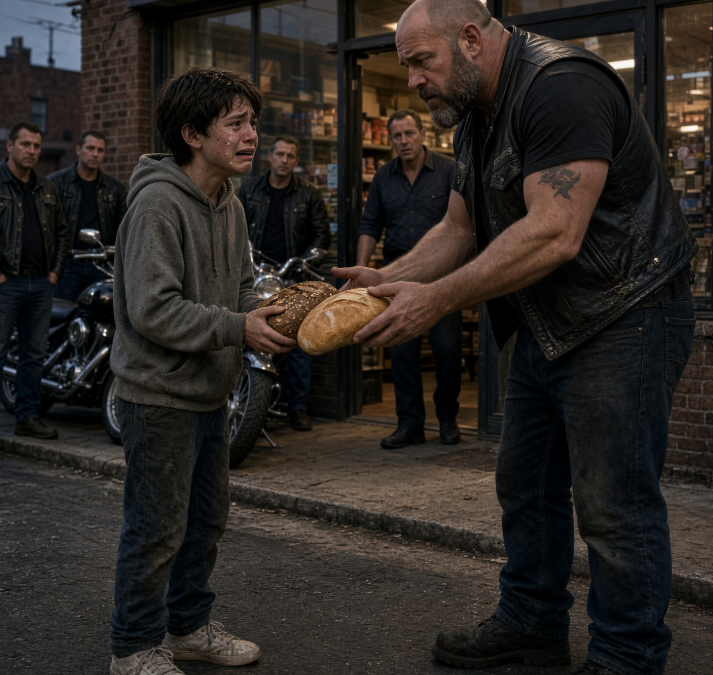
He walked straight up to me and shoved the two loaves of bread into my hands.
“I stole these,” he said.
His voice shook.
His eyes did not.
“So call the police.”
For a moment, nobody spoke.
The parking lot seemed to hold its breath.
I looked down at the bread.
Then at him.
“What’s your name?”
He swallowed.
“Daniel.”
“Daniel what?”
“Daniel Reyes.”
I nodded slowly.
“Well, Daniel Reyes, that’s an interesting introduction.”
His jaw tightened.
“I took them.”
“I heard you.”
“I didn’t pay.”
“I gathered that.”
“So call the police.”
The grocery manager reached us then, still breathing hard.
“That’s right. He stole from my store. I saw him put them under his hoodie.”
Daniel did not deny it.
That was the part that got me first.
Not the theft.
The honesty afterward.
Most kids caught stealing food cry, lie, run, beg, or freeze. This boy had walked directly to the scariest-looking adult in the parking lot and handed over evidence like he was reporting himself for a crime he had no intention of escaping.
I looked at the manager.
“What’s the damage?”
The man blinked.
“What?”
“How much for the bread?”
“That’s not the point.”
“It usually is.”
“He stole.”
“And now I’m asking how much.”
The manager’s face tightened.
“Four dollars and eighteen cents.”
I reached for my wallet.
Daniel moved fast.
“No.”
I paused.
The boy’s hand had shot out toward the bread.
Not both loaves.
One.
He grabbed the loaf with the blue label and pulled it tight against his chest.
“Don’t.”
I looked at him.
“Don’t what?”
“Don’t take that one.”
The manager scoffed.
“Kid, you don’t get to be picky about stolen property.”
I ignored him.
“Why that one?” I asked Daniel.
His throat moved.
He looked down at the loaf like it hurt him to explain.
“My little brother likes that one.”
That changed everything.
Not loudly.
Not dramatically.
Just enough that every man standing beside me went still.
Tank, who was built like a refrigerator and usually had something smart to say about everything, stopped mid-breath. Ghost had just come out of the store carrying paperwork and immediately froze at the door. Even the manager’s expression shifted slightly, irritation losing its footing.
I kept my voice low.
“How old is your little brother?”
“Eight.”
“You got other siblings?”
Daniel’s eyes flicked toward the apartment building across the street.
That flicker answered before he did.
“Two sisters.”
“How old?”
He hesitated.
“One is six. One is three.”
I looked at the bread again.
Two loaves.
Four kids.
No adult in sight.
“What about your parents?”
Daniel’s face closed.
“She’ll be back.”
Not they.
She.
I heard it.
So did Ghost.
He moved closer but stayed quiet.
“How long has she been gone?” I asked.
Daniel said nothing.
The grocery manager crossed his arms.
“How long, kid?”
Daniel’s eyes dropped.
Five seconds passed.
Long enough for the parking lot noise to come back around us.
A cart wheel squeaked.
Someone’s car door shut.
The grocery sign buzzed overhead.
Then Daniel whispered, “Five weeks.”
The manager’s arms fell to his sides.
Ghost muttered, “Jesus.”
Five weeks.
A fourteen-year-old boy.
An eight-year-old brother.
Two little sisters.
A mother gone five weeks.
And two stolen loaves of bread held like contraband and salvation.
I looked at Daniel.
“Where are the kids?”
His head snapped up.
Defensive immediately.
“They’re not alone.”
“You’re fourteen.”
“I’m enough.”
Those three words stopped me cold.
I’m enough.
The parking lot vanished for a second.
I was not standing outside Harlan’s Grocery anymore.
I was fourteen again, standing in the doorway of a trailer with my baby sister behind me, telling a social worker the same lie with the same desperate pride.
I’m enough.
I had believed it too.
I believed it because I had to.
Because my mother was gone more than she was home.
Because my father had fists and debts and disappeared whenever consequences came looking.
Because my little sister, Grace, would hide behind me and whisper, “Don’t let them take me.”
Because at fourteen, I thought love meant standing between the world and the person you loved until your bones broke.
I was not enough.
No child is.
But you could not have told me that then.
Looking at Daniel Reyes, I knew no one had told him either.
I took a breath.
“Daniel.”
He held the bread tighter.
“I’m not letting anyone take them.”
“I didn’t say that.”
“You’re thinking it.”
“I’m thinking someone needs to make sure they’re safe.”
“They are safe.”
“Are they hungry?”
His silence answered.
“Are they warm?”
Another silence.
“Is the three-year-old sick?”
His eyes flashed.
That was the wrong question in the right direction.
“How did you know?”
I did not.
But little ones get sick first when food, heat, and sleep start failing.
I handed the other loaf to Tank.
Then I held out the blue-label loaf to Daniel.
He stared.
“Take it,” I said.
Slowly, he took it.
The manager watched, uncertain now.
“I don’t want trouble,” he said, softer than before. “But I can’t just let kids walk out with food.”
“I’ll pay for the bread,” Ghost said.
“No,” Daniel snapped.
Everyone looked at him.
His face burned red with shame and anger.
“I said I took it. Don’t make it like I didn’t.”
There it was again.
Dignity.
Sharp as broken glass.
I looked at Ghost.
He understood immediately.
Ghost turned to the manager.
“Ring it up as damaged product.”
The manager frowned.
“What?”
“You found out two loaves were taken. We reimburse the loss. Kid still told the truth.”
Daniel looked confused.
I said, “You confessed. That matters. But your brother still gets his bread.”
The boy’s eyes filled.
He blinked hard, refusing the tears.
“I’ll pay it back.”
“I believe you.”
“I will.”
“I said I believe you.”
That seemed to hit him harder than accusation would have.
The manager rubbed a hand over his face.
“All right. Fine. I’ll mark it damaged.”
He looked at Daniel.
“But don’t come stealing from my store again.”
Daniel’s shoulders stiffened.
Before he could answer, I said, “He won’t need to.”
Ghost stepped closer.
“Where’s the apartment?”
Daniel looked toward the building across the street again.
The building was called Brookside Terrace, though there was no brook and no terrace. Just a tired three-story block with peeling paint, uneven balconies, and stairwells that smelled like damp concrete and old smoke.
“Daniel,” I said, “show me.”
He shook his head.
“No.”
“Your sister is three.”
His jaw tightened.
“I said no.”
“I’m not asking to punish you.”
“You don’t get it.”
“I get more than you think.”
“No, you don’t!”
His voice cracked loud enough that the woman by her trunk flinched.
Daniel looked around, humiliated, then lowered his voice.
“If you see it, they’ll take them.”
The sentence came out like something he had been holding in his teeth for weeks.
“If people see, they’ll take them away. They’ll split us up. They’ll put Lily somewhere and Mateo somewhere and Sofia won’t stop crying because she doesn’t sleep without me. So no. You can call the police on me, but I’m not showing you where they are.”
His breathing was fast.
His hands shook around the bread.
I looked at him and saw myself so clearly it hurt.
Fourteen years old.
Standing in front of a closed bedroom door.
Thinking terror was responsibility.
Thinking secrecy was protection.
Thinking if adults did not know, adults could not ruin what little was left.
I crouched so we were closer to eye level.
“Daniel, listen to me carefully.”
He stared at me like a cornered animal.
“I know what it feels like to think you’re the only thing between your family and disaster.”
His face flickered.
“I know what it feels like to lie to teachers, dodge landlords, stretch food, and tell little kids everything is fine when nothing is fine.”
His eyes changed then.
Just slightly.
“I know what it feels like to say ‘I’m enough’ because the truth is too terrifying to say out loud.”
He swallowed.
“What truth?”
“That you’re not.”
His face hardened.
“I am.”
“No,” I said gently. “You’re brave. You’re loyal. You’re tougher than any kid should have to be. But you are not enough, Daniel. Not because you failed. Because no fourteen-year-old should have to be.”
The tears came then.
He did not sob.
He just stood there while his eyes filled and spilled over, furious at his own body for betraying him.
“I promised them,” he whispered.
“I know.”
“I said I wouldn’t let anyone take them.”
“I know.”
“If I open that door, everything changes.”
“Yes.”
That was the truth.
I would not lie to him.
“But if you don’t open it,” I said, “things may change in a way you can’t fix.”
He looked away.
The blue-label bread crinkled in his arms.
Ghost spoke for the first time, low and steady.
“Kid, we don’t want to take your family from you. We want to keep your family alive long enough for the right people to help the right way.”
Daniel looked at him.
Ghost was a terrifying-looking man to strangers, shaved head, long beard, tattoos up his neck, eyes like winter.
But he had raised four daughters. He knew how to soften his voice.
“I got a wife,” Ghost said. “Marie. She helps families. I got Rosa. She’s a nurse. We can bring food. Check on the little one. Figure out what comes next without making it worse.”
Daniel shook his head, but weaker now.
“You’ll call people.”
“We may have to,” I said.
His face crumpled.
“But we won’t do it behind your back. And we won’t let you stand alone while it happens.”
That was what reached him.
Not the promise that everything would be fine.
He was too smart for that.
The promise that he would not stand alone.
Daniel looked across the street.
Then at the bread.
Then at me.
“If they get scared, you leave.”
“I can do that.”
“If Sofia cries, I hold her.”
“Yes.”
“If Lily hides, don’t grab her.”
“No one grabs anybody.”
“If Mateo asks if Mom’s coming back, don’t say no.”
I hesitated.
That one hurt.
“I won’t lie to him.”
Daniel’s eyes narrowed.
“I said don’t say no.”
“I’ll say we’re trying to find out.”
He stared at me for a long second.
Then nodded.
“Okay.”
Apartment 4C was on the second floor.
The stairwell smelled like mildew, cigarette smoke, and old cooking oil. One overhead light flickered near the landing. Daniel climbed fast, like he knew every broken edge by memory.
I followed with one grocery bag Ghost had bought inside, just enough not to overwhelm anyone.
Ghost stayed at the bottom of the stairs with Tank and the others.
No crowd.
No engines.
No spectacle.
The door to 4C had three locks, only one of which looked functional. Daniel pulled a key from his pocket, hesitated, then turned it.
Before opening the door, he looked back at me.
“Don’t look mad.”
That nearly broke me.
“I’m not mad.”
“You might.”
“I won’t.”
He opened the door.
The apartment was dark except for one lamp with no shade sitting on the floor near the couch.
The first thing I noticed was the smell.
Not filth.
Not neglect in the way judgmental people imagine.
It smelled like children, stale air, boiled noodles, laundry that had been washed in a sink and dried indoors, and fear.
The second thing I noticed was how hard Daniel had tried.
There were folded blankets on the couch. Plastic bowls washed and stacked near the sink. A trash bag tied neatly by the door. School worksheets on the table. A handwritten schedule taped to the refrigerator.
Breakfast.
Brush teeth.
Lily school.
Mateo school.
Sofia nap.
Lock door.
No stove unless Daniel home.
There was almost no food.
One packet of crackers.
Half a jar of peanut butter scraped nearly clean.
Two cans of green beans.
A box of cereal with maybe one bowl left.
A little girl with tangled curls peeked from behind the couch.
Six, I guessed.
Lily.
She held a plastic unicorn missing one leg.
“Danny?”
“It’s okay,” Daniel said immediately. “He’s with me.”
An eight-year-old boy appeared in the hallway, thin and watchful, wearing pajamas too short at the wrists.
Mateo.
His eyes went to the bread.
Then to me.
Then back to the bread.
“Did you get it?”
Daniel held up the blue-label loaf.
Mateo’s face lit so brightly it hurt to see.
Sofia, the three-year-old, was asleep on a blanket on the floor near the couch. Her cheeks were flushed. Her breathing sounded congested.
I looked at Daniel.
His face had gone pale.
“She just has a cold.”
I set the grocery bag down slowly.
“Rosa needs to see her.”
“No hospitals.”
“I didn’t say hospital.”
He lifted Sofia carefully, like he had done it a thousand times. She stirred, coughed, and tucked her face into his neck.
Too hot.
Even from where I stood, I could see it.
Daniel knew too.
That was the worst part.
He knew.
He had known and kept going because the alternative was admitting help was needed.
Lily edged closer to the bread.
“Can we eat?”
Daniel looked at me, ashamed.
I hated that shame.
More than I can explain.
“You all like peanut butter sandwiches?” I asked.
Mateo nodded vigorously.
Lily said, “We’re almost out.”
“Good thing I brought some.”
Her eyes widened.
I unloaded the bag.
Peanut butter.
Jelly.
Milk.
Bananas.
Crackers.
Soup.
More bread.
Nothing fancy.
Enough to make the table look less hopeless.
Lily whispered, “Are we in trouble?”
“No,” I said.
She studied me.
“You look like trouble.”
“Fair.”
Daniel almost smiled despite himself.
I made sandwiches while Daniel held Sofia and Mateo stood so close to the counter he might as well have climbed onto it.
When I handed him a sandwich, he did not eat immediately.
He looked at Daniel.
Daniel nodded.
Only then did Mateo take a bite.
That told me everything I needed to know about who had been raising them.
Lily ate slowly, trying to make it last.
Mateo did not.
Sofia woke enough to whimper and cough.
I stepped into the hallway and called Rosa.
No drama.
No panic.
Just the facts.
Three-year-old feverish, coughing, possibly dehydrated. Four kids alone. Mother gone five weeks. Need assessment now. Bring Marie.
Rosa said, “On my way.”
I called Ghost next.
“We need supplies. Food. Diapers if she still uses them. Kids’ medicine. Thermometer. Clean blankets. And keep everyone calm.”
Ghost was silent for a second.
“How bad?”
“Bad enough.”
“We calling CPS?”
I looked through the doorway at Daniel wiping jelly from Sofia’s chin with the corner of his sleeve.
“Eventually, yes. But not like a raid. We need emergency support, not terror.”
“Marie will know.”
“She better.”
“She always does.”
Marie arrived twenty minutes later with Rosa.
Marie Hale had the kind of presence that made frightened rooms loosen. She was Ghost’s wife, a former school counselor, and the only person I knew who could tell a biker twice her size to sit down and have him thank her afterward.
She knocked softly before entering.
Daniel answered with Sofia on his hip.
Marie did not rush him.
“Hi, Daniel. I’m Marie. Bear called me because he said you’ve been doing a very hard job.”
Daniel’s mouth tightened.
“I’m fine.”
“I didn’t ask if you were fine.”
That confused him.
She smiled gently.
“I said the job was hard.”
Rosa came in behind her, medical bag in hand.
She crouched near Sofia.
“Hey, sweetheart.”
Sofia buried her face in Daniel’s hoodie.
“She doesn’t like strangers,” Daniel said.
“Smart girl,” Rosa replied.
That helped.
Rosa checked Sofia while Daniel held her.
Temperature high.
Breathing not great.
Dehydrated, but responsive.
Needed urgent care.
Daniel’s body went rigid.
“No.”
Rosa looked at him.
“I’m not asking to take her from you. I’m saying she needs medicine and a doctor tonight.”
“We don’t have money.”
“That’s an adult problem.”
“I’m the adult.”
Marie stepped closer.
“No, honey. You’ve been forced to do adult things. That doesn’t make you the adult.”
Daniel looked like she had slapped him.
Not cruelly.
Truth hurts when a lie has been keeping you upright.
Mateo began crying then.
Quietly at first.
“I don’t want them to take Danny.”
Lily joined him.
Sofia coughed against Daniel’s shoulder.
The apartment filled with the sound of children finally understanding that their secret had been exposed.
Daniel’s face crumpled.
He tried to pull it back together.
Failed.
“I’m enough,” he whispered again.
But this time, he did not sound convinced.
I moved closer.
“No, Daniel.”
He looked at me.
“You’re not enough alone.”
I put emphasis on the last word.
His eyes held mine.
“You hear me? Not alone.”
Marie sat on the floor so she was lower than the kids.
“Nobody here wants to split you up tonight,” she said. “But we do have to make sure Sofia gets care. We have to find your mom. And we have to bring in people whose job is to protect children.”
Daniel shook his head.
“They’ll take us.”
“Maybe,” Marie said softly. “Maybe temporarily. Maybe there’s a way to keep you together with emergency placement. Maybe there’s family we can find. Maybe there are options we don’t know yet. But if Sofia gets worse because everyone was too scared to call, that is not protection.”
Daniel looked down at his little sister.
Her face was red against his hoodie.
Something inside him surrendered.
Not all of it.
Just enough.
“Can I ride with her?”
“Yes,” Rosa said immediately.
That saved him.
We took Sofia to urgent care.
Marie drove Daniel and the children because no one was putting traumatized kids on motorcycles in the dark. I followed behind in my truck with Ghost. Tank stayed with two riders to clean the apartment, stock food, and wait in case the mother returned.
At urgent care, Sofia was diagnosed with a respiratory infection and dehydration. Not hospital-level yet, but close enough that the doctor’s face got serious.
Close enough that Daniel went silent.
The nurse gave Sofia fluids, medicine, and a breathing treatment. Daniel never let go of her hand.
Mateo fell asleep in Marie’s lap.
Lily sat beside me, clutching the unicorn.
“Are you really called Bear?” she asked.
“Yes.”
“Do you eat people?”
“Only rude ones.”
She thought about that.
“Daniel is rude sometimes.”
“Daniel is tired.”
She nodded solemnly.
“He cries in the bathroom.”
I looked across the room at Daniel.
He was staring at Sofia, jaw locked.
“Does he know you know?” I asked.
“No.”
“Maybe don’t tell him.”
“I won’t.”
She leaned against my arm.
After a while, she whispered, “Is Mom bad?”
That question was worse than all the others.
I had no right to answer it.
So I said, “I think your mom is missing, and missing people leave a lot of hurt behind.”
Lily nodded like she understood more than she should.
The authorities got involved before midnight.
Marie handled the call.
Not the police first.
Child protective emergency line, then a missing person report for their mother, Carla Reyes. Marie used words carefully. Children currently safe. Medical care obtained. Community adults present. Immediate need: emergency placement that keeps siblings together if possible.
Words matter in crisis.
They shape what kind of help arrives.
A social worker named Denise Carter came to urgent care at 1:20 in the morning.
Daniel saw her badge and stood in front of the kids like a guard dog.
Denise stopped several feet away.
Smart woman.
“Daniel?” she said.
He said nothing.
“My name is Denise. I’m not here to punish you.”
“You’re here to take them.”
“I’m here because a three-year-old needed medical care and four children have been without a parent for several weeks.”
His chin lifted.
“I took care of them.”
“I can see that.”
That answer surprised him.
Denise looked at the kids.
“I can see you worked very hard.”
His face changed.
Just slightly.
“But no child should have to do this alone,” she continued.
Daniel’s eyes flicked toward me.
I nodded once.
Not alone.
The night became paperwork.
Questions.
Names.
Birth dates.
School information.
Last contact with mother.
Possible relatives.
Neighbors.
Emergency options.
The children had an aunt in Kentucky they had not seen in two years. No grandparents nearby. Father not in the picture. Mother’s phone disconnected.
Denise made calls.
Marie made calls.
Ghost made calls.
I sat with Daniel near the vending machines while the younger kids slept under blankets in a family waiting room.
He had not eaten since the sandwich.
I handed him a granola bar.
He stared at it.
“I don’t want it.”
“You do.”
“I’m not hungry.”
“Liar.”
He glared.
Good.
Anger meant he still had some fuel left.
“Eat,” I said. “You can’t protect anybody if you fall over.”
“I’m not protecting them anymore, remember?”
“That’s not what I said.”
“You said I’m not enough.”
“I said you’re not enough alone.”
He looked away.
“There’s a difference.”
He did not open the granola bar.
I leaned back against the wall.
“When I was fourteen, my sister Grace was six.”
Daniel stayed still.
“My old man was violent when he was around and gone when he wasn’t. My mother disappeared for days. Then weeks. I made food out of whatever was left. Walked Grace to school. Lied to teachers. Stole canned beans from a corner store once.”
His eyes moved to me.
“I told everyone I was enough.”
“Were you?”
“No.”
His fingers tightened around the granola bar.
“What happened?”
“One day Grace got sick. Fever. Bad. I waited too long to ask for help because I was scared they’d take her.”
Daniel’s face had gone pale.
“Did she die?”
“No.”
He breathed.
“But she got worse than she should have. And when help came, it came hard. Police. Social workers. Foster placement. We got split up for seven months.”
“That’s what I’m trying to stop.”
“I know.”
“Then why are you helping them do it?”
I looked at him.
“Because I wish someone had helped me before it became an emergency.”
He looked down.
“I hated everyone for years,” I said. “The social workers. The cops. The neighbors who called. The teacher who noticed. I thought they ruined everything.”
“Did they?”
“No. My parents did. The adults who failed us did. The people who stepped in just arrived too late to make it gentle.”
Daniel finally opened the granola bar.
Took one bite.
Chewed like it hurt.
“What happened to Grace?”
“She’s alive. Married. Three kids. Still yells at me every Christmas because I buy loud toys.”
A tiny flicker moved across his face.
Almost a smile.
“We found each other again,” I said. “But I spent a long time thinking I had to be enough for everybody. It nearly killed me.”
Daniel looked toward the room where his siblings slept.
“I promised them.”
“Then keep the promise the right way.”
His voice was barely audible.
“What’s the right way?”
“By letting more people stand between them and the fall.”
By morning, the emergency plan was in place.
It was not perfect.
No plan involving abandoned children is.
But it was better than the nightmare Daniel had imagined.
Marie and Ghost were licensed emergency foster providers.
I had known this, but Daniel had not.
Years earlier, after raising their own daughters, they had gotten certified to take short-term emergency placements, mostly teenagers who needed somewhere safe while relatives were located.
Denise reviewed everything, made calls, verified the home, got approvals.
By noon, all four Reyes children were temporarily placed with Marie and Ghost.
Together.
Daniel heard the word together and sat down hard in a plastic chair.
He covered his face with both hands.
No sound came out.
Marie sat beside him.
“You did it,” she said softly.
He shook his head.
“You kept them alive long enough for help to arrive.”
That was when he finally cried.
Not the angry tears from the parking lot.
Not the silent ones he kept swallowing.
Real ones.
Fourteen-year-old boy tears.
The kind that should have been allowed weeks earlier.
Mateo climbed into his lap.
Lily hugged his side.
Sofia, sleepy from medicine, reached for his hoodie string.
The social worker watched with wet eyes.
So did I.
Ghost pretended to check his phone.
Nobody believed him.
The next days were not easy.
Stories like this rarely become simple after the emotional rescue moment.
The children were safe, but safety did not erase fear.
Mateo woke crying at night, asking if Daniel was still there.
Lily hid food in pillowcases.
Sofia clung to Daniel and screamed if he left the room.
Daniel tried to parent everyone in Ghost and Marie’s house until Marie finally took him aside and said, “You are allowed to be fourteen here.”
He did not know how.
He corrected lunch portions.
Checked door locks.
Counted the younger kids’ socks.
Tried to refuse new clothes.
Insisted on doing dishes.
Asked for a ledger to track what he owed.
Marie shut that down.
“You owe us nothing.”
“I owe everybody.”
“No.”
“I stole.”
“You confessed.”
“I lied.”
“You survived.”
“I should’ve asked for help sooner.”
Marie softened.
“Yes,” she said. “You should have.”
That truth landed without cruelty.
“And now you know.”
He looked at her.
“Does that mean I’m bad?”
“It means you’re a child who was put in an impossible position and made some wrong choices while trying to do the right thing.”
Daniel stared at the floor.
“That sounds complicated.”
“It is.”
“Can’t I just be bad?”
“No.”
“Why?”
“Because bad would be easier than healing, and you don’t get the easy lie.”
He did not like that.
He needed it anyway.
Meanwhile, the River Saints moved quietly.
No publicity.
No social media posts with sad children and heroic bikers.
Ghost forbade it before anyone suggested it.
“Those kids are not a charity poster,” he said.
We stocked the foster room.
Clothes.
Shoes.
School supplies.
Stuffed animals.
A nightlight for Sofia.
A lockbox for Daniel’s private things.
Groceries.
A therapist who worked with foster youth agreed to see Daniel at reduced cost until state coverage caught up.
Harlan, the grocery manager, called Ghost on day three.
“I’ve been thinking,” he said.
“That sounds dangerous.”
“I want to donate groceries for the kids.”
Ghost looked at me while the phone was on speaker.
I raised an eyebrow.
The same manager who came outside ready to call police now sounded like guilt had chewed through his sleep.
Ghost said, “That would help.”
“And if the boy wants, when things settle, I’ll give him work sweeping after school. Paid. Legal. Just a couple hours. No pressure.”
When I told Daniel, he looked suspicious.
“He feels bad.”
“Probably.”
“I don’t want pity.”
“Then take wages.”
He thought about it.
“Real wages?”
“Real wages.”
“I’ll think about it.”
That was Daniel for yes.
The search for Carla Reyes took eleven days.
She was found in a hospital forty miles away under her maiden name.
Not because she had deliberately abandoned her children forever.
Not because she had run off to start a new life.
The truth was messier and sadder.
Carla had been struggling for months—depression, unpaid bills, an abusive boyfriend she had tried to leave, and a job that cut her hours until rent became impossible. She left one night intending to take a bus to a cousin who had promised money. Somewhere along the way, she was injured in a car accident involving the boyfriend, treated under confusion, then transferred for psychiatric care after a breakdown.
She had no phone.
No wallet.
No one had connected her to the children because shame and chaos had scattered every detail.
When Denise told Daniel his mother had been found alive, he did not react at first.
Then he asked, “Is she coming back?”
Denise’s face told us the answer was not simple.
“She wants to see you.”
Daniel stood up.
“No.”
Marie nodded slowly.
“You don’t have to today.”
“She left us.”
“Yes.”
“She said she’d be back.”
“I know.”
“Sofia got sick.”
“I know.”
“I stole bread.”
His voice broke on bread.
Marie put a hand on his shoulder.
“Daniel.”
He pulled away.
“No. She doesn’t get to come back and cry and make everybody feel bad for her. I was there. I did it. I fed them. I changed Sofia. I got Mateo to school. I told Lily stories when she cried. I was there.”
His chest heaved.
“I was there.”
I heard the accusation beneath it.
Where was she?
No one had a good enough answer.
The first visit happened a week later at a family services office.
Daniel agreed only because Mateo wanted to see her.
Carla Reyes looked smaller than I expected.
Thirty-four, maybe. Thin. Face drawn. Hands trembling. Eyes swollen from crying before she ever entered the room.
Sofia ran to her immediately.
That hurt Daniel.
I saw it.
Mateo followed slower.
Lily stayed behind Marie.
Daniel stood beside me, arms crossed, face carved from stone.
Carla dropped to her knees and held Sofia like she might vanish.
“I’m sorry,” she sobbed. “I’m so sorry.”
Daniel looked away.
The reunion was not clean.
It was not the kind of moment where music swells and forgiveness washes everything bright.
The little ones wanted their mother.
Daniel wanted answers.
Lily wanted to want her and was angry that she did.
Carla wanted forgiveness before she had earned trust.
Denise kept the visit calm.
Marie kept the children grounded.
I stood near the wall in case Daniel needed somewhere to put his anger that would not hurt anyone.
After thirty minutes, Carla looked at him.
“My Danny.”
He flinched.
“I’m sorry.”
He said nothing.
“I thought I’d be gone two days.”
“Five weeks.”
“I know.”
“Sofia got sick.”
“I know.”
“No, you don’t.”
Carla covered her mouth.
Daniel’s voice stayed low, but every word shook.
“You weren’t there when she couldn’t breathe. You weren’t there when Mateo cried because there was no cereal. You weren’t there when Lily asked if we were bad. You weren’t there when I stole bread.”
Carla sobbed harder.
“I know.”
“Stop saying that!”
The room froze.
Daniel pointed at her.
“You don’t know. I know. I was there.”
Carla nodded, crying silently now.
“You’re right,” she whispered. “You’re right. I don’t get to say I know.”
That was the first thing she said that reached him.
Not enough for forgiveness.
Enough for the truth to have a place to stand.
Reunification took time.
Months.
Not days.
Carla entered treatment, parenting classes, supervised visits, job assistance, housing support. The state moved slowly. The children healed slowly. Daniel resisted everything quickly.
That was his style.
He fought therapy.
Then attended.
Fought school counseling.
Then wrote three pages about hunger that made his counselor cry in her car.
Fought new clothes.
Then wore the same donated hoodie until Marie threatened to wash it while he slept.
He started working at Harlan’s Grocery two afternoons a week.
Sweeping.
Stocking bread.
The irony was not lost on anyone.
His first paycheck was twenty-eight dollars.
He brought it to me.
“What do I owe?”
“Nothing.”
“The bread.”
“Paid.”
“Then the groceries.”
“Covered.”
“The urgent care.”
“Insurance and assistance.”
“The clothes.”
“No.”
His face hardened.
“I don’t like owing.”
I understood.
Debt feels like a leash when you have had too little power.
So I gave him something else.
“Then start a fund.”
He frowned.
“For what?”
“Kids who steal food because they’re hungry.”
He stared.
“With twenty-eight dollars?”
“Everything starts somewhere.”
That became the Bread Fund.
Not officially at first.
Just an envelope in Ghost’s desk with Daniel’s twenty-eight dollars inside.
Then Harlan added fifty.
Then Tank added a hundred and pretended it fell out of his pocket.
Then the River Saints held a ride.
Not a big public spectacle.
A community run.
Food collected.
Money raised.
Grocery gift cards distributed through schools, clinics, and social workers—quietly, without making families perform their pain.
Daniel insisted on one rule.
“No pictures of kids.”
Ghost agreed before he finished the sentence.
By the end of the first year, the Bread Fund had helped forty-three families.
Daniel did not smile when he heard the number.
But his shoulders lowered.
Sometimes that is what healing looks like.
Not joy.
Less weight.
Carla eventually got her children back.
Not because anyone forgot what happened.
Because she did the work.
The apartment they moved into was not 4C.
No one wanted that.
It was a small duplex near the school, arranged through a housing program Marie helped navigate. Carla worked at a laundry service, attended treatment, kept appointments, accepted help before emergencies swallowed her.
Trust returned in pieces.
Sofia forgave first, because she was little.
Mateo second, because he missed being someone’s son.
Lily took longer.
Daniel took longest.
He moved home last.
For a month, he stayed with Ghost and Marie while the younger kids transitioned.
Carla accepted that without making him feel guilty, which was one of the reasons I believed she might make it.
On his last night at Ghost’s, Daniel sat on the porch with me.
“You think I should go?”
“I think you should decide what helps you heal without punishing yourself or her.”
“That’s annoyingly therapist-ish.”
“I know. I hate it too.”
He looked out at the street.
“What if she leaves again?”
“Then we deal with it.”
“We?”
I looked at him.
“Yes, we.”
He nodded slowly.
“I don’t know how to stop being in charge.”
“You don’t stop all at once.”
“How did you?”
I thought about Grace.
About losing her to the system for seven months because I waited too long.
About finding her again.
About all the years I had spent confusing control with love.
“I’m still learning.”
Daniel leaned back.
“That’s not reassuring.”
“It’s honest.”
He smirked faintly.
“I guess that’s better.”
He went home the next day.
Not perfectly.
Not permanently in the easy sense.
But truly.
With backup.
With people watching.
With a mother trying.
With siblings safe.
With a biker he could call when the walls started closing in.
Years later, Daniel would tell people the worst part of those five weeks was not hunger.
It was decision-making.
Which child ate first.
Which bill to ignore.
Which lie to tell school.
Whether fever was bad enough to risk exposure.
Whether stealing bread made him a criminal or a brother.
Children should not make decisions like that.
That became the line he used when he eventually spoke at Bread Fund events.
He hated public speaking.
Did it anyway.
At seventeen, he stood in front of two hundred riders, grocery workers, teachers, and social workers and said:
“I stole bread. I’m not proud of that. But I’m proud that I told the truth. And I’m proud that when I said I was enough, someone told me I didn’t have to be.”
I cried.
Obviously.
Tank pretended something was in his eye.
Ghost did not pretend.
Daniel grew into a serious young man.
Still thin, but strong now.
Still watchful.
Still stubborn.
He graduated high school with honors, worked part-time at Harlan’s through college, and studied social work because, in his words, “I already did the unpaid internship at fourteen.”
Carla sat in the front row at graduation with Sofia, Mateo, and Lily. She cried the hardest. Daniel hugged her afterward.
Not for the cameras.
Not because everything was erased.
Because love had survived the truth.
When Daniel turned twenty-one, he came to the clubhouse carrying a paper bag.
Inside were two loaves of bread.
Same cheap brand.
One regular.
One blue label.
He placed them in my hands.
My chest tightened.
“What’s this?”
He smiled.
“I bought these.”
“I assumed.”
“With money I earned legally.”
“That’s new.”
He laughed.
Then grew serious.
“I wanted to say thank you.”
“You don’t owe me that.”
“I know. That’s why I can say it.”
He looked around the clubhouse.
Ghost and Marie were there. Tank. Rosa. Harlan, retired now but still involved with the Bread Fund. Carla and the kids. Grace, my sister, who had become close with Daniel in the way survivors recognize each other without needing every detail.
Daniel held up the blue-label loaf.
“Mateo still likes this one.”
Mateo, now fifteen and tall, shouted from across the room, “Because it’s superior!”
“It’s bread,” Lily said.
“It’s not just bread,” Sofia declared with all the confidence of a child who had no memory of the worst night but lived inside the love that followed.
Daniel looked at me.
“No,” he said softly. “It’s not.”
He was right.
It never had been.
The bread was hunger.
Confession.
Fear.
Love.
A child’s impossible burden.
A brother’s promise.
A biker’s memory.
A doorway opening.
Help arriving before it was too late.
Every year now, the River Saints hold the Bread Ride.
No speeches longer than necessary.
No pity.
No photos of children.
Just food, grocery cards, school referrals, emergency pantry restocks, and a quiet network of adults who know how to ask the right questions when a kid shows up tired, hungry, and too responsible.
The fund’s motto came from Daniel.
Not Enough Alone.
He hated it at first.
Said it sounded weak.
Then one day, after delivering groceries to a family where a thirteen-year-old girl had been hiding eviction notices from her younger brothers, he came back to the clubhouse, sat down heavily, and said, “I get it now.”
No one asked him to explain.
We already knew.
I still think about that night outside Harlan’s Grocery.
The boy walking toward me with two loaves of stolen bread.
The manager ready to punish.
The parking lot ready to judge.
Daniel’s thin hands shaking.
His voice saying, “I stole these. So call the police.”
Then the way he pulled back one loaf and whispered, “My little brother likes that one.”
People talk about theft like it is always greed.
Sometimes it is.
Sometimes people take because they want what is not theirs.
But sometimes theft is a child standing at the edge of hunger with three little faces waiting at home, choosing between the law and dinner.
That does not make stealing right.
But it should make adults ask better questions before deciding what kind of child they are looking at.
Daniel did wrong.
He also did something brave.
He confessed.
He protected.
He survived.
And finally, when the weight became too heavy, he opened the door.
Apartment 4C changed my life because it took me back to the part of myself I had spent thirty-five years trying to outrun.
The fourteen-year-old boy in me who had said, “I’m enough.”
The boy who was not.
The man I became got the chance to answer differently this time.
Not with shame.
Not with silence.
Not with fear dressed up as strength.
With help.
With witnesses.
With enough hands to hold what one child never should have carried alone.
That is the truth Daniel taught all of us.
Love is not proven by carrying everything yourself.
Sometimes love is proven by opening the door.
Sometimes it is handing over the bread.
Sometimes it is admitting the little ones are hungry, the baby is sick, and you are scared.
Sometimes the bravest thing a boy can say is not “I’m enough.”
It is “I need help.”
And sometimes, if the right person is standing in the parking lot when he finally says it, help does not arrive as judgment.
It arrives on motorcycles.
It pays for the bread.
It checks the fever.
It keeps the siblings together.
It finds the mother.
It builds a fund.
It teaches a boy that being a protector does not mean standing alone until you break.
It means knowing who to call before the breaking starts.
Daniel could have run.
He had every reason to.
Instead, he walked straight up to a group of bikers and put two loaves of bread into my hands.
That was the first brave thing he did.
Opening the apartment door was the second.
Letting us stay was the third.
And years later, when people ask why the River Saints still ride every spring with saddlebags full of bread and grocery cards, I tell them the same thing every time.
Because once, a hungry boy told the truth.
And the rest of us finally listened.