They Put a Gvn to My Charge Nurse’s Face and Thought the Rookie in Blue Scrubs Would Freeze.v
PART 2 and FULL ENDING  Thank you

The emergency lights came up yellow instead of white.
That difference sounds small.
It was not.
Hospital fluorescent lighting makes everything sharp.
Clean.
Clinical.
Emergency lighting turns the same hallways into tunnels.
Corners become deeper.
Faces become harder to read.
Every stainless-steel edge throws a different shadow.
For three seconds, while the main power was down, I stopped being Sam Kinsley.
Not emotionally.
Not dramatically.
My body simply remembered before my mind gave it permission.
My breathing slowed.
My shoulders settled.
My eyes adjusted to the darkness.
I listened.
Brenda was still complaining.
“What the hell is maintenance doing?”
She picked up the desk phone.
Nothing.
“The phones are dead.”
That was the second warning.
Power outage.
Internal communications down.
One entrance covered by weather and a major interstate pileup pulling police resources away.
Dominic Costa bleeding in Trauma One.
My skin tightened along the back of my neck.
Then came the sound of the main ER doors failing.
Not an explosion.
A hard mechanical crash.
Glass fractured.
Metal bent.
The waiting area went silent.
The first set of boots hit the floor.
Heavy.
Measured.
Not running.
That told me almost as much as the weapons did.
Panicked people rush.
Professionals enter knowing where they are going.
Four men moved into the ER.
Black clothing.
Body armor.
Covered faces.
Compact suppressed weapons.
One carried a shotGvn.
They spread out immediately.
No shouting between them.
No confusion.
One took the main corridor.
One covered the waiting room.
Two stayed closer to the leader.
Officer Wyatt, our overnight security guard, came out from the cafeteria corridor.
He was fifty-two.
Overweight.
Kind.
He brought donuts every second Thursday and pretended not to know the pediatric nurses stole most of them before the day shift arrived.
He reached for his radio.
“Hey. You can’t—”
Two muted shots.
Wyatt fell.
The radio hit the tile and spun.
Brenda screamed.
Patients disappeared under chairs.
A mother pulled her little girl against her chest.
Someone began praying.
The leader lifted one gloved hand.
Everything stopped.
“Nobody moves.”
His voice was calm.
That was worse than yelling.
“We’re looking for the man who came in five minutes ago. Gvnshot wound. You bring him to us, everybody else walks out.”
Behind the glass of Trauma One, Albright had gone completely still.
I could see his mouth moving.
“Oh God.”
Costa was unconscious on the table.
The monitors continued their steady electronic rhythm.
Beep.
Beep.
Beep.
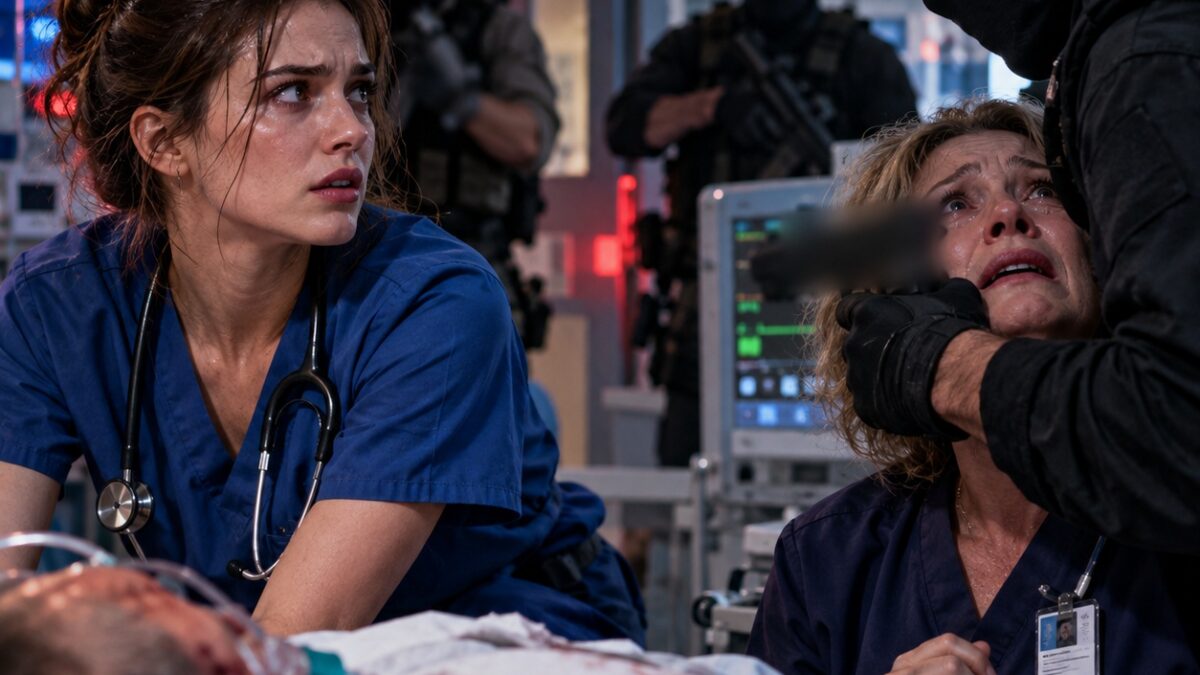
The leader seized Brenda by the front of her scrub top and pulled her around the nurse’s desk.
He pressed the barrel of his weapon against the side of her face.
The woman who had spent thirty years ordering everyone else around became very small.
“Where is he?”
Brenda was sobbing.
“Trauma One.”
She pointed.
“Please.”
“Anyone else in there?”
“The doctor.”
“Anyone armed?”
“No.”
The leader released her so suddenly she fell.
He looked at two men.
“Go.”
They moved toward the trauma bay.
I stood beside the supply corridor with my hands hanging loose at my sides.
Nobody looked at me.
That was the advantage.
I was the rookie.
The soft one.
The woman Brenda scolded.
The nurse Albright thought was afraid of blood.
The person nobody important remembered to see.
My old instructors had taught me something years before.
People do not notice what they believe cannot threaten them.
I had built my entire second life around that principle.
Now it was keeping people alive.
I counted.
Leader by the desk.
One man controlling the waiting room.
Two moving toward Trauma One.
I had no weapon.
No backup.
No realistic way to attack four armored men in open space without getting patients killed.
The first rule was not to be brave.
It was to change the problem.
I backed into the supply area.
Slowly.
One step.
Then another.
A terrified respiratory therapist crouched behind a cart.
His name was Luis.
He looked at me.
I put one finger to my lips.
His eyes were huge.
I pointed toward a side door leading into the service hallway.
Then toward the floor.
Stay low.
He nodded.
The two Gvnmen passed the opening.
I moved.
Not toward them.
Away.
I slipped through the service door and pulled it almost shut behind me.
The hospital had been remodeled so many times that even employees got lost in parts of the back corridor.
Laundry access connected to central supply.
Central supply connected to radiology storage.
Radiology connected to a staff stairwell.
The men who had invaded the ER knew the direct routes.
That did not mean they knew the building.
I did.
More importantly, I knew where the old security office connected to the hall.
I moved fast.
Quiet.
No unnecessary noise.
At the first corner, I nearly collided with a housekeeping cart.
I caught it before the wheels squealed.
Then I heard someone behind me.
One of the armed men had broken from the waiting room.
Maybe he had seen movement.
Maybe the leader had sent him to clear the rear hall.
Either way, I had seconds.
I looked around.
Locked medication room.
Utility closet.
Steel cart.
Fire door.
The old part of me began doing geometry.
Not violence.
Geometry.
Distance.
Visibility.
Exit.
Sound.
He rounded the corner.
I ducked behind the utility door.
His steps passed.
I waited.
One.
Two.
Three.
Then I stepped out behind him.
He turned.
Too late.
The fight was short.
Ugly.
Nothing like movies.
Real violence has no choreography.
It is breath and friction and panic and weight.
I got inside his reach before he could bring his weapon around.
We hit the wall.
He tried to drive me backward.
I used the narrow hallway against him.
He was stronger.
I was faster.
He expected a frightened nurse.
He got somebody who had spent years learning what to do in cramped spaces when there was nowhere to run.
Seconds later, he went down.
I stood over him breathing through my nose.
My hands were steady.
That scared me more than him.
I had spent years trying to become someone whose hands shook after violence.
Somewhere inside me, that woman still did not exist.
I took his sidearm.
Nothing more.
No trophies.
No satisfaction.
I checked the corridor.
Clear.
Then I heard the two men near Trauma One.
“Door.”
“Move.”
Albright’s voice carried through the glass.
“Please. There are patients here.”
One of the men laughed.
I moved toward the junction.
My heart rate was slow.
Too slow.
That old cold clarity returned.
I hated it.
I needed it.
The first attacker raised his weapon toward the trauma bay.
I fired.
He dropped.
The second spun.
I fired again.
He went down behind a shattered section of glass.
Inside Trauma One, Albright disappeared beneath the table.
The monitors kept beeping.
Costa did not wake.
For one surreal second, everything seemed frozen.
Then the leader shouted from the front.
“Contact!”
Automatic fire tore down the hallway.
I was already moving.
Rounds ripped through drywall behind me.
A medication cart exploded into metal fragments and plastic drawers.
IV bags burst.
Saline splashed across the floor.
I slid behind a reinforced supply trolley and flattened myself against the tile.
The leader had one man left with him.
Two in front of me.
One behind.
I had taken away their confidence.
That mattered.
Men who enter expecting control make different decisions once they realize somebody else understands the environment.
They started shooting at shadows.
I let them.
Every round they fired told me where they were.
The nurse’s station was ahead and left.
The leader remained behind cover.
His last man moved toward the pediatric corridor.
He was trying to flank.
I could hear his boots sticking slightly on the saline-wet floor.
I looked up.
Smoke detector.
Fire door.
Sprinkler controls farther down.
Hospital buildings are full of systems designed to respond to chaos.
You do not always need to create more chaos.
Sometimes you let the building do what it was built to do.
I grabbed a metal instrument tray from the bottom of the cart and threw it hard into the opposite hallway.
It crashed.
The mercenary fired toward the noise.
I moved the other direction.
A red alarm station was within reach.
I pulled it.
The corridor erupted.
Sirens.
Emergency strobes.
Fire doors began closing.
The remaining attacker looked toward the lights.
For half a second, he lost track of me.
That was enough.
I rushed him behind the moving fire door.
He turned.
We collided.
His weapon hit the frame.
The door separated us from the leader.
A brutal struggle followed.
He caught my shoulder.
I hit the wall.
Pain flashed through the old injury near my collarbone.
For an instant I was somewhere else.
Dust.
Concrete.
A different hallway.
Different country.
Someone shouting my old call sign.
I forced myself back.
Mercy General.
Chicago.
Tuesday.
2:59 a.m.
I drove forward.
He lost his balance on the wet floor.
I used the opening.
When it was over, he was no longer a threat.
I backed away.
My lungs were working harder now.
Three men down.
Leader still active.
Patients still trapped.
And something else bothered me.
These men had arrived too quickly.
Costa had been brought in through the ambulance entrance unexpectedly.
We had not even completed registration.
Yet the attackers knew exactly where he was.
They knew the power layout well enough to cut local service.
They knew response times would be slow.
Somebody had helped them.
That thought barely formed before a scream came from Trauma One.
Albright.
Not fear.
Pain.
I ran.
The glass door was shattered.
I crossed the threshold and stopped.
Harrison stood behind Albright.
Harrison.
Quiet, forgettable Harrison.
Hospital orderly.
Thirty years old.
Never late.
Always wore earbuds while mopping.
He had a scalpel against Albright’s throat.
In his other hand was a small storage device smeared with blood.
Costa’s jacket had been torn open farther than before.
A section of the lining hung loose.
The inside man.
My stomach dropped.
That was how they knew.
Harrison had been waiting for Costa.
Or for whatever Costa carried.
He dragged Albright backward.
“Put it down, Sam.”
His voice shook.
The scalpel shook more.
Albright’s face had gone gray.
“Sam.”
He sounded different.
Not arrogant.
Not Dr. Albright.
Gregory.
A terrified man.
“Please.”
I kept the pistol level.
Harrison laughed too fast.
“You’re a nurse.”
I said nothing.
“You’re the idiot Brenda screams at.”
Still nothing.
“You don’t know what you’re doing.”
I looked past him.
Dominic Costa.
Monitor stable.
Barely.
Storage device.
Blood.
Harrison.
Exit behind me.
Leader somewhere outside.
My mind sorted the room into pieces.
“Harrison.”
He tightened the scalpel.
“Don’t.”
“Look at me.”
“I said put it down.”
“Look at me.”
His eyes locked on mine.
That was what I wanted.
“You know me.”
His mouth twitched.
“No.”
“You do.”
“You’re nobody.”
“Exactly.”
Something changed in his face.
I lowered my voice.
“You’ve watched me spill coffee. You’ve watched Brenda yell at me. You’ve watched Albright make jokes about me.”
Albright made a sound somewhere between a sob and a breath.
I continued.
“You believed all of it.”
Harrison swallowed.
“So did they.”
I nodded toward the broken corridor.
He glanced instinctively.
Bodies.
Weapons.
Blood.
The silence afterward.
His grip changed.
Not much.
Enough.
“I just wanted the money,” he whispered.
“How much?”
He blinked.
“What?”
“How much was this worth?”
“Fifty thousand.”
Albright closed his eyes.
I almost felt pity for Harrison.
Fifty thousand dollars.
Four armed professionals.
A hospital security guard dead.
Patients terrorized.
People who would hear Gvnfire in dreams for years.
All so Harrison could hand over a storage device.
“Put the scalpel down.”
His eyes filled.
“I can’t.”
“Yes, you can.”
“They’ll kill me.”
“Most of them are already down.”
“The leader isn’t.”
“I know.”
Harrison’s eyes shifted toward the door.
That was when a shadow moved behind me.
I felt it before I saw it.
An arm locked around my throat.
Hard.
Fast.
My pistol fell.
The leader had circled around through the adjacent corridor.
He pulled me backward.
For the first time that night, I lost control.
Not emotionally.
Physically.
He was enormous.
Strong.
Trained.
His forearm locked under my jaw.
My vision tightened.
“You’re good,” he whispered.
His voice was almost admiring.
Then colder.
“But you’re done.”
I tried to break the grip.
Nothing.
The room narrowed.
Sound became distant.
Harrison shoved Albright away.
The doctor crashed into a cabinet.
Harrison ran for the door clutching the storage device.
The leader tightened his arm.
Black spots moved into my vision.
I stopped fighting.
That surprised him.
I let my body go heavy.
Dead weight.
His balance shifted.
Only slightly.
But slightly was enough.
I dropped lower.
Turned.
Drove everything I had into escaping the hold.
The pressure changed.
Air hit my lungs.
Pain exploded through my throat.
I twisted free.
He came after me.
A knife appeared.
I backed around the surgical table.
Albright crawled away.
Costa’s monitor alarmed.
The leader slashed.
I moved.
Steel passed close enough that I felt air across my sleeve.
He was angry now.
Anger makes people fast.
It also makes them predictable.
He came again.
I shoved the instrument cart into his path.
He knocked it aside.
Metal crashed.
He closed distance.
We fought in a space designed for healing.
That part stayed with me.
The blood on the floor.
The sterile wrappers.
The bright trauma lights.
The sound of medical instruments scattering under boots.
This room had spent years saving lives.
Now two people were trying desperately to survive inside it.
He hit me across the cheek.
My vision flashed white.
I slammed into the wall.
He grabbed my scrub top.
For half a second I saw the knife rise.
Then I moved inside his reach.
My hand found the heavy handle of a medical tool on the fallen tray.
I swung once.
He staggered.
Again.
The knife dropped.
He collapsed to one knee.
I kicked the blade away.
He tried to rise.
I struck him hard enough to stop him.
Then I backed away.
I did not move closer.
Did not finish anything.
Did not need to.
His body sagged.
He was no longer fighting.
The room went quiet.
Not truly quiet.
Machines still beeped.
The fire alarm still sounded farther away.
Somebody cried in the corridor.
Sirens approached outside.
But compared with the last five minutes, it felt like silence.
I looked around.
Albright sat against the wall.
Blood marked his neck where Harrison’s scalpel had pressed.
Costa was still alive.
Barely.
Harrison was gone.
My first instinct was to chase him.
My second was the one I trusted.
Patients.
I moved to Costa.
His pressure was dropping.
The chest injury had stabilized somewhat, but he was still bleeding.
I looked at Albright.
“Doctor.”
He stared at me.
“Gregory.”
That reached him.
He blinked.
“What?”
“We still have a patient.”
Something returned to his face.
Training.
Identity.
He stood.
His knees nearly failed.
I caught his arm.
He looked at my hand.
Then at me.
For the first time, he seemed to understand that every awkward movement he had seen from me for months had been deliberate.
He swallowed.
“Who are you?”
“Right now?”
I pulled gloves from a box.
“Your nurse.”
We went back to work.
That may sound impossible after what had happened.
It was not.
Emergency medicine teaches you that disaster does not excuse physiology.
Costa did not care that armed men had invaded the hospital.
His blood pressure still fell.
His lungs still needed support.
His body still moved toward death unless we interrupted it.
Albright inserted the chest tube.
I managed medications.
Brenda stumbled into the trauma bay ten minutes later.
Her face was streaked with tears.
She looked at the leader on the floor.
Then at the broken glass.
Then at me.
Her mouth opened.
Nothing came out.
“Brenda.”
She looked at me.
“We need blood.”
That broke the spell.
“Right.”
She nodded too many times.
“Yes. Yes.”
Then ran.
I almost smiled.
It was the first time Brenda Carmichael had ever taken an order from me without questioning it.
Police entered Mercy General minutes later.
Real police.
Uniforms.
Tactical officers.
Shouted commands.
Weapons raised.
Every person in the hallway was ordered to show hands.
I placed the stolen pistol on the floor before they reached Trauma One.
Then I stepped away from it.
Albright watched.
He looked like he wanted to say something.
I shook my head once.
Small.
Do not.
The first officer through the door saw the bodies.
Saw the blood.
Saw me.
His weapon turned toward me.
“Hands!”
I raised them.
“Hands where I can see them!”
“They’re up.”
“On your knees!”
I went down.
No argument.
No pride.
He moved closer.
Another officer covered the room.
“Are you injured?”
“I’m a nurse.”
“That’s not what I asked.”
“My shoulder. My throat. I’m okay.”
“Whose Gvn?”
“One of theirs.”
He looked toward Albright.
The doctor’s face changed.
I could see the decision happening.
He could tell them everything.
Who I had become.
How I moved.
What he had seen.
Instead he said:
“She saved us.”
The officer looked back at me.
I let my breathing become uneven.
Not entirely fake.
The adrenaline had beGvn leaving.
That is the ugly thing about control.
Eventually your body collects the bill.
My hands started shaking.
This time I did not need to pretend.
The shaking moved into my arms.
Then my shoulders.
Then my teeth.
An officer lowered his weapon slightly.
“Ma’am, you’re safe.”
Safe.
The word nearly broke me.
I stared at the blood on the floor.
Officer Wyatt was dead.
At least two attackers were not getting back up.
Others were critically injured.
Harrison was somewhere inside or outside the hospital carrying whatever men had killed for.
Safe did not feel like the right word.
But I nodded.
A blanket went around my shoulders.
Someone guided me toward the hallway.
Brenda sat against the nurse’s station.
She looked twenty years older.
Luis, the respiratory therapist, was beside her.
Patients were being evacuated from the waiting room one at a time.
A little girl clutched a stuffed rabbit.
Her mother held her so tightly the child could barely move.
As I passed, the girl looked at me.
“Are you a nurse?”
I looked down at my blue scrubs.
For some reason, that question hit harder than Gvnfire.
“Yes.”
She pointed toward my scraped knuckles.
“You’re bleeding.”
“I know.”
She reached out and touched the edge of my blanket.
“My mom says nurses help people.”
My throat tightened.
“She’s right.”
That was why I had come here.
I had almost forgotten.
Outside, Chicago rain washed red streaks from the ambulance pavement.
Police vehicles filled the street.
News vans had not arrived yet.
They would.
They always did.
Federal agents came because Dominic Costa’s name connected the incident to organized crime.
Hospital administrators came because administrators appear anywhere there are cameras and liability.
A trauma resident examined my shoulder.
Someone tried to ask me questions.
I gave them simple answers.
I heard shots.
I hid.
One attacker came through the back hall.
There was a struggle.
I got his weapon.
I fired when others threatened patients.
Simple.
True.
Incomplete.
Albright sat twenty feet away while another doctor cleaned the cut along his neck.
Every few minutes, he looked at me.
Not suspiciously.
Not exactly.
More like he had spent months looking at one painting and had just discovered another picture underneath it.
At 5:20 a.m., a federal agent named Walsh sat across from me in an administration office.
Mid-fifties.
Gray suit.
Tired eyes.
He placed a recorder on the table.
“You fired the handGvn?”
“Yes.”
“You had firearms training?”
I hesitated.
“Some.”
“Where?”
“Before nursing.”
“What kind?”
“Military.”
His eyes lifted.
“Branch?”
“Navy.”
“Job?”
“Medical support.”
He waited.
I did not continue.
“What unit?”
“Not relevant to what happened tonight.”
“That’s usually for me to decide.”
“I understand.”
His gaze stayed on me.
He had probably spent his career watching people lie.
I was not lying.
That made me harder to read.
He leaned back.
“You handled that weapon better than most patrol officers.”
“I was scared.”
“Those things aren’t mutually exclusive.”
“No.”
He tapped one finger against the table.
“Your service record is thin.”
I said nothing.
“Almost suspiciously thin.”
Still nothing.
He smiled slightly.
“Ms. Kinsley, I’m not trying to hurt you.”
“Then don’t dig where somebody worked very hard to bury something.”
His smile disappeared.
For several seconds, neither of us spoke.
Then he closed his notebook.
“Stay available.”
“I will.”
At the door, he paused.
“One more thing.”
I looked at him.
“We found Harrison.”
My stomach tightened.
“Alive?”
“Yes.”
“Where?”
“Parking structure. Tried to leave through employee access.”
“The storage drive?”
“We recovered it.”
I exhaled.
Walsh studied me.
“You knew there was an inside man.”
“I suspected.”
“When?”
“Before I saw Harrison with the scalpel.”
“How?”
“The attackers arrived too fast.”
He nodded slowly.
“Get some sleep.”
I almost laughed.
Sleep.
At 6:07, I sat alone in the locker room.
My scrub top was torn.
One sleeve had blood that was not mine.
My face looked wrong in the mirror.
Too calm.
I turned on the sink.
Cold water.
Washed my hands.
The water ran pink.
Then clear.
I kept washing.
Nine years earlier, after my first real operation, an older medic told me something.
You will remember the hands.
Not the shooting.
Not the screaming.
Hands.
Your own.
Other people’s.
What they were holding.
What they were trying to stop.
I had thought he was being philosophical.
He was not.
That morning, I remembered Wyatt’s hand reaching toward his radio.
Brenda’s hand shaking as she pointed toward Trauma One.
Albright’s hands covered in Costa’s blood.
Harrison’s hand gripping the scalpel.
The little girl’s hand touching my blanket.
Mine holding a weapon I had promised myself I would never carry again.
I shut off the faucet.
“Rough first year?”
Albright’s voice came from the doorway.
I looked at the mirror.
He stood behind me.
Fresh bandage along his neck.
His face pale.
“You should be getting checked.”
“So should you.”
“I already was.”
He entered slowly.
For once, he did not carry himself like the smartest man in the building.
He sat on the bench.
I turned around.
We looked at each other.
Finally he said:
“You lied.”
“Yes.”
“That was easy.”
“I’m tired.”
“About nursing school?”
“No.”
“Ohio?”
“Mostly true.”
“Being terrified of blood?”
I gave him a look.
He nodded.
“Right.”
Silence.
Then:
“Were you special operations?”
I leaned against the sink.
“I was attached to people whose jobs were complicated.”
“That is the most government answer I have ever heard.”
“It’s the only one you’re getting.”
He rubbed his hands together.
“When you treated Costa…”
“I’m a nurse.”
“That isn’t what I mean.”
“I know.”
“You diagnosed the chest problem before I did.”
“No.”
“You did.”
“I saw it quickly.”
“You moved like you’d done it under fire.”
I looked away.
He understood.
His voice softened.
“How long?”
“Long enough.”
“And then you just became…”
“A rookie nurse?”
He actually smiled.
“Worst rookie nurse I’ve ever met.”
“Thank you.”
“I mean your charting is terrible.”
“It’s intentionally average.”
“You missed three signatures.”
“I needed credibility.”
He stared at me.
Then laughed.
The laugh turned into something else.
His eyes filled.
He covered his face.
For months, I had seen Gregory Albright as arrogance wrapped in expensive shoes.
I had never watched him cry.
“I hid under a table,” he said.
“You survived.”
“I hid.”
“You had people shooting at you.”
“You didn’t hide.”
“I had different training.”
He lowered his hands.
“I froze.”
“So did everyone.”
“Not you.”
I stepped closer.
“That is not a moral achievement.”
He looked confused.
“It doesn’t make me braver.”
“What does it make you?”
“Conditioned.”
I sat opposite him.
“There is a difference.”
He absorbed that.
“Were you scared?”
“Yes.”
“You didn’t look scared.”
“I learned a long time ago that looking scared and being scared are separate problems.”
His eyes dropped.
“I thought I was going to die.”
“I know.”
“And when Harrison…”
“I know.”
He looked up.
“What happens now?”
“That depends.”
“On what?”
“How much you tell people.”
His face went still.
“You’re asking me to lie.”
“I’m asking you not to explain things you don’t actually know.”
“I know you killed—”
“Gregory.”
He stopped.
I lowered my voice.
“You know armed men came into a hospital to murder a patient.”
“Yes.”
“You know I defended people.”
“Yes.”
“You know I have military training.”
“Yes.”
“Everything else is speculation.”
He stared for a moment.
Then nodded.
“Fine.”
“Fine?”
“I won’t dig.”
“Why?”
That question surprised him.
“Because you saved my life.”
I shook my head.
“That is exactly why you should not make a decision right now.”
“No.”
He leaned forward.
“I spent months treating you like an idiot.”
“You treated most nurses like idiots.”
He winced.
“Fair.”
“You don’t owe me secrecy because you feel guilty.”
“I’m not doing it because I feel guilty.”
“Why?”
He looked toward the locker room door.
“Because I saw what happened when those men looked at you and saw nothing.”
I said nothing.
He continued.
“Maybe being nothing is keeping you alive.”
That was closer to the truth than he knew.
At 7:30, Brenda found me.
She stopped six feet away.
Normally Brenda entered every room like it belonged to her.
Not that morning.
“Sam.”
“Hey.”
She folded her arms.
Then unfolded them.
“I owe you an apology.”
That sentence nearly caused a second emergency.
“For what?”
“For…”
She struggled.
Brenda Carmichael had no muscle memory for apologizing.
“Everything.”
“That’s broad.”
“I’m serious.”
“I know.”
“I thought you were incompetent.”
“I worked hard at that.”
Her eyebrows drew together.
Then she realized I was joking.
A strange laugh came out of her.
She looked down.
“Wyatt’s dead.”
The humor disappeared.
“I know.”
“They’re calling his wife.”
I closed my eyes.
Wyatt had shown me photographs of his grandkids.
Twins.
Five years old.
He had once spent twenty minutes fixing the wheel on a medication cart because engineering took too long to respond.
He should have retired.
He had been talking about it.
“Sam.”
I looked at Brenda.
“I told them where Costa was.”
“You had a Gvn against your face.”
“I told them.”
“You survived.”
“What if you hadn’t been here?”
That question was too large.
So I did not answer it.
Brenda’s eyes hardened.
Not at me.
At herself.
“I pointed.”
“You were trying to stay alive.”
“That doesn’t make it feel better.”
“No.”
She blinked.
“You’re terrible at comfort.”
“I know.”
“Were you like this before nursing?”
“Worse.”
That almost made her smile.
Hospital leadership put the ER on lockdown for the rest of the morning.
Patients were transferred.
The dead were removed only after investigators finished photographing the scene.
By eight, the street outside Mercy General was a wall of media.
“Hospital Siege.”
“Organized Crime Attack.”
“Rookie Nurse Fights Back.”
The first headline with my name appeared before lunch.
I hated it.
Someone had leaked security footage showing part of the waiting-room breach.
Another clip showed officers escorting me outside wrapped in a blanket.
The image made me look exactly how I wanted the world to see me.
Small.
Shaken.
Ordinary.
The public story formed quickly.
A nurse found an attacker’s Gvn during the chaos.
She defended herself and others.
Several attackers were killed or critically injured.
Police captured an employee accomplice while he tried to flee.
Dominic Costa survived surgery.
That was enough.
The parts that were not enough stayed inside federal interviews.
Agent Walsh returned two days later.
This time he came without the recorder.
I was in an employee conference room drinking terrible coffee.
He closed the door.
“Your file is classified.”
I did not react.
“That is not a question.”
“No.”
“People above my pay grade called people above their pay grade.”
“I’m sorry.”
“No, you’re not.”
“Not especially.”
He sat.
“They told me to stop asking questions about nine years of your life.”
“Good advice.”
“I dislike being told not to ask questions.”
“I guessed.”
He leaned forward.
“Were those men connected to anything from your past?”
“No.”
“You’re sure?”
“Yes.”
“Costa?”
“No.”
“This was coincidence?”
“As far as I know.”
Walsh nodded.
“That’s what they said too.”
“Then why are you here?”
He studied me.
“Because Harrison talked.”
That got my attention.
“He knew Costa carried information.”
“What kind?”
“Financial records. Names. Payment trails. Enough to damage multiple organizations.”
“And the strike team?”
“Contracted.”
“By whom?”
“Still working that.”
I looked into the coffee.
Walsh continued.
“Harrison sold access. Power schedules. Security blind spots. Shift information.”
“For fifty thousand dollars.”
“You heard him say that?”
“Yes.”
“He confirmed it.”
I shook my head.
Walsh watched.
“What?”
“Nothing.”
“That look wasn’t nothing.”
“People always think betrayal has to be expensive.”
He waited.
I continued.
“Sometimes somebody destroys ten lives for less than a new car.”
Walsh sat back.
“You miss it?”
“What?”
“Your old life.”
“No.”
“That was fast.”
“I have had years to answer.”
“You were good.”
“So?”
“People usually miss being good at something.”
I thought about that.
“I miss knowing what I was supposed to do.”
He nodded slowly.
“That I understand.”
“When I was deployed, everything was terrible but simple. Protect this person. Reach this building. Stop this threat. Stabilize this casualty.”
“And nursing isn’t simple?”
“Nursing is people.”
He smiled.
“People are harder.”
“Much.”
I finished the coffee.
“But that’s why I chose it.”
Walsh stood.
At the door, he turned.
“Your secret’s safe from me.”
“I don’t have a secret.”
He almost laughed.
“Right.”
A week later, Mercy General reopened the emergency department.
New glass.
Repainted walls.
Fresh ceiling panels.
You could still see small scars if you knew where to look.
A patched section of tile.
A replacement door frame.
A darker square where Wyatt’s radio had scraped the floor.
The hospital held a memorial for him.
His wife came.
So did his daughters.
His grandchildren wore tiny black jackets.
I stood in the back.
Brenda spoke.
She made it through half her remarks before her voice broke.
Albright stood beside me.
Neither of us said anything.
Afterward, Wyatt’s wife approached.
“You’re Samantha?”
I froze.
“Yes.”
She hugged me.
Hard.
I did not know what to do with my hands.
“My husband talked about you.”
I pulled back.
“He did?”
“He said the new nurse was a nervous wreck but sweet.”
I laughed despite myself.
“That sounds like him.”
“He said Brenda scared you.”
I glanced across the room.
Brenda saw us.
Her face did something strange.
Wyatt’s wife squeezed my hands.
“They told me you tried to help everybody.”
“I wish I could have helped him.”
Her eyes filled.
“So do I.”
No comforting lie came.
I could not tell her I had done everything possible.
I did not know that.
Maybe if I had recognized the threat ten seconds earlier.
Maybe if I had convinced Albright to lock down the department.
Maybe if—
She touched my cheek.
“Don’t.”
I looked at her.
“My husband was a security guard in a hospital attacked by men with rifles. You did not put him there.”
I swallowed.
She had no idea how badly I needed someone else to say it.
“Thank you.”
“No.”
She shook her head.
“Thank you.”
Two months passed.
Dominic Costa survived.
Federal custody took over almost immediately.
I never saw him awake.
Harrison pleaded guilty to charges I stopped following closely.
The surviving attacker never returned to Mercy General.
The media moved on.
It always does.
One week you are the face on every screen.
The next week, nobody recognizes you at the grocery store.
That suited me.
Brenda returned to scolding nurses.
Not exactly the same way.
She still corrected people.
Still cared too much about signatures.
Still believed an unsigned medication log was a sign civilization was collapsing.
But she stopped humiliating people.
At least publicly.
One night, a new graduate named Taylor mixed up two labels on a specimen bag.
Brenda caught it.
Old Brenda would have announced the error across the station.
Instead she pulled Taylor aside.
Quietly.
Showed her the mistake.
Asked her to correct it.
Then moved on.
I watched.
Brenda caught me watching.
“What?”
“Nothing.”
“Do not start.”
“I didn’t say anything.”
“Your face said something.”
“I’m proud of you.”
She threw a pen at me.
It missed.
Albright changed too.
That was more entertaining.
He started asking nurses what they thought.
At first everyone assumed he had suffered brain damage.
During a trauma case, he looked at one of the senior nurses and said:
“Maria, what are you seeing?”
She stared at him.
He frowned.
“What?”
“You asked me.”
“Yes.”
“Voluntarily.”
“Would you answer the question?”
Later she came to me.
“What did you do to him?”
“Nothing.”
“He says please now.”
“Trauma.”
“Can we schedule another one next quarter?”
“That seems excessive.”
She laughed.
The relationship between Albright and me became strange.
He knew too much.
Not enough to understand.
Enough to respect silence.
Sometimes he tested me.
A case would arrive.
A difficult airway.
Complicated trauma.
A patient crashing without an obvious cause.
His eyes would flick toward me.
I learned to glare.
One night he whispered:
“You know what this is, don’t you?”
“I’m a rookie.”
“You’ve been here almost a year.”
“Still emotionally a rookie.”
He shook his head.
But he stopped exposing me.
Eventually, I allowed myself to become slightly better at my job.
Not too quickly.
That sounds ridiculous.
It was.
I could not spend the rest of my career intentionally making mistakes just to preserve a cover that nobody important cared about anymore.
So I improved.
Gradually.
I became competent.
Then reliable.
Then one of the nurses Brenda trusted in a bad room.
Not because I wanted authority.
Because after Mercy General, pretending helplessness felt different.
Before, the disguise protected me.
After, it began to feel dishonest around people who had bled beside me.
Still, I kept the past buried.
There is a difference between being truthful and being completely known.
Some lives require that distinction.
On the one-year anniversary of the attack, I worked the graveyard shift.
I could have requested the night off.
I did not.
At 2:14 a.m., I stood at the nurse’s station drinking coffee.
Same hour.
Same fluorescent lights.
Rain hit the windows.
My body noticed before I did.
My shoulders tightened.
My eyes moved automatically toward the ER entrance.
Albright saw.
He was sitting with a tablet.
He did not say anything.
At 2:38, ambulance doors opened.
I froze.
A paramedic pushed in an elderly man complaining of chest pain.
No blood.
No weapons.
No syndicate tattoos.
Just a seventy-three-year-old retired math teacher named Arthur who had eaten too much barbecue and was convinced his indigestion was a heart attack.
I almost laughed.
Brenda looked at me.
“You okay?”
“Yeah.”
“You sure?”
“Yeah.”
She nodded.
No lecture.
We treated Arthur.
His heart was fine.
He complained about hospital coffee.
At 4:00 a.m., things quieted.
Albright found me near Trauma One.
The glass doors had been replaced long ago.
He looked into the room.
“I still hate this bay.”
“So do I.”
“Have you ever thought about leaving?”
“Mercy?”
“Yeah.”
“Every week.”
“Why don’t you?”
I looked through the glass.
A young resident was stitching a cut on a construction worker’s hand.
A nurse laughed at something near the computer.
Ordinary life.
“Because this is what I wanted.”
“This?”
“This.”
He looked confused.
I explained.
“When I left the military, I thought healing would feel clean.”
He waited.
“It doesn’t.”
“No.”
“It’s still blood. Still fear. Still families crying. Still people dying when you do everything right.”
“Sounds like a terrible sales pitch for nursing.”
“It is.”
“Then why?”
“Because here the goal is different.”
His expression softened.
“Save them.”
“Yeah.”
He nodded.
“I’m glad you stayed.”
“Don’t become sentimental.”
“Wouldn’t dream of it.”
He started walking away.
Then stopped.
“Sam.”
“What?”
“Do you remember after the police came?”
“Yes.”
“You put soot on your face.”
I went still.
He smiled.
“I always wondered whether I imagined that.”
“You were traumatized.”
“That’s not a denial.”
“Go finish your charts, doctor.”
He laughed.
I watched him leave.
The truth was, he had seen me.
Not the combat.
Not the shooting.
Me.
The moment after.
When I pulled my oversized scrub top back over the black undershirt.
When I looked at the ruined trauma room and understood that the life I had buried could never be completely buried again.
When I smeared grime across my cheek because looking helpless still felt safer than being recognized.
Albright had seen it.
He had kept the secret anyway.
Sometimes loyalty begins in strange places.
At sunrise, my shift ended.
I changed out of my scrubs.
Walked through the employee entrance.
Chicago was gray.
The rain had stopped.
Traffic hissed over wet streets.
People carried coffee.
Buses groaned.
A woman argued into her phone.
Nobody knew that one year earlier, armed men had turned this building into a battlefield.
Nobody needed to.
I stood under the awning.
For years, I had believed my life had two separate halves.
Before.
After.
The operator.
The nurse.
Destroy.
Heal.
That night at Mercy General taught me the division was never that clean.
The skills I hated had saved people.
The person I wanted to become had stopped me from enjoying what those skills could do.
Maybe that was the balance.
Not forgetting who I had been.
Not becoming her again either.
Using what remained when somebody else left no peaceful option.
Then putting it down.
I heard the doors open behind me.
Brenda came outside.
She held two coffees.
She gave me one.
“No fentanyl log today?”
“I signed it.”
“Without being reminded?”
“I’m growing.”
“Miracles happen.”
We stood in silence.
After a moment, she said:
“People still ask me about that night.”
“What do you tell them?”
“That I was scared.”
“That’s true.”
“That Wyatt was brave.”
“Also true.”
“That Albright hid under a table.”
I nearly choked on coffee.
“Brenda.”
“What? Also true.”
“You’re cruel.”
“He deserves some humility.”
She looked at me.
“And I tell them the rookie nurse got lucky.”
I turned toward her.
She sipped her coffee.
Her expression stayed innocent.
“Lucky?”
“Very.”
I understood.
She knew too.
Not everything.
Enough.
“You’re terrible at keeping secrets.”
“I’ve worked in an ER thirty years. We invented keeping secrets.”
She started toward the parking lot.
Then turned.
“Oh, and Kinsley?”
“Yeah?”
“You forgot your badge.”
I looked down.
Of course I had.
She held it up.
I walked over.
She clipped it onto my jacket herself.
“There.”
Her eyes met mine.
For one brief second, neither of us pretended.
Then she said:
“Try not to save the whole hospital tonight. We’re short-staffed tomorrow.”
I smiled.
“No promises.”
She walked away.
I stood there holding the coffee.
For years, I thought strength was the part of me I needed to hide.
I had been wrong.
The dangerous part had never been strength.
It was what I believed strength was for.
Once, it had meant completing the mission.
Eliminating the threat.
Getting home.
Now it meant keeping a stranger alive at three in the morning.
Holding pressure on a wound.
Sitting beside a terrified family.
Stopping an armed man because there was a child under a chair behind me.
And knowing when the fight was finished.
The men who entered Mercy General believed they were walking into a building full of helpless people.
They were wrong about that too.
Brenda survived terror.
Albright went back to the operating table after thinking he was about to die.
Luis guided patients through the service hall.
Wyatt stood up when armed men entered the place he had been hired to protect.
Courage had been everywhere that night.
Mine was simply louder.
That distinction mattered to me.
I did not want to become the legend people whispered about.
The hidden assassin.
The secret warrior.
The woman who could kill.
Those stories are easy.
The harder truth was that I had spent years trying to become someone who valued the lives in front of her more than the part of herself that knew how to fight.
That was why I stayed at Mercy.
Not because I had nowhere else to go.
Because after everything, I still wanted the same thing I wanted when I first put on blue scrubs.
To walk into a room where somebody was dying and use my hands to move them in the other direction.
Most nights, that meant medicine.
Once, it meant something else.
And after the armed men were gone, the blood cleaned from the tile, the glass replaced, and the headlines forgotten, I went back to being Samantha Kinsley.
Nurse.
Former rookie.
Still terrible with the espresso machine.
Still occasionally late on paperwork.
Still carrying a life nobody around me fully understood.
Albright never asked again.
Brenda never said another word.
Agent Walsh never called.
And whenever I passed Trauma Bay One late at night, I sometimes remembered the moment Albright looked at me and realized the nervous young nurse he had dismissed for months had never existed.
The truth was stranger.
She had existed.
I had needed her.
I had wanted to become her.
Soft enough to heal.
Ordinary enough to disappear.
Safe enough to forget.
But when the lights went out and armed men walked into my ER, the woman I had buried came back long enough to protect the life I had chosen.
Then, when it was over, I put her away again.
Not because I was ashamed of her.
Because she had finally done the one thing I had always wanted from her.
She helped me save people.
And this time, when the sun came up, I was still a nurse.








