The Mother Dog Wouldn’t Drop the Bloody Cloth
The Mother Dog Wouldn’t Drop the Bloody Cloth
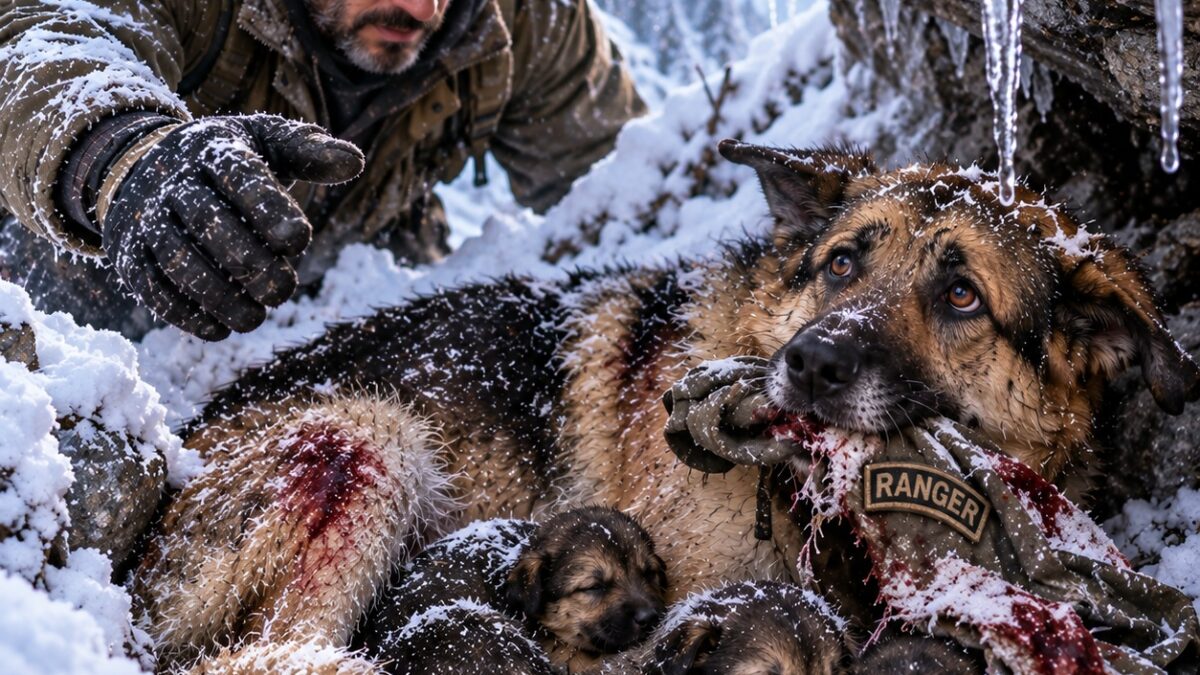
THE WOUNDED MOTHER DOG WAS HALF-FROZEN IN THE RAVINE, WRAPPING HER BROKEN BODY AROUND THREE NEWBORN PUPPIES LIKE THE STORM ITSELF HAD COME TO TAKE THEM.
SHE HAD EVERY REASON TO BITE ME WHEN I REACHED FOR HER BABIES, BUT WHAT SHE REFUSED TO LET GO OF WASN’T A PUPPY—it was a bloody piece of a ranger’s coat.
WHEN I SAW THE NAME STITCHED INTO THAT TORN FABRIC, I REALIZED I HAD NOT FOUND A STRAY DOG IN THE MOUNTAINS—I HAD FOUND THE LAST WARNING BEFORE A WHOLE TOWN WENT DARK.
Winter had sealed the Bitterroot Range beneath a hard, breathless white.
Snow lay heavy on the black pines around Elk River Basin, bending the lower branches until they nearly touched the ground, and the morning sky hung low and gray, as if the whole mountain had been pressed beneath a sheet of cold iron.
No sunlight broke through.
No bird moved between the trees.
Even the wind seemed careful, sliding through the forest in long, thin breaths that made powder shift across old tracks and half-buried stones.
My name is Liam Calder.
At fifty, I had outlived the age of proving things.
I had left that behind with uniforms, commands, briefings, and the kind of nights that never fully ended even after sunrise. That morning, I was not heading deep into the Montana mountains to hunt like a reckless man trying to prove he still belonged to danger. I only meant to check the trail cameras near the lower ridge, inspect a sagging line of old fencing before the next storm buried it, and read the fresh animal signs before weather erased every truth the snow was holding.
The rifle was slung over one shoulder because this country still belonged to wolves, mountain lions, and hungry things that did not care about a man’s desire for peace.
But the thing I carried most carefully was not the rifle.
It was the quiet.
My cabin stood half a mile above the last maintained road outside Red Hollow, tucked between pine trunks and granite outcrops, where smoke from the chimney disappeared into the trees before anyone in town could see it. People in Red Hollow knew me the way small towns know men who do not ask to be known.
They knew I could pull a truck out of a ditch in a blizzard without saying more than three sentences.
They knew I would fix a widow’s porch steps and leave before she could offer coffee.
They knew I had once served in places nobody asked about twice.
Some called me steady.
Some called me distant.
I preferred both to the truth, because the truth was that distance had become my only reliable shelter.
In the service, I had been sent toward danger with maps, weapons, and men who trusted me to move first. I had learned to read a room by the weight of silence, a hillside by the wrong angle of a broken branch, and a stranger by the hesitation before a lie.
Those instincts had kept me alive.
They had also followed me home like ghosts that knew my name.
Out there, in the clean violence of winter, I could sometimes convince myself they had finally gone quiet. The forest usually helped. There was honesty in tracks. A deer did not hide its limp from the snow. A fox did not pretend it had not crossed a clearing. Wind, hunger, blood, warmth—all of it left a mark if a man knew how to look without forcing the world to explain itself.
I moved along the ridge at a measured pace, boots sinking into the crust, breath fogging the wool scarf at my throat. My olive canvas jacket had gone pale at the shoulders from years of weather. My old brown boots creaked softly. Beneath my glove, the scratched face of my military watch pressed against my wrist with its familiar, unnecessary weight.
The first sign that something was wrong was not what I saw.
It was what I did not hear.
No chickadees.
No squirrel chatter.
No distant snap of a deer breaking brush.
The woods around Elk River Basin were never truly silent, not even in deep winter. Life hid itself, but it did not vanish.
That morning, the trees seemed to be holding their breath.
I stopped near a stand of young firs and let the cold settle around me. My eyes moved slowly across the slope, not searching for one thing, but for the absence of what should have been there.
Then I saw the blood.
Not much at first.
Just a dark scatter on the snow near a wind-polished rock.
I crouched and studied the marks without disturbing them. The blood was partly frozen, clotted at the edges, recent but not fresh enough to still steam. Beside it were paw prints, large and deep, uneven in a way that told a story before I knew the animal’s name.
A dog.
Not a wolf.
The stride was broken, one rear leg barely registering, the body weight shifting hard to one side.
Something heavy had tried to move while injured.
I followed the marks for a few yards, then stopped again.
There were bootprints too.
Several men.
Heavy tread.
Military-style soles, or close enough to make my spine tighten.
One print had crushed through the dog’s track. Another had slid sideways near the rim of the ravine, as if someone had braced while pulling or striking.
Farther back, half buried under a dusting of new snow, a brass casing lay against a chunk of ice.
I did not touch it.
I only looked at it long enough for the old part of my mind to wake with cold precision.
This was not a hunting accident.
This was not a wounded dog wandering from a farm.
Something had happened here near the edge of the ravine.
A struggle.
More than one man.
A shot fired, maybe more.
The snow was already softening the story, covering the sharpest lines. But I could still read enough to know that whatever had taken place had not ended cleanly.
I moved closer to the rim.
The ravine dropped between two walls of stone glazed in blue ice. Snow had collected on ledges and narrow shelves, making the depth difficult to judge. A fall there would break bones before the cold began its slower work.
I lowered myself flat and peered over the edge, scanning the shadows below.
At first, I saw only rock, drifted snow, and the black ribs of dead branches caught between stones.
Then came the sound.
A weak, broken whimper rose from below.
So thin the wind nearly tore it apart before it reached me.
FULL STORY CONTINUATION
I did not move for three seconds.
I listened again, separating the sound from the groan of trees and the scrape of snow against stone.
There it was.
Alive.
Frightened.
Fading.
I backed away from the edge, unslung my pack, and worked without hurry because haste on ice killed faster than fear. Rope around the pine trunk. Anchor checked. Carabiner locked. Gloves tightened. Rifle set aside within reach, but no longer in my hands.
Whatever was down there did not need a weapon pointed at it first.
I descended slowly, boots searching for holds beneath the snow, one hand steady on the rope. Halfway down, the smell reached me.
Blood.
Wet fur.
Cold earth.
Something sour with panic.
The whimper came again, closer now, followed by a low sound that was almost a growl but lacked the strength to become one.
At the bottom, beneath a shelf of ice where the wind could not strike directly, I found her.
She was a German Shepherd, long-haired and large. Her coat was a dark sable blend of charcoal, smoke gray, and dull gold beneath clots of frozen blood. Her body curved tightly around three newborn pups no larger than my gloved hands.
One pup had its muzzle buried against her belly.
Another twitched weakly beneath the thick fur of her chest.
The smallest lay pressed under her forehead, a thin white mark barely visible beneath its chin.
The mother’s rear right leg was bent wrong, held stiffly away from the rest of her body. Snow had frozen into the long hair along her flank. Her left ear stood high but torn at the edge. Her amber eyes fixed on me with terror so fierce it looked almost like hate.
In her mouth, clenched between blood-darkened teeth, was a torn piece of dark green fabric.
I stopped where I was.
The dog lifted her head a fraction and growled.
The sound was low, ragged, and exhausted, but it carried the full meaning of a warning.
She could not run.
She could barely raise herself.
But if I reached for those pups, she would spend the last of her life trying to stop me.
“All right,” I whispered.
My voice sounded strange in the ravine, too human for a place that had become nothing but ice and instinct.
I lowered myself slowly to one knee, then set the rifle down on the snow beside me and pushed it away.
The dog’s eyes tracked the movement.
I removed one glove with my teeth, tucked it under my arm, and placed my bare hand flat on the snow where she could see it. The cold bit into my skin immediately.
“I’m not here to hurt them.”
The shepherd’s lips trembled around the fabric. Her breathing came in hard, shallow pulls. I could see where her ribs moved beneath the matted fur.
I had spoken to wounded men like this in the dark. Men who had no reason to trust anything except the pain telling them they were still alive.
Keep the voice low.
Give them no sudden motion.
Do not promise what cannot be done.
Do not take what they are guarding unless they let you.
I reached into my coat pocket and pulled out a strip of dried venison. I placed it on the snow halfway between us, then withdrew my hand.
The dog did not look at the meat.
Her eyes remained on me.
I waited.
Snow sifted from the ravine wall. Above us, the storm thickened, muting the world even further. I could feel time moving against the pups, against the mother’s blood loss, against whatever had happened on the ridge.
“I know,” I murmured. “You did your job. You kept them warm.”
The dog’s growl weakened into a shuddering breath.
I inched closer, not toward the pups first, but toward the mother’s shoulder. I let her smell my bare hand. Her nostrils flared.
For one dangerous moment, I thought she would bite.
I would not have blamed her.
Then something in her gaze shifted.
Not trust.
Not yet.
Calculation.
The recognition of another living thing that had chosen not to strike.
When I touched the smallest pup, the mother’s body tensed so violently that pain passed through her like a shock.
I froze.
“Easy,” I said. “Just warmth. That’s all.”
The pup was terribly cold, its tiny mouth opening without sound. I opened my jacket and tucked it inside against the thermal layer close to my chest.
One by one, I lifted the other two, moving slowly, speaking to the mother the entire time.
“They’re here. I’ve got them. They’re still with you.”
I activated two chemical heat packs from my survival kit, wrapped them in cloth so they would not burn the pups’ delicate skin, and nestled them inside my jacket. Their faint movements touched my ribs like fragile heartbeats.
Only then did I examine the mother’s leg.
The break was bad. Swelling had already begun under the fur, and the angle told me she would not climb, not even with help, not without splinting and a careful lift.
Other wounds marked her body too.
Scrapes.
Bruises.
Places where the fur had been torn.
My jaw tightened, not in surprise, but recognition.
There were injuries an animal got from falling.
And there were injuries that carried the shape of human cruelty.
The shepherd still held the fabric in her mouth.
I leaned closer, slowing my breath as I studied it.
Dark green.
Heavy winter material.
A strip of reflective trim.
Not a hunter’s coat.
Not ranch canvas.
Federal ranger issue, or close to it.
Along the torn edge, partly stiff with blood, a few embroidered letters remained.
HART.
The cold moved through me in a way the weather had not.
Evelyn Hart had stood on my porch twice in the last month, her Federal Ranger patch bright against a dark green coat, chestnut hair tucked beneath a wool cap, eyes sharp enough to notice the old trail map pinned beside my door.
She had asked about forgotten routes around Elk River Dam.
Old service roads.
Closed maintenance paths.
Places a person could move through the basin without showing up where they were expected.
I had answered because she had asked like someone carrying more worry than authority.
Both times, a sable-coated German Shepherd had waited near her truck, calm and watchful, a leather collar at her neck with a metal tag that caught the light when she turned.
“Sable,” I said.
The wounded dog beneath the ice shelf did not blink.
Her amber eyes had not left me.
She was not only a mother guarding her pups.
She was a witness.
She had carried the last piece of Evelyn Hart in her teeth through pain, cold, and fear, and she had kept it there because letting go might mean letting the world forget.
I closed my hand gently around the torn fabric, but I did not pull.
“Where is she?” I whispered.
Sable’s jaw trembled.
For a long moment, she held on.
Then, with a sound that was almost a sob, she released the cloth into my hand.
Above the ravine, the forest remained silent. Snow thickened over the bootprints, the blood, the brass casing, and the marks of whatever had happened before I arrived.
But down in the cold shadow of the rocks, with three newborn pups warming against my chest and a wounded German Shepherd watching me through eyes bright with pain, I understood that I had not found the end of something.
I had found the only clue someone had managed to keep alive.
Getting Sable out of the ravine took more from me than I expected, and I am not a man who often misjudges weight, distance, or pain.
The newborn pups were tucked inside my jacket against my thermal shirt, wrapped in a spare wool layer with two covered heat packs placed carefully along the outside of the bundle. Their tiny bodies shifted faintly against my ribs, so fragile that every movement of my own chest felt too rough for them.
Below me, Sable lay on a makeshift sling made from my coat liner, rope, and two straight pine limbs I had cut with my field knife.
She did not fight me now, but neither did she surrender to me.
Even exhausted, even broken, she watched every motion with amber eyes that refused to close.
The climb was slow and brutal.
I moved one careful foot at a time, bracing myself against ice-glazed rock, hauling the sling in short pulls whenever I reached a stable shelf.
Twice the rear of the sling slipped.
Twice Sable made a strangled sound through clenched teeth.
Twice I stopped until her breathing steadied again.
I had carried wounded men under fire, had lifted bodies heavier than my own fear.
This was different.
A soldier could understand a command.
A dog only understood pain, cold, and whether the stranger above her meant harm.
“Almost there,” I said, though I knew she could not understand the words.
Maybe I said it because I needed to hear a human voice that was not inside my memory.
By the time I reached the top, sweat had frozen along my spine beneath the canvas jacket, and the storm had moved closer. The morning had lost its thin gray light. Snow began to fall in harder grains, no longer drifting, but driving sideways across the ridge. The prints near the ravine were already softening. The blood marks that had led me down were fading into pink shadows beneath fresh white.
I stood there with the rope in my hand, Sable breathing hard at my feet, three pups against my chest, and the torn green fabric in my fist.
Every practical instinct in me pointed toward the cabin.
Fire.
Clean water.
Better supplies.
A table where I could set the pups.
A stove where I could warm towels.
A roof strong enough to hold back the storm.
I could save the dog.
I could save the pups.
That was something real, something within reach.
Evelyn Hart was not within reach.
Not yet.
She was a name stitched onto bloodied cloth and a memory of a ranger standing on my porch, asking questions no one else in Red Hollow had thought to ask.
If she was dead, chasing her trail would only risk four lives already in my care.
If she was alive, every minute I spent choosing safety might be another minute stolen from her.
I looked down at Sable.
The German Shepherd had turned her head toward the timberline, toward the basin beyond the ridge, toward wherever the violence had gone after throwing her into the ravine.
Her rear leg trembled inside its swelling.
Her body wanted the ground.
Her eyes did not.
“Damn it,” I whispered, but there was no anger in it.
Only the old knowledge that the right choice was rarely clean.
I needed shelter for them first.
I could not leave a bleeding mother and three newborns exposed on the ridge while I followed a trail into a storm.
I scanned the slope, remembering the terrain not as a map, but as a collection of useful places. A fallen cedar that blocked wind from the west. A split boulder that held snowmelt in spring. A shallow rock hollow beneath a shelf of granite where I had once waited out freezing rain while checking camera traps.
The hollow was not far.
Moving Sable there took another twenty minutes that felt like an hour.
I dragged the sling across packed snow, stopping often, keeping the pups inside my jacket and one hand free for the rifle now slung across my chest.
The hollow was narrow but dry at the back, shielded by rock on three sides and half hidden by low pine branches. It was not home. It was not safe in any permanent sense, but it was better than the open ridge.
I worked quickly.
I spread my emergency blanket with the reflective side inward, then folded a dry wool shirt into the base of my rigid frame pack to make a small insulated nest. I checked the heat packs with bare fingers, making sure they were warm but not hot, then placed the three pups inside one by one.
The smallest, the one with the pale mark under its chin, made a thin squeaking sound that cut through me more sharply than the wind.
Sable tried to lift herself toward them and failed.
I slid the pack close to her belly, easing the pups back against the living warmth they knew.
“Stay with them,” I said. “That part’s yours.”
I splinted her rear leg with two smooth sticks, wrapping them with gauze and strips from a spare undershirt, careful not to tighten too much over the swelling. Sable flinched once, then pressed her muzzle into the snow and endured it.
That nearly broke something in me.
Not because of the blood.
I had seen blood.
Not because of the injury.
I had seen bodies damaged beyond repair.
It was the silence of her endurance.
The way she did not waste strength crying out when the pups needed her breathing steady.
I had known people like that.
People who waited until everyone else was safe before admitting they were afraid.
I pulled the radio from my pack and extended the antenna. Static answered before I even keyed the mic. I changed position, turned toward the south, then the west, then climbed halfway out of the hollow until the wind struck my face hard enough to water my eyes.
“Red Hollow base. This is Calder. Anyone on this frequency, respond.”
Static.
I tried the sheriff’s emergency channel.
Nothing but broken hiss.
I tried the forestry band Evelyn had once mentioned while standing in my doorway, her gloved finger tracing an old service road on my map.
For a moment, I caught a voice so faint it might have been imagination.
Then it vanished.
I pressed the transmit button again.
“Mara, if you can hear me, this is Liam. I need veterinary guidance. Canine, adult female, severe leg fracture, postpartum. Three neonates exposed to cold, possible human assault. Evelyn Hart may be injured or missing near Elk River Basin.”
The radio cracked so violently I nearly lowered it.
Then, through storm static, a woman’s voice broke in.
“Liam, say again. You’re cutting out.”
Mara Keen sounded far away, buried beneath weather and distance, but the steadiness in her voice reached me. I pictured her at the Red Hollow clinic, short dark hair tied back, navy coat over teal scrubs, one hand already searching for a notepad before she had enough information to justify fear.
Mara had treated injured working dogs, half-frozen barn cats, mule deer hit by trucks, and once a porcupine that had wandered into someone’s mudroom. She did not panic easily.
“Mara,” I said, leaning into the wind. “Dog mother. German Shepherd. Just gave birth. Broken rear leg. Three pups. Cold exposure. I’m north of Elk River Trail near the old ridgeline.”
“Keep pups warm,” Mara answered, her words snapping in and out. “Not directly on heat packs. Wrap cloth. Keep them near mother if she’s conscious. Check gums if you can. Don’t feed if she’s shocky. Limit movement. Liam, where exactly are you?”
Static swallowed me when I tried to answer.
I shifted higher on the rock shelf, but the storm pushed harder, snow needling my eyes.
“Repeat,” Mara’s voice came again. Thinner now. “Liam, did you say Evelyn Hart?”
“Yes,” I said. “Evelyn. Blood. Possible armed men. Tell Callow. Elk River Basin. Old maintenance access may be involved.”
The last words tore apart in the static.
Mara said something that might have been my name.
Then the signal collapsed into a long empty hiss.
I stood still for several seconds with the radio in my hand.
I had not given her enough.
Not coordinates.
Not the ravine marker.
Not proof.
But maybe enough to make her worry. Maybe enough for Mara to call Sheriff Ben Callow. And Ben, if the phone lines held, would start putting pieces together.
It was not rescue.
It was a thread.
Sometimes a thread was all a man got.
Back in the hollow, Sable was trying to rise. The effort sent a tremor through her whole body. The pups squirmed blindly against her fur, their small mouths rooting for warmth.
I crouched in front of her.
“No,” I said, quiet but firm. “You move, you bleed more. You bleed more, they lose you.”
Sable stared past me toward the trees.
The torn fabric lay on my knee where I had placed it while working. When my hand brushed it, she made a low sound from deep in her chest.
Not a threat now.
A plea.
I held up the cloth.
“I know who it belongs to.”
Her ears shifted.
The torn left one twitched despite the pain.
I did not know how much a dog could understand, but I knew loyalty when I saw it. Sable was not asking to be saved first.
That was the terrible thing.
She was asking me to go.
I built the shelter as best I could. I stretched a small tarp from the rock shelf to a low branch, angling it so snow would slide away from the entrance. I set a crude noise alarm with fishing line, a metal cup, and two empty cartridge tins from my pack, tying the line low across the front so anything larger than a rabbit would rattle it.
I left soft food within reach of Sable’s muzzle, though I doubted she would eat, and wedged my insulated water bottle into the snow near the back, where it would cool slowly but not freeze solid too fast.
Then I took off my old military watch.
The pale ring of skin beneath it looked strange, almost indecent, as if I had removed part of myself.
I set the watch beside the pack holding the pups, not because the dog needed a clock, but because I needed to leave something that meant I intended to return.
Sable watched the gesture.
For the first time, her gaze moved from my hands to my face and stayed there.
I folded the torn ranger fabric and tucked it inside my jacket.
“I’ll find her,” I said.
It was too close to a promise, and I had learned long ago to fear promises made in bad weather.
Still, I said it.
Sable held my stare for a moment longer, then lowered her head beside the pups.
She did not relax.
She only allowed me to leave.
I stepped out of the hollow and let the storm take me.
The trail was already dying. Snow filled the shallow places first, smoothing the edges of Evelyn’s bootprints, softening the drag marks that led away from the ravine.
I moved quickly, but not carelessly, reading what remained before it disappeared.
A heel dug deep where someone had resisted being pulled.
A broken twig with a smear of blood at waist height.
Another casing half pressed into slush.
A small metal hair clip caught beneath a crusted paw print and stained dark at one end.
I picked up the clip and closed my fist around it.
Evelyn had not gone willingly.
Farther down the slope, the signs changed. Human struggle gave way to transport. The snow held the wide blocky imprint of track tires, probably a utility snow vehicle or compact crawler. Diesel hung in the air, faint but recent, buried beneath pine resin and cold stone.
I followed at a distance, keeping to the trees whenever possible.
The old path curved toward restricted land near Elk River Basin, where signs warned of avalanche danger and closed federal access. Somebody had ignored those signs with equipment heavy enough to chew through snow and leave a road where none should have been.
Dusk came early under the storm.
Not true dusk, but a bruised dimming of the world.
I climbed the last rise on hands and knees, keeping low beneath a screen of fir branches. At the crest, the land dropped into a hidden valley east of the dam access road.
I lifted my binoculars and adjusted the focus with fingers stiff from cold.
At first, I saw only gray motion.
Snow.
Trees.
The blurred shapes of rocks.
Then lights appeared.
Not the warm glow of a cabin.
Hard lights.
Work lights.
A generator throbbed beneath the wind, steady and artificial. Trucks sat under white tarps. Metal containers were stacked beside a canvas shelter. Men moved between them with rifles held close and heads lowered against the storm.
A guard stood near a rough timber building, stamping his feet in the snow.
Another man dragged a covered crate toward the tree line where the old maintenance route descended toward the dam.
I shifted the binoculars to the timber building.
Through a gap between two hanging tarps, I saw a woman tied to a support post, dark green ranger coat torn at one shoulder, chestnut hair loose around a face bruised but upright.
She turned her head as someone outside shouted, and even through the snow-blurred glass, I recognized the hard set of her jaw.
Evelyn Hart was alive.
Relief moved through me, brief and painful.
Because beyond the building, two armed men were loading heavy metal cases onto a sled track pointed toward the old service tunnel beneath Elk River Dam.
I lowered the binoculars just enough to breathe.
The choice I had made on the ridge had led me here.
Sable’s torn cloth had been a message.
The blood trail had been a warning.
And whatever Evelyn had uncovered was not waiting for the storm to pass.
It was moving deeper into the mountain.
I did not move down into the valley.
The first urge that struck me was old and simple.
Close distance.
Get the hostage out.
It came from training, from muscle memory, from years when hesitation could cost a man beside him his life.
But I had survived long enough to know the difference between courage and impatience.
Down there beneath the storm lights and the shifting curtain of snow, Evelyn Hart was alive.
That mattered.
It also meant I could still get her killed.
I pressed myself lower behind the crest, cold soaking through the front of my jacket, and let the binoculars become my only movement.
The camp was not large, but it was too orderly to belong to careless men. Eight, maybe nine people occupied the valley floor, though only eight were visible at first. Two guards rotated between the trucks and the timber building where Evelyn was tied. One man remained near the generator, checking fuel with the irritated efficiency of someone who understood machines better than people. Another stood under a tarp beside stacked metal cases, using hand signals instead of shouting over the wind.
Their rifles were not carried casually.
Their spacing was deliberate, not military perfect, but disciplined enough to tell me someone had taught them how to be dangerous in bad weather.
Then I saw the man giving orders.
Silas Bourne stepped out from beneath the largest canvas shelter without hurrying. Even through the binoculars, I recognized him from the kind of descriptions small towns passed around in low voices.
Mid-forties.
Broad in the chest.
Dark parka.
Black gloves.
A scar cutting down the right side of his face like a pale thread beneath the stubble.
He moved with the certainty of a man who had once worn authority and never accepted losing it. I had heard the name in Red Hollow at the feed store, outside the sheriff’s office, in fragments spoken by men who dropped their voices when the conversation turned toward militia meetings, stolen fuel, and a private security contractor stripped of his license after a weapons transport scandal.
Silas Bourne had not vanished because he was ashamed.
He had vanished because men like that liked shadows better than consequences.
Silas crossed to the timber building and ducked inside.
I shifted slightly, finding the narrow line of sight between two loose planks and a hanging tarp.
Evelyn Hart was bound to a support post. Her dark green ranger coat was torn at one shoulder, exactly where Sable’s bloodied scrap had been ripped away. Her face was bruised along the cheekbone, and loose chestnut hair stuck to her skin where melting snow had run down from her cap.
She looked exhausted.
She did not look broken.
Her chin remained lifted. Her eyes followed Silas, not with panic, but controlled hatred.
That steadiness told me something important.
She was not waiting to be saved like a helpless victim.
She was working.
Even tied to a post.
Even outnumbered.
Silas held a ruggedized ranger device in one hand, its screen glowing faintly blue.
“You’re going to unlock it,” he said, voice carrying through the broken gaps in the wall whenever the wind dropped. “And you’re going to delete whatever you copied.”
Evelyn’s reply was too low for me to catch at first. Then Silas stepped closer and her voice sharpened.
“It won’t sync in this weather. You know that satellite link is unstable.”
Silas laughed without warmth.
“Convenient.”
“It’s a federal tracking unit in a blizzard basin,” she said. “Convenience has nothing to do with it.”
I almost smiled despite the cold.
She was stalling.
Not desperately.
Professionally.
She was using the one thing Silas needed against him.
Access.
If Silas wanted her device, her patrol routes, her evidence, or whatever location data she had hidden inside it, he could not kill her too soon.
Evelyn knew that, and she was stretching the minutes one sentence at a time.
Silas turned and barked an order toward the door.
A younger man stepped inside carrying a coil of cable and a hard case. He was thinner than the others, his brown-gray field jacket hanging too loosely from narrow shoulders. A black knit cap was pulled low over disordered dark-blond hair. Even from the ridge, I could see his hands were not steady.
A length of orange paracord circled his right wrist, bright against the grime and snow.
He avoided looking directly at Evelyn until Silas forced the device into his hands.
“Tell her,” Silas said.
The younger man swallowed.
“The roads are closing. Snow’s filling the cut. If we’re moving anything toward the tunnel, it has to be now.”
Silas watched Evelyn as he answered, “Then we move now.”
Evelyn’s eyes cut toward the younger man.
Something changed in her face.
Not recognition exactly.
Confirmation.
I saw it and understood this was not just another guard.
This was the weak point.
The one she had come for.
The one who had sent the warning.
Wade Harker.
I had heard that name too, though not in connection with Silas until now. A local drifter’s son. Good with machinery. Bad with money. Missing from regular work since early winter.
Men like Silas collected men like Wade.
Men angry enough to be useful.
Lonely enough to be claimed.
Ashamed enough to stay once the truth became uglier than the lie that recruited them.
Wade looked at Evelyn as if every second of her captivity was an accusation he had no defense against.
“You said storage and transport,” Wade muttered, barely loud enough for me to catch. “That’s what you said.”
Silas stepped close to him.
“I said you’d be part of something that matters.”
“Red Hollow’s downriver.”
Silas’s face hardened.
“Red Hollow is asleep. That is the problem.”
The words moved through me colder than the snow.
I lowered the binoculars for one breath, then lifted them again.
The metal cases.
The sled track.
The route toward the old service tunnel.
Evelyn’s questions about forgotten maintenance roads.
This was not a stash waiting out a storm.
This was an operation in motion.
Evelyn must have reached the same conclusion days ago. Someone inside Silas’s group had sent her an anonymous warning about explosives moving through Elk River Basin. She had brought Sable to the meeting because she trusted the dog more than the coordinates. Silas had found out, turned the meeting into a trap, taken the ranger alive because he needed her access, and punished Sable for fighting back.
I pictured the shepherd biting a guard’s hand, buying Evelyn a few seconds to hide data or throw off pursuit.
I pictured men dragging a wounded dog to the ravine, not caring that she had pups hidden nearby.
The anger that rose in me was clean for one second.
Then dangerous.
I pushed it down.
Anger made noise.
Noise killed hostages.
Silas walked out of the building and called the others closer under the main tarp. I could not hear every word, but the storm carried enough.
Elk River Dam.
Manual access.
Federal response delayed.
Power grid statement.
Downriver evacuation impossible in the first hour.
The phrases came broken.
The meaning arrived whole.
Silas intended to strike the dam during the blizzard, when roads were buried, air support grounded, and communication unreliable.
He did not want only destruction.
He wanted helplessness.
He wanted a town beneath a wall of water and darkness so the world would be forced to hear his name.
I pulled my radio and kept the mic inside my glove to block the wind.
“Mara, anyone receiving, this is Calder. I have visual on Evelyn Hart. Alive. Armed group in Elk River Basin. Possible explosives moving toward dam access. Need response. Repeat, possible explosives moving toward Elk River Dam.”
The radio answered with static so sharp it sounded like tearing cloth.
Then, under it, something like a voice called for location.
Sheriff Ben Callow maybe.
Or Mara relaying.
Or only hope finding shape in interference.
I gave the best coordinates I could estimate from terrain, old survey markers, and the dam’s position. Then I repeated them twice.
The second repetition vanished halfway through.
The third came back to me as a clipped burst of my own voice reflected and broken by the mountain.
I switched channels, tried again, and got only empty hiss.
I wanted to stay and gather more, but the thought of Sable and the pups pulled at me with a different urgency.
Not fear exactly.
Responsibility.
I had put them in a hollow and asked them to survive on my promise.
Promises did not create heat.
They did not stop shock.
They did not keep predators away if the storm drove hungry things low.
I marked the camp’s layout in my mind one more time, counting lights, routes, guards, and the shed where Evelyn was held.
Then I withdrew the way I had come.
The trip back to the hollow felt longer because now every sound had meaning. A branch cracking might be snow or a patrol. Wind might be weather or an engine starting below. Darkness thickened under the trees, and I moved with the rifle ready but lowered, unwilling to waste attention on fear until fear became information.
When I reached the first shelter, the fishing-line alarm was intact.
No metal rattle.
No tracks at the entrance except my own softening footprints.
I ducked inside.
Sable was alive but weaker. Her head lifted when I entered, not quickly, not fully, but enough that the amber of her eyes caught the dim light from my headlamp. The three pups were pressed into her belly, their small bodies rising and falling in shallow rhythm. One had wormed halfway out of the wool wrap.
I tucked it back gently and checked the warmth around the pack.
The heat packs were fading, but not dead.
Sable’s gums looked pale.
Her breathing was still steady, though pain tightened every exhale.
“She’s alive,” I said.
I did not know why I chose those words first.
Maybe because Sable’s eyes demanded nothing else.
The shepherd stared at me, then past me toward the valley. Her injured leg shifted. She tried to rise.
“No.”
I caught her shoulder before she could put weight on the fracture.
“No, you don’t get to do that.”
Sable pushed weakly against my hand, not hard enough to move me, hard enough to tell me she would have gone through me if she could. The pups squeaked at the disturbance, and that sound made her freeze. Her head turned back to them, torn between two impossible loves.
I knelt beside her.
“You kept them alive,” I said quietly. “You got me to Evelyn. That’s enough.”
Sable looked at me then, and the look was almost unbearable because it refused the comfort of my sentence.
Enough was a human word.
It belonged to men who counted risks, measured strength, decided what could be sacrificed and what could not.
Sable did not live in enough.
Evelyn was hers.
The pups were hers.
Both truths existed in her at once, and pain did not cancel either.
I sat back on my heels.
The first hollow would not serve now. It was too far from the valley, too exposed if the storm shifted, and too distant from the old route I might need if I got Evelyn out.
I hated the next decision before I made it.
Moving Sable risked worsening the injury.
Leaving her here risked losing time later or worse, forcing me to choose between reaching Evelyn and returning for the pups.
There was another place, a narrow stone pocket above the old service cut, closer to the maintenance approach, shielded by a fallen cedar and a rock overhang. I had used it once years ago to wait out sleet. It was not comfortable, but it was warmer than the open ridge and closer to any route back from the camp.
I rebuilt the sling with better knots and worked slowly.
“I know,” I said when Sable trembled as I shifted her. “I know.”
I moved the pups first, bundling them against my chest again. Then I dragged Sable across the slope in short, careful distances, stopping whenever her breathing sharpened.
Snow erased the tracks behind us almost as soon as we passed, which was one mercy the storm still offered.
The second shelter lay above the old maintenance cut, hidden beneath the bent ribs of a fallen cedar. I cleared windblown powder from the rock pocket, laid the reflective blanket again, reset the fading heat packs, and placed my watch beside the pups once more.
From there, faint but real, the valley sounds carried differently.
The generator’s low pulse.
A shouted order swallowed by wind.
The distant grind of a sled track moving toward the dam route.
Sable heard it too.
Her ears lifted.
I looked from her to the dark line of the valley below. I thought I had moved her closer because it made tactical sense, because I could check on her if I survived long enough to return, because the new hollow gave better protection from the storm.
I did not know then that sound traveled through that cut like a throat.
I did not know that if Evelyn called out in the right place, Sable would hear her.
All I knew was that the night had tightened around us, and the storm was no longer hiding a crime.
It was hiding a war Silas Bourne meant to start before dawn.
The storm gave me the only cover I had, and I hated how easily my body knew how to use it.
Snow drove sideways across the hidden valley, breaking the hard work lights into shifting halos and turning every shape beyond twenty yards into a pale smear. The wind bent sound out of place. Footsteps vanished. Voices arrived late, torn into fragments. Men who might have seen clearly on a calm night kept their chins tucked down and their shoulders hunched against the cold, watching the ground more than the tree line.
To anyone else, it would have been miserable weather.
To me, it was concealment, misdirection, and opportunity.
That knowledge did not comfort me.
It made something old inside me sit up straight.
I waited until the guard near the generator turned his back to shield a cigarette from the wind, then moved from the trees to the shadow of a parked snow crawler. Not fast. Not dramatic. Just enough motion at the right moment, hidden inside the tarp’s violent snap.
My boots found places where the snow had already been disturbed so I would not leave a clean new trail.
The rifle stayed slung across my back.
The knife at my belt remained sheathed.
Tonight, if I could help it, would not become a killing field.
That line mattered more than I wanted to admit.
Silas Bourne had armed men, a hostage, and explosives moving toward Elk River Dam. I had every excuse to let the old training take over completely.
But excuses were how men became the thing they claimed to hate.
My goal was smaller, colder, and harder.
Blind the camp.
Slow the operation.
Reach Evelyn.
Get a signal out before Silas could move his plan beyond recovery.
The auxiliary generator sat beneath a lean-to near stacked fuel cans, its cable line feeding two floodlights and a small communications box mounted on a pole. I had watched the mechanic check it twice. The man trusted the machine more than the guards trusted one another.
That made it vulnerable.
I slid behind the fuel stack, waited for a gust strong enough to drown movement, then opened the box with a thin pry tool from my pack. I did not need to destroy everything. Destruction made noise, sparks, questions. I loosened one connection, cut another, and let snow blow into the casing before closing it halfway.
The first floodlight flickered.
The second dimmed, brightened, then died.
Half the camp dropped into dirty shadow.
A shout rose near the tarp. The mechanic cursed and stumbled toward the box. Another guard left his post by the timber shed to look.
I backed under the snow crawler, lay flat for three breaths, and let their confusion pass over me.
Someone yelled that the storm was icing the lines.
Someone else snapped back that the equipment had been checked that afternoon.
Silas’s voice cut through both, low but sharp, ordering them to fix it and keep moving.
He did not panic.
That made him more dangerous.
I needed one guard removed from the shed.
I picked up a loose metal clasp from the crawler bed and threw it low toward the supply stack. It struck a half-buried propane cage with a dull, convincing clatter.
The guard closest to the shed turned his head.
I waited.
The man hesitated, annoyed by the cold, then moved toward the sound with his rifle angled down.
He reached the gap between two tarped crates and saw nothing.
By then, I was behind him.
One hand sealed his mouth. The other locked his arm and shoulder before his body understood the fight had begun. I lowered him into the snow, controlled the struggle, and cut off air only long enough to make resistance collapse.
No broken neck.
No blade.
No shot.
Just the terrible efficiency of a skill I had spent years trying not to miss.
I dragged the guard into a narrow storage lean-to and bound his wrists and ankles with zip ties taken from his own belt pouch, then wedged a strip of cloth between his teeth. The guard would wake with a headache and a story he could survive.
The second man nearly ruined everything.
He came around the corner sooner than expected, drawn by the dead lights and the missing guard’s footprints. I saw the beam of his flashlight sweep across the snow and dropped behind a stack of timber. The man muttered into his radio, but the communications box I had tampered with spat only static.
Irritated, he stepped closer to inspect the cable line.
I rose from shadow as the man crouched.
This time, the struggle was rougher. The guard twisted hard, elbow catching my ribs. Pain flashed white. I drove him into the timber stack and pinned him before the rifle could come up.
For half a second, my hand found the angle that would end the fight permanently.
I felt it with sick clarity.
Thumb.
Throat.
Pressure.
Silence.
The old knowledge was still there, patient as a loaded weapon.
I changed the angle.
I slammed the man’s wrist against the wood, stripped the radio, and put him down with a chokehold held just long enough.
When it was over, I stayed crouched beside him, breathing through my teeth, ashamed not because I had hurt the man, but because some part of me had known exactly how much more damage I could have done.
“Not tonight,” I whispered.
The words disappeared into the storm.
Inside the timber shed, Evelyn Hart heard the camp change before she understood why.
I entered through the back door without making it creak.
She had managed to hook a small folding knife closer with the edge of her boot, but her fingers were too numb to control it. When the door opened, her head snapped up, eyes already turning defiance into one last weapon.
I raised one hand before she could speak.
Snow clung to my shoulders. My eyes moved once over the room, counting doors, tools, restraints, her injuries.
“Calder,” she breathed.
I crossed the space and crouched behind her.
“Keep your voice low.”
“How did you—”
“Sable.”
The name hit her harder than any blow.
“Where is she?”
“Alive,” I said, cutting into the rope. “Hurt bad. Three pups alive too.”
Evelyn’s breath caught.
For one unguarded moment, the ranger vanished, and only the woman who loved that dog remained. Tears rose fast, silent, humiliating in their force. She turned her face away as if I had no right to witness them.
“She held them warm,” I said. “And she carried your coat.”
Evelyn swallowed the sob before it became sound.
When the rope loosened, she nearly fell forward. I caught her under the arm, and she hated how much she needed the help. Blood returned to her hands in burning needles. Her shoulder screamed when she tried to stand. She took one step, then another until the dizziness passed.
“We have to go to the tunnel,” she said.
I looked toward the back door.
“We have to get you out.”
“No.”
She gripped my sleeve hard enough to stop me.
“Silas already moved part of the C4. If we leave now, Red Hollow won’t get warning in time. The old tunnel gives access under the dam face. He needs my device for the safest route, but he can still try a manual approach.”
I held her gaze.
In another life, I might have argued.
In this one, I saw she was not speaking from panic. She knew the structure, the terrain, the consequence.
Leaving would save her and abandon everyone below the basin to luck.
I nodded once.
“Can you move?”
“Enough.”
The alarm came before we reached the door.
Not a clean siren at first.
A shouted name.
Then another.
Then the metallic clanging of someone beating a wrench against the fuel cage.
One of the bound guards had been found, or the damage at the generator understood.
Silas’s voice cut across the camp, no longer cold but furious. Orders cracked through the storm.
Find the breach.
Check the shed.
Move the schedule.
I pulled Evelyn into the shadow beside the back wall as boots pounded past the front entrance. Through gaps in the boards, we saw Silas stride into the open, scar pale against his angry face, one glove missing from his right hand where a bandage showed beneath.
Wade stood nearby, rigid with fear.
Silas shoved him toward the sled team and shouted that midnight was no longer the plan. They would move now, in the storm, before whoever had entered the camp could bring the mountain down on them.
Evelyn looked at me.
I looked toward the dark line behind the shed where the drainage cut dropped toward the old service route.
There was no safe direction.
The town lay below the dam.
Sable and the pups waited above the cut.
Silas’s men were moving explosives into the mountain.
I had come to rescue one woman.
The storm had changed the shape of the rescue.
I opened the back latch.
It stuck exactly where Wade must have said it would.
Evelyn kicked low and hard, and the door gave with a muted crack swallowed by the wind. Together, we slipped into the white dark, not toward Red Hollow, not toward the cabin, but toward the old tunnel under Elk River Dam.
The old service entrance did not look like a doorway at first.
In the white dark of the storm, it was only a black seam behind a frozen curtain of rock, half hidden beneath overhanging ice and pine branches bent under snow. Evelyn found it by memory more than sight. She moved with one hand against the stone wall, breath tight from pain, boots sliding on glazed ground as I kept one arm near her without fully holding her unless she needed it.
Pride still lived in the way she walked.
Injury slowed her.
It did not turn her into someone waiting to be carried.
“There,” she whispered, pointing to a rusted maintenance marker almost swallowed by ice. “Secondary access.”
I brushed snow from the steel door and found the manual latch stiff with cold. It resisted, groaned, then gave with a shudder that seemed too loud in the storm.
Behind us, voices rose from the direction of the camp.
Silas’s men were moving fast now, no longer pretending the night was under control.
I slipped inside first, rifle low, flashlight covered by my gloved fingers so only a thin blade of light cut through the dark. Evelyn followed, pulling the door until the wind slammed it nearly shut behind her.
The sound of the blizzard faded at once, replaced by something worse.
The deep, constant pressure of water moving on the other side of concrete.
The tunnel smelled of rust, mineral damp, old oil, and freezing stone. Water dripped from overhead seams and ran in thin black lines along the floor before hardening into slick patches of ice. The walls curved inward slightly, their surfaces stained by decades of seepage.
Somewhere deep ahead, the dam groaned.
Not failing.
Not yet.
Alive with the weight of the reservoir held back behind it.
I had been inside tunnels in war zones, under cities, beneath broken industrial yards where every echo might belong to a man waiting with a gun.
This was different.
The danger here was not only human.
It was structural.
Elemental.
Patient.
The mountain and the water did not care who was right.
Evelyn paused at a junction where faded yellow arrows marked inspection routes. She was pale in the dim light, one side of her face bruised dark, the torn shoulder of her ranger coat stiff with frozen blood. Yet when she looked at the walls, her eyes sharpened.
“Main maintenance corridor drops thirty yards, then splits. If they’re targeting support access, they’ll use the lower gallery.”
“You surveyed this place?”
“After last spring’s slide. The county wanted to reopen part of the service road. I recommended against it.”
She drew a breath through her teeth and pushed forward.
“Silas must have found an older map. Or someone sold him one.”
I did not answer.
I was listening to the tunnel.
Our footsteps.
The drip of water.
The dull thud of something heavy being moved far behind us.
Silas was coming.
Or his men were.
Time had become a narrowing space.
The first device was not hidden well.
It sat beneath a pipe bracket along the lower corridor, dark and compact against the concrete, wired into a bundle that disappeared behind a corroded panel. Evelyn stopped so abruptly that I nearly ran into her.
For one heartbeat, neither of us spoke.
The thing did not need to be described in detail to be understood.
Its presence changed the air.
I had seen enough explosive charges in my life to know the difference between a threat and a plan.
This was a plan.
Evelyn lifted a small canister of reflective marking paint from her belt with fingers that shook only after she had aimed it. She sprayed a bright slash on the wall above the device, then another on the floor several feet back.
“For the bomb squad,” she said.
“If they get here.”
“When,” she corrected.
That correction cost her something.
It was not optimism.
It was discipline.
We moved deeper.
The second and third packages were placed near access points. I did not fully understand, but Evelyn did. Each time, her face tightened in a way that told me the target mattered. She marked them quickly using short bursts of paint. I inspected the routing, the control line, the junction box feeding signal toward the lower gallery.
I did not have the tools or the time to make the tunnel safe. Trying to dismantle everything in the dark with cold fingers and an injured ranger beside me would be stupidity disguised as bravery.
So I did the one thing that might matter.
I looked for the link between them.
Not the charge.
Not the substance.
The command.
The way Silas intended to make separate points obey one signal.
It took me several minutes, and each minute carried the sound of men approaching somewhere above or behind.
At a service panel half-covered in frost, I found what I needed.
A field relay box tied into the improvised control path.
“I can interrupt this,” I said. “Maybe stop them from triggering everything at once.”
“Maybe?” Evelyn asked.
“Maybe is what we have.”
She nodded once.
No argument.
No demand for certainty.
That made me respect her more than if she had pretended not to be afraid.
I stripped off one glove with my teeth and worked by feel. Careful. Methodical. Refusing to let urgency make my hands stupid. I disabled what I could without touching what I should not. I broke connection where connection mattered, damaged the relay enough to delay or divide the signal, then closed the panel loosely so it did not scream sabotage from a distance.
I could not stop every possible method.
I knew that.
Evelyn knew it too.
But the tunnel had shifted from a killing mechanism into a problem that might be slowed.
From somewhere behind us came a shout.
I killed my flashlight.
Evelyn did the same.
Darkness swallowed the corridor so completely that for a moment the only proof of the world was the sound of our breathing.
Boots scraped concrete above us.
A man cursed.
Another voice answered.
Then Silas Bourne’s voice cut through the tunnel with a calm so forced it sounded like a blade being sharpened.
“Bring him.”
A dragging sound followed.
Then a body hit the wall with a dull impact.
Evelyn’s hand tightened around my sleeve.
“Wade,” she breathed.
We saw him when the beam of a flashlight crossed the upper junction. Wade Harker stumbled between two men, blood at his mouth, his black knit cap gone, hair wet with melted snow and sweat. The orange paracord on his wrist stood out strangely bright in the gloom.
Silas walked behind him with one glove off. A bandage wrapped the hand Sable had made someone pay for earlier. His scar looked pale under the flashlight beam.
“You wanted to warn people,” Silas said, voice echoing. “Then watch what warning costs.”
One of the men shoved Wade to the floor near the junction. Wade tried to rise and failed.
Silas did not look at him again.
Wade had become an object lesson, not a person.
That was how Silas used everyone.
As proof.
As symbol.
As tool.
Evelyn started toward Wade.
I caught her arm.
She shook me off, not angrily, but with urgency.
“He helped me.”
“He also brought you here.”
“And now he may know how to stop the rest.”
That was true.
I hated that it was true.
We reached Wade just as he dragged himself upright against the wall. His face had gone gray, eyes unfocused but aware enough to recognize Evelyn.
“I didn’t tell him the drainage cut,” Wade whispered. “I swear.”
“Can you move?” she asked.
He laughed once, bitter and weak.
“Not fast.”
“Where’s the backup?”
Wade looked toward the lower passage, fear returning with him.
“Hand unit. Short range. He said if the relay failed, he could still do enough damage from the gallery.”
His eyes flicked to me.
“I’m sorry.”
I did not offer forgiveness.
This was not the moment, and forgiveness was not mine to give.
“Stay down,” I said. “If you can reach a radio, call out on any emergency channel. Use Hart’s name. Elk River Dam. Explosives. Lower gallery.”
Wade nodded, though it was unclear if his body could obey.
Evelyn and I moved on.
The lower gallery opened wider than the service corridor, a cold concrete chamber where pipes and structural ribs disappeared into darkness. The sound of water was louder here, not rushing freely, but pressing, vibrating through the walls and floor.
Evelyn sprayed one more marker near a critical section, then turned toward the side exit.
“If we reach the auxiliary hatch, we can get above the gallery and maybe cut him off from—”
The sentence died when a flashlight struck her face.
Silas stood between us and the hatch.
He had anticipated the route or guessed it, or simply understood that people trying to stop him would go where the structure mattered most.
Two armed men flanked him, their faces tense now that the night had become something beyond slogans.
Silas held a compact hand control in one hand and a pistol in the other.
He did not raise his voice.
He did not need to.
“Put it down, soldier.”
My rifle came halfway up, then stopped.
Silas stepped behind Evelyn before I could find a clean angle, hooked an arm around her, and pressed the pistol against her side.
Evelyn froze, not from obedience, but calculation.
I saw it.
She was measuring distance, leverage, injury, the weapon, the men behind Silas.
“Down,” Silas repeated.
I lowered the rifle and set it on the wet concrete.
Silas smiled slightly.
“There he is. The old professional. I knew when I found my men tied instead of dead that we had someone disciplined in camp. That kind of mercy is always vanity. Men like you want to be good after proving how well you can be violent.”
I said nothing.
“That all you have?” Silas asked.
“No speech about innocent lives?” Evelyn answered for me, voice raw with anger. “Red Hollow is full of civilians. You flood that valley, you murder people who have nothing to do with your war.”
“My war?” Silas’s face hardened. “They live under the power they stole. They sleep beneath federal concrete and call it safety. Tomorrow they will wake up knowing what dependence costs.”
“If they wake up,” Evelyn said. “That’s the point you keep avoiding.”
For the first time, rage cracked through Silas’s control.
He shoved her forward, then pulled her back hard enough that she gasped.
I moved half a step before both rifles swung toward me.
“On your knees,” Silas said.
I lowered myself to the concrete.
The cold came through my jeans immediately, then the wet. My shoulder throbbed from the earlier fight. My ribs ached where the guard’s elbow had caught me. My hands were numb, and the air tasted of rust and storm water.
I looked at the hand control in Silas’s grip and knew the truth with terrible clarity.
I had damaged the main path but not ended the threat.
If I lunged, Silas could shoot Evelyn.
If I waited, Silas could still try to trigger enough destruction to matter.
There were no angles left.
No shadow to use.
No guard to misdirect.
No clever route hidden behind discipline.
This was what defeat felt like when it arrived without drama.
Just wet concrete under my knees and a gun held by a man who had turned human lives into a message.
Outside, above the old service cut, the storm drove snow against the rock pocket where Sable lay with her pups.
The tunnel carried sound strangely through the drainage path, turning shouts into ghosts and echoes into names.
Evelyn’s voice rose once, sharp with pain and fury.
Sable lifted her head.
The three pups lay bundled in the improvised nest, blind bodies pressed into one another for warmth. The smallest made a faint sound when Sable shifted. She lowered her muzzle to each of them, touching them with slow, trembling care. Her breath fogged over their tiny backs.
For a moment, her body seemed to remember only motherhood.
Stay.
Warm.
Guard.
Breathe.
Then Evelyn’s voice came again, broken by stone and wind but unmistakable.
Sable tried to stand.
Her injured leg failed immediately. She fell against the rock, a sound of pain tearing from her throat before she could swallow it.
The pups stirred.
She dragged herself closer to them, licked the smallest under the chin, then pressed her nose once to the old watch I had left beside the nest. The metal was cold, but it smelled of the man who had taken her pups from the ravine and promised to return.
Sable did not understand promises the way humans did.
She understood scent.
Sound.
Belonging.
Her pups were here.
Evelyn was there.
Both were hers.
She rose again, this time keeping the broken leg almost lifted, using the wall of the rock pocket to brace her shoulder. Snow struck her face as she pushed out from beneath the cedar.
Each step was wrong.
Each step cost her.
But the service cut carried Evelyn’s scent upward now, mixed with fear, blood, concrete, and the deep mineral breath of the dam.
Sable lowered her head and moved into the dark, leaving a shallow, uneven trail in the snow as she dragged herself toward the tunnel entrance.
Silas dragged me to my feet by the back of my jacket, then shoved me hard enough that my shoulder struck the damp concrete wall. The pistol came up beneath my jaw a second later, cold metal pressing into skin already numbed by the tunnel air.
Evelyn made a sharp sound and tried to step forward, but one of Silas’s men jerked his rifle toward her chest.
She stopped, trembling with rage more than fear.
I saw it in her eyes.
She was not afraid for herself.
She was afraid because I was the last person in that tunnel still close enough, trained enough, and desperate enough to keep Silas from finishing what he had started.
And now Silas had taken even that from me.
“Open the hatch,” Silas said to Evelyn. His voice had gone quiet again, which made it worse. “Then hand me the ranger unit.”
Evelyn’s face was pale beneath the bruising, but her answer was steady.
“You lost the main relay.”
Silas smiled.
“I lost convenience, not purpose.”
The hand control sat in his left grip.
The pistol stayed under my jaw.
His other men watched the corridor, nervous now, no longer wearing the hard certainty they had carried in the camp. The tunnel had done something to them. Its weight, its echoes, the deep pressure of water behind the concrete. It had stripped slogans down to breathing and fear.
Wade lay slumped against the far wall, half conscious, blood at the corner of his mouth. His eyes opened and closed as if he were trying to return to a world that kept sliding away.
I kept my hands visible.
I could feel every possible movement, and none of them were good.
If I drove my elbow back, Silas would fire.
If I dropped and turned, Evelyn would be hit.
If I waited too long, Silas might use the backup device.
The old part of my mind searched for angles, distances, human habits, weak hands, loose footing.
It found nothing clean.
For the first time since I had seen the lights in the valley, I understood that control had left me completely.
Silas leaned close enough that I could smell coffee, sweat, and cold metal on him.
“You know what I dislike about men like you?” he asked. “You think discipline makes you moral. It only makes you useful.”
I did not answer.
I was listening beyond him now.
Not for rescue.
Not for another guard.
For the faintest change in the tunnel.
Somewhere behind us, wind moved through the old service cut like breath through a broken instrument.
Then a sound came from the darkness near the entrance.
Low.
Ragged.
Almost too weak to be a growl.
Every head turned except mine.
I felt Silas’s attention shift, the pistol easing a fraction away from the exact line beneath my jaw.
One fraction.
One breath.
At the edge of the flashlight spill, Sable stood in the tunnel.
For a moment, no one spoke.
The German Shepherd looked less like an animal arriving for a fight than a living thing refusing to die before finishing what love had asked of her. Snow clung to her long sable coat in wet clumps. The makeshift splint on her rear leg had slipped crooked from the journey, its cloth wrap dark with melted snow and blood. Her torn left ear twitched against the tunnel noise. Her chest rose and fell too fast.
Each breath seemed borrowed.
But her amber eyes had found Evelyn.
Evelyn broke.
“Sable?” she whispered, then louder with grief so raw it echoed off the concrete. “Sable? No.”
The dog heard only her name and the fear inside it.
Her lips lifted, not in blind aggression, but in recognition of danger.
Silas turned fully now, pistol moving away from me as irritation flashed across his scarred face.
“That thing is still alive.”
It was the last mistake he made while he still believed the tunnel belonged to him.
Sable lunged.
It was not the leap of a strong dog.
It was uneven, short, and terrible to watch. Her broken leg failed the moment she pushed off, so the movement became half jump, half fall, all will.
But she was close enough.
Her jaws closed around Silas’s gun hand before he could bring the weapon back.
The pistol fired once, the shot exploding upward into the concrete ceiling. Dust, ice crystals, and old flakes of mineral scale rained down. One of Silas’s men shouted. Evelyn dropped to the floor instinctively.
I moved.
I did not think.
Thought would have been too slow.
My left hand seized Silas’s wrist above Sable’s bite. My right drove into the man’s elbow, turning pain and surprise into leverage. Silas fought hard, stronger than his age suggested, fueled by fury and humiliation.
But his balance was broken.
His gun hand trapped.
His attention split between me and the dog clamped onto him.
I drove him down onto the wet concrete, knee between his shoulders, wrist locked high.
Silas tried to reach the hand control with his free arm.
Evelyn saw it first.
She kicked the device away, then slid across the floor and knocked the pistol out of reach with both hands.
“Stay down,” I growled.
Silas bucked once.
Then again.
I tightened the lock until the fight left the man’s shoulder in a gasp.
It would have been easy to break the joint completely.
For one second, that old precise knowledge rose again.
I held the line.
I used enough.
No more.
Sable released Silas only when Evelyn reached her.
The dog collapsed sideways, legs folding as if every bone had remembered its injury at once. Evelyn pulled Sable’s head into her lap, wrapping both arms around the blood-matted fur.
“I’m here,” she said over and over, voice shaking apart. “I’m here, girl. I’m here.”
Sable’s eyes moved past Evelyn.
Searching.
Not the tunnel.
Not Silas.
The pups.
I saw it even while binding Silas’s wrists with his own zip ties.
“She’s looking for them.”
Evelyn pressed her forehead to Sable’s.
“They’re safe,” she whispered, though she did not know where safe ended in a night like this. “Liam found them. They’re alive.”
Across the chamber, Wade made a broken sound and forced himself onto one elbow. His face was gray, but his eyes were clearer now. Chaos had burned through the last of his paralysis.
He pointed toward a fallen radio clipped to one of Silas’s men.
“Camp frequency,” he rasped. “Stronger set. Repeater in the crawler. Channel three. Code phrase is North Gate.”
I stripped the radio from the stunned guard Evelyn had disarmed and tossed it to Wade.
“Can you work it?”
Wade’s hands shook so badly the first attempt failed.
Then Evelyn, still holding Sable, snapped, “Wade, look at me.”
He did.
“You wanted to warn people,” she said. “Do it now.”
That steadied him more than kindness would have.
He keyed the mic.
“North Gate. North Gate. This is Harker. Command compromised. Do not proceed. Device relay damaged. Bourne is down. Repeat, Bourne is down.”
I took the radio next and switched to the channel Wade indicated. Static cracked, then thinned. The storm had begun to ease outside, or the stronger system was punching through where my hand radio could not.
I spoke slowly, repeating every critical point twice.
“Emergency traffic. This is Liam Calder with Ranger Evelyn Hart at Elk River Dam lower service gallery. Armed group contained. Explosive materials present. Main relay interrupted, but site unsafe. Need law enforcement and explosive ordnance response. Coordinates follow.”
I gave them again.
Then again.
For several seconds, nothing came back.
Then a voice burst through, thin but unmistakable.
“Liam. Liam, this is Mara. Say again. Did you say Evelyn Hart is with you?”
At the sound of Mara’s voice, something inside me loosened just enough to hurt.
“Alive. Injured. Sable is critical. Three pups in a rock shelter above the service cut. Get Callow moving now.”
Mara did not waste time asking questions.
“Already moving. Hold your position if you can. Ben has state patrol and federal rangers on the line. Roads are bad. They’re coming.”
The words were not rescue yet.
They were distance.
Weather.
Engines fighting snow.
Men and women loading gear into vehicles.
But they were no longer only hope.
They were a response.
Silas lifted his head from the concrete and laughed once, breathless and ugly.
“You think they’ll get here in time?”
Wade answered before I could. He staggered to his knees, blood on his chin, and keyed the camp frequency again.
“Listen to me, all of you. This wasn’t leverage. This wasn’t storage. He was going to flood Red Hollow. People. Civilians. The relay’s dead, and he’s tied up on the floor. If you keep following him now, you’re not soldiers. You’re murderers for a man who already lost.”
One of the remaining men swore over the radio. Another demanded proof.
Evelyn reached for the mic, one hand still buried in Sable’s fur.
“This is Ranger Evelyn Hart. Federal and state response has your location. Put your weapons down. Move away from the marked devices. Anyone who helps secure the site may live long enough to explain himself in court. Anyone who touches another case will be treated as an active threat.”
Her voice shook only at the edges.
That made it stronger somehow.
The tunnel did not become safe all at once.
Nothing ever did.
Two men in the upper corridor argued, one still loyal to Silas, the other suddenly very aware that death had not sounded like glory when described in plain language. I kept Silas pinned while Evelyn directed Wade to repeat instructions over the camp channel. The men were ordered into a side chamber away from the marked points, hands visible, weapons placed in the center of the floor.
One refused and tried to run toward the old route.
I used the radio to bluff that the exit was covered and weighted the lie with details only the group knew.
The man stopped.
Fear did what conscience could not.
Minutes stretched, then an hour or something close to it.
Time inside the dam lost edges.
Evelyn kept Sable wrapped in her torn ranger coat and my spare layer, rubbing warmth into the dog’s neck and chest. Sable did not rise again. Her breathing remained shallow, but when Evelyn spoke, one ear moved.
I looked toward the tunnel entrance more times than I could count.
The pups were alone in the shelter above.
I imagined their small bodies pressed together near the fading heat packs. I imagined snow pushing against the rock pocket. I imagined arriving too late after saving everyone else.
The thought nearly split me.
But if I left before responders arrived, Silas’s men might break. If I carried Sable out now, the tunnel could fall back into chaos. If I ran for the pups, Evelyn might lose control of the prisoners and the marked devices.
Every choice still had teeth.
At last, light appeared from the upper corridor.
Not the harsh swing of Silas’s flashlights, but multiple beams held with discipline, followed by voices calling clear identifiers.
Sheriff Ben Callow came first among the local officers, broad-shouldered in a snow-crusted brown winter coat, silver badge dull under tunnel dust, mustache white with frost. Behind him came federal rangers and state police, faces hard with cold, weapons low but ready. A compact bomb response team followed with heavy cases and calm, deliberate movements.
Callow’s eyes landed on me.
Then Evelyn.
Then Sable.
Then Silas bound on the floor.
Then Wade kneeling beside the radio.
“Hell of a night, Calder.”
I did not smile.
“Site’s not clear.”
“Then we clear it right.”
Professionals took over with the quiet efficiency I had been praying for without admitting it.
The marked devices were isolated. The remaining men were cuffed and removed in pairs. Silas was hauled up last, still trying to speak, still trying to turn failure into prophecy.
But nobody in the tunnel was listening anymore.
The dam held.
The water stayed behind concrete.
Red Hollow far below remained lit beneath the storm, unaware of how close the mountain had come to opening above it.
Evelyn still had not let go of Sable.
“She saved me twice,” she whispered.
I looked at the German Shepherd’s exhausted body, the crooked splint, the torn ear, the amber eyes barely open but still fixed on Evelyn.
Then I looked toward the tunnel mouth, toward the shelter where three newborn lives waited because their mother had refused to die in the snow.
“No,” I said softly. “She saved all of us.”
A rescue tech arrived with a folding stretcher and a thermal wrap. Sable whimpered when they lifted her, and Evelyn walked beside the stretcher with one hand on her head the entire way.
I did not follow immediately.
The second Sable was in trained hands, I turned and ran.
The climb to the rock shelter burned through the last of my strength. Snow had drifted over the entrance, but the alarm line remained unbroken. Inside, the pups were still there, bundled together in the pack beside my old watch.
Cold.
Weak.
Alive.
I gathered them inside my jacket with a care that bordered on reverence and carried them back down to the tunnel entrance where Sable lay wrapped in silver thermal fabric.
At the first thin cry, Sable’s eyes opened.
She could not lift her head.
She could barely move.
But her gaze found the sound.
Evelyn helped me place the pups close against their mother’s chest, one by one, including the smallest with the pale mark beneath its chin.
Sable’s breathing changed then.
It did not become strong.
It became peaceful.
Only when all three were against her did the German Shepherd finally close her eyes.
Not in surrender.
In permission.
For the first time since the ravine, she allowed the world to guard what she loved.
Sable survived the night, but survival was not the same as healing.
By the time Mara Keen got her onto the surgery table at Red Hollow Veterinary Clinic, the storm had weakened to a tired gray snowfall, and dawn was beginning to stain the windows without bringing warmth.
The clinic ran on a backup generator that made the overhead lights tremble. Every metal tray, every bottle of antiseptic, every folded towel seemed to vibrate with the low machine hum.
Mara worked with her sleeves pushed to the elbow, dark hair tied tight, eyes sharp from exhaustion, hands steady in the way I had always trusted.
She did not waste breath on comfort she could not guarantee.
Sable’s rear leg was badly fractured. She had lost too much blood. The cold had slowed some damage and worsened other parts. The pups, bundled in a warmed box lined with towels beside the operating area, made tiny blind sounds that kept pulling Evelyn’s eyes away from the table.
“Talk to her,” Mara said without looking up.
Evelyn stood near Sable’s head, still wearing the torn ranger coat with dried blood at the shoulder. Her face looked older in the clinic light, not because of years, but because guilt ages a person faster than time.
She bent close to Sable’s ear and whispered the same things again and again.
The pups were here.
The dam was safe.
She had done enough.
No one was going to leave her in the cold again.
Sable was under sedation, but one ear moved when Evelyn spoke. It was such a small response that no one else might have noticed.
Evelyn noticed.
She pressed a shaking hand to her mouth and kept talking.
I stayed near the wall at first, still in snow-soaked boots, still carrying the smell of concrete tunnel, diesel, blood, and pine cold.
I had given statements to Sheriff Callow until the first federal agents arrived, then stepped back as soon as men with badges and cameras began asking questions in sharper voices. I had no interest in being made into a headline.
Silas Bourne was in custody.
The men from the valley were being processed.
The bomb team had secured the lower gallery.
Red Hollow still had power.
Those facts mattered.
The rest—the cameras, the reporters already gathering outside the sheriff’s office, the words people would use because they needed a shape for what had nearly happened—felt far away and strangely small compared to the sight of Mara trying to save a dog who had carried three lives and one last message through the snow.
Hours passed.
Mara repaired what could be repaired, cleaned what could be cleaned, and finally stepped away from the table with the kind of silence that made both Evelyn and me stop breathing.
“She made it through surgery,” Mara said.
Evelyn closed her eyes.
Mara lifted one hand before relief could become too large.
“That does not mean she is fine. She has a long road. Infection risk, nerve damage, pain management, limited mobility. She is not going back to mountain patrols. Not the way she was.”
Evelyn nodded, but the words entered slowly.
Sable had always been motion to her.
Running ahead on snowy trails.
Circling back when Evelyn fell behind.
Standing between her and strangers at remote trailheads.
Waiting with quiet German Shepherd patience while Evelyn checked fences, cameras, culverts, signs.
To imagine Sable unable to work beside her felt like imagining the forest without tracks.
“She lived because she is stubborn beyond medical explanation,” Mara added, softer now. “But love is not a treatment plan. She needs rest. Real rest.”
News traveled through Red Hollow faster than plows could clear the streets.
By that afternoon, everyone knew enough to be frightened and not enough to be accurate.
Silas Bourne’s name came out in pieces.
The dam was safe.
Ranger Hart was alive.
Liam Calder had been involved.
A dog had somehow mattered.
Sheriff Callow handled the press with a frozen mustache, a dented travel mug in one hand, and the expression of a man who had no patience for people turning near disaster into entertainment.
Wade Harker became a witness under guard.
Not a hero.
Not forgiven.
But not ignored.
He had helped Silas before he helped stop him.
That truth stayed.
So did the other truth.
When the last choice came, he had spoken into the radio and saved lives. Evelyn later asked the prosecutor to record his cooperation accurately, not because she trusted him, not because she wanted easy redemption, but because she had seen the exact moment a weak man chose at last not to become an empty one.
In the clinic, days lost their edges.
Snow kept falling.
The pups opened their mouths and rooted against warm towels.
Sable woke in pieces, first with a low whine, then with a confused lift of her head, then with a desperate search for her litter that made Evelyn lean in quickly, guiding her muzzle toward the box.
When Sable smelled them, her whole body changed.
Pain remained.
Panic left.
Mara arranged the pups safely beside her under careful supervision, one by one, including the smallest with the pale mark beneath its chin. Sable touched each pup with her nose, counting them in the only language she trusted.
Evelyn came every day, sometimes twice.
She sat on the floor beside Sable’s recovery pen with her back against the wall, one hand through the bars, fingers resting on Sable’s fur. She did not say much when others were present. When she thought no one heard, she apologized for the meeting, for trusting a message without seeing the trap, for bringing Sable into danger, for surviving when Sable had paid the higher price.
Mara finally stopped her on the fourth day.
“She did not fight because you failed her,” Mara said, setting down a tray harder than necessary. “She fought because she loved you and because those pups were breathing. Don’t turn her courage into your punishment.”
Evelyn looked up, eyes wet and angry.
“You think I can just set that down?”
“No,” Mara said. “I think you can stop making it heavier every time she wakes up and sees your face.”
I heard the exchange from the back room where I was repairing a cracked latch on the supply cabinet because I had run out of useful reasons to stay and invented one.
I had been at the clinic more than I had been at my cabin since the rescue.
I fixed the draft under the rear door.
I split and stacked dry wood beside the generator shed.
I built a low wooden whelping box with smooth sides so the pups could stay close without getting trapped under bedding.
I brought coffee for Mara and left it where she would find it without thanking me.
At first, I told myself I was only helping because Sable had saved all of us.
Then one night, while warming a bottle under Mara’s instruction for the smallest pup, I realized I had not once thought about the rifle locked in my truck.
That unsettled me more than I expected.
For years, peace had meant absence to me.
No voices in the house.
No one waiting for me.
No promises hanging from a hook by the door.
No life fragile enough to require me twice in one day.
I had mistaken emptiness for safety because emptiness could not be taken hostage, could not bleed in my arms, could not look at me with amber eyes and ask me to become responsible again.
Sable and her pups ruined that illusion gently, without permission.
Weeks passed before Mara cleared Sable to leave the clinic.
Not healed.
Never that simple.
Stable enough for a quiet place, strict care, and no unnecessary travel.
Evelyn stood outside the recovery room when Mara said it. Her hands were tucked under her arms, ranger badge back on her coat, face turned toward the window where snow slid off the roof in soft sheets. She had reports to file, hearings to attend, testimony to give, damaged patrol routes to assess.
The investigation into Silas’s network would not end with his arrest. Federal teams moved in and out of Elk River Basin. Reporters still called. The forest still needed Evelyn, but Sable could not return to that life with three pups and a repaired leg that would never again trust deep snow the same way.
I did not ask to take her.
That mattered to Evelyn.
I did not stand there with an offer shaped like possession.
I only said my cabin was warm, close enough for Mara to visit, close enough for Evelyn to come by after patrols, and quiet enough for a mother dog to sleep without boots stomping past her pen.
Then I added, almost awkwardly, “If she wants it.”
So when the day came, Evelyn drove slowly up the plowed road behind my truck. Sable lay on thick blankets in the back seat, pups in a warmed crate beside her. The cabin looked different before Evelyn even stepped inside. I had built a shallow ramp over the front step. A windbreak of rough boards shielded the porch.
Inside, the space near the stove had been cleared and lined with wool blankets, water bowls, and the low box I had made. Firelight moved over the log walls. The room smelled of pine smoke, clean towels, and milk.
I opened the door and stepped back.
Sable entered slowly, supported by a sling under her belly. She paused just inside, nose working.
She smelled the man who had carried her pups from the ravine.
Wood smoke.
Cold iron stove.
Evelyn’s glove.
Mara’s medicine on the bandage.
The warm, restless scent of her litter.
The pups squirmed in their crate, impatient with the world.
Sable took one careful step.
Then another.
Then lowered herself before the fire with a long, trembling sigh.
No one spoke for a moment.
Evelyn knelt beside her.
Tears came, but not like before.
These were quieter, less sharp.
“I’ll come back,” she said, pressing her forehead into Sable’s rough fur. “You hear me? This is not goodbye.”
Sable licked her wrist once, slow and deliberate, then turned her head toward the pups as I lifted them into the box beside her.
The smallest crawled over its siblings’ backs and ended up nose first against Sable’s chest.
Evelyn laughed through her tears.
The sound changed the room.
I stood by the door, giving them space, until Evelyn looked at me.
“You sure?”
“No,” I said honestly.
Then, after a pause, “But I’m staying.”
That was enough.
Winter remained over Red Hollow for weeks.
The dam stood at the head of the valley, unchanged to the eye and forever changed to those who knew. Sheriff Callow visited under the excuse of paperwork and always ended up crouched beside the whelping box, letting one pup chew the edge of his glove. Mara came to change Sable’s bandages and stayed long enough to drink coffee by the stove.
Evelyn came after patrols, sometimes with snow still crusted on her shoulders, sometimes too tired to speak. She would sit on the floor beside Sable, and the dog would rest her head across Evelyn’s boot as if no time had passed at all.
I did not hunt again that winter.
The rifle stayed cleaned, unloaded, and locked away.
My mornings filled with wood, water, medicine schedules, and three growing pups that attacked my bootlaces like enemies of the state. At night, Sable slept near the stove, her breathing deepening day by day.
The cabin no longer protected me from the world by keeping it out.
It protected something inside.
On the final night of that long storm season, snow fell lightly beyond the porch. Red Hollow glowed far below, a scattering of warm lights under the valley dark. I sat on the front step with Sable lying beside my boot, her sable coat silvered by moonlight, her amber eyes no longer wild with fear.
Behind us, three pups slept in a heap near the fire, twitching through small dreams.
I rested my hand on Sable’s head.
She looked up at me.
Calm.
Tired.
Alive.
From the bottom of a frozen ravine, she had carried the last plea of the woman she loved.
Through pain, storm, and darkness, she had guarded what was helpless and reached for what was lost.
In doing so, she had given me something I had not known how to ask for.
Not a mission.
Not forgiveness.
Not a medal.
A home with enough warmth for the wounded to stop standing guard.
For the first time in years, the silence around me did not feel empty.
It felt safe.