The HOA President Sent Three Police Cars to My Vineyard Because I Refused to Let Her Control My Land
The HOA President Sent Three Police Cars to My Vineyard Because I Refused to Let Her Control My Land
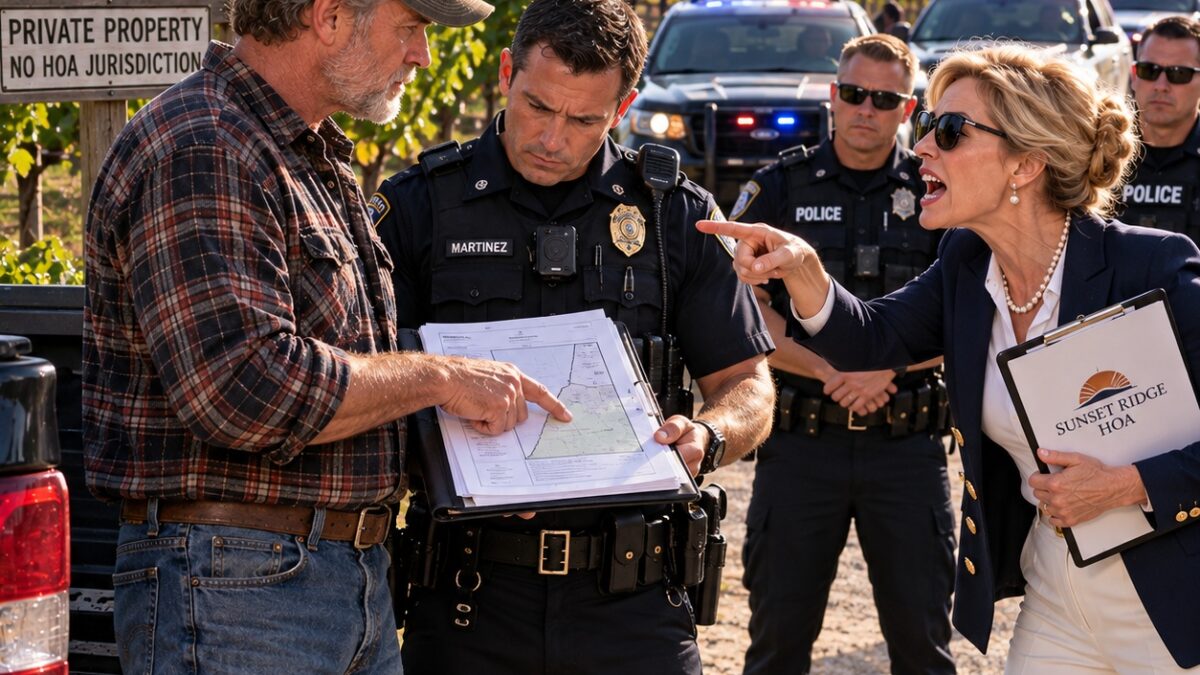
Three police cruisers came down my gravel drive with their lights flashing while the HOA president stood behind them holding a clipboard and smiling like she had finally found a way to destroy everything I had built.
She expected me to panic when the officers stepped onto my vineyard, but after thirty years in the military, I had learned that the person shouting the loudest was rarely the person with the strongest position.
What Karen did not know was that the folder sitting in my truck contained four pieces of paper that could turn her entire performance against her.
My name is Jack Callahan.
After three decades of military service, I retired with one promise to myself.
I wanted quiet.
No chains of command.
No inspections.
No somebody standing over my shoulder telling me how my day should look.
I wanted land.
So I bought a rolling parcel on the edge of a suburban development called Sunset Ridge and began building the vineyard I had dreamed about for years.
The property sat just outside the HOA boundary.
That detail mattered.
Sunset Ridge could regulate its mailboxes, lawns, trash cans, fences, Christmas decorations, or whatever else its residents had agreed to.
It had no authority over me.
For the first few months, nobody seemed to care.
I prepared the soil.
Installed irrigation.
Planted my first rows of vines.
I got up before sunrise, worked until my back reminded me I was no longer twenty-five, and went to sleep tired in the satisfying way only physical work can make you tired.
Then Karen Middleton noticed me.
Karen had been president of the Sunset Ridge HOA for seven years.
She wore navy blazers to board meetings, carried a clipboard like a weapon, and treated neighborhood rules as though Congress had personally authorized her to enforce them.
The first certified letter arrived on a Thursday.
According to Karen, my vineyard was an “unsightly agricultural disturbance” damaging the visual harmony and property values of Sunset Ridge.
She ordered me to stop farming and restore my land within thirty days.
I read the letter twice.
Then I laughed.
My property was outside the HOA.
I threw the letter away.
That was my first mistake.
Not because Karen had any authority.
Because I underestimated how personally she would take being ignored.
A second letter came.
Then a third.
Threats of fines.
Lawsuits.
“Community penalties.”
Violations of rules that did not legally apply to me.
When the letters failed, Karen began calling county code enforcement.
Inspectors arrived because she reported unauthorized structures.
They found none.
She accused me of operating an illegal business.
Another inspection.
Another clean report.
She complained about zoning.
Nothing.
Every failure seemed to make her angrier.
Then, one Tuesday morning, I saw her dark sedan parked near my property.
Karen sat behind the wheel, talking aggressively into her phone and gesturing with one hand.
I had spent enough years around people preparing confrontations to recognize one.
I went back to checking vines.
Less than an hour later, I heard engines.
Three police cruisers came down my drive.
Karen followed directly behind them.
She stepped out before her car looked fully stopped, navy blazer buttoned, clipboard clutched against her chest, and marched toward the officers like she was leading a raid.
The first officer introduced himself as Sergeant Martinez.
He looked uncomfortable.
“We received a complaint regarding possible zoning violations and community-rule issues on this property.”
Karen immediately stepped closer.
“He has been warned repeatedly,” she said. “This operation is lowering our property values, and he refuses to comply.”
Sergeant Martinez looked at me.
I smiled.
“Officers, I think you’re wasting your time.”
Karen’s expression sharpened.
That was the moment she had been waiting for.
She expected fear.
Defensiveness.
Maybe anger.
Instead, I walked to my truck, opened the glove box, and pulled out the folder I had started keeping there because of her.
Inside were copies of my deed.
My survey.
The recorded property boundaries.
And a letter from my attorney confirming that the vineyard was outside Sunset Ridge HOA jurisdiction.
I handed it to Sergeant Martinez.
Karen was still talking behind him.
He stopped listening.
His eyes moved across the survey.
Then the deed.
Then the boundary map.
Finally, he looked up.
First at me.
Then at Karen.
And the smile disappeared from her face.
[END OF FACEBOOK CAPTION]
[FIRST COMMENT / FULL STORY CONTINUATION]
Sergeant Martinez held the survey in one hand and pointed to the boundary line with the other.
“Mr. Callahan,” he said, “your property appears to be entirely outside the Sunset Ridge HOA.”
“Yes, Sergeant.”
He checked the deed again.
Then the attorney’s letter.
He did not rush.
That was one thing I appreciated about him immediately.
He was not interested in embarrassing anyone.
He wanted the facts right.
After a few more seconds, he nodded.
“This is consistent.”
Karen stepped forward.
“No, it isn’t.”
Martinez looked at her.
“I’m sorry?”
“There has to be an error.”
Her voice had changed.
The confidence was still there, but now it was stretched too tightly.
“The vineyard directly impacts our subdivision.”
“That may be true,” he said, “but impact and jurisdiction aren’t the same thing.”
“You haven’t seen our governing documents.”
Karen opened the binder she was carrying.
It was thick.
Color tabs divided sections.
Printed photographs of my land stuck out from clear plastic sleeves.
She pulled out several pages.
“These are the violations.”
Sergeant Martinez looked at the first sheet.
“What exactly am I looking at?”
“Improper agricultural use.”
He glanced at me.
“Is this property zoned for what he’s doing?”
I answered.
“Yes.”
“I didn’t ask you,” Karen snapped.
Martinez’s eyes moved back to her.
“Ma’am, I did.”
That shut her up for about two seconds.
Then she pulled out another page.
“This is an unapproved structure.”
It was a photograph of my equipment shed.
The shed had already passed county inspection.
Martinez asked, “Unapproved by whom?”
“The HOA.”
“He isn’t in the HOA.”
Karen inhaled sharply.
“You’re missing the broader issue.”
I almost smiled.
That phrase became a favorite of hers whenever the narrow issue destroyed her argument.
The broader issue.
The community.
Property values.
Standards.
Anything except the inconvenient fact sitting directly in front of her.
Sergeant Martinez handed the documents back.
“Do you have anything showing this parcel is subject to your covenants?”
“Our neighborhood surrounds the area.”
“That isn’t what I asked.”
“We have standards.”
“For your association.”
“His activities affect us.”
“That doesn’t give you enforcement authority.”
Karen’s cheeks reddened.
She flipped through the binder faster.
“Look at these photographs.”
One showed my workers installing vineyard posts.
Another showed newly turned soil.
One showed a tractor.
Another showed irrigation tubing.
I had to give Karen credit for persistence.
She had built an entire case proving that I was farming on a farm.
Martinez looked increasingly tired.
“Ma’am, are any of these violations of county law?”
“I have reported them.”
“That isn’t the question.”
“Code enforcement refused to act.”
“Did they refuse because there was no violation?”
Karen’s jaw tightened.
“They were dismissive.”
I said nothing.
I had already learned that the best thing to do when Karen was losing an argument was to let her continue talking.
She usually made the situation worse for herself.
Martinez asked, “How many times have you contacted county agencies regarding this property?”
“That’s irrelevant.”
“It’s relevant to the complaint we were dispatched to investigate.”
“I have a responsibility to protect homeowners.”
“How many times?”
“I don’t keep count.”
I did.
Not deliberately.
But I had saved every inspection notice and every follow-up letter.
There had been six separate county contacts in less than two months.
Noise.
Zoning.
Building permits.
Commercial operation.
Runoff.
Traffic.
Every single complaint had ended the same way.
No violation.
One of the younger officers walked toward the edge of the vineyard and looked across the rows.
The vines were still young then.
Short.
Orderly.
Nothing like the mature vineyard I have today.
He returned and quietly said something to Martinez.
The sergeant nodded.
Then he faced Karen again.
“Ma’am, unless you can identify an actual crime or legal violation occurring right now, there is nothing for us to enforce.”
Karen stared at him.
“This is unbelievable.”
“What was the emergency you reported?”
That question changed everything.
For the first time, she looked genuinely uncertain.
“I reported an unlawful operation.”
“Did you tell dispatch there was an immediate public-safety concern?”
“I told them he was violating the law.”
“What law?”
“The HOA regulations.”
“He isn’t subject to them.”
“He refuses to cooperate.”
“That isn’t a crime.”
“He’s intentionally damaging property values.”
“That isn’t a police matter.”
Karen’s voice rose.
“So you’re just going to let him do whatever he wants?”
“On his own property, within the law?”
Martinez paused.
“Yes.”
I looked down because I knew if Karen saw my face, she would think I was mocking her.
And maybe I was, just a little.
But mostly I was relieved.
Months of letters and inspections had created a strange psychological pressure.
I knew Karen was wrong.
My lawyer knew Karen was wrong.
County inspectors had repeatedly confirmed she was wrong.
Yet when someone sends enough official-looking envelopes and repeatedly calls government agencies, a small part of your mind begins preparing for the possibility that they will eventually find a way to make being wrong expensive.
That morning, standing between grapevines with three police cars on my property, I understood what Karen had been trying to create.
Not legal authority.
The appearance of authority.
She wanted me exhausted enough to behave as though she had power even if she didn’t.
Sergeant Martinez handed my folder back.
“Keep these copies.”
“I intend to.”
Then he turned toward Karen.
His tone became noticeably firmer.
“Ma’am, submitting repeated unfounded complaints to law enforcement is serious.”
Karen’s face changed.
“I had legitimate concerns.”
“You reported a situation requiring three units.”
“I didn’t decide how many officers were sent.”
“No. But dispatch decisions depend on the information provided.”
“I told the truth.”
“Then the truth is that this man owns property outside your association and appears to be operating legally.”
Karen pointed toward my vines.
“You’re taking his side.”
Martinez looked genuinely irritated now.
“This isn’t about sides.”
“It certainly looks that way.”
“It’s about jurisdiction and evidence.”
“I’m HOA president.”
One of the younger officers looked away.
I had the feeling he was hiding a reaction.
Martinez remained professional.
“Being HOA president does not make you law enforcement.”
Karen’s grip tightened around her binder.
“It means I represent this community.”
“And this property is not part of your community association.”
“You don’t understand what he is doing to us.”
Martinez gave her a long look.
“I understand exactly what the documents say.”
That ended the discussion.
The police left shortly afterward.
Karen stood beside her sedan watching the cruisers disappear down my drive.
For once, she had nothing to say.
I walked back toward the vines.
“Jack.”
I stopped.
Karen’s voice was lower now.
I turned.
She marched toward me.
“You enjoyed that.”
“No.”
“Don’t lie.”
“I enjoyed having the situation clarified.”
“You embarrassed me.”
“I handed the police a deed.”
“You made me look like an idiot.”
I almost told her she had done that herself.
Instead, I said, “Karen, stop contacting me.”
“This is not finished.”
“It needs to be.”
“You think a few papers give you the right to destroy what people here have worked for?”
“My vineyard is not destroying your neighborhood.”
“You don’t know that.”
“I know I’m not in your HOA.”
Her face hardened.
“You could choose to cooperate voluntarily.”
“There it is.”
“What?”
“The part where you admit I don’t actually have to.”
She stared at me.
I had dealt with commanding officers, frightened young soldiers, hostile civilians, bureaucrats, and men who believed volume was leadership.
Karen reminded me of none of them exactly.
What made her difficult was not aggression.
It was absolute conviction.
She had spent seven years being obeyed.
Somewhere along the way, she had stopped distinguishing between people following rules they had agreed to and people obeying her personally.
I said, “Stay off my land.”
She gave a bitter laugh.
“You haven’t seen what difficult looks like.”
Then she drove away.
That evening, I called my lawyer.
Rebecca Chen specialized in real-estate disputes.
She was younger than I expected when I first hired her, but she had the calmest courtroom mind of anyone I had met since leaving the service.
I had already consulted her after Karen’s third letter.
This time, I told her everything.
Three cruisers.
The false jurisdiction claim.
The binder.
The accusation of an unlawful operation.
Sergeant Martinez’s warning.
Rebecca was quiet for a moment.
“Send me the police incident number.”
“I have it.”
“And every letter.”
“You already have most of them.”
“Send the new ones anyway.”
“What are you thinking?”
“That we stop treating this as annoying HOA correspondence.”
I leaned back in my chair.
“What do we treat it as?”
“A pattern.”
That word landed harder than I expected.
A pattern.
One letter can be stupid.
Two can be overreach.
Repeated government complaints after being told you have no jurisdiction start to look like something else.
I sent Rebecca everything.
Karen’s certified letters.
The county inspection records.
The code-enforcement closures.
My property documents.
My notes from each interaction.
The police report.
Rebecca called two days later.
“I want to send a cease-and-desist notice.”
“To Karen?”
“To Karen individually, the HOA board, and their legal counsel if they have one.”
“What does it say?”
“That she has no jurisdiction over your property. That further interference may expose both her and possibly the association to liability. That you consider the repeated complaints harassment. And that any further false reports will be documented and referred to the appropriate authorities.”
“Will that stop her?”
Rebecca laughed once.
“I’m a lawyer, Jack, not a prophet.”
Fair.
Within a week, the notice went out.
Rebecca wrote it in the kind of language Karen appreciated.
Formal.
Specific.
Unpleasant.
It referenced my ownership rights.
The documented lack of HOA jurisdiction.
The history of repeated complaints.
Potential abuse of government processes.
Possible civil claims if the conduct continued.
Copies went to Karen.
The HOA board.
And the county prosecutor’s office as part of the broader documentation Rebecca was assembling.
I thought that would finally end it.
The next afternoon, my phone rang.
Unknown number.
I answered.
“Jack Callahan.”
Karen.
“You think you’re clever.”
I leaned against my kitchen counter.
“I’m guessing you received Rebecca’s letter.”
“You went behind my back.”
“My lawyer sent you a legal notice.”
“You’re trying to intimidate the board.”
“I’m trying to get you to leave me alone.”
“You are poisoning this community.”
“My property isn’t in your community.”
“Stop saying that.”
I almost laughed.
“Why?”
“Because this is bigger than boundary lines.”
“No, Karen. The entire problem is boundary lines.”
Her breathing became louder.
“You are going to regret coming here.”
I became still.
“Is that a threat?”
“You know exactly what I mean.”
“No. I’d like you to explain it.”
“You think you can embarrass me and walk away?”
“I’m documenting this call.”
Silence.
Then I added, “And I’ll send a copy of my notes to Rebecca as soon as we hang up.”
The connection went dead.
I stared at the phone.
Military service taught me something about threats.
The dramatic ones are not always the dangerous ones.
But you document them anyway.
I called Rebecca.
She was almost cheerful.
“She called you?”
“Yes.”
“After receiving the cease-and-desist?”
“Yes.”
“And threatened you?”
“Depending on how generous we want to be with interpretation.”
“What exactly did she say?”
I repeated it.
Rebecca sighed.
“Please tell me you didn’t threaten her back.”
“I told her I was documenting the call.”
“Good.”
“Is it wrong that I’m starting to enjoy how predictable she is?”
“Yes.”
I smiled.
“Thought so.”
The cease-and-desist had another effect neither of us expected.
The HOA board saw it.
And once the other directors understood that Karen had potentially exposed the association to legal trouble over property the HOA did not even control, the internal questions began.
I learned that slowly.
First through neighbors.
Then through documents.
Then through people who began calling Rebecca.
Karen had ruled Sunset Ridge for seven years.
That was the word residents eventually used.
Ruled.
At first, I assumed that was exaggeration.
Then stories surfaced.
Karen measuring lawns personally.
Karen photographing garbage cans at 7:01 a.m. because rules required them removed by seven.
Karen sending fines because holiday decorations remained up one day too long.
Karen timing contractor vehicles.
Karen photographing children’s bicycles.
Karen issuing warnings for chalk drawings on sidewalks.
One elderly man told the board Karen had fined him because his newspaper was delivered earlier than what she considered acceptable.
I thought he was joking.
He wasn’t.
A young mother described Karen threatening legal action because her daughter had drawn flowers in sidewalk chalk.
Karen called the drawings a violation of “visual continuity standards.”
There was no such specific rule.
She had apparently interpreted a vague landscaping provision and invented an enforcement policy around it.
That was Karen’s talent.
She found ambiguity and filled it with herself.
When enough residents began speaking, the HOA directors scheduled an emergency meeting.
I did not attend.
It wasn’t my association.
That mattered to me.
I had spent months telling Karen exactly that.
I was not going to walk into Sunset Ridge and involve myself in their internal politics merely because their politics had spilled onto my vineyard.
But people told me what happened afterward.
Karen arrived prepared to defend herself.
She blamed me.
She said I was trying to destroy Sunset Ridge.
She described the vineyard as an outside commercial threat.
She accused certain board members of betrayal.
She claimed the legal notice was part of an intimidation campaign.
For years, apparently, those tactics had worked.
Not that night.
People were tired.
One homeowner after another stood up.
The older man with the newspaper.
The mother whose child drew chalk flowers.
A couple fined because a trash can had remained visible for less than an hour.
A widow who had received three warning notices while she was away caring for her dying sister.
A man threatened with legal fees because his replacement garage door was installed one shade darker than the approved color after the manufacturer discontinued the original.
Each story alone sounded small.
Together, they described a system built around making people afraid of attracting Karen’s attention.
The board had tolerated it because property values were good and Karen worked relentlessly.
That is one of the uncomfortable truths about controlling people.
They often make themselves useful.
Karen knew the rules.
She attended every meeting.
She answered every email.
She maintained files.
She remembered deadlines.
She volunteered for responsibilities other people did not want.
Slowly, responsibility became authority.
Authority became control.
And because no single incident seemed worth a revolt, residents adjusted.
Until my vineyard.
The problem with bullying somebody outside your system is that your usual leverage disappears.
Karen could not fine me.
Could not attach fees to my property.
Could not threaten my HOA privileges.
Could not deny architectural requests.
All she had were complaints to outside agencies.
When those failed, her overreach became visible to everyone.
The board meeting lasted more than three hours.
By the end, according to George Bennett, one of the residents who later became a regular customer of mine, Karen had stopped arguing and simply sat at the front table.
The directors voted to remove her as president.
Unanimously.
Several members demanded a full review of HOA finances and enforcement practices.
Karen left without speaking.
When George told me, I was tying young vines along a trellis.
“That’s it?” he asked after I nodded.
“What do you mean?”
“I expected a bigger reaction.”
“Like what?”
“I don’t know. Celebration?”
I looked down the row.
“I still have mildew starting on three plants.”
George stared at me.
“You’re strange.”
“I spent thirty years in the military. I’ve been called worse.”
He laughed.
But the truth was simpler.
I did not want Karen destroyed.
I wanted her stopped.
Those were not the same thing.
If she had stopped after the first letter, I would have forgotten her.
If she had stopped after the county inspections, I would have forgotten her.
If she had stopped after the police came, I would have forgotten her.
Karen kept choosing escalation.
Every consequence after that began with another decision she made.
The legal situation kept moving.
Rebecca had compiled the complaint history.
Not just mine.
She gathered information about repeated reports Karen had made to government offices.
Some involved me.
Some involved Sunset Ridge residents.
Some were legitimate enough to be ordinary HOA business.
Others were not.
The county prosecutor became particularly interested in the calls that triggered police responses.
Sergeant Martinez’s report mattered.
Dispatch records mattered more.
Karen had apparently described certain situations in ways that suggested urgent legal or safety concerns.
That was how three police vehicles ended up on my vineyard over HOA complaints.
The county did not find that amusing.
Neither did the prosecutor.
I received a call from an investigator.
He asked me to describe the morning the officers arrived.
I gave him facts.
Nothing more.
“Did Ms. Middleton tell you she intended to call police?”
“No.”
“Did you threaten her?”
“No.”
“Did you threaten the HOA?”
“No.”
“Were you violating any zoning restriction?”
“Not according to every inspector who visited.”
He smiled slightly at that.
“How many inspections?”
I gave him the records.
He looked through them.
“You kept everything.”
“Thirty years in the military.”
“That explains the folder.”
“It explains several folders.”
For the first time, the investigation made me uncomfortable.
Not because I had done anything wrong.
Because consequences were becoming real.
Until then, Karen had been annoying.
Infuriating.
Exhausting.
Now I was hearing phrases like fraudulent reports.
Improper use of emergency response.
Diversion of public resources.
Potential criminal charges.
I called Rebecca after the interview.
“Did we push this too far?”
She was quiet.
“No.”
“That was fast.”
“You reported conduct. The prosecutor decides whether laws were broken.”
“I wanted her to stop calling agencies on me.”
“And she has.”
“I didn’t expect criminal charges.”
“Jack, this is important.”
I waited.
“Karen’s consequences are not something you are doing to her.”
I looked through my office window toward the vines.
Rebecca continued.
“If the county believes she knowingly abused emergency systems or filed false reports, that is between Karen and the county. You are a witness.”
I understood the distinction.
Emotionally, it took longer.
Maybe that sounds overly sympathetic.
Karen had tried to shut down my livelihood.
She had threatened me.
She had sent police.
She had spent weeks making my life harder because she disliked being told no.
Still, I had spent most of my adult life around consequences far more serious than HOA disputes.
I did not enjoy watching a person’s life collapse.
Even when they built the collapse themselves.
The HOA suffered too.
That bothered residents deeply.
Lawyers became involved.
The association had to respond to Rebecca’s claims.
They reviewed insurance.
Meeting records.
Karen’s conduct.
Eventually, an agreement resolved the civil portion of my dispute.
The association covered my attorney expenses.
They issued a formal written apology acknowledging that my vineyard lay outside their jurisdiction.
They also adopted new procedures requiring board approval before officers contacted public agencies in the HOA’s name about neighboring properties.
The financial cost approached fifteen thousand dollars once legal expenses and related costs were included.
That money ultimately came from homeowners.
Some through existing funds.
Some through increased dues and additional assessments.
I hated that part.
Most of those residents had never done anything to me.
They were paying for leadership they had tolerated but not necessarily directed.
I could not undo that.
But I could choose what happened next.
So I opened the vineyard.
Not permanently.
Not as a tourist attraction.
Just for one Saturday.
An open house.
I invited Sunset Ridge residents to walk the property.
See the vines.
Ask questions.
Taste the first small batch of wine I had produced.
Rebecca thought it was funny.
“You’re inviting the same HOA that tried to shut you down?”
“One person tried to shut me down.”
“Several board members let her.”
“They’ve already paid for that.”
“You really are determined to make me dislike your emotional maturity.”
“I thought lawyers liked reasonable clients.”
“We do. They’re just less entertaining.”
The Saturday morning arrived warm and clear.
I expected twenty people.
Maybe thirty.
By noon, cars were lined along the designated parking area.
Families came.
Retirees.
Young couples.
People I recognized from driving past.
People I had never seen.
George helped direct traffic.
A local musician brought a guitar.
Someone from the neighborhood bakery showed up with bread without asking for payment.
I walked groups through the rows.
Explained trellising.
Soil drainage.
Pruning.
Harvest timing.
People asked good questions.
Some apologized.
That part made me uncomfortable.
“You don’t owe me an apology,” I told one older woman.
“We let Karen go too far.”
“You didn’t call the police.”
“We didn’t stop her either.”
I looked toward the gathering near the tasting tables.
“You stopped her eventually.”
She smiled sadly.
“After she picked the wrong fight.”
Maybe.
But I thought there was more to it.
Karen had picked someone she could not formally control.
That exposed how much of her power had depended on other people believing resistance was impossible.
Once they saw me resist and survive, fear weakened.
The wine was young.
Not perfect.
I knew every flaw.
Too much acidity in one batch.
Not enough structure in another.
But people loved it anyway.
Maybe because they liked the story.
Maybe because they genuinely liked the wine.
Probably both.
I stood near the tasting table watching people from Sunset Ridge lift glasses made from grapes Karen had once called an unsightly disturbance.
The irony did not escape me.
George walked over.
“Well?”
“Well what?”
“Property values seem devastated.”
I looked around.
People were laughing.
Several had asked about buying cases from future harvests.
One couple wanted to know whether I would host their anniversary dinner once the vineyard matured.
“I may never recover,” I said.
George grinned.
By the end of the day, I had a list of customers interested in future bottles.
More importantly, the place felt different.
For months, the subdivision beyond my property line had felt hostile.
Now those people were standing among the vines.
Not HOA members.
Not enemies.
Neighbors.
That mattered.
Karen was not there.
No one mentioned her much.
I appreciated that.
I wanted the vineyard to become known for wine.
Not conflict.
The criminal case moved faster than I expected after that.
Karen was charged with filing false police reports and improperly using emergency-response resources.
The prosecutor focused heavily on the fact that officers had been diverted from legitimate duties.
Three police deployments were central to the case.
I was subpoenaed as a witness.
Walking into court felt strangely familiar and completely foreign at the same time.
Military hearings have a different rhythm.
Civil disputes have another.
Criminal court carries its own weight.
Karen sat beside her attorney.
She looked smaller.
Not physically.
Something else.
Without the clipboard, the board table, the neighborhood title, and the audience that once deferred to her, she was simply a woman facing a judge.
That realization stayed with me.
Authority can look permanent while you have it.
Then somebody removes the nameplate.
The prosecutor presented dispatch records.
Police reports.
Statements.
Documentation showing the vineyard lay outside the HOA.
The repeated findings of no code violations.
The warnings.
The cease-and-desist.
My testimony was straightforward.
Karen’s attorney tried to show she had sincerely believed she was protecting her neighborhood.
I did not argue with that possibility.
Maybe she did.
People are capable of doing terrible things while believing they serve a good cause.
He asked, “Mr. Callahan, Ms. Middleton never physically damaged your vines, correct?”
“Correct.”
“She never personally prevented you from farming.”
“She attempted to.”
“But you continued operations.”
“Yes.”
“And your vineyard is now doing well.”
“Yes.”
“So financially, you ultimately benefited from the publicity surrounding this conflict.”
Rebecca had prepared me for questions like that.
“I benefited from my vineyard doing well.”
“But the attention helped.”
“Some of it.”
“Would you agree this dispute made your vineyard better known?”
“Yes.”
Karen looked toward me.
Her attorney nodded.
“Then Ms. Middleton’s actions did not destroy your business.”
I waited.
“That doesn’t make the police reports true.”
The courtroom went quiet.
He moved on.
The district attorney emphasized something far larger than my vineyard.
Emergency systems depended on truthful reporting.
Officers responding to fabricated or exaggerated complaints were officers unavailable somewhere else.
Police resources were not private tools for settling neighborhood grudges.
That was the heart of their case.
The defense sought an agreement.
From what I later understood, prosecutors did not want the matter dismissed with a warning.
They believed Karen’s conduct had gone on too long and that the repeated nature of the reports required meaningful consequences.
She ultimately faced three counts involving false police notifications and one related to misuse of emergency-response resources.
When sentencing day came, I almost did not attend.
Rebecca asked whether I wanted to.
“I don’t know.”
“You don’t have to.”
“I feel like I should see it through.”
“Then go.”
The courtroom was colder than I remembered.
Karen wore a dark gray suit.
No navy blazer.
No clipboard.
Her attorney spoke first.
He described her years of community service.
Her age.
Her lack of serious prior criminal history.
Her belief that she had been protecting homeowners.
He asked for leniency.
The prosecutor responded.
Intentions did not erase repeated false reports.
Public resources had been consumed.
Law enforcement had been used as leverage in private disputes.
Warnings had been ignored.
The behavior had escalated.
I sat in the back and listened.
Then the judge spoke.
He acknowledged Karen’s service to the HOA.
He also said leadership increased responsibility rather than reducing it.
That line made me look up.
For years, Karen had treated her position as protection.
The judge treated it as the opposite.
She had been trusted.
That made abuse of that trust more serious.
He imposed six months in local detention.
Three years of supervised release.
And twelve thousand dollars in restitution and damages associated with the wasted police deployments and related public costs.
Karen’s face went pale.
Her hands closed around the edge of the defense table.
For a moment, she looked toward the gallery.
Her eyes found mine.
I expected hatred.
I expected accusation.
I expected the look she had given me on the morning the police came to my vineyard.
Instead, I saw something I had never seen in Karen Middleton.
Fear.
And maybe disbelief.
It lasted only a second.
Then she looked away.
I felt no satisfaction.
That surprised me less than it would have months earlier.
I had already gotten what I wanted.
My vineyard was safe.
The HOA had stopped interfering.
Residents had reclaimed their association.
Karen’s control had ended.
The sentence did not give me anything new.
It only marked the final point in a chain of choices she had refused to stop making.
Outside the courthouse, Rebecca joined me.
“You okay?”
“Yes.”
“Doesn’t sound convincing.”
“I’m thinking.”
“Dangerous habit.”
I smiled faintly.
We walked toward the parking lot.
“I spent thirty years watching people make decisions under pressure,” I said. “Sometimes one bad decision ruins everything.”
“This wasn’t one.”
“No.”
“That matters.”
I nodded.
Karen had chances.
The first letter could have been the end.
The first clean county inspection could have been the end.
The second inspection.
The third.
The police warning.
The cease-and-desist.
The phone call.
The board investigation.
At every point, she could have stepped backward.
Instead, she treated every boundary as a challenge to her authority.
That was what finally destroyed the authority.
Rebecca stopped beside her car.
“What are you doing tomorrow?”
“Checking the north rows.”
“Of course you are.”
“I think we have a fungus issue.”
She shook her head.
“Six months of litigation, county investigators, criminal court, an HOA coup, and you’re worried about fungus.”
“Fungus doesn’t care about court schedules.”
“That may be the wisest thing you’ve said all year.”
The next morning, I woke before sunrise.
No police.
No certified letters.
No calls from lawyers.
I made coffee.
Put on work clothes.
Walked into the vineyard.
Dawn was beginning to brighten the hills.
The vines were wet with dew.
Birds moved through the tree line.
A little fog sat in the lower part of the property.
For a long time, that view had been why I bought the land.
Then Karen turned it into a battlefield.
Now it was simply beautiful again.
I checked the north rows.
Rebecca was right to laugh.
There was fungus.
I treated it.
Life moved forward.
The Sunset Ridge HOA elected new leadership.
Their new president came to the vineyard one afternoon.
His name was Thomas Avery.
He was probably in his late fifties.
He approached the gate carefully.
That amused me.
“You can come in,” I said.
“I’ve heard a lot about boundaries.”
“Good lesson.”
He smiled.
“I wanted to introduce myself.”
We shook hands.
“I also wanted to make something clear. We understand this property is not under our jurisdiction.”
“That is an excellent opening statement.”
Thomas laughed.
“I thought you’d appreciate it.”
He brought a bottle of wine.
Not mine.
California cabernet.
“I figured showing up empty-handed might look bad.”
I took it.
“What do you want?”
“Nothing.”
I raised an eyebrow.
“Seriously.”
“HOA president who wants nothing?”
“I’m hoping to redefine the role.”
That made me laugh.
We walked through the rows.
Thomas told me the association had approved new oversight rules.
No single president could initiate repeated government complaints in the HOA’s name without board review, except for legitimate emergencies.
Fines required better documentation.
Residents had clearer appeal procedures.
Financial records were undergoing outside review.
“People are angry,” he said.
“At Karen?”
“At themselves too.”
“That fades.”
“Does it?”
“Usually.”
He looked at the vines.
“I think a lot of people knew she was excessive. They just figured it was easier to stay quiet.”
“That’s how people like Karen get powerful.”
Thomas looked at me.
“You say that like you’ve seen it before.”
“I spent thirty years in large organizations.”
He understood.
Silence can be permission even when nobody intends it that way.
We reached the hill overlooking Sunset Ridge.
From there, the roofs looked peaceful.
Orderly.
Exactly the kind of place Karen believed she had been protecting.
Thomas said, “Some residents want the HOA to formally partner with your open house next year.”
“No.”
He blinked.
I smiled.
“The residents are welcome. The HOA does not need to manage it.”
He laughed.
“Fair enough.”
We opened the cabernet later.
It wasn’t bad.
My wine eventually got better.
Much better.
The second harvest produced enough for a serious commercial release.
The open house became annual, though I kept it small.
People from Sunset Ridge came.
People from outside the area came.
I hired two local workers full-time.
Then four.
The vineyard that Karen called a visual blight became something locals pointed out when giving directions.
Turn past Jack’s vineyard.
You’ll see the rows on the hill.
The strangest part was how quickly the drama faded once Karen disappeared from the center of everything.
For months, she had felt enormous.
Every letter.
Every complaint.
Every official vehicle entering my drive seemed to make her bigger.
Then the process ended.
The county moved on.
The HOA moved on.
Residents moved on.
I moved on.
Control is strange that way.
It can look permanent until people stop participating in it.
One evening, about a year after those three police cruisers first rolled down my driveway, I stood near the same spot where Sergeant Martinez had looked through my property folder.
The vines were taller.
Thicker.
The hillside greener.
A delivery truck had just left with cases from the latest bottling.
I could hear laughter from the tasting area where a small private group was finishing dinner.
The scene looked nothing like that Tuesday morning.
But I could still remember it clearly.
Karen behind the police.
Clipboard.
Navy blazer.
Certain that she had finally found enough authority to make me obey.
I remembered how calm I had felt.
Not because I knew exactly what would happen.
I didn’t.
I was calm because my facts were in order.
My deed was clear.
My permits were valid.
My property line existed whether Karen respected it or not.
That experience changed the way I thought about conflict.
For years in the military, I had believed the best defense against chaos was preparation.
Karen reminded me that the same principle worked in civilian life.
Keep documents.
Know what you own.
Know what you agreed to.
Do not confuse somebody’s confidence with their authority.
And when someone keeps insisting they control something that belongs to you, do not waste all your energy trying to outshout them.
Sometimes you simply hand the right person the right piece of paper.
I still have that folder.
The deed.
Survey.
Boundary records.
Rebecca’s original opinion letter.
I no longer keep it in my truck.
There’s no reason.
It sits in a filing cabinet in my office.
Every once in a while, I see the tab and think about throwing away the old extra copies.
Then I leave them.
Not because I expect another Karen.
Because the folder reminds me of something useful.
Peace is not the same as surrender.
I had retired because I wanted peace.
That desire made Karen think I would be easy to pressure.
She misunderstood.
I did not avoid unnecessary battles because I was afraid of them.
I avoided them because I knew what battles cost.
That is exactly why I would not let someone manufacture one on my land and then demand that I surrender to end it.
The final time I heard Karen’s name officially was months after her sentence.
Rebecca called.
“There’s nothing else pending,” she said.
“With me?”
“With you, the vineyard, or the HOA matter.”
“So we’re finished.”
“We’re finished.”
I looked across my office.
Sunlight came through the window and landed on several bottles from the latest batch.
“Thank you.”
“You did most of the work.”
“I grew grapes.”
“And kept records.”
“Very exciting.”
“Jack?”
“Yes?”
“Don’t get into another HOA war.”
“I’m not in an HOA.”
She laughed.
“That didn’t stop the first one.”
After the call, I went outside.
Several Sunset Ridge residents were at the farm stand.
George was among them.
He lifted a bottle.
“Discount for people financially traumatized by former HOA leadership?”
“No.”
“Veteran customer?”
“No.”
“Loyal neighbor?”
“No.”
“Friend?”
“Absolutely not.”
He laughed and paid full price.
I watched him walk away carrying wine made from vines Karen had once demanded I remove.
There was poetic justice in that.
But the older I got, the less interested I became in justice that looked like humiliation.
What mattered was that the vineyard survived.
The residents learned to question authority that claimed too much.
And I learned something about the little kingdom Karen had created.
It had never been as strong as it looked.
It depended on people being tired.
People being intimidated.
People deciding that resisting was more trouble than compliance.
The moment enough people said no, the kingdom disappeared.
That evening, I walked to the top of the hill.
The sunset turned the rows gold.
Beyond the property line, porch lights began appearing throughout Sunset Ridge.
Families were cooking dinner.
Kids were riding bicycles.
Someone was mowing a lawn.
Ordinary life.
For years, Karen had claimed everything she did was necessary to protect that ordinary life.
Maybe at some point she had believed that.
Maybe seven years of being obeyed changed her.
Maybe she had always been that way.
I stopped caring about the answer.
Understanding Karen was not my responsibility.
Maintaining the vineyard was.
I looked over the vines.
They had survived every inspection.
Every complaint.
Every letter.
Every police visit.
Not because they were defiant.
Because none of those things had anything to do with whether grapes grew.
Plants have a useful relationship with human ego.
They ignore it.
I smiled.
Then I went back down the hill.
There was work to do the next morning.
There would always be work.
And after everything that had happened, that felt less like a burden than a privilege.
Karen had once promised she would make my life unbearable.
Instead, she made me appreciate how good my life already was.
The vineyard stayed.
The wine improved.
The neighbors came.
The HOA learned where its boundary ended.
And eventually the flashing lights, legal letters, threats, meetings, and courtrooms became nothing more than a story I could tell while standing beside rows of vines Karen Middleton once believed she could erase.
She had tried to prove that her title gave her power over my land.
In the end, the land never cared what her title was.
Neither did the law.
And neither did I.








