The HOA President Poisoned My Lake to Frame Me—She Forgot Where the Water Really Went.v
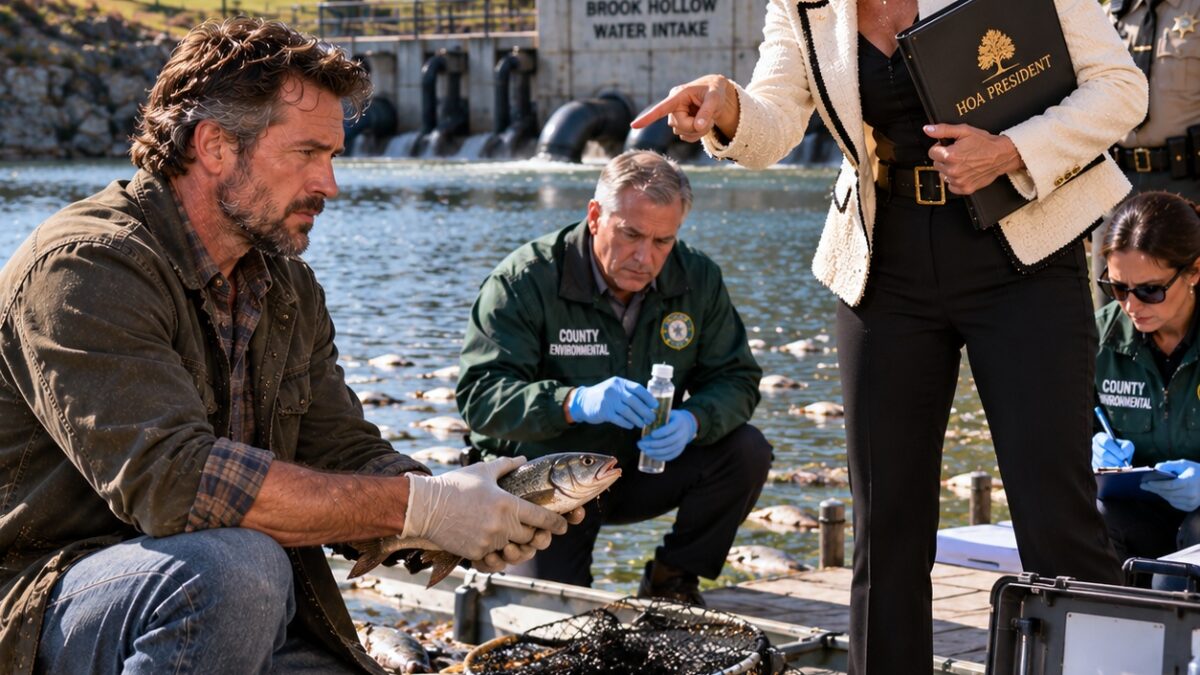
PART 2 and FULL ENDING  Thank you

Not confidence.
Control.
She closed the folder.
“Stop fishing, Mr. Mercer.”
“No.”
“Then you will face formal penalties.”
“Send whatever paper makes you feel better.”
She turned to leave.
Then stopped.
When she looked back, her expression was calm enough to make the words colder.
“You have no idea what you’re messing with.”
Then she walked away, leaving behind the smell of expensive perfume and the slow knock of lake water against the dock pilings.
I watched her cross the grass toward the association road.
I should have felt annoyed.
Instead, I felt warned.
That night, I sat on my porch with the lights off.
Around midnight, a truck without HOA markings crawled along the access road near the back side of the lake.
Headlights off.
Engine barely above idle.
I couldn’t see the driver.
I thought about calling the sheriff.
Then didn’t.
A truck on a dark road was suspicious, but suspicion alone felt thin.
By morning, I told myself I was overthinking it.
Two days later, every fish in the lake started dying.
[End Facebook Caption — full story continues below]
The first notice arrived the afternoon after Karen came to my dock.
It was taped to my front door in a plastic sleeve.
UNAUTHORIZED FISHING ACTIVITY.
Fine:
$750.
I stood there holding the paper, reading it twice because the wording was so absurd I half expected to find a sentence at the bottom admitting it was a joke.
There wasn’t one.
Karen had signed it personally.
Her handwriting was sharp and controlled, the kind of signature that looked like it had practiced becoming more important than the person reading it.
I didn’t pay.
Two days later, another notice appeared.
$1,500.
By the end of the week, the fine had climbed to $3,000.
Same accusation.
Same crest.
Same signature.
The ordinary thing would have been to hire a lawyer right away.
But I wasn’t ordinary in that sense.
I had spent too much of my life believing that if you remained calm and kept your papers in order, unreasonable people eventually got tired.
That belief had worked for smaller disputes.
Fence questions.
Access rights.
Driveway easements.
The kind of rural-neighborhood arguments that flare up and die because nobody wants to spend money proving what a survey already says.
Karen was different.
She didn’t get tired.
She escalated.
That Friday evening, she called an emergency association meeting at the clubhouse.
I went because staying home would have let her tell the story alone.
The room was nearly full.
Brook Hollow residents sat in neat rows of folding chairs under fluorescent lights, murmuring the way people do when they believe something dramatic is happening but aren’t sure yet whose side they’re supposed to be on.
Karen stood at the front with her folder.
Of course.
“Mr. Mercer,” she said, “has refused to comply with community water-use rules.”
I sat near the back.
A few heads turned.
“He has continued extracting aquatic life from a shared resource despite repeated warnings.”
Extracting aquatic life.
That was what she called fishing.
She described me as selfish.
Uncooperative.
A man exploiting a lake that belonged to everyone.
Some residents nodded along because Karen had trained them to accept her version of events as the first draft of reality.
Others looked uncomfortable.
One of them was Lenora Voss.
Lenora had lived in Brook Hollow longer than most of the new homeowners had known what an HOA was.
She was in her seventies.
Small frame.
White hair pinned neatly.
A voice that could still cut through a room without needing volume.
She raised her hand.
Karen pretended not to see it.
Lenora kept it raised.
Finally Karen said, “Yes, Lenora?”
“Since when does the association own the lake?”
The room went quiet.
Not completely.
Just enough.
Karen paused for half a second.
Most people would have missed it.
I didn’t.
“The legal documentation is complicated,” Karen said.
Lenora leaned forward.
“Then simplify it.”
A few people shifted in their seats.
Karen’s smile tightened.
“The board is reviewing historical documents and will clarify the matter soon.”
“So you don’t have proof tonight.”
“I did not say that.”
“You didn’t answer.”
Karen’s eyes hardened.
That was the first time I saw someone other than me puncture the performance.
Authority without paperwork is just a habit people are used to obeying.
That thought came to me while Karen rearranged the papers in her folder to buy herself time.
Before the meeting ended, she announced that if I continued refusing cooperation, the association would be forced to take further action.
I stood.
Not dramatically.
Just enough that the room looked back.
“Go ahead.”
Then I walked out.
Outside, the air smelled like cut grass and rain.
I should have felt better.
I didn’t.
That night, the boathouse camera caught something at 2:07 a.m.
I didn’t see it until the next morning.
A hooded figure moved along the shoreline.
Crouched near the reeds.
Opened a small plastic container.
Poured something slowly into the lake.
The footage was grainy, recorded by a camera mounted near the boathouse roofline.
The person’s face was hidden.
The movement wasn’t.
Deliberate.
Careful.
Unhurried.
Whoever it was had done it like a task.
By the time the sun came up, the damage had already spread.
I walked down to the dock at dawn expecting the usual morning stillness.
Water.
Birds.
A heron sometimes picking through the shallows.
But the silence was wrong.
No birds.
No surface movement.
No soft splash of bass feeding near the reeds.
Then I saw the first fish.
A large bass floating sideways near the shoreline.
Dull scales.
Clouded eyes.
A second drifted past the dock.
Then a third.
Then more.
Dozens.
By the time I stepped closer, the surface was spotted with dead fish rocking gently in the light current.
The smell was sharp.
Almost metallic.
Nothing like the lake I knew.
I called the county environmental hotline before I fully processed what I was seeing.
Then I called the sheriff’s non-emergency line.
Then I checked the security footage again.
That was when I discovered the main camera folder was empty.
Wiped.
Except for one corrupted thumbnail.
I stared at the blank folder for a long time, cold spreading through my chest.
The boathouse eave camera still had its file, but the obvious camera—the one facing the dock directly—had been erased.
Thirty minutes later, Karen arrived.
Not a deputy.
Not an environmental officer.
Karen.
She moved quickly for someone who supposedly had no personal stake in a private lake behind my house.
Her face was arranged into concern, but it didn’t reach her eyes.
She stood on the edge of the dock, looked at the dead fish, and sighed.
“This is exactly what happens when people misuse natural resources.”
I turned slowly.
“Did you do this?”
She laughed.
Short.
Sharp.
“Why on earth would I poison my own community’s water?”
That phrase hit me strangely.
Not:
the lake.
Not:
your lake.
My own community’s water.
At the time, I didn’t know why those words mattered.
I only knew she had chosen them too quickly.
“I checked my camera footage,” I said.
“Oh?”
“The main files were wiped.”
Her expression barely changed.
“People shouldn’t rely too much on home camera systems. They’re very easy to tamper with.”
I said nothing.
Not because I had no answer.
Because sometimes people reveal more when they think you missed it.
That afternoon, while waiting near the reeds to collect my own water sample, I found a small plastic cap snagged in the vegetation.
Industrial.
Not from a soda bottle.
Not from anything ordinary.
Stamped on top in faded letters:
ROR ENVIRONMENTAL SERVICES.
I put it in a plastic bag and sealed it.
Then I drove out to see Gideon Price.
Gideon was a retired water-systems technician who lived two towns over in a cabin full of old maps, old manuals, and the kind of organized clutter that belongs to people who never truly stop working after retirement.
He had spent thirty years maintaining county infrastructure.
He knew more about Brook Hollow’s buried systems than most of the people currently being paid to oversee them.
I spread an old survey map on his kitchen table.
“I need you to look at this lake.”
He adjusted his glasses.
At first, he was casual.
Then his hand stopped above the blue shaded shape.
“Where did you get this?”
“County file.”
He looked up.
His expression changed in a way I did not like.
“What?”
“Silas.”
“What?”
He tapped the lake.
“Do you know what’s under this?”
“Fish, until this morning.”
He didn’t smile.
“There’s an old intake system under the lake bed.”
“Intake for what?”
“The community water-treatment station.”
I stared at him.
“You mean irrigation?”
“No.”
“Stormwater?”
“No.”
“Drinking water?”
He nodded slowly.
My stomach dropped.
“Are you telling me this lake supplies Brook Hollow’s drinking water?”
He looked back down at the map.
“Not part of it.”
Then he corrected himself.
“Almost all of it. Especially during dry months when the secondary reservoir gets low.”
I sat back.
The dead fish flashed in my mind.
Karen’s phrase returned.
My own community’s water.
“Why wouldn’t anyone know that?”
“They were supposed to.”
“What does that mean?”
“The intake was supposed to be decommissioned years ago and replaced by the newer municipal line.”
“Was it?”
He didn’t answer right away.
That silence was enough.
“Gideon.”
“It looks like it never fully happened.”
I stood.
Then sat again because standing didn’t help.
“So whatever went into that lake—”
“Could enter the treatment system, depending on the intake status and concentration.”
“People drink this.”
“Yes.”
“Children.”
“Yes.”
“Elderly residents.”
“Yes.”
“Everyone.”
His face tightened.
“Yes.”
For a while, neither of us spoke.
The kitchen clock ticked loudly behind me.
Then I asked:
“Who would know the intake was still active?”
Gideon leaned back.
“The county should.”
“But if the county thought it was decommissioned?”
“Then whoever was signing the annual inspection reports.”
“Who signs those?”
He stood, walked to a filing cabinet, and pulled open the bottom drawer.
“I kept copies of more things than I probably should have.”
“Good.”
He found an old folder.
Inside were maintenance logs, inspection forms, and annual certifications.
He explained that every year, the county was supposed to receive a signed report confirming whether the old intake remained sealed or had been reopened for any reason.
For the last three years, the reports said it was sealed.
Decommissioned.
Inactive.
Then he turned the most recent page around.
Karen Whitlock’s name sat at the bottom in blue ink.
Dated four months before she ever stepped onto my dock with her folder.
I stared at the signature.
“She knew.”
Gideon said nothing.
“She knew the lake fed the water system.”
“It appears she signed forms saying the opposite.”
“She knew.”
“Silas.”
“She poisoned drinking water.”
“We need proof of that.”
He was right.
The words felt true, but words are not enough.
Not in court.
Not with a woman like Karen.
I took copies and drove home while the pieces rearranged themselves in my mind.
The fishing fines.
The truck in the dark.
The dead fish.
The wiped footage.
The chemical cap.
The intake system.
The fake decommissioning reports.
This had never been about fishing.
Not really.
Fishing was the accusation she wanted people to remember because it was simple.
One selfish man abusing a shared lake.
But the lake wasn’t just scenery.
It wasn’t just fish.
It wasn’t just my mornings.
It was water.
Brook Hollow’s water.
And Karen had been hiding that for years.
I hired Everett Sloan two days later.
Everett was a real estate attorney with a reputation for reading fine print nobody else bothered to check.
He had silver hair, tired eyes, and the calm irritation of a man who had watched too many people sign documents without understanding them.
When I laid everything on his conference table, he didn’t interrupt.
Dead fish.
Fines.
Karen’s threats.
Deleted footage.
Chemical cap.
Gideon’s intake maps.
Annual reports.
Karen’s signature.
He read each item.
Slowly.
Then stacked the papers in two piles.
“What’s that?”
“Things that prove she lied.”
“And the other pile?”
“Things that may prove why.”
That was the difference.
Lies are useful.
Motive is better.
Together, we pulled property records, association bylaws, environmental permits, old county survey maps, and Brook Hollow meeting minutes going back years.
Every thread led back to the same uncomfortable truth.
Karen had known about the intake system long before she ever used my fishing as an excuse to assert control over the lake.
But the intake alone was not the whole story.
Three years earlier, the association had quietly signed a preliminary agreement connected to a regional real estate developer interested in land bordering the lake’s northern edge.
A development expansion.
Upscale homes.
Waterfront access.
Big money.
The project stalled because of one issue:
the active water source beneath the lake.
If the lake remained formally classified as part of Brook Hollow’s drinking-water supply, any construction nearby would trigger strict environmental review, delays, and costs high enough to kill the deal.
Karen needed the lake reclassified.
A contaminated lake could be closed.
A closed lake could be controlled.
A controlled lake could be “remediated” under association authority.
And if everyone believed I had damaged it through reckless activity?
Even better.
I would become the villain.
She would become the protector.
Everett spread three years of HOA meeting minutes across his table and began matching them to county development filings.
The pattern was too neat to ignore.
When the project stalled, Karen pushed new lake rules.
First:
limitations on dock improvements.
Then:
approval requirements for activity after sunset.
Then:
restrictions on “commercial exploitation of community water features.”
Finally:
the rule she used against me.
The fishing rule had not appeared because anyone cared about fish.
It appeared because Karen was building a paper trail.
Each rule made it look as if the association had authority over the lake.
Each fine made my existence near the water look like a problem.
Each meeting planted the idea that community safety required HOA control.
Then Everett found the payment.
$48,000 from the homeowners association account to a vendor listed as Ror Environmental.
The same name on the cap in my reeds.
Authorized by Karen Whitlock.
I thought that was the end.
Everett didn’t.
“This is bad.”
“It proves she hired them.”
“It proves a payment.”
“To the company whose chemical cap was at the lake.”
“Yes.”
“So?”
He pulled an old county survey map from another folder.
At the corner, a red stamp read:
WATER INTAKE ACTIVE.
“This is worse,” he said.
“Why?”
“Because it proves she knew exactly what she was risking.”
Within days, residents began noticing the water.
Cloudy faucets in the morning.
Chemical odor.
Kitchen sinks.
Bathroom taps.
Several people reported headaches and stomach discomfort after drinking straight from the tap.
Whispers moved through Brook Hollow faster than any official notice.
Karen called another emergency meeting.
This time, I walked in carrying a manila folder.
Everett came with me.
The clubhouse felt different from the earlier meeting.
Less trust.
More fear.
People who had nodded along when Karen accused me of fishing now sat stiffly, holding bottled water instead of coffee.
Karen stood at the front.
“The contamination appears to have originated from Mr. Mercer’s unauthorized activities near the lake,” she said.
I walked to the table.
Didn’t raise my voice.
Didn’t accuse her first.
I laid down one document.
Then another.
Then another.
Payment record.
Ror Environmental.
Karen’s authorization.
Gideon’s intake map.
Active water-supply stamp.
Annual report with Karen’s signature falsely saying the intake was decommissioned.
The room grew quiet before I said a word.
“The association paid the contractor,” I said.
Karen’s face changed.
Not much.
Enough.
“That is a falsified record.”
Everett stood.
“Then you’ll be able to explain the bank statement.”
I placed that down too.
Highlighted line.
Ror Environmental.
$48,000.
Karen Whitlock authorization.
Lenora Voss stood from the back row.
“Why didn’t any of us know the lake supplied our water?”
Karen looked at her.
No answer.
Gideon walked in then, carrying rolled blueprints under one arm.
I hadn’t expected him to come.
Everett had.
Gideon unrolled the old intake system map across the table.
Every person in that clubhouse leaned forward.
“The intake was never actually disconnected,” he said.
His voice was steady.
“It has been running quietly beneath the lake for years.”
A woman in the second row began crying.
Someone else whispered:
“My kids drink that water.”
Karen said nothing.
In the days after that meeting, Brook Hollow changed.
Neighbors who had once waved politely from driveways now gathered in small groups, comparing water samples in jars.
People bought bottled water by the case.
Residents called county offices.
Environmental inspectors came and went.
The story no longer belonged to Karen’s folder.
County Environmental Officer Roland Pike arrived at my house two days later.
He carried a lab report and the expression of a man who had found something worse than he wanted to find.
“You need to see this.”
We sat at my kitchen table.
He laid out the test results.
“The compound detected in the lake and community water lines was not a standard pond treatment.”
“What was it?”
He named it.
The name meant nothing to me.
The explanation did.
Broader environmental risk.
Capable of moving through water systems.
Far more serious than something used casually to kill fish.
“The concentration is high,” Roland said.
“How high?”
“Higher than what would be expected for targeting fish alone.”
I stared at the paper.
“So whoever did this wanted the water declared contaminated.”
He did not answer immediately.
Then:
“That is a reasonable concern.”
“Karen.”
“We need proof tying her directly to the application.”
“What about the payment?”
“It helps.”
“The report she signed?”
“It helps.”
“The cap?”
“It helps.”
“But not enough.”
“Not enough by itself.”
Karen must have sensed the same thing.
She moved fast.
Publicly, she called herself the victim of a coordinated smear campaign.
She hired her own attorney.
She announced that I was defaming her and interfering with association property.
Then she filed a countersuit.
It might have frightened me if I hadn’t discovered the second camera.
I had installed it years earlier after a raccoon kept getting into the boathouse.
Small weatherproof unit.
Tucked high beneath the eave.
Far enough from the main dock camera that whoever wiped the obvious system never found it.
I almost forgot about it myself.
When I remembered, my hands shook opening the app.
The video was grainy.
Recorded just after 2:00 in the morning.
It showed the shoreline near the reeds.
Karen Whitlock stood beside a man Everett immediately recognized from the Ror Environmental filings.
Calvin Ror.
She handed him a thick envelope.
Then pointed toward the water.
The gesture was unmistakable.
The video caught enough audio to hear her voice.
Flat.
Businesslike.
“Make sure Mercer gets blamed.”
No screaming.
No villain speech.
No dramatic confession.
Just one sentence.
Roland sat back when the clip ended.
Everett replayed it.
Karen’s voice came through again.
“Make sure Mercer gets blamed.”
I felt no joy.
That surprised me.
I thought proof would feel like victory.
Instead, I felt heavy.
Brook Hollow had trusted this woman with violation notices and budgets and community meetings.
Somehow she had used that trust to reach all the way into people’s faucets.
The emergency hearing was scheduled for the following week.
Karen arrived in a charcoal suit.
Rigid posture.
Calm face.
She looked like she had already decided that composure could still save her.
Her attorney argued that I owned property by the lake, that I fished regularly, that I had motive to undermine the association after repeated fines, and that any footage could have been manipulated.
Everett rose.
Quietly.
No grand opening.
He built the case with documents.
Payment records.
Ror contract.
Gideon’s intake blueprints.
The active water-source stamp.
Karen’s annual decommissioning certifications.
Roland’s lab results.
The concentration analysis.
The cap recovered from the reeds.
Then the footage.
Once.
Then again at the judge’s request.
Karen’s jaw tightened during the second playback.
Her hands folded.
Unfolded.
Folded again.
Calvin Ror was called.
At first, he tried to claim he had only delivered standard maintenance chemicals at Karen’s request.
Roland presented vehicle-location data from the company truck, placing it near the lake at the same hour the camera captured the poisoning.
Everett produced the association payment authorization.
Then the envelope exchange.
Then Karen’s recorded words.
Ror began sweating under the fluorescent lights.
Finally, he admitted Karen had hired him directly.
He admitted she knew the intake system beneath the lake was still operating.
He admitted she knew the chemical could create contamination beyond a simple fish kill.
When the judge leaned forward and asked Karen one question, the room felt like it stopped breathing.
“Did you knowingly contaminate a community water source?”
Karen opened her mouth.
Closed it.
For the first time since I had known her, she had no sentence ready.
Outside the hearing room, reporters waited.
I didn’t enjoy that either.
People expect someone vindicated to look triumphant.
I didn’t.
I answered only one question clearly.
“The truth took longer to surface than it should have.”
That was all.
Brook Hollow learned everything within hours.
Karen was suspended as HOA president that week.
The board came under formal investigation for financial mismanagement and improper water-resource oversight.
Two members resigned.
Maybe they knew more than they admitted.
Maybe they simply couldn’t stand under the weight of what Karen had done.
The clubhouse where she once stood with folders and fines went quiet.
Not permanently.
But long enough.
A temporary oversight committee was appointed to manage the association until new elections could be held.
Lenora volunteered.
Of course she did.
Someone needed to read every document Karen had ever used to frighten people into silence.
Every account was audited.
The real estate development near the lake’s northern edge was frozen.
Then cancelled.
Once the lake’s active water-source status became public record, the numbers no longer worked.
Environmental review.
Permitting.
Public outrage.
Too much risk.
Karen’s development play died exactly where it had begun.
At the water.
Calvin Ror cooperated fully once he realized how much evidence already existed.
He explained Karen had first approached him nearly a year earlier, asking questions about chemicals that could damage water quality without immediately pointing back to obvious dumping.
He claimed he thought she was worried about algae.
Invasive species.
General maintenance.
Maybe that was true at first.
Maybe it was another excuse.
By the night she handed him the envelope and pointed toward the lake, he knew enough.
He did it anyway.
That mattered.
Karen tried to shift everything onto him.
Her own signature stopped that.
Her contract.
Her payment authorization.
Her emails.
Her annual reports.
Her video.
Her voice.
Make sure Mercer gets blamed.
Six words can be heavier than a truckload of documents.
County officials ordered a full restoration of the intake and treatment system.
The lake cleanup moved section by section.
Sediment near the intake.
Repeated water testing.
Replacement of compromised piping.
Temporary bottled-water advisories where needed.
Independent monitoring.
It went on for weeks.
Then months.
Residents got used to seeing trucks near the access road, technicians in reflective vests, and warning signs that looked more honest than anything Karen had ever posted.
The association was formally barred from exercising future control over community water resources.
Certified county professionals took over oversight.
Good.
Water should never have depended on one HOA president’s secrecy.
Criminal and civil proceedings moved forward.
I was asked whether I would pursue every possible legal consequence against Karen.
I thought before answering.
“She didn’t just come after me,” I said.
“She came after every person who lives in this community and trusts what comes out of their faucet.”
That became the quote reporters used.
I meant it.
Because by then, my anger had shifted.
At first, Karen had been the woman fining me for fishing.
Then the woman poisoning my lake.
Then the woman trying to frame me.
But the more I learned, the more I understood:
I was never her only target.
I was simply the most convenient name to blame.
Karen eventually had to stand before the residents she had once controlled.
No folder.
No crest.
No practiced authority.
Lenora stood and looked directly at her.
“You were supposed to protect this community.”
Karen said nothing.
That silence was the only honest thing I ever heard from her.
The lake cleared slowly.
Fish did not return all at once.
Nature does not care about legal deadlines.
Cleanup crews worked.
Tests improved.
The smell faded.
The water stopped carrying that chemical sharpness.
One morning, long after the first hearing, I walked back down to my dock before sunrise.
No fine taped to my door.
No Karen behind me.
No homeowners whispering from the road.
Just lake.
Air.
Wood under my boots.
For the first time in months, I cast a line.
Not because fishing was the point.
Because quiet was.
I sat there with my thermos beside me and let the morning settle.
A few minutes later, the line tightened.
A real pull.
Alive.
For reasons I still can’t explain, that nearly broke me.
Then my phone buzzed.
Everett.
I considered ignoring it.
Didn’t.
“Silas,” he said.
“There’s one more document you need to see.”
I drove to his office that afternoon.
Everett slid a weathered folder across his desk.
Yellowed pages.
Old county archive stamp.
The document inside was an original land survey more than fifty years old, from the period when the lake had first been engineered as part of the region’s water-supply infrastructure.
I read slowly.
Then again.
“What am I looking at?”
Everett tapped a section.
“When this lake was built into the water system, landowners along the edge were given specific rights.”
“Fishing?”
“Not just fishing.”
He pointed lower.
“In exchange, they carried responsibilities tied to protecting access to the intake and preserving the water source.”
I stared.
“So my property—”
“Was never just bordering the lake.”
“What was it?”
He smiled faintly.
“A caretaker parcel, essentially.”
I leaned back.
All this time, Karen had painted me as an outsider exploiting community water.
But buried in an archive older than her rules, older than most of the homes around the lake, was proof that my land carried a formal role in protecting the water source.
I had not known.
My father hadn’t either, as far as I knew.
Over time, the agreement had simply been forgotten.
Ownership passed.
Records aged.
The county moved to new systems.
The HOA invented its own authority in the space left by everyone else’s forgetfulness.
But the old responsibility had still existed.
Karen’s attorneys had apparently searched for something like it and missed it.
Maybe they didn’t go far enough back.
Maybe they didn’t want to find it.
Either way, Everett had.
The irony was almost too much.
Karen had tried to seize control of the lake by accusing me of abusing it.
In truth, my property had been tied to its protection the entire time.
Not as lord of the lake.
Not owner of everyone’s water.
Caretaker.
That word settled inside me differently than victory.
After the investigations, Brook Hollow rewrote its rules from the ground up.
Financial records became available to residents.
No more locked cabinets.
No more folders only Karen understood.
No more emergency meetings built around one person’s version of events.
Oversight of water resources transferred fully to county-certified professionals.
The association could maintain lawns and mailboxes and clubhouse reservations.
It could not manage a drinking-water source.
The development project near the lake was cancelled outright.
Once people understood what the lake truly was, nobody wanted bulldozers near the northern shore.
Residents argued about what to do with recovered association funds and insurance proceeds.
I could have asked for money.
A lot of it.
Everett told me I had a strong claim.
False fines.
Defamation.
Property interference.
Emotional distress.
Damage tied to the lake.
The legal list was long.
I didn’t ask for a large personal settlement.
Some people thought that was foolish.
Maybe.
But I knew what I wanted.
A portion of recovered funds went toward fully restoring the lake and building a small public fishing dock along the northern shore.
Open to residents.
Not a monument to me.
No plaque with my name.
No ceremony where anyone called me a hero.
A dock.
Simple.
Wood.
Rail.
Safe access.
A place where anyone in Brook Hollow could stand beside the water and understand that it was not a tool for one person’s ambitions.
Water belonged to everyone who depended on it.
Quietly.
Every day.
Whether they knew it or not.
When the dock opened, Lenora walked down beside me at dawn.
She held two coffees.
“I hear you’re finally fishing again.”
“Finally.”
“Catching anything?”
“Sometimes.”
“Good.”
She handed me a cup.
For a while, neither of us spoke.
The lake was still.
Clean.
Not perfect in the way it had been before any of us knew the truth.
But honest.
The warning signs were gone.
The fines were gone.
Karen was gone.
The clubhouse meetings now had residents asking questions before voting.
That alone made me smile.
Authority works differently when people remember they’re allowed to ask for proof.
Lenora looked across the water.
“You know,” she said, “I believed her at first.”
“A lot of people did.”
“I’m ashamed of that.”
“You asked the right question when it mattered.”
“Too late?”
“No.”
She nodded slowly.
Then:
“Since when does the association own the lake?”
I smiled.
“Still a good question.”
“It was a better question than I knew.”
We stood in silence as light spread over the water.
Eventually, I cast my line.
There are moments after a long fight when peace feels suspicious.
Like a trick.
Like another folder is waiting somewhere.
But nothing came down the dock except morning.
No heels.
No clipboard.
No threat.
Just Lenora sipping coffee and the faint ripple of fish below.
Karen faced formal legal consequences.
Calvin Ror cooperated and received a reduced outcome tied to his testimony.
I don’t need to dress those facts in drama.
The consequences mattered.
But the most important change was not Karen’s punishment.
It was structural.
Brook Hollow learned never again to allow one person to control records, money, water, and narrative.
The county learned that old infrastructure could not remain hidden in forgotten files.
Residents learned their drinking water was not an abstract utility bill.
It came from somewhere.
It could be harmed.
It had to be protected.
And I learned something about myself too.
For years, I had thought of my mornings on the dock as private.
Mine.
A small quiet corner of the world I didn’t owe anyone an explanation for.
After the final archive document, I understood the dock differently.
Still mine in a property sense.
But connected.
The lake fed homes.
Children drank from it.
Elderly residents made tea from it.
Families cooked with it.
People showered, filled bottles, watered pets, and never thought about where the water began.
Most people don’t.
They shouldn’t have to.
Trust is the whole point of public systems.
But trust without oversight becomes a hiding place for people like Karen.
That is why I kept fishing.
Not to prove I could.
Not to defy anyone.
Because the ordinary use of a protected place can be its own kind of watchfulness.
If the fish die, someone sees.
If the water smells wrong, someone notices.
If a person with a folder begins claiming authority without a deed, someone asks.
Quiet is not the same as indifference.
I stayed quiet for years.
Then Karen mistook that for weakness.
She made the same mistake many controlling people make.
She assumed the people who avoid conflict will accept anything to keep avoiding it.
No.
Sometimes quiet people simply wait longer before speaking.
And when they finally do, they bring documents.
I still keep the first fine.
$750.
Unauthorized fishing activity.
It sits in a drawer with a copy of Karen’s payment authorization to Ror Environmental, the intake map, and the old caretaker agreement Everett found in the county archive.
A strange little museum of paper.
Each document says something different.
The fine says she believed she could punish me.
The payment says she believed she could buy a disaster.
The map says she knew what the lake really was.
The old agreement says I was never the trespasser in the story she tried to write.
The weather has changed the dock boards again.
I repair them when needed.
The public dock across the lake is used more often now.
Children fish there.
Retirees too.
Sometimes people wave.
I wave back.
I do not manage the lake.
I do not own the community.
I am not president of anything.
Thank God.
Certified county professionals handle the intake.
Reports are public.
Testing is regular.
Residents read them.
Not all residents.
Enough.
Lenora sends me the annual summary every year with one handwritten sentence on top:
Still clear.
That is better than any apology Karen could have offered.
I have been asked whether I hate her.
I don’t know anymore.
I hated what she did.
I hated the dead fish.
I hated the smell in the water.
I hated knowing families were drinking from a source she had treated like a chessboard.
But hatred is active.
It asks to be fed.
I’d rather feed the fish.
That sounds sentimental.
Maybe it is.
Age makes some things simpler.
Karen believed she was poisoning one man’s lake.
That was her first mistake.
It was never just mine.
She believed authority was something she could print on association letterhead.
That was her second.
Authority without truth collapses eventually.
She believed blame could be poured like chemicals, aimed at whoever stood in her way.
That was her third.
The water carried the evidence farther than she expected.
And she believed nobody would look beneath the surface.
That was the mistake that ended her.
Because beneath the surface was everything.
The intake.
The old system.
The forged reports.
The development motive.
The buried responsibility.
The truth.
Some mornings now, before sunrise, I still walk to the dock with black coffee.
The air is cold enough to make my hands ache.
The lake is dark.
Quiet.
If I arrive early enough, it looks untouched.
Of course, I know better now.
Nothing stays untouched simply because a brochure or a memory says so.
Places survive because somebody pays attention.
That is what I do.
I sit.
I fish.
I watch.
I listen.
Not with fear.
With care.
And every time the sun comes up clean across the water, every time a bass breaks the surface, every time a child laughs from the public dock on the far shore, I think about the sentence Karen said when she first walked onto my dock.
“You won’t be fishing here anymore.”
She was wrong.
I still fish.
But now I know I was never just fishing.
I was keeping watch over the water every person in Brook Hollow depended on, long before any of us understood how badly one woman had tried to make us forget it.








