The HOA Drained Its Neighborhood Into My Quarry—Then Their Own Memo Sank Them.v
𝗙𝗨𝗟𝗟 𝗦𝗧𝗢𝗥𝗬 𝗜𝗦 𝗜𝗡 𝗧𝗛𝗘 𝗙𝗜𝗥𝗦𝗧 𝗖𝗢𝗠𝗠𝗘𝗡𝗧

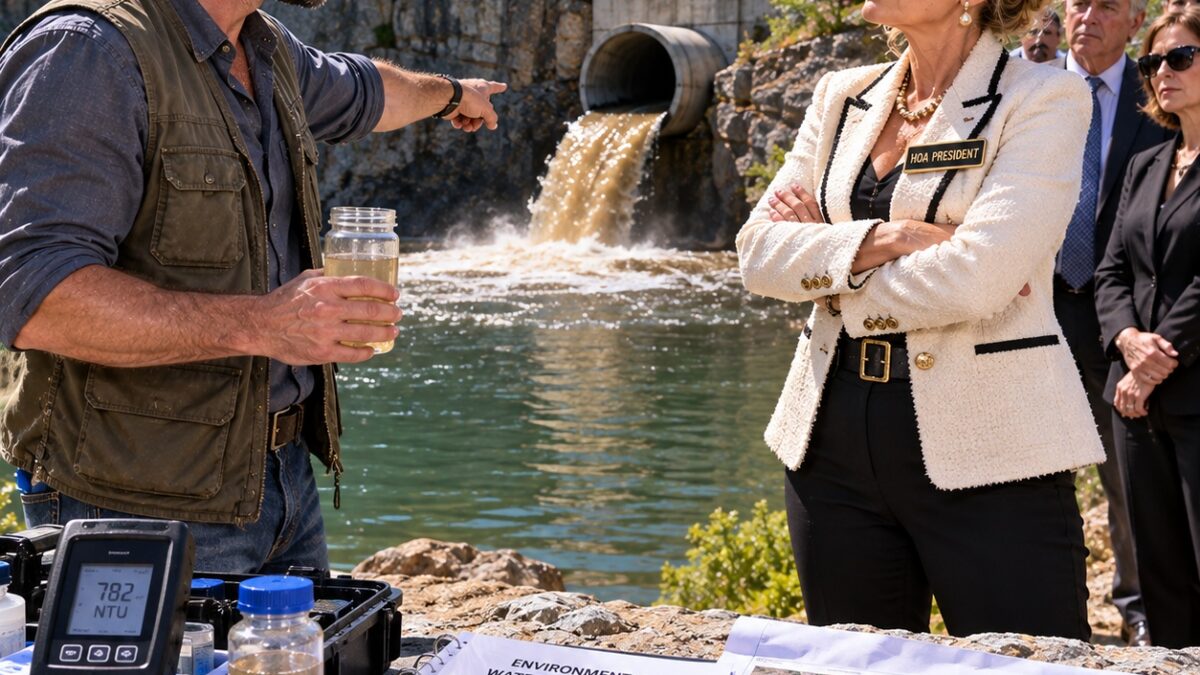
The kind of data you gather before restoration so nobody can later argue about what condition the water was in when you started.
That morning, I stood knee-deep near the shoreline and watched the turbidity meter blink.
Then I frowned.
Then I checked the number again.
Nearly four times higher than what I expected from a deep, still quarry pond fed mostly by rainfall and groundwater seepage.
I ran a secondary panel.
Petroleum hydrocarbons.
Then trace readings on two heavy metals.
Lead and zinc.
Neither belonged there at those levels.
Not in a closed granite pit with no active industrial use.
I walked the shoreline looking for the source.
I found it along the north wall.
A concrete pipe about thirty-six inches in diameter protruded from the rock face, pouring water in a steady, continuous stream.
Not stormwater after rain.
Continuous flow.
Algae staining and mineral buildup streaked the granite below it, proving it had been running for a long time.
Above that wall sat Milbrook Quarry Estates.
A gated community of large homes built over the past fifteen years on the old quarry spoil pile and surrounding acreage.
I drove straight to their management office.
Harriet Blackmore, HOA president, met me in the lobby with the kind of calm face people wear when they have already decided your concern is an inconvenience.
I told her about the pipe.
She didn’t blink.
“That’s our community storm drain system,” she said. “It’s been running into that quarry for years.”
“Is there some kind of problem?” she asked.
“Yes,” I said. “Several.”
And that was the first time her expression shifted.
Not much.
Just enough.
[End Facebook Caption — full story continues below]
I explained who I was.
Geologist.
Environmental engineer.
New owner of the quarry parcel.
I explained that urban stormwater runoff is not harmless simply because people are used to seeing it disappear into a drain.
It collects petroleum residue from driveways.
Roadway chemicals.
Fertilizer.
Lawn treatments.
Roofing runoff.
Metals.
Sediment.
Whatever is on pavement, grass, roofs, and gutters during a rain event can end up in the receiving water.
“And this isn’t even behaving like normal stormwater,” I said.
Harriet folded her hands over the desk.
“What does that mean?”
“It means that pipe is flowing continuously.”
“Yes.”
“Storm drains do not usually discharge continuously unless something else is feeding them.”
Her face did not change.
I continued.
“Discharging that water into a connected water body without treatment or a permit can violate federal environmental law. That’s separate from the fact that the pipe itself sits on land I now own.”
“The neighborhood has drained into that quarry since long before you bought it.”
“That doesn’t answer the permit question.”
“That’s how it’s always worked.”
“That also doesn’t answer the permit question.”
Her lips pressed together.
“I’m not sure what you’re expecting me to say, Mr. Ashworth.”
“I’m expecting you to tell me what authorization Milbrook Quarry Estates has for that outfall.”
“The system has been in place for years.”
“Do you have a discharge permit?”
“I’d have to check our records.”
That was the first real answer she gave.
Then she leaned back slightly and said:
“I’ll tell you plainly. The neighborhood drained into that quarry before you bought it, and it’s going to keep draining into it regardless of whatever concerns you’re bringing to me today. You don’t have authority to stop something that predates your ownership.”
I kept my voice even.
“Owning the receiving water body gives me more authority than you seem to think.”
She stood.
“I have another meeting.”
Then she walked back toward her office without waiting for me to leave.
I drove back to the quarry that afternoon.
Not to argue.
To confirm what I already suspected.
On the southeast corner of the property, a small spring-fed seep ran through a break in the granite and continued downhill toward a public creek roughly half a mile away.
I had known about that connection from the geological survey I commissioned before closing.
But now it mattered more.
A quarry pit completely isolated from a watershed can create one kind of regulatory question.
A quarry pit that drains, even seasonally, into a creek that eventually reaches a river system creates a different one.
I stood at that outflow point for a long time.
Water leaving my property.
Traveling downhill.
Toward Cardan Creek.
Toward public water.
Toward places where people fished, waded, and trusted what they could not see.
Then I turned and looked back across the quarry toward the north wall.
That thirty-six-inch pipe wasn’t just dumping water into my future lake.
It was feeding a connected watershed.
That night, I pulled every public record I could find.
Milbrook Quarry Estates original development plans.
County permit filings.
Stormwater-management references.
Environmental review documents.
Anything that might tell me when the pipe was installed and what authorization existed.
There were general stormwater references buried in the fifteen-year-old site plan.
Drainage swales.
Catch basins.
Subdivision runoff.
But nothing resembling an active discharge permit for a continuous outfall into a connected water body.
Nothing for a pipe dumping unfiltered runoff into the quarry.
Nothing that would make Harriet’s confidence reasonable.
I had spent my career seeing legacy infrastructure nobody questioned until someone finally had reason to look closely.
Old pipes.
Outfalls.
Bypassed treatment.
“Temporary” solutions that survived long enough to become accepted reality.
Every case had the same beginning:
It’s always been that way.
And every case came down to the same question:
Was it ever legal?
Over the next week, I collected samples properly.
Five points around the quarry shoreline.
Two directly from the pipe discharge.
Each sample logged with GPS coordinates and timestamps.
Chain of custody.
Photographs.
Weather conditions.
Water appearance.
I treated the work like evidence because experience had taught me that someday, someone would try to say my findings were emotional, biased, or exaggerated.
I sent the samples to an independent certified lab two counties away rather than relying only on my field equipment.
Nine days later, the results came back.
Petroleum hydrocarbon concentrations above thresholds safe for an unmonitored receiving water body.
Lead.
Zinc.
Both commonly associated with roadway and roofing runoff.
Both at levels flagged for further investigation.
I drafted a formal letter to the HOA.
I attached the lab results.
I cited the federal permitting requirement for point-source discharge into a water body connected to a broader watershed.
I demanded an immediate halt to the discharge and compensation for remediation costs once a full assessment could be completed.
I sent it certified mail.
Copied the HOA management email.
Then waited.
Two weeks.
Nothing.
No response beyond the certified-mail signature.
No counterproposal.
No board acknowledgement.
No public discussion.
Silence.
Silence can mean ignorance.
It can also mean strategy.
I used the waiting period to search county planning-commission records again, this time narrowing the search to Milbrook Quarry Estates stormwater projects.
That was when I found the meeting minutes from roughly a year earlier.
The board had requested three contractor bids for a proper stormwater treatment facility.
A system that would filter runoff before discharge.
Each bid landed close to the same number once engineering, permitting, and construction were included.
$1.2 million.
The minutes said the board tabled the item for further budget review.
Then the project vanished.
No approval.
No formal rejection.
No follow-up.
Just gone.
Right around the same period I closed on the quarry.
I leaned back in my chair and stared at the screen.
That was too convenient.
Then I found the name Dutch Yarrow.
His company appeared in older drainage-related records tied to the original system installation.
The permit file was vague.
General grading.
Drainage work.
Nothing explicitly describing a continuous discharge outfall.
I called him.
He answered like a man already irritated before he knew who was calling.
When I explained I owned the quarry and was asking about the north-wall pipe, he went quiet.
Then he sighed.
“I’ll be straight with you,” he said. “That pipe’s been there since we did the original site grading.”
“Was there ever a discharge permit?”
“Not that I’m aware of.”
“Did anyone ask you to file one?”
“No.”
“Did you tell the board it probably needed one?”
Another pause.
“I had a feeling it should have gone through proper channels.”
“But?”
“But they wanted water moved off the development fast and cheap. Running it into that old quarry pit was the easiest option.”
“You built what they asked for.”
“I did the work I was hired to do.”
That sentence is common in environmental cases.
Too common.
Everyone does the work they were hired to do.
Few ask whether the work should have been done that way in the first place.
I thanked him for being honest and hung up.
Then I sat there longer than I should have.
The HOA hadn’t ignored my letter because it genuinely believed the pipe was harmless.
They had priced the legitimate alternative.
They had seen the number.
They had walked away.
And the pipe kept running.
That evening, I stood at the quarry’s edge and watched the same steady stream pour from the concrete outfall.
The water below carried a faint oily sheen in the fading light.
Clean groundwater does not shine like that.
I thought about the three contractor bids.
$1.2 million.
I thought about Harriet telling me the system would keep running regardless of my concerns.
I thought about the project disappearing from the agenda.
Then I called a colleague I had worked with on municipal stormwater-compliance cases years earlier.
Mostly, I wanted her to sanity-check my read.
She listened.
Then said:
“That timing isn’t something I would explain with good faith.”
“Meaning?”
“A board that tables a million-dollar compliance project right when a new owner takes over the discharge point isn’t confused about the law. They understood the cost and decided waiting to see whether anyone pushed back was cheaper.”
That was exactly what I had feared.
It was also what I needed to hear.
The next morning, I called attorney Dorian Weatherby.
A former client had given me his name years earlier for an unrelated land-use matter.
He had the reputation of being calm, precise, and not easily impressed by bluster.
I walked him through everything.
The pipe.
Lab results.
Connected seep.
Vanished treatment project.
Dutch’s statement.
Harriet’s response.
When I finished, he said:
“You’re describing a textbook Clean Water Act problem.”
“Then why do I feel like I’m the unreasonable one?”
“Because the pipe was already there when you arrived. Existing wrongdoing often disguises itself as normal.”
Good line.
He explained the core legal issue.
Any point-source discharge into waters of the United States requires an NPDES permit.
Length of time doesn’t make the permit requirement disappear.
Ownership change doesn’t make the discharge lawful.
But the case depended heavily on one fact:
whether the quarry qualified as a jurisdictional water.
An isolated pit could be murky.
A pit that drained into a creek connected to a broader river system was different.
I told him about the spring-fed seep and Cardan Creek.
“That connection is the case,” he said.
Dorian arranged for Inspector Mavis Trent from the county’s Environmental and Water Resources Management Office to walk the property with us.
Mavis arrived with her own testing kit, a GPS unit, and a topographic survey marked with watershed boundaries.
She was not theatrical.
Not warm.
Not rude.
She simply worked.
For nearly three hours, she traced water paths, inspected the discharge, marked sampling points, reviewed the seep, and followed the slope toward Cardan Creek.
Finally, standing near the southeast corner, she looked at her GPS and said:
“This connects.”
I waited.
She continued.
“Continuous documented flow from this point down to Cardan Creek, which feeds into the river system farther south. That establishes the quarry as part of a connected watershed under the current regulatory interpretation.”
“And the pipe?”
“Not feeding an isolated pond,” she said. “Feeding a connected watershed. The permitting requirement applies.”
Her own samples came back five days later.
They matched my independent results closely enough that she called the correlation “about as clean a confirmation as I ever get.”
Then she checked the permit database going back fifteen years.
No NPDES permit application from Milbrook Quarry Estates.
No discharge permit for that outfall.
Nothing.
“This has been running completely unpermitted for as long as that pipe has been in the ground,” she told me.
“What does that mean in penalties?”
Her expression hardened.
“Continuous unpermitted discharge carries penalties calculated per day of violation.”
“Per day.”
“Yes.”
“Over years.”
“Yes.”
“If Dutch is right, about seven years.”
“Then the exposure is not modest.”
That was when this stopped being a dispute between me and a difficult HOA president.
It became a regulatory case.
Dorian filed the civil complaint that same week.
Clean Water Act violations.
Immediate cessation of discharge.
Damages for remediation costs tied to restoring the quarry’s water quality before my restoration project could legally proceed.
Mavis issued an emergency discharge suspension order the same day.
The HOA had forty-eight hours to stop all flow through the pipe or face additional penalties.
On Dorian’s advice, I called Sheriff Gideon Pruitt’s office to document the posting of the order.
A deputy came out.
Photographed the order.
Photographed the pipe still flowing.
Logged everything.
He told me that if the discharge continued past the deadline, the sheriff’s office would treat it as a documented violation of a lawful state order, separate from the civil case.
Two days later, I drove to the quarry half expecting the pipe to be flowing exactly as before.
It wasn’t.
For the first time since I bought the property, the concrete outfall sat dry.
Mineral staining remained.
Algae streaks.
Evidence of what had poured from it for years.
But no water.
No steady rush.
No oily sheen spreading below.
Just silence.
I stood there longer than I expected.
Mavis had accomplished in forty-eight hours what my certified letter had failed to do in a month.
Authority matters.
Real authority.
Not HOA letterhead.
Not a president’s confidence.
Statutory authority tied to water, permits, and enforcement.
I called Harriet that afternoon.
Not because I owed her anything.
Because some stubborn part of me still wanted to believe enforcement might make her reasonable.
“I’m aware the state has gotten involved,” she said.
Her voice was colder now.
“The board is reviewing options.”
“You stopped the discharge.”
“For now.”
“Not for now. The order says stop.”
“I’ll say this plainly, Mr. Ashworth. The system predates your ownership by years. I don’t think it’s reasonable for you to expect us to bear full responsibility for something operating that way long before you showed up.”
“The permit obligation belongs to whoever is actively discharging.”
“That’s your interpretation.”
“No. That’s the law.”
She didn’t answer that.
“The board attorney will handle future communications.”
Then she hung up.
That night, I stood again at the dry outfall.
Harriet’s phrasing bothered me.
Not reasonable to bear responsibility.
As if seven years of unlawful discharge became less of a problem because nobody had stopped it earlier.
As if time could convert pollution into tradition.
As if the quarry had been a convenient place to dump runoff precisely because nobody who owned it had the knowledge, time, or resources to fight back.
I didn’t yet know that Harriet had written almost that exact calculation herself.
That came from Opalene Fitch.
HOA board secretary.
She called Dorian’s office a week after the suspension order took effect, before any subpoena had reached her.
Dorian called me immediately.
“You’ll want to be here tomorrow morning.”
Opalene was already in his conference room when I arrived.
A woman in her fifties.
Thin manila folder held tight against her chest.
The kind of grip that tells you a person has been carrying more than paper.
“I’ve kept board records for six years,” she said.
“Minutes. Internal memos. Bid files. Anything official crosses my desk eventually.”
She had read the civil complaint once it became public.
Something about the timeline bothered her.
So she went back through her archive.
The way a good secretary does when a date doesn’t sit right.
She opened the folder and set a printed page on the table.
A memo Harriet drafted two months before I closed on the quarry property.
“This was circulated to the full board,” Opalene said. “I filed it at the time without thinking much about it.”
I read.
Option one:
Construct compliant stormwater treatment facility.
Estimated cost:
$1.2 million.
Option two:
Continue discharging into adjacent quarry pit at no cost, contingent on the current property owner either not noticing or lacking resources to pursue litigation.
My name was in the next line.
Ashworth.
Two months before I owned the land.
Then, beneath the typed comparison, Harriet had written a handwritten conclusion.
Go with option two.
Monitor the situation with Ashworth.
I read it once.
Then again.
Slower.
“She wrote this before I closed.”
Dorian leaned over my shoulder.
“She didn’t just anticipate risk. She weighed compliance against continued violation, explicitly considered whether you might lack resources to fight, and chose the illegal option in writing.”
Opalene looked sick.
“I filed the three bids the same month.”
Nobody spoke.
“I helped schedule the board meeting where they tabled the treatment project. I didn’t understand that tabling it meant choosing to keep polluting someone else’s water.”
She looked at me.
“I’m sorry.”
I didn’t know what to say.
Because she had filed the memo.
Yes.
But she had also brought it forward.
Without that document, the case was already strong.
With it, everything changed.
Dorian asked the practical questions.
Had she altered anything?
No.
Who received copies?
All five sitting board members at the time.
Where was the original?
Still in the internal archive.
Could she preserve metadata and filing history?
Yes.
When Opalene left, Dorian sat back and stared at the memo.
“This changes the shape of the case.”
“How?”
“Up to now, we had an unpermitted discharge, strong lab evidence, and a contractor saying no permit was filed. Now we have Harriet’s own cost comparison. Her own acknowledgment that compliance cost $1.2 million. Her own note betting on you not noticing or lacking the resources to pursue litigation.”
He tapped the handwritten line.
“That’s premeditation.”
I called Mavis.
She was not surprised in the way I expected.
“Seven years of continuous unpermitted flow already suggested someone actively chose not to fix it,” she said. “This confirms it.”
She later calculated the violation period more precisely by cross-referencing Dutch’s estimated installation date with the suspension order’s effective date.
Roughly seven years.
Daily violations.
Willful conduct.
Documented knowledge.
No benefit of the doubt.
Two days later, Dorian called with the hearing date.
State Court Judge Petra Elling would preside over the Clean Water Act violation, damages, penalties, and remediation order.
Harriet retained her own personal attorney separate from the association’s general counsel.
That told me she understood what the memo had done.
The hearing drew nearly two dozen Milbrook residents.
More than I expected for a civil environmental matter.
Word had spread.
Suspension order.
Potential penalties.
Dry outfall.
Memo.
People who had lived above that quarry for years now wanted to know whether their own board had gambled with federal environmental law and lost.
Dorian opened with the sequence.
The pipe.
The lab results from my testing.
Mavis’s confirmation.
The hydrological connection to Cardan Creek.
The absence of any NPDES permit.
The three contractor bids.
Dutch’s statement.
And finally, Harriet’s memo.
The HOA’s attorney argued the system predated my ownership.
Suggested the association could not fairly be held responsible for the full penalty period when infrastructure had been installed under earlier decisions.
Mavis answered from the stand.
“Permit obligations attach to whoever is actively discharging at any given time,” she said. “More importantly, this is not a case of an association unknowingly inheriting a compliance gap. The memo entered into evidence shows the current board president reviewed the cost of fixing it, chose not to, and documented her reasoning for continuing the violation.”
She paused.
“That removes any argument of innocent oversight.”
Dutch testified next.
He confirmed he installed the outfall without ever being asked to pursue a discharge permit.
He admitted he suspected the arrangement likely required one.
He said he had done the work his client requested.
Dorian then introduced Harriet’s memo.
Projected it onto the courtroom screen.
Large enough for everyone to read.
Treatment facility:
$1.2 million.
Continued discharge:
zero cost, contingent on owner not noticing or lacking resources to pursue litigation.
Then the handwritten line.
Go with option two.
Monitor the situation with Ashworth.
Someone in the gallery whispered:
“Oh my God.”
Judge Elling looked directly at Harriet.
“Ms. Blackmore,” she said, “this memo does not describe confusion about legacy infrastructure. It describes a cost comparison between legal compliance and continued violation, an explicit wager that the affected property owner would lack the means to respond, and a handwritten instruction naming him specifically.”
Harriet’s attorney tried to call the memo internal brainstorming.
Judge Elling asked one question.
“Did the board proceed exactly as the memo recommended?”
The attorney did not give a direct no.
He couldn’t.
The treatment project had been tabled.
The discharge continued.
The pipe kept running.
The memo’s option two had become reality.
I testified near the end.
I described the morning I found the pipe.
The turbidity readings.
The lab results.
The continuous flow.
The dry outfall after Mavis’s order.
I stayed factual.
That was harder than it sounds.
Part of me wanted to say what I felt.
That Harriet had treated my property like a waste channel.
That her board had looked at a legal compliance cost and decided maybe I wouldn’t be rich enough or stubborn enough to matter.
That they had polluted water for years because clean infrastructure didn’t fit the budget.
But facts did more damage than anger.
Judge Elling did not take long.
She found the HOA in willful violation of the Clean Water Act.
She calculated the per-day penalty across the full seven-year discharge period Mavis documented.
She added remediation costs for restoring the quarry’s water quality.
She ordered construction of a compliant treatment facility within twelve months.
The total judgment came to just over $2.1 million, assessed jointly and severally against the association, Harriet Blackmore personally, and Dutch Yarrow for his role in the unpermitted installation.
The judge ordered the figure read into the record a second time.
Slowly.
Two million, one hundred thousand dollars.
The gallery shifted.
Residents pulled out phones.
Some began calculating what that meant spread across households.
Harriet sat still.
Controlled posture.
No tears.
No outburst.
Her attorney leaned toward her twice during the reading.
Both times, she gave a small tight shake of her head.
Outside the courthouse, Opalene found me near the steps.
Her folder was empty now, tucked under her arm out of habit.
“I keep thinking about how long that memo sat in my filing cabinet,” she said.
“You brought it when it mattered.”
“I should have understood it earlier.”
“Maybe.”
She flinched.
I softened.
“But you understood it eventually.”
She looked toward the courthouse doors.
“If I hadn’t reread it…”
“Then we would have fought with the evidence we had.”
“But maybe not won this way.”
“Maybe not.”
She nodded.
There was no easy forgiveness there.
No dramatic embrace.
Just two people standing beside the consequences of a document one had written and another had found.
I drove past the quarry that evening.
The outfall still sat dry against the granite.
The water below it was not clean yet.
Not close.
But it was beginning to settle.
For the first time since I bought the land, nothing new was pouring in.
A month later, the HOA’s liability carrier denied most of the claim.
Intentional environmental violations are not ordinary governance errors.
Harriet’s memo made the denial easy.
That left Milbrook Quarry Estates responsible for the overwhelming majority of the judgment out of association reserves, plus a special assessment affecting every household.
Dutch Yarrow’s contractor license was suspended for ninety days by the state licensing board, with additional civil exposure tied to his role in the unpermitted installation.
Residents were furious.
At me, at first.
Then at Harriet.
Then at themselves.
Then back at Harriet.
An emergency community meeting filled the clubhouse beyond capacity.
Residents arrived carrying printed local coverage of the ruling.
Some had highlighted the memo.
Some had circled the phrase:
lacking resources to pursue litigation.
That phrase infuriated them more than the pollution in a strange way.
Because it revealed contempt.
Not just for me.
For process.
For law.
For anyone outside the boardroom who might be affected by a decision made because it was cheaper.
The recall vote came before anything else on the agenda.
Harriet was removed as president unanimously.
The room that had once trusted her no longer wanted to hear her explain.
The county attorney separately opened a review into whether her conduct as a fiduciary rose to actionable misconduct beyond the civil judgment, given that she had committed the association to years of federal liability without disclosing the true risk calculation to the residents she represented.
The new board’s first policy required any infrastructure decision involving environmental permitting to undergo independent legal and regulatory review, with full written documentation presented at an open meeting before the board could table or defer compliance on anything touching water quality or federal law.
Boring policy.
Excellent policy.
Good governance often looks like a dull document created after someone very confident creates a disaster.
Opalene stepped down as secretary after the hearing.
She told the incoming board she would rather hand the archive to someone else than spend another term being the person who might have to explain what she found buried in it.
I saw her one more time at a meeting months later, dropping off old files.
She caught my eye across the room and gave a small settled nod.
Not happy.
Not proud.
Finished.
Construction on the treatment facility began that fall under Mavis’s direct oversight.
The project looked almost exactly like the one the HOA had priced out before I bought the quarry.
Same concept.
Same treatment requirements.
Same kind of contractors.
Only now it was happening under court order.
Not voluntary compliance.
The irony was expensive.
Very expensive.
I used part of the settlement to accelerate my own restoration work.
Wetland remediation specialist.
Sediment assessment.
Native shoreline plantings.
Water-quality monitoring.
Mavis’s office conducted quarterly testing.
Each report showed steady improvement.
Not dramatic.
Not overnight.
Water takes time to recover after people spend years using it badly.
The turbidity readings fell.
Hydrocarbon concentrations dropped.
Metals stabilized.
The oily sheen disappeared.
The quarry began doing what water does when left alone:
clearing one season at a time.
That winter, Mavis’s office asked whether the case could be used as a training reference for inspectors handling legacy discharge disputes.
I agreed.
Mostly because cases rarely come with the defendant’s own handwritten cost-benefit analysis of breaking federal law.
If my quarry was going to spend seven years receiving unfiltered runoff, the least the case could do was teach another inspector to ask one more question before another pipe became “just how it’s always worked.”
Two years later, I stood at the edge of the restored lake.
Not finished in the sense that land is ever finished.
But clear.
Real clear.
Granite water reflecting the sky.
A small wooden footbridge crossed the seep area.
A swim platform sat where I had once imagined it.
Native plants held the shoreline.
A trail looped through the restored edge.
Above the north rim, barely visible through trees, the treatment facility ran quietly.
Every drop of Milbrook stormwater passed through filtration before reaching any channel that led toward my lake.
Near the water’s edge, I installed a simple sign.
No names.
No judgment amount.
No mention of Harriet.
Just:
RESTORED QUARRY LAKE
PROTECTED UNDER THE CLEAN WATER ACT
I stood there a long time.
The afternoon was still.
The water no longer carried the faint cloudy stain I had seen when I first tested it.
No steady pipe noise.
No oily shimmer.
No sound except wind over the granite and water moving where water should.
I thought about the memo less by then.
That surprised me.
For a while, Harriet’s handwriting had lived in my head.
Go with option two.
Monitor the situation with Ashworth.
The arrogance of it had burned.
But time shifted my attention back to the place itself.
That was healthier.
If you let the person who harmed land remain the center of its story forever, the restoration is never complete.
The quarry deserved better than to be remembered as evidence.
It deserved to be water again.
People sometimes ask whether the judgment felt like revenge.
No.
Revenge would have been wanting Milbrook ruined.
I didn’t.
Hundreds of residents lived there.
Children.
Retirees.
Families who never saw Harriet’s memo until it was projected in a courtroom.
Their assessments hurt.
The special assessment was real.
Some households struggled.
I did not enjoy that.
But the alternative would have been letting everyone learn the wrong lesson:
that an HOA can avoid environmental compliance if it delays long enough and hopes the neighboring landowner lacks resources.
That could not stand.
The judgment was not about revenge.
It was about moving the cost back where it belonged.
They had saved $1.2 million by not building a treatment facility.
That “savings” had been placed in my water, my project, and a connected watershed.
The court simply sent the bill back.
With interest.
With penalties.
With consequences.
Harriet had treated compliance like an optional expense.
Federal environmental law treated it like an obligation.
That distinction made all the difference.
I never spoke to Harriet after the hearing.
Not once.
I saw her from a distance at one later proceeding.
She looked exactly as composed as ever.
Maybe that was armor.
Maybe denial.
Maybe personality.
It didn’t matter.
I had wanted, at one point, to hear her say she was wrong.
By the time the lake cleared, I no longer needed it.
Water does not require an apology to recover.
It requires the discharge to stop.
The truth is, I also had to forgive myself for buying the land without discovering the pipe first.
That sounds unreasonable.
Maybe it is.
But I had walked that property before closing.
Commissioned surveys.
Reviewed available records.
Studied geological maps.
And still, I missed the outfall until I owned the place.
For weeks, I replayed it.
What if I had walked the north wall more carefully?
What if I had tested before closing?
What if I had found it during due diligence?
Then one evening Mavis said something that helped.
“People hid this by letting it become ordinary.”
“What does that mean?”
“It wasn’t concealed like a secret trap. It was concealed by everyone acting as if a continuous pipe into a quarry was normal.”
She was right.
Normal can hide in plain sight.
That is what makes legacy infrastructure dangerous.
Not always malice.
Sometimes habit.
Sometimes budgets.
Sometimes a memo deciding that habit is cheaper than law.
Harriet’s memo was malicious in its calculation, but the pipe had survived before her because everyone around it had accepted the outfall as scenery.
Milbrook residents walked past it.
Contractors knew it existed.
Boards inherited it.
County files vaguely referenced drainage but never forced the question.
Then I bought the receiving water body and asked:
Where is the permit?
A simple question.
A very expensive answer.
The restored lake eventually opened for limited swimming.
Permits first.
Testing.
Safety rules.
A small beach area.
Nothing grand.
I wanted to keep it quiet.
The first day families came down the trail, I stood back near the old quarry road.
A child ran toward the platform and shouted because the water looked “like glass.”
That stayed with me.
Glass.
Two years earlier, my turbidity meter had blinked a number so wrong I thought the instrument might be faulty.
Now a child could look at the same water and see glass.
That is restoration.
Not a judgment.
Not a press article.
Not a memo becoming evidence.
A kid seeing clear water where a pipe once ran.
I kept the original turbidity reading in my files.
Also Harriet’s memo.
Also the first clean quarterly report.
The three documents form a strange sequence.
Problem.
Cause.
Recovery.
When environmental work is done right, the final record should be less interesting than the first.
A crisis begins loudly.
Restoration ends quietly.
That is how it should be.
Milbrook’s new board eventually invited me to speak at a meeting about water protection.
I almost declined.
Dorian advised me to accept.
Not because I owed them.
Because future cooperation would be easier if people heard me as a neighboring landowner instead of a lawsuit.
So I went.
The clubhouse was packed again, but the mood was different.
Not hostile.
Embarrassed.
Careful.
I spoke for ten minutes.
No scolding.
No legal victory lap.
I explained watershed connection.
Point-source discharge.
Treatment infrastructure.
Why stormwater matters.
Why “just runoff” is rarely just runoff.
Then someone asked:
“Do you blame all of us?”
I looked around.
“No.”
Several people exhaled.
“But residents have to ask questions when boards table million-dollar compliance projects.”
A man in the back nodded slowly.
I continued.
“Environmental obligations don’t disappear because the alternative is expensive.”
That was the message.
Not:
Your HOA president was evil.
Not:
I defeated you.
Just:
Ask what happens to your water.
The new treatment facility became part of the community’s annual budget, like pool maintenance or road work.
Less glamorous.
More important.
I told them that too.
Nobody posts real estate photos of properly treated runoff.
Maybe they should.
Harriet had understood something ugly about people.
We like visible improvements.
Stone entrance signs.
Clubhouse upgrades.
Fresh landscaping.
We dislike expensive invisible systems.
Treatment.
Drainage.
Monitoring.
Permits.
The HOA had been willing to spend money where residents could see prestige, but not where they could only see responsibility.
That is how environmental harm often begins.
Not with someone twirling a mustache.
With a budget line that feels too expensive to explain.
$1.2 million.
Tabled.
Then forgotten until a lake turns cloudy.
The restored quarry became my life for a while.
Then, gradually, it stopped being a project and became a place.
That was the point.
Trails needed maintenance.
Plants needed replacement.
Storms rearranged the shoreline.
Families left towels behind.
Someone carved initials into a bench.
A goose claimed part of the swim area one spring and acted like it had senior rights.
Ordinary problems.
Good problems.
I learned to be grateful for boring maintenance.
It means the emergency is over.
One afternoon, Dutch Yarrow visited.
I hadn’t expected that.
He called first.
Asked if I would meet him at the gate.
I considered saying no.
Then said yes.
He looked older than he had in court.
Work boots.
Faded hat.
No attorney.
“I’m not here to start anything.”
“Okay.”
He looked toward the lake.
“Looks good.”
“It does.”
Silence.
Then:
“I should’ve pushed harder on the permit.”
“Yes.”
He nodded.
No defense.
No “I was just doing my job.”
No speech about clients.
Just yes.
“I told myself it was the board’s responsibility.”
“It was partly theirs.”
“But not only theirs.”
“No.”
He looked at the treatment facility visible through the trees.
“I’ve added permit-verification language to every infrastructure contract my company signs now.”
“That’s good.”
“Too late for you.”
“Yes.”
He accepted that.
Then said:
“I’m sorry.”
I nodded.
“Thank you.”
That was all.
Sometimes apology does not repair the thing.
It still matters.
Harriet never gave one.
Dutch did.
Opalene did in her way.
The new board did by policy.
Mavis did not apologize because she had nothing to apologize for, but she stayed on the case with a patience I will always respect.
Dorian sent me a framed copy of the final restoration approval as a joke.
I did not hang it.
Legal documents belong in files.
The lake belongs outside.
The sign by the shore is enough.
Protected under the Clean Water Act.
Some people read it and move on.
A few ask what happened.
I tell a shorter version now.
Old HOA stormwater pipe.
No permit.
Bad memo.
Big judgment.
Lake restored.
If they ask more, I explain.
If not, I let them enjoy the water.
Not every visitor needs to carry the whole history.
Land can be protected without becoming a museum of harm.
Still, I sometimes stand near the old north wall and look at the dry pipe opening.
It remains there, capped and abandoned according to engineering standards.
No flow.
No sound.
A dark circle in granite.
Evidence of a bad decision made long before me, then preserved by another bad decision written in Harriet’s own hand.
I considered removing it entirely.
The remediation specialist advised leaving the capped section stable.
So there it stays.
Not dangerous now.
A reminder if you know what you’re looking at.
Most people don’t.
That’s fine.
I do.
Two years after the ruling, Mavis brought a group of trainees to the quarry.
Inspectors.
Young.
Clipboards.
They stood near the old outfall while she explained the case.
Not in dramatic terms.
Hydrological connection.
Permit absence.
Discharge duration.
Lab correlation.
Willfulness memo.
Penalty calculation.
One trainee asked:
“What was the first clue?”
Mavis pointed to me.
“He checked the water.”
I shrugged.
“That’s the job.”
But it wasn’t only the job.
It was the difference.
A turbidity reading blinked too high.
I trusted the number enough to keep looking.
That matters.
People often think environmental cases begin with disasters.
Sometimes they begin with a meter.
A smell.
An oily sheen.
A pipe everyone else walks past.
You notice.
Then you document.
Then you ask the right question.
If the answer is evasive, you keep going.
Harriet thought the pipe’s age protected it.
She thought my recent purchase made me weaker.
She thought the cost of compliance could be weighed against my ability to fight.
That was her mistake.
Well, one of them.
The law did not ask how long the pipe had been running before I bought the land.
It asked whether the discharge was permitted while Milbrook kept discharging.
It was not.
The law did not ask whether building a treatment facility was expensive.
It asked whether they had the required permit.
They did not.
The law did not ask whether Harriet believed I lacked resources.
It asked what she chose after learning the cost of compliance.
She wrote it down.
People say:
Never put anything in writing.
I disagree.
Bad decisions should be written down more often.
They’re easier to stop that way.
Of course, Harriet did not write the memo because she wanted accountability.
She wrote it because she believed the boardroom was the whole world.
That is another common mistake.
Every secret memo is only secret until someone with a conscience rereads it.
Opalene reread it.
The case turned.
I sometimes wonder whether Harriet ever thinks about that line.
Monitor the situation with Ashworth.
She did monitor.
Just not well enough.
She watched me like a risk.
I watched the water like a system.
The system won.
Years later, the quarry is still not exactly what I imagined before I bought it.
Better in some ways.
Harder earned.
The swim platform sits slightly farther east than my first design.
The restored wetland near the seep is larger than planned because Mavis pushed for more buffer.
She was right.
The trail around the north rim bends away from the treatment facility view.
Not to hide it.
To preserve quiet.
But if you look through the trees, you can see it.
Low building.
Functional.
Unromantic.
Essential.
I like that it is visible if you know where to stand.
Restoration should not erase the infrastructure that keeps it possible.
Clean water is not magic.
It is engineering, law, money, maintenance, and people deciding not to take the cheap illegal option.
Every time the facility hums quietly above the quarry, it says:
Someone is paying the real cost now.
That is justice.
Not Harriet’s removal.
Not the judgment number.
Not the special assessment.
Those were consequences.
Justice is the water staying clean after everyone stops reading about the case.
I still work as an environmental engineer.
I still consult.
But my own quarry made me more impatient with clients who say:
“It’s always been this way.”
I ask sooner now:
“Where is the permit?”
If the answer is vague, I keep asking.
If someone says the old owner never complained, I say:
“That’s not a permit.”
If someone says fixing it costs too much, I say:
“Compared to what?”
Because costs do not disappear when avoided.
They move.
Into water.
Into soil.
Into neighbors.
Into future lawsuits.
Into special assessments.
Into public trust.
Milbrook learned that expensively.
My quarry learned it physically.
Harriet learned it personally.
I learned it professionally and personally at the same time.
That is enough.
One evening, after the lake had been open for a full season, I stayed late after everyone left.
Towels gone.
Gate locked.
Trail empty.
The water reflected the sky so clearly that the granite wall looked doubled.
I walked to the old north side and listened.
For years, that wall had held the constant rush of somebody else’s runoff.
Now, only wind.
I thought about the day I first stood there with the lab report in my hand, angry enough to shake.
Then about the courtroom.
The memo projected large enough for every resident to see.
Go with option two.
Monitor the situation with Ashworth.
Then about the sign near the swim platform.
Restored Quarry Lake.
Protected under the Clean Water Act.
Two written statements.
One chose pollution because it was cheaper.
The other named protection because it was necessary.
I know which one I want lasting longer.
Before leaving, I knelt near the water and took a small sample in a clear jar.
I didn’t need it.
No active testing required that day.
Maybe habit.
Maybe sentiment.
The water looked clean enough that, for the first time, I did not need a meter to believe the lake had survived.
I still tested it later.
I’m an engineer.
Trust, but verify.
The result came back excellent.
I taped that report inside my restoration file.
Not as evidence.
As closure.
People like simple endings.
Harriet lost.
HOA paid.
Pipe stopped.
Lake restored.
True enough.
But the deeper ending is quieter.
A child jumps from the swim platform and comes up laughing.
A trail walker pauses on the bridge.
Stormwater enters a treatment facility instead of my lake.
Quarterly testing shows steady compliance.
Residents attend open meetings where environmental decisions are documented before being delayed.
Opalene sleeps better.
Dutch asks better questions before building.
Mavis trains new inspectors.
Dorian sends fewer emails.
And I stand sometimes at the shore of a quarry lake that finally looks like what I believed it could become before I ever knew anyone had been poisoning it with convenience.
That is the ending I prefer.
Not the judgment.
The water.
Harriet once told me the neighborhood would keep draining into my quarry regardless of my concerns.
She was wrong.
Not because I was loud.
Not because I was rich.
Not because I wanted a fight.
She was wrong because the law had a name for what she was doing, the watershed had a path that could be traced, the lab results told the truth, and somewhere in the HOA archive, her own handwriting explained the whole calculation more clearly than any accusation I could have made.
She thought the quarry was an abandoned pit no one important cared about.
She thought compliance was optional if nobody had the money to object.
She thought seven years made the pipe permanent.
But water remembers every channel cut for it.
Records remember every decision filed away.
And sometimes the quietest property in the room belongs to someone who knows exactly how to read both.








