The Dog Refused to Leave the Roof of a Sinking Car—Then We Realized He Wasn’t Barking for Himself.v
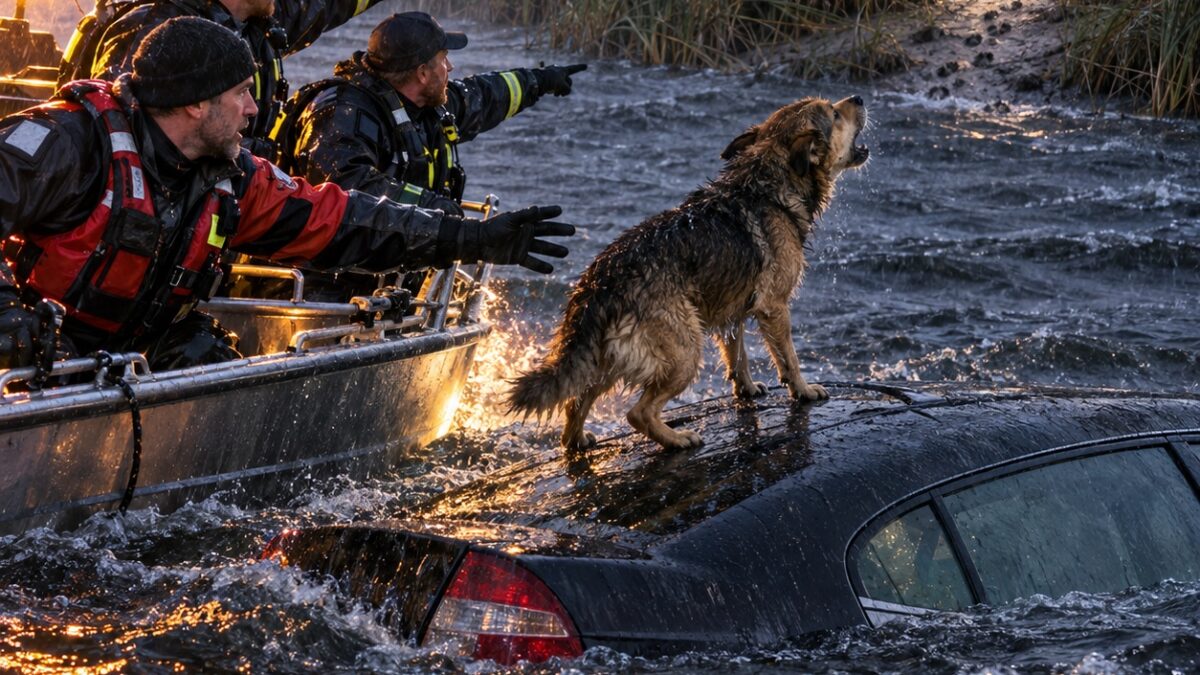
PART2
We turned the boat.
The dog watched shore the entire way.
He didn’t look back at the sinking car.
Not once.
That detail matters to me now.
At the time, I was too focused on keeping him from jumping overboard.
Jason kept one arm loosely across his chest.
“Easy.”
The dog whined.
Short.
High.
Then shifted toward the reeds again.
When we reached the muddy bank, Jason lifted him carefully.
This time, the dog didn’t resist.
Not at all.
As if being brought to shore was suddenly acceptable.
Because we were finally moving in the correct direction.
Jason set him down.
The dog hit mud.
Slipped.
Recovered.
Then ran.
Straight toward the reeds.
“Hey!”
Thomas shouted.
The dog ignored him.
Ten or twelve yards from shore, he stopped.
Turned.
Looked directly at us.
Barked once.
One sharp call.
Then turned back toward the reeds.
Jason stared.
“I swear to God, he’s telling us to follow.”
Marcus was already moving.
“Then move.”
We followed.
Rain fell harder for a few seconds, drumming against our jackets.
Mud pulled at our boots.
The dog ran ahead but never disappeared completely.
Every few steps, he turned.
Checked.
Waited.
Then continued.
That wasn’t random flight.
That was guidance.
I felt the first real unease then.
Not fear for the dog.
Fear that we had missed something.
The shoreline near the reeds was shallow.
Maybe ankle-deep in places.
Broken vegetation.
Debris.
Branches.
A small wooden crate or box might have washed ashore.
I noticed paw prints.
“Stop.”
Everyone paused.
I crouched.
Rain was already softening the edges.
Still clear enough.
Dog prints.
From water toward reeds.
Then another set.
Same size.
Same direction reversed.
Back toward water.
Jason came beside me.
“What?”
I pointed.
“He came through here.”
“So?”
I touched one track.
“Then went back.”
Silence.
Marcus looked toward the lake.
Then toward the reeds.
The same realization moved across all three faces.
The dog had reached shore before we ever saw him.
Safe.
At least safer.
And then he had gone back toward the sinking car.
Why?
The question felt cold in my stomach.
The dog barked from ahead.
We moved faster.
The reeds rose nearly to my chest.
Rain collected on the leaves and dumped down our sleeves as we pushed through.
The dog disappeared.
Then a whine came from somewhere inside.
Not his.
Smaller.
Weak.
I stopped.
“Did you hear that?”
Jason nodded.
“Yeah.”
Another sound.
Barely more than breath.
We pushed through a final wall of reeds.
Then saw the clearing.
Not really a clearing.
A patch where stalks had been crushed or broken.
Like something had fallen or been dragged through.
An old wooden crate rested crooked in the mud.
Rotten boards.
One side broken.
Inside it, something moved.
Gray.
Tiny.
Jason whispered:
“No way.”
I dropped to one knee.
Kitten.
Three or four months old.
Soaked.
Curled tight.
Shivering.
Its fur was plastered flat enough that it looked almost completely gray.
Huge green eyes.
Wide.
Not frantic.
Too cold for frantic.
The dog reached the crate.
Slow now.
No barking.
He lowered his nose.
Touched the kitten gently.
The kitten made a tiny sound.
His entire body relaxed.
I saw it.
Clear.
Shoulders dropped.
Head lowered.
Tail moved once.
He sat.
Just sat beside the crate under the rain.
The rescue he had been trying to complete was finally in front of him.
Jason took off his jacket.
Wet outside.
Still warmer inside.
He bent.
“Hey, little one.”
The kitten tried to stand.
Front legs straightened.
Rear body shook.
Then she collapsed.
“She’s freezing.”
I touched one ear.
Cold.
Too cold.
Jason wrapped her.
The dog immediately stood.
Watched every movement.
Not aggressive.
Focused.
Marcus looked at me.
“What the hell happened?”
I had no answer yet.
But the tracks were shouting.
Dog out of water.
Dog to reeds.
Dog back to water.
Dog found on roof.
Dog barking toward reeds.
The kitten did not look capable of getting far alone.
I stared at the dog.
“You got her here.”
He stared back.
Maybe.
Maybe not.
We would never know exactly how.
But something had happened between the car and this crate.
Something that ended with Willow on land and Beck returning to danger.
At the time, we didn’t know their names.
They were just dog and kitten.
But before we knew names, we understood the shape of what had happened.
The dog had escaped.
The kitten had escaped.
The kitten ended up sheltered in the reeds.
Then the dog returned to the water.
Not wandered.
Returned.
The tracks proved it.
I felt sick.
Because suddenly the scene on the car roof changed.
His resistance.
The barking.
The direction.
We had nearly forced him away from the one thing he was trying to show us.
Jason lifted the kitten.
She disappeared into his jacket.
Only her face visible.
The dog moved alongside him immediately.
No more running ahead.
No need.
He stayed close.
Every few steps, he looked up at the bundle.
We walked back through the reeds.
Rain began softening to drizzle.
The lake came back into view.
The sedan was almost gone.
Only a small portion of roof remained.
No safe place left to stand.
If we’d arrived even later, the dog wouldn’t have had a platform.
He would have had to choose between returning to land or swimming until exhaustion.
That thought stayed with me.
Not because it made him more heroic.
Because it showed how narrow the margin was.
The dog had gambled with time.
Maybe without understanding it.
But he had.
And somehow we arrived before the final piece of roof disappeared.
When we reached the rescue area, Jonathan wasn’t alone.
A woman stood beside him.
Young.
Wet hair plastered to her face.
Pale.
Shaking.
Not from cold alone.
She saw the dog first.
Her mouth opened.
“Beck!”
The dog exploded.
No hesitation.
He ran.
Straight to her.
She dropped to her knees in mud and gravel.
Beck slammed into her chest.
She wrapped both arms around him.
“Oh my God.”
He licked her face.
Whined.
Pressed his head beneath her chin.
She was crying too hard to breathe properly.
“Beck.”
Then she saw Jason.
Saw the jacket.
Saw the small gray face.
Her whole body changed.
“Willow.”
Jason approached.
The woman’s hand flew to her mouth.
“Willow.”
The kitten’s ears moved at the sound.
The woman stood too quickly.
Nearly fell.
Jason caught her elbow.
“Easy.”
“Give her to me.”
“She’s very cold.”
“Please.”
He handed Willow over carefully.
The woman folded around the kitten.
Not held.
Folded.
As if trying to put her own body between Willow and the entire world.
“I thought you were dead.”
She whispered.
Again.
Again.
“I thought you were dead.”
Beck pressed against her leg.
She reached down blindly with one hand and found his neck.
“I thought I lost both of you.”
That sentence broke something in all of us.
Her name was Emily Carter.
It took several minutes before we got the full story.
Even then, “full” wasn’t really full.
Some parts would remain mystery forever.
Emily had parked near the overlook the previous night.
She had Beck and Willow in the vehicle.
She left briefly to walk a nearby trail.
Exactly how long didn’t matter to her afterward.
To Emily, any amount of time became too long.
At some point while she was away, the car moved.
Parking brake failure seemed possible.
Wet incline.
Vehicle slowly rolling.
Maybe gaining momentum.
No witness saw the first movement clearly.
By the time anyone noticed something was wrong, the sedan had entered the lake.
Emily returned and saw it in the water.
That was the moment she believed both animals were gone.
She told us later she couldn’t even remember running down the slope.
Only seeing the car.
Calling their names.
No answer.
Water.
Rain.
Then rescue vehicles.
She kept repeating:
“I left them there.”
Jonathan said:
“You parked a car.”
“I left them.”
“You didn’t put the car in the lake.”
“I should’ve—”
“You couldn’t predict this.”
Logic has limited reach when guilt is fresh.
Emily wasn’t listening.
She looked at Beck.
Then Willow.
Then lake.
“I should’ve been there.”
I had heard variations of that sentence from survivors.
If I’d arrived sooner.
If I’d called.
If I’d stayed.
If I’d noticed.
Guilt wants control after control has already been lost.
We couldn’t solve that on the shore.
We could save the animals in front of us.
So I explained what we found.
The broken rear window.
Willow in the crate.
Tracks.
Beck returning.
Emily looked at me.
“What do you mean returning?”
I pointed toward the reeds.
“He made it to shore.”
Her brow tightened.
“We found his tracks.”
“He got out?”
“Yes.”
“And Willow?”
“We think she got out too.”
“How?”
“We don’t know.”
“Did Beck—”
“We don’t know.”
I stopped her gently.
“We may never know.”
That truth mattered.
I wasn’t going to turn guesswork into legend.
But the evidence still told us enough.
“The tracks go from the water to the reeds.”
Emily’s eyes moved toward the shoreline.
“Then another set goes back toward the water.”
She froze.
I continued:
“When we arrived, Beck was on the car roof.”
Her face changed.
No.
Disbelief first.
Then understanding.
“He went back?”
Jason answered:
“That’s what it looks like.”
Emily stared at Beck.
Rainwater ran down his coat.
A small cut on one paw had begun leaving faint red marks in the mud.
“He was safe?”
“As safe as the shore was.”
“And he went back?”
“Yes.”
“Why?”
No one said Willow.
We didn’t need to.
Emily looked down at the kitten in her arms.
Then at Beck.
Beck pressed closer.
She sank back onto her knees.
“No.”
Not denial.
Emotion too large for another word.
She put her forehead against Beck’s head.
“You stupid, stupid dog.”
Her voice cracked.
Beck licked her nose.
“You went back.”
Willow made a small sound inside the jacket.
Beck’s head turned instantly.
He checked her.
Then returned to Emily.
There was the whole family.
One soaked woman.
One trembling dog.
One freezing kitten.
All alive.
Barely, maybe.
But alive.
We transported them to the nearest veterinary clinic.
The ride was tense.
Jason sat with Willow.
Emily beside him.
Beck refused to settle unless he could see the kitten.
At one point, Willow shifted inside the blanket.
Beck stood immediately.
Whined.
Jason lowered his hand.
“She’s here.”
Beck sniffed the edge of the jacket.
Then lay down.
Not relaxed.
Alert.
The same dog who had been willing to return to freezing water now watched a bundle of warm fabric as if his life depended on it.
Maybe it did.
Not physically.
Something else.
At the clinic, Dr. Rachel Anderson met us.
Rachel had worked with emergency animal cases for years.
Calm hands.
Calm voice.
The worse the room felt, the quieter she became.
Willow went first.
Emily resisted letting go.
Not consciously.
Her arms simply tightened.
Rachel said:
“I need to warm her properly.”
Emily nodded.
Didn’t release.
“Emily.”
That got through.
She handed Willow over.
Then stood two feet away.
Hands clasped.
Beck below the table.
Watching.
Willow’s temperature was low.
Mild hypothermia.
Exhaustion.
Dehydration.
But heart strong enough.
Breathing stable.
No obvious major trauma.
Rachel wrapped her in warm blankets.
Started gentle warming.
Fluids.
Careful.
Not too fast.
Beck watched everything.
When Willow made a weak sound, Beck stood.
Rachel looked down.
“This one yours too?”
Emily nodded.
“Beck.”
Rachel crouched briefly.
“Beck, I’m helping her.”
He sniffed Rachel’s hand.
Then looked at Willow.
Rachel stood.
“I’ll take that as conditional approval.”
Beck was examined next.
The cut on his paw was from glass.
Small.
Likely from the broken window.
No fracture.
No serious internal injury we could tell.
Cold.
Fatigued.
Abrasions.
But astonishingly stable.
Jason shook his head.
“He swam out, got the kitten to land somehow, went back into the water, then stood on a roof in cold rain.”
Rachel said:
“And?”
“And that’s all he has?”
She examined Beck’s paw.
“Bodies surprise us.”
I looked at Beck.
“Some more than others.”
Rachel glanced toward Willow.
“Sometimes adrenaline carries an animal until the task feels complete.”
That made me think of the clearing.
Beck barking until he reached Willow.
Then quiet.
Maybe he had been running on purpose.
Once Willow was found, the body could finally admit it was exhausted.
Beck lay down.
Within minutes he was asleep.
Still angled toward Willow.
Emily sat on the floor beside him.
Her hand on his back.
I stayed longer than I needed.
So did Jason.
Part of rescue work is knowing when your job ends.
That day, none of us seemed eager to define the boundary.
Willow’s temperature rose slowly.
That was good.
Rachel checked repeatedly.
Emily watched every number.
“What should it be?”
Rachel told her.
“What is it now?”
Told her.
“How fast—”
“Emily.”
She stopped.
“We’re getting there.”
Emily nodded.
Ten minutes later:
“What is it now?”
Rachel answered anyway.
Guilt had turned into vigilance.
Beck slept.
Then woke.
Saw Willow.
Relaxed.
Slept again.
That pattern repeated several times.
Eventually Willow opened her eyes more fully.
Lifted her head.
Very small movement.
Emily covered her mouth.
“Hi.”
Willow blinked.
Beck heard Emily’s voice.
Stood.
Rachel allowed him closer.
Beck sniffed Willow’s face.
Willow turned her head weakly.
Touched nose to nose.
Beck’s tail moved.
Slow.
One side.
Then the other.
No one in the room spoke.
You didn’t need language.
Later, when Willow accepted a small amount of food, Emily cried again.
Beck watched her eat.
Then finally ate from the bowl Rachel offered him.
Only after Willow.
Emily noticed.
“He does that at home.”
“What?”
“If she isn’t in the kitchen, he goes looking for her.”
She laughed once.
A broken sound.
“She follows him everywhere.”
Jason looked at Beck.
“So you’ve been babysitting before today.”
Emily rubbed her eyes.
“She came to me tiny.”
“How tiny?”
“Tiny enough to think Beck was furniture.”
Rachel smiled.
“Still seems accurate.”
Emily looked toward Willow.
“She sleeps against him.”
There it was.
The lake hadn’t created heroism out of nowhere.
It exposed a relationship already built through boring days.
Meals.
Naps.
Play.
Annoyance.
Routine.
The kind of love nobody notices until something tries to break it.
By afternoon, Willow’s condition improved enough that the tension in the room softened.
Not gone.
Enough.
Rain outside stopped.
Sun appeared weakly between clouds.
The light entered the clinic window and landed across Beck’s back.
He was sleeping again.
Willow nearby.
Emily beside both.
I left.
Drove home.
Showered.
Put on dry clothes.
Made food.
Didn’t eat.
Couldn’t.
Every time I closed my eyes, I saw Beck on that roof.
But now the image contained knowledge.
That’s the cruel thing about hindsight.
You revisit every moment carrying information you didn’t have then.
I heard his barking.
Remembered his eyes.
The way he kept looking toward shore.
And I wanted to go back in time and understand faster.
“He was telling us.”
I said aloud to an empty kitchen.
No one answered.
I sat at the table.
Rainwater still seemed trapped in my ears.
The question came:
What if we hadn’t followed?
We would have taken Beck.
Checked him.
Maybe left.
Search around the vehicle would continue.
Someone might eventually notice tracks.
Maybe.
Willow might have been found.
Maybe.
The crate gave some shelter.
But she was already hypothermic.
Time mattered.
I hated every version where we didn’t listen.
Rescue workers live with alternate timelines.
What if.
What if.
What if.
Most are useless.
Still, the mind creates them.
So I forced myself back to the real one.
We did follow.
Willow was found.
Beck was alive.
Both at the clinic.
Emily with them.
Reality deserves more weight than fear.
The next morning, Jason called.
“They’re good.”
I sat upright.
“Both?”
“Willow stayed overnight. Temp normal now.”
“And Beck?”
“Refused to leave.”
I almost laughed.
“Of course.”
“Emily stayed too.”
Also of course.
Two days later, both animals were home.
That’s when the story spread.
Emily told someone.
Someone told local media.
A reporter called our department.
Jonathan tried to keep everything factual.
Vehicle entered water.
Dog located on roof.
Dog repeatedly oriented toward shoreline.
Paw tracks indicated dog reached shore and returned.
Kitten located in reeds.
Both survived.
Simple.
Then Emily agreed to an interview.
Her version broke people.
“I want people to know what Beck did.”
She sat with him beside her.
Willow in her lap.
Beck looked bored.
Hero dogs are often unimpressed by journalism.
“He got Willow out.”
Emily said.
“We don’t know exactly how.”
The reporter asked.
“But you believe he helped her?”
Emily nodded.
“She could barely stand when they found her.”
Then she looked at Beck.
“And he came back.”
Her voice changed.
“He was already safe.”
She took a breath.
“He went back to the car and stood there in the rain until someone came.”
The reporter asked:
“You think he knew rescuers would follow him?”
Emily smiled sadly.
“I don’t know what he understood.”
Then:
“I know what he did.”
That’s the cleanest statement anyone made.
We don’t know what Beck thought.
We know what he did.
The local paper called Beck and Willow “the heroes of Grand Lake.”
Messages poured in.
People wanted updates.
Some wanted to send toys.
Blankets.
Food.
One child sent a drawing.
Beck standing on blue water wearing a red cape.
Willow on his back.
Not accurate.
Emotionally perfect.
We hung it at the station.
The story moved because people needed it.
That week, the news was full of bad things.
Accidents.
Storm damage.
Loss.
Then a mixed-breed dog went back into cold water because the kitten he loved couldn’t call rescuers herself.
People held onto that.
I understood why.
I did too.
Emily visited the station a few weeks later.
Beck came.
Willow stayed home because she hated the carrier.
Reasonable.
Beck received enough treats to erase all professional discipline.
Marcus crouched.
“You made us look bad, you know.”
Beck ate.
“We showed up with a boat.”
Beck ate another treat.
“You already did half the rescue.”
Jason said:
“More than half.”
Jonathan replied:
“Don’t tell him that.”
Beck didn’t care.
He looked toward the station door whenever Emily moved.
Same pattern.
Check.
Locate.
Relax.
Emily told us he struggled with cars after the accident.
I wasn’t surprised.
The first time she tried taking him somewhere, he froze at the open door.
Wouldn’t jump in.
Trembling.
She didn’t force.
She sat beside him.
Waited.
Next time, engine off.
Treat.
Home.
Then short drive.
Again.
Slowly, trust returned.
Willow helped.
When Willow’s carrier went into the car, Beck became more willing to follow.
I smiled when Emily told me.
“So she guided him this time.”
Emily looked at the kitten photograph on her phone.
“I think they take turns.”
That line stayed with me.
They take turns.
Rescue rarely moves in one direction forever.
Beck saved Willow when the car went into the lake.
Later, Willow’s calm presence helped Beck face the thing associated with terror.
That’s how bonds work.
One carries.
Then the other.
People ask me sometimes how Beck could have saved a cat.
As though species should prevent devotion.
Animals don’t read our categories.
Dog.
Cat.
Natural rivals.
No.
Beck knew Willow.
That was enough.
Maybe he thought of her as family.
Maybe pack.
Maybe companion.
Maybe something for which we have no human word.
The label doesn’t matter.
When danger arrived, he didn’t leave her.
That’s the fact.
Emily explained their relationship before the accident.
Willow came to her very young.
Small enough to fit beneath Beck’s chest.
At first, Beck tolerated her.
Willow didn’t understand boundaries.
Climbed on him.
Bit ears.
Stole warm spots.
Beck sighed.
Moved.
Willow followed.
Eventually he stopped moving.
They slept together.
If Willow disappeared into another room, Beck checked.
If Beck went outside, Willow waited near the door.
Ordinary days.
That’s where courage was built.
Not in the lake.
In the kitchen.
On the couch.
Shared naps.
Hundreds of tiny repetitions saying:
You’re mine.
I’m yours.
You’re still here.
So when the car began sliding, Beck didn’t suddenly become loyal.
He already was.
Crisis only made the bond visible to strangers.
I thought about that often.
We praise extraordinary action.
But extraordinary action usually grows from ordinary love.
Weeks later, Emily sent us a picture.
Willow recovered.
Dry fur showed her real coloring.
Mostly white.
Gray patches.
Bright green eyes.
Standing on Beck’s back.
Beck lying with the expression of an animal reconsidering every life choice.
I laughed.
Caption:
She survived a sinking car and still has no respect for him.
Perfect.
Another photo:
Both asleep.
Willow curled against Beck’s chest.
The picture looked peaceful enough to make the lake feel impossible.
That’s what I wanted for them.
Not eternal heroism.
Ordinary.
The right to become boring again.
To sleep.
Eat.
Annoy each other.
Not be defined forever by the worst morning of their lives.
Emily eventually moved into a small house near the lake.
Not right on the low shoreline.
Higher.
Safer.
She joked:
“I check the parking brake three times now.”
Not funny.
Also funny.
Trauma produces strange humor.
She kept Beck and Willow indoors during storms.
Beck didn’t like heavy rain anymore.
The first big storm after the accident, Emily said he paced.
Went to windows.
Couldn’t settle.
Willow walked to his bed.
Lay down.
Beck stood over her.
Then lay beside her.
Eventually slept.
Again:
They take turns.
Some nights, Emily said Beck dreamed intensely.
Paws moving.
Legs twitching.
Breathing faster.
Like running.
Or swimming.
She wondered if he remembered the lake.
No way to know.
Then he’d wake.
Head up.
Look around.
Find Willow beside him.
Lower his head.
Sleep.
That image became the ending of the story for me.
Not the car.
Not the newspaper.
Not the hero label.
A dog waking from a dream.
Checking for the cat he once went back into freezing water to save.
Seeing her.
Then relaxing.
Safe.
Together.
Done.
But before the story quieted, there were still details I couldn’t stop examining.
The rear window.
When the car was recovered, damage was consistent with it breaking during impact.
That likely created Beck’s exit.
His paw cut fit broken glass.
Willow had no major lacerations.
How did she get out?
No one knew.
Maybe Beck exited first.
Returned.
Maybe Willow followed through the opening.
Maybe she clung to him in the water.
Maybe he physically took hold of her.
Possible.
Not provable.
We resisted the temptation to choose the most dramatic version.
The truth didn’t need help.
She ended up on shore.
He ended up on shore.
Then he went back.
Those facts were enough.
Marcus had the hardest time accepting the unknown.
“He had to carry her.”
“Maybe.”
“How else?”
“Could’ve swum beside her.”
“She was tiny.”
“Yes.”
“Maybe she held onto him.”
“Possible.”
He sighed.
“I want to know.”
“So do I.”
Some rescues keep one secret.
This one kept several.
Maybe that’s appropriate.
Beck didn’t do it for explanation.
He did it because Willow needed to get out.
The rest belongs to them.
One month after the accident, our team returned to the site for unrelated inspection work.
The road was repaired.
Vehicle gone.
Water calm.
Reeds still there.
No dramatic scar.
Jason stood near the shoreline.
“Doesn’t look like the same place.”
“It is.”
I stared at the water.
Weather can change the morality of a landscape in your mind.
On a sunny day, lake.
On that morning, threat.
Neither is the lake’s intention.
Nature doesn’t intend.
We do.
I walked toward the reeds.
Rain had long since erased the prints.
The crate was gone.
Probably debris cleanup.
I stood where I believed the clearing had been.
Could not be sure.
That bothered me less than expected.
The location didn’t need to become a monument.
Willow was home.
That was the monument.
Jason came beside me.
“You think he knew we’d follow?”
“There it is again.”
“What?”
“The question nobody can answer.”
He smiled.
“I know.”
We looked at the water.
Then he said:
“Doesn’t matter.”
“No.”
“He went back.”
“Yes.”
“And he barked until somebody showed up.”
“Yes.”
“That’s enough.”
Exactly.
That became the line I used whenever people tried to turn Beck into a human strategist.
You don’t need to know what he understood abstractly.
You only need to respect behavior.
He was safe.
He returned.
He directed attention toward Willow.
He led rescuers there.
Enough.
Months passed.
Other calls filled our lives.
An overturned canoe.
A child missing near a riverbank who was found safe.
A dog trapped on thin ice.
A vehicle with one injured driver.
Not every outcome good.
That’s rescue.
If you do it long enough, you accumulate faces.
Some you saved.
Some you didn’t.
The danger is letting the losses convince you they are the only true stories.
Beck interrupted that.
On difficult days, I remembered him.
Not because animals are purer than humans.
Not because every dog is heroic.
Because sometimes a life surprises you at exactly the moment you need evidence that courage still exists.
One terrible call came months later.
We were too late.
I won’t describe it.
I went home angry.
At water.
Timing.
Everything.
It started raining that night.
Of course.
I sat near my window listening.
Then my phone buzzed.
Emily.
Photo.
Beck asleep.
Willow draped partly across him.
Message:
Rain tonight. He was restless until Willow came over. Now they’re both out cold.
I stared at it for a long time.
Life doesn’t cancel loss.
But neither does loss cancel life.
Both coexist.
That image got me through the night.
Emily later said something in an interview that stayed with me.
The reporter asked:
“Do you see Beck differently now?”
She looked surprised.
“No.”
Then thought.
“I mean, yes. I’m proud of him.”
She stroked Beck’s head.
“But he was always Beck.”
The reporter asked:
“What does that mean?”
Emily smiled.
“He always checked on Willow.”
“He always waited for her.”
“He always protected her when she got scared.”
“The lake just made everybody else see it.”
Exactly.
Heroism revealed.
Not invented.
That is what I eventually understood.
People praised the single extraordinary act.
Beck’s act was built from hundreds of ordinary ones.
Checking a room.
Waiting by a door.
Sharing a bed.
Tolerating kitten claws.
Routine forms attachment.
Attachment creates responsibility.
Then crisis arrives.
Character moves.
At the station, we started joking about the Beck Rule.
Not official.
If an animal keeps looking somewhere, look there too.
We didn’t treat it like magic.
Animals look places for a thousand reasons.
But we became more careful about patterns.
One call involved a dog refusing to leave near flood debris.
Kept circling one area.
We searched.
Found nothing.
Still worth searching.
Another time, a dog barked at a drainage culvert.
Inside: two puppies.
That one made Jason call me immediately.
“Beck Rule.”
I laughed.
“Fine.”
Behavior is information.
Not always urgent information.
But don’t dismiss repeated direction during crisis.
That practical lesson may save something someday.
Beck had saved Willow already.
Then improved us.
Another layer.
A year later, a school invited us to speak about emergency preparedness and water safety.
Someone mentioned Beck.
The kids cared about nothing else afterward.
Hands everywhere.
“Did he bite the window?”
“No idea.”
“Did the cat ride on him?”
“No idea.”
“Did Beck know how to swim before?”
“Most dogs can paddle instinctively, but swimming in cold rough water is different.”
“Was he scared?”
I paused.
“Probably.”
A boy said:
“Then how was he brave?”
Children ask questions adults avoid.
“Being brave doesn’t mean not being scared.”
He frowned.
“It means doing something even though you’re scared?”
“Sometimes.”
“What did he do?”
“He got out.”
“Then went back?”
“Yes.”
“For Willow?”
“That’s what the evidence strongly suggests.”
The boy nodded.
“Then he was scared and went anyway.”
Simple.
Yes.
Another girl asked:
“Why didn’t Willow save him?”
I smiled.
“Maybe she did later.”
The teacher looked confused.
I explained how Emily said Willow helped Beck feel calmer around cars.
The girl nodded as if that was obvious.
“She took her turn.”
Exactly.
Children understand reciprocal love faster than adults sometimes.
They drew pictures.
One showed Beck on the roof.
Willow in reeds.
Rescue boat between.
Rain.
The child had drawn an arrow from Beck’s mouth toward Willow.
Not speech.
Just direction.
That drawing was more accurate than the cape version.
We hung both.
Years after the accident, I still remembered the physical details.
Cold.
Rain inside my collar.
Dog’s claws scraping roof.
Metal groan.
Jason reaching.
Beck twisting toward shore.
I replayed the exact moment he stopped resisting.
At the time, I thought exhaustion.
Now I wonder whether he recognized we were turning toward land.
Maybe not.
I don’t know.
There it is again.
Unknown.
But he let Jason lift him.
Then once on shore:
Run.
Lead.
Find.
Stop.
Sequence so clean it almost looks planned.
Animal behavior can be astonishing without requiring human-level narration.
Intent exists in action.
He wanted us somewhere.
We went.
Willow was there.
That’s enough.
Emily remained deeply affected by guilt longer than the news story suggested.
Publicly, gratitude.
Privately, guilt.
She told me once when we visited:
“I see the car every time I close my eyes.”
Beck lay beside her.
Willow in the window.
“You weren’t in it.”
“That makes it worse sometimes.”
“Why?”
“Because they were.”
I understood.
“If I’d stayed—”
“Emily.”
She stopped.
“If you’d stayed, you might have been in the car too.”
Silence.
She hadn’t considered that, or didn’t want to.
“Then Beck would’ve had three problems.”
That got a tiny laugh.
I wasn’t trying to erase responsibility.
There was no evidence of reckless intent.
Accidents happen.
Equipment fails.
Rain changes roads.
But survivors look for a place to put pain.
Often inside themselves.
Beck didn’t need Emily destroyed by guilt.
He needed her present.
Willow too.
I told her:
“You can’t change the part where the car moved.”
She nodded.
“You can change what happens next.”
She looked at both animals.
“I already moved.”
“Good.”
“Higher ground.”
“Very good.”
Sometimes healing is practical.
New house.
Safer habits.
Check brake.
Don’t leave animals in vehicle.
Move forward.
Guilt transformed into care.
That’s useful.
Endless guilt isn’t.
Rachel, the veterinarian, said something similar when Emily worried Willow might have hidden damage.
“Watch her.”
“Care for her.”
“Don’t turn her into a permanent patient because you’re afraid.”
That line mattered.
Willow recovered.
Fully.
She deserved to become a cat again.
Not fragile symbol.
She climbed furniture.
Knocked things down.
Annoyed Beck.
Stole his sleeping spots.
Excellent.
The first time Emily sent a photo of Willow sitting on the kitchen counter beside something she’d broken, the caption said:
Apparently survival has made her arrogant.
I replied:
Good.
A safe animal misbehaves.
Underrated blessing.
Beck became ordinary again too.
Walks.
Food.
Sleep.
Dreams.
Checking Willow.
Sometimes, during storms, more alert.
But not living on a car roof emotionally forever.
That mattered.
People often want trauma survivors to remain inspirational.
That’s unfair.
They deserve boring.
Routine.
No audience.
Beck deserved to never prove bravery again.
He had proved enough.
Today, when I think about the most painful part of the story, it isn’t the sinking car.
It isn’t even Willow shaking in the crate.
It’s the knowledge that Beck had already reached shore.
That fact changes everything.
He was out.
Imagine the body-level relief.
Land.
Mud.
Air.
No sinking metal.
No glass.
No cold water holding you.
And then:
Willow.
Still vulnerable.
Unable to call anyone.
Beck could have stayed.
Self-preservation would have been reasonable.
Nobody would have blamed a dog.
Instead, the paw prints went back.
That is the part that hurts me.
Because love made safety insufficient.
Not until both were safe.
The tracks are what I remember.
One set toward land.
One set back.
Rain erasing them while we stood there.
Evidence disappearing in front of us.
If we’d arrived later, maybe no tracks.
Maybe we wouldn’t have understood.
But we did.
For a few minutes, the mud held the entire story.
He escaped.
He returned.
Sometimes heroism is no more complicated than footprints going the wrong direction.
Back toward danger.
People ask whether I’d do the same.
I don’t know.
I hope.
That’s all anyone can honestly say until the moment arrives.
Beck didn’t know he’d become a story.
He just knew Willow was there.
Maybe that’s why his courage feels so clean.
No identity.
No audience.
No expectation of praise.
Action.
One life mattered.
Move.
I think about that on days when the world feels particularly selfish.
A mixed-breed dog in freezing rain reminds me not to become cynical.
Not because dogs are morally superior.
Because courage is possible.
Connection is possible.
Even under stress.
Even afraid.
Even when the easier direction is away.
The final update Emily sent that I keep on my phone is simple.
No news headline.
No rescue uniform.
No lake.
Bedroom.
Soft light.
Beck asleep on one side of a bed.
Willow curled against his chest.
Emily wrote:
He was dreaming again last night. Paws moving like he was swimming. Then he woke up, looked at Willow, and went right back to sleep.
I read that message whenever I think of Grand Lake.
Because that’s the ending.
Not hero dog.
Not rescued kitten.
Not sinking car.
A dream.
A wake-up.
A check.
She’s here.
Sleep.
The body eventually learning that the emergency ended.
That’s what home gives survivors.
Repetition of safety.
Night after night.
Enough good mornings to outnumber the one terrible morning.
Enough ordinary rain to soften the memory of cold lake water.
Enough waking beside the one you almost lost that checking becomes habit instead of panic.
I hope Beck reached that place.
From what Emily tells us, I think he did.
Willow sleeps beside him every night.
Completely recovered.
Beck still checks her.
Probably always will.
But he doesn’t need to stand on sinking things anymore.
He did that once.
Once was enough.
My name is Daniel.
I’m still a rescue worker.
Every time a call sends us toward water, I remember what Grand Lake taught me.
Don’t assume the person—or animal—you see is the whole emergency.
Watch direction.
Watch repetition.
Ask what doesn’t make sense.
The thing that looks like resistance may be information.
The one you’re trying to rescue may already be trying to rescue someone else.
And never confuse fear with cowardice.
Beck was cold.
Shaking.
Probably terrified.
His body had every reason to move away from that lake.
Yet after reaching shore, he went back.
Not because he wanted danger.
Because Willow mattered more than comfort in that moment.
That is courage.
Not a cape.
Not a headline.
Not applause.
Courage can look like a wet dog standing on the last few feet of a sinking roof.
Claws slipping.
Body shaking.
Rain in his eyes.
Barking toward a shoreline full of reeds.
Everyone around him misunderstanding.
Car sinking beneath him.
Still barking.
Still looking.
Still refusing to let us take him away until he believed we had finally understood where we needed to go.
And when we reached the reeds, he didn’t celebrate.
He didn’t need to.
He touched his nose to Willow.
Sat beside her.
Became quiet.
That silence told me everything.
He had already done what mattered.
He got her out.
He kept trying.
He came back.
He found people.
He showed us the way.
Only then did he allow himself to stop.
So whenever someone asks me who the hero of that rescue was, I don’t point to our boat.
I don’t point to the uniforms.
I don’t point to myself.
I think about those tracks in the mud.
Out of the water.
Toward safety.
Then back.
Toward danger.
And I think of Beck standing in the rain on a disappearing roof, barking not for himself—
but for the small gray kitten waiting alone in the reeds.
That was the morning I learned that sometimes the bravest soul at a rescue scene is the one who cannot explain what he has already done.
All he can do is keep calling until somebody finally listens.








