The Blood-Soaked SEAL Wouldn’t Let Anyone Touch His Dying K-9 Until He Saw What Was Hidden on My Arm
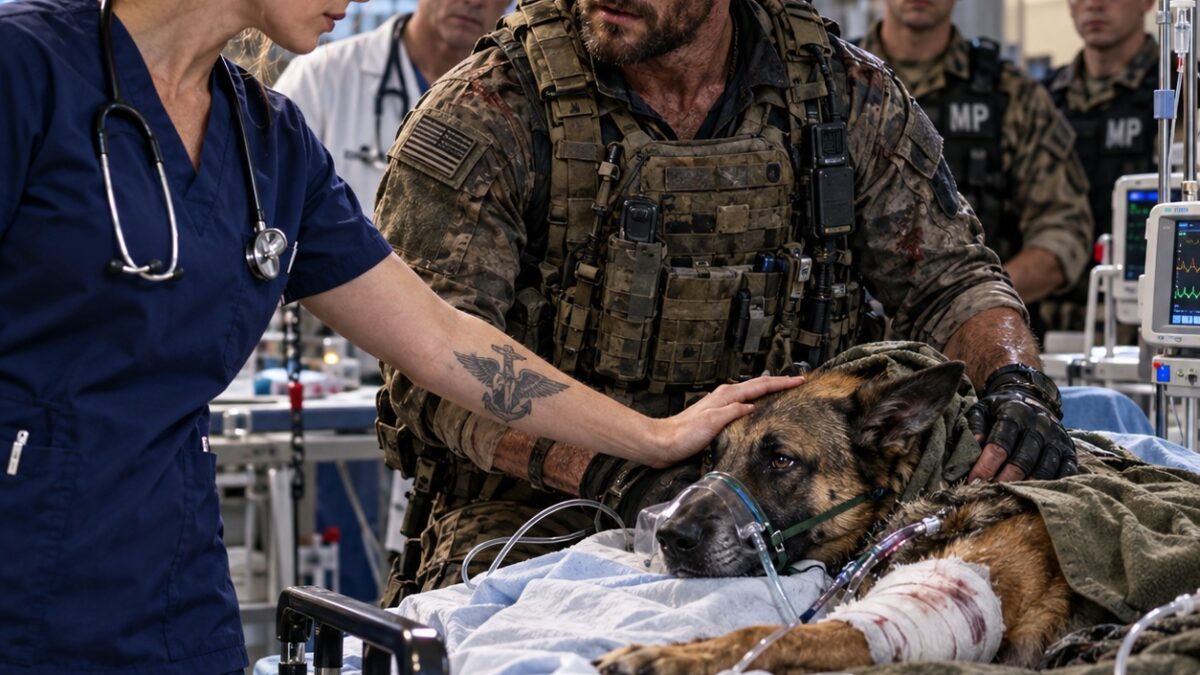
PART 2 and FULL ENDING  Thank you

I pulled my sleeve down slowly.
For eight years, I had learned how to answer questions about that tattoo without reopening every part of myself I had fought to put back together.
Most people saw the trident and assumed I had served.
I hadn’t.
Others assumed my father or brother had been Navy.
Neither was true.
The tattoo belonged to one man.
Or, more accurately, the meaning of it did.
Tyler was still staring at me.
The rage that had filled the room seconds earlier was gone.
Not reduced.
Gone.
His mouth opened, but no words came.
Finally, he asked again.
“Where did you get that?”
His voice sounded completely different.
Smaller.
Almost frightened.
I touched the fabric covering my forearm.
“He designed it.”
Tyler swallowed.
“Who?”
I knew before he said another word that he already knew.
The coordinates had told him.
The date had told him.
The handwriting had finished the job.
I had taken the words from the last letter my husband mailed home before the mission that killed him.
“I had the writing copied exactly,” I said. “From his letter.”
Tyler shook his head once.
“No.”
I felt the old pain move through my chest.
Not sharp anymore.
Nothing like those first years.
But deep.
Permanent.
“Chief Petty Officer William Phillips.”
Tyler stumbled backward and hit the crash cart.
“Billy?”
I nodded.
“He was my husband.”
The change in Tyler frightened me more than his anger had.
A minute earlier, he had looked capable of fighting every person in the hospital.
Now his knees seemed unable to support him.
He stared at me as though he had spent eight years searching for somebody and had just discovered her standing five feet away.
“You’re Aurelia.”
I hadn’t told him my first name.
I didn’t need to ask how he knew it.
Billy used to joke that his team probably knew more about me than some of my relatives did.
He talked.
Constantly.
About my cooking.
My terrible habit of falling asleep during movies.
The flowers I grew badly on our apartment balcony.
The way I hated when he left wet towels on the floor.
The nursing program.
The home we hoped to buy someday.
The children we thought we would eventually have.
His teammates had known me without ever meeting me.
At least through him.
Tyler’s knees hit the floor.
Hard.
He covered his face with both hands.
“Oh, God.”
I heard something break in his voice.
“I’m sorry.”
I stood there.
“I’m so sorry.”
Blood from his shoulder had soaked halfway down his sleeve.
His hands were black with soot and red with Havoc’s blood.
“I couldn’t save him.”
His shoulders shook.
“I couldn’t save Billy.”
For one impossible second, Trauma Bay Three disappeared.
I wasn’t a nurse.
I wasn’t thirty-four.
I was twenty-six again.
Standing inside our tiny apartment.
Two men in dress uniforms outside my door.
One chaplain.
One folded flag months later.
One empty side of the bed.
One toothbrush I couldn’t throw away.
I had spent years teaching myself not to live permanently inside that moment.
And now one of the men who had been with Billy when he died was kneeling in front of me, apologizing for surviving.
I walked toward Tyler.
I placed my hand on his uninjured shoulder.
He flinched.
Not from me.
From grief.
“Tyler.”
He lowered his hands.
Tears had cut clean lines through the dust on his face.
“I held him.”
His voice barely worked.
“I held him in the helicopter. I kept pressure on his neck. I screamed for the medic. I—”
“Tyler.”
“I couldn’t—”
“He made his choice.”
He stared at me.
“He should’ve stayed behind cover.”
“Would he have?”
That silenced him.
I knew my husband.
If Billy saw one of his men bleeding in the open, there had never been a universe where he stayed safe and watched.
He had spent most of our marriage worrying me because courage and self-preservation were never equally weighted inside him.
“He would make the same choice again,” I said.
Tyler shook his head.
“You don’t know what happened.”
“I know enough.”
“He died because of me.”
“No.”
“He came out for me.”
“That doesn’t make his decision your crime.”
Tyler looked away.
I squeezed his shoulder once.
Then I looked at Havoc.
The dog’s chest barely rose.
We were running out of time.
“Tyler.”
He followed my gaze.
“I need you now.”
He wiped his face with the back of one hand.
“I need to save your dog.”
His eyes locked on mine.
“Can you?”
“I can keep him alive long enough to give the veterinarian a chance.”
“That’s not what I asked.”
“It’s the only promise I’m willing to make.”
That must have reminded him of Billy.
My husband hated false reassurance.
He believed hope was useful only if it stood next to reality.
Tyler nodded.
“Do it.”
“Then get up.”
He looked surprised.
“What?”
“You’re not sitting there while I work.”
I pointed toward Havoc’s injured hind leg.
“If he trusts you, you’re going to help me.”
Tyler rose immediately.
The transformation was extraordinary.
Grief was still there.
Shock too.
But he suddenly had a mission.
People survive some moments by giving their pain a job.
I had done it through nursing.
Tyler did it through Havoc.
I positioned his hands.
“Pressure here.”
He obeyed.
“Hard?”
“Enough to slow the bleeding, not enough to crush everything underneath. Don’t release unless I tell you.”
“I’ve got him.”
I moved to the front of the table.
Havoc’s gums were almost white.
The dog’s pulse was weak and rapid.
His eyes were half closed.
“We need vascular access.”
Tyler looked at me.
“You know how?”
“I know enough mammalian anatomy to buy time.”
That was the truth.
I had never pretended to be a veterinarian.
I also wasn’t going to watch an animal bleed to death while waiting for a title to walk through the door.
I clipped fur from the front leg and searched for a viable vein.
Shock was already collapsing Havoc’s peripheral circulation.
Everything felt small.
Flat.
Uncooperative.
“Come on,” I whispered.
Tyler heard me.
“Is something wrong?”
“His pressure is terrible.”
“What do you need?”
“A vein.”
“Tell me what to do.”
“Hold his front leg.”
Tyler shifted carefully while keeping pressure on the femoral wound.
He used his forearm to stabilize Havoc’s body.
The dog was barely responsive.
That scared me more than thrashing would have.
I cleaned the site.
Palpated again.
There.
Almost nothing.
But enough.
I slid the catheter in.
No flash.
I adjusted slightly.
Then dark blood appeared.
“Got it.”
Tyler exhaled.
I advanced the catheter, taped it, and opened fluids.
They weren’t a replacement for blood.
But volume was better than nothing while we waited.
For maybe thirty seconds, I felt the smallest amount of relief.
Then I looked at Havoc’s tongue.
Blue.
His breaths had become shorter.
Faster.
His chest moved unevenly.
I grabbed my stethoscope.
Right side.
Breath sounds.
Left.
Almost nothing.
My stomach tightened.
The blast had injured his chest.
I looked at Tyler.
“His left lung isn’t expanding properly.”
“What does that mean?”
“Air may be trapped between the lung and chest wall.”
“Can you fix it?”
“I can relieve the pressure.”
“Then do it.”
I reached for a large-bore needle.
That was when Tyler’s confidence faltered.
“What are you doing?”
“Chest decompression.”
“On a dog?”
“If my assessment is wrong, this is dangerous.”
He stared at me.
“And if you’re right?”
“He may arrest if we don’t.”
Tyler closed his eyes.
Then leaned over Havoc.
“Okay.”
I counted ribs.
Adjusted for canine anatomy as best I could from knowledge, training, and desperate reasoning.
I hated guessing.
Good emergency medicine is not heroic improvisation.
It is disciplined decision-making under incomplete conditions.
But sometimes you reach a point where doing nothing is also a decision.
And often the worse one.
“Hold him.”
Tyler pressed his forehead against Havoc’s head.
The dog’s eyes fluttered.
“I’ve got you, brother.”
His voice dropped to a whisper.
“Hold the line.”
My hand stopped for half a second.
Billy’s words.
Tyler must have realized what he had said.
His eyes met mine.
Neither of us spoke.
Then I inserted the needle.
A sharp hiss escaped.
Air.
Trapped pressure releasing.
Havoc’s body jerked.
Tyler held him.
“Easy. Easy. I’ve got you.”
The dog pulled in one massive, shuddering breath.
Then another.
The color in his tongue improved slightly.
Not healthy.
But less blue.
Tyler looked at me like he wanted permission to hope.
“Better?”
“For now.”
“Is he going to make it?”
“I still can’t tell you that.”
He nodded.
He accepted the answer this time.
A few minutes later, the doors flew open.
Dr. Finch returned with a man wearing a white coat over civilian clothing.
David Gregory.
Senior veterinary surgeon.
I had never been so happy to see a veterinarian in my life.
He took in the scene quickly.
IV.
Pressure on the leg.
Needle decompression.
Blood everywhere.
Tyler.
Me.
Havoc.
“Report.”
I gave it.
“Severe laceration near the left femoral artery. Significant blood loss. Hypovolemic shock. Compromised left chest after blast trauma. I placed peripheral access, started crystalloid, performed emergency decompression because breath sounds were absent on the left and cyanosis was worsening.”
Gregory bent over Havoc.
Checked the airway.
Listened.
Palpated the chest.
Inspected the leg.
Then he looked at me.
“You did all of this?”
“Yes.”
He examined the catheter.
Then the chest site.
“If you hadn’t, he would probably have arrested before I arrived.”
Tyler’s head dropped.
For one second his entire body sagged with relief.
Gregory immediately became all business.
“We have canine blood products at the base veterinary suite. I need him there now.”
He looked toward Tyler.
“Master Chief, we’ll control the artery, transfuse him, repair the chest injury, and operate.”
“I’m coming.”
“No,” I said.
Tyler turned toward me.
The old resistance returned to his face.
“Absolutely not.”
“You have shrapnel sticking out of your shoulder.”
“I don’t care.”
“You’ve lost blood.”
“I can walk.”
“That doesn’t mean you should.”
“Havoc needs me.”
“Havoc needs a surgeon.”
Tyler stared at me.
I stepped closer.
“You did your job.”
“No.”
“Yes.”
“He’s not safe yet.”
“Neither are you.”
“I said I’m going.”
I lowered my voice.
“Tyler.”
Something in my tone made him stop.
Maybe Billy again.
Maybe he was simply exhausted enough to listen.
“You trusted me for the last twenty minutes.”
“Yes.”
“Trust me for one more.”
His jaw clenched.
“Let Dr. Gregory take Havoc.”
Tyler looked down.
Havoc’s eyes were barely open.
He reached toward the dog’s head.
His fingertips touched one ear.
The same ear that, under normal circumstances, would have been standing upright and alert.
Tyler bent down.
Pressed his mouth to the top of Havoc’s head.
“Save him, Doc.”
Gregory nodded.
“I intend to.”
“Promise me.”
“I promise I’m going to do everything medicine allows me to do.”
Tyler looked at him for another second.
Then finally removed his hands.
The veterinary team replaced his pressure with a clamp and compression setup.
They moved Havoc onto a transport stretcher.
Tyler followed two steps.
I blocked him.
He glared at me.
“That is far enough.”
“Havoc—”
“Is going where he needs to go.”
The doors closed behind the veterinary team.
For the first time since Tyler entered the hospital, his arms were empty.
That was when his body stopped pretending it wasn’t injured.
He swayed.
His knees softened.
I caught him under the good arm.
He was much heavier than he looked.
“Easy.”
“I’m fine.”
“Of course you are.”
“I am.”
“You currently have a piece of metal inside your shoulder.”
He looked down as if noticing the injury for the first time.
“Oh.”
“Very convincing.”
I guided him to a bed.
Dr. Finch returned.
One look at Tyler and he started issuing orders.
Tyler did not argue anymore.
That frightened Finch more than the threats had.
“What happened to him?” he asked quietly while another nurse started cutting away ruined clothing.
“He finally realized he is a patient.”
Tyler heard me.
“I hate you.”
“You’ll survive.”
His eyes closed.
“That’s what Billy used to say.”
I froze.
Tyler opened his eyes again.
“He’d tell us that whenever we complained.”
A faint smile appeared.
“‘You’ll survive. Unfortunately for the rest of us.’”
I laughed before I could stop myself.
It was Billy.
Exactly Billy.
For half a second, hearing it hurt.
Then it didn’t.
It felt like somebody had opened a window in a room that had been closed for years.
Dr. Finch examined Tyler’s shoulder.
The shrapnel had entered near the upper left shoulder and torn through muscle without damaging the major vessels.
Lucky.
Depending on your definition.
Tyler also had multiple bruises, minor burns, dehydration, and enough blood loss to keep him overnight.
He objected once.
I pointed at him.
He stopped.
Finch raised an eyebrow.
“How did you do that?”
“Ancient nursing technique.”
Tyler said, “She threatens people.”
“I do not.”
“You threatened me.”
“I told you the truth.”
“That’s worse.”
Finch laughed.
It was the first normal sound I had heard in hours.
Once Tyler was stable and his shoulder had been cleaned, repaired, and bandaged, I finally changed out of my scrubs.
Havoc’s blood had soaked the front.
So had Tyler’s.
I stood alone in the staff locker room looking at the stains.
I should have felt shaken by the emergency.
Instead, all I could think about was Billy.
For eight years, grief had changed shape inside me.
At first, it was everything.
I woke inside it.
Worked inside it.
Ate inside it.
Went to sleep hoping, somehow, that I could dream myself back into the life we had.
People said time helped.
That wasn’t exactly true.
Time did not reduce what Billy had meant to me.
It simply enlarged the rest of my life around the missing place.
Eventually, grief became something I carried rather than somewhere I lived.
I finished nursing.
Took the job at Balboa.
Moved apartments.
Built routines.
I even learned how to laugh without immediately feeling guilty afterward.
But I had never met Tyler Rearden.
Billy had written about him.
Not by full name at first.
“The new guy.”
“The stubborn kid.”
“The idiot who thinks he can muscle through everything.”
Then later:
“Rearden is getting good.”
“Rearden has instincts.”
“Rearden is going to be dangerous when he learns patience.”
And finally, in the letter that arrived three days before Billy died:
“Tyler’s got the heart of a lion. Too stubborn for his own good. Someday he’s going to lead men, and if I do my job right, he’ll live long enough to figure out the difference between being fearless and being responsible.”
I had memorized that paragraph.
After Billy died, I received boxes of his things.
His uniforms.
Notebooks.
Books.
Letters.
One scrap of paper contained a design he had been sketching for a tattoo.
The trident.
The chain.
Coordinates.
And the words he used constantly.
Hold the line.
The handwritten version came from his final letter.
I had the tattoo done on what would have been our tenth anniversary.
For me.
Not as a public memorial.
Not as an announcement.
A private piece of him I could carry under my sleeve.
Until Tyler grabbed my wrist.
I changed clothes.
Washed my face.
Then went back to work.
That is something people outside hospitals sometimes don’t understand.
Your world can change completely at 11:30 p.m.
At 11:47, somebody in Room Six still needs medication.
The waiting room still has twelve people.
A child is still vomiting.
Someone’s father still has chest pain.
An elderly woman still needs help to the bathroom.
Grief does not pause the shift.
Neither does revelation.
About three hours later, the ER had quieted.
The peak chaos had passed.
I checked Tyler’s chart.
Then walked into his recovery room carrying two cups of coffee.
Hospital coffee at three in the morning is a special category of punishment.
Tyler was sitting on the edge of the bed in gray scrubs.
His shoulder was wrapped heavily.
His face had been cleaned.
Without blood and soot, he looked younger.
Not young.
Just human.
I handed him a cup.
“You trying to poison me?”
“Yes.”
“Appreciate the honesty.”
I pulled up a rolling stool.
We sat without speaking.
The silence wasn’t uncomfortable.
It was crowded.
Billy was in it.
Eventually, I asked, “How’s the shoulder?”
“Numb.”
“That will change.”
“They said I got lucky.”
“You did.”
He looked at his hands.
They were clean now.
I could tell that bothered him.
The last time they had been covered in blood, the blood belonged to Havoc.
Before that, years ago, to Billy.
“Aurelia.”
“Yes?”
“I need to tell you what happened.”
I already knew what he meant.
“Tyler—”
“At Korengal.”
The source records and Tyler’s memory had always called the area Korengal Valley.
Billy had died there on October 14, 2018.
Tyler’s voice became tight.
“I need you to know I tried.”
I put the coffee down.
He kept staring at his hands.
“We were moving through a narrow position. Terrain was terrible. Everything was exposed.”
His breathing slowed as memory pulled him backward.
“We took fire. I got pinned. Couldn’t move. Billy was behind cover.”
He stopped.
I waited.
“I told him not to come.”
His mouth twisted.
“I actually screamed at him not to come.”
A tear gathered in one eye.
“He came anyway.”
I reached across and placed my hand over his.
“Look at me.”
He didn’t.
“Tyler.”
Slowly, he lifted his head.
There was shame in his eyes.
Eight years of it.
“I remember the helicopter.”
He swallowed.
“I had my hand on his neck.”
I knew.
The casualty report described massive blood loss.
“I kept telling him he was fine.”
Tyler laughed once, bitterly.
“Stupid.”
“No.”
“He knew.”
“Probably.”
“I kept lying.”
“You were trying to keep him with you.”
“I couldn’t stop the bleeding.”
“Tyler.”
“They told me later nothing I did would have changed it.”
“Then believe them.”
“I can’t.”
“I can.”
That stopped him.
He stared at me.
I reached into my pocket.
My phone was there.
For years, I had kept photographs of some of Billy’s letters.
I opened the folder.
Found the last one.
Held the screen out.
Tyler recognized the handwriting immediately.
His face crumpled.
I read the paragraph aloud.
“Got a new generation coming up behind us. One of them, Rearden, is too stubborn for his own good, but the kid has the heart of a lion. I think he’ll be one of the great ones someday. My job is making sure he stays alive long enough to learn that courage isn’t the same thing as throwing your life away.”
Tyler stared at the phone.
“He wrote that?”
“Three days before he died.”
“He never said—”
“Of course he didn’t.”
A tiny smile touched my mouth.
“Billy complimenting you to your face would have violated some personal code.”
Tyler laughed through his tears.
That sound mattered.
I continued.
“He believed in you.”
“He died for me.”
“No.”
Tyler looked at me sharply.
“He died getting you out.”
“That’s the same thing.”
“It isn’t.”
“How?”
“Because when you say he died for you, you make yourself responsible for a decision he made.”
His jaw tightened.
“He chose.”
“He shouldn’t have.”
“Maybe not.”
The answer surprised him.
I wasn’t going to turn Billy’s death into a beautiful speech about sacrifice.
I had been furious at him too.
For years.
“I spent a long time angry with my husband.”
Tyler blinked.
“You did?”
“Of course.”
“For saving me?”
“For dying.”
The words came out quietly.
“For leaving me with bills and half-finished plans and a closet full of uniforms I couldn’t touch.”
My throat tightened.
“For making me answer questions about whether we had children. For making me call his mother. For turning thirty without him. For every stupid ordinary day we were supposed to have together.”
Tyler listened.
“I loved him.”
I squeezed his hand.
“And I was furious.”
“I’m sorry.”
“You don’t need to apologize for that either.”
I took a breath.
“Eventually I understood something.”
“What?”
“I could be angry about what his decision cost me without pretending the decision belonged to anybody else.”
Tyler looked down.
“You’ve been carrying Billy’s choice like evidence against yourself.”
He said nothing.
“Eight years?”
“Yes.”
“Every day?”
“Yes.”
I leaned closer.
“Then listen to me carefully.”
He finally looked up.
“My husband did not drag you out of that valley so you could spend the rest of your life punishing yourself for making it home.”
Tyler’s face tightened.
“He believed you were worth saving.”
“I don’t know if I am.”
“Billy did.”
That broke him.
Not dramatically.
There was no shouting.
He simply bent forward.
One hand covered his eyes.
His shoulders began to shake.
I stayed there.
For all my medical training, there are moments you cannot fix.
You witness them.
You keep someone from being alone inside them.
Tyler cried for Billy.
Maybe for Havoc.
Maybe for himself.
Maybe for every person he had buried mentally without ever actually saying goodbye.
I didn’t know.
I didn’t ask.
After a while, he said, “You must hate me.”
“No.”
“I threatened you.”
“Yes.”
“I grabbed you.”
“Yes.”
“I almost—”
“Yes.”
He looked at me.
“You should hate me.”
“You were injured and in acute trauma.”
“That’s not an excuse.”
“No.”
That answer mattered.
Compassion does not require pretending harmful behavior is harmless.
“You owe several people apologies.”
“I know.”
“You may owe Dr. Finch a new jaw emotionally.”
Tyler almost smiled.
“And the MPs?”
“Probably.”
“They reached for their guns.”
“You threatened them.”
“Fair.”
I picked up my coffee.
Cold.
Terrible.
Still coffee.
Tyler stared at his cup.
“Billy talked about you.”
“I know.”
“All the time.”
“I know.”
“He made your meatloaf sound like a classified national asset.”
I laughed.
“He hated my meatloaf.”
Tyler looked stunned.
“What?”
“He lied to you.”
“No.”
“He put ketchup on it every single time.”
“He said it was incredible.”
“That man survived combat deployments and was afraid to tell his wife she couldn’t cook meatloaf.”
Tyler laughed.
Really laughed.
It turned into a wince when his shoulder moved.
“Don’t do that.”
“Laugh?”
“Move.”
“Bossy.”
“I’m a nurse.”
“Same thing.”
We were still smiling when the phone at the nurses’ station rang.
Something in my chest tightened before I even stood.
Calls at that hour rarely brought neutral news.
I walked out.
Answered.
“This is Aurelia.”
Dr. Gregory.
He sounded exhausted.
But not defeated.
“Havoc is out of surgery.”
My hand tightened around the receiver.
“And?”
“We repaired the femoral injury.”
I closed my eyes.
“The lung?”
“Chest tube is in. He lost a lot of blood, but the transfusion worked.”
“David.”
“He made it.”
I covered my mouth.
“He’s stable.”
The relief was so sudden my knees felt weak.
“He’s waking up.”
I thanked him.
Hung up.
For a second, I stayed at the desk gathering myself.
Then I returned to Tyler.
He stood the moment he saw my face.
Bad idea.
“Sit.”
“What happened?”
“Sit down.”
“Aurelia.”
I couldn’t keep it from him.
“He made it.”
Tyler stopped breathing.
Then:
“What?”
“Havoc made it through surgery.”
His eyes filled immediately.
“They repaired the artery. Chest tube is working. He’s stable.”
Tyler sat hard on the bed.
Not because I ordered him.
Because his legs gave out.
“He made it.”
“Yes.”
“Can I see him?”
“I knew that was coming.”
“Please.”
It was the first time he had asked me for something instead of demanding it.
I checked his status.
Checked with Finch.
Made sure he could safely leave under supervision.
Then I found a wheelchair.
Tyler looked offended.
“No.”
“Yes.”
“I can walk.”
“You nearly collapsed three hours ago.”
“I’m a SEAL.”
“You’re a patient.”
“I hate that word.”
“Get in the chair.”
He glared at me.
Then sat.
“Billy would laugh at this.”
“He would take pictures.”
“That’s worse.”
“I know.”
The base was quiet when we crossed toward the veterinary facility.
San Diego air had gone cold in the hour before dawn.
The sky was no longer black.
Purple had begun appearing along the horizon.
I pushed Tyler through the nearly empty corridor of the veterinary clinic.
Dr. Gregory met us outside the recovery ward.
“He’s sedated.”
Tyler nodded.
“He’ll look rough.”
“I don’t care.”
“He needs quiet.”
“I’ll be quiet.”
“He cannot get excited.”
Tyler looked almost offended.
“I know how to handle my dog.”
Gregory glanced at me.
I shrugged.
“He’s been very cooperative all night.”
Tyler looked back at me.
“That is slander.”
Gregory smiled.
Then opened the door.
Havoc lay inside a large recovery enclosure.
Blanket.
IV.
Bandage around the hind leg.
Chest tube.
Shaved patches of fur.
He looked smaller somehow.
Combat dogs never look small in photographs.
Not when they’re standing beside armored men or jumping from helicopters or wearing working harnesses.
But sleeping after surgery?
Havoc looked vulnerable.
Tyler went still.
I locked the wheelchair.
He pushed himself carefully to his feet.
Gregory started to object.
I shook my head.
Let him.
Tyler lowered himself to his knees in front of the enclosure.
For several seconds, Havoc didn’t move.
Then Tyler’s boot squeaked against the floor.
One ear twitched.
His head lifted slightly.
Tyler stopped breathing.
“Havoc.”
The dog made a weak sound.
A tiny raspy whine.
Tyler put one hand against the metal.
“I’m here.”
Havoc dragged himself forward an inch.
Gregory almost intervened.
Then stopped.
The dog reached the front.
His nose pressed weakly between the bars.
Tyler leaned in.
Havoc touched his nose against Tyler’s cheek.
Tyler closed his eyes.
The tears came immediately.
“I’m here, buddy.”
His voice cracked.
“You did good.”
Havoc breathed against his face.
“You did so good.”
I stood in the doorway watching them.
My fingers drifted toward my left forearm.
The tattoo was hidden beneath my sleeve.
But I could feel where it was.
Hold the line.
Billy had written those words during a deployment when I was in nursing school and convinced I was going to fail.
He used them for everything.
Bad days.
Long nights.
Fear.
Marriage.
Training.
Life.
Hold the line didn’t mean never break.
Billy knew better than that.
It meant stay where you are long enough to remember why you chose the ground in the first place.
That night, Tyler held the line for Havoc.
I held it for Tyler.
And somewhere in the middle of all that blood, fear, anger, and grief, Billy’s words connected three lives that had spent eight years moving separately through the world.
Tyler looked over his shoulder at me.
There was no need for him to say thank you.
His face said enough.
But he whispered it anyway.
“Thank you.”
I shook my head.
“For tonight?”
“For him.”
He looked at Havoc.
Then back at me.
“For Billy.”
My throat tightened.
“You don’t owe me for Billy.”
“I owe him everything.”
“Then live like it.”
He stared at me.
I continued.
“That’s how you pay him back.”
He nodded slowly.
We stayed until Havoc fell asleep again.
Then I pushed Tyler back toward the hospital as the sun began rising over San Diego.
Neither of us spoke much.
Some silences don’t need filling.
Over the next several days, Tyler recovered faster than anybody expected and slower than he wanted.
Typical.
His shoulder injury would keep him off full duty for weeks.
He considered that a personal insult.
Havoc’s recovery would take much longer.
Tyler visited every day.
Once he was discharged, he somehow convinced half his unit to rotate transportation so he never missed visiting hours.
Dr. Gregory called me twice with updates even though technically he had no obligation to.
“Your patient is impossible,” he told me.
“Tyler or Havoc?”
“Yes.”
Havoc developed no major postoperative infection.
The artery repair held.
His lung reinflated.
The chest tube came out.
The first time Havoc stood, Tyler called the nurses’ station.
Not my personal phone.
The hospital nurses’ station.
One of the younger nurses answered.
“This is Trauma.”
“Aurelia there?”
“Who is this?”
“Master Chief Rearden.”
She found me.
I picked up.
“What did you do?”
“I didn’t do anything.”
“Then why are you calling my ER?”
“He stood.”
I smiled before I could stop myself.
“Havoc?”
“Four seconds.”
“That’s good.”
“He almost fell.”
“That’s why recovery exists.”
“He was annoyed.”
“That’s even better.”
Tyler laughed.
“He tried to bite the rehab sling.”
“Definitely recovering.”
There was silence.
Then he said, “I thought you’d want to know.”
“I did.”
“Okay.”
“Tyler?”
“Yeah?”
“I’m glad you called.”
Two weeks later, he came to see me without Havoc.
He carried a small cardboard box.
I was at the nurses’ station doing paperwork.
“You look suspicious.”
“You always this welcoming?”
“Yes.”
He placed the box on the counter.
“What is it?”
“Open it.”
Inside was a photograph.
Old.
Creased.
Billy.
Younger Tyler.
Three other operators.
They were filthy.
Exhausted.
Smiling.
Billy stood behind Tyler with one arm around his shoulders and two fingers raised behind his head like rabbit ears.
I laughed.
“He sent me other pictures from that deployment. Not this one.”
Tyler nodded.
“I found it in an old storage box.”
There was writing on the back.
Billy’s handwriting.
REARDEN FINALLY STOPPED SHOOTING LIKE A MARINE. PROGRESS.
I covered my mouth.
Tyler smiled.
“He gave me hell constantly.”
“That was affection.”
“I know now.”
There was something else in the box.
A folded sheet.
I opened it.
A copy of a mission briefing page.
At the bottom, Billy had written:
HOLD THE LINE, IDIOTS.
The words were messy.
Fast.
Exactly like my tattoo.
I looked at Tyler.
“I thought you should have it.”
I shook my head.
“This is yours.”
“No.”
“Tyler.”
“I have other things.”
He paused.
“You have his last letter.”
I touched the paper.
“He was everywhere in our unit. Notes. Maps. briefing books.”
A faint smile.
“He wrote on everything.”
“That sounds like him.”
“He used to steal my pens.”
“That absolutely sounds like him.”
I folded the page carefully.
“Thank you.”
Tyler nodded.
Then he looked at my arm.
“You got the chain around the trident from his design?”
“Yes.”
“What did it mean?”
I thought about it.
“Billy said teams are chains.”
Tyler nodded immediately.
“Every link carries weight.”
“He told you too?”
“All the time.”
I smiled.
“Then you already knew.”
Tyler looked away.
“I forgot for a while.”
“Maybe.”
He met my eyes again.
“Not anymore.”
Havoc came home from the veterinary hospital several weeks later.
I only know that because Tyler sent a picture through the hospital’s secure patient-contact system with Gregory’s permission.
Havoc was wearing a ridiculous protective cone.
The expression on his face was absolute betrayal.
I laughed so loudly a resident thought something was wrong.
The caption underneath read:
HE WOULD RATHER FACE ANOTHER EXPLOSION.
I wrote back:
KEEP THE CONE ON.
Tyler responded:
TYRANT.
Months passed.
Life went back to normal.
As normal as emergency medicine gets.
I had patients.
Tyler had rehabilitation.
Havoc had physical therapy.
I did not suddenly become part of Tyler’s unit.
He did not become my replacement family.
Billy remained Billy.
Grief does not work by substitution.
But Tyler and I stayed in touch.
At first through short updates.
Havoc walking.
Tyler returning to conditioning.
Then longer conversations.
Sometimes about Billy.
Sometimes not.
That mattered.
Eventually, Tyler could speak to me without every sentence being an apology.
The first time he told a funny story about Billy and laughed all the way through it without looking guilty afterward, I noticed.
I didn’t mention it.
Healing is shy.
Sometimes attention makes it retreat.
Nearly a year after that night in the ER, Tyler came back to Balboa.
This time he wasn’t bleeding.
That was an improvement.
Havoc walked beside him.
Older.
A slight stiffness remained in the injured leg.
A scar ran beneath the fur.
But his ears were upright.
His eyes alert.
He wore his working harness.
The moment he saw me, his tail moved once.
Then twice.
I crouched.
“Havoc.”
He approached.
Sniffed my hands.
Then leaned his head against my shoulder.
Tyler stared.
“He doesn’t do that.”
“He remembers excellent medical care.”
“He remembers you stabbed him in the chest.”
“That too.”
I scratched behind Havoc’s ears.
Tyler looked healthier.
The shoulder had healed.
More importantly, something in his face had changed.
Less tension.
Not gone.
Men like Tyler do not suddenly become carefree.
But he no longer looked like he was fighting an invisible argument every second.
“You back?”
“Light duty first.”
“And Havoc?”
“Retired.”
I looked up.
“Really?”
“He earned it.”
“Where’s he going?”
Tyler stared at me as if I had asked the dumbest question possible.
“With me.”
“Good.”
“He’s family.”
“I know.”
We walked outside.
The afternoon was bright.
Hospital traffic moved around us.
Sailors.
Staff.
Patients.
Ordinary life.
Tyler stopped near a bench.
“There’s something I never asked.”
“What?”
“Were you afraid that night?”
“In the ER?”
“When I grabbed you.”
I thought about lying.
Then didn’t.
“Yes.”
His face changed.
“I knew you were traumatized. That didn’t make you harmless.”
“I’m sorry.”
“I know.”
He looked down at Havoc.
“I barely remember parts of it.”
“That’s not unusual.”
“I remember your tattoo.”
“I figured.”
“I thought Billy was standing there.”
I didn’t know what to say.
Tyler continued.
“For a second, when I saw the handwriting, I could hear him.”
“What did he say?”
Tyler smiled.
“Stop being an idiot.”
I laughed.
“That also sounds like him.”
Then Tyler’s smile faded.
“I used to think surviving him was something I had to apologize for.”
I waited.
“Now I think maybe surviving was the assignment.”
That sentence stayed with me.
Because maybe it applied to me too.
For years, people told me to move on.
I hated that phrase.
Move on suggested abandoning something.
Leaving Billy behind.
I never wanted to do that.
But surviving as an assignment?
That felt different.
You could carry someone forward.
You could build something with what they gave you.
Not instead of grief.
Alongside it.
I touched my tattoo.
“Maybe.”
Tyler looked at the words beneath my sleeve.
“Hold the line.”
“Hold the line.”
Havoc sneezed.
We both laughed.
Tyler eventually left active operational work.
Not immediately.
And not because that night magically changed him.
Life is not that neat.
He completed rehabilitation.
Returned.
Served longer.
Then accepted a training role.
Havoc retired fully and spent the rest of his working-dog retirement living with Tyler.
According to every photograph I received, he took retirement seriously.
Couches.
Beaches.
Steak scraps he was probably not supposed to have.
Sleeping in sunlight.
A Belgian Malinois who had survived explosions and surgery apparently discovered that civilian life consisted mostly of demanding attention.
I approved.
Dr. Gregory occasionally asked about them.
Dr. Finch pretended he hated the entire story because technically Havoc had been an animal patient inside his human trauma bay.
But one Christmas, I caught him showing a resident a photograph of Havoc and explaining, with absolutely unnecessary detail, how “his charge nurse temporarily stabilized a military working dog under extraordinary circumstances.”
I stood behind him.
“Temporarily?”
Finch jumped.
“Aurelia.”
“You make it sound like I applied a Band-Aid.”
“I’m describing events responsibly.”
“You screamed at me.”
“I did not scream.”
“You absolutely screamed.”
The resident looked terrified to be witnessing this.
Finch pointed toward the hallway.
“Go work.”
“I am your charge nurse.”
“I regret that daily.”
Normal life.
Exactly what I had once thought I had lost forever.
On the anniversary of Billy’s death, I used to stay home.
Curtains closed.
Phone off.
One glass of wine I rarely finished.
Photographs everywhere.
Eventually that ritual started feeling less like remembrance and more like punishment.
The year after meeting Tyler, I changed it.
I worked half a shift.
Then drove to the beach.
Tyler met me there.
Havoc came too.
We didn’t make speeches.
We brought sandwiches.
Billy would have preferred food to speeches.
Tyler brought a six-pack of the beer Billy used to complain was too expensive.
We poured one into the sand.
Probably environmentally questionable.
Emotionally necessary.
Tyler told stories.
Some I knew.
Most I didn’t.
Billy falling asleep during surveillance and denying it afterward.
Billy losing a bet and having to sing an entire country song in front of the team.
Billy threatening to throw Tyler into the ocean during training.
Billy carrying photographs of me inside a waterproof pouch and pretending he didn’t.
I told Tyler things Billy never would have told his teammates.
He was afraid of spiders.
Tyler refused to believe me.
“He killed one with a boot in Syria.”
“He made me remove them from our bathroom.”
“No.”
“Yes.”
“You’re lying.”
“I was married to the man.”
Tyler stared at the ocean.
“Everything I believed is broken.”
I laughed until I cried.
Then the crying changed.
Grief does that.
Laughter becomes tears.
Tears become laughter.
You stop trying to control the border between them.
Tyler sat beside me.
Havoc rested his head on my knee.
We watched the sun drop.
At one point Tyler said, “I wish he could see this.”
I looked toward the horizon.
“So do I.”
Not “he can.”
Not “he is.”
I had stopped pretending I knew what happened after death.
I only knew what remained.
Billy’s handwriting.
His choices.
The people he trained.
The husband he had been.
The stories.
My tattoo.
Tyler.
In that sense, Billy was still everywhere.
The night Tyler entered my ER, I thought the crisis was Havoc.
A dog losing blood.
A lung collapsing.
Minutes remaining.
That was the emergency I could see.
What I didn’t understand yet was that another wound had been bleeding for eight years.
Tyler’s.
No monitor measured it.
No scan showed it.
No bandage covered it.
Survivor’s guilt doesn’t announce itself the way an arterial bleed does.
It whispers.
You should have died.
You caused this.
You don’t deserve what they gave you.
For eight years, Tyler believed Billy’s death was a debt he could never repay.
And maybe I had been carrying my own version.
If I became stronger enough, useful enough, calm enough, perhaps Billy’s death would mean something.
But death does not need us to justify it.
Loss is not a transaction.
Billy died because a terrible moment demanded a decision and he made one.
Havoc nearly died because he made one too.
He moved toward danger to protect people he trusted.
Tyler carried him through hospital doors because Tyler made another choice.
And I stepped toward Tyler instead of away because nursing had taught me that sometimes the person frightening everyone in the room is also the person most terrified.
None of us were superheroes.
We were people trying to keep something alive.
A dog.
A teammate.
A memory.
Sometimes ourselves.
Years later, the tattoo has faded more.
The black lines have softened.
The words are still readable.
HOLD THE LINE.
Patients occasionally ask about it when my sleeve shifts.
Most of the time, I smile and say:
“It belonged to someone I loved.”
That is enough.
Tyler no longer drops to his knees when he sees it.
He complains about my coffee.
Havoc eventually grew gray around the muzzle.
When Tyler sent me the photograph, I stared at it for a long time.
Combat dogs look immortal until suddenly they don’t.
I called him.
“He’s getting old.”
“I know.”
“You okay?”
“No.”
At least he was honest.
“He sleeps more.”
“That’s allowed.”
“He can’t jump into the truck anymore.”
“Help him.”
“He hates being helped.”
“Sounds familiar.”
Tyler laughed.
Then went quiet.
“Aurelia.”
“Yes?”
“When it happens…”
I knew.
“You’ll survive it.”
“That sounds cruel.”
“It isn’t.”
“I don’t know if I can.”
“You thought that about Billy.”
Silence.
“So did I.”
More silence.
Then:
“Hold the line?”
I smiled.
“Hold the line.”
Havoc lived longer than either of us expected.
When he finally died, he was at home.
Tyler was beside him.
No explosion.
No blood-covered helicopter.
No frantic trauma bay.
Just an old dog lying on his favorite blanket with the man he had saved more than once.
Tyler called me afterward.
He couldn’t speak for almost a minute.
I let him breathe.
Finally, he whispered:
“He waited until I told him it was okay.”
I closed my eyes.
“That sounds like him.”
“I told him Billy would be there.”
My throat tightened.
“I hope you’re right.”
“Me too.”
We stayed on the phone.
Neither of us tried to make the moment smaller.
That is another thing grief taught me.
Comfort is not always cheering somebody up.
Sometimes comfort is agreeing that something hurts because it mattered.
Months later, Tyler sent me Havoc’s old identification tag.
I called immediately.
“No.”
“You haven’t even opened the package?”
“I know what you sent.”
“How?”
“Because you are emotionally predictable.”
“Keep it.”
“It belongs with you.”
“I kept his collar.”
“Tyler.”
“Aurelia.”
I hated when he used my own tone against me.
Inside the package was Havoc’s tag.
And a note.
BILLY SAVED ME ONCE.
HAVOC SAVED ME TWICE.
YOU SAVED BOTH OF US THAT NIGHT.
HOLD THE LINE.
I cried at my kitchen table.
Not the way I had cried when Billy died.
Those tears had felt like drowning.
These felt different.
They hurt.
But they also carried gratitude.
I placed Havoc’s tag inside the box where I keep Billy’s last letter.
Not because one replaced the other.
Because they belonged to the same story now.
Mine.
Tyler’s.
Billy’s.
Havoc’s.
A story that started long before a blood-covered SEAL entered my emergency room and threatened anyone who tried to take his dog.
A story none of us knew was still moving toward that trauma bay.
I sometimes think about what would have happened if my sleeve hadn’t moved.
Would Tyler have eventually let me touch Havoc?
Probably.
Maybe after security restrained him.
Maybe too late.
Would Havoc have survived?
I don’t know.
Medicine doesn’t give you alternate timelines.
You only get the one in front of you.
But I know this.
Tyler’s grip forced my sleeve upward.
He saw four words.
And for one second, eight years collapsed.
Billy was no longer only my dead husband.
He became Tyler’s mentor again.
The man who had believed in him.
The man whose sacrifice Tyler had misunderstood as a sentence instead of a gift.
That recognition saved time.
Time saved Havoc.
Havoc surviving gave Tyler enough space to finally face what Billy’s death had done to him.
And somehow, helping Tyler helped me too.
Not because I needed closure.
I don’t believe grief closes.
Doors close.
Wounds scar.
Stories change.
Love remains open.
Billy remains part of my life.
So does that night.
I can still remember Tyler standing beside the trauma table.
Huge.
Bleeding.
Terrified.
Telling an entire room he would destroy anyone who failed his dog.
Then I remember him hours later on his knees outside Havoc’s recovery enclosure.
No weapons.
No threats.
No rank.
Just a man whispering through metal bars:
“I’m here, buddy.”
That was Tyler Rearden beneath all the armor.
Not a dangerous operator.
Not a broken survivor.
Not Billy’s debt.
Just a man who loved deeply enough to be terrified when love could be taken away.
I understood that man.
Because I had been him.
The morning Havoc survived surgery, dawn came slowly over San Diego.
Purple first.
Then gray.
Then a thin line of gold.
Tyler was beside the enclosure.
I was standing in the doorway.
The dog’s nose pressed against his cheek.
For eight years, I had associated military hospitals and early morning phone calls with the moment my life split into before and after.
That morning gave dawn back to me.
Not completely.
Nothing erases what happened.
But it gave me another memory to put beside the old one.
A man survived.
A dog survived.
And a ghost that had been standing between two strangers became a bridge instead.
I looked down at the words on my arm.
Hold the line.
For years, I thought Billy meant endure.
Don’t move.
Don’t break.
Be strong.
I understand it differently now.
Holding the line doesn’t mean refusing to fall.
Sometimes you fall.
Sometimes you collapse on the floor of a trauma bay.
Sometimes you cry in front of a stranger.
Sometimes the strongest thing you can do is let another person take over when you can’t carry the weight anymore.
Holding the line means staying connected.
Trusting the person beside you.
Letting somebody help.
Remembering that strength is not the absence of grief.
It is what you build while grief is still there.
That night, Tyler finally let go.
Of Havoc.
Of Billy.
Of some part of the guilt he had carried for nearly a decade.
And because he let go, other people could help him hold what remained.
That is the part of the story I remember most.
Not the threats.
Not the MPs.
Not the blood.
Not even the tattoo.
Trust.
Tyler trusted me with Havoc.
Years later, he trusted me with his grief.
I trusted him with stories about Billy I had once protected like possessions.
And somewhere along the way, two people who had spent years carrying the same dead man from opposite sides finally realized neither of us had been meant to carry him alone.
That was the gift Billy left without knowing it.
Or maybe he did know.
He had always believed teams were chains.
Every link carries weight.
Mine still does.
So does Tyler’s.
And when one of us gets tired, the other remembers the words written in Billy’s crooked handwriting.
Hold the line.








