PART2:We Took Our Dying Dog to the Ocean for One Last Day—The Next Morning, My Dad Said Something I Never Expected
PART2
The beach was almost empty.
That was a gift.
I had been afraid there would be tourists.
Children running.
Music.
People laughing too loudly.
Nothing would have been wrong with any of that.
But grief makes you selfish.
You want the world to notice that yours is ending.
That afternoon, the world seemed to understand.
Clouds covered most of the sun.
Wind moved gently off the water.
The waves came in low and steady, folding over themselves before sliding across the sand.
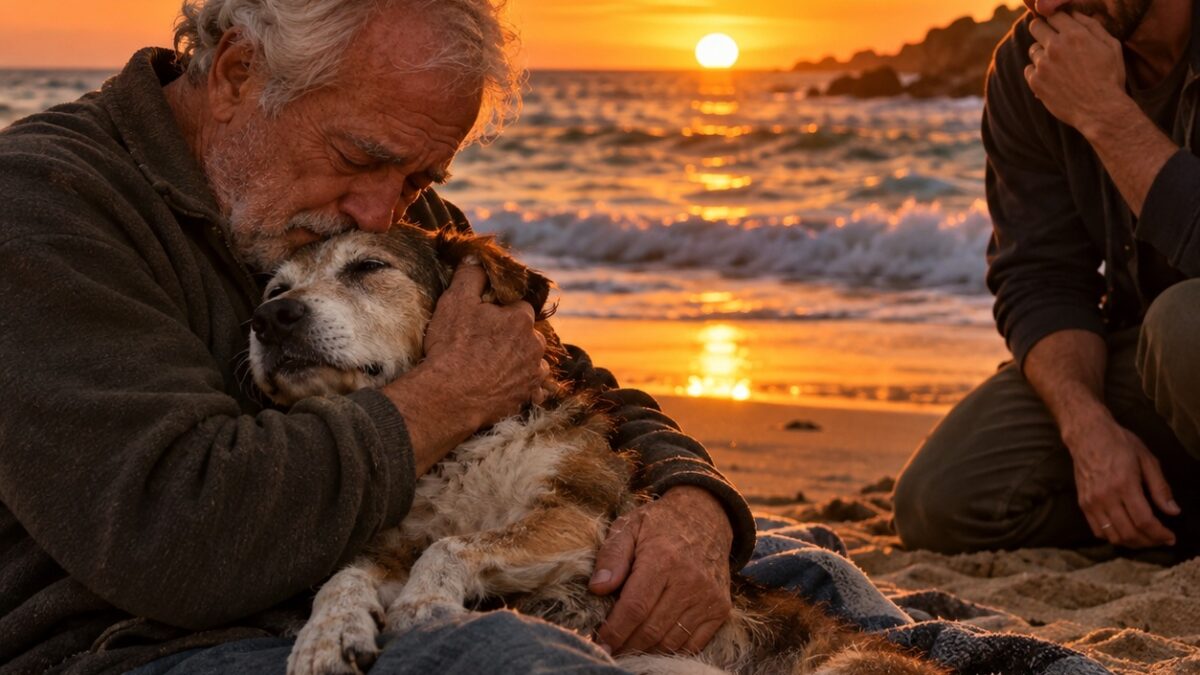
Dad carried Bruno all the way to the wet edge.
His arms shook.
Not only because Bruno was heavy.
Because Dad was trying very hard not to cry.
I walked beside him with the blanket.
“Here?”
Dad looked around.
Then toward the horizon.
“Yeah.”
He lowered himself carefully.
Set Bruno on the blanket.
Bruno tried to stand.
His front legs pushed.
His back legs followed slowly.
For half a second, I thought he might actually walk toward the water.
Then his body gave out.
Dad caught him before he hit the sand.
“No, no.”
Dad gathered him back against his chest.
“You don’t have to.”
Bruno breathed heavily.
His eyes moved toward the ocean.
Dad sat.
I sat beside them.
The three of us watched the water.
No one spoke for several minutes.
Bruno’s ears moved when a wave broke louder than the others.
Dad smiled.
“You hear that?”
Bruno blinked.
“That’s the Atlantic.”
I looked at Dad.
“He doesn’t know what the Atlantic is.”
Dad kept looking at Bruno.
“He knows water.”
That was Dad.
He had always spoken to Bruno as if the dog understood every word.
Maybe he did not understand the sentences.
But he understood Dad.
That mattered more.
Bruno had understood Dad during years when I sometimes couldn’t.
My mother left when I was eight.
I do not mean she died.
Sometimes people hear a story like ours and assume that because grief was involved, death must have caused it.
It did not.
She left.
There were adult reasons.
Arguments I only partly understood.
Things my father never told me.
Things my mother explained differently years later.
What I understood at eight was simple.
One day she lived with us.
Then she didn’t.
Dad became quieter after that.
He worked.
Came home.
Cooked.
Cleaned.
Helped with homework.
Made sure I got to school.
He did everything a responsible father was supposed to do.
But something inside him had shut down.
He smiled less.
Music disappeared from the kitchen.
He stopped inviting friends over.
Sometimes I heard him moving around late at night when he thought I was asleep.
Then Bruno arrived in the rain.
One day.
That was what Dad said.
By morning, the dog was still hiding behind the kitchen table.
When Dad tried to approach, Bruno lowered himself flat against the floor.
I had never seen a dog make himself look that small.
Dad stopped.
Set a bowl several feet away.
Then sat with his back against the refrigerator.
He did not touch Bruno.
Did not call him.
Just sat.
Eventually Bruno crept forward.
Ate.
Ran back.
Dad looked at me.
“One day.”
By afternoon, he had bought dog food.
By evening, a collar.
Next morning, Bruno was still there.
“Shelter?” I asked.
Dad was making eggs.
“Monday.”
It was Saturday.
Monday came.
Dad called the shelter.
Then told me they were full.
Maybe they were.
I never checked.
Tuesday, Bruno followed Dad from the kitchen to the garage.
Wednesday, he slept beside the couch instead of behind it.
Thursday, he let me touch his head.
Friday, Dad took him to a veterinarian.
A week later, Bruno had tags.
A bed.
A leash.
And, apparently, a family.
He learned our routines before either of us realized he had decided to stay.
My alarm went off.
Bruno appeared.
Dad opened the refrigerator.
Bruno appeared.
School bus arrived.
Bruno waited at the window.
Dad’s truck turned into the driveway in the evening.
Bruno reached the door before I did.
Then came the passenger seat.
It happened without training.
One Saturday, Dad opened the car to load groceries.
Bruno jumped inside.
Climbed into the passenger seat.
Sat.
Dad stared at him.
I stood behind Dad laughing.
“What?”
Dad looked at me.
“I didn’t invite him.”
Bruno stared through the windshield.
“You’re driving him somewhere now.”
“I am not.”
Bruno remained seated.
Dad looked at the dog.
Then me.
Then back at Bruno.
And he smiled.
Not a polite smile.
Not the tired thing he had been giving relatives when they asked whether we were okay.
A real one.
The first real smile I remembered seeing since Mom left.
“Fine.”
Dad walked around to the driver’s side.
“Where are we going?”
I climbed into the back.
“Anywhere.”
That became their ritual.
Dad driving.
Bruno in the passenger seat.
Me behind them.
Bruno’s head out the window whenever the speed was low enough.
Ears beating in the wind.
Dad occasionally reaching over to steady him.
Our family had been two people learning how to be lonely together.
Then a dog made us three.
Sitting on the beach twelve years later, I thought about that first car ride.
Bruno was now curled against Dad’s chest.
Too weak to sit in any seat.
Dad ran one hand down his back.
Slowly.
Again.
Again.
The waves continued.
Bruno’s breathing became calmer.
For a while, I let myself pretend he was simply tired.
We had done that for weeks.
Every bad day:
He’s tired.
Every unfinished meal:
He ate earlier.
Every time his legs slipped:
The floor is slick.
Hope can become denial without anyone noticing the exact moment.
The veterinarian had been gentle.
She had known Bruno since he was young.
She did not tell us we had to let him go immediately.
She simply told Dad:
“You’re going to have to watch him very carefully now.”
Dad had asked:
“How will I know?”
The veterinarian’s eyes softened.
“You’ll know when he has more difficult moments than comfortable ones.”
Dad hated that answer.
I know because he complained about it in the car.
“That’s not an answer.”
“It is.”
“How do you measure that?”
“I don’t know.”
“What if I get it wrong?”
I had no answer.
Bruno sat in the passenger seat that day.
He turned and looked at Dad.
Dad touched his head.
“You’re not helping.”
Bruno licked his fingers.
Then came the night Bruno could no longer climb the porch steps.
Dad carried him.
The next morning, Bruno did not want breakfast.
He drank water.
Slept.
Woke.
Tried to follow Dad across the kitchen.
His legs buckled.
Dad caught him.
I watched from the doorway.
Dad did not say anything.
But that evening he called the veterinarian.
Then he came into my room.
“Tomorrow we’re taking Bruno to the ocean.”
I looked at him.
The way he said it told me everything.
“Tomorrow?”
“Yeah.”
“Then what?”
Dad stared at the floor.
“We’re going to give him a good day.”
I hated him for not answering.
Then hated myself because I knew he had.
At the beach, Bruno remained against his chest.
Hours passed strangely.
We had food but barely ate.
Dad offered Bruno water.
He drank a little.
At one point, I carried him closer to the surf.
A wave reached my shoes.
Bruno’s paw touched wet sand.
He lifted his nose.
Wind.
Salt.
Seaweed.
All those smells entering a world he had never experienced before.
His eyes seemed brighter for a moment.
Dad crouched beside us.
“What do you think, buddy?”
Bruno sniffed.
Another wave came.
He did not move away.
Dad laughed quietly.
“He likes it.”
“How do you know?”
“I know.”
Maybe he did.
We spent the afternoon telling Bruno stories he already knew.
The time he stole an entire roast from the kitchen counter.
The squirrel he chased into Mrs. Palmer’s yard and refused to abandon for forty minutes.
The winter he destroyed one of Dad’s work boots and then slept with the other like a pillow.
The time I had chickenpox and Bruno refused to leave my bedroom for three days.
The first thunderstorm when he crawled under Dad’s bed.
The last thunderstorm, years later, when he barely opened one eye.
I reminded Dad about my eleventh birthday.
That year at school had been awful.
A group of boys discovered the easiest thing to use against me.
My mother.
Children can find a wound with the efficiency of surgeons and none of the compassion.
One boy asked if my mother had left because she did not like me.
Another said his mom told him some women “just don’t want their kids.”
I punched him.
Got sent home.
Dad had to leave work early.
In the car, he asked:
“You want to tell me what happened?”
“No.”
“School says you hit somebody.”
“He deserved it.”
“Probably.”
That surprised me enough to look at him.
Dad continued:
“You still can’t hit him.”
I stared out the window.
Then started crying.
Not quietly.
I had held it in for hours.
“What if she left because of me?”
Dad pulled the car over so fast I thought something was wrong.
He turned.
“Your mother leaving had nothing to do with you.”
“How do you know?”
“Because I do.”
“Maybe she didn’t want me.”
“Elias.”
His voice broke.
“Do not carry that.”
I looked away.
He reached back.
I refused his hand.
That night, I locked myself in my room.
Bruno scratched once at the door.
I opened it.
He came in.
Climbed onto the bed.
Laid his head on my legs.
He did not tell me my mother loved me.
Did not explain divorce.
Did not offer advice.
He simply stayed.
I cried into his fur.
Eventually slept.
When I woke, Bruno had not moved.
That was one of his gifts.
Presence without questions.
Dad needed that gift too.
He never admitted how badly.
But I heard him talking to Bruno late at night.
At first I thought it was ridiculous.
Then I realized the things Dad said to the dog were things he could not say to anyone else.
He told Bruno when work was bad.
When money scared him.
When he was angry at Mom.
When he missed her.
When he worried he was failing me.
Once, when I was fourteen, I came downstairs for water and heard Dad in the living room.
Bruno lay beside his chair.
Dad had one hand resting on his head.
“I don’t know if I’m doing this right.”
Bruno’s tail tapped the floor.
Dad laughed.
“That’s your answer to everything.”
I backed upstairs before he saw me.
That was the first time I understood Bruno had not only become our dog.
He had become the place where Dad put all the words he could not carry alone.
Now, on the beach, Dad stroked the same old head.
Bruno’s fur was thinner.
Gray.
His eyes cloudy.
Dad whispered:
“You did good.”
I looked away toward the water.
I did not want to cry in front of him.
Then I thought:
Why?
So I cried.
Dad did too.
We sat there holding Bruno between us as evening arrived.
The clouds thinned.
Sunlight broke through near the horizon.
Orange light spread across the water.
Bruno lifted his head.
It took effort.
Dad supported him beneath the chest.
“Look.”
The sun touched the ocean.
Bruno stared toward it.
Maybe.
Or maybe his eyes were simply open in that direction.
I do not need to know.
He was there.
We were there.
That was enough.
As the air cooled, Dad wrapped him in the old blanket.
The same blanket Bruno had slept on for years.
It still carried his hair.
Probably always would.
We did not leave.
Dad had rented a small place nearby, but neither of us wanted to take Bruno away from the water yet.
We sat on the sand.
Night came.
Stars appeared between clouds.
The moon broke through occasionally, silvering the waves.
Bruno’s breathing slowed.
I knew.
Dad knew.
No one said it.
Around us, the beach became almost black.
Dad held Bruno across his lap.
I sat pressed against his shoulder.
My hand rested on Bruno’s back.
His chest rose.
Fell.
Long pause.
Rose again.
Dad whispered:
“You can rest.”
I felt myself break.
“No.”
Dad looked at me.
I shook my head.
“No.”
He reached for me with one hand while still holding Bruno.
“Elias.”
“He can’t.”
My voice sounded like a child’s.
Not mine.
Nine years old again.
Losing somebody again.
“He can’t go.”
Dad pulled me closer.
Bruno breathed.
I put my face against his fur.
“Please.”
I had no idea what I was asking.
Please stay.
Please don’t hurt.
Please make this not happen.
Please make twelve years reversible.
Bruno’s body relaxed.
Dad whispered:
“You saved us, buddy.”
His voice broke.
“You hear me?”
Bruno’s ear shifted.
Maybe wind.
Maybe him.
Dad continued:
“You don’t have to do anything else.”
Another breath.
“You can rest.”
Bruno exhaled.
Then there was no next breath.
At first I waited.
I counted.
One second.
Two.
Three.
Four.
Dad placed his hand against Bruno’s chest.
His face changed.
I knew before he spoke.
“Oh, buddy.”
Dad bent over him.
Pressed his forehead against Bruno’s head.
I kept my hand on Bruno’s back.
Still warm.
Still soft.
But something had changed so completely that no one needed a medical explanation.
Bruno was gone.
He died peacefully.
No struggle.
No dramatic final movement.
He simply stopped fighting.
As if Dad had finally given him permission.
We stayed on the beach for a long time.
Dad did not speak.
He held Bruno.
I sat beside him.
The waves kept coming.
That offended me at first.
How dare they continue?
How could water keep moving when Bruno was dead?
Then slowly, the repetition became comforting.
Wave.
Retreat.
Wave.
Retreat.
The world did not stop.
Maybe that was cruel.
Maybe merciful.
Eventually, the stars became brighter.
Dad’s face looked different in moonlight.
Older.
His hair had gone almost completely gray over the previous years.
Lines deep around his eyes.
But there was peace there too.
Not happiness.
Peace.
I had never understood how grief and peace could occupy the same face.
Now I did.
Bruno was dead.
And Bruno was no longer hurting.
Those truths existed together.
Dad looked toward the water.
“Thank you.”
I did not know whether he meant me.
Bruno.
The ocean.
God.
All of it.
We finally stood.
Dad lifted Bruno.
The weight of him was different now.
I hated noticing that.
He carried him to the car.
Placed him carefully across the back seat.
Wrapped the old blanket around his body.
Then Dad got into the driver’s seat.
I climbed beside him.
Neither of us looked backward first.
We looked at the passenger seat.
Empty.
That was Bruno’s seat.
Everyone in our family knew it.
If I sat there, Bruno would stand beside me until I surrendered.
If someone else rode with Dad, Bruno sat behind them looking deeply insulted.
Mornings before work, he was there.
School trips.
Veterinarian.
Grocery store.
Aimless drives after bad days.
Passenger seat.
Head out the window.
Ears moving.
Now the seat held nothing.
Dad placed one hand on the steering wheel.
Did not start the car.
I watched him.
He whispered:
“I don’t know how to drive home without him there.”
That sentence hurt more than anything at the beach.
Because it was ordinary.
Death does not only remove the big things.
It removes where someone sits.
The sounds in a room.
The reason you open the back door at a certain time.
The bowl beside the refrigerator.
The shape of daily life.
I reached across the console.
Held Dad’s arm.
He started the car.
The road home was long.
It did not feel long.
We barely spoke.
I looked out at the dark sky.
Stars appearing and disappearing behind clouds.
Memories came without order.
Bruno as a puppy.
Bruno old.
Bruno sleeping beneath my desk while I studied.
Bruno waiting at the door for Dad.
Bruno riding in front.
Bruno muddy.
Bruno scared.
Bruno brave.
The night Dad brought him home kept returning most strongly.
Rain.
Kitchen.
Shaking body.
Dad saying:
“One day.”
I understood something on that drive I had missed as a child.
Dad had not rescued Bruno because he was ready for another responsibility.
He rescued him because both of them looked abandoned.
Bruno had been physically alone.
Dad had been emotionally alone.
Maybe each recognized something in the other.
Dad kept Bruno because caring for him created a reason to be gentle with something when gentleness had become difficult.
Then Bruno gave that gentleness back.
We reached home near morning.
Dad pulled into the garage.
Turned off the engine.
Again we sat.
Passenger seat empty.
Bruno behind us wrapped in the blanket.
I could smell him.
That familiar dog smell people apologize for when visitors come over.
I would have given anything for the whole car to smell like him forever.
Dad stared at the empty seat.
Then said:
“I thought I saved him.”
I looked at him.
He swallowed.
“When I found him that night.”
His eyes stayed forward.
“I thought I was doing him a favor.”
Long silence.
Then he turned toward me.
“But he saved us.”
I could not answer.
I put my head against Dad’s shoulder.
He leaned his head against mine.
We sat there beside an empty passenger seat and a dog who would never sit in it again.
That was the lowest point.
Not the beach.
Not his final breath.
The garage.
Because the goodbye had ended.
Now we had to live afterward.
The next morning, the house was wrong.
That is the only word.
Wrong.
I woke and waited for Bruno’s nails against the hallway floor.
Nothing.
I came downstairs.
His bowl was still beside the kitchen cabinet.
Dad had made coffee.
Two mugs.
He sat at the table.
Neither of us touched breakfast.
The house felt enormous.
Dad looked terrible.
Red eyes.
Same shirt from the night before.
I sat opposite him.
We said nothing.
A whole family’s worth of silence collected between us.
Then Dad stared into his coffee.
“I think we should save another one.”
I thought I had misheard.
“What?”
He looked up.
“I think we should rescue another dog.”
Anger came first.
Fast.
“No.”
Dad blinked.
“Elias—”
“No.”
“I’m not saying today.”
“You just said we should go get another dog.”
“I said I think we should save another one.”
“That’s the same thing.”
“It isn’t.”
I stood.
“You’re replacing him.”
Dad’s face changed.
“No.”
“He died last night.”
“I know.”
“Then why are you talking about another dog?”
“Because Bruno—”
“Don’t.”
I hated myself almost immediately.
But grief is not polite.
It looks for somewhere to go.
Dad stood too.
“Sit down.”
“I don’t want another dog.”
“Okay.”
“I don’t want some dog sitting in his seat.”
“Okay.”
“I don’t want you calling it Bruno.”
“I would never do that.”
I looked at him.
That calmed me slightly.
Dad walked around the table.
He put both hands on the back of a chair.
“I’m not trying to replace him.”
“Then why?”
His eyes filled.
“Because yesterday, while I was holding him, I kept thinking about the first night.”
I did not speak.
“The rain. The gas station. How scared he was.”
Dad looked toward Bruno’s empty bowl.
“What if I had driven past?”
My throat tightened.
“He was only supposed to stay one night.”
“I know.”
“Then twelve years happened.”
Dad wiped his face.
“Bruno gave us twelve years we didn’t know we needed.”
He looked at me.
“If there’s another dog sitting somewhere feeling the way he felt that night…”
He stopped.
His voice cracked.
“I don’t know, Elias. I just don’t think I can pretend I didn’t learn anything from him.”
The anger left.
Not the grief.
That remained.
I sat again.
Dad did too.
For a long time, we drank cold coffee.
Then I said:
“Not a replacement.”
“Never.”
“Not Bruno’s bed.”
“Okay.”
“Not his collar.”
“Of course not.”
“And we don’t have to pick one.”
Dad nodded.
“We can just look.”
That was how we ended up at the shelter later that day.
I almost turned around at the entrance.
Too soon.
Everything was too soon.
The volunteer asked what kind of dog we wanted.
Dad said:
“We don’t know.”
She nodded like she understood that answer better than any breed request.
We walked down the kennel corridor.
Dogs barked.
Jumped.
Stared.
Some pushed noses through the bars.
Others stayed back.
I looked at each pair of eyes and hated myself for comparing them.
Bruno’s eyes had been brown.
This dog’s were lighter.
Bruno’s ears folded differently.
Bruno was smaller than that one.
It felt disloyal.
Then I saw him.
Small dog.
Thin.
Curled in the far corner.
Not barking.
Trembling.
I stopped.
Dad almost walked past me.
Then noticed.
The dog looked up.
There was something familiar in the expression.
Not because he resembled Bruno physically.
He did not.
It was the sadness.
The guardedness.
The way he seemed to expect that being noticed would lead to something unpleasant.
I crouched.
Dad remained behind me.
The dog pressed farther into the corner.
I did not reach through the bars.
I waited.
Five minutes.
Maybe more.
The shelter hallway remained loud.
Other dogs barked.
People walked past.
This little dog watched me.
Eventually, I extended my hand low.
Far enough that he could approach if he wanted.
He did not.
I started to withdraw.
Then he stood.
One step.
Stopped.
Another.
He came close enough to sniff my fingers.
Then, very slowly, he licked my hand.
Behind me, Dad inhaled sharply.
I turned.
He was crying.
Smiling too.
“He has the same eyes.”
I looked back at the dog.
“No.”
Dad wiped his face.
“What?”
“He has his own eyes.”
Dad nodded.
“You’re right.”
Then after a moment:
“But I know that look.”
“So do I.”
We asked about him.
Fearful.
Underweight.
Had not been there long.
Needed patience.
No dramatic backstory was necessary.
He was alone.
That was enough.
Dad looked at me.
“What do you think?”
I looked at the dog.
The dog looked at my hand.
I thought about Bruno’s last night.
About the passenger seat.
About Dad whispering:
He saved us.
Then I said:
“Let’s take him home.”
We named him Olivier.
I do not remember exactly who suggested it.
It simply fit.
The shelter helped us with paperwork.
Food.
Adjustment advice.
Then suddenly Olivier belonged to us.
Or we belonged to him.
Those things are difficult to separate.
In the car, he sat in the back seat beside me.
Trembling.
I kept one hand gently against his back.
Dad drove.
Neither of us spoke.
At a red light, Dad looked at the passenger seat.
Empty.
I saw it.
He looked forward again.
I wondered whether bringing Olivier home had been a terrible mistake.
Then we reached the house.
Dad opened the garage.
Parked.
I unclipped Olivier carefully.
Before I could guide him out of the back seat, he climbed over the center area.
Into the front.
Onto the passenger seat.
He sat.
Looked at Dad.
Then me.
Then Dad again.
Everything inside me stopped.
Dad’s hands tightened around the steering wheel.
For one horrible second I thought he would break down.
Instead, Olivier’s tail moved.
One tiny wag.
Barely visible.
Dad laughed through tears.
I did too.
The seat was not Bruno’s because Bruno’s body had occupied it.
It was Bruno’s because love had filled it.
And love, somehow, had left enough room for another frightened dog to sit there.
That did not erase Bruno.
It made what Bruno had given us useful again.
The first weeks with Olivier were difficult.
Of course they were.
He was not Bruno.
That sounds obvious.
Grief made us forget.
Bruno had known our routines for twelve years.
Olivier knew nothing.
The sound of Dad dropping keys made him jump.
Quick movement sent him behind furniture.
He did not understand where to sleep.
He ate too fast at first.
Then sometimes refused food if we stood too near.
At night, he paced.
I would wake and hear his nails moving down the hallway.
Once I found Dad sitting on the kitchen floor with him at 2:00 a.m.
Dad had placed food several feet away.
Olivier stayed near the doorway.
Dad did not move.
The scene looked so much like Bruno’s first morning that I felt physically dizzy.
Dad noticed me.
“Go back to bed.”
I sat beside him.
We waited.
Eventually Olivier ate.
Dad smiled.
“Progress.”
I realized then that grief had not made Dad weaker.
It had made him patient.
Bruno had trained us for this.
Not intentionally.
But he had.
We knew now that trust could take days.
Weeks.
Months.
We knew a frightened dog was not rejecting us personally.
We knew not to rush.
Olivier began changing.
First, he stopped hiding every time Dad entered.
Then he waited near the door when Dad returned from work.
One afternoon I came home and found Olivier sleeping beside my bed.
Not on it.
Not touching anything.
Just nearby.
A week later, he slept at the foot.
Then came the garden.
At first he stood on the porch.
Would not step into the grass.
Dad sat outside.
Coffee in hand.
No leash pressure.
Eventually Olivier came down.
Sniffed.
Ran back.
Next day, farther.
Soon he discovered that the backyard contained squirrels.
Fear lost a little ground.
Then more.
Olivier began playing.
Awkwardly.
As if he had forgotten how.
He chased a ball once, then looked confused when it stopped moving.
I threw it again.
He chased.
Third time, brought it halfway back.
Dad clapped.
Olivier panicked at the noise.
Dad immediately stopped.
“Sorry.”
That became us.
Learning him.
He learned us.
The passenger seat remained his favorite place.
Every morning Dad opened the car.
Olivier climbed in.
At first, Dad froze every time.
I noticed.
He would look at the dog.
Then through the windshield.
For a fraction of a second, his face belonged to the past.
Eventually that changed.
The memories remained.
The pain softened.
One morning, I asked:
“Do you think about Bruno when Olivier sits there?”
Dad rested one hand on the steering wheel.
“Every time.”
“Does it hurt?”
“Yes.”
Then:
“Not only.”
I understood.
Grief had stopped being one thing.
At the beginning, Bruno’s memory was pain because memory was proof he was gone.
Over time, memory became warmth too.
Laughter.
Gratitude.
The ache remained.
But it shared the room with other feelings.
That may be how love survives loss.
Not by removing grief.
By growing around it.
Months passed.
Olivier filled out.
His coat improved.
He learned toys.
Doors.
Our voices.
Dad’s work schedule.
My footsteps.
He started running to the entrance when Dad returned.
Exactly as Bruno had.
The first time, I saw Dad stop outside through the window.
He stood on the porch looking at Olivier on the other side of the door.
Then Dad smiled.
Same smile.
The one I remembered from years ago when Bruno first claimed the passenger seat.
Hope.
I finally understood it.
That was the expression I had seen in the kitchen when I was nine.
Dad holding a trembling stray in the rain.
“One day.”
Even then, part of him had known.
Not that Bruno would live twelve years.
Not that he would become our family.
Only that caring for something could make tomorrow feel different from today.
Olivier did not save us from Bruno’s death.
That would be unfair to both dogs.
He gave grief somewhere to place its tenderness.
That is different.
We still missed Bruno.
I sometimes walked into a room expecting him.
Dad occasionally called Olivier “Bru—” and stopped.
The first time, Dad looked horrified.
“I’m sorry.”
Olivier wagged.
I laughed.
“He doesn’t care.”
“I care.”
“Bruno wouldn’t.”
Dad considered.
“No.”
Then laughed too.
We kept Bruno’s old collar.
Not on Olivier.
In a drawer with his tags.
His blanket was washed eventually.
That nearly caused an argument.
Dad did not want to.
I understood.
The blanket still smelled like Bruno.
But after a while, it smelled mostly like grief and an old dog blanket.
We washed it.
Folded it.
Kept it.
His favorite toy stayed on a shelf.
The passenger seat belonged to whoever sat there.
Memory did not require freezing the house.
That took us time to learn.
One evening Dad and I sat on the front porch.
Olivier lay across our feet.
Sunset turned the sky orange.
Dad had coffee.
I had a soda.
For a while, none of us moved.
Then I asked:
“Dad?”
“Yeah?”
“When you brought Bruno home that first night and said one day…”
Dad smiled.
“I remember.”
“What if you hadn’t brought him home?”
The smile faded.
He looked toward the yard.
Long silence.
“I don’t know.”
“Would we have been okay?”
Dad rubbed one thumb against his mug.
“Probably.”
That surprised me.
I expected something more dramatic.
“We would’ve survived.”
He looked at me.
“But survival and living aren’t always the same.”
I waited.
Dad glanced down at Olivier.
“I thought I was saving Bruno from being alone.”
Then:
“He saved me from being alone too.”
His voice softened.
“And you.”
I leaned against his shoulder.
Dad continued:
“He didn’t bring your mom back.”
“I know.”
“He didn’t fix everything.”
“I know.”
“He just made the house feel like somewhere worth coming home to.”
That was exactly right.
Bruno had not solved our lives.
He had inhabited them.
That was enough.
Olivier lifted his head.
Looked from Dad to me.
Then put his chin back on Dad’s shoe.
Dad smiled.
“And now this one’s eating my laces.”
I laughed.
The story of Bruno did not end when he died at the beach.
That sounds sentimental.
I know.
But I do not mean he lived literally through Olivier.
Olivier was his own dog.
His own fears.
His own habits.
His own strange hatred of vacuum cleaners.
His own obsession with stealing socks.
Bruno remained Bruno.
What continued was the change he had made in us.
Before Bruno, Dad saw a frightened animal and said:
“One day.”
After Bruno, Dad saw another frightened animal and said:
“We should save him.”
That difference was Bruno’s legacy.
I changed too.
As a child, I thought rescue meant taking someone out of danger.
Later I learned that is only the beginning.
Bruno was removed from one bad night.
Then he needed years of ordinary belonging.
Olivier was adopted from the shelter.
Then he needed trust.
Routine.
Patience.
Safety repeated until it became expectation.
That is what home is.
Not one door opening.
The same door opening every day.
The first anniversary of Bruno’s death, Dad asked whether I wanted to go back to the beach.
I said yes.
We took Olivier.
Dad drove.
Olivier in the passenger seat.
Me behind.
At first that arrangement felt almost too symbolic.
Then Olivier sneezed all over the dashboard.
Dad swore.
I laughed.
Bruno would have approved.
We reached the same beach.
Same ocean.
Different sky.
Bright blue.
Wind stronger.
Olivier had never seen the sea.
When we let him onto the sand, he lost his mind.
He ran.
Stopped.
Sniffed.
Ran again.
Then a wave reached him.
Olivier jumped backward with such offense that Dad doubled over laughing.
“He thinks it attacked him.”
Olivier barked at the ocean.
The Atlantic remained unmoved.
I stood near the place where I believed we had sat with Bruno.
It was impossible to know exactly.
Sand changes.
Water moves.
That helped.
There was no sacred marker.
No precise spot I could cling to.
Only sea.
Dad came beside me.
Olivier continued challenging waves.
“You okay?” Dad asked.
“Yeah.”
We watched the water.
I remembered Bruno’s final breath.
It still hurt.
But the pain no longer erased everything before it.
I could remember the sunset too.
Dad telling him he could rest.
Bruno hearing the sea.
Twelve years.
Not just one night.
I said:
“Do you think we did the right thing?”
Dad knew what I meant.
“With Bruno?”
“Yeah.”
He stared toward the horizon.
“I think we waited until he was tired enough to tell us.”
“How?”
Dad thought.
“He stopped asking for more days.”
That answer stayed with me.
Bruno had always wanted another walk.
Another drive.
Another meal.
Another morning.
Near the end, he wanted rest.
Dad had finally seen it.
Love sometimes means holding on.
Sometimes it means recognizing the difference between keeping someone alive and asking them to stay because you are not ready.
I still do not know how Dad found the courage.
Maybe he did not.
Maybe courage is simply doing the right thing while every part of you wants another answer.
Olivier ran toward us.
Wet.
Covered in sand.
He shook.
Water hit both of us.
Dad shouted:
“Seriously?”
I laughed.
The solemn moment ended.
Good.
Bruno never liked solemnity either.
He liked food.
Wind.
Riding shotgun.
Being near us.
So we spent the afternoon the way he would have wanted.
Walking.
Throwing a ball.
Eating sandwiches.
Letting Olivier investigate everything.
Before sunset, Dad sat in the sand.
Olivier curled beside him.
I took a picture.
Dad looked older.
White hair.
Lines around his eyes.
But not empty.
That mattered.
When Mom left, loneliness had hardened him.
Bruno had reopened something.
Bruno’s death had almost closed it again.
Olivier kept it open.
Not because one dog replaces another.
Because love is practice.
If you stop practicing after loss, grief becomes the only thing you do well.
Dad chose differently.
The hardest lesson Bruno gave us was that loving deeply guaranteed pain eventually.
You could use that as a reason never to love another dog.
Or as proof that the years before the pain had been worth something.
Dad chose the second.
I am grateful he did.
Today, while I write this, Olivier is lying near my feet.
Dad is in the kitchen making coffee.
Morning light comes through the window.
The house sounds familiar.
Cup against counter.
Refrigerator.
Olivier sighing dramatically because nobody has fed him the second breakfast he believes he deserves.
Some things changed.
Some did not.
Dad still talks to the dog.
He tells Olivier about work.
About bills.
About me.
Sometimes about Bruno.
One night I heard him say:
“You know you’re only here because another dog taught me better.”
Olivier yawned.
Dad laughed.
“That’s what Bruno would’ve said.”
I stayed in the hallway.
Smiling.
Every morning, Dad opens the car.
Olivier climbs into the passenger seat.
Dad places one hand on the wheel.
The other briefly on Olivier’s back.
Then they leave.
From the doorway, sometimes I see Bruno too.
Not literally.
Memory does not work like a ghost standing in one place.
I see him in the shape of the ritual.
A dog beside Dad.
A hand on fur.
A car pulling away.
What Bruno created continues.
There are days when that comforts me.
There are days when it hurts.
Both are allowed.
Grief does not become successful when it disappears.
It becomes livable when love no longer feels trapped entirely in the past.
For us, Olivier was not a replacement.
He was proof that Bruno had made us capable of doing something again.
Opening the door.
That is what Bruno’s life became.
An open door.
The night Dad found him.
The day he chose our house.
The passenger seat.
The bedroom door he scratched when I was crying.
The space beside Dad’s chair.
The final trip to the ocean.
Then the shelter door opening for Olivier.
One life creating room for another.
There is a photograph on Dad’s desk now.
Bruno in the passenger seat.
Young.
Head out the window.
Ears flying.
Beside it is another picture.
Olivier on the same seat.
Not posed.
Looking toward Dad.
People who do not know us might think they are photographs of two dogs who happened to sit in the same place.
They would be right.
And completely wrong.
Between those photographs lies most of my childhood.
My father’s loneliness.
My own sadness.
A marriage ending.
A frightened stray becoming family.
Twelve years.
A beach.
A death.
An empty seat.
A shelter.
A trembling dog.
One tiny tail wag.
Hope returning.
Dad once told me that when you love an animal, the contract is unfair.
You know, if things happen naturally, you will probably outlive them.
You agree anyway.
You feed them.
Take them to the veterinarian.
Complain about hair.
Take pictures.
Teach them where to sleep.
Then one day you carry them when they cannot walk.
And eventually you say goodbye.
I asked:
“Why do it?”
Dad looked at Bruno’s photograph.
“Because the goodbye isn’t the whole story.”
That is the answer.
Bruno’s death hurt because his life mattered.
If we could remove the pain by removing those twelve years, neither Dad nor I would take that deal.
Not for a second.
I would still choose the rain.
The kitchen.
“One day.”
I would choose the chewed work boot.
The school nights.
The passenger seat.
The fur on every dark shirt I owned.
I would choose the final drive.
Even knowing exactly how it ended.
Because love is not proven by escaping grief.
Sometimes grief is simply the receipt for having received something priceless.
Bruno gave us more than we ever gave him.
Dad had been right in the garage.
He saved us.
Not dramatically.
He did not drag anyone from a burning house.
He saved us by needing breakfast.
By waiting at the door.
By making Dad laugh.
By sitting with a lonely child.
By listening to a lonely man.
By forcing our little broken family to organize itself around something besides loss.
That is rescue too.
People think adoption is one direction.
Person saves animal.
Sometimes.
But often the animal enters a house and quietly begins rescuing rooms nobody knew were in danger.
The kitchen.
The car.
The bedroom.
The heart.
Bruno did that.
Olivier is doing it now in his own way.
Years after Bruno’s death, Dad and I still talk about the beach.
Not constantly.
We do not need to keep reopening the wound to prove we remember.
But sometimes the weather looks similar.
Clouds.
Silver water in a photograph.
A moon half covered.
Then Dad will say:
“He liked the ocean.”
I used to correct him.
“He barely moved.”
Dad would answer:
“He liked it.”
Eventually I stopped arguing.
Maybe Bruno did.
Maybe Dad needed to believe it.
There are worse things.
The final thing I remember most clearly about that night is not Bruno dying.
It is Dad’s face afterward.
Holding him.
Looking toward the sea.
Peace.
I understand that peace now.
Bruno had stayed as long as he could.
Dad had fulfilled his promise.
Not the one-day promise.
The real promise.
The one he never spoke aloud when he brought that shaking dog into our kitchen.
You are safe here.
I will take care of you.
I will not abandon you.
And when you cannot go farther, I will carry you.
He did.
All the way to the ocean.
All the way through the final breath.
Then home.
The next morning, Bruno gave us one more thing without being there.
A decision.
Save another.
Olivier arrived.
Not because grief was finished.
Because it wasn’t.
Love made room anyway.
That is where I choose to end Bruno’s story.
Not with his body wrapped in the blanket.
Not with the empty passenger seat.
Not even with the beach.
I end it on an ordinary morning now.
Dad reaches for his keys.
Olivier hears them.
He runs toward the garage.
Dad opens the car.
Olivier jumps onto the passenger seat.
He turns once.
Settles.
Dad gets behind the wheel.
Before starting the engine, he places his hand on Olivier’s back.
For one second, he looks at the photograph clipped near the console.
Bruno.
Young.
Brown eyes.
Ears in the wind.
Dad smiles.
Then he starts the car.
They leave.
I stand in the doorway watching until the car disappears.
And I no longer think the passenger seat became empty the night Bruno died.
I think it became full in a different way.
Full of twelve years.
Full of hair Dad never managed to vacuum completely out.
Full of drives.
Full of laughter.
Full of silence.
Full of the dog who was only supposed to stay one day and somehow taught two grieving people how to become a family again.
Olivier does not erase any of that.
He sits on top of it.
He adds his own story.
That is what love does when we let it survive loss.
It does not replace.
It continues.
It changes shape.
First, a frightened dog in Dad’s arms.
Then a passenger beside him.
Then an old dog listening to the ocean.
Then memory.
Then courage.
Then another frightened dog licking my hand at a shelter.
Then another tail wagging in the same seat.
The shape changes.
The love remains.
Sometimes I still close my eyes and see Bruno with his head out the window.
His ears flap.
Dad laughs.
I am in the back seat complaining that Bruno gets the front.
We are going nowhere important.
Maybe the grocery store.
Maybe the park.
Maybe Dad simply needed to drive.
I did not know then those ordinary minutes would become the memories I protected most carefully.
That is another thing Bruno taught me.
You rarely recognize the sacred moments while they are happening.
They look too ordinary.
A dog in a seat.
A kid doing homework.
A father talking to an animal late at night.
A walk around the block.
A bowl filled every morning.
Then time passes.
Suddenly those small things are the whole story.
So now I pay attention.
When Olivier follows Dad to the door, I notice.
When he sleeps against my feet, I notice.
When Dad complains about dog hair and then kisses the top of Olivier’s head five minutes later, I notice.
I know better now.
These are the days.
Not preparation for something later.
Not replacements for the past.
The days themselves.
Bruno’s last day at the sea was heartbreaking because we knew it was the last.
But perhaps every ordinary day before it would have been more beautiful if we had known how finite they were.
Maybe that is impossible.
Maybe the mercy is that we do not know.
We are allowed to live without constantly thinking:
This may be the last time.
Then when loss comes, memory does its work.
It turns ordinary moments gold.
I do not believe love always wins in the simple way people say.
Love did not stop Bruno from aging.
Did not cure him.
Did not prevent his death.
It did not keep Mom from leaving.
It did not protect Dad or me from grief.
But love did something else.
It kept loss from becoming the only truth.
Bruno died.
True.
Bruno lived with us for twelve years.
Also true.
Bruno left an empty seat.
True.
That empty seat taught us we still had room to help someone else.
Also true.
Pain is not canceled.
It is surrounded.
That is enough.
Dad once said:
“I thought losing Bruno would close something.”
“What?”
“My ability to do that again.”
He nodded toward Olivier.
“What happened?”
Dad smiled.
“Bruno didn’t teach me how to close things.”
He thought for a second.
“He taught me how to open them.”
Doors.
Car doors.
Shelter doors.
Hearts, if you want to be sentimental.
Dad would hate that sentence.
I like it anyway.
The night Bruno died, I thought love had failed because it could not keep him with us.
The next morning, I began understanding that love’s job had never been to make him permanent.
Its job was to make his time matter.
It did.
Bruno’s twelve years mattered.
They mattered to a man who had forgotten how to smile.
To a child who believed his mother might have left because he was unlovable.
To another frightened shelter dog years later who received a home because Bruno had taught us not to walk past fear.
That is more than enough for one dog.
And yet, sometimes when Dad opens the garage and Olivier races toward the passenger seat, I swear there is still one more gift.
Dad laughs.
The same laugh.
The same man who once stood in the kitchen dripping rainwater onto the floor while holding a trembling stray.
Older now.
Whiter hair.
More scars.
Still capable of hope.
That is Bruno’s final legacy to me.
Not that love wins because nothing dies.
Love wins because after death, after loneliness, after the empty seat, we can still choose to love again without betraying what came before.
Bruno taught us that.
Without words.
One day.
That was all Dad promised.
Bruno stayed twelve years.
And somehow, even after he left, he was still teaching us how to stay.








