PART2:We Shaved Away the Matted Fur and Found a Tiny Puppy Underneath—But the Saddest Part Was What Neglect Had Taken From Him
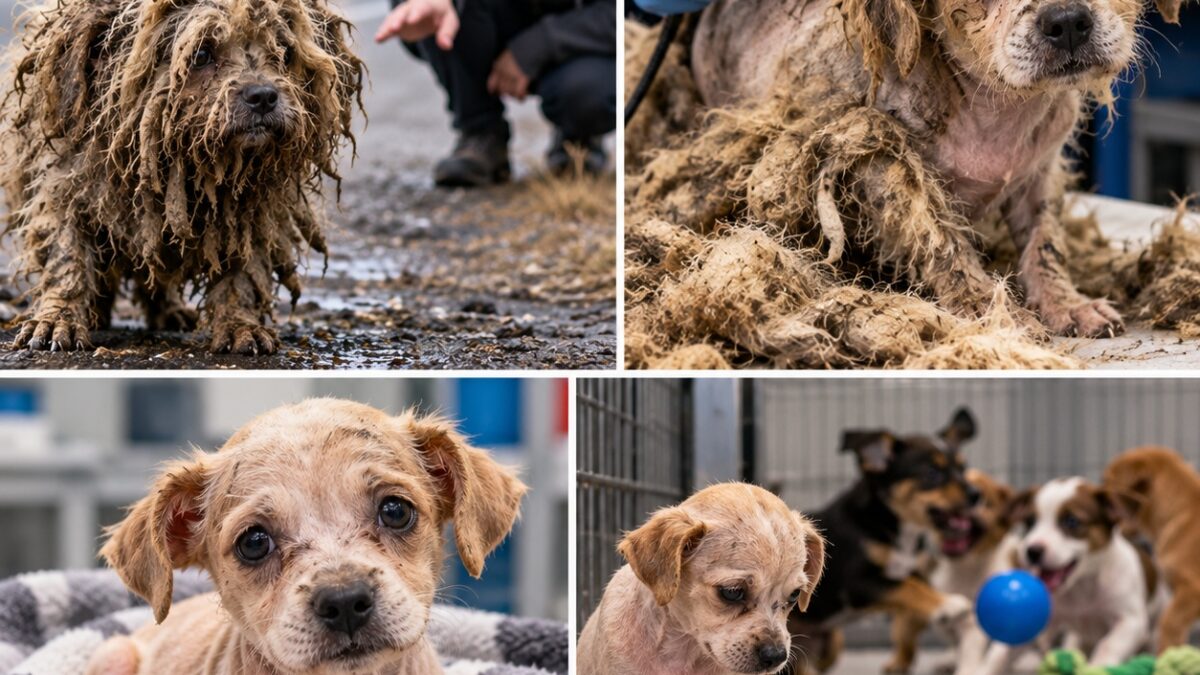
PART2
At first, we gave Angelito time.
That is what frightened dogs need.
Time without pressure.
A safe place.
Food arriving when it is supposed to.
Water that does not need to be searched for.
People passing without reaching too quickly.
Doors opening without forcing him back onto the street.
We assumed that once he understood those things, his puppy personality would appear.
Maybe he would start bouncing around.
Maybe he would steal toys.
Maybe he would wrestle with the others.
Maybe he would become the kind of little dog who exhausted everyone around him simply because he had discovered he could.
We waited.
Angelito stayed quiet.
At the shelter, he often curled himself into the smallest shape he could make.
Head down.
Body tucked.
Watching.
When people passed, his reaction was almost always the same.
Lower the head.
Avoid attention.
Do not ask for anything.
Do not take up too much space.
He was not hiding because anybody there was hurting him.
Nobody was.
That was what made it so difficult to see.
The danger was gone.
His body had not received the message yet.
Safety is a fact before it becomes a feeling.
Angelito was safe.
But he did not know how to live like a safe dog.
The other puppies did.
That difference was impossible to miss.
They played because puppies play.
They chased.
Tumbled.
Bumped into each other.
Grabbed toys.
Lost interest.
Found another toy.
Started games for no reason.
Ended them for no reason.
Puppy life is usually chaotic in the most beautiful way.
Their whole bodies moved with curiosity.
Angelito watched from a distance.
That image broke my heart more than the mats ever had.
His coat had been shocking.
The dirt had been sad.
The roadside rescue had been frightening.
But all of those things were visible problems.
You could look at them and understand what needed to happen.
Remove the mats.
Treat the skin.
Bring him indoors.
Feed him.
Keep him safe.
How do you treat a puppy who does not know how to join other puppies?
How do you give back an experience he should have been having all along?
I watched him one day while two puppies chased each other across the floor.
Angelito lifted his head.
His eyes followed them.
Left.
Right.
Back again.
His body leaned forward slightly.
Then stopped.
He looked interested.
That was obvious.
But interest did not become movement.
One of the puppies ran near him.
Angelito lowered his head.
The puppy continued past.
Angelito looked up again.
Watched.
It was like seeing a child standing outside a playground fence.
Close enough to understand something wonderful was happening.
Too uncertain to step inside.
I remember thinking:
He wants this.
He just does not know what to do.
That realization was worse than if he had simply disliked other dogs.
He did not look uninterested.
He looked confused.
He seemed to want connection without knowing the steps required to reach it.
Puppies are not supposed to need instructions for friendship.
Usually they throw themselves at life and figure out the rules afterward.
Angelito had missed something.
Maybe not forever.
But enough that it showed.
He had learned survival skills before social skills.
Watch movement.
Stay small.
Run.
Stop.
Decide again.
Those lessons had kept him alive near the road.
Now they stood between him and everything a puppy should have been free to enjoy.
We did what humans tend to do when we love an animal.
We wanted to fix it.
Sit closer.
Offer more affection.
Encourage him.
Show him toys.
Make him understand.
Angelito did not need us to convince him.
That was the lesson.
Pressure, even kind pressure, is still pressure to a frightened animal.
He needed something quieter.
He needed examples.
He needed repetition.
He needed to watch safe things happen again and again until safety stopped feeling unusual.
And without anyone planning it, the other dogs began giving him exactly that.
They did not hold meetings about Angelito.
They did not understand his rescue story.
They did not look at his shaved little body and think about neglect.
Dogs do not carry our narratives that way.
To them, Angelito was simply there.
Another dog.
Small.
Quiet.
Different maybe.
But present.
And they kept inviting him into their world.
Not dramatically.
One puppy would approach.
Sniff.
Move away.
Another would lie nearby.
A toy might roll toward Angelito.
Sometimes another dog would cross his space and continue without demanding anything.
Again.
Another day.
Another dog.
Another invitation.
Angelito could refuse.
He often did.
No punishment.
No exclusion.
The others simply came back later.
That mattered.
A dog who has learned caution expects consequences.
If I do not respond correctly, something may happen.
If I hesitate, maybe the opportunity disappears.
If I make the wrong choice, maybe I get chased.
The dogs taught him another pattern.
You can say no today.
We will still be here tomorrow.
One puppy tried to engage him.
Angelito moved away.
The puppy found something else to do.
Later, the same puppy came near again.
No resentment.
No memory of rejection.
Just:
Want to try now?
Angelito watched.
That became the rhythm of his days.
Watch.
Rest.
Observe.
Another dog passes.
Another one plays.
Angelito watches.
No one pushes.
No one gives up.
And little by little, the shape of him began changing.
Not physically.
The mats were already gone.
His skin was healing.
This was something else.
His head came up more often.
That was one of the first differences.
Instead of curling completely inward when activity began, he watched openly.
His eyes followed toys.
Followed puppies.
Followed movement.
Curiosity started competing with caution.
Curiosity is an important thing in a frightened dog.
Fear asks:
What could happen to me?
Curiosity asks:
What is happening over there?
The questions look similar from the outside.
Inside, they point in opposite directions.
Angelito had spent too much of his young life asking the first one.
Now the second was beginning to appear.
What are they doing?
Why are they running?
Where did that toy go?
Why does everybody seem excited?
Can I get closer?
He did not ask in words.
He asked by watching longer.
Sitting a little nearer.
Not retreating quite as quickly.
One day, another puppy settled down close to him.
Not touching.
Just nearby.
Angelito looked over.
The other dog did nothing.
No demand.
No sudden movement.
Angelito stayed.
Minutes passed.
Neither dog needed to make the moment important.
That was what made it important.
Two puppies resting near each other.
Completely ordinary.
For Angelito, ordinary was new.
I began noticing that he spent less time trying to disappear.
His body still became small when people moved too quickly.
Some habits remained.
But around the dogs, he began allowing himself more space.
The other puppies taught him things without teaching.
You can lie here.
You can move there.
You can watch.
You can approach.
You can leave.
You can return.
Nothing terrible happens.
That is how nervous systems learn.
Not through explanation.
Through experience.
Again and again.
Safe outcome.
Safe outcome.
Safe outcome.
Angelito had learned caution through repetition.
Now companionship was slowly replacing the old lesson with another one.
I watched one of the other puppies come toward him with the loose, clumsy movement puppies have.
Angelito stiffened.
But he did not leave.
That alone made my chest tighten.
The puppy sniffed his face.
Angelito looked away.
The puppy sniffed again.
Then bounced backward.
Angelito watched.
The other dog bounced forward.
Back again.
A play invitation.
Angelito did not respond the way most puppies would.
Not yet.
But he kept watching.
The puppy left.
A few minutes later, Angelito shifted forward.
Only a little.
If you had not been paying attention, you would have missed it.
We did not miss it.
Rescue teaches you to celebrate movement measured in inches.
One inch closer to another dog.
One second longer with the head raised.
One moment of interest instead of fear.
These are victories.
Angelito’s biggest changes arrived that way.
Quietly.
The same way he had been surviving beside the road.
No announcement.
No dramatic transformation.
Just tiny choices.
Stay.
Watch.
Move a little closer.
Do not run this time.
Then maybe next time, try something else.
The other dogs were patient in a way only animals can be.
Humans often stare at progress.
We celebrate too loudly.
We turn every milestone into an event.
Dogs do not care.
One puppy simply approached Angelito again the next day.
Another passed him carrying a toy.
Another settled close.
There was no disappointment when Angelito stayed still.
That freedom mattered.
He was allowed to learn at his own speed.
As his skin healed, his appearance softened.
The puppy hidden beneath the neglected coat became easier to see.
But emotionally, I still sometimes saw the roadside Angelito.
The one watching every movement.
Ready to run.
That is the strange thing about rescue.
The body can change faster than your memory.
You look at the safer version and still remember the frightened one.
Maybe that is why his social recovery moved me so deeply.
Every little step toward another dog felt like watching him leave the roadside again.
Not physically.
Inside himself.
The road had required independence.
The shelter offered community.
Angelito had to learn the difference.
He did not need to handle everything by himself anymore.
Someone else could find food.
Someone else could keep watch.
Other puppies could exist without threatening him.
Play could be pointless.
There did not have to be a survival reason for every movement.
That may be what it means to be a puppy.
To spend energy on things that accomplish nothing.
Chasing.
Wrestling.
Stealing a toy only because another puppy has it.
Running three circles around a room and then falling asleep.
Safe animals are allowed to waste energy.
Survival does not allow waste.
Every calorie matters.
Every movement matters.
Every decision matters.
Angelito had lived as though life required constant calculation.
Now he was surrounded by puppies doing ridiculous, unnecessary things.
And slowly, he began learning that he could too.
At first, he participated only with his eyes.
Then with his body.
A lean.
A shift.
A step.
One day, he moved toward the group instead of waiting for the group to come near him.
I remember that moment.
Nobody made a sound.
We were almost afraid to disturb it.
Angelito took a few careful steps.
Stopped.
The puppies kept doing whatever they were doing.
No one turned the moment into a test.
He moved closer again.
Then sat.
Not in the center.
At the edge.
But closer than before.
That was enough.
He had chosen proximity.
The next time came easier.
Not easy.
Easier.
There is an important difference.
Healing does not erase fear.
It gives fear competition.
Angelito could still be uncertain and curious at the same time.
He could want to retreat and want to stay.
The same conflict we had seen beside the road was still there.
Run.
Stop.
Look back.
Except now, every time he stopped, the world gave him more reasons not to run.
No one chased him.
No one hurt him.
The dogs kept welcoming him.
The people stayed gentle.
The food kept arriving.
His skin kept improving.
The shelter remained where it had been the day before.
Safety did not disappear overnight.
That consistency built something.
Confidence.
Not the loud kind.
Angelito did not suddenly become the boldest puppy in the room.
Confidence sometimes looks like a dog entering a space without lowering his head.
That was enough.
I saw him do it once and almost cried.
A person walked by.
Angelito noticed.
But his head stayed up.
He watched.
The person passed.
Nothing happened.
He returned his attention to the dogs.
Think about what that means.
The world was no longer entirely about threat.
He had something more interesting to focus on.
Friends.
The other puppies had become more powerful than fear for a moment.
That was what we could not give him ourselves.
We could be kind.
We could feed.
Treat.
Protect.
But we were humans.
Angelito’s caution had been built around humans and an unpredictable outside world.
The dogs met him somewhere else.
They showed him how to exist inside safety without demanding that he understand safety first.
That is the gift animals sometimes give each other.
They demonstrate normal.
Come here.
Lie down.
Play.
Eat.
Sleep.
Nothing bad follows.
Angelito watched.
Then copied.
Not everything.
Not immediately.
But enough.
The heartbreaking puppy sitting alone began spending more time near the others.
He still needed space.
The dogs gave it.
He still hesitated.
They waited.
He still watched before joining.
Nobody cared.
That freedom let him change.
I began thinking about the word forgotten.
When we first saw him at the shelter, I said to myself that Angelito seemed to have forgotten how to be a puppy.
Maybe that was not exactly right.
Perhaps you cannot forget something you were never given the chance to learn.
Maybe Angelito had never really known puppyhood.
Maybe the road, neglect, matted fur, searching for food, and constant caution had come too early.
Maybe play had never been safe enough to become natural.
We did not know his exact history.
I refuse to invent one.
His behavior told us only this:
He had learned caution deeply.
Everything beyond that belongs to guesses.
But whether he had forgotten puppyhood or never truly experienced it, the result looked the same.
He needed to learn now.
The dogs became his teachers.
Not by forcing him.
By making room.
That is a lesson humans could use.
Sometimes we think welcoming means pulling somebody into the center.
Come on.
Join.
Smile.
Talk.
Play.
Be okay.
But real welcome can look like leaving a space open beside you.
No demand.
No deadline.
You are allowed to sit at the edge.
You are still included.
That was what the dogs gave Angelito.
An edge that remained part of the group.
From there, he could decide.
Some days he moved closer.
Some days he stayed back.
Progress did not vanish because he had a cautious day.
That mattered.
Recovery is not a test you pass once.
One good interaction does not mean fear has been cured.
One playful moment does not mean the past disappeared.
The goal was never to turn Angelito into a completely different dog.
It was to let Angelito discover he had choices.
Run if you need to.
Stay if you want to.
Approach when ready.
Rest when tired.
Play when curious.
No punishment.
Choice is one of the first things neglect steals from animals.
Hunger chooses for them.
Weather chooses.
Fear chooses.
People choose.
The street chooses.
Angelito’s early life seemed to have required reaction.
Now he could choose.
He began choosing the other dogs more often.
That was his victory.
There were moments when another puppy would invite him and he still seemed uncertain.
Then he would take one step.
Maybe two.
Sometimes that was all.
Sometimes he stayed longer.
We learned not to decide what counted as enough.
Angelito decided.
The day I first saw the beginning of play in his body, I almost did not believe it.
Nothing dramatic happened.
One puppy moved past him quickly.
Angelito’s head snapped toward the motion.
Then his front end shifted forward.
His body loosened.
For just a second, he looked less like a dog evaluating danger and more like a puppy thinking:
Wait.
Where are you going?
He followed.
Not far.
But he followed.
The other puppy turned back.
Angelito stopped.
The puppy moved again.
Angelito followed again.
There it was.
Not full wrestling.
Not wild chasing.
The beginning.
A question.
Is this how we do it?
The other puppy answered by continuing.
Angelito kept watching.
I remember smiling so hard my face hurt.
The moment would have looked meaningless on video to someone who did not know him.
Two dogs moving a few feet.
That was all.
To us, it was enormous.
The puppy who ran from every uncertain movement near the road was voluntarily following movement now.
Because movement had become interesting instead of dangerous.
That shift is what healing looks like.
Same stimulus.
Different meaning.
A person steps toward me.
Maybe danger.
A dog runs past me.
Maybe play.
A hand lowers.
Maybe affection.
A room fills with noise.
Maybe life.
Meanings change through experience.
Angelito was accumulating better experiences.
One at a time.
As days passed, he spent less time curled completely alone.
Sometimes he still chose solitude.
That was okay.
Safety includes the ability to rest alone without loneliness becoming abandonment.
But the distance between him and the other puppies narrowed.
Then the emotional distance did too.
He seemed to look for them.
A dog would leave the area.
Angelito noticed.
One returned.
His attention lifted.
That is friendship beginning.
Not necessarily dramatic attachment.
Simply another life becoming relevant to yours.
The dogs had been relevant to Angelito as moving objects at first.
Then examples.
Then companions.
That progression was beautiful.
We humans were changing in his mind too.
He still lowered his head sometimes when someone approached.
But not always.
Gentle handling continued.
No rushing.
No grabbing when unnecessary.
His skin needed time.
Trust needed more.
One afternoon, I sat near him without reaching.
He looked at me.
Then at the other dogs.
One puppy came close to my leg.
Received a gentle scratch.
Moved away.
Angelito watched.
The same puppy came back.
Another scratch.
Safe.
Angelito shifted toward me.
I kept my hands still.
He moved a little closer.
Stopped.
Looked.
Then sat.
I waited.
Eventually, I lowered my hand slowly.
Angelito did not run.
My fingers touched beneath his chin.
One second.
Maybe two.
Then I moved away.
His choice.
His pace.
He stayed.
I cannot tell you what that did to my heart.
The roadside Angelito had run whenever people approached.
This Angelito had watched another dog receive affection and decided to investigate.
The dogs were not only teaching him how to play.
They were teaching him how to trust us.
That is why I say his real turning point did not come from people.
We created the conditions.
The dogs changed the language of those conditions.
They made safety visible.
Angelito believed them before he fully believed us.
That is fair.
We had no right to demand otherwise.
He had not asked to be neglected.
Had not asked to be left beside a road.
Had not asked for his coat to become a heavy prison around his small body.
We were the same species that had failed him somehow.
The dogs were simply dogs.
No history.
No explanation.
Maybe that was easier.
He followed their lead.
The other puppies did not treat Angelito as damaged.
I think that mattered too.
People see neglect and feel pity.
Pity is not always comfortable to receive.
Dogs do not pity.
They adjust.
A cautious dog gets more space.
A playful dog gets chased.
A sleeping dog may get stepped on because puppies are inconsiderate.
Normal social life.
Angelito needed normal.
Not constant reminders that everyone felt sorry for him.
His story mattered.
But he also deserved moments when his story was irrelevant.
A toy.
A nap.
Another puppy nearby.
A little excitement.
Nothing symbolic.
Just life.
Those moments increased.
The more they increased, the less his past seemed to occupy every corner of him.
He still carried it.
Of course.
You could see it when something startled him.
The quick lowering of the head.
The hesitation.
The instinct to evaluate before moving.
Those responses did not vanish.
But now there was another Angelito too.
The one who leaned forward.
The one who watched the group with interest.
The one who moved closer.
The one who stayed.
Both could exist at once.
That is what real healing often looks like.
Not replacement.
Expansion.
Fear remains, but courage appears beside it.
Caution remains, but curiosity grows.
The dog who learned to survive does not die.
He simply gets to learn other skills.
Play.
Connection.
Rest.
Trust.
Belonging.
Angelito was adding them.
Day by day.
I thought often about the mats we shaved away.
They had hidden his size.
That image became a metaphor in my mind, though Angelito did not need one.
Everyone who first saw him believed the physical neglect was the thing covering him.
Remove it.
Find the puppy.
But emotionally, there had been another layer around him.
Fear.
Isolation.
Hypervigilance.
That layer could not be shaved away in one afternoon.
It had to loosen through experience.
The other dogs did that gently.
Every peaceful interaction pulled at one strand.
Every invitation without pressure loosened another.
Every time Angelito watched them play and nothing bad happened, another knot softened.
Every time a dog returned after Angelito had moved away, another lesson changed.
Eventually, more of the puppy underneath became visible.
Not because anyone forced him out.
Because he stopped needing so much protection.
The difference mattered.
You cannot demand the vulnerable version disappear.
It helped him survive.
You thank it.
Then give him enough safety that he no longer needs it every minute.
Angelito’s caution had protected him.
We did not hate it.
We simply wanted him to have more options.
One day he chose to stay near the group for most of the afternoon.
He did not play constantly.
He did not suddenly become wild.
But he stayed.
That was the milestone.
Before, his default had been separate.
Now proximity was becoming normal.
At one point, another puppy lay down with its back near Angelito.
Not touching.
Angelito shifted.
Then let his side rest lightly against the other dog.
Barely any weight.
The other puppy did not react.
No need.
They remained that way.
I looked away because tears had come into my eyes again.
Two puppies leaning against each other.
Why should that hurt?
Because one of them had once stood by a road unable to decide whether human help was safe.
Now his body had chosen contact without being asked.
That is trust.
That is belonging beginning.
The puppy beside him eventually moved.
Angelito did not panic.
He simply watched it go.
Then settled again.
There was another lesson in that.
Connection can leave temporarily without becoming abandonment.
A dog can move away and return.
A person can leave a room and come back.
Food can disappear from the bowl and appear again later.
Safety can survive separation.
Neglected animals sometimes need to learn that too.
Angelito kept learning.
We kept trying not to rush.
The hardest part for humans is often leaving progress alone.
You see one good moment and want the next.
He sat near a dog yesterday, maybe he will play today.
He accepted touch, maybe now he will cuddle.
He followed the group, maybe his fear is gone.
No.
Let yesterday be yesterday.
Today Angelito decides again.
Healing needs freedom.
Some days he seemed more confident.
Other days something would make him withdraw.
We did not treat those days as failure.
A frightened response is not proof that progress disappeared.
It is simply a frightened response.
The safe experiences remain stored too.
Angelito could return to them.
That is what happened.
A cautious morning.
Then a better afternoon.
A day mostly alone.
Then another beside the dogs.
Direction.
That was enough.
Soon, I began recognizing anticipation in him.
The puppies would become active.
Angelito’s eyes would brighten.
His head would lift before anyone approached him.
He knew what might happen.
He was not only reacting anymore.
He was expecting.
Expectation is powerful.
At the road, his expectations had been built around danger.
Someone approaches—run.
Sound—watch.
Movement—prepare.
Now:
Puppies become excited—maybe play.
Person arrives—maybe food.
Hand lowers—maybe gentle touch.
Another dog lies down—maybe company.
His brain was learning new predictions.
Safety had become possible enough to anticipate.
That is how a world changes from the inside.
The outside world can be perfectly safe and still feel dangerous if every prediction says harm.
Angelito’s predictions were being rewritten.
The other dogs kept helping without knowing.
I loved them for that.
They did not save Angelito in the dramatic sense.
We had already picked him up.
Taken him to the veterinarian.
Shaved him.
Treated his skin.
Brought him to the shelter.
But rescue is more than removing danger.
The dogs helped give him life after danger.
That distinction is everything.
You can rescue a body and still have a frightened soul sitting alone in a corner.
Angelito needed more than survival.
He needed relationship.
The dogs opened that door.
He chose whether to walk through.
Slowly, he did.
I never saw one single dramatic day where everyone could point and say:
There.
Angelito is healed.
That day did not exist.
Instead, we looked back after some time and realized he was different.
He was closer to the others.
More interested.
More present.
Less folded into himself.
The change had happened between moments.
Tiny enough to miss while living through it.
Obvious when looking backward.
That is how many important things happen.
Hair grows.
Wounds close.
Trust forms.
Morning becomes evening.
A frightened puppy becomes a puppy who is learning how to belong.
No single second contains the transformation.
All of them together do.
Angelito’s name began sounding different to me.
At first, it belonged to the dog by the road.
The tiny one hidden beneath mats.
Then it belonged to the shelter puppy watching from far away.
Then the puppy who sat closer.
The one who followed.
The one who accepted touch.
Same name.
More dog visible each time.
It reminded me that identity is larger than circumstances.
Angelito had been neglected.
He was not neglect.
He had been frightened.
He was not fear.
He had been isolated.
He was not loneliness.
Those things had shaped his behavior.
They did not define everything he could become.
The other dogs seemed to understand that naturally.
They did not need him to explain his history before joining them.
They did not ask why he was quiet.
They simply kept making room.
That is the kind of welcome Angelito needed.
I wish humans were always as patient.
We see a scared animal and want gratitude.
A rescued dog should know he is safe.
Should wag.
Should play.
Should understand.
Why?
How?
Safety arrived yesterday.
Fear may have been present for months.
The math does not work that quickly.
Angelito taught us to respect the timeline.
His timeline.
Not ours.
The physical transformation from matted to shaved happened in hours.
The emotional transformation needed days upon days of ordinary kindness.
Maybe longer.
That is fine.
Nothing about rescue should require an animal to perform recovery for us.
He owed us nothing.
Not affection.
Not play.
Not a wagging tail.
Our responsibility was safety.
Whatever Angelito built from that safety belonged to him.
He built connection.
That made it more beautiful.
One afternoon I watched him standing near several puppies.
Not outside the space anymore.
Near them.
One puppy moved.
Angelito moved too.
Then another.
For a few seconds, the group shifted as one little pack.
Angelito among them.
My mind immediately flashed to the road.
Run.
Stop.
Run.
Stop.
Now he was moving because they were moving.
Not away from danger.
With friends.
The same legs.
Different reason.
That image stayed with me.
I think that is the heart of Angelito’s story.
At first, movement meant escape.
Later, movement began to mean participation.
The difference between surviving and living can be that subtle.
Running because something scares you.
Running because another puppy has started a game.
Physically, both are running.
Emotionally, they are worlds apart.
Angelito was beginning to cross that distance.
There were still quiet moments.
He still liked curling somewhere safe.
I came to appreciate those too.
Not every puppy needs to be the loudest puppy.
Healing does not mean personality disappears into some generic cheerful dog.
Angelito might always be gentle.
Observant.
Careful.
Those could be parts of him, not only injuries.
The goal was not to erase caution.
It was to remove the cage around it.
Let him choose quiet because he liked quiet, not because fear forced him away.
Let him watch because he was thoughtful, not because he expected danger.
Let him play when he wanted.
Rest when he wanted.
That freedom matters more than turning him into a stereotype of puppy happiness.
The other dogs seemed to respect it.
They kept approaching.
Kept leaving.
Kept returning.
Sometimes he joined.
Sometimes not.
No one held a grudge.
That reliability may have been the greatest gift.
We are still here.
That message reached Angelito again and again.
He had run from help on the roadside because he had no reason to believe help stayed.
Now it did.
People.
Dogs.
Shelter.
Meals.
Care.
Day after day.
He began building a new assumption.
Maybe I do not have to run every time.
Maybe I can stop.
Maybe I can watch.
Maybe I can stay.
Maybe I can move closer.
That is a beautiful sequence.
It mirrors the rescue itself.
Run.
Stop.
Look back.
Run.
Stop.
Look back.
Eventually:
Stay.
Angelito stayed.
Not because we trapped him.
Because something in him had finally found enough evidence that staying might be safe.
And once he stayed long enough, he discovered things the road could never have given him.
Companionship.
Play.
Warmth.
Predictability.
A group.
He discovered that another dog could approach without taking anything from him.
That people could walk past without hurting him.
That being noticed did not automatically mean danger.
That his small body had a place in the room.
That was perhaps the hardest lesson of all.
Take up space.
Angelito had spent so much time making himself small.
The mats had made him look bigger than he was, but emotionally he seemed determined to disappear.
Lower head.
Curl body.
Stay out of the way.
Then slowly he began standing differently.
Not dramatically.
But enough.
Head higher.
Body less folded.
Eyes more engaged.
The puppy underneath the fur was finally becoming visible in every sense.
Not only physically.
Emotionally.
Socially.
He was emerging.
The veterinary team had revealed his body.
The dogs helped reveal Angelito.
That is why I will always remember them as part of his rescue.
They did not carry him from the road.
They did not shave the mats.
They did not treat his skin.
But they gave him something medicine could not prescribe.
An invitation to belong.
Day after day.
No pressure.
No exclusion.
No giving up.
And Angelito responded in the same way he had responded to us at the beginning.
Not all at once.
Run.
Stop.
Consider.
Then move closer.
The difference was that this time, every hesitation ended with something good waiting.
A dog.
A game.
A quiet place beside someone else.
I often wonder what the first truly happy moment felt like to him.
Not safe.
Happy.
Those are different.
Safety is the foundation.
Happiness is what becomes possible afterward.
Maybe it was simply sitting near another puppy.
Maybe following one for a few steps.
Maybe the first spark of play.
We may never know.
That is okay.
Animals do not owe us cinematic turning points.
Sometimes happiness enters quietly and becomes visible only later.
Angelito’s did.
His eyes changed before anything else.
Less guarded.
More curious.
That was enough to tell us the inner world was shifting.
Curiosity opened the door.
The dogs walked through it with him.
The heartbreaking puppy at the edge was not disappearing.
He was discovering he could move.
I think about that whenever someone says a rescued dog should be grateful.
Gratitude has nothing to do with it.
Angelito did not need to thank us.
He needed to recover ownership of his own life.
Choose where to stand.
Choose whom to approach.
Choose when to play.
Choose when to rest.
Neglect had made those choices small.
Safety made them larger.
That was the victory.
We gave him room.
The dogs gave him confidence.
Angelito did the rest.
It would be easy to write a more dramatic ending for him.
A forever family.
A perfect adoption.
A photograph years later.
But that is not the ending I was given, and Angelito’s real progress deserves more respect than an invented one.
What we know is already enough.
We know he was found beside the road carrying neglect on his body.
We know he ran when help came near.
We know some part of him kept stopping.
We know people were finally able to lift him and take him somewhere safe.
We know the mats came away.
We know the little dog underneath was a puppy.
We know his body, thankfully, had survived in better condition than the outside suggested.
And we know physical safety was not the last thing he needed.
He needed to learn how to be near others.
He needed friendship.
He needed examples.
He needed time.
The other dogs gave him that.
Day after day.
They kept welcoming him.
Angelito began changing.
That is where the truth of the story ends.
Not with everything solved.
With change underway.
I like that ending more than a perfect one.
Because it is honest.
Healing is underway.
The puppy is still learning.
He has not been transformed into a completely different animal.
He is becoming more himself.
The mats are gone.
His skin can heal.
The road is behind him.
And now, when other puppies play, Angelito does not have to remain forever on the outside watching.
Little by little, he is learning that there is room for him too.
That he can move closer.
That friends will not punish his hesitation.
That if he is not ready today, they will still be there tomorrow.
That is what belonging looks like when it first begins.
Not certainty.
An invitation.
Angelito spent too much of his young life believing every movement required caution.
Now he is surrounded by movement that means something else.
A puppy running past.
Another coming back.
A body settling nearby.
A friend waiting.
And each time Angelito chooses not to run away, something old loses a little of its power.
Each time he watches with curiosity instead of fear, something new grows.
Each time he moves closer, the road becomes farther away.
That is his happy ending for now.
Not perfection.
Possibility.
A tiny puppy once hidden beneath neglected fur is finally learning the things he should have been allowed to learn from the beginning.
How to trust.
How to stay.
How to have friends.
How to be included.
How to be a puppy.
And the beautiful part is that nobody had to force him.
They just kept welcoming him until one day, little by little, Angelito began believing he belonged.








