PART2:Vitória Wandered the Streets With Her Mouth Taped Shut—The Man Who Stayed Beside Her Until She Trusted Again Eventually Became Her Family
PART2
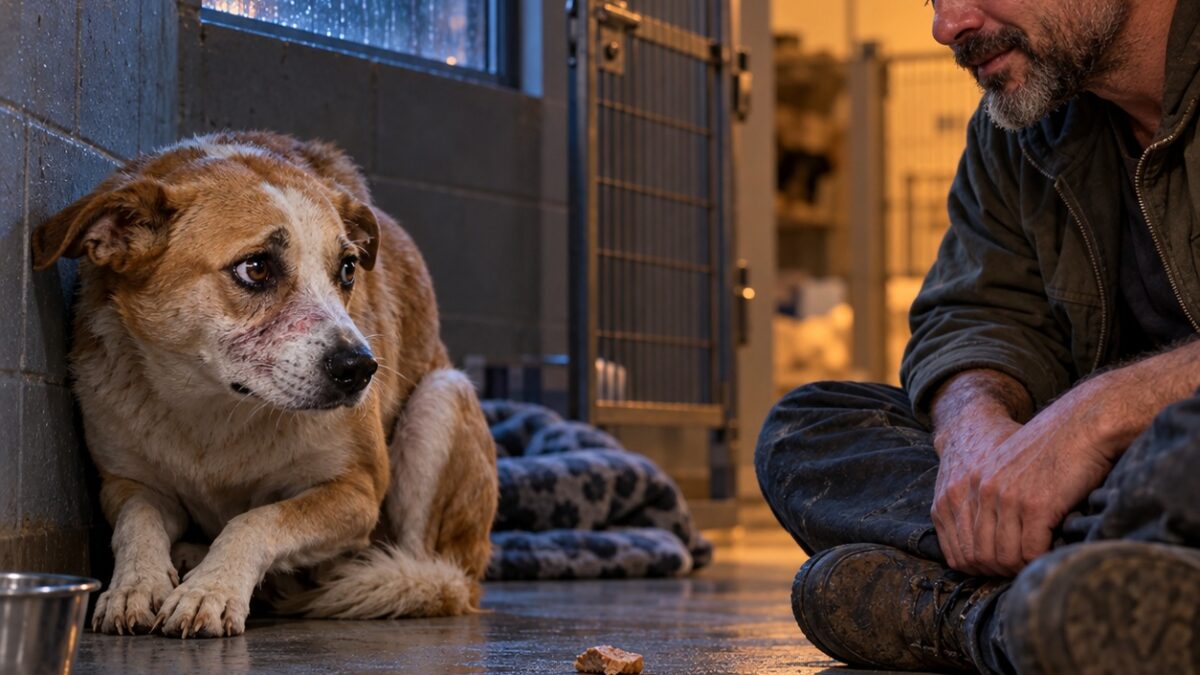
Vitória did not come closer.
That first day, I did not expect her to.
She watched me.
Sometimes looked away.
If I shifted too quickly, her muscles tightened.
If my hand moved toward her, she reacted.
So I stopped reaching.
That sounds simple.
It is not.
When you care about an injured animal, your body wants to do things.
Touch.
Comfort.
Pet.
Check.
Fix.
But affection offered too early can feel like pressure.
Vitória needed something harder from me.
Restraint.
I sat nearby.
Talked softly.
Nothing important.
“You don’t know me.”
She watched.
“That’s fair.”
Her mouth looked painful.
The tape was gone, but the skin carried the damage.
She had finally regained the ability to open her jaws, yet eating was still not simple.
Pain.
Stress.
Fear.
All of it affected appetite.
I brought food.
Placed it where she could reach without approaching me.
Then moved back.
Vitória stared at the bowl.
Then at me.
Food.
Me.
Food.
Fear won.
She refused.
I waited.
Ten minutes.
Fifteen.
No eating.
I left the room briefly.
When I returned, the food was still there.
That worried me.
An injured dog who had been unable to use her mouth properly should have been ravenous.
But stress can overpower hunger.
The nervous system does not care that a meal is technically safe.
If survival says:
Do not lower your guard,
the dog does not eat.
I tried again later.
Different food.
Soft enough not to hurt.
Warm enough to smell appealing.
Placed it down.
Backed away.
Vitória sniffed the air.
No movement.
I sat on the floor.
“You can hate me.”
Her ears shifted.
“Just eat.”
Nothing.
“I’m serious.”
I looked away deliberately.
“You don’t even have to like me.”
Minutes passed.
Then Vitória moved.
Barely.
One step.
Pause.
Another.
I did not look directly.
She reached the bowl.
Sniffed.
Pulled back.
Returned.
Then took one small bite.
I froze.
Chew.
Slow.
Another.
My eyes filled immediately.
I stared at the wall so I would not make her nervous.
Vitória ate again.
Not much.
Enough.
That first meal felt different from watching any healthy dog eat.
Food is ordinary until someone has been prevented from having it.
Vitória’s mouth had been bound.
The skin damaged.
She had wandered unable to eat normally.
Now her jaws could open.
A bowl was hers.
No one was taking it away.
She ate.
I remember thinking:
This should never have been extraordinary.
But it was.
The next day she ate a little more.
Then more.
Once her appetite truly returned, we understood how hungry she had been.
Vitória wanted food.
Not recklessly.
But with intensity.
Her body needed calories for everything.
Healing skin.
Fighting infection.
Rebuilding strength.
Stress had already consumed enough.
I brought meals consistently.
Same approximate times.
Same quiet approach.
Food down.
Step away.
Vitória began learning the routine.
At first she waited until I was far away.
Later, she ate while I stayed in the room.
Then while I sat several feet away.
Small changes.
They mattered.
Her wounds required regular treatment.
That was harder.
Food could be offered at a distance.
Wound care required touch.
Hands near the very part of her body where someone had already caused terrible pain.
The first sessions were tense.
Vitória reacted when we came too close.
Medication helped with discomfort.
Still, fear remained.
We moved slowly.
I talked.
A veterinarian worked.
Vitória watched everything.
Whenever possible, we gave breaks.
No unnecessary restraint.
No punishment for defensive behavior.
She was not “bad.”
She was scared.
That distinction changes how you treat an animal.
Aggression in a frightened dog is communication.
Too close.
Too fast.
I do not trust you.
Listen.
So we listened.
Not perfectly.
Medical care cannot always wait for full consent from an animal who needs treatment.
But we reduced force wherever possible.
We made patterns predictable.
Touch.
Clean.
Medication.
Stop.
Food afterward.
Rest.
Vitória gradually learned that the procedure ended.
That sounds small.
It is huge.
Trauma can make uncomfortable moments feel endless.
Predictability teaches:
This has a beginning.
This has an end.
You survive it.
Nobody keeps going just because you are helpless.
Her wounds improved.
Slowly.
The damaged skin became less inflamed.
The raw areas began closing.
Pain eased.
That physical improvement changed behavior too.
A dog in constant pain has less capacity for curiosity or trust.
As pain reduced, Vitória had emotional space to notice other things.
Me.
The people caring for her.
The environment.
She began watching without immediately reacting.
At first, I could sit five feet away.
Then four.
Then three.
No magic number.
No single day.
Just less distance.
I started spending more time beside her when no procedure was happening.
That was important.
If every time I appeared meant wound care, Vitória would have good reason to dislike me.
So sometimes I came with nothing.
No medicine.
No towel.
No veterinary supplies.
I sat.
Talked.
Or stayed quiet.
One afternoon, I sat reading messages on my phone.
Vitória watched.
I ignored her.
Five minutes.
Ten.
Then I felt movement.
She had changed position.
Closer.
Not much.
Maybe one foot.
I did not look.
Another few minutes.
Closer again.
My heart pounded harder than it should have.
Do not ruin this.
Vitória sniffed toward my shoe.
Then stepped back.
That was all.
I smiled after she moved away.
The next day she came closer faster.
Trust does not always arrive in a dramatic moment.
Sometimes it is measured in inches.
Vitória gave me inches.
I accepted them.
Weeks passed.
Her weight improved.
The injuries around her mouth healed further.
Scabs gave way to healthier tissue.
The veterinarian remained involved.
Regular checks.
Treatment.
Watching for complications.
I brought her to appointments.
At first, clinic visits made her defensive again.
New hands.
New room.
Smells.
But gradually familiar staff became less threatening.
One technician always spoke before approaching.
“Hi, Vitória.”
Same voice.
Same movement.
Vitória began recognizing her.
Tail?
Not yet.
But the body loosened.
That counted.
I became attached long before I admitted it.
At first, I told myself I was doing what I did for many animals.
Help.
Stay until stable.
Support recovery.
Find the next step.
But Vitória was different.
Maybe because trust had been so difficult.
Every bit she gave felt personal.
The first time she ate from my hand, I almost stopped breathing.
I held soft food on my fingers.
Not too close.
Vitória leaned.
Sniffed.
Her mouth opened.
That action alone struck me.
An open mouth.
Free.
She took the food.
Gently.
I stared at her.
“Good girl.”
She chewed.
Then looked for another piece.
I laughed.
“So now we’re friends?”
No.
Too soon.
Vitória took food.
That was not friendship.
But it was a bridge.
I gave another.
She ate.
That became a game.
Food.
Trust.
Distance shrinking.
Eventually she allowed me to touch beneath her chin.
I made the movement slowly.
She stiffened.
I stopped.
Waited.
Vitória remained.
My fingers touched fur away from the healing wounds.
One stroke.
I pulled back.
Her eyes followed my hand.
I tried again.
She stayed.
The third time, her body softened slightly.
That feeling—
I cannot explain it fully.
A dog who had reacted aggressively when I approached was allowing my hand near the mouth someone had tied shut.
Trust had crossed into the place of injury.
That felt sacred.
I never rushed after that.
There is a temptation once an animal accepts one touch to take five.
Do not.
Let one successful interaction remain successful.
I stopped.
“Enough.”
Vitória looked at me.
The next day, she accepted more.
That was better.
Her relationship with food changed too.
Initially, eating was tentative because fear interfered.
Later, she became enthusiastic.
I started teasing her gently.
“You said you didn’t like my cooking.”
Vitória ate.
“No apology?”
Nothing.
“Rude.”
Eventually, the tail moved.
The first wag was small.
Almost accidental.
I had walked into the room carrying food.
Vitória’s tail flicked.
I stopped.
“Did you just—”
Tail again.
Food-related.
Fine.
I would take it.
Several days later, I entered with nothing.
No bowl.
Vitória looked at me.
Tail moved.
I felt my throat close.
Not food.
Me.
That one mattered more.
I crouched.
“Hi.”
Vitória approached.
Slowly.
Her body no longer rigid.
She stopped near me.
I waited.
She moved her head forward.
Touched my hand with her nose.
I scratched gently under her chin.
She stayed.
That was when our relationship changed.
Not completely.
Fear still existed.
But Vitória had started choosing me.
That is different from tolerating help.
Choice matters.
The wounds continued healing.
Her health improved.
Weight returned.
Her coat looked better.
Her eyes brighter.
The dog who had arrived with every muscle prepared for danger started sleeping more deeply.
At first, rest remained shallow.
A sound and she was awake.
Later, I could move around and Vitória stayed asleep.
That became one of my favorite milestones.
Sleep is trust.
You cannot defend yourself while deeply asleep.
A frightened animal knows that instinctively.
Vitória’s body had begun believing someone else was watching.
So she could stop.
For a while.
Let go.
Rest.
Eventually, she was strong enough for walks.
The first one was short.
Very short.
No need to prove anything.
Vitória stepped outside.
Stopped.
Looked around.
The world felt different now.
The first time we knew her outdoors, she had been wandering injured and unable to call for help.
Now she stood beside me on a leash.
No tape.
Mouth free.
Body healing.
A person close.
The distinction almost overwhelmed me.
I did not pull.
“Take your time.”
Vitória sniffed.
One patch of ground.
Then another.
She walked.
A few steps.
Stopped.
Looked back at me.
“I’m here.”
We continued.
Cars passed in the distance.
Vitória tensed briefly.
I stopped.
No dragging.
She recovered.
Walked again.
That first outing might have lasted only minutes.
It felt enormous.
Walking because you choose to explore is completely different from walking because you are searching for help.
Vitória finally got to know that difference.
We went out again.
And again.
Distances grew.
Confidence too.
She became interested in smells.
Other dogs at safe distances.
People.
Wind.
Normal things.
I loved watching ordinary curiosity replace emergency.
The street was no longer only where she had suffered.
It could become a place for walks.
That reclamation mattered.
People who had followed her rescue began asking about her.
How is Vitória?
Better.
Eating?
Yes.
Wounds?
Healing.
Trusting?
Slowly.
Then:
Very much.
That last answer took time.
I did not mind.
Trust that arrives slowly often feels solid because you can remember every layer.
The first meal.
First hand feeding.
First touch.
First tail wag.
First voluntary approach.
First walk.
Vitória and I accumulated those moments.
Without noticing, I stopped imagining the day she would leave.
That should have alerted me.
Instead, I told myself:
We’ll think about adoption when she’s stronger.
She became stronger.
Then:
After the next veterinary appointment.
Appointment came.
Then:
Let her settle more.
She settled.
Everyone else could see what I was doing.
I could not.
One friend finally said:
“You know you’re keeping her.”
“No.”
They laughed.
“I’m serious.”
“So am I.”
“She follows you everywhere.”
“She’s recovering.”
“She sleeps beside you.”
“Trust exercise.”
“You bought her a new bed.”
“Medical necessity.”
“You bought two.”
I had no answer.
Vitória was nearby.
Tail moving.
Traitor.
The truth was simple.
I had devoted years to helping animals.
Many entered my life.
Some stayed temporarily.
Some moved into other homes.
That is rescue.
You love enough to let go when the right future is somewhere else.
With Vitória, every attempt to picture her somewhere else felt wrong.
Not because no one else could love her.
Many could.
Because somewhere during the slow process of teaching her I was safe, she had become safe for me too.
There is something about an animal learning to trust you that creates responsibility.
Not ownership.
Relationship.
Vitória looked for me.
If I left a room, sometimes she followed.
If I sat, she settled near me.
When strangers came, she checked where I was.
During veterinary visits, my presence helped her regulate.
I had become part of the system by which she understood safety.
And she had become part of mine.
I finally admitted it.
“You’re staying.”
Vitória was eating.
Very emotional response.
“Did you hear me?”
Nothing.
“You’re adopted.”
Chew.
“I thought this would be bigger.”
Tail.
Fine.
I scratched her head.
She leaned into my hand.
That was enough.
There was paperwork.
Formalities.
But emotionally, the adoption had happened long before.
The day Vitória decided my hands were safe.
The day she chose to sleep near me.
The day she turned toward me on a walk instead of away.
Home is often established before anyone signs anything.
After adoption, very little changed.
That was the best proof that it was right.
Same meals.
Same bed.
Same walks.
Same veterinarian.
Same person.
Me.
Only the uncertainty disappeared.
No next place.
No transition plan.
Vitória was home.
That changed how I thought about the beginning.
Once, she had wandered from street to street because there was nowhere safe to stop.
Now she had a place she returned to after every walk.
A door.
A bed.
Water.
Food.
Me.
Those ordinary things carried enormous weight.
The first time I watched her fall asleep after an evening walk, I sat nearby longer than necessary.
Her mouth relaxed.
Slightly open.
That image hit me hard.
Open.
Once, someone had physically prevented that.
Now Vitória slept with her mouth loose, jaw relaxed, no tape, no wound forcing her expression.
Just sleep.
I stared.
Then looked away because she did not need to become a symbol every minute.
She deserved to nap.
That became important.
Do not turn every good moment into a comparison with trauma.
Let good moments be good.
Vitória began playing.
That had not been the central part of the original story, but once her health and confidence improved, ordinary interaction naturally followed.
I would move a toy.
She watched.
Sometimes engaged.
Sometimes ignored me completely.
Very dog.
We played together.
I learned what she liked.
She learned I was ridiculous.
Fair arrangement.
The stronger she became, the more visible her personality was.
Affectionate with people she trusted.
Alert.
Sometimes stubborn.
Very interested in food.
Understandable.
She enjoyed walks.
And attention.
Especially when she decided attention was overdue.
She would approach.
Press her head beneath my hand.
If I stopped too soon, she remained.
I understood the message.
“More?”
Tail.
“Yes, ma’am.”
The dog who once could not let me approach now demanded affection.
That transformation never stopped amazing me.
But I tried not to describe it as forgiveness.
We do that too often with animals.
“They forgive humans.”
Maybe.
Maybe Vitória simply learned one human at a time.
The people who harmed her—or whoever caused the condition she was found in—were not every person.
Her nervous system generalized danger at first.
Then new evidence narrowed it.
Marcinho safe.
This caregiver safe.
This veterinarian familiar.
That is not blind forgiveness.
That is intelligent learning.
Vitória had evidence.
I kept giving it.
Every day.
Hand reaches.
No harm.
Food appears.
Nobody takes it away cruelly.
Leash comes out.
Walk, then home.
I leave.
I return.
Consistency.
Dogs understand consistency better than promises.
The original tape wounds healed into scars.
The skin no longer looked raw.
Pain receded.
Sometimes I touched near the area carefully.
Vitória stayed relaxed.
That was physical and emotional healing intersecting.
The same place once associated with unbearable restraint could now receive gentle touch.
No flinch.
Sometimes eyes closed.
I never took that for granted.
People who met Vitória later might have noticed the scars and asked:
“What happened?”
I gave the simple truth.
“She was found with her mouth taped shut.”
They reacted.
Horror.
Anger.
Questions.
Who did it?
Why?
We did not have every answer.
I stopped trying to fill the unknown.
Vitória did not need a more dramatic backstory.
The known part was bad enough.
What mattered now was the dog standing beside me.
I would say:
“She’s doing well.”
That was the part I wanted people to hear.
Not because the past should be hidden.
Because the present deserves equal weight.
She survived.
Recovered.
Trusted.
Stayed.
Those verbs mattered.
Vitória’s walks became some of my favorite time.
Not because anything extraordinary happened.
Exactly the opposite.
We walked.
She sniffed.
Sometimes stopped too long at something completely uninteresting to me.
I waited.
Other days she moved quickly.
Tail loose.
Body relaxed.
If someone passed, she watched.
Then continued.
Ordinary.
I remembered the first story I heard.
A dog moving from street to street with tape around her mouth.
Now the same movement—walking outside—had no urgency.
No desperation.
No need to find someone.
Just walk.
That contrast never fully left me.
One evening, we passed a woman standing near a gate.
The woman smiled.
“Beautiful dog.”
I said:
“Thank you.”
That was all.
No rescue story.
No explanation.
Vitória continued sniffing.
I loved that interaction.
For that stranger, Vitória was simply a dog on a walk with her person.
Maybe that is one of the greatest successes rescue can achieve.
The trauma stops being visible enough to introduce the animal before their name.
Vitória.
Not:
The taped-mouth dog.
Vitória.
My dog.
Home.
That was her new identity.
She became more playful at home.
Sometimes she followed me around.
Sometimes ignored me because apparently permanent adoption reduced my novelty.
Good.
A dog who feels safe enough to ignore you has confidence.
She did not need constant reassurance.
She knew where I was.
She knew I would remain.
One afternoon, Vitória slept in another room while I worked.
Months earlier, separation might have worried her.
Now she chose distance.
That made me happy.
Attachment does not mean clinging.
Secure attachment gives space.
She had that.
Later, she walked in.
Checked me.
Lay down.
Perfect.
The veterinarians continued monitoring until the wounds had fully reached the stage where ongoing treatment was no longer the center of daily life.
That transition was strange.
For months, care had structured everything.
Clean.
Medication.
Check.
Return.
Then one day:
Nothing urgent.
Just routine life.
I found myself almost searching for something to manage.
Vitória had other ideas.
Food.
Walk.
Sleep.
Attention.
Normal priorities.
Good.
Let medicine leave the center.
Health means you can forget the wound for hours.
Then days.
Eventually you notice the scar only when someone asks.
We reached that point.
Vitória’s weight stabilized at a healthier level.
Her body looked stronger.
Energy increased.
She could walk longer without fatigue.
She no longer ate with the tentative discomfort of the early days.
Meals became enthusiastic.
Very enthusiastic.
I sometimes joked:
“Your mouth works perfectly now.”
Vitória stared at the bowl.
“Clearly.”
I put it down.
She ate.
That sentence affected me every time even though I meant it jokingly.
Her mouth works.
Such a basic thing.
Open.
Eat.
Drink.
Pant.
Play.
Receive a scratch beneath the chin.
All functions someone had taken from her temporarily with tape.
Now ordinary again.
Never underestimate ordinary.
I came to think ordinary was the entire goal.
Rescue people sometimes chase transformations because those are what audiences understand.
Before.
After.
But Vitória’s best “after” was not a glamorous picture.
It was her drinking water when she wanted.
Opening her mouth after a walk to pant.
Yawning.
Taking food gently.
Things nobody photographs.
Freedom is often invisible because it looks like normal function.
Vitória had it back.
That satisfied me more than anything.
Our relationship deepened without drama.
Every day.
Morning greeting.
Food.
Walk.
Work nearby.
Evening.
Sometimes play.
Sometimes affection.
Sometimes nothing.
That is family.
Not constant emotional climax.
Repetition.
The same person there tomorrow.
Vitória once needed repeated evidence to trust me.
Eventually the evidence became life.
She no longer watched each interaction as a test.
She expected kindness.
That may have been her greatest recovery.
Expectation.
Imagine how much has changed when an animal expects good things.
Not hopes nervously.
Expects.
Bowl?
Food.
Leash?
Walk.
Hand?
Scratch.
Door opens?
Marcinho returns.
That is safety internalized.
I saw it happen.
One day I reached over without thinking and scratched behind her ear.
Vitória leaned.
I froze afterward because I realized neither of us had prepared for the touch.
Early in recovery, every movement had to be announced.
Now casual affection.
She trusted the ordinary spontaneity of living together.
I smiled.
“Look at us.”
Vitória ignored the speech.
Correct response.
I occasionally thought about the woman who first tried to help and could not get close.
She had done exactly the right thing by calling rescuers rather than forcing the situation.
That matters.
People sometimes feel like failure if an animal does not accept help directly.
It is not.
Knowing when to bring more help is part of rescue.
That woman noticed.
Tried.
Recognized risk.
Called.
Without her, Vitória might have continued wandering.
She was part of the chain.
No one person owned the rescue.
The initial woman.
Rescuers.
Veterinarians.
Everyone who treated wounds.
Then me.
Each person carried one part.
Vitória carried the hardest part.
Living through it.
The original story often gets framed around my tears when I first saw her.
Yes.
I cried.
But emotion alone does not save an animal.
What mattered was returning the next day.
And the next.
Bringing food after the first refusal.
Trying again without forcing.
Cleaning wounds repeatedly.
Veterinary appointments.
Sitting beside her when she still reacted to me.
Patience is love translated into time.
Vitória needed time.
I gave what I could.
She eventually gave trust.
That exchange changed both of us.
There is a moment I remember clearly.
I was sitting outside after one of our walks.
Vitória beside me.
Nothing special.
She was tired and lay down near my feet.
After a while, she rolled slightly onto her side.
Then rested her head across my shoe.
I looked down.
She fell asleep.
A dog once so defensive that I could barely approach was using me as furniture.
I laughed quietly.
“Very dignified.”
No response.
Sleep.
I stayed still because moving my foot would wake her.
This is what attachment does.
You lose circulation for dogs.
Worth it.
That moment mattered because Vitória had no reason to monitor me.
No food.
No treatment.
No crisis.
She simply liked being close.
That is friendship in the simplest form.
Later, family.
The adoption decision did not feel heroic.
That is important.
I did not “save her forever.”
Vitória and I already lived around each other.
The paperwork acknowledged reality.
She was part of my home.
Part of my schedule.
Part of what I worried about.
Part of what made me laugh.
I did not want her gone.
She did not seem interested in going.
Decision made.
Her new life did not need a bigger climax.
She had already survived one.
The best thing I could offer after trauma was consistency, not another dramatic event.
So life settled.
Vitória played.
Walked.
Ate.
Slept.
Received attention.
The scars stayed.
Fine.
They were not infection.
Not open wounds.
They belonged to past tense.
That is what scars should be allowed to become.
Past tense.
I sometimes ran my fingers near them.
Not as a ritual.
Just petting.
Vitória did not care.
She leaned.
That helped me stop caring cosmetically too.
Healing does not owe us unmarked skin.
It owes the patient comfort if possible.
Vitória had comfort.
Good.
One evening after a longer walk, she lay on the floor panting lightly.
Mouth open.
Tongue out.
I stared.
She noticed.
Probably thought I was strange.
I was.
Because the sight of her panting made me emotional.
Once:
Mouth taped shut.
Now:
Mouth open because she had spent energy on a walk she enjoyed.
Same anatomy.
Different meaning.
I laughed at myself.
“You have no idea, do you?”
Vitória’s tail moved.
Good.
She did not need to know.
We remember the beginning.
She gets to live the ending.
That seems fair.
People often tell me animals teach forgiveness.
Vitória taught me patience more than forgiveness.
You cannot rush someone out of fear just because you are tired of watching them be afraid.
You sit.
Bring food.
Return.
Let evidence accumulate.
She also taught me that help can be rejected without becoming useless.
The first woman could not touch her.
Still helped.
I could not immediately gain trust.
Still stayed.
The first meal was refused.
Still offered another.
Progress sometimes looks like the same kindness repeated after “no.”
Respectfully.
Without resentment.
Until one day the answer changes.
Vitória’s did.
No.
No.
No.
Food.
Touch.
Tail wag.
Walk.
Home.
Each yes arrived when she was ready.
I value them more because of that.
Today, Vitória lives with me.
That sentence still feels extraordinary because daily life no longer does.
She knows the house.
Knows where meals happen.
Knows her resting places.
Knows my voice.
We play.
She gets attention.
Sometimes she asks for more.
Often.
She walks beside me.
No desperate roaming.
No tape.
No wounds needing constant treatment.
The dog who once moved through the streets unable to call for help now has somebody who notices before she ever needs to cry.
That may be the part of home that matters most.
Needs do not have to become emergencies before someone responds.
Hungry?
Meal coming.
Uncomfortable?
Check.
Want affection?
Come closer.
Need space?
Take it.
That is care.
Early intervention.
Attention.
The opposite of abandonment.
Vitória has it now.
I do not know what she remembers about those streets.
Maybe smells.
Maybe fear.
Maybe dogs do not replay the past the way humans do.
I hope not.
Humans replay enough for everyone.
When I catch myself imagining her wandering with that tape, I redirect.
Vitória now.
Present tense.
She is sleeping.
She is eating.
She is walking.
She is playing.
She is home.
That is where attention belongs.
The past explains our gratitude.
It should not steal every current moment.
One morning, I woke and found Vitória watching me.
“Food?”
Tail.
“Of course.”
I got up.
She followed.
Normal.
In the kitchen, I prepared her meal.
She waited.
Not perfectly.
She was never required to become a saint.
I set the bowl down.
Vitória ate.
I stood for a moment.
Something as ordinary as a dog eating breakfast.
Once, I would have cried.
Now I made coffee.
That transition was healing too.
Her eating no longer needed to be celebrated because eating had become guaranteed.
I love that.
The absence of emotional drama around basic needs is one of the best signs an animal is truly safe.
Breakfast should be boring.
Vitória earned no such thing—again, wrong word.
She deserved it all along.
Now she has it.
One of the last times someone asked me about the rescue, they said:
“What was the moment you knew she trusted you?”
I thought.
There were many.
Food from hand.
First touch.
Tail wag.
Walk.
Sleeping near me.
But I answered:
“There wasn’t one.”
That is the truth.
Trust appeared like daylight.
No single second where darkness became morning.
It simply got brighter.
One day I realized I could approach without aggression.
Then touch.
Then she approached me.
Then followed.
Then rested nearby.
By the time I named trust, it had already been there for a while.
That is how many important things work.
Gradually enough that you notice only after they have changed everything.
Vitória changed my house that way too.
A bowl appeared.
Bed.
Leash.
Routine.
Then suddenly:
This is her home.
No ceremony required.
She belonged.
I think that is why her story deserves to end quietly.
Not with revenge.
Not with some invented confrontation with whoever taped her mouth.
We do not have that.
Not with a new tragedy.
She has had enough.
End with the relationship.
A man who rushed to see an injured dog and cried.
A dog who did not trust him.
Food refused.
Food accepted.
Hands rejected.
Hands tolerated.
Hands sought.
Walks.
Home.
That arc is enough.
The most powerful reversal is not punishment for whoever hurt her.
It is Vitória discovering that people can also stay.
She learned that from me.
I learned something from her too.
Love is not proving you have good intentions.
It is giving another living thing enough consistent experiences to decide your intentions are safe.
There is humility in that.
I could not demand trust because I rescued animals.
My reputation meant nothing to Vitória.
Good.
She judged behavior.
Come close too fast?
No.
Sit quietly?
Maybe.
Bring food?
Interesting.
Return tomorrow?
Noticeable.
Return again?
Pattern.
Pattern becomes trust.
Trust becomes attachment.
Attachment becomes home.
That is the whole story.
I still play with her.
Sometimes she becomes excited and opens her mouth wide to grab a toy.
Every now and then that image catches me.
Open mouth.
No restraint.
No pain forcing it closed.
Teeth around a toy.
Tail moving.
I smile.
Vitória probably thinks the toy is the point.
Maybe she is right.
The toy is the point now.
Not the tape.
Not the street.
Play.
Life.
When rescue succeeds, trauma eventually becomes context instead of current event.
Vitória reached that.
Her scars tell one story.
Her behavior tells another.
I know which one I prefer to watch.
One afternoon, we returned from a walk.
Vitória went inside first.
No hesitation at the doorway.
She knew exactly where she was going.
Water.
Then her bed.
I closed the door.
She drank.
Turned around.
Looked at me.
Tail.
I sat down beside her.
Vitória came over.
Pressed her head beneath my hand.
I scratched slowly along her neck.
Her eyes closed.
For a moment I remembered our first meeting.
Me sitting far away.
Her body rigid.
Aggression every time distance narrowed.
I almost laughed at the contrast.
“You really hated me.”
Vitória opened one eye.
“Okay. Fair.”
I scratched again.
She leaned closer.
No tension.
No need to keep watch.
The black tape had once controlled whether she could open her mouth.
Fear had once controlled whether anyone could approach her.
Neither controlled her anymore.
Vitória had a home.
A person.
Choice.
That is freedom in ordinary form.
Sometimes people want me to say she rescued me too.
Maybe stories like that sound more poetic.
I do not need to claim it.
Vitória’s story is enough without making her responsible for healing a human.
She deserved rescue for herself.
Not because she taught me something.
Not because she made me better.
Not because suffering transformed into a lesson.
She deserved it because she was a dog in pain.
Full stop.
Anything I learned was secondary.
I like keeping that clear.
The reward was hers.
Food.
Treatment.
Safety.
Home.
My reward was getting to see who she became when she no longer had to defend herself constantly.
That was more than enough.
Vitória is affectionate now.
Playful.
Connected.
Sometimes stubborn.
Sometimes demanding.
Wonderful.
Let her be difficult occasionally.
A dog secure enough to have preferences is a success.
No need for permanent gratitude.
If she does not want to move from a comfortable spot, fine.
If she wants one more scratch, she asks.
If dinner is late, she notices.
That ordinariness means she expects care.
I want her to expect it.
Every day.
For the rest of her life.
The person who hurt her taught her one lesson about humans.
We spent months teaching another.
Neither happened through words.
Actions.
The difference is that our lesson continues.
Morning.
Evening.
Tomorrow.
Again.
Someone is here.
You do not have to wander.
You do not have to search.
You do not have to accept pain silently.
You do not have to earn food.
You do not have to defend every inch between yourself and a hand.
Rest.
Vitória eventually did.
And when she sleeps now, sometimes she lies completely relaxed.
Mouth slightly open.
Breathing steady.
I can walk past.
No reaction.
I think that may be my favorite ending.
Not adoption papers.
Not the healed wounds.
Sleep.
A dog whose mouth was once bound so tightly the skin tore can now fall asleep with her jaw loose and her whole body unguarded because she knows someone safe is nearby.
There is nothing more I need from the story.
One person stayed.
One dog learned.
Then she stayed too.
That is home.
When I look at Vitória today, I still know exactly where the scars came from.
I do not need to look at them often.
Instead I see the dog waiting for me to throw her toy.
The dog walking beside me.
The dog leaning into my hand.
The dog who knows where she belongs.
Once, Vitória wandered the streets because nobody had made room for her to stop.
Now there is a place where she does not need to keep moving.
A bed.
A bowl.
A door she recognizes.
And me.
The man she once would not let near her.
I reach down.
Vitória lifts her head.
No aggression.
No fear.
She steps closer before my hand even reaches her.
And every time she does, I remember that trust was never something I gave her.
It was something she finally decided I had earned.
I intend to keep earning it.
Every day.








