PART2:They Took His Name Off the Adoption List Because He Was Old and Sick—Then a Couple Saw His Photo and Whispered, “That’s Our Dog”
PART2
The call came the next morning.
I almost missed it.
We were short-staffed.
A dog in intake had knocked over a water bowl.
Someone was asking about vaccination records.
Another phone was ringing at the front desk.
I picked up mine without looking.
“Shelter, this is Sloan.”
Silence.
Then breathing.
A woman.
Crying.
“Hello?”
“I’m sorry.”
Her voice shook.
“I’m sorry, I just—”
“Take your time.”
“Is the dog from the post still there?”
My chest tightened.
“The Border Collie?”
“Yes.”
“Blue?”
A pause.
Then a sob.
“Is that what you call him?”
I sat down.
“Yes.”
“What?”
“We call him Blue.”
Another pause.
Longer.
Then:
“Oh my God.”
I stopped moving.
The woman said something to someone near her.
Muffled.
I could not hear it.
Then she returned.
“I think that is our dog.”
I gripped the phone.
“What do you mean?”
“We lost him.”
“When?”
Her breathing became uneven again.
“Years ago.”
I looked toward the hallway where Blue’s room was.
“What was his name?”
She whispered:
“Blue.”
My skin went cold.
Of course the name alone proved nothing.
Blue is not an unusual name.
Border Collies are not rare.
Old photographs can be misleading.
People see hope when they want it badly enough.
I forced myself to stay professional.
“Do you have photographs?”
“Yes.”
“Any identifying features?”
“Yes.”
“Do you have veterinary records? Old paperwork? Anything that can help us confirm?”
“We have everything.”
She sounded almost offended by the idea that years had erased him.
“We never threw anything away.”
That sentence stayed with me.
“Where are you now?”
“About two hours away.”
“Can you come?”
“We’re already leaving.”
I looked at the clock.
My heart started pounding.
Before hanging up, I asked:
“What happened?”
Another silence.
“We lost him during a move.”
She spoke carefully, as if each word had been used many times before.
“There was confusion. A door. People moving things. By the time we realized he was gone, we couldn’t find him.”
“You searched?”
“For years.”
Years.
The word landed differently now.
“We posted signs. Contacted shelters. Called veterinary clinics. Checked online groups. We drove back whenever someone reported a Border Collie.”
Her voice broke.
“Every time.”
I closed my eyes.
“We thought eventually…”
She could not finish.
I understood.
Eventually hope becomes painful enough that people stop saying it aloud.
“I saw the photo last night.”
“How?”
“Someone shared it.”
That was it.
A stranger.
A share.
One photograph of an old dog whose name had already disappeared from our adoption list.
She continued:
“My husband said it couldn’t be him.”
“What changed his mind?”
“The eyes.”
I looked toward the hallway again.
“He said he would know those eyes anywhere.”
I could not speak for a second.
“We’re coming.”
“Okay.”
“Please…”
Her voice became almost childlike.
“Please don’t let him go anywhere.”
I swallowed.
“He’s not going anywhere.”
When I hung up, I remained sitting for several seconds.
Then I ran.
Not walked.
Ran.
Through the hallway.
Past the supply room.
Past the laundry.
Into isolation.
Blue was lying in his corner.
Same blanket.
Same position.
For a moment, I could not breathe.
He looked exactly like the photograph.
Exactly like the dog whose whole life might have just changed because somebody had looked at a screen and recognized him.
I approached slowly.
Kneeled.
“Blue.”
His eyes moved.
“Listen.”
He looked at me.
“I don’t know if you understand.”
His ears lifted slightly.
“But somebody is coming.”
I felt ridiculous.
Tears were already gathering.
“Someone who knows you.”
Blue raised his head.
Not much.
Enough.
“Someone who says they’ve been looking.”
His eyes stayed on mine.
“Someone remembers.”
Blue’s head remained lifted.
That alone felt enormous.
For weeks, I had watched him barely react to anything.
Now he was looking at me.
I put my hand on the floor, not touching him.
“They’re coming, old man.”
I wanted to say:
Your people.
I stopped myself.
Not yet.
I was terrified of giving him a hope that might turn out to be ours rather than his.
So I sat there.
Blue eventually lowered his head again.
But not completely.
His eyes stayed open.
The hours before the couple arrived were unbearable.
I checked the clock too often.
Every time the parking lot door opened, I looked.
Blue did not know what time meant.
Maybe that was mercy.
Around midday, the woman called.
“We’re forty minutes away.”
Then twenty.
Then:
“We’re here.”
I looked through the front window.
A car had just parked.
Two people got out.
Middle-aged.
The woman stood beside the passenger door for a moment before moving.
Her husband walked around the front of the car and took her hand.
They stood there together.
Not walking toward the building yet.
As if the shelter doors were the boundary between two possible realities.
On one side, hope.
On the other, confirmation or heartbreak.
I went outside.
The woman looked at me.
“Sloan?”
“Yes.”
“I’m…”
She stopped.
Introductions seemed unimportant.
Her husband carried an envelope.
Photographs.
Records.
Everything they had promised.
We verified what we reasonably could.
Old images of a younger Border Collie.
Black-and-white coat.
Specific markings.
Same shape of face beneath years of aging.
The husband pointed with a trembling finger.
“Here.”
One marking near the shoulder.
Another around the neck.
The wife held a photograph of Blue lying on a living-room rug.
Young.
Strong.
Eyes bright.
I looked between the photograph and the hallway.
My throat tightened.
There was no absolute magic test that erased every question in seconds.
But the evidence aligned.
And more than anything, the couple did not behave like people trying to claim a dog they had never known.
They behaved like people afraid to breathe too hard near a miracle.
I said:
“He’s in a quiet room.”
The woman’s hand squeezed her husband’s.
“How is he?”
I hesitated.
She saw it.
“Tell me.”
“He’s old.”
“I know.”
“He’s had health problems.”
She nodded.
“He doesn’t move much.”
Her eyes filled.
“Does he suffer?”
“We manage his comfort. But…”
“But?”
“He’s withdrawn.”
The husband looked down.
The woman whispered:
“Because he thinks we left him.”
I did not answer.
No one could know that.
But the sentence hurt anyway.
We walked toward the isolation room.
Slowly.
The couple behind me.
I could hear their breathing.
At the door, I stopped.
“He may not react.”
The woman nodded.
“He may not remember in the way you expect.”
She closed her eyes briefly.
“I know.”
“Please let him come to you.”
“Yes.”
“No sudden movement.”
“Yes.”
Her husband said quietly:
“We just want to see him.”
I opened the door.
Blue was in the corner.
Head on paws.
He did not move.
The woman stopped at the threshold.
Her husband stopped too.
No one said anything.
The entire room seemed to hold its breath.
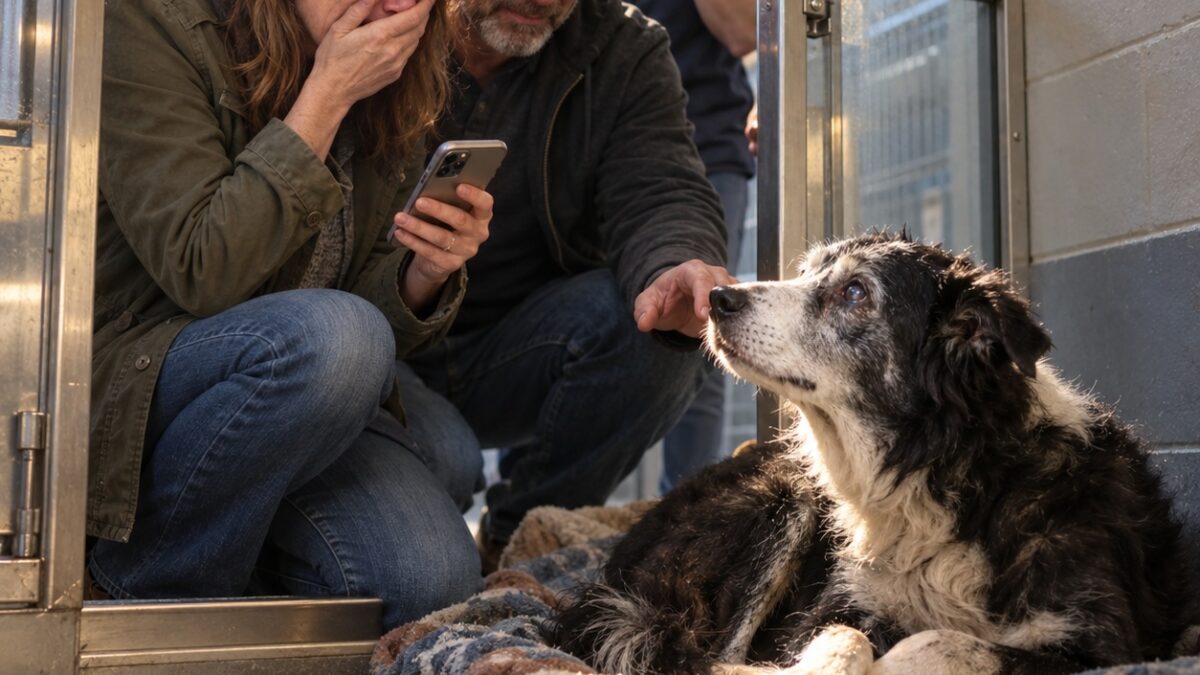
The woman looked at him.
Her face changed.
Not surprise.
Recognition so immediate it looked like pain.
She covered her mouth.
“Oh.”
Her husband’s eyes filled.
He did not wipe them.
The woman whispered:
“That’s him.”
No one moved.
“That’s Blue.”
Her husband nodded.
Tears ran down his face.
“Yes.”
I stepped back toward the wall.
The woman walked in first.
Slowly.
She stopped several feet away.
Then lowered herself carefully to the floor.
She did not reach.
That told me something.
People who truly know an animal often remember how to wait.
The husband remained near the doorway.
The woman looked at Blue.
“Blue.”
Nothing.
Her voice broke.
“Blue, sweetheart.”
His ear moved.
Just slightly.
She froze.
“I’m here.”
Blue did not lift his head.
The woman’s tears fell onto her hands.
“I came.”
No movement.
“I’m sorry it took so long.”
The husband turned his face away.
I wanted to leave.
I also could not.
The woman whispered again:
“Blue.”
Then:
“I’m back.”
For several seconds, nothing happened.
I felt the terrible possibility settle over the room.
Maybe he could not hear clearly.
Maybe age had taken too much.
Maybe memory does not work the way we hope.
Maybe recognition existed in the people only.
The woman did not move closer.
She repeated:
“Blue, my boy.”
His eyes opened.
Then his head lifted.
Slowly.
So slowly I almost thought he would give up halfway.
But he lifted it.
Looked at her.
Everything stopped.
The woman did not speak.
Blue stared.
Not wagging.
Not running.
Just staring.
He looked at her face for a long time.
Then toward the husband.
The husband took one involuntary step forward.
Blue looked at me.
Then back at the woman.
I watched confusion move across his expression—or maybe I only imagined it.
He looked like a dog trying to decide whether memory had stepped into the room.
The woman extended one hand.
Still did not touch him.
“Blue.”
His front legs shifted.
I held my breath.
He pushed.
His body trembled.
For months, Blue had avoided standing unless necessary.
Now he was trying.
The first attempt failed.
His back end slipped.
The woman made a sound.
Not quite a sob.
“Take your time.”
Blue tried again.
Front legs straight.
Rear legs under him.
He stood.
Barely.
Every part of him shaking.
I instinctively moved forward.
The husband raised a hand.
Not stopping me.
Asking.
Let him.
Blue took one step.
Stumbled.
Recovered.
The woman remained on the floor.
Crying openly now.
“Come here.”
Another step.
Then another.
His nails scraped the floor.
His old body looked impossibly fragile.
But he kept coming.
He had spent months staring at the door waiting.
Now the person he had been waiting for was only a few feet away.
Blue reached her.
Stopped.
The woman’s hand remained open.
He lowered his nose.
Sniffed her fingers.
Once.
Again.
Then her sleeve.
Her wrist.
She leaned forward slightly.
Blue smelled her hair.
That was when his tail moved.
One slow sweep.
The woman gasped.
Another.
Then faster.
Blue’s entire rear body began shaking with the effort.
The husband covered his face.
The woman cried:
“Oh, Blue.”
And Blue leaned into her.
Not gently.
With everything his old body still had.
She wrapped her arms around him.
Careful of his joints.
Her face disappeared into his coat.
“I’m sorry.”
Blue’s tail kept moving.
“I’m so sorry.”
Her husband crossed the room.
Dropped to his knees.
Put one hand against Blue’s shoulder.
Blue turned.
Smelled him.
Then pressed into both of them.
Three bodies on the floor.
One dog.
Two humans.
All crying in their own way.
I stood in the doorway.
I had worked in a shelter long enough to see reunions.
Microchip reunions.
Lost dogs returned after days.
Sometimes weeks.
I had never seen years collapse in one room.
For those minutes, Blue did not look old.
His body was still old.
Legs trembling.
Coat gray.
Eyes cloudy with age.
But something inside him had come alive.
The tail.
The ears.
The way he kept smelling them as if confirming again and again:
You are real.
You are here.
The woman pulled back.
Held Blue’s face.
He licked her chin.
She laughed through tears.
“You remember.”
Blue leaned closer.
She looked at me.
“He remembers.”
I nodded because speaking would have destroyed me.
The husband whispered:
“We thought he hated us.”
His voice broke.
“We thought after all these years…”
Blue pressed his head beneath the man’s hand.
The husband closed his eyes.
“No.”
The woman answered him.
“He waited.”
I looked toward the corner.
The old blanket.
The door.
Months of waiting suddenly had context.
Maybe not proof.
But context.
Blue had not been waiting for an adopter.
He had been waiting for home.
They stayed on the floor for a long time.
Nobody rushed them.
The shelter could continue without that room for a while.
Eventually, the woman looked at me.
Her face was red from crying.
“We want to take him home.”
I nodded immediately.
Then remembered procedure.
“We need to talk about his health.”
“We know.”
“He’ll need care.”
“We know.”
“He may not improve very much.”
“We understand.”
“He’s old.”
The husband smiled through tears.
“So are we compared to when he disappeared.”
The woman stroked Blue’s face.
“We don’t care.”
“He may have limited time.”
Her hand stopped.
Then continued.
“All the more reason.”
I looked at her.
She said:
“We don’t want him spending another night thinking nobody is coming.”
That finished me.
I turned away for a second.
When I faced them again, she continued:
“We searched for him.”
“I know.”
“We never stopped loving him.”
“I know.”
“We thought eventually there was nothing else we could do.”
She looked down.
“Then that photograph appeared.”
Blue’s head rested against her leg.
“We want whatever time he has.”
The husband added:
“At home.”
That word.
Home.
For Blue, it had been missing for years.
Paperwork followed.
Necessary.
Boring.
Beautiful.
Management initially had questions.
Reasonably.
The dog was elderly.
Medically compromised.
The situation unusual.
But once records, photographs, history, and the reunion itself were considered, nobody wanted to stand between Blue and the people kneeling beside him.
One supervisor said quietly:
“There are rare days when this job gives something back.”
I understood.
The couple signed.
Blue officially left the shelter that same afternoon.
We fitted him with a secure collar and leash.
The woman held one side.
Her husband walked on the other.
Blue moved between them.
Slowly.
Painfully.
But his head was higher than I had seen it in months.
Shelter staff gathered at a distance.
Nobody made a big scene.
Blue hated too much noise.
At the front door, he stopped.
Looked back.
I swear he looked toward the hallway.
Toward the room.
Maybe he did.
Maybe I needed him to.
Then he turned toward the couple.
Tail.
One gentle sweep.
The woman opened the car.
Blue needed help climbing.
Her husband supported his rear end carefully.
Inside, Blue immediately turned and laid his head across the woman’s lap.
She stroked his ears.
He closed his eyes.
Not the shut-down sleep I had seen in the shelter.
Something softer.
Safe.
I stood at the entrance watching their car leave.
And cried.
Not because I was sad.
Not exactly.
There are kinds of joy that hurt because they arrive after you have already accepted that they never will.
That was what I felt.
Hope arriving late enough to feel impossible.
I watched until the car disappeared.
Then I went back inside.
The hallway felt different.
Blue’s room was empty.
For months, every time I passed it, he had been there.
Corner.
Blanket.
Door.
Now nothing.
That afternoon, management called me into the office.
I assumed I had broken some policy.
Would not have been the first time.
Instead they asked me to explain what had happened.
So I told them.
The photograph.
The post.
The call.
The records.
The reunion.
I explained that Blue had been taken off the active adoption list and I could not stand the idea that this meant he would become invisible.
One person listened silently.
Then said:
“You made the right decision.”
I looked up.
“You didn’t give up because the process had.”
That sentence hit me harder than I expected.
I had spent months feeling useless around Blue.
I could feed him.
Clean.
Arrange medical care.
Sit nearby.
But I could not give him the one thing he seemed to want.
His people.
All I had done was take a photograph.
Write a post.
Hope someone saw.
Small things.
Sometimes small things are exactly large enough.
The next morning, I went to the isolation room.
Empty.
The silence was enormous.
In the corner was Blue’s old blanket.
Worn.
Flattened where he had slept.
I picked it up.
I still do not know why.
Maybe because after months of seeing him on it, throwing it into laundry felt wrong.
Maybe because I needed something physical to remind myself he had actually left.
I folded it.
Put it in my locker.
I kept it.
For a long time.
Perhaps part of me needed evidence too.
The couple called two days later.
I answered immediately.
“How is he?”
The woman laughed softly.
“Asleep.”
“Eating?”
“Yes.”
“Drinking?”
“Yes.”
“Walking?”
“Slowly.”
“Comfort?”
“Better.”
I heard something in the background.
A bark.
Weak but unmistakable.
I froze.
“Was that him?”
“Yes.”
She laughed.
“He barked because my husband went outside without him.”
I covered my eyes.
Blue had barely made noise at the shelter.
“Good.”
“He sits by the garden door.”
“Waiting?”
“No.”
She paused.
“I think asking.”
That distinction made me smile.
Waiting is passive.
Asking means you expect someone to answer.
Blue had started expecting things again.
They called periodically.
Not every day.
Enough.
Blue liked the garden.
He sat in sunlight.
He still moved stiffly.
Some days better than others.
At night, he slept close to them.
The woman told me:
“He puts his head on our feet.”
I pictured him.
She added:
“He doesn’t watch the door anymore.”
That sentence became my favorite.
He doesn’t watch the door anymore.
At the shelter, Blue had spent months orienting his entire body toward the possibility of someone returning.
At home, he no longer needed to.
His people were already there.
Weeks passed.
Then one call changed again.
“You’ll never believe this.”
“What?”
“He ran.”
I laughed.
“Define ran.”
“Four steps.”
“That counts.”
“Five maybe.”
“Definitely counts.”
She sounded younger through the phone.
“He saw my husband with his old ball.”
Old ball.
I paused.
“You still had his toys?”
Silence.
Then:
“Some.”
My eyes filled.
“We couldn’t throw everything away.”
Years.
They had kept things.
Not all.
Enough.
A ball.
Photographs.
Records.
Fragments of life with a dog they believed they might never see again.
Blue had spent years somewhere out in the world.
They had spent those same years carrying proof he had once been theirs.
Now an old toy had made him run five steps through a garden.
That may be one of the saddest and happiest things I have ever heard.
Another month.
Blue started playing.
Not like a young Border Collie.
No endless sprinting.
No sharp turns.
He would push a toy.
Pick it up.
Carry it.
Sometimes bark when they stopped too soon.
He gained a little strength.
Not youth.
Strength.
There is a difference.
His age remained.
His health challenges remained.
But depression—or what we had interpreted as that shut-down withdrawal—lifted.
He wanted things.
Food.
Garden.
Company.
Attention.
He had stopped being a dog waiting for life to end.
He was participating again.
The couple invited me to visit.
I hesitated.
Not because I did not want to.
Because I was afraid.
What if Blue did not remember me?
Stupid.
I knew.
He owed me nothing.
Still, shelter workers become attached in strange ways.
You spend months with an animal.
Then their best day is the day they leave you.
That is the job.
I drove out.
Their house was quiet.
Comfortable.
Nothing extravagant.
A garden behind it.
The woman met me near the side gate.
“He’s outside.”
“How’s today?”
“Good day.”
She smiled.
“Very good.”
I stepped through.
Blue was lying in the grass.
For a second, he did not notice.
Then his head lifted.
He looked at me.
I stopped.
“Hey, old man.”
Blue stood.
Faster than I had ever seen him stand at the shelter.
Not smoothly.
But eagerly.
Then he came toward me.
A walk.
A trot.
Something between.
I laughed.
“Blue!”
He barked.
Actually barked.
Tail moving violently.
By the time he reached me, I was on my knees.
He pushed into my chest.
I wrapped both arms around him.
“Look at you.”
He licked my face.
I cried.
Of course.
Apparently that had become my response to Blue.
“You remember.”
He barked again.
The woman laughed behind us.
“I told you.”
Blue tried to put his front paws against me.
I steadied him.
“No jumping.”
He ignored me.
For a few seconds, the old dog from the isolation room disappeared.
Not literally.
Age does not vanish because love returns.
But joy changed how I saw him.
He moved.
Barked.
Investigated.
Tried to play.
The woman sat near us.
I stroked Blue’s side.
She said quietly:
“When we lost him, we thought eventually he’d forgotten us.”
I looked at her.
“We thought maybe he found another family.”
She smiled sadly.
“We hoped that, actually.”
Because if he had another family, at least he was safe.
“We also worried he was angry.”
“At you?”
“Yes.”
She looked at Blue.
“We blamed ourselves.”
The husband joined us carrying a ball.
Blue noticed immediately.
Tail.
The woman continued:
“When we saw him at the shelter…”
Her voice broke.
“I thought he would look at me like a stranger.”
Blue nudged her hand.
She touched his face.
“But he didn’t.”
“No.”
“He wasn’t angry.”
She looked toward the garden.
“He was waiting.”
I had no answer.
Blue barked at the husband.
The man held up the ball.
“You want this?”
Blue’s entire body sharpened.
“Okay.”
He tossed it a short distance.
Blue trotted after it.
Slow.
Uneven.
Happy.
He picked it up.
Turned.
For several seconds, I forgot he was the same dog.
At the shelter, he had lain for hours without moving.
Now he was carrying a ball across grass.
Not cured.
Not young.
Home.
That was the transformation.
The woman handed me a photograph before I left.
At first I thought it was a new picture.
Then I realized.
My shelter photograph.
Blue in the corner.
Head on paws.
Eyes toward the door.
She had printed it.
“I want you to have this.”
“I took it.”
“I know.”
“Then why?”
“Because this photo brought him home.”
I looked at it.
The image hurt more now.
Because I knew the dog in it.
Not just Blue.
The younger Blue from their old family photographs.
The dog sleeping on their rug.
The dog with a ball.
The dog lost during a move.
The dog searched for through years of phone calls and signs and false sightings.
The dog who eventually became old somewhere away from them.
The dog in the shelter.
All one animal.
One life.
I looked toward the garden.
Blue was standing beside the husband.
Tail moving.
The contrast was almost unbearable.
The woman said:
“We thought that picture was the saddest thing we’d ever seen.”
I nodded.
“So did I.”
She smiled.
“Now it’s my favorite.”
“Why?”
“Because it’s the last picture before we found him.”
That changed the photograph for me forever.
The dog in the corner was not at the end.
He was hours away from hearing his name in the voice that had once meant home.
He did not know it.
Neither did I.
That is what hope looks like sometimes.
Not feeling hopeful.
Being close to an answer without knowing it.
Blue’s name had been removed from the adoption list.
He was old.
Sick.
Forgotten by almost everyone who walked through our doors.
From the outside, his possibilities had narrowed to almost nothing.
But somewhere two hours away, a couple still had photographs.
Records.
A ball.
Memory.
Love.
They just did not know where he was.
One post connected the distance.
That humbled me.
Shelter work can make you cynical.
You see abandonment.
Neglect.
Animals returned because they became inconvenient.
People lying about why they are surrendering them.
You learn not to expect miracles.
Blue did not erase any of that.
One reunion does not cancel a thousand sad cases.
But it reminded me not to let realism become surrender.
There is a difference between understanding odds and deciding someone is no longer worth trying for.
Blue’s adoption chances had been poor.
That was true.
His age was real.
His health was real.
His withdrawal was real.
But none of those things told the whole story.
The missing information was:
Someone was still looking.
That changed everything.
After Blue, I began thinking differently about the animals who received less attention.
The old ones.
The sick ones.
The frightened ones who photograph badly.
The ones who do not run to the front of a kennel.
A dog does not become less worthy because he has stopped advertising himself.
Sometimes exhaustion looks like disinterest.
Fear looks unfriendly.
Age looks inconvenient.
Grief looks empty.
Blue had not stopped wanting home.
He had simply stopped believing movement would bring it faster.
That thought still hurts.
I remembered all the times I walked into his room and wished he would stand.
Come on, Blue.
Come meet someone.
Maybe he was not refusing.
Maybe he had learned that strangers were not the people he wanted.
Then one afternoon, his people entered.
And he stood.
That was enough to teach me something I should have known.
Behavior has context.
Love has memory.
And hope can survive in forms so quiet you mistake them for absence.
The couple continued sending updates.
Blue had good days.
Slow days.
He slept more than he played.
Sometimes his legs hurt.
Sometimes he needed extra rest.
They never pretended age had disappeared.
That mattered to me.
I dislike rescue stories that turn senior animals into puppies through love.
Love does not reverse time.
It gives time meaning.
Blue was still old.
That was not a failure.
He was old at home.
There is a world of difference.
He slept beside the people he remembered.
Sat in their garden.
Heard familiar voices.
Smelled familiar things.
Had someone notice when he was uncomfortable.
Someone who knew how he used to tilt his head.
How he liked to be scratched.
Which noises bothered him.
History matters.
Especially at the end of a long life.
They had lost years.
Nobody could return those.
I never asked too many questions about where Blue might have been during that time.
We did not know.
Guessing would not help.
What mattered was that the story did not end with those missing years.
It continued.
A reunion does not erase separation.
But it changes what separation gets to mean.
Once, those years had been an open wound.
Where is he?
Did he survive?
Did someone hurt him?
Did he forget us?
Then Blue came home.
The questions did not all receive answers.
But the most important one did.
Are you still alive?
Yes.
Do you remember?
Tail.
Yes.
Can we have one more day?
Yes.
Then another.
And another.
That is enough sometimes.
The old blanket remained in my locker for months.
I would see it when grabbing my coat.
Eventually someone asked:
“Why do you have that?”
“Blue’s.”
“Who?”
I stared.
Then laughed.
Shelters move fast.
New dogs.
New emergencies.
Staff changes.
An animal can be the center of your world one month and become a name newer employees never heard.
I showed them the photograph.
Told the story.
They understood why I kept the blanket.
Later, I washed it.
Folded it.
Kept it again.
Not as something sad.
As proof of absence.
An empty blanket can be beautiful when the reason is home.
That changed too.
People online continued sharing Blue’s story for a while.
Comments appeared.
People called it a miracle.
Maybe.
I hesitate with that word.
Miracle makes it sound as though nothing human mattered.
Something did.
Someone shared a post.
A woman looked closely instead of scrolling.
A husband recognized eyes beneath age.
They saved records.
They drove.
Management listened.
Blue stood.
Ordinary actions aligned.
Maybe miracles often look like that.
People paying attention at the correct moment.
If so, I can accept the word.
One day, months after my visit, the woman sent me a short message.
Blue is in the garden barking at a bird.
I laughed.
No photograph.
No dramatic update.
Just that.
Barking at a bird.
Normal.
Perfect.
I replied:
Tell him the bird is probably terrified.
She wrote:
He is very proud.
That became my favorite kind of update.
Not:
Blue survived.
Not:
Blue remembers us.
Those questions had been answered.
Now:
Blue stole my husband’s sock.
Blue refused to come inside because the sun was out.
Blue barked at the neighbor’s cat.
Blue slept through breakfast and then complained that breakfast was late.
Ordinary nonsense.
You know an animal has rejoined life when the updates become annoying.
He had stopped being “the old dog from the shelter.”
He was Blue.
Their dog.
Again.
That word matters.
Again.
His home was not new.
It was old and new at the same time.
Familiar people in older bodies.
A dog returned in an older body too.
Nobody was who they had been years earlier.
Still, recognition survived.
That is the thing I cannot explain away.
The woman’s voice.
The husband’s smell.
Hands.
Hair.
Blue stood.
Sniffed.
Remembered something deep enough to move his failing legs.
I have seen people dismiss animal memory because dogs cannot tell stories the way humans do.
Blue told one.
He told it with a tail that started moving slowly and then would not stop.
He told it by pushing himself up from a floor he had barely wanted to leave.
He told it by crossing a room.
He told it by putting his head in a woman’s arms as if years had suddenly become smaller.
That was language enough.
I think often about the woman repeating:
“I’m back.”
What must that have meant to her?
Not just to Blue.
Years of guilt.
Searching.
Imagining.
She had probably said his name into empty neighborhoods.
On lost-dog calls.
To strangers.
At shelters.
Into phones.
Then one day she said it three feet away from him.
Blue.
I’m back.
And his head lifted.
Some stories are too precise in their cruelty.
This one was precise in its mercy.
Had the photograph been taken a week later, maybe she would not have seen it.
Had someone not shared it.
Had she scrolled past.
Had Blue been moved elsewhere.
Had I accepted his removal from public view.
So many small points.
I do not like dwelling on what-ifs.
But they remind me that visibility matters.
Someone has to see.
That is why I kept photographing senior dogs after Blue.
Not pretending every one had a long-lost family somewhere.
Most did not.
But every animal deserves the chance for the right person to know they exist.
A photograph cannot save a dog alone.
It can make invisibility harder.
That matters.
Years of shelter work taught me despair often begins not with cruelty, but with being unseen.
Blue was alive.
He needed medical management.
Comfort.
Company.
But before any of that could become home, someone had to recognize him.
They did.
The phrase still gives me chills:
That’s our dog.
Not:
We might adopt him.
Not:
He’s cute.
Our dog.
Belonging spoken before paperwork.
Before confirmation was complete.
Before Blue stood.
They knew.
Then he knew.
That is why I never saw their adoption as a normal adoption.
It was a return.
A circle closing after being broken open for years.
The couple once told me they initially feared bringing Blue home would confuse him.
Maybe the house was different.
Furniture changed.
Smells changed.
Years passed.
They had aged.
What if memory became frustration?
Instead, Blue adapted quickly.
Not because every detail matched.
Because home had never been architecture.
It was people.
I loved that.
He did not need the exact rug from the old photograph.
He needed the woman who once sat beside it.
The man who threw the old ball.
Their voices.
Their presence.
That was home enough.
The garden became part of the new version.
Blue spent hours there.
Sometimes sleeping.
Sometimes watching.
Sometimes walking slow circles.
His body improved slightly with care and movement.
He ate better.
Strength returned in small amounts.
The first few running steps became a family legend.
The husband told it differently from the wife.
He claimed five steps.
She said three.
Blue offered no comment.
I told them four.
Diplomatic.
What mattered was not distance.
A dog who had stopped standing voluntarily wanted to chase something again.
Wanting is life.
That may be the simplest way to say what changed.
At the shelter, Blue existed.
At home, he wanted.
Sun.
Ball.
Food.
People.
Garden.
Attention.
The difference was enormous.
I visited more than once.
Not constantly.
I did not want to make their reunion my story.
But enough to see progress.
Every time, Blue greeted me.
Sometimes with a trot.
Sometimes simply walking over and pressing his head against me.
As he aged, the greetings became slower.
Still greetings.
The couple never complained.
They had waited years.
Waiting ten seconds for him to cross a garden was nothing.
One afternoon, the woman and I sat while Blue slept near our feet.
She said:
“You know what I regret most?”
I expected:
Losing him.
She surprised me.
“Thinking he had forgotten.”
I waited.
“For years I told myself maybe that was kinder.”
“What?”
“If he forgot.”
I understood.
If Blue forgot them, maybe he was not grieving.
Maybe he had built another life.
“Then he saw us.”
She smiled through tears.
“And I realized memory wasn’t the cruel part.”
“What was?”
“Separation.”
That stayed with me.
Memory had not hurt Blue by itself.
Memory became joy when separation ended.
We often wish survivors could forget painful chapters.
Maybe sometimes what they need is not forgetting.
Sometimes they need the ending to change.
Blue’s did.
Not the years before.
Those remained lost.
But the final chapter was rewritten by reunion.
That matters.
I cannot tell you Blue became young.
He did not.
I cannot say every illness disappeared.
It did not.
I cannot claim love cures age.
It does not.
What I can say is that an old dog who had stopped lifting his head started barking again.
Started playing.
Started asking.
Started walking into the garden.
Started sleeping beside people instead of staring toward a shelter door.
That is enough of a miracle for me.
People sometimes think quality of life means the absence of illness.
It does not always.
Especially in old age.
Quality can be a comfortable bed.
Managed pain.
Food you like.
Sunlight.
Familiar hands.
A reason to stand.
Blue had those.
And because he had them, being old stopped meaning being forgotten.
That is what broke my heart most about his shelter months.
Not his age.
Not sickness.
The possibility that he might die somewhere nobody knew who he had been.
We knew him as Blue.
Senior Border Collie.
Quiet.
Withdrawn.
But somewhere else he had been a young dog racing after a ball.
Sleeping near a couple.
Part of birthdays, mornings, arguments, meals, ordinary family life.
Shelters see animals after chapters we rarely know.
Blue reminded me every dog has history before intake paperwork.
Every gray face was once young somewhere.
Every scar has an origin.
Every old habit might belong to a home that existed years earlier.
You are meeting the current page, not the whole book.
I became gentler after that.
Not soft in the impractical sense.
Shelter work requires decisions.
Resources are finite.
But I became slower to interpret.
The dog who will not approach?
Maybe fear.
The senior who sleeps through visitors?
Maybe pain.
The quiet dog who does not “show well”?
Maybe grief.
Not every dog needs the same chance.
Every dog deserves to be understood as fully as possible.
Blue had looked like a dog who no longer cared.
He cared so much he had been waiting for years.
I still have the photograph the woman gave me.
The shelter one.
Sometimes I look at it.
Old Blue curled in the corner.
People who do not know the ending see sadness.
I see suspense.
Because I know what he did not.
A phone call was coming.
A car was already beginning a drive toward him.
Two people were carrying old photographs into our shelter.
A woman would kneel a few feet away.
Say his name.
And he would stand.
The photograph captures the final hours of waiting.
That makes it almost unbearable.
Also beautiful.
Hope is strange that way.
When you are inside the waiting, it can feel identical to despair.
The difference sometimes exists outside your field of view.
Blue could not see the car coming.
Neither could I when I took the picture.
That does not mean it was not on the way.
I do not use that as a promise that everyone gets a happy ending.
They do not.
I know too much to say that.
But I use it as a reason not to confuse “I cannot see the answer” with “there is no answer.”
That distinction mattered once.
For Blue, it mattered completely.
When I left the couple’s garden after my first visit, the woman handed me the printed photo.
I held it against my chest.
Blue was several yards away with her husband.
The ball sat near his paws.
I called:
“Bye, Blue.”
He lifted his head.
Tail.
He did not follow me to the gate.
That made me happier than if he had.
He did not need to follow everyone who left anymore.
He knew who stayed.
I opened the gate.
Looked back.
Blue lowered his head beside the man.
Home.
I drove back to the shelter.
Later, I walked past his old isolation room.
Another dog was there.
Different story.
Different eyes.
For a moment, I almost expected Blue in the corner.
Then remembered.
Garden.
Ball.
People.
I smiled.
The old blanket remained folded in my locker.
Eventually, I brought it home.
Not because I wanted to keep shelter property forever.
I replaced it.
Do not report me.
I washed it again.
Stored it with the photograph.
Two ordinary objects.
A blanket from waiting.
A photograph that ended it.
Years of working in rescue have given me many memories.
Some I wish I did not have.
Blue is one I hold carefully.
Not because he suffered more than every other animal.
He did not.
Not because his reunion was the most dramatic thing I ever saw.
Maybe it was.
I remember him because his story corrected something in me.
I had started believing that once an animal became old enough, sick enough, quiet enough, the world simply stopped looking.
Often it does.
Blue showed me one exception can matter completely to the one being found.
To the shelter, he was one senior dog.
To the couple, he was Blue.
That is an enormous difference.
Statistics disappear when somebody says a name.
Years later, I still hear her voice in that room.
Blue, my boy.
I’m here.
I’m back.
And I still see him raise his head.
I still see those legs shake.
The failed first attempt to stand.
The second.
The first step.
The smell of her hand.
The tail.
That tail.
Slow.
Then faster.
Then like every lost year had reached it at once.
If someone asked me what love looks like, I could give prettier answers.
Flowers.
Weddings.
People growing old together.
But I have another image now.
An old Border Collie with failing legs crossing a shelter room because someone he remembered had said his name.
That is love too.
Memory moving a body that had almost stopped trying.
The couple never asked Blue why he disappeared.
Could not.
Never blamed him.
They had blamed themselves enough.
Blue never asked why it took them years.
Could not.
He only leaned into them.
Animals can be merciful in ways humans struggle to be.
They do not require perfect explanations before accepting safety.
That does not mean they forget.
Blue clearly had not.
It means sometimes reunion matters more than accounting.
The years were gone.
They chose the days left.
I admired that.
No bitterness.
No:
We lost so much.
Only:
We have him now.
That is how Blue lived too.
He did not spend his garden days mourning the years he missed.
He sniffed grass.
Barked.
Carried a ball.
Slept on feet.
Again, dogs understand the present better than we do.
Maybe that is why their forgiveness feels miraculous.
Or maybe it is not forgiveness at all.
Maybe Blue simply recognized:
These are my people.
And moved toward them.
Enough.
I am Sloan.
I still work in the shelter.
I still see dogs waiting.
I still take photographs.
Sometimes bad photographs.
Sometimes the honest ones.
I still write posts longer than management would probably prefer.
Because somewhere, someone might know a face.
Or someone might simply stop long enough to care.
Blue taught me not every animal needs the whole world to remember them.
Sometimes one person is enough.
One couple.
One family.
One voice saying the name that still means home.
When everything looked finished for Blue, nobody arrived with a miracle cure.
Nobody made him young.
Nobody erased the years.
A photograph reached the right screen.
A woman looked.
A husband looked again.
They remembered.
Then they drove.
That was enough to change the rest of his life.
The last time I saw Blue during that period, he was in the garden.
Moving slowly.
Happy.
He had dirt on one paw.
His coat looked better.
His eyes looked awake.
Not younger.
Present.
He looked at the couple.
Then at me.
Then toward the ball.
The husband tossed it a few feet.
Blue went after it.
Not fast.
Not far.
He did not need to.
He had already crossed the greatest distance of his life.
From lost.
To forgotten.
To seen.
To remembered.
To home.
And when he carried that old ball back across the grass, tail moving, surrounded by the people who had spent years believing they would never see him again, I finally understood why the photograph from the shelter no longer made me feel hopeless.
Because now I knew what existed just beyond its frame.
Someone remembered.
Someone was coming.
Blue only had to hold on long enough to hear his name again.








