PART2:They Threw This Elderly French Bulldog Away in a Garbage Dump—Then She Learned What It Felt Like to Be Wanted
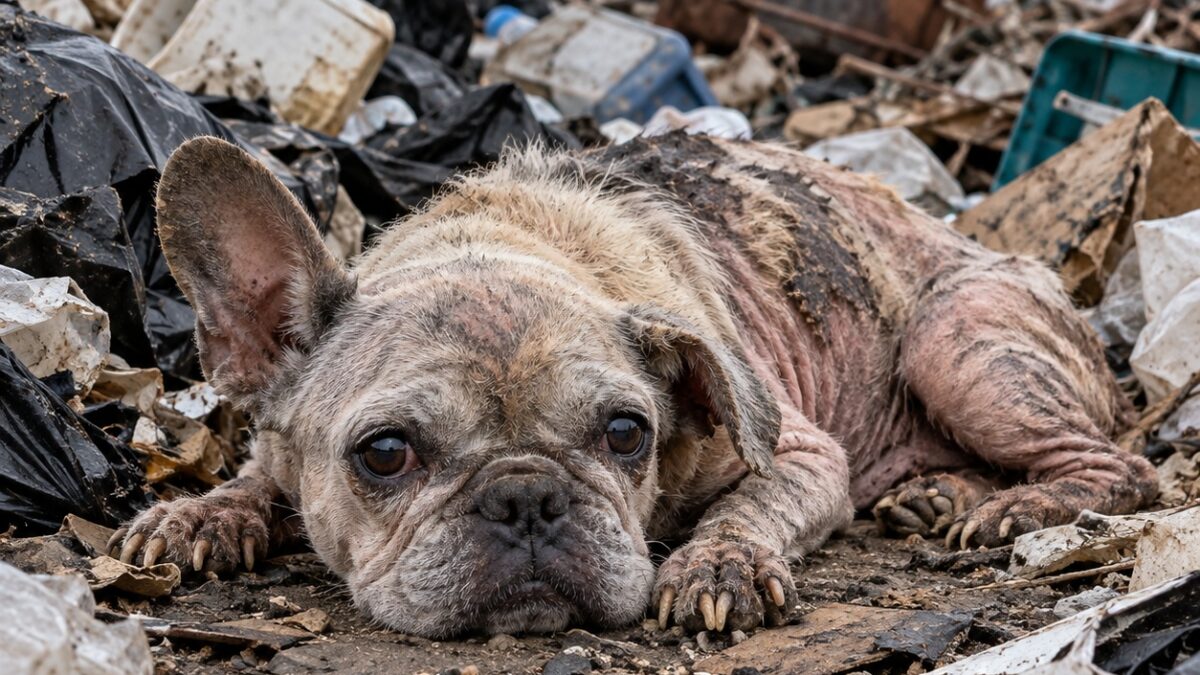
PART2
Frenchy stayed almost completely still while the team worked.
One person supported her.
Another cleaned.
Another removed the visible larvae from the wounds.
Her body trembled occasionally.
But she did not snap.
Did not struggle.
Did not try to escape.
I stood near her head and spoke quietly.
“You’re okay.”
The phrase felt absurd.
Nothing about her situation was okay.
So I corrected myself.
“You’re not alone.”
That was at least true.
The wounds on her back were the worst.
Maggots had burrowed deep enough that removing the ones we could see did not mean the problem was over.
That first cleaning took time.
Long enough that everyone became quiet.
There is a point during difficult medical care when conversation disappears because nobody wants to fill the room with meaningless words.
Frenchy breathed.
We worked.
That was enough.
Afterward, the wounds looked cleaner.
Still terrible.
But cleaner.
The team dressed the areas appropriately and made a plan.
Clean twice a day.
Monitor.
Remove anything newly visible.
Manage infection risk.
Support her body.
Feed her.
Watch.
That sounds straightforward.
It wasn’t.
The next cleaning, more maggots appeared.
Hidden ones.
Buried deeper.
Someone said:
“I thought we got them all.”
The veterinarian shook his head.
“They were deeper.”
So we started again.
Frenchy lay there.
Quiet.
I hated how patient she was.
I wanted her to growl.
To complain.
To make us work for it.
Anything that suggested she expected to be heard.
Instead she accepted the handling as though this was simply another thing being done to her.
That broke my heart.
But then meal time came.
And Frenchy changed.
Not dramatically.
She did not leap to her feet.
She couldn’t.
But her head lifted.
Her nose moved.
Eyes sharpened.
Food.
She wanted it.
I watched her take the first bite.
Then another.
She kept eating.
That simple act affected everyone in the room.
When an elderly neglected animal arrives with wounds this advanced, you look for evidence of desire.
Does she want water?
Does she respond to comfort?
Does she engage?
Does she eat?
Frenchy ate.
Not politely.
Not reluctantly.
She wanted food.
I remember laughing despite everything.
“Well, there you are.”
Frenchy kept eating.
“You’re still in there.”
She finished enough that we all felt lighter.
The wounds remained.
The infection risk remained.
Her age remained.
But appetite is powerful.
A body asking for food is still asking for tomorrow.
We held on to that.
Twice a day, the wounds were cleaned.
Twice a day, Frenchy endured.
More hidden maggots came out.
The team removed them carefully.
The process repeated.
Clean.
Inspect.
Remove.
Treat.
Dress.
Feed.
Rest.
Then again.
It is easy to tell a rescue story afterward and say:
She was treated.
That sentence hides hours.
It hides the smell of damaged tissue.
The supplies thrown away.
The hands washed again and again.
The old dog lying still while people leaned over her.
It hides the exhaustion of seeing more larvae after you thought the wound was finally clear.
It hides the moment someone mutters:
“How many more?”
Then keeps going anyway.
Frenchy deserved that “anyway.”
The veterinarians began to suspect, based on her age and physical condition, that she may have spent part of her life being used for breeding.
We could not reconstruct every year.
We could not know exactly how many litters.
Who owned her.
What kind of place she lived.
What happened the day she was discarded.
But the possibility fit too painfully.
An older female French Bulldog.
Body worn.
Neglected.
Then thrown away once sick or no longer useful for producing puppies.
Maybe.
We were careful with the word.
Likely.
Not proven.
But looking at Frenchy, it was difficult not to think about usefulness.
Human beings have a terrible habit of measuring animals by what they can provide.
Puppies.
Security.
Entertainment.
Money.
Then age arrives.
Illness.
Complications.
And suddenly a living creature becomes “too much.”
Frenchy’s body looked like the result of being considered valuable only as long as she could offer something.
We decided the rest of her life would not work that way.
From this point forward, Frenchy would not have to earn food.
Or softness.
Or medical care.
She would not have to produce anything.
Not puppies.
Not obedience.
Not gratitude.
Nothing.
She only had to be alive.
That was enough.
Her nails had to be addressed too.
They had grown so long that walking comfortably was difficult.
Again, that told us something.
Someone had gone a very long time without doing the basic things.
Nails.
Skin.
Wounds.
This was not one missed appointment.
This was neglect becoming normal.
We trimmed them carefully.
Frenchy watched.
Still calm.
I held one paw.
“You should’ve had someone doing this.”
She blinked.
“You should’ve had a bed.”
No reaction.
“You should’ve had someone who noticed.”
That one was for me.
Because from then on, somebody would.
The first days in the hospital were exhausting for her.
She slept.
Ate.
Endured treatment.
Slept again.
Her appetite became our daily emotional measurement.
“She ate.”
Good.
“How much?”
Most.
Good.
One morning, she ate everything.
I wanted to tell the whole hospital.
If you have never cared for a severely neglected senior animal, that reaction probably seems excessive.
It isn’t.
When the body has been asked to survive without enough support, food becomes evidence.
Energy.
Permission to keep trying.
Frenchy took every meal we offered and turned it into another day.
The wounds slowly began looking less horrific.
Not good.
Better.
There is a wide distance between those.
The maggot problem eventually came under control.
The cleanings remained necessary.
Damaged tissue does not become healthy because the larvae are gone.
Healing needed time.
Medication.
Nutrition.
Rest.
And somebody willing to look closely every day.
Frenchy had that now.
For the first time in a very long time, perhaps.
I started noticing details beyond the wounds.
The shape of her face.
The little folds around her nose.
The way one ear sat when she was listening.
The way her eyes followed food preparation.
The way she seemed to understand when a treatment session was finished.
Frenchy was appearing.
Not the medical case.
The dog.
That is always one of my favorite stages of rescue.
At first, crisis fills the entire frame.
Then the crisis slowly recedes enough for personality to become visible.
One day Frenchy made a small impatient noise while waiting for food.
I laughed.
“Excuse me?”
Another sound.
“Oh, now you have opinions?”
Frenchy stared.
Good.
Opinions are expensive.
They require energy.
I was happy to pay.
The hospital staff began teasing her.
Not cruelly.
Affectionately.
Food motivated.
Very serious about meals.
The old dog who had lain among garbage was becoming the old dog who expected dinner at the correct time.
That was progress.
Eventually, the veterinary team said she was stable enough to leave the hospital.
I felt relief.
Then fear.
Hospital discharge sounds like a finish line.
It rarely is.
Frenchy’s wounds still needed cleaning.
Medication still had to be given.
Follow-up appointments were ahead.
Her body still carried the damage of everything that had happened.
Discharge meant:
The emergency was controlled enough to continue care elsewhere.
It did not mean:
She’s done.
So we brought Frenchy home.
Home.
I loved saying that word.
Not forever yet.
But home enough.
A place with clean floors.
Beds.
Other dogs.
Food.
Air conditioning.
People.
No garbage dump.
The first hours were almost quiet.
Frenchy explored cautiously.
Not far.
She seemed unsure of what was expected.
That made sense.
Animals emerging from neglect often don’t immediately know how to use comfort.
A bed may be unfamiliar.
Freedom can feel confusing.
People moving around a house may trigger vigilance.
So we let her go slowly.
She found a place to rest.
Ate.
Slept.
The wound care continued.
Cleaning Frenchy at home was different.
In the hospital, treatment belonged to an institution.
At home, medical care had to fit around life.
Medication near meal time.
Wounds checked.
Bedding washed.
Follow-up scheduled.
Then normal things.
Rest.
Walk around.
Sniff other dogs.
That transition matters.
An animal cannot remain a patient forever.
At some point, care has to become part of life instead of the whole of life.
Frenchy started learning that.
Then we discovered something that made me wonder even more about her past.
She had an accident in the house.
Nothing dramatic.
Senior dog.
Medical recovery.
New environment.
It happens.
I reached for supplies to clean it.
Frenchy saw me.
And ran to the corner.
Not fast.
But with urgency.
She turned her back.
Lowered her head.
Made herself small.
I stopped.
“Frenchy.”
No response.
Her posture said everything.
She was expecting something.
Punishment?
Yelling?
A hand?
I couldn’t know.
But dogs do not hide in corners after an accident for no reason.
Fear attaches to patterns.
Somewhere, sometime, Frenchy had learned:
If there is a mess, disappear.
My throat tightened.
I put the cleaning supplies down.
Walked toward her slowly.
Not too close.
“Hey.”
Frenchy stayed facing the wall.
“It’s okay.”
No movement.
I sat several feet away.
“You’re not in trouble.”
Still.
“No one’s going to hurt you.”
Minutes passed.
I cleaned the accident without making a big thing of it.
Then I sat again.
Eventually, Frenchy turned her head.
Looked.
I smiled.
“Come on.”
Nothing.
I waited.
She took one step.
Stopped.
Another.
Came out of the corner.
I did not celebrate.
Did not grab.
She walked past me.
Then, in what may have been the most Frenchy thing possible, she headed toward a bowl where another dog had left a little food.
I laughed so hard I almost cried.
“There you are.”
Frenchy finished the leftovers.
Fear and appetite living in the same dog.
That became our pattern.
Accident.
Frenchy hides.
We reassure.
Clean quietly.
Nothing bad happens.
She comes out.
Again.
Again.
Eventually, she began learning a new pattern.
A mess does not mean fear.
A human hand does not automatically mean punishment.
That kind of rehabilitation rarely appears in medical notes.
But it mattered as much as wound healing.
The wounds told us what had happened to Frenchy’s body.
The corner told us what might have happened to her expectations.
We could treat both.
One with medicine.
One with repetition.
No anger.
No shouting.
No punishment.
Just:
It’s okay.
Again.
The other dogs helped.
They behaved normally around her.
Dogs have a way of making a house understandable to another dog.
Here is where we sleep.
Here is where food appears.
This person opens the door.
This sound means something interesting.
This bed can be stolen if you’re fast enough.
Frenchy observed.
Participated slowly.
At first, her age and recovery made her cautious.
Then one day, she moved faster.
I watched.
She gave a little hop.
Then another.
Almost a run.
I couldn’t believe it.
“Frenchy!”
She kept moving.
Not far.
She wasn’t young.
But she was playing.
Or at least moving with the kind of spontaneous energy that had nothing to do with survival.
That mattered.
I remembered the garbage dump.
The bare skin.
Maggots.
Still body.
Now this dog was hopping.
The transformation was not cinematic.
She did not suddenly become a puppy.
Her age did not disappear.
The body still had history.
But joy does not require youth.
Frenchy proved that.
One outing became one of my favorite memories.
She started trotting around.
Then running as much as her little body allowed.
Tiny bursts.
Hops.
Her face looked different when she moved like that.
Open.
Interested.
Alive.
We laughed.
She came back toward us.
Then almost immediately seemed to decide the weather had become unacceptable.
French Bulldogs are not known for negotiating heat gracefully.
Frenchy had discovered her favorite place at home.
Near the air conditioner.
Cool floor.
Moving air.
Luxury.
After playing, she hurried back to that spot with incredible purpose.
I watched her settle.
Chest rising.
Satisfied.
And I thought:
Look at what she wants now.
Not escape.
Not survival.
Comfort.
There is something beautiful about an animal reaching the stage where she can develop preferences that are almost ridiculous.
The coolest spot.
Food leftovers.
A specific resting area.
These are the privileges of safety.
When you’re fighting for life, preferences become luxuries.
Frenchy was collecting them.
The air conditioner spot became hers.
Everyone knew.
If she disappeared after activity:
Check there.
Frenchy.
Of course.
I would sit nearby sometimes.
She looked peaceful.
Older face.
Soft eyes.
Wounds healing.
I wanted to remember that version more than the dump.
The trouble with rescue is that the first image can become too powerful.
We keep telling the animal’s story through the worst day.
Found abandoned.
Found injured.
Found starving.
Those things are important.
But if we never update the mental picture, we trap them there.
Frenchy was no longer the dog in the garbage.
She was the dog near the air conditioner.
The dog who stole leftovers.
The dog who hid after accidents but was learning not to.
The dog who could hop.
The dog who knew meals.
That was her now.
Her wounds continued closing.
Healing old animals takes patience.
Their bodies do not always repair at the pace we wish.
We kept appointments.
Cleaned.
Medicated.
Watched.
Every week, less of the emergency remained.
Her skin improved.
Her comfort improved.
The worst wounds became something we could talk about in the past tense.
I remember the first time I realized I had not thought about maggots in several days.
That sounds strange.
For weeks, they had defined everything.
How many removed?
Any more?
Wound clean?
Now:
Did Frenchy eat?
Where is she?
Air conditioner.
Good.
That is healing for caregivers too.
Crisis stops occupying every thought.
Frenchy began accepting more affection.
She had always tolerated some touch.
But now she sought it occasionally.
Small difference.
Huge meaning.
An animal allowing contact because she cannot escape is not the same as an animal leaning toward a hand.
Frenchy began leaning.
I would scratch near her head.
She stayed.
Sometimes pushed slightly closer.
No dramatic cuddle transformation.
Just choice.
That was enough.
The accidents in the house became less emotionally painful too.
Not because they never happened.
Because Frenchy started understanding the aftermath.
Once, she had an accident.
She took two steps toward the corner.
Stopped.
Looked back at me.
I said:
“It’s okay.”
Frenchy stood there.
Then turned around and came toward me.
I nearly cried.
That was one of the most important moments of her recovery.
No corner.
No hiding.
No shrinking.
She had tested the new rule enough times.
Accident does not equal danger.
The body remembers fear.
The body can also learn safety.
She came close.
I stroked her.
Then cleaned the floor.
Nothing else happened.
Perfect.
The adoption conversations started once Frenchy was medically stable enough.
I dreaded them.
Not because I wanted to keep her forever necessarily.
Because senior dogs are often harder to place.
Add medical history.
Skin issues.
Possible past breeding.
Fear behaviors.
Potential accidents.
People can become hesitant.
Everyone says older dogs deserve love.
Far fewer people walk into a shelter or rescue and say:
Give me the one with history.
Most people want years.
Predictability.
Fewer medical needs.
I understand.
But Frenchy still needed someone.
Not sympathy.
A family.
We prepared her story honestly.
Elderly French Bulldog.
Found severely neglected in a garbage dump.
Wounds from maggot infestation treated.
Continuing recovery.
Needs patience.
Likes food.
Likes cool places.
Learning home life.
The right person would need to see beyond the beginning.
Then a family appeared.
They wanted her.
I asked too many questions.
Always do.
Senior dog?
Yes.
Medical history?
Understood.
Follow-ups?
Yes.
Other dogs?
They had them.
A little girl?
Yes.
That last detail made me nervous at first.
Not because Frenchy was aggressive.
She wasn’t.
But children need guidance around older animals.
Gentle handling.
Respect.
Quiet.
The family understood.
They met Frenchy.
I watched everything.
Frenchy watched too.
The other dogs were part of the eventual home.
There was interest.
Cautious interaction.
Nothing forced.
Then the little girl approached.
Slowly.
She had been told not to rush.
Good.
She knelt.
Frenchy looked at her.
The child held out her hand.
Frenchy sniffed.
No retreat.
The girl smiled.
I felt something inside me loosen.
They did not need some dramatic instant bond.
Safe was enough.
Over time would come the rest.
The family asked questions.
Food.
Wound care.
Bathroom habits.
Medications.
Heat sensitivity.
Everything.
Then:
“What does she like?”
I smiled.
“The air conditioner.”
They laughed.
“Seriously?”
“Completely.”
“And food.”
“Very seriously.”
Good.
They were learning Frenchy, not just her medical chart.
The adoption went forward.
They decided to call her Mami.
I loved it immediately.
Frenchy had been the name of the dog we rescued.
Mami felt like the name of a dog who belonged to someone.
The family prepared.
Soft beds.
Cool places.
Food.
Other dogs.
People.
I held Frenchy—Mami—before she left.
She was heavier than when she arrived.
Healthier.
Her skin no longer looked like the body from the dump.
I touched her back where the worst wounds had been.
Closed.
Healing.
No maggots.
No garbage.
I whispered:
“You really did this.”
She looked toward the family.
I laughed.
“Fine.”
Already moving on.
Good.
Her new family carried her home.
The first update arrived quickly.
She ate.
Of course.
I smiled.
Second update:
She found a bed.
Third:
She had discovered where the cool air was.
Naturally.
Then came the photo that nearly destroyed me.
Mami with the little girl.
Morning.
The child’s arms wrapped around her gently.
Mami relaxed inside them.
Not trapped.
Not shrinking.
Relaxed.
The message said the girl hugged her every morning.
Every morning.
I stared at those words.
Think about the difference.
Frenchy had once been found among garbage.
Discarded.
Now somebody woke up and included her in the first part of the day.
Morning hug.
Routine.
Not charity.
Not rescue.
Family.
There is a point where an adopted animal stops being “the rescue.”
That is the point I always hope for.
They become:
Mami.
Where’s Mami?
Did Mami eat?
Mami stole someone’s food.
Mami is on the couch.
Mami is sleeping.
Mami and the little girl.
Ordinary language.
That is the happy ending.
The other dogs accepted her into their routine.
Mami played in the ways her age allowed.
Rested when she wanted.
Took couch naps.
Found soft beds.
And yes, kept seeking cool spots.
Her family learned quickly that Mami treated comfort like an entitlement.
Good.
I wanted that for her.
If anyone had earned the right to be demanding about cushions and temperature, it was this dog.
Updates came.
Mami asleep near another dog.
Mami in a bed.
Mami following family members.
Mami being hugged.
Mami eating.
I saved too many.
The most ordinary photos were my favorites.
No dramatic comparison.
No wounds.
Just an elderly French Bulldog asleep on a couch.
People often share rescue transformations using before and after.
They put the worst image beside the healthiest one.
Powerful.
But sometimes I think the truest “after” is a photograph nobody would notice online.
A dog asleep.
That’s all.
Because a dog in deep sleep is not checking for danger.
A dog on a couch is not lying on garbage.
A dog with a child’s arm around her has been placed inside somebody’s definition of family.
That is enough.
Her new name took over quickly.
Mami.
At first, I still thought Frenchy.
Then the updates trained me too.
Mami ate.
Mami played.
Mami slept.
The name began belonging to her.
I liked that.
Names can mark chapters.
Not erase.
Mami’s past still mattered medically and emotionally.
But it did not need to follow her into every introduction.
She was not obligated to be “the dog from the dump” forever.
She had a present.
One day her family sent a video of Mami moving quickly through the house.
That old little hop.
I laughed.
She headed straight toward the cool spot.
Nothing about it was important in the traditional sense.
That is exactly why it mattered.
She was doing something because she liked it.
Preference.
Pleasure.
These are the signs I look for after survival.
An animal begins choosing.
Where to lie.
Who to sit near.
When to play.
Which food to steal.
Safety creates choice.
Mami had choices.
Her skin continued improving.
The medical follow-ups remained part of responsible care.
Old age did not reverse.
Of course.
She was still an elderly French Bulldog.
Senior dogs bring senior realities.
Maybe more appointments.
Less endurance.
Different needs.
Her family knew.
They had not adopted a fantasy version.
They had adopted her.
That mattered more than any promise.
I thought often about the suspected breeding history.
Again, we could not prove every detail.
But the possibility still hurt.
The idea that she may have spent years producing puppies for someone else only to be discarded when her body failed.
Then I would look at the picture of her sleeping near the little girl.
Whatever Frenchy had once been expected to give humans, Mami was finally allowed to receive.
Food.
Care.
Softness.
Attention.
A place.
No transaction.
That shift mattered.
She no longer had to be useful.
She only had to exist.
I wish every old animal understood that before being abandoned.
You do not lose your worth when you stop producing something.
Age is not failure.
Illness is not betrayal.
Bodies wear out.
That is when loyalty should become more visible, not less.
Frenchy’s earlier humans—whoever they were—had apparently failed that test.
Mami’s new family did not.
Her little girl certainly didn’t.
Children can be wonderfully direct.
To her, Mami was not economically useful.
Not medically inspiring.
Not symbolic.
Dog.
Mine.
Love.
Morning hug.
Simple.
That may be the purest form of adoption.
One photo showed the girl lying near Mami.
Both resting.
I remembered the dump.
I always come back to it.
Garbage around Frenchy.
Nobody claiming her.
Then this.
A child’s hand on her back.
House around her.
Everything claimed.
Not owned in the harsh sense.
Belonged.
There is a difference.
People sometimes asked why we thought Frenchy had remained so gentle after everything.
I don’t know.
Animals are individuals.
Some become defensive.
Some shut down.
Some stay open.
There is no moral superiority in any response to trauma.
Frenchy was not “better” because she remained quiet.
In fact, her stillness often worried us.
What mattered was what happened later.
Mami developed enough safety to express herself.
She ran.
Hopped.
Hid less.
Ate enthusiastically.
Rested openly.
Her life got louder.
That was healthy.
I still remember those early hospital cleanings.
Frenchy motionless while maggots came out of her back.
Then I compare that with Mami rushing to the air conditioner after playing.
Same dog.
The contrast feels almost impossible.
But that is what good care does.
Not magic.
Work.
Patricia noticed.
Veterinary staff treated.
Rescuers cleaned wounds twice a day.
Medication.
Food.
Follow-ups.
Home care.
Adoption.
Family.
Love is often a chain of competent actions.
Without Patricia, no hospital.
Without medical treatment, no healing.
Without home wound care, no progress.
Without adoption, no Mami.
Everyone carried one piece.
That is rescue.
No single hero.
Frenchy did not need one person to do everything.
She needed enough people to do the next right thing.
The woman at the dump.
The clinic.
The hospital.
The home caregiver.
The adopters.
The little girl.
The chain held.
That is why she got to become Mami.
I think about her appetite too.
At the hospital, food was the first part of Frenchy that seemed stubbornly alive.
Wounds.
Maggots.
Age.
Still:
Food.
Later at home:
Other dogs left something?
Frenchy would finish it.
Of course.
In her new family?
Meal time remained serious business.
Some traits survive every chapter.
I love that.
It makes the story less about transformation into a new dog.
Mami was already there.
Hunger and all.
Care simply gave her enough health to express more of herself.
Maybe that is what rescue really does at its best.
It does not create personality.
It removes enough suffering for personality to emerge.
Frenchy’s personality was hungry, opinionated about comfort, capable of play, and apparently quite talented at locating the coolest place in a room.
Perfect.
One of the most painful memories was her hiding after accidents.
The posture.
Back turned.
Face low.
I hated imagining what might have taught her that.
But I loved what happened later.
No punishment.
Again.
Accident.
Still no punishment.
Again.
Eventually she stopped believing fear had to follow.
That’s how you rewrite expectation.
Not with one reassuring sentence.
With evidence.
“It’s okay” only becomes meaningful after enough times when it actually is okay.
Mami’s new family continued that evidence.
If she made a mess, they handled it.
She remained family.
No door opened to discard her.
No trash pile.
No rejection.
That matters.
Animals with histories of neglect sometimes need years of boring proof.
You still live here.
Even if you get sick.
Even if you have an accident.
Even if you get old.
Even if your body requires work.
Still here.
That is the promise Frenchy should have had from the beginning.
Mami finally did.
I visited her once after adoption.
I wasn’t sure how she would react.
Mami was lying comfortably.
When I entered, she looked.
Then came toward me.
Slowly.
Tail.
Recognition.
I crouched.
“Hi, Mami.”
That name felt natural now.
She sniffed me.
Then moved on.
Honestly?
Perfect.
I did not want her to act as though rescue was still the most important relationship in her life.
Her family should be.
I was history.
They were home.
I watched the little girl approach later.
Mami’s attention changed.
She knew her.
That made me happier than being remembered ever could.
The child wrapped her arms gently around Mami.
Mami stayed.
Head relaxed.
I looked away for a second.
I had seen those shoulders covered in wounds.
Now a child held them.
Not carelessly.
Tenderly.
I wanted to tell Mami:
This is what was supposed to happen.
Not the garbage.
This.
Morning.
Arms.
Home.
But dogs do not need humans narrating justice for them.
Mami simply lived.
Better.
She had couch naps.
The phrase sounds so trivial.
It isn’t.
A couch nap is a luxury for an abandoned dog.
No need to stay alert.
No hard ground.
No weather.
No insects inside open wounds.
No searching for food.
Sleep.
Soft.
That is wealth at animal scale.
Mami became rich.
Beds.
Food.
Cool air.
Family.
Time.
I hope she never understood how extraordinary that looked to us.
The best rescues eventually become boring to the rescued animal.
Of course there’s food.
Of course the bed is there.
Of course the girl hugs me.
Of course someone comes when I need them.
Expectation.
That is the goal.
Transform kindness from surprise into baseline.
Mami deserved that baseline.
The family sent an update one morning:
Mami refused to leave the bed.
I laughed.
From garbage dump to refusing to get out of bed.
There are worse character arcs.
Another:
Mami stole somebody’s spot on the couch.
Good.
Another:
Mami tried to finish another dog’s food.
Unsurprising.
She remained herself.
Safe enough to be inconvenient.
I say that often because it matters.
A shut-down animal may seem “easy.”
Quiet.
Still.
No demands.
People praise that.
Sometimes it’s fear.
Healthy animals can be annoying.
They ask.
They protest.
They steal.
Mami had reached the stage where she could make family life slightly harder.
That was wonderful.
The wounds left history on her body.
Scars may remain.
A scar is not the same as an open wound.
Important difference.
The first says:
Something happened.
The second says:
It is still happening.
Mami moved from one to the other.
Past tense.
Her family did not treat scars as ugliness.
They were simply part of her.
Older dog.
History.
Still loved.
That is healing in another form.
I sometimes wondered whether the person who abandoned her ever saw the rescue story.
Again, not a fact.
Just a thought.
If they did, I would not want revenge.
I would want one thing.
For them to see what they misjudged.
This dog was not garbage.
She was not finished.
She was not worthless because she was old or sick.
She had joy left.
Appetite.
Play.
Attachment.
Years or months—whatever time she had—still contained life.
They threw away a future someone else was grateful to receive.
That is consequence enough.
Mami did not need them.
She had moved past their decision.
Her new life did not depend on anyone apologizing.
Another reason I love adoption.
It can repair without requiring the person who caused harm to become better.
The family does not wait for justice.
They build safety.
Mami sleeps.
That’s enough.
Her caregivers continued watching her health because she was a senior.
Age remains.
No happy ending removes mortality.
That’s not the point.
A good ending does not promise forever.
It promises the time remaining will be different.
Frenchy’s past had been hard.
Mami’s remaining days belonged to softness.
That is realistic hope.
She would age.
Slow down.
Need care.
Her family knew.
And they still chose her.
That is the part I find most moving.
People often adopt young animals because they want many years.
Understandable.
Adopting an elderly dog means accepting a different math.
Maybe less time.
Possibly more medical needs.
You choose anyway.
Because love’s value is not measured only by duration.
Mami’s family understood.
The little girl did not care about the math.
Morning is morning.
Mami is here.
Hug.
That is enough.
One morning photo became my favorite.
Mami lying beside the child.
The light soft.
Nothing happening.
If a stranger saw it, they would never know.
No garbage.
No hospital.
No maggots.
No wounds.
Just family.
I saved it beside the original photo from rescue.
I rarely look at them together.
It hurts.
But when I do, I notice something beyond physical change.
In the dump photo, Frenchy existed among discarded objects.
In the family photo, Mami is physically touching another living being who wants her there.
That is the entire story.
Discarded.
Wanted.
Everything in between is the bridge.
Patricia found her.
That must never be forgotten.
One person looked at a dog among trash and refused to see trash.
That’s the first moral choice.
Then professionals refused to let the severity of her wounds become an excuse not to try.
Then caregivers refused to let accidents become reasons for punishment.
Then adopters refused to let age become a reason to say no.
Again and again:
No.
You are not disposable.
That was the message.
Not spoken.
Demonstrated.
The strongest form.
Frenchy had spent some unknown amount of time learning the opposite.
It took repetition to replace it.
Food appears.
Wounds cleaned.
No abandonment.
Accident.
Still no abandonment.
Old.
Still wanted.
Medical needs.
Still wanted.
That is how Mami’s new identity formed.
Not because we renamed her.
Because her world changed.
Names matter.
Patterns matter more.
I think Patricia would recognize her physically now, but maybe not emotionally.
The quiet dog at the dump had become one who moved with confidence.
The dog who lay still during painful cleaning became one who could hop around on outings.
The dog whose body was invaded by maggots became the dog who selected the best air-conditioned spot in the house.
How do you even compare those realities?
You don’t.
You simply remain grateful the second became possible.
People ask sometimes how rescuers keep doing this work after seeing cruelty.
Mami is part of the answer.
Not because happy endings erase cruelty.
They don’t.
The garbage dump still happened.
The wounds still hurt.
But cruelty was not the final human act in her story.
That matters.
Patricia was human too.
The veterinary team.
Caregivers.
Adopters.
Little girl.
When one person fails an animal, other people can still show what our species is capable of.
Not redemption in some cosmic sense.
Repair.
Practical repair.
One good action after another.
Mami’s body carried evidence of both.
Scars from failure.
Health from care.
The people around her chose which evidence would continue growing.
One afternoon, Mami went outside with the other dogs.
She moved more than expected.
Little run.
Hop.
Play.
Then suddenly stopped.
Turned.
Headed straight inside.
Air conditioner.
I laughed until my stomach hurt.
Her family said:
“She knows exactly what she wants.”
Good.
An animal who once had no control over where she slept now choosing climate conditions.
That is luxury.
Let her be demanding.
The little girl apparently learned Mami’s routines too.
Morning hug.
Gentle touch.
No rough play.
Children can learn compassion through specificity.
Not “be nice to animals.”
Mami is old.
Mami likes this.
Mami doesn’t like that.
Mami needs rest.
Respect is learned through individual relationships.
Frenchy, perhaps once used for what humans wanted from her, now had a child learning to ask what the dog wanted.
That reversal is beautiful.
I imagine the girl growing up with photographs.
Mami on the couch.
Mami sleeping.
Mami near her.
She may someday hear the full rescue story and understand that the dog she hugged each morning had once been found dying among garbage.
That will teach something no lecture can.
Worth does not depend on appearance.
Age does not erase dignity.
A discarded life is still a life.
Care changes endings.
Maybe that becomes part of what Mami gives back.
Not because she owes it.
Simply because love leaves impressions.
Frenchy may have produced puppies in her earlier life.
If that suspicion was correct, humans once measured her legacy through reproduction.
But Mami’s real legacy may be a child’s memory of tenderness.
I prefer that.
No use.
No profit.
Relationship.
Her adopter once described the mornings as ordinary.
The little girl wakes.
Finds Mami.
Hugs her.
Day begins.
Ordinary.
I thought:
You have no idea how extraordinary that sounds to us.
But I didn’t say it.
Let ordinary remain ordinary in their house.
Rescue people can keep the contrast.
Mami does not need to carry it.
That is part of giving an animal a new life.
Stop asking them to perform their trauma forever.
Let them become boring.
The family never forgot her health.
Medical follow-ups continued.
Senior care.
Skin monitoring.
The basics.
Responsible love.
But nobody introduced every day with:
Remember when you were sick?
Good.
Mami looked forward.
Or rather, animals do not think in those terms.
She lived forward.
Meal.
Cool floor.
Dog friend.
Girl.
Nap.
Repeat.
I admire that.
Humans spend years revisiting injustice.
Animals often prioritize the bowl.
Perhaps both approaches have value.
Frenchy’s story stayed with me.
Mami lived without needing to tell it.
When I visited again months later, she was sleeping near the air conditioner.
Of course.
I sat nearby.
She woke.
Looked at me.
Tail.
Then back to sleep.
I whispered:
“Very emotional reunion.”
Her adopter laughed.
“She has priorities.”
“Yes.”
I looked at the sleeping dog.
Old face.
Soft bed.
Cool air moving through the room.
No smell of garbage.
No wounds needing maggot removal.
No corner.
A family moving around her.
The contrast settled into me slowly.
This was the ending.
Not the adoption paperwork.
Not the first hug.
This.
Frenchy asleep in a place where nobody was asking her to earn another day.
The rest of her life could be measured in ordinary comforts.
That was enough.
I think about what we mean when we say “saving” an animal.
Getting Frenchy out of the garbage dump saved her from immediate danger.
The hospital saved her from infected wounds and infestation.
But saving did not end there.
Someone had to clean those wounds twice a day.
Someone had to feed her.
Someone had to reassure her after accidents.
Someone had to give medicine.
Someone had to notice she liked cool air.
Someone had to adopt her.
Someone had to hug her the next morning.
And the morning after.
Rescue is not one dramatic moment.
It is continuity.
The person who continues.
That is why her final family matters as much as the people who found her.
They completed the rescue by making care ordinary.
Frenchy became Mami because a temporary safety became permanent belonging.
I do not know exactly how long she has.
No one does with any elderly dog.
But I no longer measure happy endings in years.
I measure them in whether the animal’s remaining time belongs to fear or comfort.
Frenchy’s future had once looked like more exposure.
More untreated wounds.
Maybe dying beside garbage.
Instead:
Soft bed.
Food.
Medical care.
Other dogs.
Cool air.
A little girl.
Morning.
That is enough future.
More than we could have imagined at the dump.
There is one image I cannot forget from the hospital.
Frenchy lying still while another maggot was removed from her back.
Her face turned slightly away.
No protest.
I remember thinking:
Please let this not be the only way humans touch you.
It wasn’t.
Later, hands cleaned without hurting more than necessary.
Hands fed.
Hands stroked.
Hands lifted gently.
Then smaller hands wrapped around her in a morning hug.
That sequence feels like the emotional center of her story.
Hands can neglect.
Hands can heal.
Mami learned the second meaning.
When her little girl hugged her, she did not shrink.
She stayed.
That tells me enough.
One morning, her family sent a photograph of Mami asleep after the child had left for the day.
Blanket beneath her.
Another dog nearby.
The message:
She went back to sleep after her morning hug.
I looked at the picture.
Old dog.
Peaceful.
And finally understood why the story hurt so much.
Not because Frenchy had been found in garbage.
Though that was horrible.
Because seeing her loved showed how little it would have taken for somebody to do right by her in the first place.
A bed.
Food.
Nail trims.
Medical care.
Attention.
Basic kindness.
None of this was impossible.
Someone simply decided not to provide it.
That is what neglect is.
Often not inability.
Absence of responsibility.
But responsibility came later through strangers.
Maybe that is the only answer we get.
We cannot rewrite the years before Patricia found her.
We can change the years after.
Or months.
Or days.
Whatever exists.
Frenchy’s body would carry the history.
Mami’s home would carry the future.
I have stopped wishing for a bigger ending.
No dramatic punishment for whoever abandoned her.
No television moment.
No miracle youth.
No need.
The satisfying ending is much quieter.
Someone abandoned an elderly dog when she had become inconvenient.
Another family looked at the same elderly body and said:
She belongs with us.
That’s the entire reversal.
From utility to love.
From rubbish to family.
From maggots to morning hugs.
You cannot improve on that without making it less real.
Today, when people ask about Frenchy, I have to pause.
Frenchy?
Oh.
Mami.
That’s who she became.
Not because the old name was bad.
Because the new life grew larger.
She has soft beds waiting.
Dogs around her.
Food she takes very seriously.
A cool spot she claims after play.
And a little girl who wakes up and wants her arms around Mami before the day really begins.
I think about the dump sometimes.
Garbage.
Bare skin.
Open wounds.
Painfully long nails.
An old dog discarded among objects.
Then I think about mornings in that house.
The child.
Mami.
Couch naps.
Nothing dramatic.
Nothing urgent.
The world may call those ordinary moments small.
Rescue teaches you otherwise.
For an animal who once had nothing, ordinary is the prize.
A normal Tuesday can be the happiest ending.
A bowl filled because somebody expected you to be there.
A bed left in the same place because it’s yours.
Another dog asleep nearby.
Someone noticing when you’re too warm and letting you lie beside the air conditioner.
A child saying good morning with a hug.
No wounds.
No fear.
No one deciding you have outlived your usefulness.
Just life.
Frenchy once lay among things people had thrown away.
Mami now lives among people who would notice immediately if she were missing from the room.
That difference is what home means.
And that is where I want to leave her story.
Not in the garbage dump.
Not even in the hospital.
At home.
Older.
Scarred.
Comfortable.
Wanted.
A little girl’s arms around her.
Her eyes soft.
Her body no longer braced for what comes next.
Because what comes next is breakfast.
A nap.
Maybe some play.
Then, inevitably, the best spot near the air conditioner.
And tomorrow morning, someone will wake up—
look for Mami—
find her—
and hold her again.








