PART2:They Taped Her Muzzle Shut and Shot Her Six Times—But Angel Was Still Waiting for Someone to Touch Her Gently
PART2
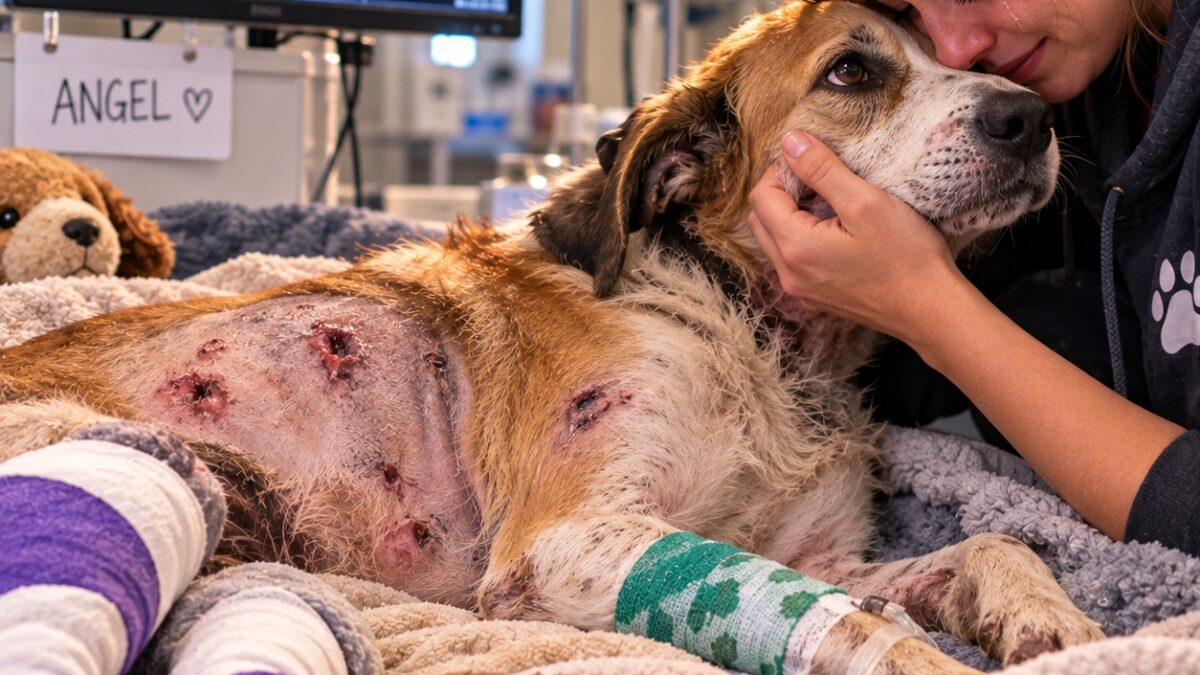
The first night, Angel barely slept.
Neither did we.
Hospitals are strange places after midnight.
The urgency changes.
Machines keep humming.
Fluorescent lights dim but never disappear.
Staff members speak softly.
Doors open and close.
Someone checks a catheter.
Someone records a temperature.
Someone adjusts a blanket.
To an animal, none of it makes sense.
Angel did not know what an X-ray was.
She did not know why strangers kept touching her.
She did not understand that the pain medication was helping.
She did not know there was a bullet close enough to her spine to threaten her future.
She simply knew she was somewhere unfamiliar.
So one of us stayed near her whenever possible.
Not constantly touching.
Sometimes animals need quiet more than affection.
But present.
A person sitting within sight.
A voice.
A hand available if she reached for it.
Angel did.
That was what kept breaking my heart.
After everything, she kept seeking people.
Not desperately.
Not in the frantic way some frightened dogs cling to anyone nearby.
She seemed to make a decision each time.
A hand approached.
She watched.
Then accepted.
A technician scratched gently beneath her chin.
Angel’s eyes softened.
A veterinarian placed a palm against her shoulder.
Angel leaned into it.
I sat on the floor outside her run.
She moved her head until her nose touched my fingers.
No one could have blamed her if she had hated every human being she saw.
But dogs do not organize morality the way we do.
Angel did not know “people” as a category that had betrayed her.
She knew this hand.
This voice.
This moment.
Safe or unsafe.
She kept testing the answer.
And we kept trying to make it safe.
The surgical team reviewed her imaging again the next morning.
Six projectiles.
Different locations.
But the spinal bullet was the urgent one.
Removing it might relieve pressure.
Might prevent additional damage.
Might give her nervous system a chance.
“Might” became the word we lived inside.
Could surgery help?
Might.
Could she regain movement?
Might.
Could she remain permanently paralyzed?
Yes.
Would anyone know immediately after surgery?
No.
People want medicine to give clean answers.
Sometimes it cannot.
The spinal cord does not care how much we love the patient.
Damage is damage.
Inflammation takes time.
Nerves may recover partially.
Or not.
The surgeon was careful with us.
“We can remove what’s causing the pressure.”
Then:
“We cannot promise what function will return.”
I appreciated that.
False hope is not kindness.
But neither is surrender.
So we agreed to the surgery.
Not because we expected Angel to wake up and walk.
Because she had already fought this far.
If removing that bullet could give her one more possibility, we owed her the opportunity.
The night before surgery, I sat beside her longer than usual.
She had begun eating a little.
Not enough to make anyone celebrate.
Enough to count.
I held a small piece of food near her mouth.
She took it gently.
Chewed.
Then looked at me.
“You have no idea what tomorrow is, do you?”
Angel blinked.
Her back legs remained motionless behind her.
I rubbed the fur between her ears.
“We do.”
I wish animals understood promises.
Then again, perhaps it is better that they do not.
Humans make too many.
Instead, I said something simpler.
“We’ll be here when you wake up.”
The next morning, they prepared her.
IV.
Medication.
Monitoring.
One technician kissed the top of her head before she was taken back.
I did not realize I was holding my breath until the doors closed.
Then the waiting started.
I tried answering emails.
Could not.
Walked outside.
Came back.
Made coffee.
Forgot to drink it.
Every person who walked through the door made me look up.
There is something uniquely helpless about surgical waiting.
You have done everything you can.
Your usefulness has ended temporarily.
Now skill, biology, and time take over.
I thought about the couple who found Angel.
I called them.
The woman answered immediately.
“How is she?”
“In surgery.”
Silence.
Then:
“Is she going to walk?”
“I don’t know.”
She started crying.
“I keep thinking if we had found her sooner—”
“Stop.”
I said it more firmly than I intended.
“You found her.”
“But what if she was there for days?”
“We don’t know.”
“What if—”
“You found her.”
That was the only fact that mattered.
They had not caused this.
They had interrupted it.
Sometimes rescuers carry guilt for the minutes before they arrived.
As if compassion should include the power to rewrite time.
It cannot.
Angel needed them to find her.
They did.
Everything after that became ours.
Several hours later, the surgeon came out.
Mask lowered.
Tired eyes.
I stood before she spoke.
“The bullet is out.”
The sentence hit me physically.
My shoulders dropped.
Someone behind me whispered:
“Thank God.”
The surgery had gone as planned.
The projectile lodged near Angel’s spine had been successfully removed.
No catastrophic complication.
Stable.
Coming out of anesthesia.
For perhaps thirty seconds, we allowed ourselves the relief.
Then came the second part.
“We still don’t know about the legs.”
Of course.
The surgery removed a threat.
It did not erase injury.
Angel would need time.
Inflammation had to decrease.
Her neurological status would have to be evaluated again and again.
Maybe movement would return.
Maybe it would not.
There was no dramatic moment of Angel waking and suddenly kicking both legs.
That would make a better movie.
It was not what happened.
She woke slowly.
Groggy.
Confused.
Her eyes opened.
Closed.
Opened again.
I was allowed near her later.
She looked terrible.
I mean that with love.
Shaved fur.
Tubes.
Exhaustion.
The blank, heavy expression of an animal still swimming through anesthesia.
I reached toward her face.
Angel’s eyes followed my hand.
My fingers touched her cheek.
Then her head shifted against them.
Barely.
That tiny movement nearly undid me.
“Hey.”
Her eyes closed again.
“You’re still here.”
That became our measure.
Not walking.
Not standing.
Here.
The day after surgery, Angel’s back legs still did not support her.
The next day, same.
People asked for updates.
I learned to answer carefully.
“The surgery was successful.”
Pause.
“She remains paralyzed.”
Both were true.
Human beings have trouble holding good news and bad news at the same time.
We want the good news to cancel the bad.
Life rarely works that way.
Angel’s spinal bullet was gone.
Angel still could not walk.
The future remained uncertain.
Four days after surgery, another worry appeared.
Fever.
Not high enough to cause panic.
High enough to matter.
The medical team monitored her.
Adjusted care.
Watched surgical recovery.
Everyone had hoped that after removing the bullet we might finally move into a simpler phase.
Instead, recovery reminded us that bodies do not read narratives.
The fever did not care that Angel had already suffered enough.
She still had to get through it.
I visited that afternoon.
Angel looked tired.
Her appetite had dipped.
I crouched beside her.
“You’re making this difficult.”
One ear twitched.
I smiled despite myself.
“Good.”
Because if Angel had taught me anything already, it was that difficult was not the same as impossible.
Her fever improved with management.
Then we turned toward mobility.
There is a particular sadness in watching a dog want to move and seeing the body fail to follow.
Angel’s front legs worked.
Her shoulders were strong enough to pull.
Her back half remained dependent.
Without support, every attempt ended with her dragging her hindquarters.
That created its own risks.
Skin injury.
Strain.
Frustration.
Loss of conditioning.
So the team introduced a mobility cart.
A wheelchair.
Two wheels supporting her back half while a harness held her body correctly.
I had seen carts before.
I knew what they could do.
Still, the first time one is fitted to a dog you love, there is an emotional adjustment.
Part of you thinks:
This is what she needs.
Another part hears:
She may need this forever.
Both thoughts can exist.
We adjusted the straps.
Made sure nothing rubbed.
Supported her while she figured out the new balance.
Angel stood inside the frame.
Front paws on the floor.
Back end held by the cart.
For several seconds, she froze.
Her face had the unmistakable expression of a dog thinking:
What did you people put on me?
Someone laughed softly.
“Come on, Angel.”
She looked toward the voice.
Then took one front step.
The wheels moved.
Angel stopped.
Looked behind herself.
Another step.
Roll.
Then another.
It was not walking in the conventional sense.
Her back legs were not carrying her.
But for the first time since the woods, Angel was deciding where her entire body went.
That matters more than it sounds.
When you are injured and dependent, almost every movement belongs to someone else.
Someone lifts you.
Turns you.
Carries you.
Moves your bedding.
Positions your body.
The cart returned one small part of control.
Angel wanted to go toward a technician.
She went.
Wanted to sniff a doorway.
She went.
Wanted to move away when she was tired.
With guidance, she could.
Her world expanded by several feet.
Then several more.
I watched her expression change.
That was one of the first times I saw something beyond survival in her.
Curiosity.
The hospital hallway became interesting.
Another dog barked in the distance.
Angel turned toward the sound.
A person walked by carrying a bag.
She followed with her eyes.
Her body had been reduced to a medical problem for days.
The wheelchair reminded all of us she was still a dog.
Dogs want to go places.
Smell things.
Follow people.
Investigate.
Angel began doing that again.
Ten days after she first entered the hospital, the team decided she was ready to leave.
Not recovered.
Ready to leave.
Those are very different things.
Her surgical site was stable.
Fever managed.
Pain controlled.
She could continue care outside the hospital.
She still needed mobility support.
Still had paralysis.
Still faced an uncertain neurological future.
But she no longer needed the intensity of inpatient hospitalization.
Foster care came next.
I remember the morning she left.
Hospital staff gathered more than they normally would.
People who had worked different shifts stopped by.
Someone took pictures.
Someone cried.
Angel went into her cart for part of the departure.
Then was transferred safely for transportation.
Her eyes moved from face to face.
She had known us only ten days.
Ten of the hardest days of her life.
Yet leaving felt strangely emotional.
“You’re not getting rid of us that easily,” I told her.
She licked my wrist once.
I decided that counted as agreement.
Foster care gave Angel something hospitals cannot.
Home sounds.
A refrigerator opening.
Television.
Floorboards.
A door.
Sunlight through windows.
Routine.
Hospitals save lives.
Homes teach rescued animals what those lives may feel like.
Her foster caregiver learned Angel’s schedule.
When she tired.
How to help with the cart.
How to position her comfortably.
Which touches she liked.
Which surfaces were difficult.
Every disabled animal has practical needs, and love becomes meaningful when it learns those needs.
Love is not:
Poor baby.
Love is:
I know how to fit your harness.
I know how to protect your skin.
I know when you are tired.
I know how to lift you without hurting you.
I know your medication schedule.
I know you are more than the thing that happened to you.
Angel began settling.
We started thinking about adoption.
That part scared me.
Not because Angel was unlovable.
Because disabled animals often attract the wrong kind of hope.
Someone sees a dramatic rescue.
They imagine themselves giving the dog a miracle ending.
Then reality begins.
Wheelchair.
Appointments.
Therapy.
Bladder or mobility assistance depending on need.
Extra time.
Potential setbacks.
And the miracle may never arrive.
Angel needed someone who would say yes if she never walked.
Not someone who only wanted to be present when she did.
We were honest in every conversation.
No guarantee.
Maybe permanent paralysis.
Maybe lifelong mobility cart.
Maybe some recovery.
Unknown.
Several people were sympathetic.
Sympathy is easy.
Commitment is harder.
Then we heard from a woman in Wisconsin.
She did not start by asking:
“Will Angel walk again?”
That mattered.
She asked about care.
What Angel needed.
Her personality.
The cart.
Follow-up.
What a typical day looked like.
How much assistance.
What to watch for.
She was not shopping for an inspirational ending.
She was asking whether she could give Angel a life.
Those are different questions.
The adoption moved forward.
Wisconsin.
Far enough that the transition required planning.
Travel.
Equipment.
Records.
Medication.
Everything.
I worried.
Of course I did.
Rescuers become ridiculous sometimes.
We spend weeks praying for an animal to get adopted.
Then adoption comes and suddenly we distrust the universe for taking them away from us.
Angel had been everybody’s patient.
Everybody’s project.
Now she would become one person’s dog.
That was exactly what we wanted.
Still hurt.
When the day came, I knelt beside her.
“You understand none of this.”
Angel looked at me.
“Probably better.”
I stroked her head.
“You’re going somewhere good.”
Her wheelchair waited nearby.
The same kind of device that had once felt like a symbol of everything she had lost.
Now it was part of the luggage for her new life.
That shift mattered.
She was not being sent away as a broken dog.
She was going home with the equipment that allowed her to participate in her life.
Her new mom received her in Wisconsin.
New floor.
New smells.
New routines.
A different voice calling her name.
Transition can unsettle even healthy dogs.
For Angel, the physical care added another layer.
But reports came back.
She was settling.
Accepting affection.
Learning.
Continuing treatment.
Practicing.
Day after day.
Her adopter worked with her patiently.
There is nothing glamorous about rehabilitation when you are inside it.
Social media loves milestone clips.
First movement.
First stand.
First step.
What videos do not show are the hundreds of ordinary repetitions between milestones.
Harness on.
Position.
Support.
Encourage.
Rest.
Try again.
Angel’s new mom did those repetitions.
Not for applause.
Because Angel needed them.
At first, the wheelchair remained primarily mobility.
Front legs pulling.
Back legs supported.
Then something subtle happened.
A leg moved.
Not dragged by momentum.
Moved.
At first, no one wanted to overinterpret it.
Spasms happen.
Reflexes happen.
Positioning can create movement.
The rehabilitation team watched.
Again.
Angel moved forward.
One back leg made a stepping motion.
Then the other.
The wheels still held her weight.
She was not walking independently.
But her hind limbs were beginning to participate.
Her new mom sent us a video.
I watched it once.
Then again.
Then slowed it down.
Left.
Right.
Not perfect.
Not strong.
But there.
The message beneath the video was simple.
LOOK AT HER LEGS.
I cried.
Not elegantly.
Not quietly.
I called one of the hospital technicians.
“You need to see this.”
She watched while we were on the phone.
Then I heard:
“Oh my God.”
Pause.
“Oh, Angel.”
Hope is dangerous in rescue.
I say that seriously.
Hope can make people dishonest.
We can become so desperate for a happy ending that we start interpreting every movement as recovery.
Every good day as cure.
Every setback as temporary.
That is unfair to the animal.
So we kept our language precise.
Angel was moving her hind legs in a stepping pattern while supported by the cart.
That was true.
She was not yet walking independently.
Also true.
The movement suggested neurological function might be returning.
Possible.
Not guaranteed.
But for the first time, the phrase “might never use her back legs again” no longer felt like the only future we had to prepare for.
Something was happening.
Her adopter kept practicing.
Angel’s legs continued participating.
Slowly.
Weakly.
The body relearning a conversation between brain, nerves, muscles, and balance.
Anyone who has never watched neurological rehabilitation may imagine movement comes back like a switch.
Off.
Then on.
It is more like a distant radio station slowly becoming clear through static.
A twitch.
A movement.
A pattern.
Weight acceptance.
Balance.
Endurance.
One part arrives before another.
Some days the signal feels stronger.
Other days weaker.
Angel practiced inside that uncertainty.
Her new mom never treated a bad day like failure.
That mattered.
Animals read us.
Frustration travels down the leash.
Disappointment changes our hands.
Angel did not need someone staring at her back legs and thinking:
Why aren’t you better yet?
She needed:
Good girl.
Again.
Rest.
Try tomorrow.
Weeks passed.
Then came the next video.
Angel standing.
Not independently from the floor.
She had been helped into position.
Her body supported initially.
Then hands eased away.
One second.
Two.
Three.
Angel’s back legs trembled.
Her front paws adjusted.
Her entire body wobbled.
Someone stayed close enough to catch her.
But Angel remained upright.
I watched the video without breathing.
She shifted.
Almost lost balance.
Recovered.
Then finally sat back into support.
Only a few seconds.
The text from Wisconsin read:
SHE STOOD.
Two words.
That was all.
I replayed it until my phone battery nearly died.
The dog found in the woods with tape around her muzzle had stood.
The dog shot six times had stood.
The dog whose spinal bullet had left her paralyzed had stood.
Not run.
Not walked across the room.
Stood.
And that was enormous.
People began asking:
“So she’s going to walk?”
We corrected them.
“We don’t know.”
“But she stood.”
“Yes.”
“So that means—”
“It means she stood.”
That discipline mattered.
Angel’s progress deserved celebration without turning it into prophecy.
There is pressure in inspirational stories.
Once an animal starts improving, people demand the next chapter.
Stand.
Then walk.
Then run.
Then dramatic reunion in a field under sunset.
But bodies do not owe audiences satisfying escalation.
Angel owed no one a run.
She did not owe us a walk.
She did not have to become nondisabled to prove her rescue mattered.
Her life had value the day she lay paralyzed in the hospital.
It had value when she used wheels.
It had value now.
If Angel never progressed one inch beyond standing for a few seconds, she would still be home.
Still loved.
Still safe.
That became the emotional center of her story for me.
Not:
Will she walk?
But:
What happens if she doesn’t?
The answer was finally good.
She stays.
She is cared for.
She is Angel.
That is the ending the woods never offered her.
Her adopter still hoped.
Of course she did.
She wanted to see Angel run.
We all did.
There is nothing wrong with hope as long as it does not become a condition.
Hope said:
Maybe.
Love said:
Either way.
Angel continued therapy.
The wheelchair remained part of daily life.
Her back legs practiced stepping.
Standing sessions.
Balance.
Strength.
Rest.
Sometimes she held herself longer.
Sometimes not.
One difficult day, her adopter messaged:
“She’s tired today.”
That was all.
No panic.
No disappointment.
They rested.
The next day, Angel tried again.
That rhythm became normal.
I learned to stop waiting for a grand announcement.
Recovery lived in small messages.
She moved a leg.
She stood a little longer.
She tolerated practice well.
She was happy.
She ate.
She slept.
She wanted attention.
She followed her mom in the wheelchair.
Normal life slowly surrounded the medical story.
That is another sign of healing.
At first, every update is about the injury.
Then one day someone sends a picture because Angel is being silly.
No medical caption.
No spinal discussion.
Just Angel.
That may have been my favorite update.
She was lying on a blanket.
Head tilted.
Looking offended about something.
No wheelchair visible.
No hospital.
No bandages.
Just a dog with an opinion.
I realized I had started thinking of her entire identity through the worst things that had happened to her.
Shot.
Taped.
Paralyzed.
But Angel never knew herself as a tragedy.
She knew smells.
Food.
People.
Comfort.
Movement.
Frustration.
Sleep.
Affection.
Maybe the greatest kindness we could give her was eventually letting the trauma become background instead of title.
Her name was Angel.
Not “the dog who was shot six times.”
Angel.
A dog living in Wisconsin.
A dog with a wheelchair.
A dog practicing standing.
A dog whose mom hoped to see her run someday.
A dog already home.
The couple who found her stayed in touch.
Months after the adoption, I sent them one of the standing videos.
The woman called.
She could barely speak.
“That’s her?”
“Yes.”
“She’s standing?”
“For a few seconds.”
She cried.
Then laughed.
Then cried again.
Her husband came onto the phone.
He said:
“When I picked her up in the woods, I thought she was dying in my arms.”
I had no response.
He continued:
“I didn’t think she’d make the drive.”
Then:
“Look at her.”
That sentence contained the whole distance.
Woods.
Hospital.
Surgery.
Cart.
Wisconsin.
Standing.
Look at her.
The woman said:
“I keep thinking about her mouth.”
“I know.”
“How tight the tape was.”
“I know.”
“I thought that was the worst thing somebody had done.”
Then the scans found the bullets.
Sometimes what we see is only the visible cruelty.
The hidden damage takes longer.
That is true in animals.
People too.
Angel’s muzzle healed before her spine did.
The tape came off in minutes.
The neurological injury demanded weeks, months, maybe a lifetime.
There was a lesson there none of us wanted but all of us understood.
Removing the obvious harm does not erase what happened underneath.
Rescue is not one dramatic moment.
It is what comes after.
You remove the tape.
Then discover the bullets.
You remove the bullet.
Then discover paralysis may remain.
You provide wheels.
Then discover rehabilitation requires patience.
You find a home.
Then discover love means adjusting every day.
Each solution reveals another layer.
The temptation is to ask:
When is she fixed?
There may never be a clean answer.
Maybe “fixed” is the wrong goal.
Angel was injured.
She needed healing.
She also needed a life while healing happened.
Her adopter gave her both.
I once heard someone say:
“I could never adopt a dog like that. It would be too sad.”
I understood what they meant.
But they were wrong about one thing.
Angel’s home was not sad.
Her history was sad.
There is a difference.
Her home had wheels rolling across the floor.
A woman calling her.
Practice.
Treats.
Frustration.
Celebration.
Sleep.
Warmth.
A dog learning what daily security feels like.
Sadness existed.
But it did not own the place.
That is perhaps the most important transformation.
In the woods, Angel’s life had been defined by what someone did to her.
In Wisconsin, her life was increasingly defined by what she did next.
Move.
Practice.
Rest.
Try again.
Accept affection.
Stand.
One afternoon, her new mom sent another message.
No dramatic video.
Just:
She followed me around all morning.
I smiled more at that than at some rehabilitation milestones.
Because following someone around is ordinary dog behavior.
Annoyingly ordinary.
Beautifully ordinary.
Angel could not do it the conventional way.
She used her cart.
Still followed.
From room to room.
Because that woman was her person now.
The dog once abandoned where nobody was supposed to find her had chosen someone she wanted to stay near.
That is an ending by itself.
Time kept moving.
Standing became part of practice.
Some attempts lasted longer.
Her balance improved incrementally.
Her back legs sometimes shook.
Sometimes crossed awkwardly.
Sometimes needed repositioning.
But the movement existed.
No one could predict the ceiling.
Would Angel eventually take independent steps?
Possible.
Would she run?
We did not know.
Her new mom continued hoping.
Not publicly demanding.
Hoping.
There is tenderness in that kind of hope.
It leaves room for reality.
“I’d love to see her run.”
Then:
“But she doesn’t have to.”
That sentence mattered more than any physical milestone.
Angel had spent part of her life in the hands of someone who treated her body as disposable.
Now she belonged to someone who valued that body exactly as it was.
Paralyzed.
Healing.
Uncertain.
Wheeled.
Standing.
Whatever came next.
That is what safety really means.
Not the absence of injury.
The absence of conditions on your right to stay.
Angel was staying.
Sometimes I still think about the first night at the hospital.
Her lying there.
Back legs unmoving.
The technician saying:
“We’re counting bullets.”
I remember how impossible the future felt.
We were not thinking about Wisconsin.
Not thinking about standing.
We were thinking:
Will she survive surgery?
Can we keep her comfortable tonight?
People like neat narratives because they make pain feel purposeful.
I resist that now.
Angel did not have to be shot for something beautiful to happen later.
Her suffering was not “worth it” because she found love.
I hate that framing.
The cruelty was unnecessary.
Wrong.
Meaningless.
The meaning came from what other people chose afterward.
They chose not to leave her.
They chose treatment.
Surgery.
Foster care.
Adoption.
Rehabilitation.
Love.
The good does not justify the bad.
It answers it.
That distinction is important.
Angel’s story is not:
Everything happens for a reason.
It is:
Terrible things happen.
Then people decide what happens next.
A couple found a dog.
They could have kept walking.
They stopped.
The rescuers could have decided the case was too difficult.
They came.
The surgeons could have said prognosis uncertain and left the bullet.
They operated.
The adopter could have waited for a healthy dog.
She chose Angel.
Again and again, the next chapter existed because someone made a choice.
That is where hope lives.
Not in pretending the world is fair.
In deciding unfairness does not get the final word automatically.
Angel’s new mom did eventually talk about the future.
A yard.
More exercises.
Possibly improved mobility.
Maybe one day a few independent steps.
She allowed herself the image of Angel running.
I did too.
Sometimes.
A dog crossing grass on four legs.
Ears moving.
Body free.
Then I stopped myself from needing it.
Because the actual Angel already existed.
Wheelchair.
Unsteady stand.
Soft eyes.
Home.
Needing the fantasy more than the dog would be another kind of selfishness.
So we celebrated what she gave us.
A second.
Five seconds.
Movement.
Comfort.
Trust.
A good day.
Rest after a hard day.
Those things became enough.
One evening, I watched the original hospital video and a newer video back to back.
In the first, Angel lay mostly still.
A person stroked her head.
Her hind legs did nothing.
In the second, she was supported near her wheelchair.
Her back paws touched the floor.
Her legs trembled.
She pushed.
Rose.
Held.
The difference was extraordinary.
But what struck me was her face.
Same eyes.
Same willingness to look toward the person beside her.
The body had changed.
The trust had been there much earlier.
Perhaps that was Angel’s greatest strength.
Not that she “forgave humanity.”
I still reject that phrase.
She did something more practical.
She kept allowing individual people to prove themselves.
The couple in the woods.
Us.
Hospital staff.
Foster.
Her adopter.
Trust rebuilt person by person.
Touch by touch.
That is probably how it works for many wounded beings.
Not a grand decision:
I trust again.
A series of smaller ones.
This hand is safe.
This room is safe.
This person comes back.
This person feeds me.
This person does not hurt me when I cannot move.
This person stays.
Eventually:
Home.
The woods had taught Angel that a person could silence her and leave.
Wisconsin taught her someone could build life around keeping her included.
Those lessons were not equal.
The second had to be repeated.
Every day.
Morning.
Afternoon.
Night.
That repetition became her new reality.
I visited disabled dogs after Angel.
Different injuries.
Different stories.
I stopped feeling pity when I saw carts.
Respect, yes.
Curiosity.
Practical concern.
But not automatic sadness.
Wheelchairs are not symbols of failure.
They are tools.
Freedom with wheels is still freedom.
Angel taught me that.
Her cart allowed her to move before her legs could support her.
It protected her body while function remained uncertain.
Later, it became part of rehabilitation.
The same object changed meaning over time.
That happens often in rescue.
A crate can look like confinement to someone who does not understand.
For an injured dog, it can be safety.
Medication can look frightening.
It can be relief.
A wheelchair can look tragic.
It can be independence.
Angel did not care what the cart symbolized to humans.
She cared that it let her go.
That simplicity helped me.
We humans attach stories to everything.
Angel kept living.
Months after the woods, her adopter sent a photo of her standing beside the wheelchair.
Not for long.
But clearly upright.
Her new mom’s hand hovered near her body.
Ready.
Angel looked forward.
Not down.
That photograph became the image I saved.
Not the tape.
Not the hospital.
That.
Because it did not lie.
It did not pretend she was cured.
The wheelchair remained right there.
So did the helping hand.
The whole truth in one frame.
Progress and dependence.
Strength and vulnerability.
Hope and uncertainty.
All together.
If someone asked me for the ending, I would show them that photograph.
They might say:
“But what happened next?”
That is the problem with endings.
Lives continue.
Angel continued practicing.
Her mom continued caring.
There were probably difficult mornings.
Good afternoons.
Days when Angel wanted to move more than her body allowed.
Days when she surprised everyone.
That is life.
But a story still needs somewhere to close.
So I close Angel’s story where the central question changed.
At the beginning, the question was:
Will she survive?
Then:
Will she survive surgery?
Then:
Will she ever move her back legs?
Then:
Will she stand?
By the end, the most important question was no longer medical.
It was:
Will she have somewhere to belong regardless of the answer?
Yes.
That answer was certain.
For once, certainty.
Angel had a home.
A person.
Care.
Treatment.
A wheelchair if she needed it.
Hands that supported instead of restrained.
A future that did not depend on proving anything.
Her new mom still dreamed about running.
Maybe someday.
I hope so.
I hope there is a morning when Angel forgets anybody ever questioned what her back legs could do and chases something across the grass.
I hope her mom cries so hard she cannot film it properly.
I hope Angel runs toward her because that is exactly the sort of thing dogs do after humans spend months imagining the moment.
But I will not tell you that happened.
Not because I want to deny a happy ending.
Because Angel already has one.
A truthful one.
The dog found in the woods with tape around her muzzle was not left there.
The dog shot six times was treated.
The bullet in her spine was removed.
The paralyzed dog learned to move through the world in a cart.
She went into foster care.
Then a woman hundreds of miles away saw what Angel needed and said yes.
Her back legs began moving.
Then she stood.
Briefly.
Shaking.
Supported.
Still uncertain.
But standing.
And when she tired, someone caught her.
That last part is the ending.
Not the standing.
The catching.
Because survival had once depended on strangers noticing her before it was too late.
Now she no longer had to depend on luck.
There was always someone close enough to catch her.
I think about the woods sometimes.
A dog on the ground.
Tape around her mouth.
Unable to use her legs.
Whoever left Angel there expected silence to finish the job.
No barking.
No following.
No running toward a road.
No way to ask for help.
But silence did not win.
Two people saw her.
Then they spoke for her.
Rescuers answered.
Doctors answered.
A foster answered.
A woman in Wisconsin answered.
One cruel act had tried to make Angel disappear.
A long chain of compassionate acts refused.
That is why I do not remember the person who hurt her most.
I remember the people who stayed.
The man carrying her out.
His wife taking off the tape.
The surgeon walking out saying the bullet was gone.
The technician adjusting the wheelchair.
The foster caregiver learning the routine.
The adopter watching those back legs move.
The hand hovering near Angel’s side while she stood.
Those are the images that matter.
Cruelty was the first chapter we knew.
It did not get to write the last.
Angel did.
One trembling stand at a time.
One safe touch at a time.
One ordinary day at home after another.
And somewhere in Wisconsin, a woman still looks at a dog who was once left for dead and imagines her running.
Maybe Angel will.
Maybe she will not.
Either way, when evening comes, she will not be lying alone in the woods.
She will be inside.
Warm.
Fed.
Safe.
Loved.
And when her legs cannot hold her, there will be hands there.
Not to hurt her.
Not to silence her.
To hold her up.
That is where Angel’s story ends for me.
Not with the gunshots.
Not with the paralysis.
Not even with the first time she stood.
It ends with something she should have had from the beginning.
A home where falling no longer means being abandoned.








