PART2:They Returned Rex to My Shelter for the Fourth Time Because He Was “Too Much”—A Year Later, That Same Energy Saved My Son’s Life
PART2
I did not make that decision responsibly.
That is probably important to admit.
Shelter employees are supposed to be realistic.
We see what happens when people adopt from emotion and discover later that affection is not a substitute for compatibility.
I knew my schedule.
I knew my house.
I knew Rex’s energy.
I knew I had a ten-year-old son named Tommy.
I knew bringing home a dog who had already been returned repeatedly meant taking responsibility not only for feeding and exercising him but also for the damage those returns had done to his trust.
I knew all of that.
And I still took his leash home that evening.
Tommy opened the door before I reached the porch.
He looked at Rex.
Then at me.
“Mom.”
“Yes.”
“That’s Rex.”
“Yes.”
“The shelter Rex.”
“Yes.”
“The one who ate the tennis ball basket?”
“He did not eat the basket.”
“He ate part of it.”
“Technical distinction.”
Tommy’s face slowly changed.
“Is he staying?”
I looked down at Rex.
He stood at my side with his head low.
No jumping.
No attempt to lick Tommy.
That worried me more than anything.
“Maybe.”
Tommy crouched.
“Hey, buddy.”
Rex glanced at him.
Tommy reached out, then stopped before touching him.
Smart kid.
“Can I?”
“Let Rex decide.”
Tommy stayed where he was.
Rex sniffed the air.
One step.
Then stopped again.
Tommy whispered:
“It’s okay.”
Rex turned away.
Tommy looked at me.
“He doesn’t like me?”
“He’s tired.”
“From what?”
I could have said the car ride.
Instead I told him the truth.
“From people changing their minds.”
Tommy did not ask anything else.
He stepped aside and let Rex enter.
The first thing Rex did inside my house was find the front door.
He sat beside it.
That was where he stayed.
I had prepared an old dog bed in my bedroom.
A blanket beside Tommy’s room.
Water in the kitchen.
Food.
A few toys.
Rex ignored almost all of it.
He drank.
Ate a little.
Then returned to the front door.
Head lowered.
Watching the floor.
Tommy whispered from the hallway:
“Is he waiting for somebody?”
“Yes.”
“Who?”
That question nearly broke me.
“I don’t think he knows.”
Tommy disappeared into his room.
A few minutes later, he returned with his favorite old blanket.
Blue.
Too small for Rex.
He placed it several feet from him.
“For when he’s ready.”
Then he went to bed.
I stayed.
The house became quiet.
Rex remained near the door.
Every passing car made one ear move.
Whenever headlights swept briefly across the wall, he raised his head.
Then lowered it when the sound disappeared.
I finally sat beside him.
Not touching.
Not calling.
Not asking.
Just sitting.
Dogs are forced to deal with humans constantly demanding things.
Come.
Sit.
Stay.
Look.
Eat.
Play.
Trust me.
Sometimes trust grows when nobody demands it.
So I stayed silent.
Fifteen minutes passed.
Then thirty.
My legs went numb.
Rex did not move.
I remember thinking:
This dog used to climb into my lap while I was trying to clean kennels.
Now he is afraid to come six inches closer.
Eventually, he stood.
Slowly.
I held still.
Rex walked toward me.
Stopped.
Then sat beside my legs.
A moment later, he lowered his head onto my lap.
I put one hand on his neck.
That was all.
No speech.
No promise.
I did not tell him I would never return him.
Words had already failed him too many times.
That first night, I slept on the floor beside the front door.
Rex slept with his head against my thigh.
When I woke sometime after midnight, his eyes were open.
“Still here,” I whispered.
His eyes closed.
The next morning, he was still near the door when I got dressed for work.
That created a problem.
I had to leave.
I worked at the shelter.
Tommy had school.
Rex had barely survived one night learning that my house might be safe, and now I was about to do the exact thing every previous owner had done before disappearing from his life.
Put on shoes.
Pick up keys.
Walk out.
Rex saw the keys.
His body changed.
Head up.
Eyes fixed.
I grabbed my coat.
He stood.
“Rex.”
He came immediately.
Too immediately.
Pressed against my legs.
I walked toward the door.
He blocked it.
Not aggressively.
Desperately.
Tommy stood nearby with his backpack.
“What do we do?”
I crouched.
“Rex.”
He panted.
“Hey.”
His eyes were locked on mine.
“I have to go to work.”
Of course he did not understand.
I touched his chest.
“I’m coming back.”
His entire life had probably been full of versions of that promise.
I’m coming back.
You’re safe.
Forever home.
Good boy.
Then the door closed.
So I did not repeat myself.
I took him to work.
My supervisor laughed when she saw us.
“You lasted one night.”
“I’m fostering.”
“Of course.”
“Temporarily.”
“Absolutely.”
Rex walked straight into the shelter.
For the first time since bringing him home, his tail moved.
But then we passed his old kennel.
He stopped.
No.
I felt it before I understood it.
He thought I was returning him.
His body dropped.
Head down.
He pulled backward on the leash.
“No.”
I knelt.
“No, Rex.”
He trembled.
Not dramatically.
Tiny vibrations through his shoulders.
My chest tightened.
I unclipped the leash.
Staff members looked at me.
Rex stayed frozen.
I walked past the kennel.
Down the hall.
Into the staff office.
He watched.
“Come on.”
He hesitated.
Then followed.
I put his bed beneath my desk.
“That’s yours.”
He sniffed it.
“All day.”
He looked toward the hall.
“You’re leaving with me.”
I worked.
Rex slept beneath my desk.
At lunch, I took him outside and ran until my own lungs reminded me I was human.
That evening, when I picked up my keys, Rex stood.
I walked toward the shelter exit.
He followed.
Outside.
Car.
Home.
When we reached my front door, something changed.
He entered faster.
Small victory.
The following week became a lesson in repetition.
Home.
Work.
Home.
Work.
Walk.
Food.
Sleep.
Every day the same.
Predictability.
Rex needed that more than affection.
At first, he followed me everywhere.
Bathroom door?
Rex outside.
Kitchen?
Rex.
Laundry room?
Rex.
If I moved chairs, he stood.
If I picked up keys, he appeared.
If I opened the front door to get the mail, he tried to squeeze through beside me.
I began practicing tiny absences.
Thirty seconds.
Step outside.
Return.
One minute.
Return.
Five.
Return.
Tommy helped.
“Why do you keep leaving?”
“So he learns something.”
“What?”
“That leaving doesn’t mean gone.”
That sentence stayed with me.
Leaving doesn’t mean gone.
Rex did not need obedience training first.
He needed proof.
I gave it to him over and over.
Door closes.
Emma returns.
Again.
Again.
Again.
One evening, I went to the grocery store for twenty minutes.
When I came home, Rex was sitting beside the door.
But when I opened it, his tail moved.
Not panic.
Recognition.
I crouched.
“See?”
He jumped.
Both front paws against my shoulders.
Nearly knocked me over.
Tommy laughed from the kitchen.
“Rex!”
I sat on the floor laughing while Rex licked my face.
That was the first time he truly greeted me at home.
Not at the shelter.
Not because we had just met.
Because I had left.
And returned.
The distinction meant everything.
Rex slowly began exploring the rest of the house as though he finally believed he might be allowed to learn it.
First the living room.
Then Tommy’s room.
Then my bedroom.
The backyard became his kingdom within approximately seven seconds.
He ran from fence to fence.
Sniffed every plant.
Found a dead leaf.
Celebrated.
Found another leaf.
Celebrated harder.
Tommy threw a ball.
Rex sprinted after it, returned with a stick.
“That’s not the ball.”
Rex looked proud.
Tommy threw another ball.
Rex chased it.
Returned with the first ball.
“He’s weird.”
“He’s Rex.”
That became our explanation for everything.
Why did he spin in circles before breakfast?
Rex.
Why did he take three toys outside and come back carrying none?
Rex.
Why did he sleep half on the dog bed and half off?
Rex.
Why did he run from one side of the yard to the other because a bird landed on the fence?
Rex.
The very qualities families had listed as problems became the rhythm of our house.
Was he exhausting?
Absolutely.
Some mornings, I wanted coffee before adventure.
Rex disagreed.
He would stand near the leash.
Then look at me.
Leash.
Me.
Leash.
“Five minutes.”
Tail.
“I’m serious.”
Tail faster.
“You are the reason people have caffeine.”
Eventually, before sunrise, we began walking through the fields outside our neighborhood.
At first, always on leash.
Rex pulled.
Not violently.
He simply had more destinations in mind than I did.
Every scent mattered.
Every rustle deserved investigation.
Every stretch of grass looked like opportunity.
I worked on recall.
Patience.
Check-ins.
He learned fast.
Not because he wanted to obey.
Because he wanted connection.
There is a difference.
He began looking back at me during walks.
Not constantly.
Just enough.
Are you there?
Yes.
Good.
Keep going.
Eventually, in safe open areas away from traffic, I let him off leash.
The first time, I expected him to bolt.
He stood.
Almost confused.
I took off the leash.
“Go.”
Rex looked at me.
“Go.”
Then he ran.
I had seen Rex run at the shelter.
Not like that.
He exploded across the field.
Full speed.
Grass kicking behind him.
He circled wide.
Jumped over a shallow stream.
Chased something that might have been a butterfly and might have been imaginary.
Turned.
Ran again.
Tommy shouted:
“Look at him!”
I was.
And what I saw made my throat tighten.
Rex was not running away.
He was running because nobody would stop him.
There was freedom in every stride.
All the things people called excessive—
energy,
speed,
curiosity,
intensity—
spread out across that field until none of them looked like problems.
They looked like a dog.
Just a dog.
Rex.
Then something happened that I will never forget.
He was perhaps fifty yards ahead.
Morning sky pink.
Sun barely above the fields.
Rex stopped.
Turned.
Looked directly at me.
For a second, neither of us moved.
Then he ran back.
Straight toward me.
Fast.
“Rex.”
He did not slow.
“Rex!”
He jumped.
I went backward into wet grass.
He landed half on me.
Started licking my face.
I laughed.
Could not stop.
Pushed him away.
He came back.
Tommy was doubled over nearby.
“Mom!”
“Help me!”
“No!”
“Traitor!”
Rex’s mouth was open.
Tongue hanging out.
His entire body shaking with happiness.
Dogs do not laugh exactly like humans.
But nobody watching Rex that morning could have convinced me joy has only one language.
He eventually collapsed beside me.
I scratched his chest.
“You came back.”
That was the moment.
Not adoption paperwork.
Not sleeping beside the door.
Not bringing him home.
That field.
Because Rex finally understood the same thing I had been teaching him.
We could move apart and still return to each other.
Months passed.
Rex became my best friend.
Tommy’s too.
The three of us became a unit almost without noticing.
Breakfast chaos.
School drop-off.
Shelter shifts.
Evening walks.
Weekends outside.
Rex still followed me often, but no longer every second.
Sometimes I left a room and he stayed asleep.
That might sound insignificant.
It was trust.
He did not need to monitor every door because he had learned something simple.
I came back.
Every time.
When I left for work without him, he waited.
When Tommy left for school, Rex watched from the window.
When we returned, he greeted us with such enthusiasm that grocery bags became dangerous.
But the panic was gone.
He was happy.
Not terrified.
Mrs. Holly lived nearby.
She liked Rex.
Mostly.
One afternoon, she leaned over her fence while he ran circles through the yard.
“Emma.”
“Yes?”
“How do you do it?”
“Do what?”
She pointed.
Rex sprinted past us carrying a ball, dropped it, discovered a stick, forgot both, and chased his own tail for reasons known only to him.
“That.”
I laughed.
“What about it?”
“He never stops.”
“He stops eventually.”
“When?”
“Usually when unconscious.”
Mrs. Holly smiled.
“He’s so active.”
There it was.
The word.
Active.
Depending on tone, people meant different things.
Energetic.
Difficult.
Too much.
I watched Rex race across the grass.
“I like that.”
“You do?”
“Yes.”
She stared at me.
“Why?”
“Because that’s Rex.”
“That’s your explanation for everything.”
“It works.”
He ran toward us.
Mrs. Holly stepped back instinctively.
Rex stopped before hitting the fence.
Good boy.
She laughed.
“I’d be exhausted.”
“I am exhausted.”
“Then why smile?”
I looked at him.
Because I had seen what he looked like when he stopped being himself.
Because I had seen his head hanging inside a kennel after people repeatedly told him, in the only language he understood, that his joy was inconvenient.
“Because he loves being alive.”
Mrs. Holly’s expression softened.
Rex dropped a ball at my feet.
I picked it up.
“You know what I think?”
“What?”
“Maybe we should all be a little more like Rex.”
I threw.
He ran.
Mrs. Holly watched him.
Then smiled.
“Maybe.”
A year passed.
Rex changed physically.
Healthy weight.
Strong muscles.
Coat shining.
Eyes bright.
But the larger transformation was harder to photograph.
He trusted.
That was everything.
He slept sprawled in the middle of the living room.
A dog afraid of being abandoned does not sleep like that.
He rolled onto his back.
Feet in the air.
Completely vulnerable.
Sometimes I would stop just to look.
The shelter Rex had always seemed ready for the next person to leave.
Home Rex could sleep through me walking to the mailbox.
That made me prouder than any sit or stay.
Sunday mornings became our favorite.
No school.
No rushed schedule.
Sometimes Tommy rode his bike while Rex and I walked through the fields.
Rex ran beside him.
Never close enough to wheels.
I taught Tommy rules.
Helmet.
Stay on paths.
Do not race downhill where you cannot see the ground.
He listened.
Mostly.
He was ten.
Ten-year-old boys are professionally convinced that warnings apply mostly to other people.
That Sunday looked ordinary.
That detail matters.
Bad days rarely introduce themselves.
Sunshine.
Birds.
Light breeze.
Tommy wheeled his bike out.
“Can I come?”
“With us?”
“Yes.”
“Helmet.”
“I know.”
“Water.”
“I know.”
“No stupid hills.”
He gave me the expression children reserve for unreasonable mothers.
“I know.”
Rex jumped around him.
“See? Rex wants me.”
“Rex also eats dirt.”
“Sometimes.”
“Not evidence.”
We left.
I remember being happy.
Not in some grand way.
The quiet kind.
Tommy riding ahead.
Rex running beside him.
Me following.
Sun on the fields.
That full feeling in your chest when, for one rare moment, nothing needs fixing.
Rex ran.
Tommy laughed.
I thought:
This is enough.
Then Tommy reached the hill.
It was not huge.
A small rise.
We had passed it dozens of times.
He rode to the top.
Turned his bike.
“Mom!”
“Stay on the path!”
“Watch!”
Those are the most dangerous words a ten-year-old boy can say.
“Tommy, slow down.”
He pushed off.
The bicycle rolled.
At first, fine.
Then faster.
“Brake.”
He laughed.
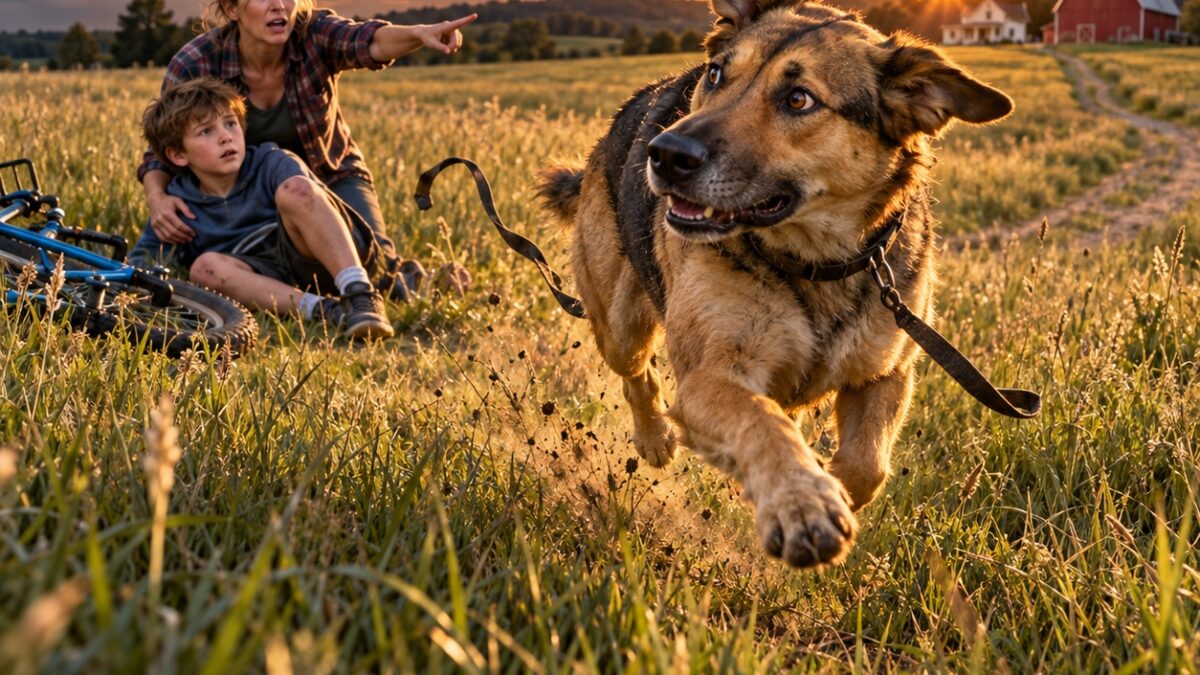
Rex chased from the side.
“Tommy.”
The front wheel hit a stone.
I saw it.
Small.
Half buried.
Something no one would notice walking.
The tire jerked sideways.
Handlebars twisted.
Tommy’s body went over.
The sound when he hit the ground was terrible.
Metal.
Dirt.
Then his scream.
“Mom!”
I ran.
I do not remember deciding.
I remember the distance suddenly feeling impossible.
Rex reached him first.
He stopped.
Sniffed.
Whined.
Tommy cried.
I dropped beside him.
“Don’t move.”
“My leg!”
“I know.”
“My leg!”
I looked.
And immediately wished I had not.
His lower leg was positioned wrong.
Not grotesque.
Wrong enough.
My training at the shelter was animal-related.
First aid.
Basic emergencies.
None of that prepares you emotionally to look at your own child crying in a field.
I touched his face.
“Look at me.”
“Mom, it hurts.”
“I know.”
“Fix it.”
Those words.
Fix it.
Mothers are supposed to fix things.
Scraped knees.
Bad dreams.
Broken toys.
Fevers.
But I could not fix his leg.
“Don’t move.”
He grabbed my arm.
“Please.”
“I’m here.”
I reached into my pocket.
Nothing.
Other pocket.
Nothing.
My phone.
Kitchen counter.
Charging.
I had forgotten it.
For several seconds, I could not process that.
No phone.
I looked around.
Fields.
Trees.
Distant houses.
No people.
I shouted.
“Help!”
Nothing.
Again.
“HELP!”
The sound disappeared into open space.
Tommy was crying harder.
I tried to lift him.
Bad idea.
He screamed.
I stopped immediately.
“No. No. Sorry.”
“Mom.”
“I’m sorry.”
I looked toward the neighborhood.
Farther than I wanted.
Could I leave him?
No.
Could I carry him?
I tried again, only enough to understand.
Tommy was ten.
Not a toddler.
And every movement risked making the injury worse.
I sat beside him.
My thoughts started breaking apart.
Phone.
Home.
Neighbor.
Road.
Run.
Stay.
Rex.
For several seconds, I forgot he was there.
Then he moved in front of me.
I looked at him.
Rex looked at Tommy.
Then at me.
Then toward the neighborhood.
His ears were forward.
“Rex?”
He paced once.
Back toward Tommy.
Looked at me.
I do not know whether dogs understand emergencies the way we do.
I do know Rex understood our emotions.
Tommy’s scream.
My panic.
The fact that something was wrong.
He looked toward home again.
And then he ran.
“Rex!”
He kept going.
Full speed.
Not playing.
No loops.
No butterflies.
No joyful detours.
A straight line through the field.
I watched him disappear.
For half a second, fear hit me from another direction.
Rex is gone.
Then I remembered every morning in the field.
Every time he ran.
Every time he came back.
Trust.
I turned to Tommy.
“Stay with me.”
He sobbed.
“Where did Rex go?”
“I think he’s getting help.”
I had no idea whether that was true.
I wanted it to be.
Minutes slowed.
I kept Tommy talking.
“What did you have for breakfast?”
He stared at me like I had lost my mind.
“My leg hurts.”
“I know. Tell me.”
“Cereal.”
“What cereal?”
“Mom.”
“Tell me.”
“The chocolate one.”
“You told me we were out.”
His crying changed slightly.
“I hid some.”
“Of course you did.”
“Don’t be mad.”
“I’m furious.”
He almost laughed.
That was good.
Anything except panic.
I checked his breathing.
Color.
Kept him still.
Told him help was coming.
I did not know.
But I said it.
Meanwhile, Rex ran.
I did not see that part.
Mrs. Holly told me later.
She had been in her kitchen when barking started outside.
Not ordinary barking.
Repeated.
Sharp.
Urgent.
She looked through her window.
Rex stood in front of her house.
Alone.
That was the first thing that frightened her.
Rex was never alone outside the neighborhood.
Never.
She opened the door.
“Rex?”
He barked.
Ran several yards toward the field.
Stopped.
Looked back.
Mrs. Holly stood there.
“What?”
He ran back.
Barked.
Turned.
Ran again.
That was when she understood he wanted her to follow.
She grabbed her phone.
“Okay.”
Rex ran.
She followed as fast as she could.
He would sprint ahead.
Stop.
Turn.
Wait.
Then continue.
Exactly the way he had learned to check for me during our walks.
Back in the field, I heard barking.
Distant.
My head snapped up.
“Rex.”
Tommy tried to lift his head.
“Is that him?”
“I think so.”
Then Mrs. Holly appeared.
Phone in hand.
Running behind Rex.
I have never been so happy to see another human being.
“Emma!”
“Call an ambulance!”
She was already dialing.
Rex reached us.
Went straight to Tommy.
Sniffed him.
Then came to me.
I grabbed his collar.
“You did it.”
He panted.
Tail moving.
Mrs. Holly gave our location.
Described the injury.
Stayed on the line.
I looked at Rex.
The dog who supposedly could not settle.
The dog who ran too much.
The dog who always needed something to do.
The dog who had been returned because people could not keep up with him.
He had just crossed that field faster than any of us could have.
Not because someone trained him for rescue.
Not because he had been taught a command.
Because Tommy needed help.
Rex understood enough to go find it.
The ambulance took what felt like an hour.
It was much less.
When the paramedics arrived, everything became movement.
Assessment.
Questions.
Splint.
Pain management.
Stretcher.
Tommy screamed once when they stabilized his leg.
I nearly stopped breathing.
One paramedic looked at me.
“Mom?”
“Yes.”
“We’ve got him.”
I nodded.
Words stopped working.
They loaded Tommy.
Mrs. Holly said she would take my things.
I started toward the ambulance.
Then stopped.
Rex.
He stood several feet away.
Panting.
Dust on his legs.
Looking at me.
I crouched.
My knees hit the ground.
Rex came.
Sat.
Put his head on my lap.
Exactly like the first night.
I wrapped my arms around him.
And I cried.
Not quietly.
Not gracefully.
A full year of loving this dog and every fear from the last thirty minutes came out at once.
“Thank you.”
Rex stayed.
I pressed my face into his neck.
“Thank you.”
Mrs. Holly put a hand on my shoulder.
“Emma.”
I looked up.
“Go with Tommy.”
I nodded.
She held Rex’s collar.
“I’ve got him.”
For one second, Rex resisted.
He moved toward me.
My chest tightened.
Old fear.
Leaving.
I put both hands on his face.
“Rex.”
He looked at me.
“I’m coming back.”
This time, I said it.
And this time, he believed me.
His body relaxed.
I climbed into the ambulance.
The doors closed.
Through the small rear window, I saw Rex standing beside Mrs. Holly.
Watching us leave.
The difference between the Rex of a year earlier and the dog outside that ambulance was everything.
He did not collapse.
Did not panic.
Did not think every departure meant abandonment.
He watched.
Because he had learned:
I return.
At the hospital, Tommy was diagnosed with a fracture.
Painful.
Serious enough to require treatment and weeks of recovery.
But fixable.
That word.
Fixable.
I sat beside his bed while he slept after the medication.
His face looked younger asleep.
Ten-year-olds spend so much time trying to seem older.
Pain strips that away.
I held his hand.
Thought about the field.
No phone.
No people.
No safe way to carry him.
Then Rex running.
Mrs. Holly arriving.
I started crying again.
Tommy opened one eye.
“Mom?”
“Go back to sleep.”
“Are you crying?”
“No.”
“You are.”
“I have allergies.”
“In the hospital?”
“Very aggressive hospital pollen.”
He smiled weakly.
Then:
“Where’s Rex?”
“With Mrs. Holly.”
“Did he get her?”
“Yes.”
His eyes opened wider.
“He knew?”
“Yes.”
A pause.
“Rex saved me.”
I swallowed.
“He helped us.”
“He saved me.”
I did not argue.
The first thing Tommy wanted when we finally returned home was Rex.
Not food.
Not television.
Not his bed.
Rex.
Mrs. Holly brought him over.
The moment Rex saw Tommy on crutches, his entire body exploded with excitement.
Then something remarkable happened.
He ran forward.
And stopped before jumping.
Rex.
The dog who supposedly had no brakes.
Stopped.
He sniffed Tommy’s cast.
Whined.
Tommy sat carefully on the couch.
Rex put his front paws beside him.
Not on him.
Tommy wrapped one arm around his neck.
“You’re a hero.”
Rex licked his face.
Tommy laughed.
“Gross.”
He did not let go.
I stood in the doorway watching them.
And every return form I had ever seen for Rex came back to me.
Too energetic.
Too demanding.
Too active.
Too much.
Every person had looked at the same qualities and seen burden.
Now I saw the dog who had crossed an empty field because my son needed someone faster than me.
The thing people rejected had not changed.
Only the circumstances had.
That was the lesson Rex kept teaching me.
A trait can look like a flaw in the wrong environment.
Put it somewhere it belongs, and suddenly it becomes strength.
Rex did not become a better dog after I adopted him.
He became a trusted dog.
There is a difference.
I did not fix him.
I gave him enough consistency to stop believing love had an expiration date.
The rest was Rex.
Tommy’s recovery lasted weeks.
Rex appointed himself supervisor.
If Tommy moved from couch to kitchen, Rex followed.
If he tried going too quickly on crutches, Rex stood nearby looking concerned.
If Tommy sat outside, Rex lay beside the injured leg.
At night, Rex started sleeping outside Tommy’s room.
The first time I found him there, I smiled.
“You know you have a bed.”
He looked at me.
This conversation again.
I left him.
One afternoon, Tommy was frustrated.
His friends were outside.
He could hear bicycles.
The cast was hot.
His leg itched.
He threw a pillow.
“I hate this.”
“I know.”
“I want to ride.”
“I know.”
“It’s not fair.”
“I know.”
“Stop saying you know!”
I stopped.
Rex walked over.
Put his head against Tommy’s lap.
Tommy stared down.
Then scratched his ear.
“You’re annoying too.”
Rex wagged.
“But you’re less annoying.”
I said:
“Excuse me?”
Tommy ignored me.
Rex did what dogs do better than adults sometimes.
He stayed without trying to solve.
When Tommy eventually returned to the field after healing, he did not ride immediately.
We walked.
All three of us.
Rex was off leash.
He ran ahead.
Stopped.
Looked back.
Tommy watched him.
“You think he remembers?”
“The accident?”
“Yeah.”
“I don’t know.”
Rex ran through the same grass.
Happy.
No fear.
Tommy looked at the hill.
I watched his face.
“You don’t have to go up there.”
“I know.”
We stood.
Then he walked toward it.
Not riding.
Walking.
At the stone where his wheel had hit, he stopped.
“That’s it.”
“Yes.”
“Looks small.”
“They usually do afterward.”
Tommy kicked dirt near it.
Rex came back.
Sniffed the stone.
Then urinated beside it.
Tommy laughed so hard he had to sit.
I laughed too.
Perfect.
Rex had expressed our collective opinion of the stone.
Healing accomplished.
Eventually Tommy rode again.
Not that day.
Later.
Slower.
Helmet.
Brakes.
No performance.
No “watch this” down unknown hills.
At least for several months.
He was still Tommy.
Mrs. Holly never stopped talking about the day Rex appeared at her house.
Whenever someone new met him, she told the story.
“Do you know what this dog did?”
I would say:
“Mrs. Holly.”
“He came straight to my door.”
“Mrs. Holly.”
“And barked until I followed him.”
“She knows.”
“He kept turning around to make sure I was coming.”
Rex would stand there receiving praise as though he had personally authorized the retelling.
One afternoon she said:
“I still don’t understand how you manage him.”
I looked at her.
“You asked me that before.”
“I know.”
“And?”
She watched Rex chase Tommy around the yard.
“I think I understand now.”
“Good.”
“He needs something to do.”
“Yes.”
“He needs room.”
“Yes.”
“And someone who doesn’t expect him to be a different dog.”
That was it.
“Exactly.”
Mrs. Holly smiled.
“I was right before.”
“About?”
“We should all be more like Rex.”
I laughed.
“Maybe not all the time.”
“Fair.”
Life settled again.
Tommy healed.
The cast came off.
Rex continued running.
We continued walking.
I continued working at the shelter.
But I handled returns differently after Rex.
Not more judgmentally.
That would have been easy.
Too easy.
Some adoptions genuinely fail.
A dog’s needs may exceed what someone can provide.
Children.
Housing.
Other animals.
Health.
Safety.
Real factors.
What changed was the way I talked about the dog afterward.
When Rex had been returned, people wrote:
Too active.
Now I heard:
Needs a highly active home.
Instead of:
Demanding.
Needs engagement and routine.
Instead of:
Can’t settle.
Struggles with transition and may need time to build security.
Words matter.
Labels follow animals.
Too much.
Difficult.
Unmanageable.
Problem dog.
Those labels can become cages stronger than steel.
Rex had never been too much.
He had been too much for certain homes.
That was different.
I started telling adopters that honestly.
“This dog will not become calm because you love him.”
“This dog needs miles, not just a backyard.”
“This dog panics when alone and will require training.”
“This dog may take months to trust.”
Some people walked away.
Good.
Better before adoption than after.
The right person usually leaned closer.
“What would he need?”
That was the question.
Not:
What’s wrong with him?
What does he need?
Rex taught me that distinction.
One year became two.
He remained active.
Still ran.
Still wanted the ball after everyone else was finished.
Still treated mornings as emergencies requiring immediate outdoor investigation.
Sometimes I would stand at the door half asleep while he bounced.
“Rex.”
Bounce.
“It’s six.”
Bounce.
“Saturday.”
Bounce.
“You don’t work.”
Bounce.
He did not care.
I would eventually put on shoes.
Because I loved him.
Not despite the energy.
Because of who that energy belonged to.
There is a difference between accepting something and secretly waiting for it to disappear.
I was not waiting for Rex to become less Rex.
That mattered to him.
I think dogs know when they are being tolerated versus loved.
The body softens differently.
The sleep is deeper.
The eyes stop checking.
Rex had stopped checking.
Months after Tommy’s accident, I realized something one evening.
I had gone to work.
Tommy had school.
Rex had stayed home alone for several hours.
When I returned, he was asleep.
Did not hear me enter immediately.
I stood in the doorway staring.
This dog who once sat beside every door because people disappeared when he stopped watching had slept through my return.
I whispered:
“Rex.”
His head lifted.
Then he realized.
Tail.
He jumped up.
Ran toward me.
I laughed as he nearly knocked me backward.
But I was crying too.
Because he had learned the thing I wanted him to know from our first night on the floor.
You do not have to stay awake to keep me.
You do not have to perform.
You do not have to be perfect.
You do not have to watch the door.
I am coming back.
That may have been the greatest rescue in the story.
Not Tommy.
He was rescued in an urgent, literal way.
Rex had rescued him.
But Rex needed something slower.
He needed his expectation of people rebuilt one ordinary day at a time.
Breakfast.
Walk.
Door closes.
Door opens.
Emma leaves.
Emma returns.
Tommy leaves.
Tommy returns.
Again.
Again.
Again.
Trust is often boring from the outside.
Inside an animal who has lost it, boring can be miraculous.
One evening, Tommy and I sat in the yard watching Rex run with a ball.
Tommy said:
“Why did people give him back?”
I thought before answering.
“Because they weren’t the right homes.”
“Did they not love him?”
“Some probably did.”
“Then why?”
“Love isn’t always enough.”
He frowned.
“That sounds bad.”
“It isn’t.”
“How can you love a dog and give him away?”
“Sometimes people realize they can’t give an animal what he needs.”
Tommy looked at Rex.
“But you could.”
“I learned.”
“What if you couldn’t?”
That was a good question.
“I would have had to make the best decision for Rex.”
Tommy hated that answer.
“So we could have returned him?”
I looked at him.
Rex was tearing around the yard.
“No.”
He smiled.
“You knew?”
“I think I knew before we left the shelter.”
Tommy laughed.
“Me too.”
“You met him at the door.”
“I knew.”
“Of course.”
Rex brought the ball.
Dropped it.
Tommy threw.
Again.
Rex ran.
Tommy watched.
Then said:
“Good thing he’s crazy.”
I laughed.
“Don’t call him crazy.”
“You do.”
“I call him Rex.”
“That means crazy.”
Fair.
Years will change Rex eventually.
I know that.
Energy slows.
Bodies age.
Dogs who run become dogs who walk.
Then dogs who need more sleep.
I work at a shelter.
I understand the shape of animal lives.
That knowledge sometimes makes joy painful because I know it is temporary.
But Rex taught me something about that too.
Temporary does not mean lesser.
People kept rejecting his energy because they imagined a better version of Rex would appear after training, maturity, time.
I learned to love the version in front of me.
That is all any of us ever actually get.
The dog today.
The child today.
The person today.
Not the one you hope they become.
Rex still runs.
Tommy is older now.
They still race sometimes.
Rex usually cheats.
Tommy complains.
Mrs. Holly still watches over the fence.
And every once in a while, when Rex tears across the yard like the ground has personally insulted him, somebody says:
“Where does he get all that energy?”
I know exactly what they mean.
I also know what I see.
I see a dog who was told again and again that his joy was exhausting.
I see the dog who eventually stopped running toward me at the shelter because he had learned that excitement did not make people stay.
I see the first night beside the door.
His head on my lap.
I see the field.
His first off-leash sprint.
The morning he ran back and knocked me into the grass.
I see the Sunday Tommy fell.
My empty pockets.
The useless distance to the nearest house.
My son crying.
And Rex looking toward the neighborhood.
Then running.
The same energy.
Same dog.
Different story.
That is why I will never describe him as too much.
Too much for what?
Too much love?
Too much life?
Too much movement?
Too much joy?
Sometimes the quality someone rejects in you is the exact quality another person will understand.
Sometimes the thing that creates difficulty in one environment becomes lifesaving in another.
Rex did not know any of this.
He just ran.
That was his gift.
He ran because running felt good.
He ran because Tommy laughed.
He ran because I let him.
And when someone he loved needed help, he ran because there was no time for anything else.
After Tommy healed, he made Rex a medal out of cardboard.
Large.
Gold marker.
String.
HERO written across it.
He placed it around Rex’s neck.
Rex immediately tried to chew it.
“Stop!”
Rex chewed.
“It’s your medal!”
Rex did not respect awards.
Tommy rescued it before complete destruction.
I still have it.
Bent.
Teeth marks.
HERO barely readable.
I keep it in a drawer with Rex’s old shelter photograph.
Sometimes I look at both.
In the shelter picture, Rex is younger.
Bright eyes.
Mouth open.
Ready to move.
People saw that photograph and adopted him.
Then returned him when the photograph became daily reality.
The medal came later.
After someone finally stayed long enough to see what that same intensity meant when paired with trust.
I do not think Rex saved Tommy because he was secretly extraordinary.
That might sound strange.
I think he saved Tommy because he was completely himself.
Alert.
Fast.
Connected.
Unable to ignore distress.
Driven to move.
Nothing magical.
Just Rex.
And maybe that is better.
Because it means we do not need every rejected animal to perform a miracle to prove they deserved patience.
Rex deserved a home before he saved my son.
He deserved kindness when all he had done was exhaust previous families.
He deserved another chance when he sat in that kennel and refused to look at me.
Saving Tommy did not make him worthy.
It revealed the worth that had always been there.
That matters to me.
Working in rescue, I meet people who say:
“I want a grateful dog.”
I understand what they mean.
They imagine an animal recognizing salvation and immediately becoming easy.
Dogs do not owe us gratitude.
Rex did not owe me calmness because I adopted him.
He did not owe me perfect behavior.
He did not owe Tommy heroism.
I brought him home because I chose responsibility for him.
Then relationship grew.
That is the order.
Not:
I saved you, therefore behave.
But:
You are safe. Let’s learn each other.
The first night, I did not make Rex come to me.
That may have been one of the best decisions I ever made.
I sat.
Waited.
He chose.
Then I spent months proving that choice would not be punished.
I left.
Returned.
Opened doors.
Came back.
Let him run.
Called him.
Watched him return.
Trust moved both directions.
The day of Tommy’s accident, I had to trust Rex completely.
He ran away from us.
Everything in me could have screamed:
Come back!
But the situation required me to stay with my son.
Rex made a choice.
He ran.
And because I had spent a year watching him become himself again, some part of me believed he knew what he was doing.
Maybe that belief was desperation.
Maybe not.
Either way, he returned with help.
Of course he did.
Rex had learned the most important thing in our family.
Leaving did not mean gone.
He had learned it from me.
That day, he taught it back.
He left.
Then came back.
With Mrs. Holly.
With a phone.
With the possibility of an ambulance.
Sometimes love looks like staying beside someone.
Sometimes it looks like running away from them as fast as you can because help is somewhere else.
Rex knew both.
One summer evening, long after Tommy’s leg had healed, we sat outside while the sun went down.
Tommy was throwing a ball.
Rex was still retrieving it.
Again.
Again.
Again.
Finally Tommy collapsed into a chair.
“I’m done.”
Rex dropped the ball.
Tommy ignored him.
Rex pushed it against his shoe.
“No.”
Push.
“No.”
Push.
“Mom.”
“You adopted him too.”
“I was ten.”
“You’re still responsible.”
“He’s broken.”
“Rex is working perfectly.”
Tommy picked up the ball.
Threw.
Rex launched himself after it.
I watched.
The field accident had changed how Tommy looked at him.
Not worship.
Something deeper.
Respect.
Rex was not just the dog anymore.
He was family.
That word gets used casually.
Family.
But what does it mean?
For Rex, maybe it meant people who come back.
For me, maybe it meant a dog whose needs became part of my decisions without feeling like burden.
For Tommy, maybe it meant the animal who ran for help when his mother could not leave him.
Different definitions.
Same bond.
One afternoon, Mrs. Holly stopped by.
Rex greeted her enthusiastically.
She scratched his neck.
“My hero.”
I laughed.
“You’re going to make him arrogant.”
“He deserves it.”
“He already thinks he owns my couch.”
“He does.”
She looked at me.
“Do you ever think about what would’ve happened if you hadn’t taken him home?”
Yes.
Of course.
But I hated that question.
“What if he’d gone to another family?”
“Maybe they would have loved him.”
“Maybe.”
“What if he was still at the shelter?”
I looked at Rex.
No.
I did not want to follow that road.
Not because every possibility was tragic.
Because reality was enough.
“I’m glad I took him.”
Mrs. Holly smiled.
“So am I.”
Rex looked between us.
Then ran away because a squirrel had committed some offense near the fence.
Mrs. Holly laughed.
“Still insane.”
“Still Rex.”
That will always be my answer.
Today, Rex is still active.
Still wants every morning to begin immediately.
Still runs.
Still plays.
Still believes one game can become twelve without consultation.
He still waits by the door when we are gone.
But not the way he did that first night.
His head is up now.
Tail moves when he hears the car.
He knows the sound.
He knows us.
When I enter, he does not look behind me to see whether somebody else is coming to take him away.
He runs to me.
Every time.
Sometimes so hard I have to brace myself.
I never complain.
Not really.
Because I remember the fourth return.
That silent dog.
The dog who had finally decided perhaps it was safer not to be excited about anyone.
The difference between that Rex and the one charging across my living room is trust made visible.
Tommy still calls him a hero.
Rex does not know what the word means.
Good.
I hope he never needs to.
He does not have to save anyone else.
He does not have to earn another chance.
He does not have to justify his energy.
He can simply wake up.
Run.
Eat.
Play.
Sleep.
Love.
That is enough.
The shelter taught me people often want second chances to look clean.
A second chance should produce immediate improvement.
Third chance should prove someone learned.
Fourth chance starts to feel irresponsible.
Rex taught me something different.
Sometimes the first second chance was the wrong chance.
And the third.
And the fourth.
Sometimes what matters is not counting how many times someone failed somewhere else.
It is asking why.
Wrong environment?
Wrong expectations?
Not enough support?
Fear?
Pain?
Misunderstanding?
Some dogs need another chance.
Some need another kind of chance.
Rex did not need another family that wanted a calm dog.
He needed someone who could love an active one.
That was the difference.
People sometimes tell me:
“You saved Rex.”
I correct them.
“No.”
They look confused.
“He needed a home.”
“Yes.”
“You gave him one.”
“Yes.”
“Then you saved him.”
Maybe.
But that sentence feels incomplete.
Because when Tommy was lying in that field and I was sitting beside him with no phone, no person in sight, and no way to carry my child home, Rex looked at us and made a decision.
He ran.
In that moment, the dog who had been returned because nobody could handle how much he moved became exactly what we needed.
He reached Mrs. Holly.
Made her notice.
Made her follow.
Brought help back.
So if we are keeping score, Rex rescued us too.
But even that is not the part I value most.
The part I value most is ordinary.
The first night.
Floor.
Door.
Silence.
Rex walking toward me slowly.
Head on my lap.
No hero.
No miracle.
Just an animal asking one last time whether trusting a person was safe.
And me sitting still long enough to answer without words.
I think about that whenever someone at the shelter says:
“This dog has been returned before.”
Returned is history.
Not destiny.
Rex was returned.
Repeatedly.
Then he came home.
There is a difference.
Tommy and I understand that better than anyone.
Sometimes, when we walk through the same field now, Rex runs ahead.
The sun comes up.
Grass moves.
Tommy is beside me.
No bike some mornings.
Sometimes bike.
Rex reaches the stream.
Jumps.
Turns.
Looks back.
Waits.
Exactly as he always does.
I raise a hand.
“We’re coming.”
Then he runs again.
Not away from us.
Never away.
Just forward.
Because Rex loves forward.
And after everything he went through, I think he has earned every single step.








